

Surah Al-Ahzab 200 Verses Missing: Weak Hadith, Broken Chains, Abrogation Explained
We always hear this sterile doubt from Christians: “Where is the rest of Surah Al-Ahzab?”
The Christian claims:
-
It was narrated on the authority of Aisha: “Surah Al-Ahzab was recited in the time of the Prophet ﷺ in two hundred verses, and we were only able to recite what we have now.” — Al-Itqan 3:82, Tafsir Al-Qurtubi 14:113, Manahil Al-Irfan 1:273, Al-Durr Al-Manthur 6:56. And in the wording of Al-Raghib: “One hundred verses.” — Lectures of Al-Raghib 2:4/434.
-
It was narrated on the authority of Umar, Ubayy ibn Ka’b, and Ikrimah, the freed slave of Ibn Abbas: “Surah Al-Ahzab was close to Surah Al-Baqarah, or longer than it, and it contained the verse of stoning.” — Al-Itqan 3:82, Musnad Ahmad 5:132, Al-Mustadrak 4:359, Al-Sunan Al-Kubra 8:211, Tafsir Al-Qurtubi 14:113, Al-Kashaf 3:518, Manahil Al-Irfan 2:111, Al-Durr Al-Manthur 6:559.
-
It was narrated on the authority of Hudhayfah: “I recited Surah Al-Ahzab to the Prophet ﷺ and I forgot seventy verses of it that I did not find.” — Al-Durr Al-Manthur 6:559.
The response follows by examining each narration individually.
First Narration: The Report from Aisha (رضي الله عنها)
The scholars of hadith criticism have exhaustively documented Ibn Lahi’ah’s unreliability:
Among the most heinous things narrated by Ibn Lahi’ah is what Al-Hakim included in Al-Mustadrak from his chain of transmission on the authority of Abu Al-Aswad, on the authority of Urwah, on the authority of Aisha, who said: “The Messenger of Allah ﷺ died of pleurisy.” This is one of the things that proves his narrations are invalid, as it is proven in Al-Sahih that the Prophet ﷺ said when they beat him: “Why did you do this?” They said: “We feared that you might have pleurisy.” He said: “Allah would not have let it inflict it upon me.” Al-Hakim’s chain of transmission to Ibn Lahi’ah is sound, but the defect is from Ibn Lahi’ah himself, as if he had inserted a hadith into a hadith.
Source: http://www.islamww.com/booksww/details_name.php?id=3570
Third Narration: The Report from Hudhayfah (رضي الله عنه)
The chain is: Muhammad Abu Yahya → Muhammad bin Sulayman bin Habib Al-Asadi → Abdullah bin Al-Zubayr Abu Abi Ahmad Al-Zubayri Al-Asadi → Abdullah bin Sharik Al-Amiri → his father: “I heard Hudhayfah recite Surah Al-Ahzab to the Prophet, and I forgot seventy verses of it.”
The scholars of criticism say about Abdullah bin Sharik Al-Amiri:
Source: http://www.islamww.com/booksww/details_name.php?id=3391
Second Narration: The Reports from Umar, Ubayy Ibn Ka’b, and Ikrimah
This is a collection of several narrations that must be examined separately.
What Was Narrated from Umar (رضي الله عنه)
What Was Narrated from Ubayy Ibn Ka’b (رضي الله عنه)
The narration is as follows: Ubayy ibn Ka’b said to Zur ibn Hubaish: “How many verses do you count in Surah Al-Ahzab?” He said: “Seventy-three verses.” He said: “If we were to equate it with Surah Al-Baqarah, at the end of it is the verse of stoning: ‘The old man and the old woman, so stone them.’”
- Narrator: Zur Al-Muhaddith → Ibn Jarir Al-Tabari — Source: Musnad Omar — Page or number: 2/872
- Summary of degree: Its chain of narration is authentic, and most scholars are of this opinion.
The narration of Ikrimah, freed slave of Ibn Abbas, in Al-Durr Al-Manthur, Vol. 5, p. 180 by Imam Jalal Al-Din Al-Suyuti: “Ibn Al-Durais narrated from Ikrimah who said: Surah Al-Ahzab was like Surah Al-Baqarah or longer, and it contained the verse of stoning.”
The Narration Attributed to Abu Bakr (رضي الله عنه)
Source: http://www.hurras.org/vb/showthread.php?t=3509
The question of the authenticity of the Ubayy narration was addressed in detail:
As for the first, its chain of transmission is weak due to the weakness of Yazid ibn Abi Ziyad. Ibn Ma’in said: He is weak in hadith. Ahmad ibn Hanbal said: He was not a hafiz. Abu Zur’ah said: He is weak, his hadith may be written down but not used as evidence. Ibn Al-Mubarak said: Throw him away. Ibn Hajar said: He is weak.
As for the second, it is also weak; in its chain of transmission is Asim ibn Bahdalah, he is Ibn Abi Al-Najud, the famous Abu Bakr Al-Muqri’, the Sheikh of Hafs Al-Muqri’. Abu Hatim said: His position with me is that of truthfulness, good in hadith, but he was not that good in hafiz. Al-Daraqutni said: There is something wrong with his memory. Ibn Sa’d said: He was trustworthy, except that he often made mistakes in his hadith. Ibn Hajar said: He is truthful but has errors, an authority in recitation.
The hadith revolves around Asim bin Bahdalah, and he is the only one who narrated this text, and his being the only one who narrated it is not valid due to his poor memory, and this hadith is considered one of the things in which Asim made a mistake.”
Second hadith (including Yazid bin Abi Ziyad): “Its chain of transmission is weak due to the weakness of Yazid bin Abi Ziyad, who is from Kufa. Ibn Ma’in said: He cannot be relied upon. Ibn Al-Mubarak said: Throw him away. Shu’bah said: He was a narrator. Even though Asim bin Bahdalah is truthful, he has errors due to his poor memory, and this hadith is considered one of his errors. Then there is something strange in the text, which is his saying: ‘I read it with the Messenger of Allah ﷺ…’”
Even If We Accept the Narrations — The Correct Interpretation
The Verse of Stoning — What Does It Prove?
The narration of Ubayy ibn Ka’b mentions “the verse of stoning: the old man and the old woman, if they commit adultery, stone them both.” Umar ibn Al-Khattab, may God be pleased with him, himself addressed this on the pulpit of the Prophet ﷺ:
Imam Al-Suyuti explicitly mentioned these narrations in Al-Itqan fi Ulum Al-Quran under the forty-seventh type: abrogating and abrogated verses. He placed the narration of Ubayy ibn Ka’b in the chapter titled: “The third type: What was abrogated in recitation but not in ruling.”
The phrase “we used to recite” — before abrogation — is like other phrases that indicate abrogation of recitation throughout the hadith literature: “raised,” “dropped from what was dropped from the Quran,” “it was among what was revealed,” “it was among what was recited,” “abrogated,” “I forgot it.” All such phrases mean abrogation of recitation.
Scholarly Disagreement on Abrogation of Recitation
For example, Imam Al-Zarkashi stated in Al-Bahr Al-Muhit (The Book of Abrogation):
Ibn Hajar, may God have mercy on him, said in Fath Al-Bari about the abrogation of the verse on breastfeeding:
Al-Nahhas said in Al-Nasikh wa Al-Mansukh, p. 9:
Some enemies of Islam claimed that the Holy Quran was incomplete. They cited as evidence what was narrated by Abdullah ibn Imam Ahmad in “Zawa’id Al-Musnad” (21207), Abd Al-Razzaq in “Al-Musannaf” (5990), Ibn Hibban in his “Sahih” (4428), Al-Hakim in “Al-Mustadrak” (8068), Al-Bayhaqi in “Al-Sunan” (16911), and Ibn Hazm in “Al-Muhalla” (12/175) through the chain of transmission of Asim ibn Bahdalah, on the authority of Zirr, who said: Ubayy ibn Ka’b said to me: “How many times do you recite Surah Al-Ahzab? Or how many times do you count it?” He said: I said to him: Three times. And seventy verses. He said: Never! I have seen it, and it is equivalent to Surah Al-Baqarah. And we have read in it: (The old man and the old woman, if they commit adultery, stone them both without fail as a punishment from Allah. And Allah is Exalted in Might and Wise.)
!There is a difference of opinion among the people, some of whom said that this narration is weak, and some of them said that it is authentic.
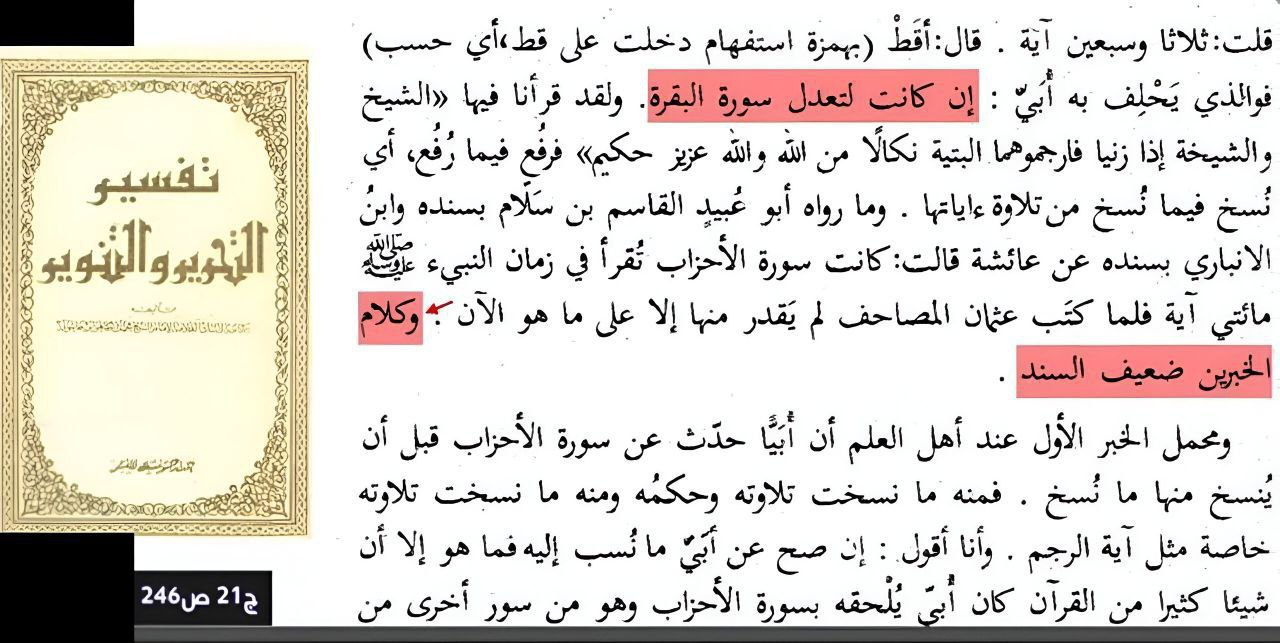
Muhammad al-Tahir ibn Ashur said: I said: Seventy-three verses. He said: “The word ‘qat’ is with a hamza of interrogation, which is added to ‘qat,’ meaning ‘enough.’ So by Him by whom my father swears…”
If it were to equal Surah Al-Baqarah
We read in it, “The old man and the old woman, if they commit adultery, stone them both to death as a punishment from God. And God is Mighty and Wise.” This was abrogated, meaning it was abrogated in the recitation of its verses. Abu Ubayd al-Qasim ibn Sallam and Ibn al-Anbari narrated with their chains of transmission from Aisha, who said: “The chapter of al-Ahzab was recited in the time of the Prophet (peace be upon him) as two hundred verses. When Uthman compiled the Qur’an, he could only find what is in it now.”
The statements of the two narrators are weak in their chain of transmission.
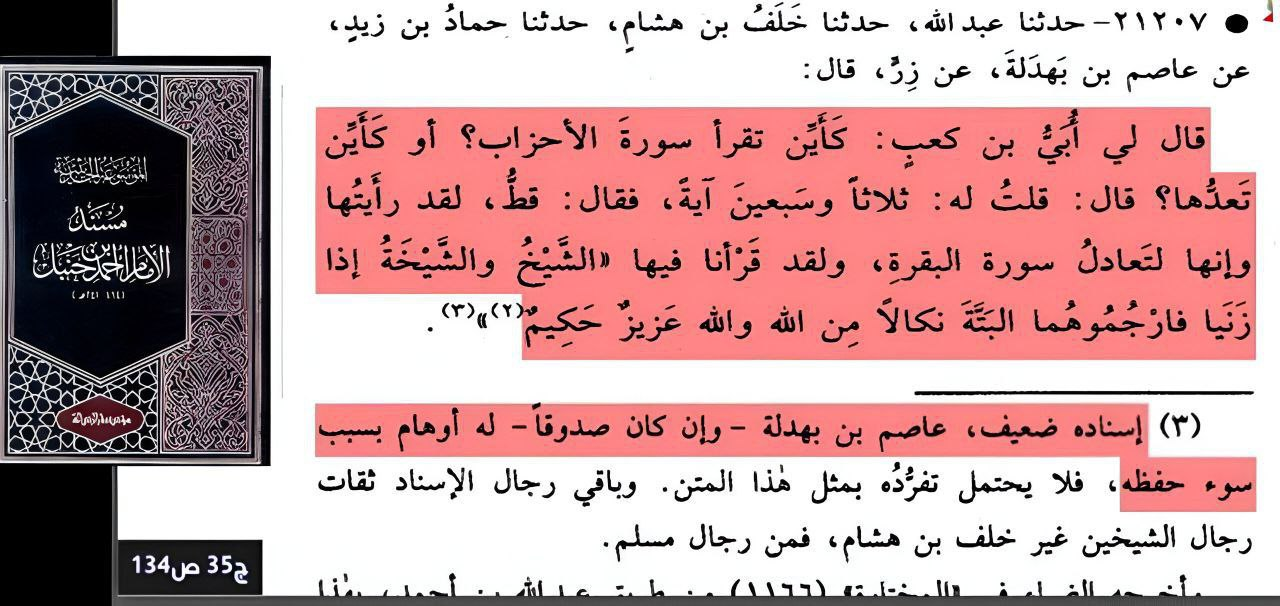
Ubayy ibn Ka’b said to me: “How many verses do you recite in Surah Al-Ahzab? Or how many do you count in it?” I said to him: “Seventy-three verses.” He said: “Never! I saw it, and it was equivalent to Surah Al-Baqarah. And we used to recite in it: ‘If an old man and an old woman commit adultery, stone them both without fail as a punishment from Allah. And Allah is Exalted in Might, Wise.’”
The scholars of Musnad said its chain of transmission is weak; Asim ibn Bahdalah – although truthful – had errors due to his poor memory.
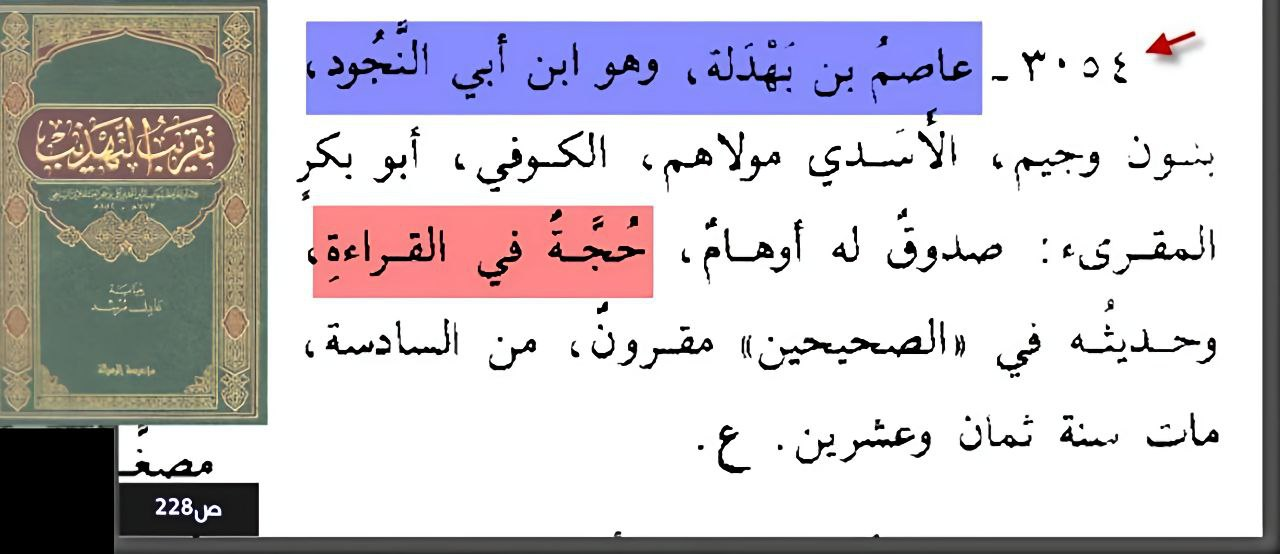
Asim ibn Bahdalah, also known as Ibn Abi al-Najud, with a nun and a jim, al-Asadi, their freedman, from Kufa, Abu Bakr al-Muqri’: truthful but prone to errors, an authority in recitation, but in hadith, he was discussed by scholars.
Ibn Saad said: They said: He made many mistakes in his narrations. [Al-Tabaqat: 8/439].
Yaqub ibn Sufyan said: There is some confusion in his narrations, but he is trustworthy. [Al-Ma’rifah wa al-Tarikh: 3/197].
Abdullah ibn Ahmad said: Zuhair ibn Harb told me, and he mentioned the hadith of Asim ibn Abi al-Najud – he said: It is unreliable, disregard it. [Al-
Ilal wa Marifat al-Rijal: T/(3992)]
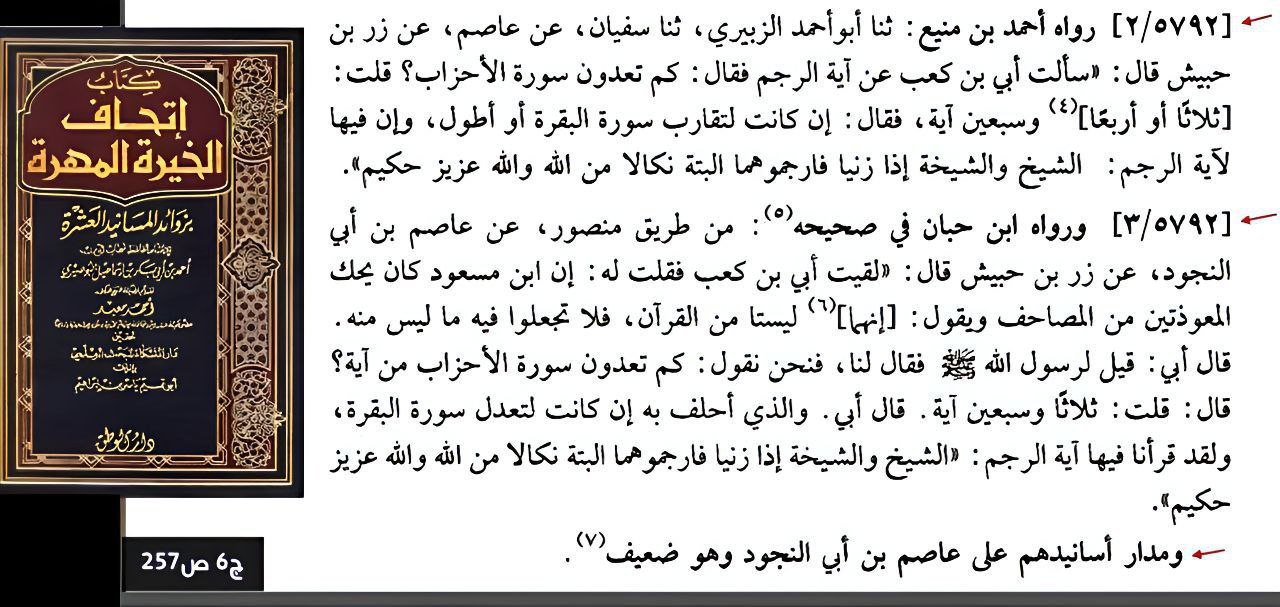
The narration was mentioned by Ahmad ibn Abi Bakr ibn Ismail al-Busiri, may God have mercy on him, who then said: “The basis of their chains of transmission is Asim ibn Abi al-Najud, and he is weak.”
However, we will deal with this narration because some scholars have authenticated it. The verse mentioned in this hadith was recited during the lifetime of the Prophet, peace and blessings be upon him.
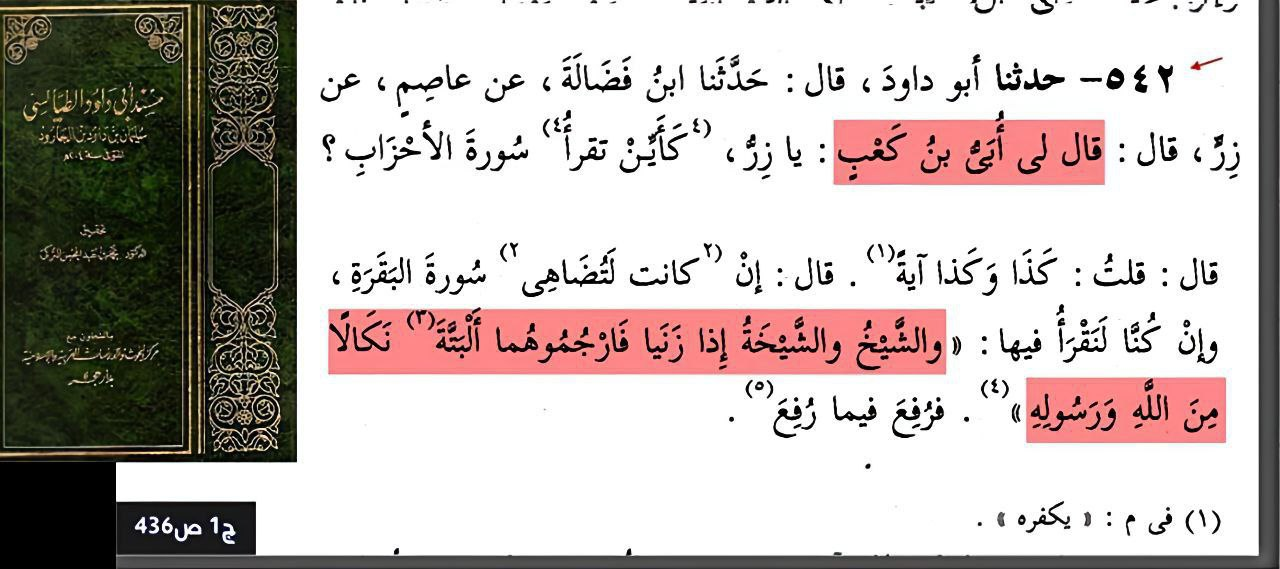
Narrated by Abu Dawud al-Tayalisi in his Musnad
Abu Dawud narrated to us, saying: Ibn Fadalah narrated to us, on the authority of Asim, on the authority of Zirr, who said: Ubayy ibn Ka’b said to me: “O Zirr, how many verses do you recite in Surat al-Ahzab?” (2) He said: I said: “Such and such verses.” He said: “It used to be comparable to Surat al-Baqarah, and we used to recite in it: ‘And the wormwood and the wormwood, if they commit adultery, stone them both as a punishment (4) from Allah and His Messenger.’”
So it was raised, along with what was raised, meaning that the verses were raised.
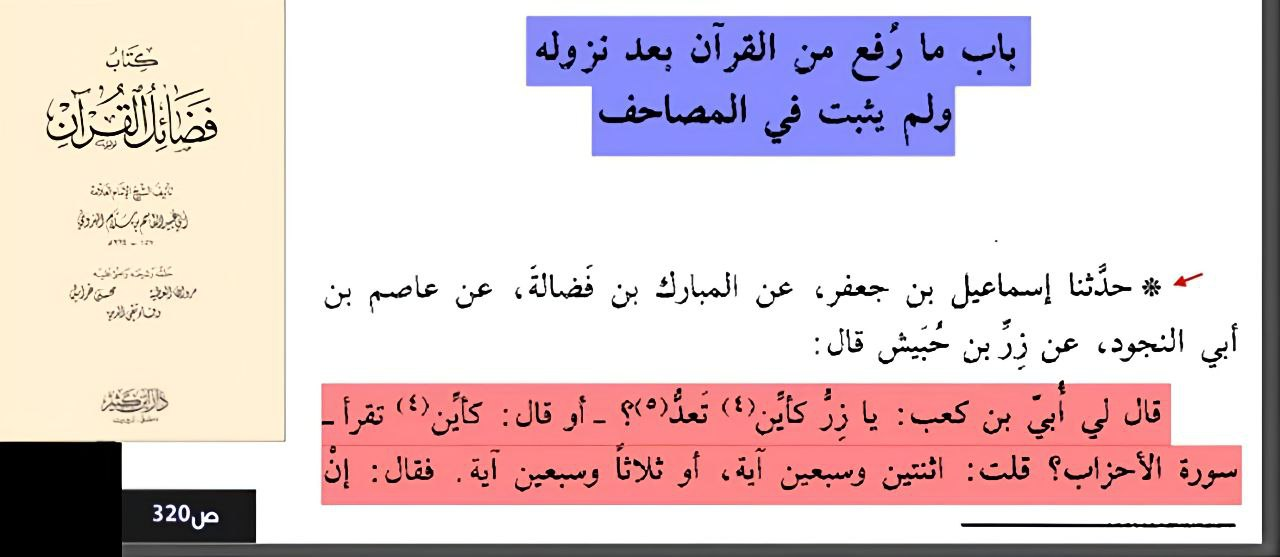
This narration is attributed to al-Qasim ibn Sallam in the chapter on what was abrogated from the Qur’an after its revelation and is not found in the copies of the Qur’an, meaning that the verses were abrogated.
Ismail ibn Jafar narrated to us from al-Mubarak ibn Fadala, from Asim ibn Abi al-Najud, from Zirr ibn Hubaysh, who said: Ubayy ibn Kab said to me: “O Zirr, how many (4) do you count (5)? - or he said: How many (4) do you recite - Surah al-Ahzab?” I said: “Seventy-two or seventy-three verses.” He said: “Indeed
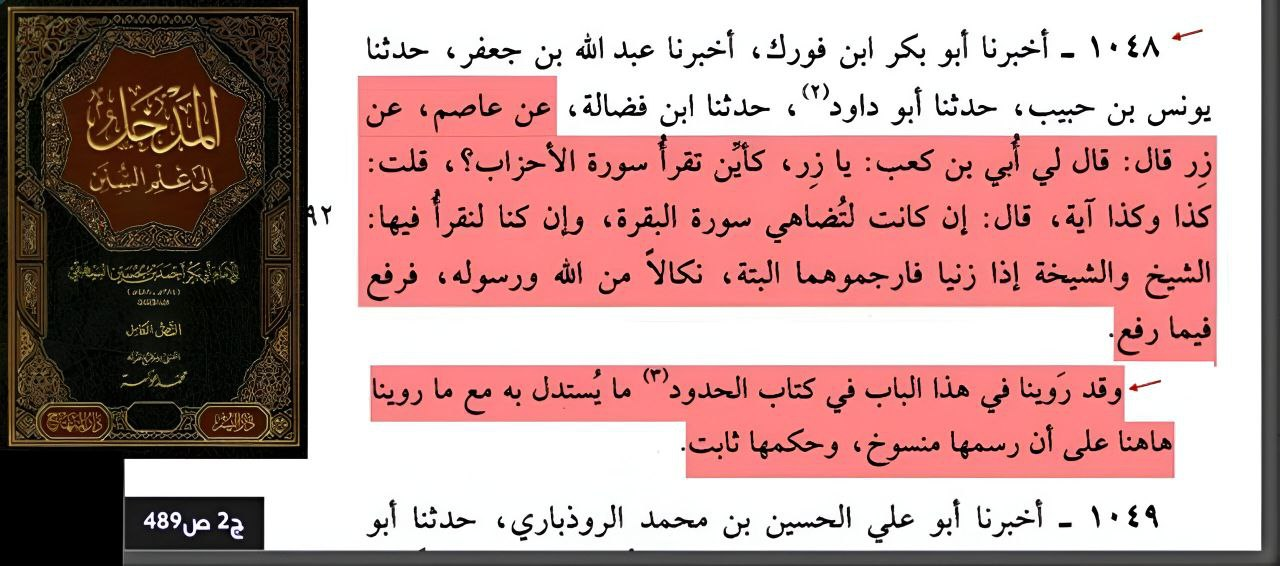
Abu Bakr al-Baqillani, may God have mercy on him, narrated on the authority of Asim, on the authority of Zirr, who said: Ubayy ibn Ka’b said to me, “O Zirr, how many verses do you recite in Surat al-Ahzab?” I said, “Such and such verses.” He said, “It used to be comparable to Surat al-Baqarah, and we used to recite in it: 92. The old man and the old woman, if they commit adultery, stone them both without fail as a punishment from God and His Messenger.”
He raised it, among other things.
This chapter in the Book of Limits (3) contains evidence that is used in conjunction with what we have narrated, and we have narrated in
Here, it is stated that its form is copied, but its ruling is established.
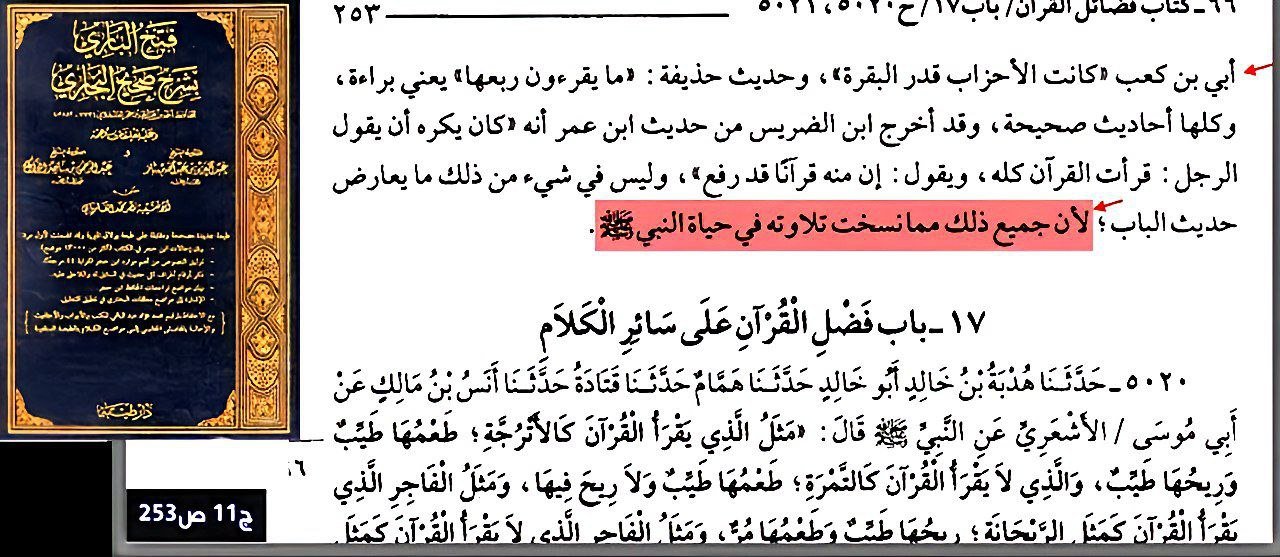
Imam Ibn Hajar said, “Ubayy ibn Ka’b said, ‘The chapters of Al-Ahzab were the length of Surah Al-Baqarah.’” And the hadith of Hudhayfah: “They do not recite even a quarter of it,” meaning Surah At-Tawbah (Surah Bara’ah). All of these are authentic hadiths. Ibn Ad-Durays narrated from Ibn Umar that he disliked a man saying, “I have recited the entire Qur’an,” and he would say, “Some of it has been abrogated.” There is nothing in any of this that contradicts the hadith.
The hadith of the chapter; because all of that was abrogated in the life of the Prophet ﷺ.
Summary of the Response
The narration from Hudhayfah — weak due to Abdullah bin Sharik Al-Amiri, who is disputed and accused of Shi’ite extremism and lying.
The narrations attributed to Umar — relate only to the verse of stoning, not to the length of the surah.
The narration from Ubayy ibn Ka’b — weak in its chains due to Yazid ibn Abi Ziyad and Asim ibn Bahdalah; and even if accepted, it refers to abrogation of recitation, explicitly classified as such by Imam Al-Suyuti in Al-Itqan. The phrase “we used to recite” is the established formula for abrogated recitation.
The narration from Ikrimah — likewise refers to abrogation, as it links the additional verses directly to the already-known abrogated verse of stoning.
None of these narrations constitute evidence for the loss, distortion, or corruption of the Quran. The Quran is preserved by tawatur — continuous mass transmission — and no individual (ahad) narration can establish or challenge what is in the Mushaf.