

SURAH At-Tawbah 29 Explained: Jizya, Fighting, and Subjugation
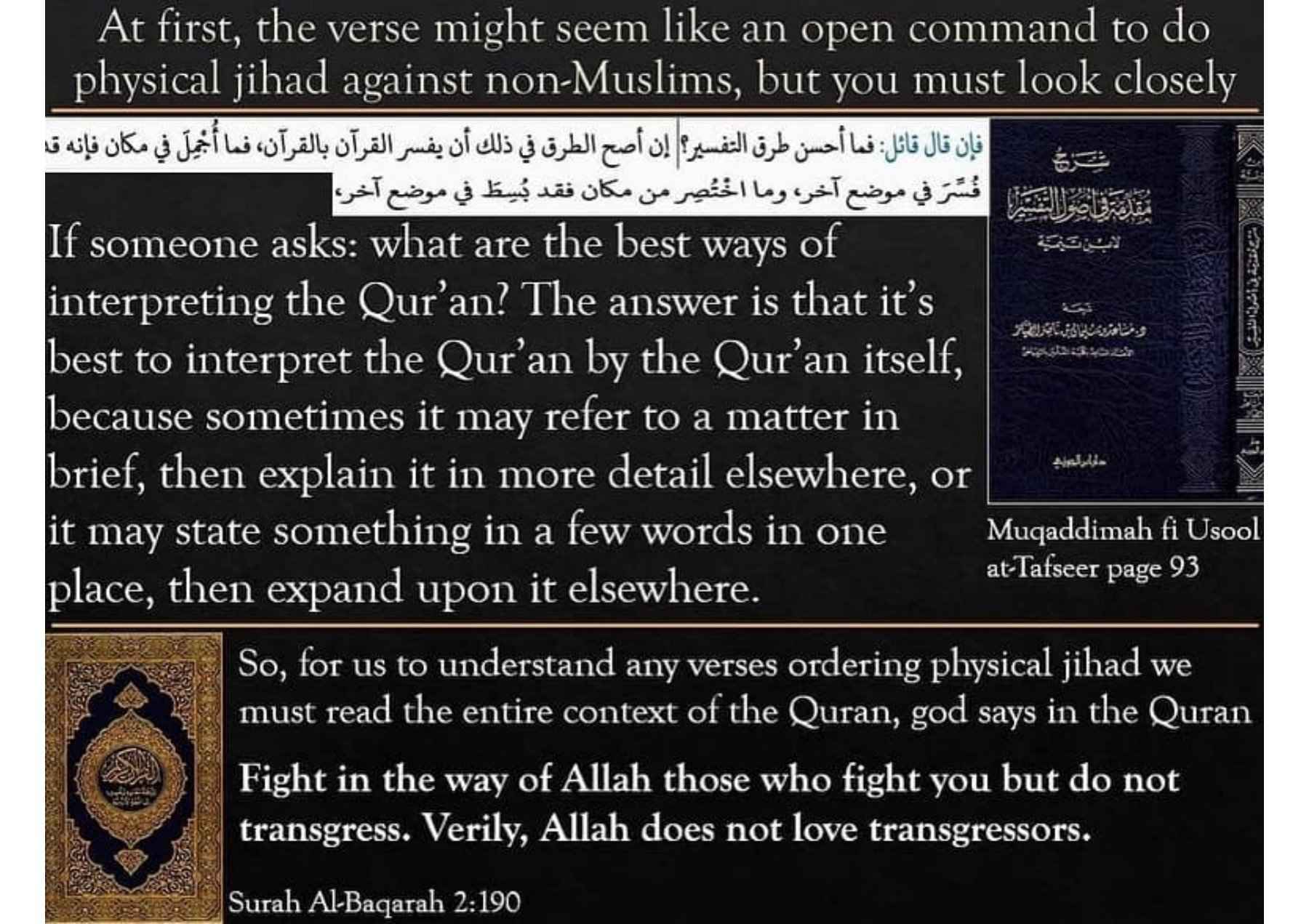
Surah At-Tawbah, verse 29 is one of the most frequently cited Quranic verses in polemical attacks on Islam, typically raised by Christians and atheists who object to three specific words: ||qital (fight), jizyah (poll tax), and saghirun|| (humbled/subjugated). A response to each requires first establishing the Islamic jurisprudential principle that the Quran is never taken one verse at a time — all verses on a subject must be gathered and read together before any ruling is derived.
Fight those who do not believe in Allah or in the Last Day and who do not consider unlawful what Allah and His Messenger have made unlawful and who do not follow the religion of truth from among those who were given the Scripture — until they give the jizyah willingly while they are humbled.
The Foundational Principle: The Quran Is Read as a Whole
Before addressing the three doubts individually, it is necessary to establish the jurisprudential method that governs all Quranic interpretation. Verses are never taken in isolation — they must be read against every other verse on the same subject to determine the full ruling.
A clear illustration of this principle: the Almighty says “Then marry those that please you of women” — and the word “women” here is grammatically general (‘aam). But this general verse is qualified by the specific one: “Forbidden to you are your mothers and your daughters” and the list that follows. The ruling is only arrived at by reading both. This is the standard method by which all Quranic rulings are derived.
Applied to this verse: it is a verse about fighting (qital). We therefore look at every verse in the Quran that speaks about fighting.
Fight in the way of Allah those who fight you, but do not transgress.
Allah does not forbid you from those who do not fight you because of religion and do not expel you from your homes — from being righteous toward them and acting justly toward them. Indeed, Allah loves those who act justly.
The picture that emerges from reading all these verses together is unambiguous: Islam permits fighting only against combatants. It prohibits the killing of women, monks, children, and non-combatant laborers.
First Doubt: The Word “Fight” (Qital)
The Arabic word qitalFrom the root q-t-l. The form qitāl (مُقَاتَلَة) denotes a bilateral fight between two parties — both sides are engaged. This is distinct from the unilateral iqtul (“kill [him]”), which is directed at a specific aggressor. is derived from muqatala — indicating a fight between two engaged parties, not a one-sided assault. The linguistic form itself establishes reciprocity: this is a verse about combating those who are already combatants.
Furthermore, the word iqtullu (kill) when it appears in the Quran is directed specifically at those who initiated the fighting. The verse “And kill them wherever you find them and expel them from wherever they expelled you” is addressed to a party that had already been expelled from their land by those same people — God commands defense and response, not initiation.
The relevant Biblical text, given in full for reference, is Deuteronomy 20:1–20:
2 When you are about to go to war, the priest shall come forward and address the people,
3 saying to them, “Hear, O Israel: Today you are about to go to war against your enemies. Do not be discouraged; do not be afraid or tremble or be intimidated by them,
4 for the Lord your God is going with you to fight for you against your enemies, to deliver you.”
5 Then the officers will speak to the people, saying, “Who is the man who has built a new house and has not dedicated it? Let him go back to his house, lest he die in the battle and another man dedicate it.
6 And who is the man who has planted a vineyard and has not yet planted it? Let him go back to his house, lest he die in the battle and another man plant it.”
7 “And who is the man who betrothed a woman and did not take her? Let him go and return to his home, lest he die in the battle and another man take her.
8 Then the officers shall speak again to the people and say, ‘Who is the man who is fearful and faint-hearted? Let him go and return to his home, lest the hearts of his brothers melt as his own.’”
9 When the officers have finished speaking to the people, they shall appoint commanders of troops over the people.
10 “When you approach a city to fight against it, offer it terms of peace.
11 If it agrees to make peace with you and opens its gates to you, then all the people in it shall be subject to forced labor for you and shall serve you.
12 If it does not make peace with you but wages war against you, then besiege it.
13 When the Lord your God delivers it into your hand, put all its males to the sword.
14 But the women, the children, the livestock, and everything else in the city, all its spoil, you may take as plunder for yourselves. You may eat the spoil of your enemies, which the Lord your God has given you.
15 This is what you must do to all the cities that are very far from you, which are not among the cities of these nations here.
16 But in the cities of these peoples that the Lord your God is giving you as an inheritance, you must not leave alive anything that breathes.
17 You must completely destroy them. The Hittites, Amorites, Canaanites, Perizzites, Hivites, and Jebusites, as the Lord your God has commanded you,
18 so that they will not teach you to do all their detestable practices that they did for their gods, and you will sin against the Lord your God.
19 “When you besiege a city for many days, attacking it to capture it, you must not destroy its trees by putting an axe to them. You will eat some of its fruit, so you must not cut them down. Is a tree in the field a person that it should go ahead of you in the siege?”
20 “But any tree that you know is not a tree from which food is eaten, you must destroy and cut it down, and build a siege against the city that wages war against you, until it falls.”
Note here the phrase “by the sword” — this is an argument against any Christian who claims that Islam forces people into religion by the sword while their own scripture commands the sword. When a Christian responds that these are not religious wars, their own scripture in verse 18 refutes them directly: “so that they will not teach you to do all their detestable practices that they did for their gods, and you will sin against the Lord your God.” This is an explicit admission that the wars commanded here are religious in nature. The Christian has no right to object.
This is a Christian commentator confirming that the Biblical wars described in Deuteronomy are explicitly premised on religious conversion.
Second Doubt: The Jizyah
The jizyahA per-capita tax levied on non-Muslim subjects (ahl al-dhimma) under Islamic governance in lieu of military service, granting them legal protection and the right to practice their religion. is a poll tax levied on non-Muslim subjects under Islamic governance. The objector frames it as oppressive or unique to Islam. Neither claim holds.
The Bible Commands the Equivalent of Jizyah
Christians owe a debt accumulated over more than 100 years: since the fall of the Ottoman Empire, the jizyah has not been collected from Christians living under Islamic governance. Yet their own scripture commands them to pay exactly this kind of tax to the ruler, and their own commentators identify it as a legitimate and obligatory duty.
Paul here calls this a legitimate right owed to the tax collector and commands that it be given. Christians are, by their own scripture, obligated to pay such taxes.
The Christian commentators are even more explicit. Tadros Yaacoub Malaty writes in his commentary on Romans 13:6–7:
St. John Chrysostom sees that the apostle transformed what many consider a burden into a comfort. If a person is obligated to pay taxes, it is for their own benefit, because the rulers “are God’s servants who are devoted to this very task,” vigilantly striving for the peace of the country from enemies and to resist evildoers such as thieves and murderers. Their lives are filled with toil and vigilance. You, on the other hand, pay taxes to live in a peace that the rulers themselves are denied. This is what led the Apostle Paul to instruct us not only to submit to the rulers but also to pray for them so that we may live a peaceful and tranquil life (1 Timothy 2:1–2). Furthermore, the word “give” here in the original Greek means “repay,” so what we offer as tribute to rulers is not a gift from us, but rather the fulfillment of a debt we owe them. They strive and toil so that everyone may live in peace. We have already discussed at length the divine commandment: “Render unto Caesar the things that are Caesar’s, and unto God the things that are God’s” in our commentary (Matthew 22:21; 1 Peter 2:13, 17). Here, tribute refers to what the ruler takes on persons and property, while taxation is levied on trade.
Antonius Fikry adds in his own interpretation:
Who Pays the Jizyah — and Who Is Exempt
The jizyah is taken from everyone capable of bearing arms. It is not taken from women, children, monks, or the destitute poor. It is levied only on those capable of participating in war and fighting. Furthermore, it is conditional on the ability of the Islamic state to protect those paying it.
Grade: Reported in the classical sources of Islamic governance
The Value of the Jizyah Across the Four Schools
The amount of the jizyah is a matter of scholarly disagreement among the four schools:
The Hanbali schoolThe Hanbali madhab holds that the jizyah amount is determined by negotiation between the dhimmi and the ruler according to the dhimmi’s financial capacity — not imposed unilaterally. holds that it is determined according to the ability of the dhimmiDhimmi: a non-Muslim subject living under Islamic governance, entitled to legal protection and religious freedom in exchange for payment of the jizyah. and agreed upon by him and the ruler.
The Hanafi and Maliki schools hold that if a city is conquered by force, the jizyah is determined by the ruler — and when it was historically set, it was four dirhams. If a city is conquered peacefully, it is determined by mutual agreement.
The Shafi’i school states that it should not exceed four dirhams. It is an annual tax.
The Jizyah Versus Modern Taxation and Zakat
Those who speak about the jizyah are unaware that modern states demand far more than the jizyah ever did, imposing taxes on everything. As for the objection that Muslims do not pay the jizyah themselves: zakatZakat: obligatory annual almsgiving in Islam, one of the Five Pillars. Unlike the jizyah, from which many categories are exempt, zakat al-mal applies to every Muslim above the nisab (minimum wealth threshold) with no categorical exemptions. in Islam is more financially demanding than the jizyah. There is zakat al-mal (zakat on wealth), zakat al-fitr (zakat at the end of Ramadan), and others. Many categories of people are exempt from the jizyah, but no Muslim above the nisabNisab: the minimum threshold of wealth a Muslim must possess before zakat becomes obligatory. is exempt from zakat al-mal.
The Marcion Objection: “The Old Testament Doesn’t Apply to Christians”
Furthermore, Jesus himself said in Matthew 5:17: “Do not think that I have come to abolish the Law but to fulfill it.” Jesus was a Jew who adhered to Jewish law. The Old Testament cannot be discarded.
Third Doubt: The Word “Humbled” (Saghirun)
The third word objected to is saghirun — translated as “humbled” or “subjugated.” Scholars have recorded three interpretations in the books of exegesis, and there is scholarly agreement on what this word does and does not mean.
The Three Interpretations
First interpretation: Saghirun means subjugation — being under the authority and governance of the Islamic state.
Second interpretation: The rulings of Islam apply to the dhimmi — meaning they are governed by Islamic law in the civil and public sphere. This meaning has been reported by many scholars, most notably Imam al-Shafi’i, and it is mentioned in many Shafi’i books. Al-Sam’ani states in his Shafi’i commentary that the meaning of saghir is that the laws of Islam are applied to them.
Third interpretation: The humiliation consists of procedural acts — such as the Christian standing while the ruler sits, the Christian coming to the ruler rather than the ruler going to him. This third interpretation is the false oneClassified as weak by Ibn al-Qayyim, who states that neither the Prophet ﷺ, nor his Companions, nor any of the Successors ever enacted any such procedural humiliation., mentioned by Imam Ibn al-QayyimA student of Ibn Taymiyyah and author of Ahkam Ahl al-Dhimma (The Rulings Concerning the People of the Covenant). in Ahkam Ahl al-Dhimma. He explicitly refuted it, stating that neither the Prophet ﷺ, nor his Companions, nor any of the Successors ever did this.
The Prophet ﷺ’s Warning Against Wronging Dhimmis
The notion that saghirun licenses mistreatment or abuse is directly refuted by prophetic hadith.
Narrated by: The Prophet Muhammad ﷺ · Source: Classical hadith collections on the rights of the people of the covenant
What “Humility” Actually Means
^^Scholars agree that saghirun does not mean humiliation, beatings, or insults.^^ It means subjugation to the laws — being governed by them. Furthermore, the concept of “humility” in Arabic is not inherently degrading. Two Quranic examples demonstrate this:
Humble towards the believers, stern towards the disbelievers.
And lower to them the wing of humility out of mercy.
The first verse describes a quality of the believers toward each other. The second describes the humility a child owes their parents. Neither use of dhull (the same root as saghirun) implies degradation or abuse — both describe a posture of deference and submission within a relationship. The vanquished are always in a position of deference to the governing authority; this is a universal reality of governance, not a command to humiliate.
Additionally, the first meaning — humility before Islamic law and God’s rulings — carries a theological dimension: those who attributed to God what is not befitting of Him have, as a consequence, been placed under the governance of a law that correctly attributes to God what is His. Furthermore, humiliation is not always humiliation: the humility of a son towards his mother and father is called dhull in the Quran. It is well-known that the vanquished are always humble before the governing authority, and this is the sense in which the term applies here.
QURAN 9:29 EXPLANATION
Read More
The Islamic Rules of Warfare: Protecting the People of the Covenant, Women, and Children