

Does Allah Deceive? Refuting the Makr, Khidāʿ, and Kayd Claims in the Qur’an
Does Allah Deceive? Refuting the Makr, Khidāʿ, and Kayd Claims in the Qur’an
Some polemicists claim that the Qur’an attributes deception to Allah because it uses words such as makr, khidāʿ, and kayd in verses where Allah responds to the plots of disbelievers and hypocrites.
The argument is usually presented crudely: if makr can mean plotting or deception when done by humans, then Allah’s makr must mean sinful deception as well.
That is a bad argument.
Arabic words are not interpreted by grabbing the ugliest English gloss and forcing it everywhere. Context controls meaning. The Qur’an uses these terms in contexts of recompense, counter-planning, punishment, and defeating the schemes of the wicked.
The Qur’an is not saying that Allah lies, cheats, or commits immoral deception. It is saying that when the disbelievers plot against the truth, Allah’s plan overcomes their plot.
The Core Refutation
Makr, khidāʿ, and kayd do not automatically mean sinful deception. They can refer to planning, plotting, strategem, concealment, or counter-action depending on context. When attributed to Allah, they mean His just response, recompense, and superior plan against the schemes of the wicked.
The critic’s mistake is treating a context-sensitive Arabic word as if it has only one hostile English meaning.
That is not translation. It is distortion.
The Main Verse About Makr
“And they planned, and Allah planned. And Allah is the best of planners.”
The verse is about the enemies plotting against Jesus عليه السلام, and Allah defeating their plot.
It does not mean:
“They committed immoral deception, and Allah committed immoral deception.”
It means:
“They planned against Allah’s messenger, and Allah planned against their plan.”
The first is evil human plotting. The second is divine justice.
Qur’an Corpus Makr as Planning
Qur’an Corpus shows that multiple English translations render the phrase in Ali Imran 3:54 with meanings such as planned, plotted, schemed, and devised.
This already proves that translating makr as “sinful deception” is not required.
Qur’an Corpus lists translations of Ali Imran 3:54 such as “the disbelievers planned, but Allah planned,” “they planned and Allah planned,” and “God planned.” This supports the point thatmakr in this context is broader than the polemical English word “deception.”
The word can carry a negative meaning when the planner is evil and the purpose is evil. But when Allah counters the wicked, the meaning is justice and superior planning.
Tafsir al-Baghawi on Ali Imran 3:54
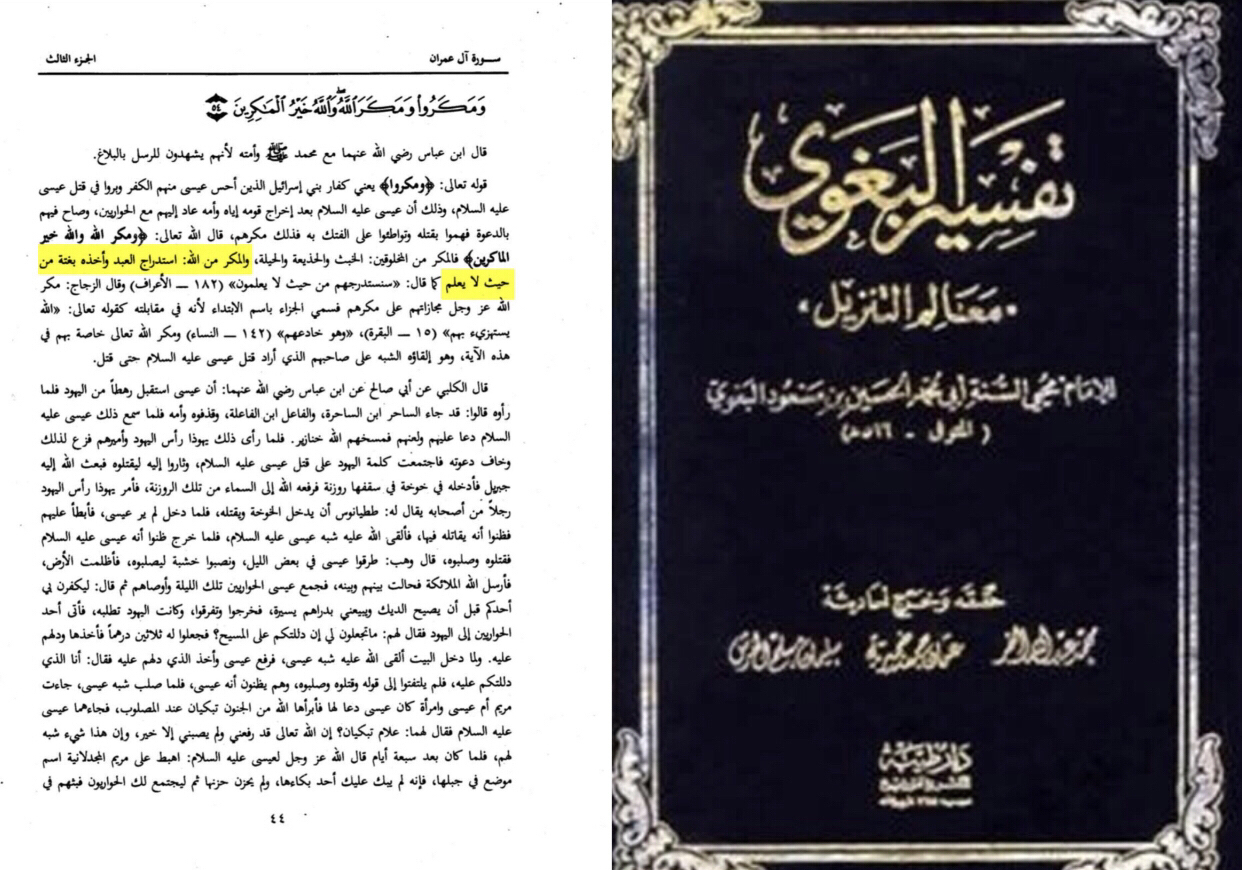
This scan is fromTafsir al-Baghawi under Ali Imran 3:54. The highlighted section explains “they plotted” as the enemies scheming against Jesus عليه السلام, and explains Allah’s makr as Allah gradually leading them and seizing them from where they did not realize. The scan also discusses the narrative of their attempt against Jesus عليه السلام and Allah’s protection of him. This is not saying that Allah commits sinful deception. It is explaining Allah’s counter-action against those who plotted evil.
Al-Baghawi explains the makr of the disbelievers as their scheme against Jesus عليه السلام, while Allah’s makr is His defeating them, taking them unaware, and overturning their plot.
This is the correct tafsir frame: evil plot versus just counter-plan.
Lisan al-Arab on Makr
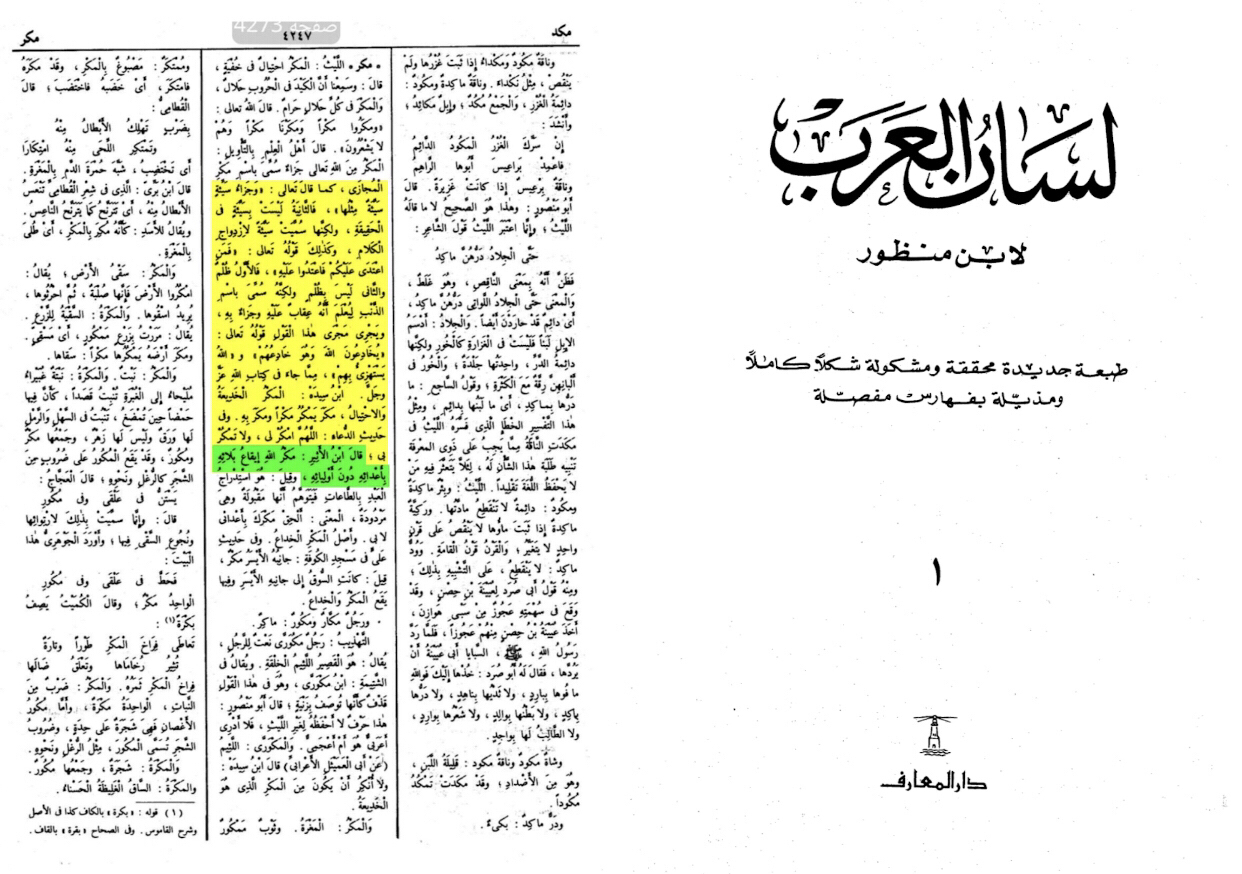
This scan is fromLisan al-Arab under the root m-k-r. The highlighted section discusses makr as hidden strategem, planning, or plotting. It also explains that when makr is attributed to Allah, it refers to Allah bringing punishment upon His enemies and taking them from where they do not expect. This is a lexical distinction: human makr may be blameworthy when used for evil, while Allah’s makr is His just punishment and counter-plan.
Lisan al-Arab does not force the meaning “sinful deception” onto Allah. It treats Allah’s makr as His taking the wicked by surprise and bringing His punishment upon them.
This is exactly the point the polemicist hides. Arabic lexicons mention the semantic range, but theology and context determine what is appropriate when the action is attributed to Allah.
Lane’s Lexicon on Makr
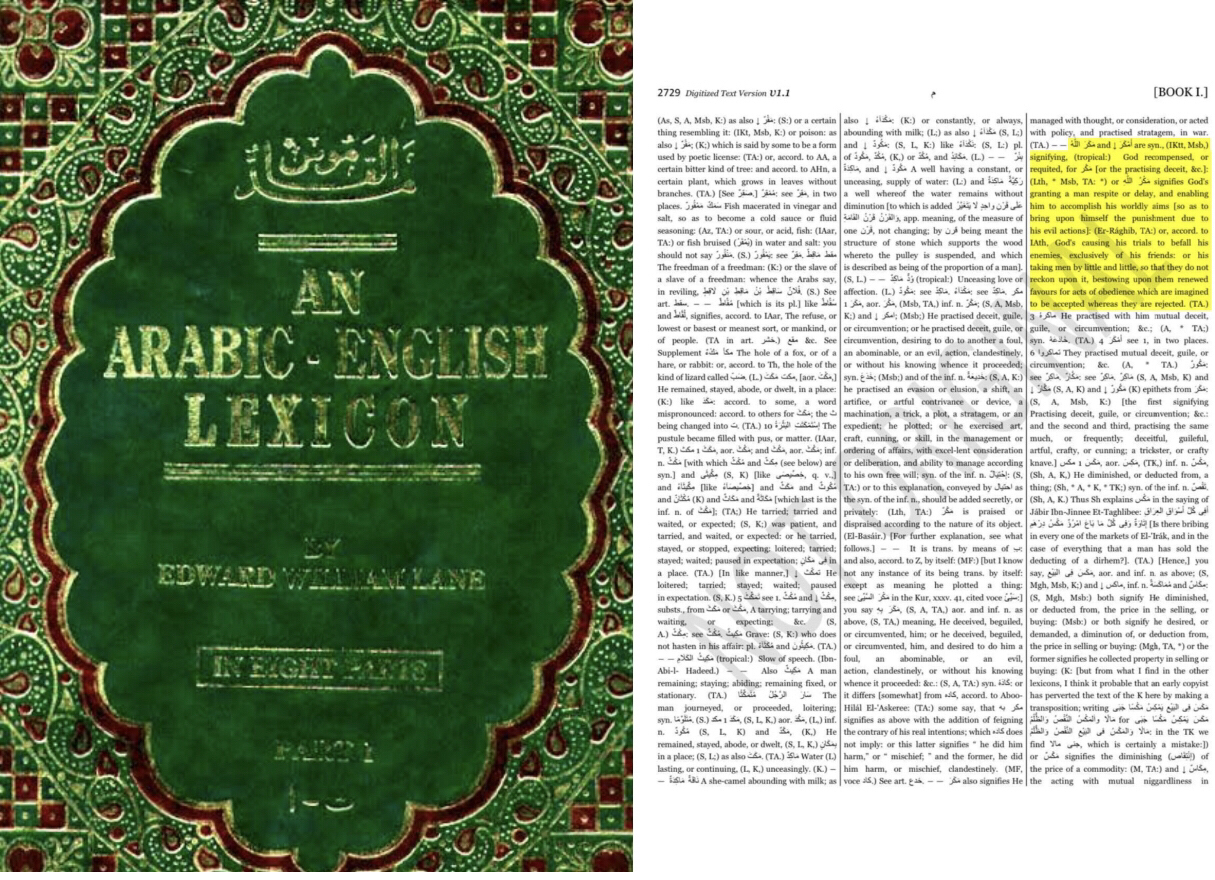
This scan showsLane’s Arabic-English Lexicon under the root m-k-r. Lane gives meanings connected to deceit, guile, and circumvention, but he also includes the broader sense of managing with thought, consideration, policy, and stratagem. The highlighted part also explains that when the expression is used concerning Allah, it refers to Allah taking the unbelievers unaware and allowing them to continue in heedlessness until His judgment reaches them. So Lane is not evidence that Allah commits immoral deception; it actually supports the contextual meaning of divine counter-planning and recompense.
Lane is useful precisely because he shows the range. Missionary polemicists often quote only the harshest English gloss and hide the explanatory material that qualifies the meaning when used for Allah.
Lane’s Lexicon: The Hidden Part They Ignore
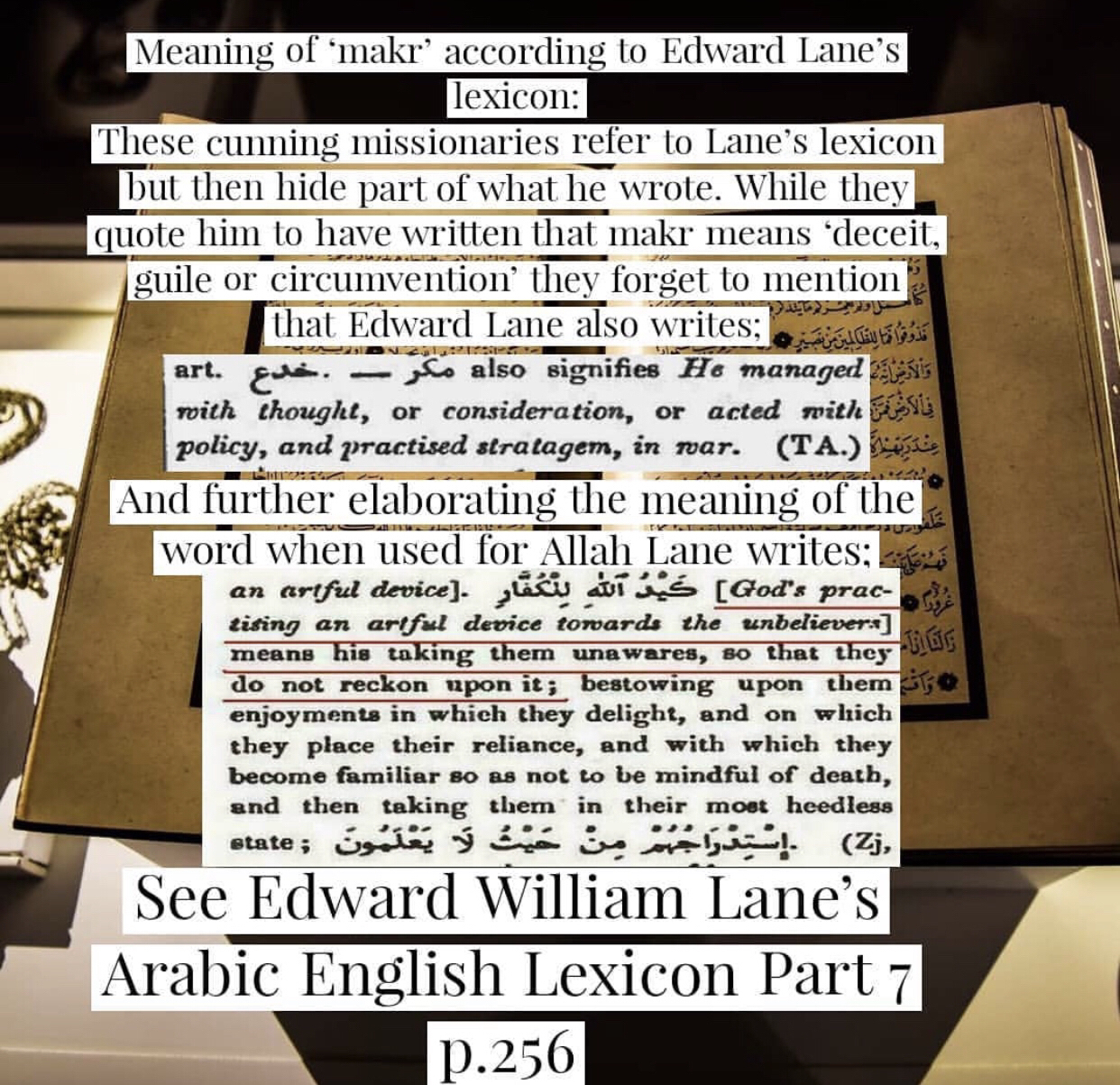
This scan directly addresses selective quotation from Lane’s Lexicon. It notes that some polemicists quote Lane sayingmakr can mean deceit, guile, or circumvention, but they ignore Lane’s additional explanation that makr can also mean managing with thought, consideration, policy, and stratagem. The scan then highlights Lane’s explanation of Allah’s makr: Allah takes the unbelievers unaware by allowing them worldly enjoyment until they are seized in heedlessness. This supports the meaning of divine recompense, not immoral deception.
Lane’s entry does not prove that Allah is deceptive in a blameworthy sense. It proves thatmakr has a semantic range and that Allah’s makr must be understood as His just counter-action against unbelievers.
This is why quoting dictionaries without context is dishonest. A dictionary gives possibilities. Context selects the meaning.
Makr Is Not an Absolute Name of Allah
There is another important theological point.
The Qur’an attributes makr to Allah in specific contexts where Allah is responding to the plots of the wicked. It does not make al-Mākir an unrestricted divine name that Muslims call upon generally.
We affirm what Allah attributed to Himself in the context He revealed it: Allah plans against those who plot evil. But we do not turn every restricted action into an unrestricted divine name.
This protects the meaning from abuse.
Allah is not called “the deceiver” in an unrestricted sense. Rather, Allah is the best of those who plan against evil plotters, because His plan is just, wise, and victorious.
The Qur’anic Pattern of Recompense
The Qur’an often uses matching language when Allah recompenses people according to their own actions.
They plot, so Allah plans against their plot.
They scheme, so Allah defeats their scheme.
They attempt to deceive, so Allah leaves them in the consequences of their own deception.
This is not moral equivalence.
The same word can be used in a reciprocal structure without making both actions morally equal. The disbelievers’ action is blameworthy because it is evil and unjust. Allah’s response is praiseworthy because it is justice and recompense.
This is basic Qur’anic rhetoric.
Al-Anfal 8:30 Makes the Meaning Clear
“And when those who disbelieved plotted against you to restrain you, kill you, or expel you. They planned, and Allah planned. And Allah is the best of planners.”
Here the disbelievers plotted to imprison, kill, or expel the Prophet ﷺ. Allah’s makr was His plan that defeated their plot and saved His Messenger.
In Al-Anfal 8:30, Allah’s makr is His protection of the Prophet ﷺ and His defeat of the murder plot. Calling that “sinful deception” is absurd.
The critic reads a rescue operation as deception because he wants the ugliest possible interpretation.
Related Term: Khidāʿ
The user’s scan set also includes material about khidāʿ, which is a related but separate term.
“Indeed, the hypocrites seek to deceive Allah, and He is the One who deceives them.”
This does not mean Allah is fooled or commits immoral fraud. It means the hypocrites attempt deception, but Allah leaves them in their deception, exposes them, and recompenses them.
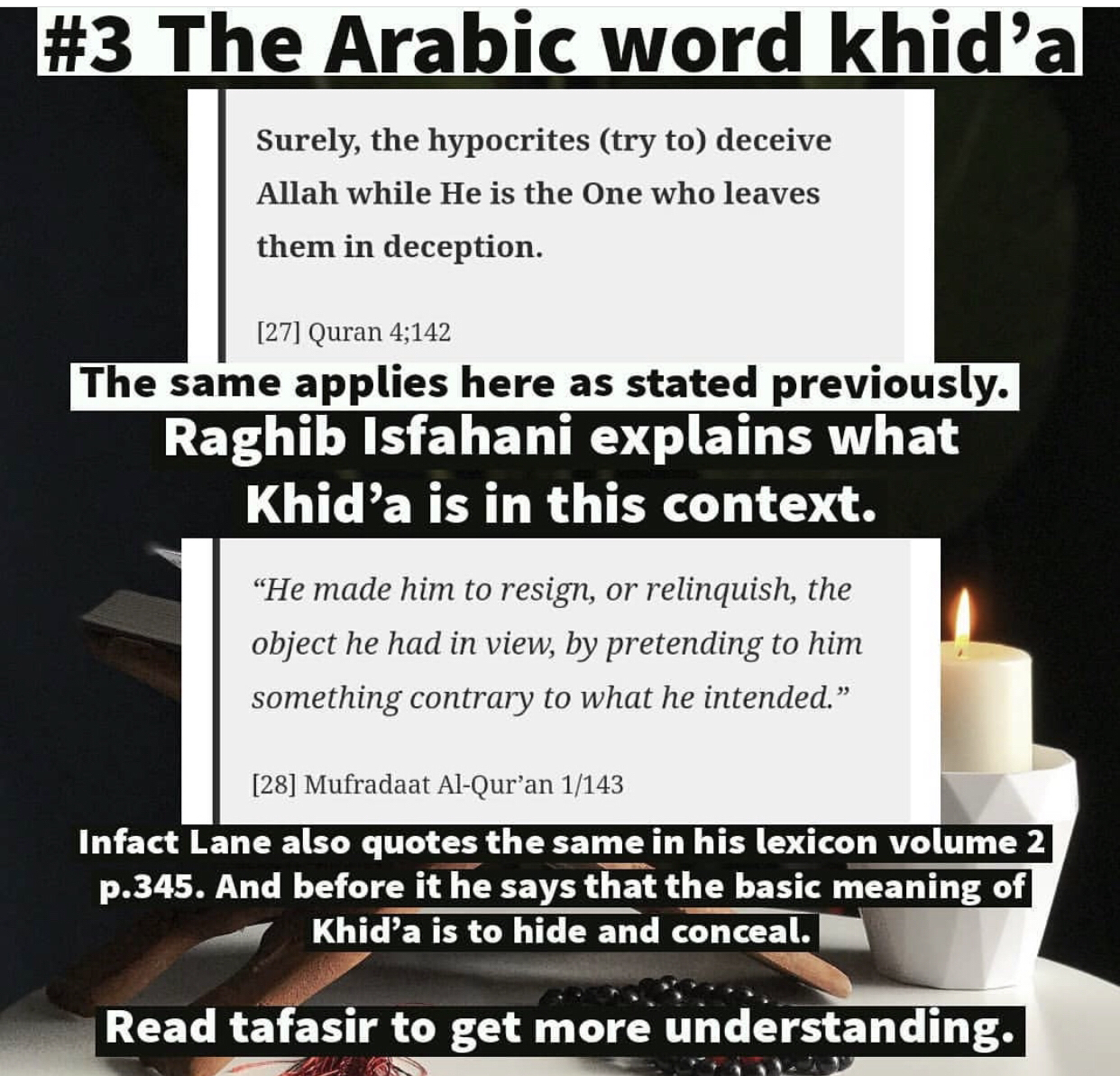
This scan is not aboutmakr directly. It is about the related word khidāʿ in the verse about the hypocrites. It says the same principle applies: the hypocrites try to deceive Allah, while Allah’s response is to leave them in deception and expose their falsehood. The scan cites al-Rāghib al-Isfahānī’s explanation of khidāʿ in this context and notes that Lane connects the root to hiding and concealment. This supports the point that Allah’s “deceiving” of the hypocrites means recompense and exposure, not sinful lying.
The hypocrites’ khidāʿ is their attempted deception. Allah’s khidāʿ is His recompense: He exposes them, leaves them to the consequences of their hypocrisy, and makes their plot return upon themselves.
The verse itself says elsewhere:
“They seek to deceive Allah and those who believe, but they deceive none except themselves, though they do not perceive.”
So the Qur’an itself clarifies that the deception returns upon the hypocrites.
Related Term: Kayd
The scan set also includes a separate discussion of kayd.
“Indeed, they are plotting a plot, and I am planning a plan.”
Again, the issue is not sinful deception. It is Allah’s counter-plan against their plot.
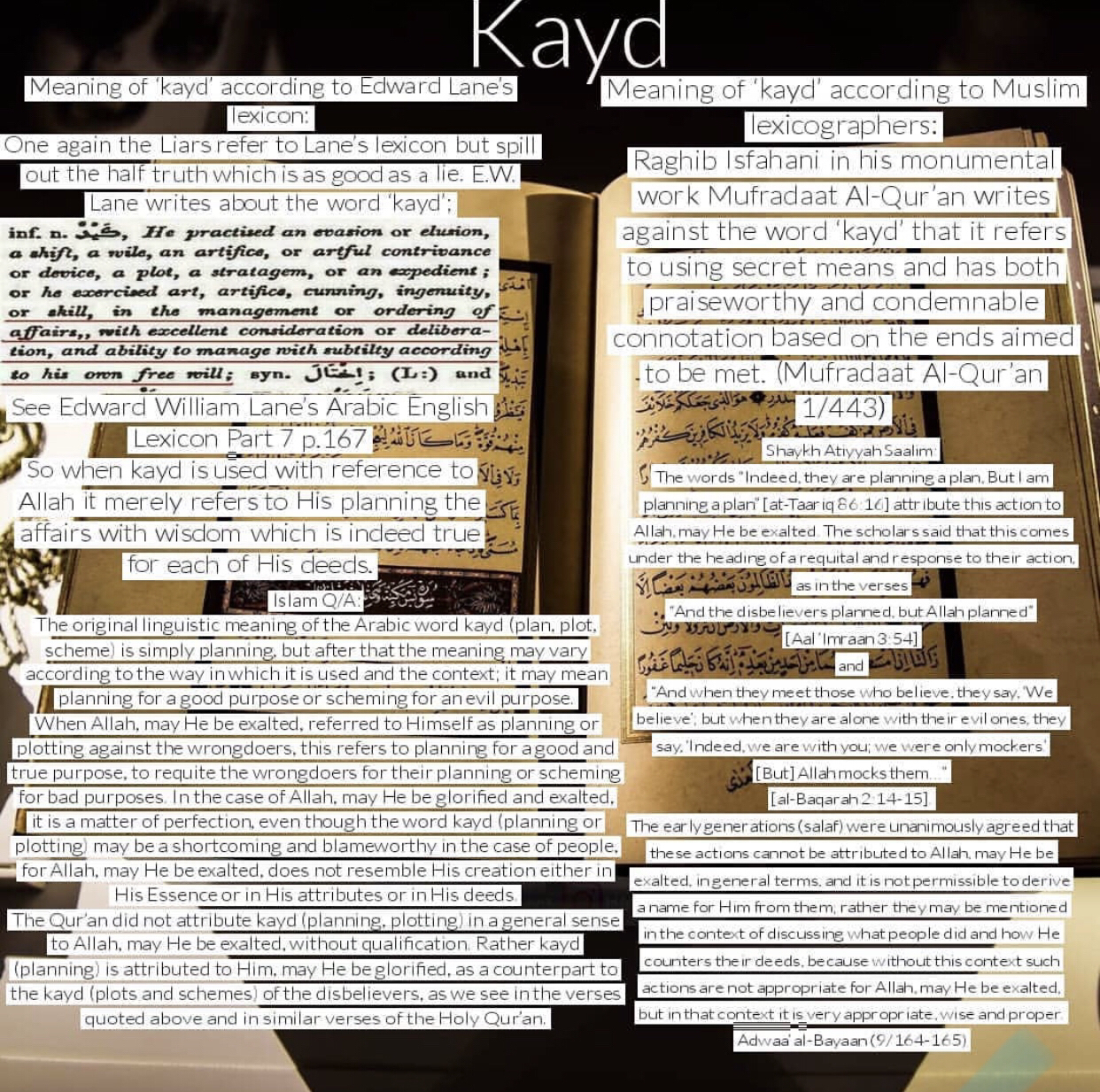
This scan is aboutkayd, not makr. On the left, it cites Lane’s Lexicon, showing meanings connected to evasion, artifice, strategy, and the management of affairs with consideration. On the right, it cites al-Rāghib al-Isfahānī, explaining that kayd involves secret means and can be praiseworthy or blameworthy depending on the intended end. The scan also cites Shaykh ʿAṭiyyah Sālim explaining that actions like planning, mockery, or counter-plotting are not attributed to Allah as unrestricted names or general descriptions; rather, they are mentioned in specific contexts where Allah responds to what the wrongdoers do. This is the correct theological rule.
Kayd may be blameworthy when used for evil by humans, but when Allah uses kayd against the wicked, it is His wise counter-plan and justice.
This is the same principle as makr: the moral value depends on the doer, the purpose, and the context.
Do Not Mix the Terms Carelessly
The evidence must be organized properly:
| Term | Basic Field of Meaning | When Used for the Wicked | When Attributed to Allah |
|---|---|---|---|
| Makr | planning, plotting, strategem | evil plotting against the truth | Allah’s superior plan and recompense |
| Khidāʿ | concealment, deception, hiding | hypocrisy and attempted deception | Allah exposing them and leaving them in their deception |
| Kayd | plotting, strategy, secret means | schemes against believers | Allah’s counter-plan against their schemes |
The critic’s entire argument depends on flattening distinct Arabic terms into one English word: “deception.” That destroys the nuance of the Qur’an and the Arabic language.
This is why the article should not say “makr only means plan” in every possible use. That is too simplistic.
The precise claim is:
Makr can involve plotting or strategem, and in evil human contexts it can be blameworthy. But when attributed to Allah, it means His just counter-plan, punishment, and recompense against the schemes of the wicked.
That wording is much stronger.
Allah Does Not Commit Injustice
Whatever meaning is assigned to these words must agree with the clear Qur’anic principle that Allah does not commit injustice.
“Indeed, Allah does not wrong even the weight of an atom.”
“And your Lord is not unjust to the servants.”
So if a word has both blameworthy and non-blameworthy applications, it must be understood about Allah in the meaning that befits His perfection.
Ambiguous or context-sensitive terms must be interpreted in light of clear Qur’anic principles: Allah is just, truthful, wise, and free from oppression.
The critic ignores this principle because his goal is not interpretation. It is attack.
Allah’s Makr Is Praiseworthy in Context
Allah’s makr is praiseworthy because it defeats evil.
When Pharaoh plotted, Allah’s decree overcame him.
When the disbelievers plotted against the Prophet ﷺ, Allah saved His Messenger.
When the enemies plotted against Jesus عليه السلام, Allah raised him and defeated their scheme.
Allah is the best of planners because no plot escapes His knowledge, no scheme overcomes His decree, and no enemy can defeat His wisdom.
This is not deception. This is sovereignty.
Why “Deception” Is a Bad Translation Here
The English word “deception” usually implies lying, fraud, and moral corruption.
That is why it is a bad translation when applied to Allah’s makr.
Better renderings include:
- plan,
- plot,
- devise,
- counter-plan,
- strategic recompense,
- taking them unaware,
- defeating their scheme.
Translating Allah’s makr as “deception” imports an English moral connotation that does not fit the Qur’anic context. “Plan,” “counter-plan,” or “out-plan” is closer to the intended meaning.
The Qur’an Corpus renderings of Ali Imran 3:54 already show that “planned” is a normal translation choice.
The Critic’s Method Is Dishonest
The polemical method usually works like this:
First, quote only the harshest dictionary gloss.
Second, ignore the broader lexical range.
Third, ignore tafsir.
Fourth, ignore Qur’anic context.
Fifth, ignore the principle of recompense.
Sixth, force the blameworthy human meaning onto Allah.
That is not scholarship.
A dictionary does not give permission to force every possible gloss into every context. The correct meaning is selected by grammar, context, usage, tafsir, and theology.
A critic who ignores all of that is not reading Arabic. He is abusing it.
Final Refutation
The claim that the Qur’an describes Allah as a sinful deceiver is false.
The word makr means planning, plotting, or strategem according to context. When the disbelievers perform makr, it is evil plotting. When Allah performs makr, it is His just counter-plan and punishment against their plot.
Khidāʿ and kayd follow the same general principle. When the wicked use them, they are blameworthy. When Allah responds with them, the meaning is recompense, exposure, counter-planning, and justice.
The scans from Tafsir al-Baghawi, Lisan al-Arab, Lane’s Lexicon, and the related material on khidāʿ and kayd all support this distinction when read carefully.
Allah’s makr is not immoral deception. It is His perfect plan against the plots of the wicked. The critic’s argument collapses because it ignores Arabic range, Qur’anic context, tafsir, and the rule that restricted actions attributed to Allah must be understood in a way befitting His justice and majesty.
Counter
Source Notes
- Qur’an Corpus, Ali Imran 3:54 translation entries.
- Al-Baghawi, tafsir of Ali Imran 3:54.
- Ibn Manzur, Lisan al-Arab, root m-k-r.
- Edward William Lane, Arabic-English Lexicon, entries for makr and kayd.
- Al-Rāghib al-Isfahānī, Mufradāt Alfāẓ al-Qurʾān, discussions of khidāʿ and kayd.
- Shaykh ʿAṭiyyah Sālim, explanation of restricted attribution of actions such as kayd, makr, and mockery to Allah only in their proper Qur’anic context.