Syriac Does Not Mean Syrian
Originally, the word Syriac is a religious term that appeared later than the word Syrian, as Syrian is a translation of the term (syrian - سيريان), while Syriac is a translation of the term (Syriac - سيرياك). The former is a geographical attribution, while the latter is a religious attribution to the Syriac Church and has no relation to affiliation with Syria. A member of the Syriac Church could be Indian or Mongolian, and their place of birth could be India or China, not Syria.
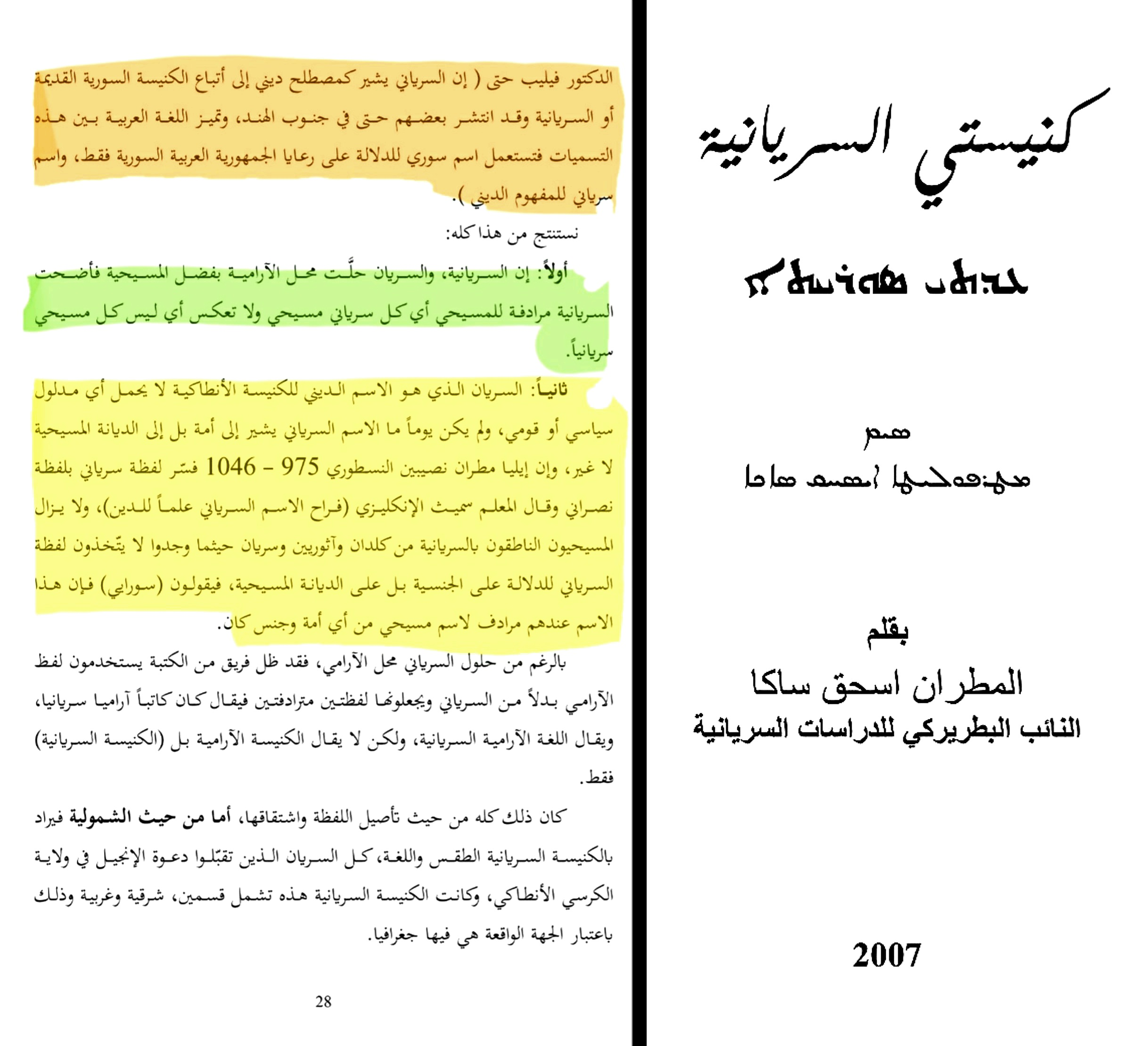
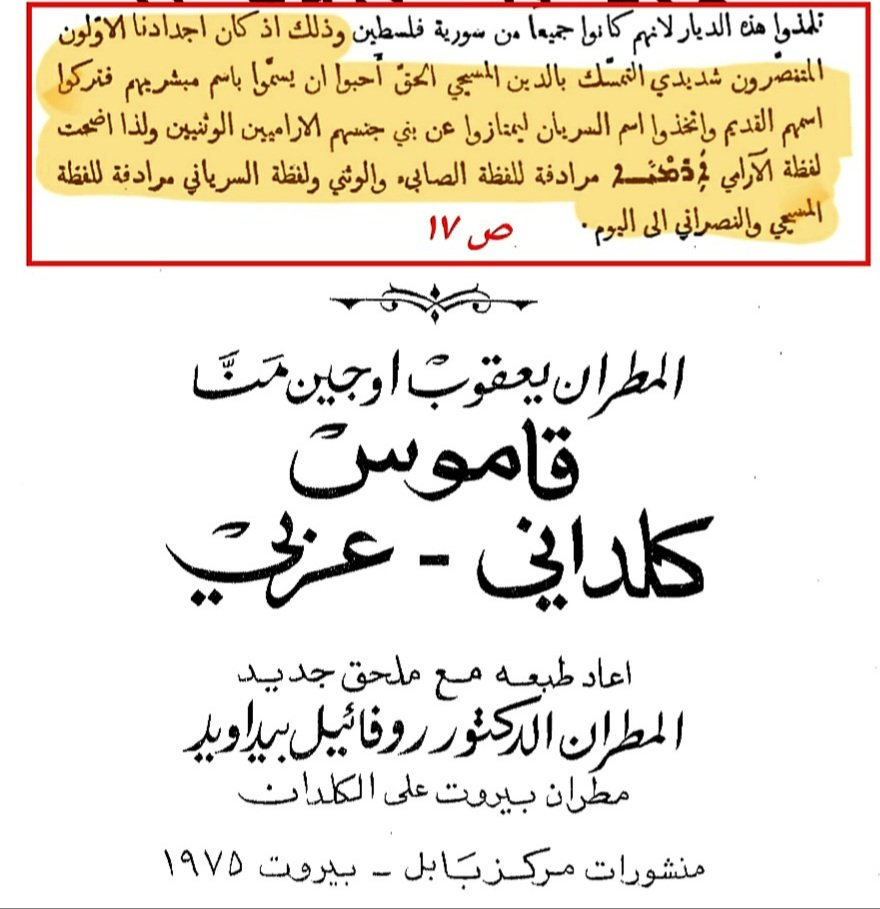
This matter was confirmed by Yakub Mana, Isaac Saka, and other historians of the Syriac Church, as they emphasized that the word Syriac was used for a religious reason, not an ethnic one, as a religious indication of a person’s affiliation with Christianity, not an ethnic meaning. Ignatius Afram mentioned that the Taghlib Arabs are Syriacs, and their name is Syriac because they religiously belong to the Syriac Church.
[ A Glimpse into the History of the Syriac Nation in Iraq ]
[ Chaldean-Arabic Dictionary, p. 17, 1975 edition ]
[ My Syriac Church, Isaac Saka, p. 28, 2007 edition ]
Originally, a person affiliated with Syria is called a Syrian, not a Syriac.
As for the people to whom most Syrians were historically affiliated, according to ancient writings, they are the Arabs.
Assyrian sources refer to the Levant as Asura Arabaia, meaning Arab Syria, and even Achaemenid sources called the Levant Asura Arabaia, meaning Arab Syria, indicating that the majority of Syrians were Arabs.
[ The Levant: Civilization - Afif Bahnasi, p. 19, Damascus 1987 ]
[ The Architecture of Damascus - Afif Bahnasi, p. 26, Dar Al-Fikr ]
The name Syrian was applied to the Arabs, and the Levant, or vast areas of it, were attributed to them.
Strabo said about the Syrians / Levantines who live from west of the Euphrates (Edessa) to the sea of Egypt (Palestine): they are the Arabs called Syrians.
This indicates that the Arabs were the majority in Syria and that they were called Syrians.
[ Strabo 16.1.1 ]
The Peutinger Map from the second or third century AD mentioned that a large area of the Levant, extending from Damascus to Apamea, was called Arab Syria.
[ Tabvla Pevtingeriana ]
Even Pliny, from the first century AD, mentioned that the land of the Arabs extends from the Amanus in northern Syria and the Mediterranean / Levantine Sea to the deserts of Palmyra, all of which is Arab land, and this entire land is Syria, meaning the Levant, indicating the Arab identity of most Syrians at that time and that Syria is part of the Arab lands.
[ Pliny 6:142 - 145 , The Loeb Classical Library vol 2 p445 - 447 ]
Julia Domna, the Arab descendant of Iamblichus, king of Emesa (called the land of the Arabs), was referred to as Syrian in the biography of Septimius in the History of the Emperors.
[ HISTORIA AUGUSTA , The Life of Septimius Severus 3:9 ]
The author David Frank Graf mentioned that the Arabs who were native to the Levant were called civilized Syrians.
[ ARABS IN SYRIA: DEMOGRAPHY AND EPIGRAPHY , David Frank Graf p319 ]
Posidonius, born in Apamea in the second century BC, mentions that the Arabs are three tribes, and these tribes are the Armians, Aramaeans, and Eirembii.
Strabo mentions that the Aramaeans, who are Arabs according to Posidonius, were called Syrians.
[ J.G. Kidd, Posidonius (Cambridge Classical Texts and Commentaries, 1989) , vol 2, pt 2, pp 955-956 ]
Posidonius’ statement indicates that the Aramaic-speaking people in the Levant and Iraq, both native inhabitants and migrant peoples, were mostly of Arab origin, not entirely non-Arab.
The reason I say Aramaic-speaking is that the name Aramaeans, after the seventh century BC, began to refer to Aramaic-speaking people from various Semitic peoples, not just the Aramaeans. Posidonius considered all these peoples to be Arab peoples.
Additionally, Posidonius’ statement supports that the Arabs in the Levant, if not called Arabs, were called Syrians / Levantines.
As mentioned earlier, the Aramaeans were called Syrians, yet Posidonius stated that they were Arabs, indicating that the majority of Syrians were Arabs and part of the Arab people.
[ THE ANCIENT ARAMAIC HERITAGE , Sebastian P. Brock ]
[ POSIDONIUS VOL III , I. G. KIDD p357-358 ]
The term Syrian was often used as a synonym for Arab, and sometimes as a rare geographical attribution for non-Arabs.
The word Syrian was ethnically linked to the Arabs, as the Arabs were the original Syrians, and geographically to the land of the Arabs, as Syria is part of the Arabian Peninsula.
As for the word Syriac, it is solely religiously linked to Christianity.
Thus, Syrian is a geographical name, usually affiliated with Arabs.
As for Syriac, it is a religious name, affiliated only with Christians.