Tardgrade and the Evolution Crisis
Tardgrade and the Evolution Crisis
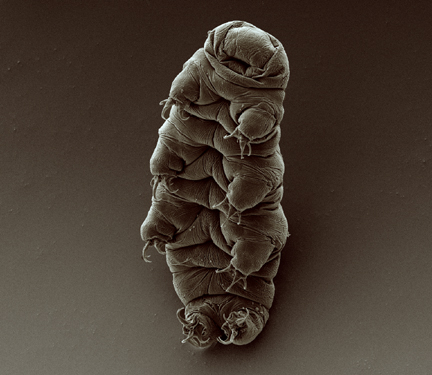
First of all: The Earth is about 4.5 billion years old, and the oldest tardigrade fossil found is more than half a billion years old, as this evolutionary site says:
https://tardigrad.org/evolution/
And this research says that it is 600 million years old
It is the same creature that exists today as it was 600 million years ago and has not evolved and has remained the same; They claim that it dates back millions of years, and it has survived all five extinction events, and has existed for 600 million years, about 400 million years before the dinosaurs
https://frontlinegenomics.com/everything-you-need-and-want-to-know-about-tardigrades/
Which puts evolution in a critical dilemma, as they claim millions of years, and here is an organism that has existed for 600 million years, even before the dinosaurs. This completely destroys that myth. What’s so strange about this organism? Take for example: This organism is almost impossible to kill, as it can withstand extreme highs and lows in temperature and can withstand pressure equal to 600 megapascals. What’s strange is that a pressure of just 30 megapascals crushes the cell and crushes its DNA;
According to a 2017 study, the tardigrade could withstand 1200 MPa when it was hibernating, but died when it was active. A 2008 study says that they tested its pressure tolerance, and the tardigrade could withstand 7.5 GPa, or 7500 MPa, for 12 hours. This is crazy. In addition to its ability to withstand gamma rays and X-rays.
https://www.ncbi.nlm.nih.gov/pmc/articles/PMC5705745/
https://www.nature.com/articles/ncomms12808
{Embed}
Radium Team 4
https://tardigrad.org/evolution/
Evolution - Tardigrades - Water Bear
Explore the remarkable evolutionary journey of tardigrades, nature’s time-travelers, in this in-depth page. Discover their astonishing adaptation strategies

{Embed}
Lauren Robertson
Everything you need (and want) to know about tardigrades - Front Li…
The science of tardigrades has come a long way in the last couple of decades – and their genomes are key to unravelling the mystery.
{Embed}
Lauren Robertson
https://frontlinegenomics.com/everything-you-need-and-want-to-know-about-tardigrades/
Everything you need (and want) to know about tardigrades - Front Li…
The science of tardigrades has come a long way in the last couple of decades – and their genomes are key to unravelling the mystery.
{Embed}
https://www.ncbi.nlm.nih.gov/pmc/articles/PMC5705745/
Tardigrades in Space Research - Past and Future
To survive exposure to space conditions, organisms should have certain characteristics including a high tolerance for freezing, radiation and desiccation. The organisms with the best chance for survival under such conditions are extremophiles, like …

🪫 How did he acquire that ability to endure and inherit it from creatures that are impossible to possess?!
In fact, this creature is older than the dinosaurs,
let alone inherited from creatures even older than it.
🪫 See? This is a contradiction.
And why aren’t there other creatures that can endure those conditions like it?!
According to evolution, natural selection aims for survival , as in the rest of the creatures,
and does not add traits that make killing it almost impossible —
otherwise they would have been available in all creatures over millions of years,
which we do not see.
🧠 In short, this means:
If natural selection aims for survival according to certain conditions ,
then why is there a creature that has the ability to endure all conditions,
when it is not present in all conditions at the same time?!
This creature is prepared for almost all conditions and not for specific ones —
so why does natural selection give the creatures that evolved from it the ability to live in deadly conditions,
unlike the rest of the creatures?!
🪫 This is fatal to this ridiculous assumption that says that natural selection aims only for survival —
otherwise, the rest of the creatures would have acquired it.
Rather, if it evolved from creatures before it, due to bad conditions,
then the creatures before it could not have lived in the conditions in which it originally lived,
because natural selection, according to the myth, occurs when conditions are difficult,
and not in environments in which it is impossible to live —
until natural selection occurs.
🪫 The same issue is in the human brain.
Natural selection aims for survival,
not to create creative structures,
or to make the creature extraordinary —
if evolution was originally blind.