

The Banu Qurayzah Incident Explained: Was It a Massacre or Wartime Treason?
Banu Qurayzah, Treaty Breach, and the Historical Context of the Judgment
Table of Contents
- Introduction
- The Treaty Between the Muslims and Banu Qurayzah
- The Conditions of the Treaty
- Did Banu Qurayzah Respect the Treaty
- The Crisis During the Battle of Al-Ahzab
- Ibn Kathir on the Breaking of the Covenant
- The Judgment of Sa’d Ibn Mu’adh
- Only Fighters or Women and Children
- The Narration of Atiyyah al-Qurazi
- The One Woman Who Was Executed
- Visual Evidence on Banu Qurayzah
- Banu al-Nadir
- Khaybar and the Wider Political Threat
- A Note on the Atiyyah al-Qurazi Narration
- Karen Armstrong on the Incident
- Related Posts
- Summary
- Research Sources
Introduction
They were at that time part of the state. They were not merely external allies or detached observers. Rather, they were included within the political order of Madinah under the terms of the treaty.
The Treaty Between the Muslims and Banu Qurayzah
The core issue in the Banu Qurayzah incident is not ethnicity or religion. The issue is covenant, wartime security, and the alleged breach of treaty during an existential military siege.
The Conditions of the Treaty
The conditions of this treaty were as follows:
1 That the Jews of Bani Awf are a nation with the believers, the Jews have their religion and the Muslims their religion, their guardians and themselves.
2 The Jews have to spend on them, and the Muslims have to spend on them.
3 And that among them victory over those who fought the people of this newspaper.
4 And that among them advice and advice, and righteousness without sin.
5 And that no man should sin against his ally.
6 And that victory is for the oppressed.
7 And that the Jews spend with the believers as long as they are at war.
8 And for the people of this newspaper to drink its hollow is forbidden.
9 And that whatever happened between the people of this newspaper of any event or quarrel that he fears spoiling, then it is attributed to God, and to Muhammad, the Messenger of God.
10 And that neither the Quraish nor those who helped it.
11 And that among them victory over those who attacked Yathrib, over all people who had their share from their side who accepted them.
12 And that this book does not prevent an oppressor or a sinner.
The Muslims respected these conditions as they lasted for five years.
Did Banu Qurayzah Respect the Treaty
This is the main reason behind the judgment against Banu Qurayzah, as will be detailed: they broke the treaty and allied themselves with Quraysh during a direct military siege of Madinah.
After the armies of the Confederates surrounded Medina with ten thousand fighters from the polytheists of Quraysh, Ghatafan, Ashja’, Asad, Fazara and Banu Salim, while the number of Muslims did not exceed three thousand fighters.
The Crisis During the Battle of Al-Ahzab
The calamity on the Muslims had intensified during the Battle of Al-Ahzab.
Umm Salamah, the Mother of the Believers, may God be pleased with her, said as she illustrated the horror of the situation:
I witnessed with the Messenger of God, may God’s prayers and peace be upon him, scenes of fighting and fear. Al-Fath and Hunayn, this was not more difficult for the Messenger of God, may God’s prayers and peace be upon him, nor was I more afraid of the trench for us, because the Muslims were in a critical situation, and Qurayzah was not safe from our offspring.
But what happened is the exact opposite. The Muslims were surprised by them breaking the covenant at the most dangerous time of the crisis.
Ibn Kathir on the Breaking of the Covenant
Ibn Kathir, may God have mercy on him, said:
He said, Woe to you, O Hayy, that you are an ominous person, and that I have made a covenant with Muhammad, so I do not contradict what is between me and him, and I have not seen anything from him except loyalty and honesty.
He said: Woe to you, open up for me to speak to you.
He said: What am I doing?
He said, by God, if you close me, except for fear of your army, I will eat with you from it.
So the man preserved it, so he opened it to him and said: Woe to you, Ka’b!
He said: I brought you Quraysh over its leaders and its masters, until you brought them down with the community of Al-Asyal from Rome and Ghatafan over its leaders and masters, until I brought them down for a sin of reprimand on the side of someone, and they promised me and they promised me that they would not leave until we extirpated Muhammad and those with him.
Ka’b said: You have come to me, God gave eternity, and Juham has spilled its water, thundering and lightning, and there is nothing in it, and it is scratching, O Hayy!
So leave me and what I am upon, for I have not seen anything from Muhammad but loyalty and honesty.
Amr bin Saad Al-Qurazi spoke and did well in what Musa bin Uqbah mentioned:
He reminded them of the covenant and covenant of the Messenger of God, may God bless him and grant him peace, and their contract with him on his victory, and he said: If you do not help him, leave him and his enemy.
Ibn Ishaq said:
Ka’b bin Asad broke the covenant and acquitted himself of what was between him and the Messenger of God, may God bless him and grant him peace.
The argument here is simple: the judgment was not because they were Jews. It was because of treaty breach during wartime and alliance with a besieging enemy.
Then the Jews of the village sent war operations, and they sent a man of them.
Hassan bin Thabit was with women and boys where the trench of the Prophet, peace and blessings of Allah be upon him, was.
And the Messenger of Allah, peace and blessings of Allah be upon him, and his companions were at the pillar until I killed him, then I went back to the fort and said:
O Hassan, go down and take him away, for nothing prevented me from taking him away except that he is a man.
The Judgment of Sa’d Ibn Mu’adh
After the polytheists and their allies turned away, carrying with them all the meanings of failure, the Muslims returned to their homes in Medina, washing themselves from the infirmities of jihad and fatigue, and catching their breath after a deep psychological anxiety that lasted an entire month.
As for Qurayzah, it is proven in the hadith that their fighters were killed and everything else was left.
The Prophet, may God bless him and grant him peace, made a covenant with the Jews of Banu Qurayzah, but they broke the covenant and sided with the polytheists in the Battle of the Trench.
Then Gabriel, peace be upon him, came to the Prophet, peace and blessings be upon him, and ordered him to go to Banu Qurayzah.
Then Sa’d bin Mu’adh judged them.
In the two Sahihs, and this is the wording of Muslim:
Indeed, I judge among them that the female fighter should be killed, that the offspring and women should be taken captive, and that their property should be divided.
As we see, Sa’d, may God be pleased with him, ordered the killing of the combatant category and did not order the killing of everyone indiscriminately.
On the authority of Buraidah, he said:
They were briefed in the name of God in the way of Allah, fought from Kafr in God, they were briefed and do not work, and do not represent, and do not kill.
Then invite them to Islam, and if they respond to you, accept it from them, then invite them to move from their home to the home of the immigrants.
Only Fighters or Women and Children
The claim being answered here is that women and children were killed indiscriminately. The response is that the narrations distinguish between combatants and non-combatants.
Narrated Atiyyah al-Qurazi:
Source: Sunan Abi Dawud 4404
Grade: Sahih according to Al-Albani
Narrated Aisha, Ummul Mu’minin:
Suddenly a man called her name: Where is so-and-so?
She said: I.
I asked: What is the matter with you?
She said: I did a new act.
She said: The man took her and beheaded her.
She said: I will not forget that she was laughing extremely although she knew that she would be killed.
Source: Sunan Abi Dawud 2671
Grade: Sahih according to Darussalam
The argument presented is that the judgment concerned those treated as fighters under the wartime standard of the incident, not a blanket killing of all women and children.
The Narration of Atiyyah al-Qurazi
Now for the argument that children were killed: those who had reached this sign, according to Awn al-Ma’bud, were counted among the fighting category.
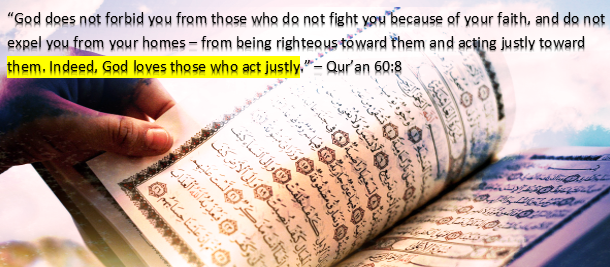
For your info: This image quotes Qur’an 60:8, which states that Allah does not forbid Muslims from being righteous and just toward those who do not fight them because of religion and do not expel them from their homes. The relevance here is that the argument is not against Jews as Jews, but against hostile wartime action and treaty breach. This supports the article’s distinction between peaceful relations and combatant aggression.
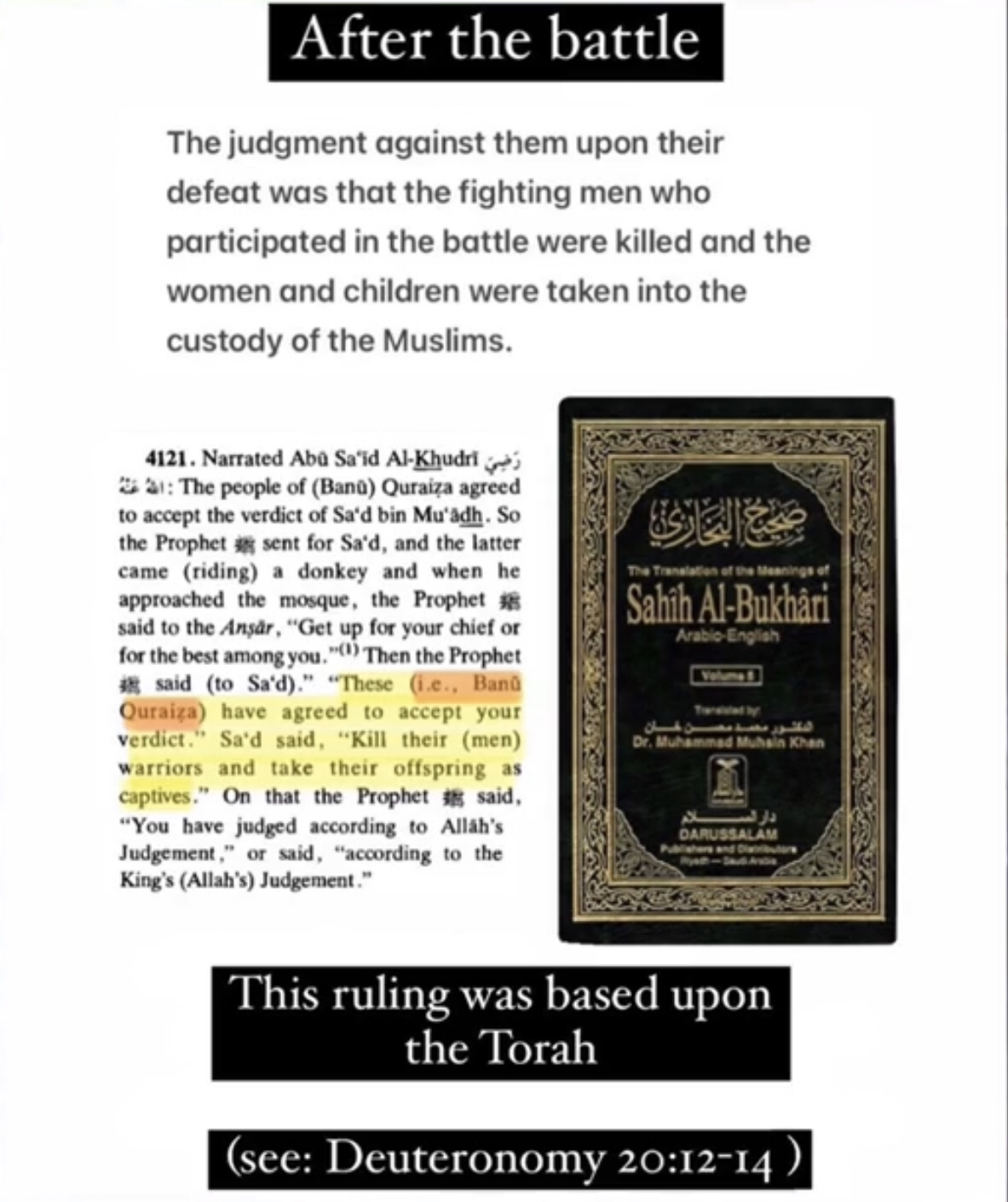
For your info: This scan presents an English citation from Sahih al-Bukhari about the verdict of Sa’d ibn Mu’adh over Banu Qurayzah. The highlighted passage states that Banu Qurayzah accepted Sa’d’s verdict, and that his judgment was to kill the fighting men and take the offspring captive. The page is being used to argue that the ruling was directed at combatants, not at all Jews or all civilians.
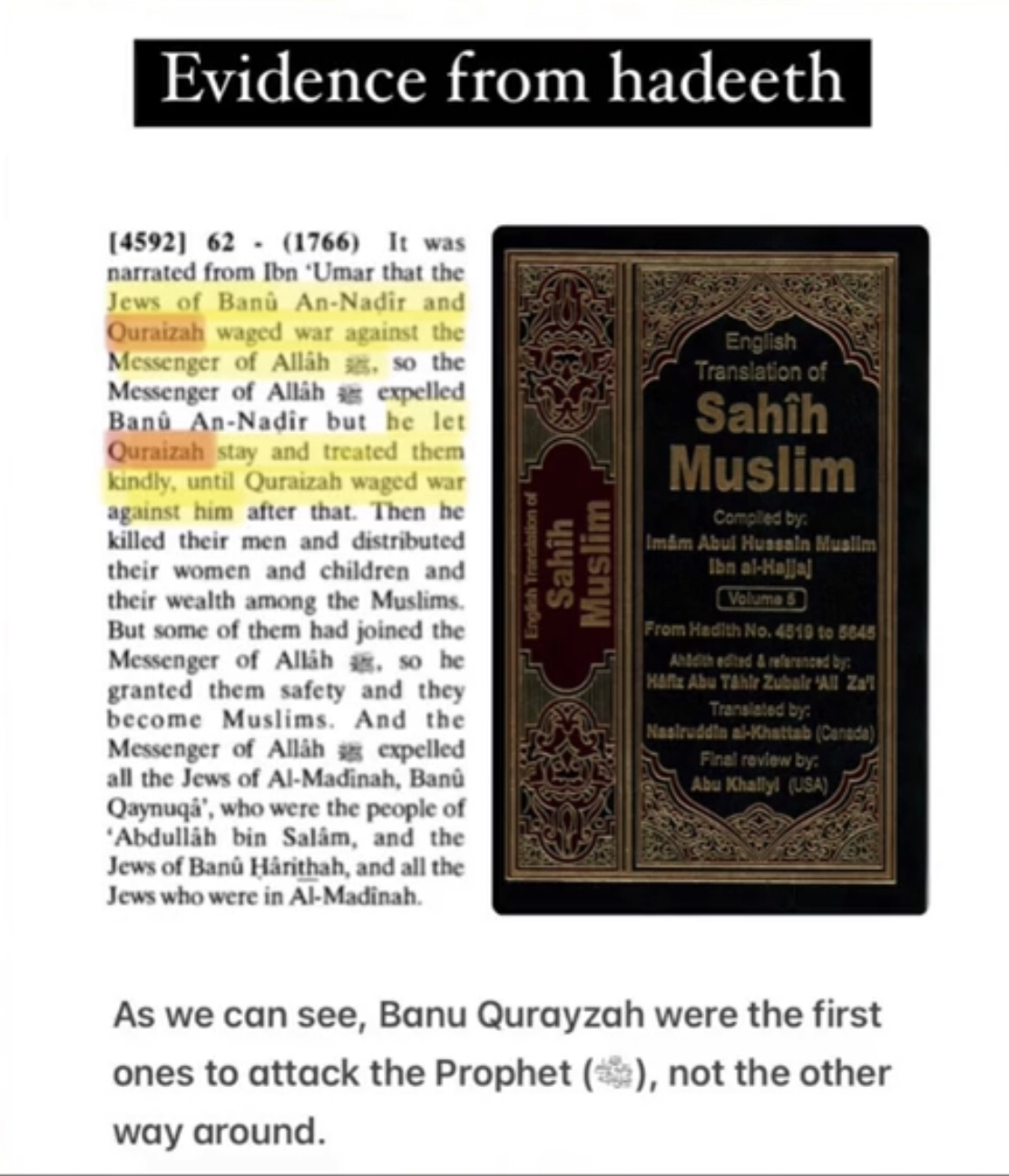
For your info: This scan cites Sahih Muslim and highlights the report that Banu al-Nadir and Qurayzah waged war against the Messenger of Allah. It also mentions that Qurayzah were treated kindly until they later waged war. The scan is being used to argue that the conflict was initiated through treaty violation and hostile action, not because of religious identity.
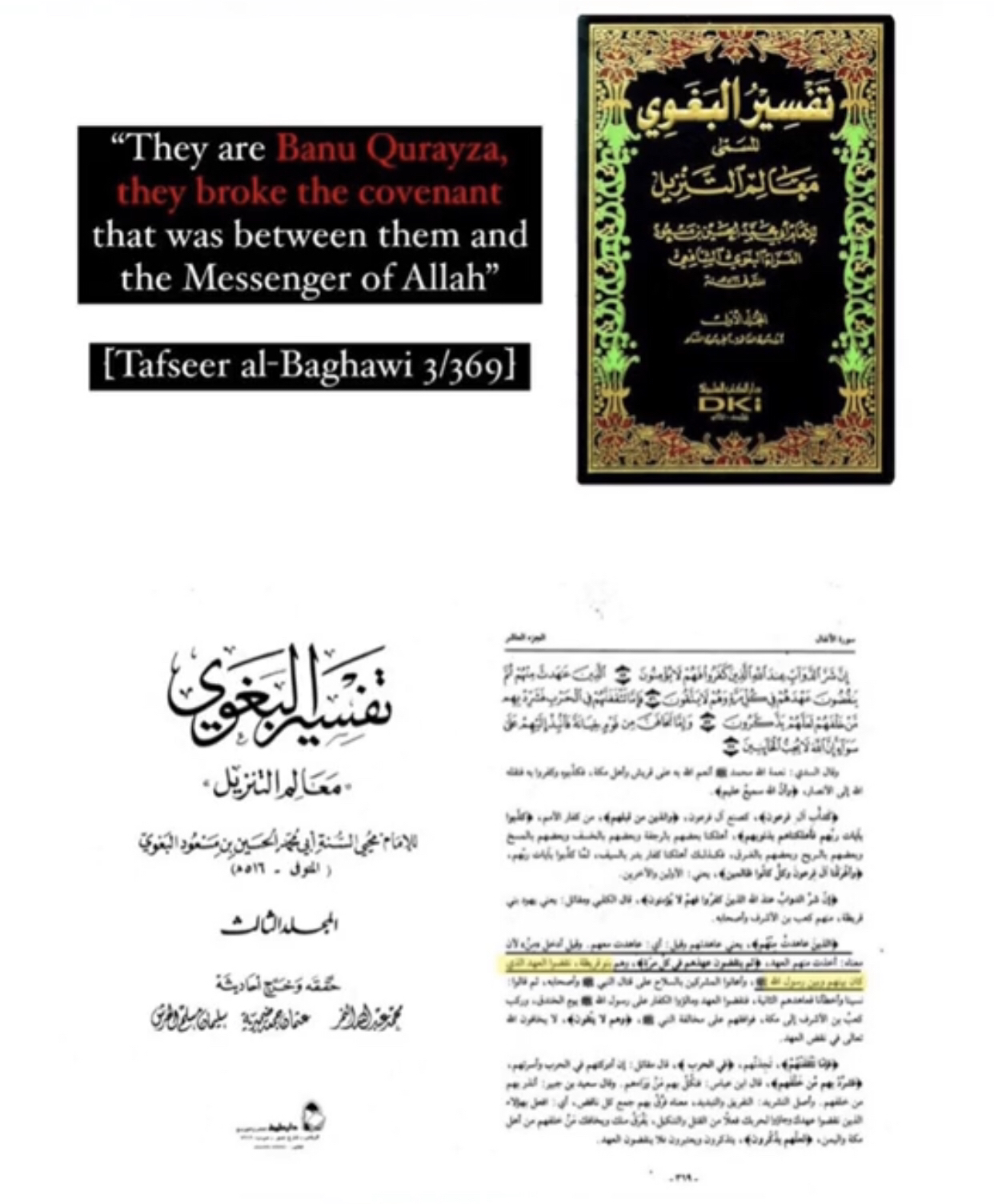
For your info: This Arabic scan is from Tafsir al-Baghawi. The highlighted section states that Banu Qurayzah broke the covenant that existed between them and the Messenger of Allah, peace and blessings be upon him. This is used as supporting evidence that the later judgment was tied to violation of the covenant during wartime.
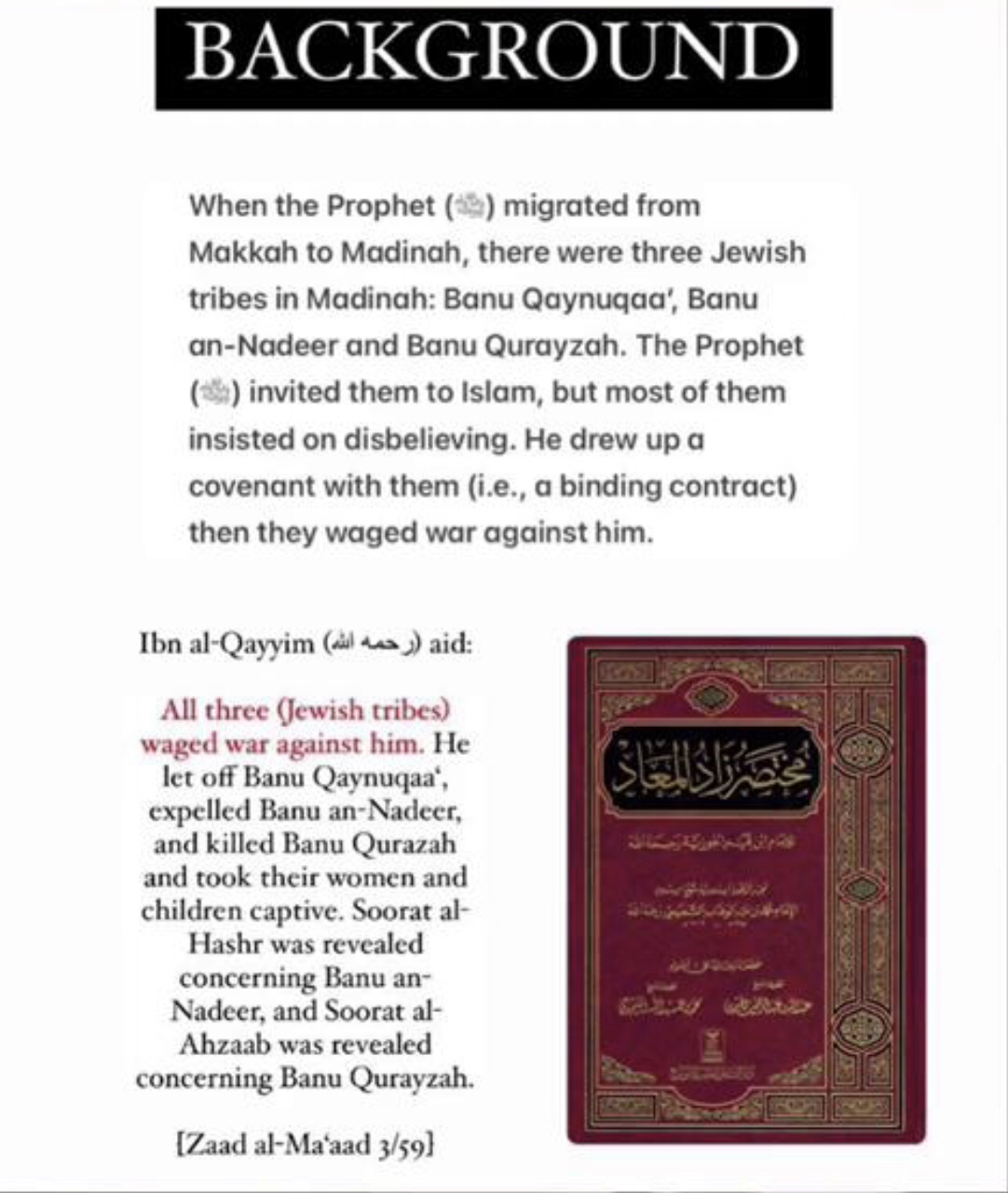
For your info: This scan gives background on the three Jewish tribes in Madinah: Banu Qaynuqa’, Banu al-Nadir, and Banu Qurayzah. It cites Ibn al-Qayyim and states that all three entered into conflict with the Prophet, peace and blessings be upon him, with different outcomes for each tribe. The page is used to frame the Banu Qurayzah incident as part of a wider political and military history in Madinah.
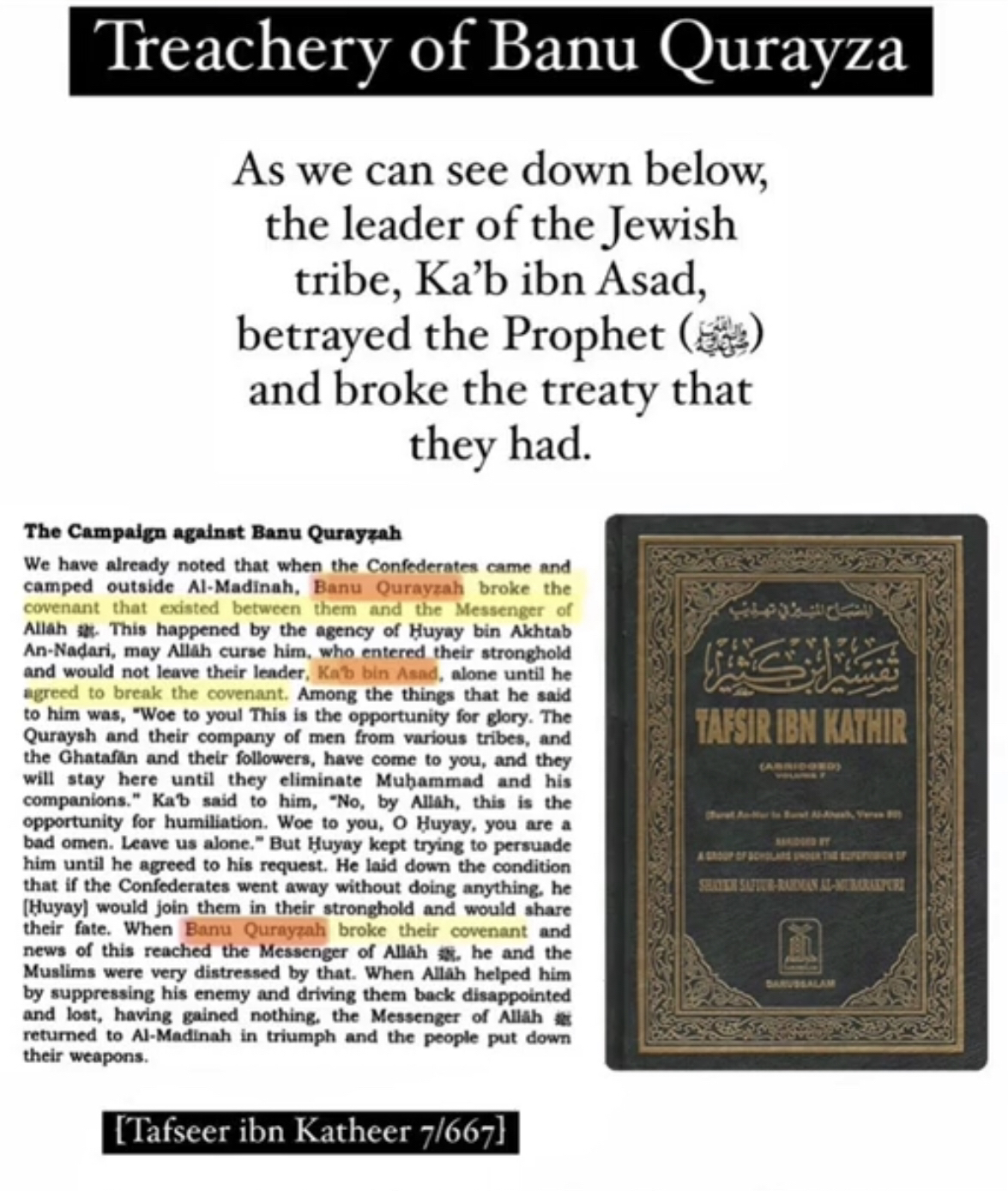
For your info: This scan quotes Tafsir Ibn Kathir concerning Banu Qurayzah and the breaking of the covenant. It mentions Ka’b ibn Asad, the leader of Banu Qurayzah, and describes how Huyay ibn Akhtab persuaded him to break the treaty with the Prophet, peace and blessings be upon him, during the campaign of the Confederates. The highlighted lines are used to prove that the issue was wartime treachery and breach of treaty.
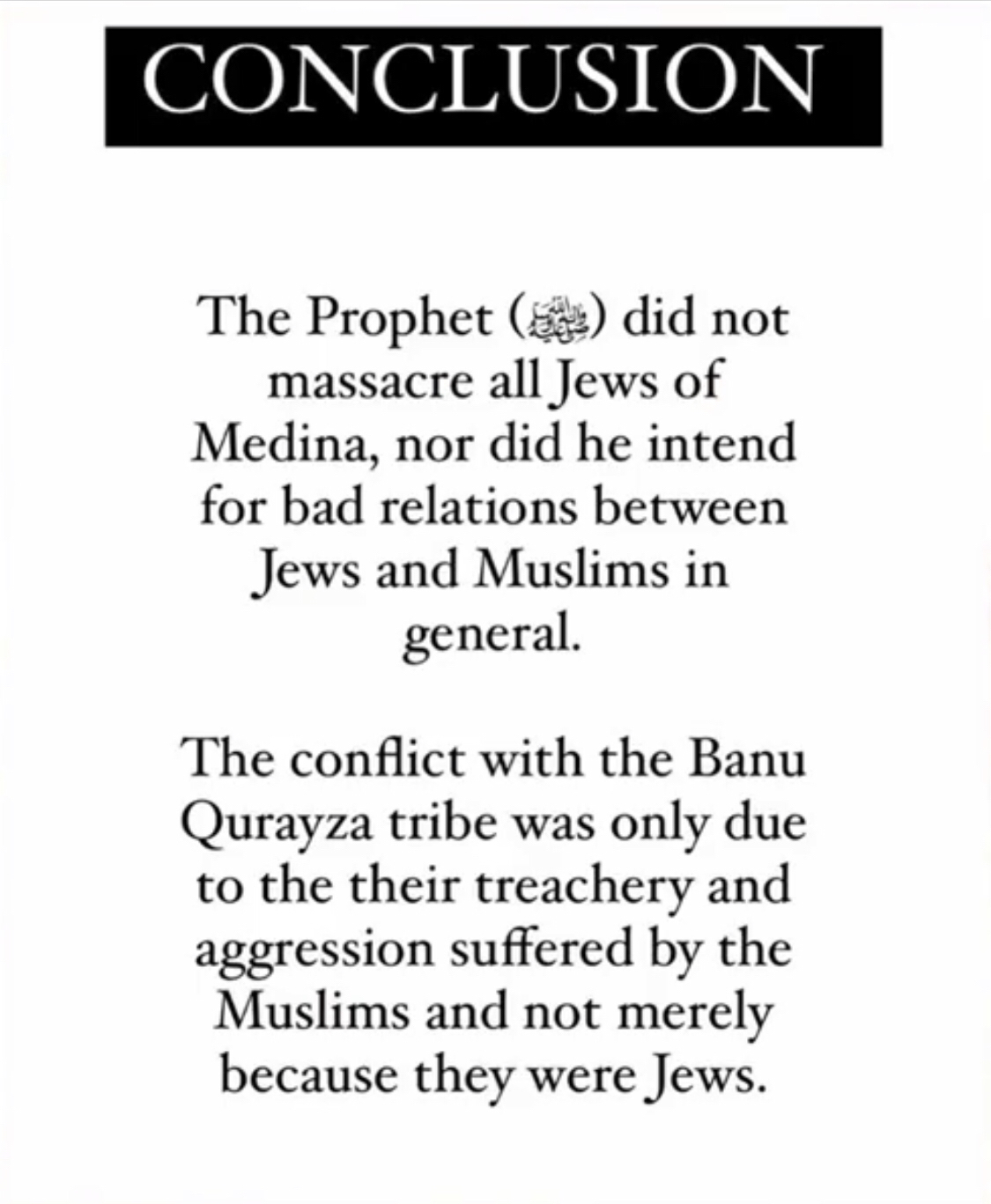
For your info: This image summarizes the conclusion: the Prophet, peace and blessings be upon him, did not massacre all Jews of Madinah, nor did the conflict exist because of Jewish identity. It states that the conflict with Banu Qurayzah was due to treachery and aggression suffered by the Muslims, not merely because they were Jews.
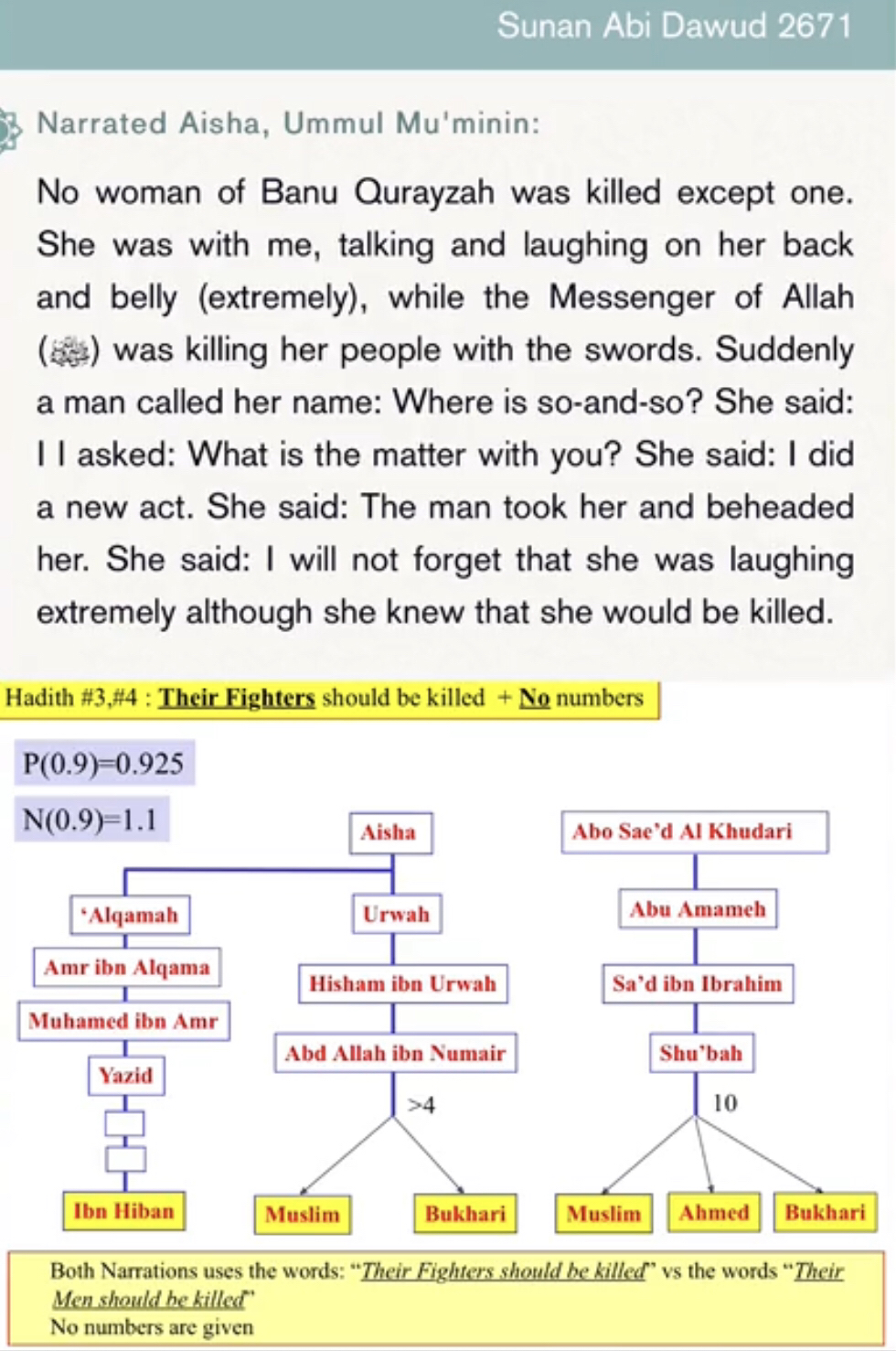
For your info: This image cites Sunan Abi Dawud 2671 regarding the report that only one woman from Banu Qurayzah was executed. The image also highlights the argument that the narrations refer to fighters and do not provide a numerical claim of indiscriminate killing. It is used here to support the claim that the incident was about combatant responsibility, not mass civilian killing.
The One Woman Who Was Executed
Only one woman was killed.
She was killed because she killed a companion of the Prophet.
Ibn Hisham, who died in 213 AH, commented:
And she is the one who threw the millstone at Khalad bin Suwayd, so she caused his death.
Source: Sirat Ibn Hisham 2/242
This explains why the one woman mentioned in Sunan Abi Dawud 2671 was executed: the report is connected to her direct killing of Khalad bin Suwayd.
Visual Evidence on Banu Qurayzah
See: Islamophobes Nightmare by Faiz e Mustafa.
Banu al-Nadir
Now let us look at what later happened in Banu al-Nadir.
The Muslims and Banu al-Nadir had a truce. The Prophet asked military help from them, so they accepted and invited the Prophet to their tribe. Then they decided to kill him, which was a clear violation of the covenant of peace that they had.
When God showed him that, the Prophet went to Madinah and gave them ten days to leave, which shows that the Prophet gave them a chance to leave.
But they refused, so the Prophet prepared for war with Banu al-Nadir. This is detailed in the books of Sirah.
Khaybar and the Wider Political Threat
Now for what happened at Khaybar:
Source: Subul al-Salam, p. 463
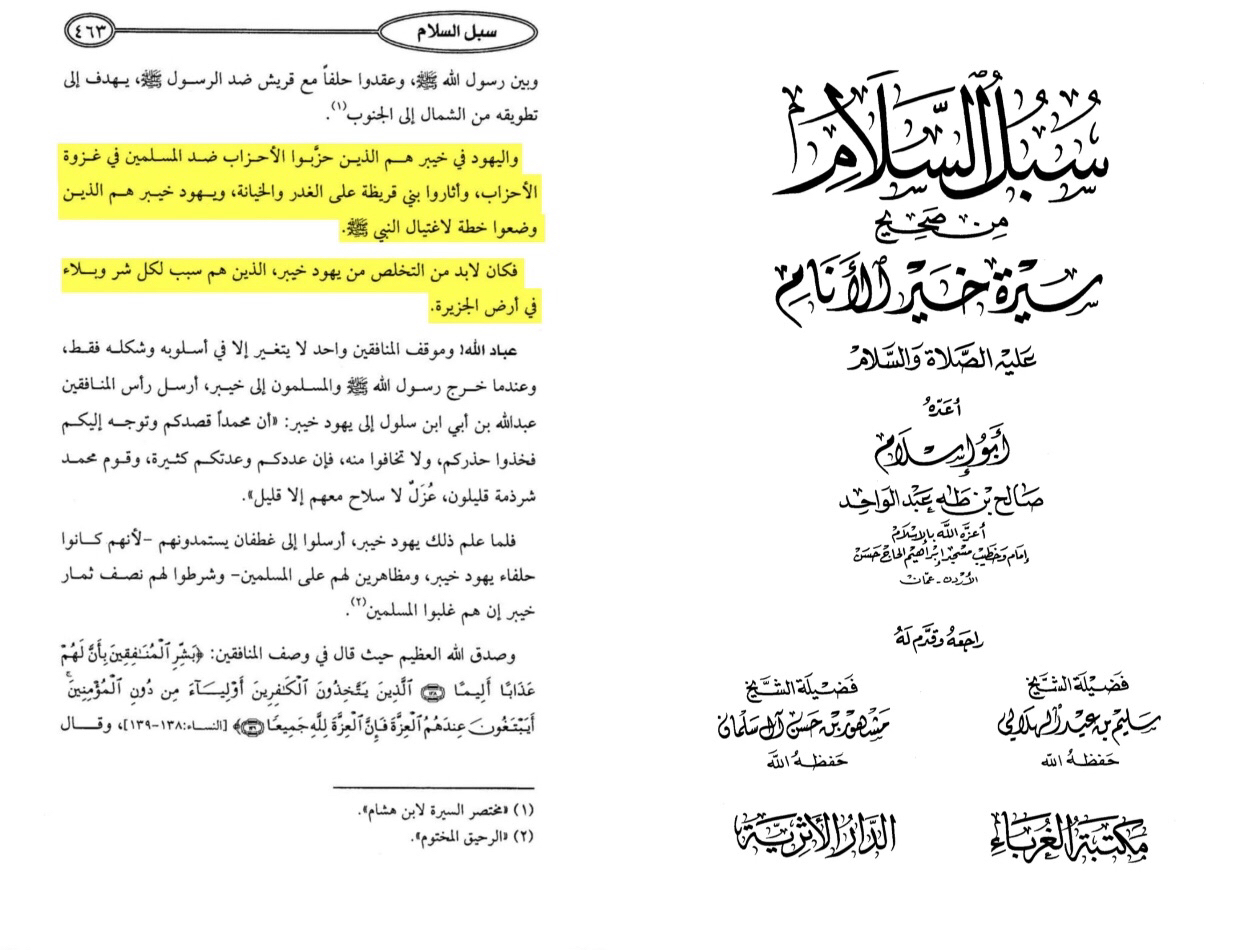
For your info: This Arabic scan is from Subul al-Salam. The highlighted section discusses Khaybar and describes it as a center of hostility during the conflicts surrounding Madinah. It states that the Jews of Khaybar were involved in gathering the Confederates against the Prophet, peace and blessings be upon him, and inciting Banu al-Nadir and Banu Qurayzah. The scan is used to argue that Khaybar was treated as a political and military threat, not as a target merely because of Jewish identity.
A Note on the Atiyyah al-Qurazi Narration
The narration is unique to Atiyyah al-Qurazi on the authority of Abd al-Malik ibn Umayr.
His hadith does not reach the level of sahih according to this criticism. Some scholars classified it as hasan. I recall Ibn Hajar’s statement regarding Banu Qurayzah, where he says that all the narrations are authentic except for the one about growing hair.
Due to its numerous chains of transmission on the authority of Abd al-Malik, the narration is classified as hasan by some and does not reach the level of sahih according to this line of argument.
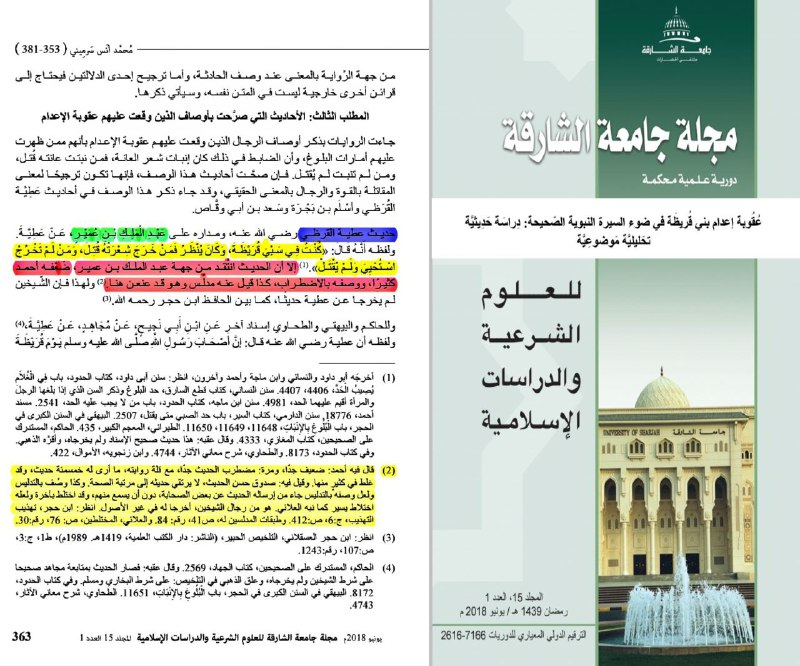
For your info: This Arabic scan appears to discuss the hadith criticism surrounding the narration of Atiyyah al-Qurazi and Abd al-Malik ibn Umayr. The highlighted section is being used to support the point that the narration about identifying males through pubic hair has been discussed critically by hadith scholars and is not treated the same way as the stronger reports in Bukhari and Muslim.
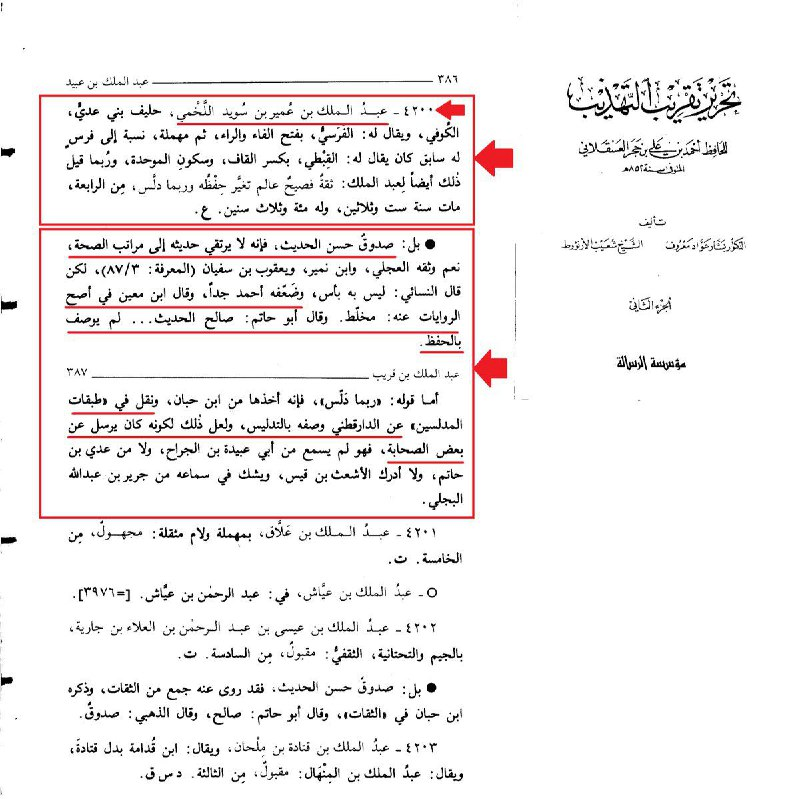
For your info: This Arabic scan is from Tahdhib al-Kamal and discusses Abd al-Malik ibn Umayr. The highlighted section records biographical and hadith-critical information about him, including statements that his hadith is generally accepted by some but also that there are criticisms regarding his precision and retention. This supports the article’s caution when relying on the specific narration transmitted through him.
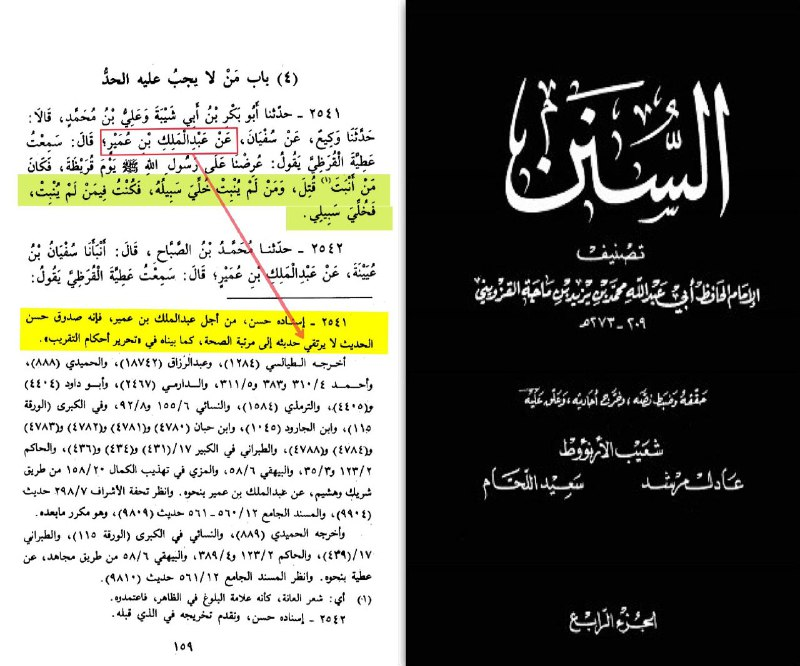
For your info: This Arabic scan shows the hadith of Atiyyah al-Qurazi in which the captives of Banu Qurayzah were examined: whoever had grown hair was treated as having reached maturity, and whoever had not was not killed. The grading note shown beneath the narration says the chain is hasan. This scan is central to the discussion because it is the narration used in the debate over whether maturity was used as a marker of combatant status.
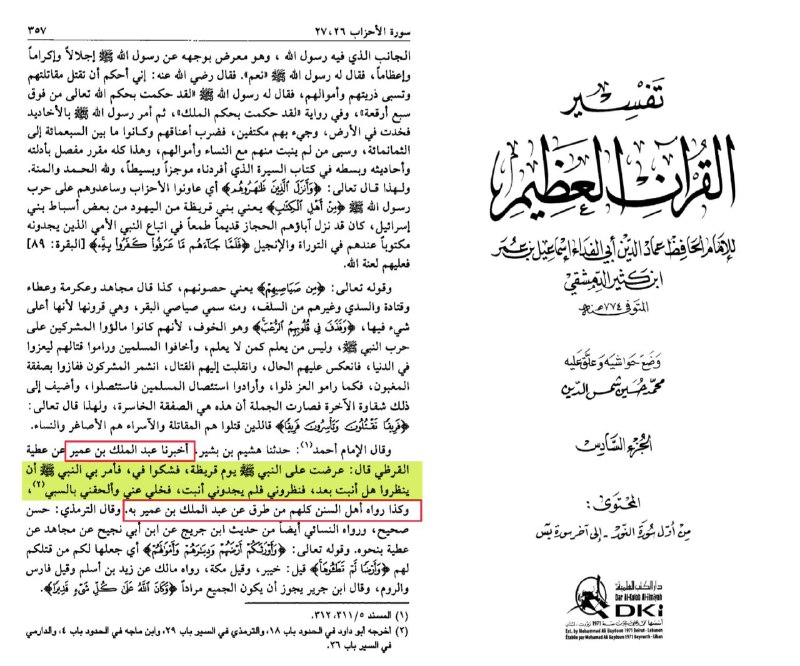
For your info: This Arabic scan cites the tafsir discussion concerning the judgment over Banu Qurayzah. The highlighted passage mentions that Sa’d ibn Mu’adh judged that the fighters be killed and the women and children be taken captive, after which the Prophet, peace and blessings be upon him, affirmed the judgment. This scan is used to support the distinction between fighters and non-combatants.
Karen Armstrong on the Incident
The final point is that the judgment over Banu Qurayzah was tied to breaking the covenant and attempting to destroy the Muslim population during wartime.
It is noteworthy that Karen Armstrong addresses this misconception.
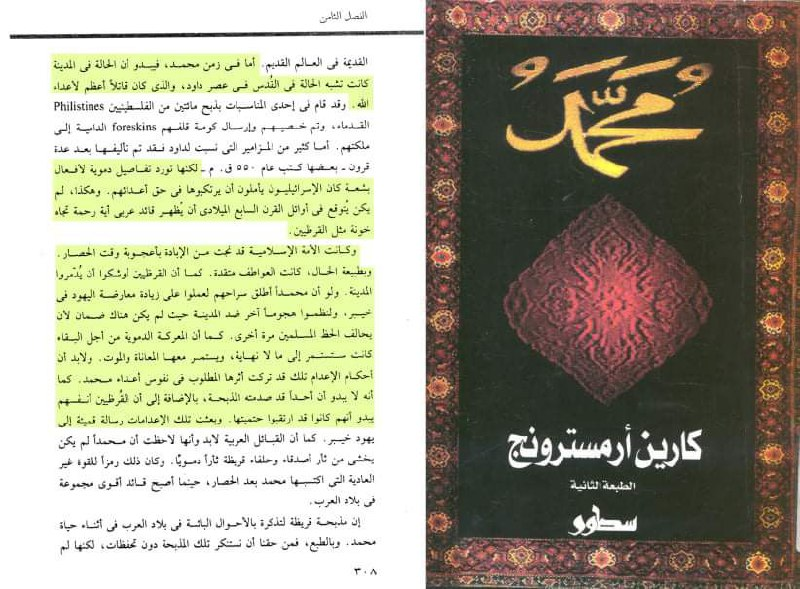
For your info: This Arabic scan is from Karen Armstrong’s work on the Prophet Muhammad. The highlighted passage argues that the conflict with Banu Qurayzah should not be interpreted as a general religious war against Jews. Rather, it places the incident in the context of wartime survival, treaty breach, and the political threat facing the Muslim community during the siege. This supports the article’s central distinction: the judgment was not because they were Jews, but because of the alleged betrayal during a critical military crisis.
Related Posts
Summary
The judgment against Banu Qurayzah had a stated reason: high treason and aiding the enemy against the Muslims during the Battle of the Trench.
The reports distinguish between fighters and non-combatants.
The narration concerning pubic hair as a marker of maturity has been discussed by hadith scholars and is not on the same level as the strongest reports in Bukhari and Muslim.
The one woman mentioned in the report was executed because she had killed Khalad bin Suwayd.
The incident must be understood through treaty breach, siege warfare, and political survival, not as a general attack on Jews as a people.
Research Sources
The Biography of the Prophet - Ibn Hisham - vol. 3 - p. 721, as mentioned by Ibn Kathir, may God have mercy on him, in the Biography of the Prophet - vol. 2 - p. 239 and others.
The Biography of the Prophet - Ibn Hisham - vol. 1 p. 503 / 504
The Biography of the Prophet - Ibn Hisham - Part 1 - Pg. 51
In the Shadows of the Qur’an, Part 21/548 i, 7th year 1391 AH.
The Biography of the Prophet - Ibn Kathir - Part 3 - p. 118
The Biography of the Prophet - Ibn Hisham - Part 3 - pg 711
Sahih Imam - Hadith No. 3321
Sahih Imam - Hadith 1731, and the Musnad of Imam Ahmad - Hadith No. 193
Money for Ibn Zanjaweh - Hadith No. 359
Sahih Al-Tirmidhi - Hadith No. 1582, as authenticated by Al-Albani and Ibn Hajar Al-Asqalani.
Sahih Imam al-Bukhari - Hadith No. 2851, and narrated by Imam Muslim - No. 1744
Narrated by Ibn Abi Shaybah in Manuscript No. page 656
Abu Dawood: The Book of Jihad, chapter on the supplication of the enemy 2614, Ibn Abi Shaybah 6/483, and al-Bayhaqi in his Sunan al-Kubra 17932.
Nayl Al-Awtar by Imam Al-Shawkani 7/290 No. 3325
Fath Al-Bari Sharh Sahih Al-Bukhari 6/147
Narrated by Abu Dawood 2669 and authenticated by Al-Albani
Discover The Truth: Re-Examining Banu Qurayzah Incident
https://discover-the-truth.com/2016/01/01/re-examining-banu-qurayzah-incident/
Google Drive Folder
https://drive.google.com/drive/folders/16nvJVaPF2S7ULUfyz0WgHWT0T8LOrl4y
...it is that a book which glorifies the beheading of a dead enemy in a psalm of praise, and endorses the act as divinely approved conduct, should not be invoked by those who wish to condemn others for...
...apply to the Old Testament you refuse to apply to the Prophet of Islam. This is a double standard.