

The Bible's Use of "Pharaoh" for Joseph's Ruler Is an Anachronism — The Quran's "King" Is Historically Accurate
The Bible calls the ruler of Egypt during Joseph’s time “Pharaoh” — but the word “Pharaoh” was not used as a personal title for the ruler of Egypt until the New Kingdom period, which began around 1570 BC. Joseph lived during the Hyksos era, approximately 1643 BC — more than 400 years before the title came into use. This is a historical anachronism in the biblical text. The Quran, by contrast, uses the word Malik (King) for the ruler of Egypt in the story of Joseph — which is precisely the correct title for that era.
I say: It is not hidden from the reader that after the death of the ancient Egyptians, the ancient hieroglyphic language, before the advent of Islam, became merely incomprehensible symbols and talismans inscribed on the walls of tombs and temples. Scholars and researchers were unable to read it until 1200 years after the rise of Islam, thanks to the French scholar Jean-François Champollion, who deciphered its symbols and read its codes using the Rosetta Stone. Here is a short video, 3 minutes long, explaining how we were able to pronounce the letters of the hieroglyphic language:
Therefore, we say that the personalities of Joseph and Moses, peace be upon them, have been mentioned in the Qur’an and the Torah, and by comparing the two stories, we know that there are great differences between them; for in all the verses of the Qur’an we find that the title of the ruler of Egypt in the story of Joseph, peace be upon him, is “the King”; and that the title of the ruler of Egypt in the story of Moses is “Pharaoh.”
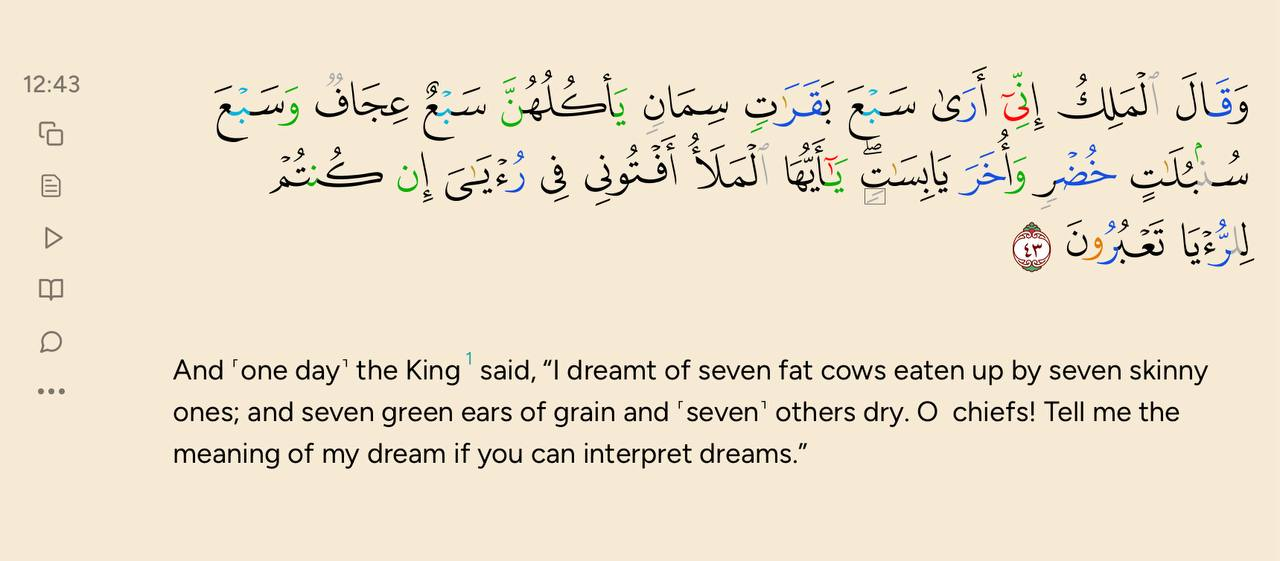
While the distorted Torah makes the title of the ruler of Egypt “Pharaoh” in both the story of Joseph and Moses, peace be upon them.
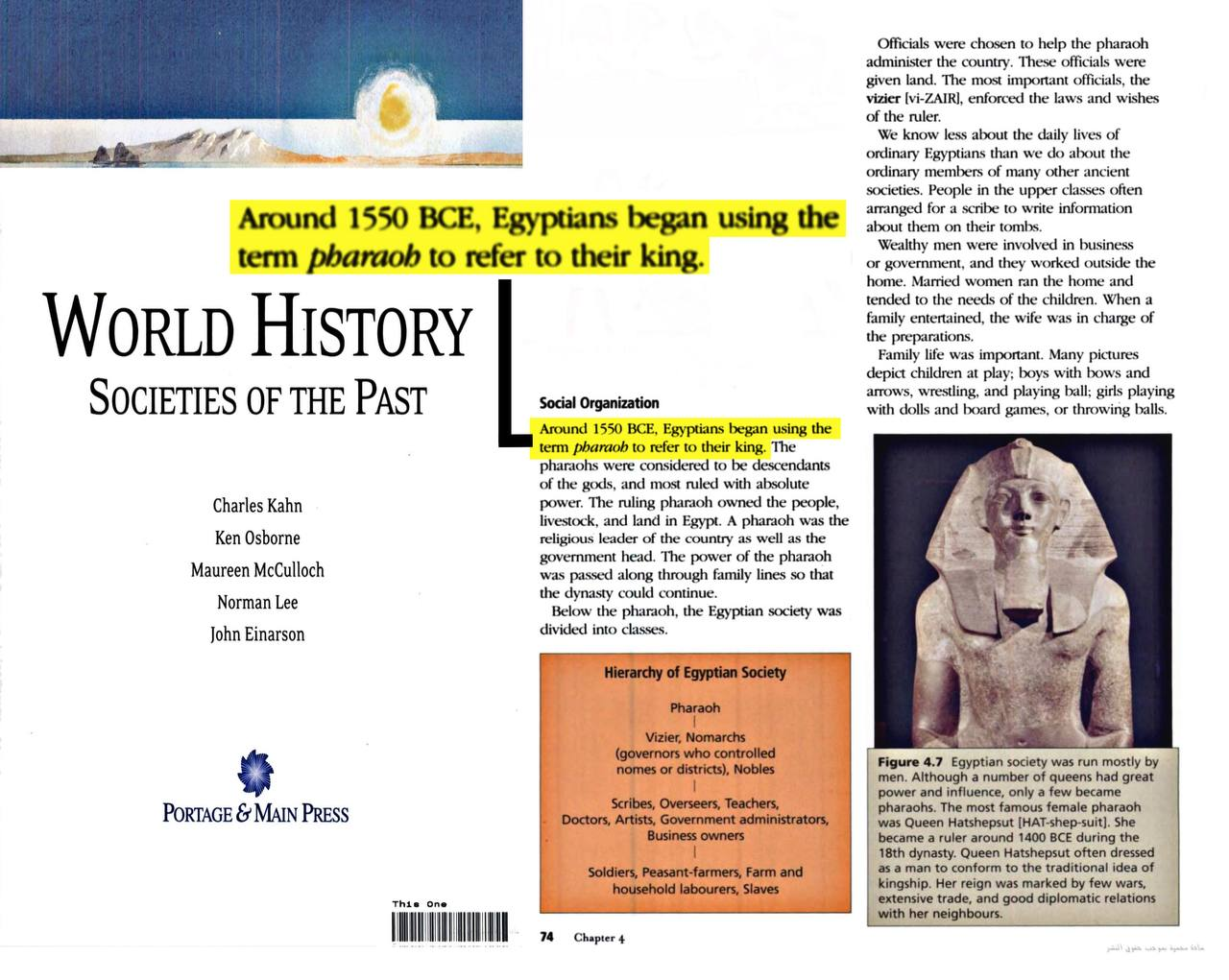
Although the first appearance of the title “Pharaoh” was in the era of the New Kingdom (around 1550-1070 BC), that is, about one hundred and fifty years after Joseph, peace be upon him, this is based on the fact that scholars estimate that he, peace be upon him, lived (around 1700 BC), that is, in the era of the Hyksos (the era of the kings).
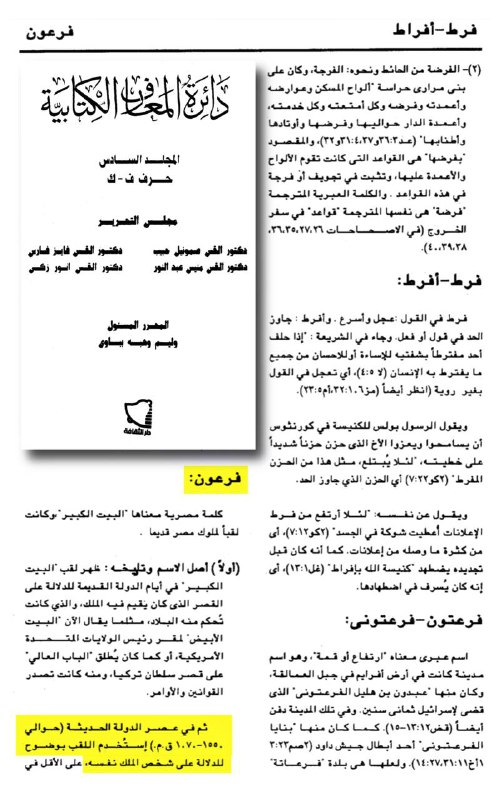
Etymology: > An Egyptian word meaning “The Great House” (البيت الكبير). It served as the primary title for the kings of ancient Egypt.
Origin & History: > During the Old Kingdom, the term strictly referred to the royal palace where the king resided and ruled.
The text compares this ancient usage to how we use“The White House” to refer to the US Presidency, or “The High Porte” to refer to the Ottoman Sultan.
Historical Evolution: > It wasn’t until the New Kingdom era (approx. 1550 - 1070 BC) that the title transitioned to explicitly denote the person of the king himself, rather than just his residence.
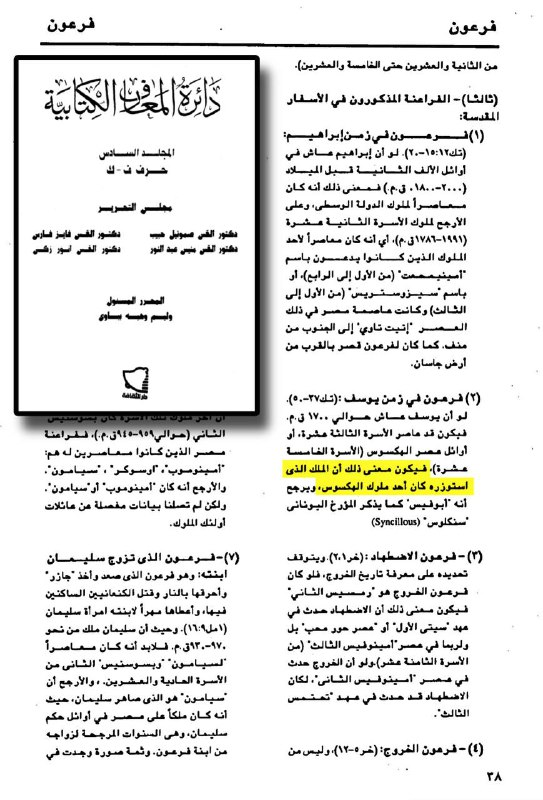
Biblical Context: > Explores the historical identity of the Pharaoh during the time of Joseph (Genesis 37-50).
Estimated Timeline: > The text posits that if Joseph lived around 1700 BC, he would have been a contemporary of the 13th Dynasty or the early Hyksos era (the 15th Dynasty).
“فيكون معنى ذلك أن الملك الذي استوزره كان أحد ملوك الهكسوس”
Translation: This would mean that the king who made him [Joseph] a minister was one of the Hyksos kings.
Historical Identification: > The entry concludes by stating that this specific Hyksos king was likely “Apophis” (أبوفيس), according to the accounts of the Greek historian Syncellus.
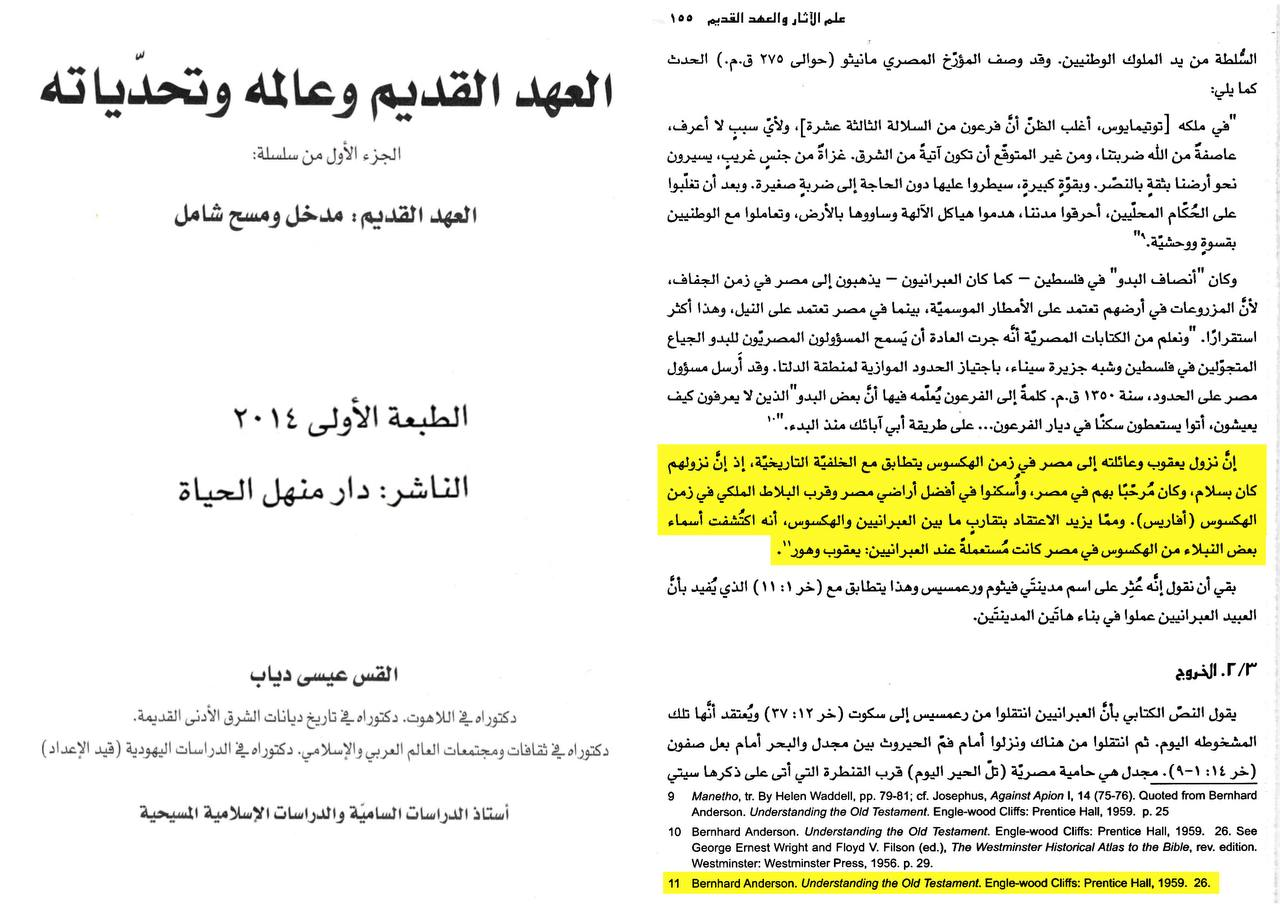
Historical Alignment: > The text asserts that the arrival of Jacob and his family in Egypt historically aligns perfectly with the era of the Hyksos rule.
“إن نزول يعقوب وعائلته إلى مصر في زمن الهكسوس يتطابق مع الخلفية التاريخية، إذ إن نزولهم كان بسلام، وكان مُرحباً بهم في مصر، وأسكنوا في أفضل أراضي مصر وقرب البلاط الملكي في زمن الهكسوس (أفاريس).”Translation: The descent of Jacob and his family to Egypt during the time of the Hyksos aligns with the historical background, as their descent was peaceful, and they were welcomed in Egypt, settling in the best lands of Egypt and near the royal court during the time of the Hyksos (Avaris).
Archaeological Evidence: > The author notes that the connection between the Hebrews and the Hyksos is strengthened by discoveries showing that some Hyksos nobles used names common among the Hebrews, specifically: Jacob (يعقوب) and Hur (هور).
Footnote Citation [11]: > The secondary highlight at the bottom of the page attributes this historical perspective to: Bernhard Anderson. Understanding the Old Testament. Englewood Cliffs: Prentice Hall, 1959. p. 26.
The Biblical Text and the Historical Problem
The website bibletimeline.info specifies the period in which Joseph lived in Egypt as the 19th century BC. The word “Pharaoh” was not used — to refer to the ruler of ancient Egypt as a person — except during the New Kingdom era.
The New Kingdom began around 1570 BC:
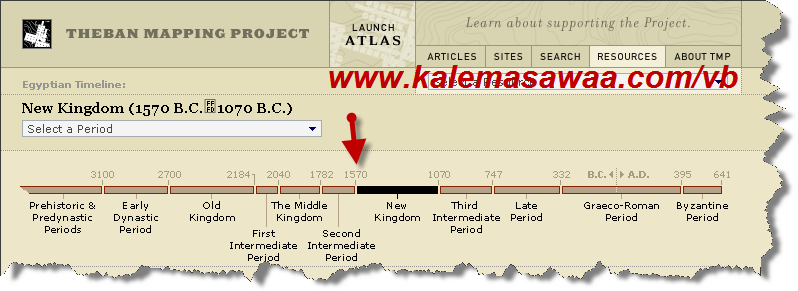
Multiple independent sources confirm that the title “Pharaoh” began to be used to denote kingship as a personal title only during the New Kingdom period — not before:
-
Wikibooks — Saylor.org’s Ancient Civilizations of the World / Dynasties in Egypt: “The title Pharaoh began to be used (to denote kingship) during the New Kingdom period.” Source: en.wikibooks.org/wiki/Saylor.org’s_Ancient_Civilizations_of_the_World/Dynasties_in_Egypt:_the_Old,_Middle,_and_New_Kingdoms
-
rapgenius.com — KJV Exodus 1 annotation: “The title of Pharaoh was given to the kings of the New Kingdom only.” Source: rapgenius.com/Holy-bible-kjv-exodus-1-lyrics#note-1187424
-
The Theban Mapping Project: Confirms the same timeline. Source: thebanmappingproject.com/resources/timeline_6.html
-
ancientegyptonline.co.uk: Confirms the New Kingdom dating. Source: ancientegyptonline.co.uk/newkingdom.html
Establishing When Joseph Lived — From the Bible’s Own Texts
The Christian missionary objects that no one can determine when Joseph lived. But the Bible’s own texts allow us to calculate this precisely.
Through this text we can determine the year in which the Prophet Jacob (peace be upon him) came to the land of Egypt — and therefore when Joseph was already established there.
The exodus of the Hebrews from Egypt was from the city of Ramesses — as the Christian holy book itself testifies — which was built by the Pharaoh Ramesses II:
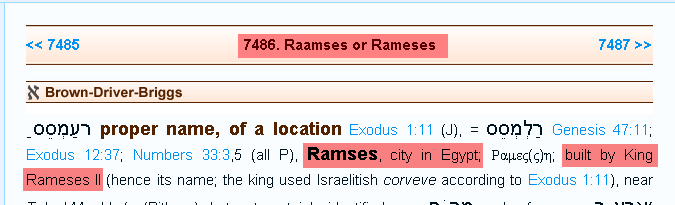
Ramesses II died in the year 1213 BC, as the Encyclopaedia Britannica confirms.
Therefore:
1213 + 430 = 1643 BC
Joseph (peace be upon him) brought his father the Prophet Jacob (peace be upon him) and his brothers to Egypt around the year 1643 BC — which corresponds precisely to the period of Hyksos rule in Egypt, the 15th Dynasty.
Whether Joseph lived during the Hyksos era or during the 19th century BC as some other Christian sources claim — in either case we are very far from the New Kingdom period, during which the word “Pharaoh” was used exclusively to refer to the ruler of Egypt as a person.
The Testimony of the French Egyptologist Jean-Pierre Cortigiani
Source: archive.org — EXODE3
This is the testimony of a professional Egyptologist — not a Muslim apologist. The ruler of Egypt at the time of Joseph should be called King, not Pharaoh.
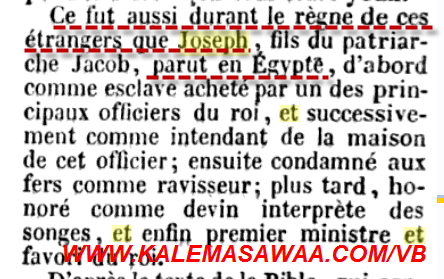
The Testimony of the Book Ancient Egypt by Champollion
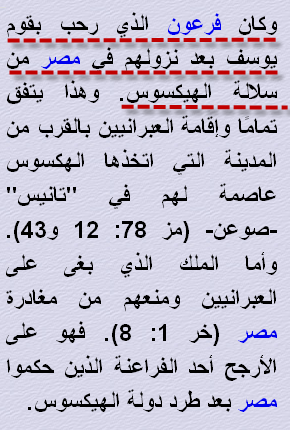
The history book Ancient Egypt by Champollion, page 298, placed Joseph (peace be upon him) in the Hyksos era. The Christian Biblical Encyclopedia — the Christian source itself — confirms that Joseph (peace be upon him) lived during the reign of the Hyksos.
The Christian Missionary’s Counter-Arguments and Their Refutations
Counter-Argument 1 — “The Hyksos King Apophis Was Called Pharaoh in Ancient Egyptian Texts”
The missionary claimed that the Hyksos king Apophis was called “Pharaoh” in ancient Egyptian texts — specifically citing the Wikipedia entry for the Apophis scarab and the Sallier Papyrus No. 1.
Refutation — The Hieroglyphic Text Does Not Contain the Word “Pharaoh”
The missionary presented the following hieroglyphic document as evidence:
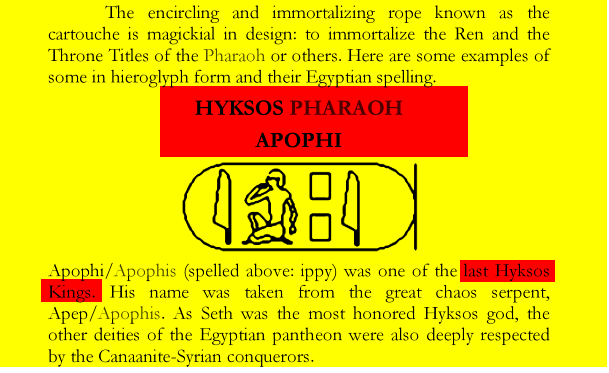
The challenge was issued: extract the word “Pharaoh” from this inscription. The missionary could not. The challenge was then extended to the Apophis scarab itself:
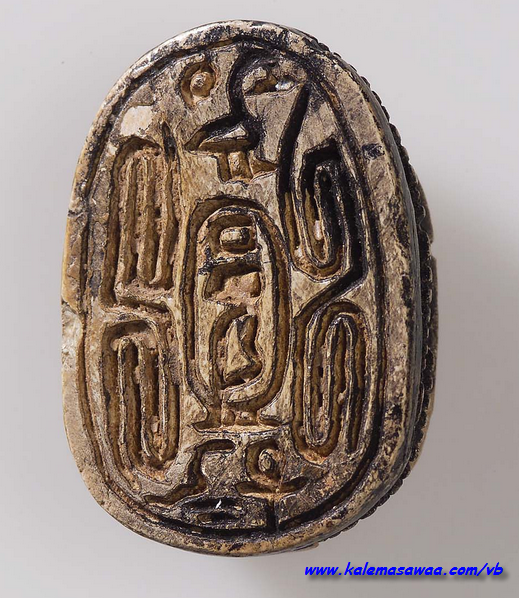
The missionary could not extract the word “Pharaoh” from either document — because it is not there.
The Wikipedia entry the missionary cited for the scarab reads: “Scarab bearing the name of the Hyksos pharaoh Apophis. Made of steatite, from the time of the Second Intermediate Period. Now residing in the Museum of Fine Arts, Boston.” The missionary cited this as proof — but a Wikipedia caption calling Apophis a “Hyksos pharaoh” is a modern description using modern terminology. It is not an ancient Egyptian document calling him Pharaoh. The caption itself says: “It bears the name of a Hyksos pharaoh called Apophis.” What does it bear? The name of a Hyksos pharaoh. It does not bear the word “Pharaoh” in hieroglyphics in the inscription itself.
Counter-Argument 2 — The Sallier Papyrus No. 1 Proves Apophis Was Called “Pharaoh”
The missionary cited the Sallier Papyrus No. 1 from the British Museum, which reads in part: “When Egypt was invaded by invaders, when Skinenre was ruler of southern Egypt, Pharaoh Apophis was in the palace of Avaris.”
Refutation — The Papyrus Uses “King APAPI,” Not “Pharaoh”
The full text of the Sallier Papyrus No. 1, page by page, reads as follows:
Page 1: “Then King SEKENEN-RA was Ruler in the Southern region, the impure in the district of Amu. Their Chief King APAPI in the city Avaris; the whole land did homage to him with their handiwork, paying tribute alike from all good produce of Tameri. King APAPI took to himself SuTECH for Lord…”
Page 2: “King APAPi sent to the Ruler of the South a notice… Now when the Messenger of King APAPi came to the Ruler of the South, he was conducted before the Ruler of the South. He said to the Messenger of King APAPI, ‘Who sent thee to the Southern region?’… The Messenger said: ‘King APAPi sent me to thee…’”
Page 3: “Then the Ruler of the South bade summon his mighty Chiefs, likewise his Captains and expert guides; he repeated to them the entire tale of the words which King APAPi sent to him concerning them.”
^^The papyrus refers to Apophis throughout as “King APAPI” — not as “Pharaoh.” The missionary’s own cited document calls him King, not Pharaoh.^^
Source: shsu.edu/~his_ncp/Hyksos.html
Counter-Argument 4 — “The Quran Does Not Know the Hyksos”
The missionary argued: “The Quran does not know the Hyksos — these are all inventions of a few who are trying to add a historical formula to the myths of the ancients.”
Refutation — The Quran Was More Accurate, Not Less
The Holy Quran was more accurate in describing the title given to the ruler of Egypt at the time of the Prophet Joseph (peace be upon him) — and this is a fact that no one can deny except a sceptic. The Quran did not need to know the word “Hyksos” — Muslims do not care about the name of the ruler of Egypt or his specific dynasty as much as they care about the historical period, which reveals the great miracle of the true divine revelation. By referring to the Christian holy book itself, one stands on the myths of the ancients — as seen in the Samson/jawbone and spear examples referenced above.
The missionary argued: “From the beginning of the 12th Dynasty, the word Pharaoh was used to refer to the royal palace, and in the New Kingdom it became used to refer to the person living in the palace.”
Refutation — The Missionary Conceded the Point
This statement from the missionary’s own side confirms precisely what was argued: the word “Pharaoh” referred to the palace — not to the person of the king — until the New Kingdom. It did not become a personal title for the ruler until the New Kingdom period. The missionary dug his own grave with this concession.
The missionary’s own source — Douglas K. Stuart in The New American Commentary, footnote page 24 — makes the same admission:
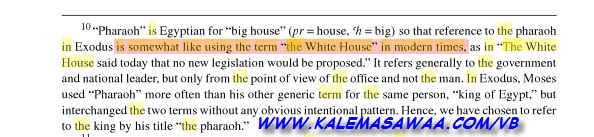
Another exchange produced the following admission from the missionary’s side: “At the end of ancient Egyptian civilization, the title of Pharaoh became the common title for the Egyptian king.”
This is the same conclusion: the title “Pharaoh” as a personal designation for the king is a late development — which is precisely the anachronism in the Bible.
The Five Unanswered Challenges
The missionary was slapped from all sides and was unable to respond to five specific challenges:
1. The words of the French Egyptologist Jean-Pierre Cortigiani — no response given.
2. What is stated in the book Ancient Egypt by Champollion, page 298 — no response given.
3. Extract the word “Pharaoh” from the hieroglyphic document the missionary himself cited and falsely relied upon:
4. Explain the meaning of the hieroglyphic writing in that same document — no response given.
5. Extract the word “Pharaoh” from the inscription of the Apophis scarab:
If the missionary has an ounce of courage, let him answer the above challenges in order: 1 — 2 — 3 — 4 — 5. The crushing continues.
The American Egyptologist William C. Hayes studied and published a papyrus from the Middle Kingdom dealing with slaves — relevant to the Joseph story. The Christian biblical archaeology site biblearchaeology.org noted: “We are fortunate to have a papyrus from the Middle Kingdom that deals with slaves. This papyrus was studied and published some years ago by the American Egyptologist William C. Hayes. We will have occasion to refer to this remarkable document in the next issue of Bible and Spade, since the reverse side of this same papyrus contains a discussion of Egyptian prisons, another topic of vital importance for the Joseph story.”
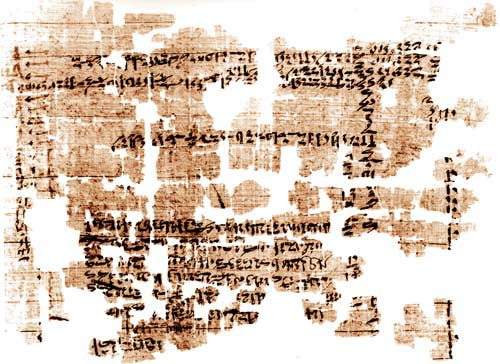
Source: biblearchaeology.org/post/2010/02/23/Joseph-in-Egypt-Part-II.aspx
The Companion Archaeological Images
The following images document the archaeological and textual evidence on the title “Pharaoh” and its historical usage:



The Quran’s Accuracy — Malik Vs Fir’awn
In the story of Joseph (peace be upon him), the Quran uses the word Malik — King — for the ruler of Egypt, not Fir’awn (Pharaoh). In the story of Moses (peace be upon him), the Quran uses Fir’awn — which corresponds correctly to the New Kingdom period when the title was in use.
The Quran distinguished between the two rulers using the historically accurate titles for each period. The Bible applied the later title “Pharaoh” retroactively to the ruler of Joseph’s time — an anachronism that Egyptology has confirmed, and that the Quran did not make.
The challenge to the Christian side was stated plainly: provide any evidence from the Quran that Joseph (peace be upon him) did not live during the Hyksos rule. No such evidence exists — because the Quran does not make the error. Muslims do not care about the name of the ruler of Egypt or the specific dynasty as much as they care about the historical period — which reveals the great miracle of the true divine revelation.
Additional Biblical Examples of Fantastic Claims
The same discussion notes several other examples of impossible claims in the Christian Bible: