The Gospel of Luke: Unknown Author, Human Sources, and Late Dating Problems
The Writer of the Gospel of Luke: Unknown Author, Unknown Condition, Unknown Time and Place
Table of Contents
- Introduction
- Luke Begins by Denying the Idea of Revelation
- Father Stephan Charpentier on Luke’s Method
- Who Is the Writer
- The Bible Dictionary on Luke
- Habib Saeed on the Anonymous Authorship
- Father Fahim Aziz on the Lack of Explicit Evidence
- Luke Was Not an Eyewitness
- Luke’s Sources Were Human Sources
- The Jesuit Bible Introduction
- Father Fahim Aziz on Luke’s Sources
- Matthew and Luke Used Mark
- Stephen Miller on Luke Using Mark
- Habib Saeed on Luke Collecting Reports
- Did Luke Write After His Death
- Final Argument
- Conclusion
Introduction
The writer of the Gospel of Luke, the “unknown” person, condition, time and place… wrote his Gospel after his death!
Luke Begins by Denying the Idea of Revelation
At the beginning of your reading of the Gospel of Luke, you will be surprised that the writer at the beginning of the Gospel denies the idea of revelation, or that he believes that what he will write will be attributed to a holy book!!
In Luke 1:1-3 we read:
“Since many have undertaken to draw up an account of the things accomplished among us, 2just as they were handed down to us by those who from the beginning were eyewitnesses and servants of the word, 3it seemed good to me also, having investigated everything carefully from the beginning, to write it down for you in order, most excellent Theophilus , 4so that you may know The truth of the words you were taught ”
The writer - the unknown - confirms to his friend Theophilus - the unknown - that what he writes is just a personal letter between two friends in which he tells him about what he knew from those who preceded him in writing!!
Father Stephan Charpentier on Luke’s Method
(Luke did not write a Gospel, but wrote with all humility a narration of events… Luke uses materials he took from tradition… but he rewrites them and arranges them skillfully, adding to them traditions that are unique to him)
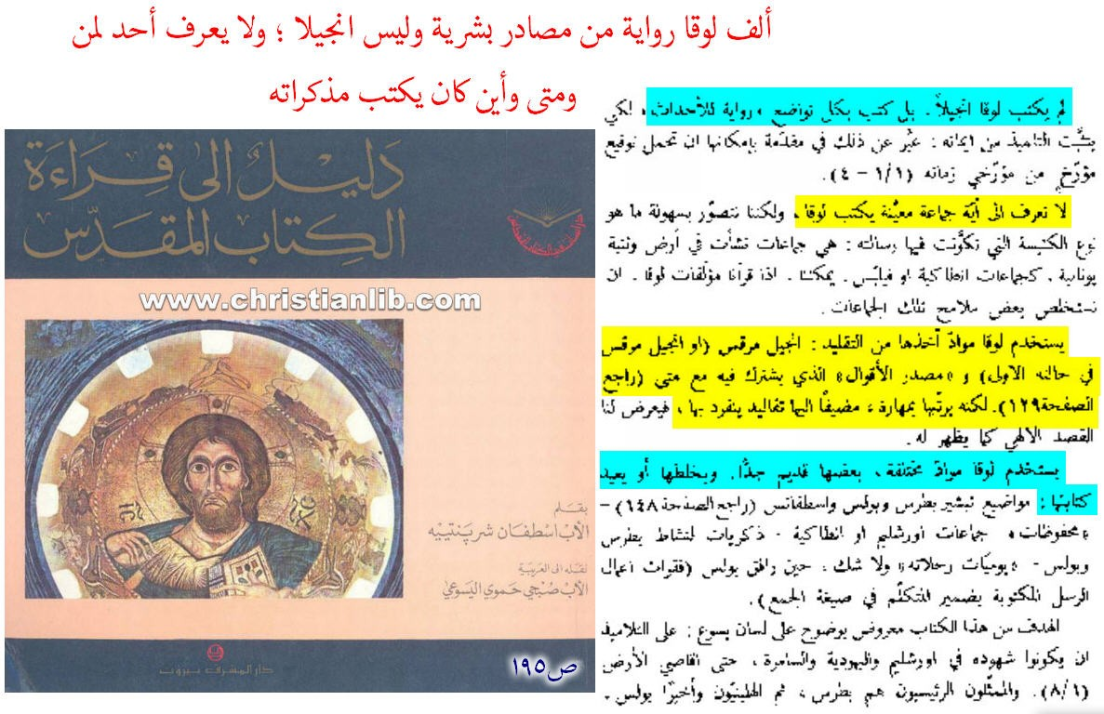
The highlighted section also says that Luke’s Gospel depends on inherited material and editorial arrangement. The emphasis is that Luke was working as a compiler and arranger of reports, not as someone presenting a direct revelation from God.
So how did these letters turn into a Holy Gospel by the choice of the Church, and there is not a single letter in them that calls for thinking that they are from God?!
Who Is the Writer
The writer says(I saw that I… should write); so who is this writer who will write?
The Bible Dictionary on Luke
(Luke is believed to be a Gentile.. and according to ancient news he was born in Antioch… no one knows anything about the time and manner of his death)
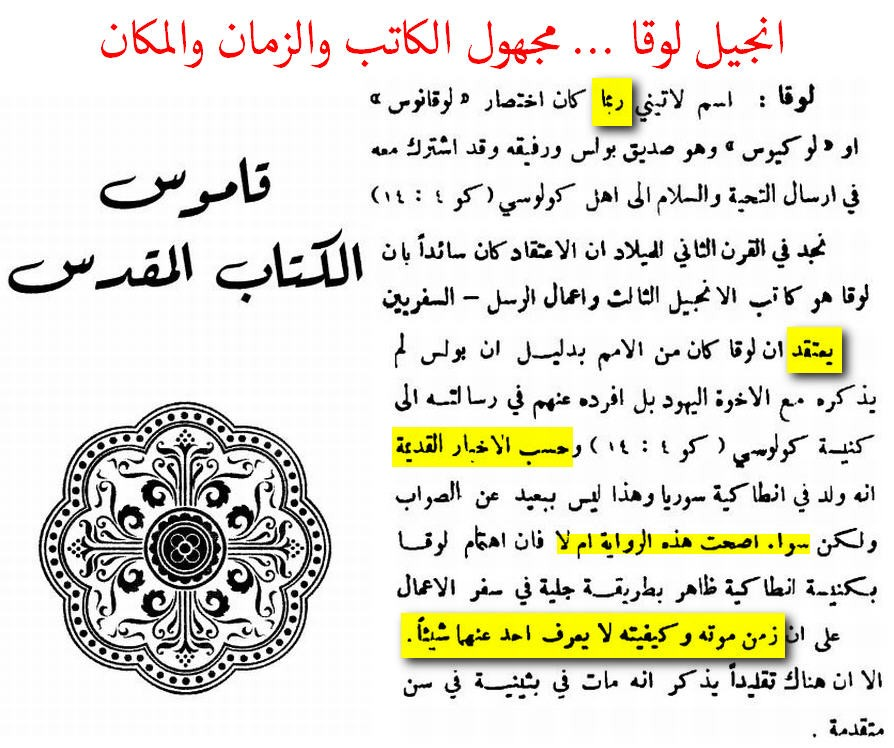
The important highlighted line says that no one knows anything certain about the time or manner of Luke’s death. The entry therefore presents Luke’s biography as dependent on belief and ancient reports, while admitting uncertainty about essential details such as his death.
Habib Saeed on the Anonymous Authorship
(The name of the author does not appear in either book - Luke and Acts - but since the second century tradition attributes these two books to Luke)
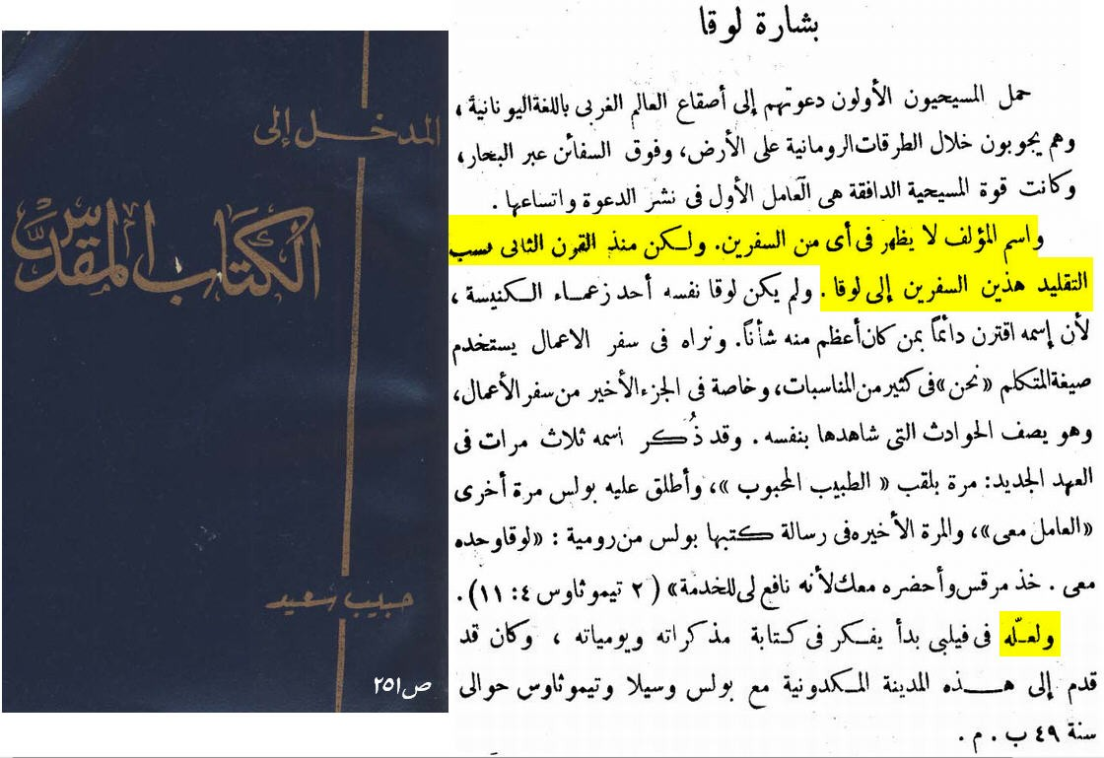
The key point in the highlighted text is that the attribution to Luke is not based on the books naming their author internally. Rather, the attribution depends on later tradition beginning from the second century.
Father Fahim Aziz on the Lack of Explicit Evidence
(The two books do not disclose the name of the writer… there is no explicit evidence that says that Luke is the author of both)
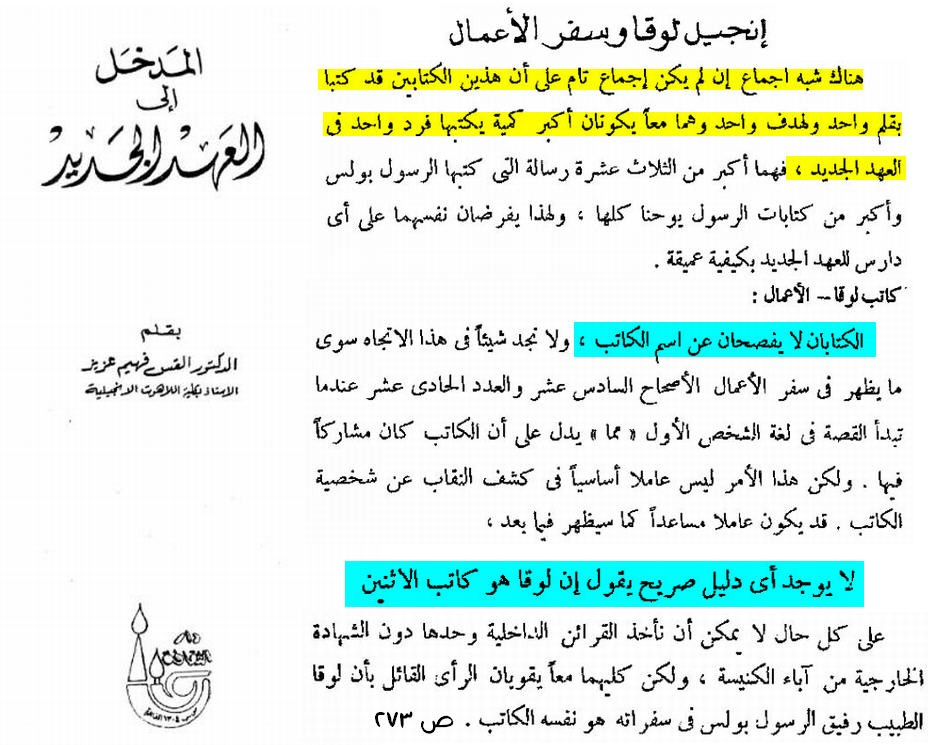
The highlighted section also points to the indirect nature of the attribution. It is not presented as an explicit statement from the text itself, but as a conclusion based on later reasoning and tradition.
Luke Was Not an Eyewitness
(This Gospel was written by a doctor named Luke… and Luke was not an eyewitness to the life of Jesus)
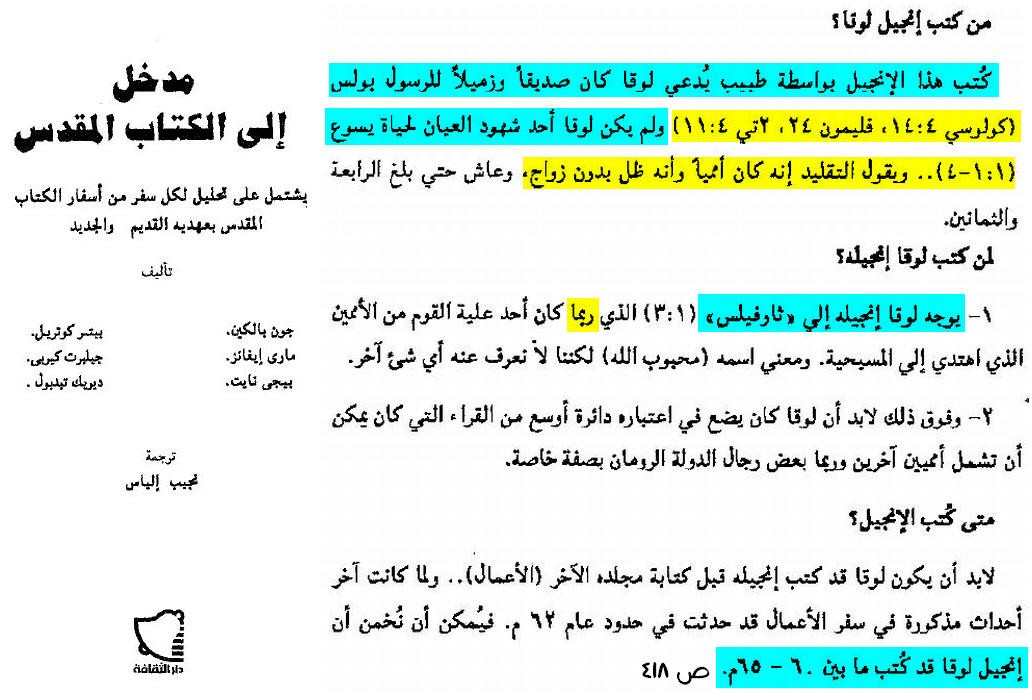
The highlighted statement is direct: Luke did not personally witness the life of Christ. This means the Gospel attributed to him is not being presented as the testimony of someone who saw Jesus’ ministry firsthand.
Until this day, no one knows who wrote the Gospel of Luke. The tradition that says that Irenaeus, who lived in the late second century, testifies that the writer of the Gospel is Luke the Physician, is without evidence or support. Irenaeus was not a contemporary of Luke’s time, so he cannot testify that he wrote the Gospel !!
Luke’s Sources Were Human Sources
The unknown Gospel writer says(I also decided, since I have carefully investigated everything from the beginning, to write in order); which confirms that he was copying from human sources and denies that he was writing under inspiration from God!
The Jesuit Bible Introduction
(Luke used in his Gospel a lot of the materials he had in common with Matthew and Mark, and these materials are very diverse… It is not possible to be certain about the origin of this Gospel… Critics often date the composition of the Gospel of Luke to between 80 and 90 AD… Tradition says that Irenaeus, who lived in the late second century, says that the writer of the Gospel is Luke the physician… This is not conclusive!!)
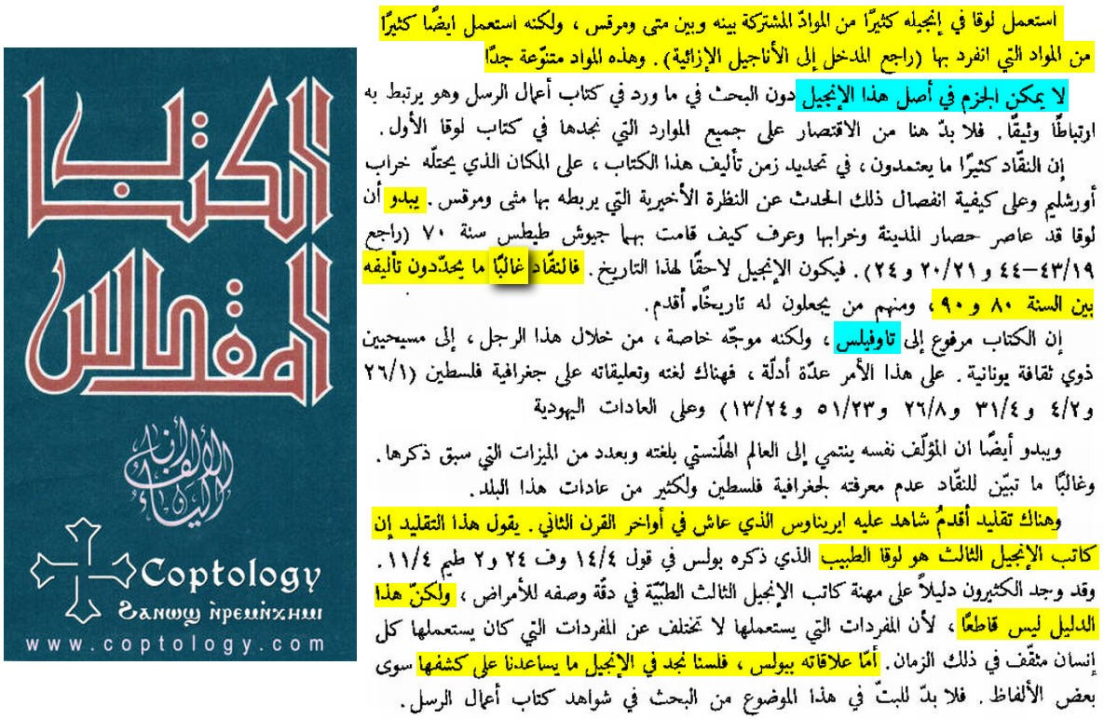
The highlighted section also mentions that critics usually date the writing of Luke’s Gospel between 80 and 90 AD. It then says that the tradition linking the Gospel to Luke the physician comes from Irenaeus, who lived in the late second century, but the text states that this is not conclusive.
Father Fahim Aziz on Luke’s Sources
(The sources that Saint Luke relied on: … The evangelist relied on those who preceded him in testifying to Christ in order to collect and obtain special information from them, and it also indicates that he took this information from written and oral sources)
(Matthew and Luke relied on four sources, which are: the Gospel of Mark, then source Q, then source L, and source M)
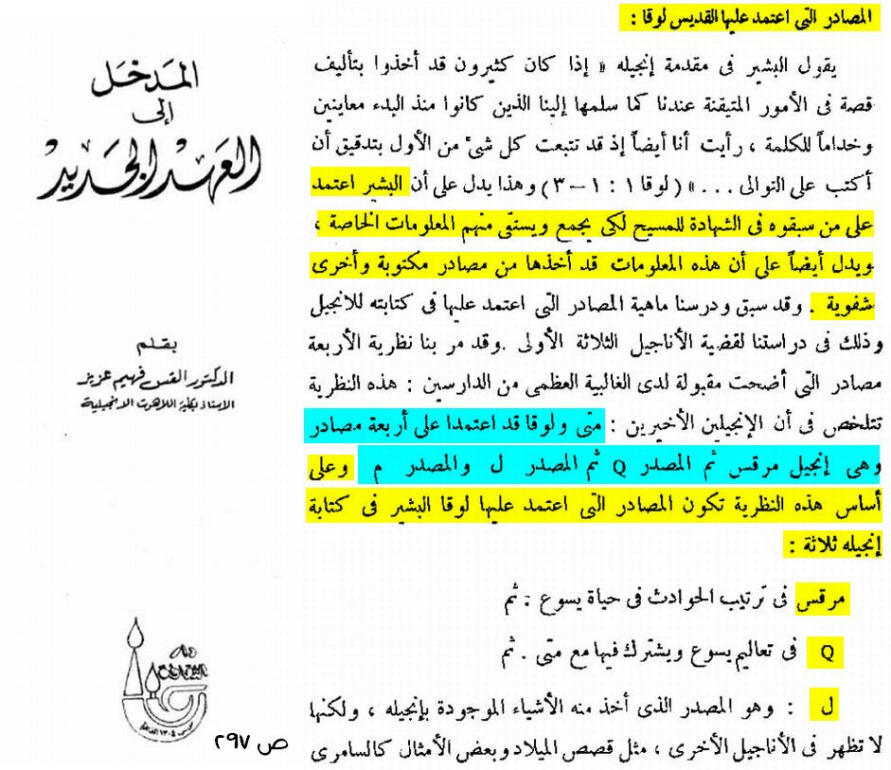
The highlighted section says Luke took information from written and oral sources. It also mentions the source theory used in Gospel studies: Matthew and Luke relied on four sources, namely the Gospel of Mark, source Q, source L, and source M.
Matthew and Luke Used Mark
(Matthew and Luke took the Gospel of Mark as a reference for them in writing Their Gospel… and they tried to refine its style in many ways)
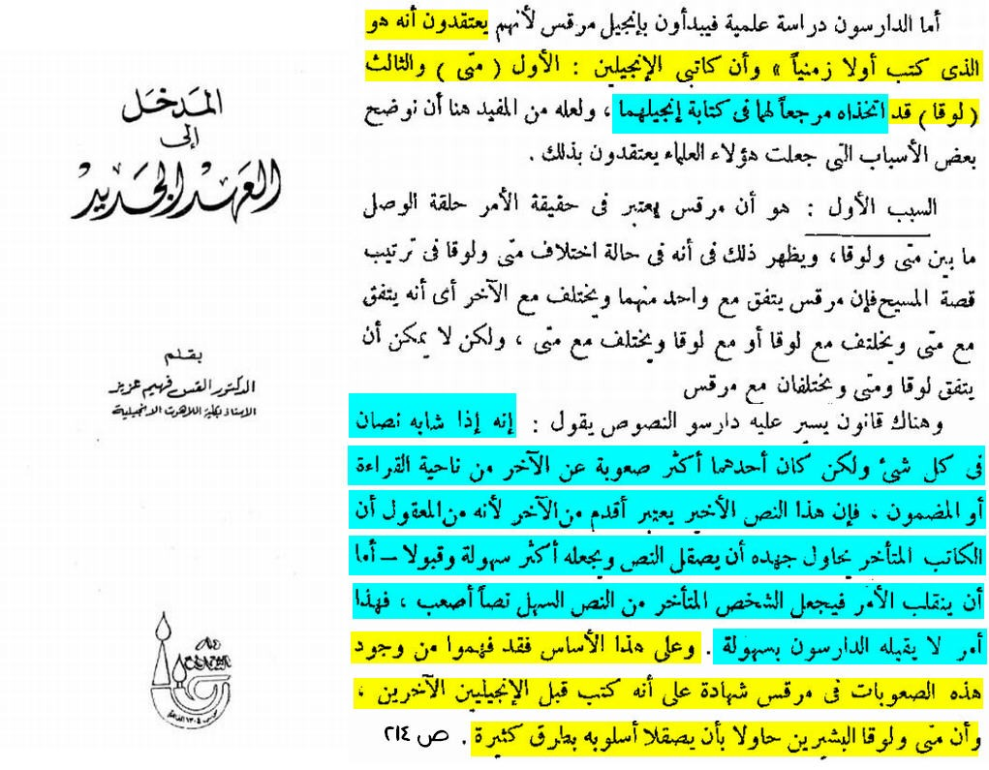
The highlighted section therefore presents Matthew and Luke as later writers using Mark as a written source, rather than independent eyewitnesses writing isolated revealed texts.
Stephen Miller on Luke Using Mark
(Luke used a lot of the Gospel of Mark with the addition of his own material)
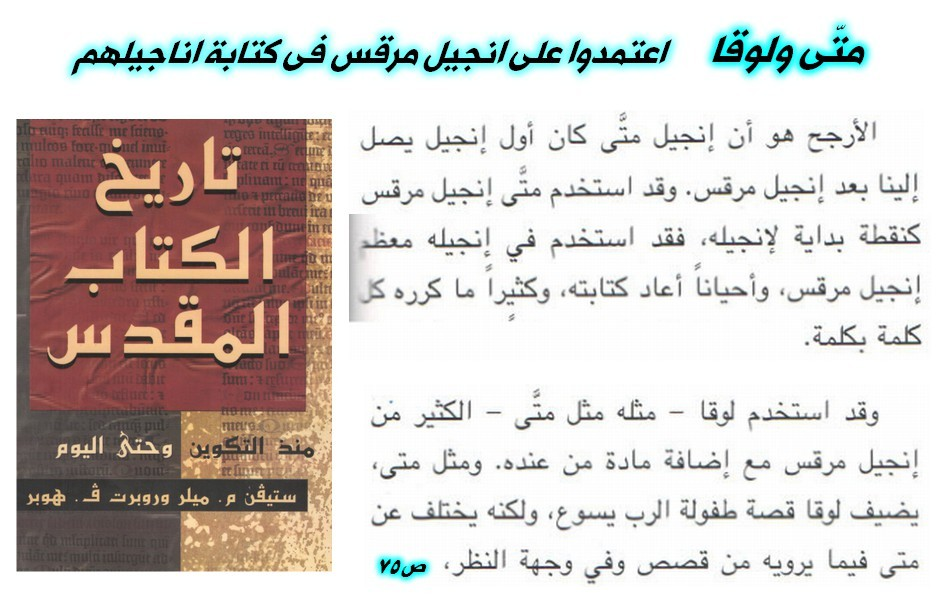
The important point is that Luke’s Gospel is described as dependent on a prior written Gospel, with additions from Luke’s own sources or material.
Habib Saeed on Luke Collecting Reports
(Perhaps in Philippi he began to think about writing his diaries and memoirs… and there is no doubt that he spent a portion of time collecting new documents and listening to oral conversations, and Philip the deacon and his four prophetess daughters lived in Caesarea and there is no doubt that he heard from him and from them the exciting stories that followed the crucifixion)
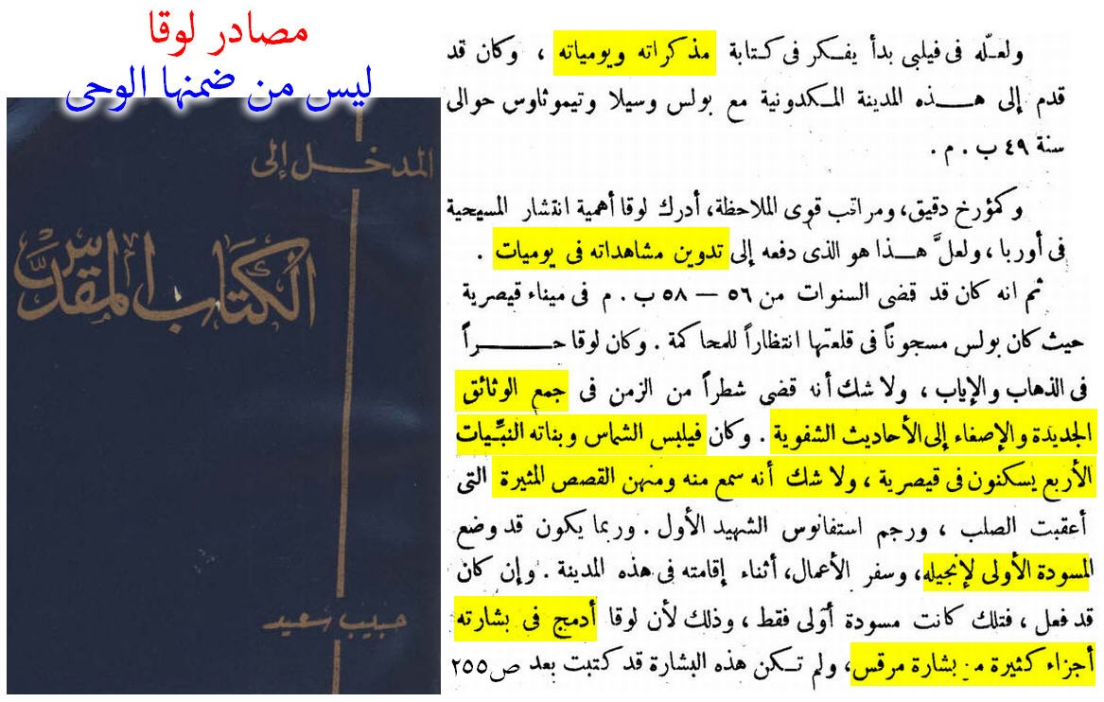
The highlighted text specifically mentions Philip the deacon and his four prophetess daughters in Caesarea, saying that Luke undoubtedly heard from them the exciting stories that followed the crucifixion. This presents Luke’s work as dependent on collected reports, documents, conversations, and stories heard from others.
So according to the testimony of Christian scholars, the writer of the Gospel was not writing by inspiration from God; rather, he was copying from written sources, some of which are known, such as the Gospel of Mark, and some of which are unknown; and he was also adding to his book what he heard from those he met, such as Philip and his four daughters !!
Was the revelation sent down to Philip’s four daughters?!!
Did Luke Write After His Death
And the surprise… tradition confirms that Luke wrote his Gospel after his death!!
Antonius Fikri says that Luke was martyred by Nero who lived between the years (37 BC - 68 AD)
and at best we will say that Nero killed Luke in the last year of his life 68 AD.
On the other hand, we read from the introduction to the Gospel of Luke from the Jesuit Bible that most critics place the composition of the Gospel of Luke between the years 80 and 90 AD!!
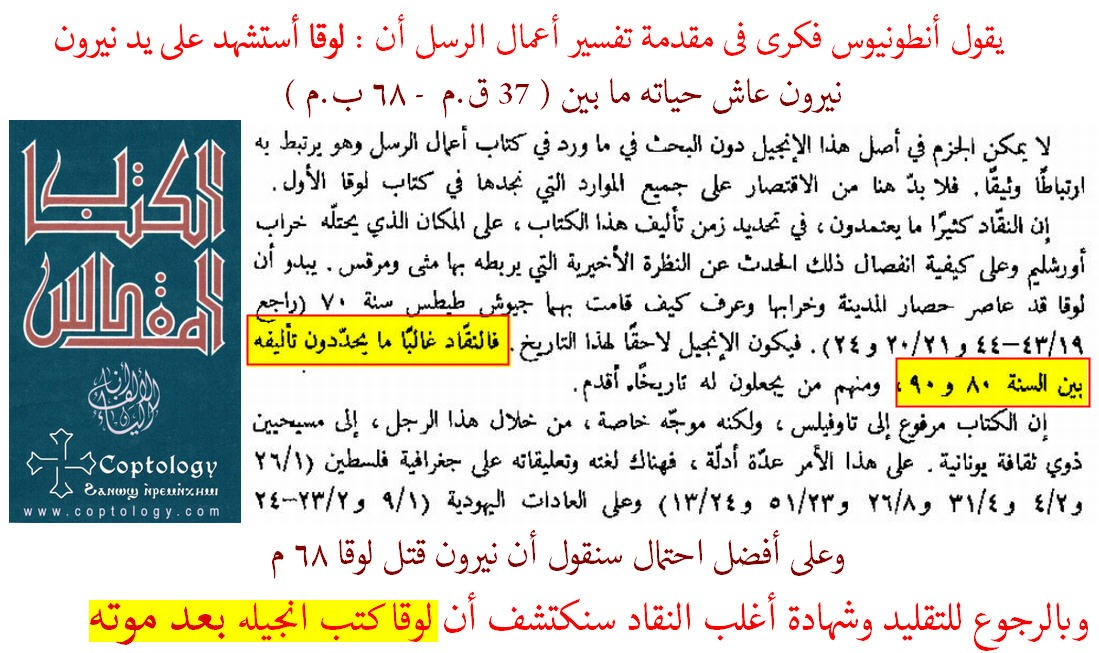
The second highlighted section, from the Jesuit Bible introduction, says that most critics date the composition of the Gospel of Luke between 80 and 90 AD. The comparison creates the problem: if Luke died by 68 AD, but the Gospel is dated between 80 and 90 AD, then the traditional attribution makes Luke the author of a Gospel written years after his death.
Here the miracle appears; by subtracting the time of writing the Gospel from the year of Luke’s death, we find that Luke wrote his Gospel12 to 22 years after his death!!
Final Argument
and if the evidence confirms that Luke was writing from biblical and non-biblical sources; to the point that he transferred the words of unknown people and girls into the text of his writings,
and if the tradition that the church adopted in choosing the name of the writer was wrong, and made Luke write his Gospel dozens of years after his death,
So, after all this evidence and proof, how could a rational person dare to attribute this human author, whose writer, time and place are unknown, to the word of the Holy Lord?!!
Conclusion
The final problem raised is chronological: if Luke died under Nero by 68 AD, while the Gospel is dated by many critics to 80–90 AD, then the traditional attribution becomes impossible on that timeline.