

The Hadith "Satan Sleeps in the Nostrils" — Explanation, Scholarly Commentary, and Satan in the Bible
The Hadith and Its Linguistic Analysis
The hadith of Abu Hurairah regarding the command to blow one’s nose states: “For Satan spends the night on one’s nostrils.”
Al-Hafiz Ibn Hajar al-Asqalani stated in Fath al-Bari, his commentary on Sahih al-Bukhari:
His saying “so let him blow his nose” is more beneficial than his saying “so let him sniff it,” because blowing the nose is similar to sniffing, not the other way around. One may sniff but not blow his nose. Blowing the nose is a complete benefit of sniffing, because the reality of sniffing is drawing water with the wind from the nose to its furthest point, and blowing the nose is removing that water. The purpose of blowing the nose is cleaning the inside of the nose, and blowing the nose is removing that dirt with the water — so it is a complete benefit of sniffing. It was said: blowing the nose is taken from the tip of the nose. It was also said: the nose itself. Based on this, whoever blows his nose has blown his nose, because he believes that he took water with his nose or the tip of his nose, and there is a view on this.
Then the apparent meaning of the hadith is that this happens to every sleeper, and it is possible that it is specific to the one who does not guard against Satan with any remembrance, due to the hadith of Abu Hurairah mentioned before the hadith of Sa’d, in which it says: “So it was a protection for him from Satan,” and likewise Ayat al-Kursi, and it was mentioned before: “And no Satan shall come near you.” It is possible that what is meant by denying closeness here is that he does not come near the place where he whispers, which is the heart, so he spends the night on the nose in order to reach the heart from it when he wakes up. So whoever blows his nose, it prevents him from reaching what he intended from the whispers — so in that case the hadith is applicable to everyone who is awake. Then sniffing water from the nose is one of the Sunnahs of ablution, according to consensus, for everyone who wakes up or is awake. A group said that it is obligatory in ritual washing and a group said that it is obligatory in ablution as well. Is the Sunnah fulfilled by it alone without sniffing water from the nose, or is there no disagreement? This is a subject of research and contemplation. What appears is that it is not completed without it, due to what was mentioned above. And Allah knows best.
The Hadith of the Singing Girl and the Phrase “The Devil Has Blown into Her Nostrils”
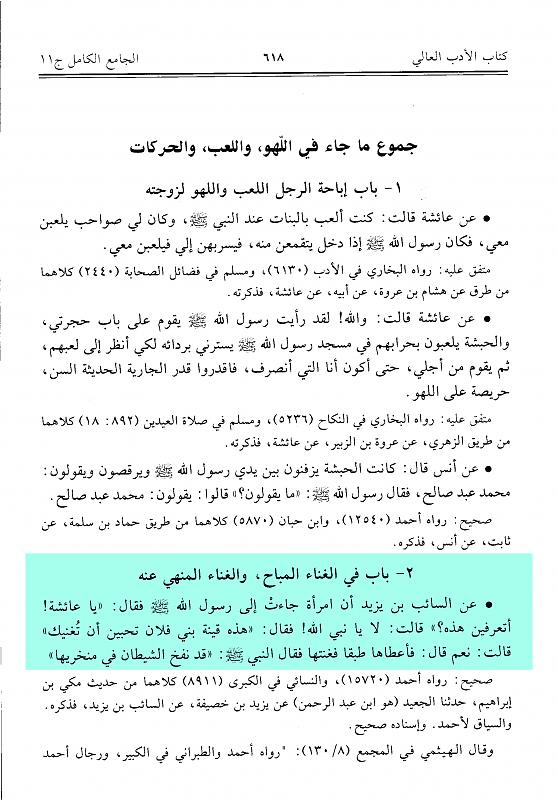
It was stated in The Biography of Sayyida Aisha, Mother of the Believers (p. 86):
Grade: Al-Haythami said in Majma’ al-Zawa’id 8/130: It was narrated by Ahmad and Al-Tabarani, and the men of Ahmad are the men of Sahih.
This means that the Prophet ﷺ disliked such songs.
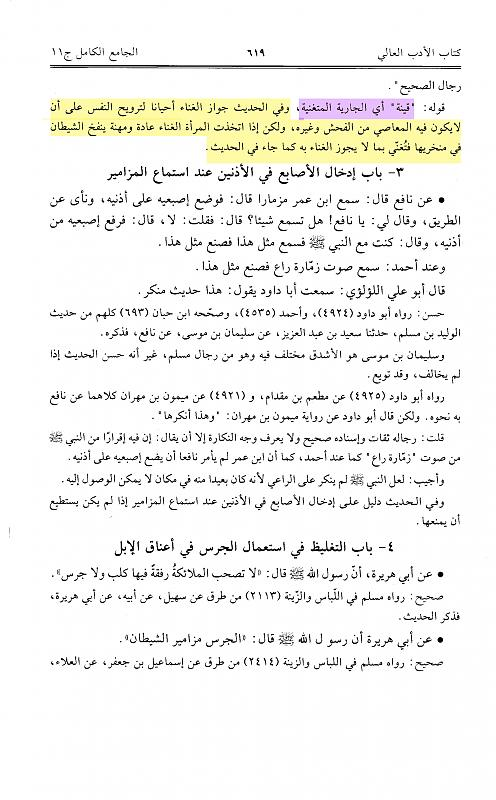
Some have interpreted his statement “The devil has blown into her nostrils” as praising and commending her singing and her activity in singing.
The author of Shama’il al-Habib al-Mustafa (p. 181) says:
It is stated in Al-Fath al-Rabbani li-Tarteebi Musnad al-Imam Ahmad ibn Hanbal al-Shaibani (17/232):
The Two Scholarly Interpretations of “Satan Sleeps on the Nose”
The scholars have offered two interpretations of the phrase “the devil sleeps on his nose”:
First Interpretation — Literal
The first interpretation is that this is as it appears — that the devil literally spends the night in this place. Ibn al-Qayyim (may God have mercy on him) said:
Second Interpretation — Metaphorical
The second interpretation is that the meaning is that whatever harm and filth is in the nose is in agreement with the devil, because devils are evil and are found in evil places. So it is prescribed for the sleeper, when he wakes up, to clean his nose by blowing it — which is drawing water into the nose and then expelling it.
Judge Iyad said:
The apparent meaning of the hadith is that this applies to every sleeper. It is possible that it is specific to someone who does not protect himself with any remembrance before sleeping, such as reciting Ayat al-Kursi.
Satan in the Bible — A Comparison
Now let us look at how Satan is portrayed in the Christian Bible.
Satan Is True and God Is a Liar
What the serpent (Satan) said came true — and the Lord God’s warning did not come to pass as literally stated.
Satan Is the Messenger of God
Satan is presented here as appearing before the Lord and conversing with Him — functioning as a messenger sent against Job by God’s own permission.
Peter, Jesus’ Disciple, Is Called “Satan”
Jesus calls his own chief disciple “Satan” — a designation placed in the mouth of the one Christians worship as God.
Satan Hindered Paul the Apostle
Paul declares that Satan was able to obstruct and hinder the plans of the Apostle of Jesus Christ — including preventing him from reaching his own congregation.