

The Hour Will Be Established While the Romans Are the Majority — Al-Nawawi & Al-Qurtubi Explain
The hadith that the Hour will be established while the Romans are the majority of people is frequently misunderstood in its geographical and theological scope, yet classical commentators and historical sources confirm that “the Romans” (al-Rum) refers to Christians and their European heirs — what is today known as the West.
The Hadith and Its Wording
Narrator: Al-Mustawrid
Grade: Sahih · Muslim
The hadith in question refers to Romans, but with the qualities found we can deduce that it is referring to the Christians. This interpretation is not novel; contemporary scholar Uthman Al-Khamis has likewise understood the hadith as referring to Christians.

Classical Scholarly Commentary
Classical scholarship confirms this reading independently of modern historical research.
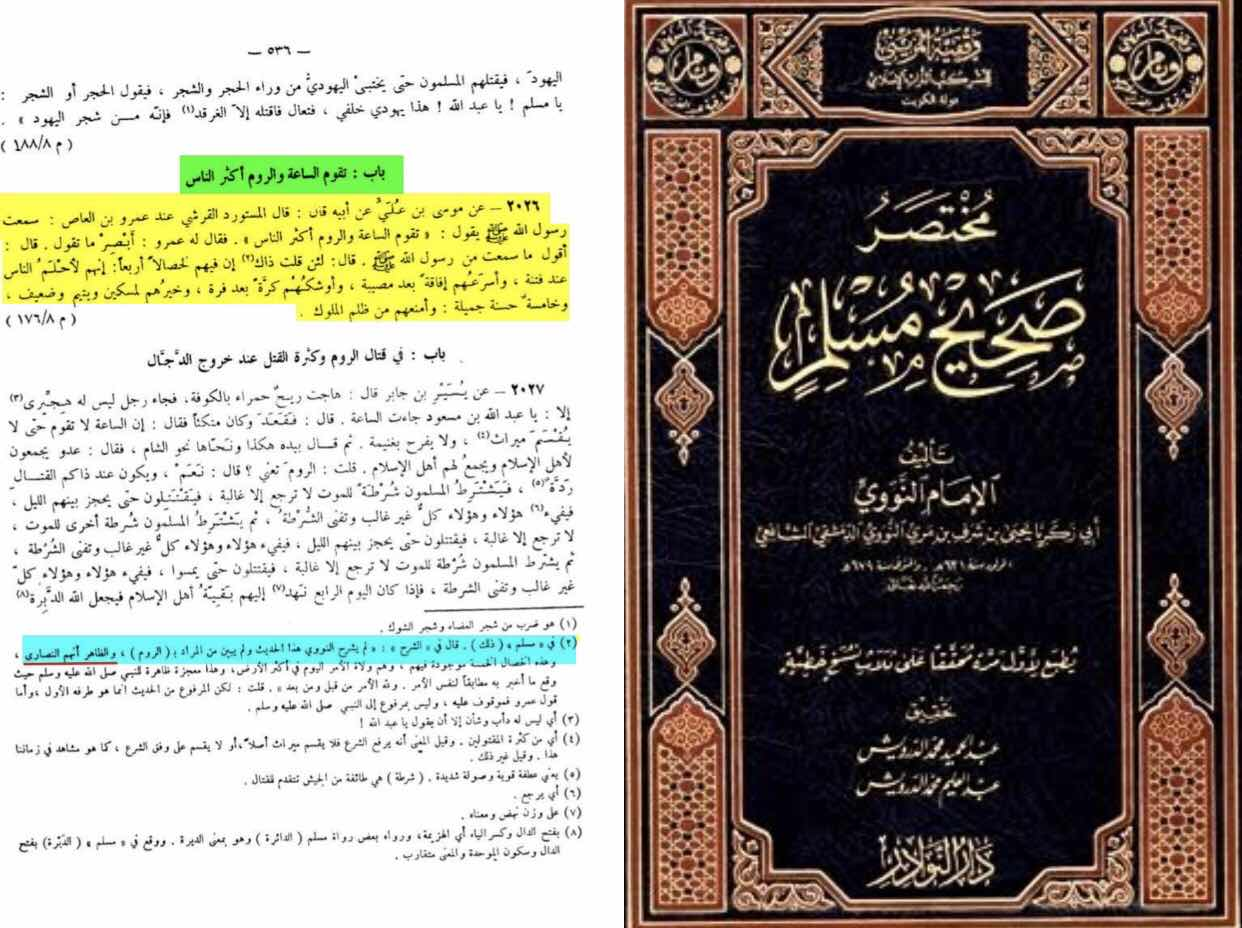
[!scholar] al-Nawawi — Mukhtasar Sharh Sahih Muslim 536
“An-Nawawi didn’t explain who the ‘Romans’ was referring to; the most apparent is that it is referring to Christians.”
The classical exegete al-Qurtubi expands on this identification by linking the hadith to observable demographic realities.
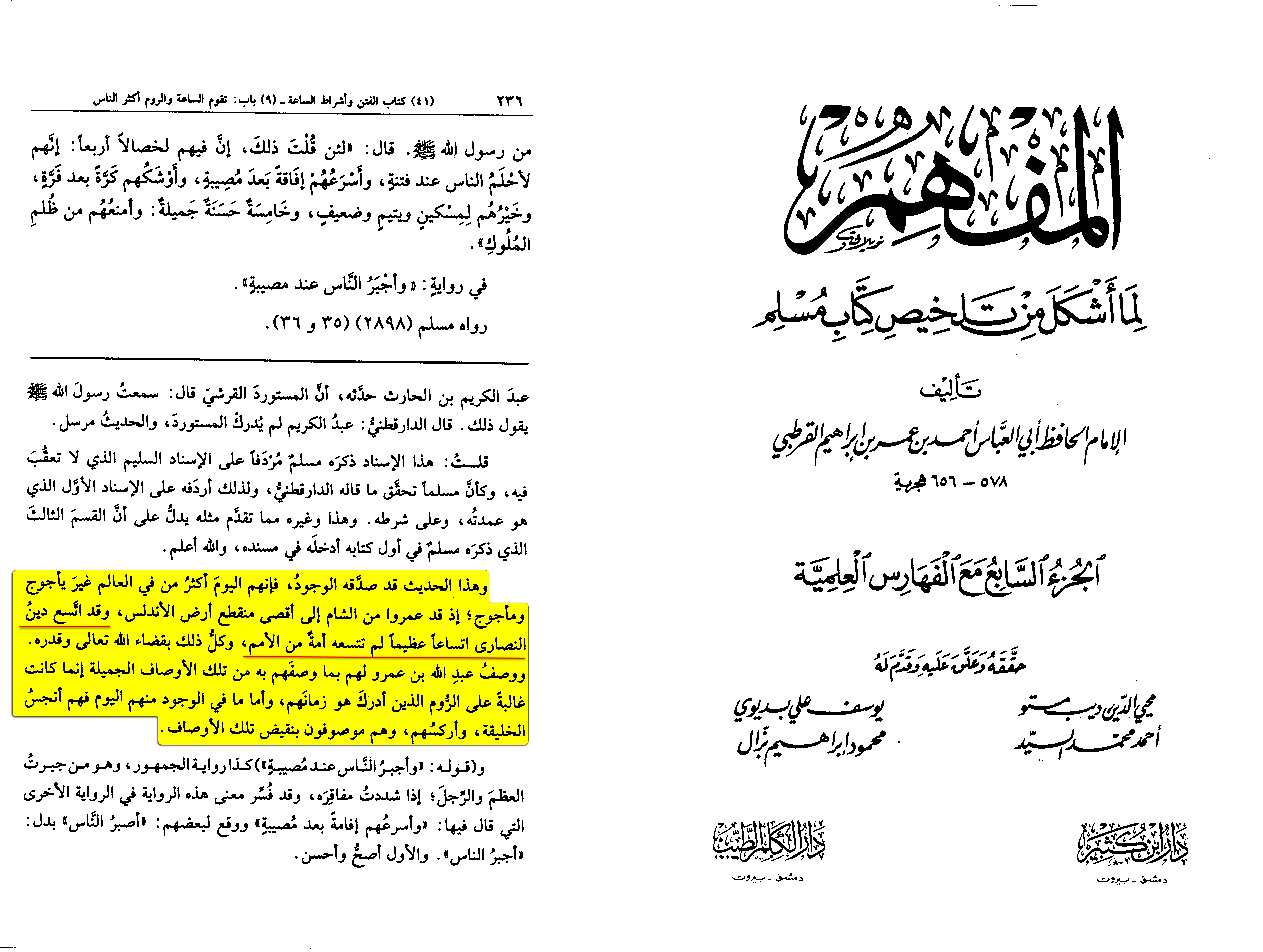
[!scholar] al-Qurtubi — Al-Mufhim 7/236
“And this hadith has been verified by reality, for today they are the biggest population other than Gog and Magog. And the religion of the Christians has spread a spread that not a single nation has been able to achieve. All of that is with the ruling of Allah (SWT).”
Al-Qurtubi’s commentary in Al-Mufhim documents the demographic reality of Christian expansion across the known world.
Historical Definition of al-Rum
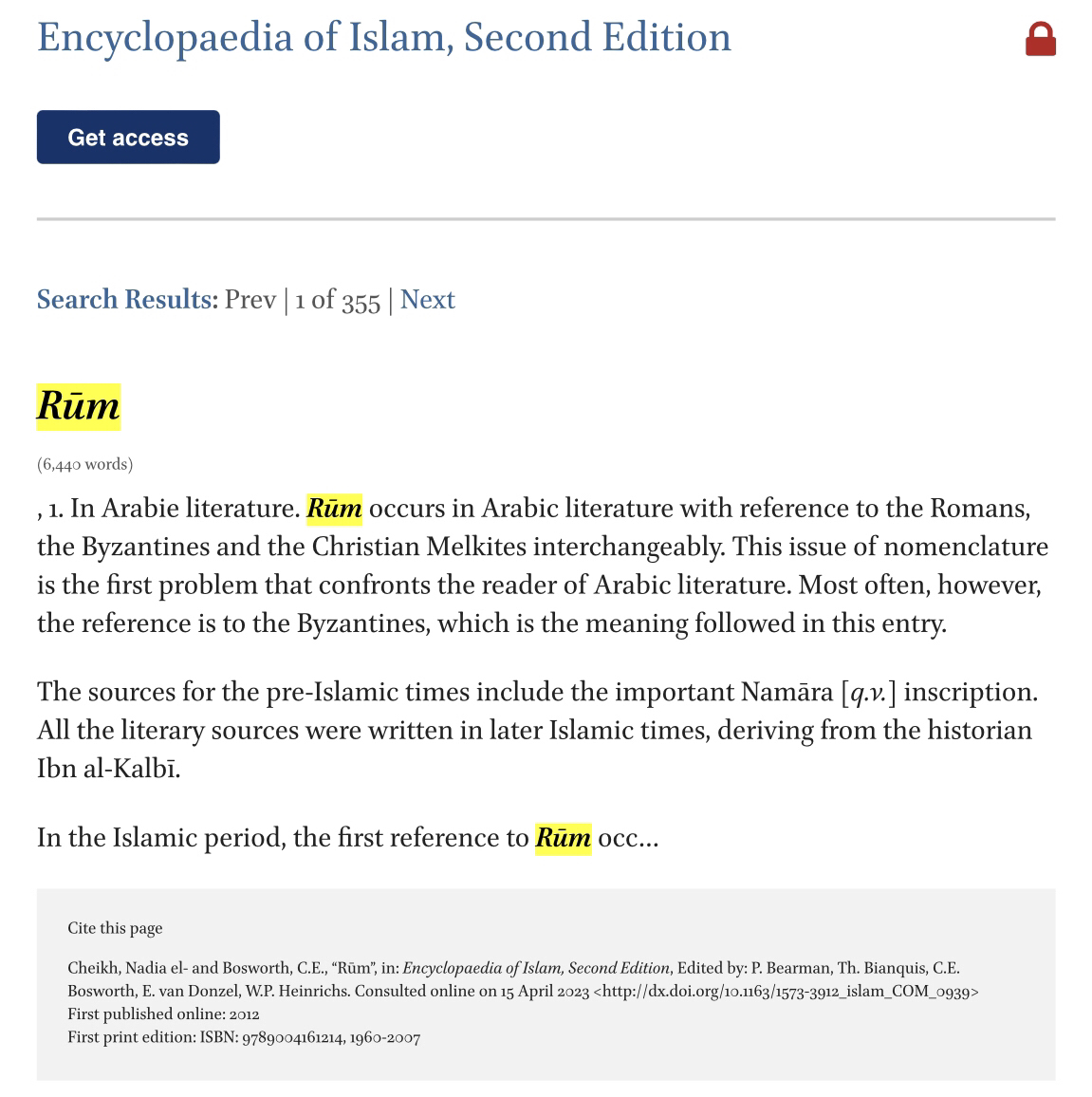
In Islamic terminology, the Arabs referred to the Byzantine Empire and its Christian, Greek-speaking subjects as al-Rum. The Byzantines themselves identified as Romans, using the Greek term Romaioi, and their Muslim opponents knew them as Rum.
Since the time of the Prophet ﷺ, Rome refers to both Eastern and Western Europe, or basically wherever they had control at some point. Romans during the time of the Prophet ﷺ and the Sahaba were what we call now Europeans, and from today’s standards, the entire group of Romans would include Europeans, North Americans, Australians, and New Zealanders. In short, what one now calls the West.
The historical usage of the term Byzantines clarifies whom the Arabs intended by al-Rum. Hugh N. Kennedy confirms that the population identified themselves as Romans and were known to Muslims as Rum.
[!admission] Hugh N. Kennedy — The Great Arab Conquests: How the Spread of Islam Changed the World We Live In 7–8
“Historians are accustomed to talking about the Byzantine Empire to describe the Eastern Roman Empire. It is a convenient term to designate the Christian, Greek-speaking and –writing empire of the seventh and eighth centuries. It is also completely out of touch with the language of the people at the time. No one at that or any other time ever described themselves in normal life as ‘Byzantines’. They themselves knew that they were Romans and they called themselves as such, though they used the Greek term Romaioi to do so. Their Muslim opponents also knew them as Rum, or Romans, and this term was often extended to include the Latin Christian inhabitants of North Africa and Spain. Despite the violence it does to the language of the sources, I have, with some reluctance, accepted the general scholarly usage and refer to Byzantines and the Byzantine Empire throughout.”
The geographical scope of Bilad al-Rum is further delineated by medieval Islamic geographers. Koray Durak maps the boundaries of the Roman lands in medieval Islamic geographical thought.
[!admission] Koray Durak — Who are the Romans? The Definition of Bilad al-Rum in Medieval Islamic Geographies 286
“The region in question (i.e. Rome) is the territory that lay to the north and west of the Islamic Near East and North Africa; it corresponds roughly to today’s Europe and Turkey.”
The medieval geographical texts delineate the Roman lands as the contiguous territories bordering the Islamic world to the northwest.
Aziz al-Azmeh further refines the understanding of Rome’s territorial identity in the medieval Islamic imagination.
[!admission] Aziz al-Azmeh — Rome, New Rome, Baghdad: Pathways of Late Antiquity
“Rome according to Muslims was generally confined to geographical Europe. Rome’s internal evolution had shifted to the East, and specifically to the Fertile Crescent and beyond. He further states: Even Irenaeus, Bishop of Lyons, was an Easterner, and wrote in Greek, which had been the original liturgical language of the Church in Rome until it was slowly, and in the fullness of time, replaced by Latin.”
Conclusion
From the above, we can safely conclude the following: Romans today are Europeans and their descendants. Their descendants today include North Americans (USA and Canada) along with the Australian continent (Australia and New Zealand). In other words, to narrow it to lesser words, we can say that Rome, in Islamic terminology, refers to what we know today as the West.
“Ar Rum” in the Quran refers to what we now call the Byzantine Empire, however it also is used to refer to their heirs, successors and/or descendants, by way of Western Europe and the Christians.
Classical scholarly opinion is significant as they are symbolic of inexpediency. They understood the hadith this way, without any of the historical insight that we have now. This should be sufficient.