

"The Peshitta Is a 5th-Century Translation — How the Late Date of the Syriac New Testament Confirms the Poor Quality of the Byzantine Text
The Question and Why It Matters — What is at stake in dating the Peshitta
The Four Manuscript Families — Alexandrian, Western, Byzantine, Caesarean
The Van Dyke Text and Its Basis — Erasmus and the Received Text
The Westcott and Hort Theory — The Byzantine family was invented late
Scholarly Consensus on the Date of the Peshitta — Lamsa, Metzger, Waltz
Manuscript Lists — All 300+ Peshitta Manuscripts Are Post-5th Century — Six sources
The Critical Evidence — Diatessaron Readings Against the Peshitta — Statistical analysis
Results — 64% of Diatessaron Readings Agree with Old Syriac, Not Peshitta
The Question and Why It Matters
What is the textual family that was widespread in Syria in the first four centuries? The answer to this question determines the date of the PeshittaSyriac: ܦܫܝܛܬܐ (Pshitta) — “the simple” or “the common.” The Peshitta is the standard version of the New Testament used by Syriac-speaking Eastern Christians. It is anonymous and its date has been debated, though the scholarly consensus firmly places it in the 5th century., the anonymous translation of the New Testament into Syriac that Eastern Christians in the Arab world use via the Van Dyke translation.
The date of the Peshitta matters because it determines whether there is any early witness to the Byzantine text familyThe Byzantine text family (also called the Majority Text or the Byzantine Majority Text) is a group of New Testament manuscripts sharing common readings, associated with the Byzantine church and the ecclesiastical transmission of the text. It forms the basis of the Textus Receptus and hence the KJV and Van Dyke translations. — one of the four families of New Testament manuscripts. If the Peshitta dates to the 2nd century and is Byzantine in character, it would push the Byzantine family back to the early period. If it dates to the 5th century, then the Byzantine family remains without any witness before the 5th century.
The scholarly consensus since the beginning of the 20th century has been that the Peshitta dates to the 5th century. The evidence examined in this note confirms and extends that consensus.
The Four Manuscript Families
The manuscripts of the New Testament differ from each other in deep-rooted and systematic ways, such that each region produced its own characteristic text. Scholars divide New Testament manuscripts into four main families:
-
Alexandrian text — associated with Egypt, represented by Sinaiticus, Vaticanus, and the papyri
-
Western text — associated with North Africa and Western Europe, represented by Codex Bezae and the Old Latin
-
Byzantine text — associated with Constantinople and the Eastern church, forming the basis of the Received Text
-
Caesarean text — associated with Palestine, a transitional family
The Peshitta is Byzantine in character in the four Gospels, but Western in the remaining 22 books of the New Testament. Additionally, the Peshitta omits five books entirely (2 Peter, 2 John, 3 John, Jude, and Revelation), which itself indicates it represents a tradition distinct from later harmonized versions.
The Van Dyke Text and Its Basis
The printed text widely used by Eastern Christians — including in Arabic — is the Van Dyke version, which is a translation of the Greek version prepared by Erasmus in the 16th century. This Greek text is known as the Textus ReceptusLatin: “Received Text.” The Greek New Testament edition produced by Erasmus in 1516, based on approximately 5–7 late medieval Greek manuscripts. It became the standard for Protestant Bible translation through the 16th–19th centuries. Modern scholarship has abandoned it in favor of critical editions based on the oldest manuscripts. (Received Text). Erasmus relied on approximately 5 manuscripts, all from the Byzantine family.
Accordingly, the quality of the Van Dyke text depends entirely on the quality of the Byzantine text family. If the Byzantine family is proven to be chronologically late — invented after the earlier text families — then the current New Testament in widespread use among Eastern Christians becomes a forged and invented text with no early manuscript support.
The Westcott and Hort Theory
In the late 19th century, a theory by Westcott and Hort swept the entire field of textual criticism. Its summary is that the Byzantine family is the worst of the textual families and was formed late — in the 4th century — by Lucian of AntiochLucian of Antioch (died 312 CE) — an early Christian theologian who produced a revised edition of the Greek New Testament. Westcott and Hort, and many scholars after them, attributed the Byzantine recension to him. This would date the Byzantine text to the early 4th century at the earliest — well after the Alexandrian and Western families..
There are five pieces of evidence for this theory:
-
There is not a single Greek manuscript containing the Byzantine text before the 5th century (the Alexandrian Codex A, which itself is not fully Byzantine).
-
None of the Church Fathers before the 4th century quote characteristically Byzantine readings.
-
The Byzantine text is consistently smooth — all difficult or disharmonious readings have been removed, indicating a process of editorial improvement.
-
The Byzantine text shows many conflationsConflation: a reading in which two earlier variant readings are combined into one longer reading. Westcott and Hort identified many places where the Byzantine text merges an Alexandrian and a Western reading, proving it must be later than both. — places where two earlier readings have been combined into one longer reading, proving it is derivative.
-
The Encyclopedia of Textual Criticism records: “The uselessness of the Byzantine text was not only universally accepted, but nearly unquestioned.” (Encyclopedia of New Testament Textual Criticism, Robert B. Waltz, p. 9)
The critical question: If the Peshitta is from the 2nd century, and it is Byzantine in the Gospels, then evidence exists for Byzantine readings before the 5th century, and the Westcott-Hort theory requires revision. If the Peshitta is from the 5th century, the theory stands intact.
The defenders of the Byzantine text are divided into two groups: textual critics (very few) and enthusiastic non-specialists. Notably, even the textual critics who defend the Byzantine family do not defend the Received Text / Van Dyke text — they advocate for a separate reconstruction called the Byzantine Majority Text, which they consider superior to the Received Text. None of the scholarly defenders use the Peshitta as evidence.
Scholarly Consensus on the Date of the Peshitta
George Lamsa
George Lamsa authored one of the most famous printed versions of the Peshitta — the Lamsa Version — and personally believed in the old 19th-century view that the Peshitta dates to the 2nd century. Despite this personal position, even he was forced to acknowledge the scholarly consensus against him:
“To add insult to injury, scholarly consensus holds that the Peshitta … was translated from the Greek by Rabbula, the bishop of Edessa from 412-435 AD.”
Source: http://www.superbook.org/LAMSA/FAQ/peshitta_old_syriac.htm
Bruce Metzger
“As for the New Testament, the process of producing the Peshitta version from the Old Syriac probably began before the end of the fourth century and seems to have been completed no later than the time of Rabbula, bishop of Edessa (AD 411–35).”
Encyclopedia of Textual Criticism
“The date of the Peshitta is unknown, but it was probably written in the fourth century and it is difficult to believe that it was written after that. The earliest Greek witness to the Byzantine text is the uncial A, of the fifth century. The Peshitta Syriac is also largely (though not overwhelmingly) Byzantine; Its date is uncertain though it is usually ascribed to the fourth century (and can hardly be later than this).”
The Critical Edition of the Peshitta — Tetraevangelium Sanctum
The famous critical edition of the Peshitta — Tetraevangelium Sanctum iuxta simplicem Syrorum versionem by Ph. E. Pusey and G. H. Gwilliam (Oxford, 1901) — states:
“The Text is based on the evidence of a large number of MSS., of various ages and different localities. They range from copies of the fifth century… to such a distinctly Jacobite copy as Lord Crawford’s MS., written in Tur’abdin in the twelfth century.”
Note that the oldest manuscripts in the critical edition of the Peshitta itself begin from the 5th century. There are none before it.
Manuscript Lists — All 300+ Peshitta Manuscripts Are Post-5th Century
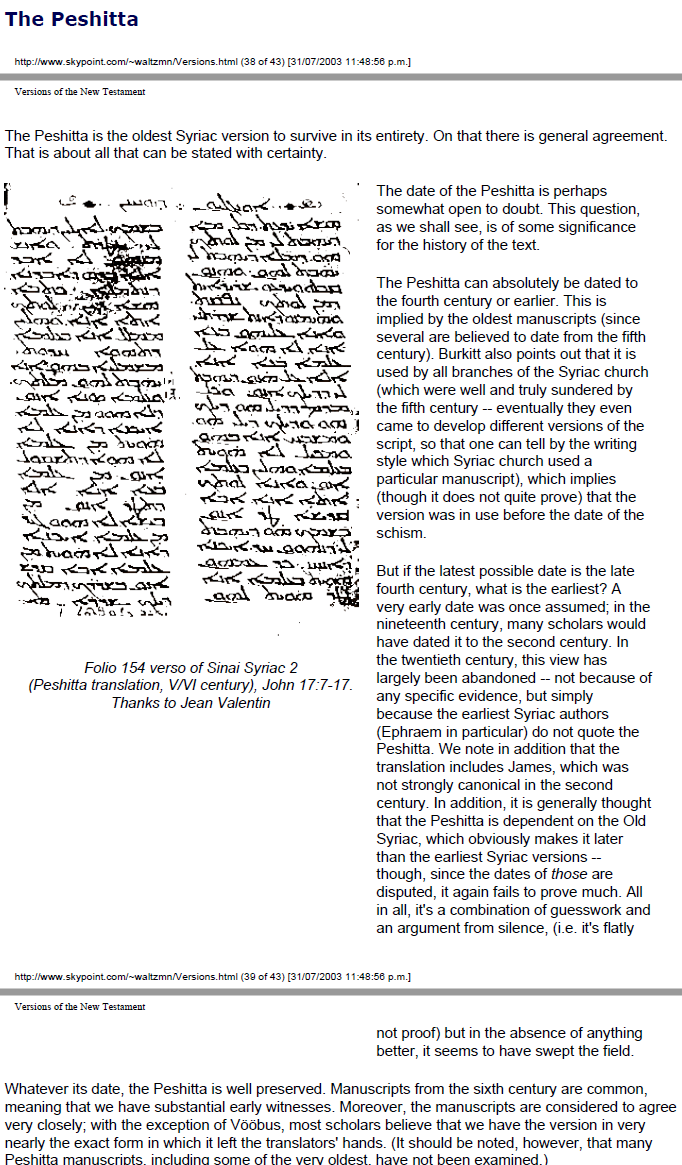
One of the most powerful pieces of evidence for the late date of the Peshitta is that all of the Peshitta manuscripts discovered — numbering more than 300 manuscripts — are from after the 5th century. There is not a single Peshitta manuscript from before the 5th century.
This is an extremely large number. It cannot be coincidence that all 300+ manuscripts begin after the 5th century.
The following images contain manuscript lists and dates from six major scholarly sources:
First: Introduction to the Textual Criticism of the New Testament — Cambridge
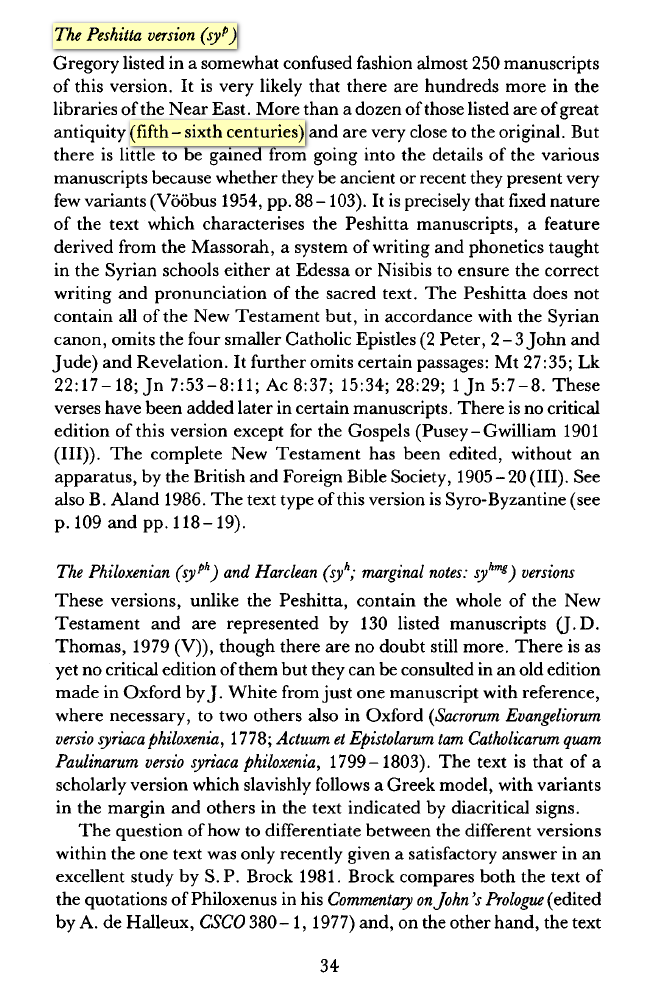
The Cambridge introduction lists Peshitta manuscripts with their dates and origins, none preceding the 5th century.
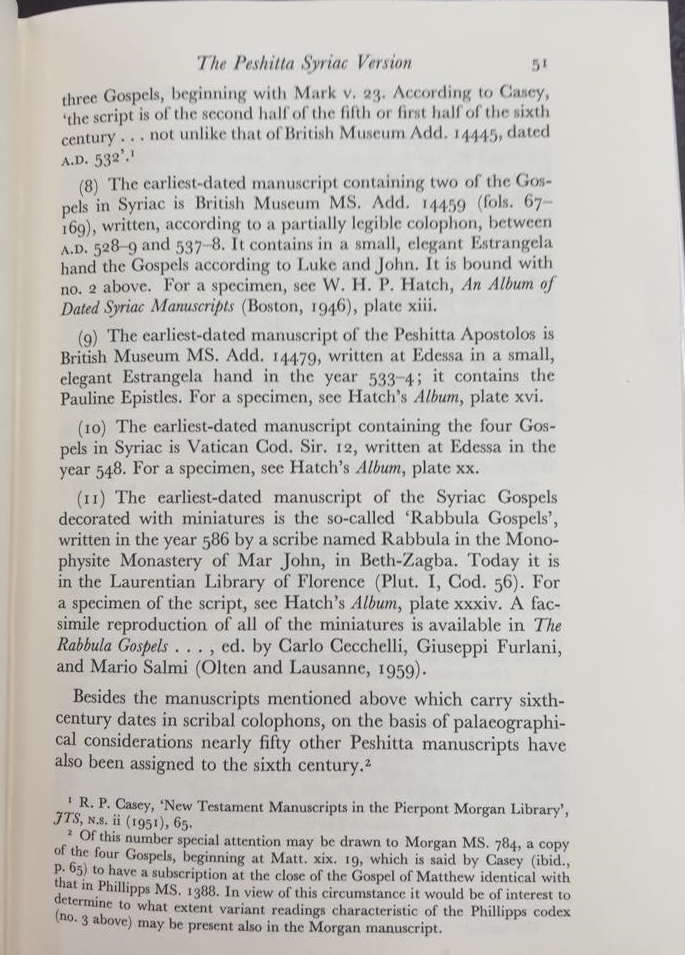
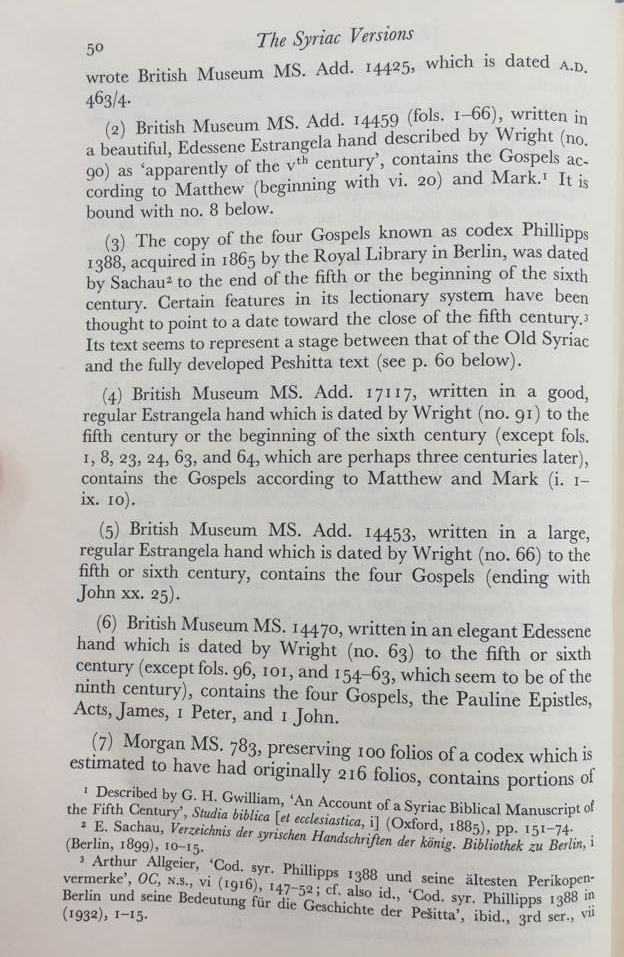
Second: Bruce Metzger — Early Versions of the New Testament
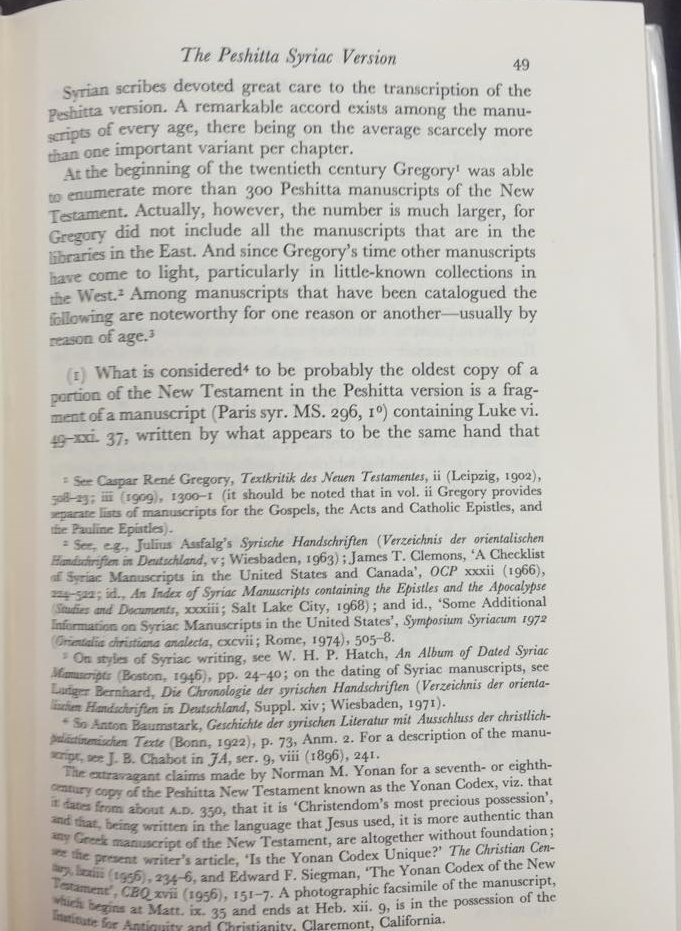
Metzger’s comprehensive treatment of early versions lists the Peshitta manuscripts with their dates and textual affinities.
Third: Introduction to Textual Criticism of the New Testament — Harold Greenlee
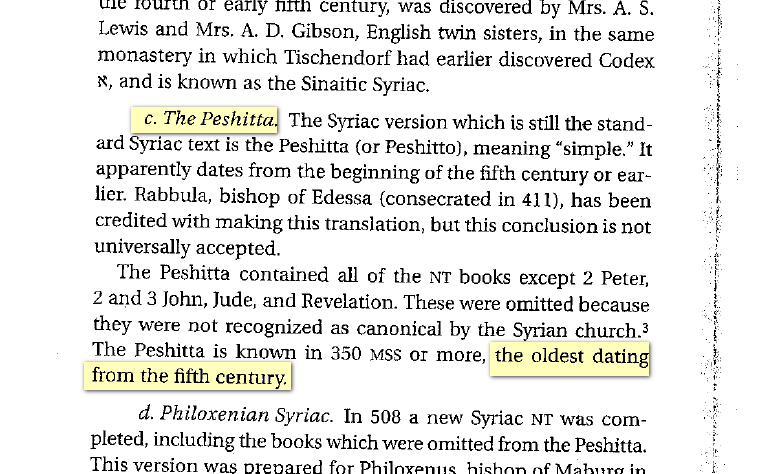
Greenlee’s introductory textbook confirms the same dating pattern across all listed Peshitta manuscripts.
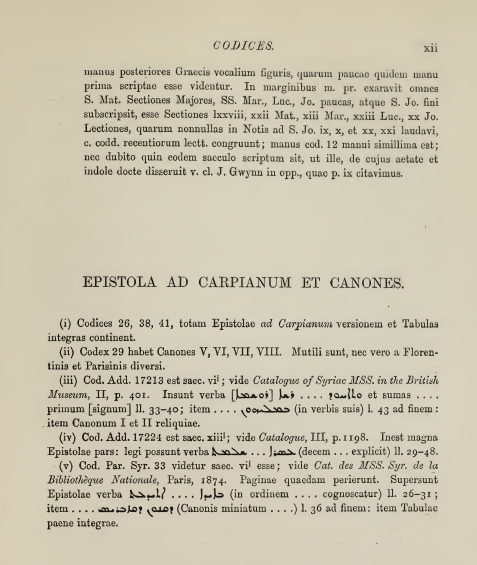
Fourth: The Critical Peshitta Edition — G. William (Gwilliam)
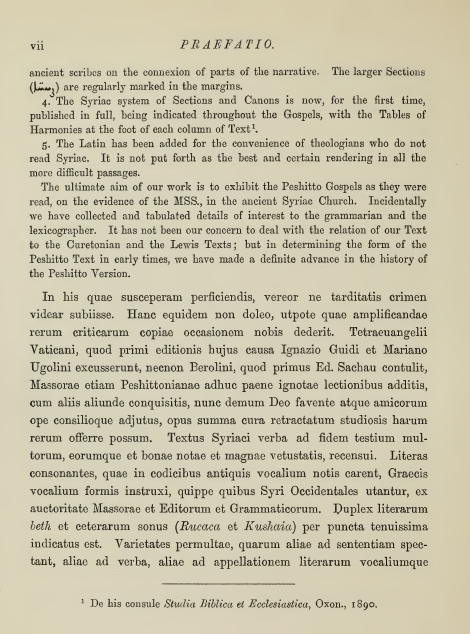
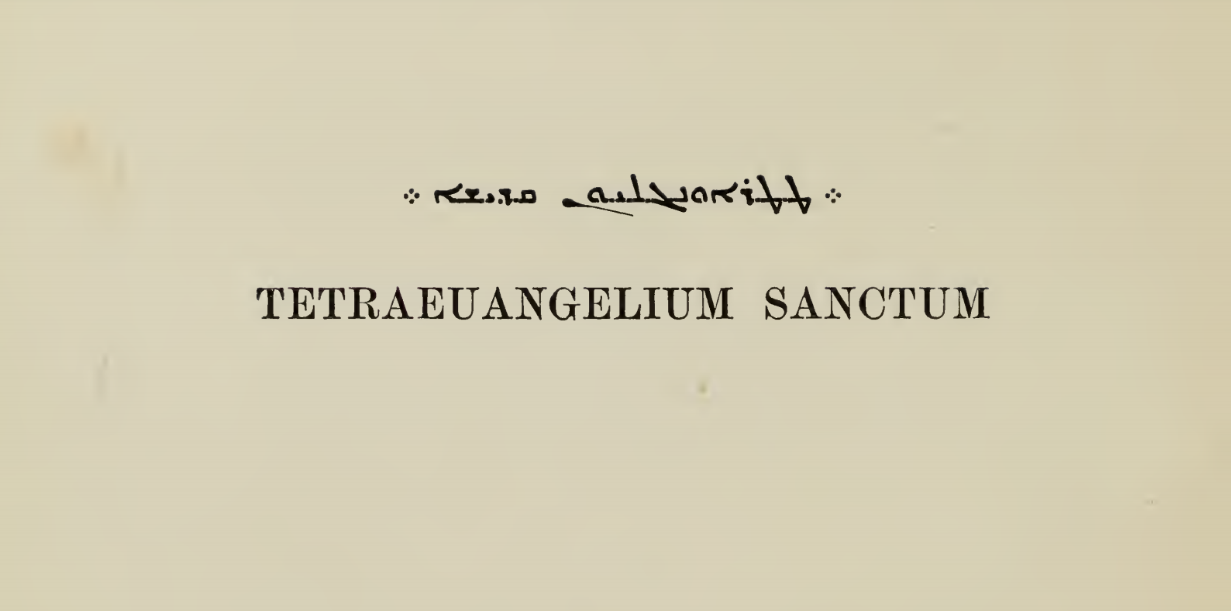
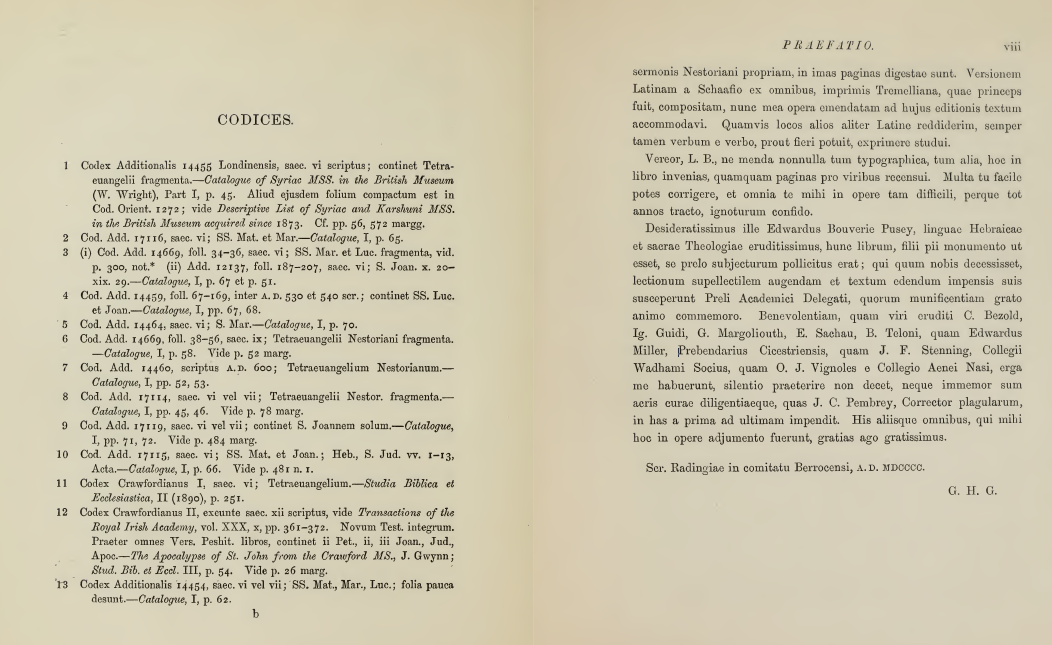
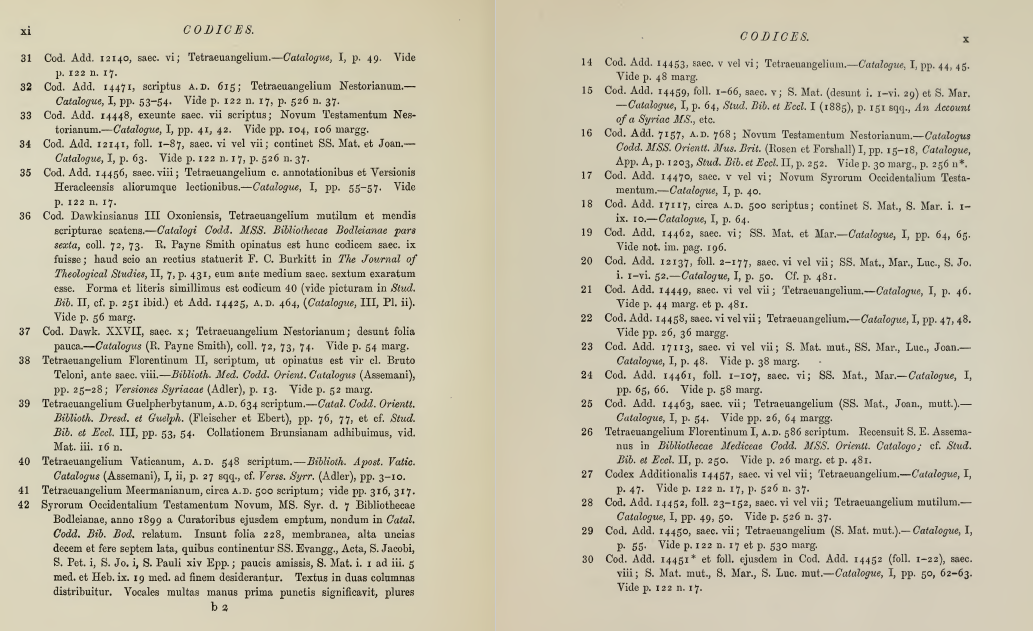
The Gwilliam critical edition — the most thorough critical edition of the Peshitta — lists its manuscript base as ranging from the 5th century onward.
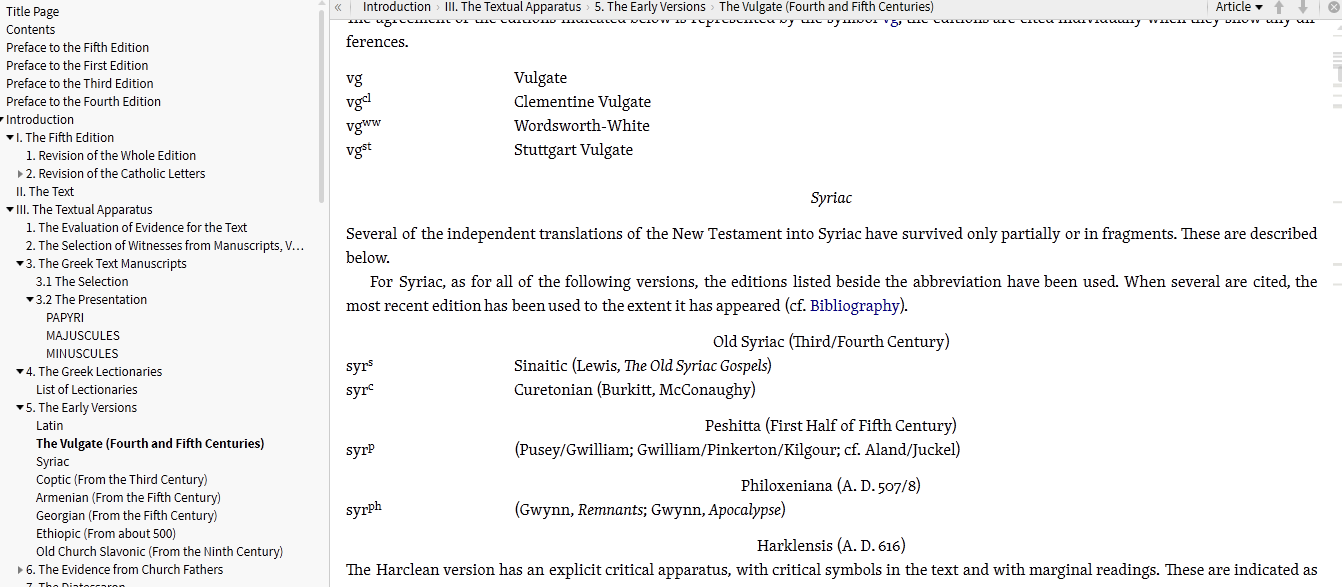
Fifth: UBS 5th Edition Critical Apparatus
Sixth: Encyclopedia of Textual Criticism
Summary Tables
The following tables summarize the names and dates of Peshitta manuscripts from all six sources above:
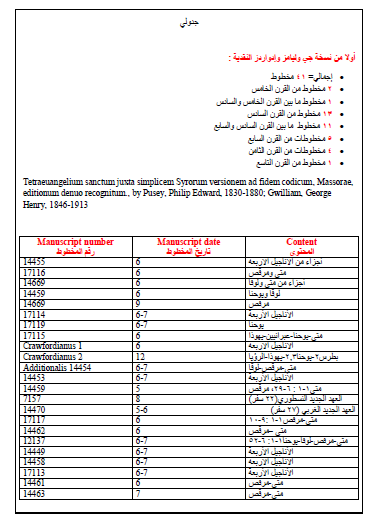
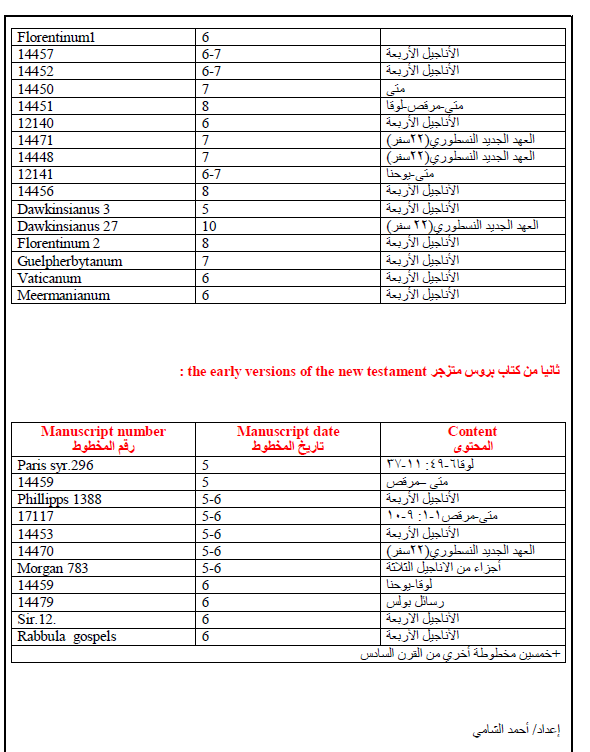
You will not find any Peshitta manuscript in any of these lists dating back to before the 5th century. The complete archive of Peshitta manuscripts — all 300+ of them — begins after the 5th century. This statistical uniformity is not coincidence.
The Syriac Manuscript Tradition — Six Sections
The manuscripts written in Syriac for the New Testament are divided into six sections, each with its own characteristic readings:
-
Diatessaron — Tatian’s 2nd-century harmony of the four Gospels into one continuous narrative
-
Old Syriac manuscripts (Vetus Syra) — the oldest Syriac witnesses:
- Syriac Sinaiticus (4th century)
- Syriac Curitonianus (5th century)
-
Peshitta — 5th century
-
Philoxenian Syriac — early 6th century
-
Heraclean Syriac — 7th century
-
Palestinian Syriac — 6th century onward
The oldest available Syriac manuscripts are the Old Syriac witnesses — the Sinaitic and Curitonianus. The available Syriac Fathers and writers from the first four centuries are three: Tatian (represented through the Diatessaron), Ephraim the Syrian, and Ephrahat the Syrian.
The UBS Committee confirms what text was dominant in Syria in this early period:
“Another Eastern type of text, current in and near Antioch, is preserved today chiefly in Old Syriac witnesses, namely the Sinaitic and the Curetonian manuscripts of the Gospels (cited in the critical apparatus as syrs and syrc) and in the quotations of Scripture contained in the works of the Syriac Church leaders Aphraates and Ephraem in the fourth century.”
This is decisive: the UBS Committee itself confirms that the text current in Syria and Antioch in the 4th century is preserved in the Old Syriac manuscripts — not the Peshitta.
The Critical Evidence — Diatessaron Readings Against the Peshitta
The present study adds a new piece of evidence to the series proving the late date of the Peshitta:
The core argument: All the Fathers and Syriac writers of the first four centuries, when they quoted from the New Testament, agreed with the ancient Old Syriac manuscripts — not with the Peshitta. If the Peshitta had existed in the early period, their quotations would have agreed with it.
Scholars examined the readings in which the Old Syriac manuscripts (Vetus Syra) differ from the Peshitta, and then asked: when these two traditions diverge, which one does the Diatessaron follow?
The comparison table was based on the critical apparatus of the UBS 5th edition:
Aland, B., Aland, K., Karavidopoulos, J., Martini, C.M., & Metzger, B. (Eds.). (2014). The Greek New Testament: Apparatus (Fifth Revised Edition). Deutsche Bibelgesellschaft; American Bible Society; United Bible Societies.
Since there is no surviving Syriac version of the Diatessaron itself, all scholars rely on Ephraim the Syrian’s interpretation of the Diatessaron. The Syriac version of Ephraim’s commentary dates to the 5th century; the Armenian version dates to the 10th century. The many differences between the two versions show that copyists modified the text over time, converting it from a Western text toward the Byzantine text.
Methodology for the comparison:
-
Only readings supported by the agreement of both the Syriac and Armenian versions of Ephraim’s commentary were used.
-
When the two versions differ, the Syriac version was preferred as approximately five centuries older.
-
The Italian, Dutch, and Latin Diatessaron texts were excluded — they are late and not in Syriac.
The numbers in the table (1, 2, 3) refer to the first, second, and third reading respectively. When two numbers appear in the same box (e.g., 2, 1), it indicates a division among manuscripts; in the Old Syriac box specifically, the first number is the reading of the Sinaitic Syriac and the second is the Curitonianus Syriac.
Color Key for the Comparison Table
-
Blue — readings in which the Diatessaron agreed with the Peshitta against the Old Syriac. These count in favor of the seniority of the Peshitta.
-
Orange — readings in which the Peshitta + Sinaitic Syriac agreed against the Diatessaron + Curitonianus Syriac. These represent readings in which the Peshitta preserved the oldest available Syriac form. Also counted in favor of the seniority of the Peshitta.
-
Red — readings in which the Diatessaron agreed with the Old Syriac manuscripts against the Peshitta. These count in favor of the seniority of the Old Syriac.
-
Green — readings in which the Diatessaron + Sinaitic Syriac agreed against the Peshitta + Curitonianus Syriac. These represent readings in which the Old Syriac preserved the oldest form represented by the Diatessaron. Also counted in favor of the seniority of the Old Syriac.

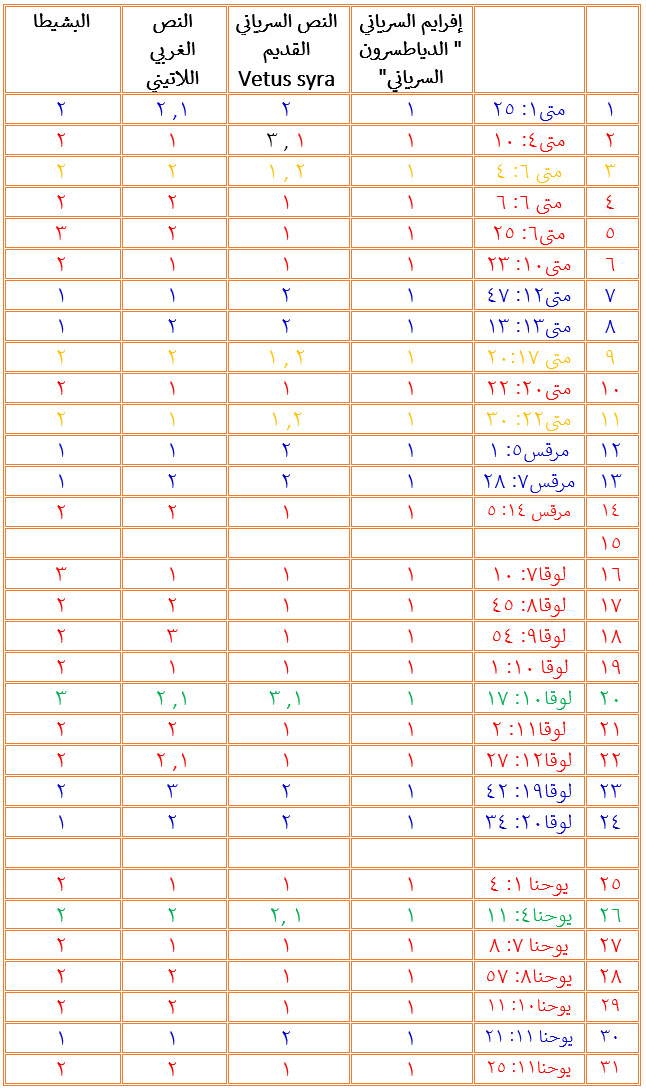
Results — 64% of Diatessaron Readings Agree with Old Syriac, Not Peshitta
Total number of readings in which the Diatessaron agreed with the Peshitta against the Old Syriac = 11 readings
Total number of readings in which the Diatessaron agreed with the Old Syriac against the Peshitta = 19 readings
The readings of the Syriac Diatessaron agree with the Old Western Syriac text by 64% — and agree with the Peshitta by only 36%. This means the Diatessaron used the readings of the Old Syriac manuscripts, and did not quote from the Peshitta. The same pattern holds for Ephraim the Syrian and Ephrahat the Syrian.
The text that was widespread and dominant in Syria in the first four centuries was the ancient Old Syriac text — not the Peshitta.
A note on the statistical threshold: textual critics consider 69% agreement sufficient to classify a manuscript as belonging to a text family. If a manuscript agrees with the Alexandrian family by 69% or more, it is classified as Alexandrian. The result here of 64% for the Old Syriac falls below that threshold, which indicates — consistent with the early period generally — that the text was fluid and undisciplined, with overlapping readings. This is expected: the early period is characterized by textual fluidity, not unified text types. The text types solidified later. But even at 64%, the Diatessaron shows a clear orientation toward the Old Syriac, not the Peshitta.
Additionally, these numbers are based on the UBS critical apparatus, which has the shortest critical apparatus of any major edition. If the same study were conducted using a larger and more detailed critical apparatus, the results would show an even higher percentage in favor of the Old Syriac over the Peshitta.
Conclusion
This note has assembled six independent lines of evidence proving that the Peshitta is a 5th-century translation and not a 2nd-century one:
- The explicit statement of George Lamsa — the Peshitta’s most famous advocate — acknowledging that scholarly consensus places it in the time of Rabbula of Edessa (412-435 CE).
- Bruce Metzger’s dating: the Peshitta was completed no later than the time of Rabbula (411-435 CE).
- The Encyclopedia of Textual Criticism: the Peshitta “can hardly be later than” the 4th century, with its earliest Greek Byzantine parallel being the 5th-century Alexandrian Codex A.
- The Gwilliam critical edition of the Peshitta itself explicitly states its manuscripts range from the 5th century onward.
- All 300+ discovered Peshitta manuscripts, across six scholarly source lists, begin from the 5th century — not one predates it.
- The Diatessaron of Tatian (as preserved through Ephraim’s commentary) agrees with the Old Syriac manuscripts against the Peshitta by 64% — proving that the text dominant in Syria in the first four centuries was the Old Syriac tradition, not the Peshitta.
The Westcott-Hort theory therefore stands: the Byzantine text family has no witness before the 5th century. The Peshitta cannot rescue it. The current New Testament in widespread use by Eastern Christians — the Van Dyke version, translated from Erasmus’s Received Text based on 5 late Byzantine manuscripts — represents the worst-attested and most chronologically late of all the text families.
This is one more piece of evidence proving the occurrence of tahrifArabic: تحريف — scribal alteration and distortion of scripture. The consolidation of the Byzantine text in the 4th–5th centuries, and its eventual dominance through political and institutional power, represents a large-scale textual standardization that overwrote older and more diverse manuscript traditions. in the New Testament — not at the level of individual verses, but at the level of the entire text tradition used by the majority of Eastern Christians.
References:
[1] http://www.superbook.org/LAMSA/FAQ/peshitta_old_syriac.htm
[2] Metzger, B.M. The Bible in Translation: Ancient and English Versions (2001), p. 15.
[3] Waltz, R.B. Encyclopedia of New Testament Textual Criticism, p. 420.
[4] Pusey, Ph. E. and Gwilliam, G.H. Tetraevangelium Sanctum iuxta simplicem Syrorum versionem, Oxford 1901 (Piscataway 2003), p. 6.
[5] Omanson, R.L., & Metzger, B.M. (2006). A Textual Guide to the Greek New Testament (p. xxiii). Stuttgart: Deutsche Bibelgesellschaft.