

The Prophet and Zaid ibn Haritha: The Nakedness Hadith Examined
Critics occasionally cite a hadith in Sunan al-Tirmidhi describing the Prophet ﷺ rushing to greet Zaid ibn Haritha in a state of incomplete dress. This note presents the full hadith, its chain of transmission, its grading, the classical scholarly explanation of its meaning, and the Biblical parallels that apply an identical standard to the New Testament.
The Hadith
“Zaid ibn Haritha came to Medina and the Messenger of Allah ﷺ was in my house. He came to him and knocked on the door, and the Messenger of Allah ﷺ stood up to him naked, dragging his garment. By Allah, I had never seen him naked before or after that. He embraced him and kissed him.”
Abu Isa al-Tirmidhi said: This is a hasan gharib hadith. We do not know it as a hadith of al-Zuhri except from this source.
Narrator: Aisha | Collection: Sunan al-Tirmidhi | Grade: Hasan Gharib
The Grading: Hasan Gharib
The hadith carries the designation hasan gharib — acceptable in transmission but narrated through a single chain without corroboration from other paths. Al-Tirmidhi himself flagged this: “We do not know it as a hadith of al-Zuhri except from this source.” A gharib narration is not fabricated or rejected — it is preserved but stands alone in its route. This grading means the hadith is not dismissed, but its solitary chain means it is not used as independent evidence for legal rulings. The classical scholars accepted it as a description of an incident and explained it accordingly.
The Classical Explanation
The scholars of hadith did not read this narration as describing the Prophet ﷺ in a state of complete undress. The explanation given in Tuhfat al-Ahwadhi bi Sharh Jami’ al-Tirmidhi — the authoritative commentary on Tirmidhi — is precise:
The meaning is therefore clear. The Prophet ﷺ rushed to the door in such joy at Zaid’s arrival that his upper cloak had not been fully settled on his shoulders — it was dragging behind him. The covering between navel and knee — the minimum required covering in Islamic law — was maintained. Aisha’s oath that she had never seen him this way before or after means she had never seen him receive anyone with that degree of rushing joy, so overcome with happiness that he did not pause to arrange his garment. Al-Tayyibi’s observation captures it precisely: the image communicates the intensity of the Prophet’s love for Zaid, not a breach of modesty.
The Biblical Parallels
Those who use this hadith to criticise the Prophet ﷺ do not apply the same standard to the figures of their own scripture.
Peter the Apostle — Naked on the Seashore
Simon Peter — described as the chief of the apostles and the rock upon whom the Church is built — was naked on the seashore in the presence of the other disciples and all those present. When he heard that Jesus had come, he put on his outer garment before throwing himself into the sea. The questions this raises are identical to those critics raise about the Prophet’s hadith: How was the leading apostle naked on a public shore? Why was nakedness permissible in the absence of Christ but not in his presence? The Gospel account gives no explanation and offers no apology. The same charity critics refuse to extend to the Prophet ﷺ — that the account describes a natural and innocent situation — is extended to Peter without a second thought.
Jesus Removes His Garments Before the Disciples
Jesus removed his garments before his disciples in order to wash their feet. The text says he laid aside his garments — plural — and wrapped himself only in a towel. This is described without embarrassment as an act of humble service.
The Crucifixion
At the crucifixion, Jesus’s garments were divided among the soldiers. The standard Christian interpretation holds that Jesus was crucified with no covering except what tradition variously describes. The Gospels record this without qualification.
Conclusion
Title Unavailable | Site Unreachable
https://www.fnoor.com/main/articles.aspx?article_no=25386
![attachments/| وما ارسلناك الا رحمة للعالم
In conclusion THE hadith is weak and unreliable. “Naked” does not mean complete nudity, as this is logically and textually impossible. In Tuhfat al-Ahwadhi, a commentary on Jami’ al-Tirmidhi, it states: ”…So he stood up towards him, meaning he went towards him naked, dragging his garment, i.e., his cloak, due to his immense joy at his arrival and coming. It is stated in al-Mafatih: This means that the Prophet (peace and blessings be upon him) had covered the area between his navel and knees, but his cloak fell from his shoulders, so what was above his navel was naked.”
The wise man said: “It was said of the Christian, if he spoke: ‘His foolishness exposed him,’ and if he remained silent, his ineptitude exposed him.” The Christian’s objection: The Prophet dragged his garment while naked. The response: Firstly, the meaning of “naked” is that his outer garment had fallen off him, but his lower garment was still on him, and his lower garment covered his private parts. Secondly, the hadith is weak. It was deemed weak by Sheikh Shu’ayb al-Arna’ut and al-Albani, and al-Dhahabi said it was rejected. Al-‘Uqayli included it in his book on weak narrators. Thirdly, the defect in the hadith is that it contains Ibrahim ibn Yahya ibn Muhammad ibn ‘Abbad and his father, Yahya ibn Muhammad ibn ‘Abbad, both of whom are weak, as Abu Hatim al-Razi and others have stated. Also, it is narrated through the chain of transmission of Ibn Ishaq, who is a mudallis (one who practices tadlis, a form of deception in hadith transmission). Fourthly, an objection: Al-Tirmidhi said it was “good and strange.” We say: Al-Tirmidhi, may God have mercy on him, erred in that, and God knows best. Al-Dhahabi said: So, one should not be deceived by al-Tirmidhi’s grading of it as “good.” Upon investigation, most of them are weak. The crucial factor is the chain of narration (isnad), and we have already established its defect. Abdullah ibn al-Mubarak said, “The chain of narration is part of the religion, and were it not for the chain of narration, anyone could say whatever they pleased.” Yahya ibn Saeed al-Qattan said, “Do not look at the hadith itself, but rather look at its chain of narration. If the chain is sound, then accept it; otherwise, do not be deceived by the hadith if the chain is not sound.” Fifth: The second narration: the narration of al-Waqidi. We say: al-Waqidi is a liar who fabricates hadiths, as stated by al-Shafi’i, Ahmad ibn Hanbal, al-Nasa’i, Abu Hatim, and others. Sixth: To the Christians: I do not understand the basis of your objection to this weak hadith. For example, Noah drank wine until he was drunk and became naked, and this is a disgrace. The second disgrace is the divine command to Isaiah to walk naked. In conclusion: The hadith is weak, and its meaning is not as the Christians believe. Furthermore, their doubts are found in their own scriptures, which expose the falsehoods of their prophets, such as Isaiah.
14 - I was forbidden from exposing myself and that was before prophethood was revealed to him]. Narrated by: Abdullah ibn Abbas • Al-Albani, As-Silsilah As-Sahihah (2378) • Its chain of narration is authentic • Narrated by At-Tayalisi (2781) 15 - I was forbidden from exposing myself and that was before prophethood was revealed to him]
Narrated by: Abdullah ibn Abbas • Al-Albani, Sahih Al-Jami’ (6784) • Authentic
Context: > This section provides critical commentary (فوائد) evaluating the reliability of a specific Hadith’s chain of transmission (Isnad).
“قلنا: إسناده ضعيف”
Translation: We said: Its chain of transmission is weak.
Reasons for Weakness (علل): > The text outlines two primary issues with the narrators in this chain:
- Muhammad bin Ishaq: The well-known author of the Prophetic Biography (Seerah) is explicitly judged here as “not reliable” (ليس بثقة). The text directs the reader to Hadith No. 9425 for further details on this assessment.
- Yahya bin Muhammad Al-Shajari: Citing Al-Uqayli’s book Al-Du’afa (The Weak Narrators), this narrator is criticized for having rejected reports (مناكير) and errors (أغاليط) when narrating from Muhammad bin Ishaq. The critique also notes he was blind and allegedly relied on prompting (يلقن).
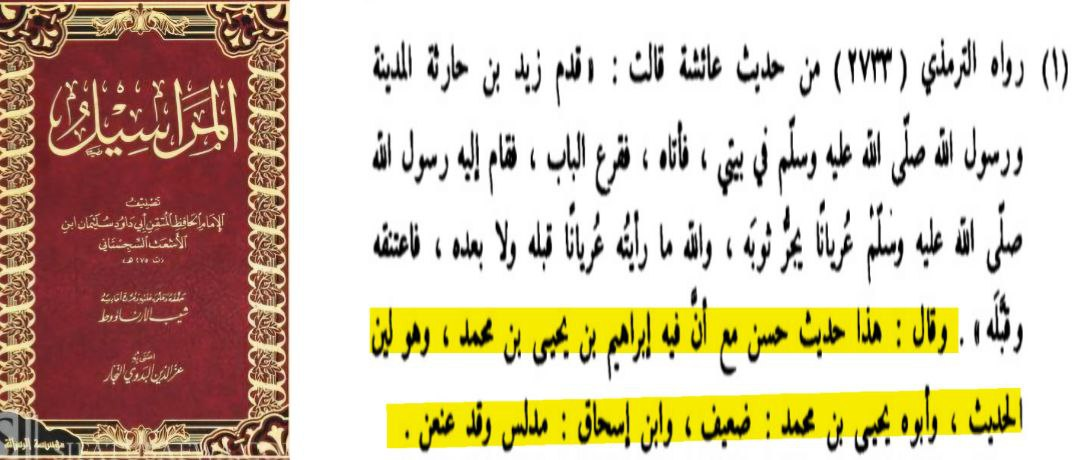
Context: > This section provides a critical analysis of the transmission chain for a hadith recorded by Al-Tirmidhi (Hadith 2733) concerning Zayd bin Harithah’s arrival in Medina.
“وقال : هذا حديث حسن مع أن فيه إبراهيم بن يحيى بن محمد ، وهو لين الحديث ، وأبوه يحيى بن محمد : ضعيف ، وابن إسحاق : مدلس وقد عنعن .”
Translation: And he said: This is a Hasan (good) hadith, even though it contains Ibrahim bin Yahya bin Muhammad, who is Layyin al-Hadith (lenient/soft in hadith), and his father Yahya bin Muhammad is Da’if (weak), and Ibn Ishaq is a Mudallis (one who conceals defects in the chain) and he narrated by saying ‘An (عنعن).
Breakdown of Chain Weaknesses (العلل): > The commentary points out specific flaws among three narrators, despite the overall Hasan rating of the hadith:
- Ibrahim bin Yahya bin Muhammad: Categorized as “Layyin” (لين) — meaning he is “soft” or has some weakness in his memorization or narrations.
- Yahya bin Muhammad (the father): Explicitly graded as “Da’if” (ضعيف) — weak.
- Ibn Ishaq: Identified as a “Mudallis” (مدلس), meaning he is known to sometimes conceal gaps in the transmission chain (Tadlis). Furthermore, he transmitted this report using the ambiguous term “‘An” (عنعن - “from”) instead of explicitly stating he heard it directly, which makes his narration here unacceptable without corroboration.
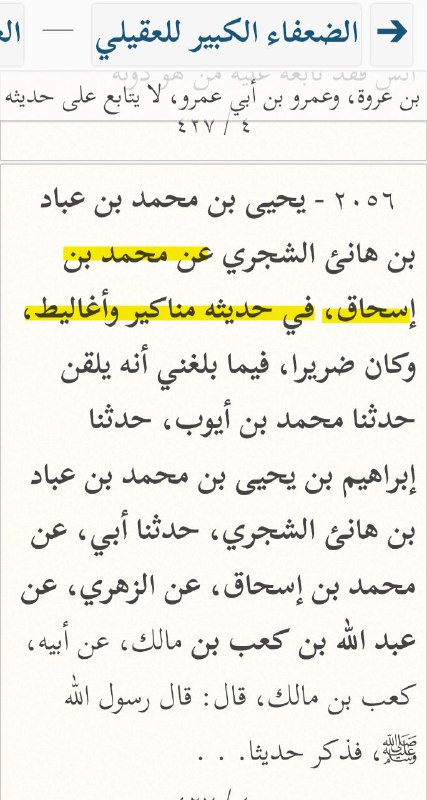
Narrator Profile: > This entry details the critical evaluation of Yahya bin Muhammad bin Abbad bin Hani al-Shajari (يحيى بن محمد بن عباد بن هانئ الشجري), specifically regarding his transmissions from Muhammad bin Ishaq.
“عن محمد بن إسحاق، في حديثه مناكير وأغاليط،”
Translation: [Narrating] from Muhammad bin Ishaq, in his hadith are rejected reports (manakir) and mistakes/errors (aghalit).
Biographical Flaws Explored: > The text provides two primary reasons for grading his narrations as weak:
- Impairment and Suggestibility: “وكان ضريراً، فيما بلغني أنه يلقن” — He was blind, and according to reports that reached the author, he would accept prompting (yulaqqan), meaning others could mistakenly influence or insert wording into his narrations.
- Example Chain of Transmission: The text provides an illustrative Isnad passing from his son Ibrahim, who narrates from Yahya [the subject], from Ibn Ishaq, from Al-Zuhri, from Abdullah bin Ka’b, from Ka’b bin Malik, leading to a Prophetic tradition.
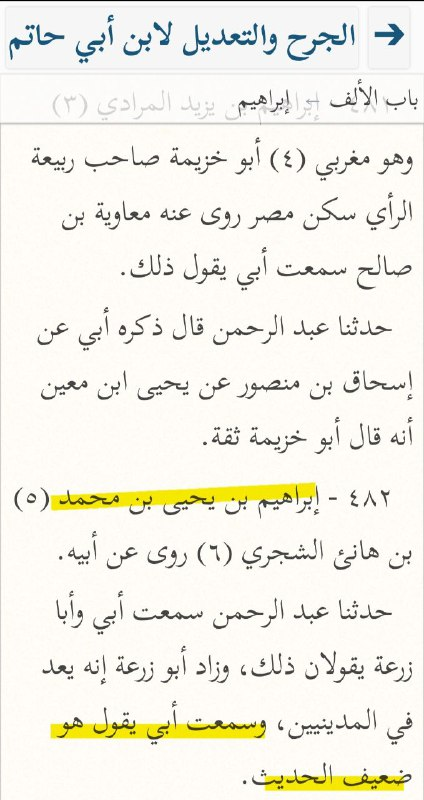
Narrator Profile: > Ibrahim bin Yahya bin Muhammad bin Hani al-Shajari (إبراهيم بن يحيى بن محمد بن هانئ الشجري). The text notes that he narrated directly from his father.
“إبراهيم بن يحيى بن محمد… وسمعت أبي يقول هو ضعيف الحديث.”
Translation: Ibrahim bin Yahya bin Muhammad… And I heard my father [Abu Hatim] say: He is weak in hadith.
Biographical Context: > The author, Abd al-Rahman, states that he heard both his father (Abu Hatim) and Abu Zur’ah evaluate this narrator. Abu Zur’ah added that he is historically classified or counted among the residents of Medina (Al-Madiniyin).
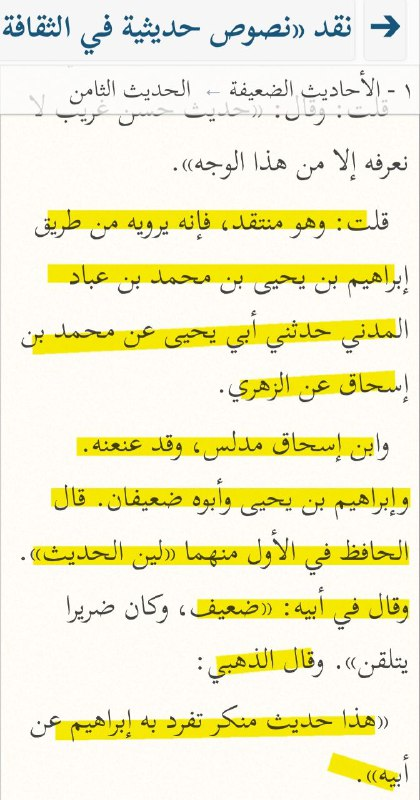
Source: Critique of Hadith Texts in Culture (نقد “نصوص حديثية في الثقافة”) — The Eighth Hadith
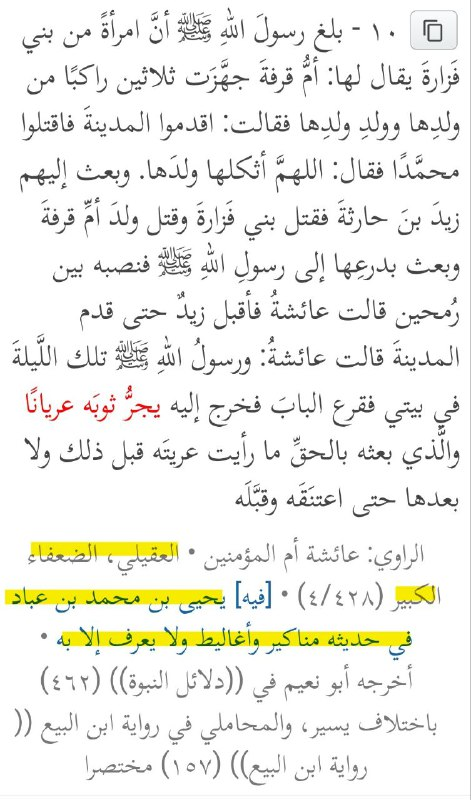
Textual Context: > Describes the military expedition led by Zayd bin Harithah against Umm Qirfah of the Bani Fazarah tribe. The text highlights a controversial segment from a report attributed to Aisha, describing the Prophet rushing to welcome Zayd: “يجر ثوبه عرياناً” (“dragging his garment unclad/naked”).
Translation: …[In its chain] is Yahya bin Muhammad bin Abbad. In his hadith are rejected reports (manakir) and errors (aghalit), and it is not recognized except through him.
Cross-References noted in the text: >
- Abu Nu’aym: Extracted this text in Dala’il al-Nubuwwah (No. 462) with a slight variation.
- Al-Mahamili: Recorded a summarized version of this account in Riwayat Ibn al-Bayyi’ (No. 157).
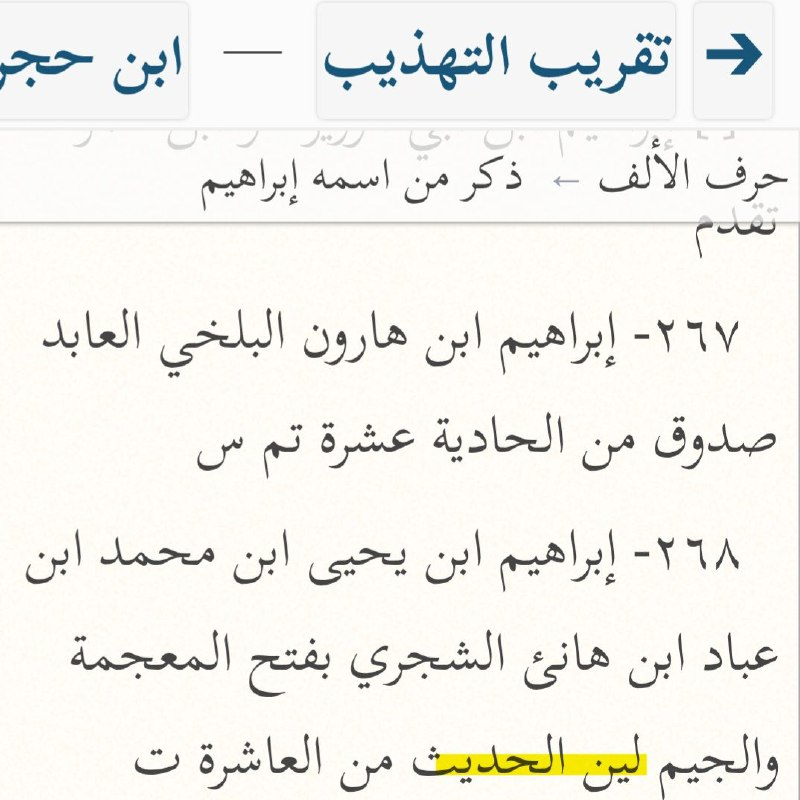
Narrator Profile: > Ibrahim bin Yahya bin Muhammad ibn Abbad ibn Hani al-Shajari (إبراهيم بن يحيى بن محمد ابن عباد ابن هانئ الشجري). The text notes the specific pronunciation parameters for his title, “Al-Shajari” (بفتح المعجمة والجيم).
“لين الحديث”
Translation: Lenient/soft in hadith (Layyin al-Hadith).
Biographical Classification: > * Generation: He is categorized as belonging to the tenth generational class of narrations (من العاشرة).
- Compilation Reference: Marked with the abbreviation symbol ت (Ta), signifying his narrations are recorded in the collection of Imam al-Tirmidhi.
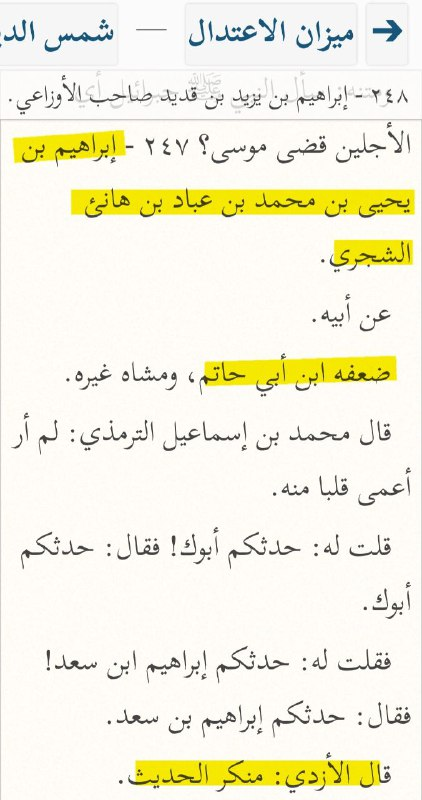
Narrator Profile: > Ibrahim bin Yahya bin Muhammad bin Abbad bin Hani al-Shajari (إبراهيم بن يحيى بن محمد بن عباد بن هانئ الشجري), who transmits material directly from his father.
Translation: Ibn Abi Hatim declared him weak… and Al-Azdi said: [He is] rejected in hadith (Munkar al-Hadith).
Biographical Insights & Criticisms: >
- Ibn Abi Hatim: Formally graded him as weak, though the entry notes that some others tolerated or passed his narrations (“ومشاه غيره”).
- Muhammad bin Isma’il al-Tirmidhi: Offered a severe character criticism, stating: “لم أر أعمى قلبا منه” (“I have not seen anyone more blind of heart than him”).
- Cognitive/Retention Defect: The text provides a brief dialogue demonstrating his poor memory or extreme suggestibility, showing him parroting back phrases verbatim when prompted by interlocutors (“قلت له: حدثكم أبوك! فقال: حدثكم أبوك…”).
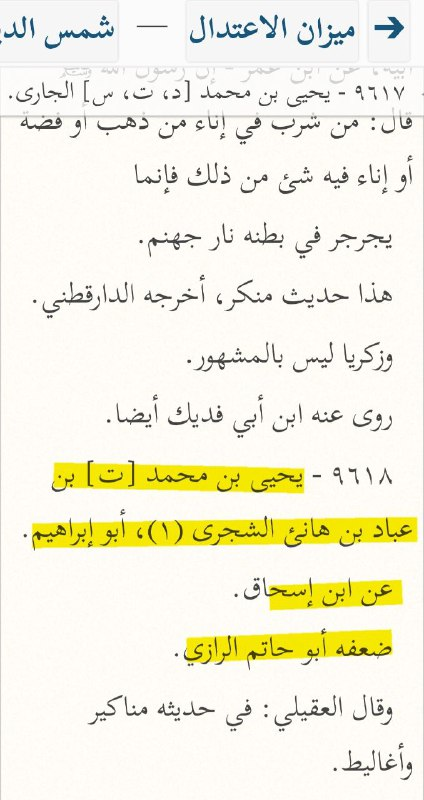
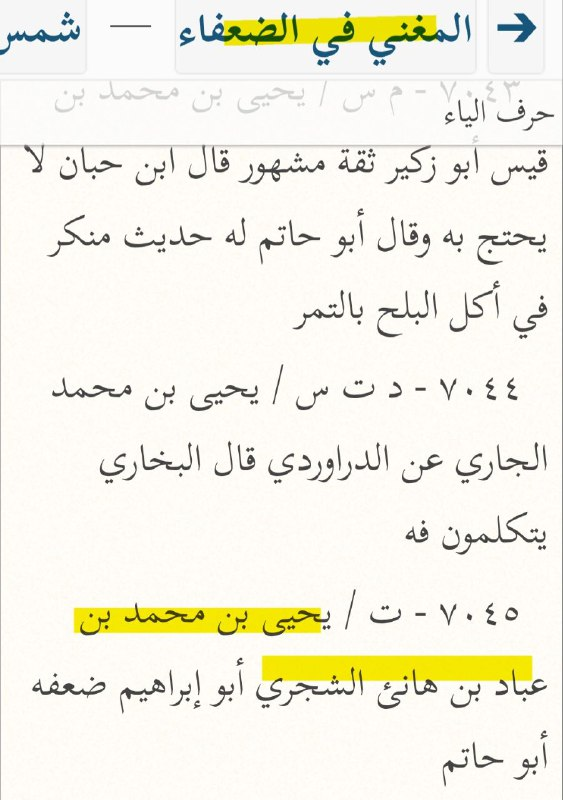
Narrator Profile: > Yahya bin Muhammad bin Abbad bin Hani al-Shajari, Abu Ibrahim (يحيى بن محمد بن عباد بن هانئ الشجري، أبو إبراهيم). This entry focuses on his standing, noting his specific lineage and his role as the father of Ibrahim. He is evaluated here regarding his direct transmissions from Ibn Ishaq (عن ابن إسحاق).
Translation: Abu Hatim al-Razi declared him weak. And Al-Uqayli said: “In his hadith are rejected reports (manakir) and errors (aghalit).”
Biographical Classifications: >
- Compilation Reference: His entry contains the abbreviations symbol [ت] (Ta), indicating that his narrations are included within the collection of Imam al-Tirmidhi.
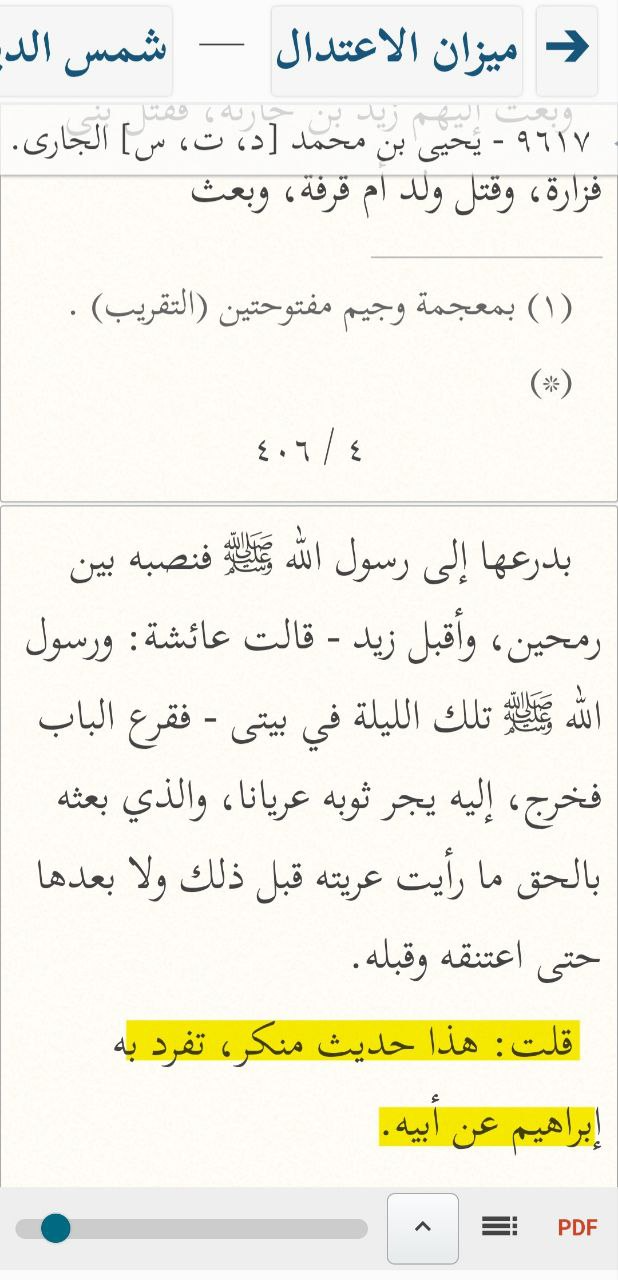
Textual Context: > Evaluates a historical report concerning the return of Zayd [bin Harithah] from an expedition. According to an account attributed to Aisha, Zayd knocked on the door at night, and the Prophet went out to welcome him while dragging his garment unclad (“يجر ثوبه عرياناً”), subsequently embracing and kissing him.
Translation: I say: This is a rejected/denied hadith (Munkar), isolated to Ibrahim from his father.
Key Analytical Takeaways: >
- Narration Grading: Al-Dhahabi explicitly grades the report as Munkar (denied/unacceptable in its phrasing).
- Isolation Defect (Tafarrud): The critical transmission flaw highlighted is that Ibrahim uniquely and solitarily transmitted this text from his father, rendering the highly unusual wording unsupported by alternative reliable chains.
Linguistic Entry: Pharaoh (فرعون): > An Egyptian word meaning “The Great House” (البيت الكبير), which served as an ancient title for the kings of Egypt.
2. Highlighted Shift: “ثم في عصر الدولة الحديثة (حوالي ١٥٥٠ - ١٠٧٠ ق.م.) إستخدم اللقب بوضوح للدلالة على شخص الملك نفسه…”
Translation: Later, during the New Kingdom era (circa 1550–1070 BCE), the title was explicitly and clearly used to designate the person of the king himself.
Additional Lexical Entries on the Page: >
- Farata / Afrata (فرط-أفرط): Discusses the scriptural context of overstepping limits, rushing in speech, or acting excessively, citing references from Leviticus, Galatians, and 2 Corinthians (such as excessive grief).
- Pirathon / Pirathonite (فرعتون-فرعتونى): A Hebrew name meaning “height” or “summit”. It refers to a city in the land of Ephraim in the mount of the Amalekites, historically tied to biblical figures like the judge Abdon bin Hillel and Benaiah, one of King David’s warriors.
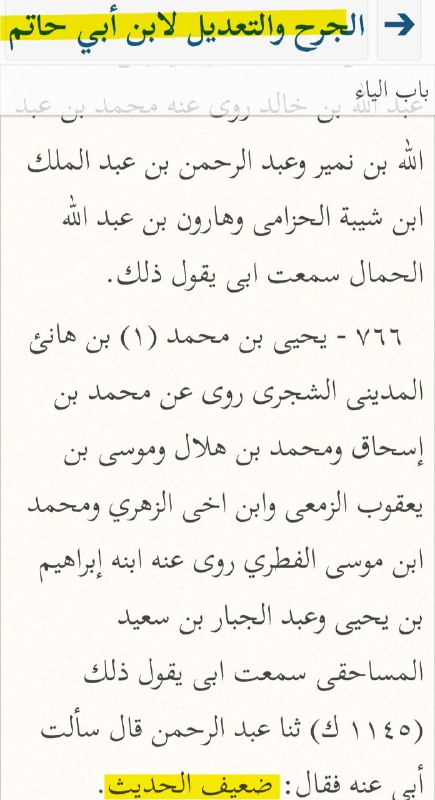
Narrator Profile: > Yahya bin Muhammad bin Hani al-Madini al-Shajari (يحيى بن محمد بن هانئ المدينى الشجرى).
-
Teachers (Narrated from): He transmitted reports from Muhammad bin Ishaq, Muhammad bin Hilal, Musa bin Ya’qub al-Zam’i, Ibn Akhi al-Zuhri, and Muhammad ibn Musa al-Fitri.
-
Students (Narrated to): Transmissions were recorded from him by his son, Ibrahim bin Yahya, and Abd al-Jabbar bin Sa’id al-Musahiqi.
Translation: Weak in hadith (Da’if al-Hadith).
Biographical Insight: > * Abu Hatim al-Razi’s Grading: Ibn Abi Hatim (Abd al-Rahman) states that he explicitly asked his father about the standing of this narrator, to which his father delivered the definitive verdict of him being weak in hadith transmission.
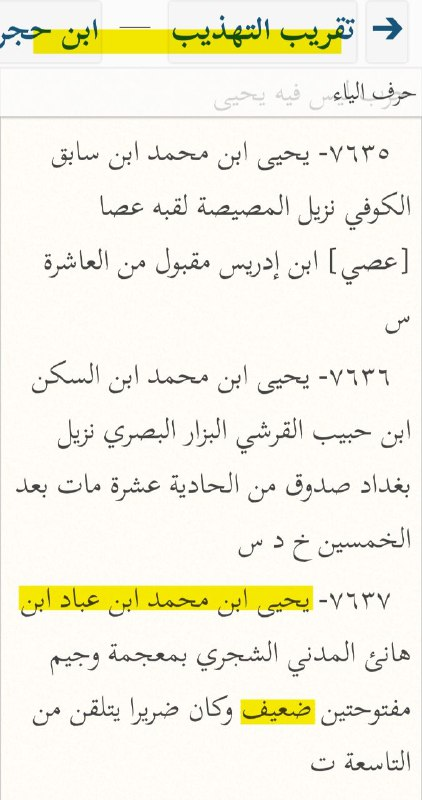
Highlighted Entry (7637): Yahya al-Shajari
Yahya bin Muhammad bin ‘Abbad bin Hani al-Madini al-Shajari (يحيى ابن محمد ابن عباد ابن هانئ المدني الشجري).
-
Orthographic Note: The text specifies that “al-Shajari” is written with a dotted letter (mu’jamah / shīn) and a jīm, both vocalized with a fatḥah.
-
Biographical Profile: He is classified under the ninth generation of narrators (من التاسعة) and noted to have been blind and susceptible to being prompted/instructed in his narrations (وكان ضريرا يتلقن).
-
Compilation Reference: Appended with the letter symbol [ت], indicating that his reports are found in the collection of Imam al-Tirmidhi.
Translation: Weak (Da’if).
Adjacent Narrator Entries on the Page:
- 7635 — Yahya bin Muhammad bin Sabiq al-Kufi: A resident of al-Massisah (نزيل المصيصة) whose title/nickname is ‘Asa Ibn Idris. He is graded as acceptable (مقبول) from the tenth generation, marked with the book symbol [س].
- 7636 — Yahya bin Muhammad bin al-Sakan: Al-Qurashi al-Bazzar al-Basri, who settled in Baghdad. He is graded as truthful (صدوق) from the eleventh generation, passed away after 250 AH (مات بعد الخمسين), and is marked with the book symbols [خ د س].
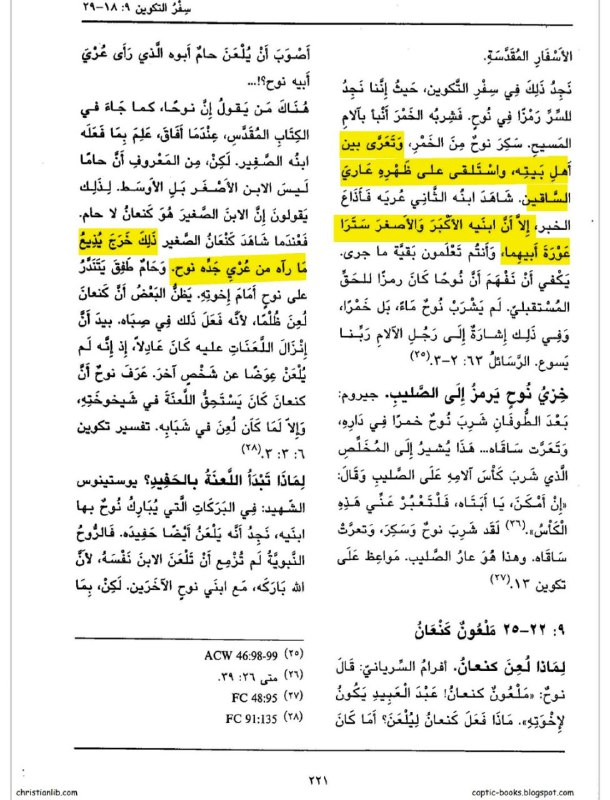
Source: Christian Exegetical Text on the Holy Scriptures — p. 221
Scriptural Focus: Exegesis of Noah’s intoxication, exposure, and the subsequent curse of Canaan.
1. Typological Symbolism of Noah’s Exposure
-
Foreshadowing Christ’s Passion: The text states that Noah’s drinking of wine and subsequent state of being uncovered (وتعرى بين أهل بيته) serves as a scriptural symbol predicting the sufferings of Christ (آلام المسيح).
-
The Shame of the Cross: Citing the commentary of St. Jerome (جيروم), Noah’s intoxication and uncovered legs after the flood symbolize the Savior drinking the cup of suffering and enduring the shame of the Cross (عار الصليب).
2. The Curse of Canaan (Genesis 9:22–25)
The text examines the core question: Why did Noah declare “Cursed be Canaan; a servant of servants shall he be to his brethren” (ملعون كنعان! عبد العبيد يكون لإخوته) instead of cursing his father, Ham, who explicitly saw the nakedness?
-
The Role of Canaan: One prominent explanation provided is that Canaan was actually the small child/grandson who first witnessed Noah’s exposure and maliciously broadcasted it to others, triggering Ham’s involvement.
-
Patristic Insight (Justin Martyr): Citing Justin Martyr (يوستينوس الشهيد), the text explains that the prophetic spirit did not curse Ham directly because God had already blessed Ham alongside Noah upon leaving the ark. Therefore, the curse bypassed Ham and was placed on his son Canaan, whose future lifestyle in old age would justly mirror the sin of his youth.
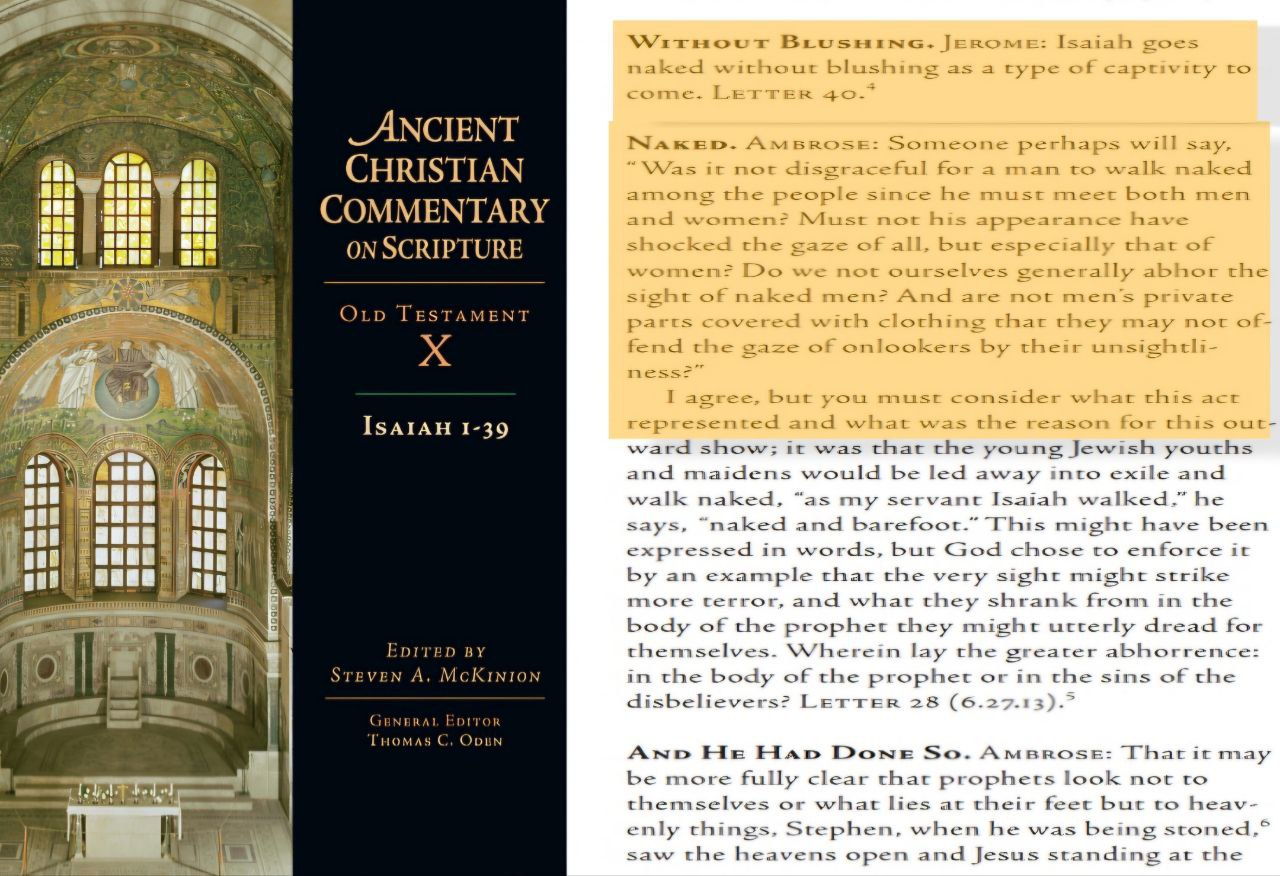
1. Book Details (Left Section)
-
Series Title: Ancient Christian Commentary on Scripture
-
Volume: Old Testament X (Isaiah 1-39)
-
Editor: Steven A. McKinion
-
General Editor: Thomas C. Oden
2. Commentary Excerpts (Right Section)
“Without Blushing” — Jerome (Letter 40)
-
Summary: States that Isaiah walked naked without shame as a prophetic symbol (“type”) representing the future captivity to come.
”Naked” — Ambrose (Letter 28)
-
The Public Objection: Acknowledges the perspective that a man walking naked in public is disgraceful, shocking to onlookers (especially women), and generally abhorrent by societal standards.
-
The Prophetic Purpose: Explains that this outward show was mandated by God to strike terror. It visually demonstrated the harsh reality that young Jewish youths and maidens would eventually be led into exile “naked and barefoot.”
-
Conclusion: The true source of abhorrence is not the physical body of the prophet, but rather the severe sins of the disbelievers.
”And He Had Done So” — Ambrose (Partial Text)
- Summary: Notes that prophets do not focus on their immediate earthly circumstances or themselves, but rather on heavenly things. It references Stephen seeing the heavens open and Jesus standing while he was being stoned.
Explanation of the Hadith, Assuming Its Authenticity
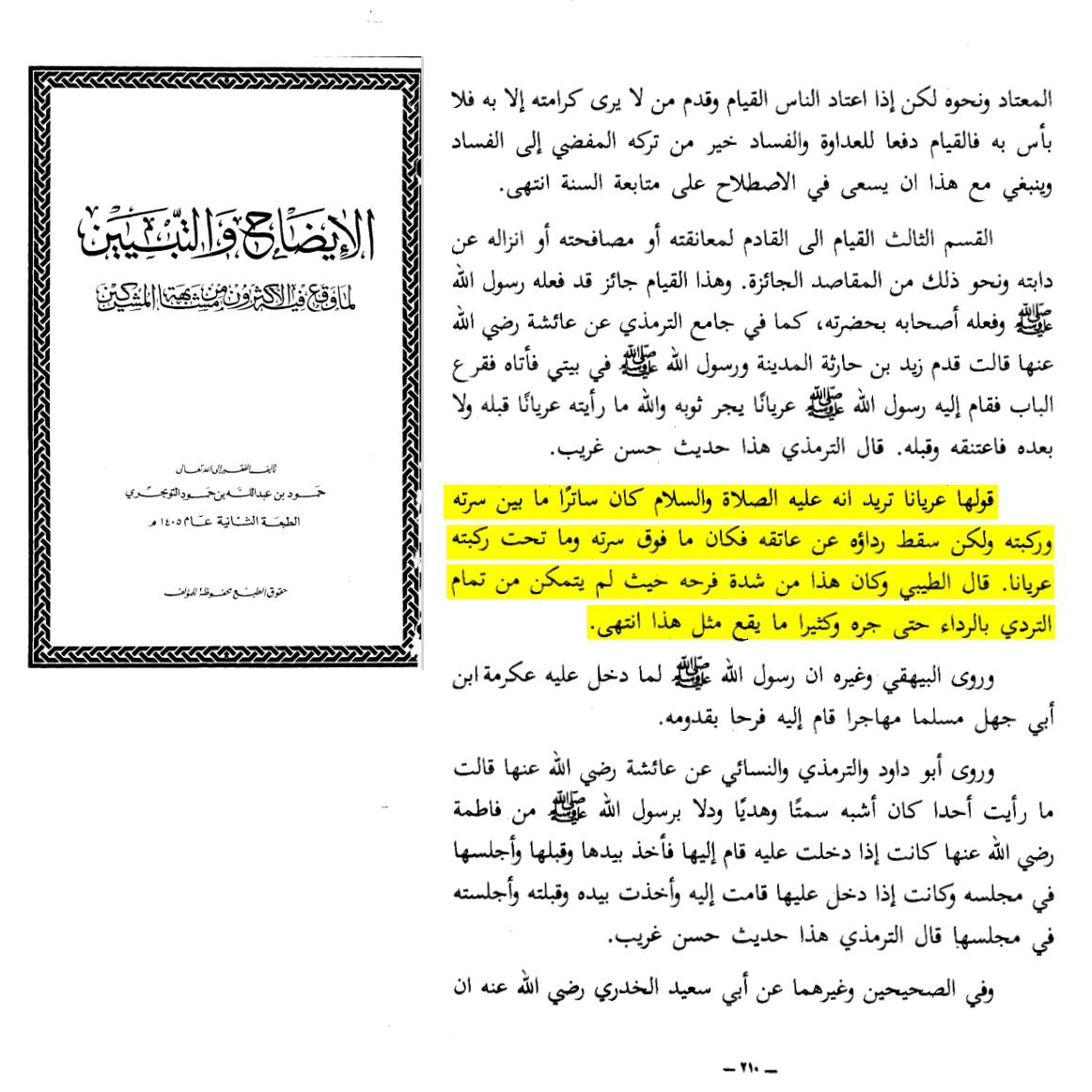
1. Book Details (Left Section)
-
Title: Al-Idah wa al-Tabyin lima waqa’a fihi al-aktharun min mushabahat al-mushrikin (الإيضاح والتبيين لما وقع فيه الأكثرون من مشابهة المشركين)
-
Author: Sheikh Hamoud bin Abdullah bin Hamoud al-Tuwaijri
-
Edition: Second Edition, 1405 AH
2. Context of the Page (Right Section - Page 210)
-
Topic: The “Third Category” concerning the ruling on standing up to greet someone.
-
Ruling: Standing up to meet an individual arriving in order to embrace them, shake their hand, or help them dismount is deemed permissible (جائز).
-
Evidence Provided: > * A Hadith from Jami’ al-Tirmidhi where Aisha (RA) narrates that when Zayd bin Harithah arrived in Medina, the Prophet (ﷺ) stood up in haste, dragging his garment, to embrace and kiss him.
-
Narrations from Al-Bayhaqi regarding the Prophet (ﷺ) standing out of joy for Ikrimah bin Abi Jahl.
-
Narrations from Abu Dawud, Tirmidhi, and Al-Nasa’i regarding the Prophet (ﷺ) and his daughter Fatimah (RA) standing up, kissing, and welcoming one another out of deep affection.
-
3. Explanation of the Highlighted Text
-
Clarification of Aisha’s Narration: The text addresses the phrase stating the Prophet (ﷺ) came out “naked” (عريانًا).
-
Meaning: It clarifies that his essential standard of modesty (the area between the navel and the knee) was fully covered. However, his upper cloak (rida’) had slipped off his shoulders.
-
Reason: Scholars like Al-Tibi note that this happened purely out of intense joy and haste to greet Zayd, leaving him no time to properly adjust the cloak—a common occurrence during moments of sudden excitement.
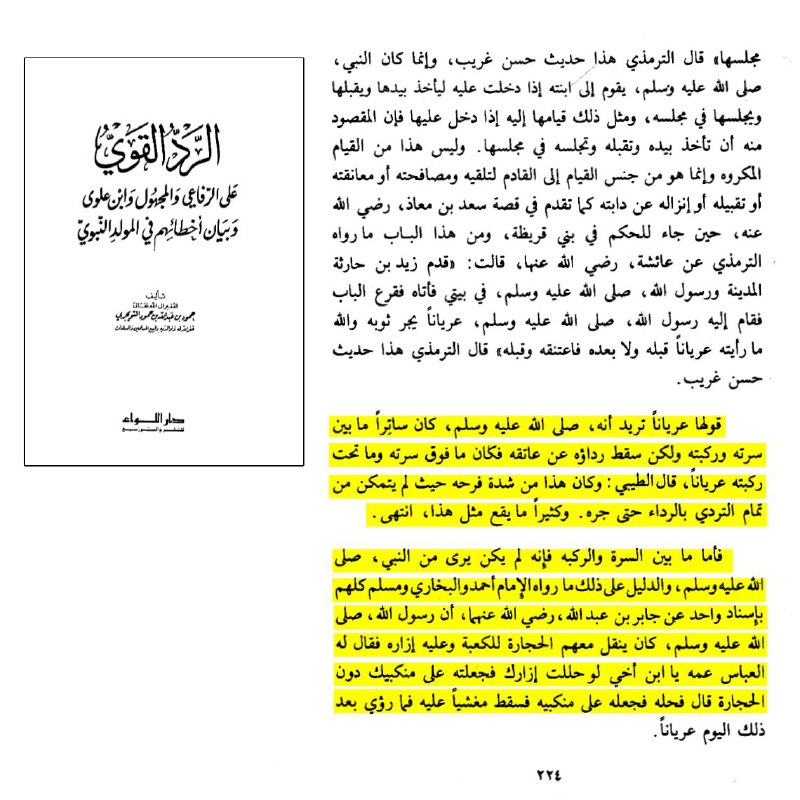
1. Book Details (Left Section)
-
Title: Al-Radd al-Qawi ‘ala al-Rifa’i wa al-Majhul wa Ibn ‘Alawi wa Bayan Akhta’ihim fi al-Mawlid al-Nabawi (الرد القوي على الرفاعي والمجهول وابن علوي وبيان أخطائهم في المولد النبوي)
-
Author: Sheikh Hamoud bin Abdullah bin Hamoud al-Tuwaijri
-
Publisher: Dar al-Liwa’ for Publishing and Distribution
2. Context of the Page (Right Section - Page 224)
-
Topic: Discussion on the permissibility of standing up to greet an arriving person out of joy, respect, or affection.
-
Evidence Mentioned: References the Prophet (ﷺ) standing up to greet his daughter Fatimah (RA), the historical context of Sa’d bin Mu’adh, and Aisha’s narration regarding the Prophet (ﷺ) rushing to embrace Zayd bin Harithah upon his arrival in Medina.
3. Explanation of the Highlighted Text
-
First Highlight (Clarifying the word “Naked”): Addresses the wording in Aisha’s narration stating the Prophet (ﷺ) came out “naked” (عريانًا). It clarifies that his essential modesty (between the navel and the knee) was completely covered, but his upper wrap (rida’) had slipped from his shoulder. Scholar Al-Tibi explains this happened solely due to his intense joy and haste to welcome Zayd.
-
Second Highlight (The Prophet’s Modesty Safeguarded): Establishes that the area between the navel and the knee was never seen exposed on the Prophet (ﷺ). It provides evidence from a Hadith in Ahmad, Bukhari, and Muslim narrated by Jabir bin Abdullah (RA): while carrying stones to rebuild the Kaaba, the Prophet’s uncle Al-Abbas suggested he loosen his lower garment (izar) to cushion his shoulders. When he did so, he immediately fell to the ground unconscious, and he was never seen uncovered again after that day.
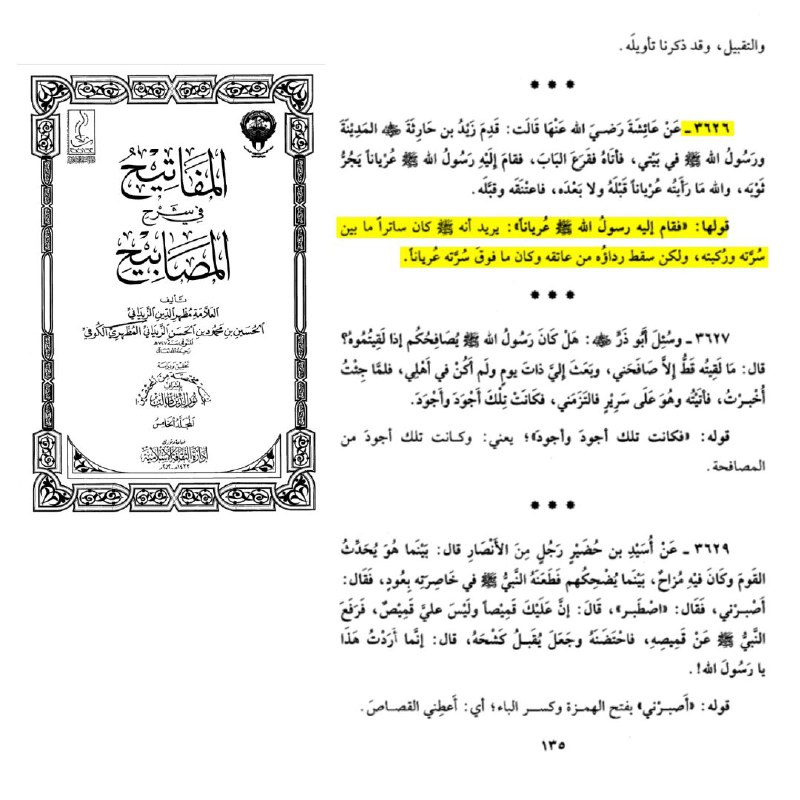
1. Book Details (Left Section)
-
Title: Al-Mafatih fi Sharh al-Masabih (المفاتيح في شرح المصابيح)
-
Author: Al-‘Allamah Mazhar al-Din al-Zaydani al-Kufi (Died in 727 AH)
-
Editing: A committee of researchers supervised by Nur al-Din Talib
-
Volume: Volume 5 (المجلد الخامس)
2. Context of the Page (Right Section - Page 135)
-
Hadith 3626: A narration from Aisha (RA) describing the arrival of Zayd bin Harithah in Medina. She notes that the Prophet (ﷺ) stood up in haste to greet him, dragging his garment, and affectionately embraced and kissed him.
-
Hadith 3627: A narration from Abu Dharr (RA) concerning the Prophet’s habit of shaking hands and embracing his companions warmly upon meeting them.
-
Hadith 3629: A narration from Usayd bin Hudayr (RA) detailing a lighthearted interaction with the Prophet (ﷺ) that culminated in Usayd hugging the Prophet (ﷺ) and kissing his side out of deep affection.
3. Explanation of the Highlighted Text
-
Clarification of the phrase “Naked” (عريانًا): The highlighted text provides the scholarly commentary on the wording in Aisha’s narration where she states the Prophet (ﷺ) approached “naked.”
-
Meaning: It defines the exact state of dress, clarifying that the Prophet (ﷺ) was properly covering his essential modesty—the area between his navel and his knee (كَانَ سَاتِراً مَا بَيْنَ سُرَّتِهِ وَرُكْبَتِهِ).
-
Reason: The term is used here contextually because his upper wrap (rida’) had slipped off his shoulders (سَقَطَ رِدَاؤُهُ عَنْ عَاتِقِهِ), leaving only the area above his navel exposed due to his speed and joy in receiving Zayd.
“but Tirmidhi said its a hasan grade hadith”
Al-Tirmidhi Was Lenient in His Corrections
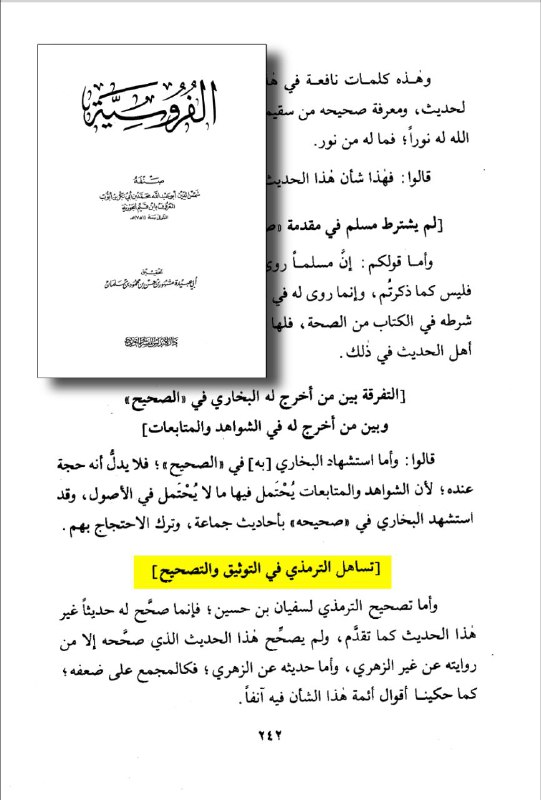
1. Book Details (Left Section)
-
Title: Al-Furusiyyah (الفروسية)
-
Author: Shams al-Din Abi Abdillah Muhammad bin Abi Bakr bin Ayyub, famously known as Ibn Qayyim al-Jawziyyah (Died in 751 AH)
-
Investigation & Verification: Abi Ubaydah Mashhur bin Hasan bin Salman
2. Core Text Content (Right Section - Page 242)
Distinction in Al-Bukhari’s Methodology ([التفرقة بين من أخرج له البخاري...])
-
Discusses the methodological distinction between narrators whose chains are used as core textual evidence (al-usool) in Sahih al-Bukhari versus those used merely for peripheral support (الشواهد والمتابعات).
-
Explains that utilizing a narrator for supporting contexts does not automatically qualify them as a definitive standalone proof (hujjah), because supporting categories tolerate minor narrative discrepancies that foundational principles do not.
Highlighted Text: Al-Tirmidhi’s Leniency ([تساهل الترمذي في التوثيق والتصحيح])
-
Topic: A critique regarding Imam Al-Tirmidhi’s perceived leniency in validating reliability (tawthiq) and authenticating chains (tashih).
-
Specific Case Study: References Al-Tirmidhi’s grading of the narrator Sufyan bin Husayn.
-
Scholarly Verdict: Clarifies that Al-Tirmidhi only authenticated a different narration from Sufyan when he transmitted from teachers other than Al-Zuhri. Conversely, Sufyan’s narrations specifically traced through Al-Zuhri are subject to a scholarly consensus concerning their weakness (مجمع على ضعفه).
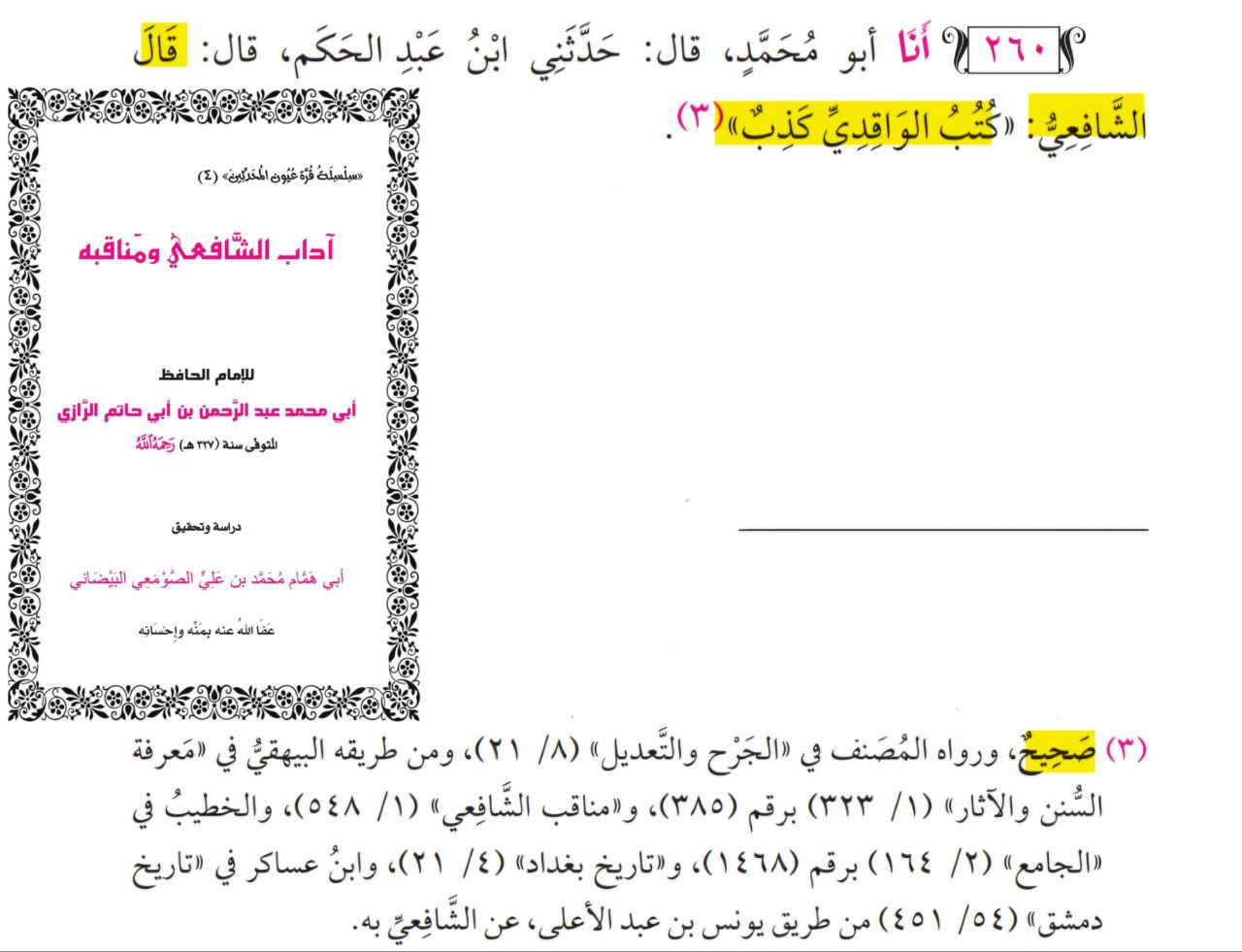
Document 1: Adab al-Shafi’i wa-Manaqibuhu (Page 260)
1. Book Details
-
Title: Adab al-Shafi’i wa-Manaqibuhu (آداب الشافعي ومناقبه)
-
Author: Imam Al-Hafiz Abi Muhammad Abd al-Rahman bin Abi Hatim al-Razi
-
Investigator: Abi Hammam Muhammad bin Ali al-Sawma’i al-Baydani
2. Core Text & Footnote
-
Narration: Al-Shafi’i states: “The books of al-Waqidi are lies” (“كُتُبُ الوَاقِدِيِّ كَذِبٌ”).
-
Grading: Authentic (Sahih / صَحِيحٌ), referenced across major biographical and historical works (e.g., Tarikh Baghdad, Tarikh Dimashq).
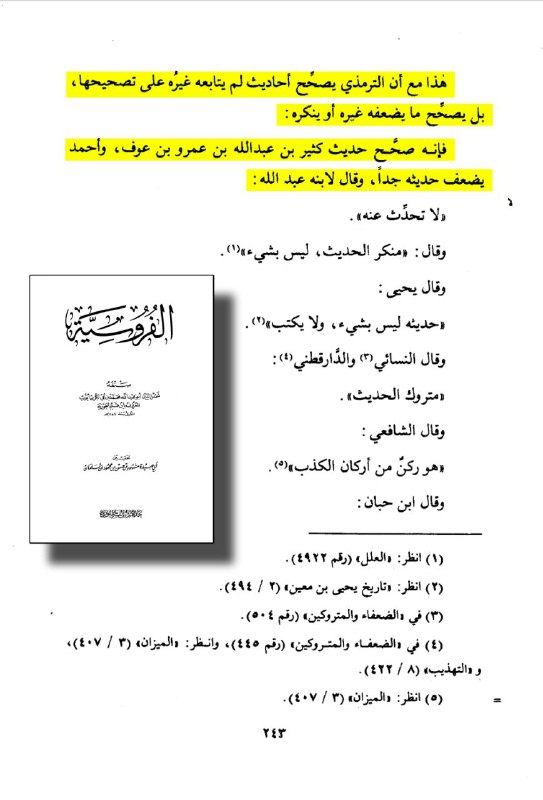
Document 2: Al-Furusiyyah (Page 243)
1. Book Details
-
Title: Al-Furusiyyah (الفروسية)
-
Author: Ibn Qayyim al-Jawziyyah (Died in 751 AH)
2. Explanation of the Highlighted Text
-
Critique of Al-Tirmidhi’s Methodology: The text notes that Imam Al-Tirmidhi independently authenticates certain Hadiths that other critics reject (yunkiruhu) or classify as weak (yuda’ifuhu).
-
Specific Example: Al-Tirmidhi authenticated a Hadith transmitted by Kathir bin Abdullah bin Amr bin Awf, despite overwhelming critical consensus against him.
3. Scholarly Verdicts on Narrator Kathir bin Abdullah
-
Imam Ahmad bin Hanbal: Deemed his narrations extremely weak and explicitly commanded his son Abdullah: “Do not narrate from him.”
-
Yahya bin Ma’in: Stated that his Hadith is worth nothing and should not even be written down.
-
Al-Nasa’i & Al-Daraqutni: Classified him as an abandoned narrator (Matruk al-Hadith / متروك الحديث).
-
Al-Shafi’i: Strongly condemned his reliability, stating: “He is one of the pillars of lying” (“هو ركن من أركان الكذب”).
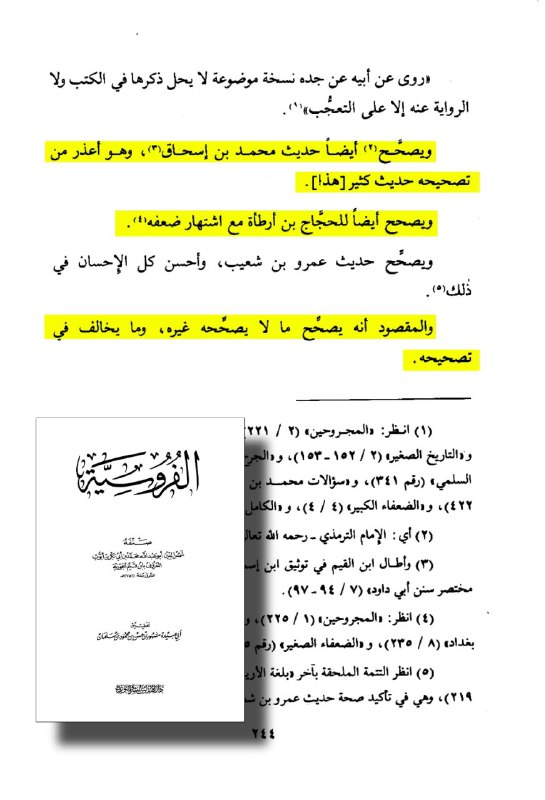
Critique of Al-Tirmidhi’s Methodology
The text details how Imam Al-Tirmidhi independently authenticates certain narrators whose reliability is heavily disputed or outright rejected by the general consensus of other Hadith critics.
Specific Examples Cited
-
Muhammad bin Ishaq: Al-Tirmidhi authenticated his narrations, which the author notes is more excusable than his authentication of Kathir.
-
Al-Hajjaj bin Artah: Al-Tirmidhi authenticated his narrations despite his widespread and well-known weakness.
-
Amr bin Shu’ayb: Al-Tirmidhi authenticated his narrations, which the author highlights as a highly correct and excellent critical judgment.
Core Conclusion: The main takeaway is that Al-Tirmidhi frequently authenticated chains that other scholars rejected or highly disputed.SAME case with Ibn Hazm