

The Satanic Verses Story: A Fabrication — Full Scholarly Refutation
The “Satanic Verses” slander — the claim that the Prophet ﷺ praised the idols of Quraysh during the recitation of Surat al-Najm — is one of the most frequently weaponised allegations against Islam. This post establishes, through the testimony of the foremost scholars of hadith and Quranic exegesis, that the narration is weak in its chain of transmission, rejected in its text, and impossible both rationally and according to the principles of the Shariah.
This formatted post covers the material in four parts. This is Part 1: the verdicts of the classical scholars of tafsir on the weakness and fabrication of the narration.
First: The Narration Is Weak — Testimony of the Scholars
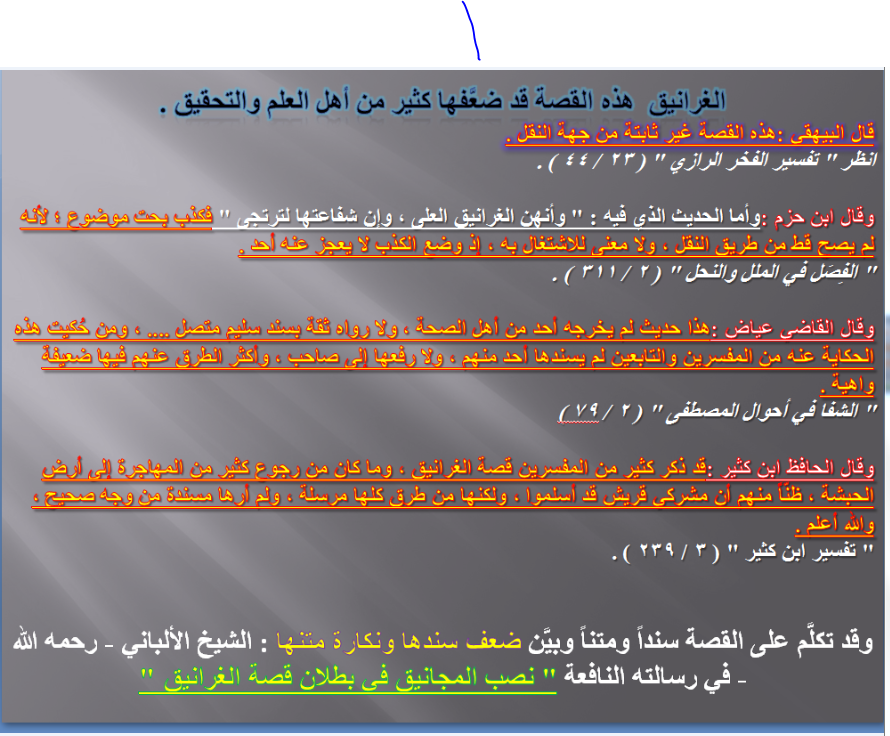
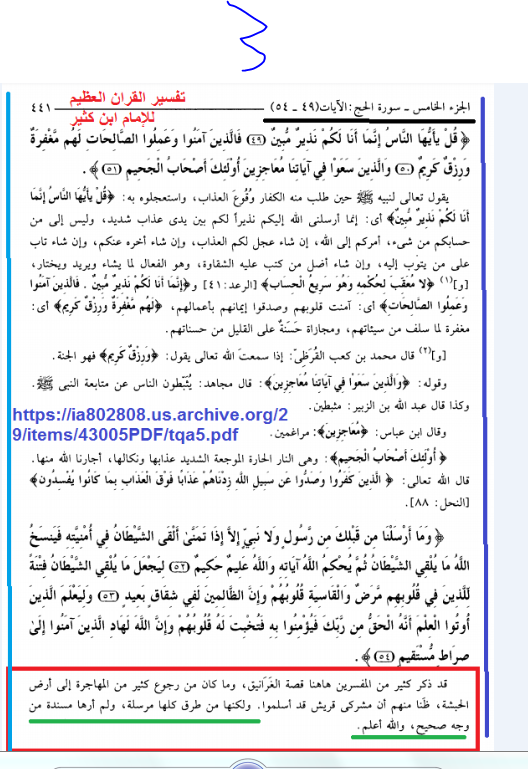
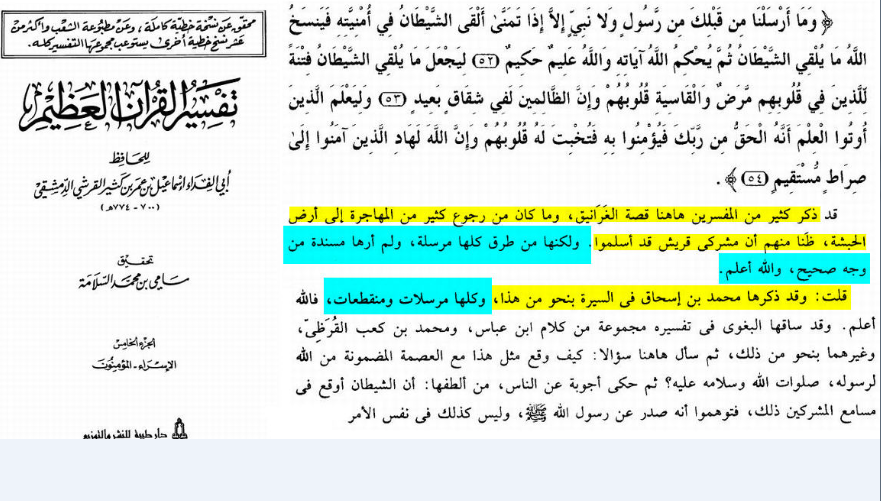
Imam Ibn Kathir
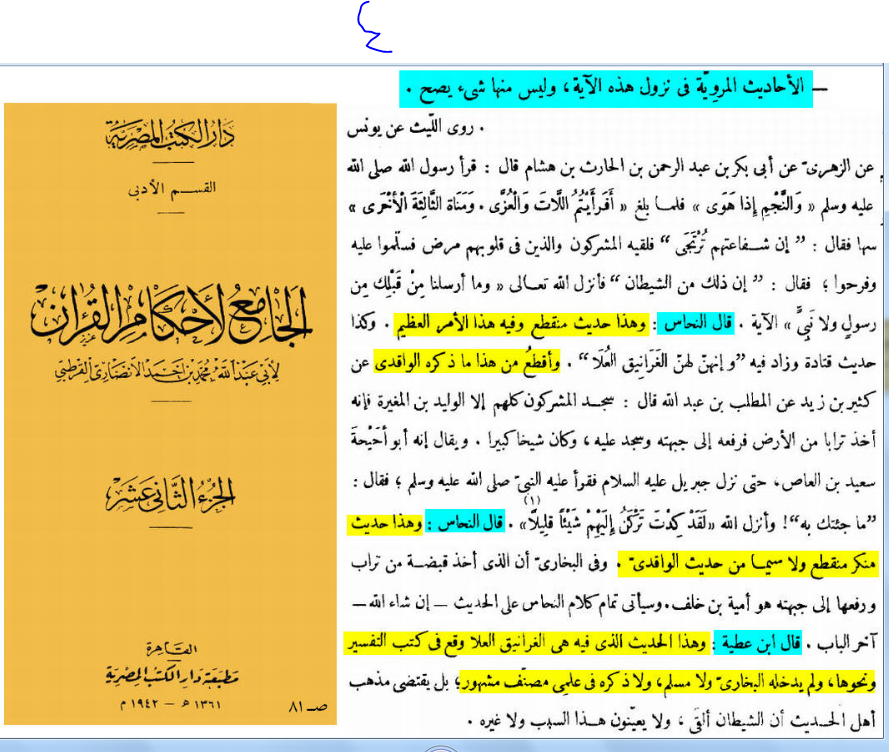
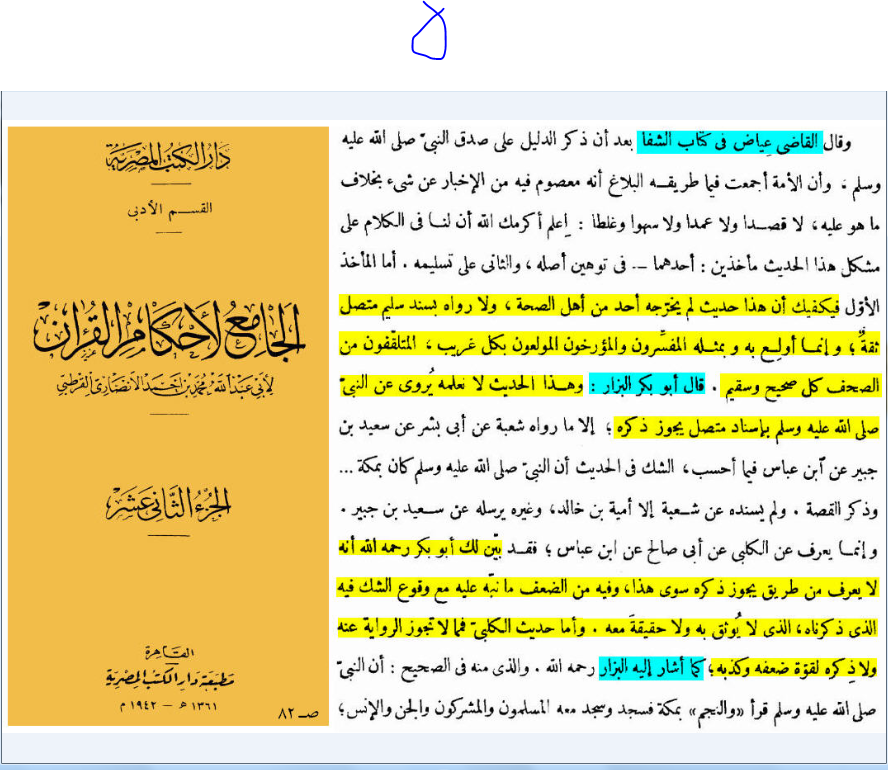
Imam al-Qurtubi
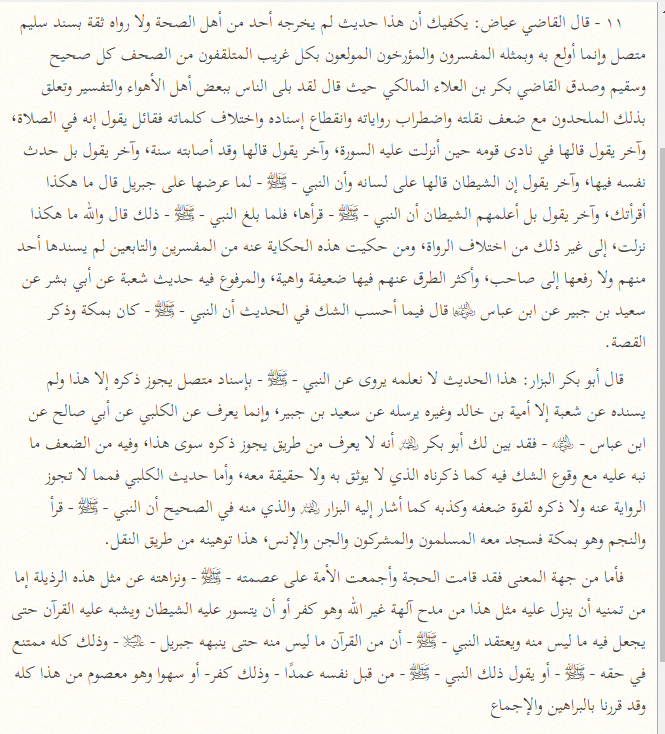
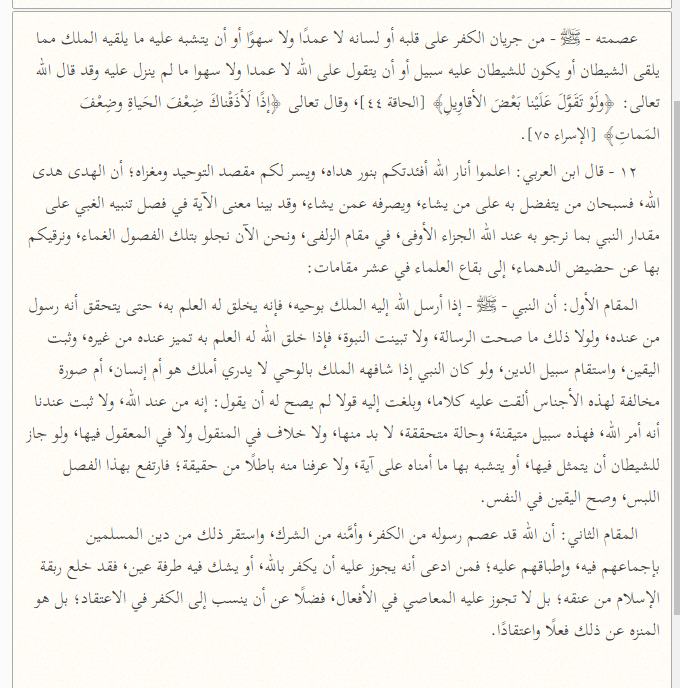
And Judge Iyad said in the book Al-Shifāʾ after mentioning the evidence of the truthfulness of the Prophet ﷺ, and that the nation has unanimously agreed in its path of transmission that he is infallible in reporting something other than what it is, neither intentionally, nor deliberately, nor by mistake: Know, may Allah honor you, that we have two points of view in speaking about the problems of this hadith: One of them is to weaken its origin, and the second is to accept it.
As for the first point of view, it is sufficient for you that this hadith was not narrated by any of the people of authenticity, nor narrated by a sound, connected, trustworthy chain of transmission; rather, the commentators and historians who are fond of everything strange, who pick up from the pages everything that is sound and weak, are fond of it and its like. Abu Bakr al-Bazzar said: We do not know of this hadith being narrated from the Prophet ﷺ with a connected chain of transmission that is permissible to mention; except what was narrated by Shu’bah, from Abu Bishr, from Sa’id ibn Jubayr, from Ibn Abbas — and in this narration there is doubt as to whether the chain is connected — and no one narrated it from Shu’bah except Umayyah ibn Khalid, and others send it back from Sa’id ibn Jubayr without connection. It is only known from al-Kalbi, from Abu Salih, from Ibn Abbas; and al-Kalbi is not permissible to narrate from nor to mention due to its strong weakness and falsehood, as al-Bazzar indicated. What is from the Sahih is that the Prophet ﷺ recited Surat al-Najm in Mecca and prostrated, and the Muslims, polytheists, jinn, and humans prostrated with him — and this is its weakness from the path of transmission.
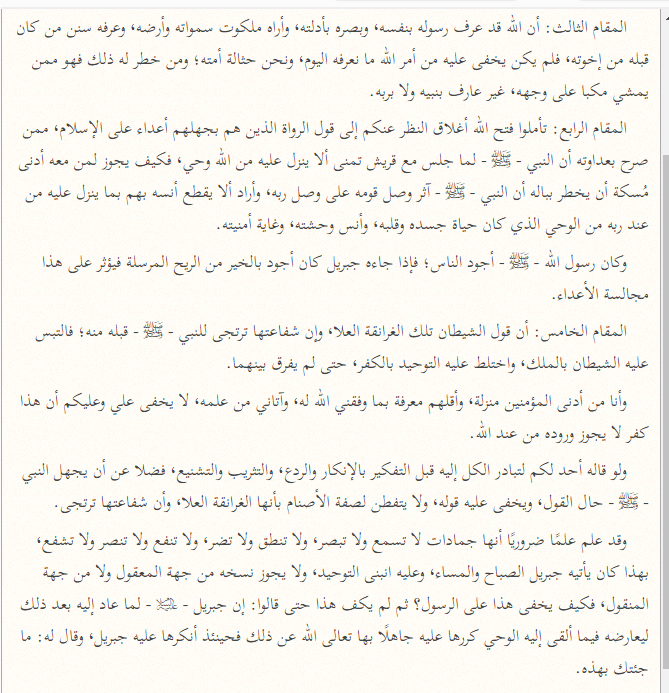
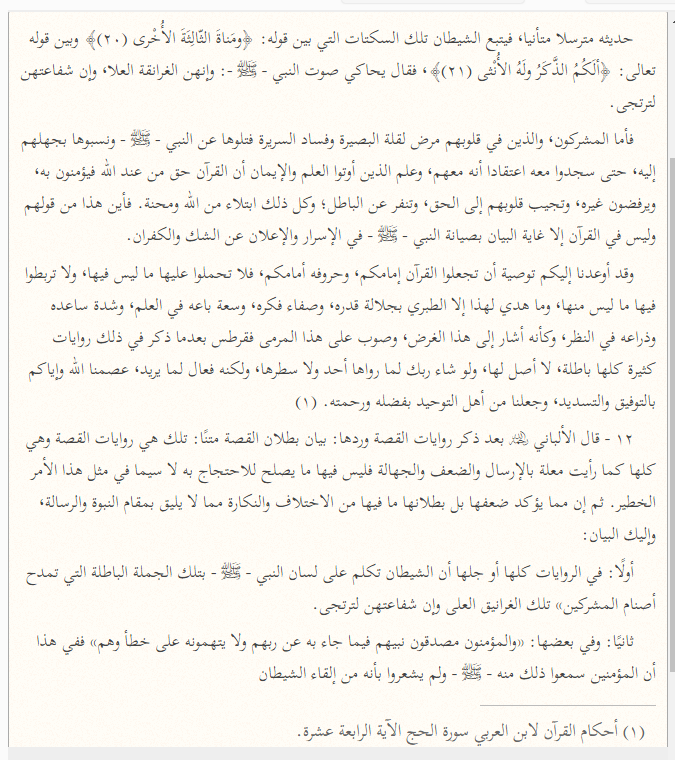
As for the second view — accepting the hadith if authentic — the best and most likely interpretation is that Satan was watching the pauses in the Prophet’s ﷺ measured recitation, inserting into them what he fabricated, imitating the tone of the Prophet ﷺ, so that the disbelievers who were nearby heard it and thought it came from him ﷺ. This did not detract from what the Muslims had memorized of the surah as God revealed it, and they were certain of the Prophet’s ﷺ state in denouncing and criticizing idols.
Sulayman ibn Harb said: ‘Indeed, fī (in) here means maʿahu (with him); that is, Satan cast into the hearts of the infidels when the Prophet ﷺ recited.’ Judge Abu Bakr ibn al-Arabi said before him: ‘This verse is a clear statement of our purpose, evidence of the correctness of our doctrine, and a basis for the innocence of the Prophet ﷺ from what is attributed to him — because Allah the Almighty said: {And We did not send before you any messenger or prophet except that when he desired, Satan cast into his desire}, meaning into his recitation. So Allah informed us that it is part of His way with His messengers that if they said something on behalf of Allah, Satan added to it from himself — not that the Prophet ﷺ spoke it.’ No one was guided to this except al-Tabari, due to his great stature, the purity of his thought, and the breadth of his knowledge.”
Imam al-Shawkani
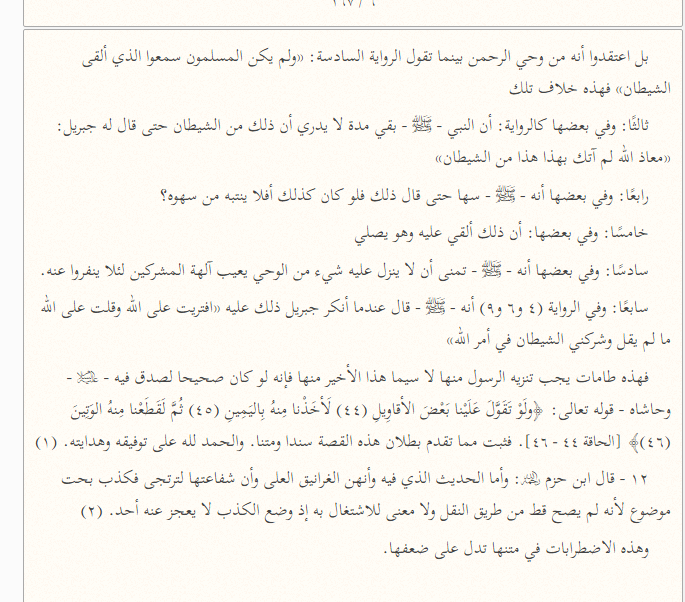
Al-Bazzar said: This is a hadith that we do not know of, narrated from the Prophet ﷺ with a connected chain of transmission.
Al-Bayhaqi said: This story is not authentic in terms of transmission, and its narrators are questionable.
And the Imam of Imams Ibn Khuzaymah said: This story is a fabrication of the heretics.
Judge Iyad said in Al-Shifāʾ: The nation has unanimously agreed that he ﷺ is infallible in reporting something other than what it is, neither intentionally nor deliberately nor by mistake nor inadvertently.
Ibn Kathir said: Many commentators have mentioned here the story of the cranes, and what happened with the return of many of the immigrants to Abyssinia, thinking that the polytheists of Quraysh had converted to Islam, but it is from all paths that are mursal, and I have not seen it attributed from a sound source.”
Imam Abu Hayyan al-Andalusi — Al-Bahr al-Muhit
It is surprising that this was transmitted while they recite the Book of Allah the Most High: {By the star when it goes down. Your companion has not strayed, nor has he erred. Nor does he speak from his own inclination. It is only a revelation revealed to him.} And Allah the Most High said, commanding His Prophet: {Say: It is not for me to change it of my own accord. I only follow what is revealed to me.} And Allah the Most High said: {And if you had fabricated against Us some sayings.} And Allah the Most High said: {And had We not strengthened you, you would have almost inclined toward them} — so the strengthening is real and comparison is negated. And the Most High said: {Thus do We strengthen your heart thereby.} And the Most High said: {We will make you recite, and you will not forget.} And these are texts that testify to his infallibility. As for the rational perspective, this is not possible, because permitting it leads to permitting it in all rulings and Shari’ah, so there is no guarantee of change and alteration in them, and the impossibility of that is known.”
Imam Ibn Hajar — Fath al-Bari
And what was said — that it was because of Satan’s whispering during the recitation of the Messenger of God ﷺ — is not sound, rationally or by transmission.
Imam al-Baydawi
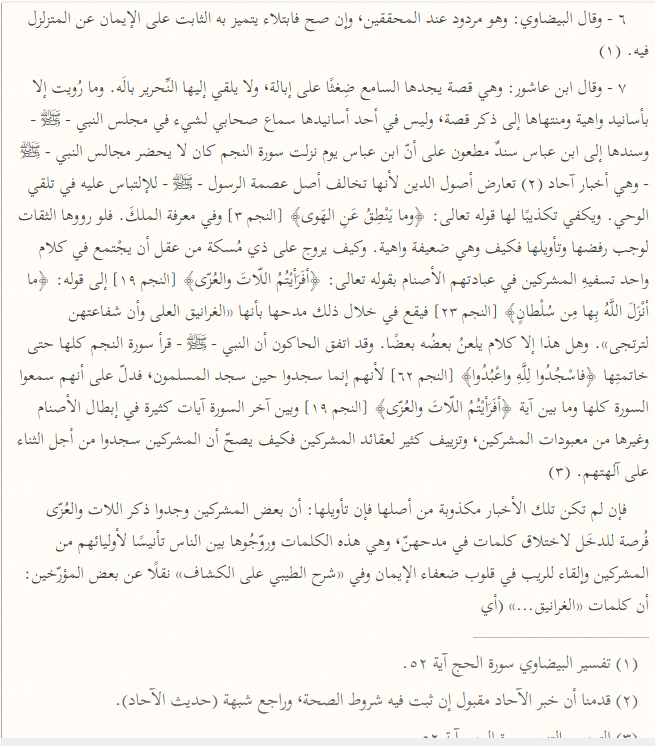
On the story itself, al-Baydawi adds that it is rejected by the investigators, and if it were true, it would be a test that distinguishes the one who is steadfast in faith from the one who is wavering.
Imam Ibn al-Jawzi — Zaad al-Masir
Imam Abu al-Su’ud
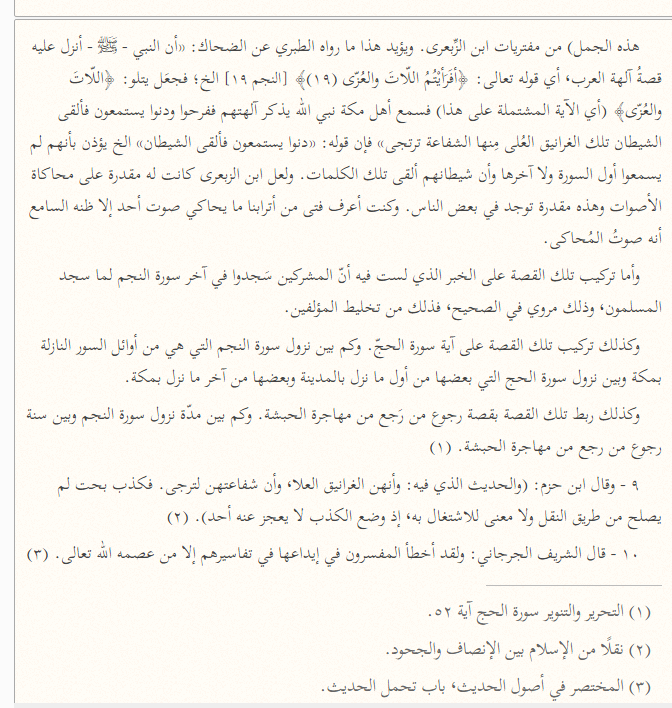
Imam Ibn Hazm — Al-Fasl fi al-Milal wa al-Nihal
As for the statement of Allah, the Most High: {And We did not send before you any messenger or prophet except that when he wished, the devil threw in his wish} — the wishes that occur in the soul have no meaning in this regard. The Prophet ﷺ wished for his uncle Abu Talib to convert to Islam, but God Almighty did not will that. These are the wishes that God Almighty mentioned, and nothing else. God forbid that a prophet would wish for disobedience.”
Imam al-Baqa’i
Ibn Adel — Quoting Ibn al-Khatib
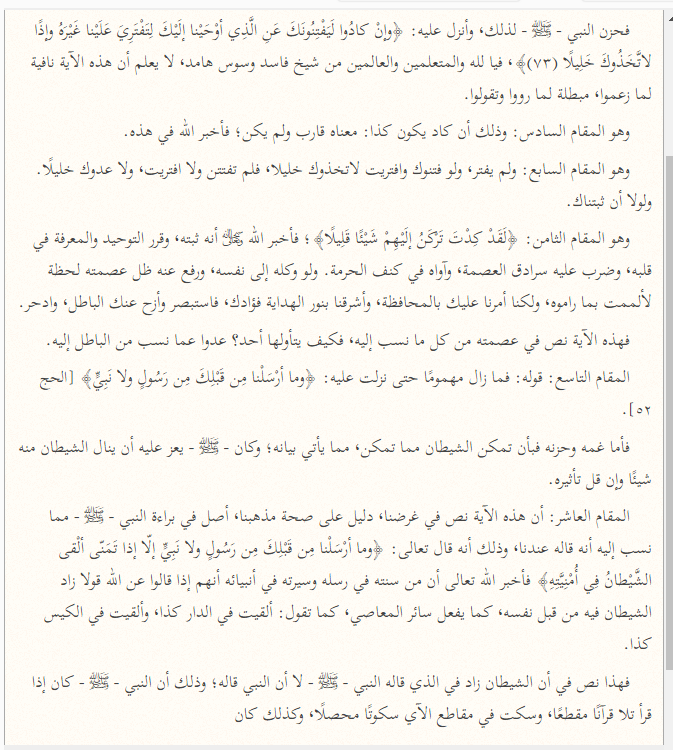
As for the Qur’an: {And if he had invented about Us some sayings, We would have seized him by the right hand, then We would have cut from him the aorta} [Al-Haqqah: 44–46]. And: {Say: It is not for me to change it of my own accord. I only follow what is revealed to me} [Yunus: 15]. And: {Nor does he speak from his own inclination. It is not but a revelation revealed} [An-Najm: 3–4]. If he had read after this verse the words ‘Those are the exalted cranes,’ the lie of God would have been immediately apparent, and no Muslim would say that. And: {And indeed they almost tempted you away from that which We have revealed to you} [Al-Isra’: 73] — the word ‘almost’ means the matter was close to being like that, although it did not happen. And: {And had We not strengthened you, you would have almost inclined toward them} [Al-Isra’: 74] — the word ‘lawla’ indicates the absence of something due to the absence of something else, indicating that this little inclination did not happen. And: {Thus do We strengthen thereby your heart} [Al-Furqan: 32]. And: {We will make you recite, and you will not forget} [Al-A’la: 6].
As for the Sunnah: It was narrated from Muhammad ibn Ishaq that he was asked about this story and said: This is from the fabrications of the heretics and he wrote a book about it. Imam Abu Bakr Ahmad ibn al-Husayn al-Bayhaqi said: This story is not proven in terms of transmission, and its narrators are criticized. Al-Bukhari narrated in his Sahih that he ﷺ recited Surat al-Najm and the Muslims, polytheists, jinn, and humans prostrated in it — but there is no mention of the cranes in it at all.
As for the rational: First, whoever allows the Messenger ﷺ to glorify idols has committed blasphemy, because it is known by necessity that his greatest effort was in denying idols. Second, he ﷺ was not even able to pray and recite at the Kaaba openly in the beginning, safe from the harm of the polytheists. Third, their enmity toward the Messenger was greater than for them to agree that he glorified their gods until they fell down in prostration, when it did not appear to them that he agreed with them. Fourth, if Allah wanted to perfect the verses so that the Qur’an would not be confused with anything else, it is more appropriate for Satan to be prevented from doing so at all. Fifth, and it is the strongest: if we were to permit that, then security would be lifted from His law, and we permit it in all laws — and His statement {Convey that which has been revealed to you from your Lord. And Allah will protect you from the people} [Al-Ma’idah: 67] would be invalidated, for there is no difference in reason between a decrease in the revelation and an increase in it. By these aspects we know in general that this story is fabricated.”
Imam al-Fakhr al-Razi — Mafatih al-Ghayb
As for the Qur’an, there are aspects: {And if he had fabricated against Us some sayings, We would have seized him by the right hand, then We would have cut from him the aorta} [Al-Haqqah: 44–46]. And: {Say: It is not for me to change it of my own accord} [Yunus: 15]. And: {Nor does he speak from his own inclination} [An-Najm: 3–4] — if he had read after this verse those lofty cranes, Allah’s lie would have been immediately revealed, and no Muslim would say that. And: {And indeed they almost tempted you away from that which We revealed to you} [Al-Isra’: 73]. And: {And had We not strengthened you, you would have almost inclined to them a little} [Al-Isra’: 74] — this indicates that this little inclination did not happen. And: {Thus do We strengthen thereby your heart} [Al-Furqan: 32]. And: {We will make you recite, and you will not forget} [Al-A’la: 6].
As for the Sunnah: Muhammad ibn Ishaq ibn Khuzaymah was asked about this story and said: This is a fabrication by the heretics, and he wrote a book about it. Imam Abu Bakr Ahmad ibn al-Husayn al-Bayhaqi said: This story is not proven in terms of transmission, and the narrators of this story are questionable. Al-Bukhari narrated in his Sahih that the Prophet ﷺ recited Surat al-Najm and the Muslims, polytheists, humans, and jinn prostrated during it — but there is no hadith of the cranes in it at all. This hadith was narrated through many chains of transmission, and none of them mention the cranes.
As for the rational, it is from several aspects: First, whoever allows the Messenger ﷺ to glorify idols has committed blasphemy. Second, he ﷺ could not pray and read the Qur’an at the Kaaba in the beginning feeling safe from the polytheists — he would pray at night or in private — and that invalidates their statement. Third, their enmity toward the Messenger was greater than for them to acknowledge this amount of reading without knowing the truth of the matter. Fourth: {Then God abrogates what Satan casts, then God establishes His verses} — if God wants to establish the verses so that what is not the Qur’an is not confused with the Qur’an, then it is more appropriate for Him to prevent Satan from doing so at all. Fifth, and it is the strongest: if we allow that, then security is removed from His law, and we allow in every one of the rulings and laws that it is like that, and the saying of Allah: {O Messenger, announce that which has been revealed to you. And Allah will protect you from the people} [Al-Ma’idah: 67] is invalidated, for there is no difference in reason between a decrease in the revelation and an increase in it. So by these aspects we know in general that this story is fabricated. Most of what is in this chapter is that a group of commentators mentioned it, but they did not reach the level of mutawatir, and the report of one person does not contradict the rational and transmitted evidence that is mutawatir.”
Al-Razi also clarifies the correct interpretation of the verse:
The third issue: The gist of the research goes back to the fact that the purpose of this verse is to clarify that the messengers whom Allah sent, even though He protected them from error with knowledge, He did not protect them from the permissibility of forgetfulness and the whisperings of Satan as a human capacity — not that any such whispering was actually incorporated into the revelation. So it is obligatory that they should not be followed except in what they do with knowledge, for that is the decisive statement.”
Imam Ibn Ashour — Al-Tahrir wa al-Tanwir
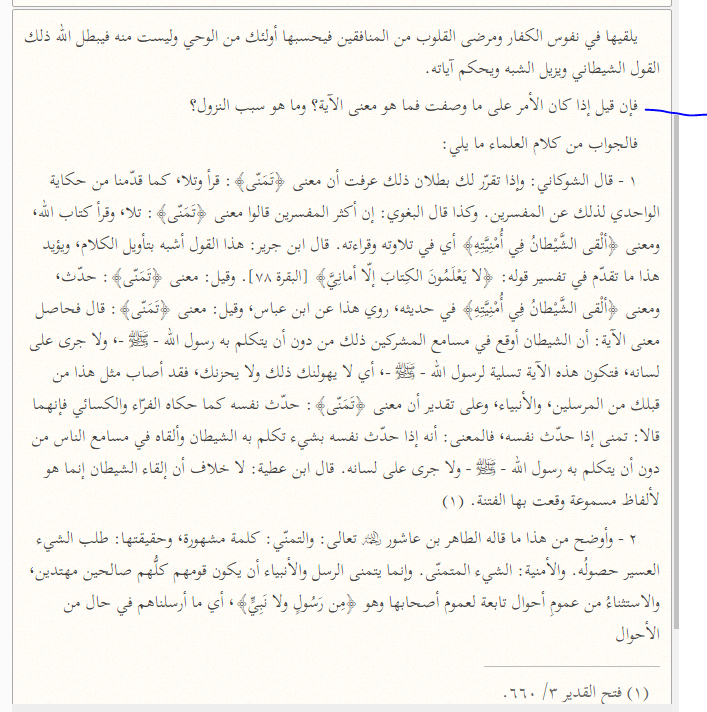
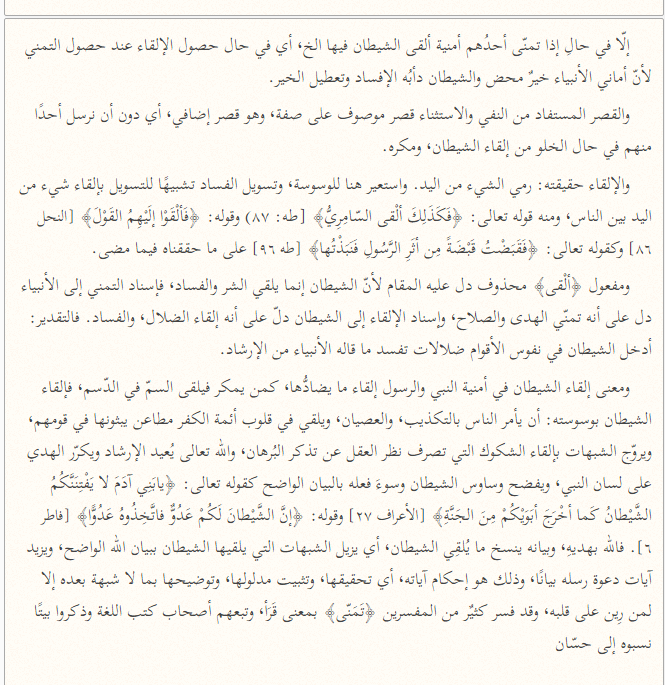
It is possible that the meaning is that if the Prophet wishes to guide his people but encounters stubbornness from them, and wishes to obtain their guidance by every means, Satan casts into the Prophet’s soul the thought of despair of guiding them, so that perhaps the Prophet will fall short out of his keenness or Satan will make him bored. These are thoughts that appear in the soul, but infallibility prevents them, and that thought soon disappears and the duty he was charged with is established in the soul of the Messenger — which is to persevere in calling to Islam and to be keen on guidance. This aligns with the saying of the Most High: {And if their aversion is hard for you, then if you are able to seek a tunnel into the earth or a ladder into the sky and bring them a sign… So never be among the ignorant} [Al-An’am: 35].
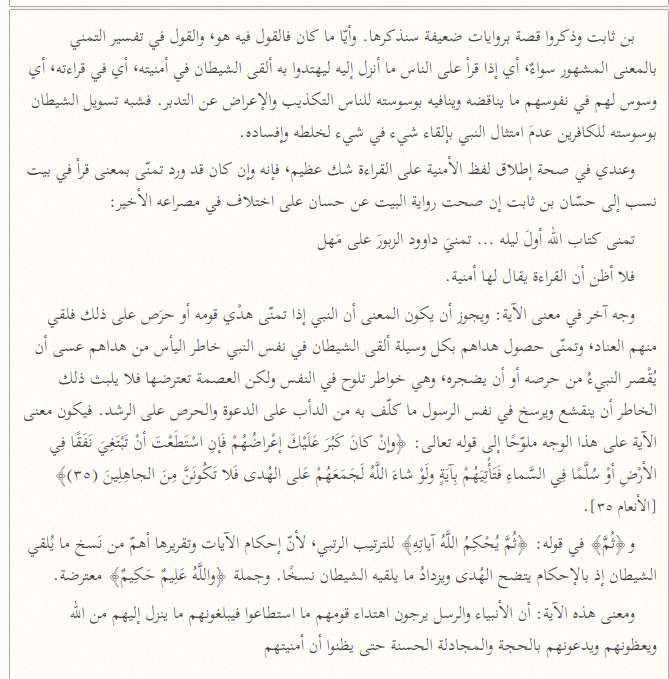
Based on what we have received in the interpretation of this verse from the clear, evident, independent system of meaning — free from the affectations and the need to include stories — you will see that the verse is isolated from what the adherents and the weak in the sciences of the Sunnah have attached to it, and what a group of commentators have received from them out of love for strange and unusual things without contemplation or scrutiny. The narrations attached to this verse — from Said ibn Jubayr, Ibn Shihab, Muhammad ibn Ka’b al-Qurtubi, Abu al-‘Aliyah, al-Dahhak — are only with weak chains of transmission, and in none of their chains is there any Companion hearing anything in the company of the Prophet ﷺ. The chain of transmission to Ibn Abbas is weak, and Ibn Abbas, on the day Surah al-Najm was revealed, did not attend the gatherings of the Prophet ﷺ. These are individual reports that contradict the principles of religion because they contradict the principle of the infallibility of the Messenger ﷺ.
It is sufficient to refute them with the words of God Almighty: {Nor does he speak from his own inclination} [An-Najm: 3]. If trustworthy people had narrated it, it would have been necessary to reject it and interpret it — so how can it be, when it is weak and flimsy?
How can it be possible for anyone with a modicum of intelligence to combine in one statement the denigration of the polytheists in their worship of idols — with the words of the Most High: {Have you considered Al-Lat and Al-Uzza?} up to {Allah has sent down no authority for them} [An-Najm: 19–23] — and then in the midst of that praise them as ‘the exalted cranes and their intercession is hoped for’? Is this not just words that curse one another?
The judges agreed that the Prophet ﷺ recited the entire Surah al-Najm until its end — {So prostrate to God and worship Him} [An-Najm: 62] — because the polytheists only prostrated when the Muslims prostrated. This indicates that they heard the entire Surah. And between the verse about Al-Lat and Al-Uzza and the end of the Surah are many verses refuting idols and falsifying the beliefs of the polytheists. How can it be true that the polytheists prostrated in order to praise their gods?”
Imam al-Qasimi
This is the correct interpretation of the verse. It has parallels that clarify what is meant by it, as we have indicated, if they needed a parallel. But it is clear in itself, and does not need a long interpretation, were it not for the need for investigators to refute the falsehoods that some narrators have inserted here.”
Al-Samin al-Halabi — Al-Durr al-Masun
Imam al-Tha’labi
Abu Bakr al-Bazzar said: We do not know of this hadith being narrated from the Prophet ﷺ with a connected chain of transmission that is permissible to mention. It is only known from al-Kalbi. And al-Kalbi is one of those from whom it is not permissible to narrate or mention, due to his extreme weakness and lying, as al-Bazzar indicated. The Ummah has agreed upon the infallibility of the Prophet ﷺ and his purity from such a thing.
Ibn Atiyyah said: This hadith which says ‘They are the gharaniq’ was mentioned in the books of interpretation and the like, and neither al-Bukhari nor Muslim included it, nor was it mentioned — as far as I know — by any famous author. Rather, the doctrine of the people of hadith requires that Satan cast it; and they do not specify this reason or any other. My father told me that he met in the East from the elders of scholars and theologians who said: This is not permissible from the Prophet ﷺ, and he is infallible in conveying the message. Rather, the matter means, if it is true, that Satan uttered a word that the infidels heard when the Prophet ﷺ said: {Have you considered Al-Lat and Al-Uzza? And Manat, the third, the other?} — and Satan brought his voice close to the voice of the Prophet ﷺ until the matter became confusing to the polytheists, and they said: Muhammad recited it. This is assuming that it is correct.
Musa ibn ‘Uqbah narrated something similar and said: The Muslims did not hear it, but rather the devil put it in the ears of the polytheists.”
Imam al-Naysaburi
Imam al-Khazin
What came in the Sahih from the hadith of Abdullah ibn Masoud is that the Prophet ﷺ recited Surat al-Najm and prostrated in it, and those who were with him prostrated, except for an old man from Quraysh who took a handful of pebbles or dirt and raised it to his forehead. Abdullah said: ‘I saw him after he was killed as a disbeliever.’”
This is Part 2 of the full refutation of the Satanic Verses slander. Part 1 covered the verdicts of the classical scholars of tafsir. This part covers the detailed isnad analysis of Imam al-Albani, the chain-by-chain breakdown of every narration in the story, and the science of mursal hadith as it applies to this case.
Second: The Contradiction of the Gharaniq Narrations with the Authentic Narration in the Two Sahihs
Before the chain analysis, we establish the baseline: what IS authentically narrated in Sahih al-Bukhari and Sahih Muslim regarding the recitation of Surat al-Najm.
Grade: Sahih · Bukhari (Ibrahim bin Tahman follows Ayyoub on this narration; Ibn Ulayyah did not mention Ibn Abbas.)
Grade: Sahih · Bukhari & Muslim
Grade: Sahih · Muslim
Al-Tabarani agreed with al-Bukhari in his narration in the Al-Mu’jam al-Kabir (11866), adding: “Hafs ibn Umar said in his hadith: The Prophet ﷺ prostrated in Mecca, and the Jews, Christians, and polytheists prostrated with him.”
The narrations in both Sahihs make absolutely no mention of any “cranes” at all — in any of their chains of transmission. The three differences between the Gharaniq narration and the authentic Sahih narrations are:
First difference: The prostration of the polytheists in the two Sahihs was at the end of Surat al-Najm, while in the Gharaniq narration, their prostration was at the beginning — after the verse about Al-Lat, Al-Uzza, and Manat.
Second difference: The reason for the prostration of the polytheists in the two Sahihs is that the verses of Surat al-Najm moved them and they heard the power and eloquence of its speech. In the Gharaniq narration, the reason is the Prophet’s supposed praise of their gods — God forbid.
Third difference: The Sahih narrations make no mention whatsoever that the Prophet ﷺ mentioned the Gharaniq at all in his recitation.
Third: Imam al-Albani’s Full Analysis — Nasb al-Majaniq li-Nusf Qissat al-Gharaniq
On 7/14/1952 AD, some of the professors from Pakistan asked me about my opinion on the hadith of the cranes — about which the opinions of two great hadith scholars differed: Ibn Kathir al-Dimashqi and Ibn Hajar al-Misri. The first denied it and the other strengthened it. One of my beloved ones later mentioned to me that a young man who had a disease in his heart used it as evidence that the Prophet ﷺ — God forbid — used to speak in a way that would please the polytheists in order to attract them, claiming he was not a true prophet but was pretending in order to rule over them, as some of the atheists have been raving about in the past and present. This prompted me to collect the chains of transmission of that story from the books of interpretation and hadith, and I explained its defects in terms of text and chain of transmission, then I mentioned the statement of al-Hafiz Ibn Hajar in strengthening it and followed it up with what would clarify the error in what he went to.”
Imam al-Albani’s verdict is categorical:
The Full Picture: All Narrations Are Either Mursal or Extremely Weak
The death of Sa’id ibn Jubayr was in the year 95 AH, and Abu Bakr ibn Abd al-Rahman was in the year 94 AH, and Abu al-‘Aliyah — whose name is Rafi’ — was in the year 90 AH, and Qatada was in the early hundreds. The first was from Kufa, the second from Medina, and the last two were from Basra. It is possible that their source was one person and no one else — and he is unknown. It is possible that it was a group but they are all weak. With these possibilities, the soul cannot be reassured in accepting their hadith, especially in such a great event that touches the noble position — so it is no wonder that the scholars followed one another in denying it and denouncing its invalidity.”
The Chain of Ibn Abbas — Why It Cannot Serve as a Support
The only narration with a chain reaching a Companion (Ibn Abbas) comes through two paths — both defective:
Path One: Through al-Kalbi
The narration from al-Kalbi, from Abu Salih, from Ibn Abbas.
Al-Kalbi is universally abandoned (matruk) by the hadith scholars. This path is rejected.
Path Two: Through Umayyah ibn Khalid via Shu’bah
The key problem: Umayyah ibn Khalid himself introduced doubt (shakk) as to whether the chain is connected or mursal. As Imam al-Albani states:
And Imam al-Albani notes from al-Wahidi’s Asbab al-Nuzul that this same path from Uthman ibn al-Aswad from Sa’id ibn Jubayr — cited by al-Wahidi — is also mursal:
A New Chain Found — Also Weak
A chain was found going back to Ibn Abbas through Jafar ibn Zayd al-Tayalisi, from Abu Asim, from Uthman ibn al-Aswad, from Sa’id ibn Jubayr, from Ibn Abbas — as included by al-Dhiya al-Maqdisi in Al-Ahadith al-Mukhtarah quoting Ibn Mardawayh.
As for Abu Bakr al-Muqri’ himself — al-Khatib al-Baghdadi mentioned him in Tarikh Baghdad and stated no criticism or praise of him. He is therefore unknown in his condition (majhul al-hal).
Conclusion on the Ibn Abbas chain: Not a single path connecting this narration to Ibn Abbas is reliable. The most “connected” path has a narrator who doubted the connection, and the correct reading is that it is mursal from Sa’id ibn Jubayr. The other path goes through al-Kalbi, who is universally abandoned.
The Four “Authentic” Mursals — Why They Cannot Support Each Other
Al-Hafiz Ibn Hajar, despite his overall support of the story, himself admitted:
Imam al-Albani responds to Ibn Hajar’s strengthening argument:
As for the four mursal paths — these mursals cannot support one another because they are from the same generation. The reason hadith scholars do not rely on mursal hadiths is the ignorance of the intermediary from whom the mursal narrator took. Al-Khatib al-Baghdadi explained in Al-Kifaya fi Ilm al-Riwayah that the mursal hadith leads to ignorance of the identity of its narrator, and it is impossible to know his justice while ignorant of his identity. Therefore, when the paths are many and all are mursal, we must not assume different sources — it is entirely possible that everyone who sent it took it from one narrator, and then the possibilities that multiply the chains vanish. This is as if Imam al-Shafi’i noticed the occurrence of this possibility and its strength, so he stipulated in the supporting mursal that its sender took knowledge from other than the men of the first narrator — precisely to make it more likely that what is deleted in one mursal is not the same as in the other.”
The Mursal of Abu al-‘Aliyah — Specifically Weakened
Ibn Sirin’s statement here is general in all of Abu al-‘Aliyah’s mursals and is not specific to any one hadith. Al-Ala’i relied on this in weakening Abu al-‘Aliyah’s mursal.
Furthermore, al-Ala’i demonstrates with a concrete example that what appears to be multiple mursal chains can in fact all trace back to a single source — Abu al-‘Aliyah:
The Mursal of Qatada — Specifically Weakened
The Mursal of Sa’id ibn Jubayr — Its Correct Status
However, al-Albani explains that this statement falls under the chapter of “the weak vs. the weaker” — not the chapter of “the acceptable”:
The Mursal of Urwah ibn al-Zubayr — Does NOT Mention the Cranes
The mursal of Urwah ibn al-Zubayr in his famous letter to Abdul Malik ibn Marwan — authenticated by Sheikh Ahmad Shakir in his investigation of al-Tabari’s Tafsir — describes the early mission of the Prophet ﷺ, the migration to Abyssinia, and the reasons for the return of some of the emigrants.
^^Urwah ibn al-Zubayr — the imam of the maghazi and one of the most authoritative sources on the early Seerah — describes the return from Abyssinia with no mention of the Gharaniq story at all.^^ This is a devastating blow to the story. Al-Albani notes:
The Mursal of the Abyssinia Account — Authenticated from Urwah, Contradicts the Gharaniq
Sheikh Ahmad Shakir authenticated the chain of Urwah’s letter in his investigation of al-Tabari:
The return of emigrants from Abyssinia in Urwah’s authentic account is explained without any reference to the Gharaniq — and this agrees with what is established in the Sunnah: the return was prompted by the Islam of Umar ibn al-Khattab and Hamza ibn Abd al-Muttalib (may Allah be pleased with them both).
Grade: Sahih · Bukhari
Dr. Muhammad al-Suwayyan authenticated this in his book Sahih min Ahadith al-Sira al-Nabawiyya, Chapter on the Islam of Umar.
The Al-Shanqiti Analysis — Adwa’ al-Bayan
Al-Bazzar and Ibn Mardawayh narrated on the authority of Umayyah ibn Khalid, on the authority of Shu’bah, on the authority of Abu Bishr, on the authority of Sa’id ibn Jubayr, on the authority of Ibn Abbas — as I think — then he cited the hadith. Al-Bazzar said: It is not seen to be connected except through this chain of transmission. Umayyah ibn Khalid is the only one who connected it, and he doubted.
It was concluded that the story of the cranes was not transmitted in a connected manner except through this source whose narrator doubted the connection. It is known that something like this cannot be used as evidence due to its apparent weakness. Therefore, al-Hafiz Ibn Kathir said: He did not see it transmitted in a correct manner. Al-Shawkani said: None of this is authentic, nor is it proven in any way.
The bottom line is that the Qur’an indicates its falsehood, and it has not been proven by transmission, along with the impossibility of it being on his tongue ﷺ as mentioned in the Shari’ah. Whoever confirms it attributes the utterance of that disbelief to Satan. It is clear that the Prophet ﷺ uttering this blasphemy, even inadvertently, is impossible according to Islamic law. The Qur’an has proven its invalidity, and it is definitely invalid in any case.”
Al-Shanqiti also gives the correct Quranic interpretation:
Note 1: The Position of Ibn Taymiyyah — Suspension, Not Authentication
Some people have claimed that Sheikh al-Islam Ibn Taymiyyah confirmed the story of the cranes. This is incorrect.
Notice how Ibn Taymiyyah conveyed the arguments of both groups and was satisfied with responding to this doubt assuming the story is true. The last relevant passage makes his hesitation clear:
The phrase “if it was correct” is a statement that indicates his lack of certainty about the authenticity of the narration — neither authentication nor denial, but suspension (tawaqquf). This position is confirmed throughout his various transmissions of the arguments of both sides.
Note 2: What al-Suyuti Actually Said About Mursal Hadith
Some have cited Imam al-Suyuti to suggest he broadly accepted mursal hadiths as evidence. His actual position from his own alfiyya (Tadrib al-Rawi) is precisely the opposite:
Al-Suyuti leans toward rejection as the strongest opinion:
Al-Suyuti himself, in Lubab al-Nuqul fi Asbab al-Nuzul, gives his own verdict on the Gharaniq chains:
And the commentary of al-Sawi on al-Jalalain, after quoting Ibn Hajar’s authentication:
Note 3: The Scope of the Mursal Acceptance — Rulings Only, Not Beliefs
A critical methodological point that some Christians and doubters overlook: those among the Hanafis and Malikis who accepted the mursal hadith accepted it only in the science of branches of rulings — not in the science of principles of beliefs (aqeedah). According to their own school of thought, the narration of al-Gharaniq is also invalid.
The key word: in rulings (fi al-ahkam). Not in aqeedah. Not in matters touching prophethood and infallibility. Al-Zayla’i in Nasb al-Rayah confirms this:
And al-Nawawi states plainly in Taqrib al-Nawawi:
And from the introduction to Sahih Muslim:
Grade: This is the position of Muslim, Abu Zur’ah al-Razi, Abu Hatim, and transmitted by Ibn Abd al-Barr from a group of hadith scholars.
Summary of the Isnad Verdict
- The al-Kalbi path to Ibn Abbas — rejected: al-Kalbi is abandoned (matruk) by unanimous agreement.
- The Umayyah ibn Khalid path to Ibn Abbas via Shu’bah — doubted connection: the narrator himself expressed uncertainty (as I think) about whether the chain reaches Ibn Abbas.
- The newly found Jafar ibn Zayd path — weak: either Jafar ibn Zayd is unknown, or Abu Bakr al-Muqri’ al-Baghdadi (the intermediary) is unknown in his condition.
- The mursal of Sa’id ibn Jubayr — mursal, and the same path cited in al-Wahidi’s Asbab al-Nuzul shows it is mursal from Sa’id, not connected to Ibn Abbas.
- The mursal of Abu al-‘Aliyah — mursal, and his mursals are specifically weakened by Ibn Sirin and al-Ala’i because he accepted from everyone.
- The mursal of Qatada — mursal, and Yahya ibn Sa’id al-Qattan described his mursals as “like the wind.”
- The mursal of Abu Bakr ibn Abd al-Rahman — mursal, from the same generation as Sa’id ibn Jubayr (died 94 AH vs. 95 AH), making it highly probable they share a single unknown source.
- The mursal of Urwah ibn al-Zubayr — mursal AND does not mention the cranes at all, making it evidence against the story.
The four mursals with authentic chains to their narrators (Sa’id, Abu al-‘Aliyah, Abu Bakr ibn Abd al-Rahman, Qatada) cannot support one another because they are from the same generation and the same approximate regions — meaning their single shared unknown source cannot be multiplied into independent chains. Imam al-Shafi’i’s condition for a supporting mursal is that its sender took knowledge from other than the men of the first — a condition these mursals demonstrably do not fulfill.
Continue to Part 3 for the Quranic and rational evidence of the story’s impossibility, and the sixth aspect: the internal contradiction of the text of the narration.
This is Part 3 of the full refutation of the Satanic Verses slander. Part 1 covered the classical tafsir scholars’ verdicts. Part 2 covered the full isnad analysis. This part covers: the Quranic evidence of the story’s impossibility, the Sunnah evidence, the rational evidence, the internal contradiction of the text of the narration, the evidence from the Prophet’s ﷺ biography, and the accountability argument turning the table on Christians.
The Third Aspect: Quranic Evidence That the Story Is False
The Quran itself — including verses in the very surah being discussed — refutes the Gharaniq story on thirteen grounds.
If he had read after this very verse the words “Those are the exalted cranes,” the lie of God Almighty would have been immediately apparent to every listener. No Muslim would say that.
The word “almost” (kada) means the matter was close to being like that — although it did not happen. Judge Iyad noted: the narrators of the Gharaniq case claimed that the very verses of Al-Isra’ 73–74 were revealed about this incident. But these two verses reject the report entirely — because Allah mentioned that they almost tempted him until he fabricated a lie, and that if He had not strengthened him he would have almost relied on them. The meaning and implication is that Allah protected him from fabricating a lie and strengthened him until he did not rely on them at all — so how much more protected is he from what the weak narrations claim? This is like the saying of Allah: {And had it not been for the grace of Allah upon you and His mercy, a party of them would have resolved to mislead you. But they mislead not except themselves, and they do not harm you at all.}
It was narrated from Ibn Abbas that everything in the Qur’an that is “almost” is what will not happen: Allah said {The flash of its lightning almost takes away the sight} — and it did not go away. And {I almost hid it} — and He did not do it.
The word lawla indicates the absence of something due to the absence of something else — indicating that this little inclination did not occur. He denied the proximity of inclination, let alone inclination itself.
Eighth — and among the clearest Quranic proofs of the story’s invalidity: the Prophet ﷺ recited after the alleged casting, in the same Surat al-Najm, the statement of Allah:
If we suppose that he said “Those are the exalted cranes,” he immediately invalidated that by saying: “They are only names which you have named.” How can the polytheists rejoice after this complete condemnation of their idols — that they are names without substance — and prostrate in joy and jubilation? Is this not just words that curse one another?
According to the alleged view that Satan put that blatant blasphemy on his tongue ﷺ — what authority is greater than that? The verses establish that Satan has no authority over the Prophet ﷺ and his sincere followers. Putting words of shirk on the tongue of the Messenger would be the greatest possible authority.
Thirteenth — Allah informed that the explanation of the Qur’an on the tongue of the Prophet ﷺ is entrusted to Allah Himself:
Ibn Abbas said: When Gabriel came down with the revelation, the Messenger of God ﷺ would move his tongue and lips and it would be difficult for him, so God revealed: {Do not move your tongue with it to hasten it. Indeed, upon Us is its collection and its recitation.} He said: It is upon Us to collect it in your chest. So when he recited it, follow its recitation. So when We reveal it, listen. Then indeed, upon Us is its clarification — upon Us to clarify it with your tongue. He said: So when Gabriel came to him, he lowered his head, and when he left, he recited it as Allah had promised. If the clarification is entrusted to Allah, then the authenticity of this story is impossible.
The Fourth Aspect: Evidence from the Sunnah of the Impossibility of This Story
First Sunnah Proof
Grade: Sahih · Bukhari & Muslim
Satan was prevented from taking his form in creation so that he would not lie on his tongue in sleep — just as it was impossible for Satan to take his form in his waking state. Al-Alusi said: If he does not take his form in a dream, then it is more appropriate that he does not take his form in wakefulness — and the commentators explained this by the necessity of confusing truth with falsehood. And if Satan is prevented from taking his form, this includes his voice and his recitation in conveying the revelation to the people — if it happened it would be the greatest deception for the people, so it is more appropriate that Satan is prevented from that.
Second Sunnah Proof
Grade: Sahih · Bukhari & Muslim
Al-Hafiz Ibn Hajar said: There is a great virtue in Umar that requires that Satan has no way over him — and it does not necessitate the establishment of infallibility since there is nothing in it except Satan fleeing from him. If this was for Umar (may Allah be pleased with him) and he is not infallible, then the Messenger of God ﷺ is more deserving of it because he is infallible by the decree of God.
Third Sunnah Proof
Grade: Sahih · Bukhari & Muslim
If God gave him power over Satan in prayer, it is more deserving of His protection from Satan in conveying the revelation.
Fourth Sunnah Proof
Grade: Sahih · Muslim
Al-Nawawi said: “He became Muslim” — with the raising of the mim (aslama, meaning submitted to Islam) or with the opening (aslamtu, meaning I was made safe from his evil) — both readings are well-known. If the Prophet ﷺ was safe from his own companion jinn’s evil, this is inescapable.
The Fifth Aspect: Rational Evidence of the Story’s Impossibility
First: Whoever allows the Messenger ﷺ to glorify idols has committed kufr, because it is known with certainty that his greatest effort throughout his life was in denying idols.
Second: He ﷺ was not even able to pray and read the Qur’an at the Ka’ba in the beginning, safe from the harm of the polytheists — he would pray at night or in private if they were not present. This invalidates the claim that he was reciting publicly in a great gathering of Quraysh.
Third: The enmity of Quraysh toward the Messenger ﷺ was greater than for them to unanimously agree that he glorified their gods — prostrating together — when it had not appeared to them that he agreed with them in any matter. How could they have all fallen in prostration without a single dissenter questioning the matter?
Fourth: Allah’s statement {Then Allah abrogates what Satan casts, then Allah establishes His verses} — establishing the verses by removing what Satan casts from the Messenger is a stronger act than abrogating the verses themselves with other verses that leave doubt about them. If Allah wants to establish the verses so that what is not the Qur’an is not confused with the Qur’an, then it is more appropriate for Him to prevent Satan from doing so at all.
Fifth — and it is the strongest: If we were to permit that, then security would be lifted from His law, and we permit it in all rulings and laws — and the saying of Allah the Almighty would be invalidated:
There is no difference in reason between a deficiency in the revelation and an increase in it.
Sixth: It is forbidden for the Prophet ﷺ to wish for something from the Qur’an to be revealed to him in praise of gods other than Allah — because that is disbelief. Likewise, it is forbidden for Satan to dominate him and make him believe that something not from the Qur’an is from it, until Gabriel makes it clear to him.
Seventh: The Indian scholar Muhammad Ali says: Reading the verses in sequence shows that it is not reasonable to include verses that contradict them in the origin of the Islamic faith. The core of Muhammad’s call ﷺ is the call to monotheism.
Eighth: The impossibility of this story in theory and in common usage — because if this speech were as narrated, it would be far from coherent, contradictory in parts, mixed with praise and blame, weak in composition and organization. This is not hidden from the slightest contemplative person — so how about those in whose presence the Prophet ﷺ recited, whose patience was sound and whose knowledge was broad in the field of eloquence?
Ninth: It is known that it is the habit of the hypocrites, the weak-hearted, and the ignorant among the Muslims to be averse at the slightest trial, and for the enemies to taunt the Muslims for the slightest doubt. No one has narrated anything about this story except this weak-based narration. If that were the case, the Quraysh would have found it difficult to confront the Muslims, and the Jews would have established proof against them through it — as they did in defiance during the story of the Night Journey, which was considered apostasy for some of the weak. No trial greater than this calamity was narrated, and no disturbance of the enemy at that time more severe than this incident, if it were possible. No word was narrated from an opponent about it, nor from a Muslim because of it — and this indicates its invalidity and the uprooting of its origin.
Tenth: There is something in the text itself that excludes the possibility that the reason for the revelation of the verse was a single incident that happened to the Messenger ﷺ — for the text states that this rule applies to all messages with all messengers: {And We did not send before you any messenger or prophet except that when he made a wish, Satan cast into his wish.} What is meant must be a general matter based on a characteristic in the innate disposition shared by all messengers as human beings — which does not contradict the infallibility established for the messengers.
The Sixth Aspect: The Internal Contradiction of the Narration’s Text
Judge Iyad pointed to the confusion in the text of the narration, and Imam al-Albani documented it in detail. The different versions of the story contradict each other in the most basic facts:
- One version says the Prophet ﷺ was praying when it occurred.
- Another says he recited it in the company of his people.
- Another says he recited it when afflicted with a sleepless night.
- Another says it occurred to himself and came out of his mouth.
- Another says Satan said it on behalf of the Prophet ﷺ — and that when the Prophet presented it to Gabriel, he said: “This is not how I recited it to you.”
- Another says that the Muslims did not hear it — only the polytheists (Musa ibn Uqba’s narration).
These are not minor variations in circumstantial detail. They contradict the core mechanism of how the alleged event occurred. A story with this degree of internal textual confusion — on top of its chain weakness — is doubly rejected.
The Seventh Aspect: The Context of Surat al-Najm Itself Refutes the Story
Allah the Most High said in the very surah being discussed:
How can we believe that the polytheists heard the Prophet ﷺ saying “Those are the exalted cranes, and their intercession is hoped for” — and then he followed it up with: “Is it for you the male and for Him the female? That is indeed an unfair division. They are not but names which you have named, you and your fathers, for which Allah has sent down no authority” — and they considered this to be praise for their gods, rejoiced at it, and extolled it with joy? And not a single one of them — the most moderate, most eloquent, most articulate Arabs — asked: “How does the beginning of the statement contradict its end?”
^^The judges agreed that the Prophet ﷺ recited the entire Surat al-Najm until its end — {So prostrate to God and worship Him} [An-Najm: 62] — because the polytheists only prostrated when the Muslims prostrated.^^ This means they heard the entire surah — including the verses between the mention of Al-Lat, Al-Uzza, and Manat and the end of the surah, which are many verses explicitly refuting idols and falsifying the beliefs of the polytheists. How can it be true that the polytheists prostrated in order to praise their gods after hearing all of this?
The Eighth Aspect: The Prophet’s ﷺ Biography Before and After the Mission
The biography of the Prophet ﷺ — both before and after the mission — demonstrates a total, lifelong rejection of idols and of Al-Lat and Al-Uzza specifically. This makes the alleged incident biographically impossible.
Before the Mission
Grade: Authentic — its chain of transmission is authentic; its men are trustworthy men of the two Sahihs, except for the neighbor of Khadija, for no one other than the author narrated this single hadith from him, and he is a Companion — and the ignorance of a Companion does not harm. (Verification: Shu’ayb al-Arna’ut)
After the Mission
Grade: Authentic — its chain of transmission is authentic; its men are trustworthy men of the two Sahihs. Al-Haythami mentioned it in Majma’ al-Zawa’id 6/21–22 and said: It was narrated by Ahmad and its men are the men of the Sahih. (Verification: Shu’ayb al-Arna’ut)
The famous writer Muhammad Hussein Haykal denied the story in his book The Life of Muhammad ﷺ on these same biographical grounds, and attributed the reason for the return of some of the immigrants from Abyssinia to the Islam of Umar ibn al-Khattab and Hamza ibn Abd al-Muttalib (may Allah be pleased with them both) — which agrees with what is proven from the Sunnah:
Grade: Sahih · Bukhari
And from Al-Tabaqat al-Kubra by Ibn Sa’d: “I saw us and we were not able to pray in the House until Umar embraced Islam. So when Umar embraced Islam, he fought them until they let us pray.” (Authenticated by Dr. Muhammad al-Suwayyan in Sahih min Ahadith al-Sira al-Nabawiyya)
The Islam of Umar and Hamza ﷺ — not any alleged Gharaniq — is the explanation for the return of the emigrants. This is confirmed by the letter of Urwah ibn al-Zubayr to Abd al-Malik ibn Marwan (authenticated chain), which describes the entire sequence of events without mentioning the cranes at all.
The Ninth Aspect: Turning the Table — Accountability for Christian Prophets
When Christians use the Gharaniq story against the Prophet ﷺ, they must be held accountable for what their own scripture explicitly attributes to some of the prophets:
1 — Aaron ﷺ and the Golden Calf (Exodus 32:1–6):
2 — Solomon ﷺ and Idol Worship (1 Kings 11:4–10):
3 — Paul describing the devil as “the god of this age” (2 Corinthians 4:4):
4 — Jacob ﷺ conditioning his worship of God on divine protection (Genesis 28:20–21):
According to this text, before this conditional vow, God was apparently not Jacob’s God.
5 — God allowing a lying spirit to speak through the prophets (1 Kings 22:19–23):
6 — A prophet deceiving another prophet by fabricating a revelation (1 Kings 13:11–24):
The result of this fabricated revelation was that the deceived prophet was killed by a lion.
7 — Jacob ﷺ wrestling with “God” and prevailing (Genesis 32:28):
The Christian who presses the Gharaniq story against the Prophet ﷺ — on the basis of a narration the hadith scholars have called fabricated and weak — must answer for explicit, canonical, undeniable texts in his own scripture attributing to prophets: idol-making, idol worship, conditional faith, fabricated revelations, and God Himself placing lying spirits in the mouths of prophets.
The Correct Interpretation of Surat al-Hajj 52–54
The correct interpretation, established by Ibn Ashour, Abu Hayyan, al-Baydawi, al-Qasimi, Ibn Hazm, and al-Shanqiti, is summarized as follows:
The meaning: When the Prophet ﷺ wished — i.e., desired the guidance of his people and was keen on their faith — Satan cast into his wish: meaning he cast into the hearts of the leaders of disbelief accusations, doubts, and embellishments of speech, and promoted these to divert people from answering the Prophet’s call. Satan tells the people that what the Messenger recites is magic, poetry, or myths of the ancients. Allah then abrogates what Satan casts — meaning He removes these doubts with clear clarification, and increases the clarity of the signs of His Messengers’ call. He perfects His verses — verifying them and clarifying them in a way that leaves no doubt except for those in whose hearts is disease.
The wisdom: That He may make what Satan casts a trial — distinguishing the steadfast believer from the one whose heart is diseased. The disbelievers who believe Satan’s insinuations increase in sin, and the believers who have been given knowledge deny him and know it is the truth — and they increase in faith. This is the same pattern Allah uses throughout the Quran in His wisdom of trial:
The verse has nothing to do with words being inserted into the recitation of the Quran. It is about the satanic insinuations in the hearts of those who hear the Prophet’s recitation — not words added to the recitation itself.
The Second Aspect: The Most Likely Opinion Among Scholars Is That the Mursal Is Not a Proof
Definition
Mursal hadith is the one in which the chain of transmission has been interrupted — specifically, where a Tabi’i says “The Messenger of God ﷺ said” without mentioning who transmitted it to him from the Prophet ﷺ. It is called mursal because the narrator has “let it go” (arsalahu) — releasing the chain without tying it to a named intermediary.
Its ruling: The mursal hadith is weak and cannot be used as evidence according to the majority of hadith scholars, al-Shafi’i, and many of the jurists and scholars of the principles of jurisprudence — due to ignorance of the status of the one who is missing from the chain. It is possible that the omitted narrator is not a Companion, and if so it is possible that he is weak.
The Statements of the Imams
Grade: This is the settled position of Muslim, Abu Zur’ah al-Razi, Abu Hatim al-Razi, al-Shafi’i, Yahya ibn Sa’id al-Qattan, and Ibn Abd al-Barr.
Those Among the Salaf Who Rejected the Mursal
There were those among the first generation of the Salaf who refused to use the mursal as evidence — refuting what al-Tabari and Abu Dawud claimed that the mursal was universally accepted until al-Shafi’i came:
1 — Ibn Sirin (may Allah have mercy on him):
2 — Sufyan ibn ‘Uyaynah (may Allah have mercy on him):
3 — Abdullah ibn al-Mubarak (may Allah have mercy on him):
4 — Ali ibn al-Madini (may Allah have mercy on him):
Al-Ala’i responds to the claim of consensus on accepting the mursal that al-Tabari and Ibn Abd al-Barr mentioned:
The denial of the people of that era of sending and their rejection of the mursal is found in many forms. So there is no consensus. And this statement of claiming consensus is opposed by what Muslim transmitted in the introduction to his Sahih from others. The statement of rejecting it was stated by those who rejected it before the two hundredth year — al-Awza’i, Shu’bah, al-Layth ibn Sa’d, Abd al-Rahman ibn Mahdi, Yahya ibn Sa’id al-Qattan, and others.”
Al-Shafi’i’s Conditions for Accepting a Mursal
Imam al-Shafi’i accepted the mursal of certain senior followers — but only with strict conditions. He stated in Al-Risala:
The five conditions of al-Shafi’i, synthesized from Al-Risala and Al-Umm:
Condition 1: The mursal must be supported by a chain of transmission (connected hadith) from another source.
Condition 2: Or another mursal from someone who took knowledge from other than the sheikhs of the first sender — precisely so the two mursals do not share an unknown source.
Condition 3: Or the statement of a Companion agreeing with the mursal.
Condition 4: Or most scholars issued a fatwa based on it.
Condition 5: If he names the one from whom he narrated, he should not name an unknown person or someone whose narration is not desired.
Then al-Shafi’i adds: “And whenever it contradicts what I have described, it harms his hadith, so that none of them can accept his mursal.”
Ibn al-Salah comments:
What we have mentioned about the invalidity of citing mursal hadiths as evidence and the ruling on their weakness is the school of thought that the majority of hadith memorizers and critics of athar have settled upon, and they have discussed it in their writings. In the beginning of Sahih Muslim: ‘A mursal hadith, in our opinion and the opinion of the people of knowledge of hadith, is not a proof.’”
Ibn al-Salah also establishes the critical distinction between types of weakness:
Some weaknesses are removed by the weakness arising from the weakness of the memory of its narrator, even though he is one of the people of truthfulness and religiousness. So if we see that what he narrated came from another source, we know that it is something he had memorized and that his control of it was not flawed.
And from that is a weakness that is not removed in a similar manner, due to the strength of the weakness and the inability of this person to correct it and resist it. This is like the weakness that arises from the narrator being accused of lying, or the hadith being anomalous (shadhdh).
This is a sentence whose details can be understood directly and through research — so know that, for it is one of the precious and valuable things.”
Without any doubt, the hadith of the cranes is from the second category — the category of weakness that is NOT removed by multiplying chains.
Applying al-Shafi’i’s Conditions to the Gharaniq Mursals
Condition 1: Supported by a connected chain of transmission
The only path claiming connection to a Companion — through Umayyah ibn Khalid to Ibn Abbas — has a narrator who himself doubted whether it is connected (as I think). The most accurate reading, as al-Albani establishes, is that it is mursal from Sa’id ibn Jubayr. The al-Kalbi path is abandoned. This condition is not met.
Condition 2: Another mursal from someone who took from different sheikhs
The four mursals with authentic chains to their narrators — Sa’id ibn Jubayr (Kufa, d. 95 AH), Abu Bakr ibn Abd al-Rahman (Medina, d. 94 AH), Abu al-‘Aliyah (Basra, d. 90 AH), and Qatada (Basra, d. 117 AH) — are from the same generation. The first three died within five years of one another. It is entirely possible — and al-Albani argues it is the most likely scenario — that they all took the story from one unknown source. Al-Shafi’i specifically required that the supporting mursal come from someone who took from other than the men of the first sender, precisely to prevent this exact scenario. This condition is not met.
Condition 3: Agreement with the statement of a Companion
No Companion narrated this story in any authentic form. Ibn Abbas was not even present at the gathering when Surat al-Najm was revealed — he was a child in Mecca. This condition is not met.
Condition 4: Most scholars issued a fatwa based on it
The position of most scholars — as documented throughout Parts 1–3 — is explicit rejection of the story. Ibn Kathir, al-Qurtubi, al-Shawkani, al-Razi, Ibn Hazm, al-Bayhaqi, Ibn Khuzaymah, Muhammad ibn Ishaq, Ibn al-Arabi, Judge Iyad, Abu Hayyan, and al-Albani all either declared it fabricated, unproven, or impossible. This condition is not met — to the contrary, most scholars rejected it.
Condition 5: The named narrators are not unknown or rejected
The most prominent named narrator in the chains reaching Ibn Abbas — al-Kalbi — is abandoned by unanimous agreement of the hadith scholars. This condition is not met.
The Challenge to the Christian Who Argues with the Mursal
Some Christians cite the mursal chains and claim they rise to the level of hasan (good) because of their multiplicity. Three specific challenges:
Challenge 1: The Same-Generation Problem
According to al-Shafi’i’s condition — that the supporting mursal must come from someone who took from other than the men of the first sender — this possibility must be eliminated before the mursals can support each other. It cannot be eliminated. Therefore the condition fails.
Challenge 2: The Sahih Narrations Contradict the Gharaniq Story
The hadith of Abdullah ibn Masoud (Sahih Bukhari and Muslim) says the prostration occurred at the end of Surat al-Najm. The hadith of Ibn Abbas (Sahih Bukhari) says the Muslims, polytheists, jinn, and humans all prostrated — with no mention of any cranes in any chain, across multiple transmissions. These are connected, authenticated narrations from Companions who were present.
The mursal of the Gharaniq directly contradicts the most authentic narration from Ibn Abbas and from Ibn Masoud — an eyewitness. According to al-Shafi’i’s own conditions, a mursal that contradicts the report of trustworthy narrators is rejected:
And Ibn Taymiyyah states:
Challenge 3: No Companion Authenticated It
Al-Suyuti’s own conditions for accepting a mursal include support from the statement of a Companion or most scholars issuing a fatwa based on it. Neither exists here. Al-Suyuti’s verdict on the chains of this very story was: “They are all either weak or disconnected except for the first chain of transmission of Sa’id ibn Jubayr” — and even that chain has the doubtful connection admitted by al-Bazzar and al-Hafiz Ibn Hajar.
The al-Sawi commentary concludes: “The truth is with Iyad and Ibn al-Arabi and other investigators in their statement that this narration is invalid, because belief depends on certainty or something close to it in the chain of transmission.”
The Positions of Abu Yusuf and al-Tahawi — Even Hanafis Rejected This Mursal
It is sometimes claimed that the Hanafis accepted mursal hadiths absolutely. This is not the position of the Hanafi imams themselves:
Abu Yusuf — the foremost student of Abu Hanifa and one of the pillars of Hanafi jurisprudence — did not accept all mursal hadiths:
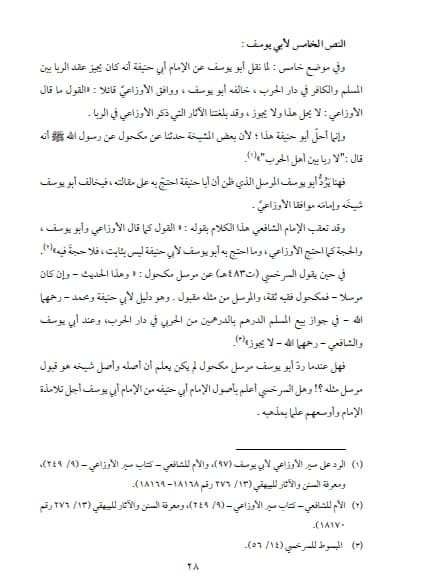
Al-Tahawi — the towering Hanafi imam of Egypt, whose leadership of the Hanafi school ended with him — likewise rejected certain mursal narrations:
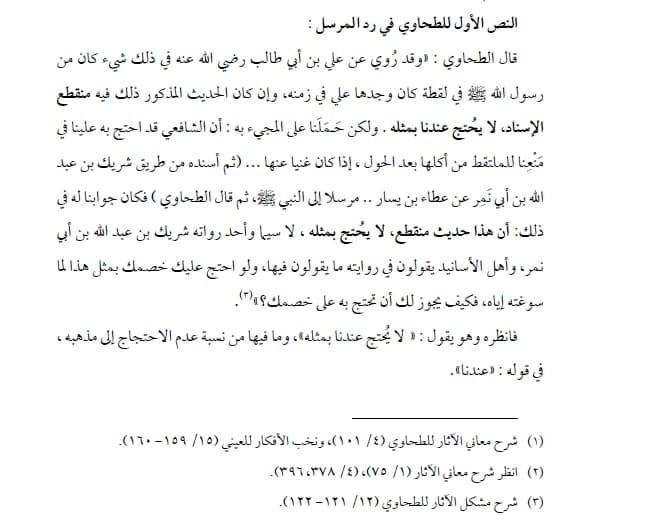
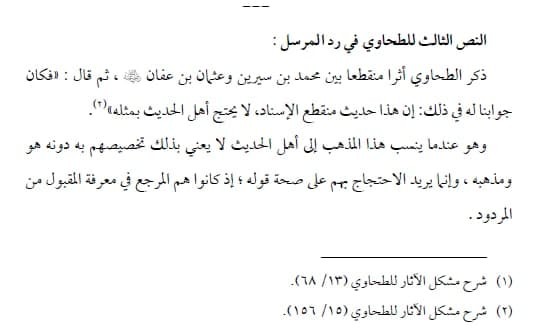
Even al-Tabari — who was very strong in defending the mursal — weakens the mursal of al-Hasan al-Basri in Tahdhib al-Athar:
Not all Hanafis accepted the mursal in all situations. And they all agreed — without exception — that they did not use the mursal as evidence in the creed (al-aqeedah).
The Broader Principle: Multiplicity of Chains Does Not Always Strengthen
Al-Albani’s response to Ibn Hajar’s strengthening argument draws on Ibn al-Salah’s principle, which he summarizes:
Of this type is the hadith of Ibn Abbas in this story, for all of its chains of transmission are very weak — so it is not strengthened by them at all. And the mursal chains — even if four have authentic chains to their narrators — cannot support one another because of the obstacle that must be considered: either their source is one unknown narrator, or they are a group all of whom are weak. With these two possibilities present and unresolvable, the mursals cannot establish proof.
The second matter: knowing the reason hadith scholars do not rely on mursal hadiths — it is the ignorance of the intermediary from whom the mursal narrator took the hadith. Al-Khatib al-Baghdadi explained: ‘The mursal hadith leads to ignorance of the identity of its narrator, and it is impossible to know his justice while ignorant of his identity.’ Therefore, when multiple mursals are cited as supporting each other, we must ask: is it possible that everyone who sent it took it from one narrator? If yes — and it is entirely possible here — then the multiplicaton of chains collapses.”
Ibn al-Mulaqqin gives a parallel example to demonstrate this principle in practice:
The Summary of the Mursal Science as Applied to the Gharaniq
As for the first condition — that the mursal is supported from another source: this does not agree with this story because the supported narration is anomalous (shadhdh) in its most authentic chains, and the rest of the chains are extremely weak. The anomalous is like that which was not narrated because the narrator made a mistake in it, and it is clear that the reason for scholars’ rejection of the anomalous is that its error became apparent — so it is not reasonable that another narration with the same meaning would be strengthened by it.
As for Condition 2 — that it comes as a mursal from someone who took knowledge from other than the men of the first: the four authentic mursals of this story are from the same generation (90–95 AH), so it is not far-fetched that their sheikh was one and the same. With this possibility, the condition of al-Shafi’i is not fulfilled.
As for the rest of the conditions: none of them are in agreement. Nothing is authentic from any Companion. Most of the scholars of knowledge have denied it. The named narrators in the connected chains include al-Kalbi — who is abandoned. Al-Shafi’i said: Whenever it contradicts what I have described, it harms his hadith, so that none of them can accept his mursal.”
The Final Verdict: Six Converging Grounds of Rejection
The Gharaniq story is rejected on six independent and converging grounds — any one of which is sufficient, and all six of which are present simultaneously:
Ground 1 — Isnad weakness: No connected chain of transmission reaching a Companion is authentic. The most “connected” path has the narrator himself expressing doubt about the connection. The strongest paths are mursal.
Ground 2 — Mursal chains cannot support each other: The four authentic mursals are from the same generation and the same approximate period, making it highly probable they share one unknown source — violating al-Shafi’i’s condition for mutual support.
Ground 3 — Contradiction with the Sahih: The authentic Bukhari and Muslim narrations of the prostration of Surat al-Najm — from eyewitness Ibn Masoud and from Ibn Abbas — mention no cranes in any chain across multiple transmissions. A mursal that contradicts the authentic connected narration is rejected.
Ground 4 — Quranic impossibility: Thirteen Quranic verses establish the Prophet’s ﷺ infallibility in conveying revelation, deny Satan’s authority over the sincere servants of Allah, and the very context of Surat al-Najm makes the alleged insertion incoherent.
Ground 5 — Textual contradiction: The different versions of the story contradict each other in the basic mechanism of the alleged event — whether the Prophet was praying, in company, drowsy, or whether only the polytheists heard it.
Ground 6 — Domain of aqeedah: Even those scholars who accepted mursal hadiths in the domain of legal rulings (furu’) agreed without exception that the mursal is not accepted in matters of creed and the principles of prophethood.
The Correct Interpretation — Final Statement
The verse of Surat al-Hajj 52–54 has a clear, self-sufficient meaning that requires no story and no “incident” to explain it. The correct interpretation, agreed upon by the investigators:
When the Prophet ﷺ wished — i.e., desired the guidance of his people and was keen on their faith with all his heart — Satan cast into his wish: meaning he cast whispers and doubts into the hearts of those being called, casting suspicions to divert them from answering, claiming that what the Prophet recites is magic or myths or fabrication. Allah then abrogates what Satan casts — He removes those doubts with His clear signs and establishes His verses with perfection, so that the believers increase in faith and the disbelievers increase in trial. This is Allah’s universal practice (sunna) with all His messengers — not a single incident of corruption that happened to one of them.
Supporting Images from the Source Material
The following images from the original source document support the arguments made across all four parts of this refutation:
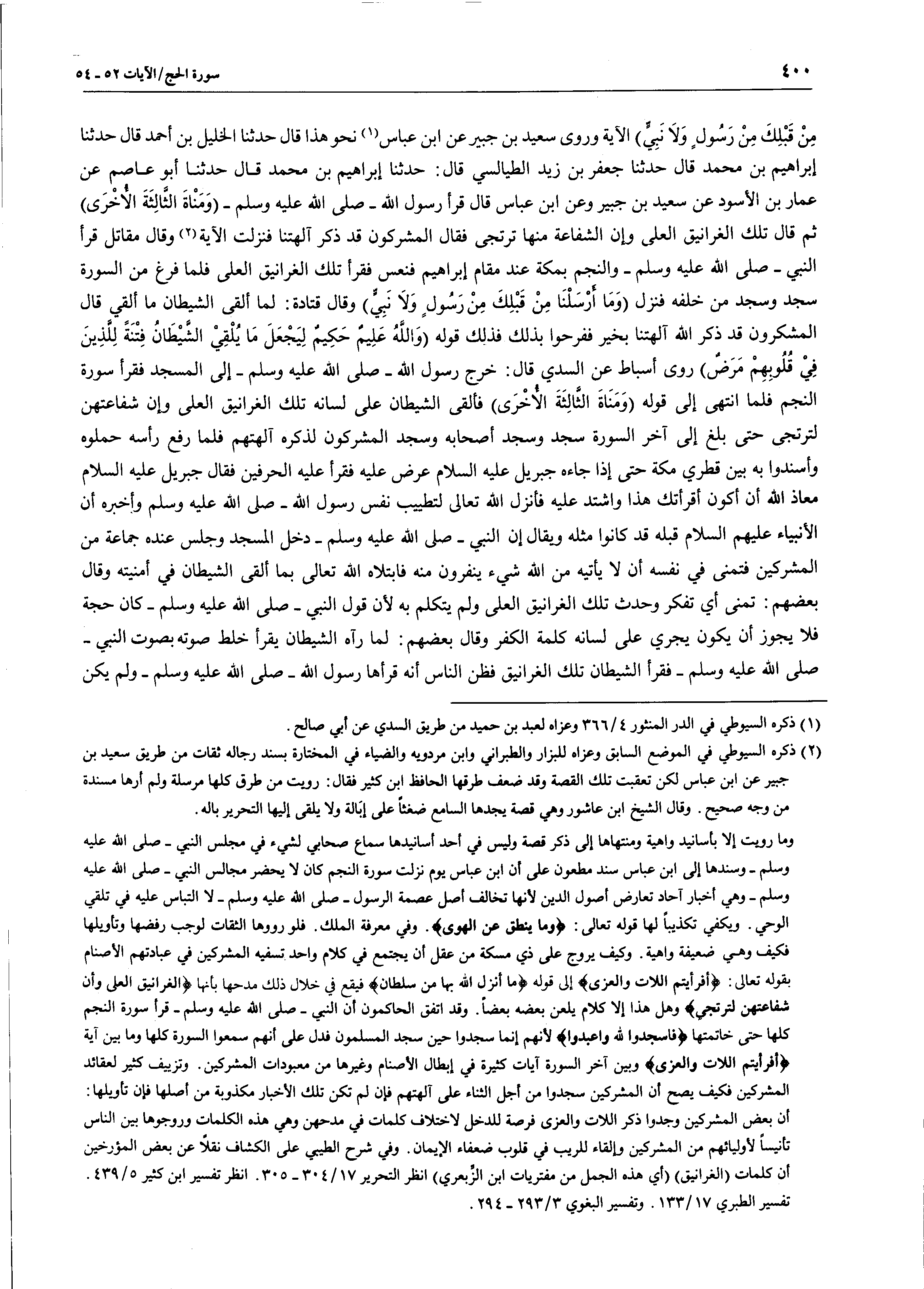
The image above is from the original source documentation of the mursal hadith science discussion.
The passage above continues the discussion of the conditions for accepting mursal chains.

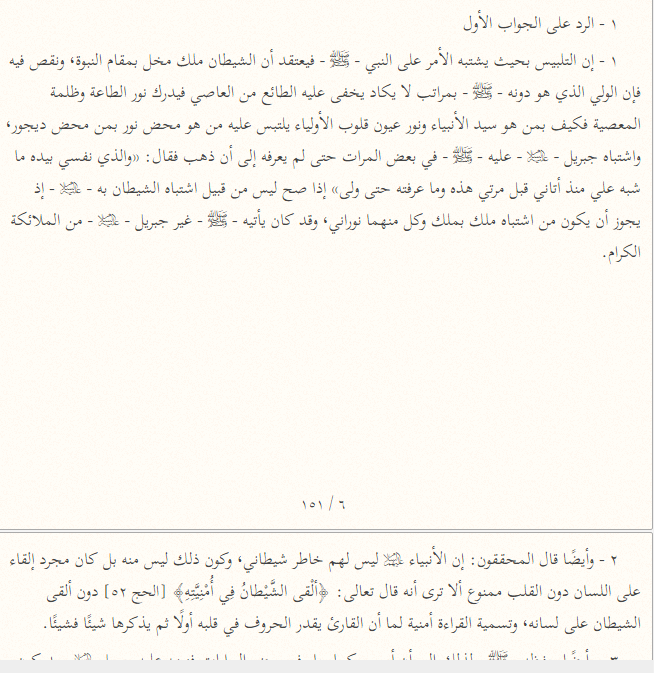
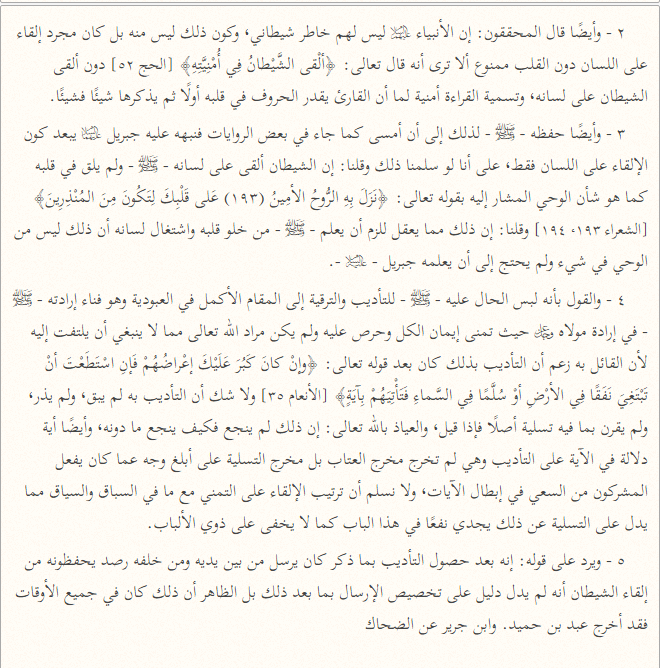
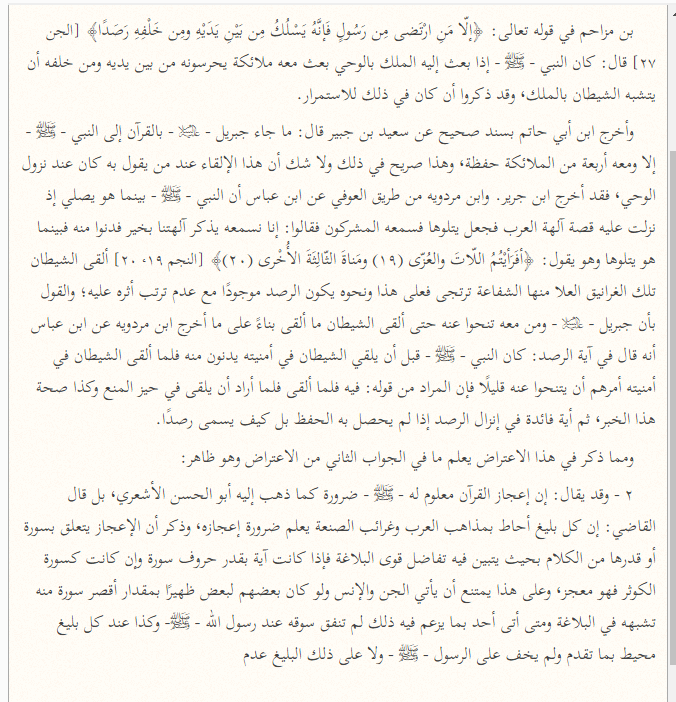
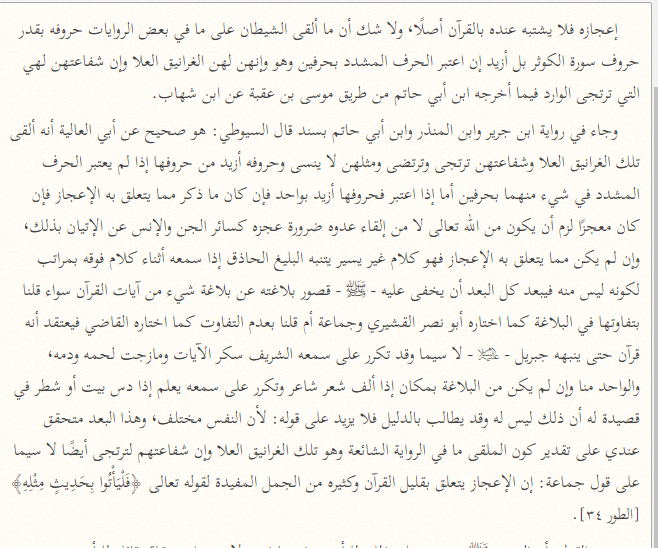
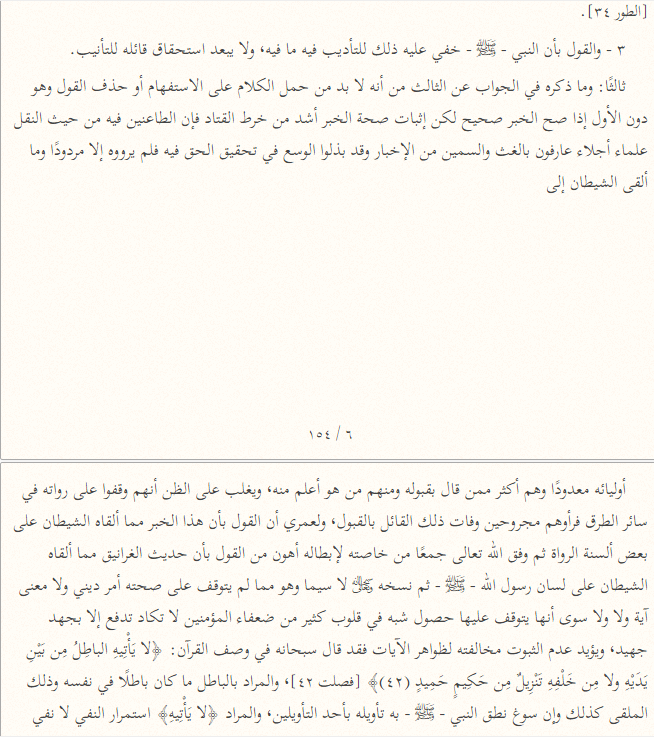
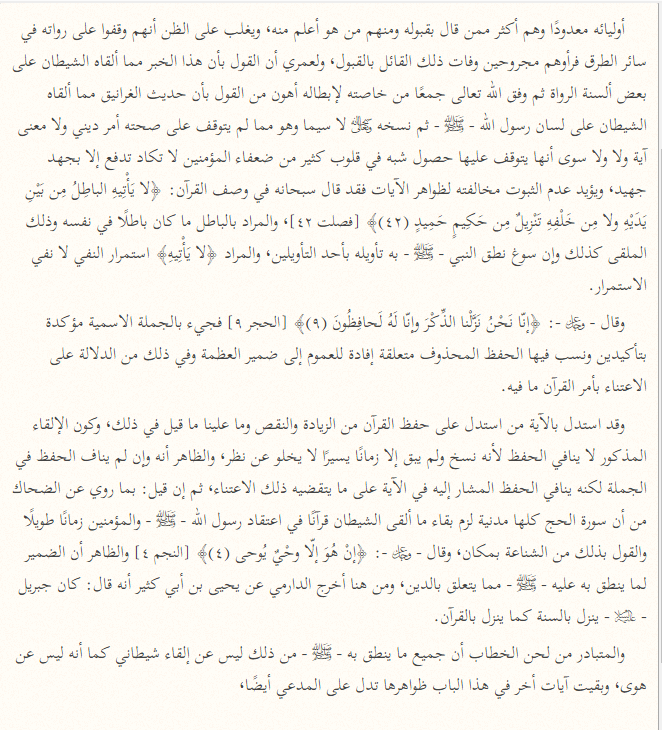
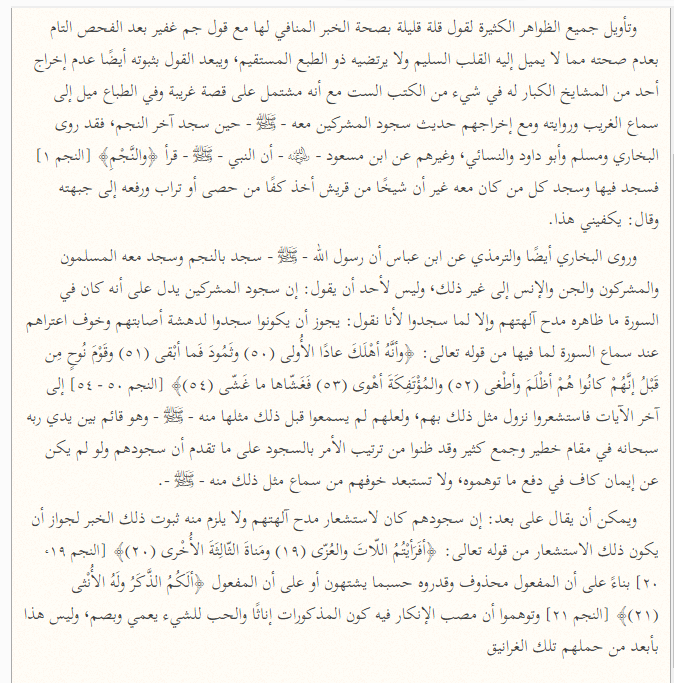
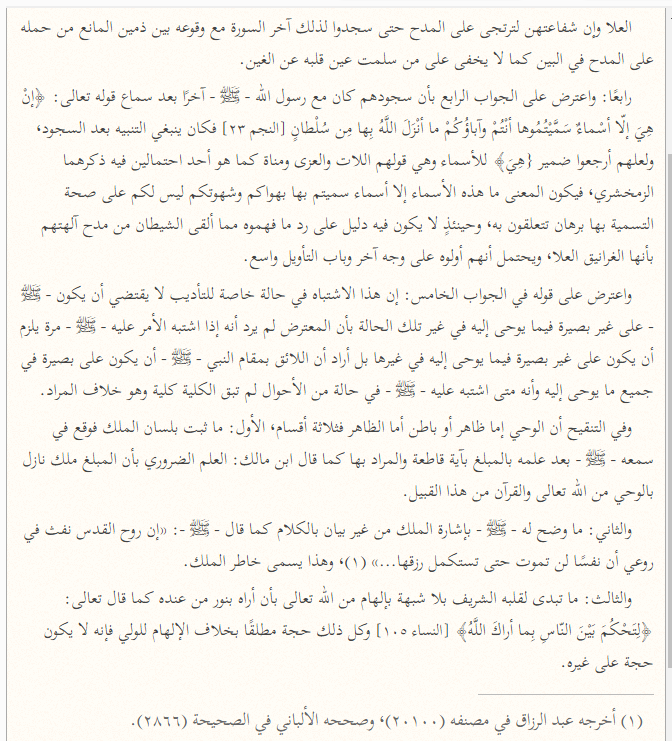
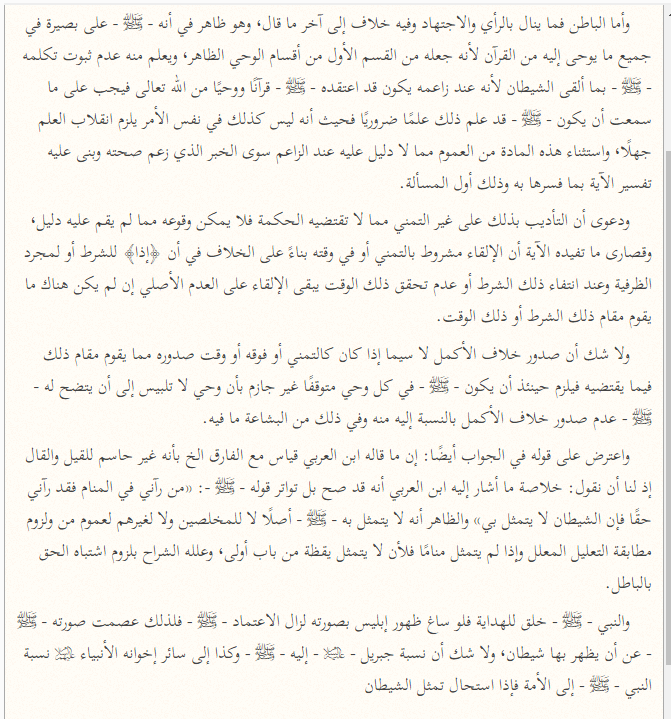
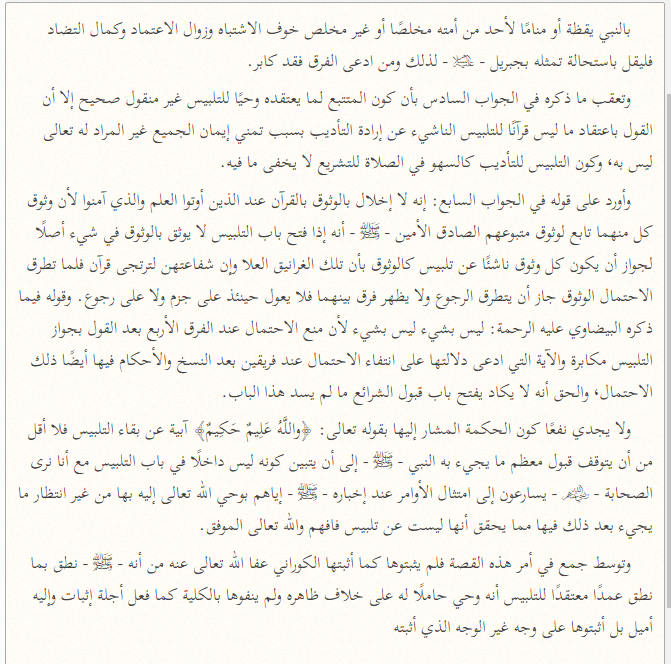
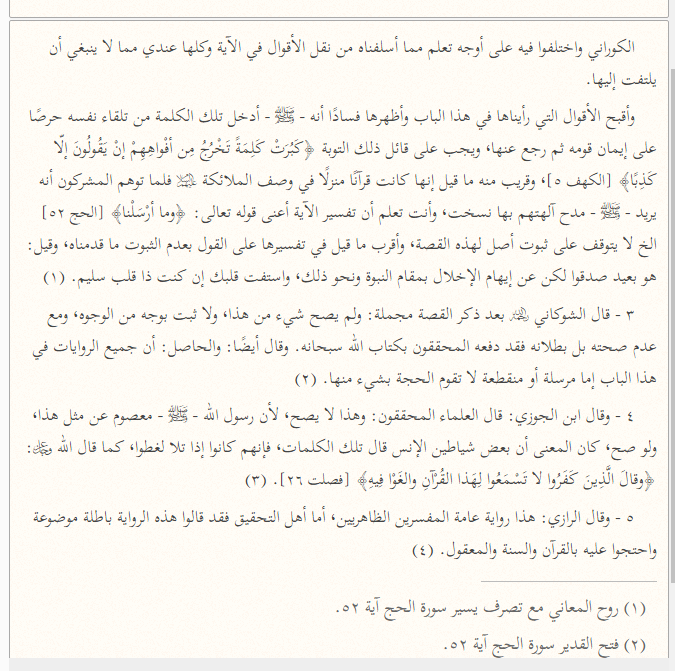
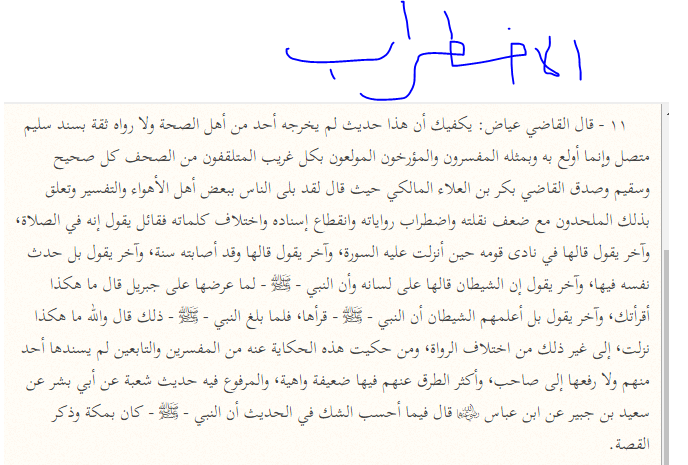
The image above documents the textual confusion and contradictions between the different versions of the Gharaniq narration, as analysed by Judge Iyad and Imam al-Albani.
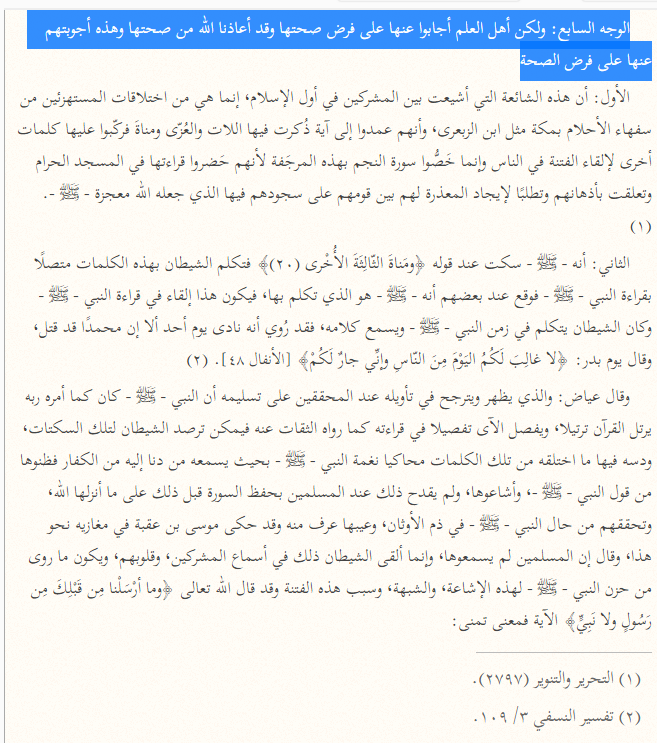
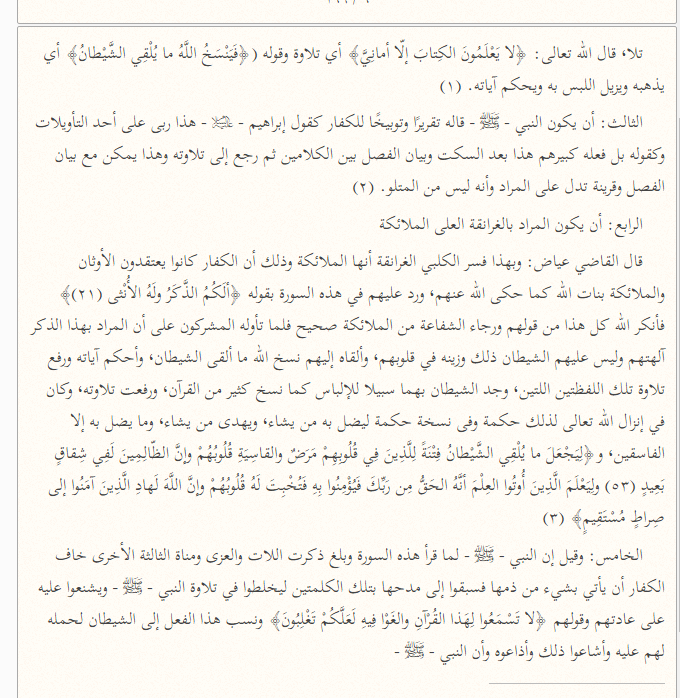
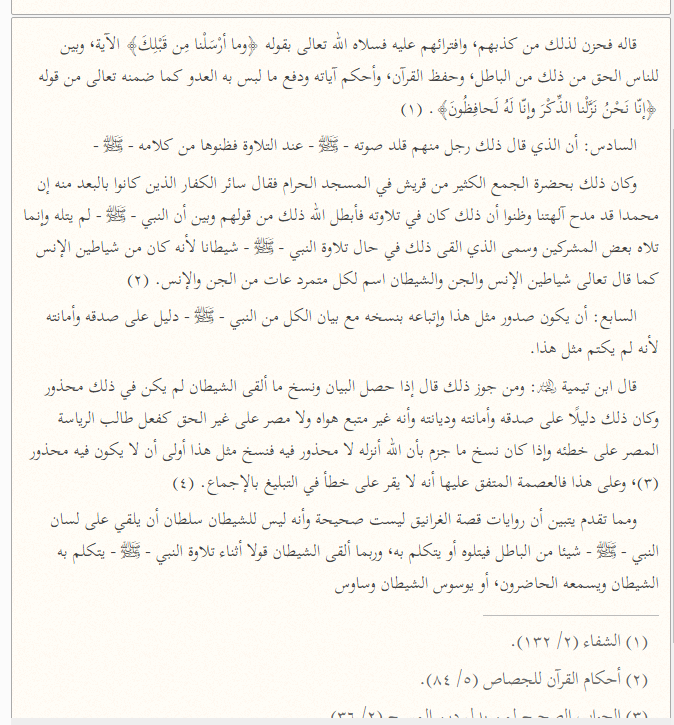
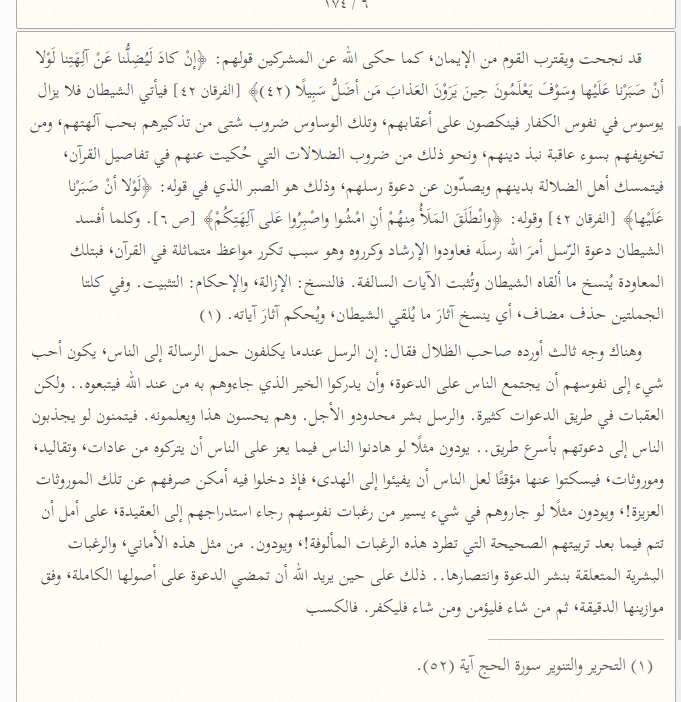
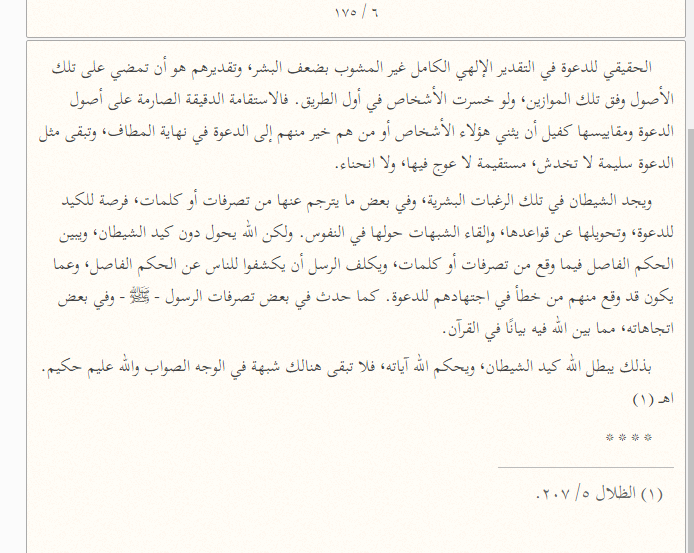
The Prophet Muhammad ﷺ was protected by Allah from Satan in all matters of revelation. The Quran is preserved. The message was delivered without addition, without subtraction, and without corruption.
Link to Imam al-Albani’s complete book: Nasb al-Majaniq li-Nusf Qissat al-Gharaniq http://islamport.com/d/1/alb/1/84/681.html