The Status of Women in Christianity: The Church Fathers, the Bible, and the Reformers
·27 min read·5977 words
The Church Fathers, the Reformers, and the biblical text itself present a portrait of woman as a being of inferior intellect, corrupt nature, and diminished humanity — excluded from the image of God, created solely for procreation, and subject to punishment, silence, and submission as a divine ordinance. This note documents these positions directly from their sources, organized by theme.
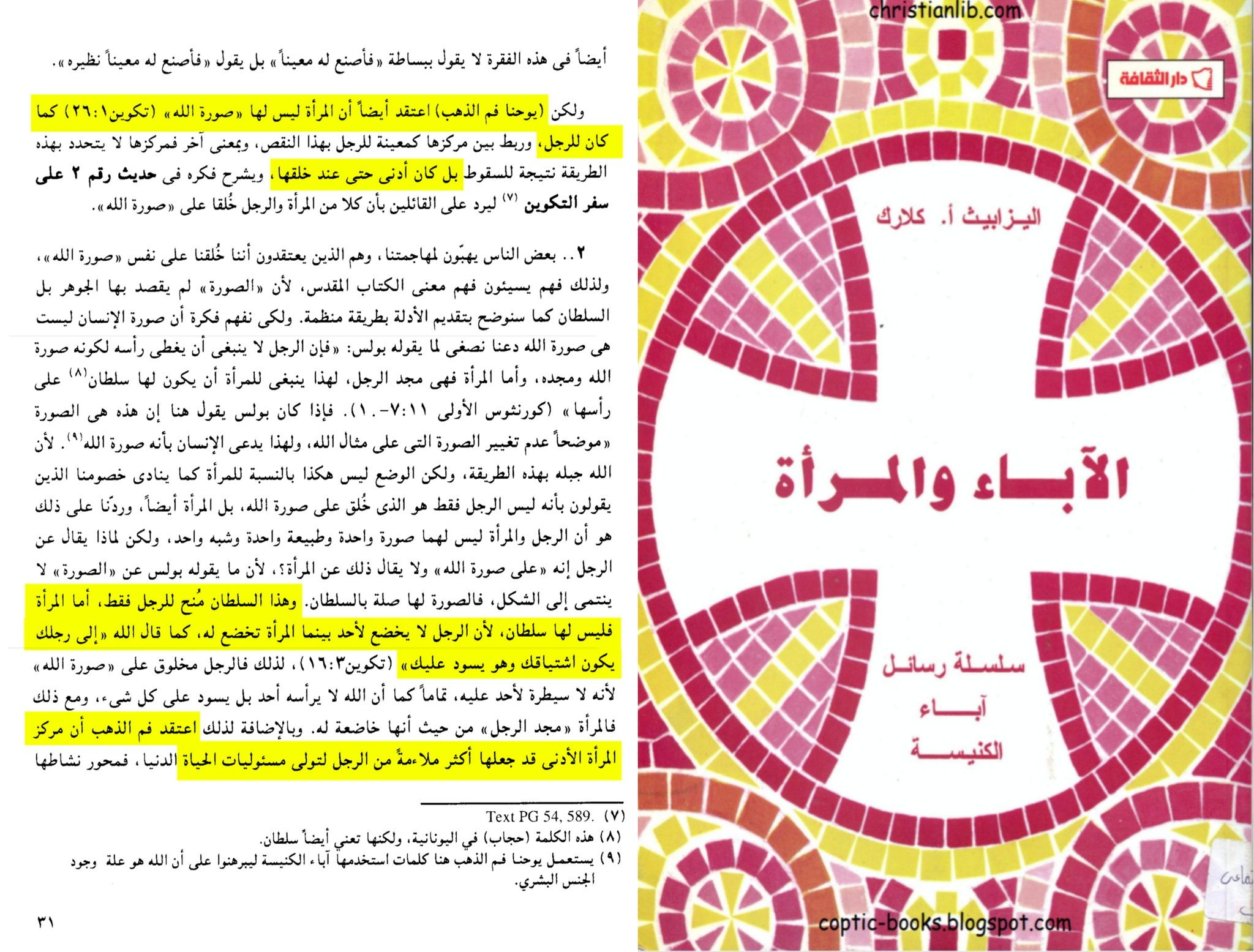
Woman Is Not the Image of God
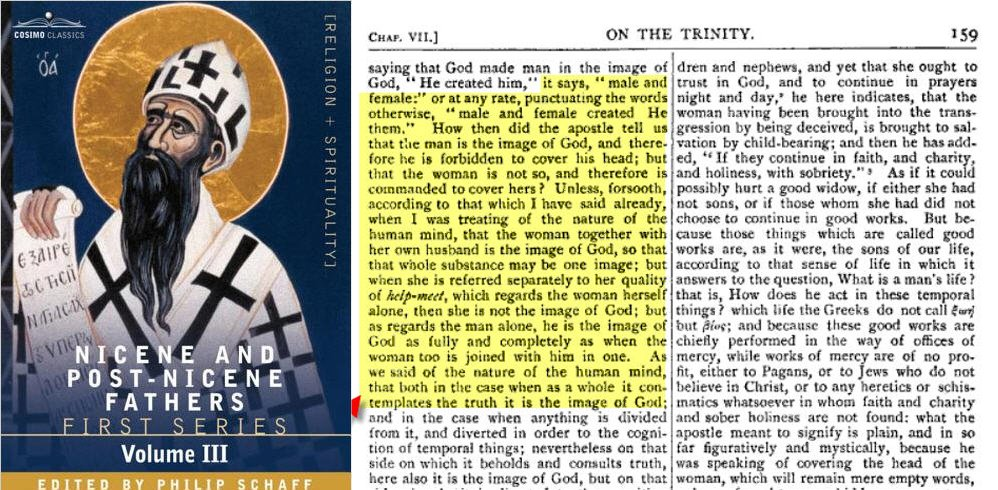
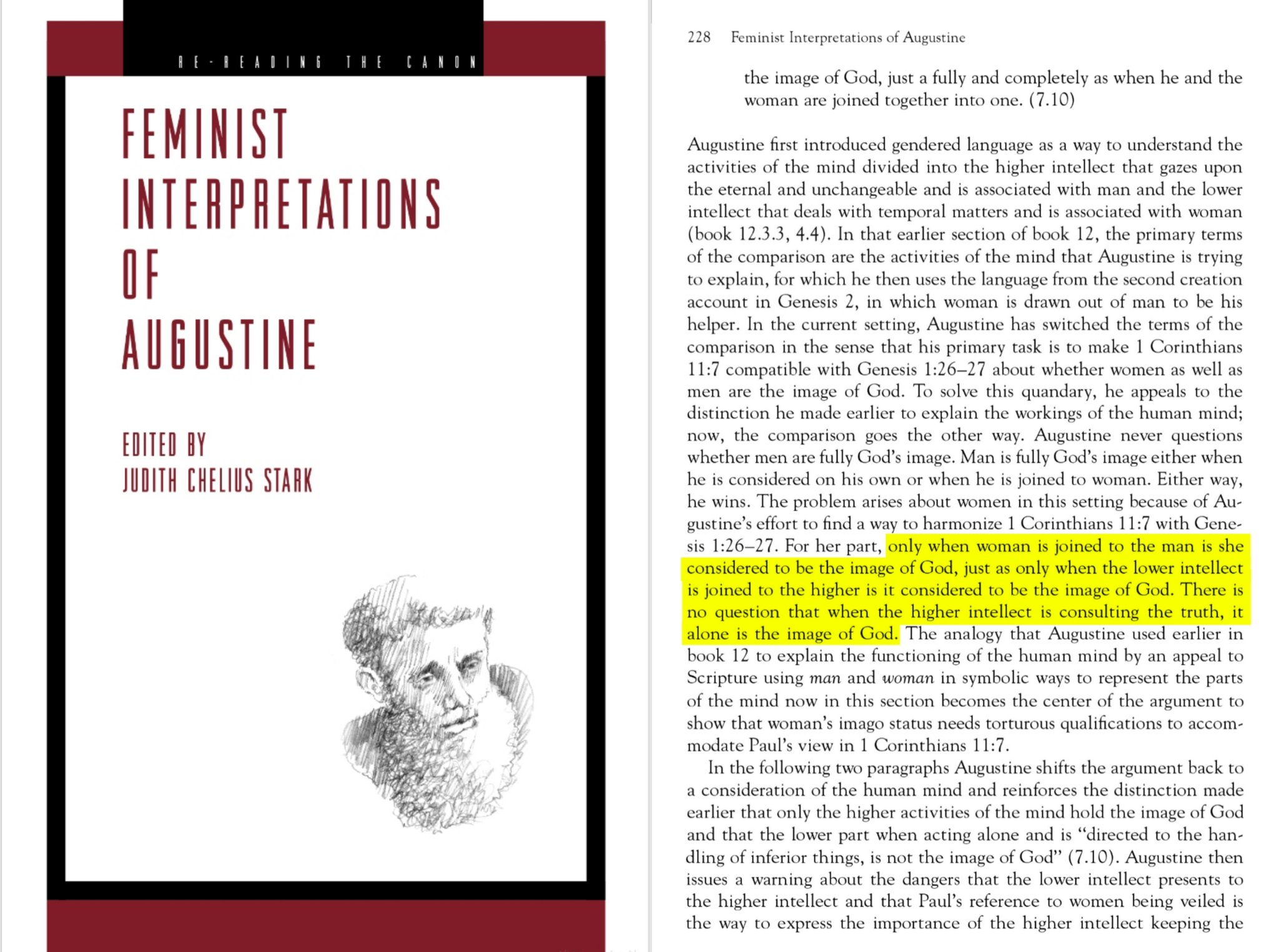
Saint Augustine — Nicene and Post-Nicene Fathers, First Series, Volume III “The woman is not the image of God except when the lower mind, which is the woman, is joined to the higher mind, which is the man. If the woman does not submit to the authority of a man, she will remain the distorted lower mind, unlike the man who, in any case, is in the image of God in which he was created from the beginning.”
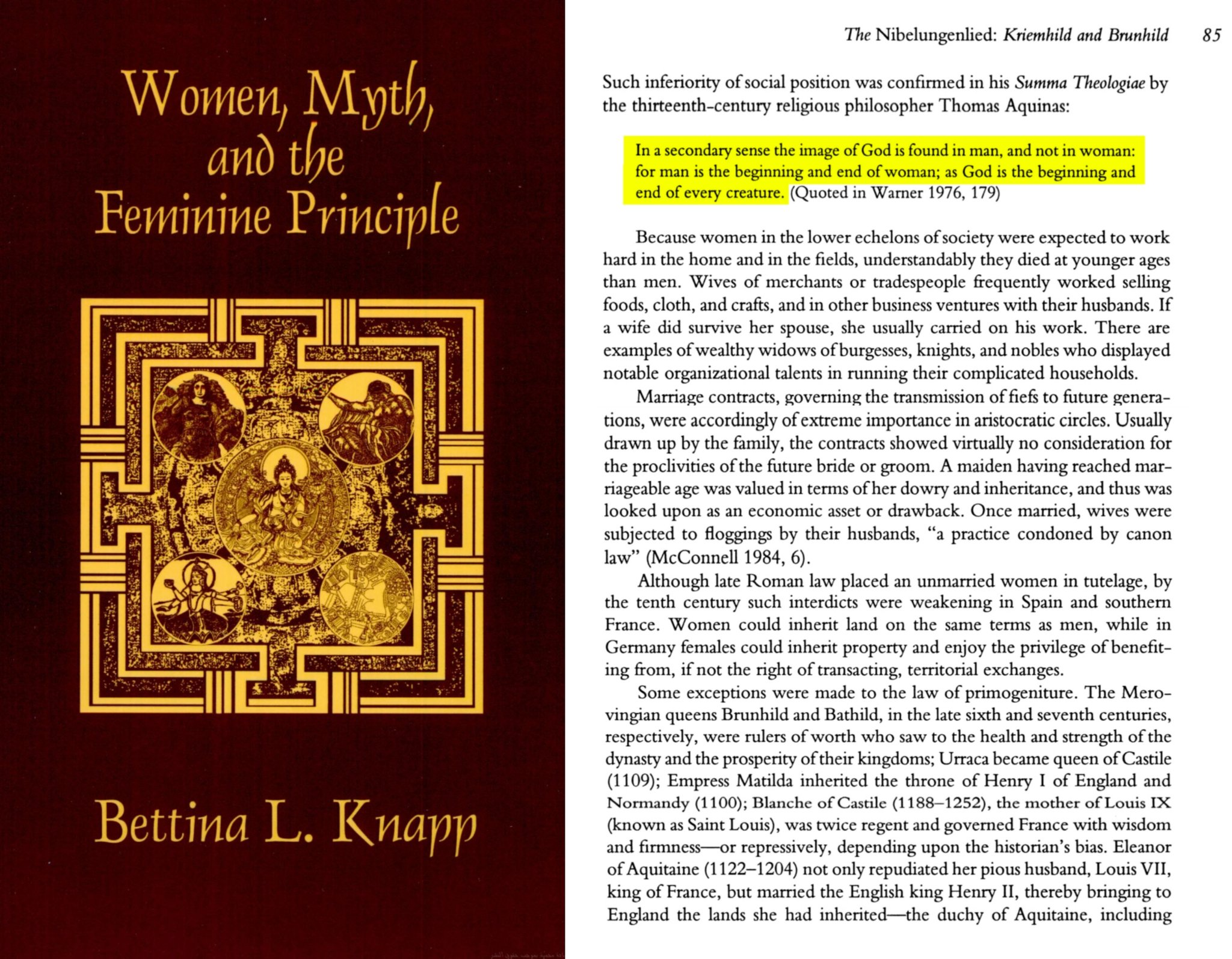
Saint Thomas Aquinas — Women, Myth, and the Feminine Principle “The image of God exists in man, not in woman, for man is the beginning and end of woman, just as God is the beginning and end of creation.”
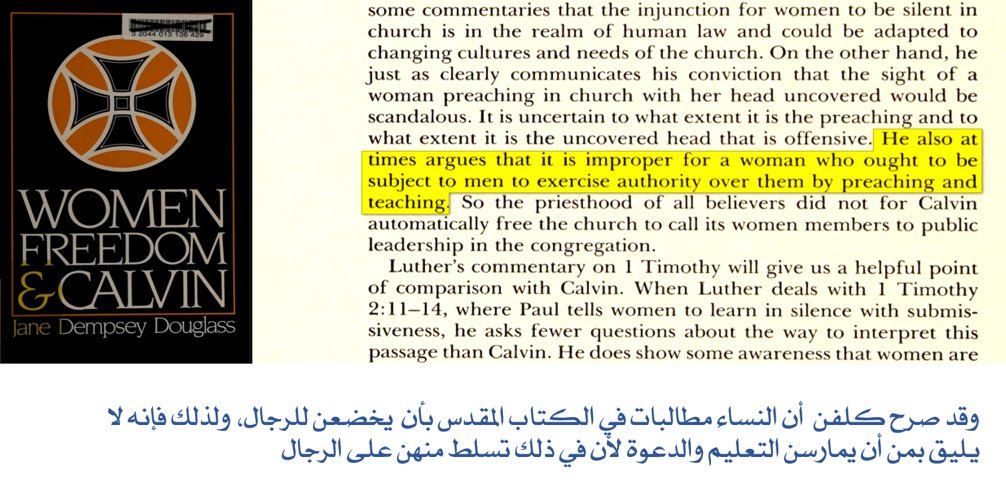
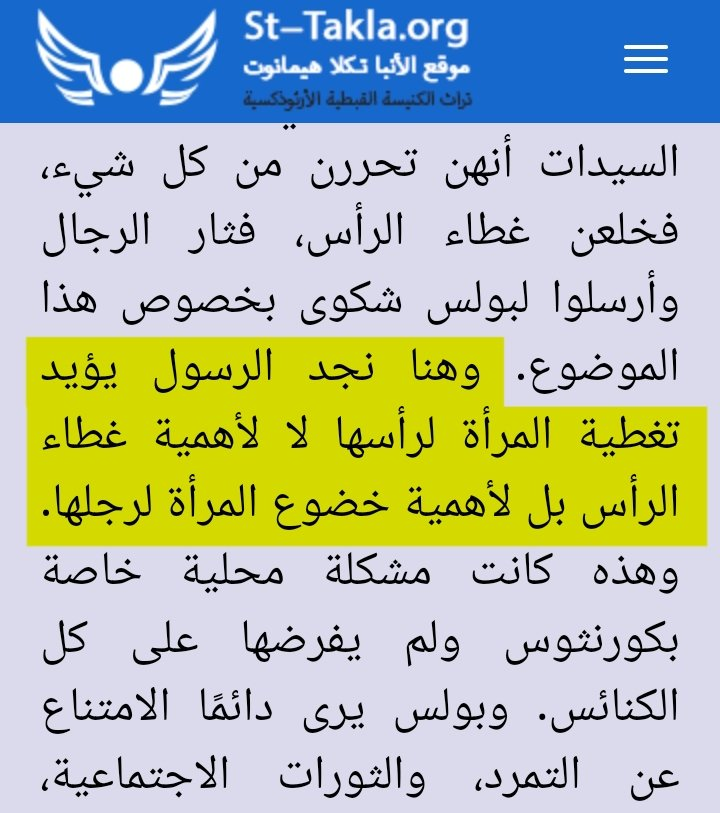
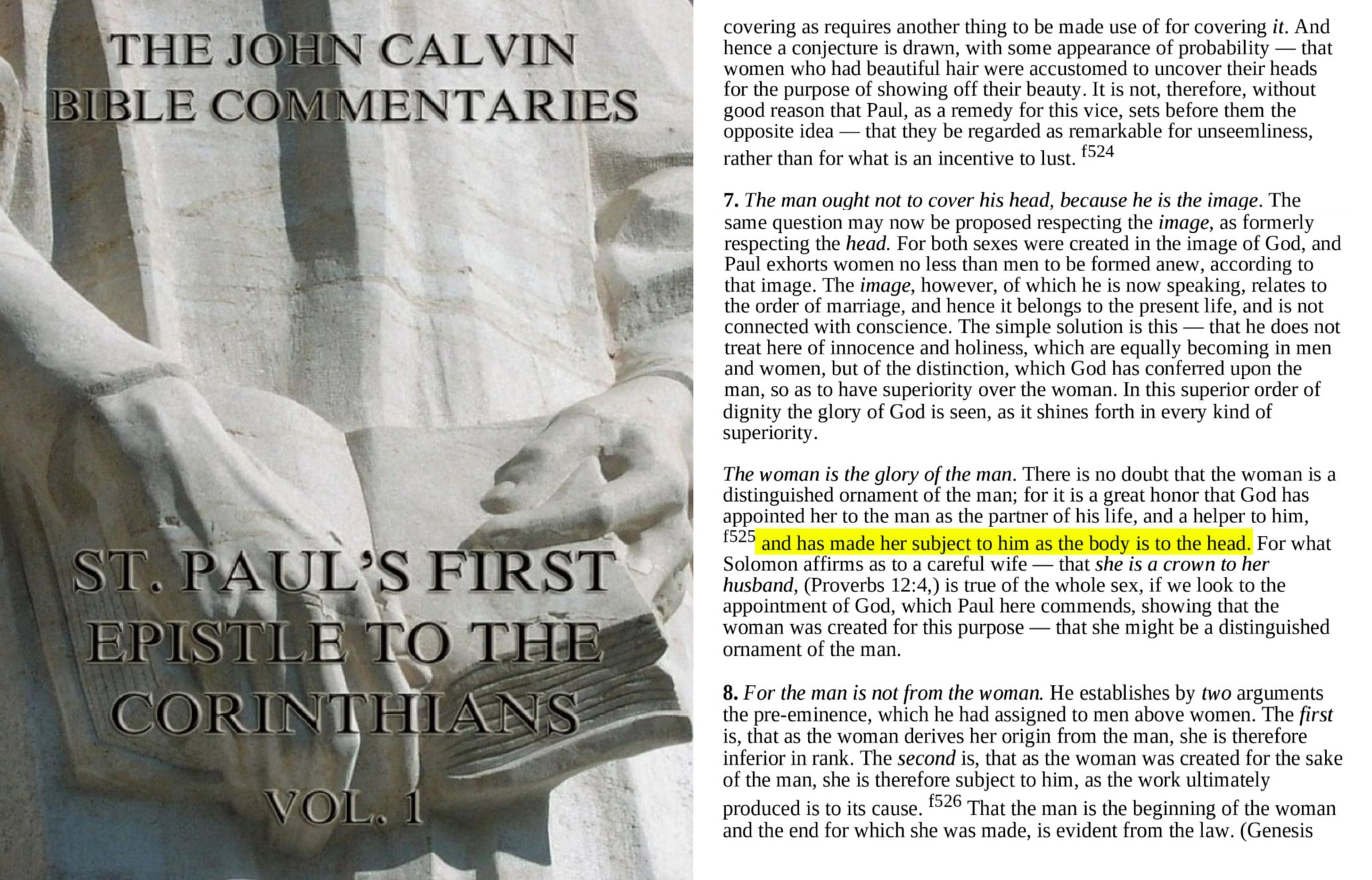
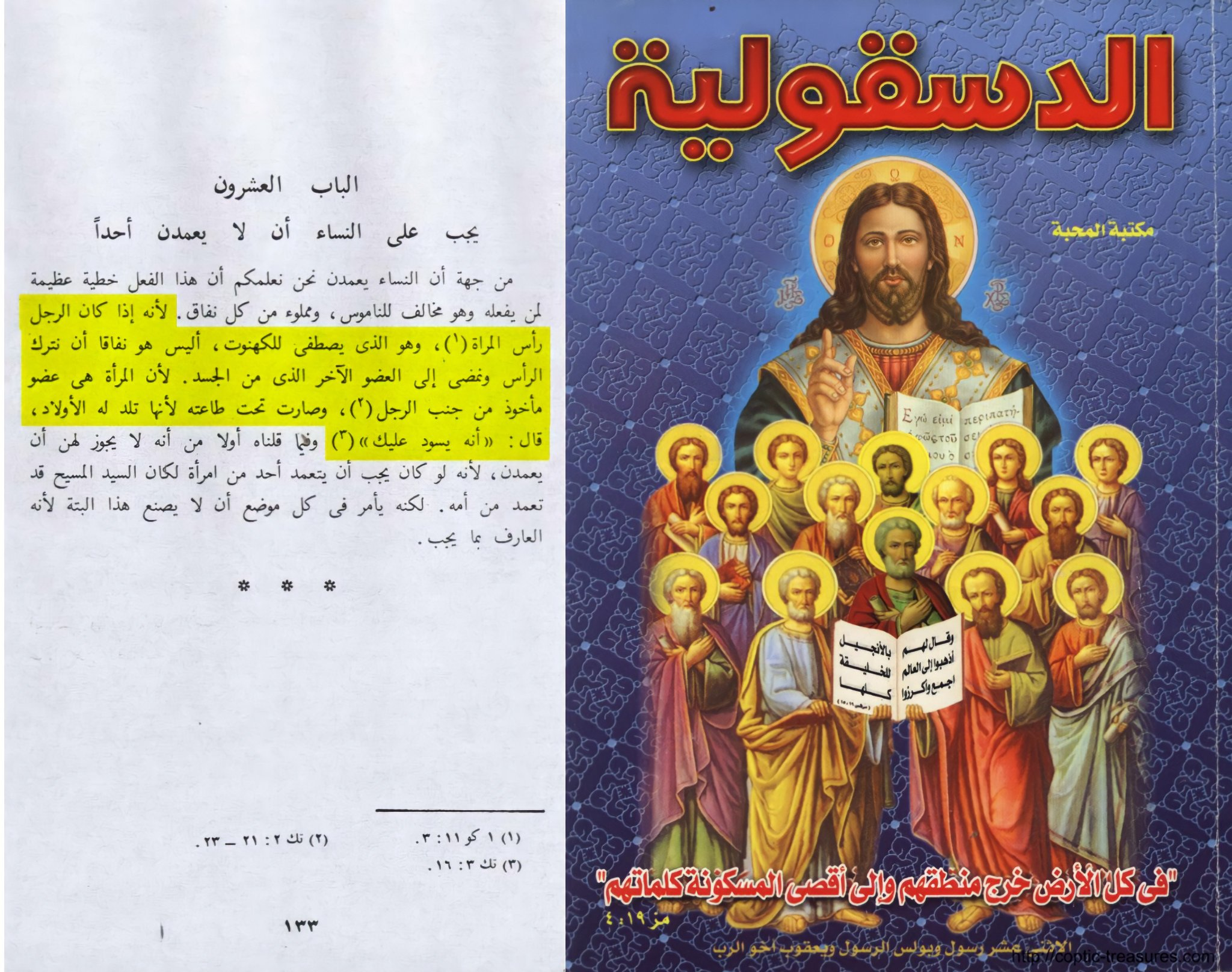
John Calvin — Commentaries on the Epistles to Timothy, Titus, and Philemon “For man ought not to cover his head, since he is the image and glory of God, but woman is the glory of man.” He wrote in his commentary on 1 Corinthians 11:7: “God has made the woman subject to the man as the body is subject to the head.”
The biblical text itself:
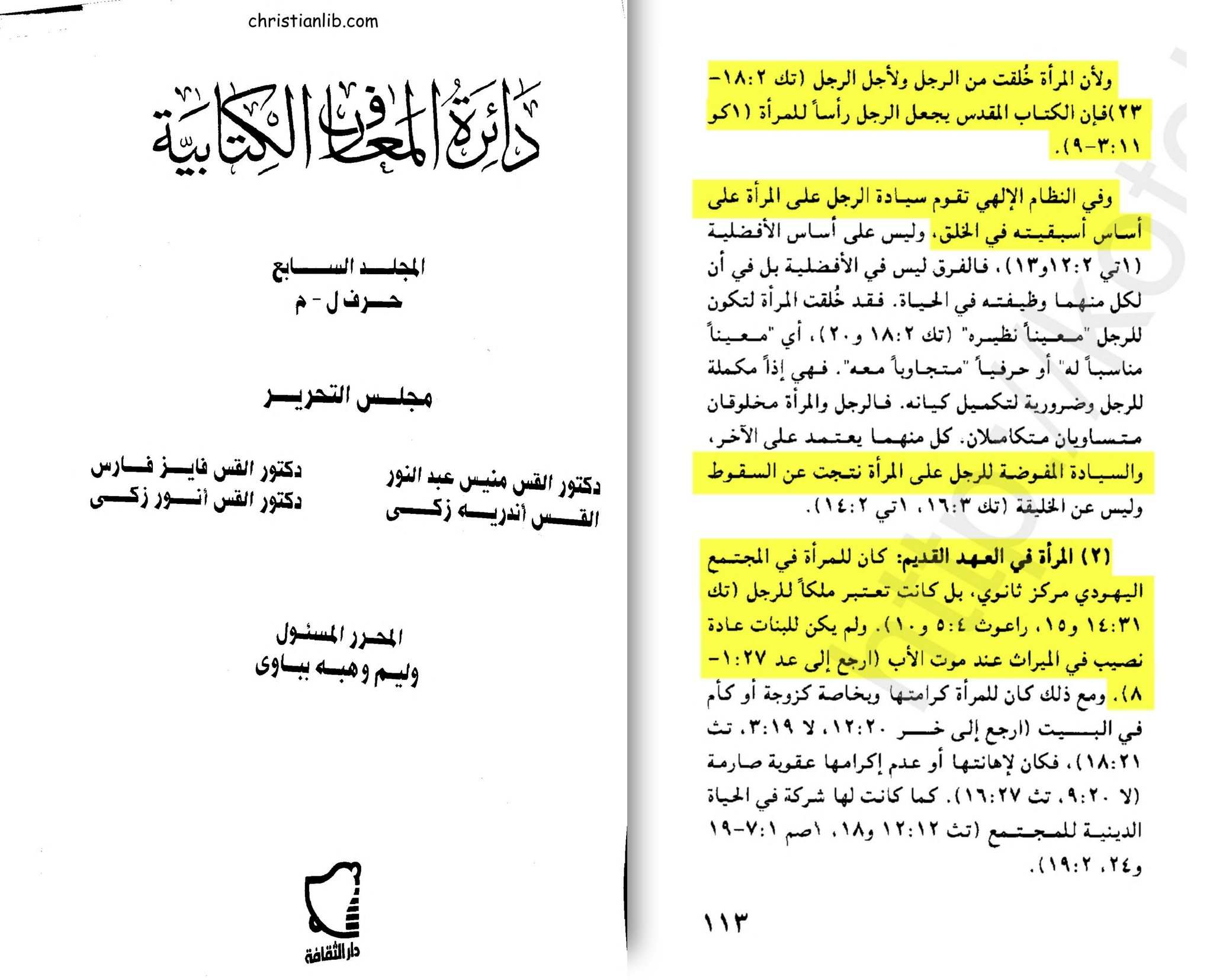
1 Corinthians 11:7 (SVD) “For a man ought not to cover his head, since he is the image and glory of God; but woman is the glory of man.”
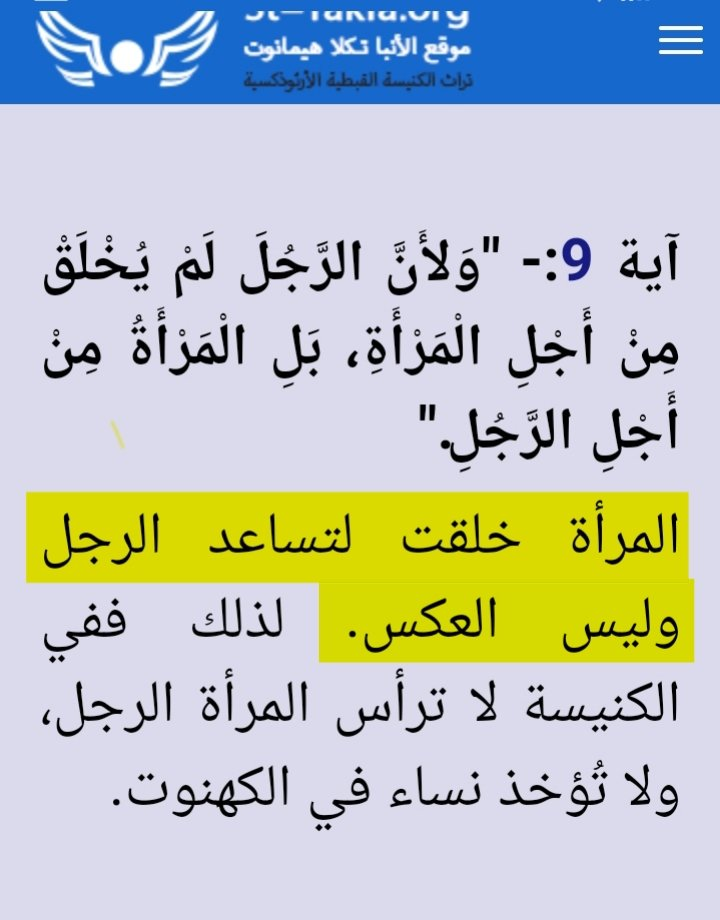
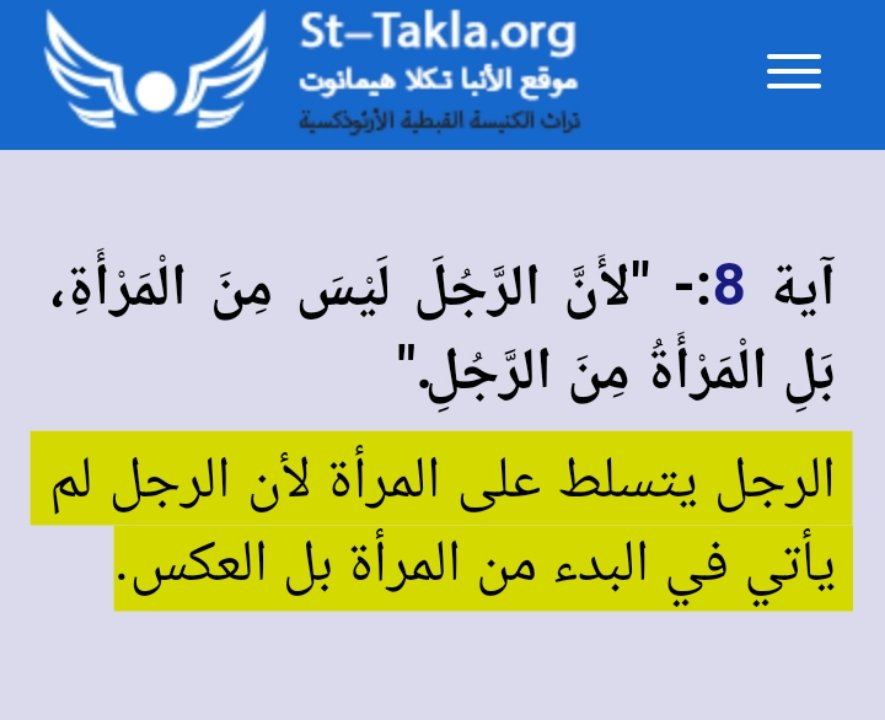
1 Corinthians 11:8–9 (SVD) “For the man is not from the woman, but the woman from the man. And because the man was not created for the woman, but the woman for the man.”
E My1G6X0AMKnuJ 88ab9f0501a12026E My17ZXsAsizoT 994d02d6890b5b8dE My3H XMAAinXz cd1db2c1d0f2d8c9E My3YtXoAYtOmc 6be7ff8eda056f95
Woman Is a Deformed Male — Created Only for Procreation
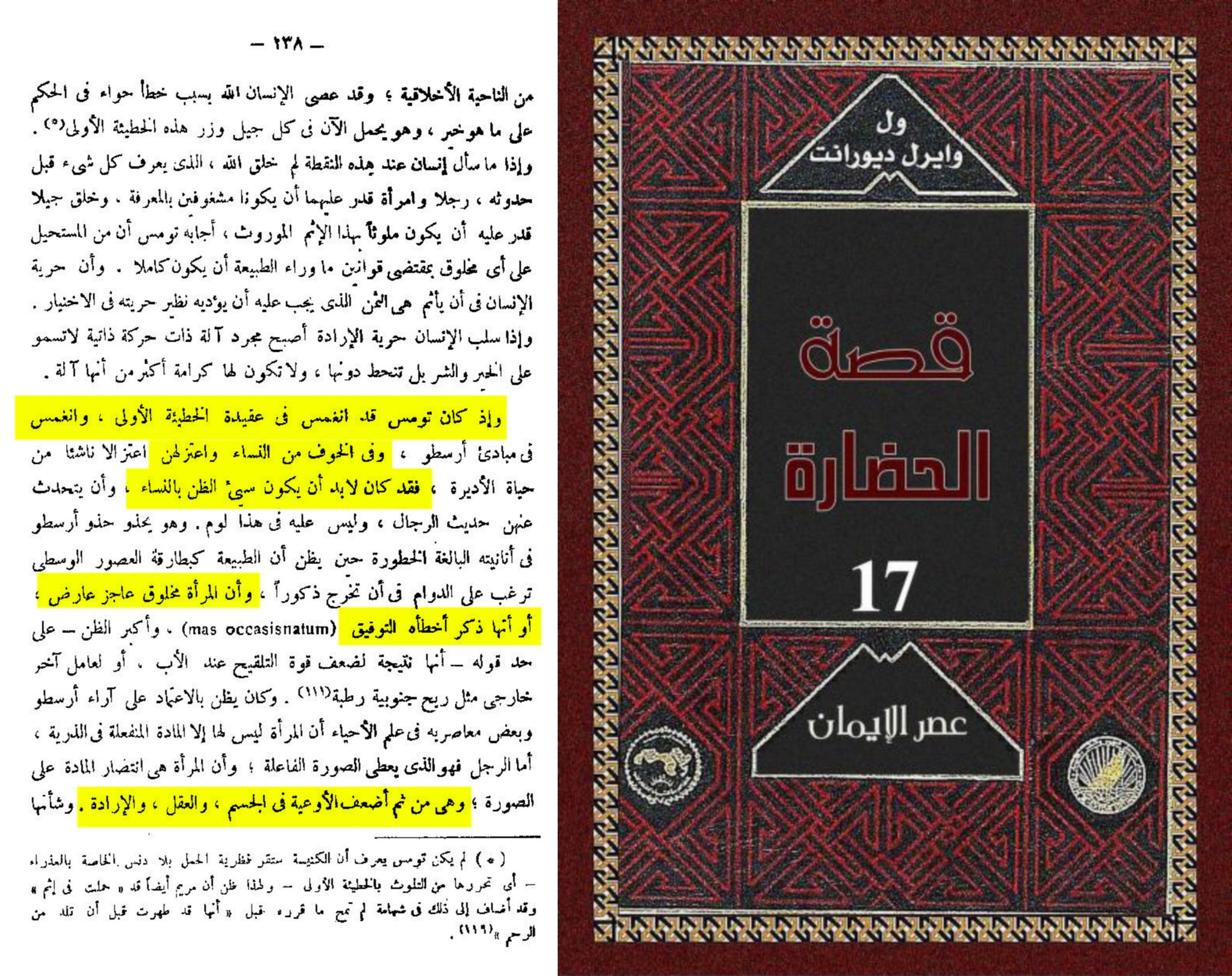
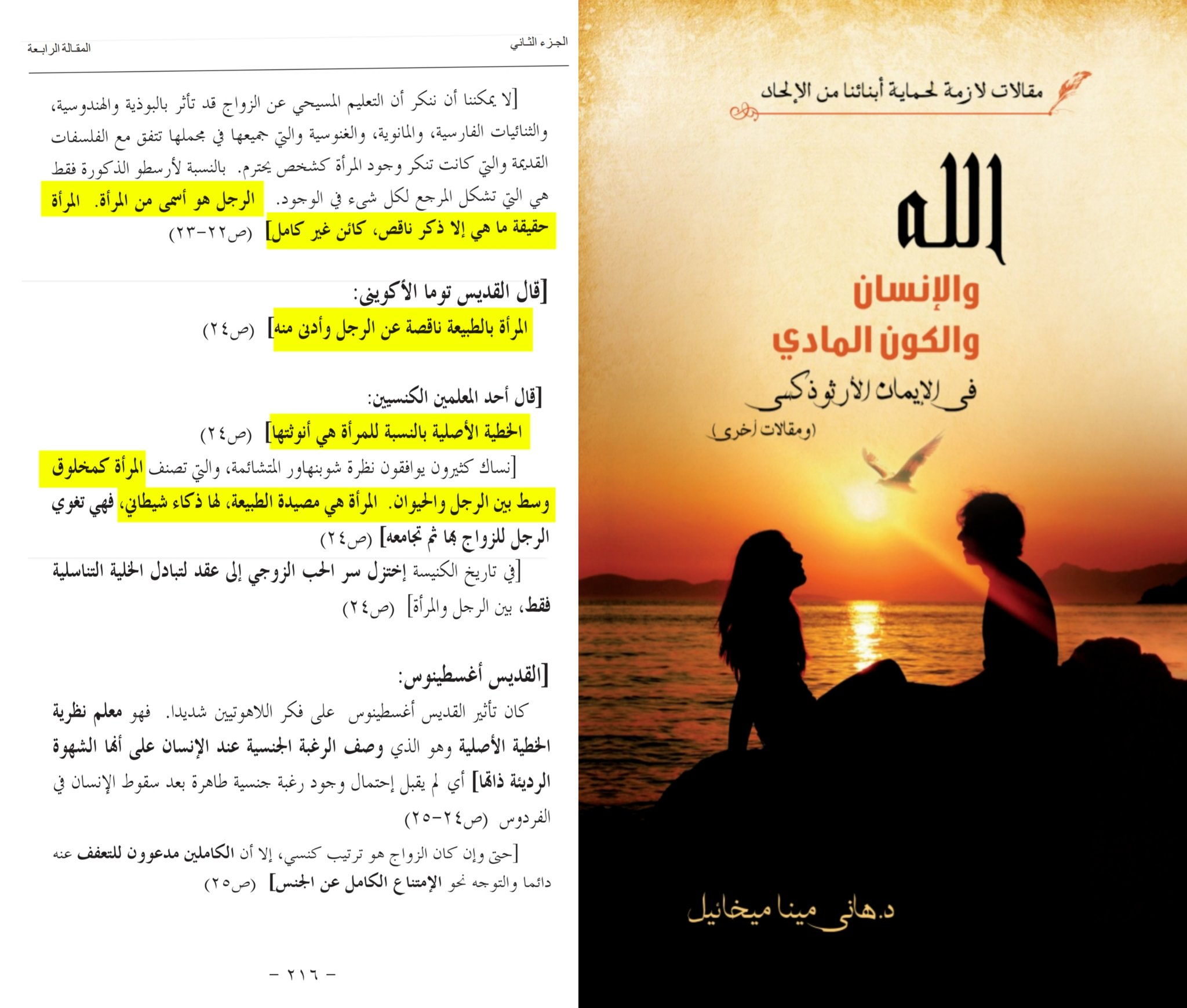
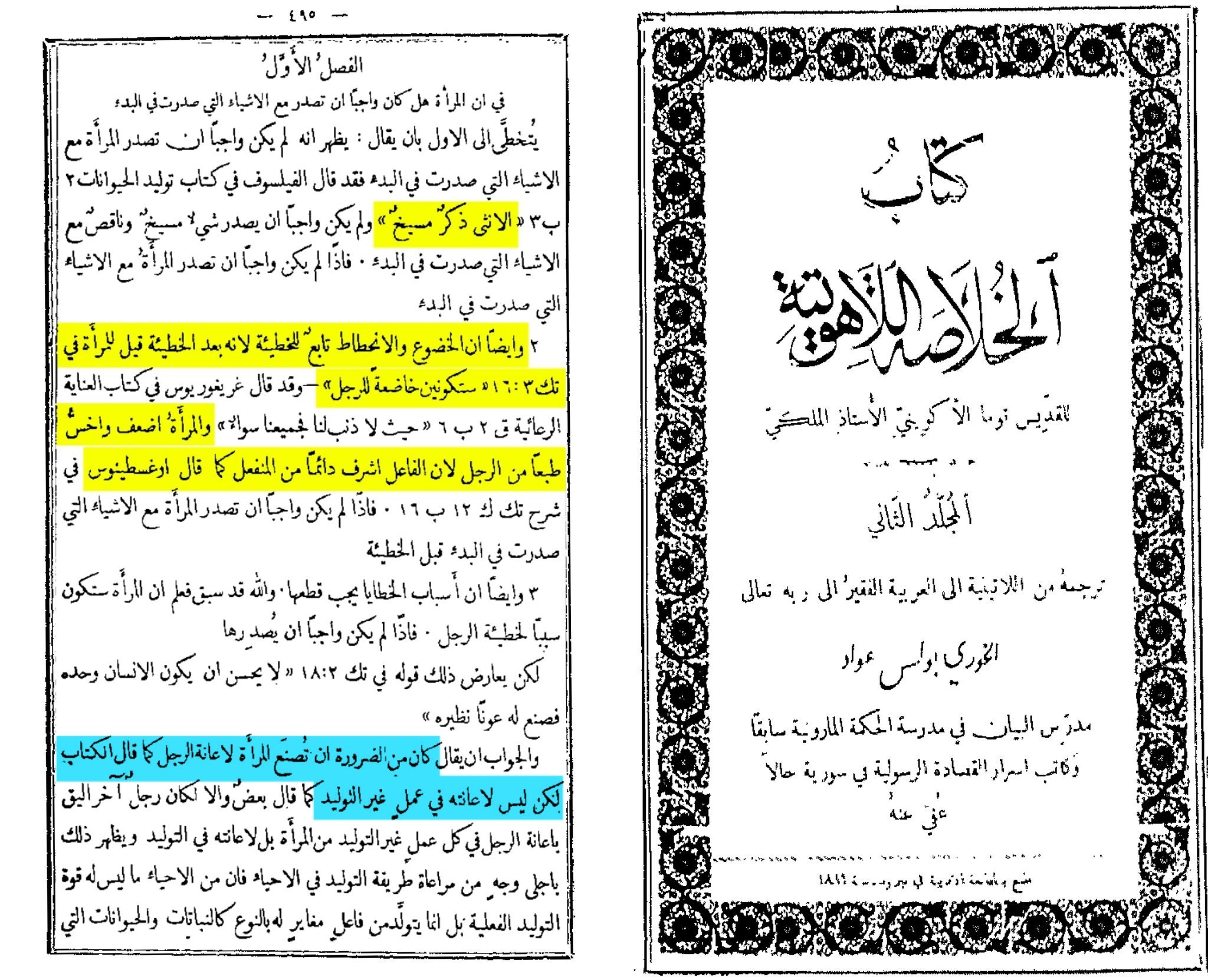
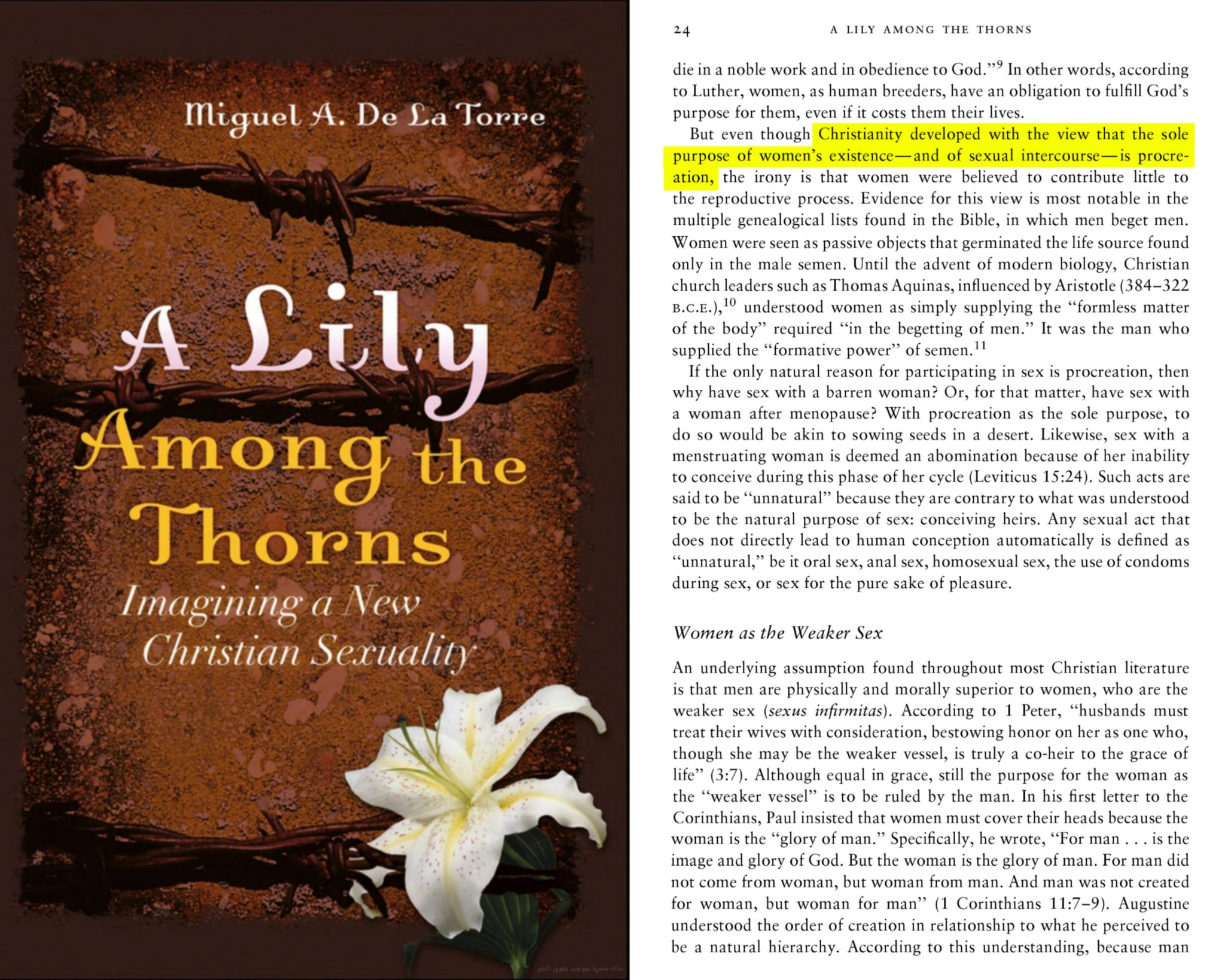
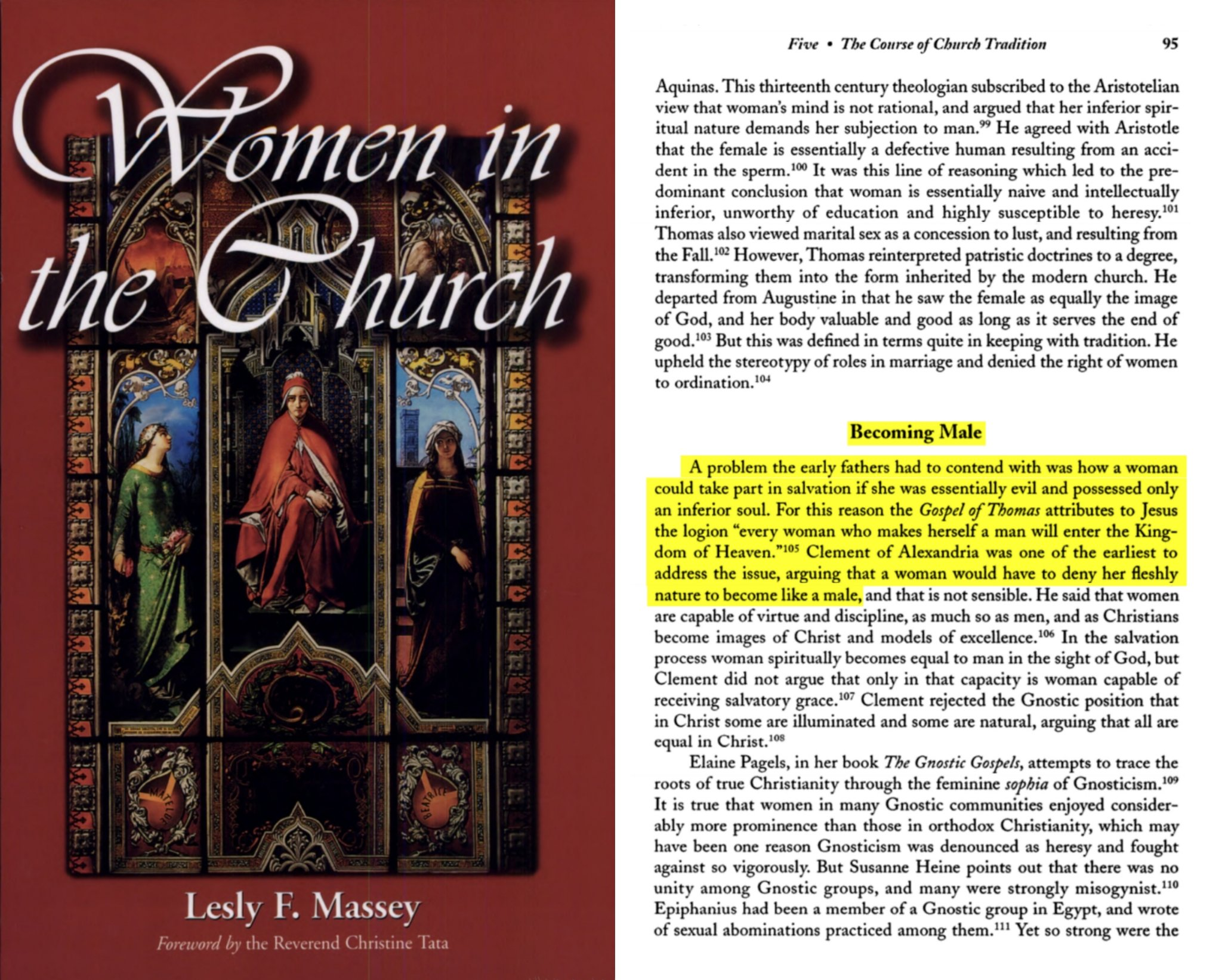
Saint Thomas Aquinas “A woman is a helpless, weak creature — a deformed male, or a male who failed to succeed. Consequently, a woman is not the image of God, unlike a man, and she is weak in mind, will, and body. It is nonetheless useless for any work other than childbirth, as the angelic teacher said, and it is not fitting for a woman to undertake any work other than midwifery.”
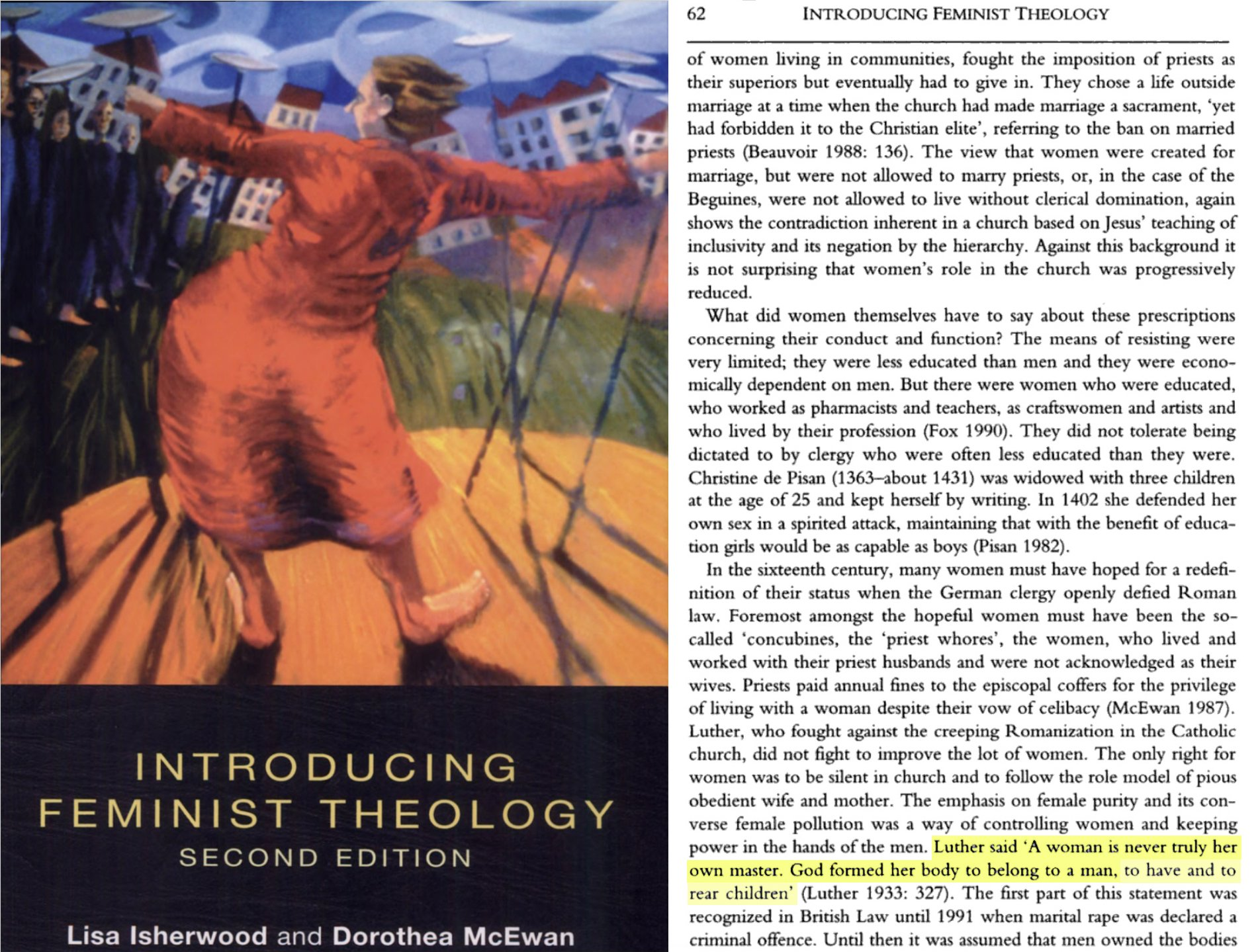
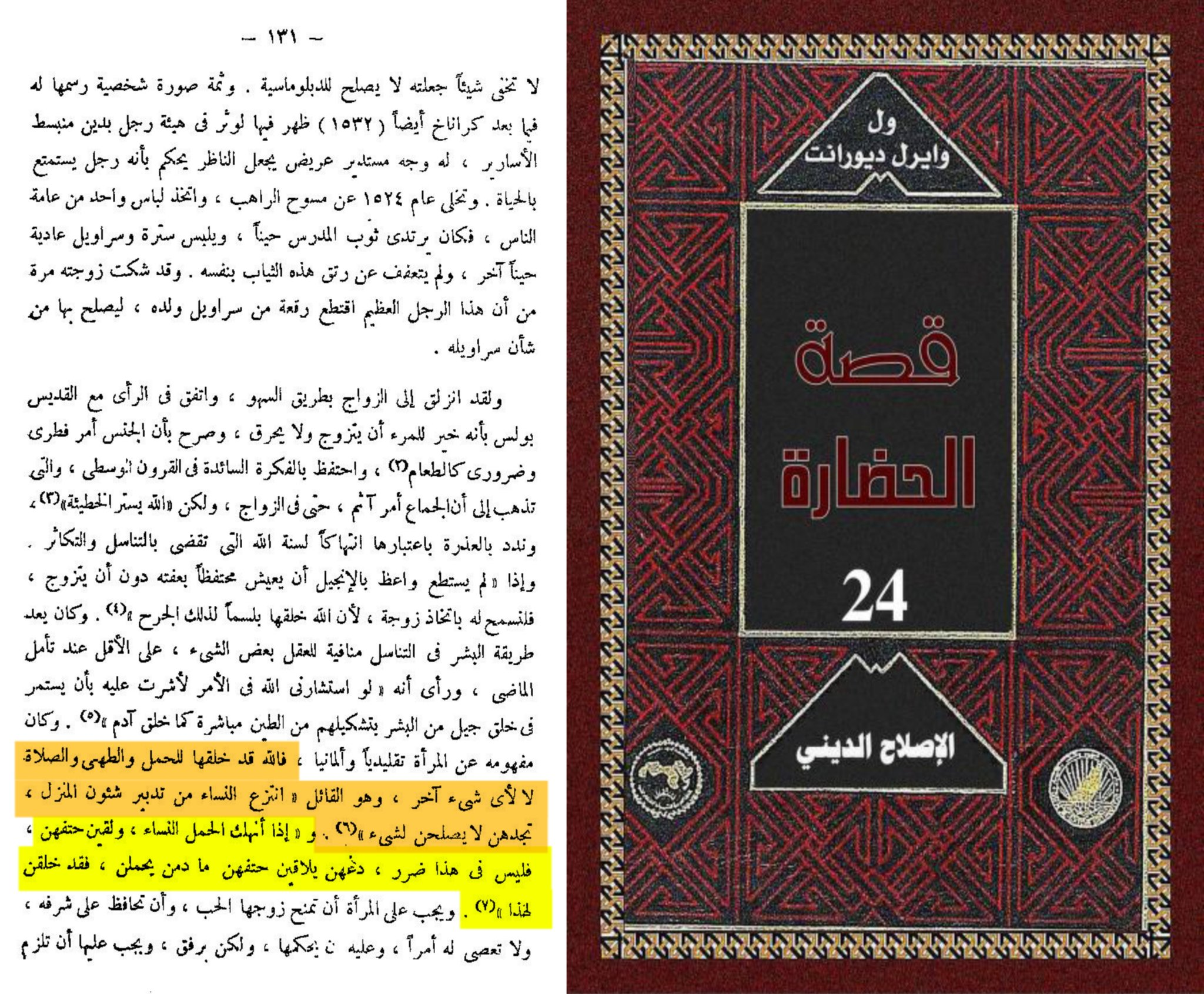
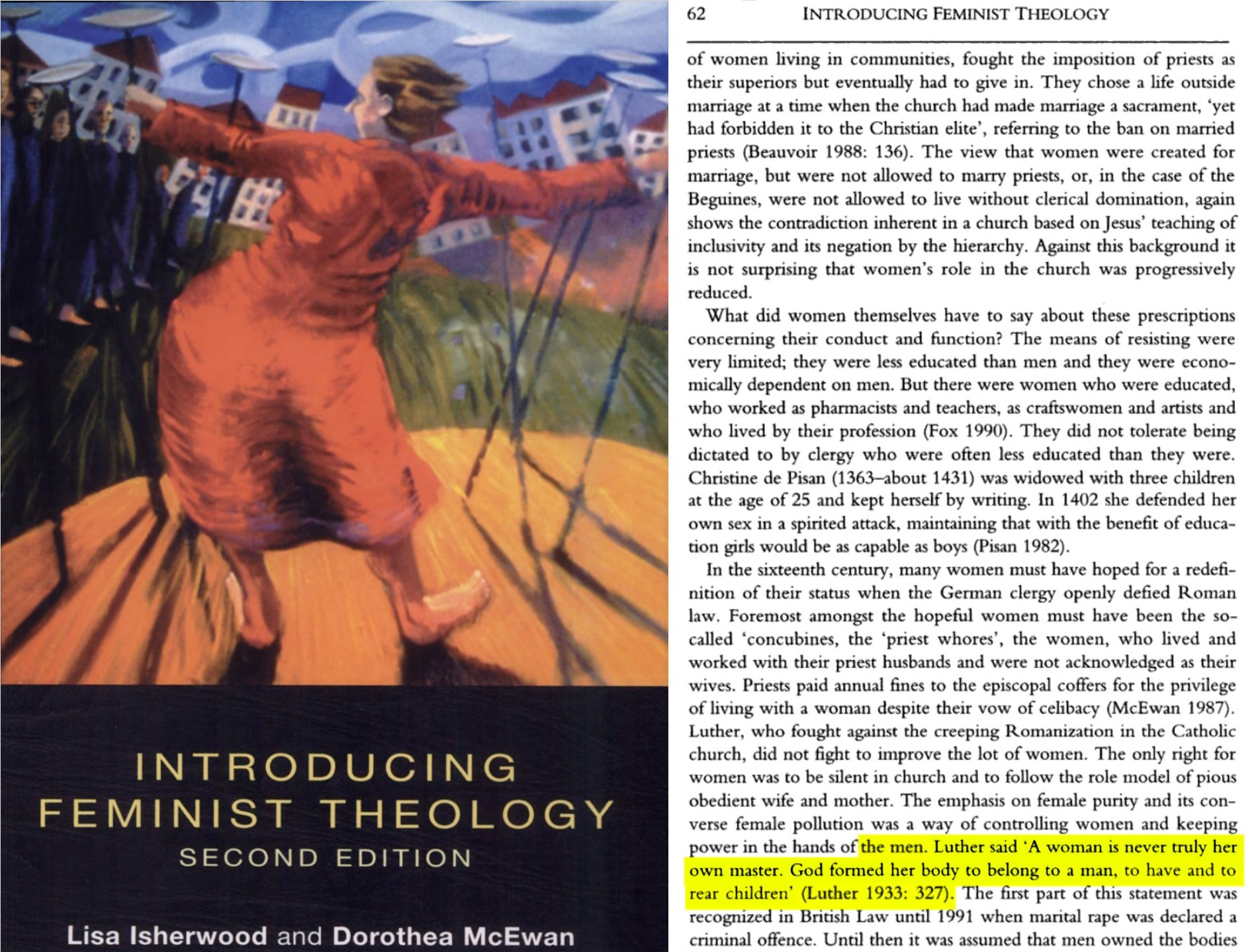
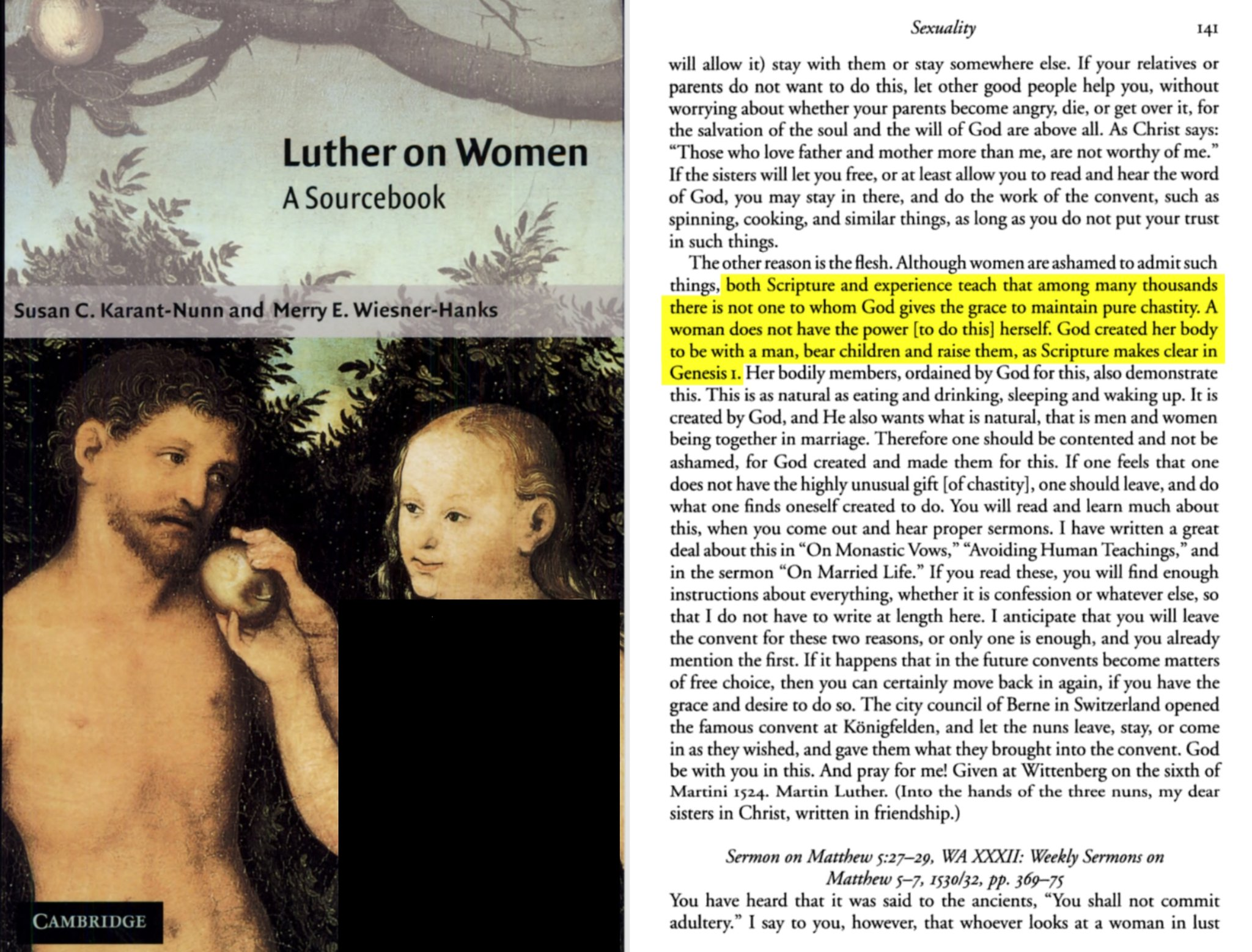
Martin Luther — cited in multiple sources “A woman is not the master of herself, but God shaped her body so that she belongs to the man and bears his children. By God, women were created for pregnancy and cooking, not for anything else. If women tire or die, it doesn’t matter — let them die, for they were created for that. Try to take women away from managing household affairs; you will find they are unfit for anything. A woman should not take on the task of teaching because she was created only for childbearing.”
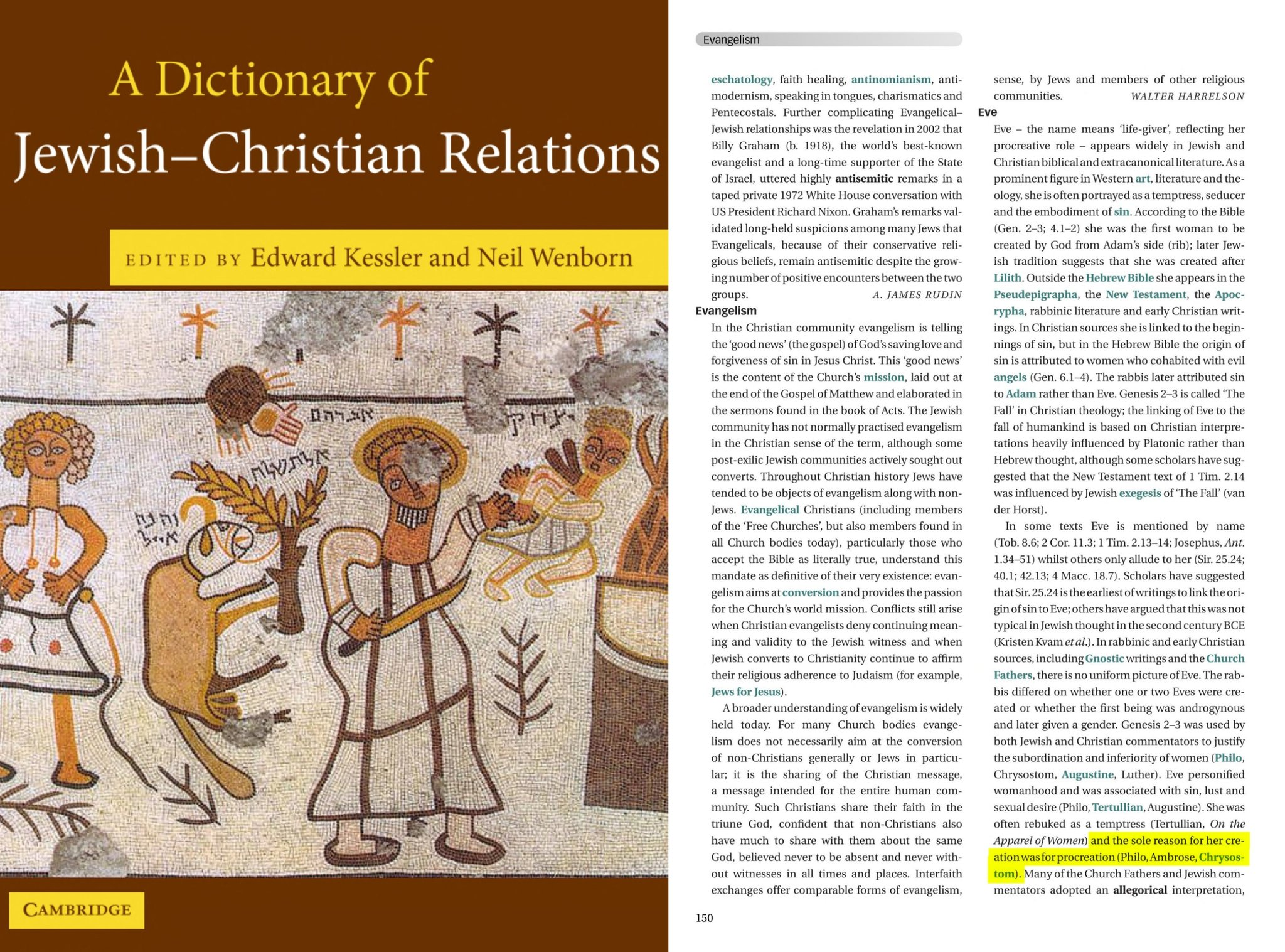
Saint Ambrose and Saint John — cited in A Dictionary of Jewish-Christian Relations “The only reason for the creation of woman is procreation.”
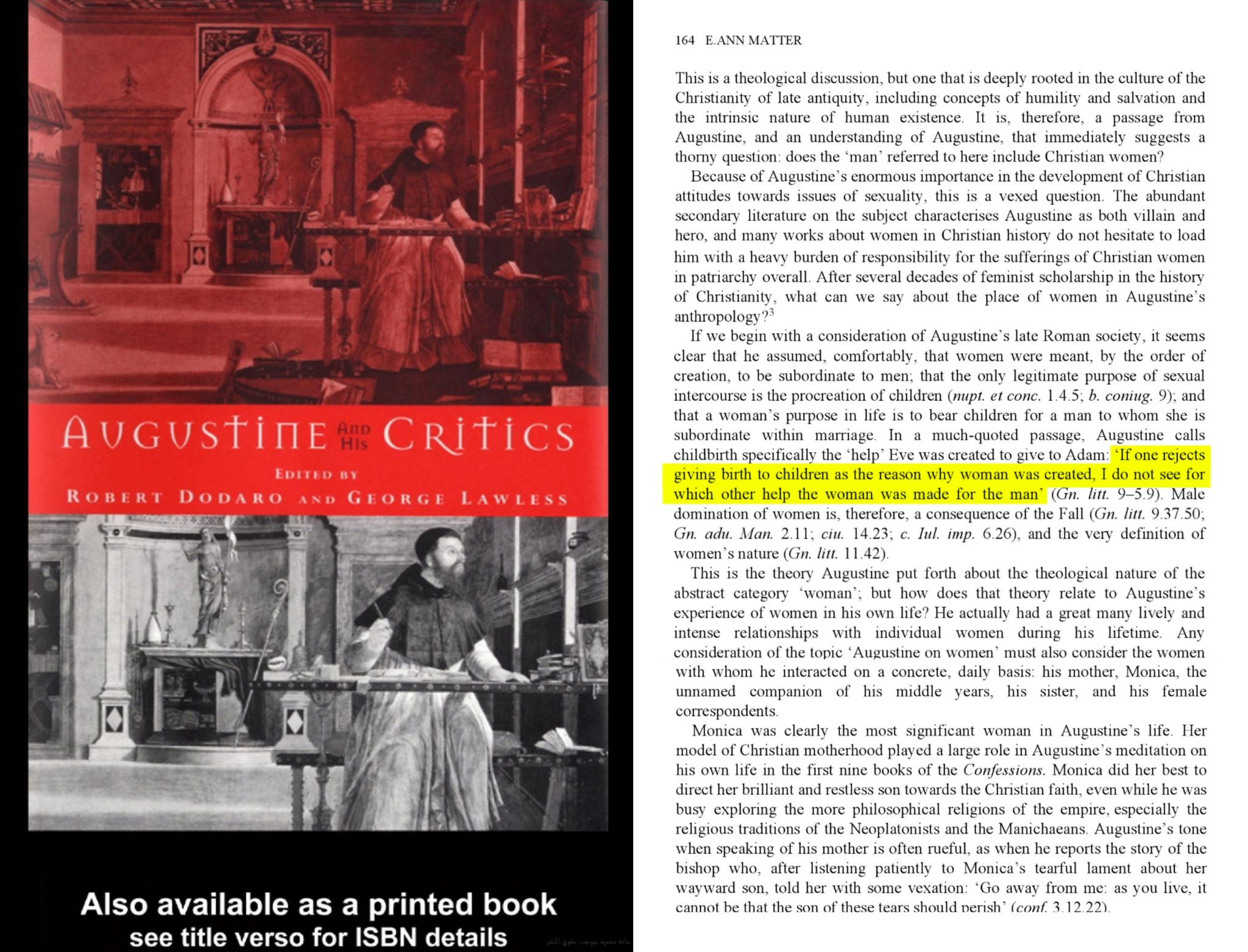
Saint Augustine — Nicene and Post-Nicene Fathers “I see no other reason for which woman was created except for procreation.”
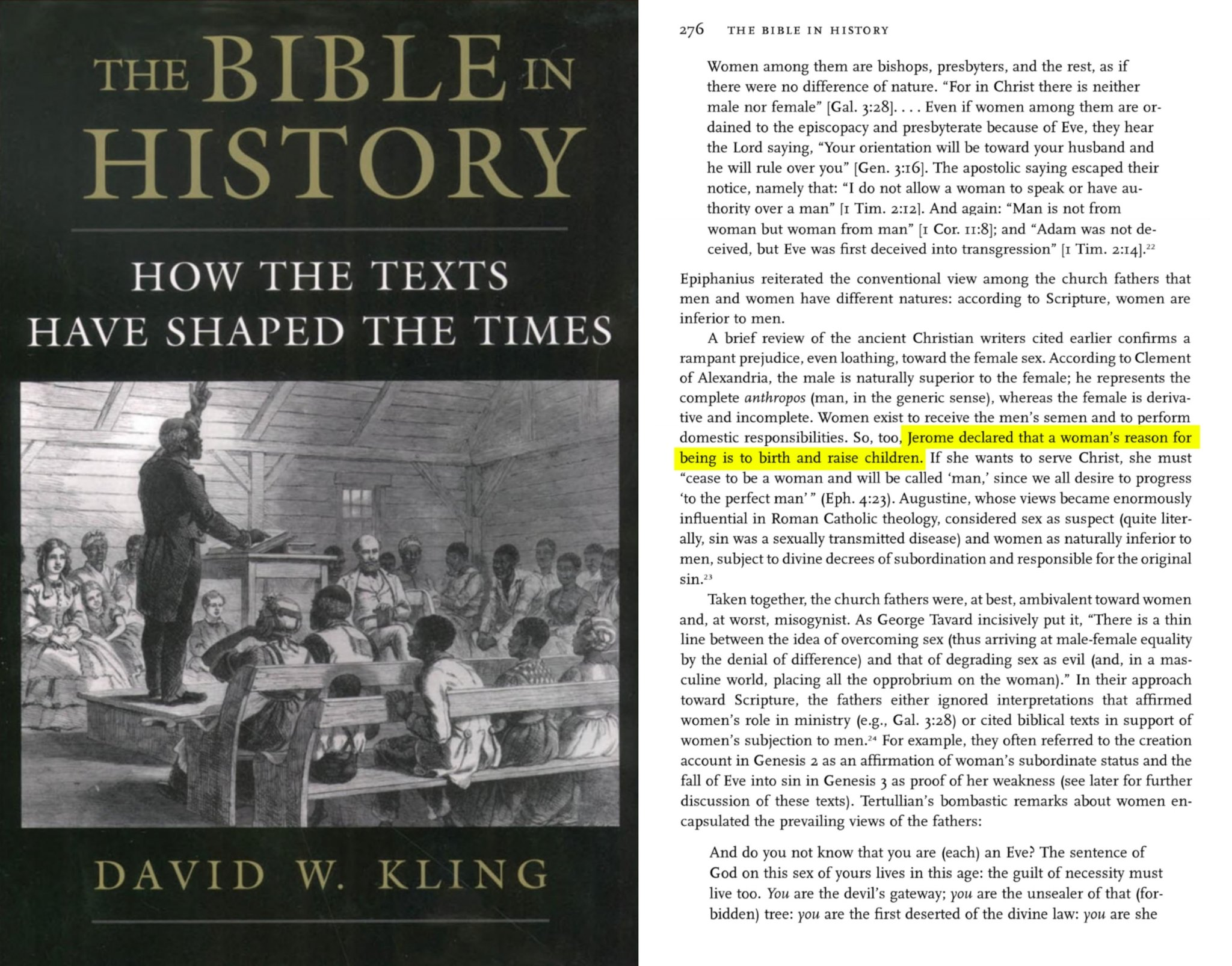
Saint Jerome “The reason for a woman’s existence is procreation.”
All theologians agreed: there is no other reason or importance for the creation of woman except that she is a means for procreation.
Woman as Gateway to Hell — Source of Evil and Defilement
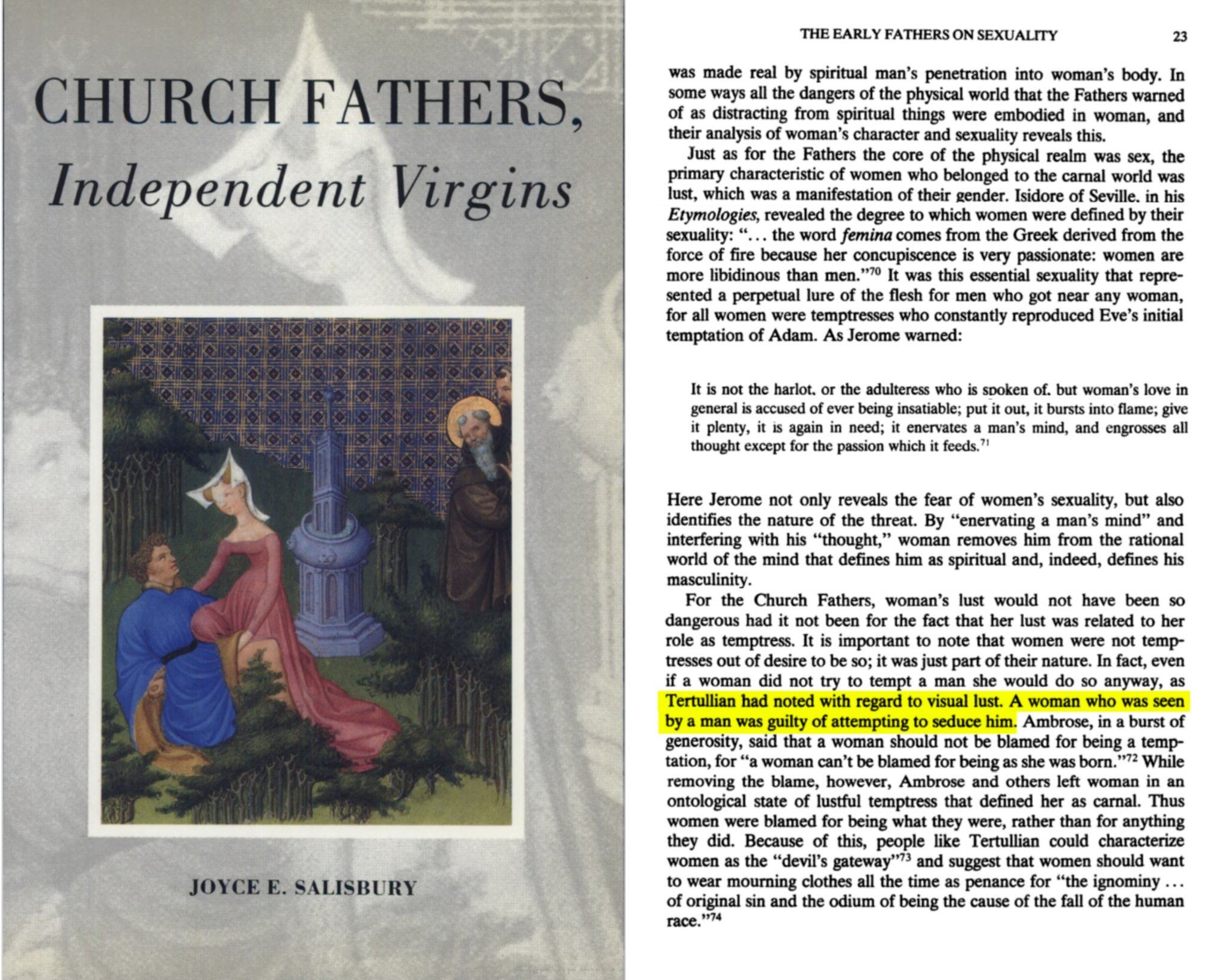
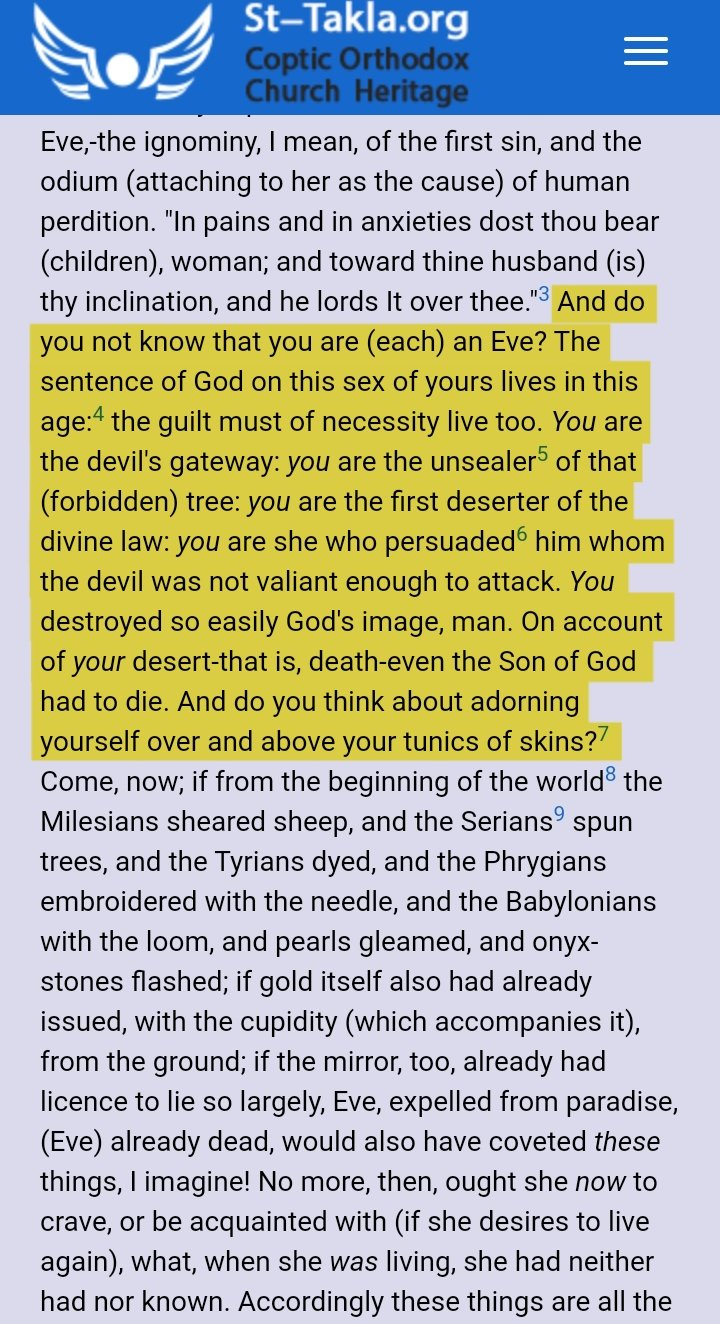
Saint Tertullian — sermon to women “Woman is the gateway to hell. Do you not realize that Eve is you? The curse that God placed on your kind is still in effect at this time, so you must bear the burdens of guilt. You are the gateway, and you are the one who defiled that deadly tree, and you are the first who betrayed God’s law. The woman who was seen by a man is accused of seeking to seduce him.”
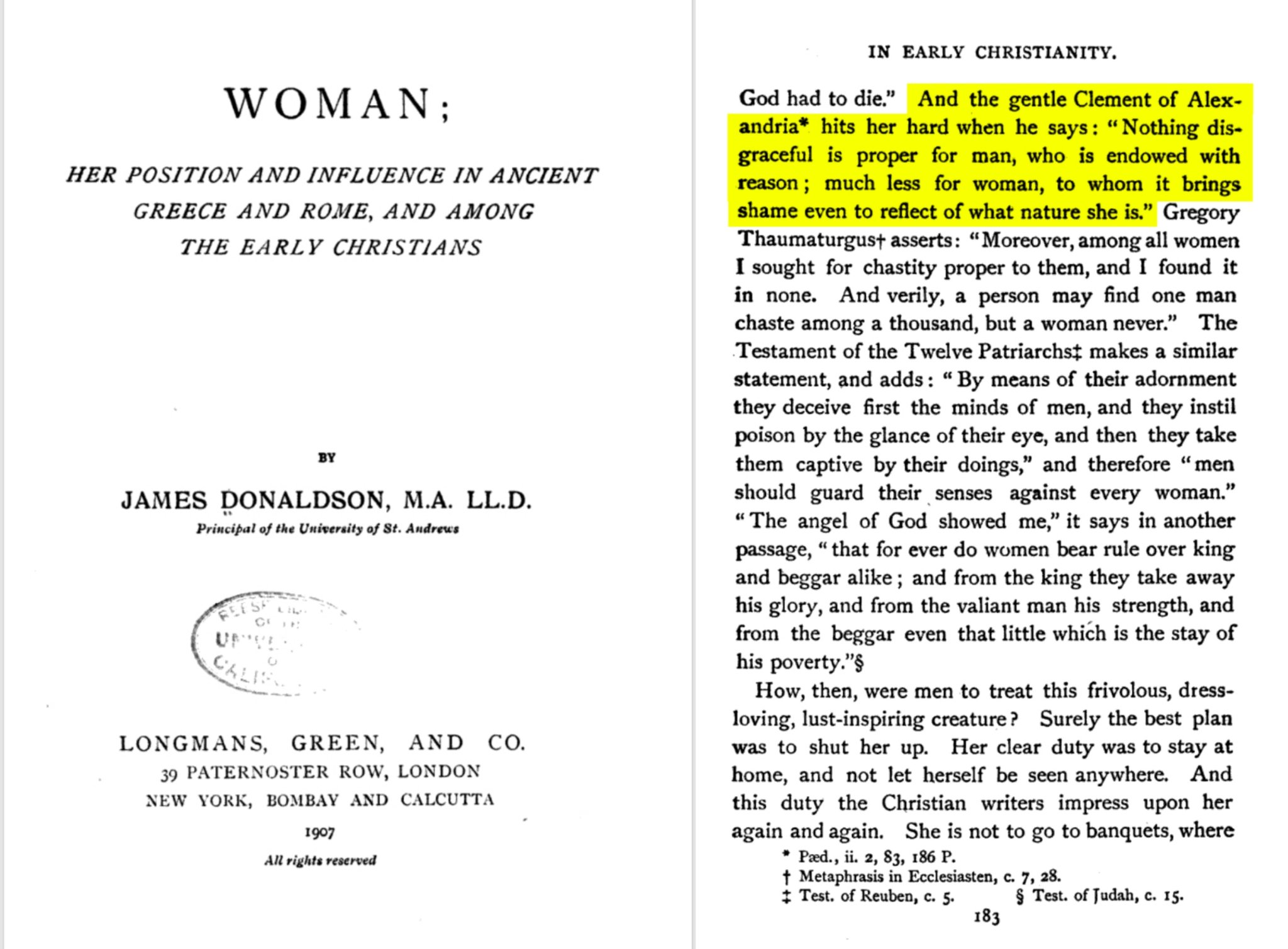
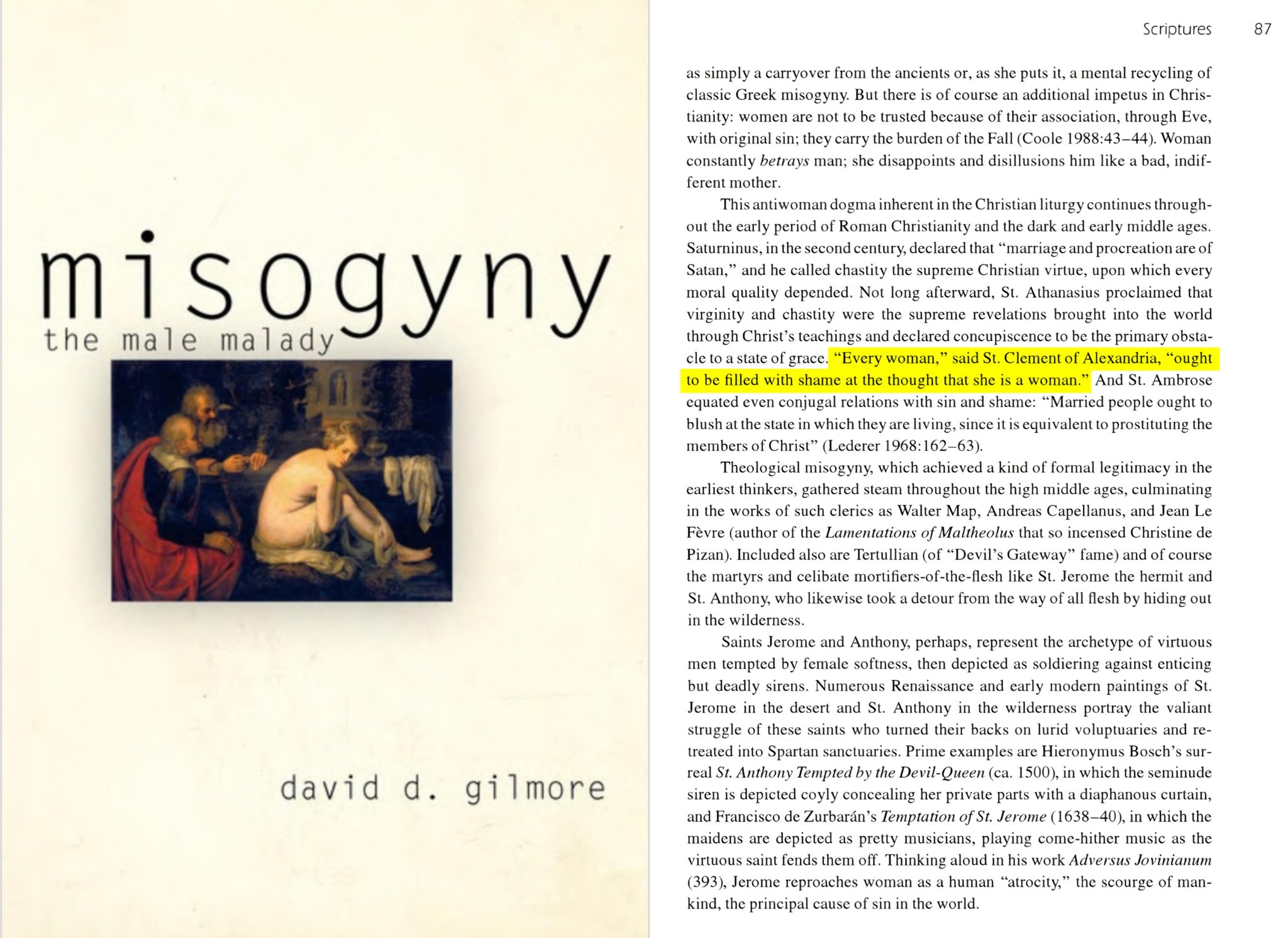
Saint Clement of Alexandria “If a woman reflected on her nature, she would feel scandalized. There is nothing shameful for the man whom God has endowed with reason, unlike the woman who brings shame and disgrace when contemplating her nature. The woman brings disgrace to the man, even if only by revealing what nature she possesses. Every woman should feel ashamed because she is a woman.”
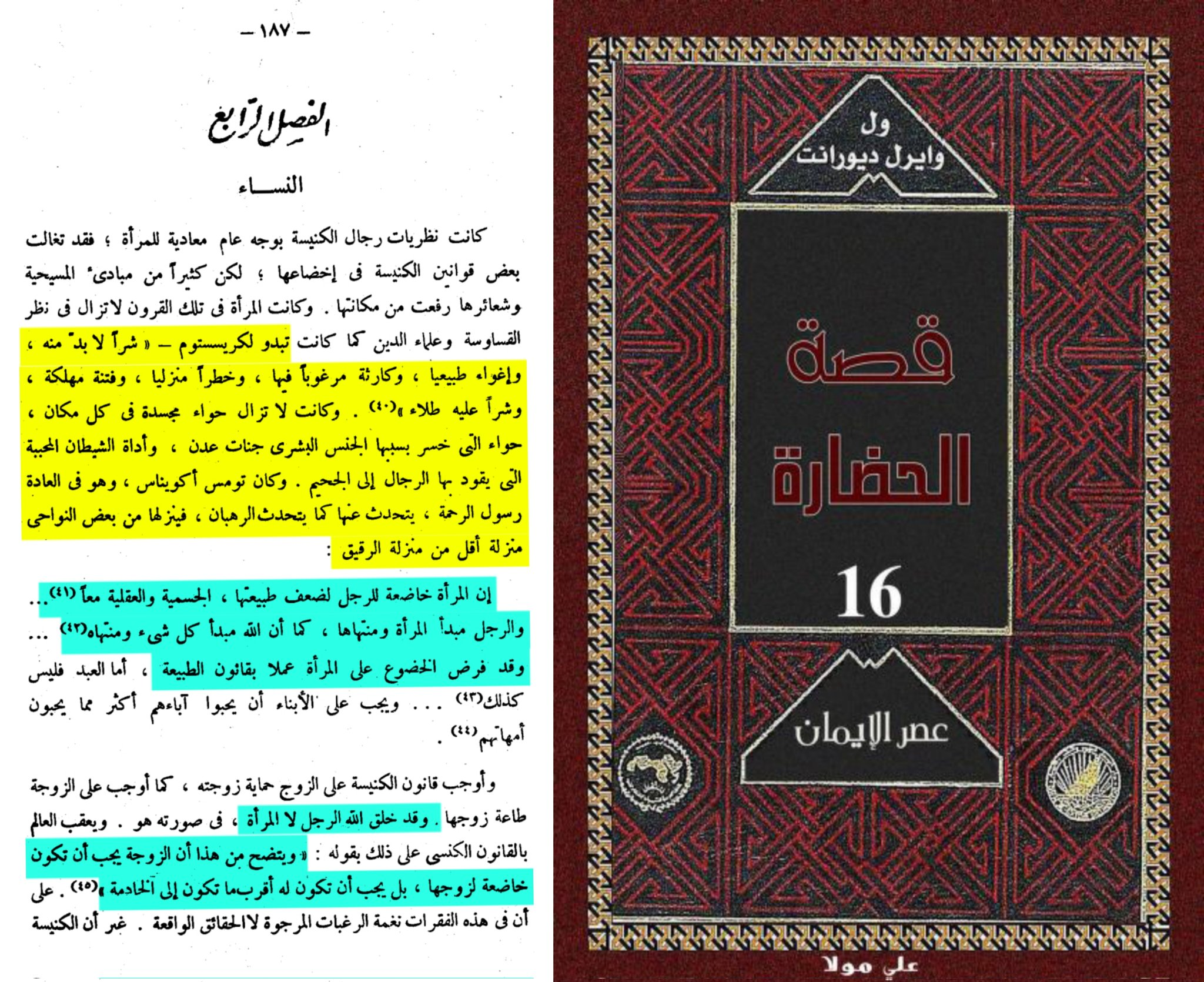
Saint John Chrysostom and Saint Jerome — cited in patristic sources “The woman, in their view, is a necessary evil, a natural temptation, a domestic danger, a destructive allure, and an evil coated with charm. The woman is the one who caused man to lose paradise, and she is the devil’s favored tool.”
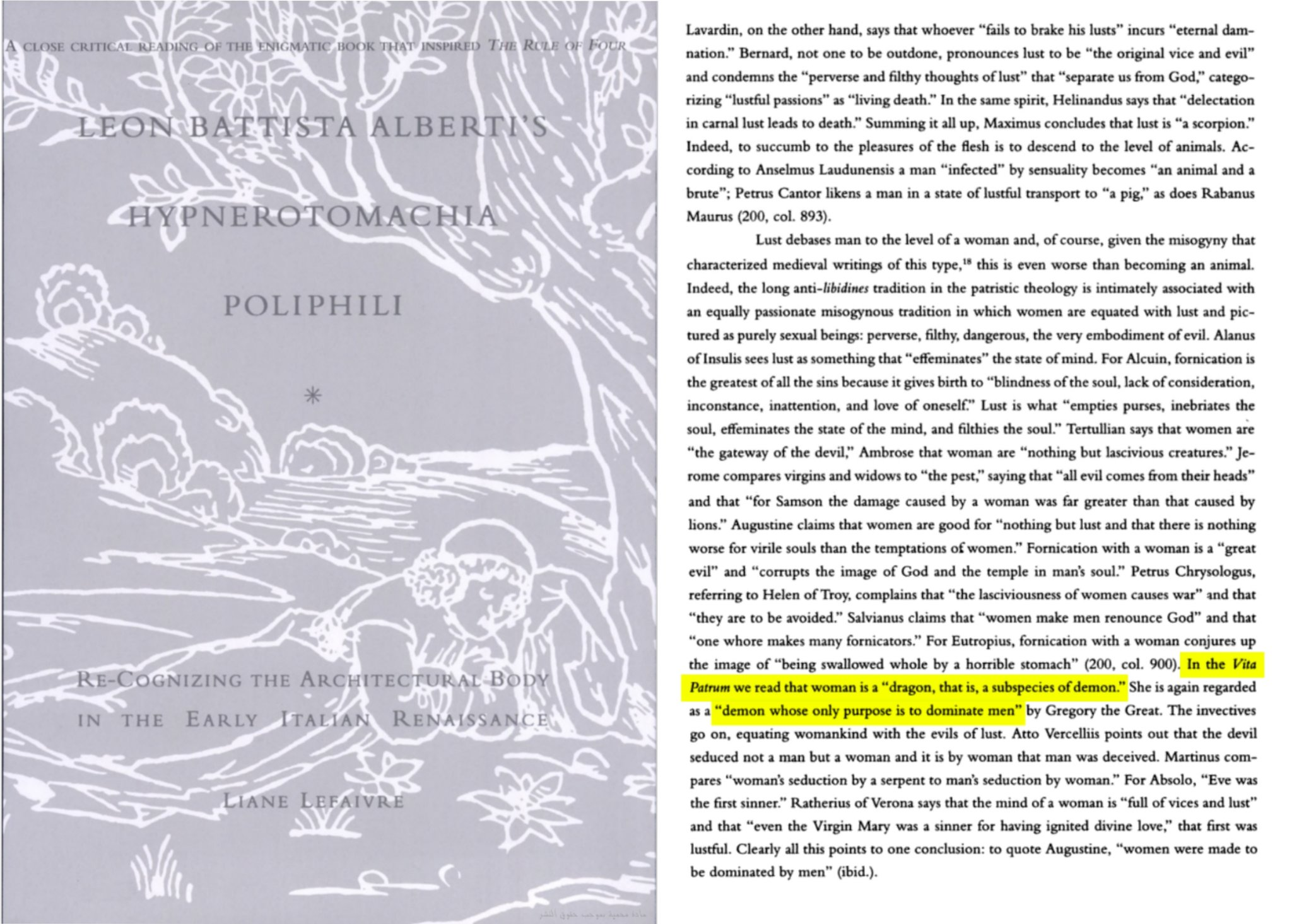
Gregory, Bishop of Tours — Vita Patrum “Indeed, a woman is a dragon — that is, one of the types of demons. And women are demons whose sole purpose is to dominate men.”
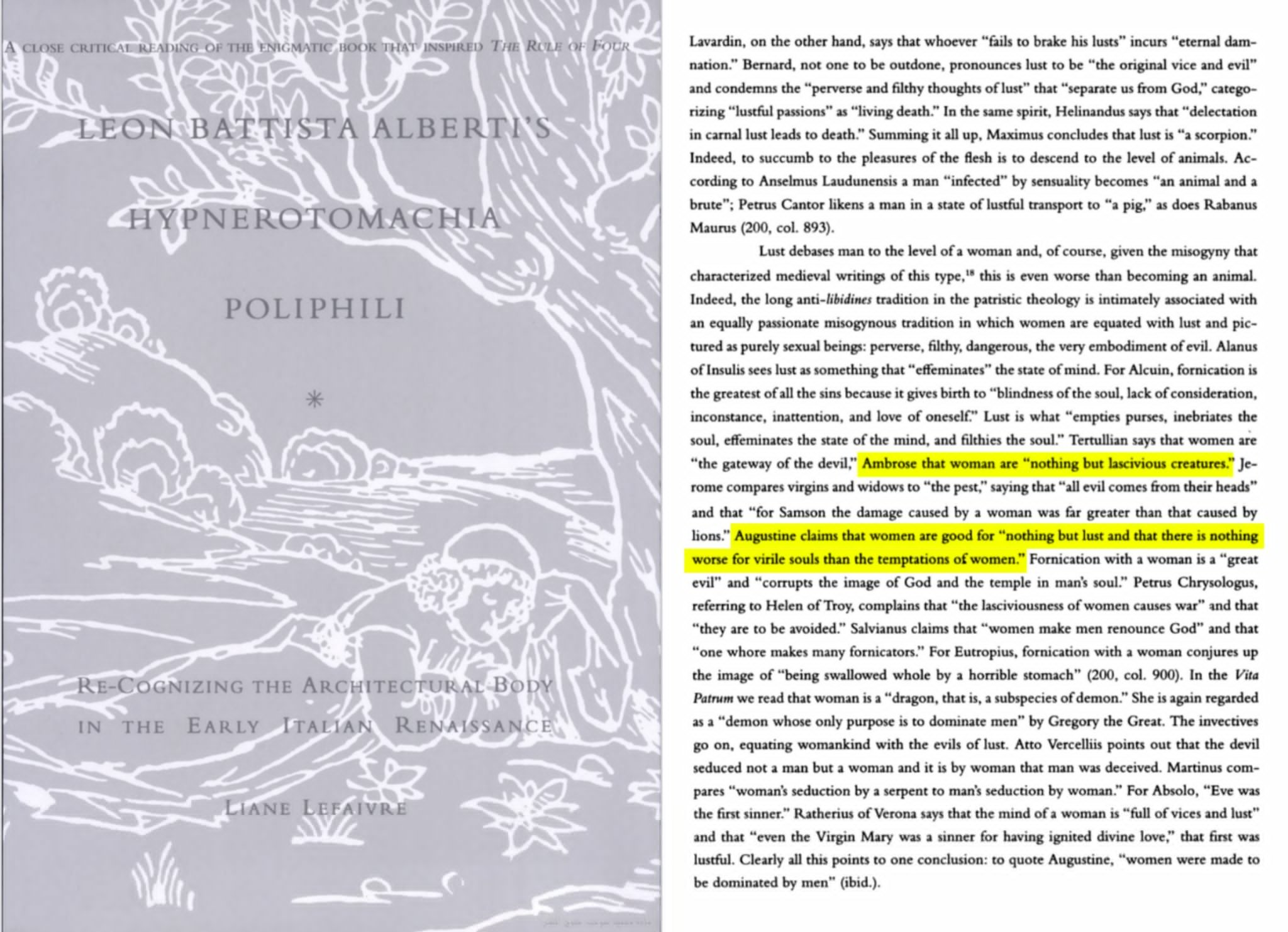
Saint Augustine — Augustine of Hippo: A Biography by Peter Robert Lamont Brown “There is nothing more dangerous to steadfast souls than the temptations of women.” When a young man complained about his mother to Saint Augustine, he said: “Beware of the seductive woman whom we must beware of in any woman, even if she is your mother.”
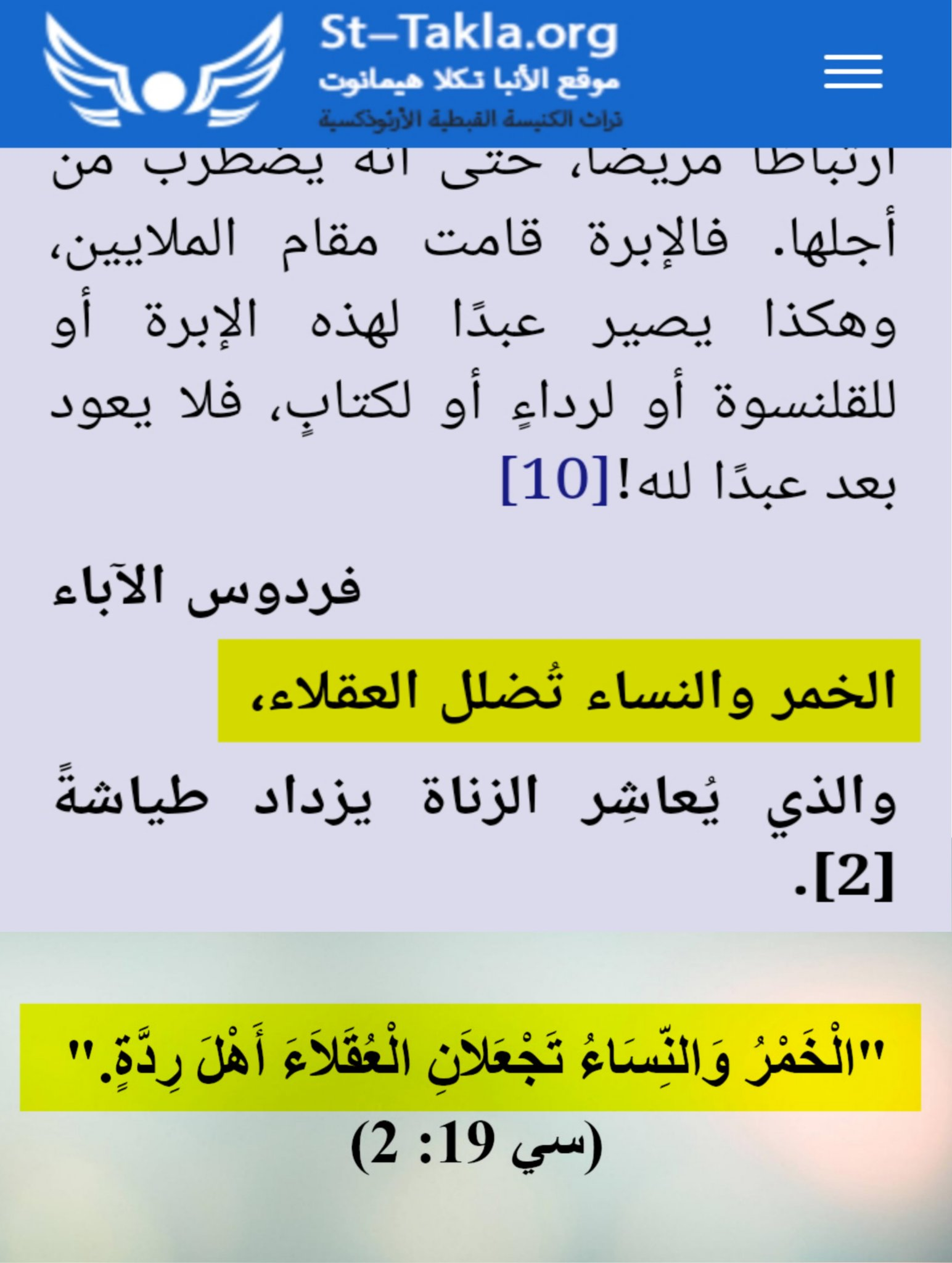
Father Hesychius of Jerusalem — cited on St. Takla website “The woman presented the first piece of evil to man in Paradise. So how can he who was born of the one who presented evil appear righteous?”
Saint Ambrose “Saint Ambrose of the Church said about women that they are nothing but corrupt beings.”
Boethius — The Consolation of Philosophy (sixth century) “A woman is a temple built over a sewer of filth.”
Odo of Cluny Abbey (tenth century) “To embrace a woman is to embrace a sack of manure.”
The biblical text on woman as evil:
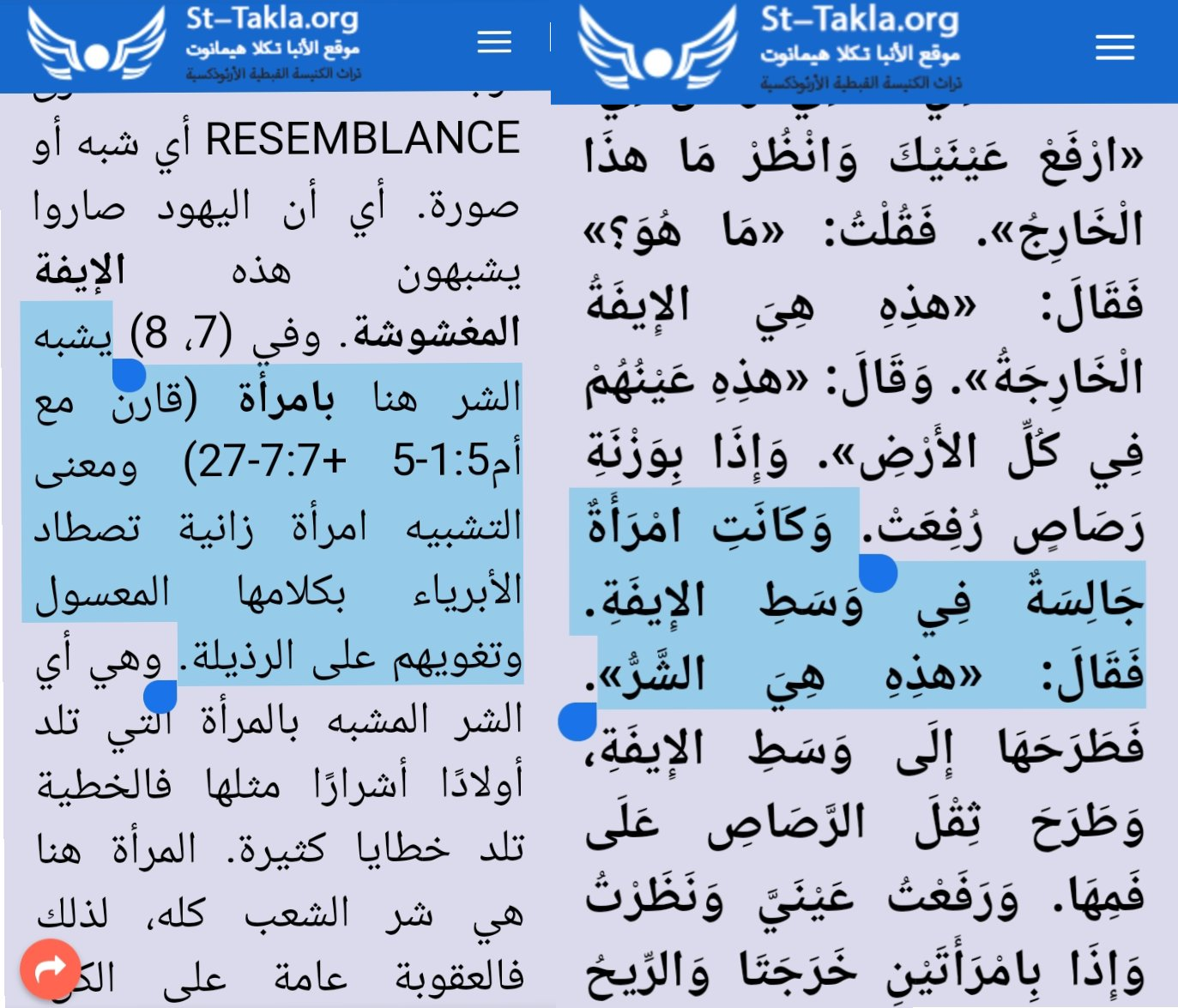
Zechariah 5:7–8 (SVD) “And behold, a talent of lead was lifted up, and a woman was sitting in the midst of the ephah. And he said, ‘This is evil.’ And he cast it into the midst of the ephah, and cast the weight of lead upon her mouth.”
Ecclesiastes 7:26 (SVD) “But more bitter than death I find a woman whose heart is snares and whose hands are fetters. The righteous in the sight of God will be delivered from her, but the sinner will be taken by her.”
Sirach 42:13–14 (Jesuit Monastic Translation) “For from garments comes the moth, and from a woman comes a woman’s wickedness. A man’s wickedness is better than a woman’s kindness, for a woman brings shame and scandal.”
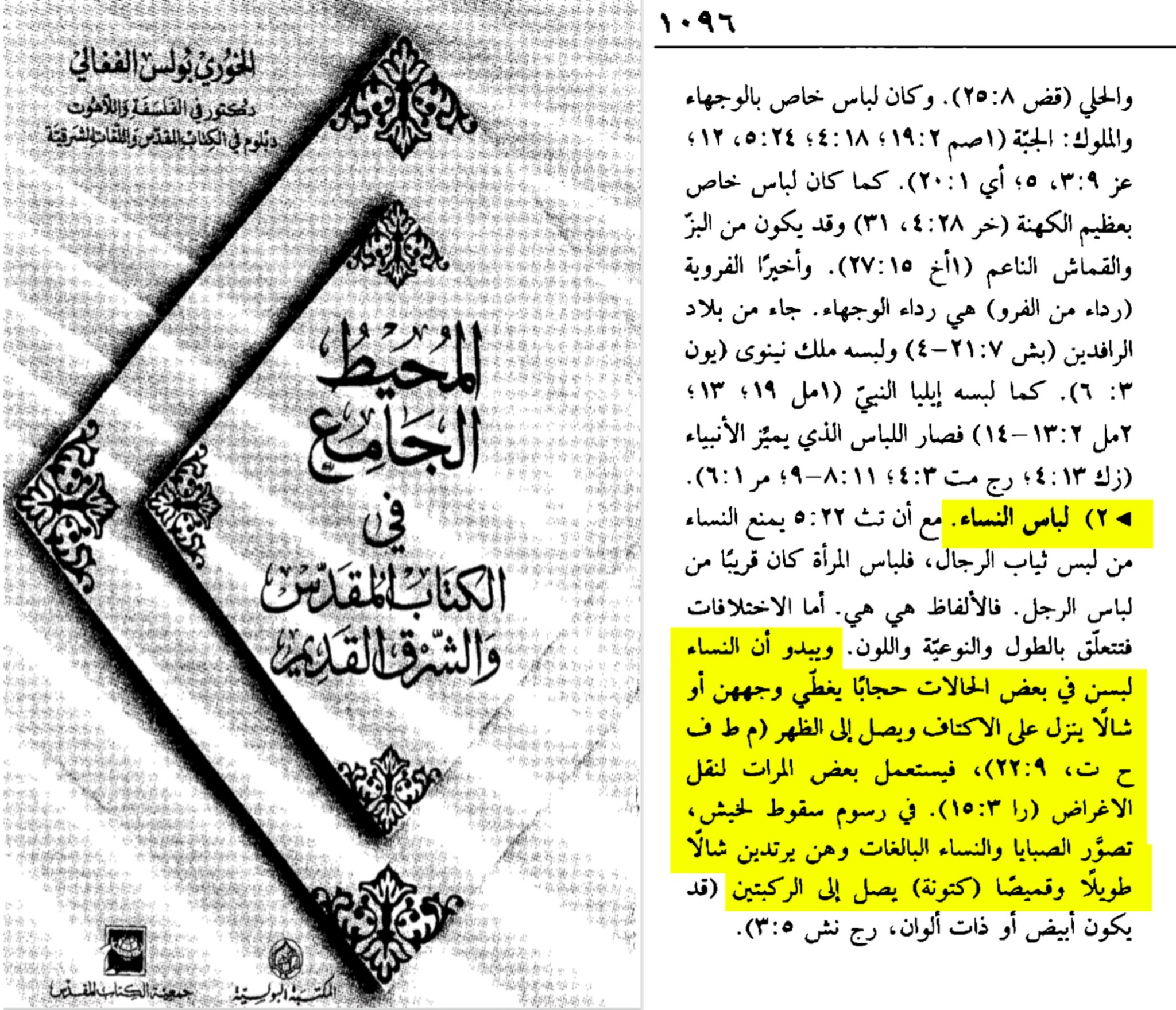
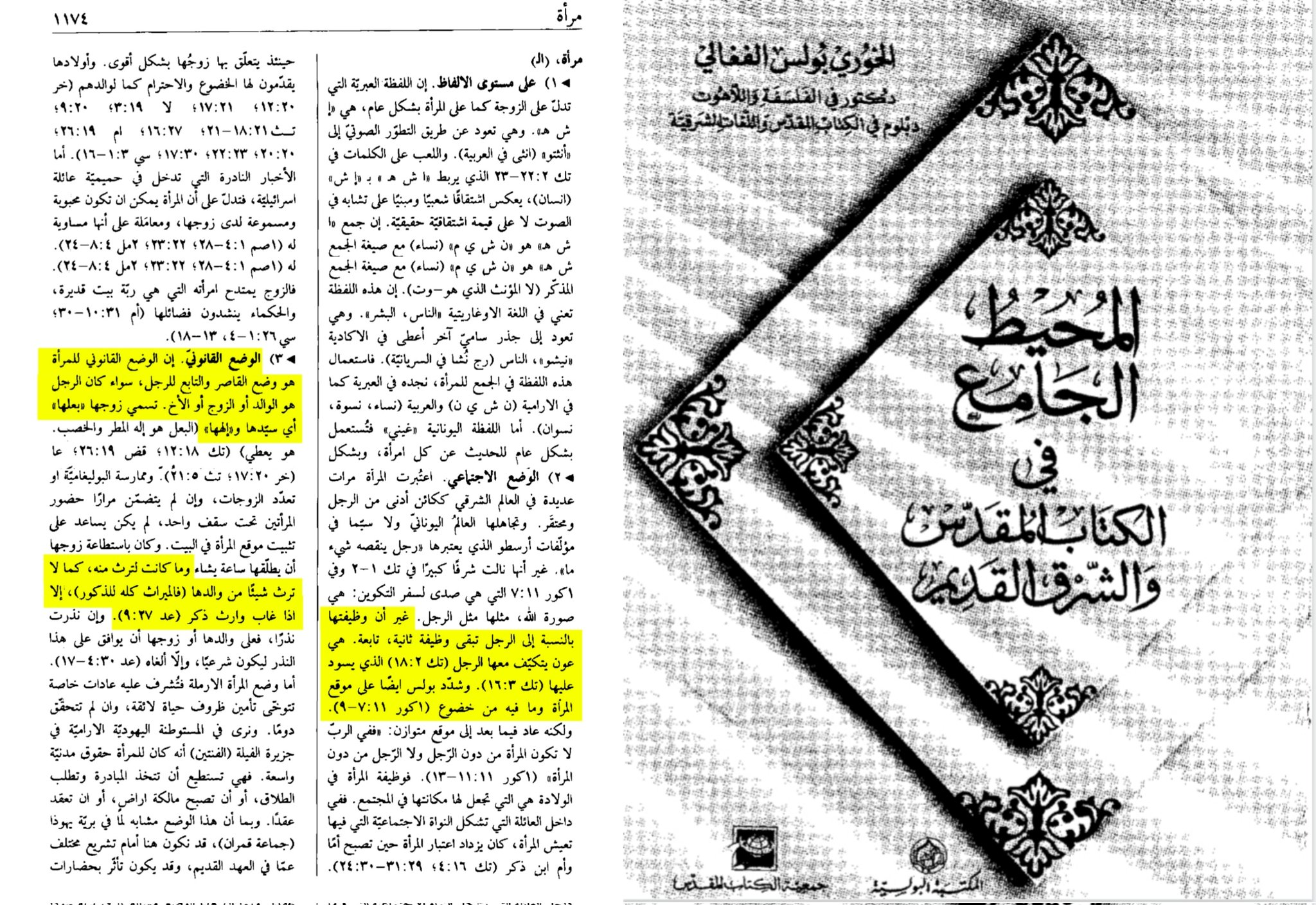
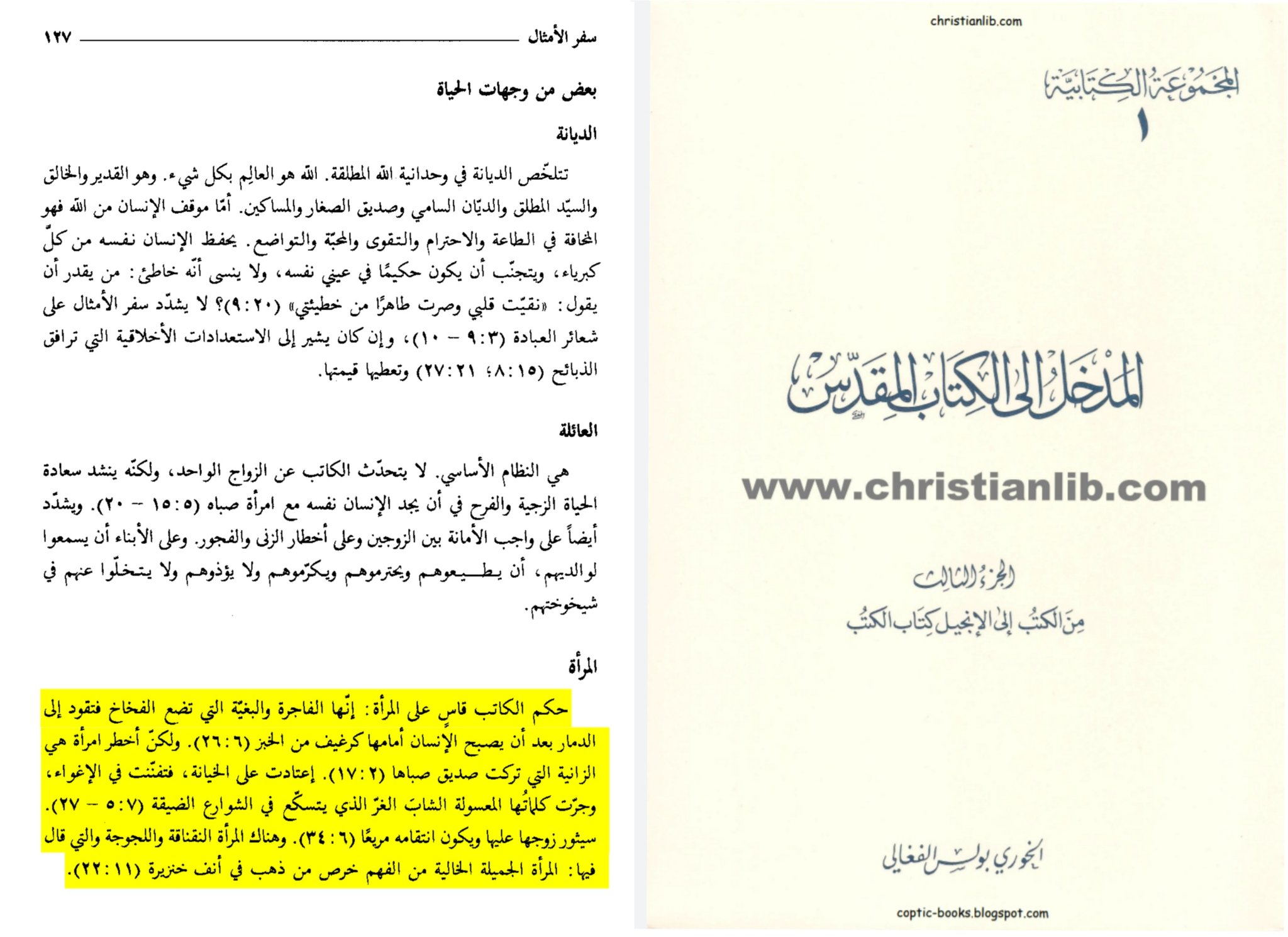
According to the Bible, a woman is corrupt by her very nature and only a woman bears inherent corruption. Father Paul al-Faghali answers the question of the Bible’s stance on women: “The Bible’s judgment is harsh on women — she is the seductress and the harlot who sets traps and lays snares, accustomed to betrayal, skilled in seduction, and a chattering, quarrelsome woman devoid of understanding.”
E dwUhgX0AEIRv5 3f29f4addcd462c1FEHEYaJWQAQco o 91ac7507ce17f971FEM yM1WQAUrusk 52b8c34c402dbbb5FENW3vqWQAIWjaz edf7031249bed923FENXRe7WYAAlK b 32630085cd753184FEKo0xcXEAMyxHQ 7c1fc83cf18ec99eFEHYOYJWYAAJlkk 184d0edc931a338bFEHdkU4XsAwYo5E 13d9eafbcdf74006FIS33FiXsAQbbNW 66fc3b8815cce7c8FFJaW9vXwAQVby1 8af6351b76c9915dFSscK9JXEAAck6Z 63b002079357db83FSscMO2XwAEekXS 0cf086f4bb09a10d
Woman’s Intellect Is Inferior
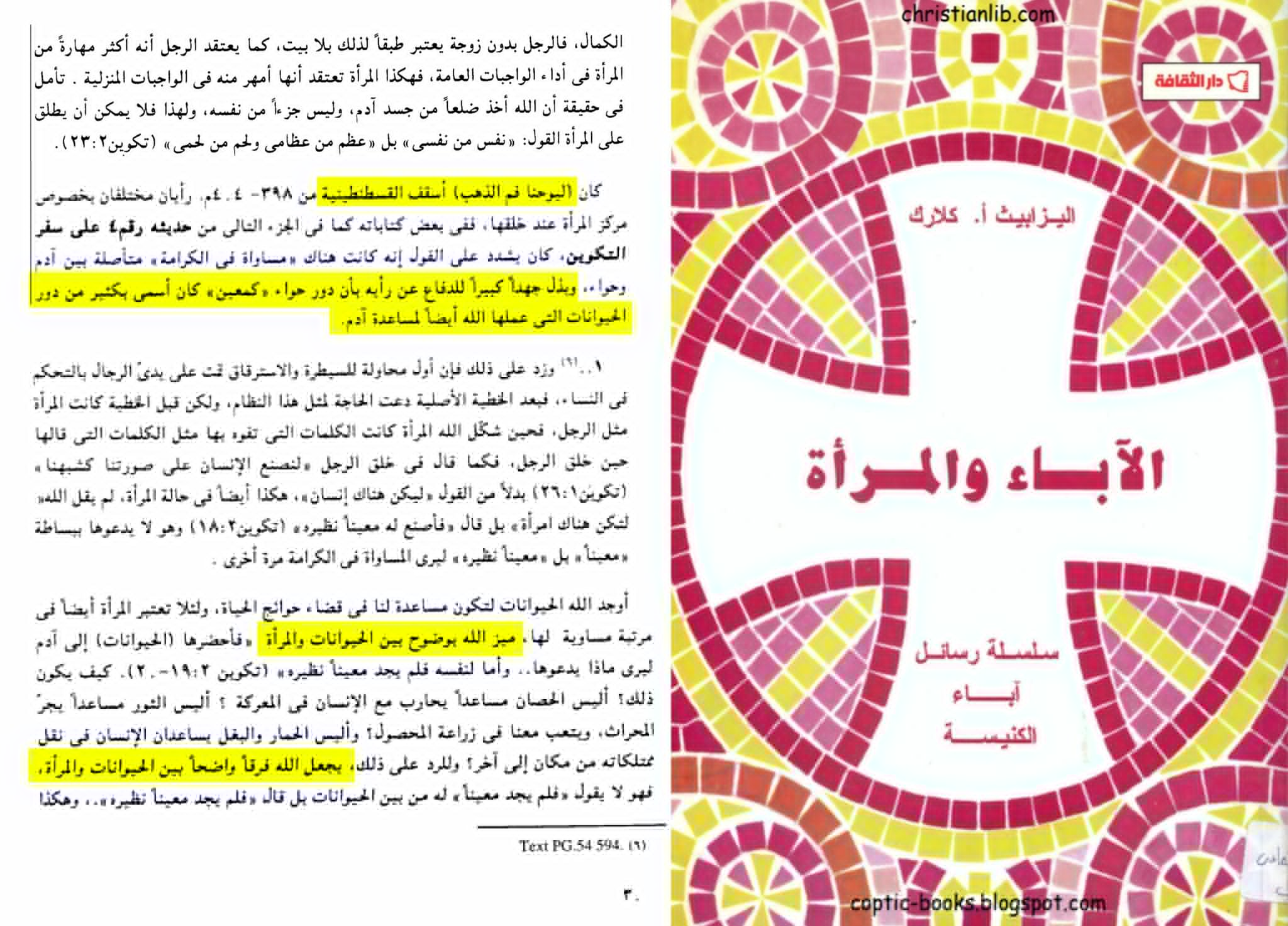
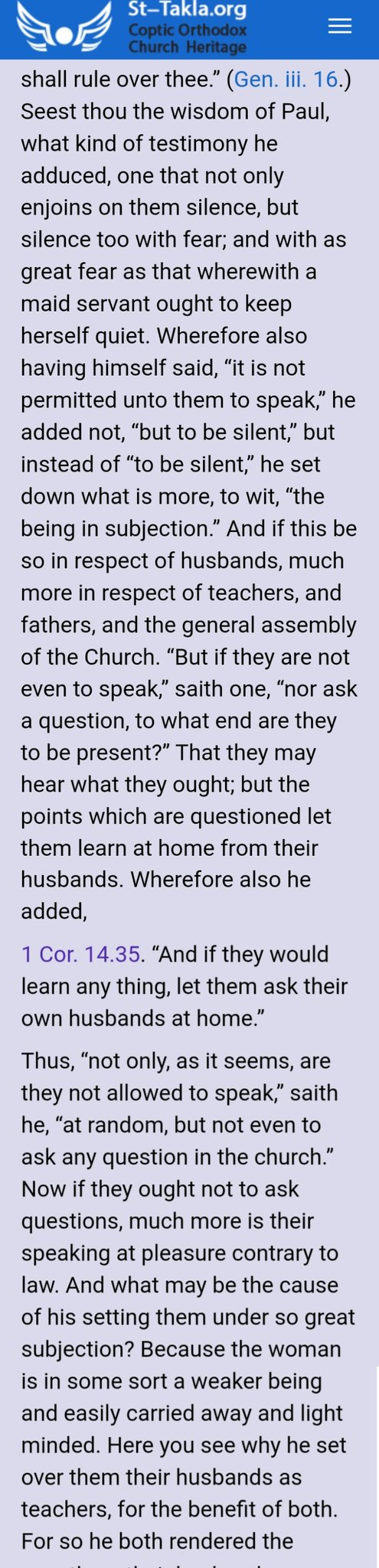
Saint John Chrysostom — Women in the Early Church “The woman is a weak being, easily provoked, and light of mind. A woman must combine fear and silence, like an owned slave. A wonderful comparison between the woman and the animal: he concluded that the woman is an intermediate being between the animal and the man.”
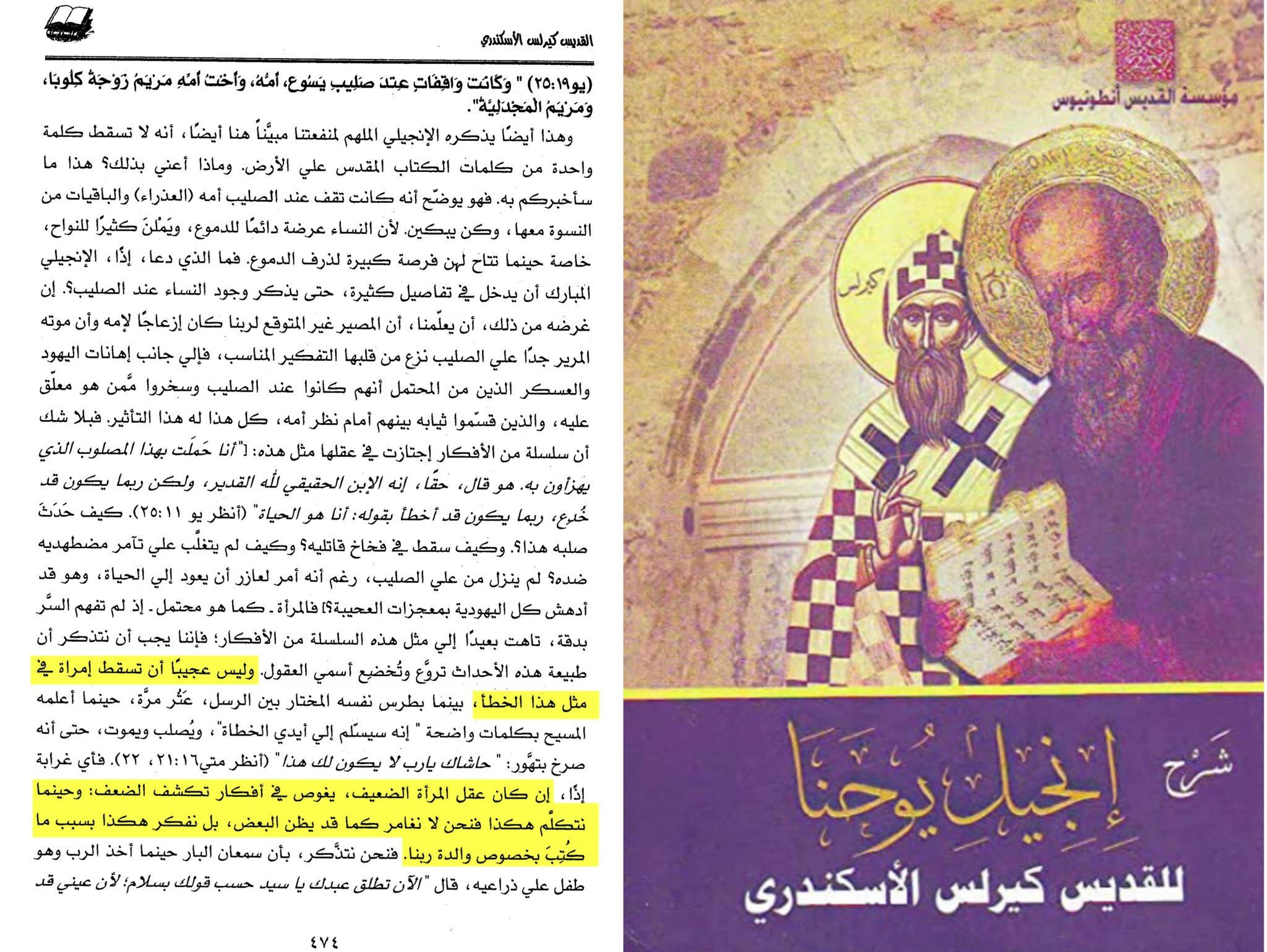
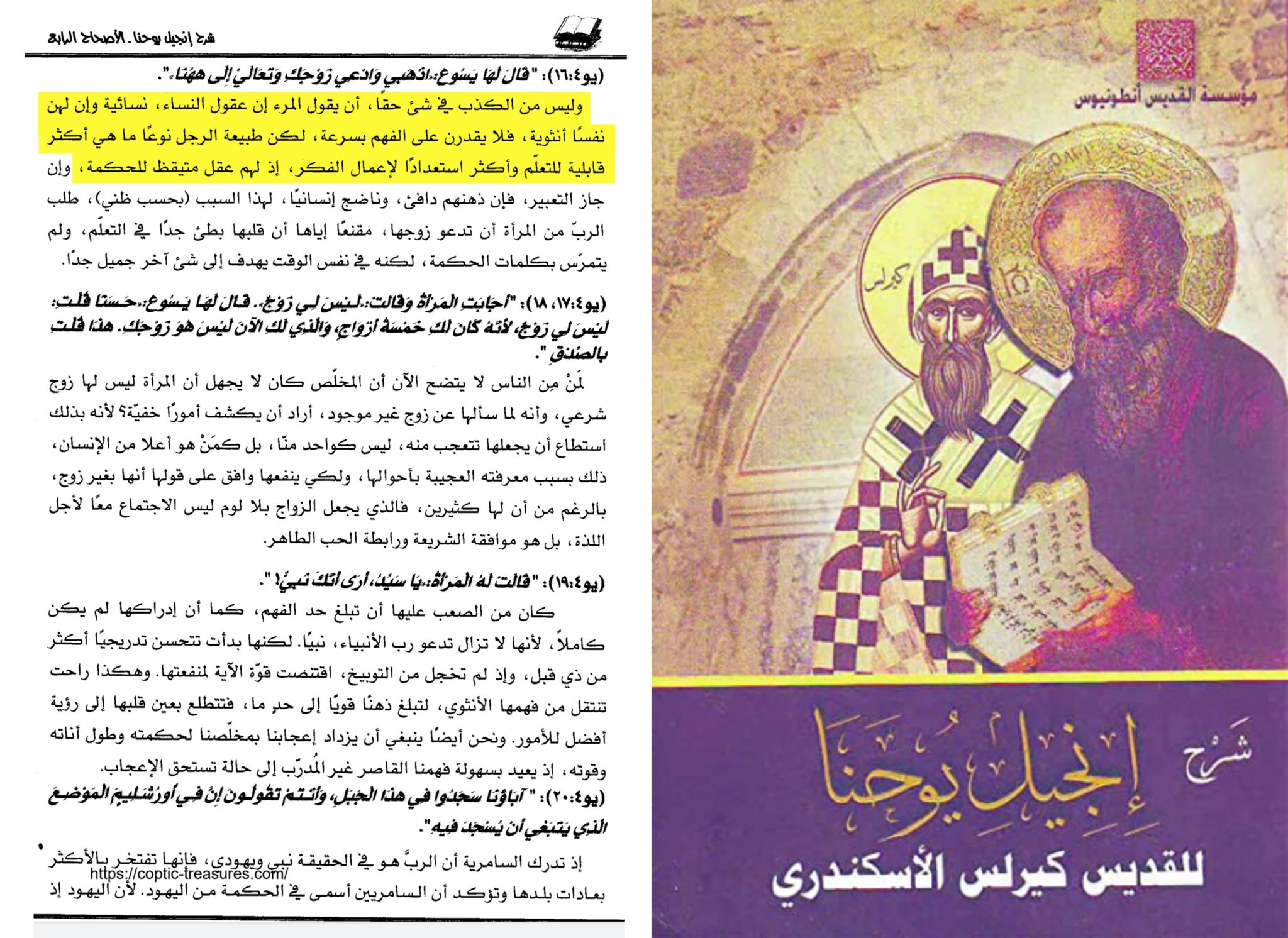
Saint Cyril of Alexandria — cited in patristic sources “Truly, it is not a lie for one to say that women’s minds are feminine and that they have a feminine soul, so they cannot comprehend quickly. However, a man’s nature is somewhat more inclined to learning and more prepared for the exercise of thought, as they have a mind alert to wisdom.”
Saint Gregory the Great — cited in patristic sources Woman lacks mental balance.
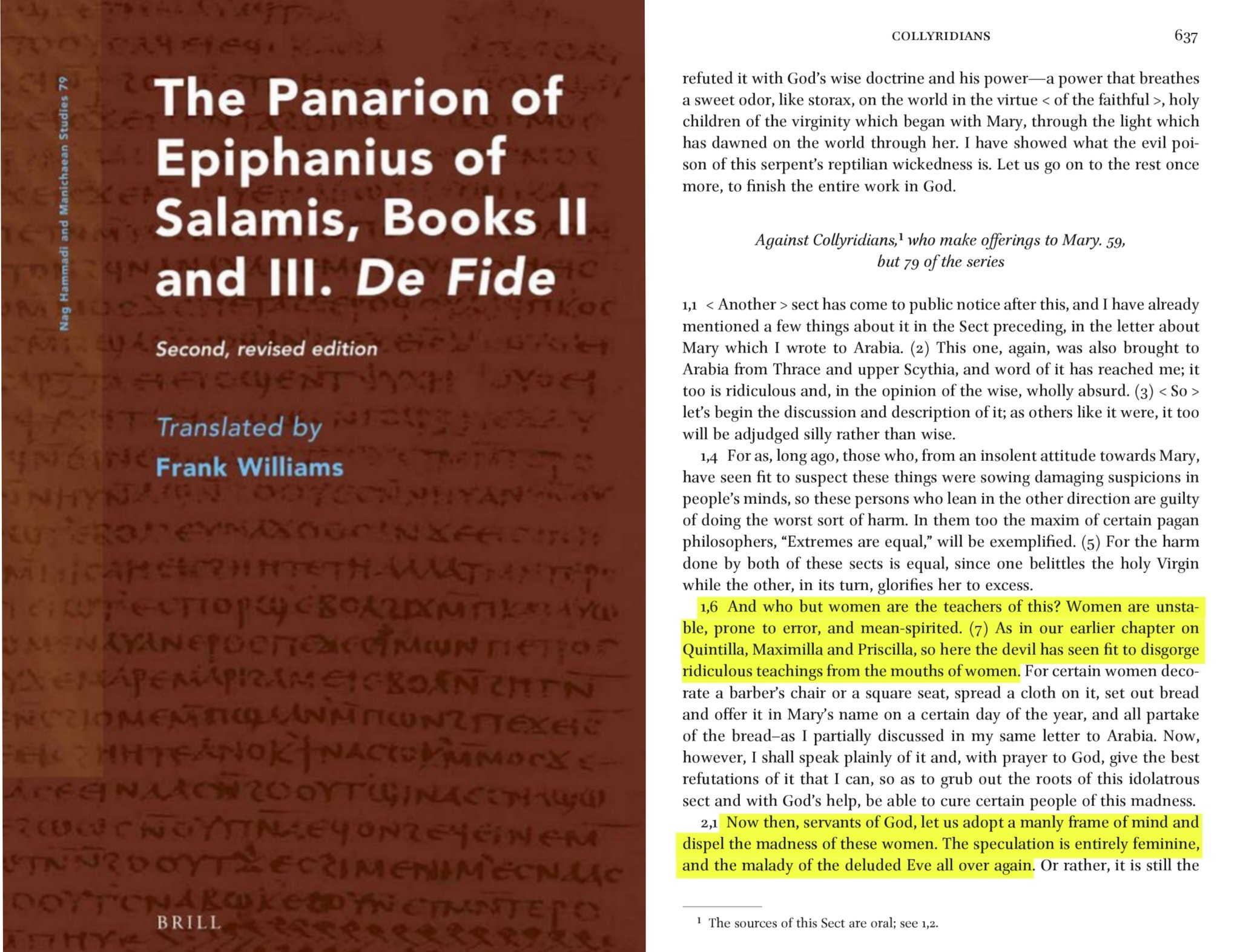
Saint Epiphanus “Women are a defective and reckless gender, unworthy of trust, easily provoked, and weak in intelligence. When the devil saw that women were less intelligent than men, he approached them and made them spread foolish teachings.”
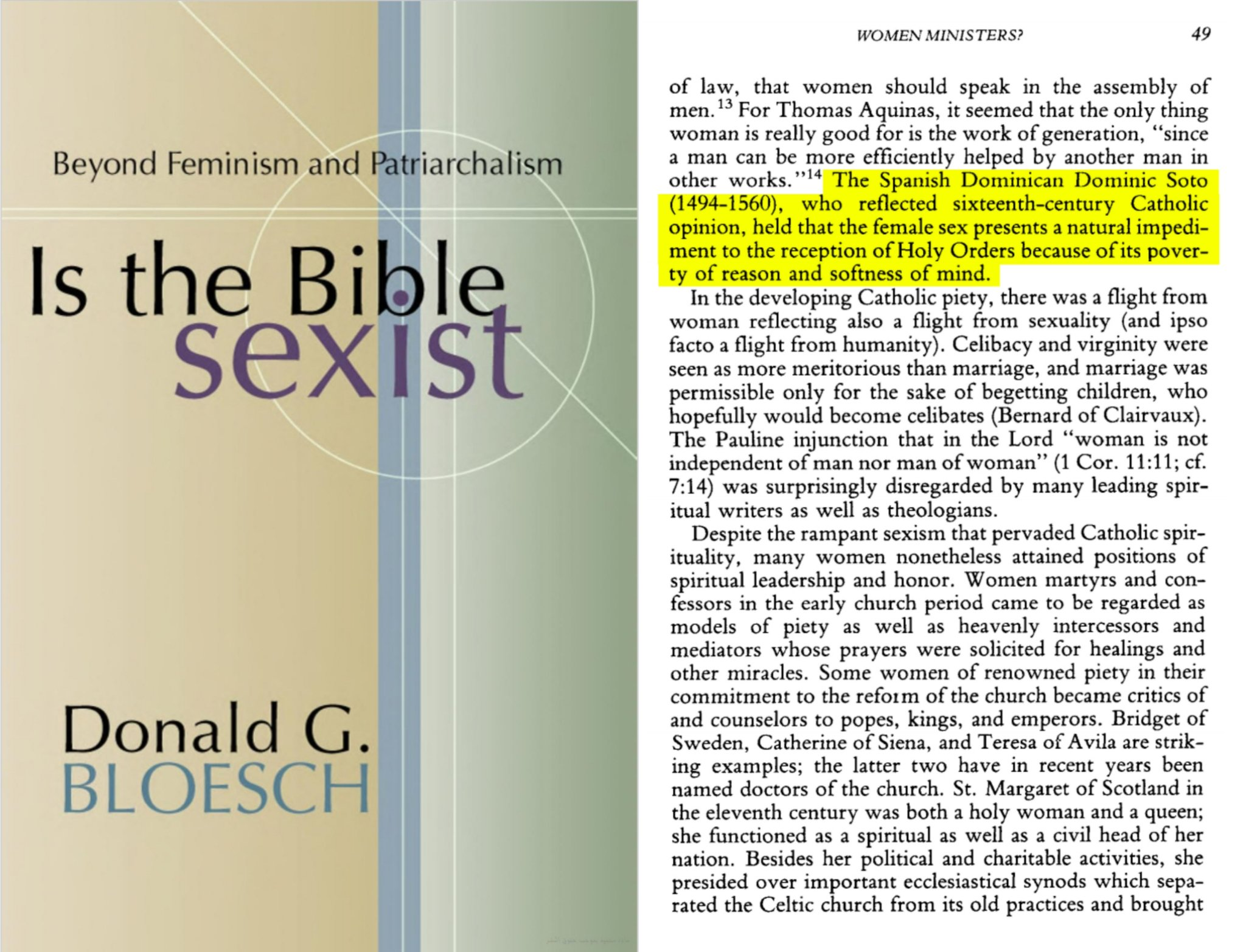
Domingo Soto — Spanish theologian, official doctrine of the Fathers “The female represents a natural obstacle that prevents receiving holy orders due to her mental weakness and the naivety of her understanding.”
Saint Cyril the Great — cited in patristic sources “The mind of a woman is characterized by weakness, instability, and ease of provocation. This trait includes even Mary, the Mother of God.”
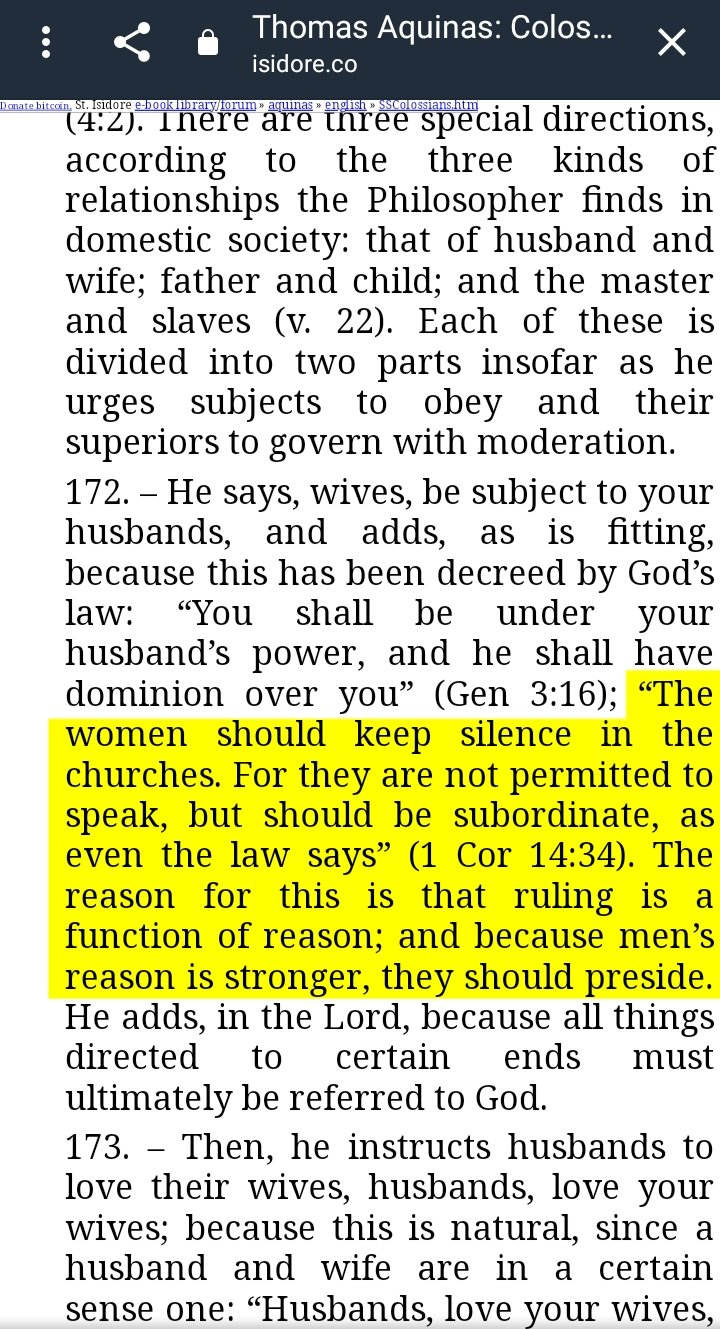
Saint Thomas Aquinas — commentary on Colossians 3:18 “The reason for a man’s authority over a woman is the function of the mind, for since a man’s mind is superior to a woman’s, he should lead her.”
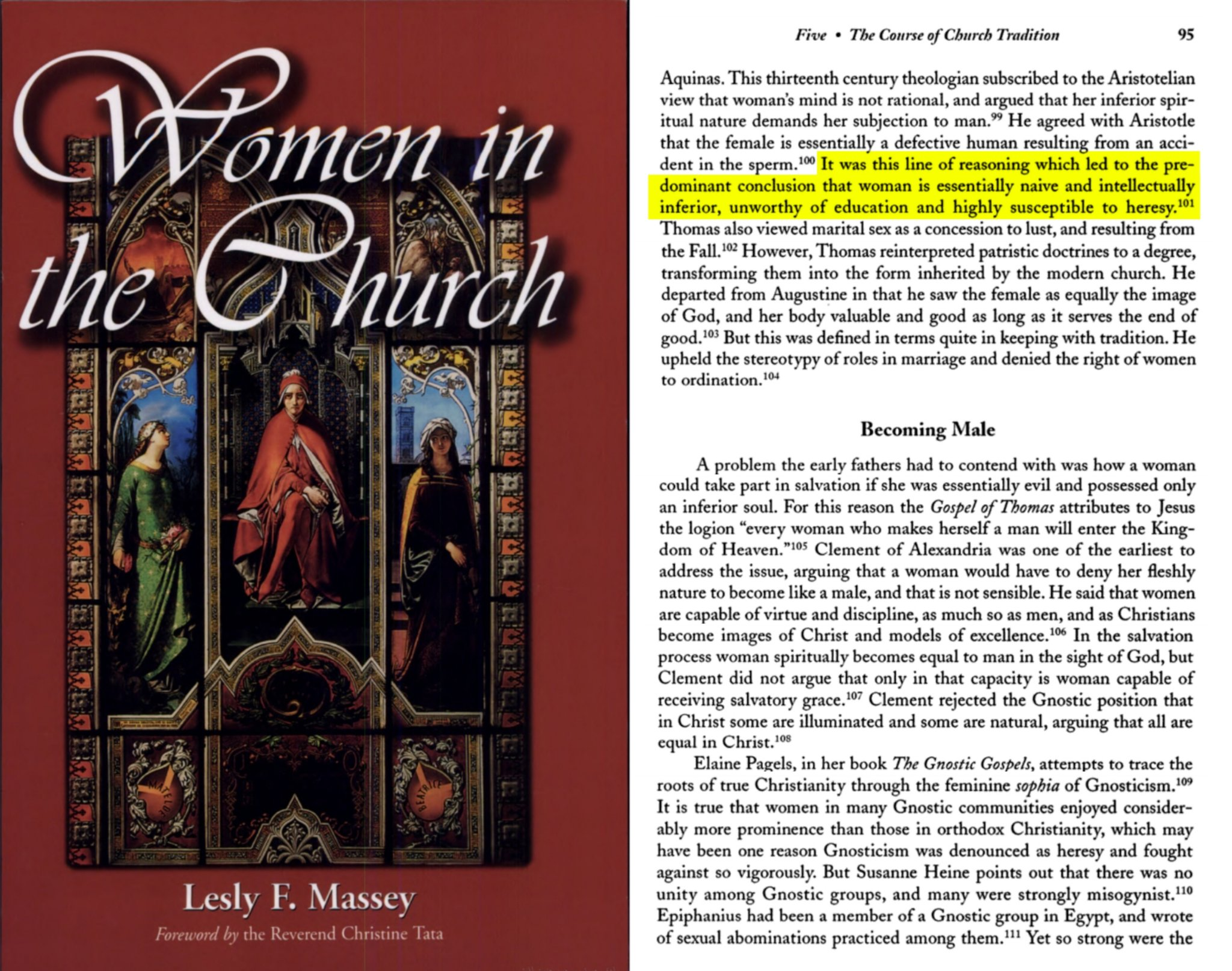
The Church Fathers unanimously agreed on the weakness of a woman’s intellect, describing her as talkative and superficial (Chrysostom), slow to understand (Cyril), lacking mental balance (Gregory the Great). They also agreed that a woman is naive, intellectually inferior, unworthy of education, and prone to heresy.
The Lutheran Wittenberg debated and questioned “whether women are truly human creatures.” And the Orthodox Christians considered women responsible for all sins and transgressions.
Femininity, according to the Church Fathers, is deficiency, while masculinity is perfection. Saint Clement of Alexandria demanded that a woman deny her feminine nature in order to become like a man.
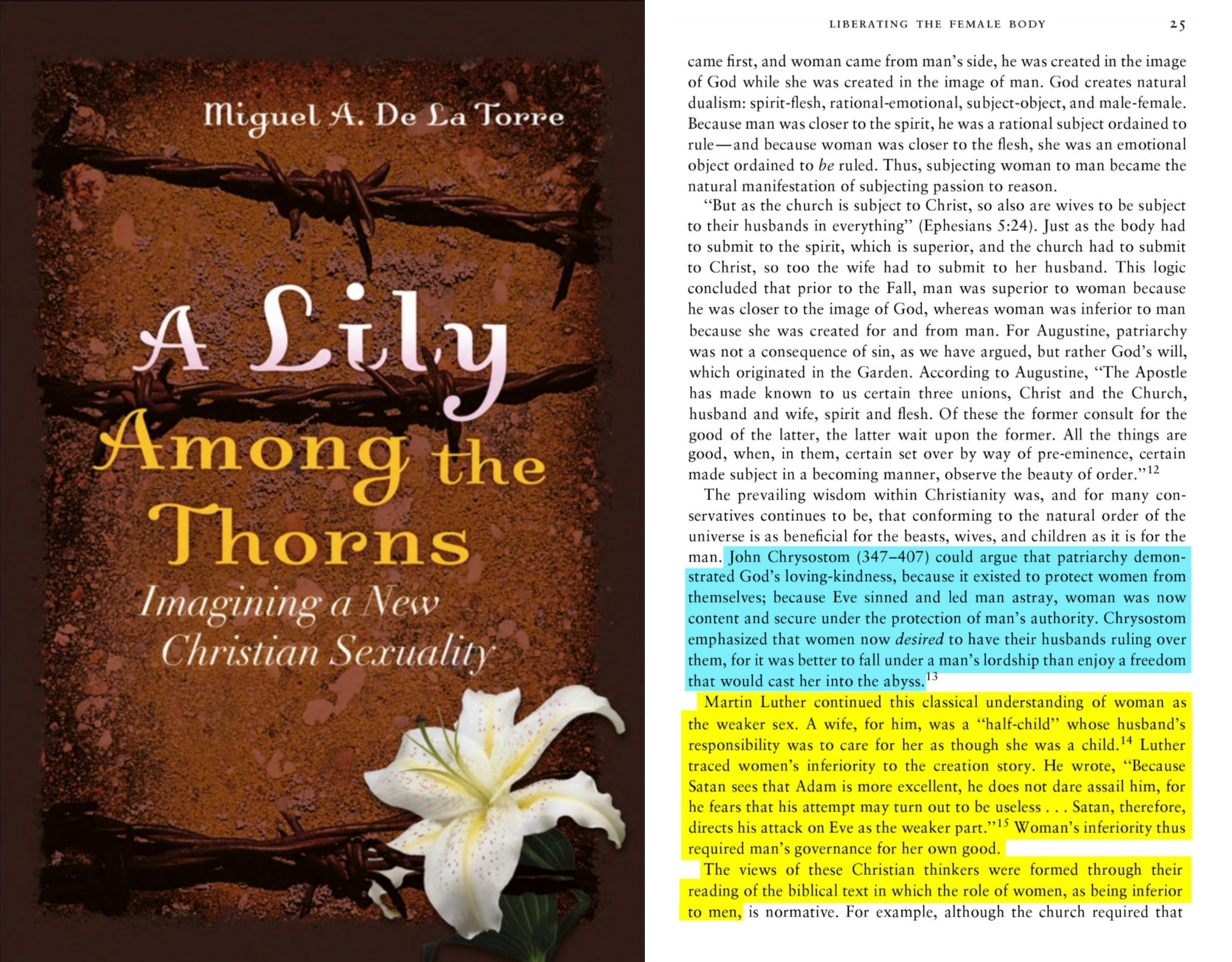
Martin Luther “Martin Luther decided that the woman is ‘half a child’ and therefore, the man must care for her as he cares for children. When the devil saw that Adam was superior to the woman, he did not dare to tempt him, for he feared his attempt would not succeed. Therefore, he directed his attack toward Eve, considering her the weaker and inferior party.”
1 Timothy 2:12 (SVD) “I do not permit a woman to teach or to assume authority over a man; rather, she is to remain quiet.”
1 Corinthians 14:34 (SVD) “Let your women keep silence in the churches, for it is not permitted to them to speak, but let them be submissive, as the law also says.”
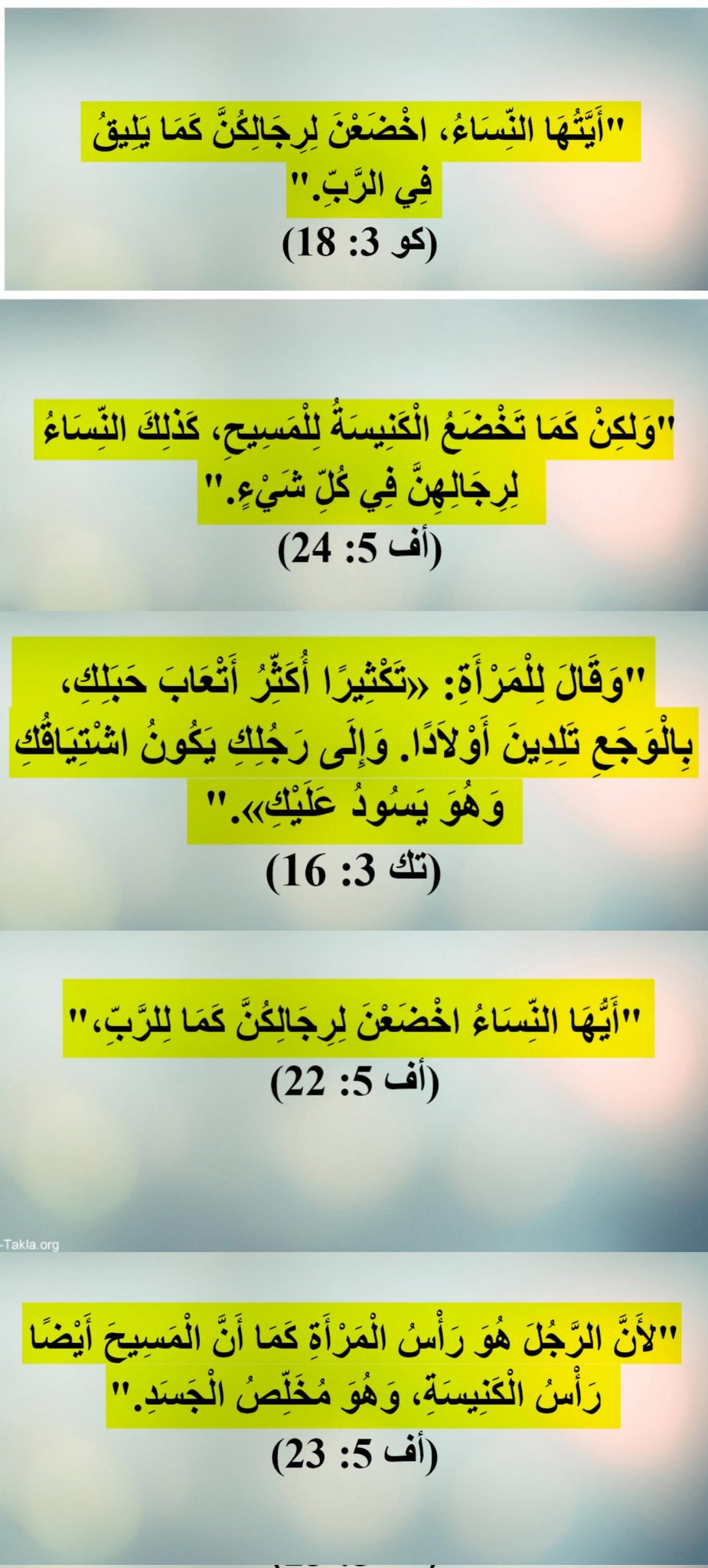
Ephesians 5:24 (SVD) “But as the church is subject to Christ, so let the wives be to their own husbands in everything.”
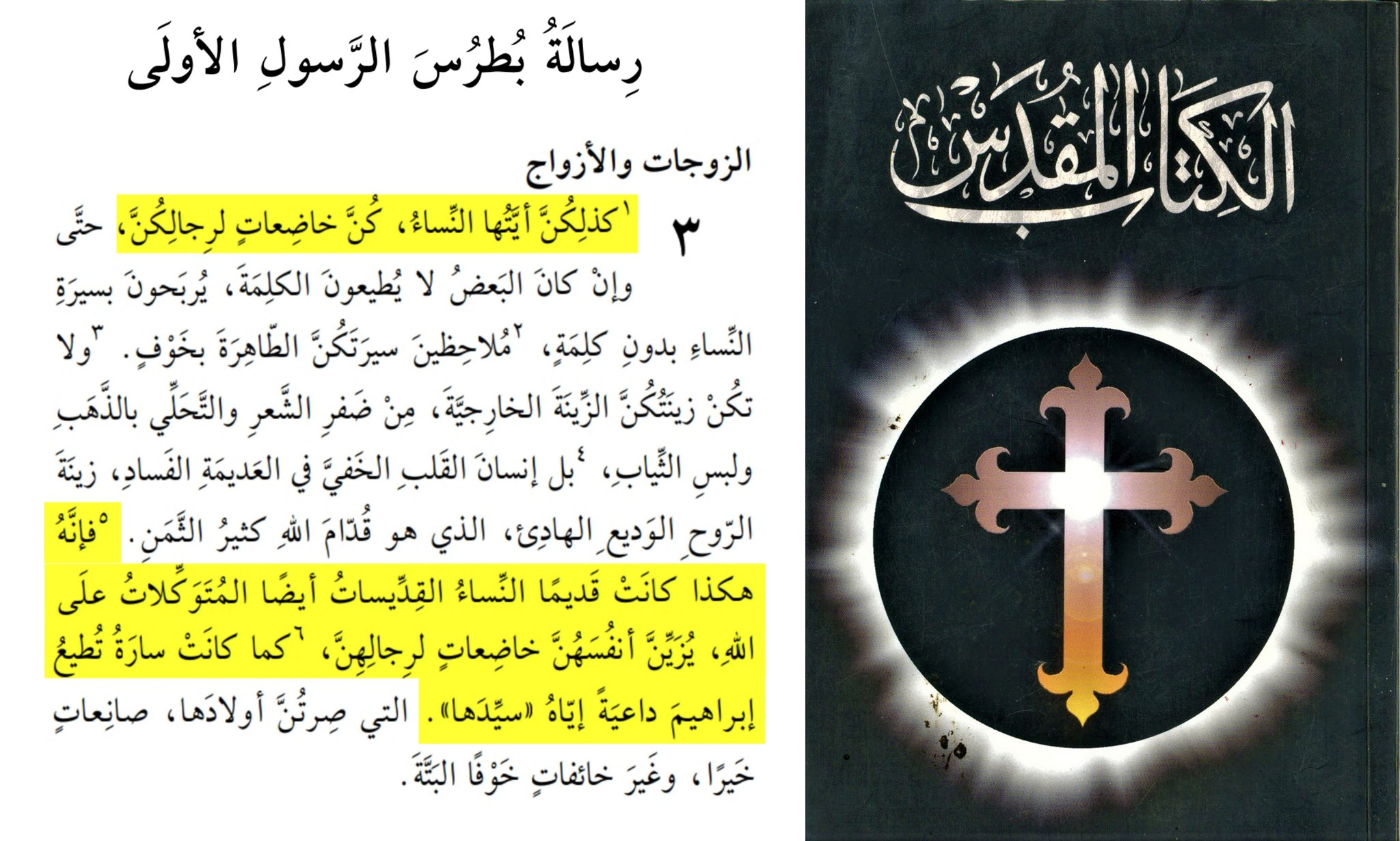
1 Peter 3:1 (SVD) “Likewise, wives, be subject to your own husbands.”
This Pauline text led to the ignorance of women for centuries. The reformer Calvin understands from it that the natural law of humanity is for her to be submissive to the man — how could it be otherwise when she is the gateway of Satan who fell into transgression and seduction?
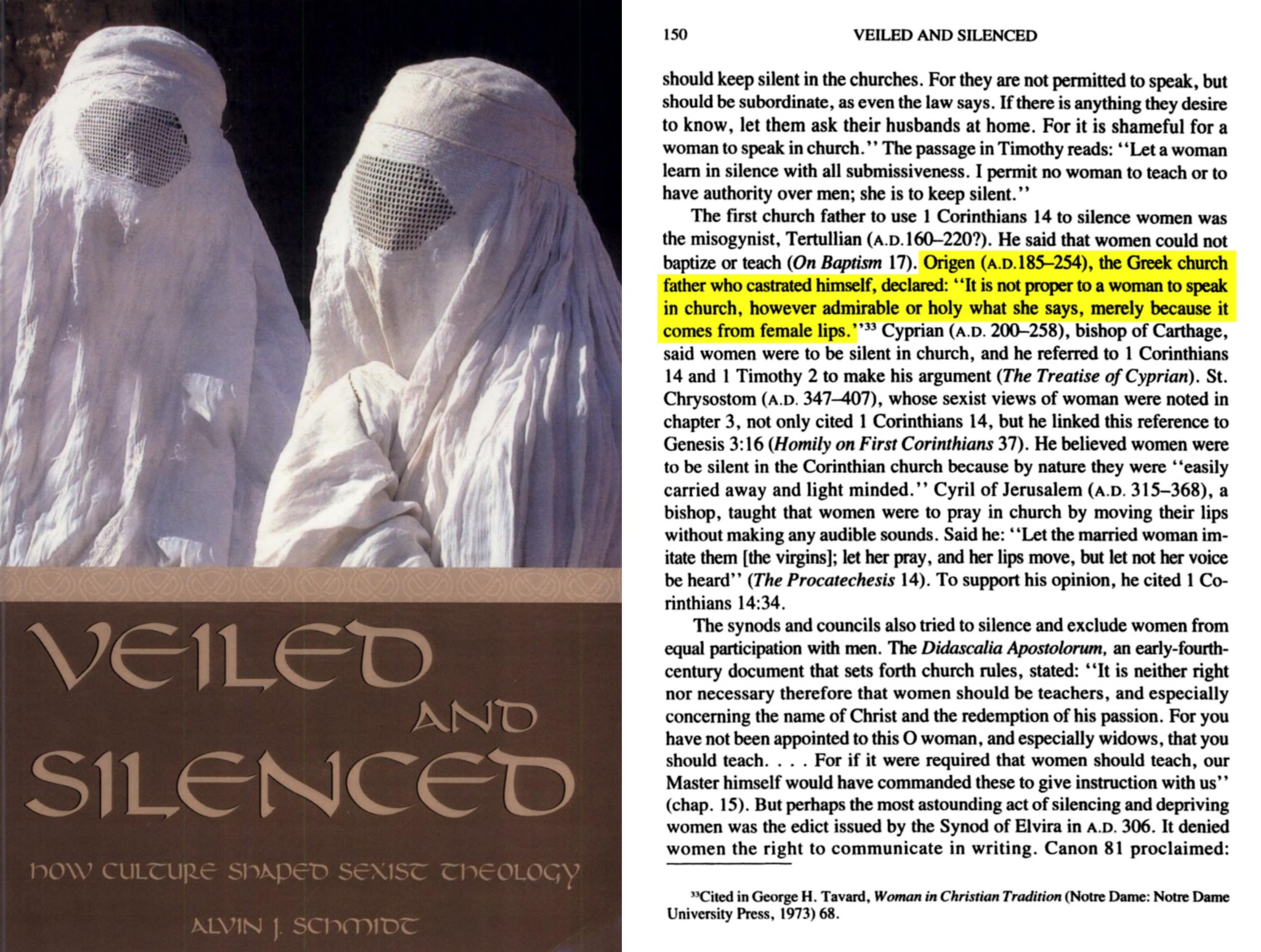
Origen — commentary on 1 Corinthians 14:35 “It is not fitting for a woman to speak in the church, no matter what she might say, even if she speaks with wonderful words and holy phrases — simply because it comes from the lips of a female.”
Saint Thomas Aquinas “The voice of a woman is a call to lust, and therefore it should not be heard in the church.”
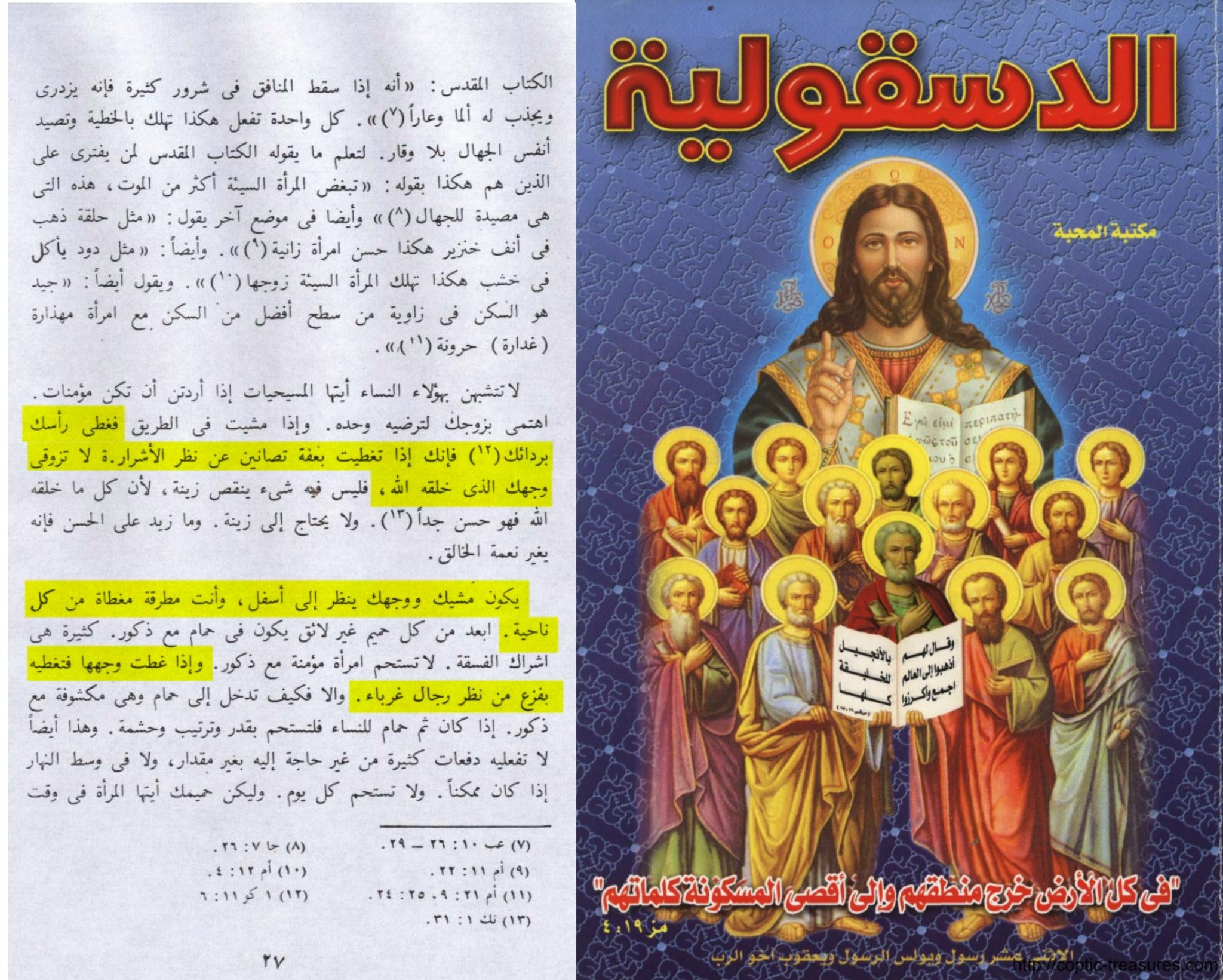
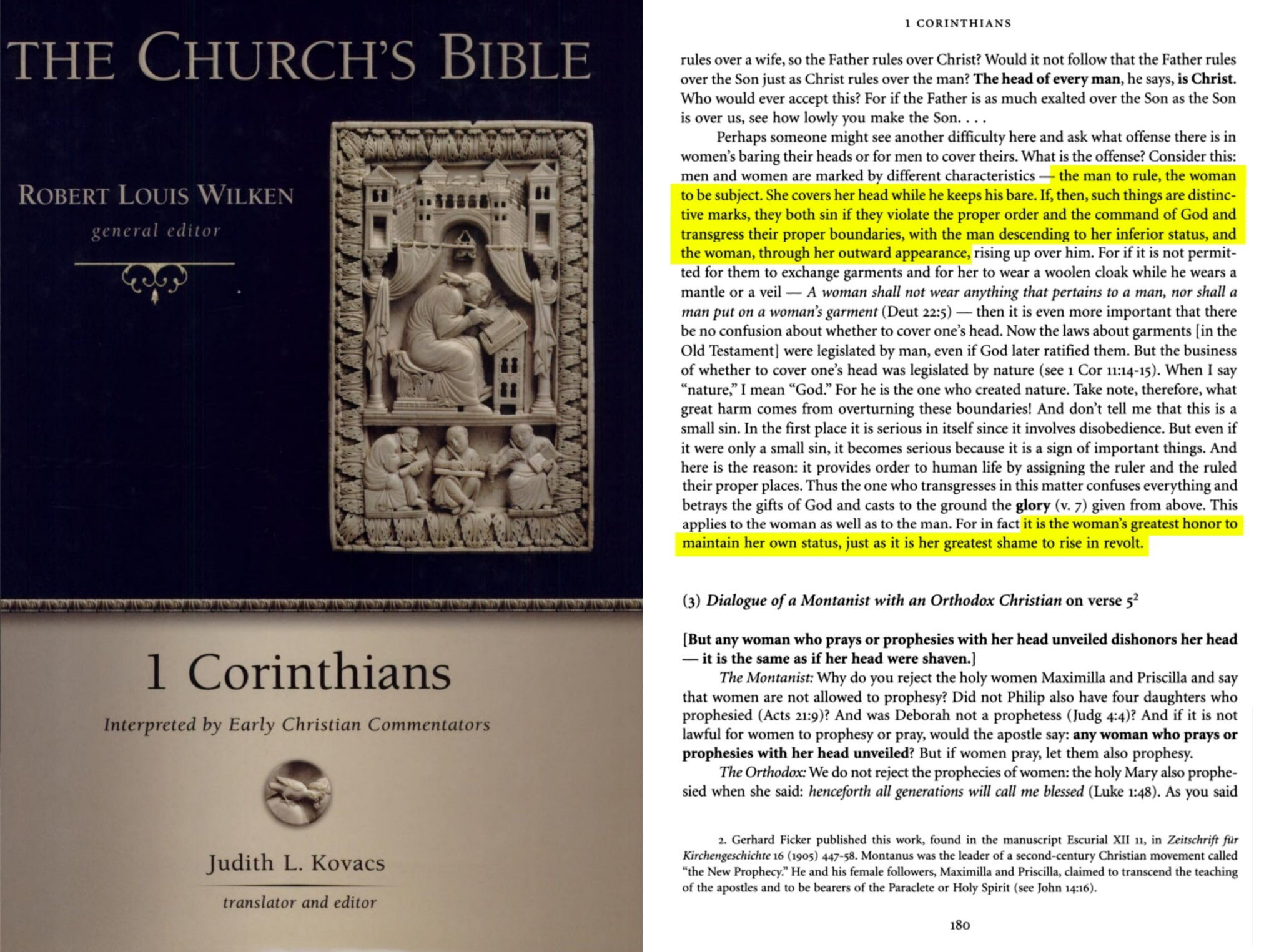
Saint John Chrysostom “The man rules, and the woman is submissive. The woman covers her head, while the man’s head remains uncovered. The man and the woman commit a sin if they violate the proper order and God’s teaching. The greatest shame a woman can bring upon herself is to rebel and attempt to raise her lowly status to be equal with a man.”
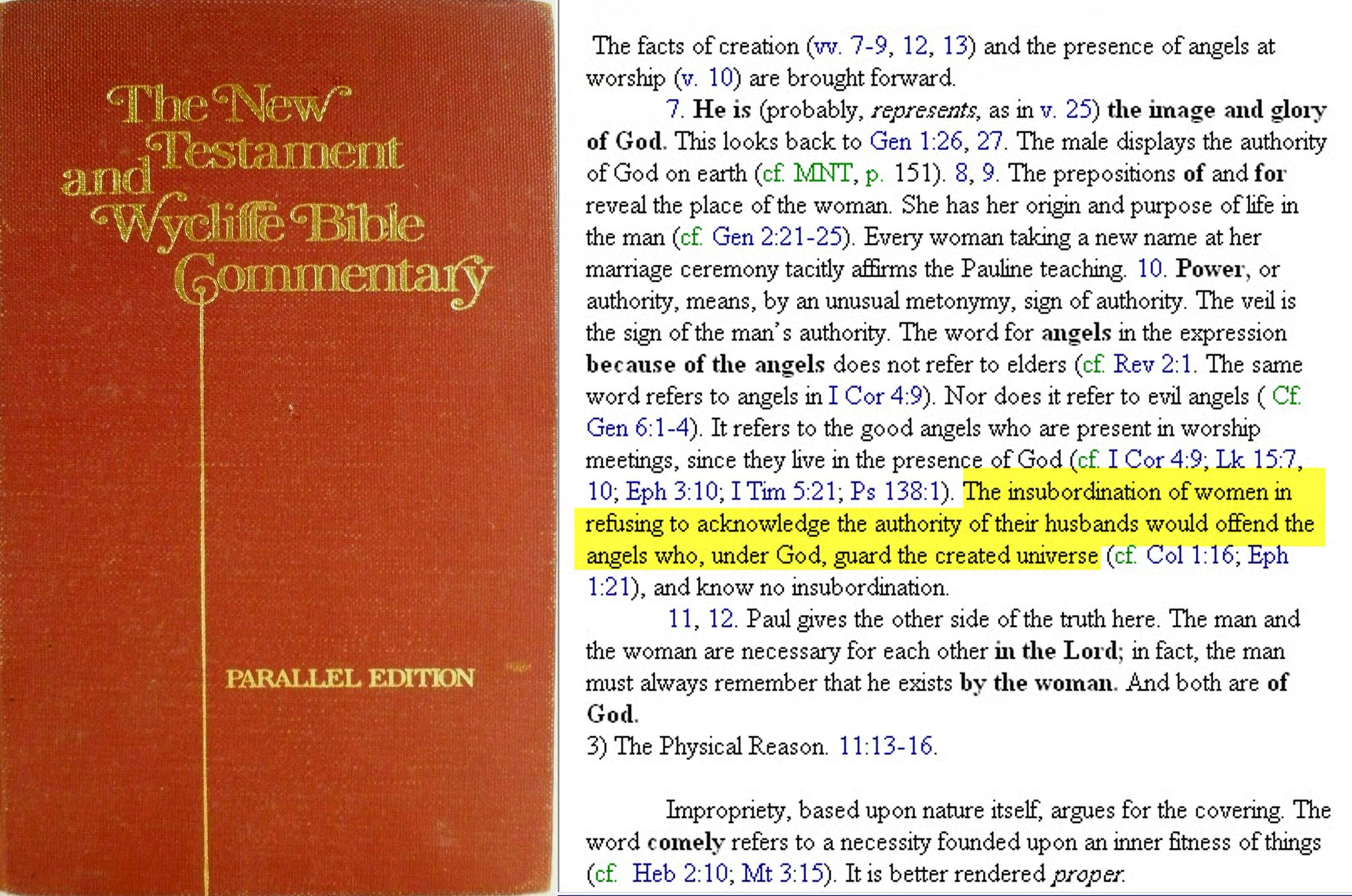
The Wycliffe Bible Commentary — The New Testament Women’s rebellion against their husbands and their refusal to acknowledge their authority over them harms the angels who guard the universe created under God.
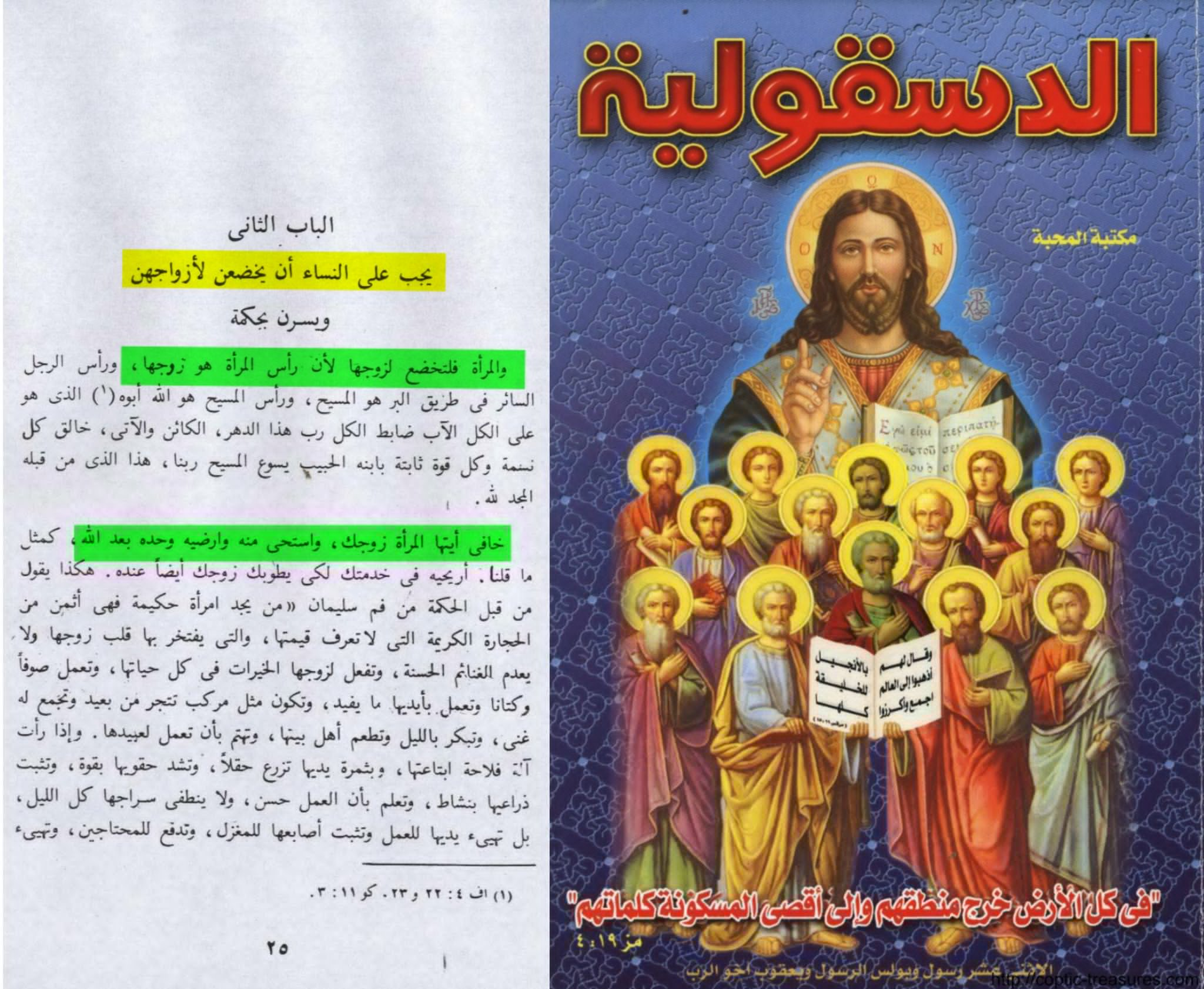
The ancient Vatican Bible manuscripts state: “O women, submit with obedience and worship your husbands, just as the church of believers submits to and worships the Lord Christ, so too must women submit and obey their husbands in all circumstances.”
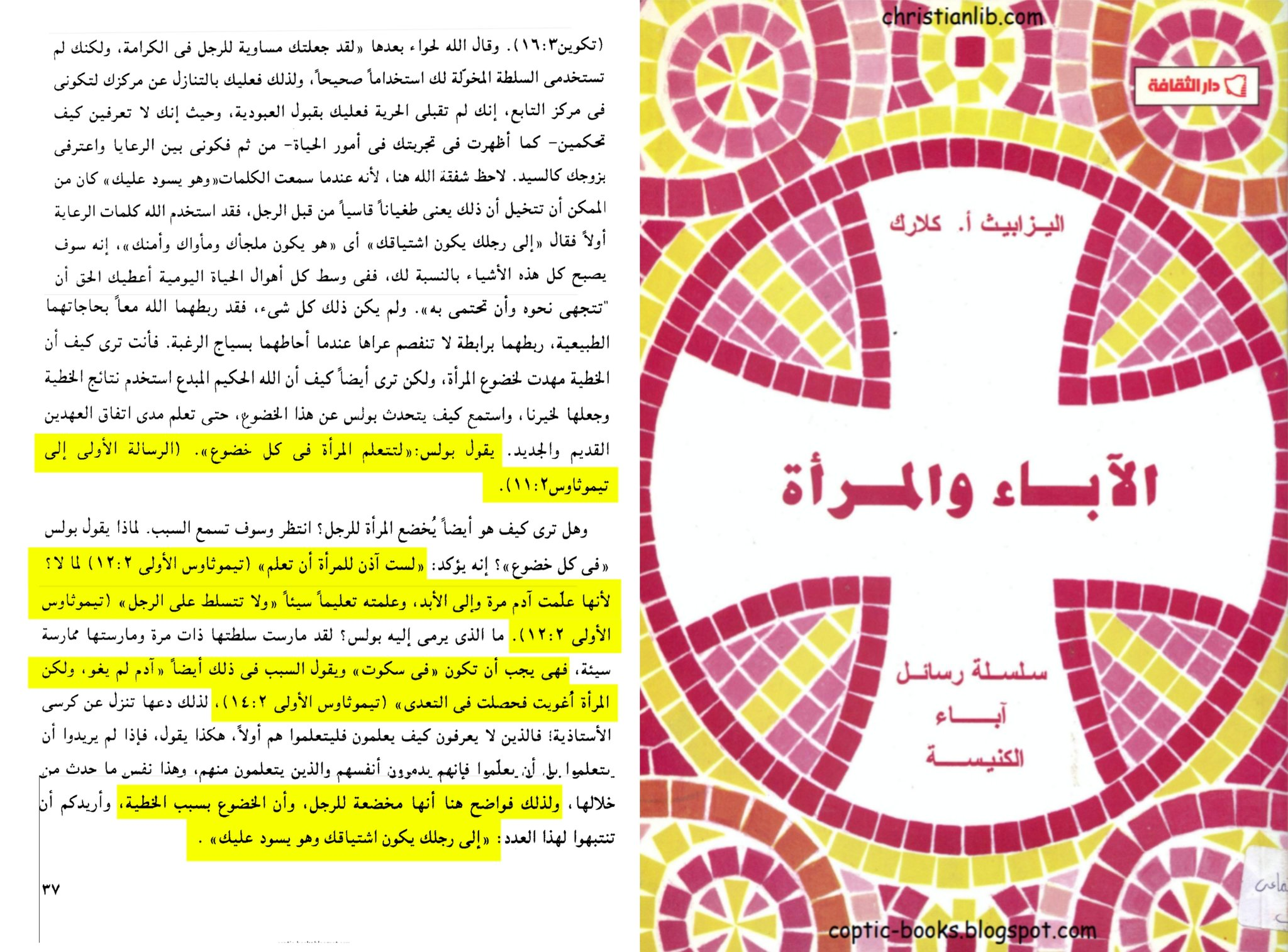
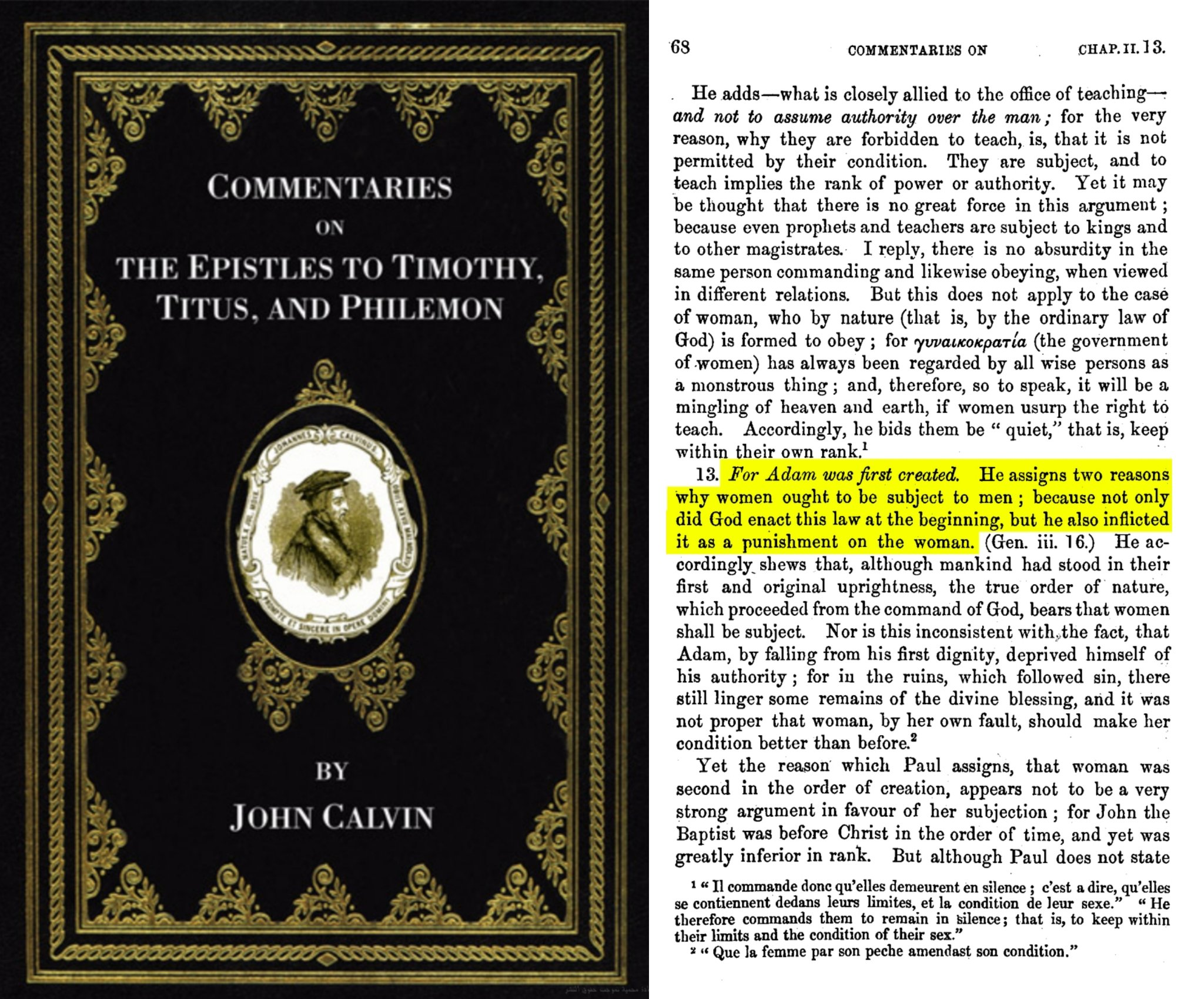
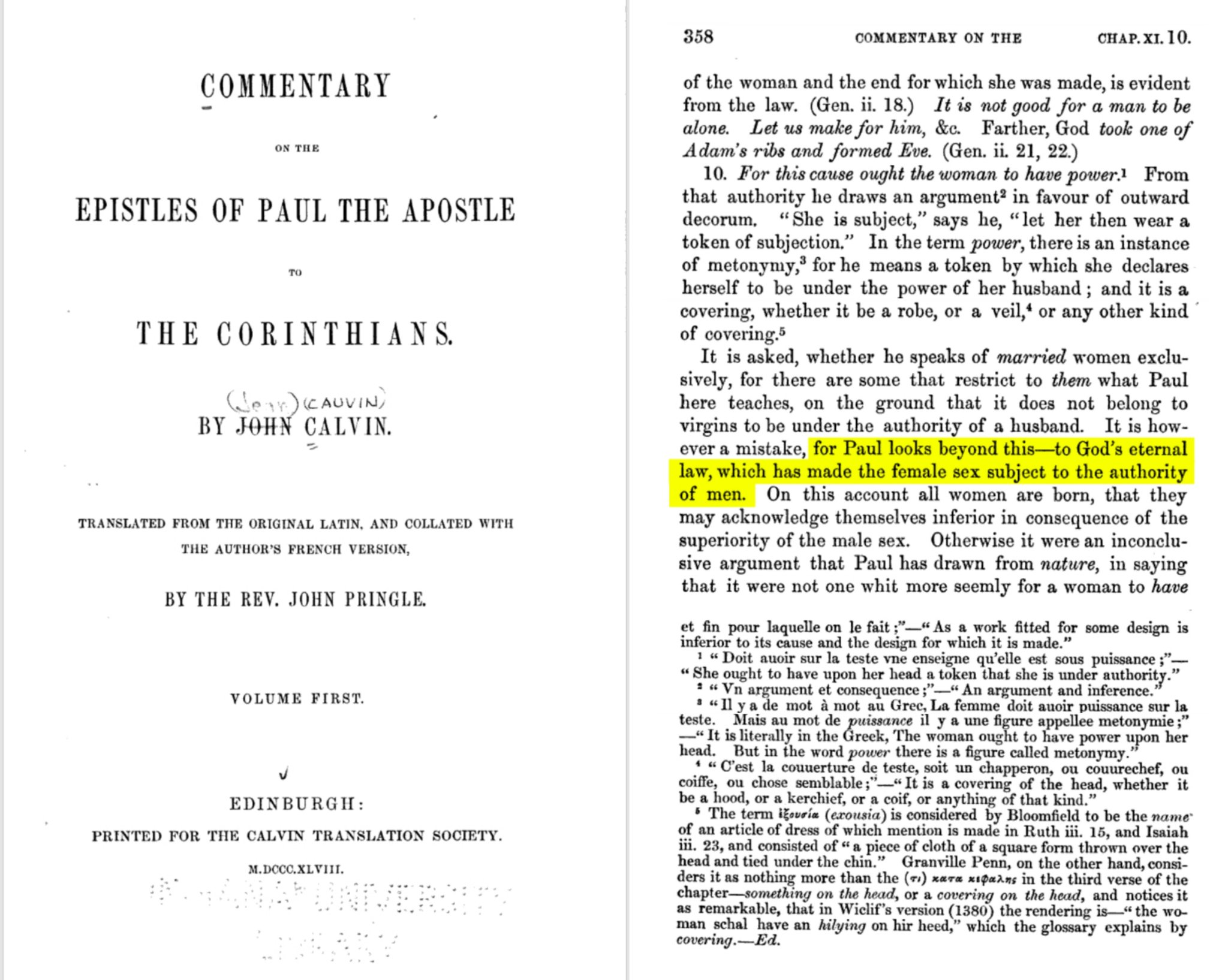
John Calvin — Commentaries on the Epistles to Timothy, Titus, and Philemon “The divine law, from the beginning, has always placed the female gender under the authority of men as an eternal punishment for them.”
Genesis 3:16 (SVD) “And he said to the woman, ‘I will greatly multiply your sorrow in childbirth; in pain you shall bring forth children. Yet your desire shall be for your husband, and he shall rule over you.’”
Calvin acknowledges that the intended submission is meant to punish and humiliate the woman.
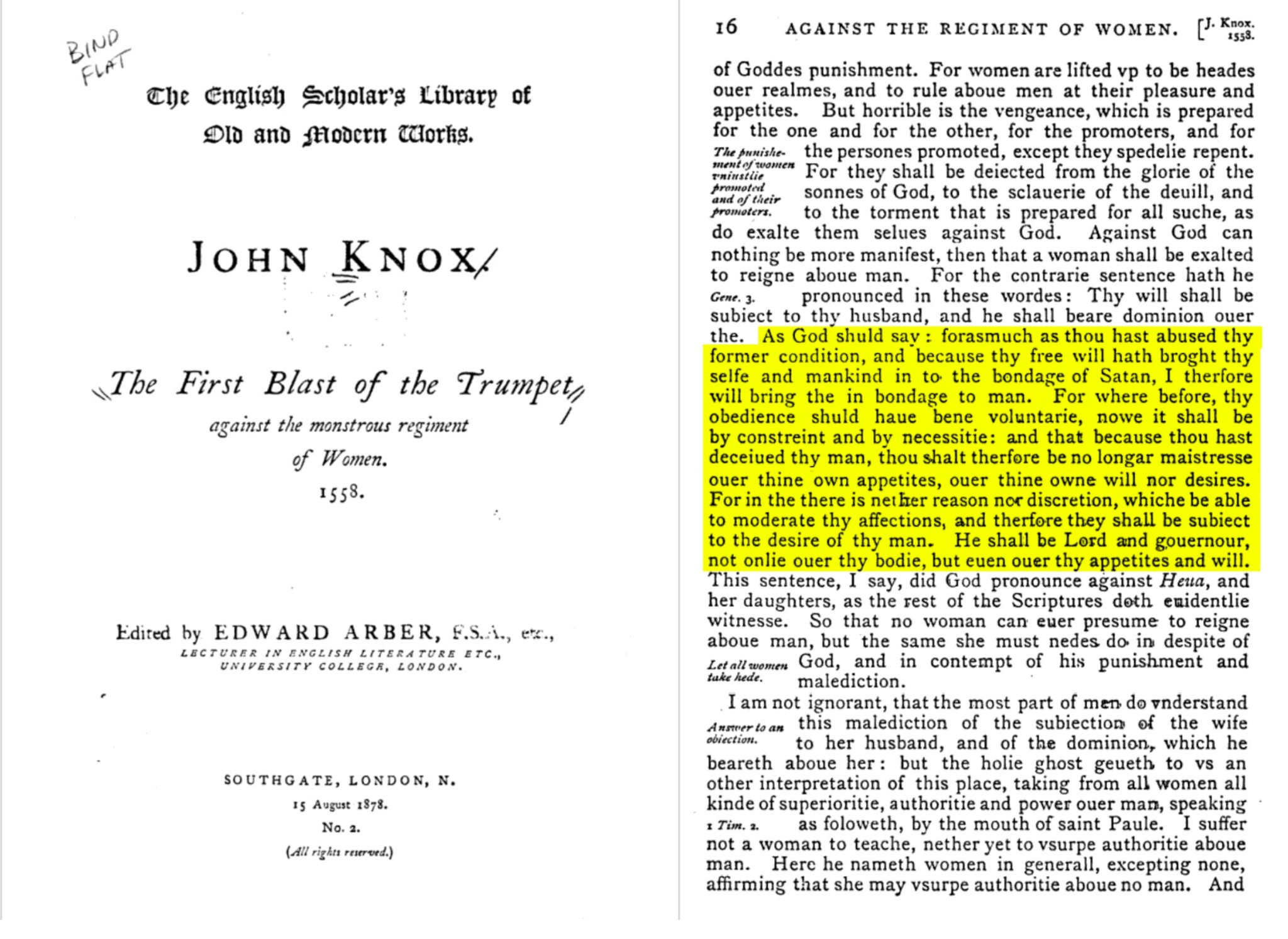
John Lux — theologian “Because of you, humans became slaves to Satan, so I will make you a servant to man, and your submission to him will be by force, for you have no mind or will, and your desires will be subject to the desire of the man who will be your master and your domineering ruler — not only dominating your body but even your passion and will.”
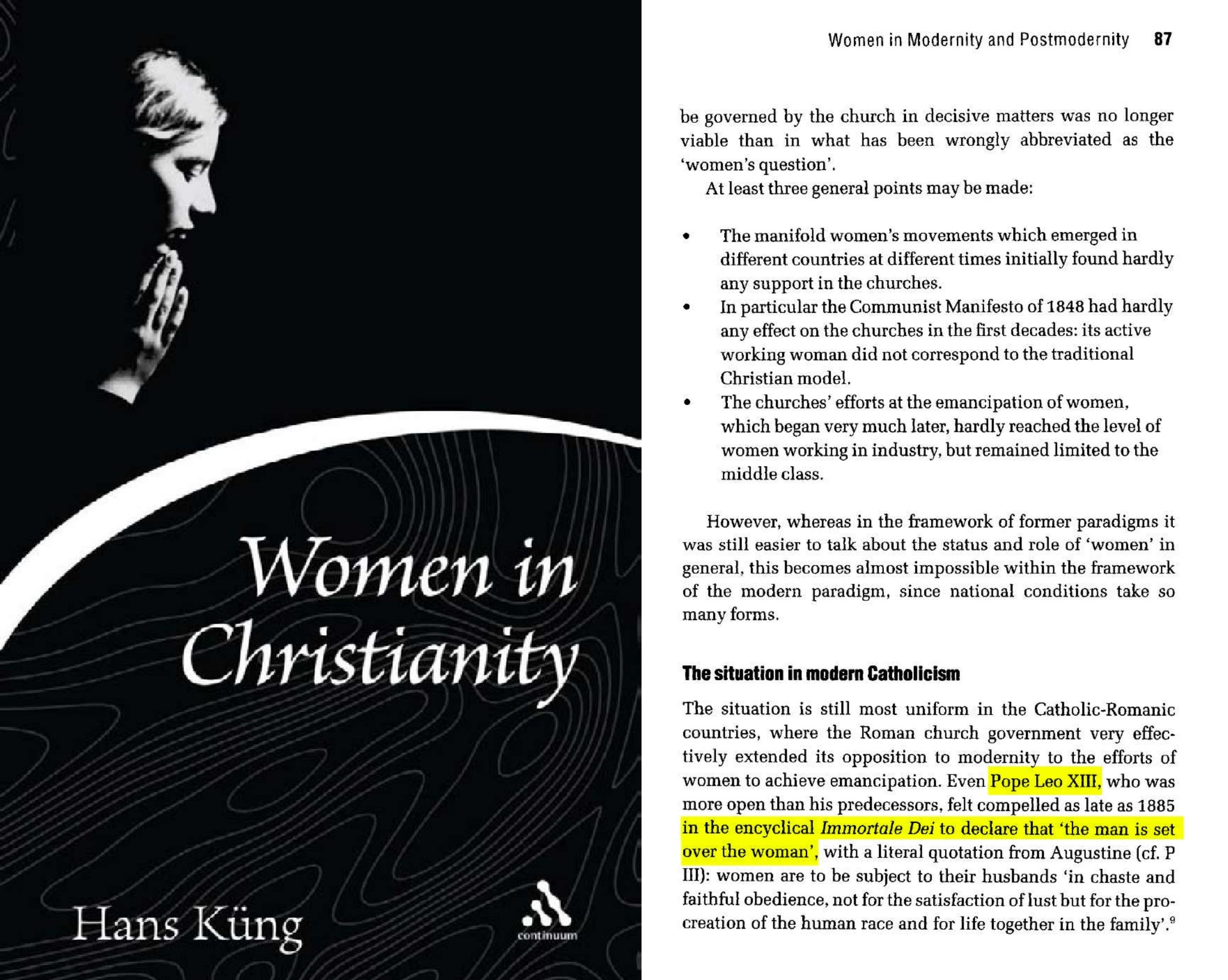
Pope Leo XIII — Immortale Dei “Man was placed above woman.” There is no equality between man and woman — the man is above the woman, and the woman is beneath him, submissive to him as a servant is submissive to his master.
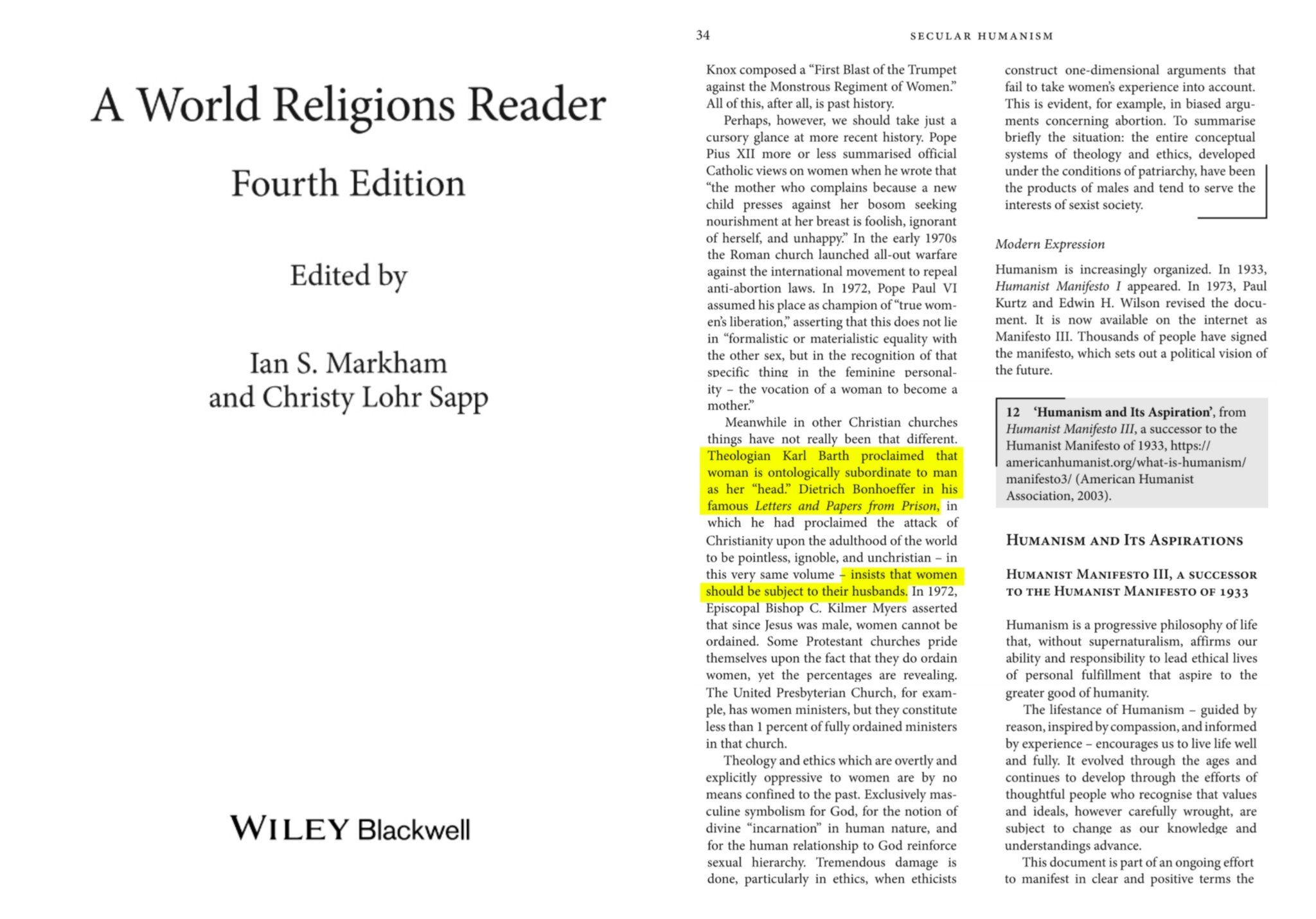
The Theologian Karl Barth “Ontologically, a woman is subordinate to a man because he is the head of the woman.”
The Theologian Dietrich Bonhoeffer “Women must submit to their husbands.”
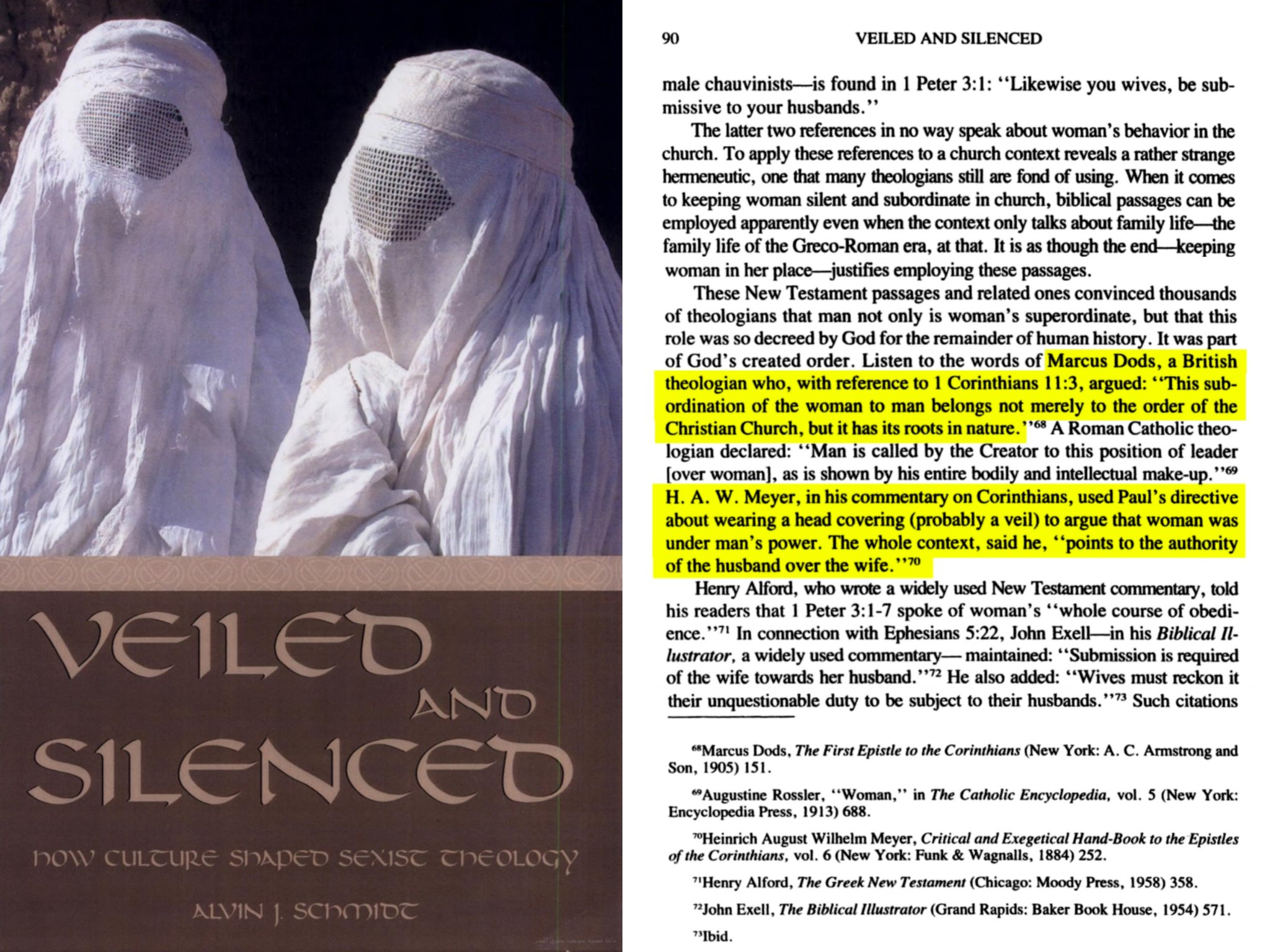
Marcus Dodds — commentary on 1 Corinthians 11:3 “This submission of the woman to the man is not only due to the Christian ecclesiastical order but also has its roots in nature.”
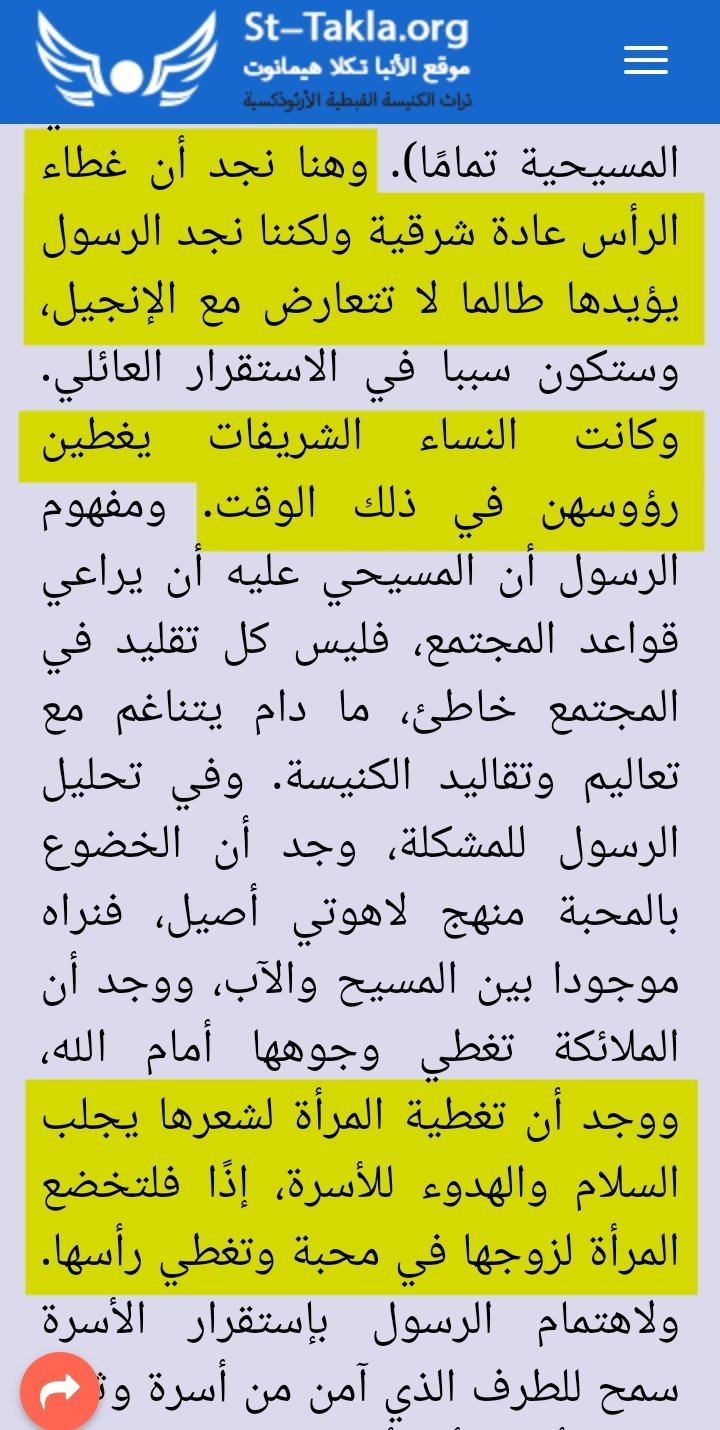
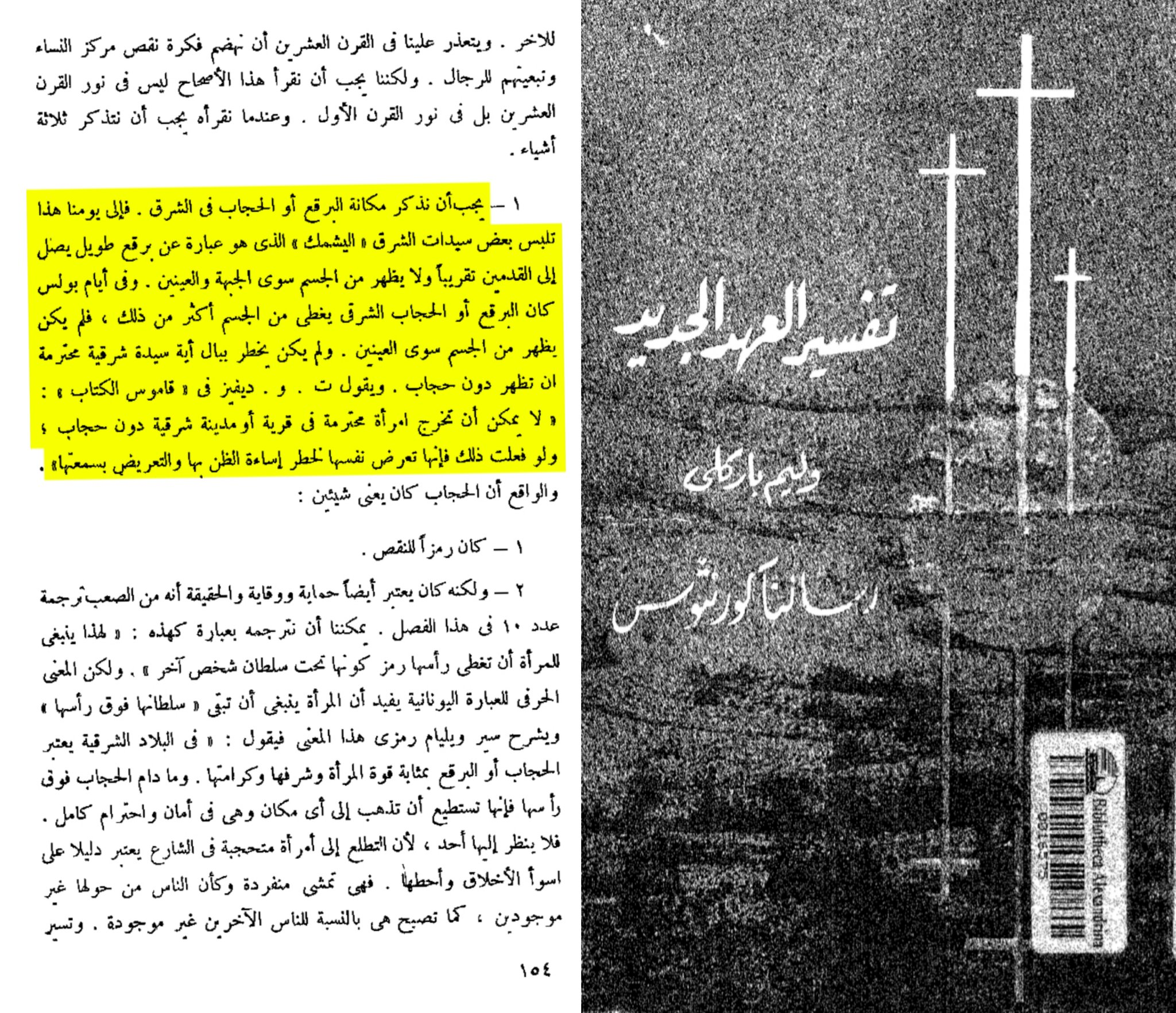
Pastor Heinrich Meyer Paul’s command for the woman to cover her head is evidence that she is under the authority of the man and must submit to the husband’s authority and his superiority over her.
Henry Alford The text of 1 Peter 3:1–7 addresses the complete scope of a woman’s submission to a man.
John Axel Submission is a duty of the woman toward her husband.
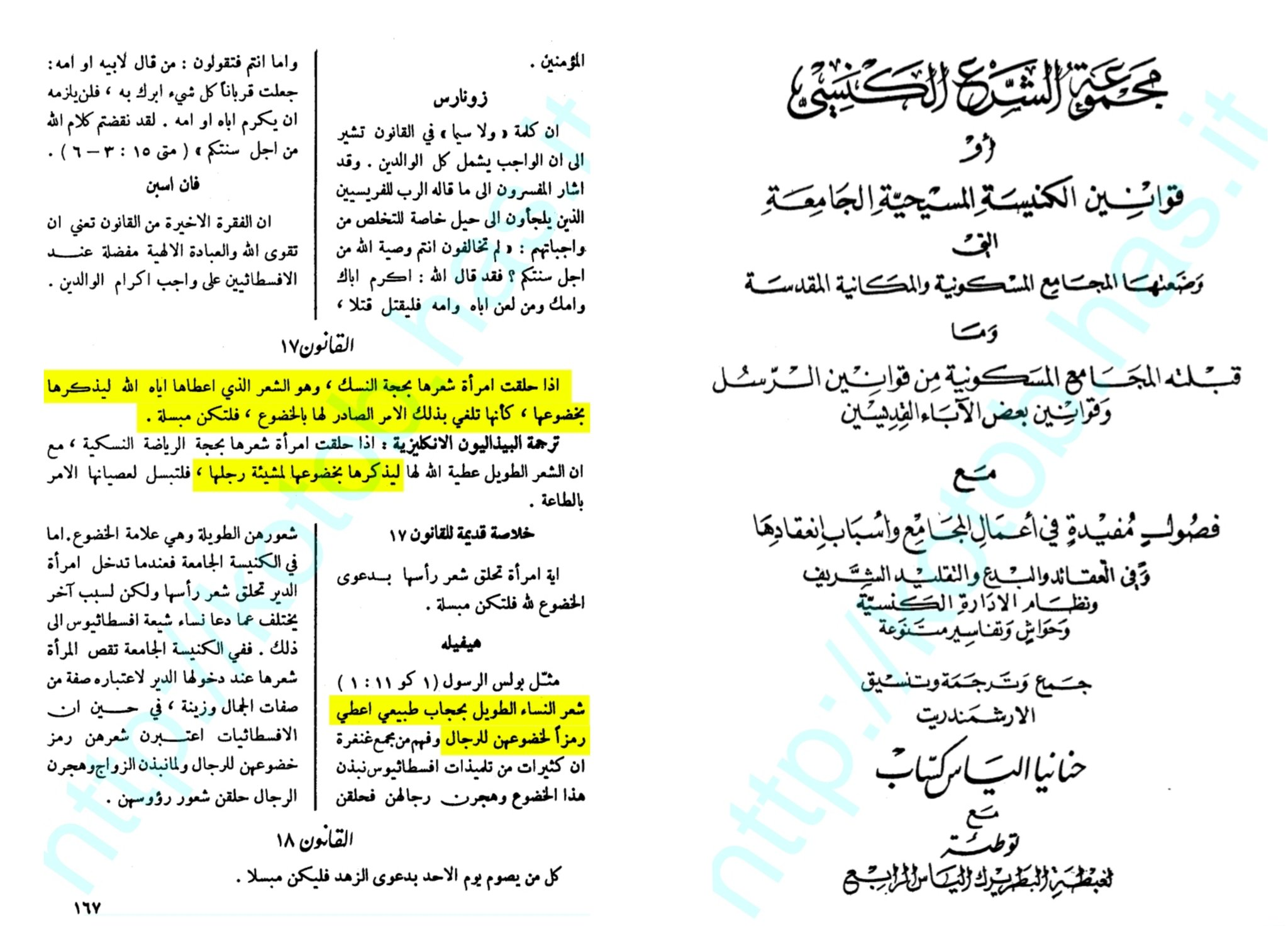
It is stated in the collection of ecclesiastical law: “A woman’s hair is a sign of her constant submission to man, and the long hair of women, with a natural veil, has been given as a symbol of their submission to men.”
FEXTbmdXsAA5uIw 99ab91460ca54c17FHEBvILWQAI2tQa e0fd2269adc03bd1Calvin on eternal punishment from Calvin source
Marriage Is a Necessary Evil — The Marital Relationship Is Filthy
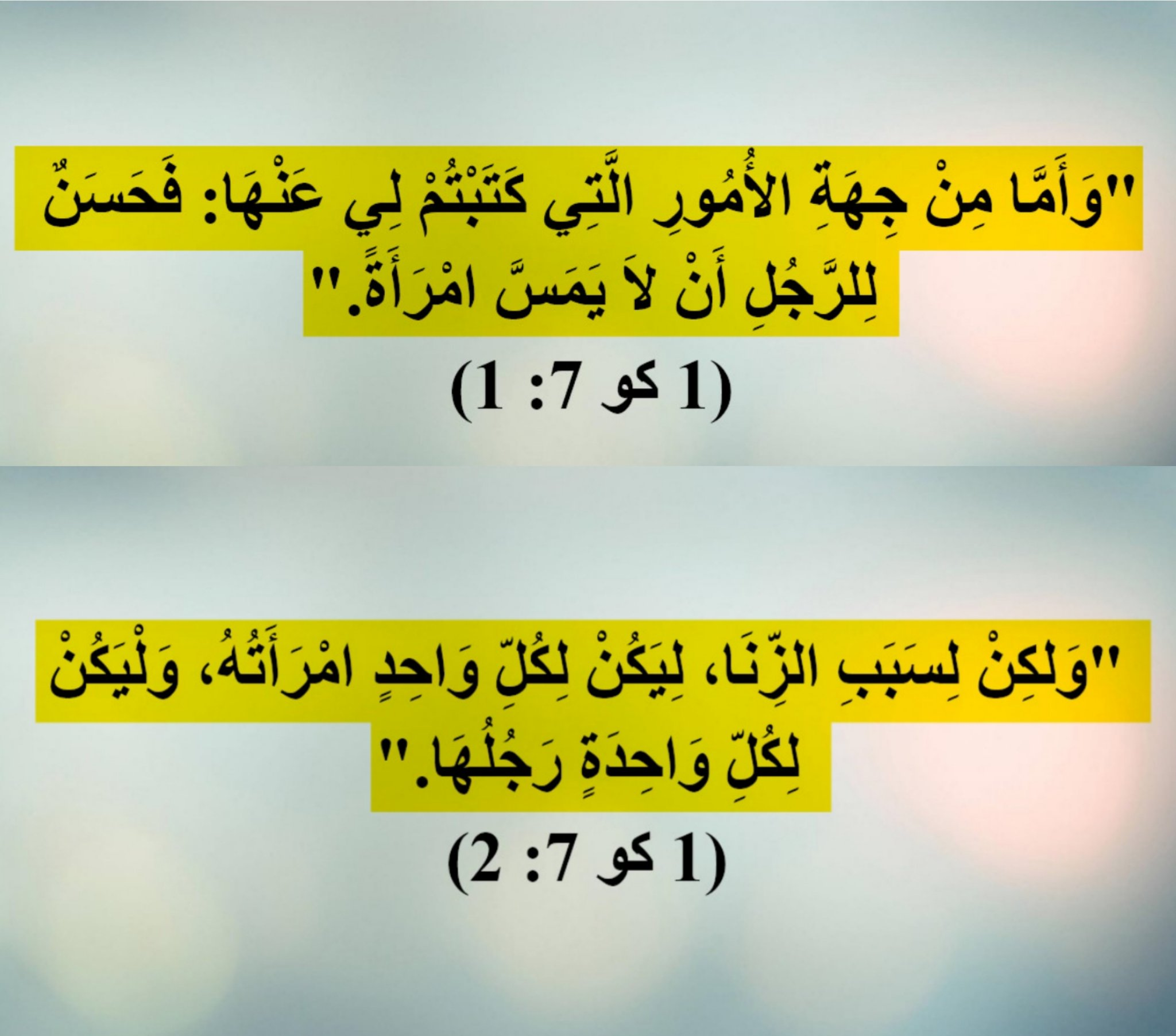
1 Corinthians 7:1–2 (SVD) “Now concerning the things about which you wrote to me, it is good for a man not to touch a woman. But because of sexual immorality, let each man have his own wife, and let each woman have her own husband.”
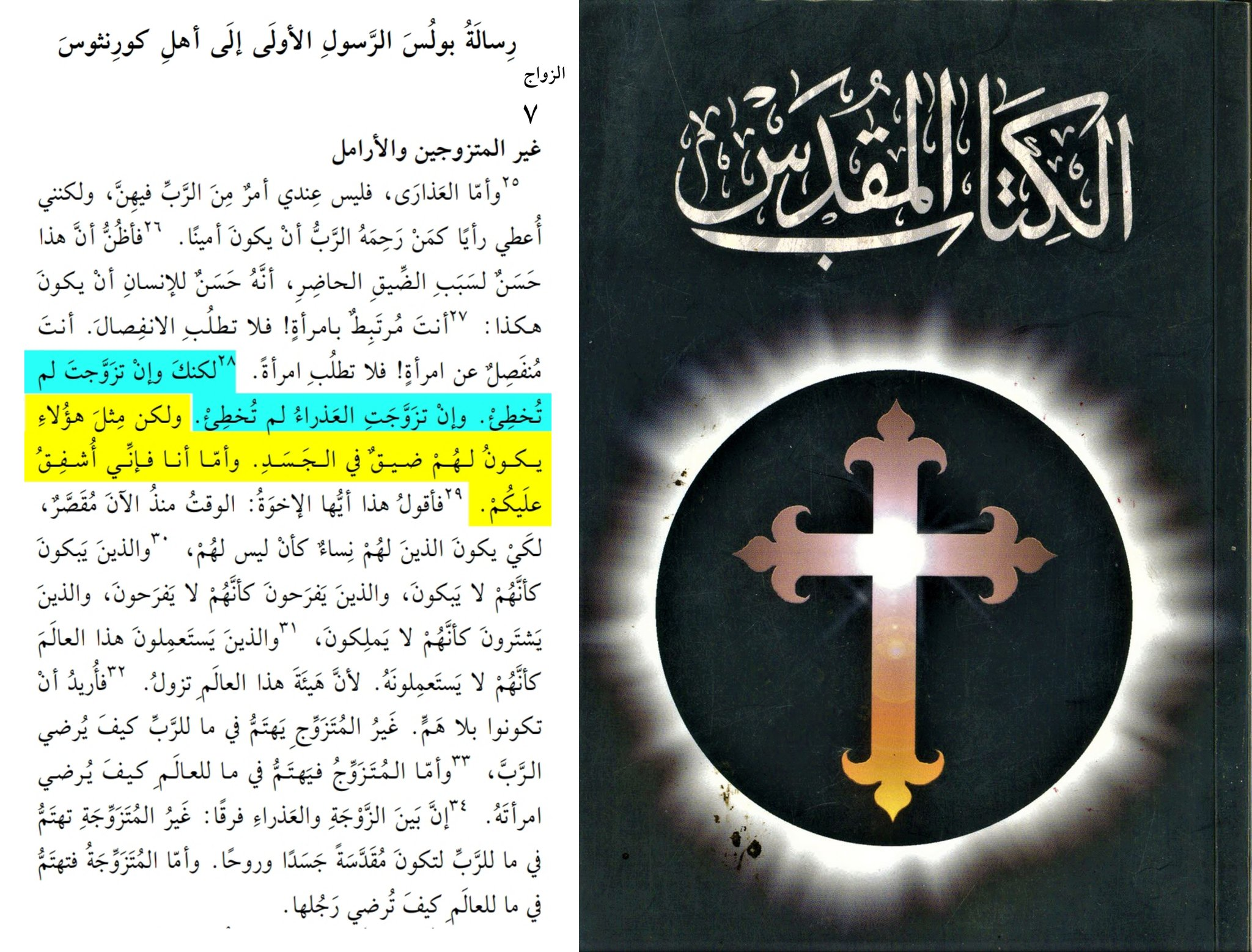
1 Corinthians 7:8–9 (SVD) “It is good for them — men — to remain as I am — that is, without marriage — but if they cannot control themselves, let them marry, for marriage is better than burning.”
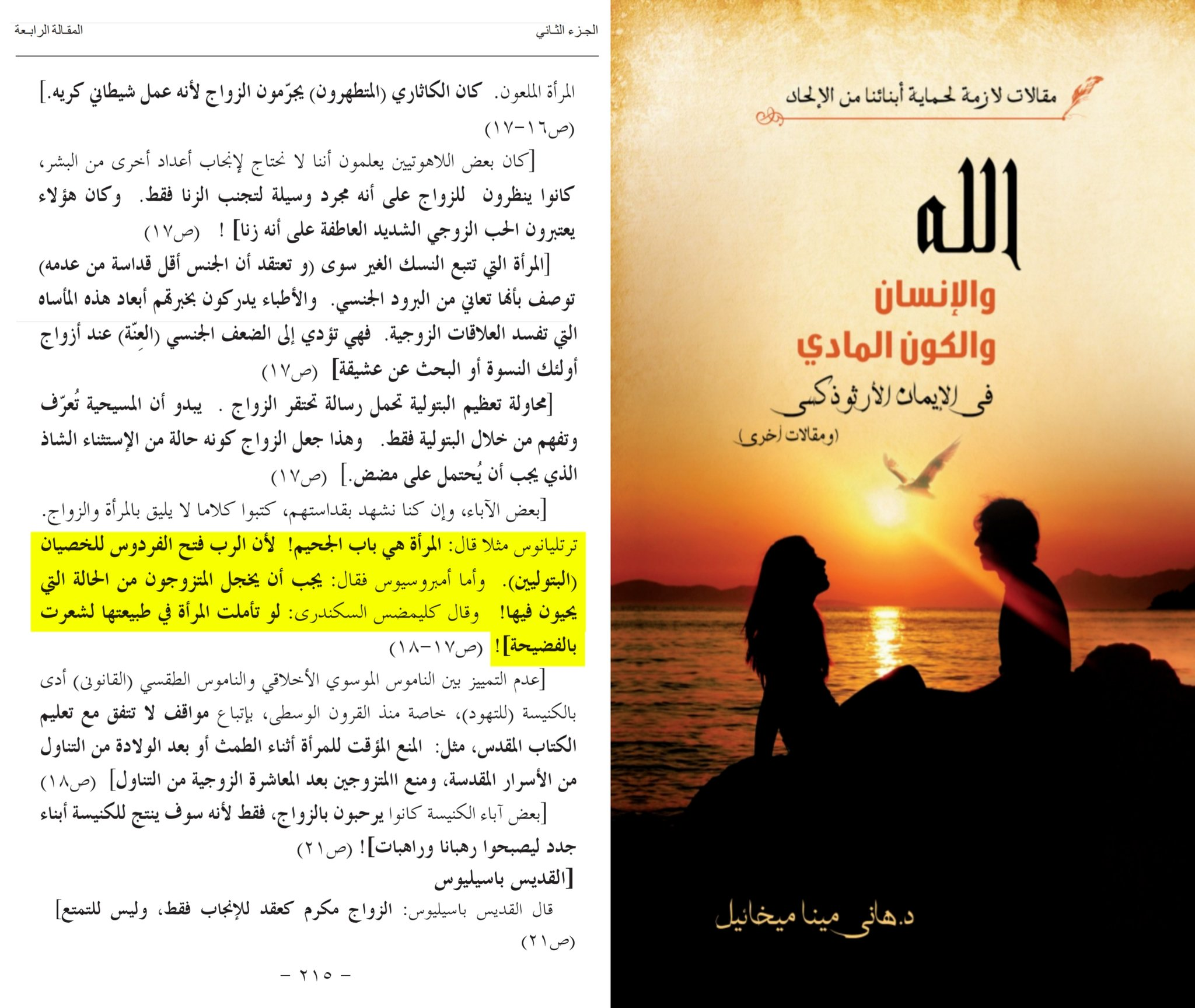
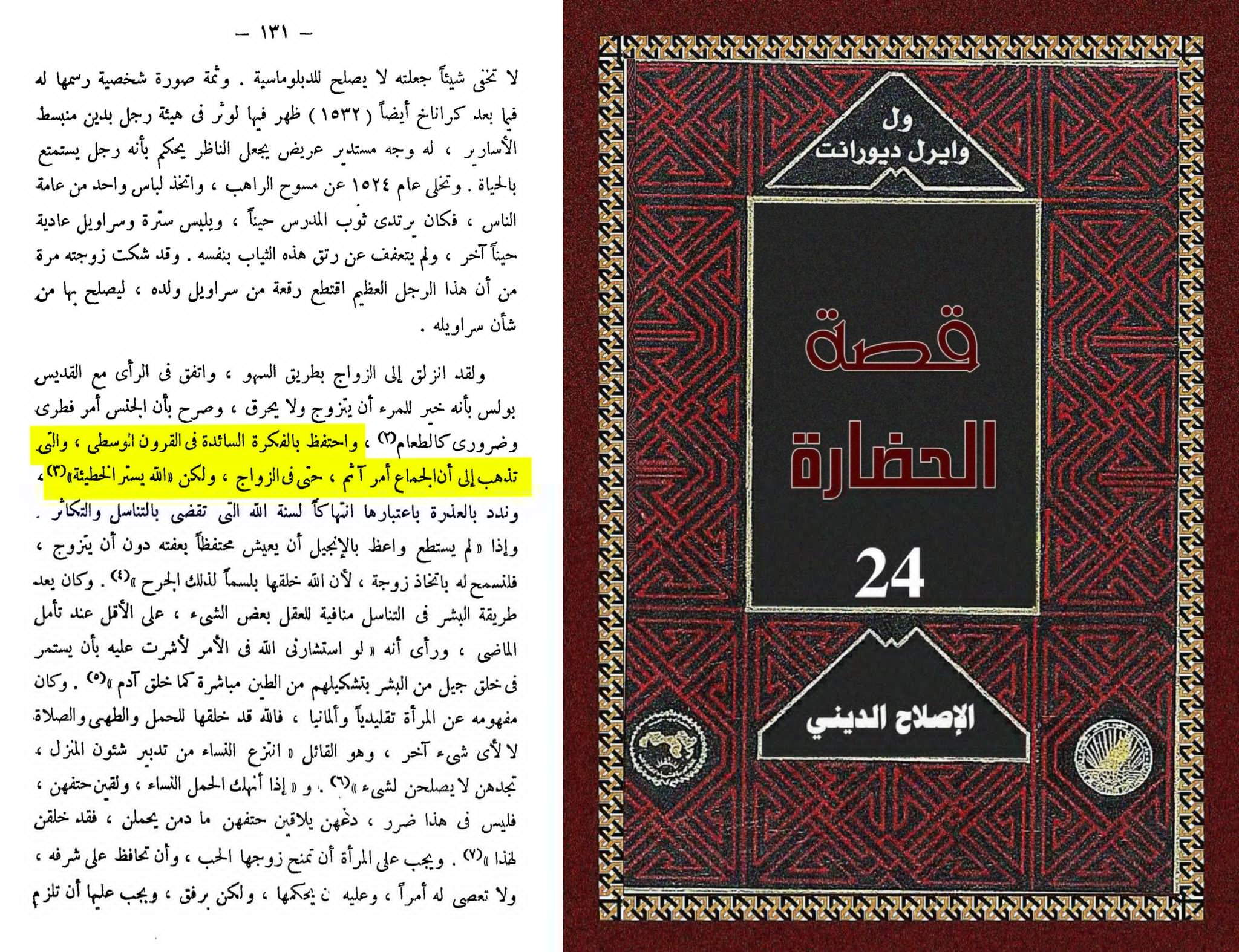
The comparison here is between the evil of marrying a woman and the evil of addiction to fornication — marrying a woman is the lesser of two evils. In principle, it is good for men not to marry women. Marriage to a woman is only to ward off burning and the sexual repression that has reached its peak.
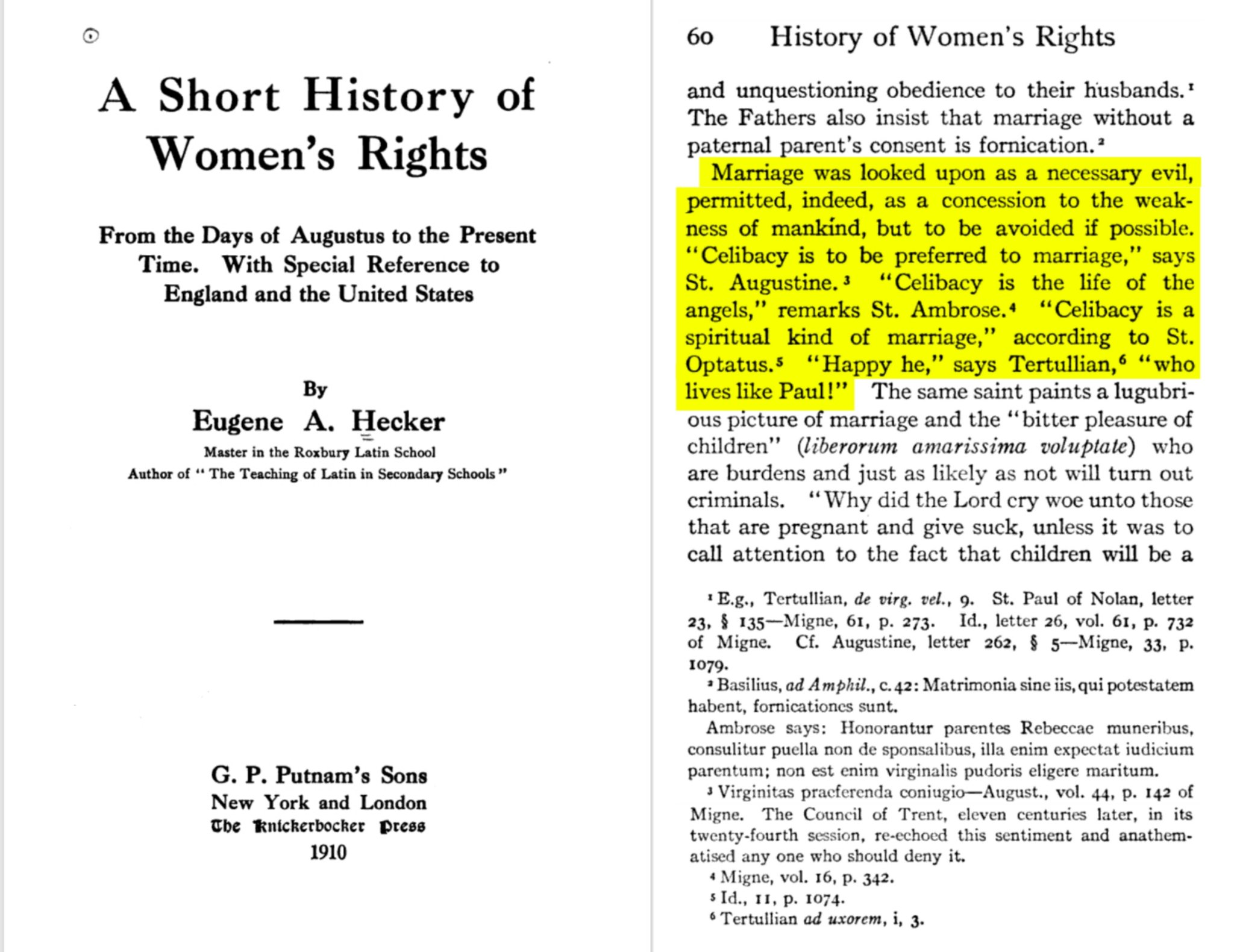
The doctrine of the Church Fathers is summarized thus: marriage is a necessary evil, permitted as a concession to human weakness, and it should be avoided if possible.
Saint Augustine “Celibacy is preferable to marriage.”
Saint Ambrose “Celibacy is the life of angels.” It is better for a woman not to marry because marriage is a miserable state for a woman, imposing on her servitude to the husband and authority.
Saint Aptatus “Celibacy is a spiritual type.”
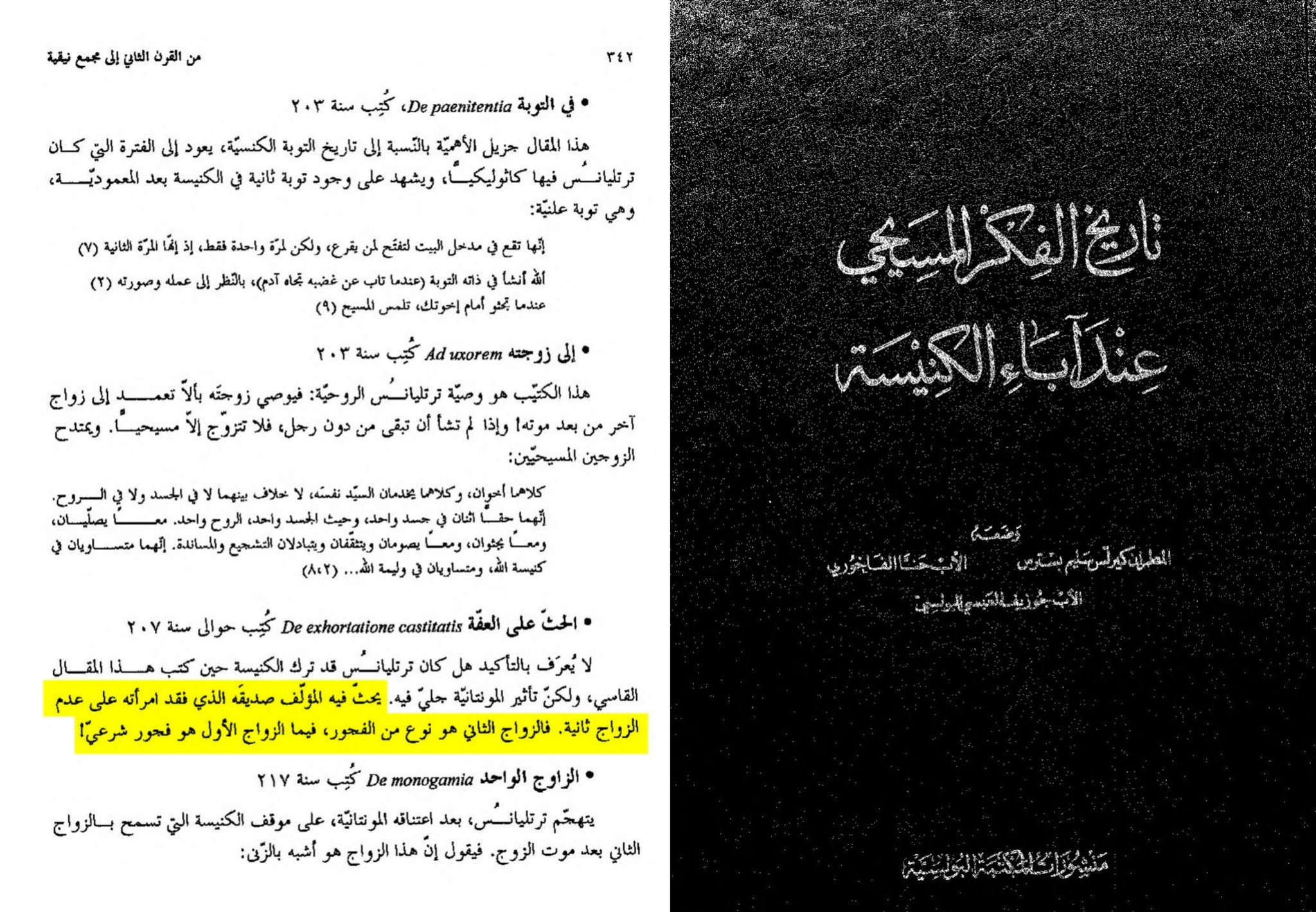
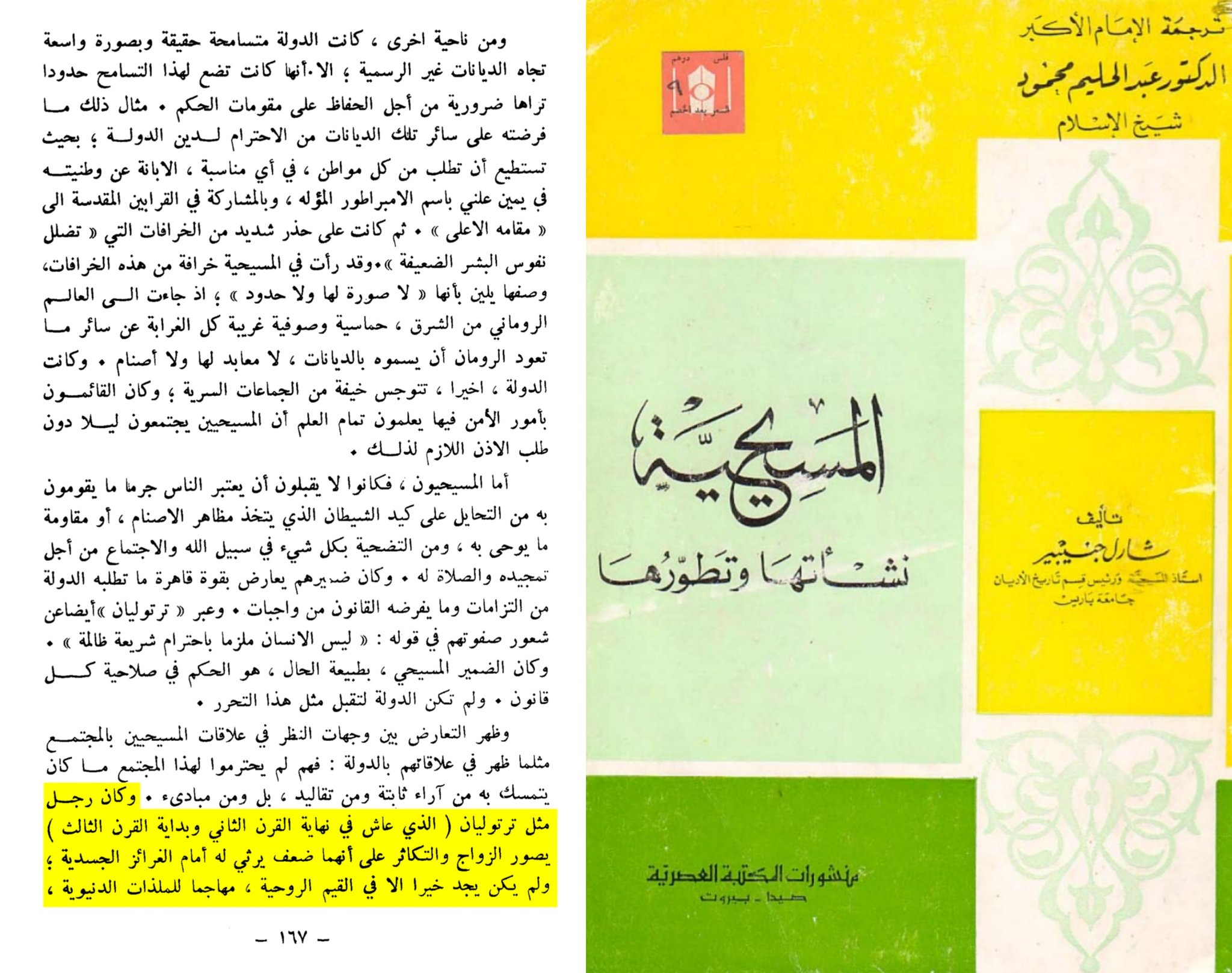
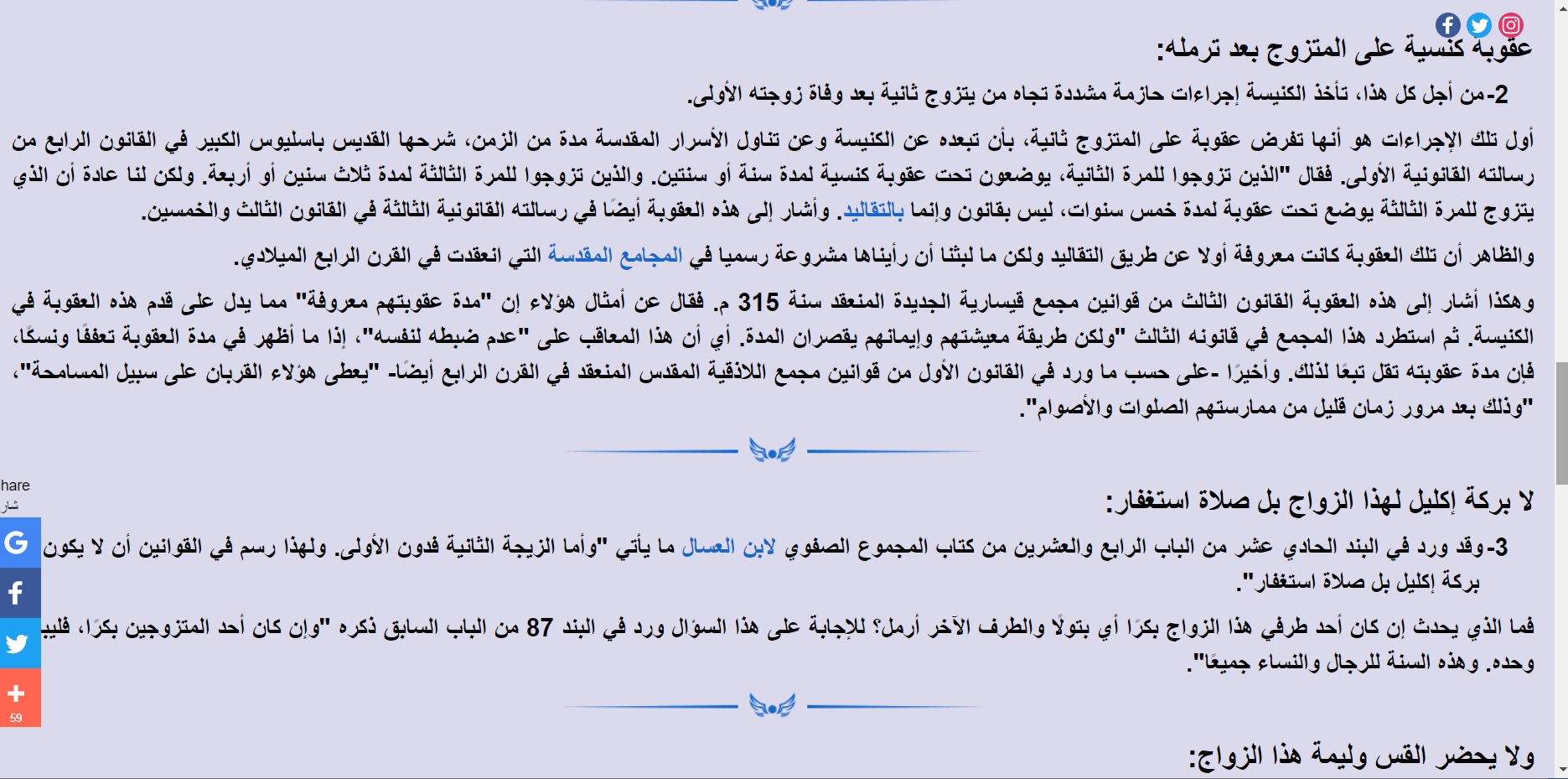
Tertullian “Happy is he who lives celibate like Paul. Marriage and procreation are a pitiable weakness in the face of physical instincts.” He advised his friend not to remarry after his wife’s death, because a second marriage is a form of debauchery — while the first marriage is lawful debauchery.
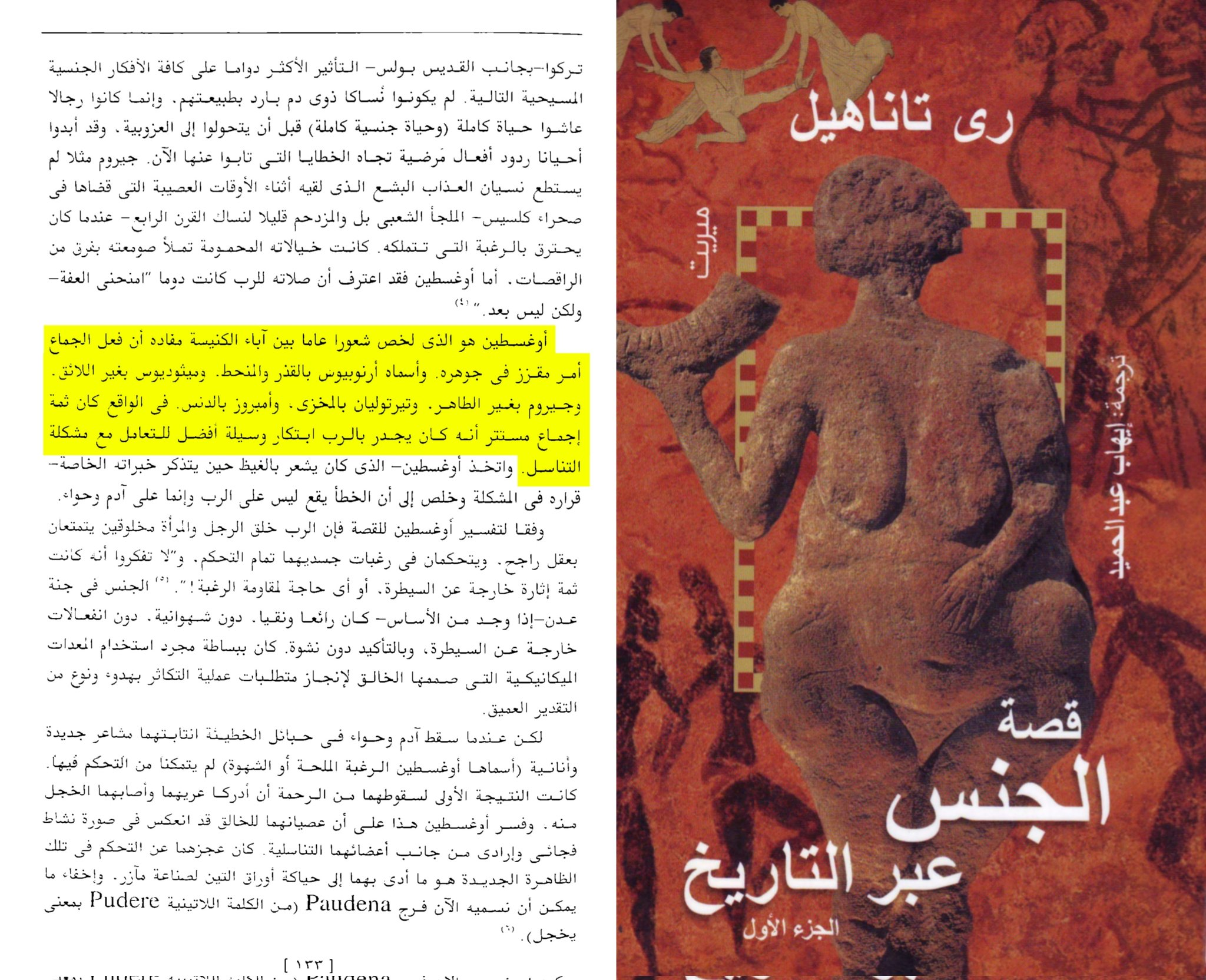
Martin Luther “Martin Luther retained the prevailing idea that sexual intercourse between spouses is a sinful act in the eyes of God, but God covers the sin. In Christianity, the child is conceived and born in sin. Martin Luther considered himself a lenient husband because his wife received no more than a punch to her ear.”
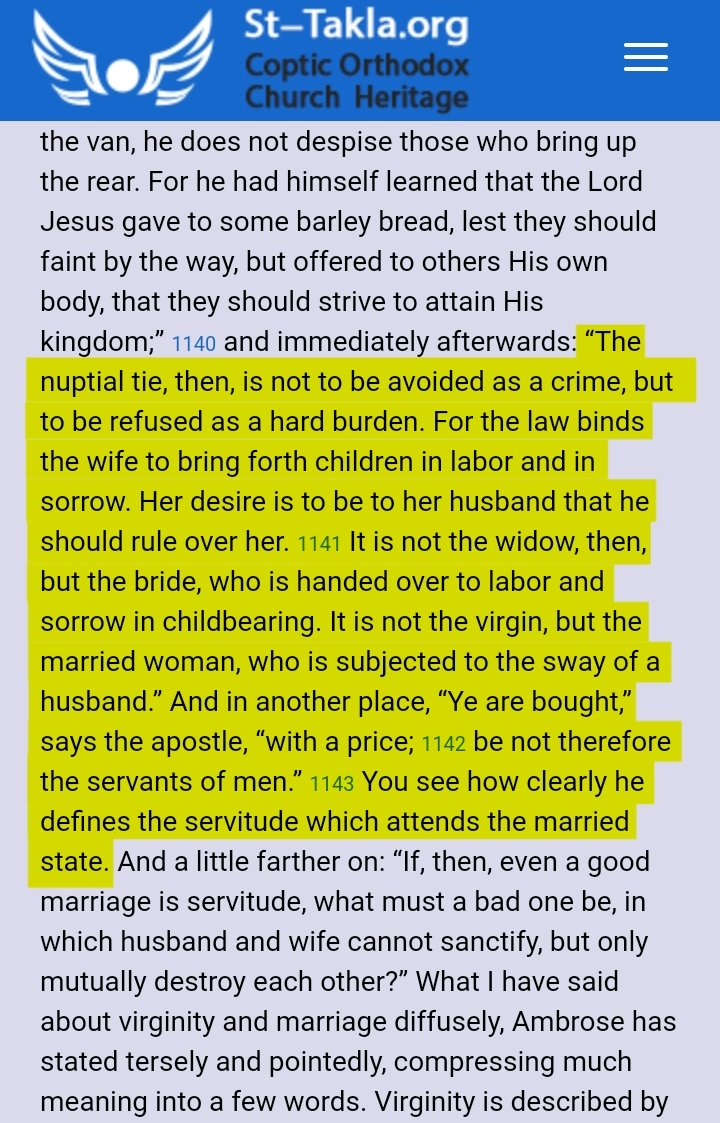
Augustine summarized a general sentiment among the Church Fathers that the marital relationship is inherently repulsive — with Arnobius calling it filthy and degraded, Methodius deeming it improper, Jerome labelling it impure, Tertullian describing it as shameful, and Ambrose referring to it as defiled. The Church Fathers unanimously agreed that it would have been more fitting for the Lord to devise another means of procreation besides marriage.
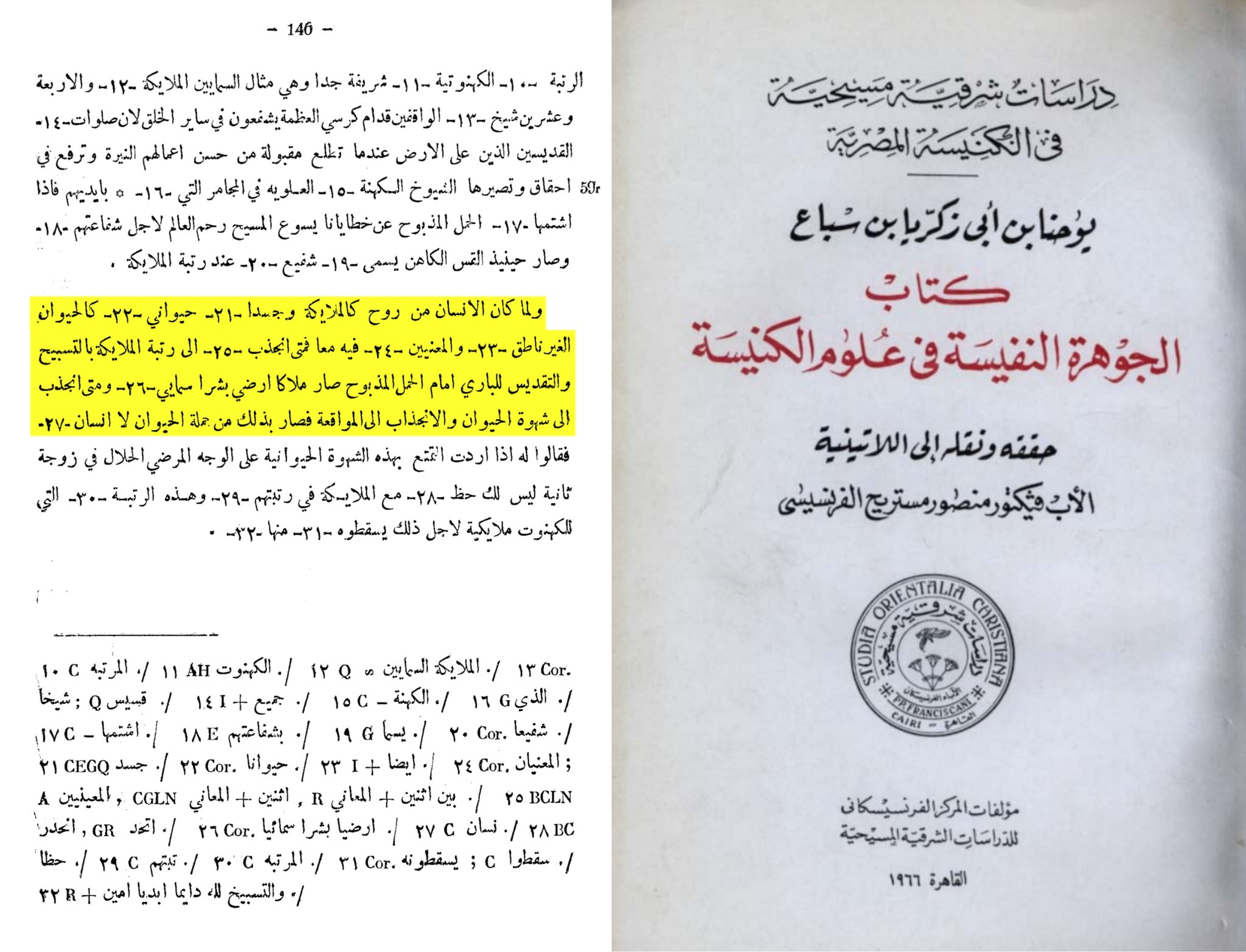
Theologian John son of Abu Zakaria son of Siba “A man, if he is drawn to cohabiting with women, becomes by that one of the animals, not a human.”
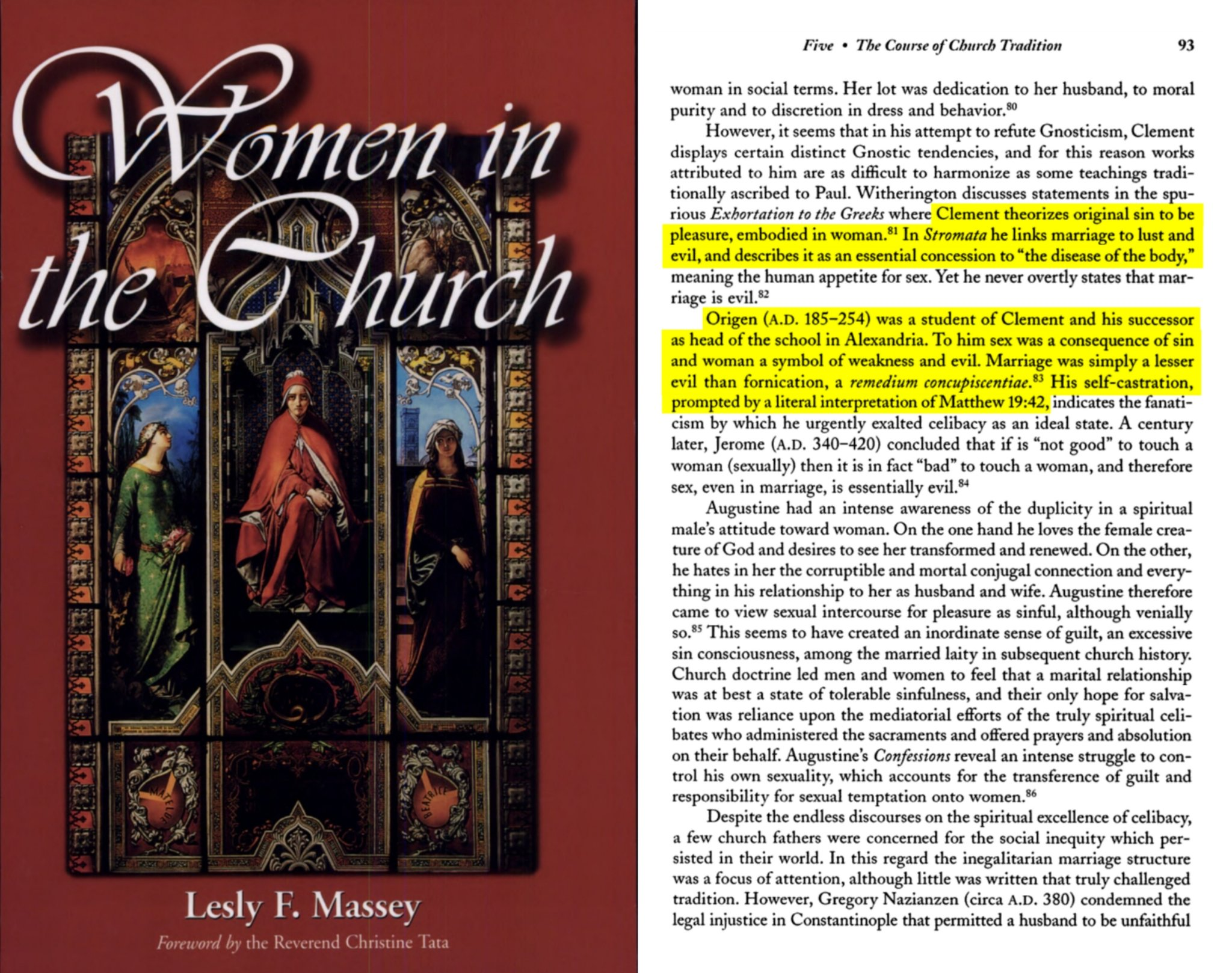
Saint Clement of Alexandria linked marriage with lust and evil, and determined that marriage is, in essence, an evil permitted as a concession to human weakness and as a concession for the sake of the body’s ailment — considering that the reproductive instinct is nothing but a disease.
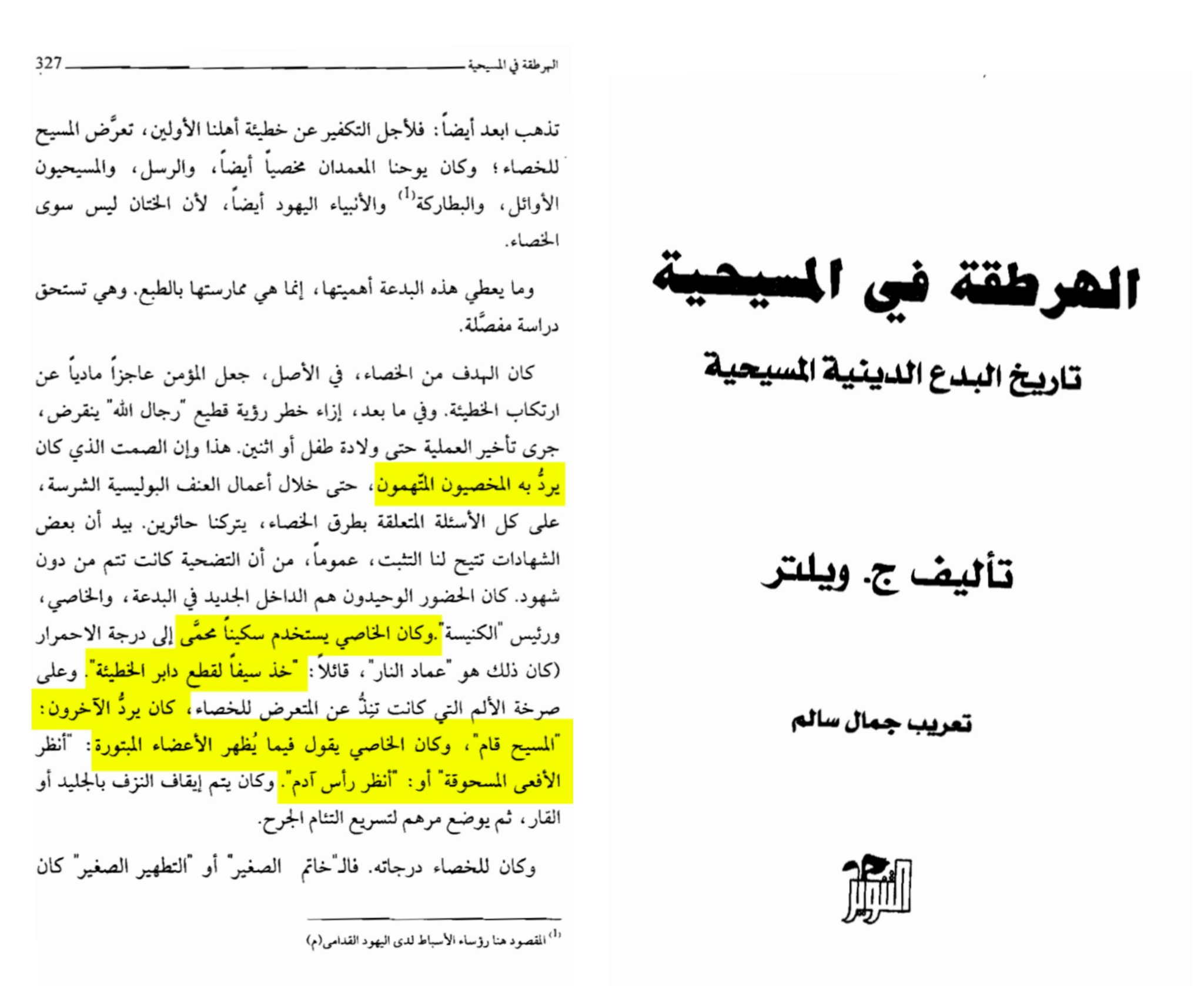
A Christian group emerged that held fast to the command — “And there are eunuchs who have made themselves eunuchs for the sake of the kingdom of heaven” (Matthew 19:12) — so they made themselves eunuchs, aspiring to the kingdom.
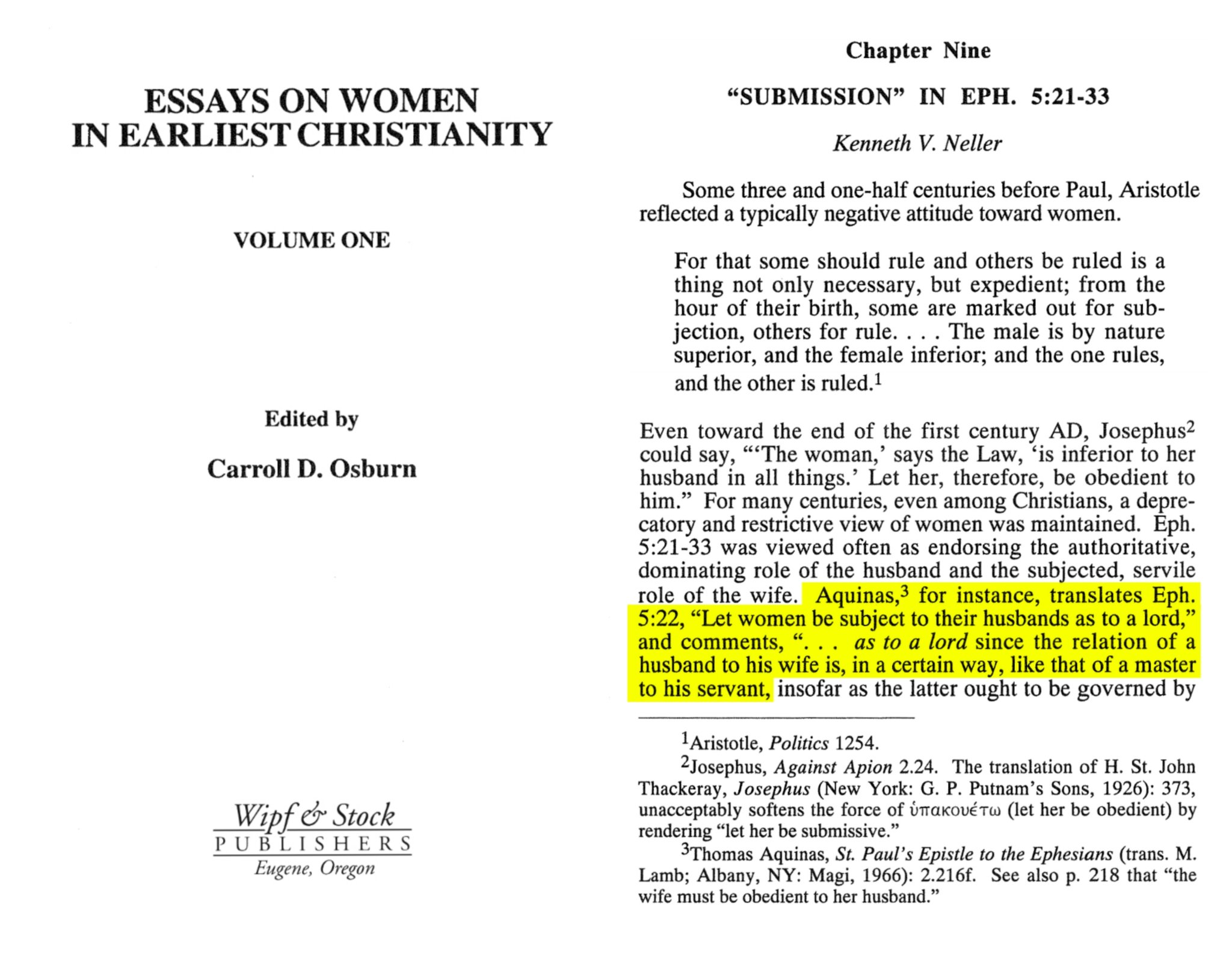
Saint Thomas Aquinas — commentary on Ephesians 5:22 “The relationship of a husband to his wife is like that of the Master to his servant.”
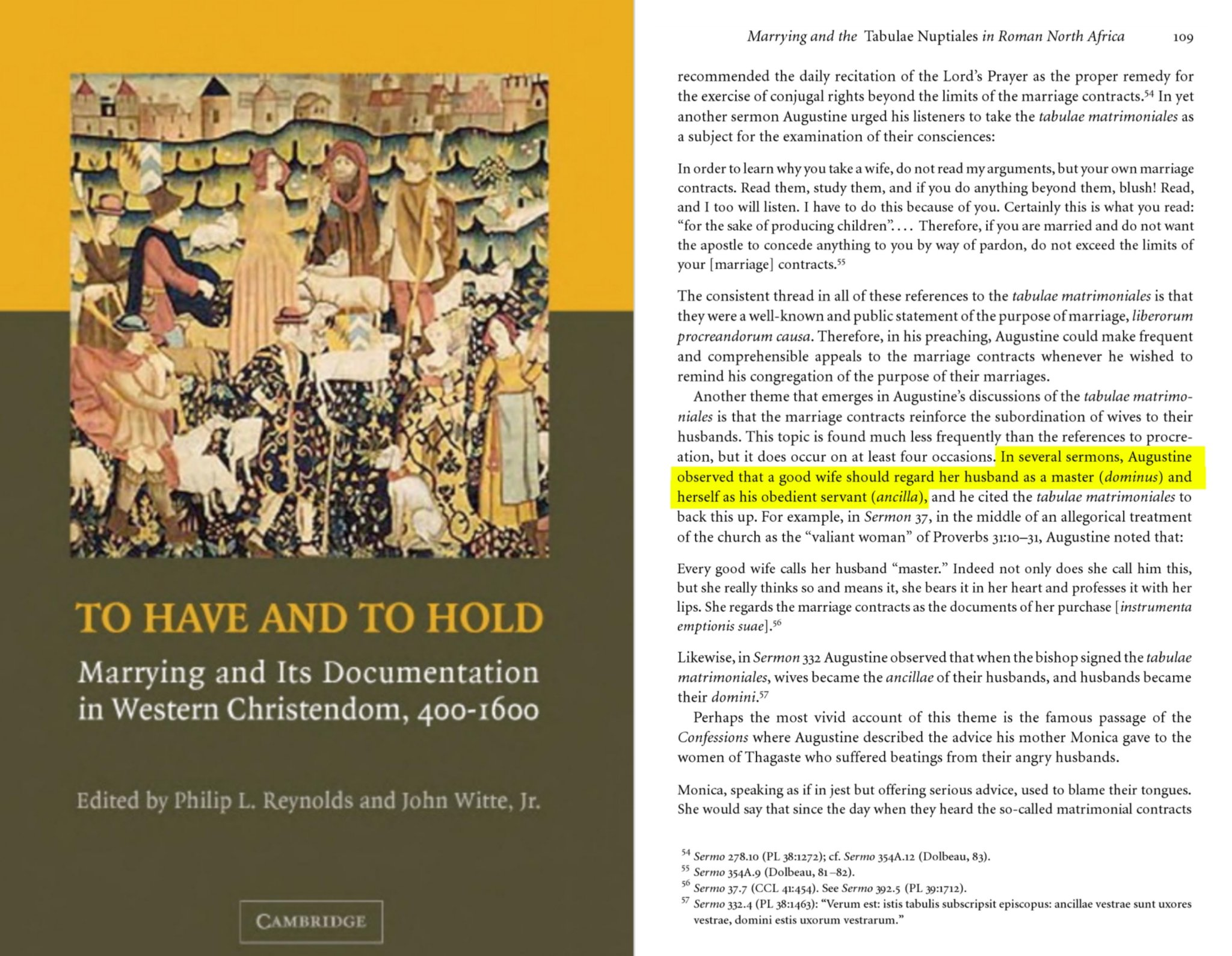
Saint Augustine — To Have and to Hold by Philip Lyndon Reynolds and John Witte “Marriage makes the man the owner and the woman a possessed servant. Therefore, she calls him master because he rules over her and subjects her to his authority.”
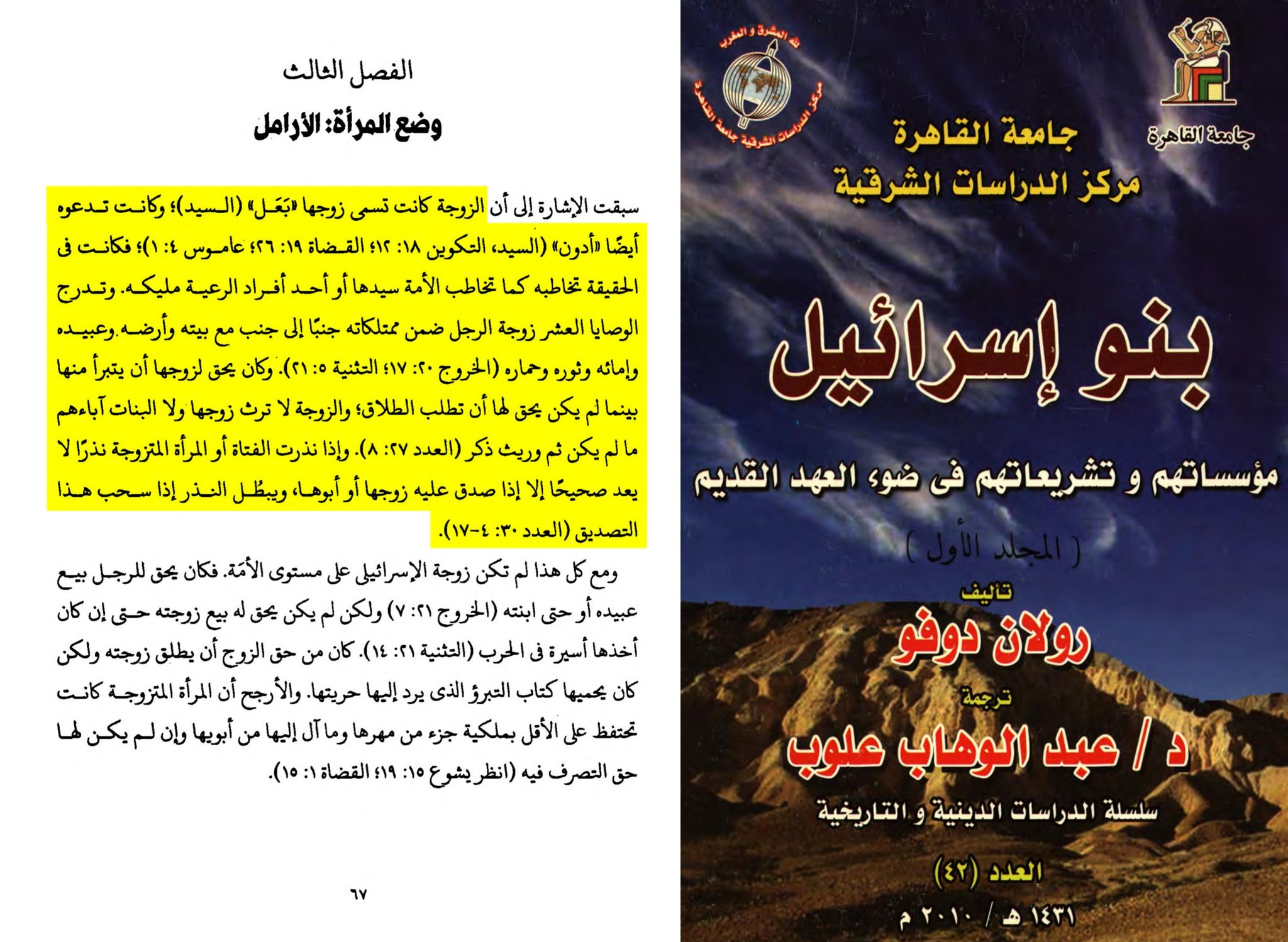
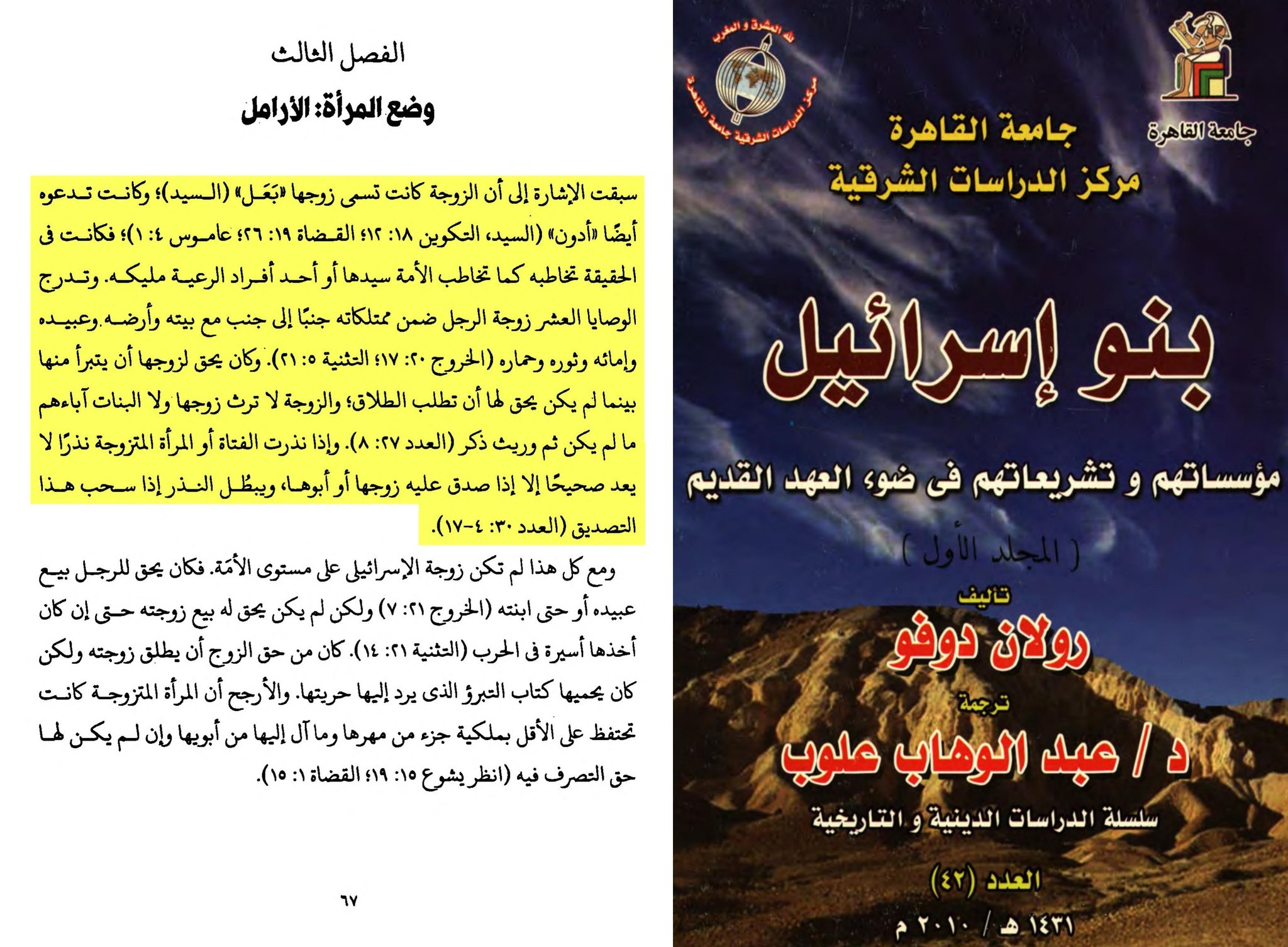
The biblical text places a wife among a man’s possessions alongside his ox, his donkey, and his land:
Exodus 20:17 / Deuteronomy 5:21 (SVD) “You shall not covet your neighbor’s wife, or his male servant, or his female servant, or his ox, or his donkey, or anything that is your neighbor’s.”
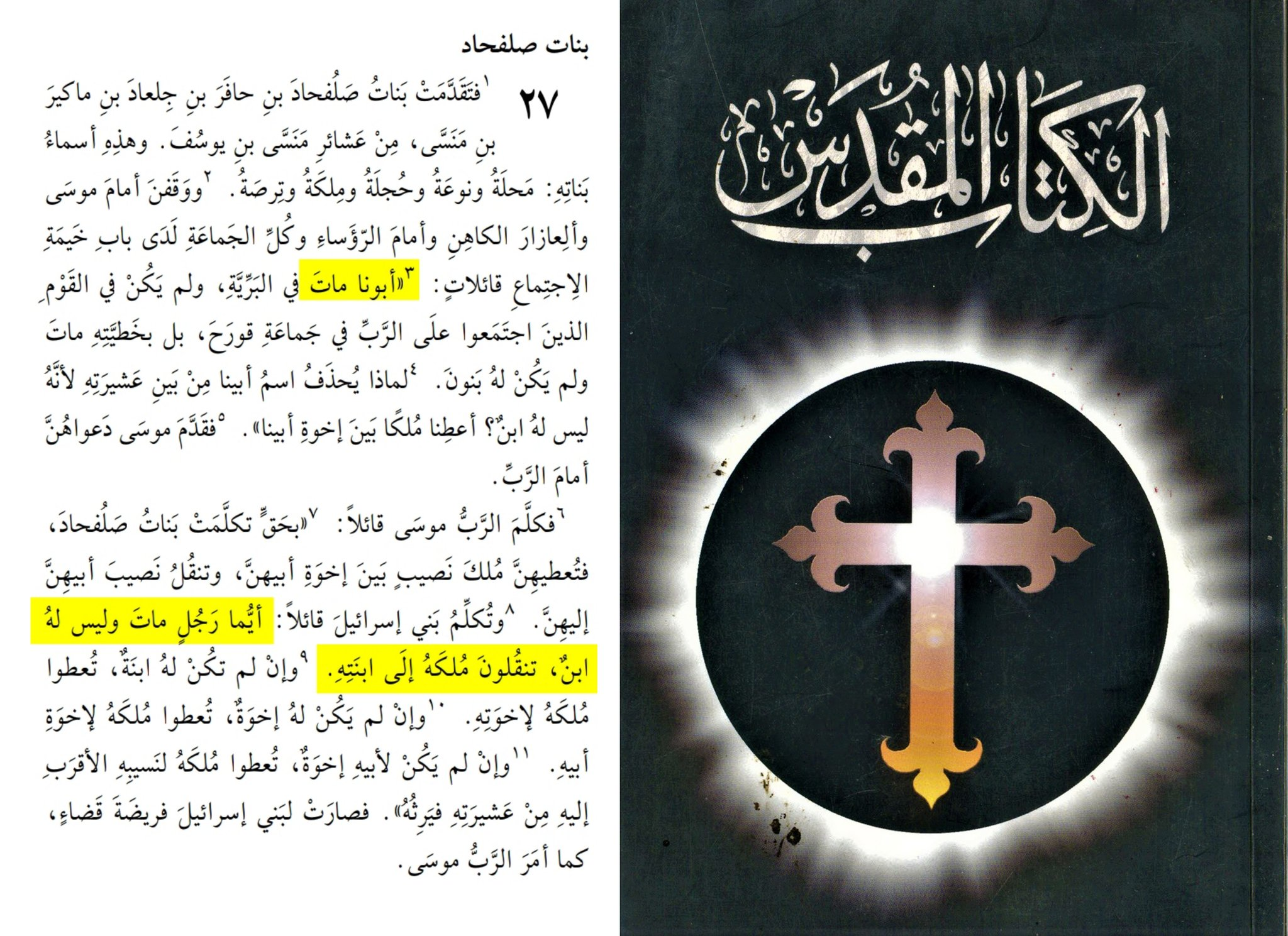
Numbers 27:8 (SVD) “If a man dies and has no son, you shall transfer his inheritance to his daughter.”
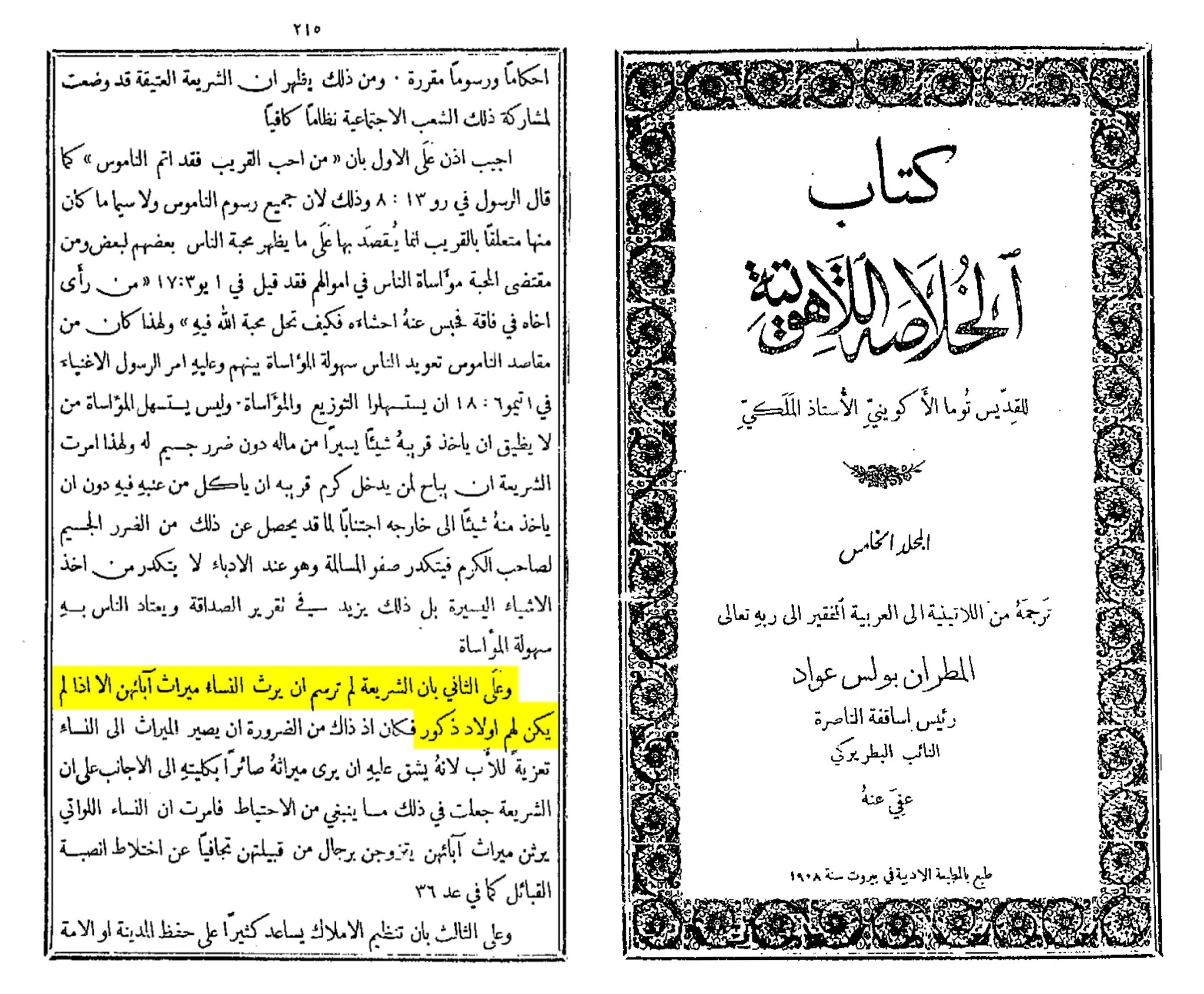
Girls do not inherit from their father except in one case only: if the father has no male children.
Saint Thomas Aquinas “The law did not stipulate that women inherit their fathers’ inheritance unless they had no male children. Likewise, she does not inherit from her husband.”
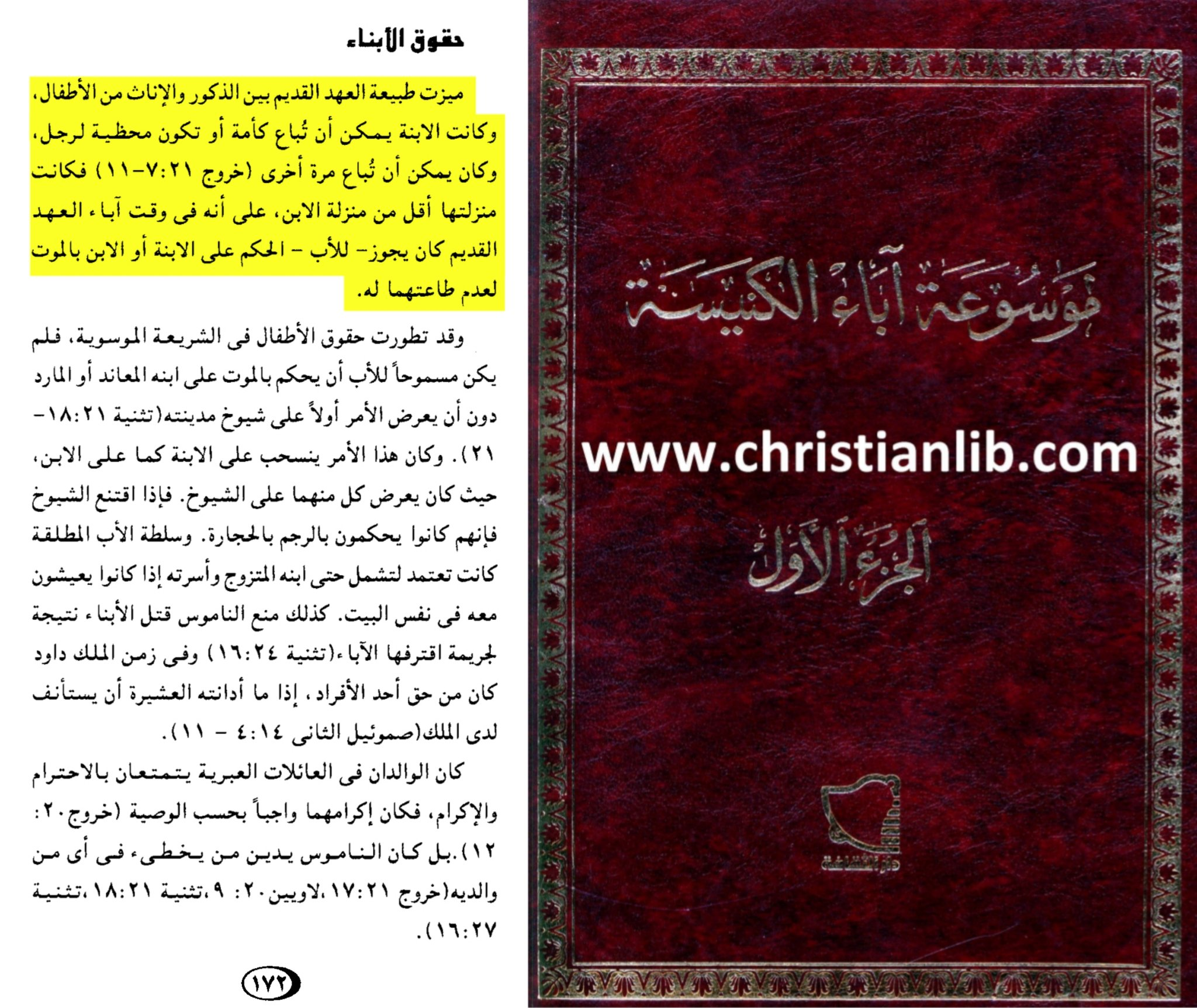
Exodus 21:7 (SVD) “And if a man sells his daughter as a maidservant, she shall not go out as the male slaves do.”
A father can sell his daughter as a maidservant, like any commodity that is bought and sold.
1 Corinthians 11:3 (SVD) “But I want you to know that the head of every man is Christ, and the head of the woman is the man, and the head of Christ is God.”
The man is the master of the woman, who is submissive to him. The First Epistle of Peter commands the woman to call her husband “my lord,” just as Sarah obeyed Abraham, calling him her lord.
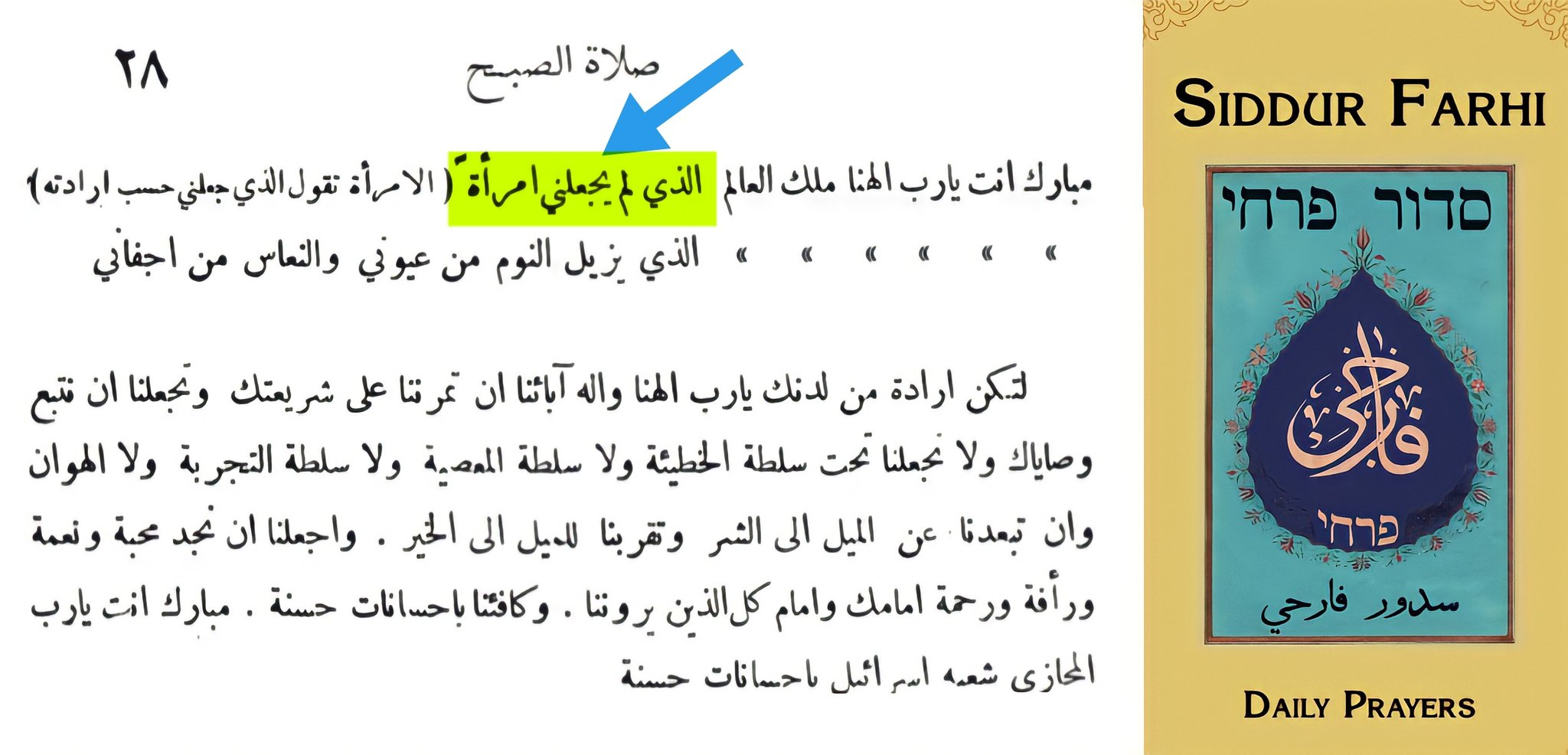
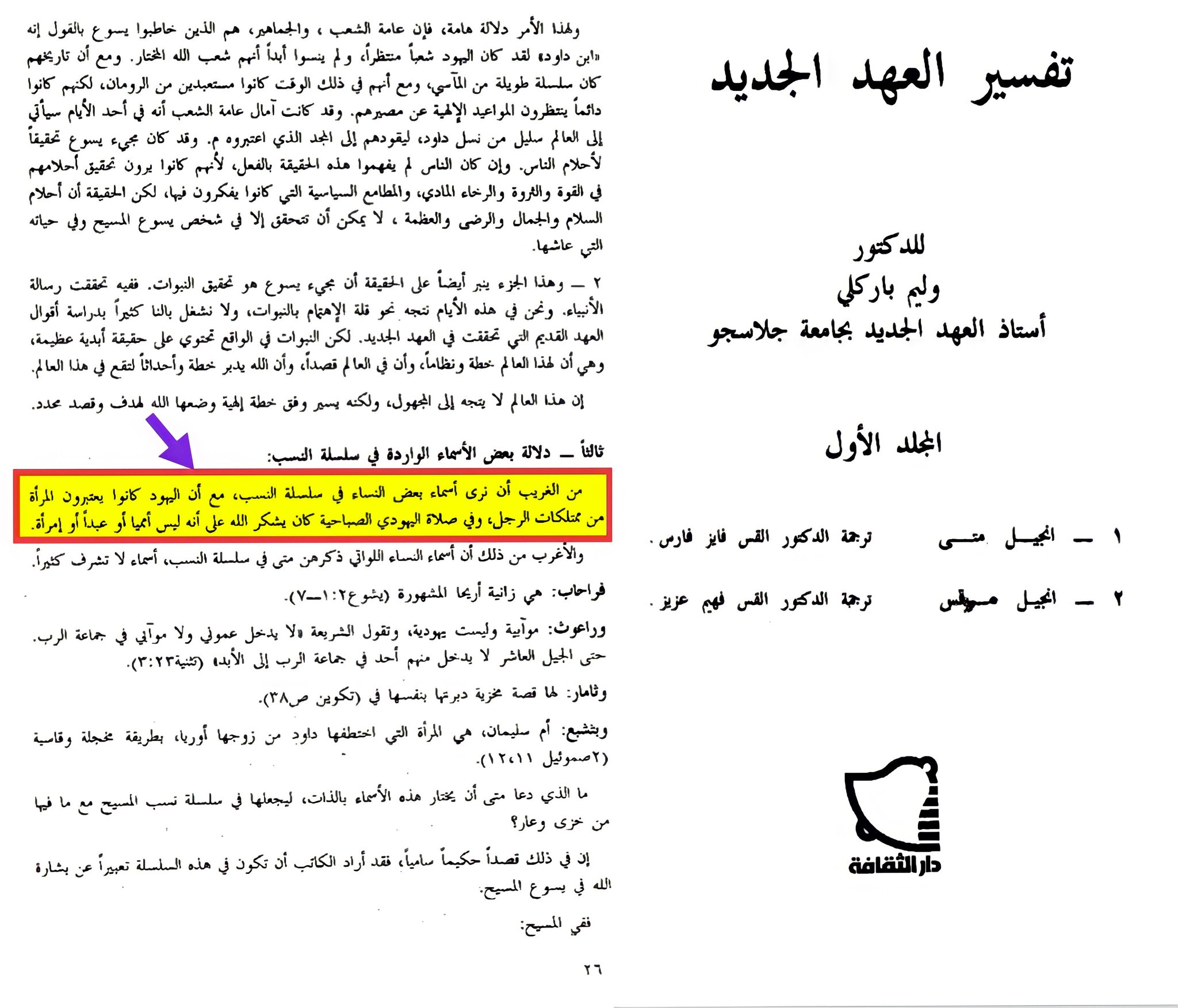
Every young Jewish man stands in his morning prayer to thank God that He did not make him a woman, a slave, or a gentile.
William Barclay’s Commentary on the New Testament — Matthew, page 26 — cited as the source for this morning prayer.
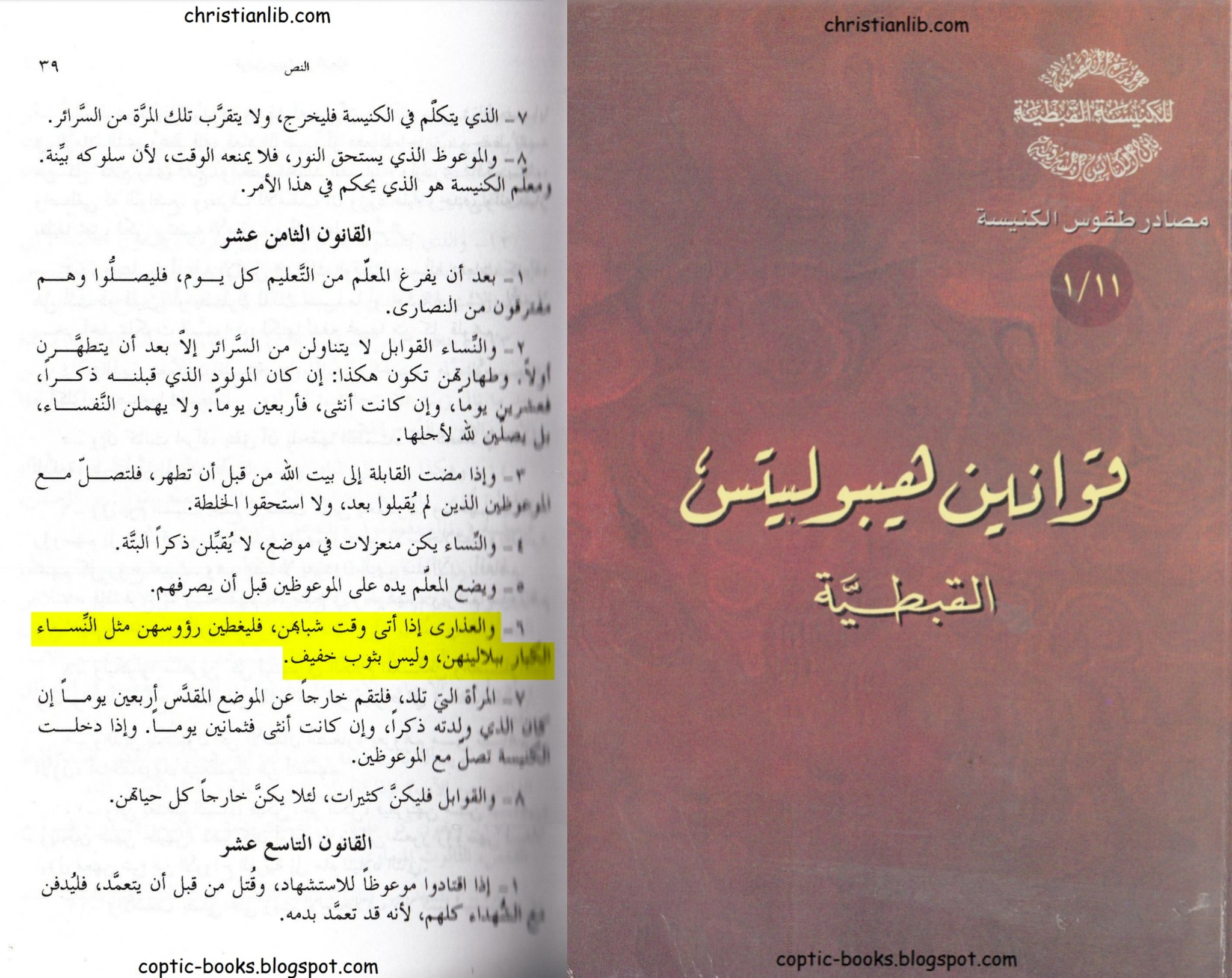
It was stated in the Didascalia: “The woman has become subject to the man because she bears his children, and therefore it is forbidden for her to assume any priestly position, for the man is the head of the woman, while the woman is created from a member lower than the head.”
FFnRGmYWYAcCVxs 0045f47013c5988cFFnRHp1XEAQWbpI f90dcc2cccf0f2d2FFng85VXMAc2e6W e6ba989569bc588fFFng9jYXoAIzuP4 bc641fcbdad5de17FHEA2W5WQA8l8y2 3b83914eb6a137e0FHEA3WtXwAYaG2V f7af2ec405badb54FHEA4ZHWQAYzxVD 5573105ff2c5b861FVSU0gKWYAAWOi 787b8b76806d9d68FVSUqCyX0AEkK b 60da4700cf6e6331FVSU6tyXoAABCfp f55b904c4dea3e2fFFkfb17X0AEiarv 826e863cab700dd2FFkseKuXEAIvuTK b9825c7dc9f7f8f5FFksfTwXIAUC0 B 7cd1ecaef195a2fcFJGdKC XwAU6G6s 20fc3dfb1b09f4cf
Woman Is Unclean — Menstruation and Childbirth
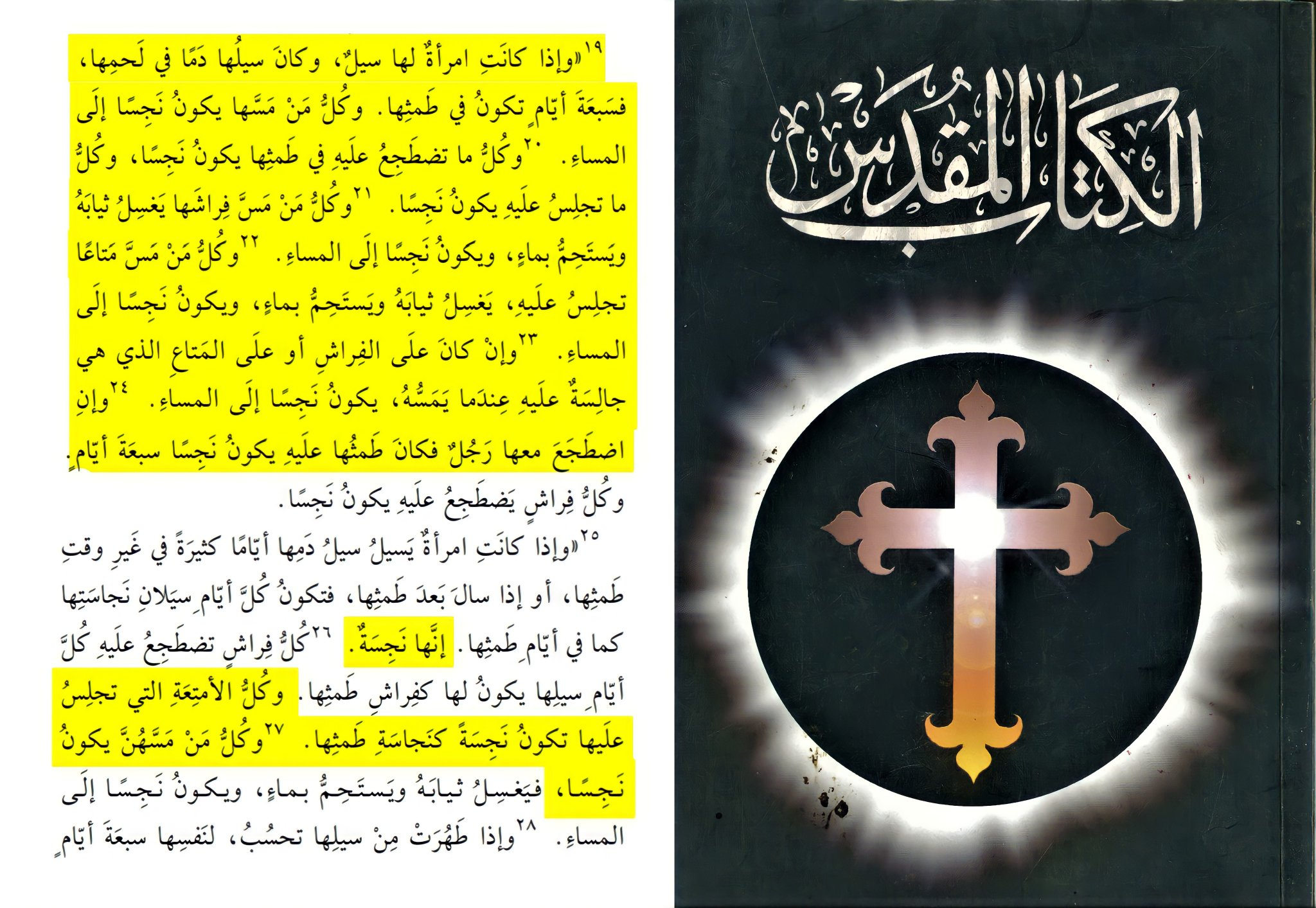
Leviticus 15:19–22 (SVD) “And if a woman has a discharge, and her discharge is blood in her flesh, she shall be in her impurity seven days, and whoever touches her shall be unclean until the evening. And whatever she lies on during her impurity shall be unclean, and whatever she sits on shall be unclean. And whoever touches her bed shall wash his clothes, and bathe himself in water, and be unclean until the evening. And whoever touches anything on which she sits shall wash his clothes, and bathe himself in water, and be unclean until the evening.”
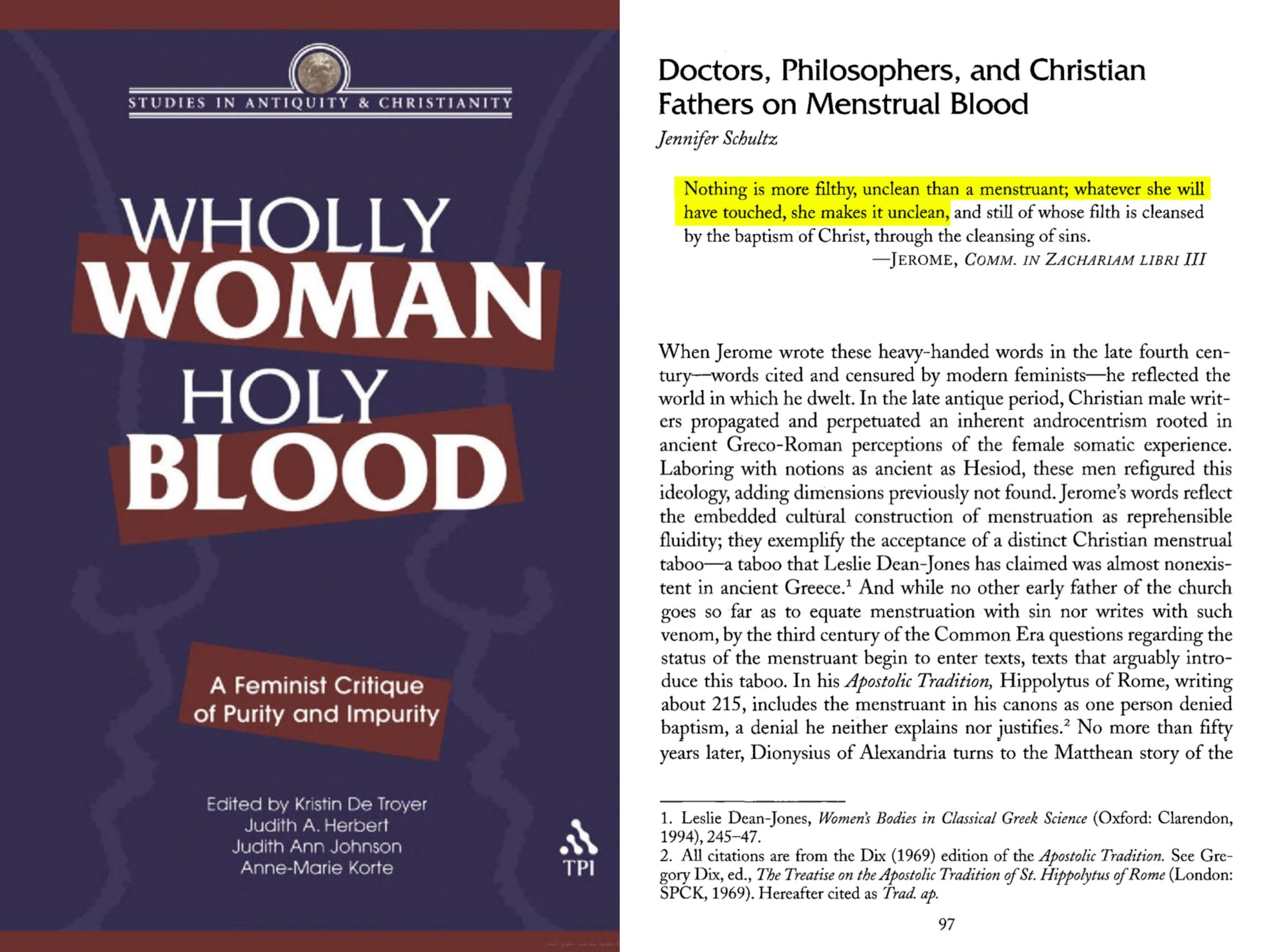
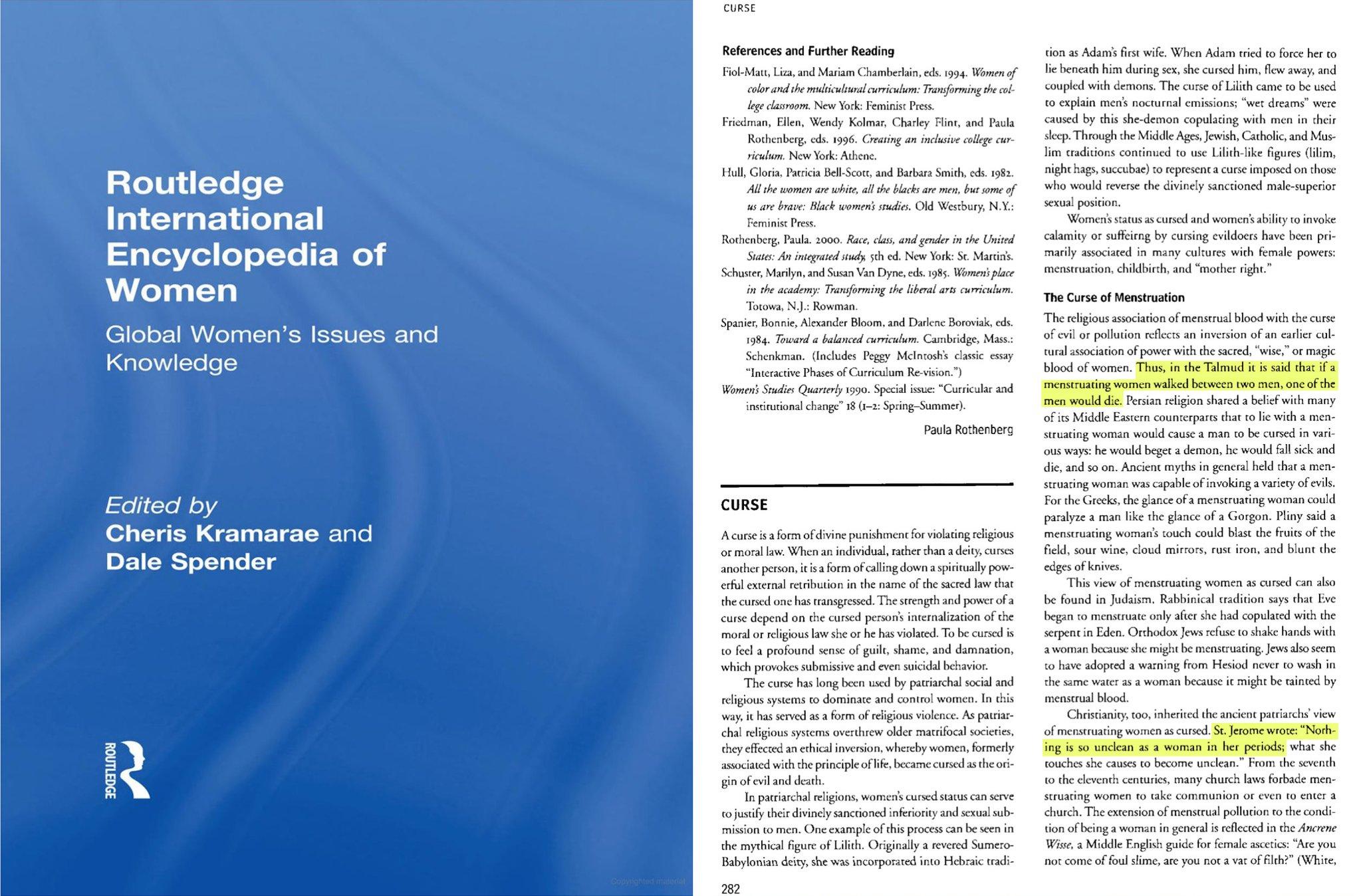
Saint Jerome “There is nothing more impure and unclean than a menstruating woman; everything she touches, she makes unclean.”
The Talmud “If a menstruating woman passes between two men, one of them might die.”
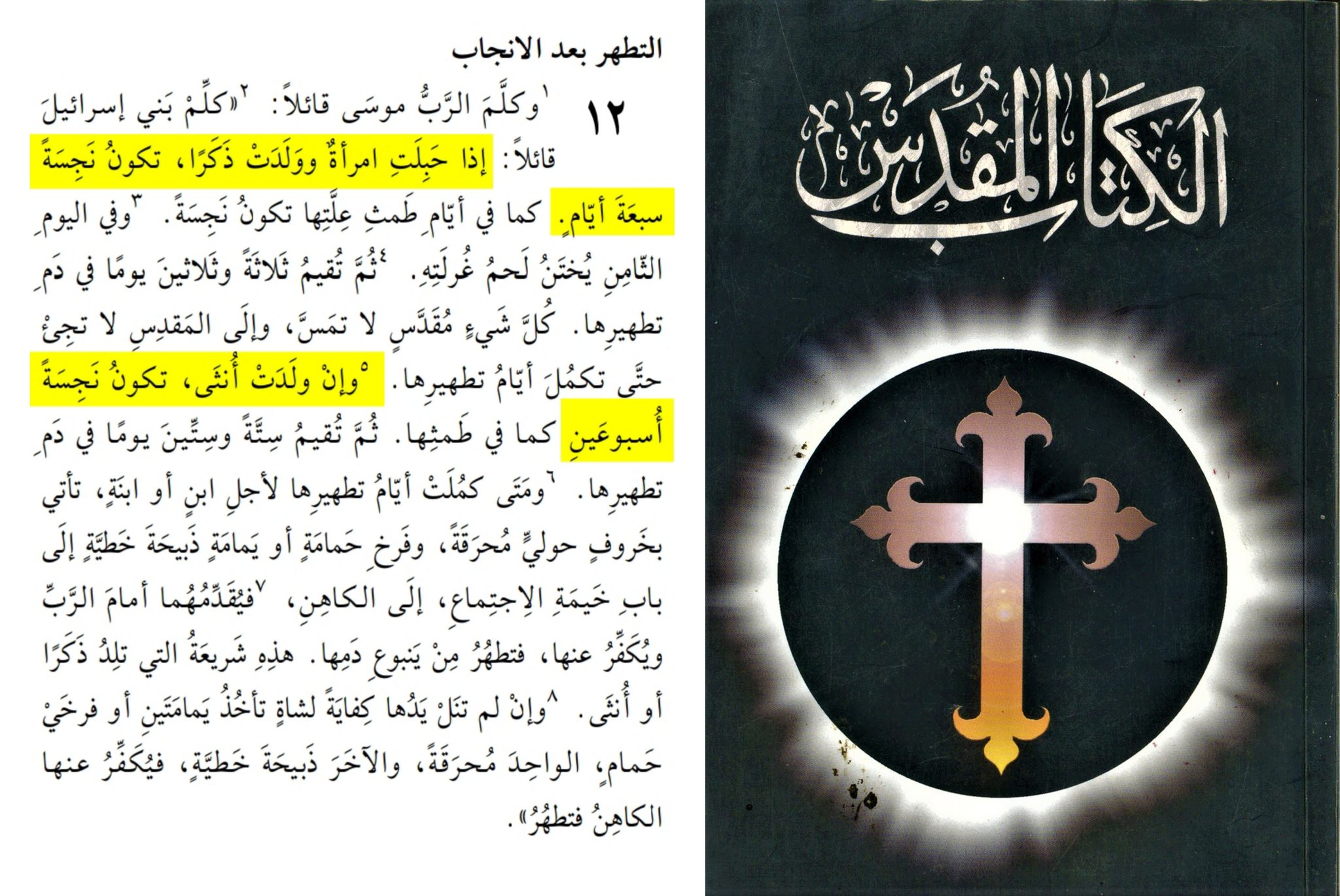
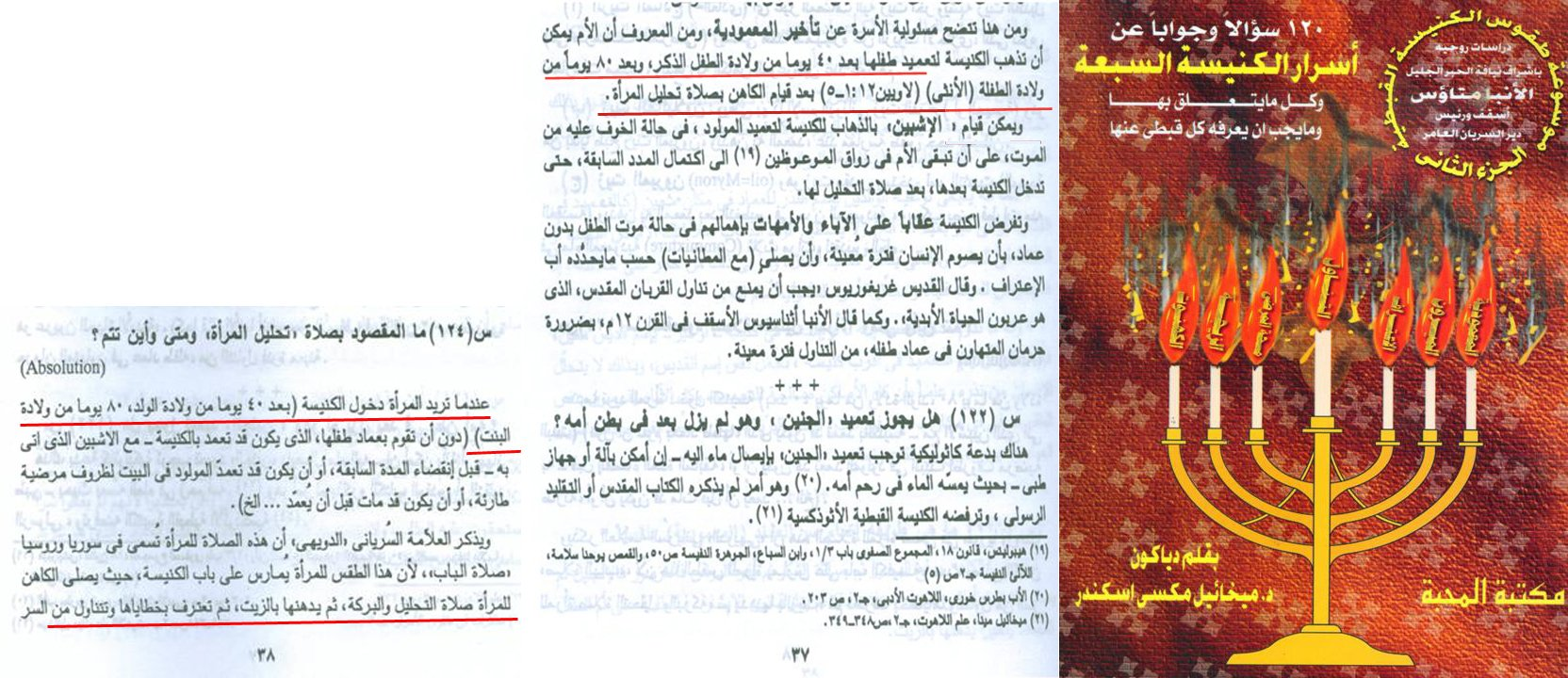
The impurity laws: if a woman gives birth to a male, she is impure for one week; if she gives birth to a female, she is impure for two weeks. A woman is not permitted to attend the baptism of a male child until 40 days after the birth, whereas a female child is baptized only 80 days after the birth — because the impurity that afflicts a woman from giving birth to a female is double that from giving birth to a male.
Father Antonius Fikri — interpretation of Ben Sirach 26 “The beginning of a woman’s corruption is her lack of contentment with what God has allotted her, so she begins to look at the world with lust that drives her to sell her honor to get what she wants. Therefore, girls and women must be watched, especially those who appear to have no shame.”
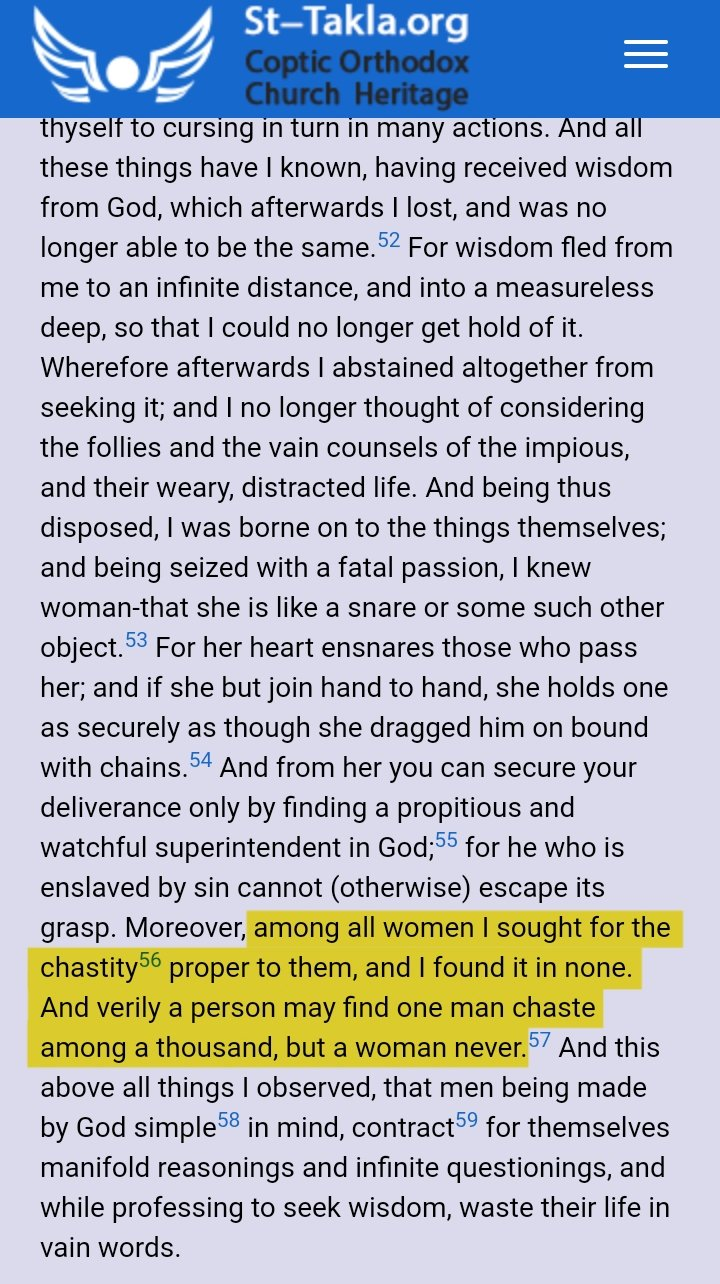
Saint Gregory the Wonderworker — literal translation, Job 7:28 “I searched among all women for their particular chastity but found it in none of them, and truly, one might find a chaste man among a thousand, but he will never find a chaste woman among women.”
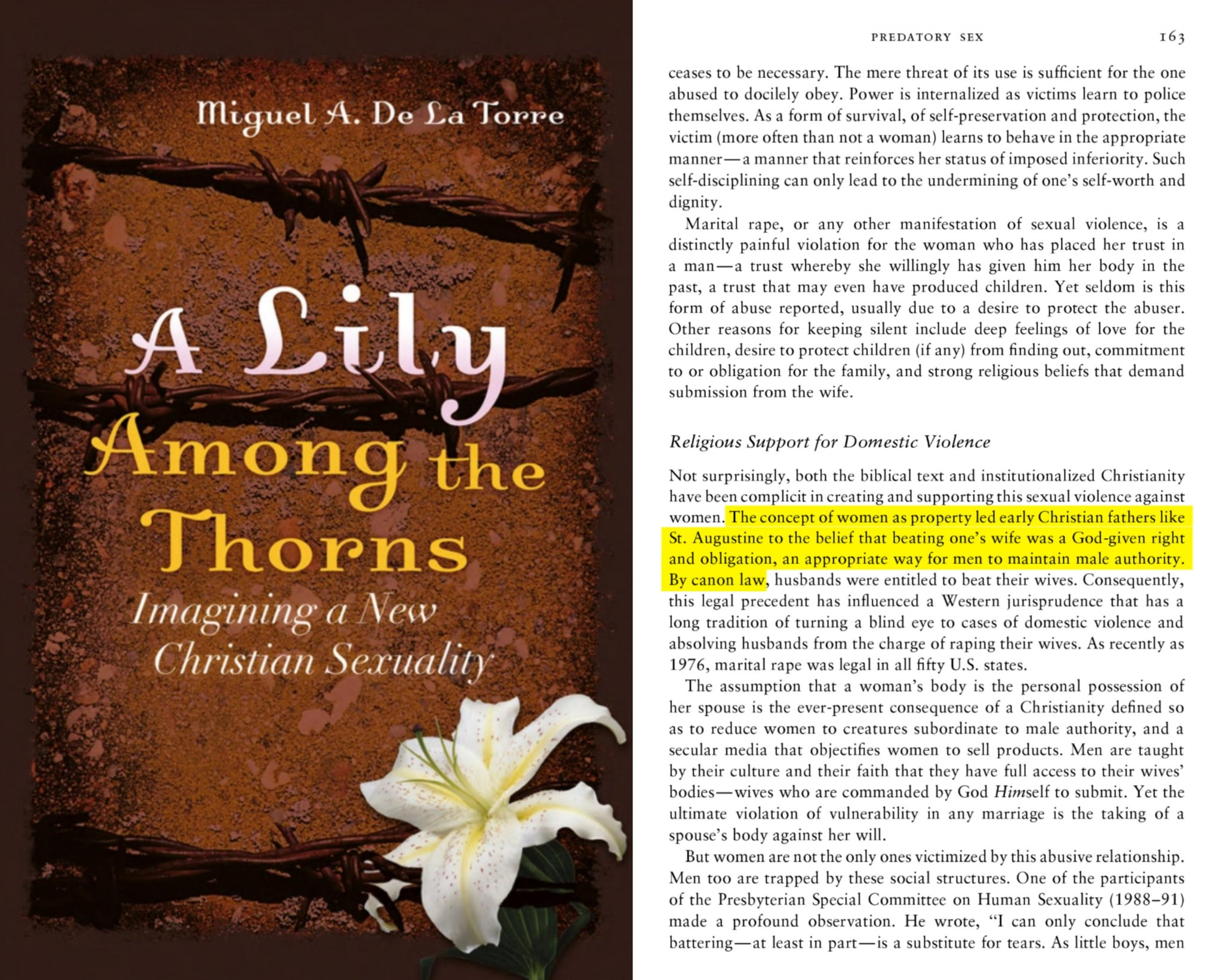
Professor Mehall A.D. Latour “The concept that a woman is something to be possessed led the early Church Fathers, such as Augustine, to believe that a man beating his wife is a right granted by God, a duty incumbent upon him, and an appropriate way for the man to maintain his authority over her in accordance with ecclesiastical law.”
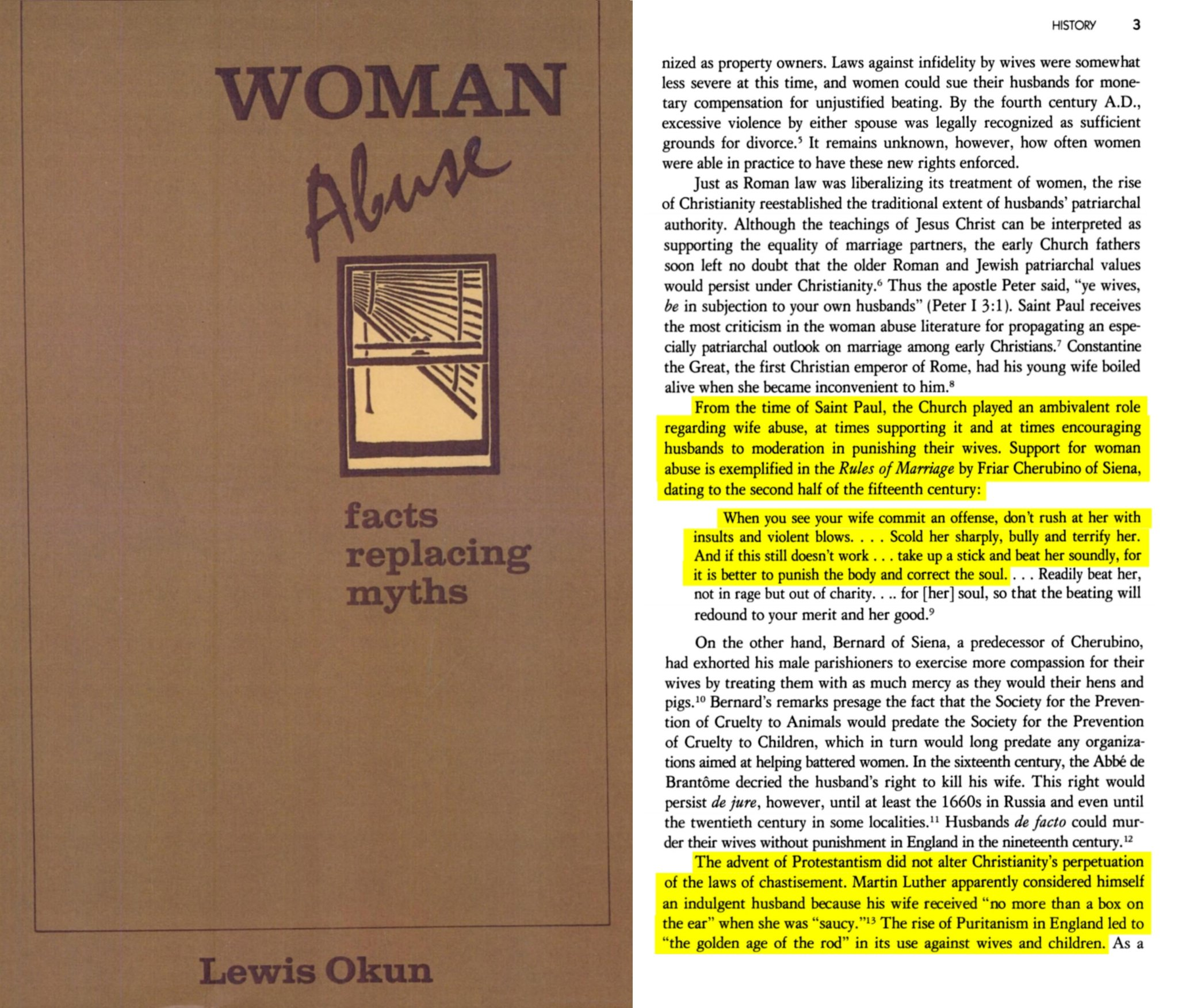
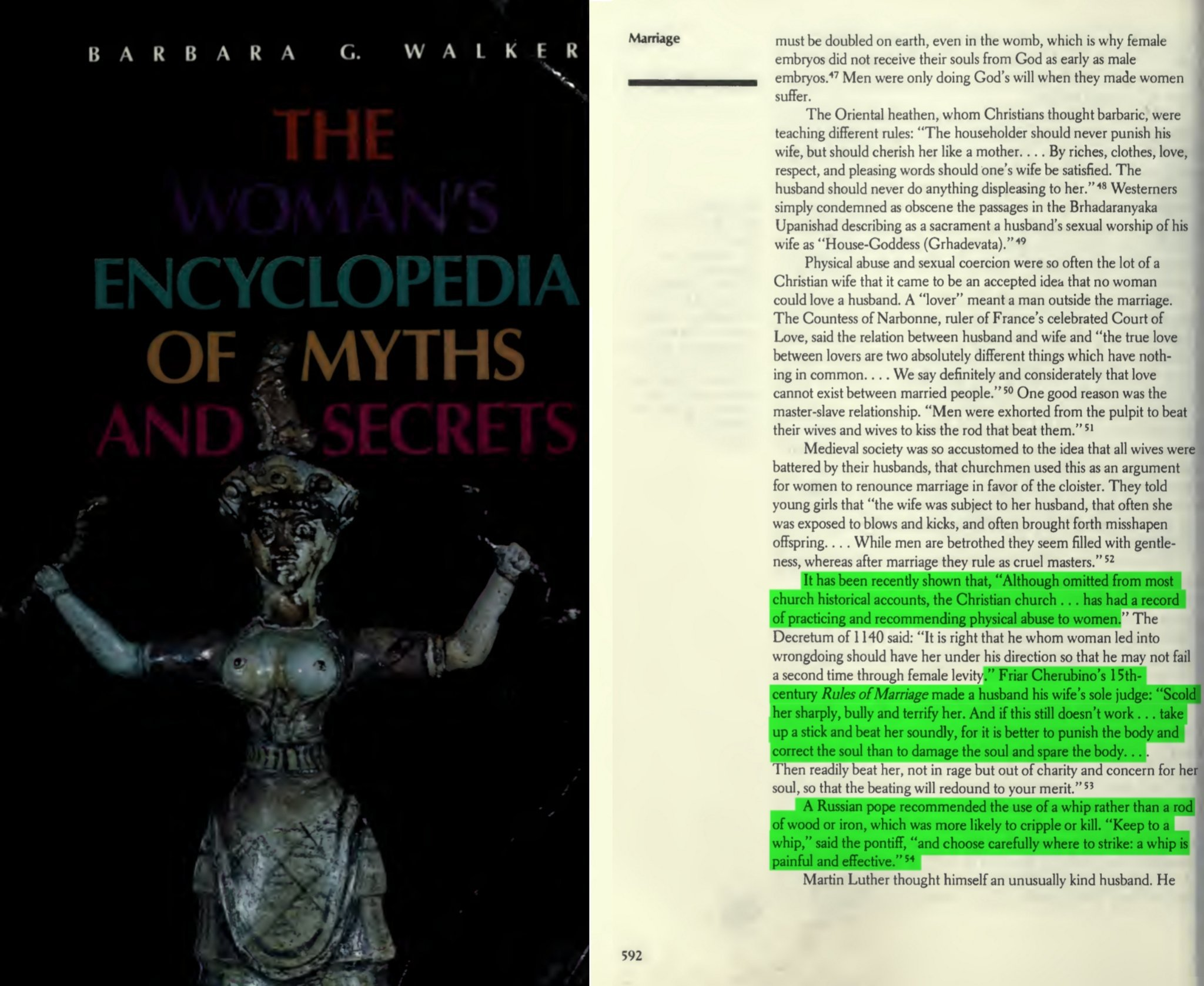
Monk Cherubino of Siena — Rules of Marriage (15th century) “If your wife commits an offense, rebuke her harshly, dominate her, and intimidate her, and if that does not work, take a stick and beat her forcefully. Take a stick and hit her hard, for it is better to punish the body and reform the soul.”
The emergence of Protestantism did not prevent the spread of Christianity with laws for disciplining women. Martin Luther considered himself a lenient husband because his wife received no more than a punch to her ear. The rise of the Puritan doctrine led to the golden age of beating women with a stick.
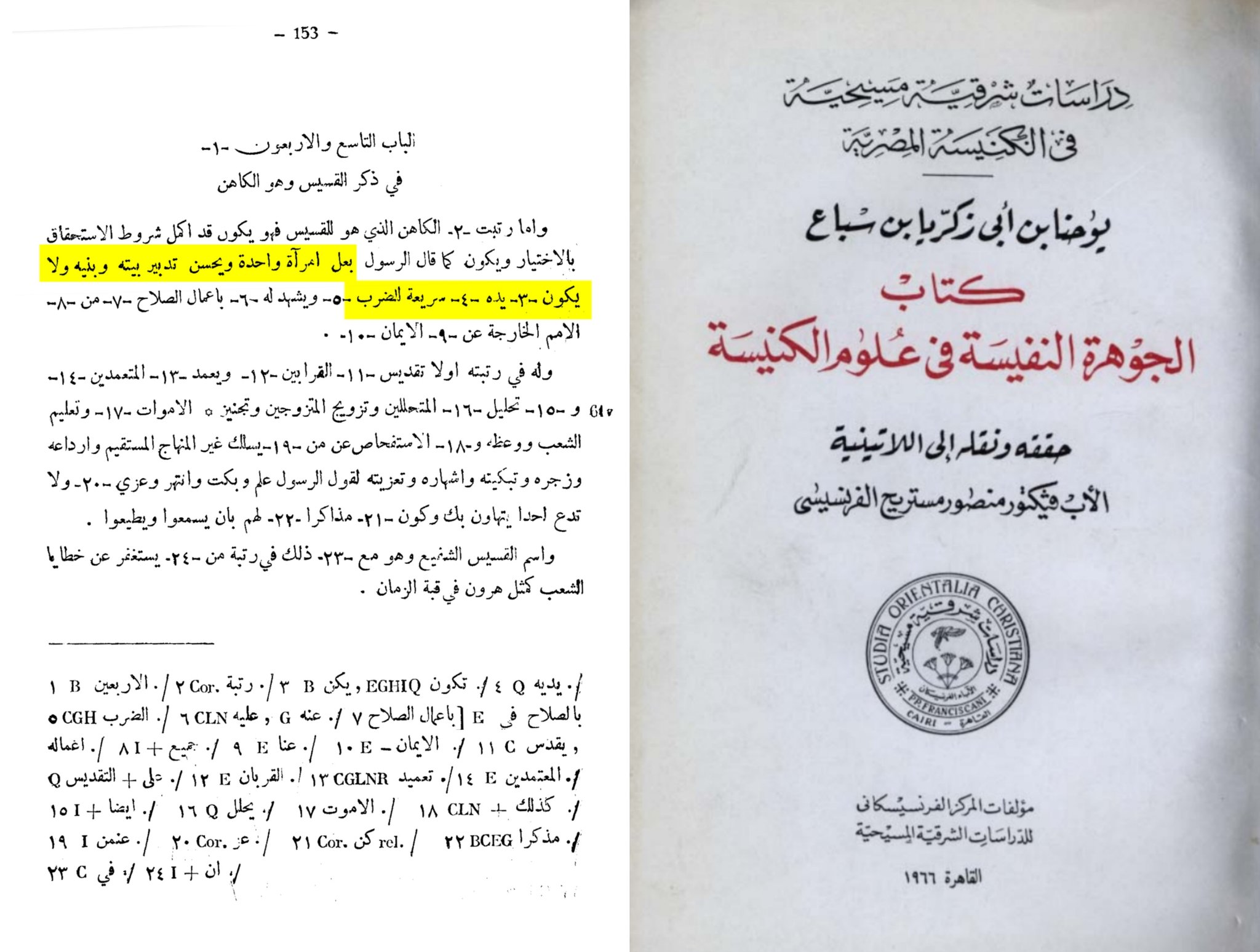
Disciplining the wife by beating is permissible in church legislation. The theologian John son of Abi Zakaria son of Siba stated that one of the conditions for a priest is that his hand not be quick to strike — indicating the permissibility of beating, since the objection is to unjustified and excessive beating, not to beating in general.
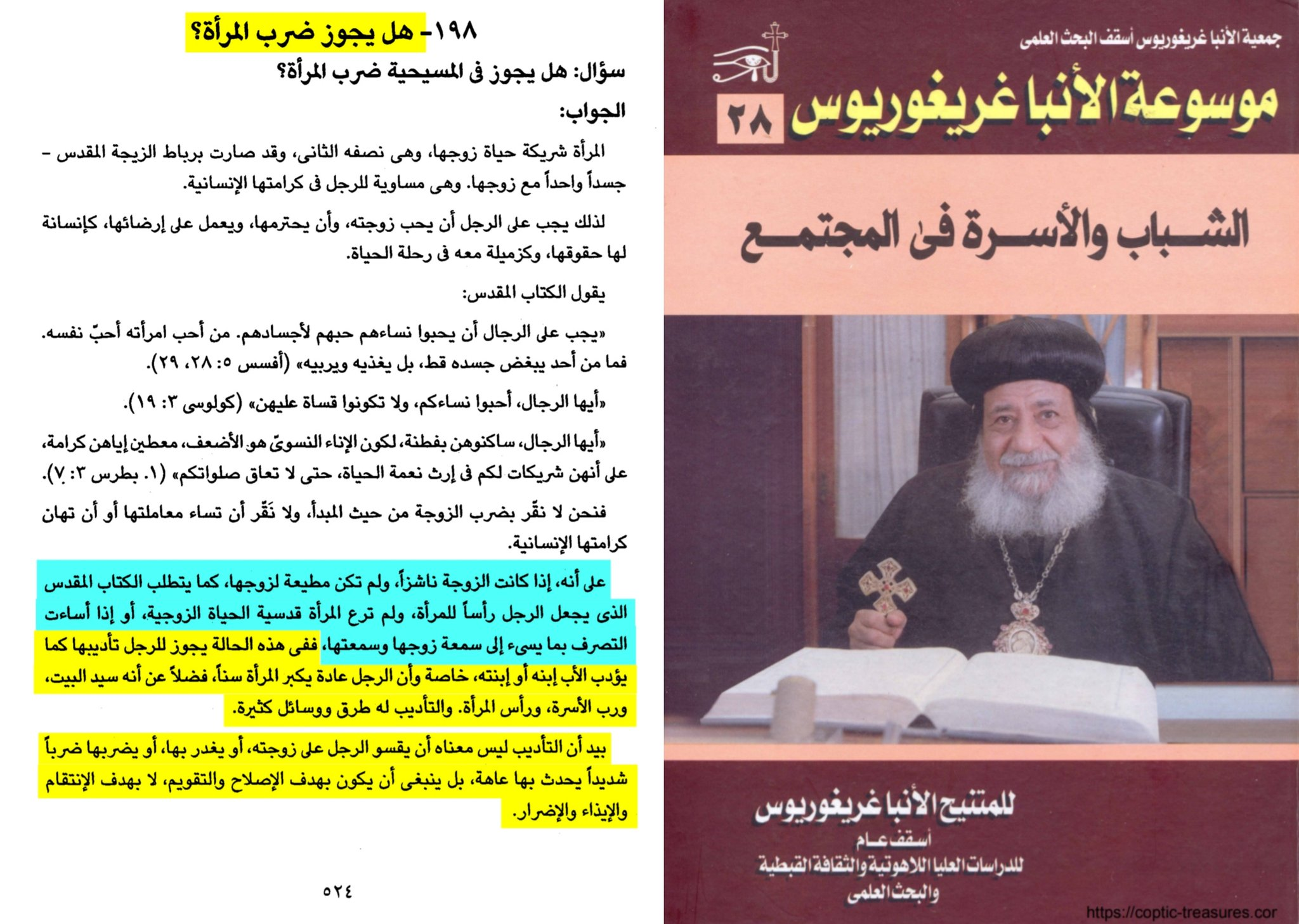
Anba Gregorius stated: if a woman is rebellious and disobedient, it is permissible for the husband to discipline her with beating, just as he would discipline his son or daughter, until he brings her back under his authority and dominance.
The Russian Pope ordered the use of a whip to strike a woman instead of a wooden or iron stick that might cause paralysis or death. The Pope says: “Stick to the whip and choose carefully where to strike.”
Since the time of Saint Paul, the church has played a complicit role in the mistreatment of women, encouraging the disciplining of wives through beating.
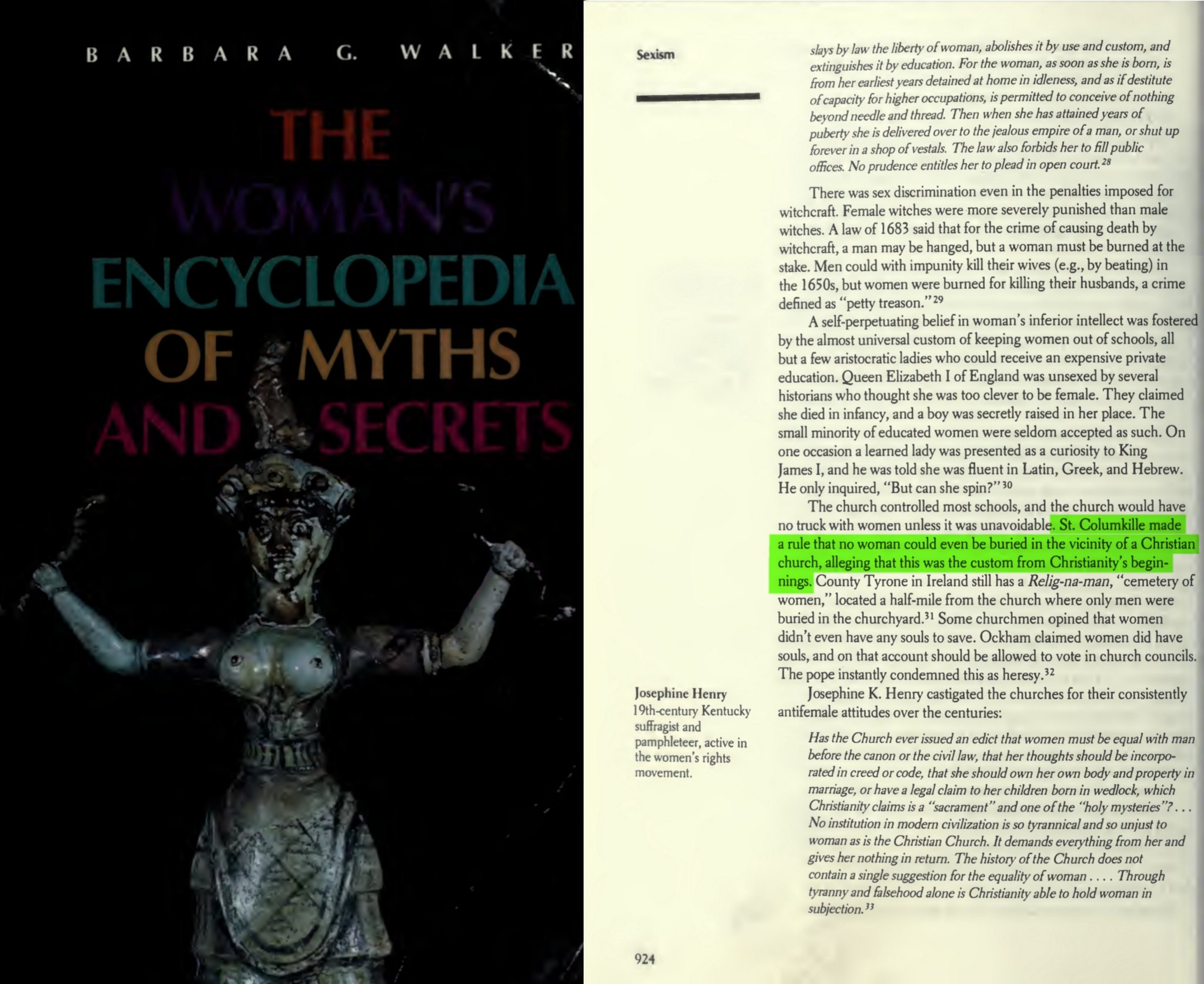
It was mentioned in The Woman’s Encyclopedia of Myths and Secrets: “Although this was erased from most of the church’s historical records, the Christian church had a record of practicing and ordering the physical torture of women.”
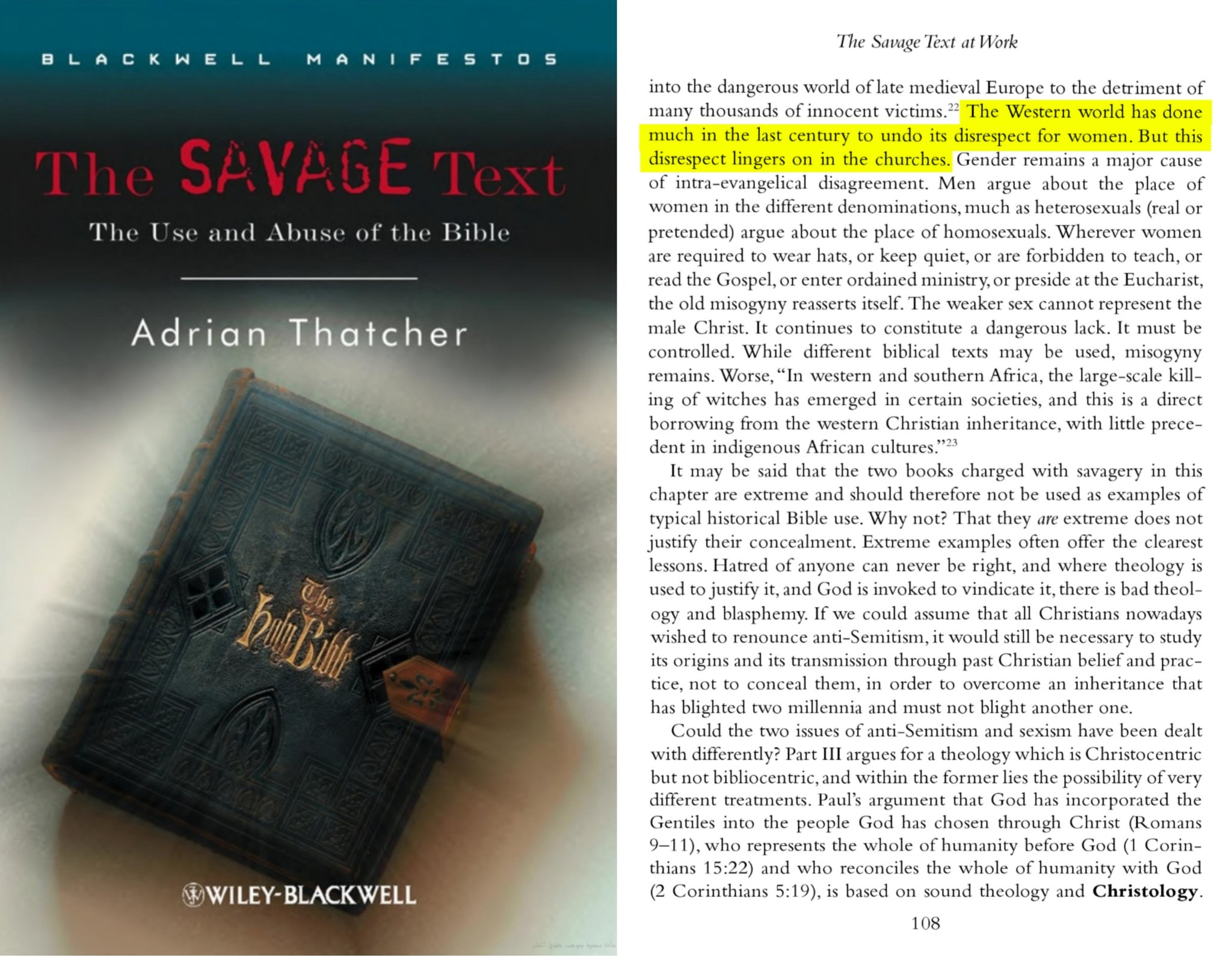
Adrian Thatcher “The Western world has exerted much effort in the past century to curb its contempt for women, but this contempt still persists in churches.”
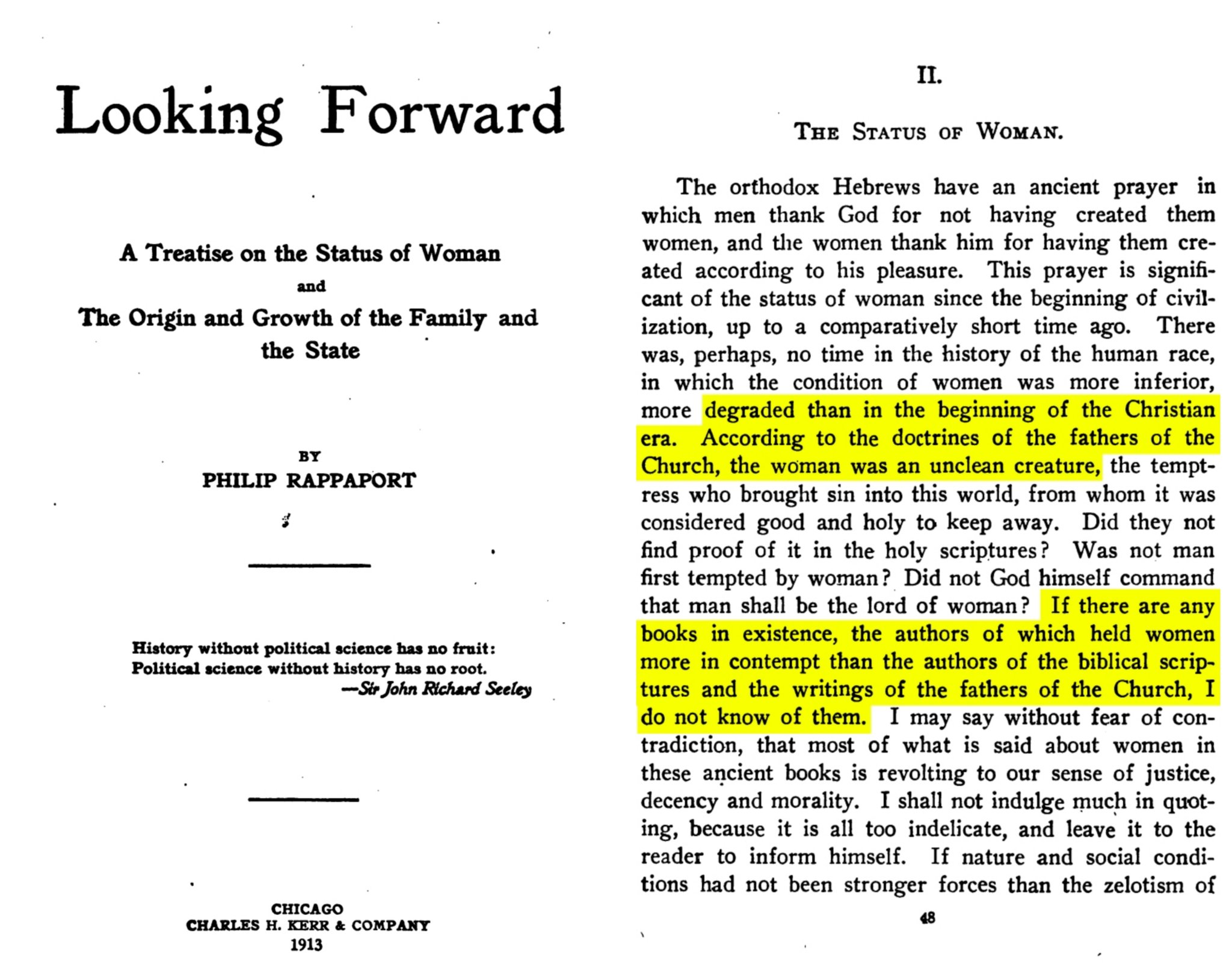
Philip Rappaport “If there are books in existence whose authors hold a more contemptuous view of women than the books of the Bible and the writings of the Church Fathers, I do not know them. The woman, according to the doctrines of the Church, is a body.”
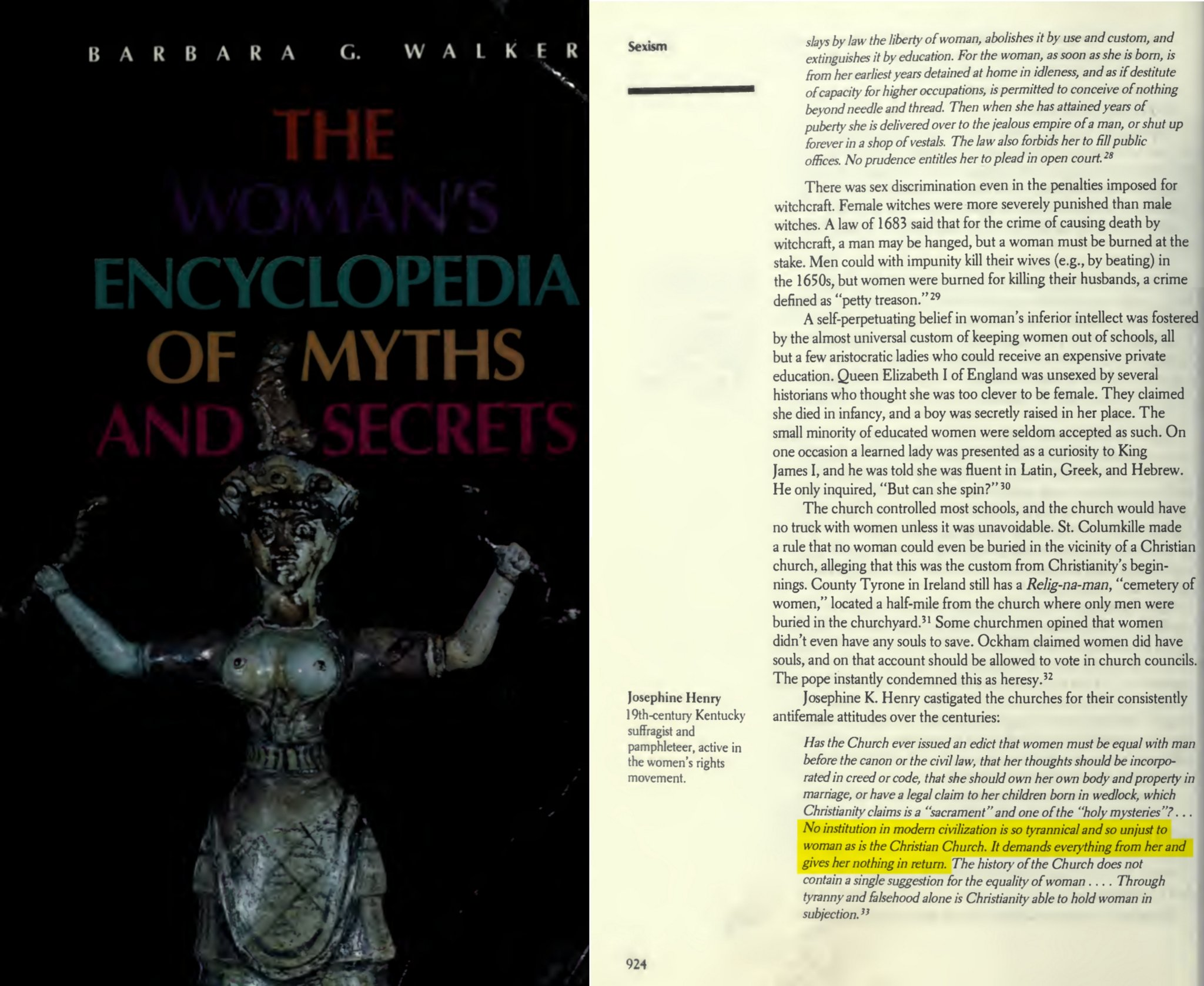
Barbara Walker “There is no institution in modern civilization like the Christian church in its level of tyranny and oppression of women — it demands everything from a woman and gives her nothing in return.”
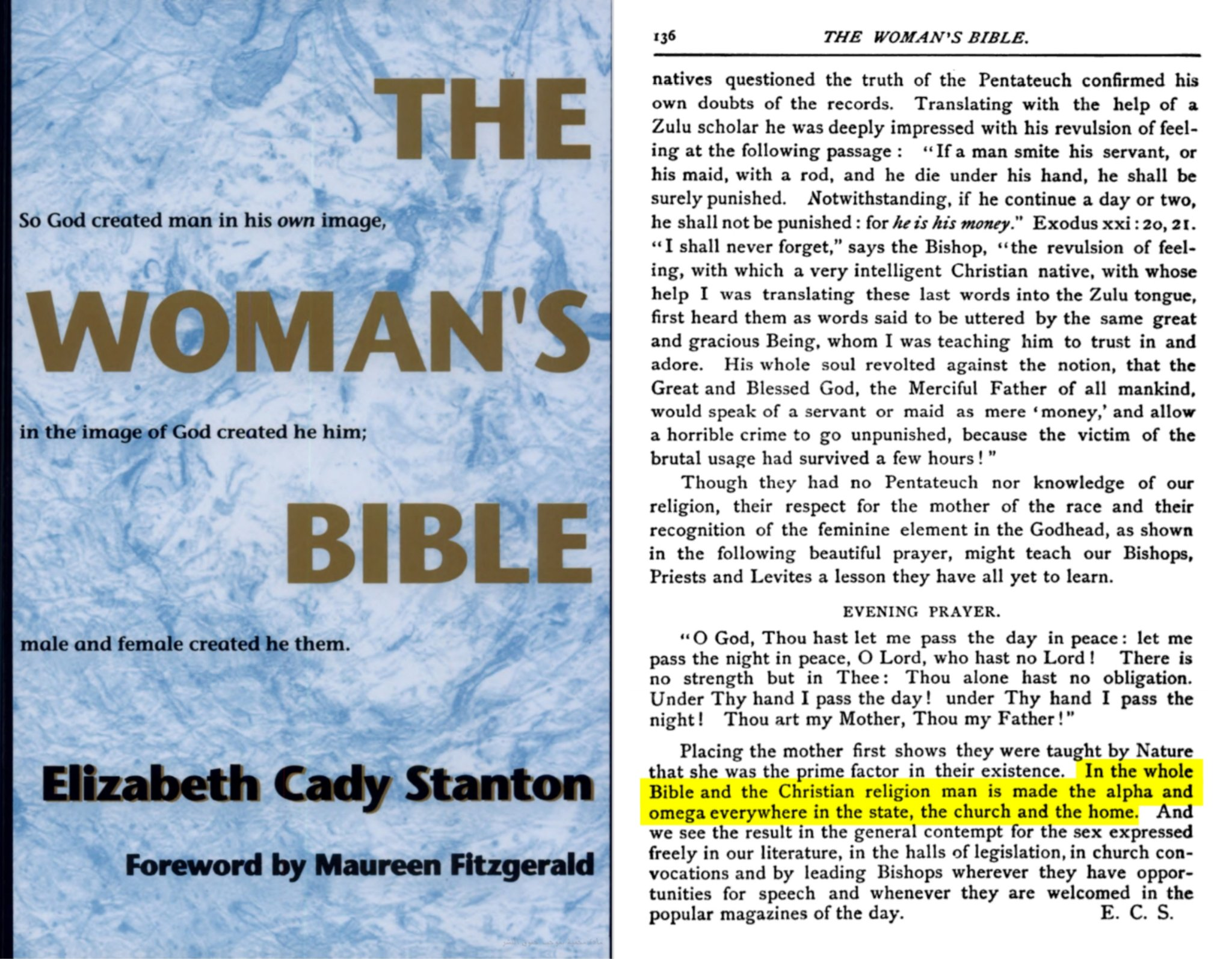
Elizabeth Cady Stanton “The entire Bible and the Christian religion make the man the first and the last in everything — in the home and the church.”
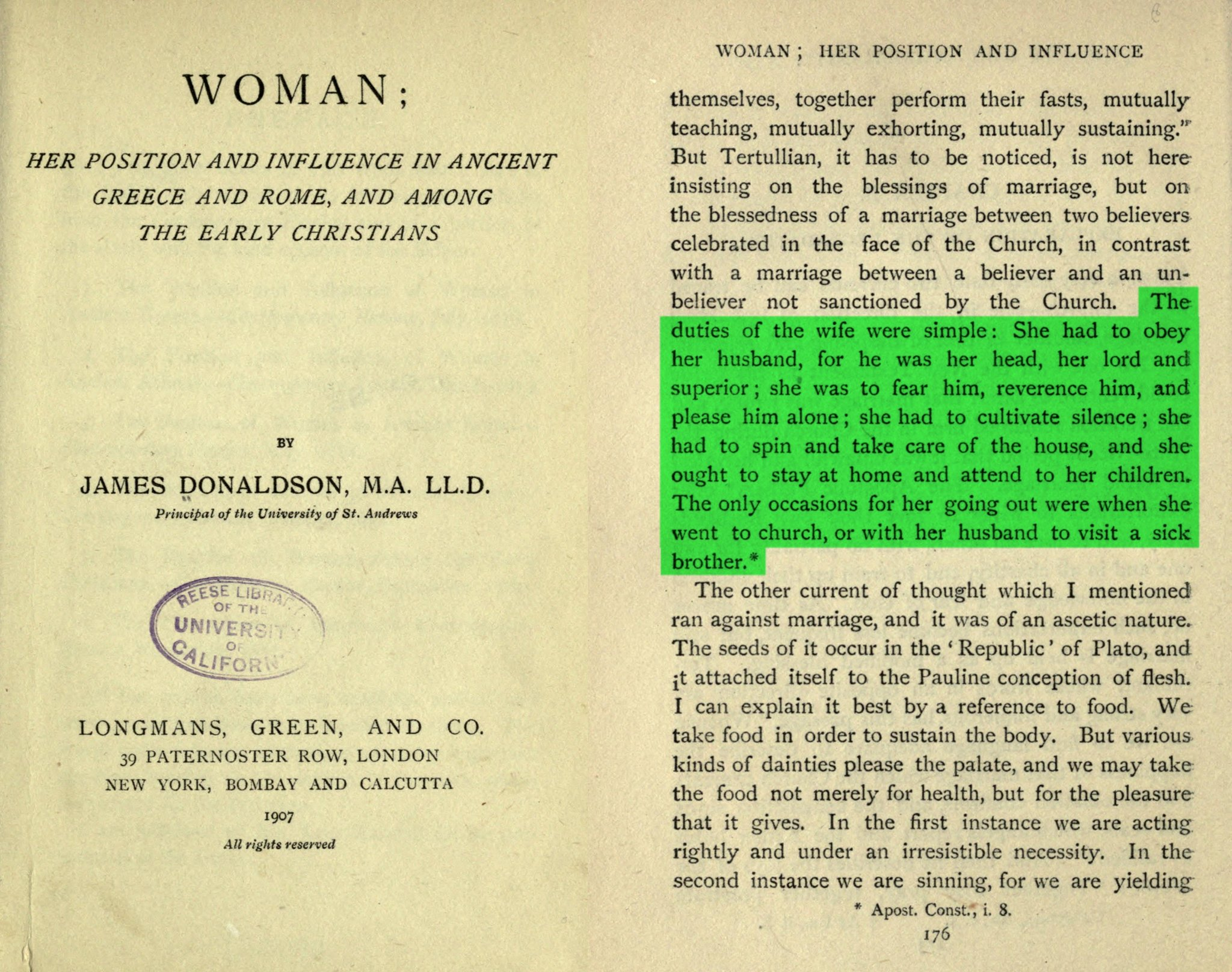
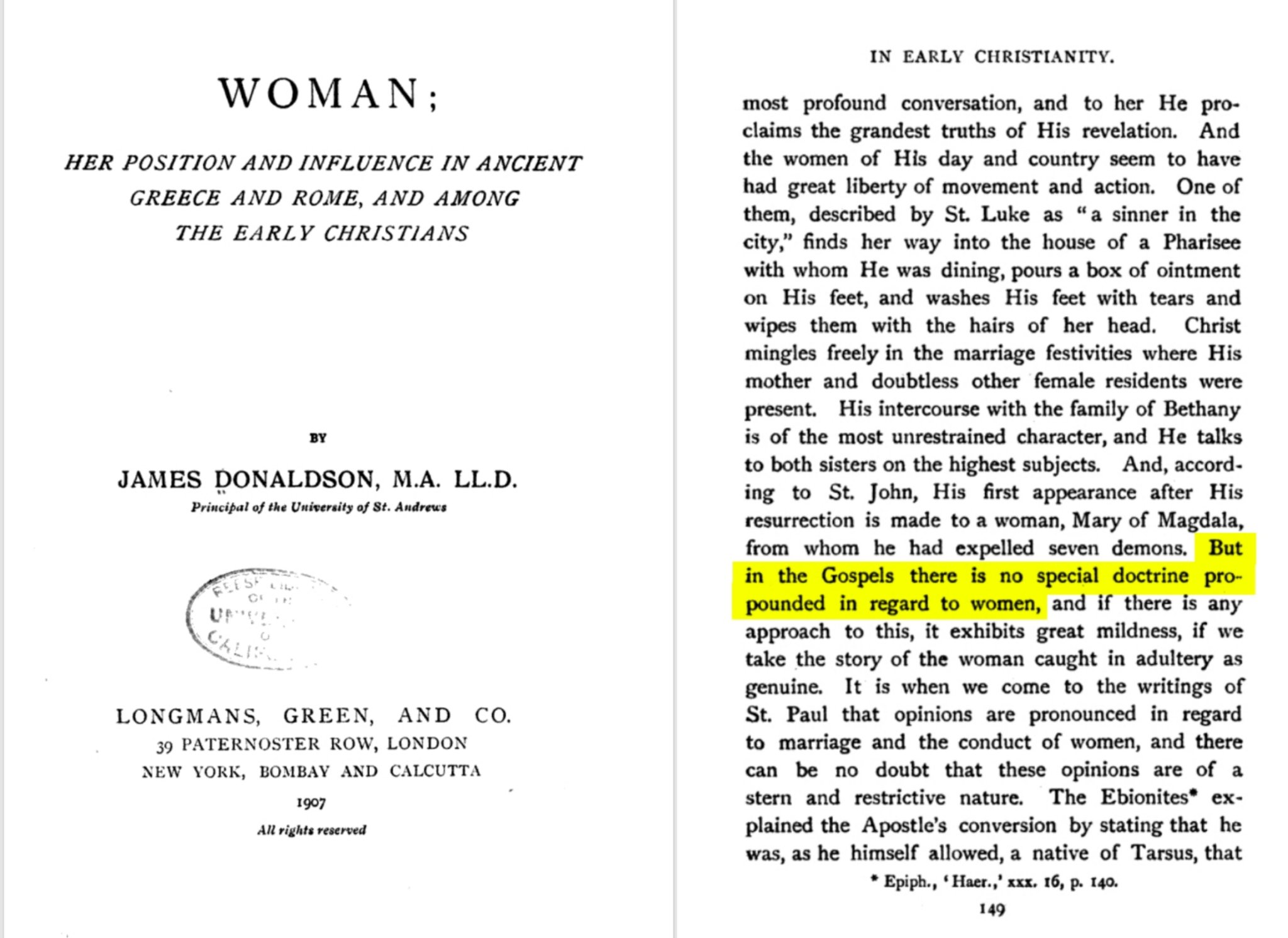
James Donaldson “There is no teaching or theory concerning the woman in the Holy Bible.”
Deuteronomy 22:28–29 (SVD) “If a man finds a young woman who is not engaged, and seizes her and lies with her, and they are found, then the man who lay with her shall give to the girl’s father fifty shekels of silver, and she shall be his wife — because he has humbled her, he may not put her away all his days.”
A woman who is raped is married to her rapist for fifty pieces of silver — and he may never divorce her.
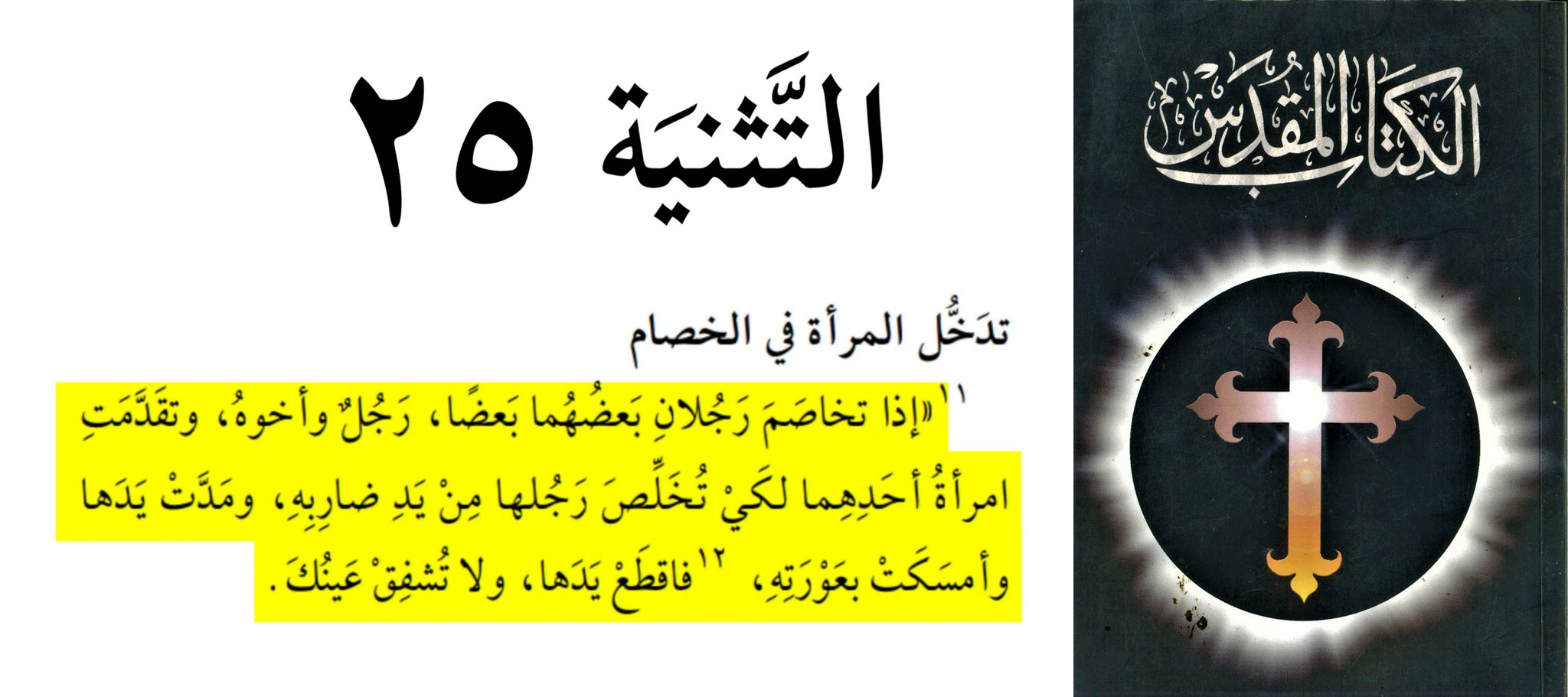
Deuteronomy 25:11–12 (SVD) “If two men strive together, one man and his brother, and the wife of the one draws near to deliver her husband from the hand of him who strikes him, and puts out her hands and seizes him by the private parts, then you shall cut off her hands, and your eye shall not spare.”
The Bible’s legislation commands the cutting off of the hand of a woman who tries to defend her husband in a fight. If she grabs the private parts of the man attacking her husband, her hand is cut off.
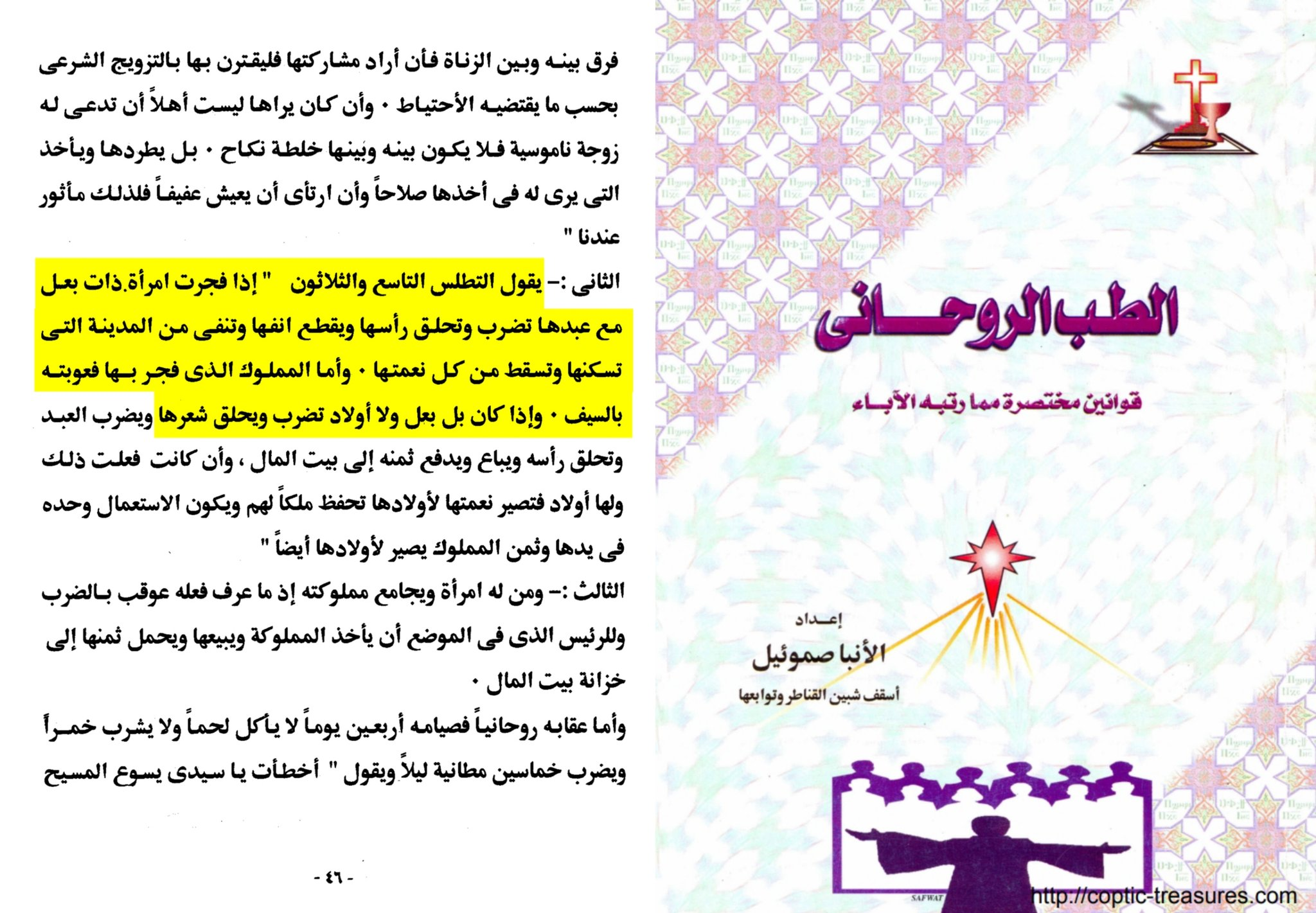
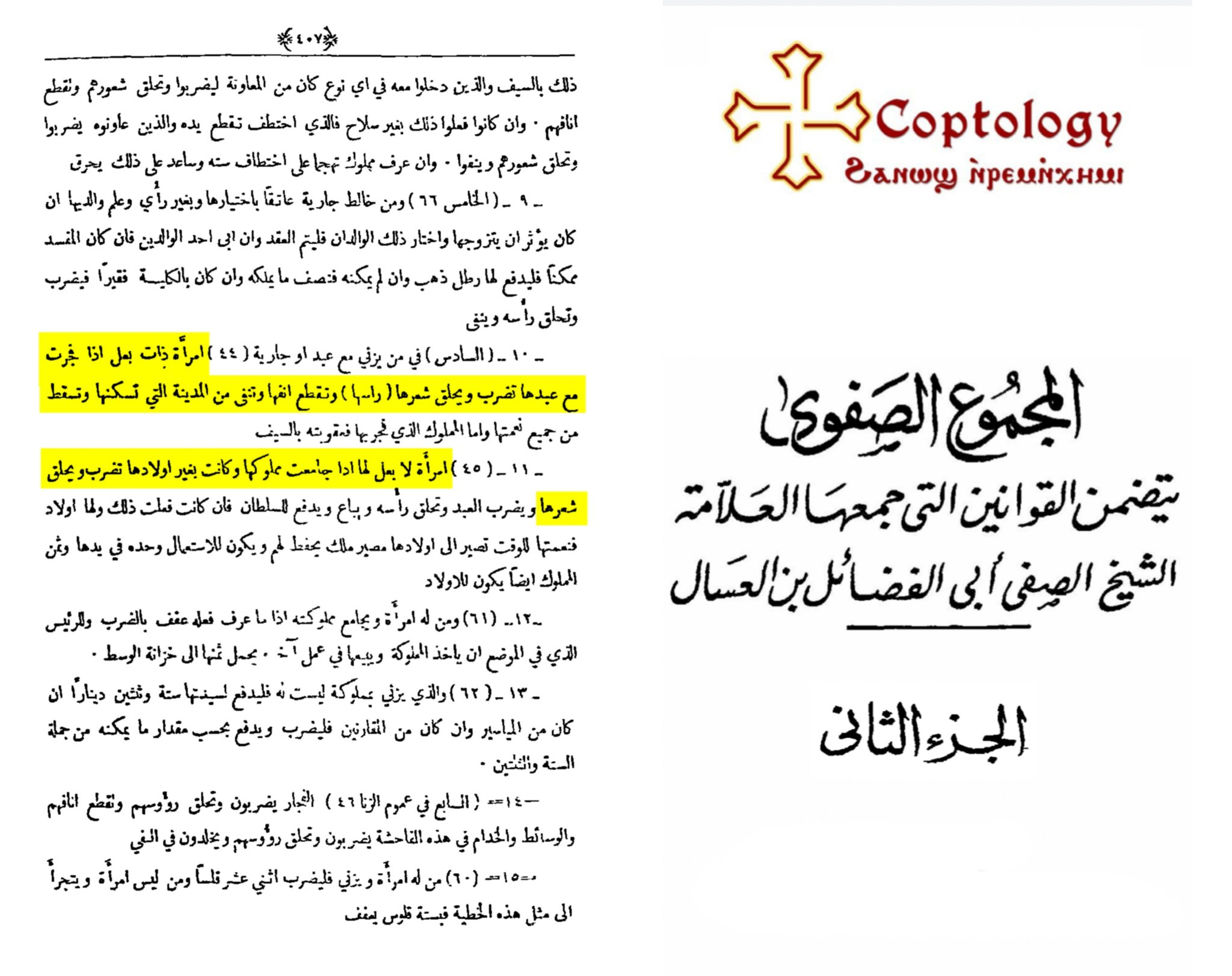
Regarding the Church’s law on adultery — a married woman who commits adultery with her slave is to be beaten, her hair shaved, her nose cut off, and she is to be banished from the city where she resides and stripped of all her privileges. An unmarried woman who has relations with her slave, if she has no children, is to be beaten and her hair shaved.
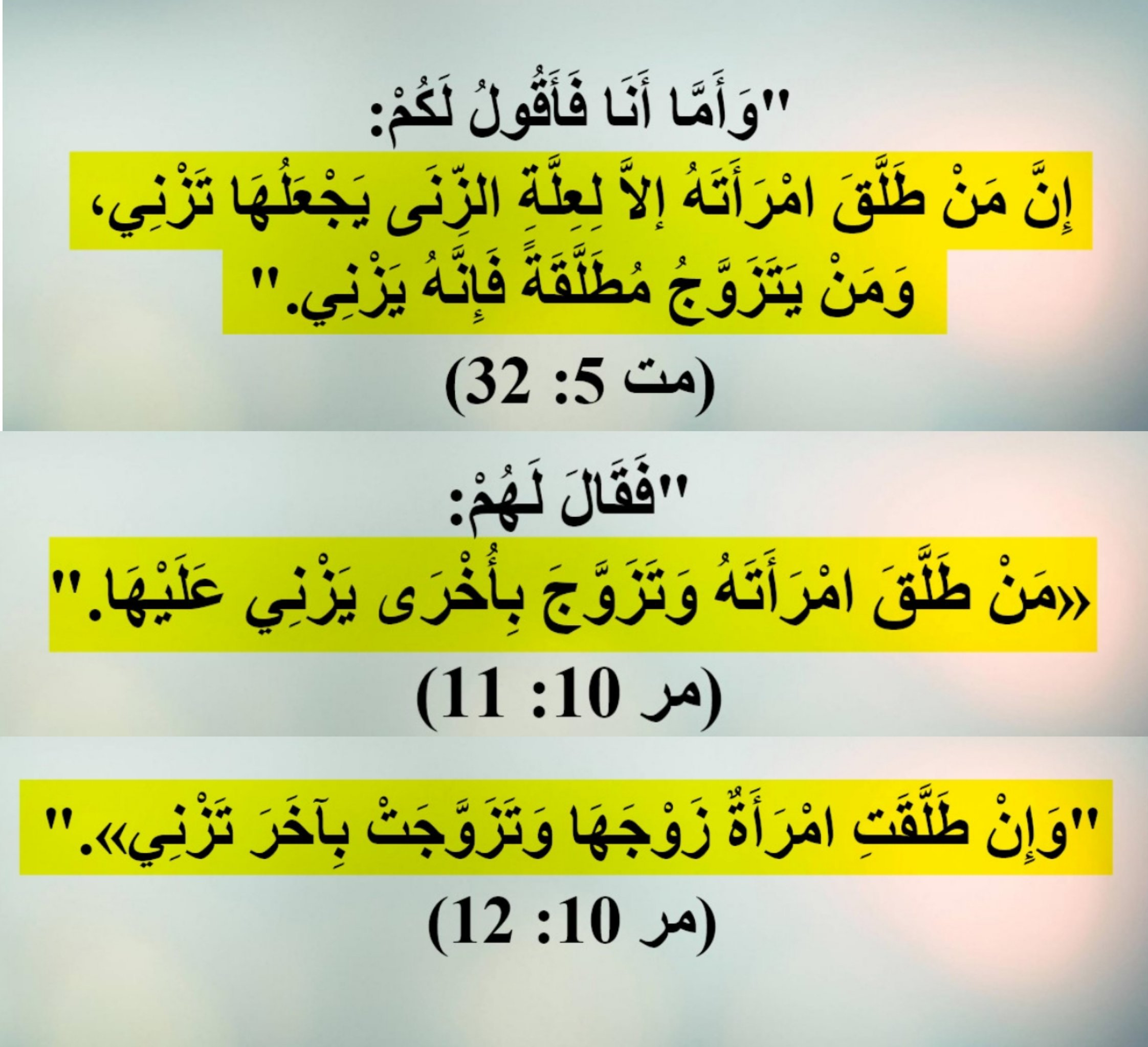
Divorce: a woman can only be divorced on the grounds of unchastity, and whoever marries a divorced woman commits adultery — so every divorced woman is an adulteress in this framework. There is great injustice and severe insult to the divorced woman in this.
Revelation 14:3–4 (SVD) “And they sang as it were a new song before the throne… And no one could learn the song except the hundred and forty-four thousand, which were redeemed from the earth. These are they who were not defiled with women, for they are pure.”
The condition for entering the kingdom is not to be defiled with women — and thus the kingdom is for men only. An open challenge: bring just one text saying that the believing Christian woman will enter the kingdom.
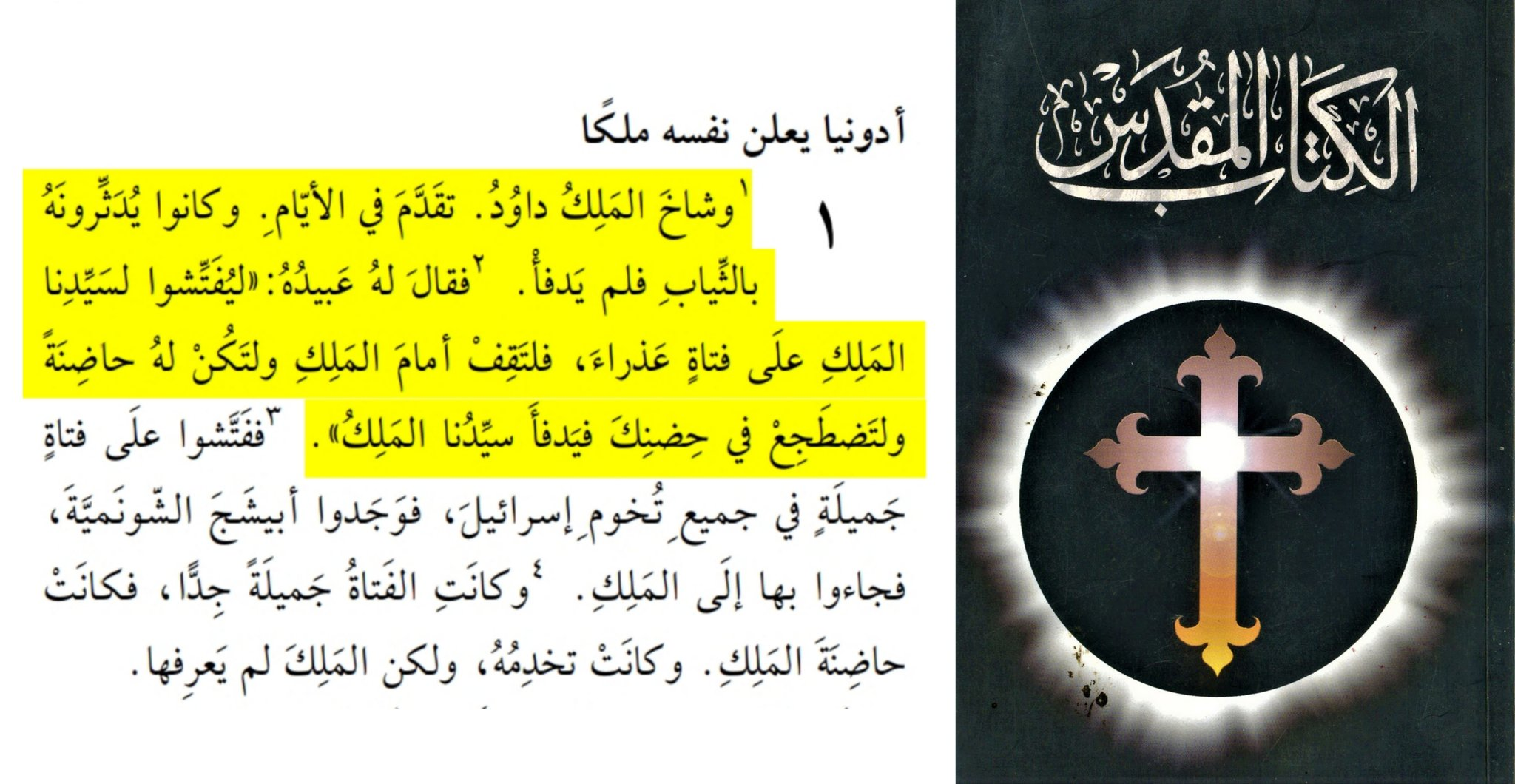
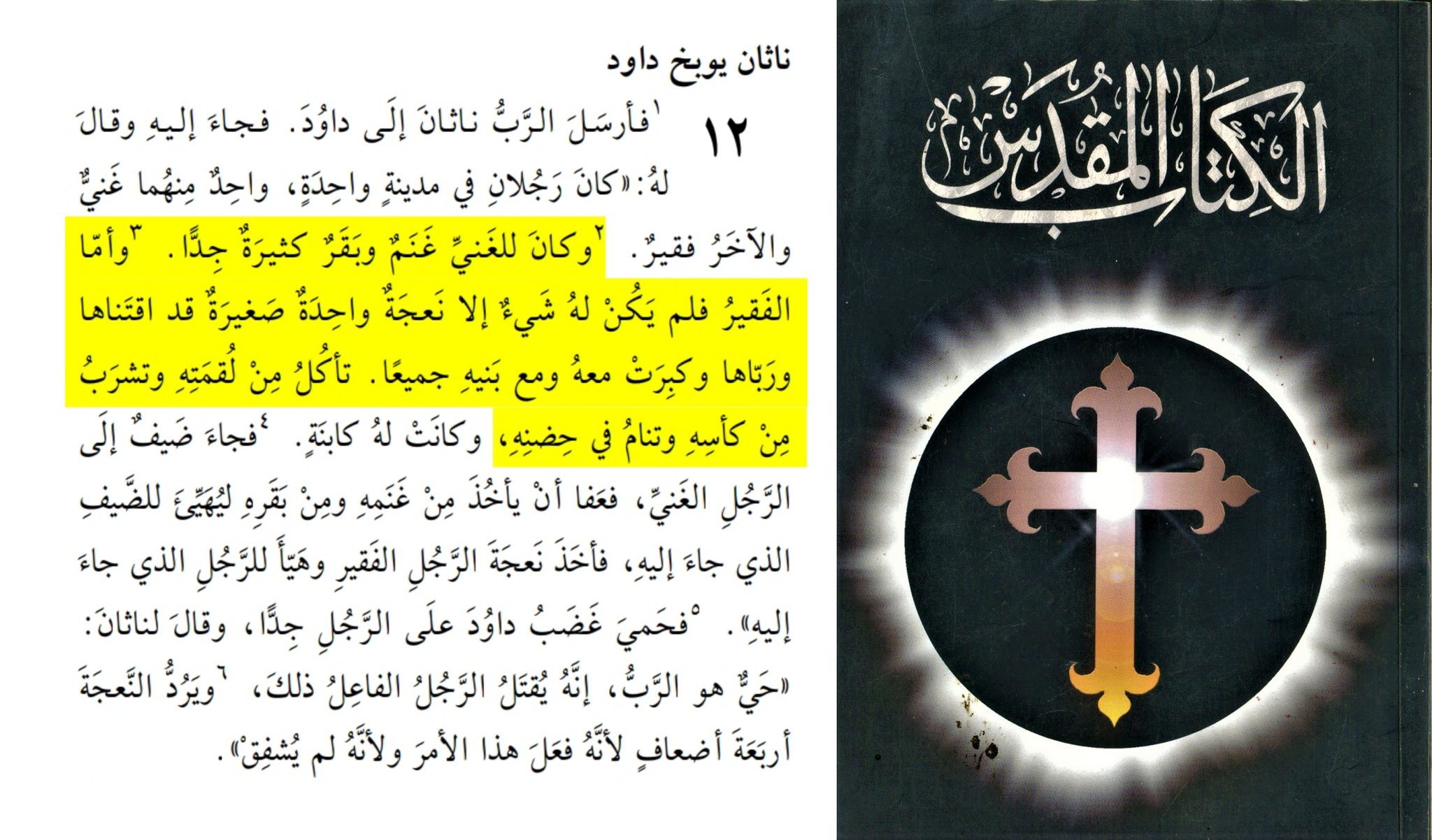
The Second Book of Samuel describes David’s many wives as numerous cows and sheep, and likens Bathsheba, the wife of Uriah the Hittite, to a ewe.
Among the advantages of a woman’s presence in the Bible: she is used as a heater in the cold.
1 Kings 1:1–3 (SVD) “Now King David was old and advanced in years, and they covered him with garments, but he was not warm. Then his servants said to him, ‘Let us seek a young virgin for our lord the king; let her stand before the king and nurse him, and let her lie in your bosom, that our lord the king may be warm.’ So they sought a beautiful young woman throughout all the coasts of Israel, and found Abishag the Shunammite, and brought her to the king.”
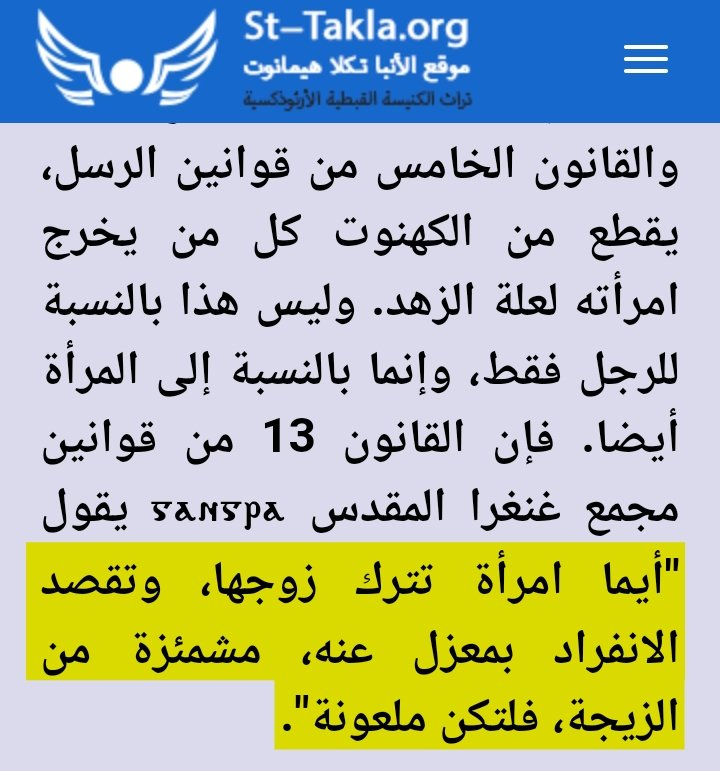
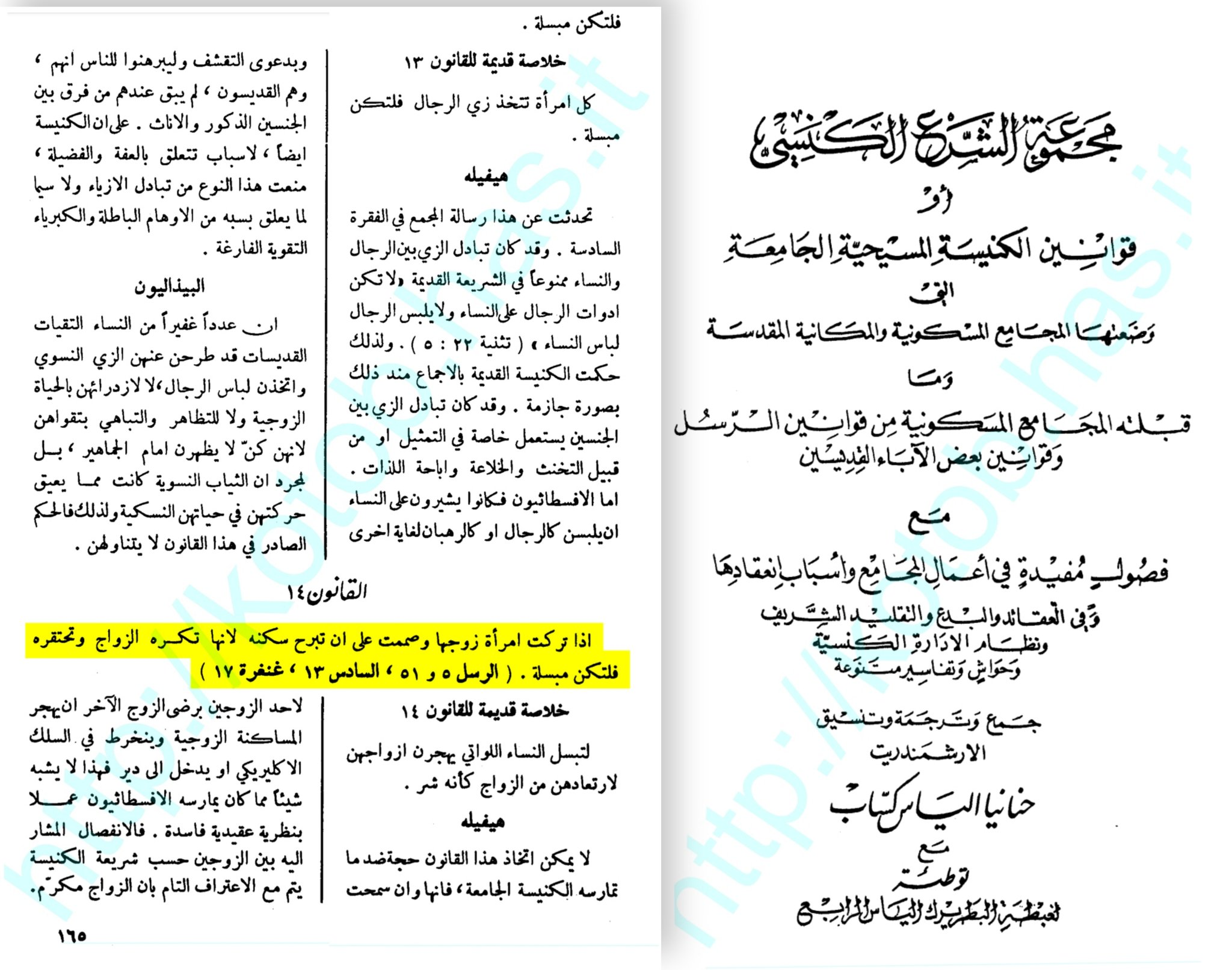
The Gangra Council’s thirteenth law: “A rebellious woman who abandons her husband and defies his authority shall be cursed.”
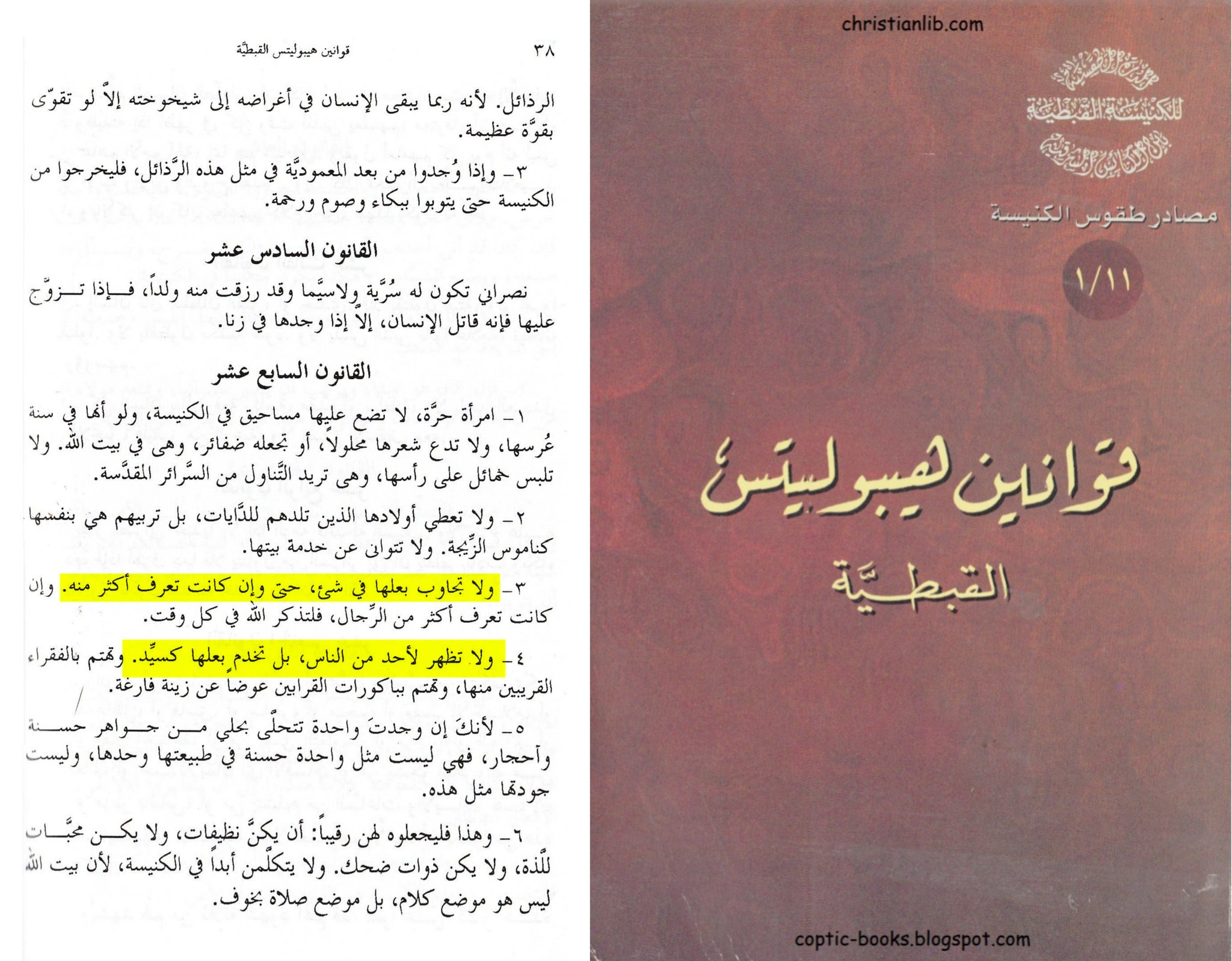
The Apostolic Canons: “A woman should obey her husband, fear him, honor him, and remain in the home without leaving it, while caring for the children. She is not permitted to go out except when going to church or with her husband to visit a sick brother.”
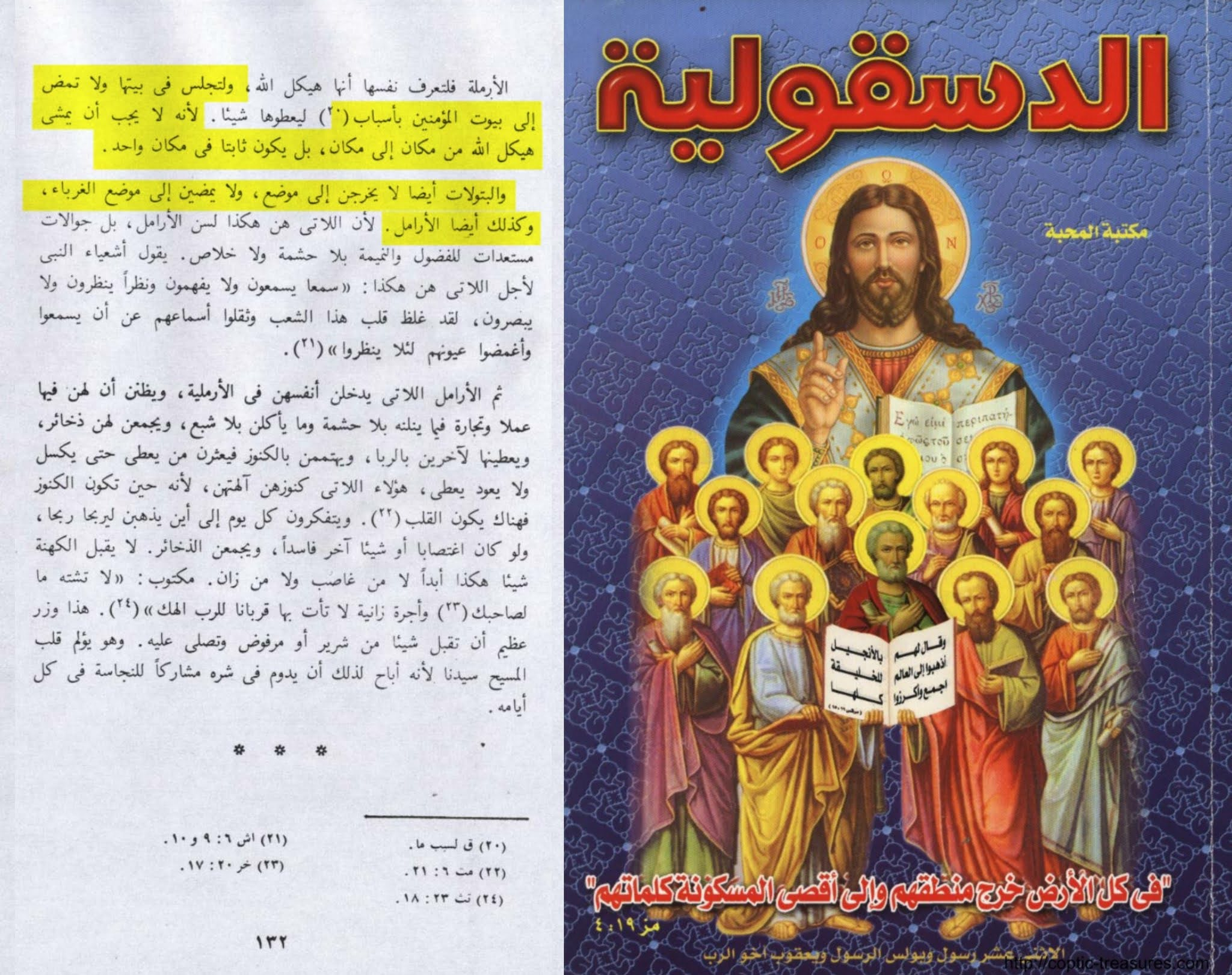
The Didascalia: “Let her sit in her home and not go to the houses of the believers for reasons. And the virgins, too, shall not go out to any place nor proceed to the place of strangers, and likewise also the widows.”
Saint Columkille declared a religious legislative rule that it is not permissible to bury women near the church — this is the custom of the church and Christianity since its inception. In the religion of the church, a woman is of low status alive and dead, bearing shame, disgrace, and impurity from her birth until she dies.
The Talmud on marriage age: “Our Rabbis taught: It is related of Justinia the daughter of Aseverus son of Antonius that she once appeared before Rabbi. She said to him, ‘At what age may a woman marry?’ ‘At the age of three years and one day,’ he told her. ‘And at what age is she capable of conception?’ ‘At the age of twelve years and one day,’ he replied.” Source: http://www.come-and-hear.com/niddah/niddah_45.html
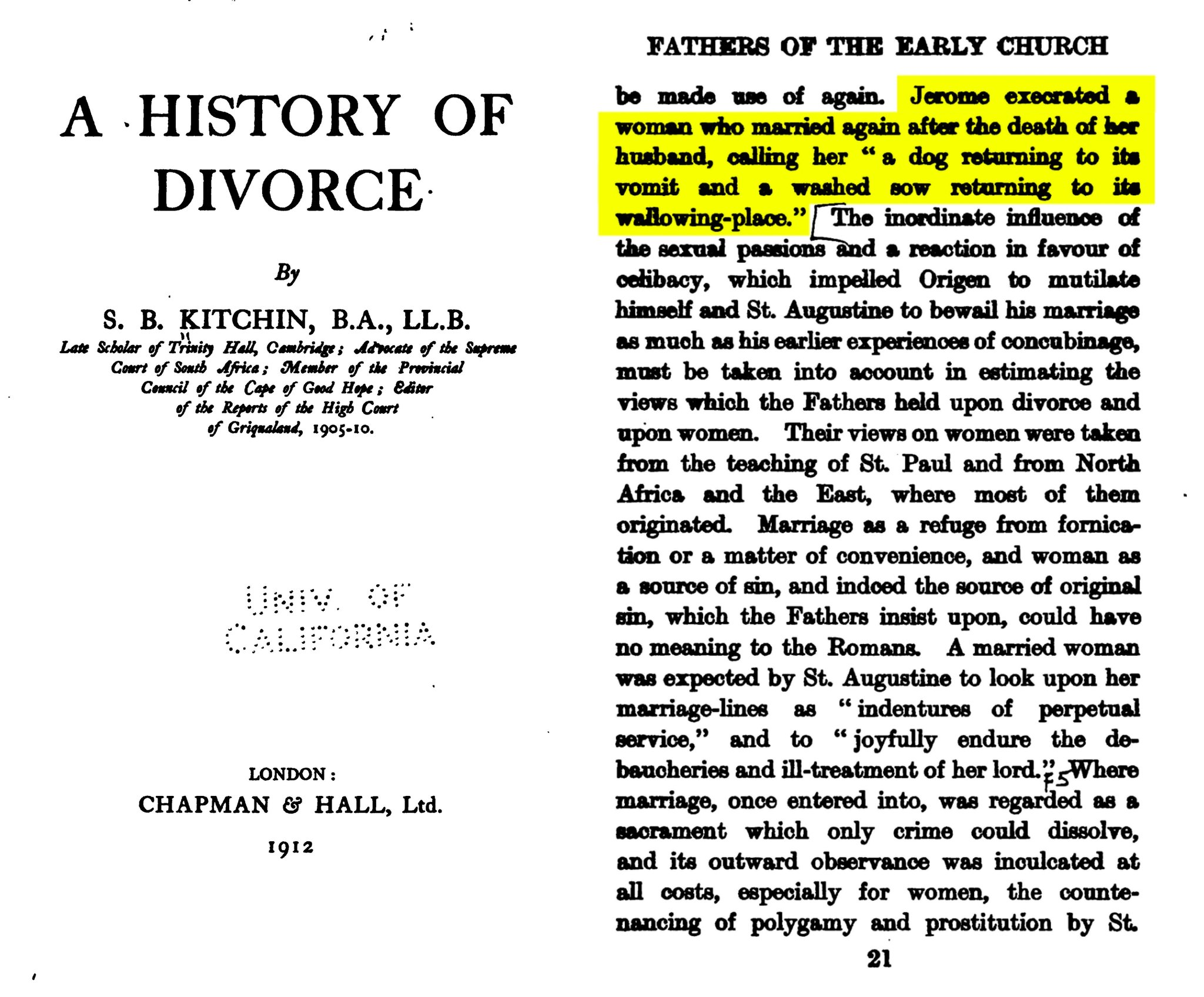
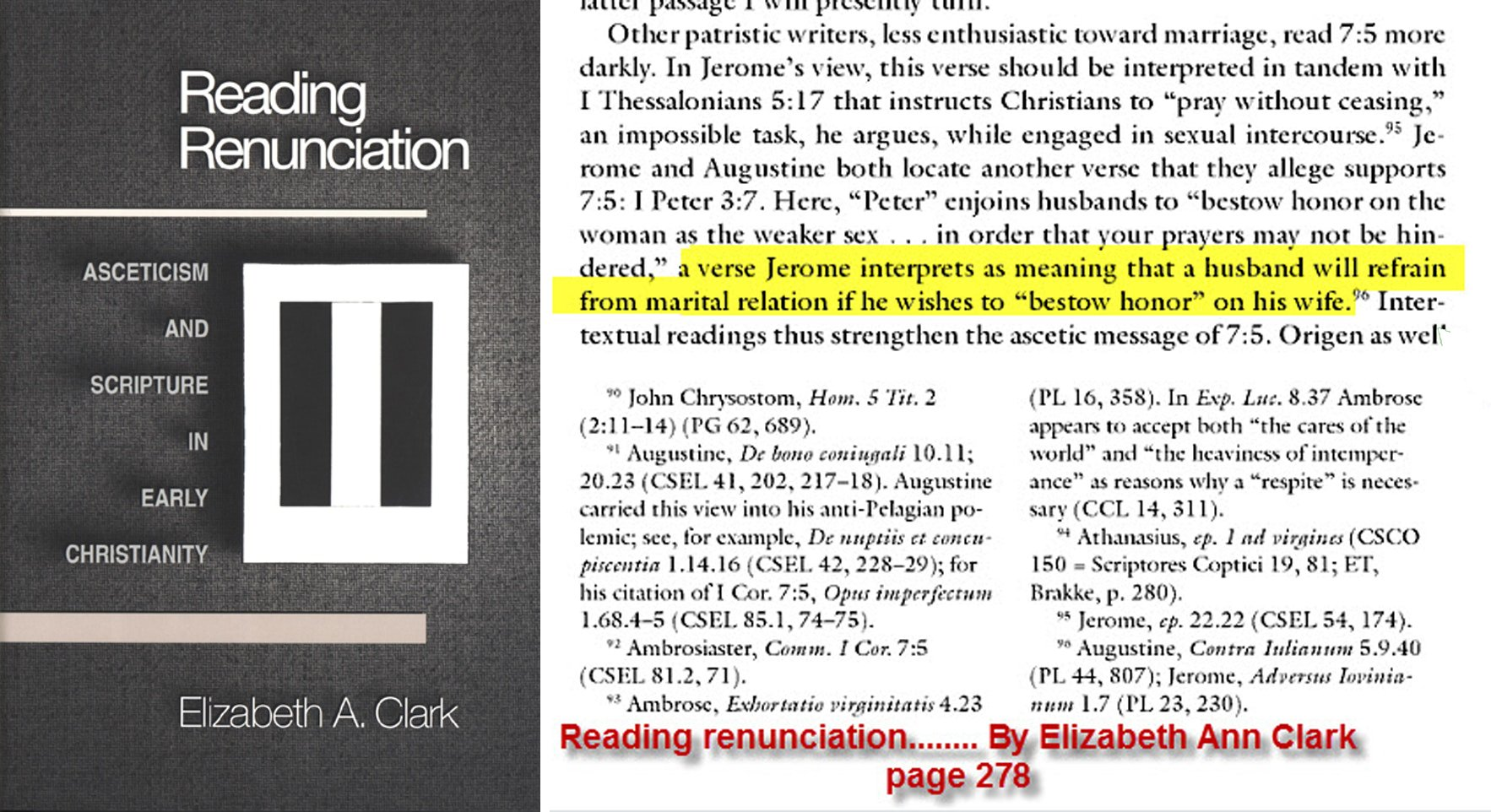
Saint Jerome “A man’s abstinence from his wife is the greatest honour to her. If a woman marries and then her husband dies, and she wishes to marry again, she is a dog — like a dog that returns to its vomit.”
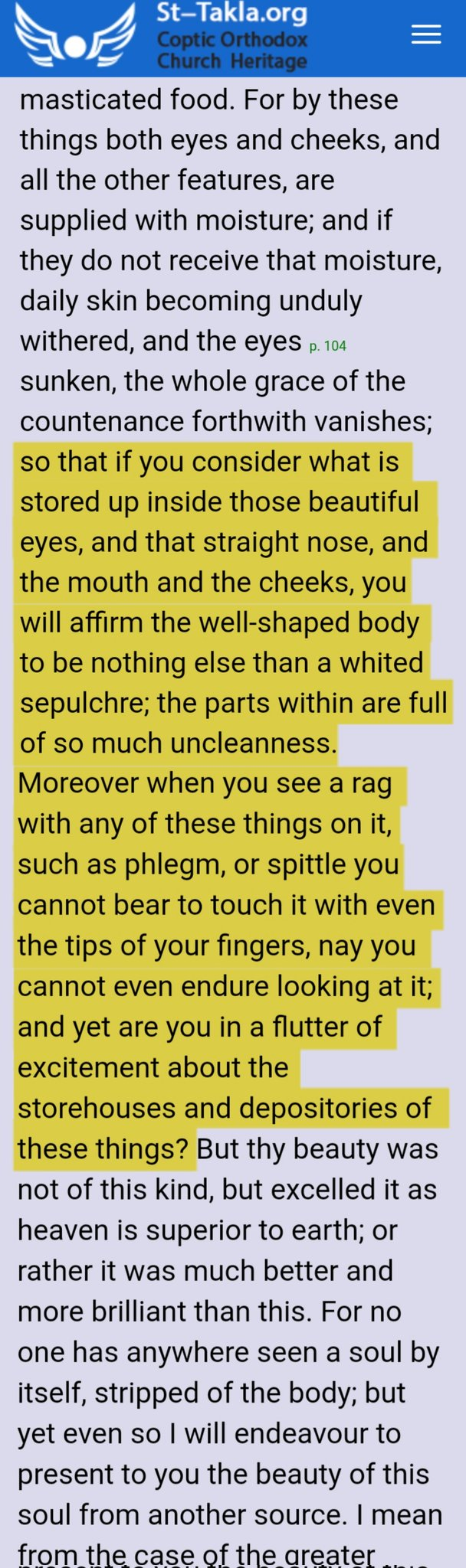
Saint John Chrysostom — letter to Theodore “If you contemplated what those beautiful eyes and cheeks conceal, you would be certain that a woman’s body is nothing but a whitewashed tomb, its parts filled with endless impurities. If you saw a rag filled with filth, you could not bear to touch it, so how can you be aroused by a woman, the storehouse of such things?”
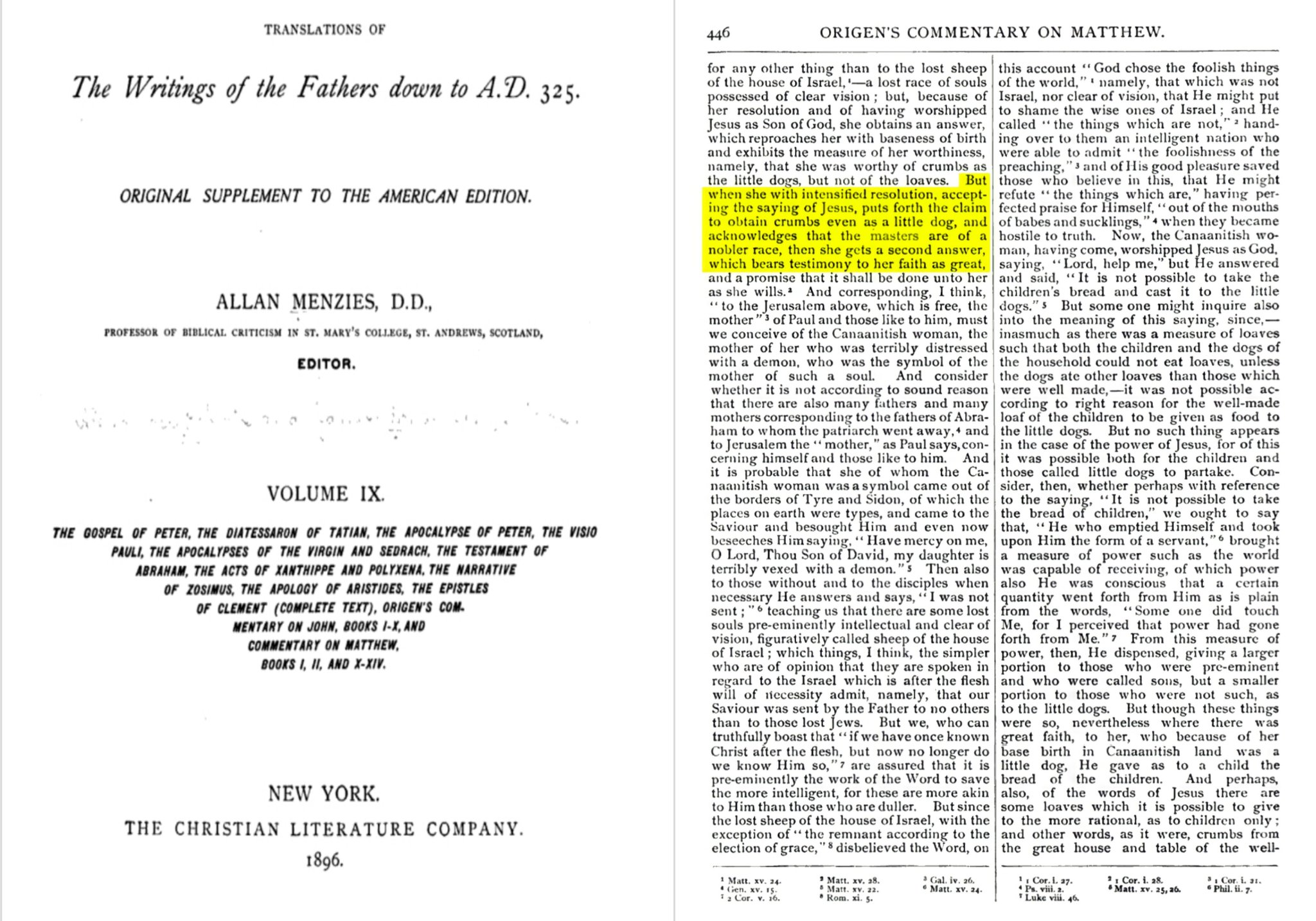
Origen — on the Canaanite woman “The Canaanite woman was not worthy of a response from Jesus because of her gender. But when she acknowledged that the masters are of the superior gender, she received a second response bearing witness to her faith, that it is great.”
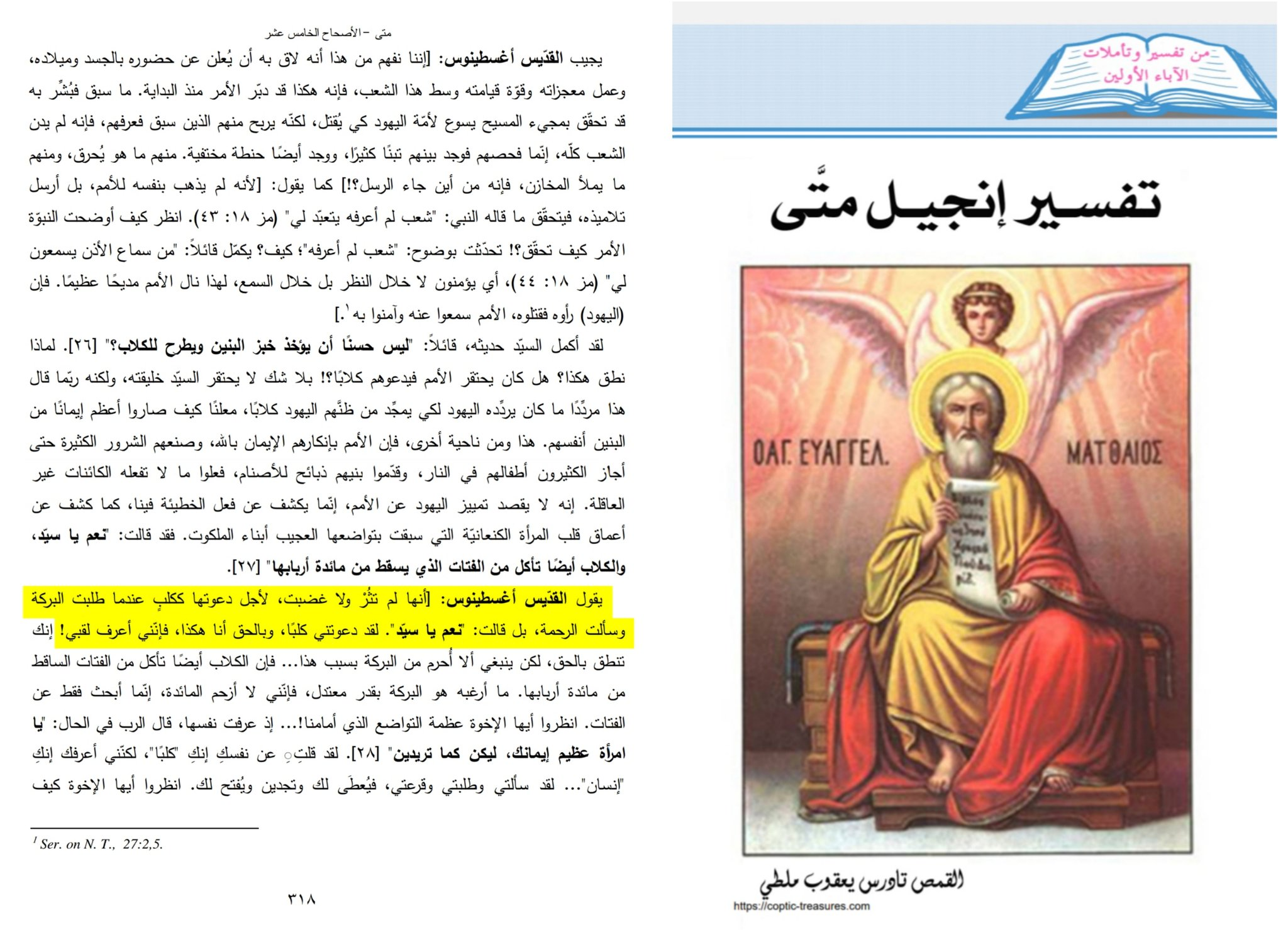
Saint Augustine — on the Canaanite woman “She was neither provoked nor angered because she was called a dog when she sought the blessing and asked for mercy, but said: Yes, Lord — You have called me a dog, and in truth, I am so, for I know my title.”
Saint Cyril of Alexandria — Introducing Feminist Theology “Truly, it is not a lie for one to say that women’s minds are feminine and that they have a feminine soul, so they cannot comprehend quickly.”
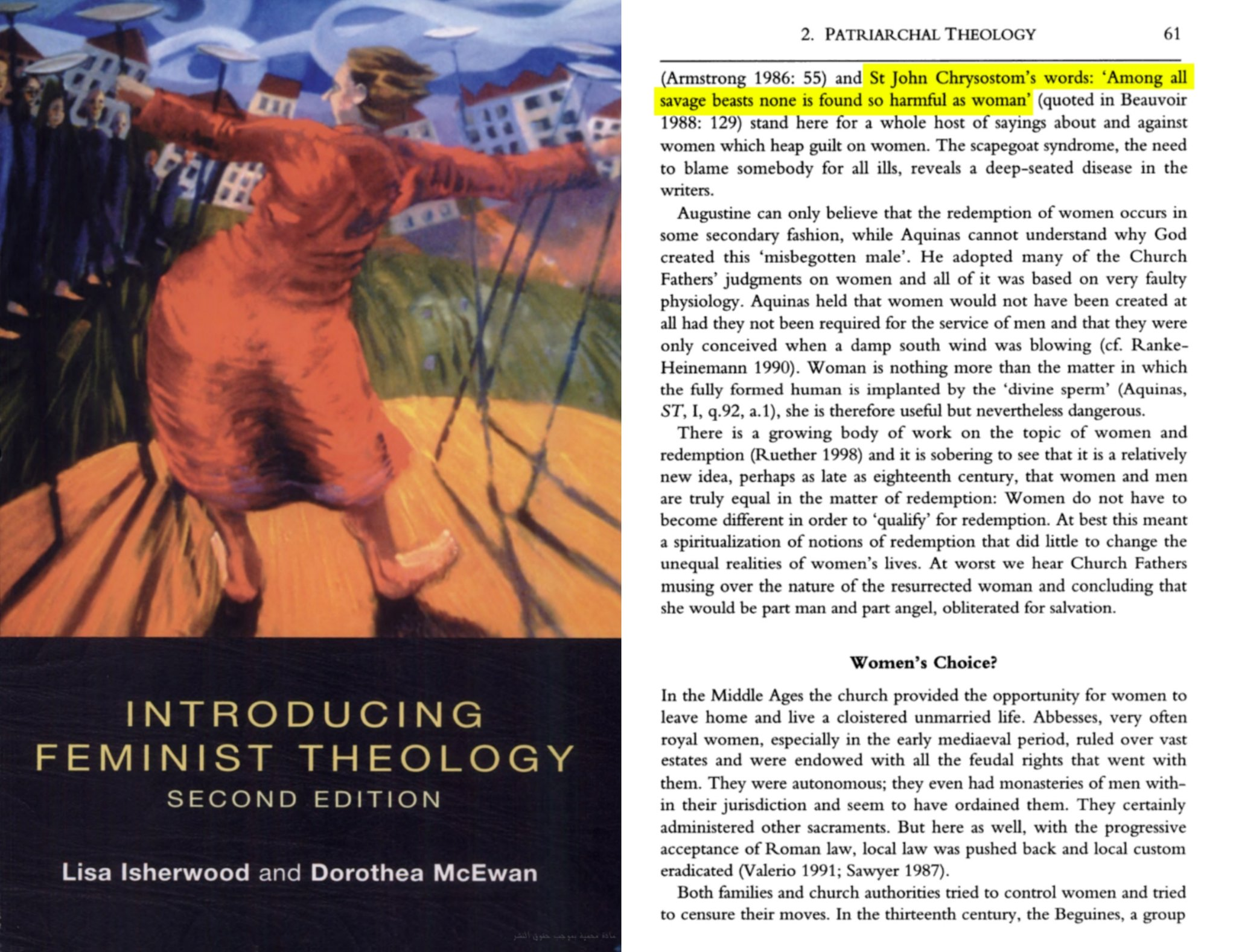
Saint John Chrysostom — Introducing Feminist Theology “Of all the predatory beasts, I have not found any more harmful than a woman.”
Saint John Chrysostom — Women in the Early Church “A wonderful comparison between the woman and the animal — he concluded that there is a strong distinction between women and animals. Just as the animal was created as a helper for man, so too was the woman created as a helper for man.”
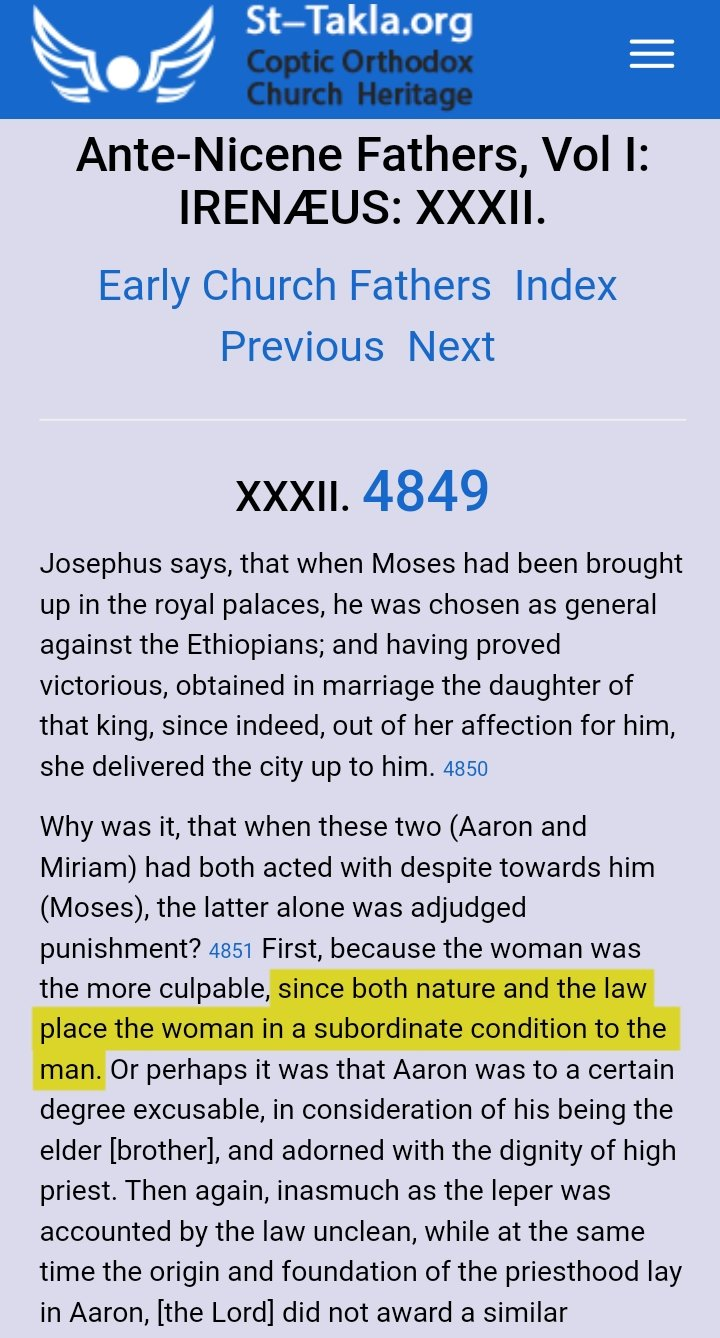
Saint Irenaeus — patristic sources “The natural and divine law place the woman in a rank lower than the man.”
Saint Thomas Aquinas “It was not fitting to create anything at the beginning of the foundation that has a defect or deceit — therefore it was necessary not to create woman at that time.”
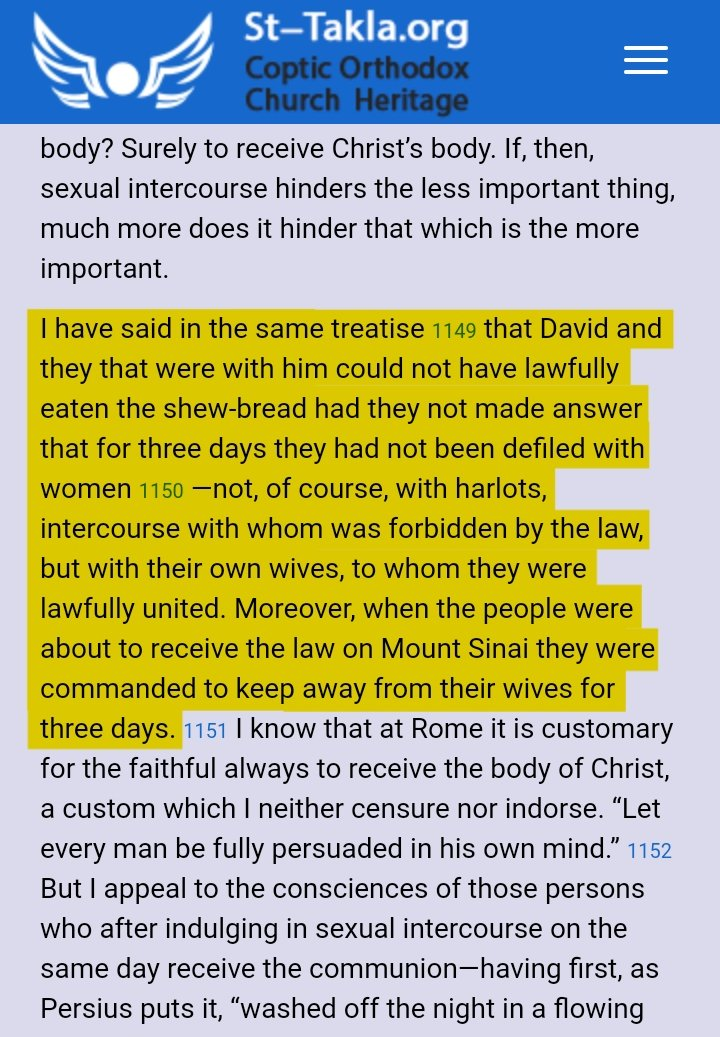
Jerome also noted: David and those with him would not have been able to eat the bread of the Presence if they had not answered that they had not been intimate with women for three days — meaning with their lawful wives. Similarly, when the people were about to receive the Law on Mount Sinai, they were commanded to stay away from their wives.
Revelation 14:4 (SVD) “These are the ones who were not defiled with women, for they are pure.”
In a clear reference that the woman is the source of defilement — and whoever mingles with her becomes defiled. These pure ones are the virgins who were not defiled by marrying.
FE5nHQrX0AIRmKk 5812c4a5c0087cb7FE5mqbdWUAc2H c 69433621781b482aFE5nQgCXIAAgykW 8db8feb43e7a9c7aFEKJo yWUAEgdGk d42de1b0d8612da1FE6cLWIXsAowXqq 48e90dc8d7fc55b3FEGWL8PXIAk44Ih e0e3f3f2e84fd5bfFSQVrX1XIAAtqLg 406d98eeab8850e4FSQAc4NXwAAeHXN a68266883bed8243Cyril on women's minds being feminine and slowThomas Aquinas on reason for man's authorityE dyRt7XEAQtewk 15ab58c09afeaf49
The Islamic Position — A Contrast
The Messenger ﷺ allocated a specific day for women to teach them matters of religion. A woman came to him and said: “O Messenger of Allah, the men have taken your talk, so allocate a day for us from yourself to come to you, so teach us from what Allah has taught you.” He said: “Gather on such and such a day, in such and such a place.” So they gathered, and the Messenger of Allah ﷺ came to them and taught them from what Allah had taught him. He then said: “There is no woman among you who brings three of her children before her, except that they will be a veil for her from the Fire.” One of them said: “O Messenger of Allah — and two?” He repeated it twice, then said: “And two and two and two.”
Grade: Sahih
Many of the scholars of Islam were taught by women. ‘Umar ibn al-Khaṭṭāb said: “In the pre-Islamic era, we did not consider women anything, but when Islam came and Allah mentioned them, we saw that they had a right over us.”
We ask our Christian friends:
First: Jesus had how many female disciples?
Second: Did Jesus allocate a day for women to teach them matters of religion?
Third: Which of the Church Fathers was taught by a woman?
The Church Fathers, the Reformers, and the biblical text itself present a portrait of woman that is uniform across centuries: excluded from the image of God, created solely for procreation, inferior in intellect, a source of defilement and temptation, subject to perpetual punishment and submission, bought and sold, beaten by ecclesiastical permission, and barred from speech in the assembly. This is the position of Augustine, Thomas Aquinas, Jerome, Chrysostom, Tertullian, Clement of Alexandria, Ambrose, Calvin, Luther, Origen, Cyril, Epiphanus, Irenaeus, Boethius, and Gregory of Tours — unanimously and across denominations. The biblical text that underlies these views places a wife among a man’s possessions alongside his ox and donkey, commands the hand of a woman who defends her husband be cut off, requires a rape victim to marry her rapist, and declares that only those not defiled with women will enter the kingdom. This is not an aberration. It is the documented mainstream of Christian patristic thought.