Violence and Killing in the Bible: A Complete Verse-by-Verse Record
·63 min read·14100 words
This post documents, without omission, every command to kill, execute, massacre, or wage war found across the books of the Old Testament — from Genesis through Second Chronicles. It is a response to Christian missionary sites that issue warnings about hellfire and eternal torment while presenting the Bible as the sole “book of salvation.” The contrast between that framing and the actual contents of the Biblical text is the subject of this article. Before beginning, we apply the framework that an experienced priest himself recommended for reading the Bible:
A Priest’s Framework for Reading Scripture A. What is the content of this section — what does it say? B. What meanings are contained in it? C. What does this section mean to me personally? D. Did I benefit from reading it in a way that helps me apply it in my practical life? E. Does this help me live a better life, and replace my bad habits with habits and behaviors that please God and people?
We apply this framework faithfully throughout.
The “Do Not Kill” Commandment and Its Immediate Contradiction
The sixth of the Ten Commandments — received by Moses — states simply: “Do not kill.” The question immediately arises: does this commandment completely prohibit killing in all its forms?
There are those who argue it is a clear, unconditional prohibition. Others limit it to murder of individuals. Still others argue it permits killing under certain conditions. One of the most frequently cited textual features of the Hebrew Bible is its grammatical distinction between singular and plural forms — the commandments “Do not swear by the name of the Lord your God in vain — Do not kill — Do not commit adultery — Do not steal” are directed at the individual singular.
What is stranger still is that within the same Book of Exodus — in the very chapter following the Ten Commandments — we already find explicit death penalty rulings:
Exodus 21:12 (KJV) “Whoever strikes a man so that he dies shall be put to death.”
This raises a direct logical contradiction: how do the books of the Law carry commandments that prevent the application of the law? How does a legal code carry judgments against those who violate its own commandments, when the commandment itself says “Do not kill”? If Christianity denies the teachings found in both testaments — treating them as abrogated — this would constitute abrogation of rulings. Yet neither Judaism nor Christianity formally accepts the principle of abrogating and abrogated texts.
Genesis: Massacre at Shechem
Genesis 34:25 (KJV) “And it came to pass on the third day, when they were sore, that the two sons of Jacob, Simeon and Levi, Dinah’s brothers, took every man his sword, and came boldly upon the city, and slew all the males.”
Genesis 34:27 (KJV) “Then the sons of Jacob came upon the slain, and plundered the city, because they had defiled their sister.”
Exodus: Infanticide, Firstborns, Death Penalties
Exodus 1:16 (KJV) “And he said, When ye have brought forth the Hebrew women, and see them upon the birth-sits, if it is a son, then kill him: but if it is a daughter, then let her live.”
Exodus 13:2, 13–15 (KJV) “Sanctify to me all the firstborn, every opening of the womb among the children of Israel, both of man and of beast; it is mine.”
“But every firstborn of a donkey you shall redeem with a lamb; and if you do not redeem it, then you shall break its neck. And every firstborn of a man among your sons you shall redeem. And it shall come to pass, when your son asks you in time to come, saying, What is this, then you shall say to him, With a strong hand the LORD brought us out of Egypt, out of the house of bondage. And it came to pass, when Pharaoh was stubborn about letting us go, that the LORD killed all the firstborn in the land of Egypt, both the firstborn of man and the firstborn of beast. Therefore I will sacrifice to the LORD the males of every opening of the womb, and I will redeem all the firstborn of my sons.”
Moses offered human sacrifices from his own people — every firstborn — while redeeming his own sons.
Exodus 4:24 (KJV) “And it came to pass by the way in the inn, that the LORD met him, and sought to kill him.”
Exodus 19:12 (KJV) “And you shall set boundaries for the people on every side, saying, Take heed that you do not go up to the mountain, or touch the edge thereof: for whosoever toucheth the mountain shall surely be put to death.”
The following texts expand the death penalties in Exodus 21–23:
Exodus 21:14–17 (KJV) “And if a man shall presume to kill his neighbor treacherously, thou shalt take him from my altar to die.” (v. 14)
“And whoever strikes his father or his mother shall surely be put to death.” (v. 15)
“And whoever steals a man and sells him, or if he is found in his possession, he shall surely be put to death.” (v. 16)
“And whoever curses his father or his mother shall surely be put to death.” (v. 17)
Exodus 21:18–22 (KJV) “If two men quarrel and one strikes the other with a stone or with his fist, and he does not die but remains in bed, if he rises up one day and walks outside on his staff, the one who struck him shall not be punished, but he shall pay him for the time he has been away from work and shall pay for his medical expenses. If a man strikes his male or female servant with a rod, and they die under his hand, he shall be avenged. But if he lives a day or two, he shall not be avenged, for the male servant is his property. If there is a quarrel and one of them strikes a pregnant woman and the fetus is lost without any other harm, the one who struck shall pay the fine that the woman’s husband imposes on him with the consent of the judges.”
Exodus 21:29, 32 (KJV) “But if the ox has been a goring bull before, and its owner has been given a witness, and he has not restrained it, and it kills a man or a woman, the ox shall be stoned, and its owner also shall be put to death.” (v. 29)
“And if he gore a male or female servant, he shall give to his master thirty shekels of silver, and the bull shall be stoned.” (v. 32)
Exodus 22:19 (KJV) “Anyone who lies with an animal shall surely be put to death.”
Exodus 22:24 (KJV) “Then my anger will be kindled, and I will kill you with the sword; your wives will become widows, and your children will become orphans.”
Exodus 22:28–31 (KJV) “Do not curse the judges, nor curse the princes of your people. Do not delay to bring the firstfruits of your threshing floor and your winepress, and give me the firstborn of your sons. Do the same with your herds and your flocks. You shall leave the firstborn with its mother for seven days, and on the eighth day you shall present it to me. You shall be a holy people to me. Do not eat the flesh of what is torn in the desert, but throw it to the dogs as food.”
Exodus 23:23 (KJV) “For my angel will go before you and bring you in against the Amorites, Hittites, Perizzites, Canaanites, Hivites, and Jebusites; and I will destroy them.”
Leviticus: An Exhaustive List of Death Penalties
The following are all taken from Leviticus and represent the full catalogue of capital offences in the Law:
Leviticus 20:2 (KJV) “Every man of the children of Israel, or of the strangers who sojourn in Israel, who gives any of his seed to Molech, shall be put to death. The people of the land shall stone him with stones.”
Leviticus 20:9–16 (KJV) “Whoever curses his father or his mother shall surely be put to death.” (v. 9)
“And if a man commit adultery with another man’s wife, even if he commits adultery with his neighbor’s wife, both the adulterer and the adulteress shall surely be put to death.” (v. 10)
“And if a man lie with his father’s wife, he hath uncovered his father’s nakedness: both of them shall surely be put to death: their blood shall be upon them.” (v. 11)
“And if a man lie with his daughter-in-law, both of them shall surely be put to death; they have committed an outrageous thing; their blood shall be upon them.” (v. 12)
“And if a man lie with mankind, as he lieth with a woman, both of them have committed an abomination: they shall surely be put to death: their blood shall be upon them.” (v. 13)
“And if a man lie with a beast, he shall surely be put to death; and you shall kill the beast.” (v. 15)
“And if a woman come near to any beast to lie down with it, then thou shalt kill both the woman and the beast: they shall surely be put to death; their blood shall be upon them.” (v. 16)
Leviticus 20:27 (KJV) “And if there be a medium or a wizard among a man or a woman, they shall surely be put to death; they shall stone them with stones; their blood shall be upon them.”
Leviticus 23:30 (KJV) “And every soul that shall do any work that same day, that soul will I destroy from among his people.”
Leviticus 24:16–17 (KJV) “And he that blasphemeth the name of the LORD shall surely be put to death: all the congregation shall surely stone him. Both the stranger and the native, when he blasphemeth the name, shall be put to death.” (v. 16)
“And if anyone kills a man, he shall be put to death.” (v. 17)
Leviticus 24:21 (KJV) “Whoever kills an animal must make restitution for it, and whoever kills a human must be put to death.”
Leviticus 26:6, 44 (KJV) “And I will give peace in the land, and you shall lie down, and none shall disturb you. And I will destroy evil beasts out of the land, and the sword shall not pass through your land.” (v. 6)
“But even so, when they are in the land of their enemies, I will not abhor them, nor will I abhor them, to destroy them, and to break my covenant with them, for I am the LORD their God.” (v. 44)
Numbers: Execution, Plague, and the Midianite Massacre
Numbers 1:51 (KJV) “And when the tabernacle is set up, the Levites shall take it down; and when the tabernacle is pitched, the Levites shall set it up: and the stranger that cometh near shall be put to death.”
Numbers 3:10, 38 (KJV) “And thou shalt appoint Aaron and his sons, and they shall guard their priesthood: and the stranger that cometh near shall be put to death.” (v. 10)
“And they that encamp before the tabernacle, on the east side, before the tent of meeting, toward the sunrise, are Moses, and Aaron, and his sons, keeping the charge of the sanctuary, to keep charge of the children of Israel. And the stranger that cometh near shall be put to death.” (v. 38)
Numbers 5:11–28 (KJV) — The Ordeal of the Suspected Wife “Tell the children of Israel, ‘If a man has a wife who has been unfaithful to him, and a man has been with her, and it has been hidden from her husband’s eyes, and her uncleanness has been concealed, and there is no witness against her, and her secret has not been revealed, and a spirit of jealousy has come into him… then he shall bring his wife to the priest, with an offering for her, a tenth part of a basketful of barley flour. He shall not pour oil on it, nor put frankincense on it… then the priest shall take holy water in an earthen vessel, and put into it some of the dust that is on the floor of the tabernacle… Then the priest shall uncover her head and put the memorial offering, the jealousy offering, in her palms; and in his hand is the bitter water that brings a curse. And he shall make her swear an oath and say to her, ‘If no man has lain with you, and you have not been defiled with anyone other than your husband, then you are innocent of this bitter water that brings a curse. But if you have been defiled by someone other than your husband and have slept with him, the Lord will make you a curse and a scourge among your people, by making your hips fall off and your belly swell. And he will put this water that brings the curse into your bowels, to make your belly swell and your hips fall off.’ Then the priest shall write these curses in a book and blot them out with the bitter water. Then he shall make the woman drink the bitter water that brings the curse… But if she has been unclean and has been unfaithful to her husband, the bitter water of the curse will enter into her, and her belly will swell and her hips will fall off, and the woman will be a curse among her people. But if the woman has not been unclean but is clean, she will be clean and will bear children.’”
The text asks us to believe the innocent woman will conceive after drinking this “bitter water.” No scientific evidence supports the claim that a woman who drinks such water can survive, let alone conceive.
Numbers 14:12 (KJV) “I will strike them with pestilence and destroy them; and I will make you a greater and mightier nation than they.”
Numbers 16:20–35, 48–49 (KJV) — The Punishment of Korah’s Assembly “And the LORD said to Moses and Aaron, ‘Separate yourselves from this assembly, for I will destroy them in a moment.’… So they fell on their faces and cried out, ‘O God, God of the spirits of all flesh, are you angry with the whole assembly because of one man’s sin?’… ‘Command the people to move away from around the tents of Korah, Dathan, and Abiram.’… And as soon as he had finished speaking, the earth opened up beneath them, and opened its mouth and swallowed them up with their houses, as it had swallowed up the men of Korah with all that they possessed… And a fire broke out from the LORD and consumed the two hundred and fifty men who offered incense.”
“And Aaron stood between the dead and the living, and the plague ceased. And those who perished in the plague were fourteen thousand seven hundred, besides those who died because of Korah.”
A single village is destroyed because of one ungodly man — and fourteen thousand seven hundred more are killed in the plague that follows.
Numbers 21:5–6 (KJV) “Then they grumbled against God and against Moses, saying, ‘Why have you brought us out of Egypt to die in the wilderness, where there is no bread and no water? And we detest this worthless food.’ Then the LORD sent poisonous serpents among the people, and they bit the people, and many of them died.”
Numbers 25:5 (KJV) “Then Moses said to the judges of Israel, ‘Everyone kill his people who are attached to Baal-peor.’”
Numbers 27:29 (KJV) “Any person who is forbidden to be forbidden among the people will not be ransomed; he will surely be put to death.”
The Midianite Campaign — Numbers 31
Numbers 31:1–54 (KJV) — Full Account “Then the LORD spoke to Moses, saying, ‘Avenge the Israelites on the Midianites, and afterward you will die and be gathered to your fathers.’ Then Moses said to the people, ‘Make men from among you who will go to Midian to avenge the LORD on them. From each tribe of Israel you will send a thousand to the battle.’ So a thousand men were chosen from each tribe of Israel, bringing the number of warriors to twelve thousand. So Moses sent them to war, and with them was Phinehas the son of Eleazar the priest, who had in his hand the sacred vessels and the trumpets of rams. And they fought against Midian, as the LORD had commanded Moses, and they killed every male, including the five kings of Midian: Evi, Rekem, Zur, Hur, and Reba. And they also killed Balaam the son of Beor with the sword. And the children of Israel took captive the women of Midian, and their little ones, and all their cattle, and their flocks, and took their property, and burned with fire all their cities, their dwelling places, and their palaces, and took all the spoil and plunder, both of man and beast.”
“And Moses was angry with the captains of the army… And Moses said to them, ‘Why have you spared all the women alive? These are the women who acted on the advice of Balaam and led the Israelites to trespass against the LORD at Peor, and the plague fell on the congregation of the LORD.’”
“Now kill every male among the little ones and every woman who has slept with a man. But the little ones and the women who have not slept with a man, keep alive for yourselves.” (vv. 17–18)
“And the spoils and spoils which the men of war took were six hundred and seventy-five thousand sheep, and seventy-two thousand oxen, and sixty-one thousand donkeys, and thirty-two thousand virgin women.”
Father Antonius Fikry explains this passage in his commentary: “The male is killed because when he grows up he will fight the people. And so killing males and prostitutes and burning cities has the same meaning as killing everything that could be a cause of war against man.”
Numbers 35:16–31 (KJV) — Laws of the Avenger of Blood “If he strikes him with an iron instrument so that he dies, he is a murderer; the murderer shall surely be put to death.” (v. 16)
“And if he strike him with a stone, with which he may kill, so that he dies, he is a murderer; the murderer shall surely be put to death.” (v. 17)
“Or if he strikes him with a wooden hand tool, with which one can kill, so that he dies, he is a murderer. The murderer shall surely be put to death.” (v. 18)
“The avenger of blood shall put the slayer to death; when he finds him, he shall put him to death.” (v. 19)
“Or if he strikes him with his hand in enmity, so that he dies, he who struck him shall surely be put to death; he is a murderer. And the avenger of blood shall put the murderer to death when he meets him.” (v. 21)
“Whosoever kills any person, the murderer shall be put to death by the mouth of witnesses; but one witness shall not testify against any person to cause death.” (v. 30)
“And you shall not take a ransom for the life of a murderer who is guilty of death; but he shall be put to death.” (v. 31)
Deuteronomy: Genocide, Death Penalties, and Curses
The Conquest Commands
Deuteronomy 2:31–35 (KJV) “Then the LORD said to me, ‘Behold, I have begun to give Sihon and his land into your hand; begin to possess his land.’ So Sihon went out to Jahaz with all his people to fight against us. So the LORD our God delivered him into our hand, and we killed him, his sons, and all his people. We captured all his cities at that time, and in every city we slew all the men, women, and children, and left none remaining. But we took the livestock as plunder for ourselves, along with the cities we had captured.”
Deuteronomy 3:4–10 (KJV) “And we took all their cities at that time; there was not a city left which we did not take from them, in all the region of Argob, which is the kingdom of Og in Bashan, sixty cities in number, all of them fortified cities with high walls, gates, and bars… And we made it lawful to kill in every city all the men, women, and children, as we had done in the cities of Sihon king of Heshbon. And the cattle and the cities we took as spoil for ourselves.”
Deuteronomy 7:20–23 (KJV) “And the LORD your God will send terror upon them, until he destroys the survivors and those who hide themselves from your presence. Do not be afraid of them, for the LORD your God is a great and awesome God among you. He will destroy these nations from before you, little by little; you will not be able to destroy them quickly, lest the wild beasts of the field overwhelm you. The LORD your God will deliver them to you and will cause them to be greatly perplexed until they are destroyed.”
Deuteronomy 9:14 (KJV) “Let me alone, that I may destroy them, and blot out their name from under heaven: and I will make of thee a nation mightier and more numerous than they.”
Deuteronomy 12:31 (KJV) “You shall not do so to the LORD your God, for they have done to their gods every abomination that the LORD hates, even burning their sons and their daughters in the fire to their gods.”
Deuteronomy 20:10–18 (KJV) “And when you come near a city to fight against it, first offer it peace. And if it surrenders and opens its gates to you, then all its inhabitants shall be your tribute and serve you. But if it does not make peace with you, but fights against you and you besiege it, and the LORD your God gives it into your hand, then you shall put to the sword every male in it. But the women, the little ones, the livestock, and all the spoil in the city, you shall take for yourselves… So you shall do to all the cities that are very far from you, which do not belong to these nations here. But in the cities of these nations that the LORD your God is giving you as an inheritance, you shall not leave alive a single one of them, but you shall utterly destroy them — the Hittites, the Amorites, the Canaanites, the Perizzites, the Hivites, and the Jebusites — as the LORD your God has commanded you.”
Deuteronomy 20:20 (KJV) “But destroy the trees whose fruit is not eaten, and cut them down, and build siege engines against the city against which you fight, until it falls.”
Deuteronomy 31:4 (KJV) “And the LORD will do to them as he did to Sihon and Og, kings of the Amorites, whom he destroyed, and to their land.”
Death Penalties in Deuteronomy
Deuteronomy 13:5–19 (KJV) — Killing for Apostasy “And that prophet or dreamer of dreams shall be put to death, because he has spoken these words to turn you away from the LORD your God.” (v. 5)
“And if your brother, the son of your mother, or your son, or your daughter, or your wife who is in your harem, or your friend who is as your soul, entice you secretly, saying to you, ‘Come, let us serve other gods’… you shall not pay attention to him or listen to him, nor let your heart be grieved for him, nor bear with him, nor cover him up, but you shall surely put him to death. Your hand will be first against him to put him to death, and then the hand of all the people will be afterward. You shall stone him to death.” (vv. 6–10)
“If you hear in one of your cities… that a group has come out from among you and said to the men of your city, to turn them away from the LORD… then you shall strike the people of that city and declare all that is in it to be put to the sword, including the livestock. And you shall gather all the vessels thereof into the middle of the open place, and burn with fire that city, and all that is in it, as an offering to the LORD your God. And it shall be heaped up forever; it shall never be rebuilt again.” (vv. 12–16)
Deuteronomy 17:2–12 (KJV) — Death for Worship of Other Gods “If a man or woman… has gone and served other gods and worshipped them, or the sun, or the moon, or any of the stars of heaven… then you shall bring that man or that woman out of the city and stone them with stones so that they die. On the testimony of two or three witnesses you shall kill him.” (vv. 2–6)
“And the man who acts presumptuously, and will not obey the priest who stands there to minister to the LORD your God, or the judge, that man shall be put to death.” (v. 12)
Deuteronomy 19:11–13 (KJV) “But if any of you hates a fellow citizen and lies in wait for him, and rises up against him, and strikes him with a deadly blow so that he dies, and flees to one of those cities, then the elders of his city shall send someone to fetch him from there and deliver him into the hand of the avenger of the slain man, to put him to death. You shall not spare him, but remove from Israel every one who sheds innocent blood.”
Deuteronomy 19:15–19 (KJV) “The testimony of one witness against a man concerning any sin or crime that he commits shall not stand; but by the testimony of two or three witnesses the testimony shall stand. If a man bears false witness against another, accusing him of a crime… The judges will investigate the matter carefully, and if they find that one witness has testified falsely against another, do to him as he intended to do to him.”
Deuteronomy 21:18–21 (KJV) — Death for a Rebellious Son “If a man has a disobedient and rebellious son who will not obey his father or his mother, and they discipline him but he will not listen to them, then his father and mother shall seize him and bring him out to the elders of the city… and say to them, ‘This son of ours is disobedient and rebellious; he will not listen to our voices, and he is a glutton and a drunkard.’ Then all the men of his city shall stone him with stones so that he dies.”
Deuteronomy 21:22–23 (KJV) “And if a man has committed a sin worthy of death, and he is put to death, and you hang him on a tree, his body shall not remain all night on the tree, but you shall bury him that same day, for he who is hanged is cursed by God.”
Deuteronomy 22:6–7 (KJV) “If you come across a bird’s nest by the wayside, in a tree or on the ground, with young ones or eggs in it, and the mother bird is nursing the young ones or the eggs, you shall not take the mother with the young ones. But you shall let the mother go and take the young ones for yourself, and it will be well with you and your days will be long.”
Deuteronomy 22:13–21 (KJV) — Death for Not Being a Virgin at Marriage “If a man marries a woman and lies with her, and hates her, and attributes a fault to her and gives her an evil reputation, saying, ‘I took this woman, and when I came near her, I did not find her a virgin’… But if the matter is true, and the girl is not a virgin, then the elders of the city shall bring the girl out to the door of her father’s house. And there all the men of her city shall stone her with stones that she die, because she hath committed folly among the children of Israel.”
Deuteronomy 22:22 (KJV) “If a man is found lying with a woman who is the wife of a husband, then both of them shall die, the man who lay with the woman and the woman.”
Deuteronomy 22:26 (KJV) “But you shall not do anything to the young girl. There is no sin in the young girl that leads to death. But as a man rises up against his neighbor and puts him to death, so is this thing.”
Deuteronomy 24:7 (KJV) “Whoever kidnaps one of his brothers, the children of Israel, and makes him a slave or sells him, and his affair is discovered, he shall be put to death.”
Deuteronomy 24:16 (KJV) “The fathers shall not be put to death for the children, nor shall the children be put to death for the fathers. Every man shall be put to death for his own sin.”
This verse is later violated directly when David hangs seven of Saul’s sons and grandsons to appease the Gibeonites — see 2 Samuel 21 below.
Deuteronomy 25:2 (KJV) “And if the guilty person deserves to be beaten, then the judge shall bring him forth and flog him before him according to the number of his offense: forty lashes shall he scourge him; but no more, lest if he be flogged with more than these many lashes, your brother should be despised in your eyes.”
Deuteronomy 25:5–10 (KJV) “If two brothers live together, and one of them dies and has no child, his widow shall not marry another man; his brother shall go in to her and take her as his wife and raise up offspring for his brother. The firstborn whom she bears shall be the one who bears the name of his brother who is dead, and his name shall not be blotted out from among the people of Israel. If a man refuses to take his brother’s wife, then she shall go to the gate of the city and say to the elders, ‘My husband’s brother refuses to raise up for his brother a name among the people of Israel, and he will not take me to be his wife.’ Then the elders of his city will call him and speak to him about it, and he will stand up and say, ‘I do not want to marry her.’ Then his brother’s wife will come to him before the elders and pull his sandal off his foot and spit in his face and say, ‘This is how it will be done to the man who does not build up his brother’s house.’ Then that man’s house will be called among the people of Israel, ‘The house of him who has taken off his sandal.’”
Deuteronomy 25:11–12 (KJV) “If two men quarrel, and the wife of one of them draws near to rescue her husband from the hand of the one who is striking him, and she stretches out her hand and seizes him by the private parts, then you shall cut off her hand; do not spare her.”
Deuteronomy 25:19 (KJV) “When the LORD your God gives you rest from all your enemies who are around you in the land he is giving you as an inheritance to possess, do not forget to blot out the memory of the Amalekites from under heaven.”
The Curses — Deuteronomy 28
Deuteronomy 28:15–68 (KJV) — Curses for Disobedience “But if you do not obey the word of the LORD your God, to keep His commandments and His statutes which I command you today… all these curses will come upon you… The Lord will send a curse upon you, a terror, and a plague upon all that your hand reaches out to do, until he scatters you and destroys you quickly… He will strike you with tuberculosis, with fever, with malaise, with inflammation, with drought, with blight, and with mildew; and they will pursue you until they have destroyed you… And the LORD will cause you to be defeated before your enemies… And your carcasses shall be food for the birds of the heavens, and for the beasts of the earth; and there shall be none to drive them away… Then the LORD will strike you with the sores with which he struck the Egyptians, with hemorrhoids, with scabies, and with itching, so that you cannot be healed. He will strike you with madness, with delirium, and with blindness of heart. So you will grope your way at noonday, as a blind man gropes in the dark… And in this siege and in this distress that your enemy will impose on you, you will eat the fruit of your womb, the flesh of your sons and your daughters whom the LORD your God gives you… And the LORD will scatter you among all peoples, from one end of the earth to the other, and there you will serve strange gods of wood and stone… And from these nations you shall not return to your land… for the LORD will give you troubled hearts, and eyes that are dim, and souls that are miserable… In the morning you shall say, ‘If only we could live until evening!’ and in the evening you shall say, ‘If only we could live until morning!’… And the Lord will bring you back to Egypt at some time… And there you will be sold to your enemies as male and female slaves, and no one will buy you back.”
Deuteronomy 29:22 (KJV) “The brimstone and the salt have burned the ground so that it is not sown, nor does it produce vegetation, and it is barren like Sodom and Gomorrah, Admah and Zeboiim, which the LORD destroyed in his anger and in his fury.”
Deuteronomy 32:22–27, 41–43 (KJV) “For my wrath burns like fire, And burns to the lowest destruction; It devours the land and its crops, And devours the foundations of the mountains. I will heap disasters upon them, And empty my quiver of arrows upon them. They shall perish with famine, And scorching fever and deadly pestilence shall devour them. I will send among them the fangs of beasts, With the poison of the creeping things of the earth. They shall fall by the sword in their houses, And their women shall be widows in their chambers. Young man and young woman shall perish together, And the infant and the gray-haired man alike. I said, I will cut them with the sword, and I will banish their mention from the people. If I had not feared the arrogance of the enemies and their denial of me, I would not have done it.”
“When I sharpen the gleam of my sword, And take the reins of judgment in my hand, I will render vengeance upon mine enemies, And will punish those who hate me. My arrows shall be drunk with blood, And my sword shall devour flesh, From the blood of the slain and of the captives, And from the heads of the leaders of the enemy. Shout, O nations, with his people, For he will avenge the blood of his servants, And will render vengeance upon his enemies.”
Joshua: Total Annihilation of Nations
Joshua 1:18 (KJV) “Everyone who disobeys your command and does not obey your words in all that you command him shall be put to death.”
Joshua 6:21, 24 (KJV) “And they utterly destroyed all that was in the city, both man and woman, young and old, and oxen, sheep, and donkeys, with the edge of the sword.” (v. 21)
“And they burned the city with fire, and all that was in it: but the silver, and the gold, and the vessels of brass and iron, they put into the treasury of the house of the LORD.” (v. 24)
Joshua 7:25 (KJV) “Then Joshua said, ‘How hast thou troubled us? May the LORD trouble thee this day.’ And all Israel stoned him with stones, and burned them with fire, and cast stones upon them… So the LORD turned from his fierce anger.”
Joshua 8:19–28 (KJV) “Then the men in ambush rose up quickly from their place, and ran as soon as he stretched out his hand, and entered the city and took it, and ran and burned the city with fire.”
“And it came to pass, when Israel had made an end of killing all the inhabitants of Ai in the field in the wilderness… All that fell that day, both men and women, were twelve thousand, all the men of Ai.”
“But the livestock and the spoil of that city Israel took as plunder for themselves, according to the word of the LORD.”
“And Joshua burned Ai, and made it a perpetual heap, a desolation unto this day. And the king of Ai he hanged on a gallows until the evening.”
Joshua 10:11–40 (KJV) “And as they fled before Israel… the LORD cast down great stones from heaven upon them even unto Azekah, and they died: and those that died by the hailstones were more than those whom the children of Israel slew with the sword.”
“But do not stay put, but pursue after your enemies and strike their rear guard… for the LORD your God has delivered them into your hand.”
“And Joshua struck them down afterward, and killed them, and hanged them on five trees; and they remained hanging on the trees until the evening.”
“And the LORD delivered it also, and its king, into the hand of Israel; and he smote it with the edge of the sword, and all the souls that were in it; he left none remaining.”
“And Joshua smote all the land of the hill country, and of the Negev, and of the lowland, and of the slopes, and all their kings: he left none remaining, but utterly destroyed all that breathed, as the LORD God of Israel had commanded.”
Joshua 11:9–15 (KJV) “And Joshua did to them as the LORD had said to him: he hamstrung their horses, and burned their chariots with fire. And Joshua returned at that time, and took Hazor, and smote its king with the sword: for Hazor was formerly the head of all those kingdoms. And they smote every soul that was in it with the edge of the sword, and utterly destroyed them; none breathed. And Hazor he burned with fire. And Joshua took all the cities of those kings, and all their kings, and smote them with the edge of the sword, and utterly destroyed them, as Moses the servant of the LORD had commanded.”
Judges: Ongoing Slaughter, Atrocities, and the Concubine
Judges 1:1–11 (KJV) “Which of us shall go up first to fight against the Canaanites? And the LORD said to them, ‘The children of Judah shall go up first, for I have given the land into their hand.’… And when the children of Judah came up, the LORD delivered the Canaanites and the Perizzites into their hand, and they killed ten thousand of them at Bezek… And Adoni-bezek fled, and they pursued him, and captured him, and cut off his thumbs and his feet… Then the people of Judah attacked Jerusalem and took it with the edge of the sword and burned it with fire.”
Judges 1:28, 30, 33, 35 (KJV) — Canaanites Subjected to Tribute “And it came to pass, when Israel had grown strong, that he put the Canaanites to tribute, and did not utterly drive them out.” (v. 28)
“Zebulun did not drive out the inhabitants of Kitron or the inhabitants of Nahalol, so the Canaanites dwelt among them and were subject to tribute.” (v. 30)
“And Naphtali did not drive out the inhabitants of Beth-shemesh or the inhabitants of Beth-anath, but dwelt among the Canaanites, the inhabitants of the land. So the inhabitants of Beth-shemesh and Beth-anath were subject to tribute to them.” (v. 33)
“And the Amorites decided to dwell in Mount Heres, in Aijalon, and in Shaalbim: and the hand of the house of Joseph was strengthened, and they were subject to tribute.” (v. 35)
Judges 2:14 (KJV) “Then the anger of the LORD was kindled against Israel, and he delivered them into the hand of spoilers who spoiled them, and sold them into the hand of their enemies all around them.”
Judges 3:15–31 (KJV) “And the LORD raised up for them a deliverer, Ehud the son of Gera, the Benjamite… And Ehud made himself a two-edged sword, a cubit long, and girded it under his garment upon his right thigh… And Ehud said, I have a word of God unto thee. So Eglon rose up from his throne… And Ehud stretched out his left hand, and took the sword from his right thigh, and thrust it into his belly.”
“And they smote of Moab at that time about ten thousand men, all the able-bodied and all the valiant; and not a man escaped.”
“And after him came Shamgar the son of Anath, who smote of the Philistines six hundred men with the ox goad.”
Judges 4:16–21 (KJV) “And Barak pursued the chariots and the army unto Harosheth of the nations: and all the army of Sisera fell by the edge of the sword; not one was left.”
“Then Jael Heber’s wife took a tent peg, and put the hammer in her hand, and came near to him, and drove the peg into his temple, and it went into the ground; for he was heavy in sleep and weary, and he died.”
Judges 5:31 (KJV) “So shall all thine enemies perish, O LORD, and his friends as the sun goes forth in his strength.”
Judges 8:10–21 (KJV) “Now Zebah and Zalmunna were at Karkor, and their army with them were about fifteen thousand, all that remained of all the army of the people of the East: and there fell an hundred and twenty thousand men that drew the sword.”
“And he broke down the tower of Penuel, and killed the men of the city.”
“So Gideon arose, and killed Zebah and Zalmunna, and took the crescents that were on the necks of their camels.”
Judges 8:23–26 (KJV) “And Gideon said to them, ‘The Lord will rule over you.’ Then Gideon said to them, ‘I would like to make a request of you, that you give me every man the earrings of his spoil, for they had earrings of gold, because they were Ishmaelites.’ And they said, ‘We will give them.’ And they spread a robe, and cast on it every man the earrings of his spoil. Now the weight of the earrings of gold that he asked for was one thousand seven hundred shekels of gold, besides the crescents, the pendants, and the purple garments that were on the kings of Midian, and besides the chains that were around the necks of their camels.”
Judges 9:23–48 (KJV) “Then the LORD sent an evil spirit between Abimelech and the men of Shechem, and the men of Shechem dealt treacherously with Abimelech.”
“And Abimelech fought against the city all that day, and took the city, and slew the people that were in it, and destroyed the city, and sowed salt in it.”
“And the people also cut down every man a branch, and went after Abimelech, and laid them upon the tower, and burned the tower over them with fire. So all the men of the tower of Shechem also died, about a thousand men and women.”
Jephthah’s Vow — The Burning of His Daughter
Judges 11:30–38 (KJV) “And Jephthah vowed a vow to the LORD, saying, If thou wilt deliver the children of Ammon into my hand, then that which cometh out of the doors of my house to meet me, when I return in peace from the children of Ammon, shall be the LORD’s, and I will offer him up for a burnt offering.”
“And Jephthah came to his house, and behold, his daughter came out to meet him… And when he saw her, he rent his clothes and said, ‘Alas, my daughter! You have brought me great sorrow… because I have vowed a vow to the Lord, and there is no way to turn it back.’ Then she said to him, ‘My father, if you have vowed a vow to the Lord, then do to me what you promised.’… ‘This is my wish: Please give me two months so that I can go to the mountains and weep over my virginity.’ ‘Go,’ he said. And he sent her for two months, and she and her companions went and wept over her virginity on the mountains.”
This is the crime that the Biblical God did not stop, did not send an angel to prevent, and — according to the text — accepted. He had sent His angel to Gideon (Judges 6:12): “And the angel of the Lord appeared to him and said to him, ‘The Lord is with you, O mighty man of valor.’” Yet no angel was sent to Jephthah. The LORD who had stopped Abraham from sacrificing his son sent no messenger here. The text then records that this became ==a custom in Israel== — that the daughters of Israel would go out to lament the daughter of Jephthah four days every year.
Judges 12:6 (KJV) “They said to him, ‘Say, It is Shibboleth.’ And he said, ‘Sibboleth.’ But he did not take care to pronounce it correctly. Then they took him and slaughtered him at the fords of the Jordan. At that time there fell of Ephraim forty-two thousand.”
Judges 14:19 (KJV) “And the Spirit of the LORD came upon him, and he went down to Ashkelon, and killed thirty men of them, and took their spoil, and gave the change of garments to them that had expounded the riddle.”
Judges 15:4–16 (KJV) “And Samson went and caught three hundred jackals, and took torches, and put them tail to tail, and put a torch between every two tails in the midst; and he kindled the torches with fire, and let them loose among the standing grain of the Philistines, and burned up the stacks, and the standing grain, and the olive vineyards.”
“Then the Spirit of the Lord came upon him (Samson)… and he smote them leg and thigh with a great slaughter.”
“And Samson said, With the jawbone of an ass, heaps, two heaps, with the jawbone of an ass, have I slain a thousand men.”
Judges 16:26–30 (KJV) “Then Samson called to the LORD, and said, ‘O Lord GOD, remember me, and strengthen me, O God, just this once, that I may be avenged of the Philistines for my two eyes.’ Then Samson took hold of the two middle pillars on which the house rested… Then Samson said, ‘Let my life die with the Philistines.’ And he leaned over with all his might, and the house fell on the lords and on all the people who were in it. So the dead whom he killed in his death were more than those whom he killed in his life.”
Judges 18:27 (KJV) “But they took what Micah had made, and the priest who had him, and came to Laish, to a people at ease and at peace, and smote them with the edge of the sword, and burned the city with fire.”
The Concubine of Gibeah — Judges 19
Judges 19:1–29 (KJV) “Now in those days, when there was no king in Israel, there was a Levite sojourning… He took a concubine from Bethlehem Judah, and his concubine played the harlot against him, and departed from him to her father’s house… Then her husband arose and followed her, to comfort her heart and bring her back… And he went to Gibeah, which belongs to Benjamin…”
“But no one took them into his house to spend the night, except an old man… And behold, the men of the city, men of Belial, surrounded the house, saying, Bring forth the man that came into your house, that we may know him. But the old man came out and said to them, No, my brethren, do not wickedly; for this man is come into my house; do not do this wickedness.”
“The sheikh said to the men of the city: Behold my virgin daughter and his concubine, let me bring them out, and you will humble them, and do to them as seems good to you, but as for this man, do not do this wicked thing to him. So the man seized his concubine and brought her out to them outside, and they recognized her and made fun of her all night until morning, and at dawn they let her go.”
“So the man took her and went out of the city and returned to his house and took the knife and seized his concubine and cut her and her bones into twelve pieces and sent them to all the borders of Israel.”
Father Antonius Fikry commented on this passage: “The man was ashamed to mention what the people of Gibeah asked for when they said to the sheikh ‘Bring out the man that came into your house so that we may know him’ — so he shortened the statement by saying ‘They intended to kill me.’” (Judges 20:5)
The man offered his own concubine — a wife under the law of the Old Testament, though of lower status — with his own hands to be gang-raped through the night, then mutilated her corpse into twelve pieces. This is “the people of God,” ancestors and tribe of the lineage of Jesus according to Christian belief.
Judges 20:15–48 (KJV) — Civil War Among the Tribes “And the children of Benjamin numbered that day out of the cities twenty-six thousand men that drew sword… And he destroyed also of the children of Israel eighteen thousand men.”
“And it came to pass, when the men of Israel turned back in the battle, that the Benjaminites began to slay of the men of Israel about thirty men.”
“So the LORD smote Benjamin before Israel, and the children of Israel destroyed of Benjamin that day twenty and five thousand and a hundred men.”
“And six hundred men turned and fled into the wilderness to the rock of Rimmon… And the men of the children of Israel returned to the children of Benjamin, and smote them with the edge of the sword, all the city, and the cattle, and all that they found: and also all the cities which they found they burned with fire.”
Judges 21:9–11 (KJV) “And when the people were numbered, there was not a man there of the inhabitants of Jabesh-gilead. So the congregation sent thither twelve thousand valiant men, and commanded them, saying, Go, and smite the inhabitants of Jabesh-gilead with the edge of the sword, with the women and the little ones.”
1 Samuel: Massacres and the Commands of God
1 Samuel 2:31–34 (KJV) “Behold, the days are coming that I will cut off your arm and the arm of your father’s house, that there shall not be an old man in your house… And this shall be a sign unto you that shall come upon your two sons, Hophni and Phinehas; they shall both die in one day.”
1 Samuel 4:2 (KJV) “And the Philistines drew up their array against Israel, and the battle was engaged, and Israel was defeated by the Philistines, and they struck down of the array in the field about four thousand men.”
1 Samuel 5:6–12 (KJV) “And the hand of the LORD was heavy upon the Ashdodites, and he destroyed them, and smote them with emerods in Ashdod and its borders… and the emerods broke out upon them, and the cry of the city went up to heaven.”
1 Samuel 6:19 (KJV) “And he smote the men of Beth-shemesh, because they had looked into the ark of the LORD; and he smote of the people fifty thousand and threescore and ten men: and the people mourned, because the LORD had smitten the people with a great slaughter.”
1 Samuel 11:6–11 (KJV) “And the Spirit of God came upon Saul… So the children of Israel were three hundred thousand, and the men of Judah thirty thousand… And Saul put the people into three companies, and they came into the midst of the camp about the watch of the morning, and smote the Ammonites until the heat of the day: and those that remained were scattered, until there were not two of them left together.”
1 Samuel 15:2–9 (KJV) “Thus says the LORD of hosts, I have remembered what Amalek did to Israel, when he waited for them in the way, when they came up out of Egypt. Now therefore go, smite Amalek, and utterly destroy all that they have; do not spare them; but put to death man and woman, child and suckling, ox and sheep, camel and donkey.”
“And Saul and the people spared Agag, and the best of the flock, and of the oxen, and of the young, and of the lambs, and of all the good things; and they would not utterly destroy them; and all the despised and wasted goods they destroyed.”
Saul’s mercy toward Agag and the best of the livestock was treated as an act of disobedience by the LORD. The response:
1 Samuel 15:10–11 (KJV) “And the word of the LORD came to Samuel, saying, I regret that I have made Saul king, because he has turned back from following me and has not performed my commands.”
1 Samuel 17:50–54 (KJV) “So David overcame the Philistine with a sling and a stone, and struck him down and killed him… So he ran to the Philistine, took his sword from him, drew it out of its sheath, and killed him and cut off his head.”
1 Samuel 18:20–27 (KJV) — Foreskins as a Bride Price “Saul said, ‘The king does not want the dowry, but he wants a hundred foreskins of the Philistines to take revenge on his enemies.’… And David rose up and went with his men and killed two hundred of the Philistines and brought all their foreskins to the king to be his son-in-law.”
1 Samuel 22:18–19 (KJV) “Then the king said to Doeg the Edomite, ‘Go near and kill the priests.’ So Doeg went near and killed them, and that day he killed eighty-five men who were wearing linen ephods. Then Saul struck Nob, the city of the priests, with the edge of the sword; and men, women, children, infants, oxen, donkeys, and sheep fell.”
1 Samuel 27:9–11 (KJV) “David made a raid into the country, leaving neither man nor woman alive. He took the sheep, the oxen, the donkeys, the camels, and the clothing… David did not bring any living people to Gath, lest they should tell and say, ‘David did such and such.’ This was his custom while he was in the land of the Philistines.”
Father Antonius Fikry — Commentary on 1 Samuel 27 “It is clear that the result was bad for David to resort to Achish… David was forced to lie, and when Achish asked him ‘So you did not invade today?’ David lied and said that he invaded southern Judah and the Jerahmeelites. This was to show Achish that he was at war against Saul and his people. We notice from Achish’s question to David that invading neighbouring tribes and peoples to plunder them was the prevailing and natural thing in those days.”
1 Samuel 30:17 (KJV) “And David fought against them from dawn until evening, and none of them escaped except four hundred men who rode on camels and fled.”
1 Samuel 31:1–13 (KJV) “Now the Philistines attacked the Israelites, and the men of Israel fled before them, and most of them fell dead on Mount Gilboa. Then the Philistines pursued Saul and his sons, and killed his sons Jonathan, Abinadab, and Melchizedhua, Saul’s sons… Then Saul took his sword and fell upon him… So Saul died that day, and his three sons, and his armorbearer, and all his men… So they cut off his head and took away his armor, and carried him through the land of the Philistines.”
2 Samuel: David, Adultery, Murder, and Human Sacrifice
2 Samuel 1:14–15 (KJV) “Then David said to him, ‘How come you were not afraid to stretch out your hand to destroy the Lord’s anointed?’ Then David called one of the young men and said, ‘Come near, I will throw him down.’ So he struck him and he died.”
2 Samuel 2:14–22 (KJV) “Then Abner said to Joab, ‘Let the young men arise and wrestle before us.’… And each one took hold of his neighbor’s head and thrust his sword into his neighbor’s side, and they all fell.”
“And David’s servants smote of Benjamin and of Abner’s men, and there died three hundred and threescore men.”
2 Samuel 3:14 (KJV) “Then David sent messengers to Ish-bosheth the son of Saul, saying, Give me my wife Michal, whom I have betrothed to myself for a hundred foreskins of the Philistines.”
2 Samuel 4:12 (KJV) “Then David commanded the young men, and they killed them, and cut off their hands and their feet, and hanged them over the pool in Hebron.”
2 Samuel 5:20 (KJV) “Then David came to Baal-perazim, and David defeated them there, and said, ‘The LORD has broken through my enemies before me like the breaking through of waters.’”
2 Samuel 6:6–7 (KJV) “And when they came to the threshing floor of Nahon, Uzzah put forth his hand to the ark of God, and took hold of it, because the oxen stooped. And the anger of the LORD was kindled against Uzzah, and God smote him there because he unawares, and he died there beside the ark of God.”
Uzzah touched the Ark to prevent it from falling when the oxen stumbled. For this act he was struck dead. This is presented as an act of divine justice.
2 Samuel 8:1–13 (KJV) “After this David overcame the Philistines and subdued them… He overcame the Moabites, and stretched out their captives on the ground, and measured them with ropes. He killed two-thirds of them, and spared a third; and the Moabites became his slaves, paying tribute… David killed twenty-two thousand of them. He appointed governors over them, and the Arameans became his servants and paid tribute. And the LORD helped him wherever he went… And David’s fame increased when he returned, after he had slain eighteen thousand Edomites in the Valley of Salt.”
2 Samuel 10:18 (KJV) “And the Syrians fled before Israel: and David slew of the Syrians seven hundred chariots, and forty thousand horsemen.”
David, Bathsheba, and the Murder of Uriah — 2 Samuel 11
2 Samuel 11:6–25 (KJV) “So David sent to Joab, saying, ‘Send me Uriah the Hittite.’… David said to him, ‘Go down to your house, wash your feet, and rest.’ So Uriah went out of the palace, and a gift from David followed him. But he slept at the gate of the palace with the guards, and did not go down to his house.”
“The next day David called him, and he ate and drank with him until he was drunk.”
“When morning came, David wrote a letter to Joab and sent it by Uriah, saying, ‘Send Uriah to where the battle is fierce, and retreat from behind him, so that the enemy may strike him down and he may die.’”
“Then David said to the messenger, ‘Thus you shall say to Joab: Do not let this thing displease you, for the sword will devour both one and the other. Strengthen your fight against the city and destroy it.’”
2 Samuel 12:11–13 (KJV) “Thus says the LORD: Behold, I will raise up evil against you from your own house, and I will take your wives before your eyes, and give them to your neighbor, and he shall lie with your wives in the sight of this sun.”
“Then David said to Nathan, ‘I have sinned against the LORD.’ And Nathan said to David, ‘The LORD has also put away your sin; you shall not die. However, because by this thing you have made the enemies of the LORD to gloat, the son that is born to you shall surely die.’”
2 Samuel 12:5 (KJV) “Then David’s anger was very hot against the man, and he said to Nathan, ‘As the LORD lives, the man who has done this will surely be put to death.’”
2 Samuel 12:29 (KJV) “Then David gathered all the people together and went to Rabbah and fought against it and took it.”
2 Samuel 13:1–14 (KJV) — Amnon’s Rape of Tamar “And Absalom the son of David had a beautiful sister, whose name was Tamar, and Amnon the son of David loved her… And he took hold of her, and said to her, Come, lie with me, my sister. But she said unto him, Nay, my brother, do not afflict me… But he would not listen to her.”
2 Samuel 13:28 (KJV) “Then Absalom charged his young men, saying, ‘See, when Amnon’s heart is merry with wine, and I say to you, Strike Amnon, then kill him.’”
2 Samuel 14:30 (KJV) “Then he said to his servants, ‘Look, Joab’s field is near me, and he has barley there. Go and burn it with fire.’ So Absalom’s servants burned the field with fire.”
2 Samuel 18:7 (KJV) “And there the people of Israel were defeated before the servants of David, and there was a great slaughter there that day; twenty thousand were slain.”
2 Samuel 19:21 (KJV) “Then Abishai the son of Zeruiah answered and said, Shall not Shimei be put to death for this, because he has cursed the Lord’s anointed?”
2 Samuel 20:10 (KJV) “But Amasa took no precautions against the sword that was in Joab’s hand, and he struck him with it in the belly, and his intestines poured out to the ground.”
2 Samuel 20:22 (KJV) “Then the woman brought her wisdom to all the people, and they cut off the head of Sheba the son of Bichri and cast it to Joab.”
Human Sacrifice for Rain — 2 Samuel 21
2 Samuel 21:1–14 (KJV) “And there was a famine in the days of David three years, year after year. And David sought the face of the Lord. And the Lord said, It is for Saul and for the bloody house, because he had slain the Gibeonites. David said to the Gibeonites, What shall I do to you? and with what shall I make atonement, that you may bless the inheritance of the Lord? They said, Let us give you seven men of his sons, and we will hang them to the Lord in Gibeah of Saul, the chosen of the Lord. And the king said, I will give it. So David took the two sons of Saul and the five sons of Saul’s daughter, and delivered them into the hand of the Gibeonites. And they hanged them on the mountain before the Lord. And the seven fell together and were killed, and water poured down on them from heaven. After that, the Lord answered for the land.”
Compare this directly with the Law’s own declaration in Deuteronomy 24:16 — “The fathers shall not be put to death for the children, nor shall the children be put to death for the fathers; every man shall be put to death for his own sin.” These are offerings presented to the Lord in exchange for rain.
2 Samuel 22:38 (KJV) “I will pursue my enemies, and destroy them; I will not return until I have consumed them.”
2 Samuel 23:8, 18 (KJV) “These are the names of David’s mighty men: Josheb, Bashebath the Tahkomonite, the chief of the three; he waved his spear against eight hundred, whom he slew at one time.”
“And Abishai, the brother of Joab, the son of Zeruiah, was chief of the three: he waved his spear against three hundred, and slew them.”
2 Samuel 24:15 (KJV) “So the LORD sent a pestilence upon Israel from the morning even to the appointed time: and there died of the people from Dan even to Beersheba seventy thousand men.”
Malachi and the Final Prophetic Threats
Malachi 4:3 (KJV) “And you will trample the wicked, for they will be ashes under the soles of your feet on the day that I do this, says the LORD of hosts.”
1 Kings: Dogs Eating Corpses and More Slaughter
1 Kings 9:16 (KJV) “Then Pharaoh king of Egypt went up and took Gezer, and burned it with fire, and killed the Canaanites who dwelt in the city, and gave it as a dowry to his daughter, Solomon’s wife.”
1 Kings 13:2 (KJV) “Then he cried out toward the altar by the word of the LORD, and said, O altar, altar, thus says the LORD, Behold, a son shall be born to the house of David, whose name shall be Josiah: and he shall sacrifice upon you the priests of the high places, who burn incense upon you, and men’s bones shall be burned upon you.”
1 Kings 14:10–11 (KJV) “Therefore, behold, I will bring evil upon the house of Jeroboam, and will cut off from Jeroboam every one that urinates against the wall, shut up and free in Israel; and I will remove the remnant of the house of Jeroboam, as one removes dung, until it is consumed. Whoever of Jeroboam dies in the city shall be eaten by the dogs, and whoever dies in the field shall be eaten by the birds of the air, for the LORD has spoken.”
1 Kings 19:17 (KJV) “And he that escapeth the sword of Hazael, him Jehu shall kill: and he that escapeth the sword of Jehu, him Elisha shall kill.”
1 Kings 20:29–30 (KJV) “And they pitched against each other seven days: and on the seventh day the battle clashed, and the children of Israel smote of the Syrians a hundred thousand footmen in one day: and the rest fled to Aphek into the city: and the wall fell upon the twenty-seven thousand men that remained.”
1 Kings 20:36 (KJV) “And he said to him, Because you have not obeyed the voice of the LORD, as soon as you depart from me, a lion will kill you. And as he was departing from him, a lion met him and killed him.”
1 Kings 21:21–23 (KJV) “Behold, I will bring evil upon you, and will destroy your descendants, and will cut off from Ahab every one that pisses against the wall, and every one that is shut up and let go in Israel.”
“And the LORD spake also of Jezebel, saying, The dogs shall eat Jezebel by the trenches of Jezreel: him that dieth of Ahab in the city shall the dogs eat, and him that dieth in the field shall the birds of the air eat.”
1 Kings 22:35–38 (KJV) “And the battle was fierce that day, and the king stood in his chariot against the Arameans. And he died in the evening, and the blood of the wound was flowing in the midst of the chariot… And they washed his chariot in the pool of Samaria, and the dogs licked up his blood, as the LORD had said, and the prostitutes bathed in the water stained with his blood.”
2 Kings: Fire From Heaven, Bears Killing Children, and More
2 Kings 1:9–15 (KJV) — Elijah and the Captains of Fifty “Then the king sent a captain of fifty with his men, and he went up to him. Now Elijah was sitting on the top of the mountain… But Elijah said to him, ‘If I am a man of God, let fire come down from heaven and consume you and your fifty.’ And fire came down from heaven and consumed him and his fifty. Then the king sent another captain of fifty with his men… But Elijah said to him, ‘If I am a man of God, let fire come down from heaven and consume you and your fifty.’ So fire came down from heaven and consumed him and his fifty.”
“Then the angel of the Lord said to Elijah, ‘Go down with him, and do not be afraid of him.’”
Since the LORD of the Bible already knew there was no reason for Elijah to fear coming down from the mountain, the question is: why were 102 people killed before the angel simply directed Elijah to go?
2 Kings 2:23–24 (KJV) — Bears Killing Children “And he went up from there to Bethel: and as he was going up by the way, behold, little children came out of the city, and mocked him, and said unto him, Go up, thou bald man, go up, thou bald man. And he looked back, and looked at them, and cursed them in the name of the LORD: and two bears came out of the wood, and devoured forty-two of them little ones.”
2 Kings 3:19, 25 (KJV) “And you shall strike every fortified city, and every choice city; and you shall cut down every good tree, and stop all the springs of water, and spoil every good piece of land with stones.”
“And they broke down the cities, and every man cast his stone into every good field, until they filled it; and they stopped up all the springs of water, and cut down every good tree.”
2 Kings 5:27 (KJV) “And Naaman’s leprosy shall cleave unto you and to your seed for ever.”
The text punishes not just Gehazi but all his descendants — a generational curse for the sin of one man.
2 Kings 6:18 (KJV) “And when they came down to him, Elisha prayed to the Lord and said, ‘Strike these nations with blindness.’ So he struck them with blindness according to the word of Elisha.”
2 Kings 6:27–29 (KJV) — Cannibalism During Siege “Then he asked her, ‘What is the matter with you?’ She answered, ‘This woman said to me, Give us your son, that we may eat him, and tomorrow we will eat my son. So we cooked my son and ate him. Then I said to her the next day, Give us your son, that we may eat him, but she hid him.’”
2 Kings 9:24 (KJV) “Then Jehu took hold of the bow with his hand, and smote Jehoram between the arms; and the arrow went out of his heart, and he fell into his chariot.”
2 Kings 10:1–17 (KJV) “Now Ahab had seventy sons in Samaria… Then he wrote to them again, ‘If you are loyal to me and obedient to my command, cut off the heads of your king’s sons and bring them to me at Jezreel this very hour tomorrow.’ And when Jehu’s message came to them, they took the king’s seventy sons, and slaughtered them, and put their heads in baskets, and sent them to him at Jezreel.”
“Then Jehu killed all the rest of the house of Ahab in Jezreel, all his men, his acquaintances, and his priests; he did not leave a single one of them.”
“And Jehu found a company of relatives of Ahaziah king of Judah… ‘Seize them.’ So they seized them and slaughtered them by the edge of a well there. They were forty-two men.”
“And he came to Samaria, and killed all that remained of Ahab there, and destroyed them, as the LORD had said to Elijah.”
2 Kings 14:5–7 (KJV) “And when the kingdom was established in his hand, he put to death his servants who had killed the king his father.”
“He slew ten thousand of Edom in the Valley of Salt.”
2 Kings 15:16 (KJV) “Then Menahem smote Tiphsah and all that was in it, and its borders from Tirzah, because they did not open to him, so he smote it, and ripped up its women who were with child.”
2 Kings 17:25 (KJV) “And it came to pass, when they began to dwell there, that they feared not the LORD: therefore the LORD sent lions among them, which killed some of them.”
2 Kings 25:7–21 (KJV) “And they slew the sons of Zedekiah before his eyes, and put out Zedekiah’s eyes, and bound him with two fetters of bronze, and brought him to Babylon.”
“And he burned the house of the LORD, and the king’s house, and all the houses of Jerusalem, and all the houses of the great men he burned with fire.”
“Then the king of Babylon defeated them and killed them at Riblah in the land of Hamath. So Judah was carried away captive out of his own land.”
Chronicles: Hundreds of Thousands Killed
1 Chronicles 5:21 (KJV) “And they took away their cattle, their camels fifty thousand, and sheep two hundred and fifty thousand, and donkeys two thousand, and took captives a hundred thousand men: for many were slain, because the war was of God.”
1 Chronicles 11:11, 20 (KJV) “Now this is the number of the mighty men that David had: Ishboam the son of Hachmoni, the prince of the tribes: he waved his spear against three hundred, and slew them at one time.”
“And Abishai, Joab’s brother, was chief of the three; and he waved his spear against three hundred, and slew them.”
1 Chronicles 21:5–14 (KJV) “And all Israel was a thousand thousand and a hundred thousand men that drew the sword; and Judah was four hundred and seventy thousand men that drew the sword. And this thing was evil in the sight of God, so that he struck Israel. And Gad came to David, and said to him, Thus saith the LORD, Accept for thyself either three years of famine, or three months to be destroyed before thy foes, while the sword of thine enemies overtaketh thee; or three days that the sword of the LORD shall be, and pestilence in the land, and the angel of the LORD shall destroy throughout all the coasts of Israel. And there fell of Israel seventy thousand men.”
2 Chronicles 13:17 (KJV) “And Abijah and his people smote them with a great slaughter; and there fell slain of Israel five hundred thousand chosen men.”
2 Chronicles 14:8–15 (KJV) “Now Asa had an army of three hundred thousand men of Judah with shields and spears, and two hundred and eighty thousand men of Benjamin with shields and bows… Then Zerah the Ethiopian went out to fight against them with an army of a million men and three hundred chariots… So the LORD struck the Ethiopians, and they fled before the army of Judah led by Asa. They pursued them to Gerar and killed them until not one of them remained. So they were defeated before the LORD and before his army… And they destroyed all the cities that were round about Gerar, for the LORD had put fear into the hearts of all.”
2 Chronicles 15:13 (KJV) “So that everyone who does not seek the Lord, the God of Israel, will be put to death, both small and great, both man and woman.”
2 Chronicles 20:25 (KJV) “Then Jehoshaphat and his people came to plunder their goods, and found among them wealth, and dead bodies, and valuable goods in abundance, and took them for themselves, so that they were not able to carry them. And they were three days plundering the spoil, for it was great.”
2 Chronicles 21:17 (KJV) “So they went up to Judah and took it captive, and carried away all the goods that were found in the king’s house, and his sons and his wives also.”
2 Chronicles 22:8 (KJV) “And it came to pass, while Jehu was judging the house of Ahab, that he found the princes of Judah, and the sons of Ahaziah’s brothers, which served Ahaziah, and he killed them.”
2 Chronicles 24:23 (KJV) “And within a year the army of Syria came up against him, and they came to Judah and Jerusalem, and destroyed all the princes of the people among the people, and sent all their spoil to the king of Damascus. For the army of Syria came with a small company, and the LORD delivered into their hand a very large army, because they forsook the LORD.”
2 Chronicles 25:11–13 (KJV) “But Amaziah took courage and went out at the head of his army to the Valley of Salt and fought against the people of Seir, and killed ten thousand of them. And the men of Judah took another ten thousand prisoners and brought them to the city of Sela, and threw them from the top of a rock there, and they were all broken in pieces. But the soldiers whom Amaziah had sent back… invaded the cities of Judah, from Samaria to Beth-horon, and killed three thousand men and took much spoil.”
2 Chronicles 26:4–8 (KJV) “And he did what was right in the sight of the LORD… And Uzziah fought against the Philistines and tore down the walls of the cities of Gath, Jabneh, and Ashdod, and built cities around Ashdod and all the land of the Philistines. And God helped him against the Philistines and against the Arabians… The Ammonites paid tribute to Uzziah, and his fame spread to the borders of Egypt, for he became very powerful.”
2 Chronicles 28:6 (KJV) “And Pekah the son of Remaliah slew in Judah an hundred and twenty thousand in one day, all valiant men, because they had forsaken the LORD, the God of their fathers.”
2 Chronicles 36:17 (KJV) “Then he brought up against them the king of the Chaldeans, and slew their chosen ones with the sword in their sanctuary. He spared neither young man nor virgin, old man nor gray-haired man, but delivered them all into his hand.”
The New Testament: Jesus Permits Killing
Matthew 5:21–22 (KJV) “You have heard that it was said to those of old, ‘You shall not murder, and whoever murders will be in danger of the judgment.’ But I say to you that everyone who is angry with his brother without a cause will be in danger of the judgment, and whoever says to his brother, ‘Raca,’ will be in danger of the council.”
The phrase “in danger of the judgment” signifies being subject to the death penalty. The phrase “in danger of the council” refers to the process of establishing proof for the accusation before executing the accused.
The image below is referenced in the original source material as part of this argument:
Quranic verse on mercy and justice — referenced in original source
A Statistical Comparison: The Bible vs. the Wars of the Prophet ﷺ
The source material concludes with a direct numerical comparison. When we count every person killed in the wars of the Messenger of Allah ﷺ against the disbelievers across all the campaigns, the total is approximately 1,100 — approximately 800 of the disbelievers and 300 Muslims.
When we count the dead recorded in only six books of the Old Testament alone — 1 Samuel, 2 Samuel, Judges, 1 Kings, Esther, and Joshua — the number of dead exceeds one and a half million (1,500,000). And this is from only six books; the full count across all the books of the Old Testament is considerably higher.
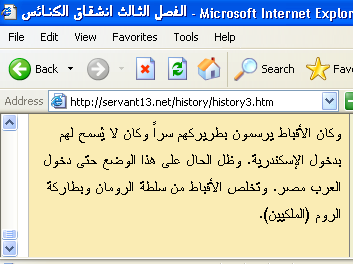
The following image is from the website of Anba Takla, the church of Anba Takla Haymanot, which acknowledges the contribution of the Islamic conquest to the survival of Christianity in the East:
Anba Takla church website — acknowledging the Islamic conquest's role in preserving Eastern Christianity
Christian clerics such as Zakaria Botros have themselves acknowledged the merit of the Islamic conquests on Christianity and the Church of Alexandria. The Anba Takla church website states that had it not been for the Islamic conquest, Christianity would not have existed in the East.
On the Claim That Islam Spread by the Sword
The orientalist Thomas Carlyle addressed this claim directly:
Thomas Carlyle — On Heroes, Hero-Worship, and the Heroic in History “The claim that Islam was spread by the sword is more clearly false than to be refuted by discussion, because the one who says this is the same as the one who says that one man carried his sword and went out to all his opponents to instill fear of his sword in them and force them to believe in what they deny. As for the issue of the Islamic conquests, they were not wars against just, liberated countries; rather, they were against two unjust empires that subjugated most of the world by the sword in order to plunder its wealth and enslave its people.”
The growth rate of Islam in Egypt illustrates the point: after a century of Islamic conquest, Muslims were 5% of the population; after two centuries, 25%; after 450 years, 75%; and after 1,400 years, 94%. Where is the compulsion with this rate of growth?
Our reading of the Quranic verses commanding jihad, and the reasons for their revelation, shows that they never commanded Muslims to attack — only to defend. When the Messenger ﷺ opened Mecca, he secured the lives and livelihoods of the people. History does not record that the early Muslims conquered Egypt, Africa, and Andalusia by killing civilians or by slaughtering people without distinguishing between combatants and non-combatants — which is precisely what the Old Testament commands explicitly and in detail. As the Quran states: “And if you were rude and harsh in heart, they would have disbanded from around you” — evidence that the sword could never have been the instrument of Islam’s spread. People followed Islam because they were intellectually convinced by its message and spiritually nourished by its meanings.