Who Is the Last Prophet
Who is the Last Prophet?
Qadianis like to claim that Prophet Muhammed ﷺ is the last prophet in the sense that another shariah bearing/law bearing prophet (like Prophet Nuh, Ibrahim, Musa, Isa and Muhammed ﷺ) can not come after Prophet Muhammed ﷺ, however according to them non law bearing prophets, who follows the shariah of Prophet Muhammed ﷺ can always come.
Whatever hadith you will bring them in which it is clearly stated that there will be no Prophet after Prophet Muhammed ﷺ, they will claim it means no “law bearing” prophet.
However this is neither the belief held by the Salaf, nor by the first generations after Mirza Ghulam Qadiani and his early caliphs (who in Qadianism are divinely guided).
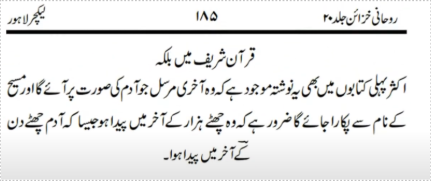
Ruhani Khazain, Volume 20, Page 185, Lecture Lahore: Translation:
“In the Holy Qur’an, and even in most of the earlier scriptures, it is recorded that the last messenger (akhiri mursal), who will come in the likeness of Adam and will be called the Messiah, must necessarily be born at the end of the sixth millennium, just as Adam was created at the end of the sixth day.”
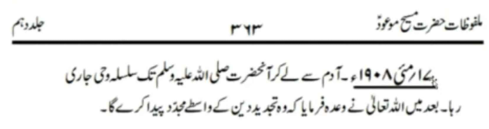
“From Adam to the Holy Prophet (peace and blessings be upon him), the chain of revelation continued. Afterwards, Allah the Almighty promised that He would raise reformers (Mujaddids) for the revival of faith.” Malfuzat of the Promised Messiah, Volume 10, page 363, dated 17th May 1908.
attachments/image-7940b93d15bd78f4.png
“Ruhani Khazain, Volume 22, Page 201, Haqiqat-ul-Wahi”: Translation: “It is a unanimously agreed matter among the Ahl-e-Sunnat (Sunni Muslims) that the last reformer (Mujaddid) of this Ummah (Muslim community) is the Promised Messiah, who will appear in the last days.”

Tashhiz al-Azhan was a Magazine founded by Mirza Basheer ud Din Mahmud Ahmad (Son of Mirza Ghulam Qadiani) in 1906 out of Qadian. The first edition was published on March 1st, 1906. Maulvi Muhammad Ali praised Mirza Basheer ud Din Mahmud Ahmad heavily and even supported the prophethood of MGA therein. It seems that in the earliest editions of Tashheez-ul-Azhan, Mirza Basheer uddin Mahmud Ahmad name was written with the appellation (saw), which is marked in short form with a Suad.
By 1910, Sheikh Abdul Rehman Lahori was the co-editor along with Mirza Bashir ud Din Mahmud Ahmad (before his Khilafat).
By 1913, Qazi Muhammad Zahuruddin Akmal seems to have become the editor. However, he was the editor from the very beginning, Mirza Basheer ud Din lied and claimed to be the editor. Mirza Basheer ud Din could barely read and write.
In March of 1922: The magazine Tashheez-ul-Azhan was merged with the Review of Religions Urdu.
{Embed}
Ahmadiyyafactcheckblog
Tashhiz al-Azhan was a Magazine founded by Mahmud Ahmad in 1906, qu…
Intro Tashhiz al-Azhan was a Magazine founded by Mirza Basheer ud Din Mahmud Ahmad in 1906 out of Qadian (check out the archives herein). The first edition was published on March 1st, 1906. Maulvi Muhammad Ali praised Mirza Basheer ud… Continue Reading →
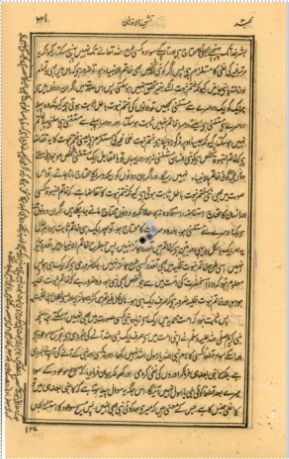
In this magazine we find the following:
“If one is independent of the other, and the second is in need of the first, then only one [final prophet] is established. This matter is completely clear, and there cannot be multiple endings. Just as the finality of prophethood is unique and indivisible, the finality of the prophetic succession must also be singular. It is essential that there be only one final prophet in this regard. Thus, it is evident that within the community of the Prophet Muhammad (peace and blessings of Allah be upon him), no more than one prophet can exist. The Holy Prophet (peace and blessings of Allah be upon him) only foretold the coming of one prophet, the Promised Messiah. Apart from him, no one was named as a prophet or messenger of Allah. He did not prophesy the coming of another prophet, and by saying ‘There is no prophet after me,’ he explicitly denied the coming of any other prophet. The question arises here: if ‘There is no prophet after me’ means that no prophet will come after me, then where is the exception for the Promised Messiah?”
As one can see, the argument of “there can come non law bearing prophets after Prophet Muhammed, just not any law bearing ones” is a deception. The qadiani belief in reality is that the door of prophethood is closed, but it was opened for Mirza Ghulam Qadiani as an exception because he was apparently “foretold”.
attachments/image-77a33bc0901d9d75.png
“The answer to this is that it has already been explained that from among this community, only that person can be the final prophet who is the complete manifestation and perfect reflection of the Prophet (peace and blessings of Allah be upon him), in which no trace of otherness remains. It is evident that this hadith, which speaks of finality, does not negate the existence of one who is the ultimate and perfect representative. It is clear that no one can be considered a complete and perfect reflection unless there is no trace of otherness in them. As has been established, only one such person can be the Promised Messiah, and this has been demonstrated over centuries.
The hadith indicates that the Prophet (peace and blessings of Allah be upon him) declared ‘There is no prophet after me’ to exclude two types of people: those who are entirely devoid of the qualities of prophethood because they are completely unrelated and alien, and those who possess some qualities of prophethood but not fully, because they are also outside the realm of perfect representation. According to this hadith, it is evident that there can only be one prophet in this community, who is the Promised Messiah, and absolutely no one else can come.
Furthermore, examining other hadiths confirms that the Prophet Muhammad (peace and blessings of Allah be upon him) designated only the Promised Messiah as a prophet and did not assign this title to anyone else. Since the future coming of the Messiah will renew the light of the Prophet’s teachings in the world, it is essential that he be considered a true successor and final representative of the Prophet. Thus, it is established that he will also be the final successor, encompassing all the perfections and qualities of the Prophet, and no additional qualities can be added beyond what he already embodies.”

“But Allah’s Sunnah is such that two types of messengers are not killed, 1. Thos who come at the beginning of a lineage/series of messengers, like in the Mosaic lineage, Musa AS, and in the Muhammadan lineage/series, our Prophet Muhammad SAW 2. Those prophets and God’s appointees who come at the end of a lineage/series of prophets, like in the Mosaic series, Esa AS, and in the Muhammadan series this humble one (Mirza referring to himself as “humble one”)…
(Ruhani Khaza’een vol 20, page tiff and 70, Tadhkira’h e Shahadatayen)
(Ruhani Khaza’een vol 20, page tiff and 70, Tadhkira’h e Shahadatayen)
“Because if other pious people, who preceded me, had the same abundance of dialogue with Allah and being matters of the unseen revealed to them, then, they would also have deserved to be called as Prophets. In that case, it would have been a defect in the prophesy of the Prophet Muhammad SAW. For that reason, Allah’s expediency/wisdom stopped these righteous predecessors to achieve this blessing (of the Prophethood). As in authentic hadiths it says that there will ONLY BE ONE SUCH PERSON, and the prophesy will be fulfilled”.
Ruhani Khazaneen, voi 22, page 407, Haqiqatul Wahi

https://www.youtube.com/live/vLzzM-hTgms?si=LRPl384V2boOOST5 starting from minute 6:32:30
Mirza Tahir Ahmad (author of tasheez ul azhan), the fourth caliph of the Ahmadiyya Muslim Community and son of Mirza Bashir-ud-Din Mahmood, stated in a video that no prophet will come after Mirza Ghulam Ahmad. This is contrary to the belief spread by the Qadiani Community, which is that there is no end to Prophethood.
{Embed}
The Dialogue With Imtiaz
https://www.youtube.com/live/vLzzM-hTgms?si=LRPl384V2boOOST5
DECEPTIONS OF AHMADI MURABBIS ON FINALITY OF PROPHETHOOD (ختم النبو…
CHAPTERS AND TIMESTAMPS:0:00:00 INTRODUCTION 0:17:50 Br.IMTIAZ GAVE REACTION ON RAZI’S STATEMENT ON AQEEDA(Duration:12 MINUTES)0:30:30 1st PART OF PRESENTATI…
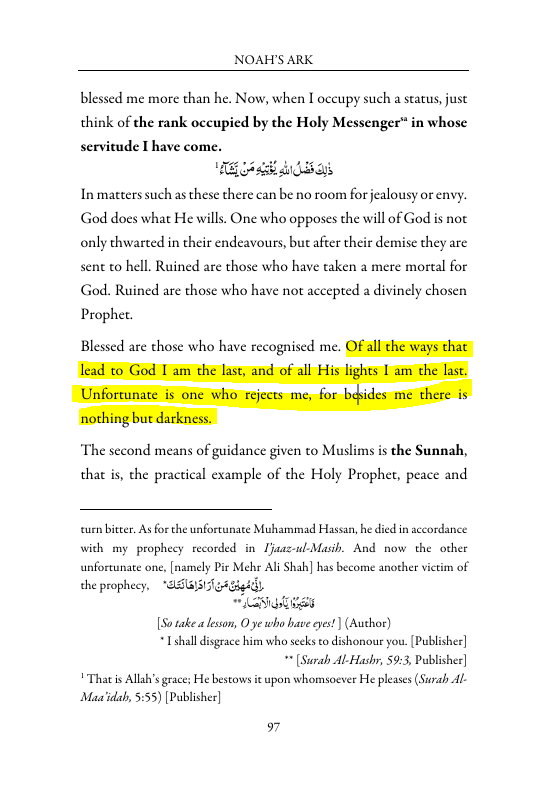
1902 Noahs Ark (Kashti-Nuh)
See page 97