Abbasid Islam Refuted: Early Syriac Evidence for Islam Before the Abbasids
Abbasid Islam Refuted: Early Syriac Evidence for Islam Before the Abbasids
The argument here is simple: early Syriac Christian texts, chronicles, church rulings, apocalyptic writings, and debate records already speak about Muslims, Islam, Islamic rule, and the growing religious threat Islam posed to Christianity before the Abbasid dynasty.
Table of Contents
- The Claim of “Abbasid Islam”
- Why Orientalists Needed This Theory
- The Real Explanation for the Scarcity of Early Islamic Writings
- Creating the Qur’an and the Problem of Late-Origin Theories
- Michael Philip Penn and Early Syriac Writings on Islam
- Early Syriac References Before 750 AD
- The Account of 637 AD and the Chronicle of 640 AD
- Letters of Patriarch Isho’yahb III
- Christian Apostasy to Islam
- Khuzestan Record and Apocalyptic Texts
- Maronite Record and Muslim Political Authority
- Syrian Church Council Rulings of 676 AD
- Yuhanna Ibn al-Finki and the Year 692 AD
- Dome of the Rock and Public Islamic Identity
- The Shift from Syriac to Arabic
- Jacob of Edessa and a More Realistic Picture of Islam
- Debates of John and the Prince and Beit Hali
- Hananishua I and Mar Aba II
- Why the Abbasid Islam Theory Fails
- Conclusion
The Claim of “Abbasid Islam”
The theory of “Abbasid Islam” claims that Islam did not truly emerge as a distinct religion until the Abbasid era.
This theory was used by some Orientalists and skeptics to explain the presence of Christian and Jewish material in the Qur’an. Since they wanted a source from which the Prophet ﷺ supposedly drew knowledge about the People of the Book, they pushed the idea that Islam’s religious identity was formed much later.
The theory collapses because early non-Muslim sources already mention Muslims, Islamic rule, Islamic religious identity, and Christian-Muslim debates before the Abbasid dynasty.
Why Orientalists Needed This Theory
The urgent need to explain the Qur’an’s references to Christianity and Judaism pushed some Orientalists, such as John Wansbrough, toward speculative theories.
Their problem was this:
If the Qur’an contains discussions of Christianity and Judaism, then skeptics needed to invent a historical environment where the Prophet ﷺ supposedly learned these matters from Jews and Christians.
But their theories were not useful enough, so they relied on imagination and adopted the idea that Islam was a later Abbasid construction.
This is weak historical reasoning. Lack of abundant surviving early Muslim writings does not prove late invention. Absence of surviving material is not evidence of non-existence.
The Real Explanation for the Scarcity of Early Islamic Writings
The scarcity of early writings about Sharia rulings, Sunnah, and other Islamic matters was used as an argument for late Islamic formation.
But this argument ignores the historical reality of the early Islamic period.
The early Muslim community was not sitting in a calm academic institution producing systematic libraries. It was passing through conquests, conflicts, political consolidation, and the construction of a new state.
The Caliphs were focused on:
- consolidating the Caliphate,
- managing military expansion,
- dealing with internal conflict,
- building a force capable of rivaling other nations,
- governing newly conquered territories.
The scarcity of early Islamic writings reflects the turbulent political and military context. It does not prove that Islam was invented later.
Creating the Qur’an and the Problem of Late-Origin Theories
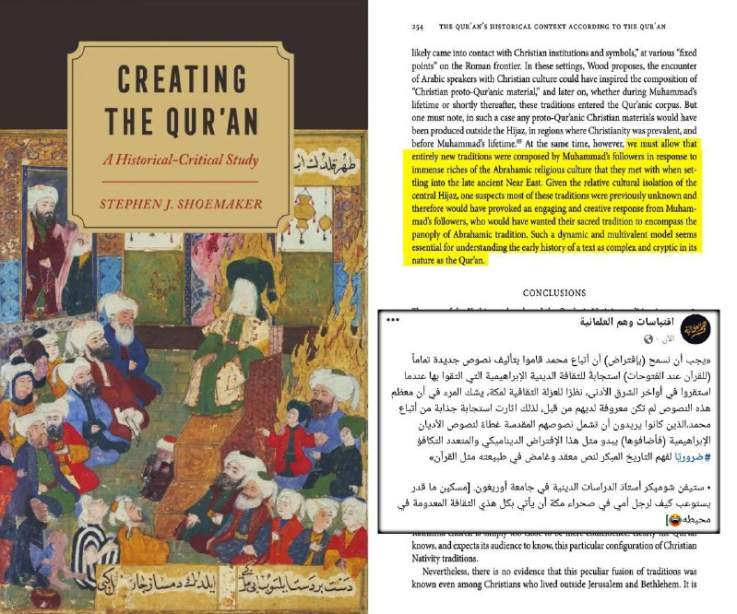
The Arabic note in the scan criticizes this type of view, saying that Shoemaker assumes the Qur’an gathered scattered Abrahamic material from the region and turned it into a scriptural corpus. The scan is being used to show the kind of Orientalist reconstruction that makes Islam appear as a late literary or communal product instead of an original prophetic message revealed in the 7th century.
Michael Philip Penn and Early Syriac Writings on Islam
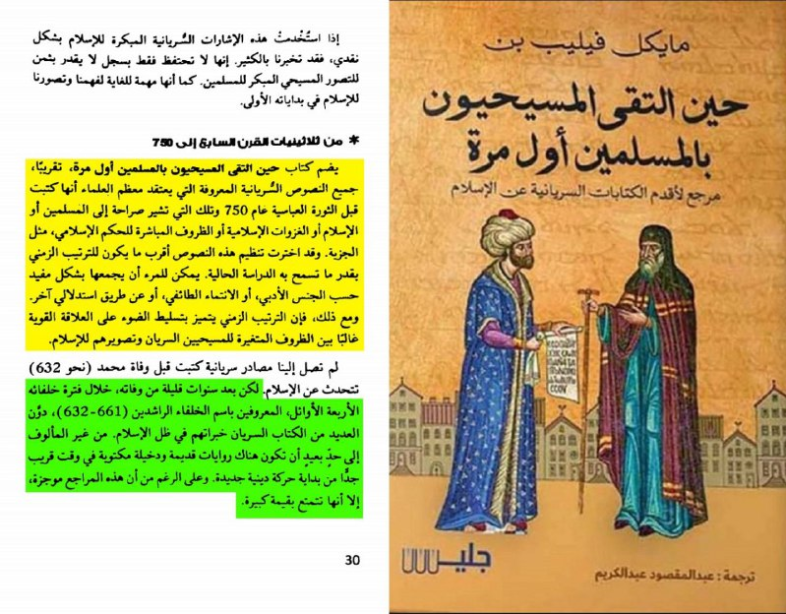
The highlighted section explains that Penn’s book is a collection of Syriac Christian writings about Muslims during approximately the first century and a half of Islam, up to around 750 AD. The introduction says that this period saw fast-moving military events, conquests, and religious transformation. The scan is important because it confirms that Christian Syriac sources from before the Abbasid period already spoke about Muslims and Islam.
The green-highlighted section explains that Islam was discussed in Syriac sources even before the monk John wrote around 632 AD, though many early writings were brief and often lacked detailed information about Islamic beliefs. This supports the point that Islam was visible early, even if Christian authors did not yet fully understand or describe it systematically.
Early Syriac References Before 750 AD
Syriac Christian texts from the 7th and early 8th centuries provide external evidence against the claim that Islam only emerged in the Abbasid era.
These sources include:
- the Account of 637 AD,
- the Chronicle of 640 AD,
- letters of Patriarch Isho’yahb III,
- the Khuzestan Record,
- the False Apocalypse of Ephrem,
- Maronite records,
- Syrian Church council rulings,
- the testimony of Yuhanna ibn al-Finki,
- writings of Jacob of Edessa,
- debates between Christians and Muslims,
- writings of Hananishua I and Mar Aba II.
These are not Abbasid inventions. They are Christian records reacting to Islam as a real religious and political force.
The Account of 637 AD and the Chronicle of 640 AD
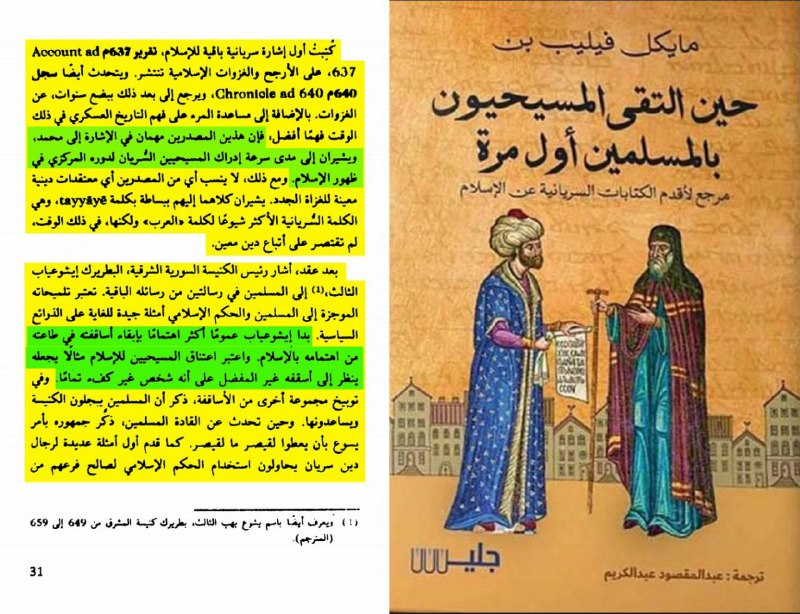
The second highlighted section discusses the letters of Patriarch Isho’yahb III, head of the Eastern Church. His letters point to Muslims indirectly because they were written in the context of Christians abandoning their faith and turning toward Islam. The scan also notes that he referred to a bishop who accepted Islam as incompetent, showing Christian concern over religious defection.
This scan proves that Christian sources already recognized Muslims and Islam in the 7th century, long before the Abbasid period.
Letters of Patriarch Isho’yahb III
The head of the Eastern Church hinted at Muslims because of the widespread movement of Christians toward Islam.
He described a bishop who embraced Islam as incompetent, reflecting his concern for the Church’s decline.
This is major evidence because it shows Islam was not merely a vague Arab political movement. It was already strong enough to attract Christians away from the Church.
Christian Apostasy to Islam
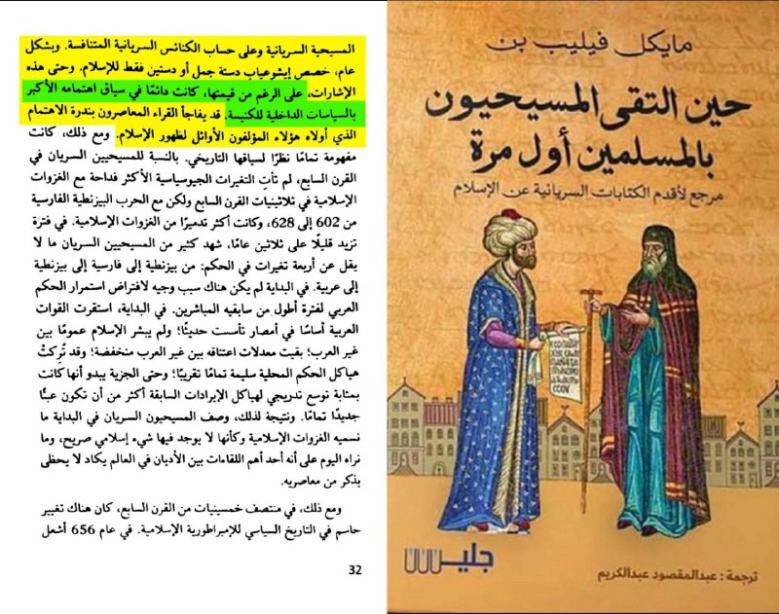
The text explains that during this early period, Muslim rule expanded quickly, and Christian writers were trying to understand the new political and religious reality. It also points out that much of the early Christian material focuses less on Islamic doctrine and more on the social and ecclesiastical problems caused by Muslim dominance.
This supports the argument that the lack of detailed Christian descriptions of Islam in the earliest sources does not prove Islam was absent. It only proves that the early Christian authors had different priorities and often wrote from within crisis, fear, and institutional concern.
Khuzestan Record and Apocalyptic Texts
The Khuzestan Record and the False Apocalypse of Ephrem presented Islamic conquests as signs of the apocalypse.
Christians often interpreted Muslim victories as divine punishment or end-times calamity.
This means they saw Muslims as:
- historically real,
- politically dominant,
- religiously significant,
- a threat to Christian civilization.
A purely Abbasid invention would not explain why earlier Christian apocalyptic literature already reacted to Muslims as a present calamity.
Maronite Record and Muslim Political Authority
The Maronite Record documents competition among Christian churches for influence and their attempts to seek Muslim support.
This shows that Muslim political authority was already recognized by Christian groups before the Abbasid era.
Christians were not dealing with a fictional later construct. They were negotiating real power.
Syrian Church Council Rulings of 676 AD
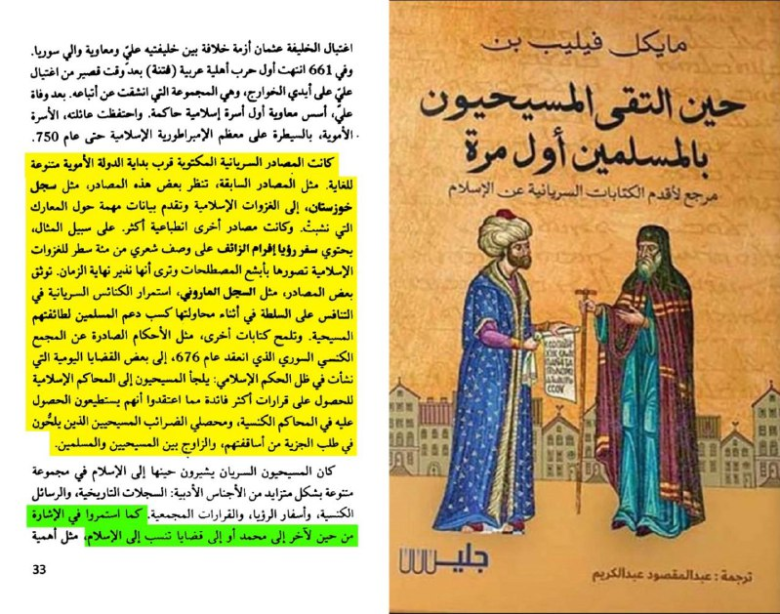
It also mentions church council rulings from around 676 AD, where Christian leaders issued decisions dealing with practical problems under Muslim governance. These rulings included warnings about relying on Muslim judges or appealing to Muslim authorities in disputes.
The green-highlighted section notes that Christian sources became increasingly important in pointing to Islam during this period. This matters because it shows that Islam had already become a recognized force shaping Christian legal and communal life before the Abbasid era.
Yuhanna Ibn al-Finki and the Year 692 AD
The testimony of Yuhanna ibn al-Finki, a 7th-century Syrian monk, discusses the conflict involving Umayyad Caliphs Marwan and Abd al-Malik against Ibn al-Zubayr around 692 AD.
This period is crucial because it marks Islam becoming publicly visible as a distinct religious identity in political, architectural, and theological terms.
The evidence includes:
- debates with the People of the Book,
- construction of the Dome of the Rock,
- public Islamic messaging,
- the movement from Syriac toward Arabic as a dominant administrative and religious language.
Dome of the Rock and Public Islamic Identity
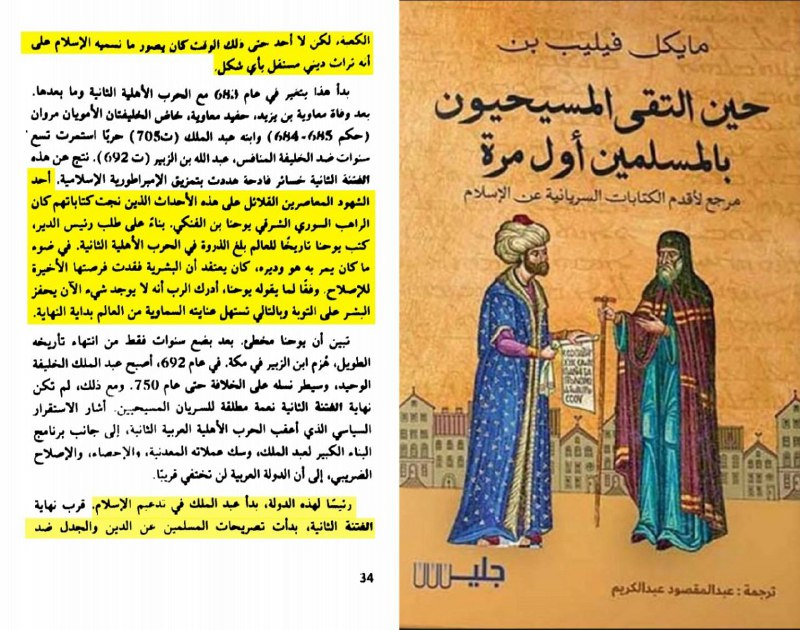
The page mentions the construction of the Dome of the Rock and the appearance of religious statements that directly entered debate with the People of the Book. This is important because the Dome of the Rock inscriptions represent a clear public declaration of Islamic belief, including themes connected to monotheism and the rejection of Christian claims about Jesus عليه السلام.
The scan is being used to show that Islam’s public religious identity was already visible under the Umayyads, not invented under the Abbasids.
The Shift from Syriac to Arabic
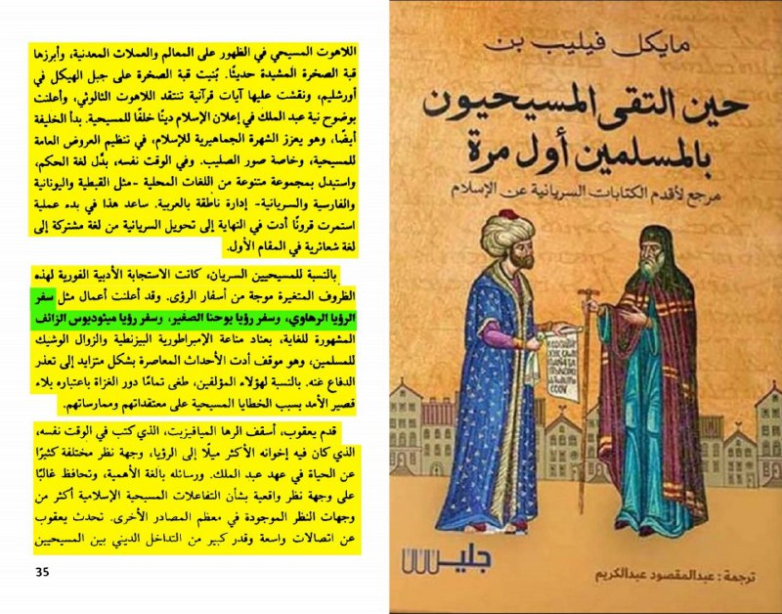
The scan also says that Syriac Christian responses to Islam were often weak, confused, or shaped by the narrow perspective of monks who were trying to understand the rise of Islam from within their own religious crisis. It mentions that some later Christian sources became more detailed, especially as Christian writers increasingly encountered Muslim arguments.
The key point is that the transition toward Arabic and public Islamic expression happened under Umayyad rule. This again contradicts the idea that Islam only took shape in the Abbasid period.
Jacob of Edessa and a More Realistic Picture of Islam
The writings of Jacob, Bishop of Edessa, provide a more realistic insight into the emergence of Islam as an independent religion.
Jacob of Edessa’s writings are valuable because they are less purely apocalyptic than some other Christian accounts.
His writings show:
- Muslims were not just raiders,
- Islam was not merely tribal politics,
- Muslims had religious practices and claims,
- Christians were forced to respond to Islam as a distinct religious system.
Debates of John and the Prince and Beit Hali
The debates known as John and the Prince and Beit Hali portray Islam as a distinct and threatening religion during its rise.
Debate literature is especially damaging to the “Abbasid Islam” theory because debate requires identifiable doctrines, opponents, and religious claims.
If Muslims were debating Christians before the Abbasids, then Islam already existed as a recognizable religious identity.
Hananishua I and Mar Aba II
The writings of Hananishua I and Mar Aba II offered deeper and more detailed descriptions of Islam.
These texts continued into the mid-8th century and the Abbasid era, where Christian awareness of Islam became more developed.
The fact that later sources became more detailed does not mean Islam was invented late. It only means Christian authors gradually understood Islam more clearly over time.
Why the Abbasid Islam Theory Fails
The theory fails because it cannot explain the early Syriac evidence.
The evidence shows:
1. Islam was known before the Abbasids.
Early Syriac texts from the 7th and early 8th centuries already mention Muslims and Islamic rule.
2. Christian leaders were responding to real Muslim authority.
Church rulings, letters, and communal instructions show Christians dealing with Muslim governance.
3. Christians were converting to Islam.
The letters of Isho’yahb III show concern over Christians abandoning Christianity for Islam.
4. Islam became publicly visible under the Umayyads.
The Dome of the Rock, debates with the People of the Book, and the shift toward Arabic show that Islam had a public religious identity before the Abbasids.
5. Later detail does not prove later invention.
Christian sources became more detailed over time because Christian writers increasingly encountered Islam and needed to respond to it.
Conclusion
The claim that Islam was a late Abbasid invention is historically weak.
Early Syriac Christian sources, church documents, apocalyptic writings, debate records, and political accounts all show that Islam existed as a real and distinct religious force before the Abbasid dynasty.
The scarcity of early Muslim legal and theological writings is better explained by the historical conditions of the early Islamic state: conquest, political consolidation, civil conflict, administrative transformation, and the gradual development of written scholarly institutions.
Islam was not invented under the Abbasids. It was already recognized, feared, debated, and responded to by Christian writers in the 7th century.