"Allah" Is Not From Syriac: Archaeological Proof the Word Is Originally Arabic
Science does not stop, and studies in the last twenty years have suddenly changed all the data, and the magic turns against the magician. Today we show with evidence and proof that the most honorable thing in any religion — which is the name of God — is not known in Christianity, and it is most likely that it was borrowed, copied, taken and stolen from the Arabic language.
Paul’s thugs on the Internet claimed that the Arabic word “Allah” was taken from Syriac. However, a heavy and scientific surprise ends this centuries-old controversy with material evidence.
Hundreds of inscriptions before Christ and after Christ before Islam, written in ancient Arabic letters, come to light — written by Arab Bedouins from the north, who lived near or in the heart of the Syriac lands.
The latest discovered inscriptions prove that the word “Allah” is an authentic Arabic word, while the Syriac word is of doubtful authenticity and may have been taken from the Arabs.
The oldest Syriac writing in existence dates back to the beginning of the fifth century AD.
It is a manuscript by Titus of Basra in which he responds to the followers of Mani, written in411 AD.
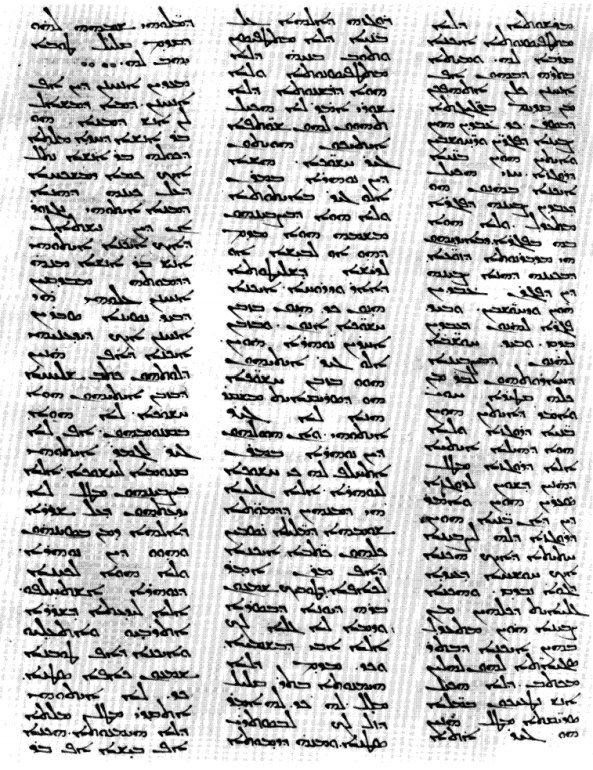
Between the oldest Arabic inscription and the first Syriac inscription: approximately 1000 years.
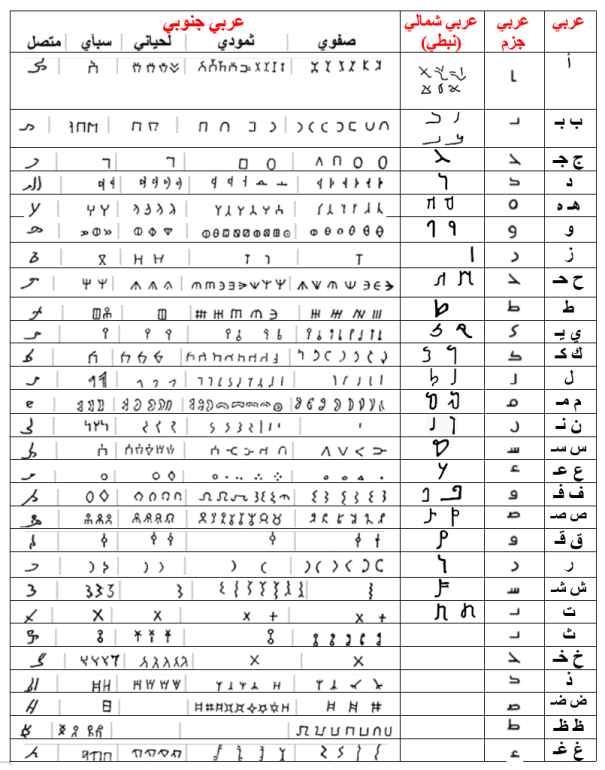
The Nabataean script (northern Arabic), which began flourishing in the first century BC, is the origin from which the Hijazi Arabic script (Jazm script) emerged — the script in which the Qur’an was written.
The Arabs of the North wrote in five different forms of the southern Musnad script in the first four centuries AD:
- Thamudic alphabet (6th century BC to 4th century AD)
- Dadanitic and Lihyanic alphabets (5th century BC to 1st century AD)
- Safaitic alphabet (1st century BC to 400 AD)
- Ahsa’i alphabet (5th to 2nd century BC)
Found by King Saud University in the area historically called Qarya / Al-Hamra / Al-Faw — an archaeological site 700 km south of Riyadh, 280 km north of Najran. It is considered the oldest text in which the Arabic language appears closest to classical Arabic.
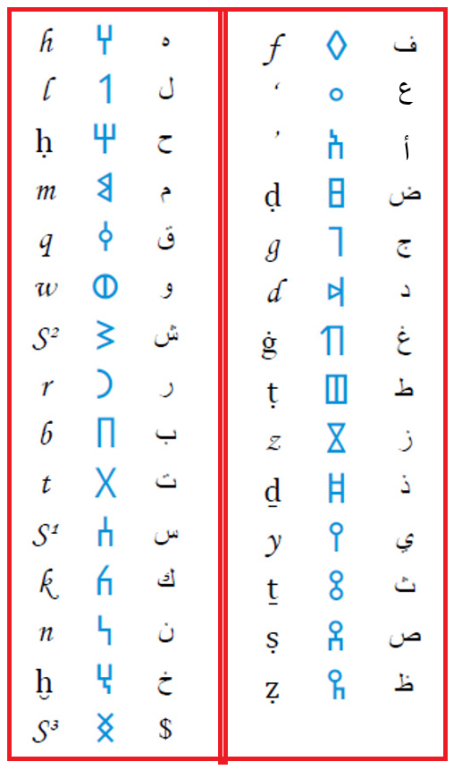
Table of Arabic correspondences for the Musnad letters
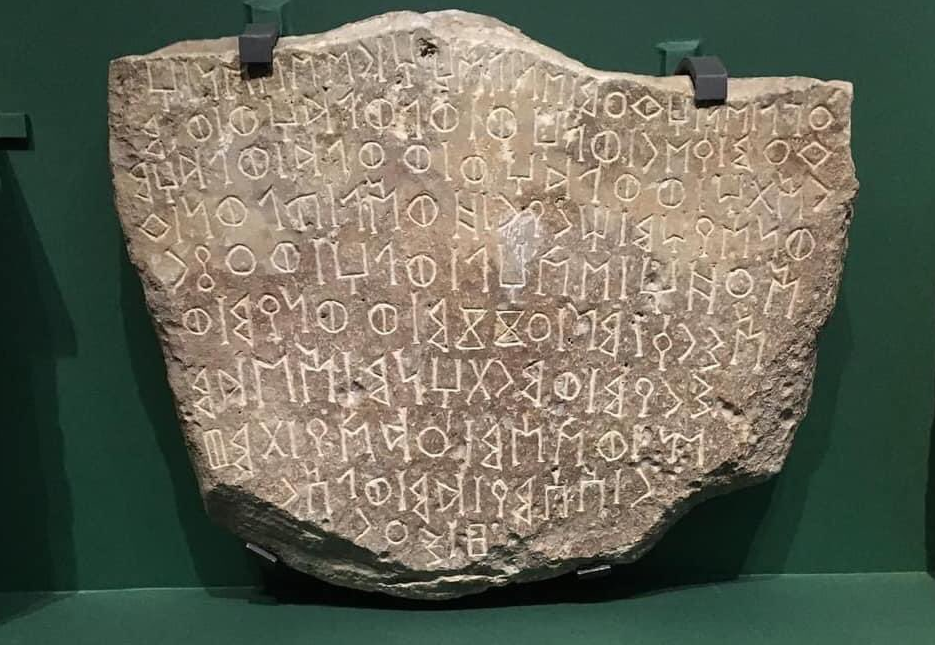
Picture of the tombstone built by Ajil bin Hafa’am for his brother and family — preserved in the National Museum in Riyadh
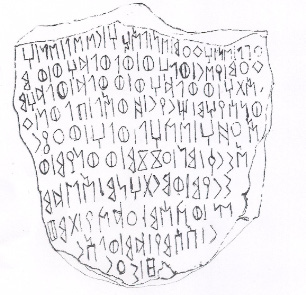
Reading of the text:
- Ajl – Bn – Hfm – Bn – L Akh – Rbbl – Bn – H
- F Am – Qabr – Walhu – Wolladhu – Wm
- Ra’tah – Wolladhu – Wolladhu – Wolladhum
- Wnsyhim – Hryr – Dhul Al – Ghaluun – F
- A’dhah – Bkhl – Wolla – Wathr (By God and Ashtar Sharqan)
- Ashrq – Mn – Azzm – W W N Y M - W
- SH R Y M - W M R T H N M - A B D M
- B N - W K S M - A D K Y - T M T
- R A S M Y - D M - W L A R
- D - S S R
- Tanween with nun converted to mim — indicates nasalization shared between mim and nun sounds.
- Striking similarity in spelling rules between Musnad and Arabic writings.
- Extended Ya did not appear in writing — common rule of old non-syllabic island writings.
- The Lam is included in “huwa” — phenomenon of saturating the pronoun’s damma.
- W L W: “And Allah” appears in the fifth line.

“I pray and swear by God”
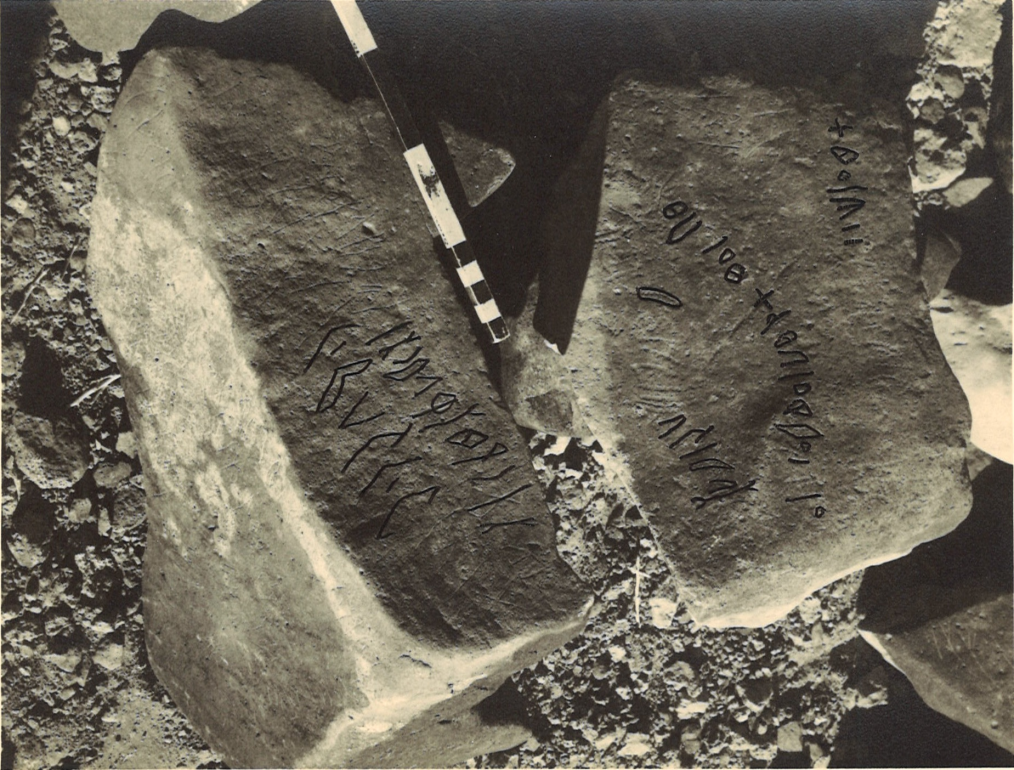
Source: http://krc.orient.ox.ac.uk/ociana/corpus/pages/OCIANA_0016976.html
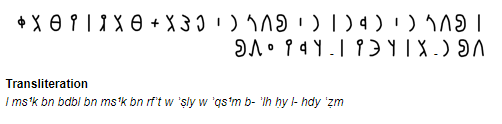
Found in Arabic inscriptions in the north — the stronghold of the Syriacs:
1. Wahb Allah — Safavid inscription WH 1860, Amman Museum
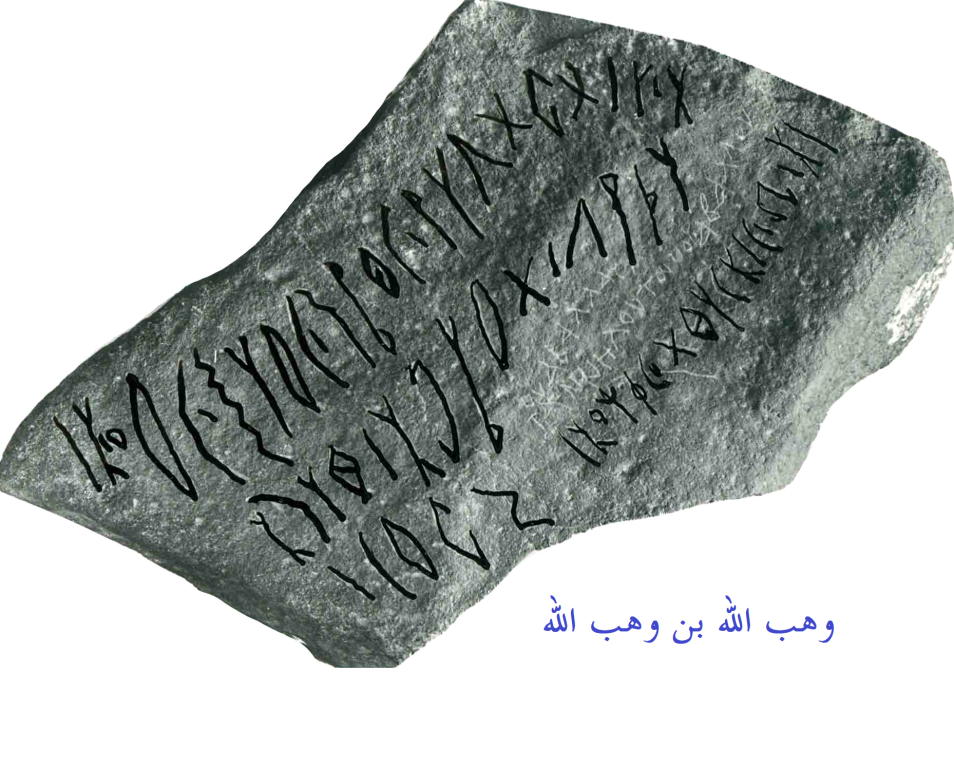
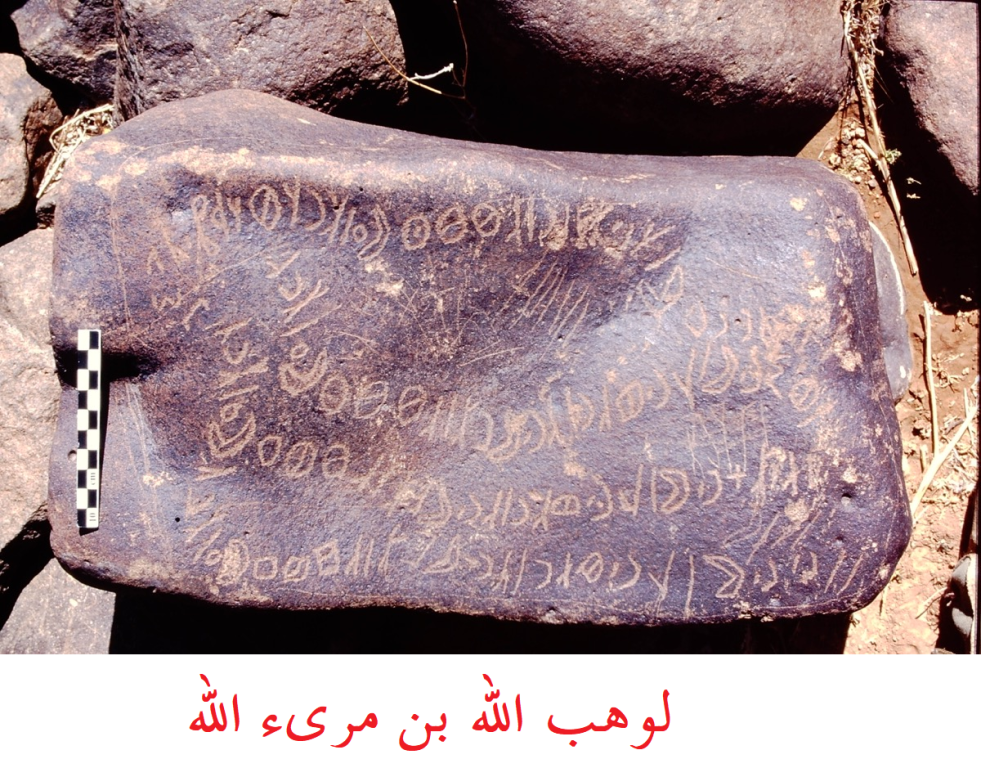
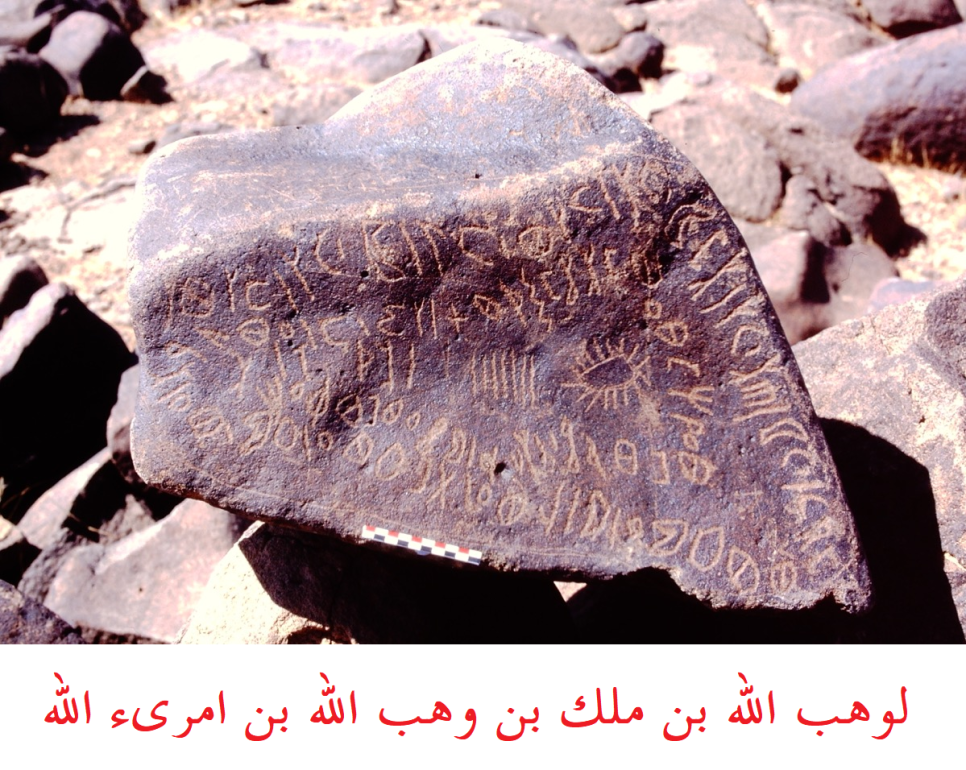
2. Wahb Allah bin Mari Allah — generation after generation! Safavid inscription, Damascus countryside (Is.M 126 and Is.M 128)
3. Safavid inscription Is.Mu 242 — Damascus countryside, stronghold of the Syriacs
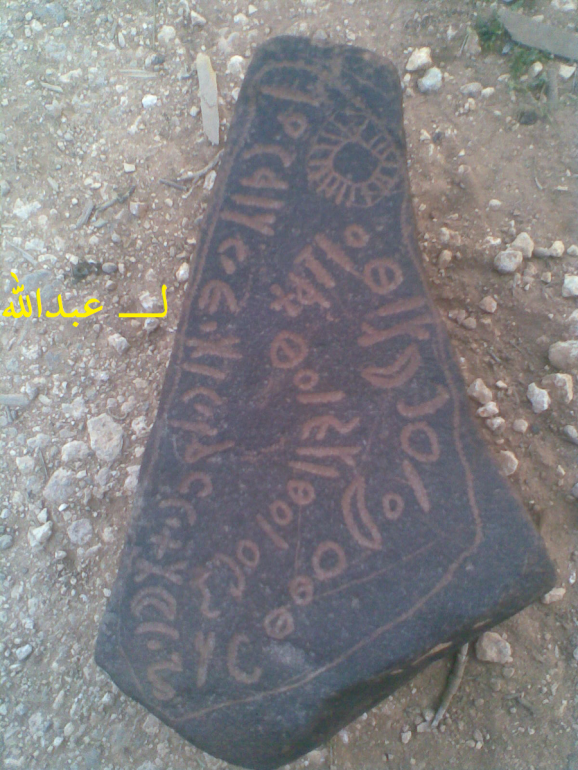
Abdullah:
And many others: Zayd Allah, Sa’d Allah (Is.R 94, JaS 66.2, KhBG! 274), Rahn Allah (JaS 29), Khalaf Allah (JaS 61, JaS! 72.1), Ghuth Allah.
Even Allāhumma is attested — in the Hismaic inscription Jackobson D.3.A.7.b: “hāllāhumma le-banī ʿoray ben ʿaklam boʾsa’” — Ahmad al-Jallad
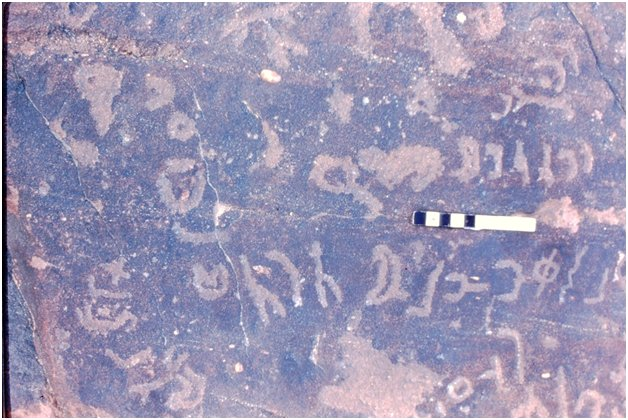
So the word “Allah” was known to the Arabs before the birth of Christ and they invaded the depths of the Syriac lands with it.
The Zabad Inscription — 511–512 AD (Greek/Syriac/Arabic) — found in Khirbet Zabad, southeast of Aleppo. Written on a stone fixed in a church above the door of the martyrdom of Saint Sergius.
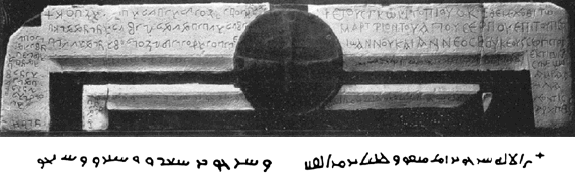
”{..Kr} The god Sarhu Bar. Umma Manf and Talib Bar Mar Al-Qais”
The Arabic language invades the Syriac Church in the Syriac stronghold.
In the oldest Syriac text, the name of God appears in Arabic for the first time.

It appears from this inscription that Arab and Syriac Christianity did not know the name “Allah” before Islam — the first use by Christian monotheists was of the Arabic word “God.”
The oldest Christian inscription adopting the name of God was in Al-Hirah after Islam — written by an Arab Christian:
“A blessing from Allah, may Allah forgive Abdul-Masih.”
The owner, Abdul-Masih bin Amr bin Qais bin Hayyan bin Baqila Al-Ghassani, was a prominent Christian of Al-Hirah known during the pre-Islamic era and early days of Islam. The people of Al-Hirah used Syriac as the language of their prayers — making this the first real cross-fertilization between Arabic and Syriac.
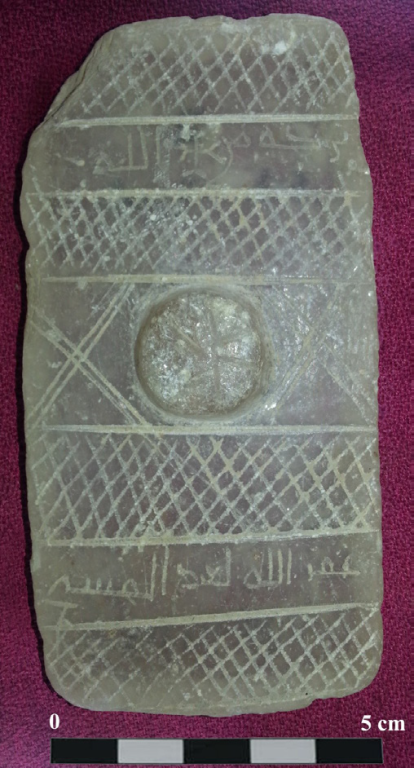
Source: Journal of Tourism and Antiquities, Vol. 28, No. 1, pp. 23–31, Riyadh, 2016 — Dr. Amer Abdullah Al-Jumaili
“A phonological and morphological analysis of the data confirms the Arabic origin of the word Allah, while the Syriac problems with the word ‘Allāha’ are described — namely that the Syriac form differs from other Aramaic dialects and requires explanation. It also discusses the possibility that Syriac borrowed the word from Arabic.”
In post-Middle Semitic: Arabic “Allah” and Syriac “Allaha” — but Allah is only used as a proper noun for the one God in Arabic, while Arabic also retains “Ilah” as a separate word. Syriac has no equivalent of “Ilah” — only “Allaha.”
- Oldest evidence of “Allah” dates to the first century AD — inscription of Ajal bin Haf’am, Qaryat al-Faw. Addition of definite article to “Lah” → “Ilah” becomes “Allah.”
- In Syriac, “God” with the definite article “al” first appears in the sixth century AD in the Zabad inscription — an Arabic-Syriac-Greek inscription. Already known in Arabic poetry and inscriptions before this.
- The Arabic language shows “Allah” as an assimilation of “Ilah” occurring in Arabic dialects — proven by inscriptions. The hypothesis of borrowing from another language is invalidated.
- Even in the Qur’an, “Allah” was understood by pre-Islamic Arabs as the supreme, unique God — firmly established among the Arabs before Islam.
- The Syriac word “Allaha” is used both for a unique god and for pagan gods — unlike Arabic “Allah” which is exclusively monotheistic.
- Inscriptions differ in writing: sometimes “Allaha,” sometimes “Alaha” — pronunciation disputed by scholars.
- Ibn al-‘Ibri noticed Western Syriacs emphasize the lam as in Arabic — only explainable under Arabic influence.
- All Aramaic dialects connect to post-Middle Semitic “Ilah/Ilahah.” Syriac is an exception in two points: it begins with open alif A (not broken I) and doubles the Lam — both unexplained from within Syriac morphology.
- Analogy — Unlikely. No dialect candidate exists for this development.
- Morphological modification — Unlikely. No evidence for the required intermediate steps. The word appears suddenly after Islam.
- Borrowing from Arabic ✅ — Most likely. Arabic has full morphophonemic derivation ability. This was also noted by Fisher, who preferred the possibility of Syriac borrowing from Arabic dialects.
The word was used before and after Islam in a purely monotheistic context referring to the one known God — unlike Syriac, where it was used by pagans and monotheists alike.
- A Study of the Oldest Written Text in the Arabic Language, the Text of ‘Ajl ibn Haf’am — Dr. Mai Fadhel Jassim Al-Jabouri
- OCIANA Online Corpus of the Inscriptions of Ancient North Arabia
- http://krc.orient.ox.ac.uk/ociana/corpus/pages/OCIANA_0016976.html
- David Kiltz — “The relationship between Arabic Allāh and Syriac Allāhā”, Der Islam 88(1):33–50, October 2012
- F.V. Winnett — Safaitic Inscriptions from Jordan
- Al-Jallad 2017 — An early Christian Arabic graffito mentioning ‘Yazid the king’
- Littman, E. 1913 — Semitic Inscriptions, Syria Publications
- Laïla Nehmé — New dated inscriptions (Nabataean and pre-Islamic Arabic)
- Robin, Christian Julien — Inscriptions antiques of the Najrān region
- Fokelien Kootstra — The Language of the Taymanitic Inscriptions and its Classification