Arabs of the Levant and Iraq Were Called Syrians — What Ancient Greek and Roman Sources Actually Say
3 min read 516 words
The Arabs of the Levant and Iraq Were Called Syrians — Historical Evidence
Table of Contents
- Introduction
- Source 1 — Strabo on the Arab Syrians
- Source 2 — The Peutinger Map — Arabia Syria
- Source 3 — Julia Domna the Arabian Called Syrian
- Source 4 — Poseidonius on the Arab Tribes and the Aramean-Syrian Connection
- Conclusion
Introduction
Key Historical Point The Arabs who settled in the Levant and Iraq were called Syrian Arabs — because Syria originally referred to both the Levant and Iraq together, not one country without the other.
Source 1 — Strabo on the Arab Syrians
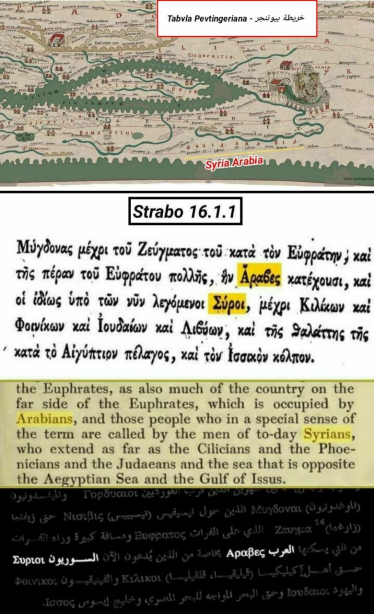
Strabo (16.1.1) Strabo said about all the Syrians who live from west of the Euphrates to the sea of Egypt — in Phoenicia, Palestine, Cilicia, Edessa, and so on — that they are the Arabs called Syrians or Assyrians, indicating that the Arabs were the majority in Syria and that they were called Syrians.
Source Strabo 16.1.1
Source 2 — The Peutinger Map — Arabia Syria
Tabula Peutingeriana — 2nd or 3rd Century AD The Peutinger Map from the second or third century AD indicated that a large area of the Levant, extending from Damascus to Apamea, was called Arabia Syria.
Source Tabvla Pevtingeriana
Source 3 — Julia Domna the Arabian Called Syrian
Historia Augusta — The Life of Septimius Severus (3:9) Julia Domna the Arabian — granddaughter of Iamblichus, king of the land of the Arabs or the region of Homs — was referred to as Syrian in the biography of Septimius in the History of the Kings.
Source Historia Augusta, The Life of Septimius Severus 3:9
Source 4 — Poseidonius on the Arab Tribes and the Aramean-Syrian Connection
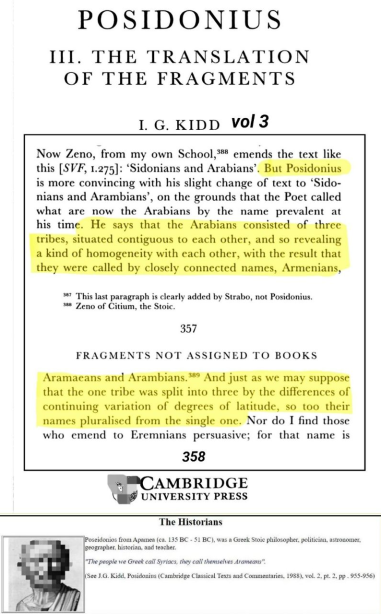
Poseidonius — 2nd Century BC Poseidonius, born in Apamea in the second century BC, mentions that the Arabs consist of three tribes: the Armians, Arameans, and Eirimbii.
The Arameans here refer only to those who speak Aramaic — as Aramaic is a language, not an ethnicity.
Strabo further mentions that the Arameans — who are among the Arabs according to Poseidonius — were called Syrians.
Source J.G. Kidd, Posidonius (Cambridge Classical Texts and Commentaries, 1989), vol. 2, pt. 2, pp. 955–956
Conclusion
Historical Acknowledgment This is a historical acknowledgment — from Greek, Roman, and cartographic sources alike — that:
- The Arabs were attributed to the lands of Iraq and the Levant
- The Arabs were among the inhabitants of these regions
- The Arabs were the residents of the Levantine and Iraqi regions
- The term “Syrian” was applied to these Arabs — because Syria historically encompassed both regions together, not one without the other
- Being called “Aramean” or “Syrian” in ancient sources was a linguistic and geographic designation, not an ethnic one separate from Arab identity
This article is part of the OpenIslam Wiki — Arab History and Identity series.