Arab Identity of the Lebanon
The Arab Presence in Lebanon in Ancient History
Often, the illegitimate Maronite nationalists, lovers of ignorance and nonsense, come out with statements claiming that they are descendants of the Phoenicians and that they were the inhabitants of Lebanon before the Arabs.
Their words are nothing but nonsense and myths in their minds, which they tried to impose on history but neither succeeded nor prevailed.
It is well-known that the Phoenician lands were extensively inhabited by Arabs, and their people, the Arabs, were considered Phoenicians. The land of Phoenicia, including the eastern and western Lebanon mountains and the Beqaa plain, were purely Arab lands before some Maronites, who have no connection to the Phoenicians whatsoever, began settling there in the seventh century AD.
1 - Western Lebanon Mountains
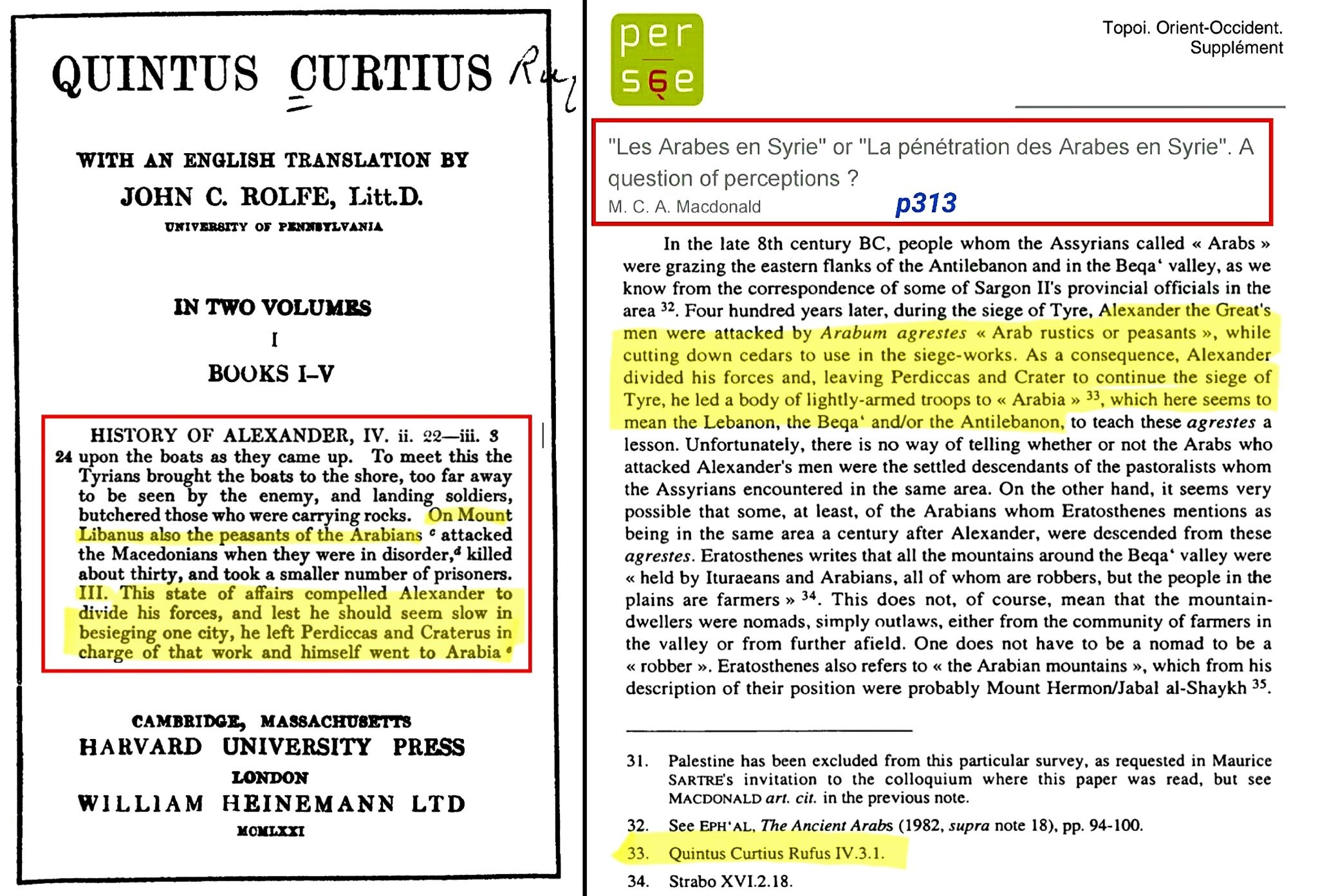
Curtius, from the second century AD, described the western Lebanon mountain range as part of the Arab land, saying: “On Mount Lebanon, the farmers from Arabia attacked the Macedonians.” He also stated, in essence, that Alexander himself went to punish those Arab farmers in Arabia. End quote.
From Curtius’ words, we understand that the Arab farmers from the region of Arabia—meaning here the Arab Mount Lebanon—attacked the Macedonians. Curtius later mentions that Alexander went to punish those Arab farmers and called the region where his soldiers were attacked, and which he intended to punish, the land of the Arabs / Arabia. This region was Mount Lebanon.
This indicates that Mount Lebanon was an Arab land, and its people were Arabs, according to Alexander, as it was part of the Arab lands. Curtius mentioned, as noted earlier, the attack by the Arab farmers in Mount Lebanon on the Macedonians, and then Alexander resolved to punish those Arabs. Alexander named the region of Mount Lebanon, where his soldiers were killed by the farmers, “Arabia.” Thus, we understand that Mount Lebanon was an Arab land.
[ Quintus curtius 4.2.24 / 4.3.1 ]
Michael Macdonald mentioned that “Arabia” in Curtius’ context refers to the western Lebanon mountains and the Beqaa, or the eastern Lebanon mountains.
[ LES ARABES EN SYRIE , M.A.C MACDONALD p313 ]
Macdonald’s statement is supported by the fact that the Arabs were the inhabitants of the Beqaa, as they were farmers, and Curtius described the Arabs as farmers, which confirms that the land of the Arabs included Mount Lebanon and the Beqaa.
[ Strabo 16.2.18 ]
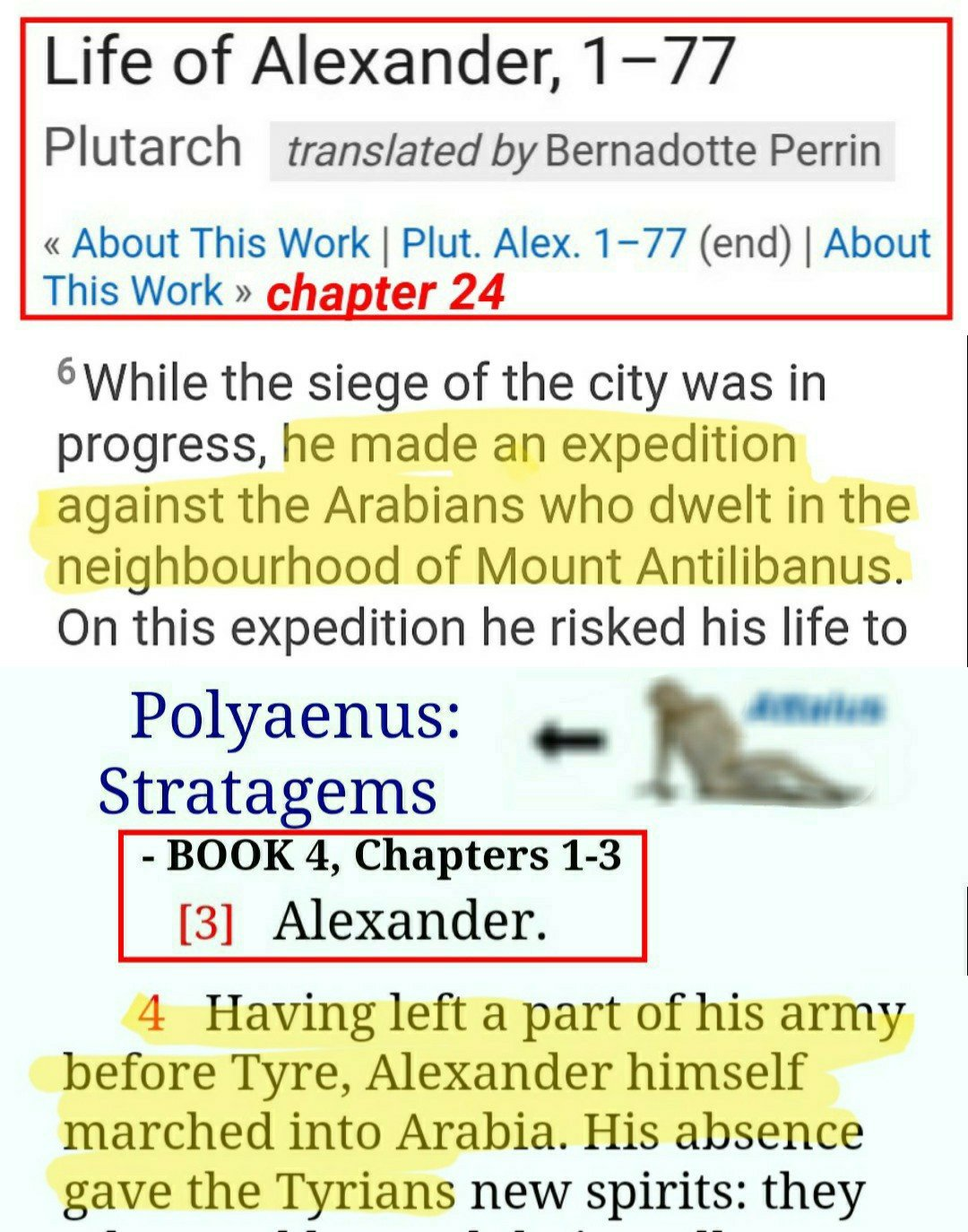
Further supporting that the western and eastern Lebanon mountains were part of the Arab lands is what Polyaenus mentioned: Alexander the Macedonian stationed part of his army in front of Tyre to continue its siege and then headed directly to Arabia to fight the Arabs. It is known that these Arabs were the inhabitants of the Lebanon mountains, referred to as Arabia, who killed Alexander’s soldiers.
[ Polyaenus: Stratagems Attalus - 4.3.4 ]
2 - Plutarch mentioned that the Arabs were not only the primary inhabitants of the eastern and western Lebanon mountains but also the inhabitants of their outskirts and surrounding areas. He stated that Alexander the Macedonian fought the Arabs neighboring Mount Anti-Lebanon (eastern Lebanon).
[ Plutarch , ALEXANDR 24.6 ]
3 - Eastern Lebanon Mountains
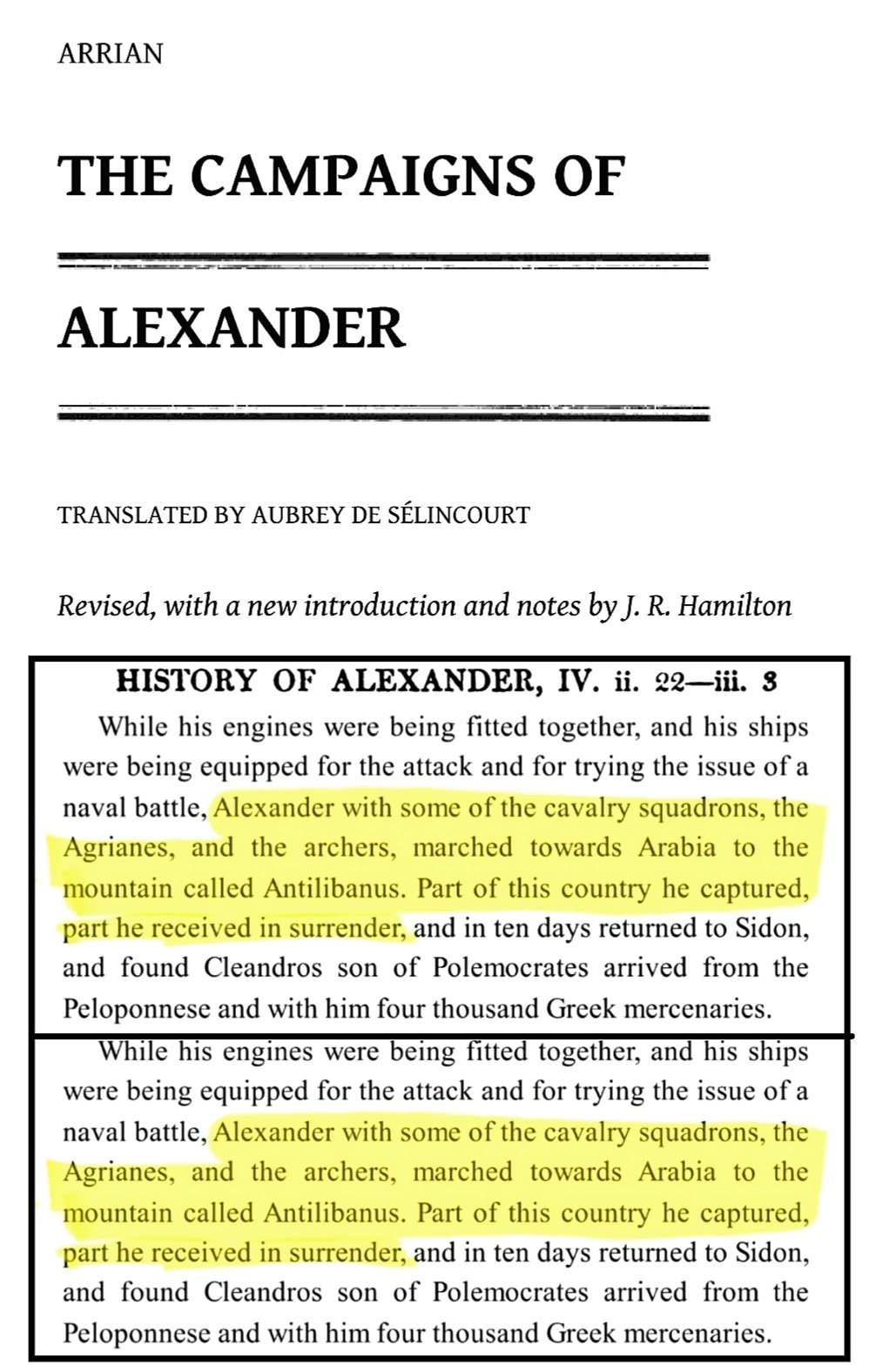
Arrian, the historian of Alexander, mentions that the Eastern Lebanon Mountains are part of the Arab lands, as he stated: Alexander marched with the guards and archers towards Arabia to the Eastern Lebanon Mountains to seize this part (Eastern Lebanon Mountains) of these lands (Arabia).
[ Arrian 2.20.5 ]
This means that the Eastern Lebanon Mountains are part of the Arab lands, as Alexander headed to Arabia to seize the Eastern Lebanon Mountains, which belong to Arabia.
Arrian said: towards Arabia to the Eastern Lebanon Mountain.
He did not say from Arabia to the Eastern Lebanon Mountain, which indicates that he considered the Eastern Lebanon Mountains part of Arabia.
Arrian’s statement can be simplified as if someone says, I am going towards the south or Jordan to the city of Amman, meaning that Amman is part of that land.
Hamilton confirmed that Arrian states that the Eastern Lebanon Mountains are located in the Arab lands, that is, Arabia.
[ ARRIAN , THE CAMPAIGNS OF ALEXANDER by J. R. Hamilton ]
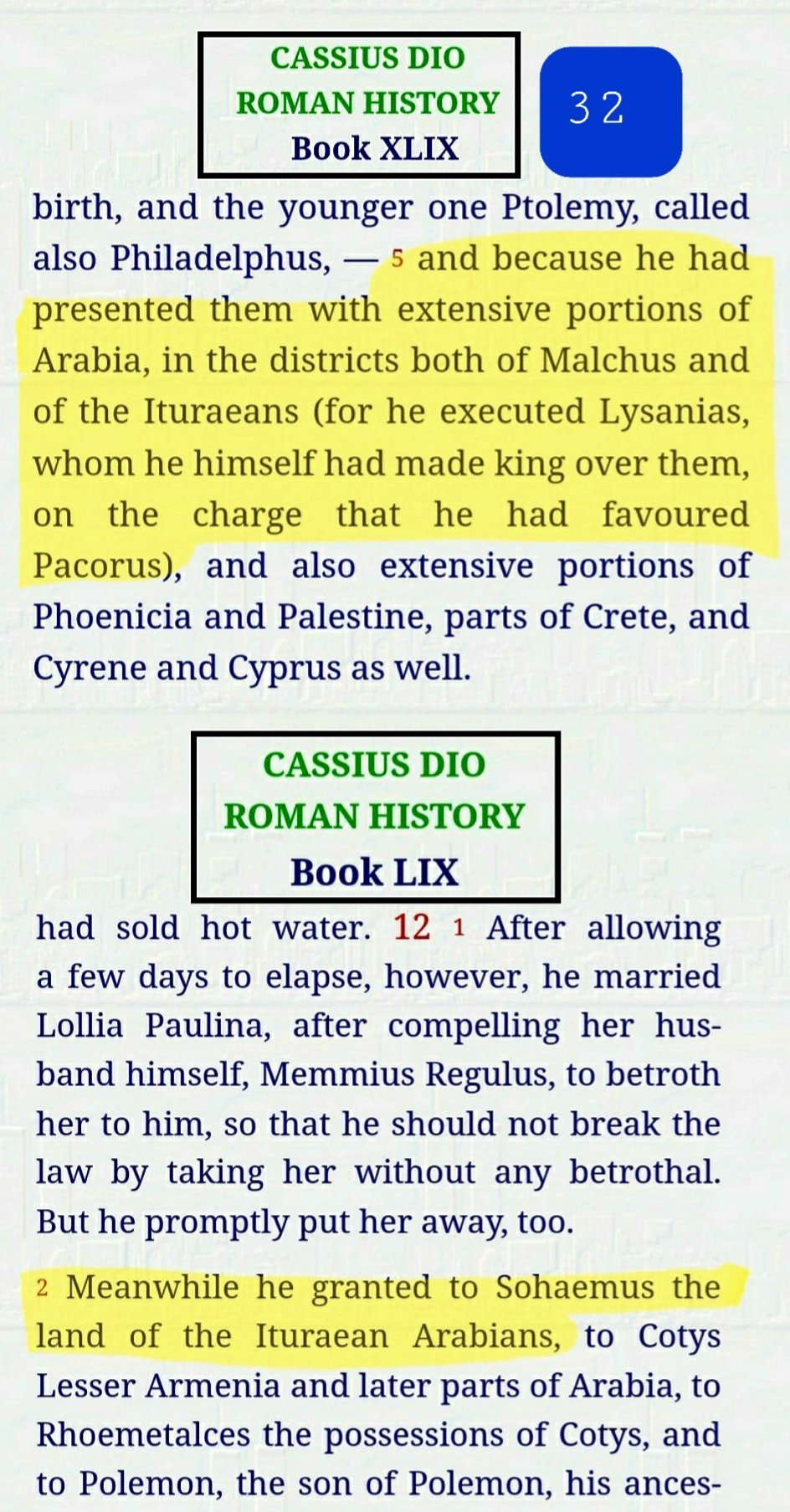
4 - The Iturean Arabs, a numerous Arab people, are described as the inhabitants of the Lebanon mountains.
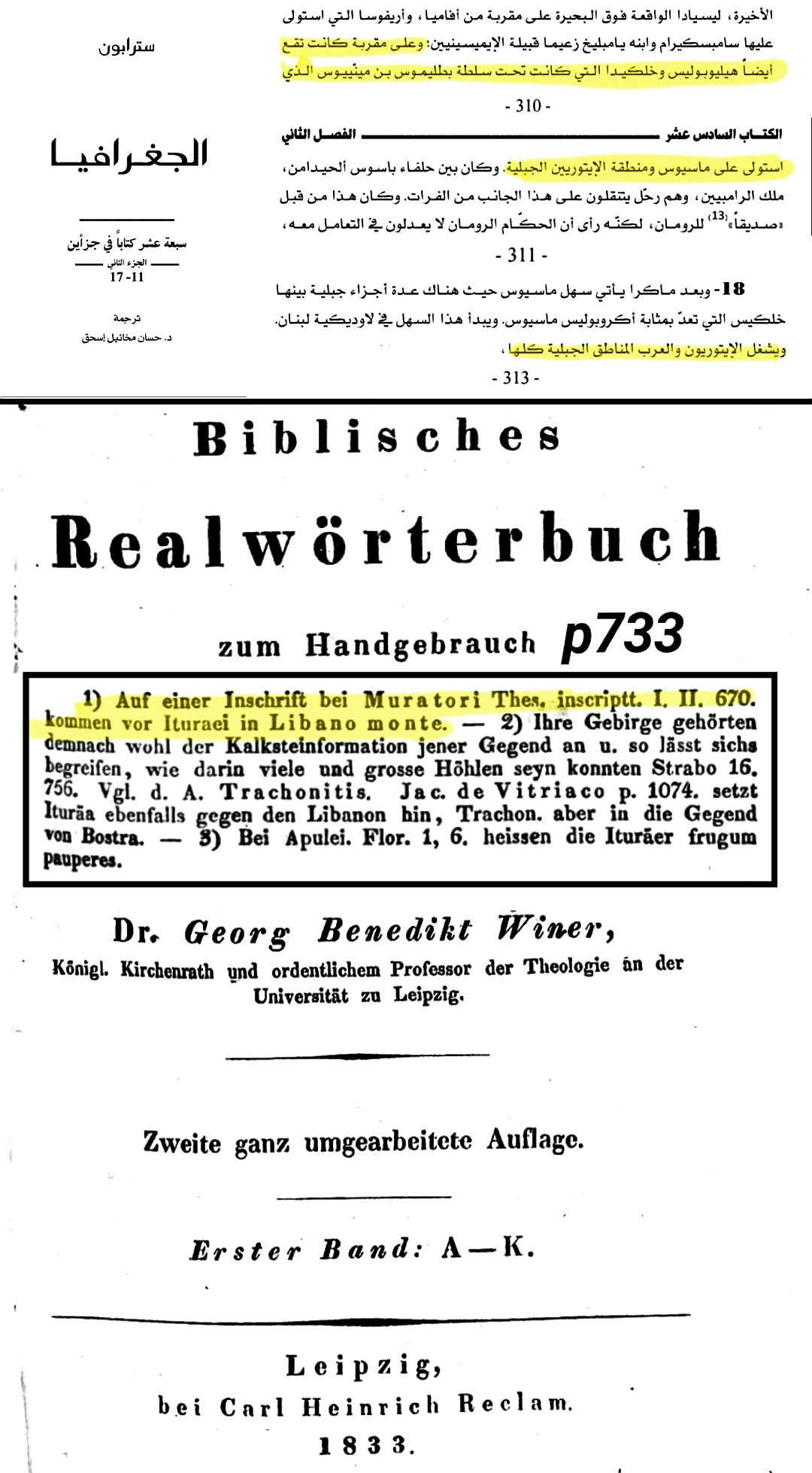
The Itureans were described as inhabitants of Mount Lebanon in a Latin inscription, and the text of the inscription is:
Ituraei in Libano Monte
Translation:
The Itureans in Mount Lebanon
See:
[ Biblisches Realwörterbuch zum Handgebrauch Dr. Georg Benedikt Winer 1833 p733 ]
Cassius Dio describes the Itureans as Arabs, stating that the Roman emperor granted Sohaemus, known as Soemus among the Romans, the land of the Iturean Arabs.
[ Cassius Dio 59:12:2 ]
5 - Eratosthenes, from the third century BCE, describes the eastern and western Lebanon mountains as Arab dwellings, noting that the dwellings of the Arabs, including the Itureans and others, are mountainous and that they live in the mountainous regions surrounding the Beqaa Valley (Massyas). These mountainous regions are the eastern and western Lebanon mountains.
Strabo mentions that the territories of the Iturean Arabs, ruled by their king Ptolemy son of Mennaeus, include the Massyas plain (Beqaa), Baalbek, and Chalcis (Anjar), as well as the Lebanon mountains.
This implies that the cities of Anjar and Baalbek were Iturean Arab cities according to Strabo.
In general, the statements of Eratosthenes and Strabo indicate the Arab character of the eastern and western Lebanon mountains and that Arabs were the primary inhabitants of the Lebanese mountains and the Beqaa.
[ Strabo 16.2.10 - 18 ]
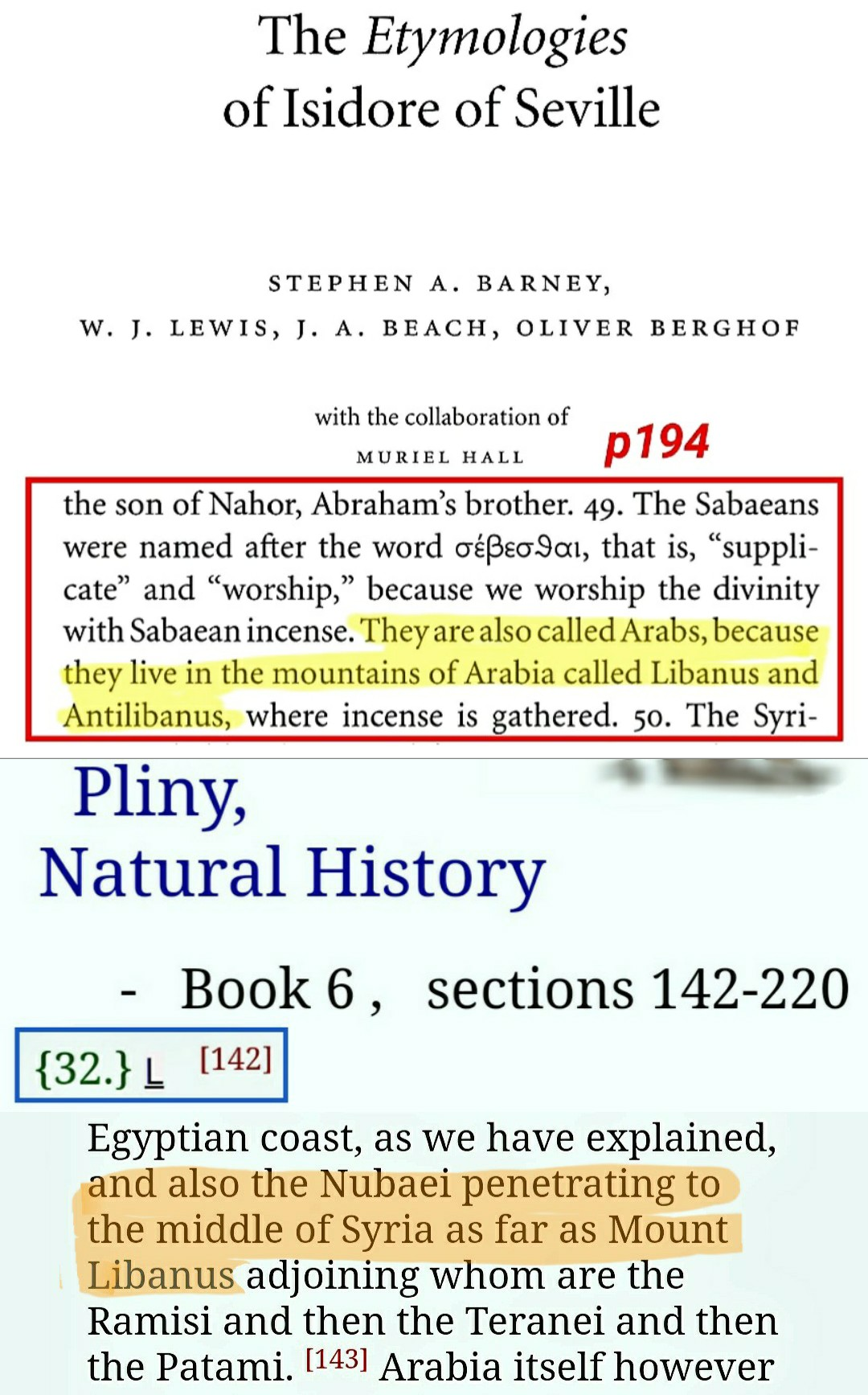
6 - And Juba from the first century BC mentions that the Nubaei Arab tribe spreads across the land extending from central Syria to Mount Lebanon, and all of this is their land
[ Pliny Natural History 6.142 ]
7 - And Isidore of Seville said, in summary: The mountains of Arabia, which are called Libanos and Antilibanos, that is, the eastern and western mountains of Lebanon
[ Etymologies , Isidore of Seville p194 ]
And this text of Isidore is a complete explanation of the texts of Arrian, Polybius, Curtius, and Plutarch about the mountains of Lebanon
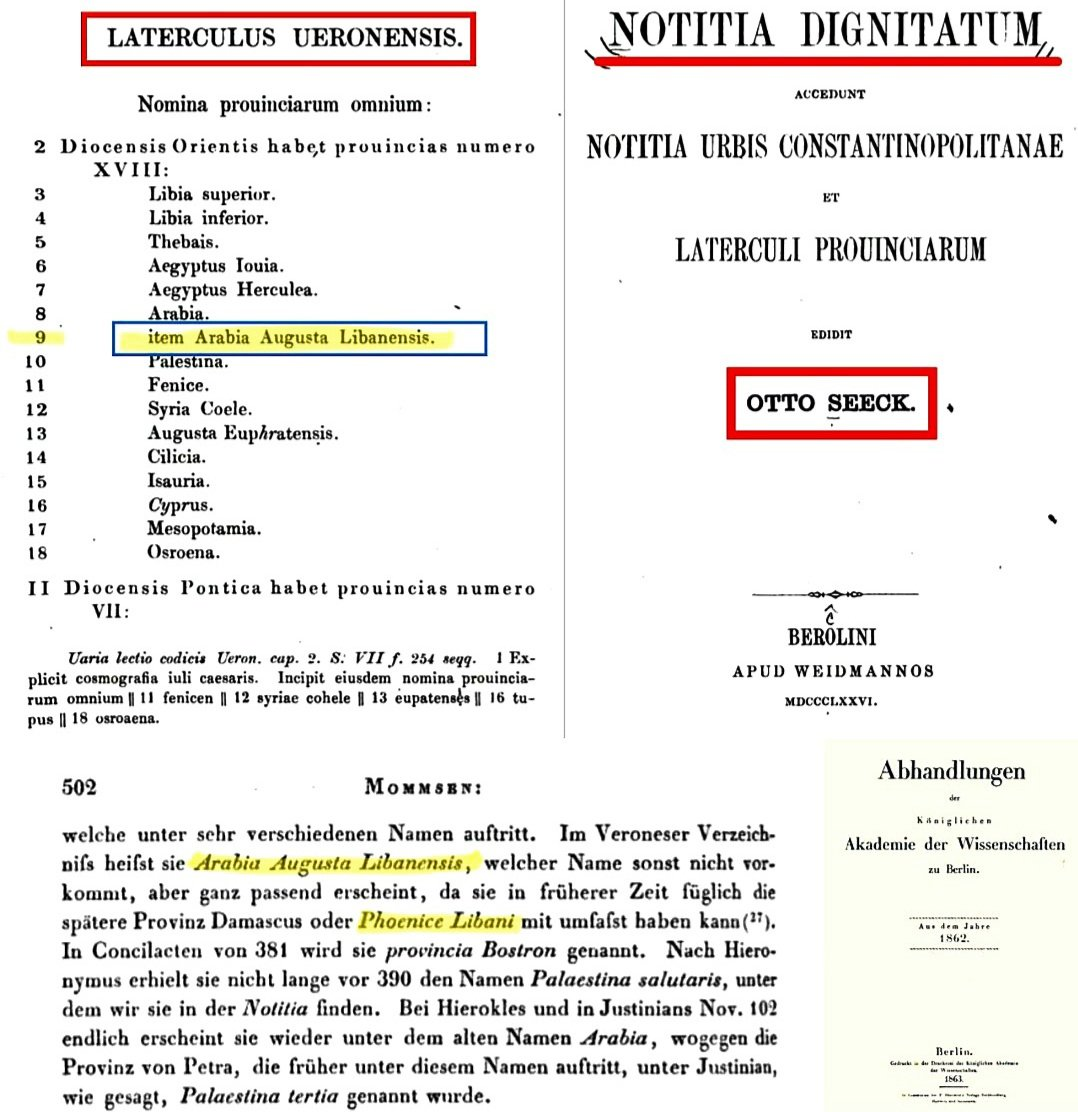
8 - And in the end, the Roman king named the land of Phoenicia Secunda or Western Phoenicia as the land of the Royal Arabs because the Arabs were the primary inhabitants of the eastern and western mountains of Lebanon, the Beqaa Valley, Homs, and Damascus, which indicates the ancient connection of the Phoenicians with the Arabs
[ NOTITIA DIGNITATUM , OTTO SEECK. Berlin 1876 p247 ]
[ Abhandlungen der Königlichen zu Berlin 1862 p502 ]