Are Qur'anic Manuscript Differences Evidence of Corruption? A Refutation of Daniel Brubaker
God willing, I will provide conclusive evidence that all the differences that may exist between any Qur’anic manuscript and the current textare nothing but spontaneous, unintended errors resulting from (auditory confusion), (visual confusion), or (mental confusion).
📑 Table of Contents
| # | Section |
|---|---|
| 1 | The Three Types of Copying Error |
| 2 | How Do We Distinguish a Spontaneous Error from a Deliberate Change? |
| 3 | The Four Criteria |
| 4 | Conclusion of the Framework |
| 5 | Method of Proof |
| 6 | [[#[1] Differences in Sanaa Manuscript No. 1]] |
| 7 | [[#[2] Differences Presented by Daniel Brubaker]] |
| 8 | Episode 1 — Sanaa Manuscript (Late 1st Century) |
| 9 | Episode 2 — MS.474.2003 (Q1/Q2) |
| 10 | Episode 3 — MS.474.2003 Continued |
| 11 | Episode 4 — The Root (Rizq) Argument |
| 12 | Brubaker’s Ten Examples — Full Rebuttal |
| 13 | Final Conclusion |
The Three Types of Copying Error
🔊 Auditory Confusion
When a copyist writes a manuscript bydictation, the reader dictates a word and the copyist mishears it due to the phonetic similarity of two words.
Example: (ya’maloon) confused with (ya’mahoon)
👁️ Visual Confusion
Example:
“Zaid went to the library, bought books from the library, and returned home.”
The copyist writes the first sentence; when returning to write the second, his eye falls on the second occurrence of “library” instead of the first — causing him to drop the phrase “and bought books from the library” due to similarity of endings.
This is called Homeoteleuton.
The counterpart error: a copyist omits one of two sentences because theyboth begin with the same word.
🧠 Mental Confusion
The copyist’s mind is occupied with a phrasesimilar to the one being copied, causing an unintentional mix-up. Because copyists are memorizers of the Qur’an, they may conflate verses with similar wording.
- “To Him belongs whatever is in the heavens and the earth.”
- “To Him belongs whatever is in the heavens and whatever is on the earth.”
- “To Him belongs whoever is in the heavens and the earth.”
- “To Him belongs whoever is in the heavens and whoever is on the earth.”
All four forms appear in the Qur’an — a copyist could easily mix two of them without realizing it.
A father was having his son memorize Surah Al-Masad. As the father recited“He will burn in a Fire of blazing flames,” the mother entered holding grapes. The boy, distracted, repeated: “He will burn in grapes!”
This is mental confusion in action — his mind was elsewhere.
James Royce —Scribal Habits in Early Greek New Testament Papyri
How Do We Distinguish a Spontaneous Error from a Deliberate Change?
The Four Criteria
Criterion 1 — Similarities
When a difference occurs in ambiguous verses (mutashabihat), the most natural explanation is mental confusion between similar passages — particularly at verse endings, which are the most common sites of confusion.
Repeated occurrences of this pattern confirm spontaneous error, not deliberate alteration.
Criterion 2 — Individual (Singular) Readings
This has never happened.
Individual readings are non-viable — they cannot compete with the Uthmanic text, which is supported by the entire manuscript tradition before and after any given deviation.
Spontaneous errors die where they are born. They are born in a single manuscript and buried there.
Criterion 3 — Size of the Difference Unit
- An entire surah present in one manuscript but missing in another
- A paragraph, verse, or even a full sentence missing
If differences were deliberate, why are there no long-form examples?
Memorizers who err typically do not drop entire verses — they confuse a few similar words between parallel passages. This is precisely what we observe.
Criterion 4 — The Goal (No Doctrinal Motive)
Question: Why would a Shi’a copyist bother distorting “whatever is in the heavens and the earth” into “whoever is in the heavens and the earth” — while leaving untouched the verses used by Sunnis as evidence against Shi’a doctrines (the Justice of the Companions, the People of the House, etc.) — issues that caused actual bloodshed?
Why would an Ash’ari change “strive with their wealth and their lives in the way of God” to “strive with their wealth and their lives” — while ignoring verses on the Attributes of God (the Hand, the Face), which caused fierce theological conflicts between Sunnis, Mu’tazila, and Ash’aris?
- A priest once claimed the Egyptian oath “By God Almighty, there are three” proves the Trinity.
- A commentator interpreted Abraham’s barbecue at Beersheba as a symbol of the crucifixion and baptism.
- A Christian admin once claimed the Qur’anic verse where Jesus says “I am the servant of God” proves his divinity.
Since no such examples exist, all remaining differences must be understood as spontaneous errors.
Conclusion of the Framework
- Individual readings (singular, not repeated in any other manuscript)
- Unable to compete with the Uthmanic tradition
- Falling in the ambiguous (mutashabihat) passages
- Short (one or two words at most)
- Not in the bloody doctrines (no theological motivation)
Method of Proof
The very examples put forward by the enemies of Islam to cast doubt on the Qur’an will themselves be used as the best evidence that all differences arespontaneous and unintentional.
[1] Differences in Sanaa Manuscript No. 1
Will be translated soon
[2] Differences Presented by Daniel Brubaker
Daniel Alan Brubaker describes himself as a “scholar” of early Qur’anic manuscripts. He provides YouTube videos of discrepancies, framing them as deliberate, dangerous, and indicative of an unreliable Qur’anic text.
These very examples will be shown to prove the opposite.
Episode 1 — Sanaa Manuscript (Late 1st Century)
Surah At-Tawbah 9:80 (Standard Text):
“Even if you ask forgiveness for them seventy times, Allah will not forgive them.”
Manuscript Text:
“If you ask forgiveness for them, Allah will not forgive them.”
The phrase (seventy times) is absent.
Al-Munafiqun 6: “It is the same for them whether you ask forgiveness for them or do not ask forgiveness for them — Allah will not forgive them.”
The copyist’s mind confused these two highly similar verses. The proof that the deletion was unintentional and not selective:
- The copyist also deleted the letter fā (ف) preceding lan — not just the phrase “seventy times”
- If the deletion were deliberate, only “seventy times” would have been removed, keeping fa-lan intact
- But Al-Munafiqun 6 uses lā yaghfiru Allāhu lahum (without the fā) — so when the mind recalled that verse, the fā was naturally absent
There is no deliberate explanation for why the fā was also dropped. The spontaneous explanation accounts for everything.
Episode 2 — MS.474.2003 (Q1/Q2)
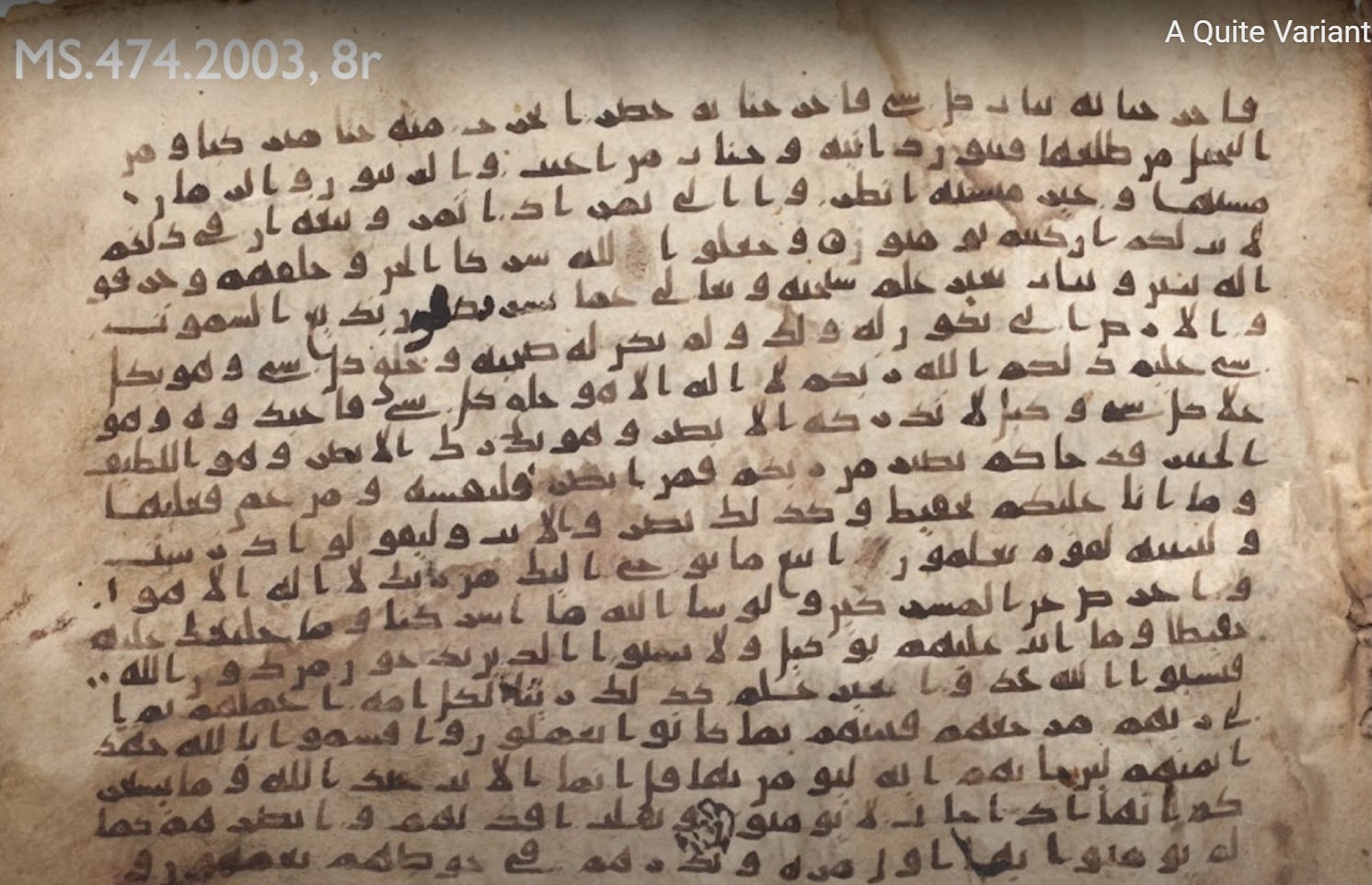
Evidence 1 — Al-An’am 6:100
Standard: “Glory be to Him, and He is far above what they describe.”
Manuscript: “…what they describe” — but with the beginning of the word yashir (يشر) written alongside it.
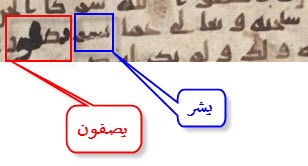
The copyist began to write “from what they associate” (يشركون — yashirkūn), then caught himself and wrote “from what they describe” (يصفون) — but left the trace of yashir behind. Both expressions appear many times in the Qur’an. Mental confusion.
Evidence 2 — Al-An’am 6:106-107
Standard (107): “And if Allah had willed, they would not have associated.”
Manuscript: “And if Allah had willed, we would not have associated.”
This is grammatically incoherent — the surrounding text speaks of polytheists in the third person. This error could only be spontaneous.
Confusion with Al-An’am 6:148: “Those who associate will say, ‘If God had willed, we would not have associated.’”
A deliberate change would never produce nonsensical grammar.
Evidence 3 — Al-An’am 6:100
The copyist wrote “And they have attributed to Allah partners among the jinn” with an extra alif, then erased it.

Reading before erasing the alif is meaningless — proving unintentional error.
Evidence 4: All differences occurred in similar/ambiguous passages.
Evidence 5: None of the differences are supported by any other manuscript.
Evidence 6: None have any theological or doctrinal motive.
Difference Table — MS.474.2003
| Current Reading | Manuscript Reading | Cause |
|---|---|---|
| Al-An’am 99 — “signs for people who believe" | "signs in that for you, if you believe” | Phrase occurs 4x vs 5x elsewhere — mental confusion |
| Al-An’am 99 — “We brought forth from it greenery" | "We brought it out green” | Confused with a similar phrase occurring 6x — mental confusion |
| Al-An’am 106 — “Follow what has been revealed” (past) | “Follow what is revealed” (present) | Two nearly identical phrases — mental confusion |
| Al-An’am 107 — “they would not have associated" | "we would not have associated” | Confused with Al-An’am 148 — mental confusion |
| Al-An’am 108 — “We have made fair-seeming to every nation their deeds” | Slight variant | Confused with similar phrase appearing 4x elsewhere — mental confusion |
| Al-An’am 110 — “their transition" | "their immersion” | Confused with verse 91 of same Surah — mental confusion |
Episode 3 — MS.474.2003 Continued
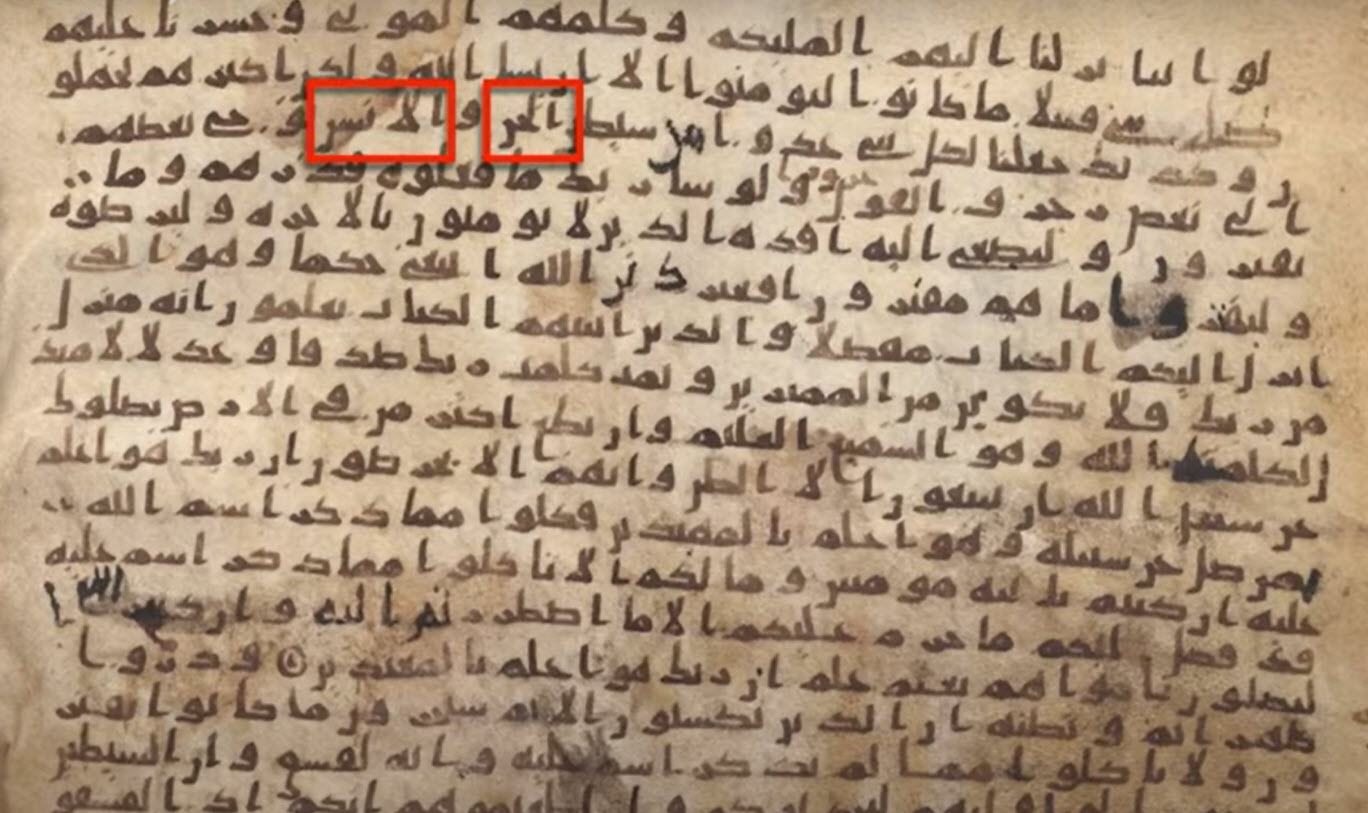
Evidence 7 — Al-An’am 6:112

The copyist forgot to write the word “arrogance/delusion” (غروراً), then went back and added it. The reason:
- Al-An’am 112: “Some of them inspire others with adorned speech to deceive them.”
- An-Nisa: “…returning the word to one another.”
The similarity between (adorned speech in delusion) and (returning speech to one another) caused the omission of the word delusion. The copyist caught the error and corrected it.
Evidence 8 — Proof of General Inaccuracy
- Al-An’am 116: Standard — “They are only guessing.” Manuscript — “They do nothing but lie.” An indisputable mistake.
- Al-An’am 121: The copyist omitted the word “Allah”, then made a failed attempt to erase and rewrite.

These errors demonstrate the copyist’s general level of imprecision — consistent with spontaneous error, not calculated distortion.
Evidence 9 — Al-An’am 6:115 (Clearest case of mental confusion)
Standard: “None can change His words (kalimātihi)”
Manuscript initially: “None can change the words of Allah (kalimāti Allāh)”
The copyist wrote the phrase from Al-An’am 6:34, then noticed the mistake and erased the open tā’ (ت) and replaced it with a closed tā’ (ة) to restore kalimātihi.


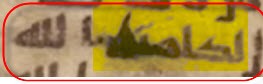
Note the open tā’ with two dots visible in the background beneath the closed tā’ written above it.
Difference Table — Episode 3
| Verse | Standard | Manuscript | Explanation |
|---|---|---|---|
| Al-An’am 112 | ”devils from mankind and jinn" | "devils of jinn and mankind” | Confused with Al-Furqan 31 — min added; order of jinn/mankind also swapped |
| Al-An’am 114 | ”Should I seek other than God as a judge?" | "Should I seek a judge other than the religion of God?” | Confused with Al-Imran 83 — word religion inserted |
| Al-An’am 115 | ”sent down from your Lord in truth" | "in truth” deleted | Confused with Ar-Ra’d 36 which lacks this phrase |
| Al-An’am 113 | ”commit what they are committing" | "invent what they invent” | Word invent appears 4x in Al-An’am alone — lingered in copyist’s memory |
| Al-An’am 120 | ”recompensed for what they used to do" | "rewarded for what they fabricated” | Same cause as above |
| Al-An’am 121 | ”you would be polytheists" | "you would be wicked” | Confused with An-Nisa 140 + many Qur’anic endings use fasqūn |

Episode 4 — The Root (Rizq) Argument
Multiple manuscripts show corrections to words derived from the root(ر-ز-ق / rizq) — Brubaker implies this represents systematic distortion.
Question 1: Why would anyone decide to distort the word rizq specifically?
Question 2: Why change rizq in one verse of one surah — but leave it untouched in all other occurrences in the same manuscript?
Brubaker cannot answer these questions — which is why he doesn’t.
- The root (خ-ل-ق / kh-l-q — creation): Two errors in the same Surah (Ar-Rum) + one in Luqman, all in BnF Arabic 340.
- The word (الله — Allah): Six errors in different Surahs.
- The words (موسى / Moses) and (فرعون / Pharaoh): Multiple errors in different Surahs.
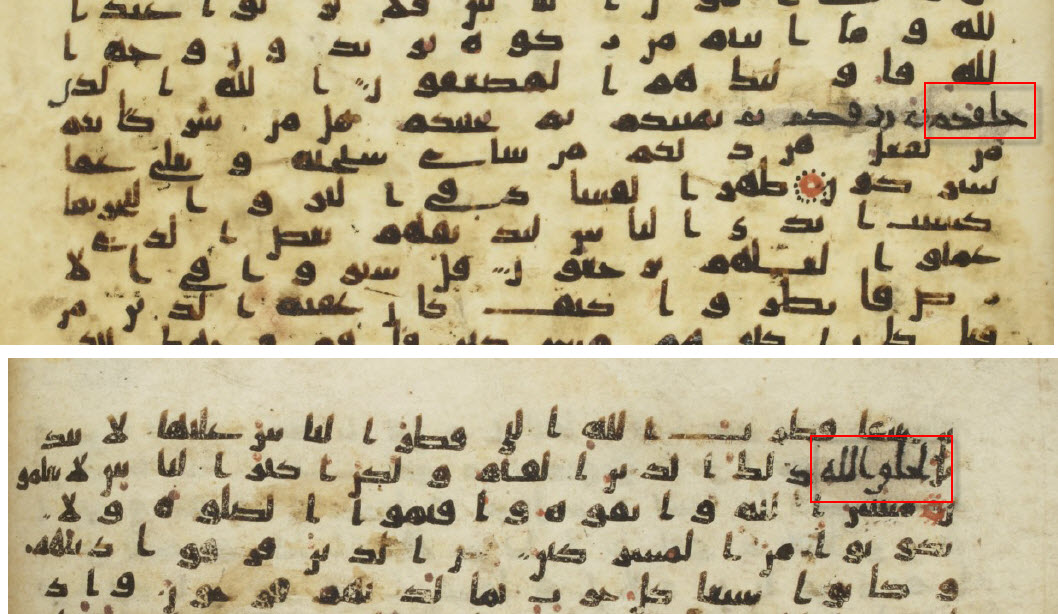
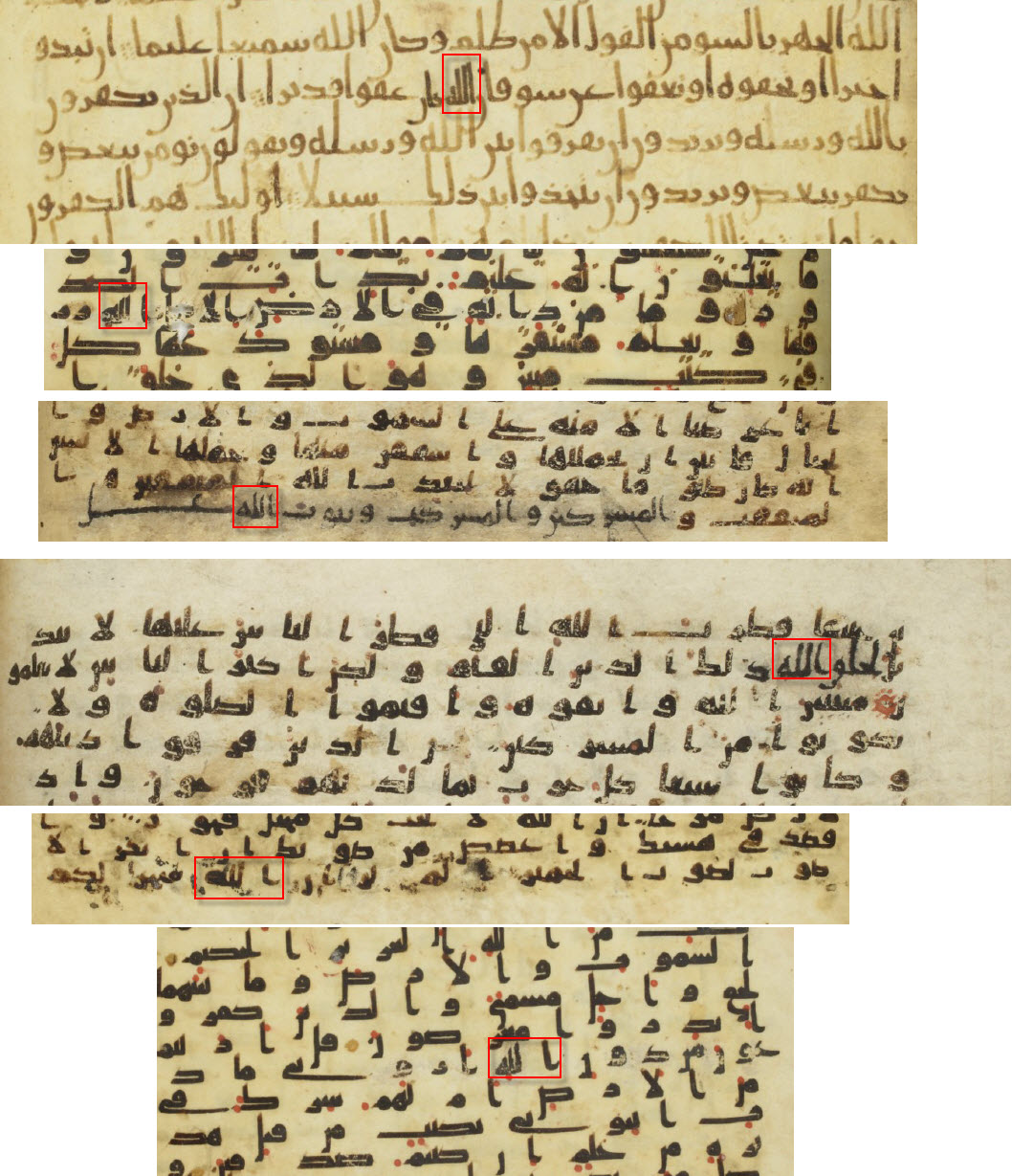
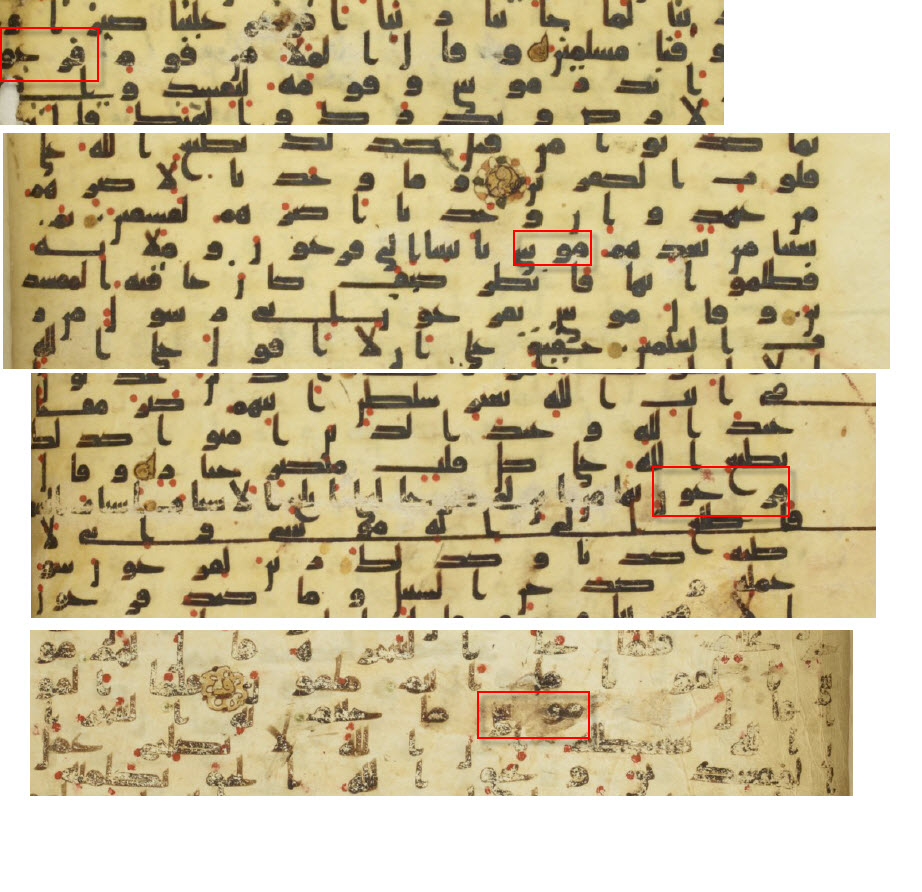
The response to the challenge ofindividual readings must come in the form of distortions — not corrections.
And it must be the same word in the same textual problem, not the same word in different texts in different manuscripts — which only demonstrates coincidence.
Brubaker’s Ten Examples — Full Rebuttal
Example 1 — BnF Arabe 341 (Al-Baqarah 2:60)
“Eat and drink from the provision (rizq) of Allah.”
Brubaker’s claim: The letter Qāf in rizq was erased and rewritten.
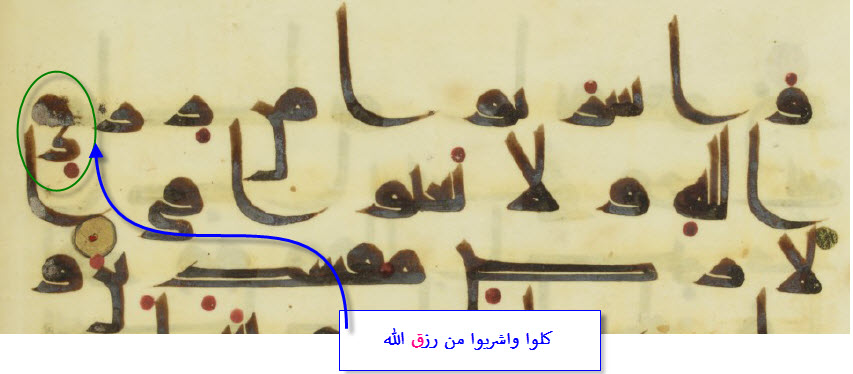
- Qāf and Fā are written identically at the base — so no meaningful substitution was possible. If Fā had been written, the word Razf has no meaning in Arabic. There would be no reason to correct it.
- The ink trace is ink seepage from the back of the page — the word on the reverse is bimā (بما) whose large round letter Meem bleeds through onto the circle of Qāf.
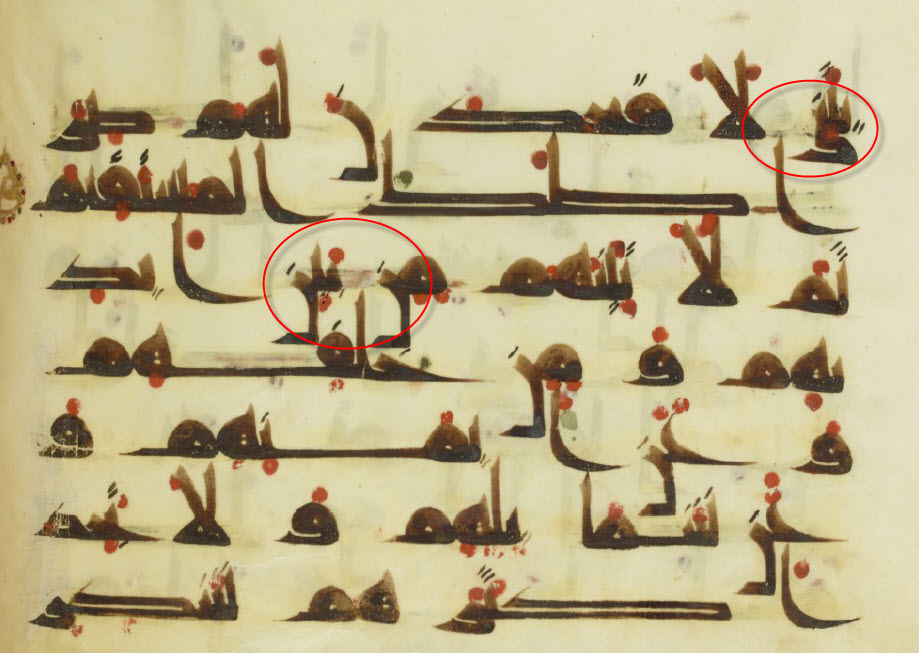
Example 2 — Topkapi Saray Manuscript (Al-Baqarah 2:25)
“Whenever they are provided with a fruit therefrom as provision (rizqā).”
Manuscript: The copyist wrote riz on the line and qā above the line.

Even Brubaker admitted this: “Was this a simple scribal mistake due to the repeat of the rasm form FA?” (IQSA, November 2016, p.4)
If he accepted it as possibly accidental, why present it as evidence of deliberate distortion?
Example 3 — NLR Marcel 8 (Al-A’raf 7:160)
Traces of erasure covering exactly the passage: “And We shaded them with clouds and sent down upon them manna and quails, saying, ‘Eat from the good things We have provided for you.’”
The obvious explanation: mental confusion with Al-Baqarah 2:57 — which is nearly identical but uses alaykum (to you) instead of alayhim (upon them). The copyist wrote the Baqarah version by mistake, then was forced to erase and rewrite the entire passage.
This explains perfectly why the erased area matches exactly the length of the rewritten passage — substituting kāf for hā’ does not change word length.
Example 4 — MIA.2014.491, Museum of Islamic Art, Doha (Al-Anfal 8:3)
“Those who establish prayer and spend from what We have provided them.”
The phrase is written over an erased area. The erased area is larger than the current text.

- He shows only one line — no comparison with the rest of the manuscript is possible.
- Minor handwriting variation is normal even for a single scribe (note the inconsistent circles of Fā and Qāf in the same word yanfaqūn).
- He provides zero evidence that the pre-erasure text lacked the word rizqnahum.
The most natural explanation: the copyist confused this verse with the many verses using “those who establish prayer and give zakāt” — writing that longer phrase, then catching the error and erasing to rewrite the shorter correct phrase (explaining why the erased area is larger).
Examples 5–10 Summary
- Presents cropped images preventing comparison
- Offers no motive for what was supposedly distorted
- Provides no evidence of what the pre-erasure text said
- Ignores that the same root rizq appears untouched multiple times in the same manuscript — fatal to any “systematic distortion” theory
Each case has a clear spontaneous explanation: visual error (homeoteleuton), mental confusion with a similar verse, or natural ink variation/sedimentation.
Final Conclusion
[1] Brubaker provided no coherent explanation or distortionary motive for the (Rizq) pattern.
[2] Not one of his examples is supported by more than one manuscript — they are all individual corrections, not individual readings. They remain non-competitive with the Uthmanic text.
[3] In every manuscript, the copyist left other instances of the same root rizq untouched — demolishing the premise of systematic intent.
[4] There is a fundamental difference between:
- Deliberate variant readings (which would require doctrinal motive and manuscript spread)
- Corrected unintentional transcription errors (which is exactly what Brubaker’s examples show)
All of Brubaker’s examples belong to the second category.
“Different individual corrections of the same word in different texts across different manuscripts” is not a rebuttal to the challenge of individual readings. To meet that challenge, one must produce deliberate distortion of the same word in the same textual problem. This has never been done — because it does not exist.
*Source: [Differences in Qur’anic Manuscripts — Professor Ahmad Al Shamy]