

Biblical Concubinage Was Not Normal Marriage: Jewish Sources Expose the Claim
Biblical Concubinage Was Not Normal Marriage
Table of Contents
- Introduction
- The Christian Apologetic Claim
- The Problem With This Claim
- Concubines Were Not Equal to Wives
- The Bible Dictionary on Concubines
- The Biblical Encyclopedia on Concubinage
- The Jewish Encyclopedia on Concubinage
- Encyclopedia Judaica: Concubines Without Kiddushin or Ketubbah
- The Talmud: Wives Had Contracts, Concubines Did Not
- Captive Women in Jewish Law
- Deuteronomy 21 and the Captive Woman
- Rashi Exposes the Real Reason for Shaving Her Head
- Why Does the Bible Separate Wives From Concubines?
- The Problem of Forced Intercourse in Deuteronomy 21
- Questions for the Patcher
- Slave Girls Were Lower Than Wives
- Rashi on Genesis 25:6
- Conclusion
Introduction
They insist that it was a marriage like any other marriage, with no sexual ownership, no lower status, and no concubinage problem.
This article examines that claim through Christian, Jewish, biblical, and Talmudic sources.
The Christian Apologetic Claim
Some Christians argue:
There is no enjoyment, and the line remains open.
She must also be Jewish and convinced of Judaism in order for him to marry her.
Purity and holiness do not change. This is the true God.
The Problem With This Claim
This claim collapses under the weight of Jewish law, Christian reference works, the Talmud, and Rashi’s explanation of Deuteronomy 21.
The system of concubines exists clearly in the Bible.
A concubine or slave girl is not identical to a wife in Jewish law.
The concubine is of lower status than the wife.
Her relationship with her master does not require the normal structure of marriage:
- no full marriage contract
- no ordinary betrothal
- no ketubbah according to the majority reading
- no equal status with the wife
- no ordinary free-woman marriage arrangement
She may be acquired by:
- purchase from slave markets
- sale by her father
- war captivity
It is apologetic patchwork.
Concubines Were Not Equal to Wives
The concubine was not simply a free wife under another name.
She was a woman of lower rank, often a slave or captive.
Her “marriage,” if one insists on calling it that, was not equivalent to the marriage contract of a free woman.
The Bible Dictionary on Concubines
We read from the Bible Dictionary:
This was permissible in the polygamy system, as concubines were usually taken from slaves and bought for a price, such as Hagar, Bilhah, and Gideon’s concubine.
Sometimes they were girls sold by their fathers, or prisoners of war.
Divorce of a concubine was easier than divorce of a mistress, but her rights were preserved according to Mosaic law.
Source:
Concubines were lower than wives.
They were often slaves.
They could be bought.
They could be sold by fathers.
They could be prisoners of war.
The Biblical Encyclopedia on Concubinage
We read from the Biblical Encyclopedia:
The law in Mesopotamia allowed the husband to have intercourse with his female slaves.
In the Assyrian state, the husband could take many concubines in addition to his free wife, and they were subject to the wife.
The children of the concubine had the right to inherit.
The law of Hammurabi stipulated that a concubine who bore children and behaved arrogantly could be treated as a slave, but she could not be sold.

For your info: This scan is used to show that concubinage was connected to ownership, slavery, and sexual access to female slaves. It also explains that concubines existed alongside free wives and had lower status. The key point is that this was not ordinary marriage between two free spouses. It was a lower-status arrangement involving a slave woman or captive woman.
The Jewish Encyclopedia on Concubinage
We read from the Jewish Encyclopedia:
She enjoyed the same rights in the house as the legitimate wife.
Since it was regarded as the highest blessing to have many children, while the greatest curse was childlessness, legitimate wives themselves gave their maids to their husbands, at least in part, for their own barrenness, as in the cases of Sarah and Hagar, Leah and Zilpah, Rachel and Bilhah.
It also says:
The concubine commanded the same respect and inviolability as the wife; and it was regarded as the deepest dishonor for the man to whom she belonged if hands were laid upon her.
Source:
http://www.jewishencyclopedia.com/articles/4585-concubinage
The same encyclopedia later explains that the wife had formal betrothal and marriage contract, while the concubine did not.
Encyclopedia Judaica: Concubines Without Kiddushin or Ketubbah
The question is:
According to Jewish law, does a concubine enter into a full marriage contract with her master simply because she is a concubine?
The answer is no.
We read from the Encyclopedia Judaica:
“What is the difference between wives and concubines? R. Judah said in the name of Rav: Wives have ketubbah and kiddushin, concubines have neither.”
Sanhedrin 21a; Maimonides, Yad, Melakhim 4:4
Source:
https://www.jewishvirtuallibrary.org/concubine
A concubine is not the same as a wife.
A wife has kiddushin and ketubbah.
A concubine, according to the majority reading, has neither.
The same source distinguishes the concubine from both:
- a married woman with full marriage ceremony, kiddushin, and ketubbah
- a prostitute who does not dedicate herself exclusively to one man
So concubinage was not treated as adultery in Jewish law, but it was also not equal to full marriage.
The Talmud: Wives Had Contracts, Concubines Did Not
We read from the Jewish Encyclopedia:
According to the Babylonian Talmud, Sanhedrin 21a, the difference between a concubine and a legitimate wife was that the latter received a ketubah and her marriage was preceded by a formal betrothal, kiddushin, which was not the case with the former.
Source:
http://www.jewishencyclopedia.com/articles/4585-concubinage
A reading from Talmud Sanhedrin 21a says:
Wives receive a marriage contract and betrothal; concubines are taken without a marriage contract and without betrothal.
Source:
https://www.sefaria.org/Sanhedrin.21a.20?lang=bi&with=all&lang2=en
Concubines were not taken through the same process as wives.
No amount of apologetic decoration changes this.
Captive Women in Jewish Law
The same Talmudic passage mentions beautiful women taken captive in war.
It says:
David had four hundred children in his army, and all of them were sons of beautiful women taken captive from their Gentile homes during war.
It also says regarding Tamar:
Therefore, Tamar was not considered the daughter of David according to halakha.
Source:
https://www.sefaria.org/Sanhedrin.21a.20?lang=bi&with=all&lang2=en
The Talmudic discussion says Tamar’s mother was a captive woman and Tamar was born before her mother converted.
If female captives in Jewish law could become concubines among the children of Israel, and the master had the right to have intercourse with his concubine, then this is not the pure modern marriage picture that apologists try to sell.
Deuteronomy 21 and the Captive Woman
Now we return to Deuteronomy 21:10–14.
“When you go out to fight against your enemies and the Lord your God delivers them into your hand, and you take some of them captive,
and you see among the captives a woman beautiful in appearance, and you cling to her and take her as your wife,
then when you bring her into your house, you shall shave her head and trim her nails.
And she shall strip off her captive garments, and shall remain in your house and mourn for her father and mother for a whole month;
and after that you shall go in to her and take her as your wife.
But if you do not delight in her, then you shall let her go for herself.
You shall not sell her for money, nor make her a slave, because you have humbled her.”
But Rashi gives a very different explanation.
Rashi Exposes the Real Reason for Shaving Her Head
We read from Rabbi Rashi’s interpretation of Deuteronomy 21:
She must let them grow, so that she should become repulsive to her captor, to induce him to change his mind about marrying her.
And she shall remove the garment of her captivity:
So that she should not be attractive to her captor, for they are pretty clothes, because Gentile women adorn themselves during wartime in order to seduce others to have relations with them.
And stay in your house:
Upon entering, he will stumble upon her, and upon leaving, he will stumble upon her, see her weeping and see her unsightly appearance — all this, so that she should become despicable to him.
And weep for her father and her mother:
Why is all this necessary?
So that an Israelite woman should be happy, and this Gentile captive woman should be sad-stricken; an Israelite woman should be dressed up, and this one should make herself repulsive.
Source:
https://www.chabad.org/library/bible_cdo/aid/9985/showrashi/true
The shaving of the head and the growing of the nails were not presented as some beautiful conversion ritual.
They were meant to make the captive woman unattractive and repulsive to the Israelite man.
So the real reason was not “purity and holiness,” as the patchworkers claim.
It was to make the captive woman ugly, grieving, and undesirable in comparison to the Israelite wife.
Why Does the Bible Separate Wives From Concubines?
If concubines were simply wives like any other wives, then why does the Bible repeatedly separate wives from concubines?
Solomon
“And he had seven hundred wives, princesses, and three hundred concubines; and his wives turned his heart away.”
David
“And David knew that the Lord had established him king over Israel, and that he had exalted his kingdom for the sake of his people Israel.
And David also took concubines and wives from Jerusalem after he came from Hebron; and sons and daughters were born to David.”
Gideon
“And Gideon had seventy sons coming out of his loins, for he had many wives.
And his concubine who was in Shechem also bore him a son, and he named him Abimelech.”
Jacob
The sons of Leah: Reuben, Jacob’s firstborn, Simeon, Levi, Judah, Issachar, and Zebulun.
The sons of Rachel: Joseph and Benjamin.
The sons of Bilhah, Rachel’s handmaid: Dan and Naphtali.
The sons of Zilpah, Leah’s handmaid: Gad and Asher.
These are the sons of Jacob who were born to him in Padan-aram.
Esau’s Line
These are the names of the sons of Esau:
Eliphaz, the son of Adah, Esau’s wife, and Reuel, the son of Basemath, Esau’s wife.
And Timna was a concubine of Eliphaz the son of Esau, and she bore Amalek to Eliphaz.
So the missionary claim that a concubine was merely a normal wife is contradicted by the Bible’s own wording.
The Problem of Forced Intercourse in Deuteronomy 21
We read Deuteronomy 21 in the Common English Translation:
When you go out to fight against your enemies, and the Lord your God delivers them into your hand, and you take some of them captive,
and one of you sees among the captives a woman beautiful to look at, and his heart is drawn to her and he marries her,
and when he brings her into his house, he shall shave her head and trim her nails,
and strip her of her captive clothing, and she shall remain in his house mourning her father and mother for a month.
After that, he may go in to her and be her husband, and she shall be his wife.
And if he desires not to keep her afterward, he must set her free and not sell her for money or enslave her, because he forced her to sleep with him.
Questions for the Patcher
These questions expose the apologetic problem:
-
Why does the text say he must set her free if she was supposedly already free when he married her?
-
How does the text say he forced her to sleep with him if this is supposed to be a natural free marriage?
-
If he wants to keep her, does he have the right to continue sleeping with her under this captive arrangement?
The missionary cannot keep calling this “normal marriage” while the text itself speaks in the language of captivity, humiliation, and release.
Slave Girls Were Lower Than Wives
Was the slave girl considered a second wife in Christianity?
The Encyclopedia of the Bible says that the slave girl was of secondary status and was not considered a second wife.
The husband could buy the woman as a slave girl, but she was clearly of lower status than the wife.
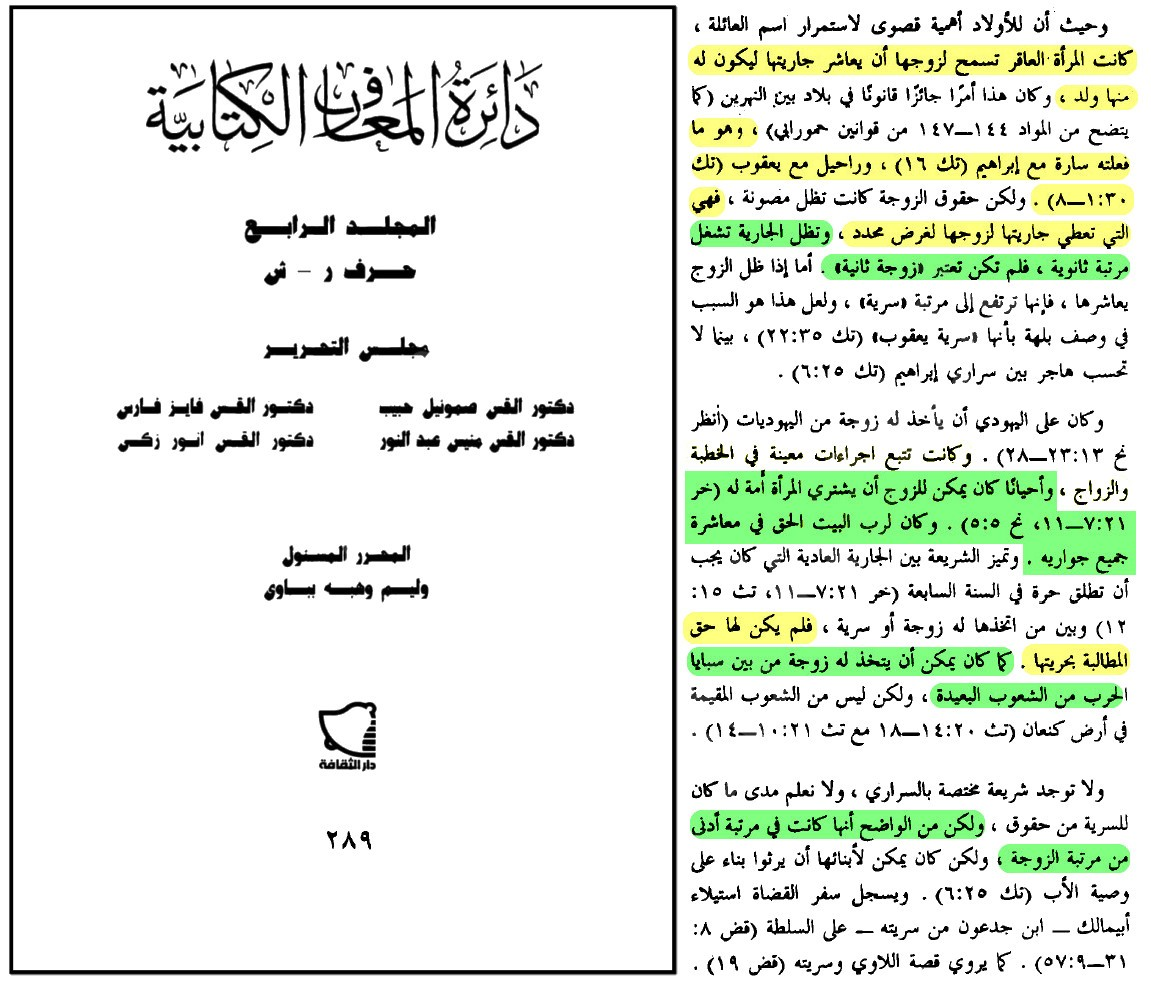
For your info: This scan states that the slave girl or concubine was not equal to the wife. It explains that the man could buy a woman as a slave girl, but she remained of lower rank. This supports the central argument of the article: biblical concubinage was not ordinary marriage between equal spouses.
Rashi on Genesis 25:6
Rashi says:
Wives are those whom a man marries with a marriage contract, while concubines do not have a marriage contract.
Source:
https://www.sefaria.org/Rashi_on_Genesis.25.6.2?lang=bi
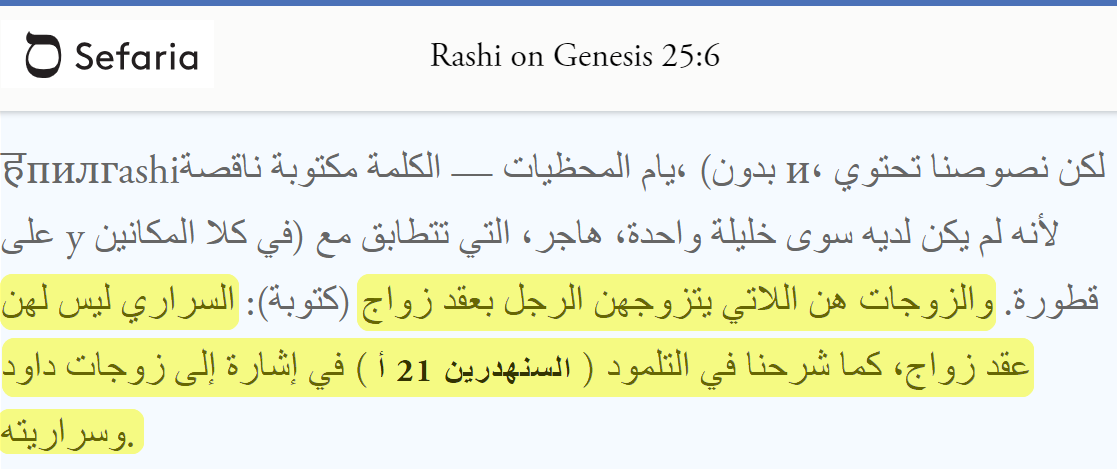
For your info: This scan quotes Rashi’s distinction between wives and concubines. Wives are connected to marriage contract, while concubines lack that contract. This directly refutes the claim that concubines were simply wives like any other wives.
Conclusion
Biblical concubinage was not ordinary marriage.
Christian and Jewish sources admit that concubines were often slaves, bought women, sold girls, or captives of war.
The Talmud explicitly distinguishes wives from concubines: wives have marriage contract and betrothal, while concubines do not.
Encyclopedia Judaica defines the concubine as a woman who cohabits with a man without kiddushin or ketubbah according to the majority reading.
Deuteronomy 21 deals with a captive woman taken after war, brought into the house, made to mourn, and then taken by the captor.
Rashi explains that her appearance was deliberately made repulsive so that the Israelite man might lose desire for her.
The Bible itself repeatedly separates wives from concubines.
Therefore, the claim that biblical concubinage was just pure, ordinary marriage is not scholarship.
It is damage control.
...that biblical concubinage was connected to slave women and lower-ranking wives. SEE PROOF HERE...