Christ Does Not Know the Time of the Day of Resurrection! an Exposition of the Confusion and Contrad
Christ does not know the time of the Day of Resurrection! An exposition of the confusion and contradictions of the Church Fathers due to the strength of the text.
Does God Not Know when Judgment Day Will Come?
While Christians believe that Christ is God, we find many biblical texts attributed to Christ that prove his non-divinity . It is a doctrinal paradox for one to believe something while the source of that belief contradicts it.
One of the Most Important Things that Denies the Divinity of Christ is His Lack of Knowledge of the Date of the Day of Judgment (the Day of Resurrection), Which is This Text
” But of that day and hour no one knows, not even the angels in heaven, nor the Son, but only the Father. ” (Mark 13:32)
Therefore, no human being, no angel, not even the Son (i.e. Christ) himself knows the time of the Day of Resurrection. Only the One who has determined it knows it, which is God the Father alone. There is no doubt that people, angels, and prophets (among whom Christ is) do not know about it, because absolute knowledge is an attribute of God Almighty, the Possessor of absolute perfection. Whoever is ignorant of something is not a god .
This text, because Christ himself denies his knowledge of the time of resurrection, which leads to a denial of his divinity, has caused widespread controversy within the Christian community . As a result, the Church Fathers and early commentators were forced to invent contradictory excuses that tended towards feelings of dilemma and intellectual suffocation, and relied on flimsy answers. The reader may be surprised by the stature of those bishops and theologians with their answers in this manner. All of this highlights the difficulty of this text and how clearly it refutes the claim of the divinity of Christ.
What is more astonishing and bitter than the conflicting and weak Christian interpretations is the extension of the treacherous hand of distortion to this text. This does not only lead to a denial of the infallibility of the Bible from distortion, but also demonstrates the strength and authoritativeness of the text in denying the divinity of Christ .
# Weak and conflicting interpretations
. Due to the extreme importance and power of this text, the Unitarian Christians (who denied the divinity of Christ) relied on this text as one of the most important texts denying the divinity of Christ.
Athanasius of Alexandria (d. 373 AD)
wrote a collection of books in which he responded to the Unitarians of his time (who were called Arians ).
In his book “Essays Against Arianism”, he devoted two entire chapters (Chapters 27 and 28) to responding to the Arian arguments that claimed that Christ was not omniscient and that there were things He did not know
. Athanasius mentioned some of their objections, including: - Christ did not know the location of the body of the dead Lazarus; He asked about him, saying: ” Where have you laid him? ” (John 11:34) . - Christ did not know the number of loaves; Where he asked: ” How many loaves of bread do you have? ” (Mark 6:38)
-
Christ increased in wisdom, which indicates that he had been less wise before: ” And Jesus increased in wisdom and stature, and in favor with God and men. ” (Luke 2:52)
-
Christ did not know the time of the Day of Resurrection, as he said: ” But of that day and hour no one knows, not even the angels in heaven, nor the Son, but only the Father .” (Mark 13:32)
The last argument is the strongest of these texts, because it is explicitly from the mouth of Christ, in which He admits that He did not know (the first two texts, for example, are not explicit, and the third text, despite its strength and clarity, is not from Christ’s words and confession).
Therefore, this text was subjected to a long debate from the Church Fathers and various justifications filled with feelings of entanglement and the difficulty of the text
. So, how did the Church Fathers justify this difficult text? There are five different evasive justifications that the early Trinitarians attempted to put forward to resolve the stifling dilemma.
I will add a sixth explanation , which is the explicit explanation, far from evasive methods, and it represents the explanation of the Church Fathers before the fourth century AD.
Meanwhile, all five justifications are later justifications that emerged since the fourth century AD, when the conflict between Trinitarians and Unitarians was at its height.
Here Are the Five Different Justifications
1Christ knows about His divinity at the time of resurrection, while He is ignorant of it regarding His humanity .
2There is no such thing as someone who knows the divinity and is ignorant of the humanity. Christ knows it, but the translation of the text is wrong . Instead of translating it as “nor the Son except the Father,” the translation should be “nor the Son except the Father.”
3There is no problem with the translation, but Christ, although he knew, declared his lack of knowledge so that his disciples would not ask him at that time !
4Christ could not lie, but what he meant by his lack of knowledge was not his knowledge itself, but rather what he meant by it was that he did not reveal to people about that time. 5-
The son who does not know is not the Christ, but the believer , because believers are children of God.
Here Are the Details of These Justifications, Demonstrating Their Weakness and Fragility
First Justification
Christ knows the time of the Day of Resurrection with his divinity, but he does not know it with his humanity.
This is the statement of Athanasius of Alexandria (d. 373), which he repeated several times in his third treatise against Arianism. This justification is unjustified, as it is a major fallacy that contradicts the Gospel text, because Christ declares that the one who does not know the time of the Day of Resurrection is the Son , as he said: ” nor the Son .” In Christian tradition , the Son is divine, not human. For the Trinitarians, the Son is the second personality (or hypostasis) of the Trinity , as God is the Father, the Son, and the Holy Spirit. The problem is that Athanasius himself, in the same book, declares the divinity of the Son, saying: ” For the divinity of the Son is the divinity of the Father. ” (The Third Treatise Against Arianism 26:36) “for the Son’s Godhead is the Father’s Godhead.”
In addition to this doctrinal contradiction in Athanasius’s Another problem arises. Let us forget for a moment that Christ used the word ” Son ” and suppose that he used the word “Christ” instead (because the word Christ is considered in Christian tradition to encompass both divinity and humanity). Does Christ, as a person, know when the Day of Resurrection will be or not? Athanasius’s words lead to making Christ into two personalities , one that knows and another that does not know, one that thinks of one thing and another that thinks of another, while the idea of divinity and humanity requires the existence of two natures, not two personalities, considering that God, in his opinion, wore a body. If we consider that God is perfect and not deficient (and thus his knowledge is perfect) and that with his complete divinity he wears a body, then there is no doubt that the body will not obscure the perfection of divinity . If Christ is a God who knows , then his wearing a body will not obscure his knowledge . Hence, it is not correct to say that he knows his divinity and is ignorant of his humanity, otherwise it would be sophistry . What is strange is that Athanasius himself realizes this statement (i.e., the humanity not obscuring the divinity), but it seems that his attempt to evade the dilemma of Christ’s ignorance led him to ignore this meaning and to contradict himself, as he said in the same context of his discussion of divinity, humanity, and the knowledge of Christ:
” For when he became human, he did not cease to be God, and while he was God, he did not shrink to the essence of man in order to lose the [divine] thought, but instead, while he was ” For He did not, when He became man, cease to be God; nor, whereas He is God, does He shrink from what is man’s; perish the thought; but rather, being God, He has taken to Himself the flesh,
and being in the flesh deifies the flesh.”
(3 Discourse against Arians 27:37)
https://www.newadvent.org/fathers/28163.htm
{Embed}
https://www.newadvent.org/fathers/28163.htm
CHURCH FATHERS: Discourse III Against the Arians (Athanasius)
Featuring the Church Fathers, Catholic Encyclopedia, Summa Theologica and more.
As is clear from Athanasius’s words, the humanity (the flesh) did not obscure the divinity, but rather the body was elevated to the point of being deified! Yes, Athanasius believes that the body of Christ is deified and worshipped (and the worshipped is undoubtedly divine, although he declares several times that this body is human!), and the reason for this confusion in Athanasius is clear,When a person believes something and then finds something logical that contradicts his belief, he is forced to twist his belief and adapt to the opposing argument ( even if that adaptation leads to a contradiction! ).
Athanasius did not stop there. By claiming that Christ’s knowledge is human, he confuses what is spiritual with what is physical. All material things related to the body are human, such as Christ’s body, flesh, bones, blood, etc., while everything that is immaterial is divine, such as Christ’s soul (his spirit) and his mind (which includes his thinking and knowledge). This is what Athanasius explains in another letter of his, entitled ” On the Incarnation of the Word ” (which contradicts his concept of Christ’s knowledge here).
” For He was not (as might be imagined) circumscribed in the body , nor, while present in the body, was He absent elsewhere; nor, while He moved the body, was the universe left void of His working and providence; … Thus, even while present in a human body and Himself quickening it, He was , without inconsistency, quickening the universe as well… Thus, the work of the soul is that which holds even what is outside its body by the works of thought
, without operating outside its own body or moving things by its presence apart from the body.” (On the Incarnation of the Word 17:1-3) “The function of the soul to behold even what is outside its own body, by acts of thought, without, however, working outside its own body, or moving by its presence things remote from the body.” (On the Incarnation of the Word 17:1-3)
As is clear from Athanasius’ statement that the divinity of Christ is the spirit that inhabits the body of Christ , and from which his thought is considered, he sees that it is Christ’s thought that controls things (of course, Christ’s thought is not material, and therefore it is spiritual, and consequently it is theological). So see how Athanasius contradicted himself when he admitted that Christ’s thought is theological (from which his knowledge is considered), and then when he fell into the problem that Christ does not know the time of the Day of Resurrection, he contradicted himself by claiming that knowledge is human! Or rather, he was forced to divide knowledge into two types: theological (spiritual) knowledge and human (bodily) knowledge. Is knowledge material and bodily for Athanasius to make it human? As I said, instead of talking about the difference between two natures (spiritual and divine, and material and physical and human), he was forced to separate Christ into two persons: one who knows and thinks one thing, and another who does not know and thinks another!
The great disaster is that although the most important church fathers who lived at the time of Athanasius did not accept this interpretation, we find some contemporary interpretations (such as the Applied Commentary on the Bible) adopting this justification without even considering the contradictions that Athanasius invented!
More important than the point of confusion and ambiguity in Athanasius’s thought regarding the divinity and humanity, and even what his words lead to in terms of inventing two personalities for Christ, is that the text in which Christ declares that he does not know when the Day of Resurrection will be, he declares with the word ” nor the Son ,” and the Son, as I said, is the second hypostasis of God! And because ” the Son ” is divine, and also because the body is not supposed to obscure the divinity, and also what Athanasius’ words result in in terms of creating two different personalities for Christ, not just two natures, the early church fathers did not accept Athanasius’ proposal and proposed other justifications that are no less flimsy than what Athanasius said.
The Second Justification
Christ’s lack of knowledge of the Day of Resurrection (“neither the Son nor the Father”) is an incorrect translation and should be amended to “neither the Son nor the Father” (
Galatians 1:1-18) . This means that the Son would not know if the Father did not know the time of the Day of Resurrection. In other words, the Son knows as long as the Father knows. **This view was held by Basil of Caesarea (d. 379), **one of the most important Church Fathers of the fourth century, who played a key role in shaping the doctrine of the Trinity into its present form.
Of course, because Basil would not accept the view of Athanasius (who ignored the theological title “the Son”), Basil began searching for a justification to resolve the thorny problem.
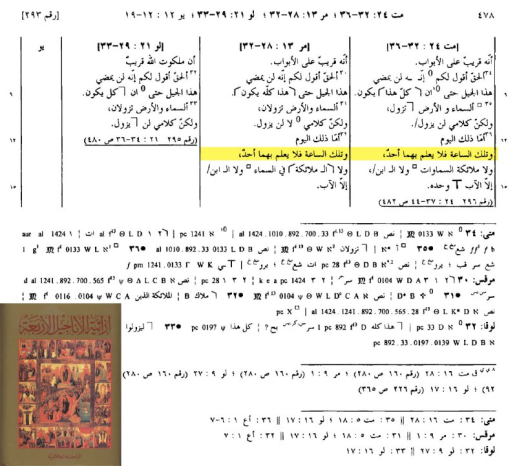
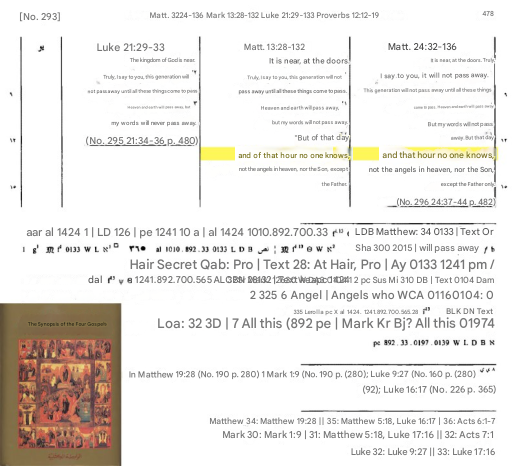
Basil believed that the solution to the dilemma lies in interpreting Christ’s words as not denying his knowledge of the time of the resurrection, but rather confirming it . This is because Christ’s singling out of God the Father the knowledge of the time of the Day of Resurrection occurs in two Gospels: the Gospel of Matthew (24:36) and the Gospel of Mark (13:32). Here are the two texts from Basil’s reading, and note the difference between the two texts in what I will underline:
Matthew’s text : ” But of that day and that hour no one knows, not even the angels in heaven, nor the Son, except the Father . ” Mark
‘s text : ” But of that day and that hour no one knows, not even the angels in heaven, nor the Son, except the Father. ”
Basil tried to exploit the style of the Greek language (which is the language of the New Testament), as Mark’s text uses the phrase “ει μη ο πατηρ” (ει μη ο πατηρ) meaning “except the Father,” and the word “ει μη ο πατηρ” (ει μη ο πατηρ) means … means ” except the Father .” (μη) Although it usually means ” except ,” in rare cases it may come with the meaning of “unless.” Thus, Basil took from here that the writer of the Gospel of Mark intended only the second meaning (i.e., “unless”). Thus, the text became, according to Basil’s understanding, as he himself mentions it, saying:
” No man knows, neither the angels of God; nor yet the Son would have known unless the Father had known: that is, the cause of the Son’s knowing comes from the Father. ” (Basil’s Epistle
This strange interpretation brought by Basil has three problems : First, it contradicts the ABCs of the definition of divinity. God, as is agreed upon by all people, is the possessor of absolute perfection , and from His perfection comes His absolute knowledge (which Basil tried to discuss here). This absolute knowledge also requires that His knowledge is intrinsic , meaning that He does not learn it from anyone. Basil’s statement that the Son derives His knowledge from the Father is sufficient evidence of the Son’s non-divinity, because God is the source of knowledge, so He does not learn or derive His knowledge from anyone.
Second:If we take the Greek “e me” to mean “unless”, then this implies that humans and angels also know…because the denial was directed at humans and angels, along with the Son (“No one knows about them, neither the angels nor the Son”). Basil’s singling out the Son and excluding him from this category is a farce that reveals the extent of his effort to evade the problem.
As for the third problem in Basil’s interpretation, which is more important than the two previous problems, it is that Basil based his interpretation on a distortion that occurred in the Gospel of Matthew! Basil’s reliance in his interpretation of what is stated in the Gospel of Mark about Christ’s lack of knowledge and his choice of the meaning “unless” has a condition in the Greek language, which is the absence of a specification , which is the word ” alone, ” for example. The Gospel of Matthew (unlike Mark), when it singles out knowledge to the Father, specifies it with the word ” alone, ” so that Matthew’s text is thus: ” except my Father alone.” The addition of the word ” alone ” (which in Greek is “monos μονος”) makes the meaning of the sentence that everyone knows except the Father alone who knows , and thus makes “e meh” mean “except” and not “unless.” This is what Basil himself said when he spoke about his choice of the meaning of “unless” in Mark, where he said: ” To a fair hearer there is no distortion in this interpretation, because the word “alone” is not added [here in Mark] as is the case with Matthew. ” (Basil’s Epistle No. 236)
” In the passage in Matthew, then, the Lord made no mention of His own Person, as a matter beyond controversy, and said that the angels knew not and that His Father alone knew, tacitly asserting the knowledge of His Father to be His own knowledge too. ” ( Basil ‘s Epistle No. 236) This justification that Basil adheres to is based on a distortion that occurred in the Gospel of Matthew . The ancient Greek manuscripts of Matthew indicate that Basil’s reading of the Gospel of Matthew was done after deleting the word ” nor the Son .” That is, the Gospel of Matthew originally contains the word ” nor the Son ,” while the manuscript from which Basil read has this word deleted. I will explain this distortion in the manuscripts later. Therefore, the Gospel of Matthew contains the word ” alone ” after ” except the Father ” and also contains ” nor the Son .”
The result is that the Son does not know when the Day of Resurrection will be ! Here is a reading of the Gospel of Matthew before the distortion: But of that day and hour no one knows, not even the angels of heaven, nor the Son , but only my Father.
” (Matthew 24:36), and the reader may be surprised when he learns that the text in this form (i.e., by returning the word ” nor the Son ”) has become the text adopted by modern Arabic translations of the Holy Bible, such as the Common Arabic Translation, the Jesuit version, the Pauline version, and the Holy Bible version.
The Third, Fourth, and Fifth Justifications
3The third justification: Christ knows, but he declared his ignorance so that his disciples would not ask him about it!
**This is the opinion of Jerome **(d. 420), who was the secretary of the Roman papacy and made a translation of the Bible known as the Vulgate. Due to his experience with manuscripts, Jerome realized that there was a difference between the manuscripts regarding the phrase ” nor the Son ” in the Gospel of Matthew. He said: “In some Latin copies is added here, “neither the Son,” but in the Greek copies, particularly those of Adamantius and Pierius, it is not found. But because it is read in some, it seems to require our notice.” (The Golden Chain of Thomas Aquinas) Therefore, because Jerome knew that there had been a distortion in the manuscripts, as he found in some Latin manuscripts (and we will show later that the origin of the difference is found in the Greek manuscripts), the presence of ” nor the Son ,” he realized that an answer like the one given by Sabellius was useless. Therefore, he looked for an alternative answer, which is that Christ was not ignorant of the time of the Day of Resurrection, but he denied this knowledge so that his disciples would not ask him! He tried to prove that this was Christ’s will that they not know what was stated in the Book of Acts: ” And he said to them, ‘It is not for you to know times or seasons that the Father has fixed by his own authority. ’” (Acts 1:7) I do not know here what Jerome’s point of view is between Christ’s statement that he himself does not know and this text that he used as evidence, in which Christ makes it clear that his disciples are not required to know it?
.
Indeed, in this passage, Christ makes clear that times and seasons are in the power of the Father (not the Son), who in our controversial passage acknowledged that only the Father knows the resurrection (and that the Son does not know it). Jerome’s answer also creates a new problem:
If Christ knows the time of the Day of Resurrection and then declares that He does not know, then this is a serious accusation of lying against Christ! It is as if Jerome is trying to compound one calamity with another!
Theoclatius (d. 1107) attempted to minimize the magnitude of this calamity (i.e., the accusation of lying against Christ) by saying that Christ declared His ignorance because He did not want to tell them, if they asked Him, that He was concealing it from them, and thus hurt their feelings and cause them grief!
This is one of the most astonishing answers. When He answered them, ” It is not for you to know times or seasons, ” did He not care about their feelings at that time, thus being a cruel criminal?
These weak answers from the Church Fathers reveal the extent to which they were under great psychological pressure in response to this passage, to the point that they did not realize what they were saying.
4The Fourth Justification : Christ Knows , but by Not Knowing, He Intends to Hide it from People . This is Augustine’s Opinion
(d. 430), then we find without a doubt that the idea that Christ is a liar in his claim of ignorance while he is knowledgeable is an unacceptable idea. Therefore, we must seek an answer that makes Christ knowledgeable while denying his knowledge without being a liar. This was an attempt by Augustine, who believes that Christ meant by his saying: ” nor the Son ” not that he himself did not know, but rather that the Son concealed its knowledge from the people . That is, what is meant by Christ’s lack of knowledge is that he did not reveal its time to the people. Father Tadarus Yaqoub Malti says in his interpretation of this text: ” Saint Augustine believes that the Lord Christ is not ignorant of the day, but rather declares that he does not know it, since he does not know it with the knowledge of someone who permits it. ”
There is no doubt that this statement is rejected by Augustine in two respects :
First : When Christ spoke of his lack of knowledge of the time of the Day of Resurrection , he placed himself alongside humans and angels . Therefore, if his lack of knowledge means his knowledge without revealing it, then what about humans and angels? Do they know its time but also conceal it?
Second : The Father knows the time of the coming of Christ, but He has not revealed it . Therefore, since the Father has not revealed it, the statement should be: “No one knows about them, not the angels, nor the Son, nor the Father”! That is, instead of “except the Father,” it should be “nor the Father.” And without a doubt, it is clear from Christ’s statement that He denies His knowledge of it (and not merely its revelation) to Himself, the angels, and all people, and He excepted God alone from this lack of knowledge .
5The Fifth Justification : What is Meant by Christ’s Saying: “nor the Son” Are the Believers because the Believer is the Adopted Son of God
: This is the answer of **Rabbanus **(d. 856), who was the Archbishop of Mainz in Germany. It seems that all of the previous justifications did not please Rabbanus, as any of the above justifications put the deification of Christ in an embarrassing position or were contradictory to the context of the text, and thus he took the whole issue out of Christ . Instead of Christ declaring himself ignorant of the Day of Resurrection, Rabbanus believes that Christ instead declared the ignorance of the believer because his saying: ” nor the Son ” refers to the believer and not Christ, since the believer is the adopted son of God, and thus the believer is the son here (see the Golden Chain of Thomas Aquinas). I think that this point does not need a comment from me, as it is true that the word ” Son ” means the son of God, and that believers are the sons of God, but everyone who reads the New Testament realizes that when the title ” Son ” appears, it refers to Christ himself!
They Resorted to Distortion when the Answers Were Weak
We saw in the answer of Basil of Caesarea (d. 379) that he denied that Christ did not know the time of the Day of Resurrection by relying on a copy of the Gospel of Matthew (24:36) that did not contain the phrase ” nor the Son ” (of course, it is not necessary that his copy read it this way, as he may have heard it from others that way).
John Chrysostom
(d. 407) also fell into the same error of Basil , as he also relied on a copy of the Gospel of Matthew that did not contain ” nor the Son ,” and concluded from his copy that Christ was merely silent on the issue of his knowledge of the time of the Day of Resurrection (see the Golden Chain of Thomas Aquinas). Moreover, Basil himself declares that he received his interpretation from teachers before him! Thus, we see that the deletion of ” nor the Son ” occurred among some Church Fathers in the fourth century AD , a century that witnessed a bitter struggle between the Christian Unitarians who denied the divinity of Christ and the Trinitarians who claimed that Christ was God. Not only did Basil and John Chrysostom read the text of the Gospel of Matthew without ” nor the Son ,” but this is what we find in two Arabic translations that we read today: - The Van Dyke version : ” But of that day and hour no one knows, not even the angels of heaven, but my Father only .”
- The Book of Life version : ” But of that day and hour no one knows, not even the angels of heaven, but the Father only .” Similar to the text of these two Arabic versions, we find English versions that do not contain ” nor the Son ” (King James Version, Darby, and Douay-Rheims Bible). Likewise, we do not find the phrase ” ni el Hijo” ( nor the Son ) in some Spanish versions, such as Reina-Valera and Sagradas Escrituras (1569). We also do not find ” ni le Fils” ( nor the Son ) in some French versions , such as Martin’s Version, Ostervald’s Version, and Darby’s French Version. As I mentioned, all the Arabic, English, Spanish, and French versions above deleted the phrase ” nor the Son ” from Matthew 24:36, while we find other Arabic, English, Spanish, and French versions that added the phrase ” nor the Son ” to the same text. In fact, they are the majority of the versions and translations in those languages . Among these Arabic versions that added ” nor the Son ” are: - The Common Arabic Translation :” But of that day and hour no one knows, not even the angels of heaven
” No one knows when that day or hour will come, not even the angels in heaven, nor the Son , but only the Father .”-
The Jesuit version : “But of that day and hour no one knows, not even the angels in heaven, nor the Son, but only the Father .” - The Pauline version: “But of that day and hour no one knows, not even the angels in heaven, nor the Son, but only the Father.” - The Holy Bible version : ” No one knows when that day or hour will come, not even the angels in heaven, nor the Son, but only the Father knows. ” - The Simplified Arabic translation : ” But no one knows when that day or hour will be, not even the angels in heaven, nor the Son, but only the Father knows.” ” Just as the phrase ” nor the Son ” was added in most Arabic versions , so too were the majority of English, Spanish, and French versions . Among the English versions are : New International Version, Revised Standard Version, American Standard Version, and Good News Bible; among the Spanish versions: Nueva Versión Internacional, La Biblia de Jerusalén, La Biblia de las Américas, Nueva Biblia Espaónola, and Nueva Traducción Viviente; among the French : Louis Segond
, La Bible du Semeur, and Nouvelle Edition de Genève; while the French Segond 21 version (2007 edition) placed it between square brackets [ ], leaving it to the reader to accept or reject it. There is no doubt that the reader wonders how some versions and translations from different languages agreed to delete it and others agreed to add it? The answer lies in our knowledge that the New Testament was written in Greek , and this written in Greek was transmitted from one manuscript to another over many centuries (since at that time there were no Printing presses after that, but rather they were passing around books by copying and writing them by hand, and that is why those copied books are called “manuscripts.” When the early Christians were passing around and copying these manuscripts , some differences, errors, and changes occurred(whether intentional or unintentional changes). This text that we are discussing is considered one of those changes that occurred in the Greek manuscripts.
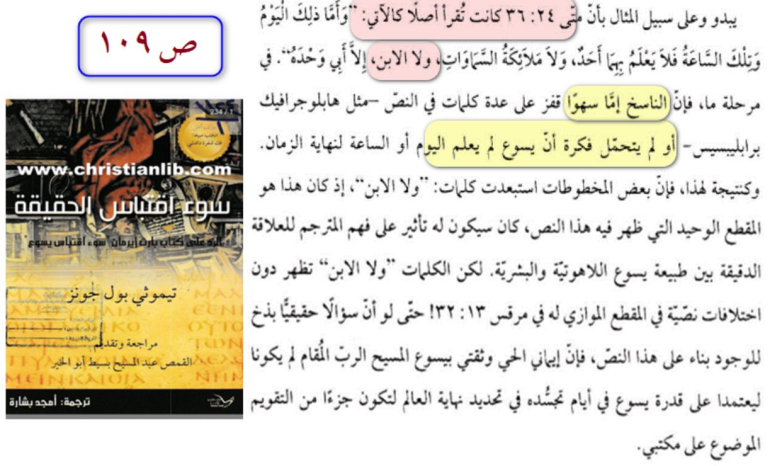
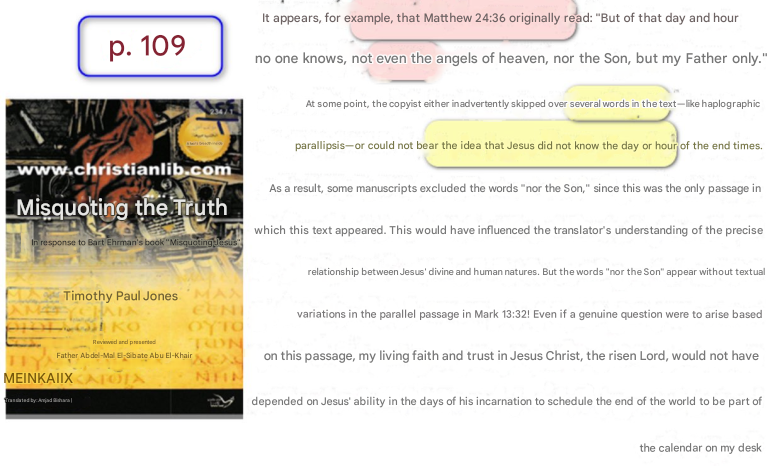
There are Greek manuscripts in which we find the phrase ” nor the son ” (which in Greek is: “odi ho aios” ουδε ο υιος ), and other manuscripts that deleted it. Moreover, the manuscripts that contain ” nor the son ” are older than those that deleted it , which confirms that ” nor the son ” is the original and that its deletion is considered a distortion.
(By the way, there are no original manuscripts handwritten by the Gospel writers, so one way to try to determine what the original reading is and what the distorted one is is to go back to the oldest discovered manuscripts, since they are the closest to the original manuscripts of their time.) The manuscripts that contain ” nor the Son ” are the Sinaiticus and Vaticanus , both of which date back to the fourth century AD , as well as the Byzantine Codex (which dates back to the fifth century AD ), while the first witness to its distortion by deleting ” nor the Son ” is the Washingtonian Codex in the fifth century AD ! Therefore, we find that the majority of Arabic, English, Spanish, and French versions and translations confirm the phrase ” nor the Son ”, because these versions and translations are modern and were made after examining those manuscripts and realizing the authenticity of “nor the Son”, while those translations and versions (Arabic and others) that deleted it relied on later Greek manuscripts.
As we have previously seen, the distortion of the Greek manuscripts by deleting ” nor the Son ” is due to the fact that the text proves that Christ did not know when the Day of Resurrection would occur. Consequently, the text opposes the deification of Christ. Their solution was to delete and distort this evidence .
This explains why the distorters were more concerned with distorting ” nor the Son ” in Matthew’s Gospel, while they were not concerned with distorting what was mentioned in Mark. This is because Matthew’s Gospel adds the word ” alone ” after ” except my Father ,” as I explained previously from Basil’s words. However, my statement here that the distorters were not concerned with distorting what was mentioned in Mark does not mean that they did not distort it. Rather, there are some Greek manuscripts in which the text of Mark 13:32 was distorted by deleting “nor the Son” (such as manuscript X, as well as 983 and 1689 , and the dates of these manuscripts are: the 9th, 12th, and 13th centuries, respectively ) . However, the concern with distorting Mark is not as great as the distortion of Matthew’s text, for the reason I mentioned earlier .
I Have Mentioned Five Conflicting Justifications Offered by the Church Fathers and Teachers since the Fourth Century AD
for the difficulty of reconciling Christ’s declaration that he did not know the time of the Day of Resurrection with their belief in the divinity of Christ.
I also mentioned how earlier Christians distorted the text of the Gospel of Matthew by deleting the phrase ” nor the Son ” to remove this difficulty. It remains for me to mention how Christians before the fourth century AD accepted that Christ did not know the time of the Day of Resurrection because this is what he himself declared.
Even though they also believed in the divinity of Christ, because of this and other texts, they believed that he was a second-degree god (or part of God) . He is god, but not at the same level as God the Father (this doctrine is called subordinationism or subordination . Of course, there were Christians who denied the divinity of Christ, but here I mention those whom the Trinitarians consider to be their great scholars).
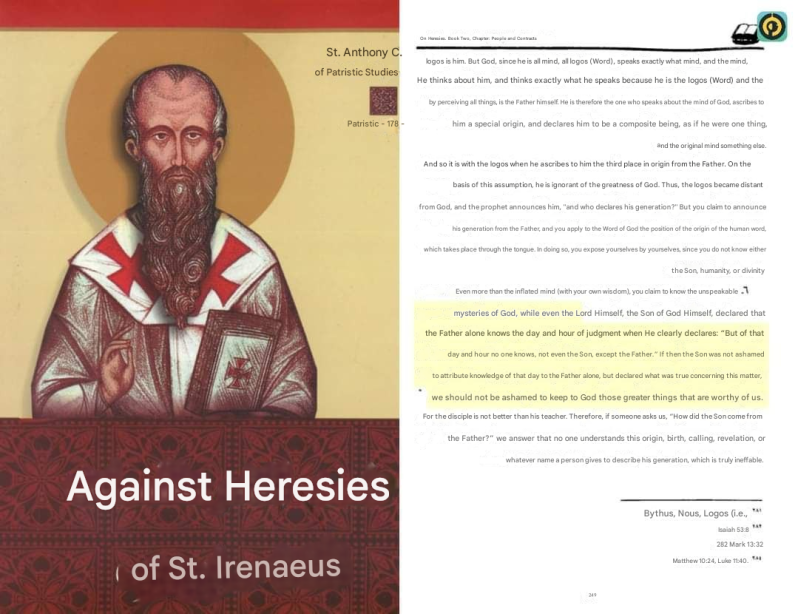
Going back to before the fourth century AD, we find, for example, **Irenaeus , who lived in the second century AD (d. 202 AD - who is called the father of church tradition) **saying:
.
*** ” While even the Lord, the very Son of God, allowed that the Father alone knows the very day and hour of judgment, when He plainly declares, “But of that day and that hour no man knows, neither the Son, but the Father only.” [Mark 13:32 ] If the Son was not ashamed to attribute knowledge of that day to the Father alone , but rather declared the truth of the matter, then we should also not be ashamed to leave to God those great questions that come to us.” (Against Heresies 2:28:6) ”***
***If, then, the Son was not ashamed to ascribe the knowledge of that day to the Father only, but declared what was true regarding the matter, neither let us be ashamed to reserve for God those greater questions which may occur to us.” (Against Heresies, 2.28.6) Irenaeus then explains why only the Father knows when the Day of Resurrection will be and Christ does not: ” That we may learn through Him that the Father is above all things. For “the Father,” says He, “is greater than I.” The Father, therefore, has been declared by our Lord to excel with respect to knowledge.” (Against Heresies, 2.28.8) ***
In the third century, we find that Tertullian
***( He is also ignorant of the last day and hour , which is
known to the Father only. ) ***(Against Praxis 26) (Against Praxeas, ch. 4)
Tertullian also said:
*** ” For the Father is the entire substance, but the Son is a derivation and portion of the whole , as He Himself acknowledges: “My Father is greater than I.” [John 14:28], and in the Psalms His nearness is described as “a little lower than the angels” [Psalm 8:5]. Therefore the Father is different from the Son and is greater than the Son , just as He who begets is one and He who begets is another, and likewise He who sends is one and He who is sent is another, and He who creates is one and through Him things were created is another. Fortunately, the Lord Himself used this expression in the person of the Comforter [i.e., the Holy Spirit] … and thus showed that the Comforter is of the third order, as we believe the Son is of the second order, by the logic of the order observed from the dispensation. ”***
(Against Praxeas, 4)
In the Psalm His inferiority is described as being “a little lower than the angels.” Thus the Father is distinct from the Son, being greater than the Son, inasmuch as He who begins is one, and He who is beginning is another; He, too, who sends is one, and He who is sent is another; And He, again, who makes is one, and He through whom the thing is made is another. Happily the Lord Himself employs this expression of the person of the Paraclete… so that He showed a third degree in the Paraclete, as we believe the second degree is in the Son, by reason of the order observed in the Economy.” (Against Praxeas, ch. 4)
Thus, we find that Christian scholars before the fourth century AD accepted the texts of the Gospels of Matthew (24:36) and Mark (13:32) as Christ declared that he did not know the time of the Day of Resurrection . They did not try to circumvent the texts, twist them, or enter into evasive justifications or distort Christ’s words, as scholars of the fourth century and later did. The reason that scholars of the fourth century (and later) invented justifications and meanings that Christ did not say is because the fourth century witnessed the elevation of Christ from a position below God to a position equal to God, making him God himself
. From those fourth-century teachers emerged the doctrine of the Trinity in the form we see today, especially the issue of Christ’s equality with the Father began at the hands of Athanasius (whose justification and evasion were presented by inventing two sciences for Christ:Theological and human), and Basil of Caesarea (who is the author of the second justification in which he relied on distorting the text of the Gospel of Matthew); the New Encyclopedia Britannica (1976 edition) says , under the title “Trinity”:
The Council of Nicaea in 325 stated the crucial formula for that doctrine in its confession that the Son is ‘of the same substance [homoousios] as the Father,’ even though it said very little about the Holy Spirit. Half a century later, Athanasius defended and refined the Nicene formula, and by the end of the fourth century, under the leadership of Basil of Caesarea, Gregory of Nyssa, and Gregory of Nazianzus (the Cappadocian Fathers), the doctrine of the Trinity had essentially taken the form in which it has been preserved ever
since . Over the next half century, Athanasius defended and refined the Nicene formula, and, by the end of the 4th century, under the leadership of Basil of Caesarea, Gregory of Nyssa, and Gregory of Nazianzus (the Cappadocian Fathers), the doctrine of the Trinity took substantially the form it has maintained ever since.”
As I mentioned, before Athanasius, the Church Fathers and teachers did not believe in the equality of Christ with God the Father (called subordinationism). In The Making of Orthodoxy : Essays in Honor of Henry Chadwick (p. 153, ed. 2002), co-authored by a group of British theologians, we read:
” Indeed, until Athanasius began to write [in the 4th century], every theologian, whether in the East or in the West, believed in some form of subordinationism, and around 300 it could be
“Indeed, until Athanasius began writing, every single theologian, East and West, had postulated some form of Subordinationism. It could, about the year 300, have been described as a
fixed part of catholic theology. ”
Thus, as we have seen, the development of Christian doctrine and its differences from what it was before the fourth century are what made fourth-century scholars change the understanding of Christ’s words to adapt them to their principles and convictions, even if Christ’s words were different from what they believed.
I Conclude here by Saying
that Christ, peace be upon him, in addition to not declaring that he is God, declared that he is a human prophet sent by God: ” I am a man who has told you the truth which I heard from God. ” (John 8:40), and he declared that he is not God, the possessor of absolute goodness: ” And a certain ruler asked him, ‘Good Teacher, what must I do to inherit eternal life?’” Jesus said to him, “Why do you call me good? No one is good except God alone. ” (Luke 18:18-19). He declared that God is not the All-Knowing, for He does not know the time of the Day of Resurrection (which is the subject of this discussion). The clarity of the clash between Christ’s lack of knowledge of the Day of Resurrection and those who deify Christ made them try with all their might to remove this problem, sometimes by distorting it and sometimes by various strange justifications.
May God guide those who want the truth and those who do not want it, and make us among those who do not disobey what God has commanded, who are monotheists, who are pure of Him, who worship none but Him, and who love the good of all people! And our final supplication is that all praise is due to God, Lord of the Worlds.
Some Related Scans
Mark 13:32 and Matthew 24:36 both said the Son doesn’t know the Hour. But a “good” copyist quietly deleted “nor the Son” from Matthew to protect Christ’s divinity.
Too bad he forgot to edit Mark—exposing the tampering.
The writer of the Gospel of Luke distorted the story and deleted the text that clearly states that the son does not know the hour.
The Doctrine of Subordination or Inferiority
https://discord.com/channels/1310948573768319047/1366429090546192466