

Deuteronomy 25:11–12 and the Hand-Cutting Ruling — The Contradiction Between the Written Torah and the Oral Law Exposed
The Christian apologist who argued that Deuteronomy 25:11–12 prescribes monetary compensation rather than hand-cutting did so by abandoning the written Torah he claims to believe in and substituting Talmudic oral tradition — a tradition he has always denied is authoritative for him. Rabbi Yehuda Etzion states plainly: the plain meaning of the written Torah indicates corporal punishment.
A Christian referred to a Christian intellectual apologetics site that argued, regarding Deuteronomy 25:11–12, that the “real” punishment prescribed for the woman who seizes a man by his private parts during a fight is material compensation and not literal amputation of the hand. The Christian arrived at this conclusion without providing a methodological basis — without acknowledging that it rests on a symbolic interpretation, without showing that the text appears elsewhere in greater detail with explicit mention of monetary compensation, and without any of the intermediary steps required to reach that conclusion honestly.
The problem with this Christian is fundamentally scientific: he deceived and spoke about what he does not know. The following analysis demonstrates this, drawing on the admissions of Jewish rabbis — the very scholars whose tradition the Christian implicitly relied upon.
The Verse Under Discussion — Deuteronomy 25:11–12
The text is plain. A woman intervenes in a fight between two men, seizes the attacker by the genitals, and the prescribed punishment is the cutting off of her hand. There is no ambiguity in the Hebrew text at this level of surface reading. The question is whether the “plain meaning” of the written Torah is what the Law actually requires, or whether the oral tradition modifies it.
The Christian Apologist’s Claim — Material Compensation, Not Amputation
The Christian website’s argument concludes:
This conclusion was reached by jumping from the surface of the question to its supposed resolution without traversing the methodological ground in between. The Christian did not tell us:
- That this conclusion is the result of a symbolic interpretation of the text
- That the text appears elsewhere in the Torah in greater detail with explicit mention of monetary compensation
- That there is any other possibility to consider
Before engaging with the substance, one observation is necessary: this Christian resolved a difficulty in his own scripture by abandoning his own scripture and substituting the oral law of the Jews — a tradition he has always denied is authoritative for him.
The Two Sources of Jewish Law — Written Torah and Oral Torah
Two sources of law exist for the Hebrew Jews, both claiming divine origin:
The written Torah (Torah Shebakhtav) is the Old Testament with its known books — the scripture the Christian claims to believe in and treat as the word of God.
The oral Torah (Torah Shebaal Be’eh) is the law that the Hebrew Jews claim was received by Moses and the prophets orally from God Almighty — transmitted across generations and eventually compiled in texts such as the Talmud, the Haggadah, and the Halakha.
Both sources prescribe their own rulings for the same situations. In the matter of hand-cutting and the “eye for eye” principle, these two sources contradict each other directly.
Rabbi Yehuda Etzion’s Admission — The Plain Meaning Is Corporal Punishment
The most important voice in this discussion is Rabbi Yehuda Etzion, whose analysis of both the hand-cutting ruling of Deuteronomy 25:12 and the “eye for eye” principle of Exodus 21 is definitive:
Etzion further states:
This is the admission of a Jewish rabbi — the inheritor of the tradition the Christian was relying upon — that the plain meaning of the written Torah is corporal punishment, and that the claim that the Torah means monetary compensation faces significant textual and linguistic difficulty.
The Mishnah on Five Compensations — What the Oral Law Actually Says
The Oral Law — specifically the Mishnah, in the Tractate Bava Kamma — states the following regarding what a person who harms another is obligated to pay:
The following image is from the Babylonian Talmud, Tractate Bava Kamma, Chapter One, presenting the Mishnah text on the five categories of compensation owed by one who injures another.
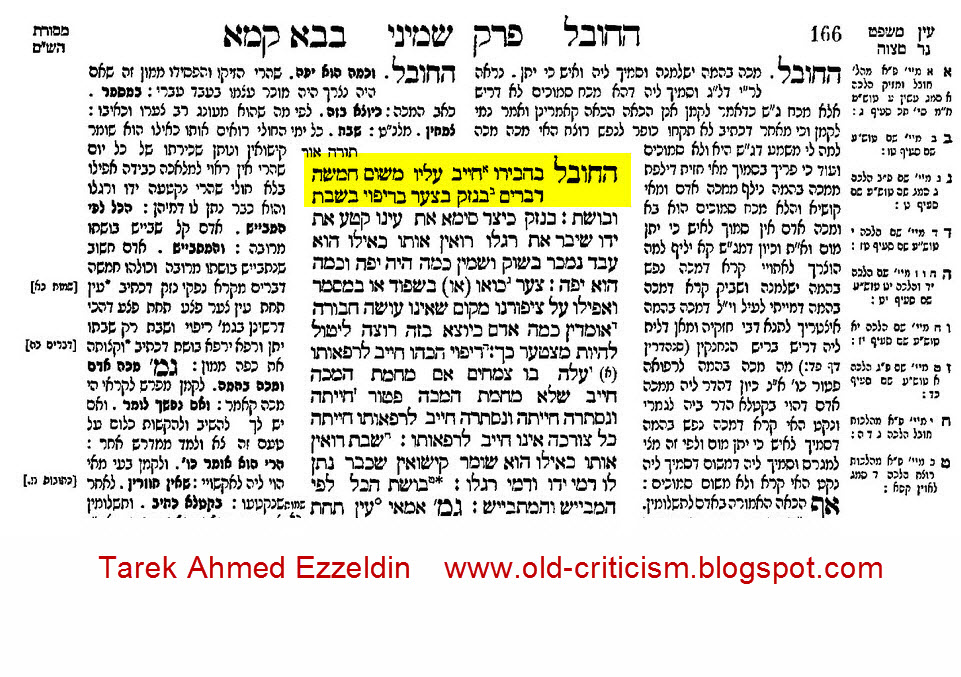
The Mishnah establishes that if a person harms another person, he is obligated to compensate him for five things: damages, pain, harm resulting from medical treatment, disability, and insult or violation of honor (בושת — often mistranslated as “shame” by those working from secondary sources; the word means violation of honor or humiliation or degradation).
This is what the oral law prescribes — financial compensation across five categories — in place of what the written Torah prescribes: hand-cutting. Both sources claim to be divine revelation received by Moses.
The Contradiction Acknowledged — Maimonides and the Guide for the Perplexed
Maimonides — Moses ben Maimon, known in the rabbinic tradition as Rambam — is one of the most authoritative figures in Jewish legal scholarship. The relevant passage from his Guide for the Perplexed (3/40) is reproduced below.
The following image is from the Guide for the Perplexed by Moses Maimonides, the passage cited by Rabbi Amnon Bazak in his analysis of the relationship between the written and oral Torah.
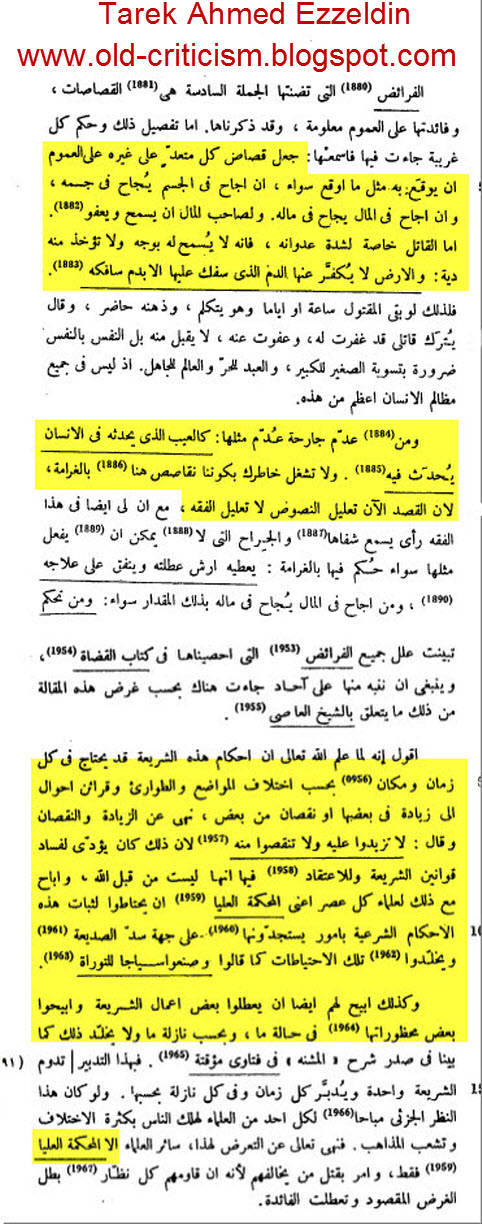
Rabbi Amnon Bazak comments on this passage:
In other words, Maimonides — whom the Christian’s apologetics website cited — is himself acknowledging that the Talmudic tradition altered what the written Torah prescribed, on the grounds that the Sanhedrin must adapt the application of the Torah to changing circumstances. The Christian cited Maimonides as an authority for his conclusion without knowing that Maimonides was saying something very different from what the Christian needed him to say.
Rabbi Amnon Bazak and the Three Principles of Jewish Interpretation
The Christian’s methodological failure can be precisely located within the framework of the three principles that govern interpretation of such situations in Jewish scholarship:
The Christian who relied on a conclusion produced by the Synthesis of Contradiction principle did not know that this principle existed. He took its output — the conclusion that material compensation is the ruling — without knowing that this conclusion was a jurisprudential synthesis designed to resolve a direct contradiction between the written Torah and the Talmud, not a straightforward reading of the written Torah itself.
Rabbi Mordechai Breuer — The Written Law Is Reversed by the Oral Law
The most explicit admission in this discussion comes from Rabbi Mordechai Breuer:
Rabbi Breuer states plainly that the written Torah gives priority to corporal punishment, and that the Talmudic tradition reversed this priority — an innovation justified by the principle that the law must respond to changing circumstances.
This is the foundation on which the Christian’s conclusion rests: not a reading of the Torah, but a reversal of the Torah by Talmudic tradition, justified by a theory of legal development that holds divine law may be modified by the requirements of successive eras. The Christian who cited this conclusion as the “real” meaning of the Torah was — without knowing it — adopting a position that:
- Abandons the written Torah (which he claims to believe in)
- Relies on the oral Talmudic tradition (which he has always denied is authoritative for him)
- Applies a Jewish principle of legal development that holds divine law changes with changing circumstances (which is the opposite of the inerrancy he claims for his scripture)
As for the attempted reinterpretations by Rashbam (Shmuel ben Meir) and Saadiah al-Fayyumi, who tried to interpret the Hebrew word “תַּחַת” (tachat, meaning “in place of”) as indicating financial compensation — Etzion’s verdict on this is clear: it is a “significant textual and linguistic difficulty,” and if the Torah had intended monetary compensation, “it could have done so in a far simpler and clearer manner.” Their interpretation is linguistically strained. Abraham Ibn Ezra himself went further, suggesting that the perpetrator would be subject to physical retaliation if they failed to pay the appropriate financial compensation — a compromise reading that combines both traditions, as one would expect from someone attempting the Synthesis of Contradiction. Neither reading erases the contradiction — they document it.
Two Questions for the Christian Apologist
Having demonstrated the methodological failure and the substance of the contradiction, two questions deserve an answer:
If the answer to Question One is yes, then the Christian has adopted the authority of the Talmud, which he has historically denied is binding on him. If the answer to Question Two is yes, then the Christian has conceded that the Torah is not the eternally fixed divine word he claims it to be, but a text whose rulings are subject to modification by subsequent generations of scholars based on the needs of their time.
It would be enjoyable to hear the answers to these innocent questions.
Footnotes:
[1] Rock, Rav Yehuda. “An Eye for an Eye.” In Alei Etzion. [2] Babylonian Talmud — Tractate Bava Kamma — Chapter One. [3] Bazak, Amnon. “Peshat and Midrash Halakha.” In Fundamental Issues in the Study of Tanakh. VBM, 2013. [4] Maimonides, Guide for the Perplexed, 3/40. [5] Bazak, Amnon. “Peshat and Midrash Halakha.” In Fundamental Issues in the Study of Tanakh. VBM, 2013. [6] Ibid.