Did Muslims Steal “Allah” from “Elohim”? A Linguistic Refutation
Did the Qur’an Steal the Word “Allah” from “Elohim”? A Linguistic Refutation
- Content of the Doubt
- I Reply to Him and Say
- First The Meaning of Allahumma
- The View of Sibawayh Al-Khalil and the Basrans
- Allahumma Means O Allah Not Elohim
- The Difference Between Elohim and Allahumma
- The Arabs Used Allahumma Before Islam
- Similarity Between Words Does Not Prove Borrowing
- Arabic Is Older and Richer Among the Semitic Languages
- Turning the Argument Back Against Elohim
- The Second Suspicion Ali and Elijah
- The Confusion Around the Name of Jesus
- Christian Borrowing from Jewish Heritage
- Reference Scans
- Conclusion
Content of the Doubt
A Christian claims that the word Allah is literally taken from the word Elohim in the Hebrew Jewish heritage, after Muslim scholars were unable to understand its meaning.
I Reply to Him and Say
Firstly:
The claimant begins by asserting that Islamic jurists do not know the meaning of the word Allahumma, and that they have been confused about its meaning.
This is the usual trick: first claim Muslims do not understand their own terminology, then reinterpret Islamic words according to an external agenda.
This same method is repeated whenever some Christian or atheist polemicists want to interpret Islamic words and terms to suit their own argument. They first claim that Muslims do not know the meaning of a word, even if Muslim linguists already knew its meaning and studied it in detail.
First The Meaning of Allahumma
So what is the meaning of the word Allahumma?
Al-Qurtubi mentions that there is a near consensus among linguists that the word Allahumma is a call to God, and it consists of two parts:
Allah + the letter Mim
The word Allahumma means in Arabic:
O Allah
The letter mim was used at the end of the word as a vocative particle instead of ya.
So when we call upon God, we say:
or:
Allahumma
Anyone who studied basic Arabic grammar should know this information.
The View of Sibawayh Al-Khalil and the Basrans
The linguist Shams al-Din al-Baali said in his book:
Al-Mutla‘ ‘ala Alfaz al-Muqni‘, page 71
“The doctrine of Sibawayh, Al-Khalil bin Ahmad, and all the other Basrans is that the root of Allahumma is O Allah, and that the mim is a substitute for O.”
End of quote.
All linguists almost agree that Allahumma is a call to God.
As for the claim that it is taken from Elohim, that is mere conjecture based on similarity of sound.
{But as for those in whose hearts is deviation, they follow that of it which is ambiguous, seeking discord and seeking an interpretation of it}
— Aal ‘Imran
Allahumma Means O Allah Not Elohim
There is a difference between the two words.
The word Elohim in Hebrew is a plural form of glorification, and it literally translates to gods, while in Jewish usage it can mean:
God / Lord of the universe
As for Allahumma in Arabic, it is a vocative expression and means:
O Allah
What does this have to do with that?!
The Difference Between Elohim and Allahumma
The argument from similarity is weak.
Two words may sound similar without one being taken from the other.
Linguistic resemblance is not proof of borrowing.
To prove borrowing, the claimant must prove actual historical transmission, not merely say:
“This word sounds like that word.”
That is not scholarship.
That is guesswork.
The Arabs Used Allahumma Before Islam
Then, the Arabs before Islam used the word Allahumma.
Professor Shawqi Dayf says in his book:
History of Arabic Literature, Volume 1, page 412
“In Your name, O God, I mention so-and-so.”
End of quote.
The Arabs used this name from the pre-Islamic era until Islam.
Therefore, the grammarian Ibn al-Warraq says in his book:
Reasons for Grammar, pages 397–398
“O God, forgive me and whoever hears it, except for Satan.”
End of quote.
Knowing that Abu al-Abbas al-Mubarrad was one of the most prominent scholars of rhetoric, grammar, and literature.
Similarity Between Words Does Not Prove Borrowing
The mere similarity of names between different peoples is not a condition that one was taken from the other.
This is what the Syriac linguist Father Anastas Marie Al-Karmali emphasized in his book:
The Emergence, Growth, and Completion of the Arabic Language, page 67
“Hebrews often say that a certain Arabic word is from Hebrew, and so do those who know Aramaic. An Arabic word is only from Hebrew or Aramaic if it pertains to the affairs of the children of Iram or the children of Israel. As for the general terms shared by all Semites, there is no superiority of one language over another.”
End of quote.
Before claiming that the word Allah is taken from Jewish heritage, the claimant must first prove that the word Allah was only used by Jews, and that others later took it from them.
Of course, he will not be able to prove that.
So he should not tire himself out.
Arabic Is Older and Richer Among the Semitic Languages
Then the Arabic language is originally older than the heritage and language of the Jews.
The Christian bishop Aqlimis Youssef Daoud Al-Mawsili Al-Syriac says in his book:
The Delicious Glimpse of Syriac Grammar, page 8
“The most famous Semitic languages are Arabic, Hebrew, Syriac, Ethiopian and their branches. We mentioned Arabic first among the Semitic languages because, by the admission of all scholars, Arabic is the most noble of the Semitic languages as a language, the oldest and the richest. Knowing it is essential for anyone who wants to master all the other Semitic languages, especially Syriac.”
End of quote.
Turning the Argument Back Against Elohim
If the claimant wants to play the game of similarity of words, then let us teach him the meaning of the name of his God: Elohim.
Father Stephan Charpentier says in his book:
Get to Know the Bible, page 24
“The greatest of the gods is called El, and he is often shown in the form of a bull. One of the names of God in the Bible is Elohim: the plural of El. This religion worships the deified forces of nature: Baal, the god of storms and rain, sometimes called ‘the rider of the clouds’ like the Lord in Psalm 5, and his sister Anat, later called Ishtar, who is the goddess of war and fertility.”
End of quote.
From the previous quote, we find that one of the names of God in the Bible is Elohim, and the singular of Elohim is El.
El is the name of the greatest god in the pagan pantheon.
In fact, the fifth psalm borrowed the description rider of the clouds from the pagan god called Baal and then attributed it to the Lord in the Bible.
So by the same logic, the Bible has taken the name Elohim from the pagans.
Personally, I do not like this argument as a final method, but it is presented here as an argument against the claimant using his own logic.
The Second Suspicion Ali and Elijah
Then the second claim goes even further.
This claimant argues that Imam Ali bin Abi Talib does not exist in reality, but is a fictional character, and that the person history talks about is Elijah, not Imam Ali.
This is baseless nonsense.
There are many people named Ali, and thousands named Elijah.
In fact, the Bible itself mentions four different women named Mary, and two men named Paul.
Does this mean none of them existed separately?
Of course not.
Moreover, Elijah, who is mentioned in the Bible, is a completely different person from Imam Ali.
Elijah lived more than a thousand years before Imam Ali.
So what does this have to do with that?
The existence of two people with similar names does not negate the existence of one of them, especially if that person is historically well-known, such as Imam Ali.
Imam Ali ruled an entire state.
Is it reasonable to deny the existence of Imam Ali just because there is another person named Elijah?
Using the same logic, one could deny the existence of Jesus on the grounds that there was a person before him named Joshua, the author of the Book of Joshua.
And if the claimant responds by saying that Jesus was mentioned in history books, the answer is simple:
Imam Ali was also mentioned in history books.
Then some Shiite Rafidis did the same nonsense with Jews and Christians and turned the tables on them.
It was mentioned in Shiite books that there is no person named Elijah, but rather the real name is Ali, referring to Imam Ali among the Shiites.
Then they claimed that Jewish books had prophesied and foretold the coming of Imam Ali.
The truth is that Jews, Christians, and Shiites who use this method are all trapped in the same weak argument, and none of them has evidence.
The Confusion Around the Name of Jesus
Secondly:
Christians themselves are confused about the name of the figure they worship.
The world’s churches have been divided into two usages.
Some call him:
Jesus
And some call him:
Yasu‘ / Isa / other linguistic forms
There is a difference between the forms.
So if mere name differences and similarities are enough to create doubt, then the same method can be turned against Christian terminology.
Christian Borrowing from Jewish Heritage
Third:
Christians are the ones who took from Jewish heritage.
They took the Torah of Moses, the books of the prophets, and the Psalms, then attributed them to themselves and claimed that they were inspired by the God of Christians.
Yet there is no explicit text in the books of the Jews indicating that Jesus is the one who inspired the books of the Jews.
Even the New Testament of Christians is heavily dependent on Jewish books.
Rev. Dr. Riad Qassis says in his book:
Why Don’t We Read the Book That Christ Read? Towards a Better Understanding of the Old Testament, pages 151–152
We can say that 229 chapters in the New Testament, out of a total of 260 chapters, each chapter has quoted at least two quotes or allusions from the Old Testament, and there are 19 chapters in the New Testament that have quoted a quote or allusion from the Old Testament.
The chapters that are devoid of quotes or allusions from the Old Testament are only twelve chapters.”
End of quote.
The above statement was also conveyed by the Christian Dr. Helmy El-Qummos Yaqoub in his book Biblical Criticism.
That is, most chapters of the New Testament contain quotations or allusions from Jewish books, and only 12 chapters are devoid of such material.
That is why Jews still accuse Christians of taking their heritage and falsely attributing it to themselves.
Reference Scans
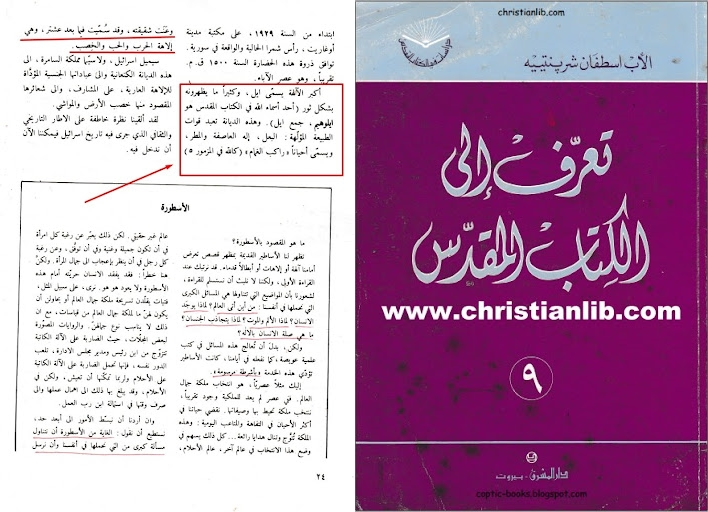
This scan shows the cover and a page fromAl-Mutla‘ ‘ala Alfaz al-Muqni‘ by Shams al-Din al-Baali. The highlighted section states that according to Sibawayh, Al-Khalil bin Ahmad, and the Basran grammarians, the original form of Allahumma is Ya Allah, meaning O Allah, and that the final mim is a substitute for the vocative particle ya. This scan directly supports the article’s central linguistic point: Allahumma is an Arabic vocative expression, not a form borrowed from Hebrew Elohim.
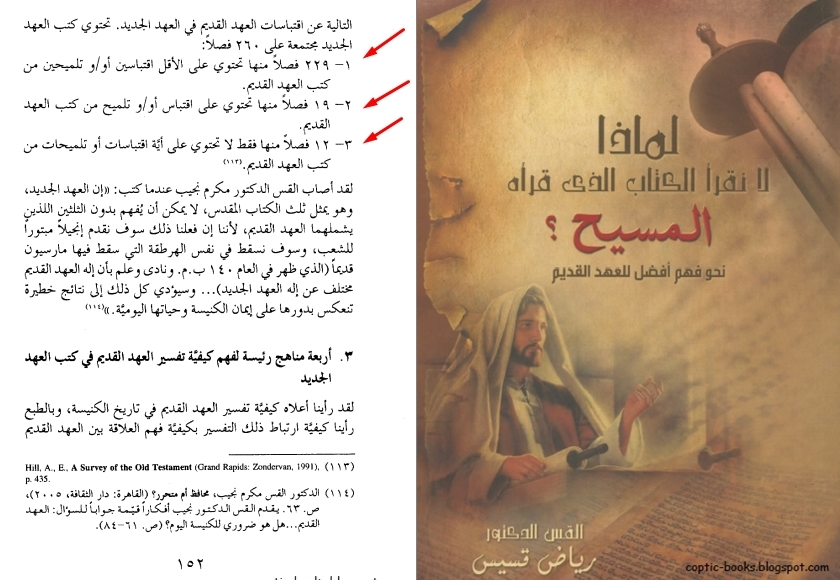
This scan is fromWhy Don’t We Read the Book That Christ Read? Towards a Better Understanding of the Old Testament by Rev. Dr. Riad Qassis. The highlighted section states that 229 chapters of the New Testament contain at least two quotations or allusions from the Old Testament, 19 chapters contain at least one quotation or allusion, and only 12 chapters lack quotations or allusions from the Old Testament. The scan is used to show the heavy dependence of the New Testament on Jewish scripture.
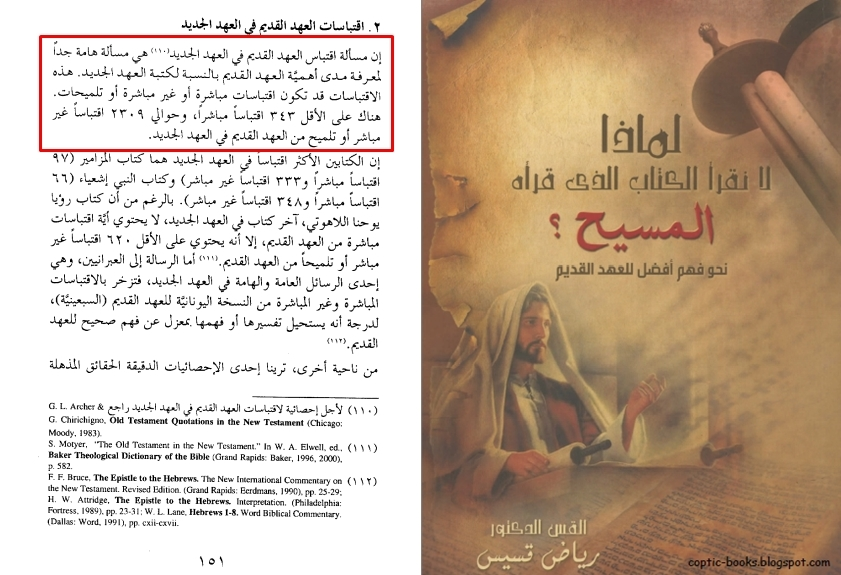
This scan is also fromRiad Qassis’s book. The highlighted paragraph says that the issue of New Testament quotations from the Old Testament is very important for understanding the importance of the Old Testament for the New Testament. It gives figures: approximately 343 direct quotations and 2309 indirect quotations or allusions from the Old Testament in the New Testament. The scan supports the article’s point that Christian scripture is deeply connected to Jewish scripture, so it is inconsistent for a Christian polemicist to attack Islam merely by claiming linguistic or textual overlap.
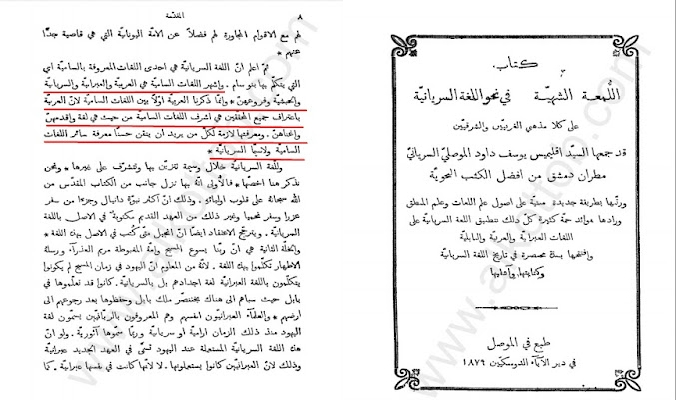
This scan shows a page fromThe Delicious Glimpse of Syriac Grammar by Aqlimis Youssef Daoud Al-Mawsili Al-Syriac. The highlighted Arabic passage states that the most famous Semitic languages include Arabic, Hebrew, Syriac, Ethiopian, and their branches. It says Arabic is mentioned first because, by the admission of scholars, it is the most noble, oldest, and richest of the Semitic languages, and that knowledge of Arabic is necessary for mastering other Semitic languages, especially Syriac. This scan is used to challenge the assumption that Arabic religious vocabulary must be borrowed from Hebrew.
Conclusion
The claim that Allah or Allahumma was stolen from Hebrew Elohim is linguistically weak and historically unsupported.
The refutation is simple:
- Allahumma means O Allah in Arabic.
- The mim at the end is a substitute for the vocative ya.
- Major Arabic grammarians such as Sibawayh, Al-Khalil, and the Basrans explained this.
- Arabs used Allahumma before Islam.
- Similarity between Semitic words does not prove borrowing.
- Shared Semitic vocabulary does not make one language the thief of another.
- If similarity alone proves borrowing, then the name Elohim itself can be turned back against the Bible because of its connection to El and ancient pagan usage.
- Christian scripture itself is heavily dependent on Jewish scripture, so the polemical standard being used is self-defeating.
Therefore, the allegation that the Qur’an or Muslims stole the word Allah from Elohim collapses.