Does “Kawāʿib Atrāban” Mean Sexualized Maidens? Refuting the Surah An-Naba 78:33 Claim
Is “Kawāʿib Atrāban” in Surah An-Naba a Sexual Term?
Table of Contents
- Introduction
- The Claim
- The Quranic Phrase
- The Correct Linguistic Context
- The Meaning According to Classical Arabic Usage
- Evidence from Arabic Scholars and Tafsir
- What the Interpreters Meant
- The Quranic Style Is Modest
- Comparison with the So-Called Holy Book
- Conclusion
Introduction
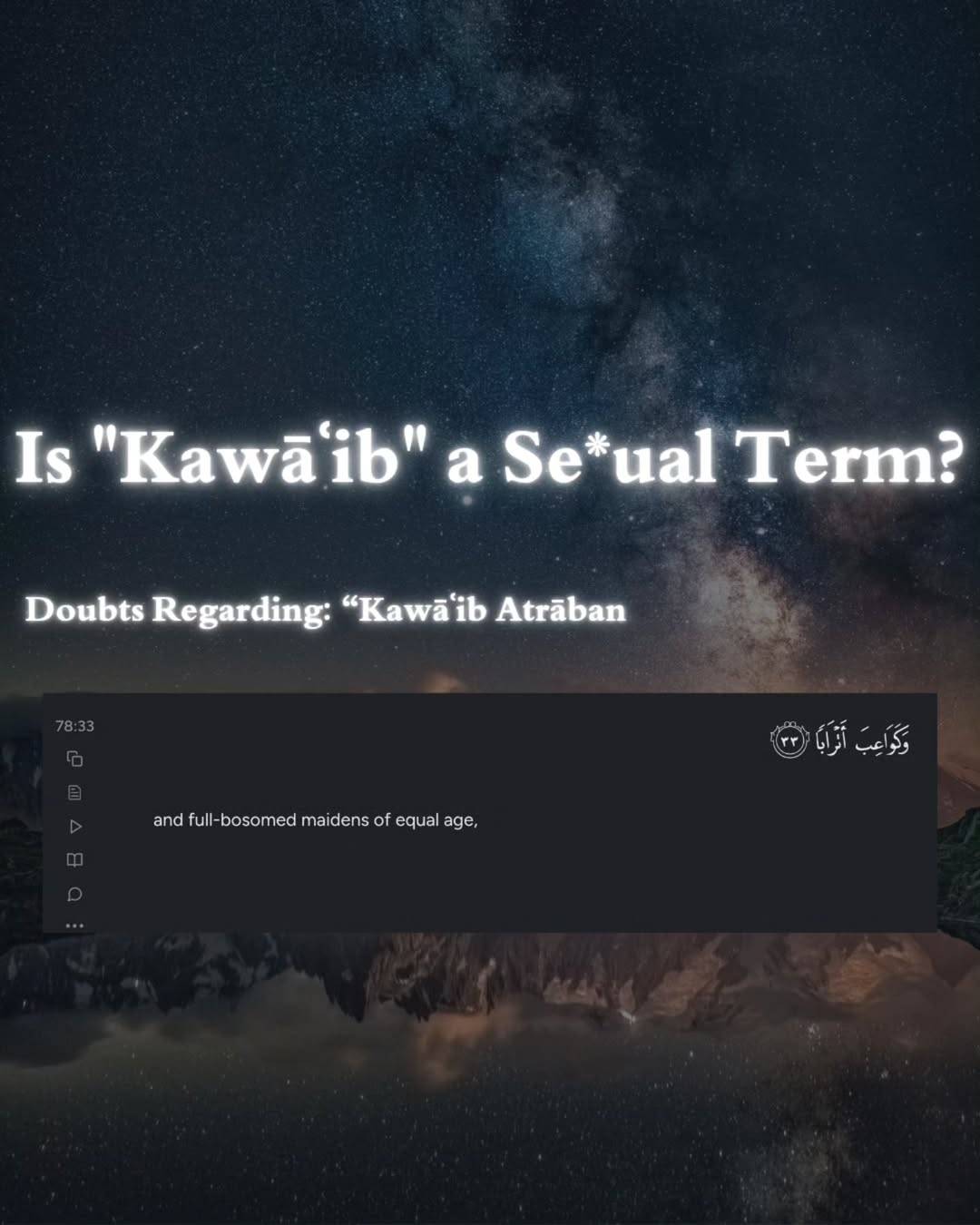
This scan introduces the objection around the Qur’anic phrase“Kawāʿib Atrāban” in Surah An-Naba 78:33. The title asks whether “Kawāʿib” is a sexual term, and the verse is shown with the English rendering “and full-bosomed maidens of equal age.” The purpose of the scan is to frame the discussion: critics claim the verse is sexualized, while the response argues that the term must be understood through Arabic usage, not through crude modern assumptions.
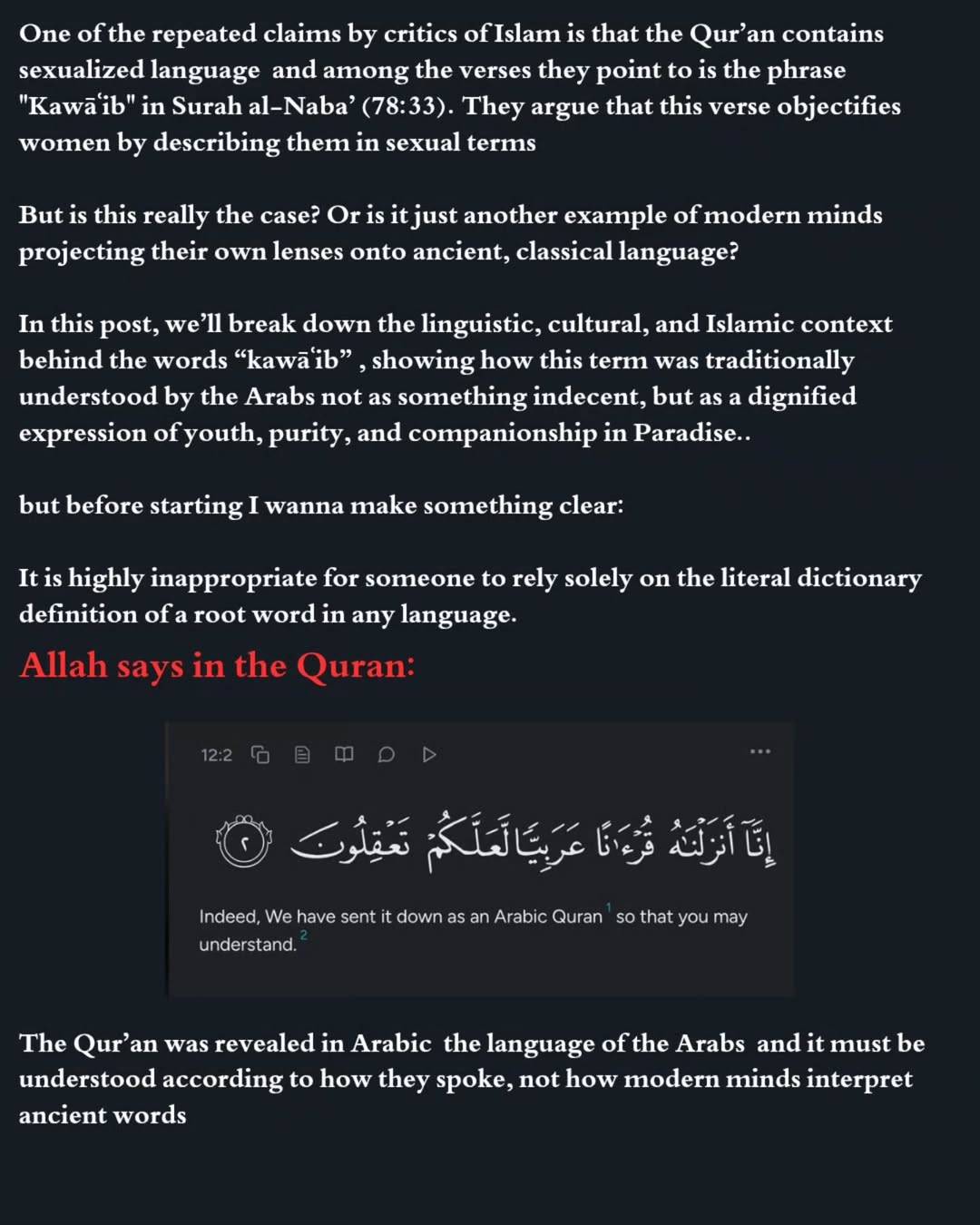
This scan explains the central problem with the critic’s method. It says that one of the repeated claims against Islam is that the Qur’an contains sexualized language, especially the word“Kawāʿib” in Surah An-Naba 78:33. The scan then challenges this by saying that critics are projecting modern assumptions onto ancient classical Arabic. It stresses that the Qur’an was revealed in Arabic, so its wording must be understood according to how the Arabs used their language. The scan also warns that it is wrong to rely only on a literal dictionary definition of a root word without considering linguistic, cultural, and Islamic context.
The Claim
They argue that the verse objectifies women by describing them in sexual terms.
The Quranic Phrase
“And maidens of equal age.”
The Correct Linguistic Context
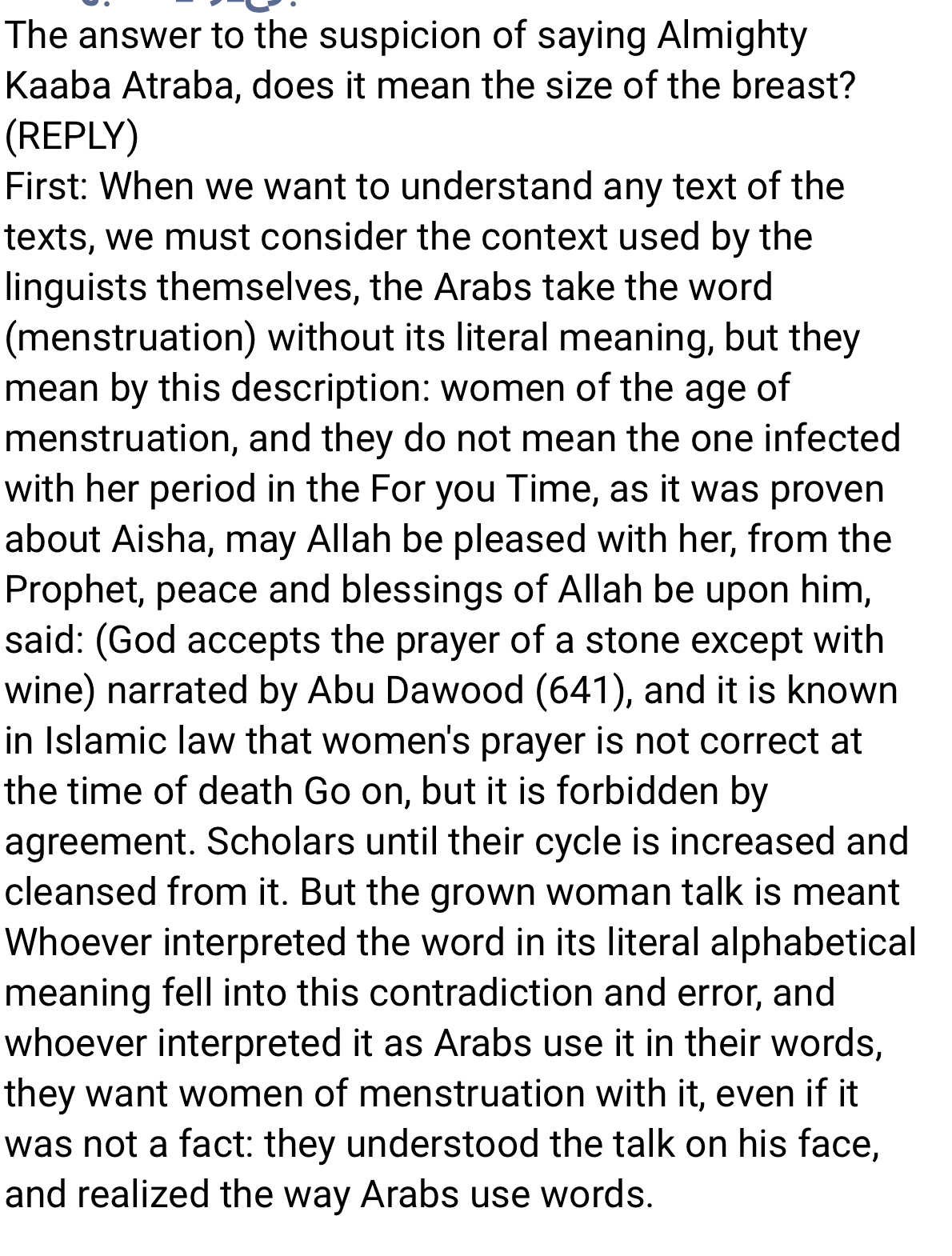
This scan answers the suspicion by explaining that Arabic words are not always used according to their raw literal sense. It gives the example of words connected to menstruation: Arabs may use such language to indicate a woman has reached the age of menstruation or puberty, not to describe the physical act or state itself. The scan argues that whoever reads the word in a crude literalistic way falls into error, while the correct approach is to understand how Arabs actually used expressions in context. The same logic is then applied to“Kawāʿib”: the intended meaning is the stage of youth and maturity, not a vulgar or sexualized description.
The Arabs may use a word without intending its literal physical detail. Rather, they may intend the age, stage, or condition associated with it.
The Meaning According to Classical Arabic Usage
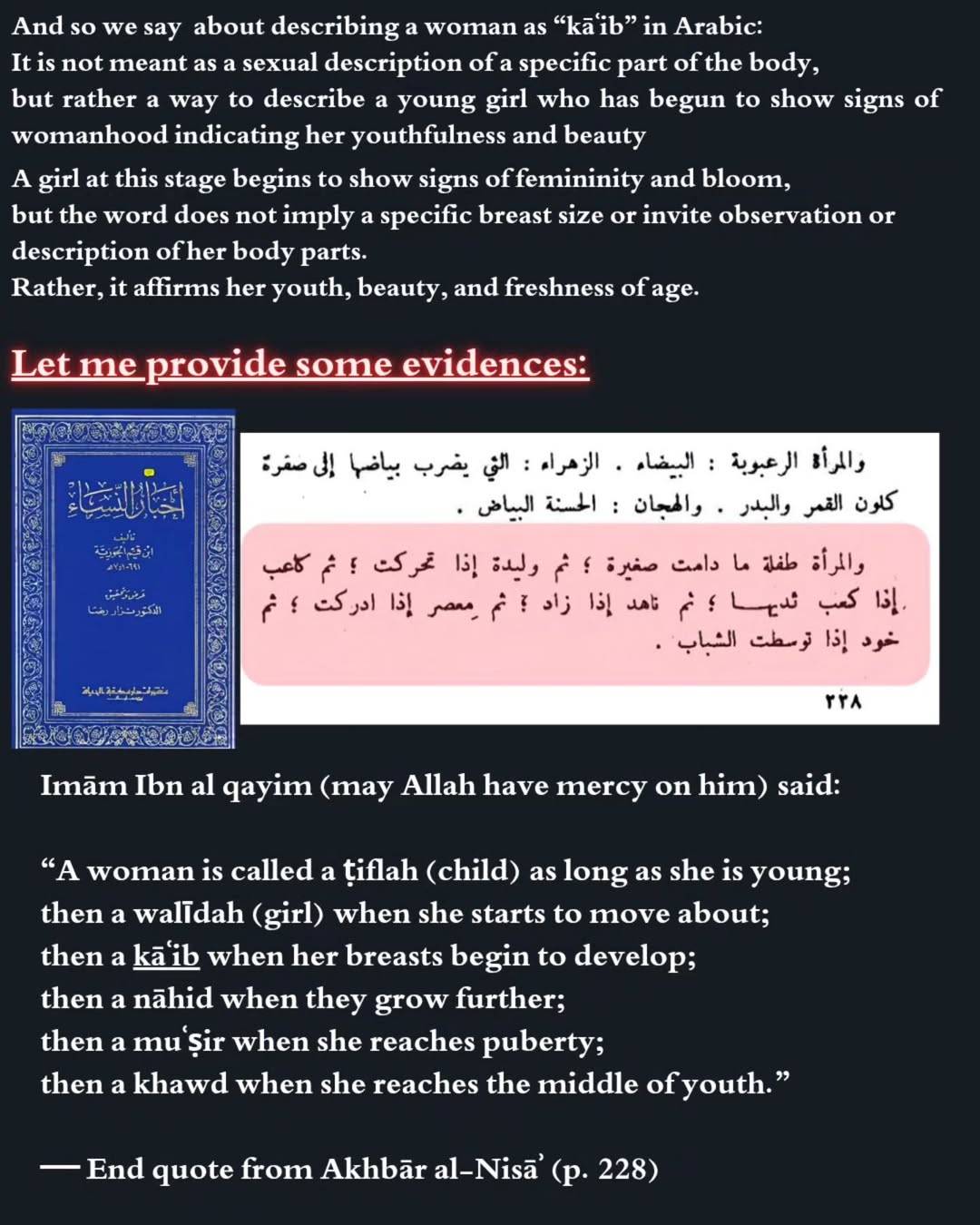
This scan explains that describing a woman as“kāʿib” in Arabic is not meant as a sexual description of a specific body part. Rather, it is presented as a way to describe a young girl who has begun to show signs of womanhood, youthfulness, and beauty. The scan quotes from Akhbār al-Nisāʾ, attributed here to Ibn al-Qayyim, listing stages of female age-development in Arabic terminology: ṭiflah while young, walīdah when she begins moving about, kāʿib when signs of development begin, nāhid when they grow further, muʿṣir when she reaches puberty, and khawd when she reaches the middle of youth. The point is that these are age-stage terms in Arabic, not crude sexual descriptions.
The point is not crude sexual description, but identifying a stage of feminine maturity and youth in classical Arabic usage.
Evidence from Arabic Scholars and Tafsir
Kawa’ib: the plural of Ka’ib, which is the breasted women whose breasts have been filled. “Al-Zamakhshari” meaning women whose breasts have been filled, and they are the breasted women. It is said: The girl Ka’abat Tak’ib Ku’uban, and Ka’abbat Tuka’ib Tak’iban, and Nahadat Tanhad Nuhudan.
Ad-Dahhak said: Like the maidens of the Adhaari.
On the authority of Ibn Abbas, with two chains of transmission, both of which are good, he said:
“If something of the Qur’an is hidden from you, then seek it in poetry, for it is the register of the Arabs.”
And from this Qais bin Asim said:
“And how many a noble horse have We taken in ***** And how many maidens have not yet reached the age of misery.”
And on the authority of Qatada, its meaning is the equality of creation, stature, and appearance at one age from the touch of the skin of one of the dirt before the other. Rather, if they were born, their birth would have been at the same time.
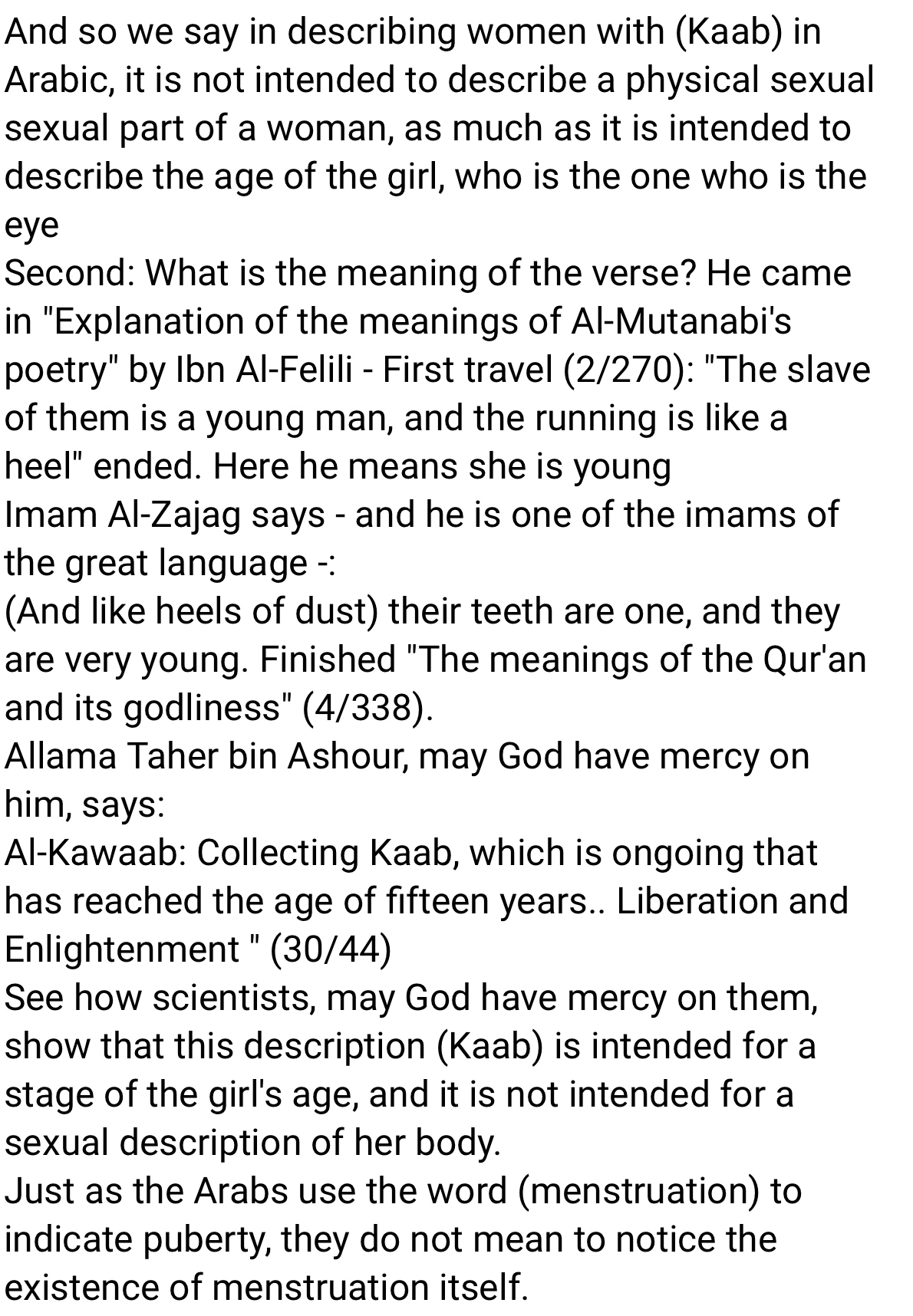
This scan argues that when Arabic describes women with the term“Kaʿb / Kāʿib”, the intended point is not a sexual body-part description, but the age-stage of the girl. It cites explanations from Arabic works and scholars, including examples where the term is connected with youth. It also mentions al-Tahir ibn Ashur, who explains “al-Kawāʿib” as referring to those who have reached around the age of fifteen. The scan’s main argument is that this is comparable to how Arabs may use a word like menstruation to indicate puberty, without intending to describe menstruation itself.
The Arabs say: A girl with large heels, if the heads of her bones do not have size; and that is more preferable for her.
And he recited:
A leg that is protruding and a heel that is dark.
In the hadith of Abu Hurairah:
Then a young girl knelt on one of her knees.
He said: Ka’ab, with the fat-ha: is the woman when her breasts appear to the breasts.
Ibn Faris said:
It is said: A woman’s breasts protrude, so she is a ka’ab: if her breasts protrude.
Ibn al-Jawzi.
Ibn Adil said in al-Lubab fi ‘Ulum al-Kitab:
It is from the heel of her breast and its protrusion, meaning that the breast is in the protrusion like the heel and the heel.
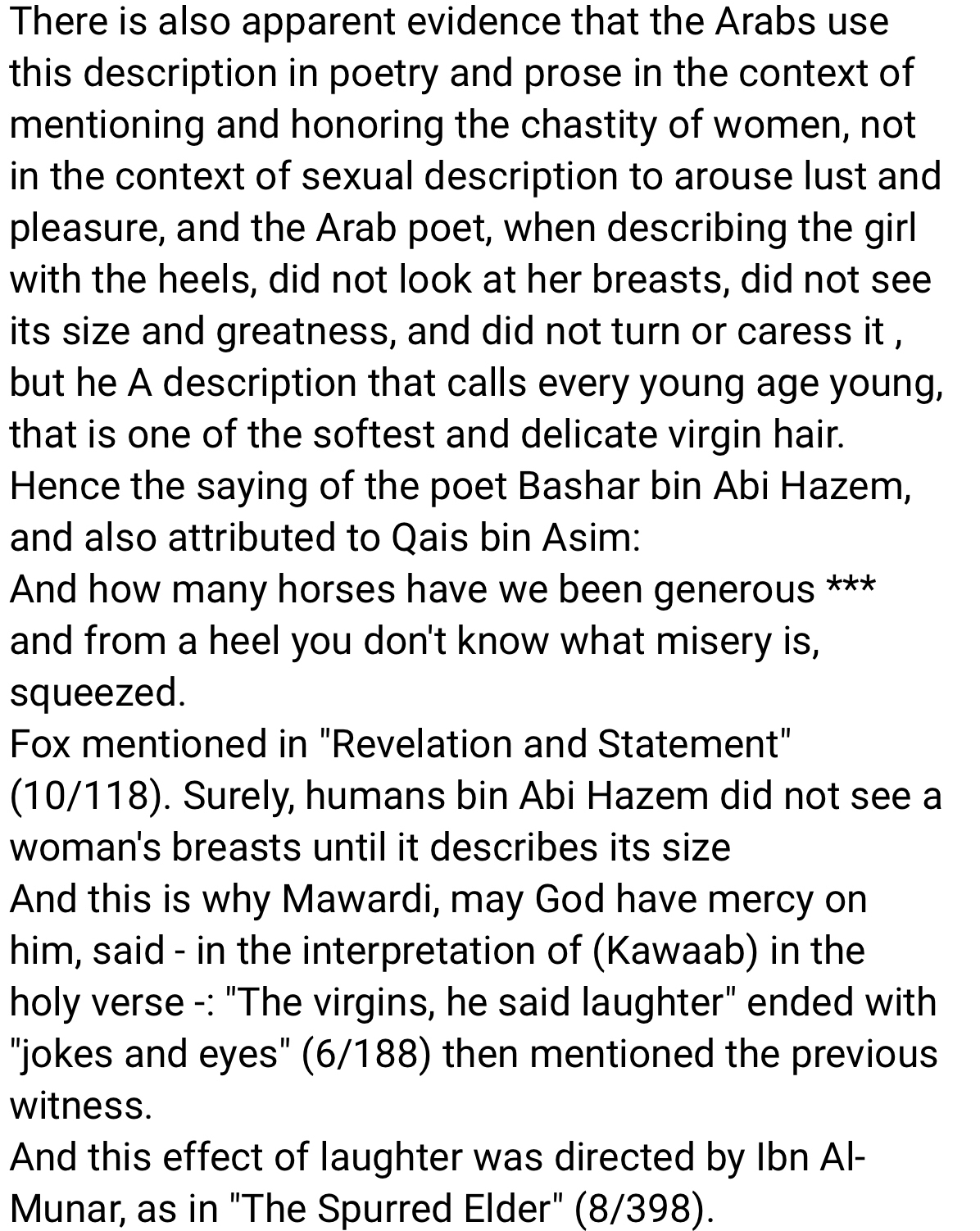
This scan gives further Arabic literary evidence. It says the Arabs used this type of description in poetry and prose when mentioning and honoring the chastity of women, not in the context of sexual arousal. It cites poetry attributed to Bishr ibn Abi Hazim and also to Qays ibn Asim, where the wording is used in a refined poetic context. The scan argues that the poet was not staring at or describing a woman’s body in a vulgar way; rather, the expression was part of Arabic usage for a youthful, delicate, chaste maiden. It also mentions al-Mawardi’s tafsir, where“Kawāʿib” is explained through “al-ʿadhārā”, meaning virgins/maidens.
The Ka’bah is the virgin’s excrement.
And he recited:
A completed mount, and his mistress completed,
It was sealed, then his Kaaba was broken.
What is meant is that they are virgin women whose breasts have become cupped and have become loose, meaning: their breasts have become like the Kaaba in their chests.
And there was less than what I feared ***** Three young women and a press.
{And virgins} is the plural of ka’ab. It is said that a woman’s breasts appeared and rose to the height of the heel, meaning virgin women, their breasts became round and became like the heel in protrusion.
It is said that the breast of a slave girl became round like the spindle’s twist.
They are called nawahed, the plural of nahid and nahida, which is a woman whose breasts are heel and appeared for the height.
{Atraban} is equal in age, meaning equal in age. A man’s birth is his age and his peer in age and birth. The ha’ is a replacement for the waw that was lost from the beginning because it is from birth.
Al-Raghib said: meaning they grow up together, likening them to the equal and similar ribs, which are the ribs of the chest, and to their falling to the ground together.
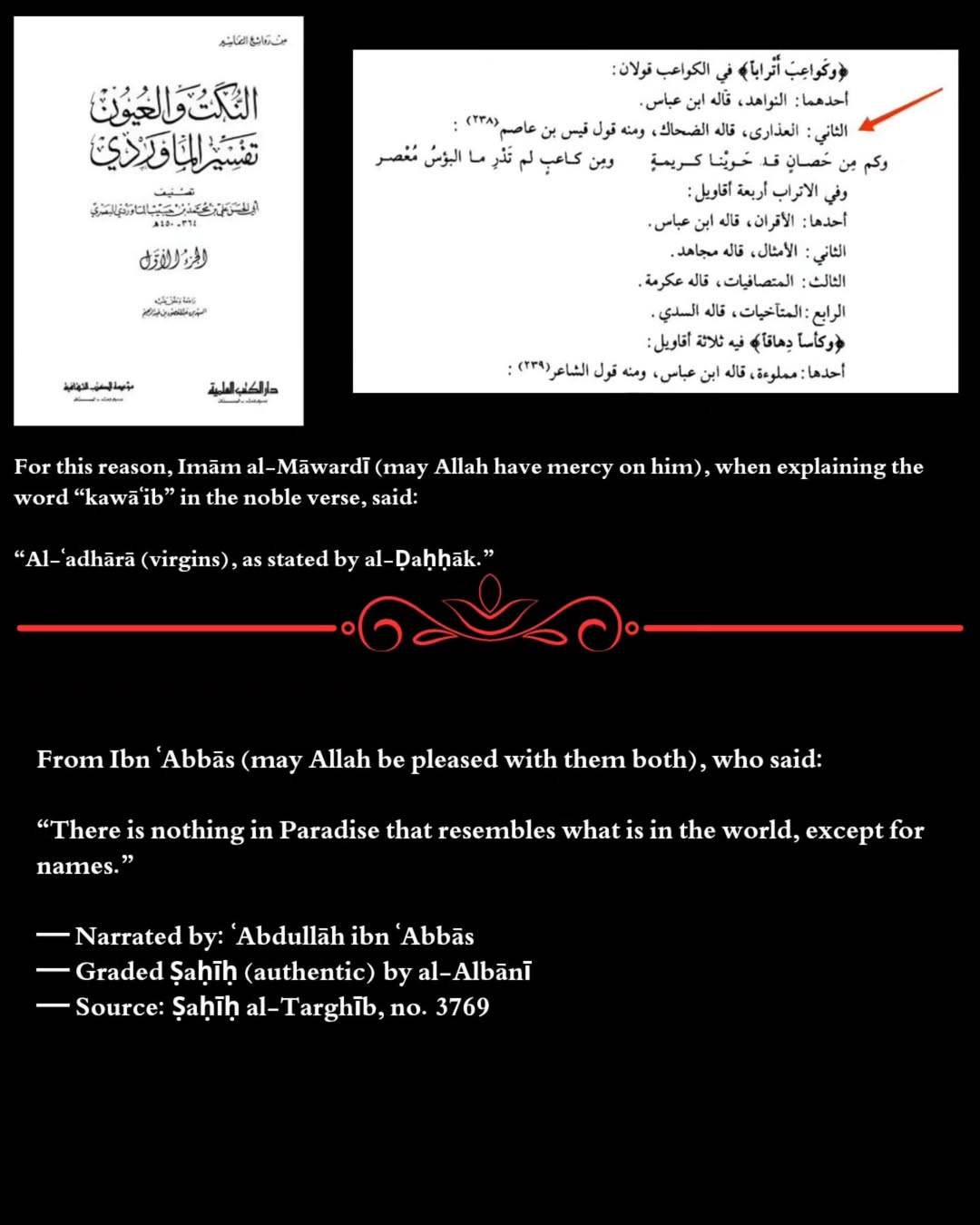
This scan citesal-Mawardi in his explanation of “Kawāʿib”, where the word is connected to al-ʿadhārā, meaning maidens/virgins, as stated from al-Dahhak. It also quotes Ibn Abbas: “There is nothing in Paradise that resembles what is in the world except for names.” The purpose of this scan is to argue that descriptions of Paradise should not be crudely reduced to worldly physical imagery. Even when familiar words are used, the realities of Paradise are not identical to worldly realities.
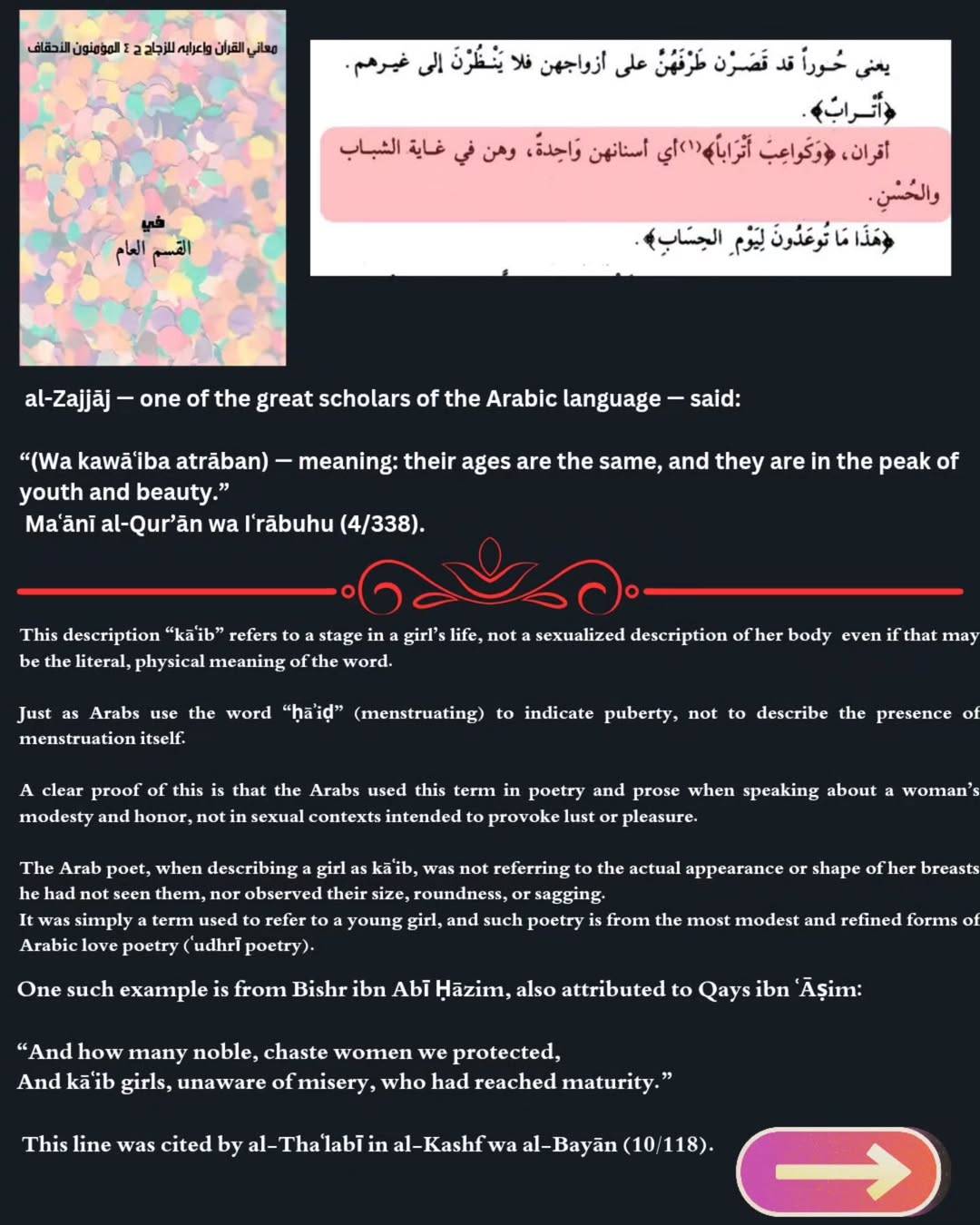
This scan quotes al-Zajjaj, one of the major scholars of the Arabic language, explaining“Kawāʿiba Atrāban” as meaning that their ages are the same and that they are in the peak of youth and beauty. It then explicitly states that “kāʿib” refers to a stage in a girl’s life, not a sexualized description of her body, even if the literal physical meaning of the word may be related to development. The scan compares this with how Arabs use “ḥāʾiḍ” to indicate puberty, not to describe the presence of menstruation itself. It also gives poetic evidence to show that Arabs used the term in contexts of modesty and honor, not lust or vulgarity.
What the Interpreters Meant
Meaning: the term points to a stage of youth, growth, and maturity.
It is not an obscene phrase, nor is it a vulgar sexual description.
maiden, chest, breast, Surah Rahman, Rehman, 78:33
The Quranic Style Is Modest
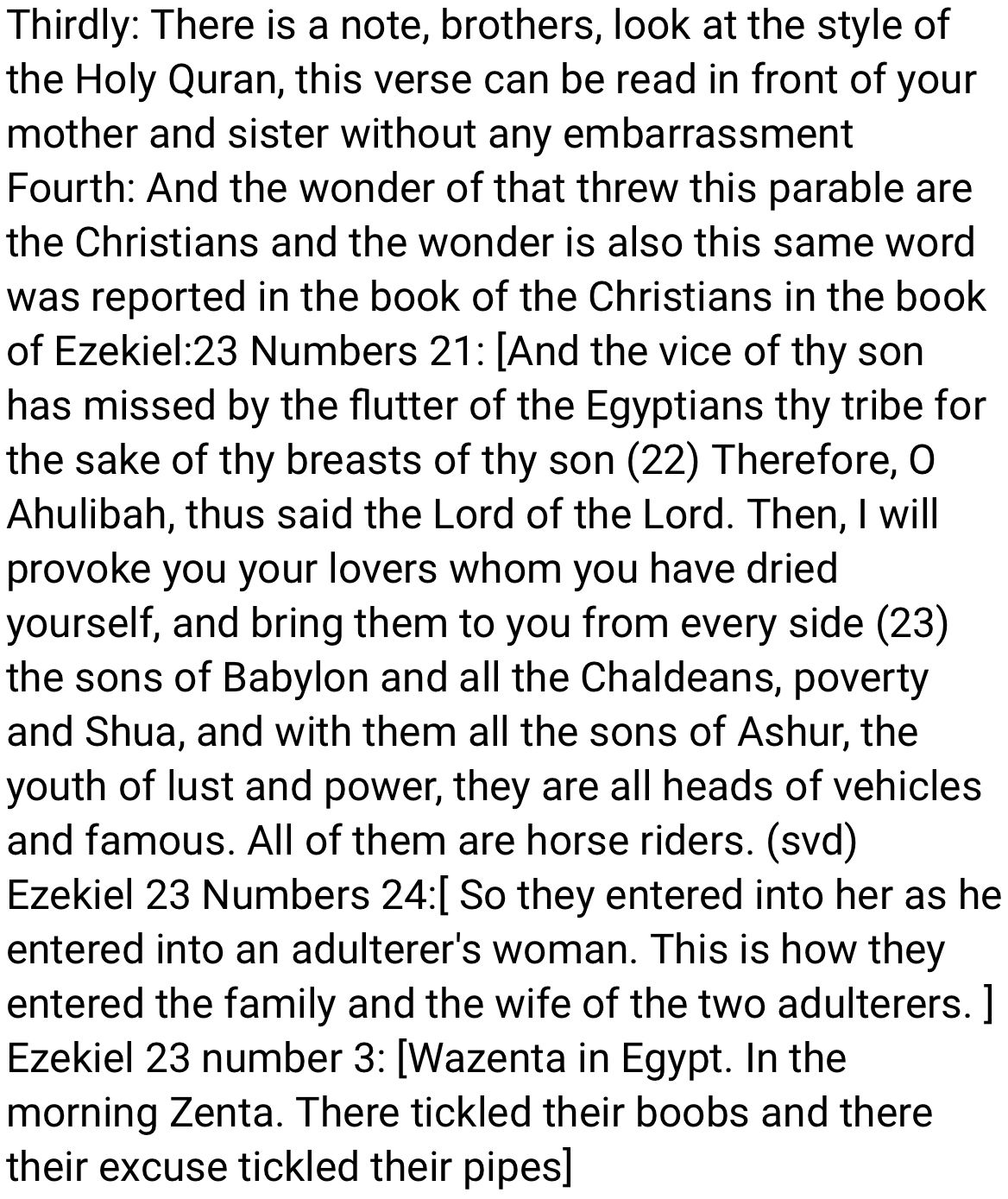
This scan argues that the Qur’anic wording is modest and can be read without embarrassment. It then contrasts this with wording found in the Bible, especially Ezekiel 23, where the language is explicit and graphic. The scan’s purpose is to say that critics who attack the Qur’anic phrase are ignoring the much more graphic style found in their own scripture. It uses Ezekiel as the first example of this contrast.
{And maidens of equal age}
is a heavenly style that does not offend the modesty of a woman or a man, because it is a description of the formation of a woman at a specific age.
Comparison with the So-Called Holy Book
If we look at the style of the so-called holy book in describing women, we find a style of impurity and impudence, no manners, no modesty, and no chivalry.
Now Onan knew that the offspring would not be his; so whenever he went in to his brother’s wife, he ejaculated on the ground, so that he would not give offspring to his brother.
Onan knew that the children from this union would not belong to him. Onan had sexual relations with Tamar, but he did not allow himself to stay inside her.
And I loved their lovers, whose flesh is as the flesh of asses, and their semen as the semen of horses.
My beloved’s bag of myrrh lies between my breasts.
Behold, you are fair, my beloved, and sweet, and our bed is green.
Your lips are like a thread of scarlet, and your mouth is lovely; your cheeks are like the fragment of a pomegranate under your veil.
Your neck is like the tower of David.
Your breasts are like the twin fawns of a gazelle, feeding among the lilies.
Your lips, O bride, drop the honeycomb. Honey and milk are under your tongue, and the smell of your garments is like the smell of Lebanon.
My beloved has put forth his hand through the window, and you are my bowels upon him.
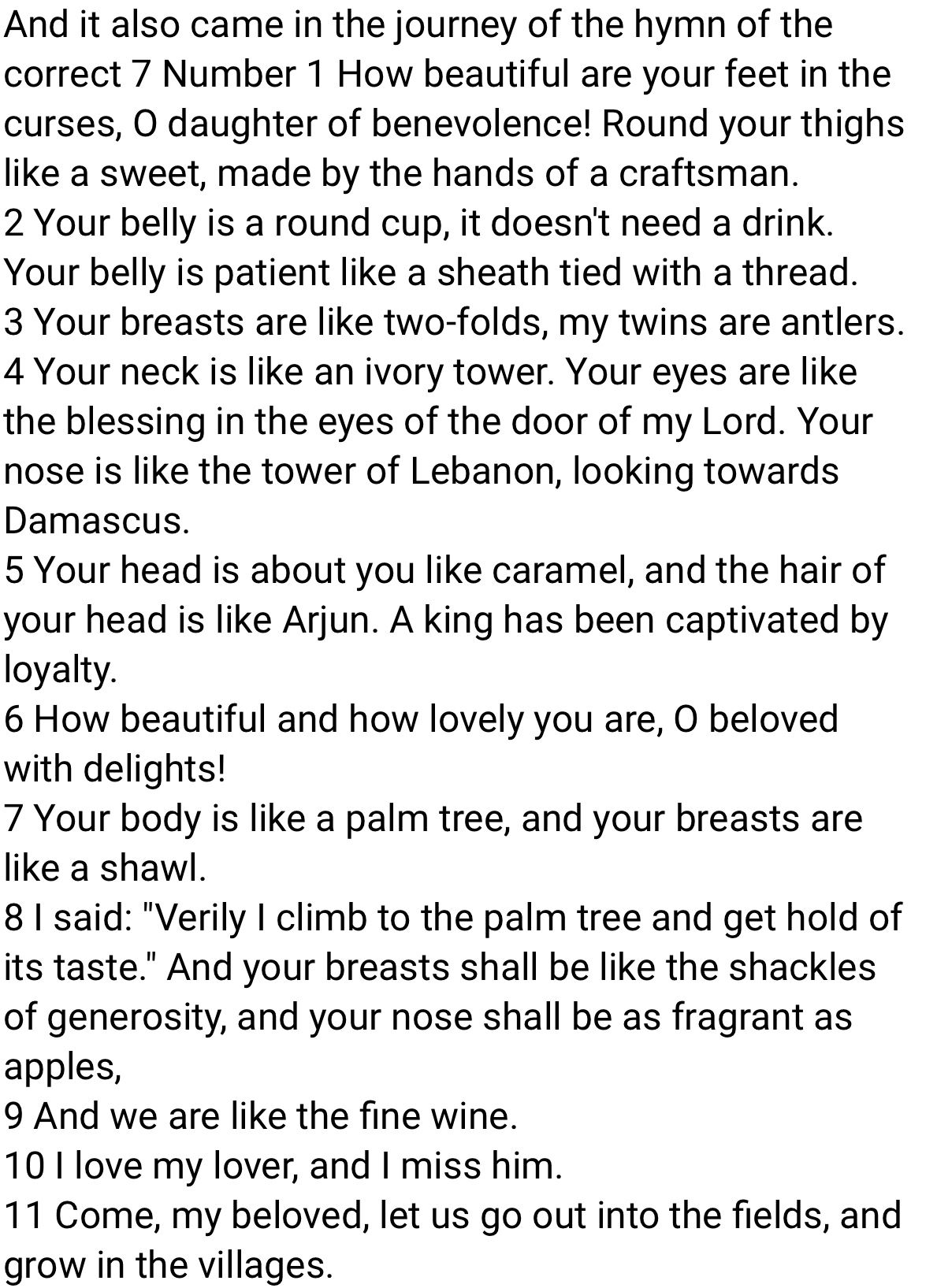
This scan continues the comparison by quoting from Song of Songs 7. It contains repeated physical descriptions: feet, thighs, belly, breasts, neck, eyes, nose, hair, body, and desire imagery. The argument being made is that the Biblical text uses direct sensual and bodily imagery, while the Qur’anic phrase“Kawāʿib Atrāban” is brief, restrained, and linguistically tied to age, youth, and equal maturity.
How comely are your feet, O daughter of the noble, in sandals! The roundness of your thighs is like ornaments, the work of the hands of a craftsman.
Your navel is a round cup that never lacks mixed drink; your belly is a heap of wheat surrounded with lilies.
Your breasts are like two fawns twined by a gazelle.
Your neck is like a tower of ivory.
Your stature is like a palm tree, and your breasts like clusters.
Your breasts shall be like clusters of the vine, and the fragrance of your breath like apples.
We have a younger sister who has no breasts; what shall we do for our sister when she is betrothed?
I am a wall, and my breasts like towers; then I was in his eyes as one finding peace.
I have perfumed my couch with myrrh, aloes, and cinnamon.
Come, let us drink love until the morning; let us delight ourselves in love.
For my husband is not at home; he has gone a long way.
She did not kiss me. But since I came in she has not ceased to kiss my feet.
For when she poured this ointment on my body, she did it to bury me.
Conclusion
Classical Arabic usage, tafsir, and Arabic literary context show that the expression refers to maidens at a particular stage of youth, maturity, and equal age.
The Qur’anic wording is brief and modest, while the objection collapses because the critics are forcing a crude modern reading onto classical Arabic.
Is this a respectable style?
Obscene and Indecent Sexual Paragraphs in Bible
Obscene Words to Describe Sexual Parts in the Bible_Sisters Are Not Allowed to Enter