Does “Lord” Prove Jesus Is God? Kyrios Explained from Christian Sources
Does the Title “Lord” Mean the Divinity of Christ? Kyrios and the Specifications of the Messiah
Table of Contents
- Introduction
- Pope Shenouda’s Rule on Christian References
- Does the Title “Lord” Mean the Divinity of Christ?
- John 1:38 — Rabbi Means Teacher
- Kyrios Was Used for Paul and Silas
- The Word Kyrios Does Not Automatically Prove Divinity
- Christian Scholarly Admissions About Kyrios
- Video Reference
- Conclusion
Introduction

This scan is the cover of the Arabic book“الفكر اللاهوتي في رسائل الرسول بولس” — The Theological Thought in the Epistles of the Apostle Paul — by Dr. Al-Qummus Fahim Aziz. It is used here as one of the Christian theological sources discussing Paul’s terminology, especially the use of titles such as “Lord” for Jesus. The importance of the source is that it is not a Muslim polemical source, but a Christian theological discussion of Pauline language.
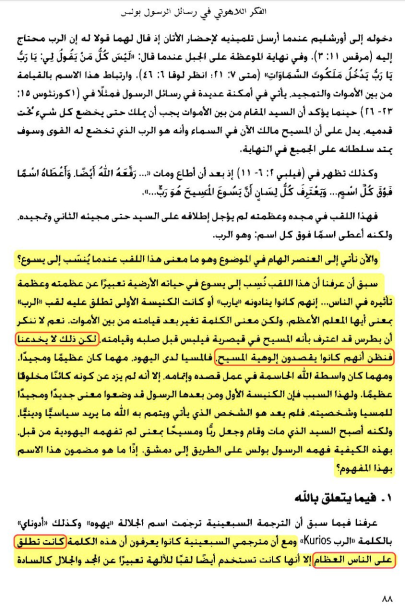
This scan is fromThe Theological Thought in the Epistles of the Apostle Paul. The highlighted section discusses the important question: what does the title “Lord” mean when applied to Jesus? It asks whether the title is merely a form of honor and respect, or whether it indicates something related to Jesus’ nature. The text explains that this title had an effect because the Jews used “Lord” for God, but it also notes that the title was used among people as a title of respect for important persons. The scan therefore supports the point that the word “Lord” cannot automatically be treated as a direct proof of divinity without examining its linguistic and contextual use.
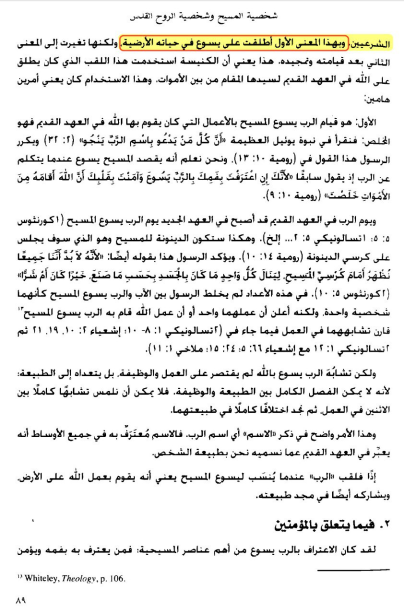
This scan continues the same discussion fromThe Theological Thought in the Epistles of the Apostle Paul. The highlighted text explains that the title “Lord” was applied to Jesus, especially after his resurrection, but the meaning must be distinguished from how the Jews used the title during Jesus’ earthly life. It also notes that in the Old Testament, “Lord” was a title used for God, yet it was also used in relation to great persons. The scan is important because it shows that Christian theological discussion itself recognizes that the title has multiple layers of usage and cannot be treated as a simple automatic proof that Jesus is God.
Pope Shenouda’s Rule on Christian References
saysin his book “The Beholder of God, the Evangelist Mark the Apostle” p. 160”In every reference, we take the truth in it.. and if we find something that does not agree with the truth, we leave it or respond to it if necessary, so we are not bound by everything in the books that we have read.”
This principle is useful here: when using Christian references, the truth in the reference is taken, and what contradicts the truth is rejected. The argument is not built on blind acceptance of every Christian source, but on extracting admissions and linguistic points that are relevant to the claim.
Does the Title “Lord” Mean the Divinity of Christ?
Does the title “Lord” mean the divinity of Christ?
John 1:38 — Rabbi Means Teacher
Then Jesus turned and saw them following, and said to them, “What do you seek?” They said to him, ” Rabbi (which means Teacher) , where are you staying?”
John 1:38
The Call of Andrew, John and Peter
The Savior always cares for those who follow him. Here he expressed this concern when he turned to the disciples and asked them, “What do you seek?” He knew the answer to this question, for he is all-knowing. But he wanted them to express their desire. Their response, “Rabbi…where are you staying?” shows their intention to stay with the Lord so that they can get to know him better. They were not content with merely meeting him; they were eager to fellowship with him . The word rabbi (rabbi) in Hebrew means teacher (literally “one of great stature”) .

This scan shows William MacDonald’s commentary on John 1:38. The highlighted part explains that when the disciples called Jesus“Rabbi,” the Gospel itself interprets it as “Teacher.” MacDonald adds that the Hebrew word “Rabbi” means teacher, literally “one of great stature.” The scan is relevant because it shows that titles of honor given to Jesus, such as “Rabbi,” do not automatically prove divinity. They can be titles of respect, teaching authority, or social status depending on usage.
Kyrios Was Used for Paul and Silas
The word (Lord, Kyrios, κύριος) was used for those others, such as Paul and Silas. They were addressed as (κυριοι τι με), which translates in the Van Dyck translation (Acts 16:30): “Then he brought them out and said, ‘Rabbis, what is necessary…?’”
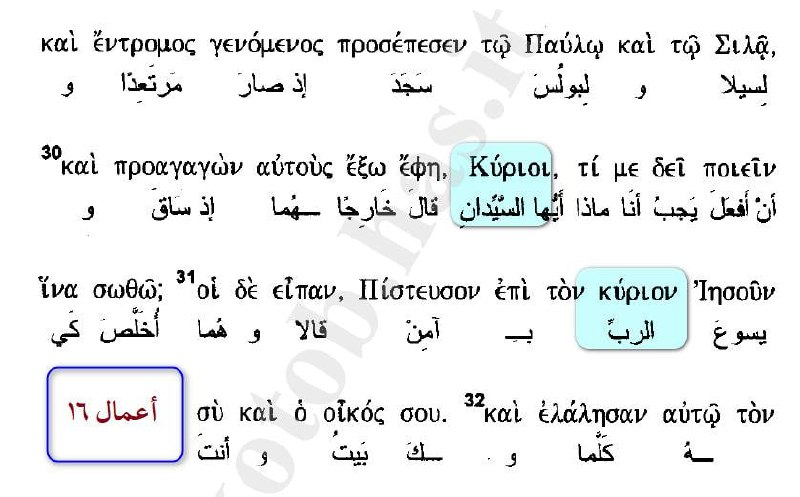
This scan shows Acts 16:30-31 in Greek with Arabic interlinear translation. In verse 30, the jailer addresses Paul and Silas with the plural formΚύριοι — “lords,” “masters,” or “sirs.” The Arabic line renders it as “أيها السيدان” — “O two masters / sirs.” Then in verse 31, the text uses κύριον for “the Lord Jesus.” The scan proves the key linguistic point: the Greek word Kyrios is not reserved only for God or Jesus. It can be used for human beings as a respectful address. Therefore, merely calling Jesus “Kyrios” does not, by itself, prove divinity.
The Word Kyrios Does Not Automatically Prove Divinity
The word for Lord (κυριος), pronounced (Kyrios), does not affirm any theological meanings, as it means master or lord and is used for other than Christ and God in several places in the Bible.💠💠💠
Christian Scholarly Admissions About Kyrios
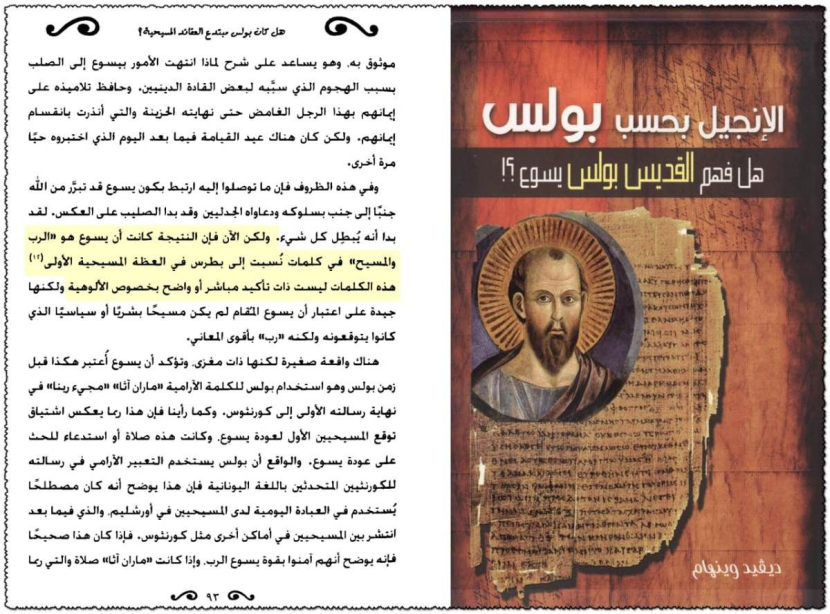
This scan is from the Arabic book“الإنجيل بحسب بولس: هل فهم القديس بولس يسوع؟!” — The Gospel According to Paul: Did Saint Paul Understand Jesus? by David Wenham. The highlighted section discusses Paul’s proclamation that Jesus is “Lord” and “Christ.” The page explains that Paul connects Jesus’ resurrection and exaltation with the title “Lord,” but the discussion is about Pauline interpretation and proclamation, not a direct linguistic proof that the word “Lord” itself means “God.” The scan supports the point that Paul’s use of the title belongs to a theological development and must be interpreted contextually, rather than treated as a simple dictionary proof of divinity.
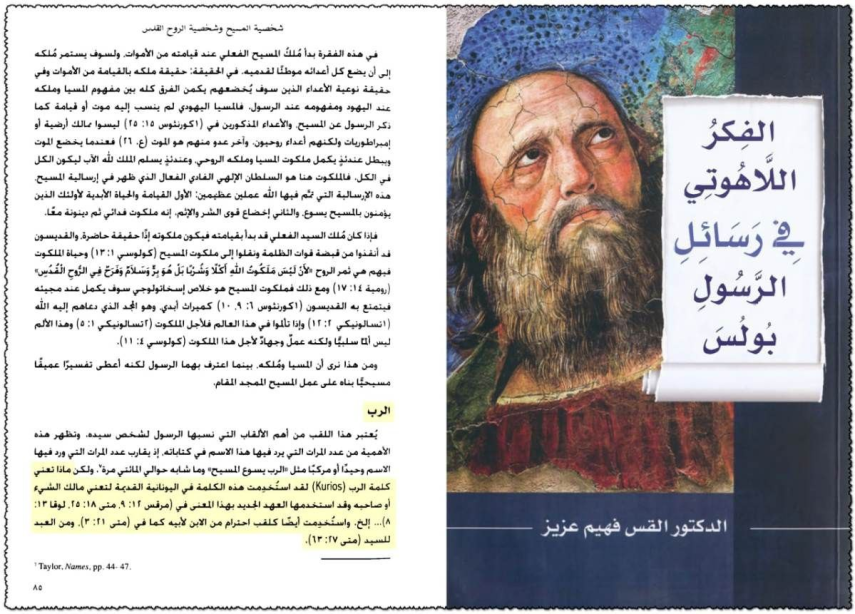
This scan is fromThe Theological Thought in the Epistles of the Apostle Paul. The highlighted section explains the importance of the title “Lord” among the titles Paul used for Jesus. It notes that the title is among the most important names Paul attaches to his master, Jesus, and that Paul uses it as a central expression in his letters. The scan is relevant because it frames the discussion as Pauline theological terminology, not as a simple statement that the word itself necessarily means divine essence.
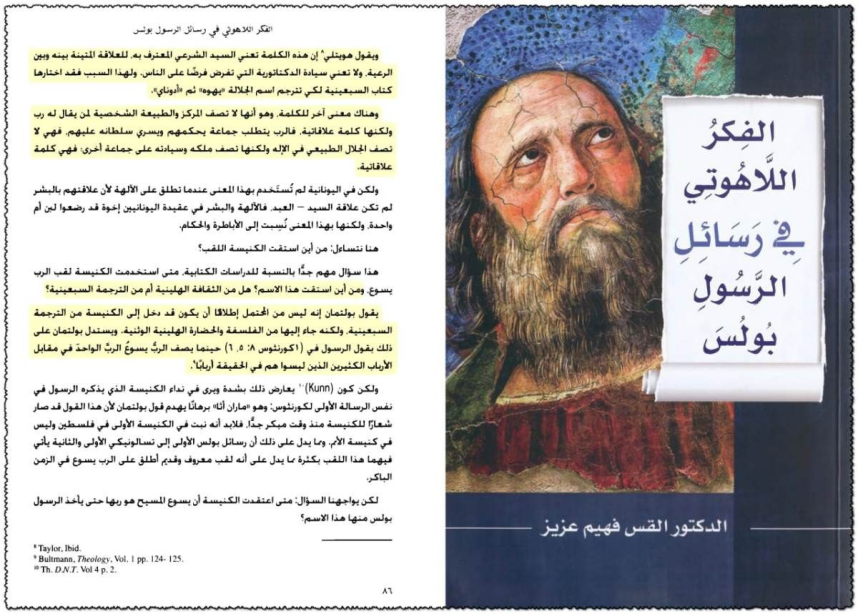
This scan continues the discussion from Fahim Aziz’s work. The highlighted passages explain that the word“Lord” has a broader range of meaning and is not limited to one narrow theological sense. It discusses the use of the word in Greek-speaking Christian environments and raises the question of whether the title came through Septuagint usage or through the Hellenistic Christian community. The scan supports the argument that Kyrios has to be studied historically and linguistically, because its meaning depends on context, culture, and usage.
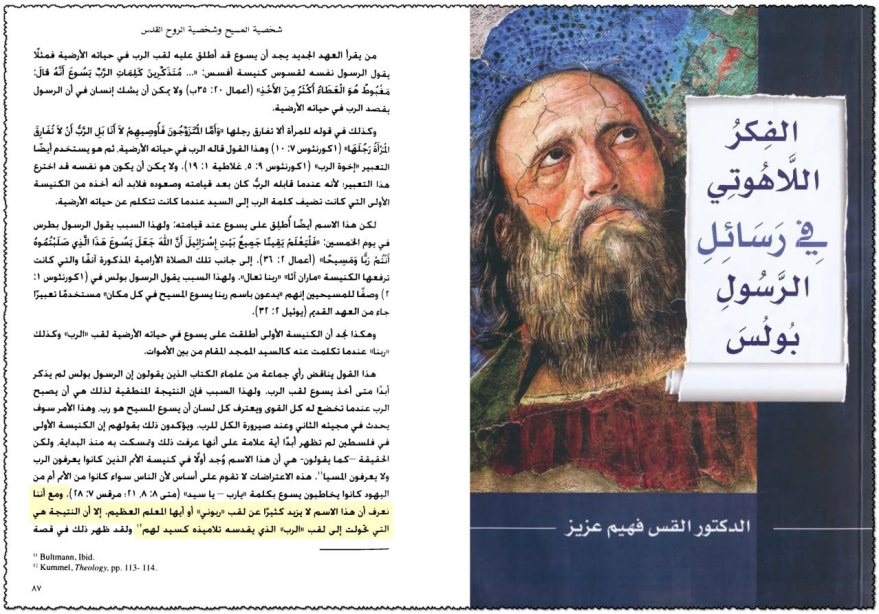
This scan is another page from the same Christian theological source. The highlighted section explains that in the first century, Jews generally avoided pronouncing the divine name and used the word“Lord” instead. The page then discusses how early Christians used the title for Jesus. The point is not that the word automatically means “God,” but that the title became loaded with religious significance through Jewish and Christian usage. This supports the article’s argument: context is essential, and the word Kyrios alone is not enough to prove Christ’s divinity.
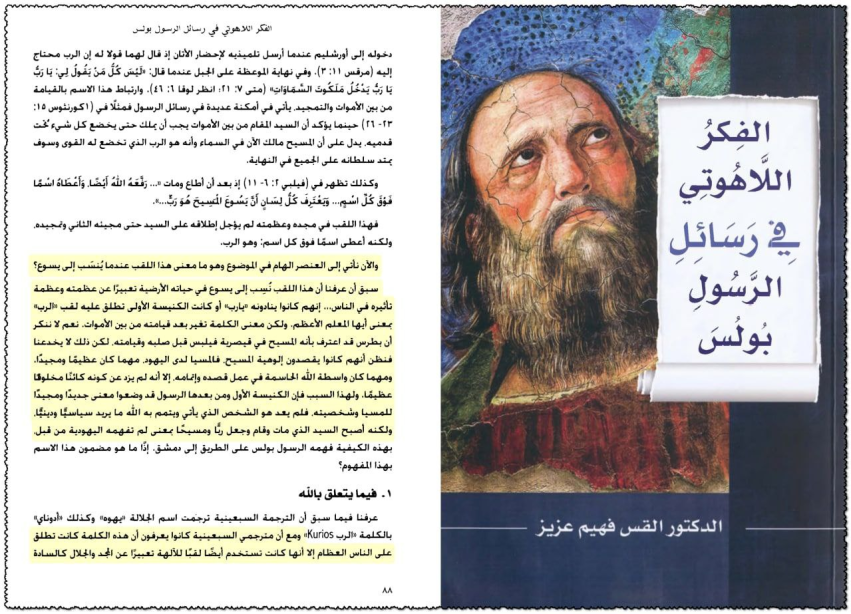
This scan repeats the page where the author directly asks what the title“Lord” means when attributed to Jesus. The highlighted passage states that the title could be taken as honor and respect, while also acknowledging that Jews associated “Lord” with God. It then notes that the title was also used among people for great or respected persons. The importance of this scan is that it explicitly breaks the simplistic claim: “Jesus is called Lord, therefore Jesus is God.” The source itself admits the title has more than one possible layer of meaning.
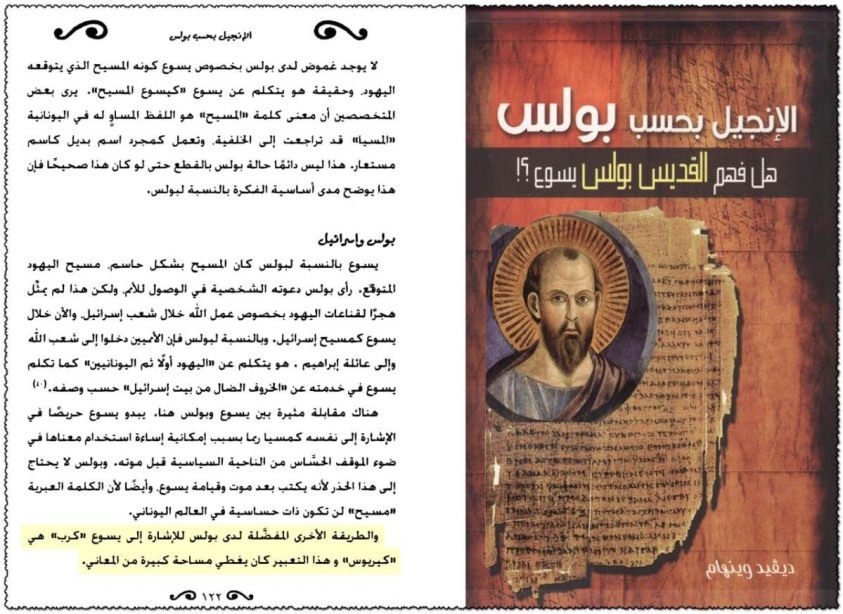
This scan is from David Wenham’sThe Gospel According to Paul. The highlighted sentence says that one of Paul’s common ways of referring to Jesus is “Kyrios”, and that this expression covered a wide range of meanings. This is a direct and important admission. It means the word cannot be reduced to one fixed theological meaning. If “Kyrios” covers a broad semantic field, then Christians cannot simply point to the title “Lord” and claim that the word itself proves Jesus is God.

This scan continues from David Wenham. The highlighted text explains thatKyrios could be used as a respectful form of address, like the English word “Sir.” It also explains that the title became important in the Greek-speaking church because Christians used it in prayer and worship. The scan supports the article’s argument from two angles: first, Kyrios can be ordinary respectful speech; second, later Christian worship usage does not prove that every biblical use of the word automatically means divinity.

This scan is from“المداولات اللاهوتية والروحية في الكتاب المقدس بحسب الإنجيل متى” by Boris Tawadros. The highlighted section defines Kurios / Kyrios as meaning lord, master, owner, or one who has authority. It explains that in Byzantine Greek the term was used as a title of respect for officials and rulers, that a wife could use it for her husband, and that it can mean the master of the house. This scan is strong evidence that Kyrios is a broad social and linguistic title, not a word that automatically means “God.”

This scan continues the same lexical discussion. It states thatKyrios is used in the Septuagint to refer to the lordship of Yahweh and to address Him, but it also lists broader biblical usages. The page shows that the word can be used in divine contexts, but that does not mean the word itself is exclusively divine. The argument is precise: Kyrios can be used for God, but it is not limited to God. Therefore, each occurrence must be interpreted by context.
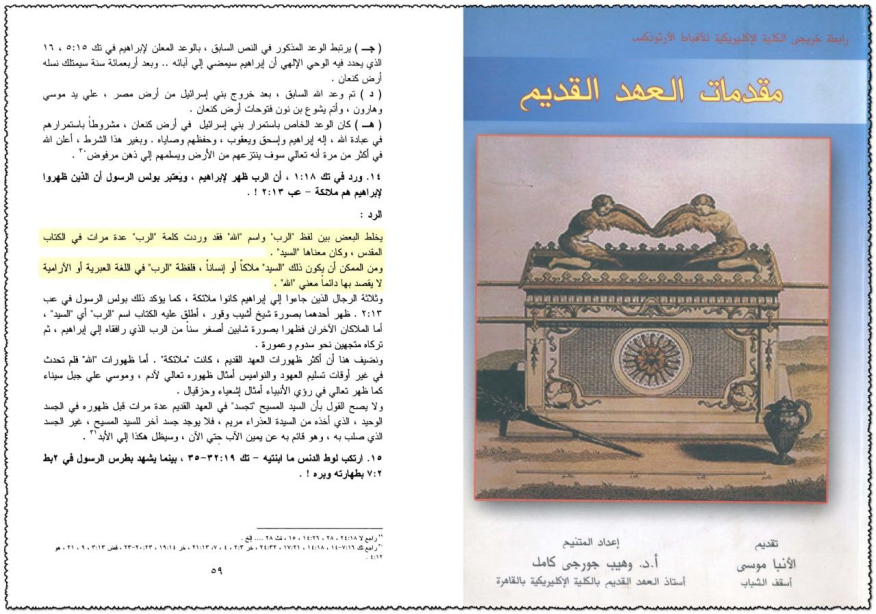
This scan is from“مقدمات العهد القديم” — Introductions to the Old Testament. The highlighted paragraph warns against confusing the word “Lord” with the divine name. It explains that in the Bible the word “Lord” can appear many times and can refer to different underlying Hebrew expressions. It says that Adonai may mean “master” or “lord” in Hebrew/Aramaic usage. The scan supports the core point: translating something as “Lord” does not automatically mean that the original word is the divine name or that the person being addressed is God.
Video Reference
Conclusion
The Greek word κύριος / Kyrios can mean lord, master, owner, ruler, sir, or a respected person.
It is used for God, but it is also used for human beings, including Paul and Silas in Acts 16:30.
Christian sources themselves admit that the word has a wide range of meanings and must be understood by context.
Therefore, the argument “Jesus is called Lord, therefore Jesus is God” is linguistically weak and contextually careless.
...rist acted after being anointed and after the Spirit of the Lord descended upon him, which proves dependence, not divinity. Therefore, the prophecy about opening the eyes of the blind is not a...