

Does the Qur’an Say Pregnancy Lasts Only Six Months? Refuting the Scientific Error Claim
Does the Qur’an Say Pregnancy Lasts Only Six Months? Refuting the Scientific Error Claim
Some critics claim that the Qur’an makes a scientific error regarding the duration of pregnancy. They argue that when the Qur’an mentions thirty months for pregnancy and weaning, and elsewhere mentions two years for breastfeeding, this allegedly means the Qur’an teaches that pregnancy always lasts only six months.
This claim is false.
The Qur’an does not say that every pregnancy lasts six months. Rather, the scholars inferred from the relevant verses that the minimum possible pregnancy can be six months, while the normal nursing period can be two full years.
The critic claims that the Qur’an says pregnancy lasts only six months, which would allegedly be a scientific error. This argument is built by combining the thirty months mentioned in Al-Ahqaf 46:15 with the two years of nursing mentioned in Luqman 31:14 and Al-Baqarah 2:233.
The objection fails because the verses are not giving a universal statement that every pregnancy lasts six months. They establish that pregnancy and weaning together can be thirty months, while complete nursing can be two years. From this, classical scholars inferred that the minimum pregnancy period may be six months.
The Relevant Qur’anic Verses
“And We have enjoined upon man goodness to his parents. His mother carried him with hardship and gave birth to him with hardship, and his carrying and weaning is thirty months.”
“And We have enjoined upon man care for his parents. His mother carried him, weakness upon weakness, and his weaning is in two years.”
“Mothers shall breastfeed their children two complete years for whoever wishes to complete the nursing.”
The calculation is simple:
- Pregnancy and weaning together: 30 months
- Complete nursing period: 24 months
- Minimum pregnancy inferred: 6 months
The Qur’an does not say that all pregnancies last six months. It indicates that pregnancy and weaning together can be thirty months, while complete nursing can be two years. From this, scholars inferred that the minimum pregnancy period can be six months.
The Critic’s Mistake
The critic turns a minimum inferred period into a universal claim.
That is the whole error.
The Qur’an is not saying:
“Every pregnancy lasts six months.”
Rather, the legal inference is:
“If pregnancy and weaning together are thirty months, and complete weaning is two years, then the minimum pregnancy period can be six months.”
These are not the same statement.
A six-month minimum pregnancy does not mean every pregnancy lasts six months. The critic has confused minimum possibility with normal duration.
This is basic logic. A statement about the shortest possible valid duration is not a statement about the usual or average duration.
Ibn Kathir on the Six-Month Minimum
Tafsir Ibn Kathir mentions that ʿAli ibn Abi Talib رضي الله عنه used Al-Ahqaf 46:15 together with the verses about two years of nursing to prove that the minimum pregnancy period is six months.
Ibn Kathir explains under Al-Ahqaf 46:15 that ʿAli رضي الله عنه used this verse, along with the verses mentioning two years of nursing, to infer that the minimum gestation period is six months.
This is not a modern apologetic invention. It is a classical tafsir point.
The inference is:
Thirty months for carrying and weaning minus twenty-four months of complete nursing leaves six months. Therefore, six months is understood as the minimum period of pregnancy.
The Report of the Woman From Juhaynah
The same point appears in the report mentioned by Imam al-Suyuti in Al-Durr al-Manthur fi al-Tafsir bi al-Maʾthur.
A man from Juhaynah married a woman from Juhaynah. She delivered a baby after six months. Her husband brought the case to ʿUthman ibn ʿAffan رضي الله عنه. ʿUthman initially ordered that she be punished, assuming adultery.
When ʿAli رضي الله عنه heard of this, he came to ʿUthman and objected.
Muhammad ibn Ishaq ibn Yasar narrated from Bajah ibn Abdullah al-Juhani that a man from Juhaynah married a woman from Juhaynah, and she gave birth after six months. Her husband went to ʿUthman رضي الله عنه and informed him. ʿUthman summoned her. As she prepared herself, her sister began crying. The woman said: “Why do you cry? By Allah, no one from Allah’s creation has approached me except him, my husband. So let Allah decree for me as He wills.” When she was brought before ʿUthman, he ordered that she be stoned. ʿAli رضي الله عنه heard of this and came to him, saying: “What are you doing?” ʿUthman said: “She delivered after six months. Can this happen?” ʿAli said: “Do you not read the Qur’an?”
ʿAli رضي الله عنه then used the Qur’anic verses to show that a six-month pregnancy was legally possible and therefore the woman could not be punished merely because of that duration.
The report shows that the six-month pregnancy inference was used to protect a woman from a false accusation, not to claim that all pregnancies normally last six months.
This is important. The Qur’an was not making a biological error. The legal reasoning recognized that a child could be born after six months.
The Scan Evidence
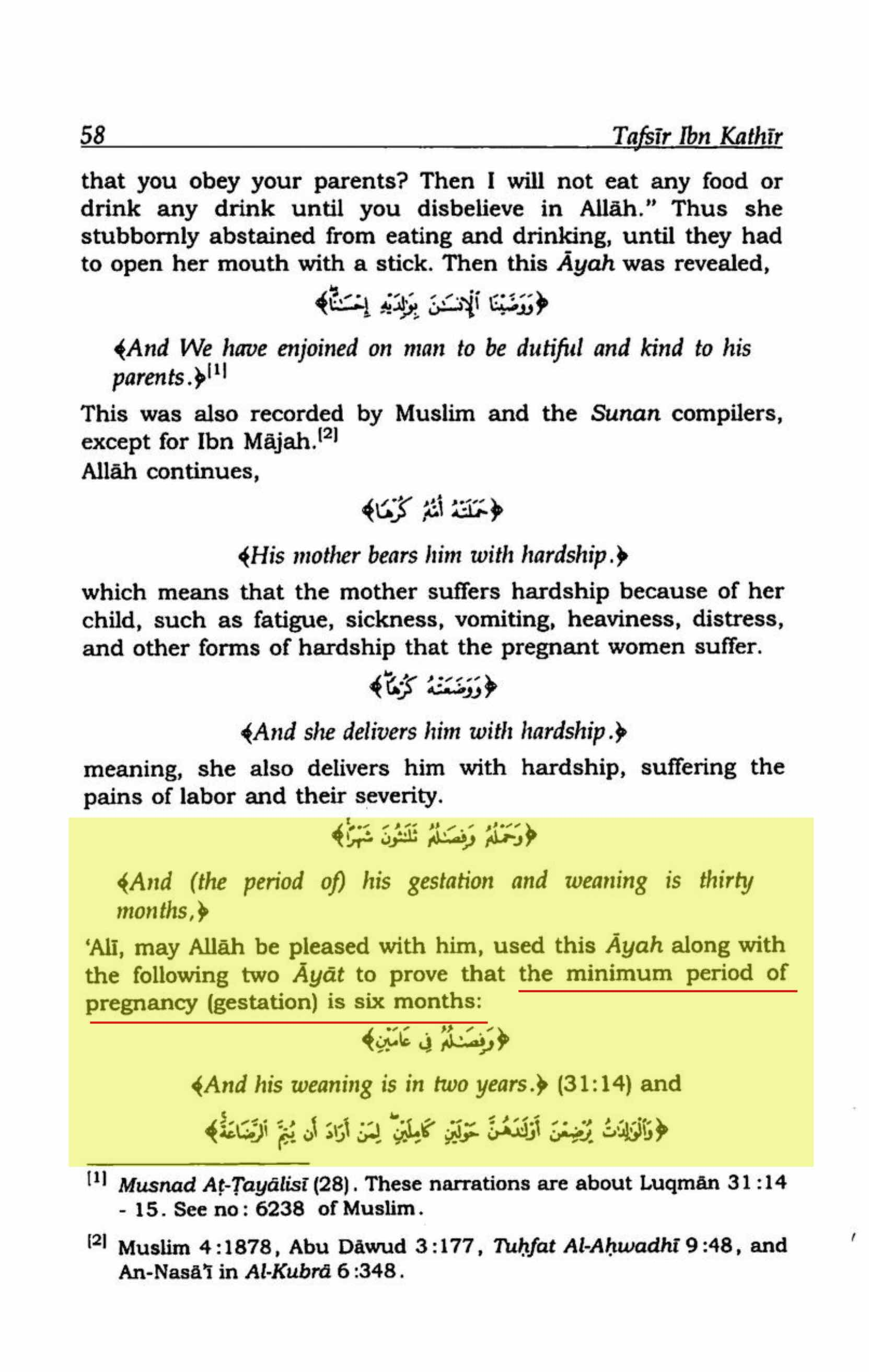
This scan is used as supporting evidence for the classical tafsir discussion of the six-month minimum pregnancy inference. It connects Al-Ahqaf 46:15, which mentions thirty months for pregnancy and weaning together, with the verses that mention two full years of nursing. The point being highlighted is that classical Muslim scholarship did not understand the Qur’an as saying every pregnancy lasts six months. Rather, the verses were used to establish that six months can be the minimum legally recognized period of pregnancy.
Modern Medical Reality
Modern medical sources do not say that every pregnancy must last exactly forty weeks in the sense that no child can be born earlier. Rather, forty weeks is the standard full pregnancy length, while preterm birth is a recognized medical category.
ACOG states that preterm labor is labor that starts before 37 weeks of pregnancy.
The CDC defines preterm birth as birth before 37 completed weeks of pregnancy.
The World Health Organization defines preterm birth as babies born alive before 37 completed weeks, with extremely preterm being less than 28 weeks.
So the medical reality is clear:
- Full pregnancy is commonly counted as about 40 weeks.
- Birth before 37 weeks is considered preterm.
- Birth before 28 weeks is considered extremely preterm.
- A child born around six months is premature and medically serious, but not automatically impossible.
Modern medicine recognizes preterm and extremely preterm birth. Therefore, the idea that a six-month birth is impossible is false. The Qur’anic inference of a six-month minimum is not a scientific error.
The critic is confusing normal full-term pregnancy with the earliest possible viable or legally recognized pregnancy.
Why “Six Months” Does Not Mean “Normal Pregnancy”
A normal pregnancy is usually measured around forty weeks.
But the question here is not: What is the average or normal pregnancy duration?
The question is: Can a child be born after roughly six months?
Modern medicine recognizes very early preterm births. These cases are high-risk and require medical care, but they exist.
The Qur’anic inference concerns the minimum period, not the average period. Saying a pregnancy can be six months is not the same as saying pregnancy normally lasts six months.
The objection collapses because it attacks a claim the Qur’an does not make.
The Qur’an’s Wording Is Precise
Al-Ahqaf 46:15 says:
“His carrying and weaning is thirty months.”
It does not say:
“His pregnancy alone is thirty months.”
Nor does it say:
“Every pregnancy is six months.”
It says pregnancy and weaning together are thirty months.
Luqman 31:14 and Al-Baqarah 2:233 mention the completion of nursing in two years. When the two are read together, the minimum possible pregnancy is inferred as six months.
The Qur’an gives a combined period and a nursing period. The six-month pregnancy is a legal and exegetical inference from combining the verses, not a claim that all pregnancies last six months.
The Role of Tafsir
The critic’s argument also fails because it ignores how Muslim scholars understood the verses.
Imam Ibn Kathir and Imam al-Suyuti did not treat the verses as a scientific problem. They reported the classical legal inference that six months is the minimum pregnancy period.
Classical scholars used the verses together to infer the minimum legal pregnancy period. They did not say the Qur’an teaches that every pregnancy lasts only six months.
This is exactly how a serious reading works: verses are read together, not isolated and distorted.
The Claim of Scientific Error Is False
The claim of scientific error depends on two bad assumptions.
First, it assumes the Qur’an says pregnancy always lasts six months.
Second, it assumes a six-month birth is impossible.
Both assumptions are false.
The Qur’an does not say all pregnancies are six months. And modern medicine recognizes preterm birth, including very early preterm categories.
The Qur’an indicates a possible minimum pregnancy period of six months through legal inference. Modern medicine recognizes that premature births can occur well before full term. Therefore, the scientific-error claim fails.
External Medical Sources
External Resources on Qur’anic Contradictions
Conclusion
The claim that the Qur’an makes a scientific error about pregnancy duration is false.
The relevant verse is Al-Ahqaf 46:15, not Surah 34:15. The verse states that pregnancy and weaning together are thirty months. Other verses mention that complete nursing is two years. From these verses, classical scholars inferred that the minimum pregnancy period can be six months.
This does not mean every pregnancy lasts six months. It means six months can be a minimum recognized period.
Classical tafsir, including Ibn Kathir and reports cited by al-Suyuti, recognized this inference. The report of the woman from Juhaynah shows that this understanding was used to prevent an unjust accusation of adultery.
Modern medical sources recognize that normal pregnancy is about forty weeks, but they also recognize preterm birth before thirty-seven weeks and extremely preterm birth before twenty-eight weeks.
The Qur’an does not claim that all pregnancies last six months. It indicates that pregnancy and weaning together may be thirty months, while complete nursing is two years. The six-month period is a minimum inferred by classical scholars, and modern medicine does not make such a birth impossible. The scientific-error claim is therefore baseless.
Source Notes
- Ibn Kathir, Tafsir al-Qur’an al-Azim, under Al-Ahqaf 46:15.
- Al-Suyuti, Al-Durr al-Manthur fi al-Tafsir bi al-Ma’thur, under Al-Ahqaf 46:15.
The Pregnancy Period in Islam Is Four Years
Does the Qur’an Contradict Itself on Pregnancy and Breastfeeding?