Ephesians 3:9 Exposed: How “Through Jesus Christ” Was Added to the Bible
Distortion of the Text of Ephesians 3:9: “Who Created All Things Through Jesus Christ”
Table of Contents
- Distortion of the Text of Ephesians 3:9: “Who Created All Things Through Jesus Christ”
- The Problem Early Christians Faced
- Biblical Texts Attribute Creation to God the Father Alone
- The Added Phrase in Ephesians 3:9
- The Oldest Manuscripts Do Not Contain This Addition
- The Peshitta Also Does Not Contain the Addition
- The Testimony of Commentators
- Critical Greek Editions Delete the Addition
- English and Arabic Translations
- Philip Comfort on Why the Addition Was Made
- The Plural Speech Argument and the Trinity
- Why Did Jesus Not Say This Himself?
- Conclusion
Distortion of the Text of Ephesians 3:9: “Who Created All Things Through Jesus Christ”
The Problem Early Christians Faced
Therefore, the pious copyists tried to graft the copies and manuscripts with some phrases that might support their belief; as the Encyclopedia of the Bible said, Vol. 3, p. 295.
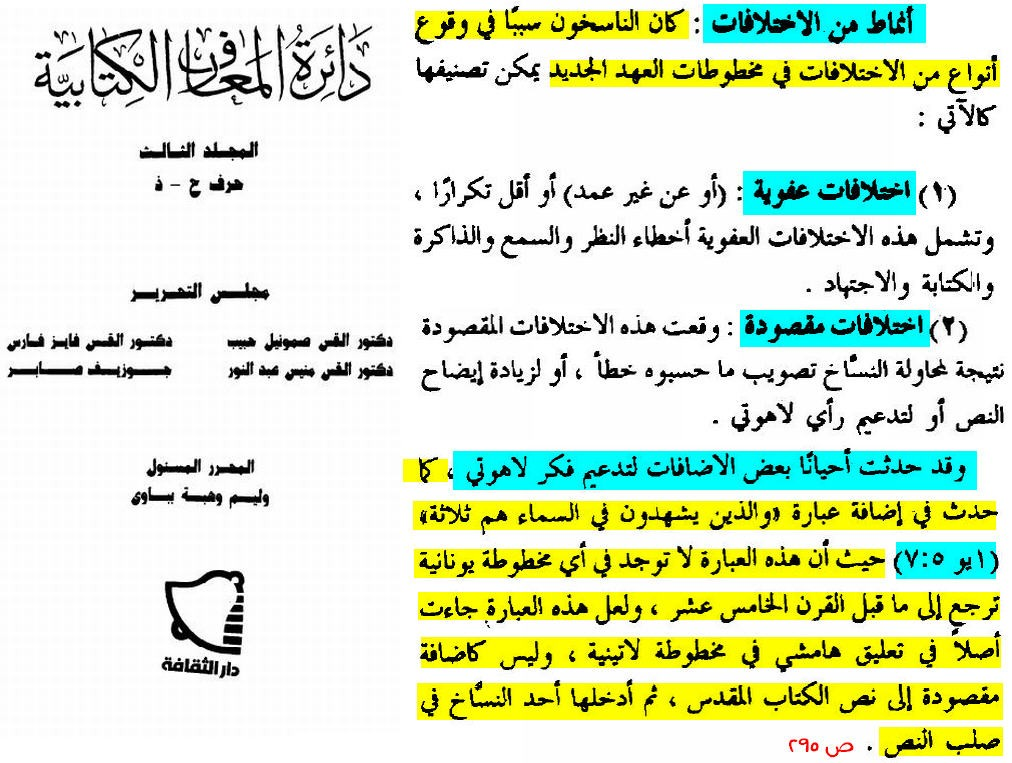
This scan is fromDāʾirat al-Maʿārif al-Kitābiyyah / The Encyclopedia of the Bible, Volume 3, under the discussion of “patterns of additions” in New Testament manuscripts. The highlighted section explains that some additions entered the New Testament manuscripts “for pious reasons.” It says that the additions were sometimes deliberate, and gives as an example the addition of the phrase “those who bear witness in heaven, they are three” in 1 John 5:7. The scan explains that this phrase is not found in any Greek manuscript before the fifteenth century, and that when it appeared, it first came as a marginal comment in a Latin manuscript, not as part of the original inspired text. The point being supported here is that Christian copyists were known to insert doctrinally useful phrases into biblical manuscripts when they felt the existing text did not provide enough support for later beliefs.
The Johannine Comma From Christian References( 1 John5_7
Biblical Texts Attribute Creation to God the Father Alone
For example: The Holy Bible, in its Old and New Testaments, contains many texts that attribute the attribute of creation to God the Father alone.
“In the beginning God created the heaven and the earth”
“Says the Lord, ‘I am the Lord, who made all things, who stretched out the heavens alone, who spread out the earth. Who is with me?’”
“For in those days there will be tribulation, such as has not been since the beginning of the creation that God created until now, no, nor ever will be”
“And Jesus answered and said to them, ‘Because of the hardness of your hearts he wrote you this commandment. But from the beginning of creation, God created them male and female’”
Will the copyists of the manuscripts remain silent about this serious shortcoming in the revelation regarding their God?!!!
The Added Phrase in Ephesians 3:9
Like what they did in the text of Ephesians 3:9
“And to make all men see what is the fellowship of the mystery, which from the beginning of the ages has been hidden in God, who created all things through Jesus Christ”
And this philosophy was adopted by the Christians from the pagan Greek thought; where they said: God is the most honorable of beings and it is not appropriate for Him to be preoccupied with creation… therefore He gives this attribute to an intermediary being… which they call “the Universal Mind”, and Christianity called it “the Word, or Jesus Christ”!!
“By Jesus Christ: Christ created Adam and all creation. And now He creates us again in baptism”
The Oldest Manuscripts Do Not Contain This Addition
But… by searching in the oldest and best manuscripts of the Bible, scholars have discovered that the phrase “by Jesus Christ” is not reliable or original; because it was added in later manuscripts, and the most important and oldest manuscripts were devoid of it!!
This addition is not found in the Sinaiticus Codex, nor in the Vaticanus Codex, nor in the Alexandrian Codex.
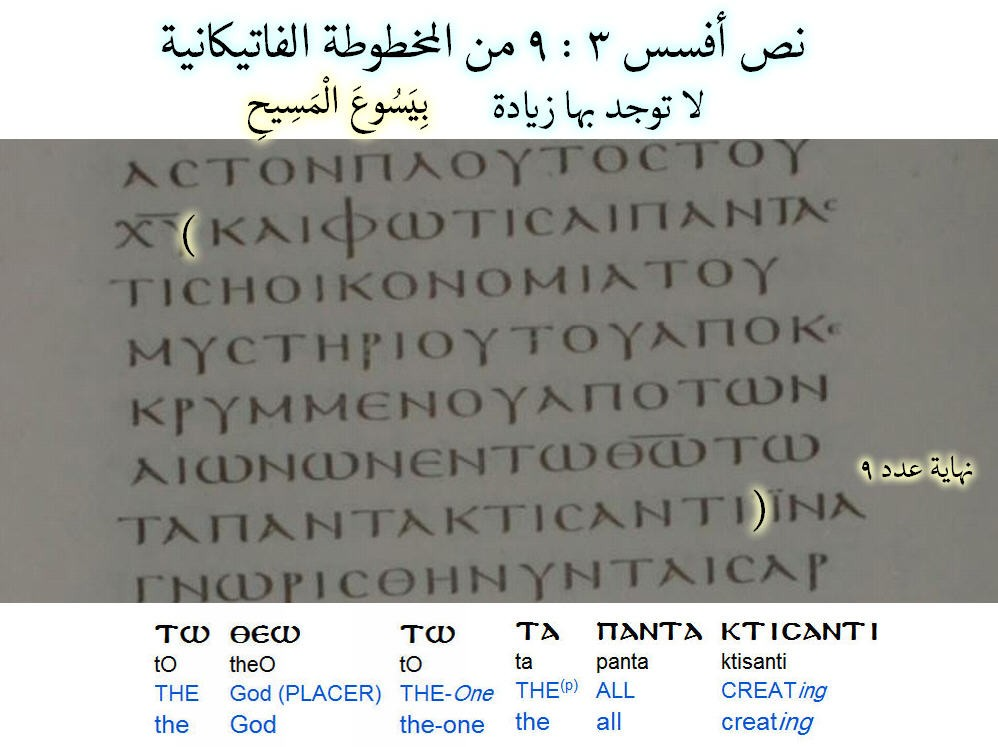
This scan presents Ephesians 3:9 from one of the major Greek manuscript witnesses. The Arabic heading says that the text of Ephesians 3:9 in this manuscript doesnot contain the addition “by Jesus Christ.” The highlighted manuscript reading ends with the Greek expression corresponding to “who created all things,” without continuing into “through Jesus Christ.” The scan also marks the end of verse 9, showing that the phrase “by Jesus Christ” is absent from the manuscript text at the point where later traditional texts insert it.
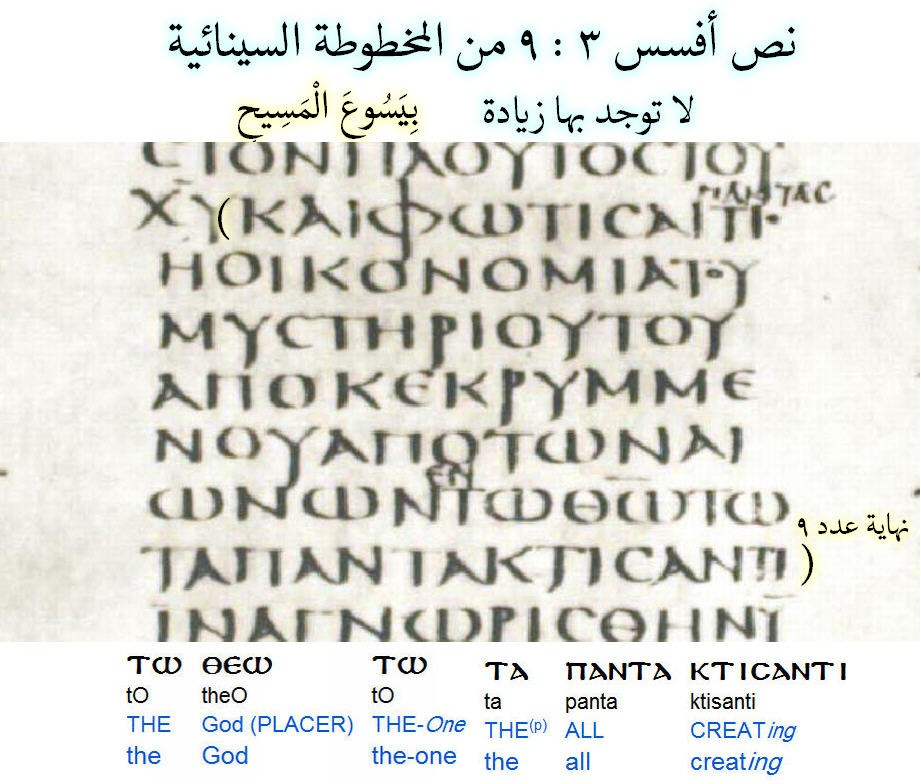
This scan gives another manuscript witness for Ephesians 3:9. The Arabic heading again states that the text hasno addition “by Jesus Christ.” The manuscript line is shown with the ending of verse 9, and the Greek expression visible at the end is “τὰ πάντα κτίσαντι,” meaning “the one who created all things.” The scan is being used to show that the verse ends without the added phrase, so the manuscript supports the shorter reading.
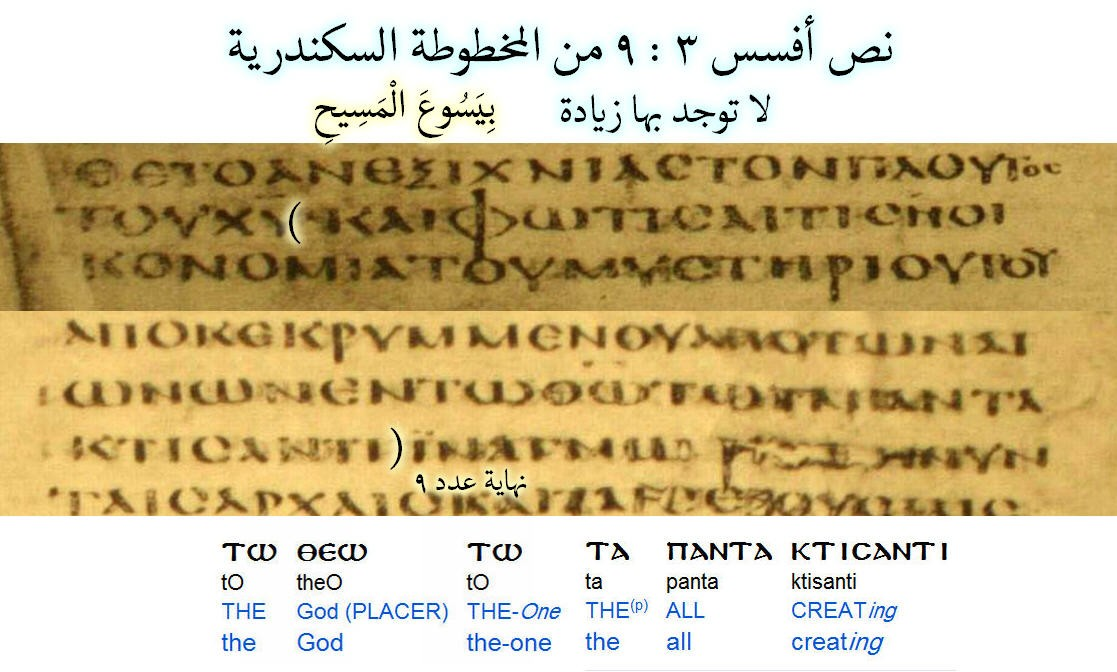
This scan shows the Alexandrian manuscript evidence for Ephesians 3:9. The Arabic heading identifies the text as Ephesians 3:9 from the Alexandrian manuscript and states that it does not contain the phrase “by Jesus Christ.” The scan highlights the same Greek ending of the verse: “τὰ πάντα κτίσαντι,” meaning “who created all things.” It marks the end of the verse after this wording, demonstrating that the phrase “through Jesus Christ” is not part of the manuscript reading.
“πάντα κτίσαντι … who created all things”!!
The Peshitta Also Does Not Contain the Addition
Even in the Peshitta; the oldest Syriac translation of the Bible, 5th century, does not have this addition.
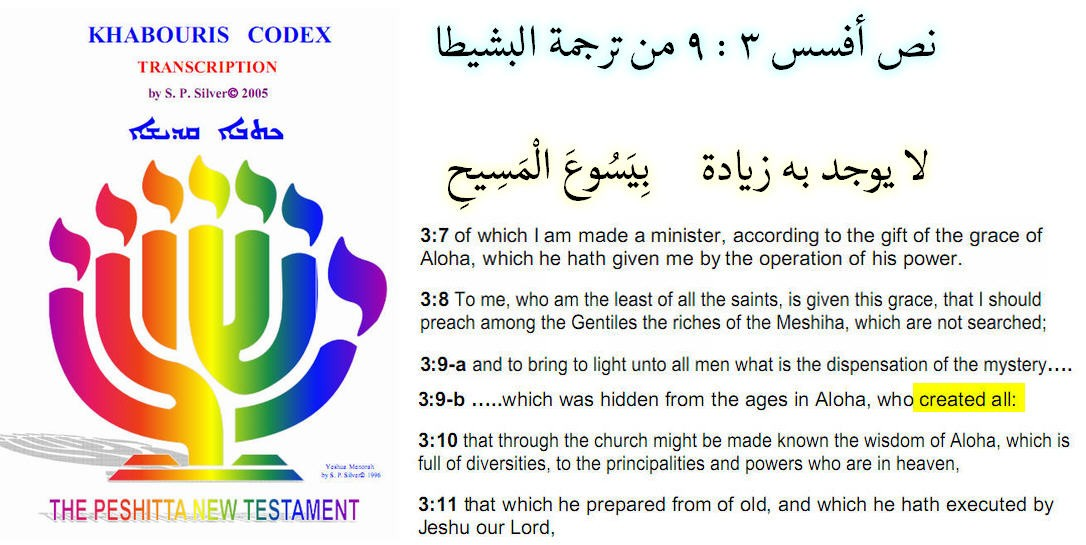
This scan presents Ephesians 3:9 from the Peshitta New Testament. The Arabic heading says that the text of Ephesians 3:9 from the Peshitta translation doesnot contain the addition “by Jesus Christ.” In the English transcription on the scan, verse 3:9 says that the mystery was hidden “in Aloha, who created all,” and the highlighted words stop at “created all.” There is no continuation saying “through Jesus Christ.” This supports the argument that even the old Syriac textual tradition preserves the shorter form of Ephesians 3:9.
The Testimony of Commentators
“The words, by Jesus Christ (AV), are not found in a great preponderance of textual authorities.”
“Who created all things by Jesus Christ.—The words ‘by Jesus Christ’ should be omitted, probably having crept in from a gloss, and not belonging to the original.”
Therefore, this addition was deleted from all critical copies, and from most Arabic and foreign translations of the Holy Bible.
Critical Greek Editions Delete the Addition
“in Jesus Christ” = διὰ Ἰησοῦ Χριστοῦ
It is omitted from the Nestle-Aland version, the Westcott-Hort version, the UBS version, the Samuel Tregelles version, and the Tischendorf version.
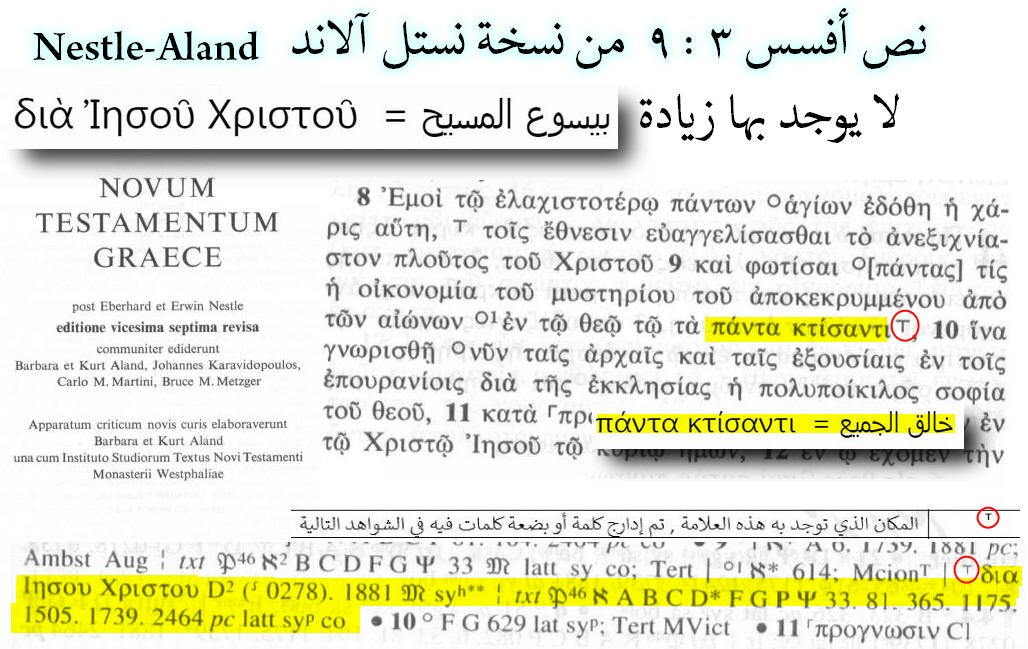
This scan is from the Nestle-Aland Greek New Testament. The Arabic heading says that the text of Ephesians 3:9 in Nestle-Aland hasno addition “by Jesus Christ.” The highlighted Greek text reads “πάντα κτίσαντι,” meaning “created all things.” The lower apparatus also shows manuscript evidence and variant information, indicating that “διὰ Ἰησοῦ Χριστοῦ” is not part of the main critical text. The point of the scan is that Nestle-Aland, one of the major critical Greek editions, prints the shorter reading and excludes the phrase used in the traditional text.
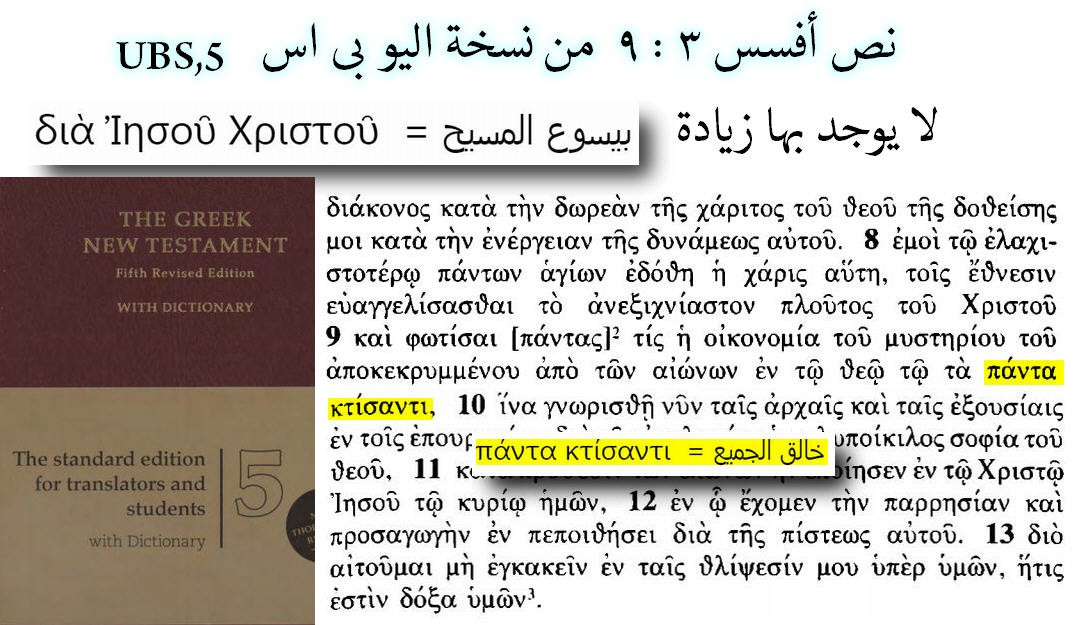
This scan is from another Greek critical edition and is used for the same textual point: Ephesians 3:9 is printed without the phrase “by Jesus Christ.” The relevant Greek wording ends with “who created all things,” while the later phrase “διὰ Ἰησοῦ Χριστοῦ” is not included in the main text. The scan supports the claim that the omission is not isolated to one editor, but is the reading followed by critical editions of the Greek New Testament.
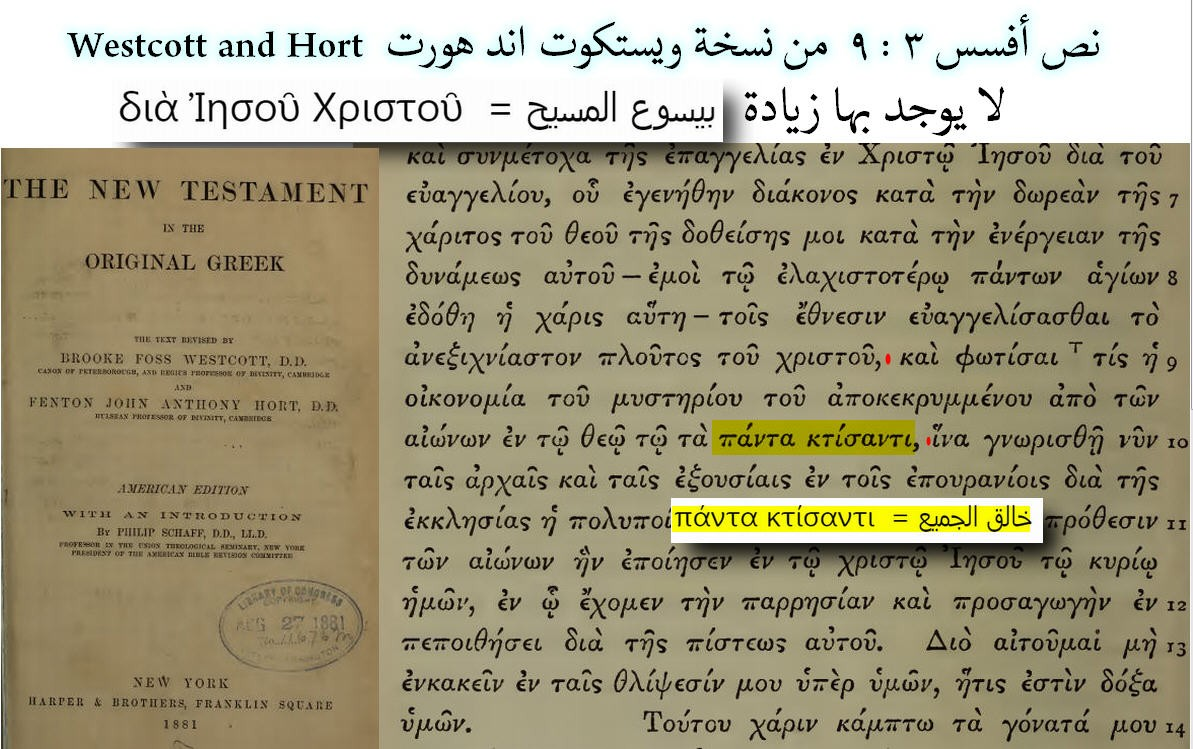
This scan is from Westcott and Hort’s Greek New Testament. The Arabic heading states that Ephesians 3:9 in Westcott and Hort doesnot contain the addition “by Jesus Christ.” The highlighted Greek phrase is “πάντα κτίσαντι,” meaning “created all things.” The scan shows that the printed Greek text proceeds without the phrase “διὰ Ἰησοῦ Χριστοῦ.” This supports the argument that the critical Greek tradition rejects the addition as secondary.
ΠΡΟΣ ΕΦΕΣΙΟΥΣ 3:9 Greek NT: Nestle 1904
καὶ φωτίσαι τίς ἡ οἰκονομία τοῦ μυστηρίου τοῦ ἀποκεκρυμμένου ἀπὸ τῶν αἰώνων ἐν τῷ Θεῷ τῷ τὰ πάντα κτίσαντι
3:9 Greek NT: Greek Orthodox Church
κτίσαντι 👉 διὰ Ἰησοῦ Χριστοῦ, 👈
English and Arabic Translations
ASV - NIV - RV - RSV - BBE - CEV - GNB - GW - ISV - NRSV
While the King James Version (KGV) and some versions based on the received text of Erasmus have mentioned the addition in the text.

This scan compares English Bible translations and textual notes for Ephesians 3:9. It shows that the KJV with Strong’s includes the phrase “by Jesus Christ,” while the New American Standard Bible gives the shorter reading: “God who created all things,” without the added phrase. It also citesA Textual Key to the New Testament by G. W. Anderson and D. E. Anderson, where Ephesians 3:9 is included among omitted or changed parts, specifically listing “by Jesus Christ” as the deleted phrase. The scan supports the claim that the phrase survives in traditional KJV-style texts but is removed in modern critical translations.
“And to make all men see what is the fellowship of the mystery which from the beginning of the world hath been hid in God who created all things👉 by Jesus Christ 👈”
“and to bring to light what is the administration of the mystery which for ages has been hidden in God who created all things;”
“A list of Omissions and Changes”
👉 3.9 ‘by Jesus Christ’ 👈
Catholic - Sarah - Joint - Jesuit - Pauline - Simplified - Sharif - Life
and most of the old translations deleted this addition “by Jesus Christ,” while the traditional Van Dyck version included it in the text.
“And to enlighten all concerning what is the fellowship of the mystery hidden from the ages in God, the Creator of all things, through Jesus Christ.”
“And to make known to all men the management of that mystery which has remained hidden throughout the ages in God, the Creator of all things.”
Philip Comfort on Why the Addition Was Made
This strange addition was placed by an unknown copyist in an attempt to prove the attribute of creation for Jesus; Here is what Philip Comfort said in his New Testament Text and Translation Commentary about the reason for adding this addition:
“Since the textual evidence strongly favors the shorter reading and since there is no good reason to explain why the phrase ‘through Jesus Christ’ would have been omitted if it was originally in the text, we must reason that the phrase was added to emphasize Christ’s role in creation, which accords with Pauline thought—see 1 Cor 8:6 and Col 1:16, which have some ideas that are similar to Eph 3:9-10.”
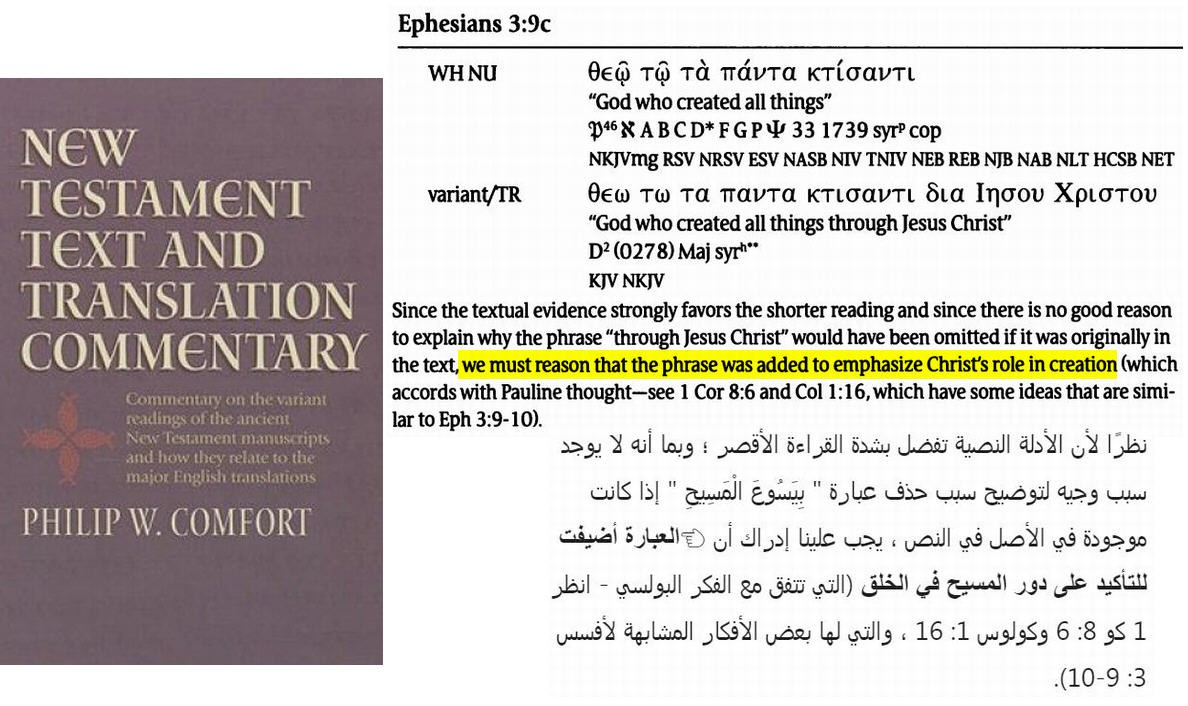
This scan is from Philip W. Comfort’sNew Testament Text and Translation Commentary. It lists Ephesians 3:9 and contrasts the shorter reading, “God who created all things,” with the variant/traditional reading, “God who created all things through Jesus Christ.” Comfort states that the textual evidence strongly favors the shorter reading. He also argues that there is no good reason to explain why “through Jesus Christ” would have been omitted if it were original, so the better explanation is that the phrase was added later to emphasize Christ’s role in creation. This directly supports the article’s argument that the phrase is a theological addition, not the original text.
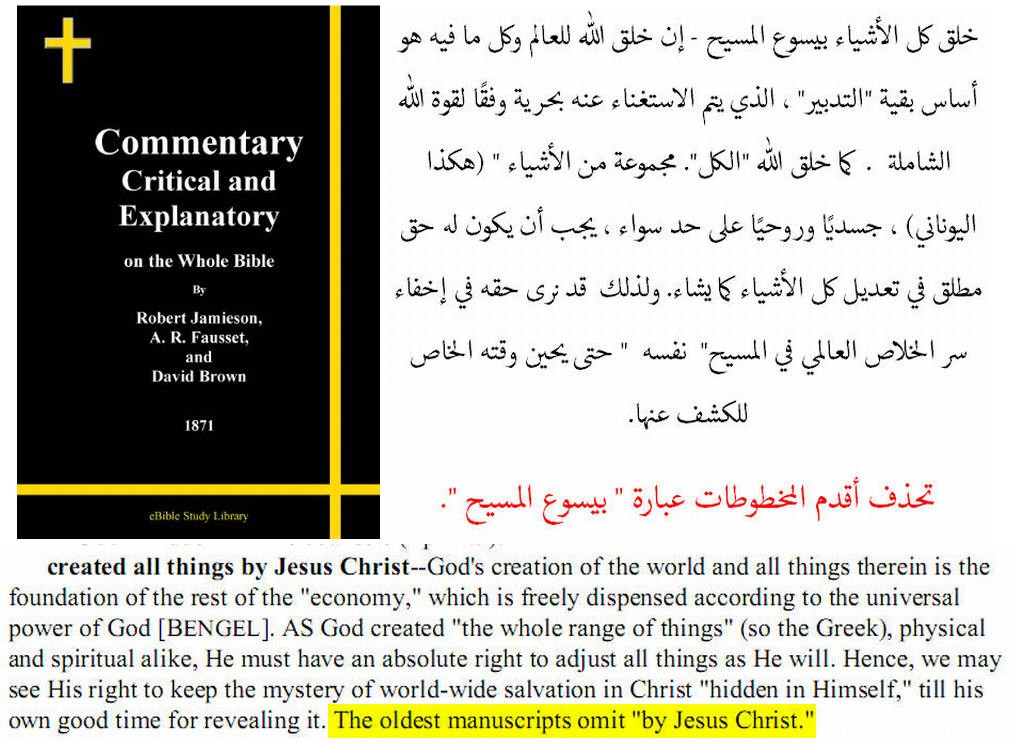
This scan is fromCommentary Critical and Explanatory on the Whole Bible by Robert Jamieson, A. R. Fausset, and David Brown. The commentary discusses the phrase “created all things by Jesus Christ” and then explicitly says: “The oldest manuscripts omit ‘by Jesus Christ.’” The Arabic text above the English quotation explains the same point: the phrase is absent from the oldest manuscripts. This scan is important because even a Christian commentary that discusses the received wording admits that the oldest manuscript evidence omits the phrase.
The Plural Speech Argument and the Trinity
Finally: Some use the words of the Lord in the Old Testament in the plural form as evidence of the existence of the Trinity since eternity; as stated, for example, in Genesis 1:26:
“And God said, ‘Let us make man in our image, after our likeness.’”
“And the Lord God said, ‘Behold, the man has become like one of us, knowing good and evil.’”
“In the Book of Genesis there are hints to the teaching of the Trinity, which are not clearly understood except in the light of the revelations that follow, such as the occurrence of the name of God in the plural form ‘Elohim’ and the use of a pronoun that indicates the plural such as our image and our God.”
He did not notice - due to his Christian background - that there is a method of glorification, which is for the pronoun of the addressee and the speaker, in which the pronoun is a plural pronoun that expresses or refers to a singular.
“One of the characteristics of the Hebrew language is that the plural form expresses vastness, greatness, and elevation, in addition to true multiplicity…; and it is not reasonable to assume that the plural form refers to the multiplicity of gods.”
And if we assume that the plural form “our image, from us, our likeness… etc.” actually indicates the plural, how do they know that the plural refers to only three?!
Why doesn’t it mean four or five or even a million?!
Why Did Jesus Not Say This Himself?
And why do his explicit statements contradict this strange belief; he was calling, praying, crying and humbling himself to God; and he was preaching eternal life to those who believed in God alone and in Christ his messenger.
“And this is eternal life, that they may know you, the only true God, and Jesus Christ, whom you have sent.”
Why did Jesus hide his divinity, and leave this impossible task to his followers; which prompted them to try to correct the divine revelation… in defense of an alleged pagan divinity?
Conclusion
It is absent from the Sinaiticus Codex, the Vaticanus Codex, the Alexandrian Codex, and the Peshitta tradition.
It is omitted from the major Greek critical editions, including Nestle-Aland, Westcott-Hort, UBS, Tregelles, and Tischendorf.
It was deleted from most modern English and Arabic translations, while remaining in the KJV and versions based on the later received text.
The textual evidence and the admissions of Christian textual commentators show that this phrase was a later theological addition inserted to emphasize Christ’s role in creation.