John 7:4: A 12th-Century Scribe Added a Proverb to the New Testament Text
John 7:4: A 12th-Century Scribe Added a Proverb to the New Testament Text
A scribe of a 12th-century New Testament manuscript added a proverb to the text because it fit the theme of the passage.
Table of Contents
- The Problem
- The Comparison With the Qur’an
- John 7:4
- The Manuscript Addition
- Scan Evidence
- Conclusion
The Problem
A scribe of a 12th-century New Testament manuscript added a proverb to the text because it fit the theme of the text.
A 12th-century copyist of a New Testament manuscript added a proverb to the text because it fit the theme of the text.
The Comparison With the Qur’an
“Patience is the key to relief”!!
This is exactly what happened when a 12th-century copyist of a New Testament manuscript added a proverb to the text because it fit the theme of the text.
John 7:4
“For no one does anything in secret and wants to be known publicly. If you do these things, show yourself to the world.”
παρρησίᾳ εἶναι. Εἰ ταῦτα ποιεῖς, φανέρωσον σεαυτὸν τῷ κόσμῳ.
The Manuscript Addition
A 12th-century manuscript, numbered 1186, adds at the end of the text a phrase that says:
Because no one can hide what he asks to be done.
Because no one can hide what he asks to be done.
Because no one can hide what he asks to be done.
Because no one can hide what he asks to be done.
This is how things go.
Even though 1200 years had passed, there was still someone who could insert a wisdom/proverb he liked into the text!!
Scan Evidence
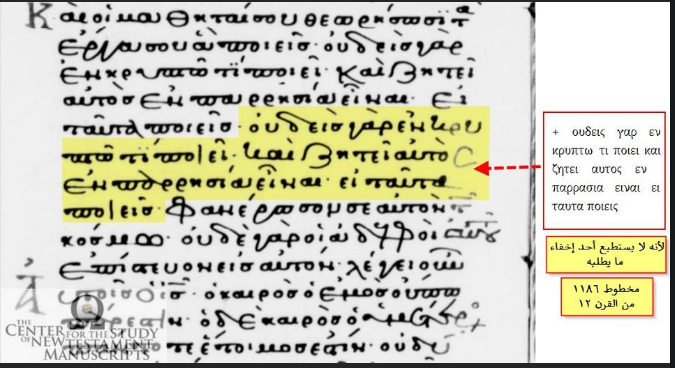
For your info:
The scan shows a Greek New Testament manuscript page with the relevant line highlighted. A red arrow points to the enlarged transcription on the right side. The Arabic note identifies it as manuscript 1186 from the 12th century. The highlighted addition is presented as a scribal insertion connected to the theme of John 7:4. The Arabic explanation under the Greek transcription renders the added idea as: “Because no one can hide what he asks to be done.” This is being used as evidence that a later New Testament copyist could add a fitting proverb or explanatory wisdom into the manuscript text.
Conclusion
A 12th-century New Testament manuscript shows a scribal addition in John 7:4, where a proverb-like phrase was inserted because it suited the theme of the verse.
If a Qur’an copyist 1400 years later inserted a proverb such as “Patience is the key to relief”, critics would call it textual corruption immediately.
Yet here, in a New Testament manuscript, a later copyist could insert a wisdom/proverb into the text because it fit the context.