

Epic of Gilgamesh vs Genesis: Did the Bible Copy the Flood Story?
In the name of God, the Most Gracious, the Most Merciful.
The Epic of Gilgamesh is considered one of the oldest stories in history. This epic speaks about a person named Gilgamesh, connected to the ancient city of Uruk. We will discuss, God willing, the history of this epic in detail: when it took place, when it was written, and what the date of its oldest manuscripts is.
The important matter is that we found something strange in this epic: it contains a story almost identical to the story of the Flood mentioned in the Book of Genesis, and also mentioned in the Holy Qur’an.
Someone might say this is normal. It is possible that the writers of the epic quoted from the Book of Genesis. Yes, that is what we said at the beginning of the research. But during the search, we were shocked by many surprises that blow up this book called “holy.”
The Basic Question
There are many things to study here.
Is Gilgamesh the one who was transferred from the Book of Genesis? Or is the Book of Genesis the one that quoted from Gilgamesh?
Before entering the story, we need to answer several questions:
- What is the age of humanity according to the Bible?
- When exactly did the Flood happen according to the Bible?
- When was the Book of Genesis written?
- What are the oldest manuscripts of this book?
- When did the story of Gilgamesh take place?
- When was it written?
- Are the similarities we will present merely Muslim claims, or do Christian references say anything about the subject?
Or do Christian references have anything to say about this subject?
The truth is that Christian references do have something to say about this subject. At first, the research was only meant to document the claim, nothing more. But we noticed a type of blackout regarding the dating of the story of Gilgamesh. Almost nobody discusses this subject clearly.
The Biblical Flood Problem
The story of the Flood in the Book of Genesis contains many loopholes. The most important is that the Flood is presented as covering the entire earth.
And the waters prevailed exceedingly upon the earth.
All the high mountains under the entire sky were covered.”
It also says that not a single living soul remained on the face of the earth. This is not true, because there are animals that do not exist in the Middle East region.
Everything in whose nostrils was the breath of life, of all that was on the dry land, died.
So God wiped out every living thing that was on the face of the earth, people, animals, creeping things, and birds of the sky. They were wiped out from the earth.
Only Noah and those with him in the ark remained.”
I will never again kill every living thing as I did.”
Noah’s Flood: Was It Global or Local? The Quran vs the Torah
What Did the Church Fathers Do?
What did the Church Fathers do to get out of this predicament?
They said that the inclusion of the story in the Epic of Gilgamesh is evidence of the story’s authenticity. In other words, they argued that the story being mentioned in Gilgamesh proves that the Flood really happened.
The evidence, according to them, is that the Epic of Gilgamesh quoted the story.
Church interpreter Tadros Yacoub Malati says:
For your info: This scan is being used to show that a Christian source discusses the relationship between the Flood narrative and ancient Near Eastern material, including Gilgamesh. The argument being built here is that Christian authors themselves acknowledge the existence of flood parallels outside the Bible, but usually frame those parallels as external confirmation of Genesis rather than as evidence of borrowing.
The continuation of the same reference follows:
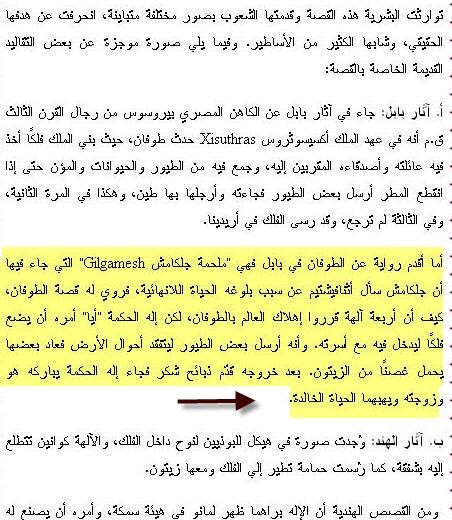
For your info: This continuation is presented as part of the same Christian discussion. The point is not merely that Gilgamesh contains a flood story, but that Christian writers knew of the similarity and attempted to use it apologetically. The author of this article argues that this becomes dangerous for the Bible once chronology and manuscript dating are considered.
Father Samuel Youssef says in his book Introduction to the Old Testament:

For your info: This scan is cited to establish that Christian academic or ecclesiastical references acknowledge ancient flood traditions outside Genesis. The author is using it to prevent the objection that Muslims invented the comparison between Genesis and Gilgamesh.
The continuation of Father Samuel Youssef’s discussion follows:
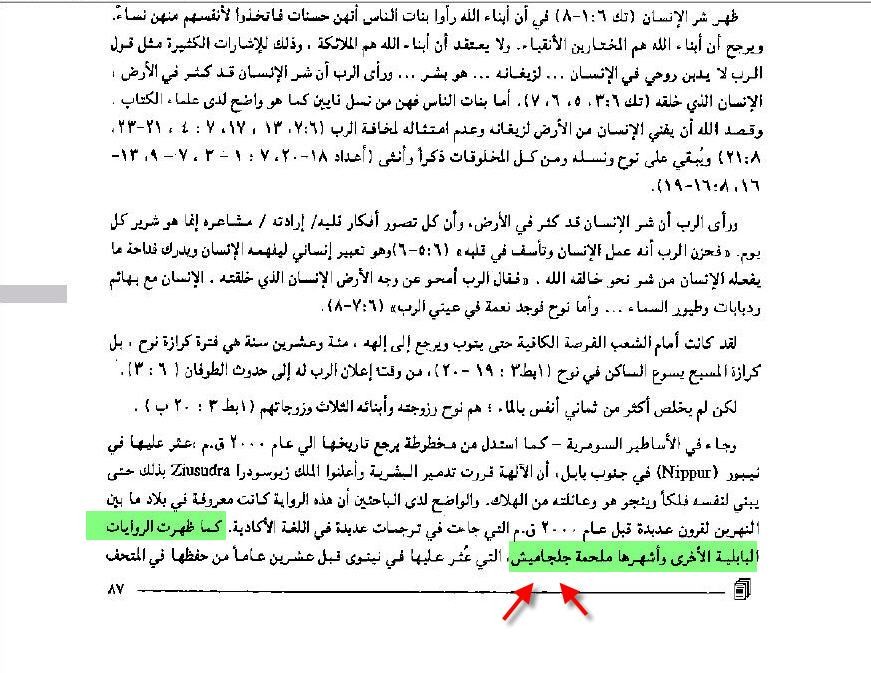
For your info: This page continues the discussion from Samuel Youssef. In the article’s argument, this scan functions as internal Christian documentation that the flood parallels were known and discussed by Christian writers, even if they did not openly follow the consequences of the dating issue.
Another page from the same reference is cited:
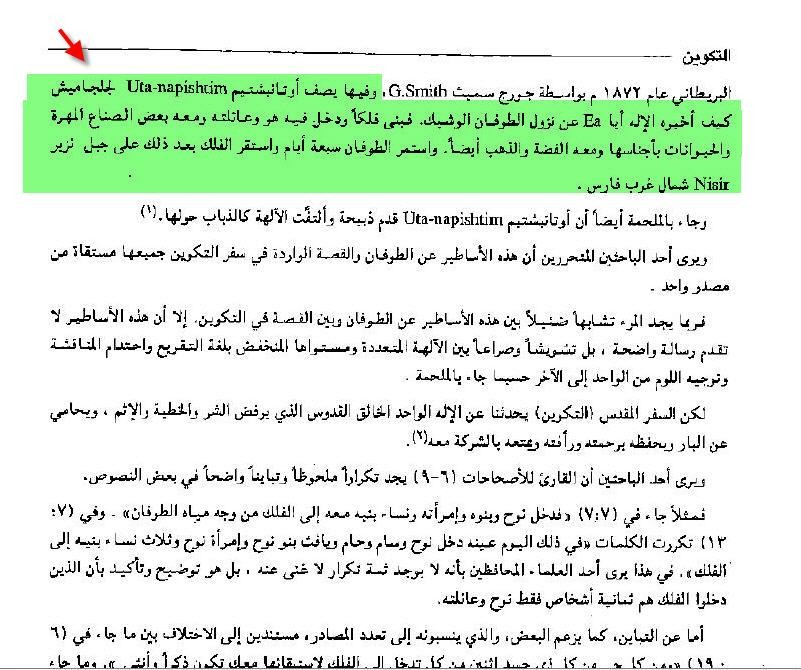
For your info: This additional page is included to strengthen the documentation from Christian sources. It supports the article’s claim that the issue is not a Muslim invention, but something acknowledged in Christian literature.
And in the Encyclopedia of the Bible:
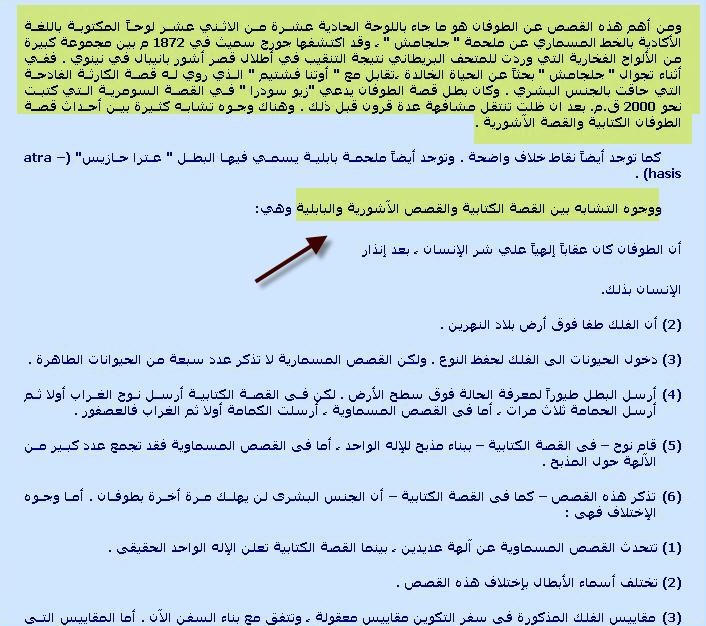
For your info: This scan is used to show that the Encyclopedia of the Bible acknowledges similarities between the biblical flood story and the Assyrian or Mesopotamian flood story. This is important because the article’s argument depends on showing that the parallels are admitted by Christian references, not merely alleged by Muslim critics.
But we notice that the Church Fathers pass over the event lightly. Some of them say that the story mentioned in Gilgamesh is taken from the Old Testament. Others pretend not to notice. Most importantly, almost nobody speaks clearly about dates.
The Three Versions of the Torah
When we search for the origins of the Torah, we find that there are three versions of the Torah. In the name of God, what God wills, the number is in the lemon, and our Lord increases and blesses.
We have the Samaritan Torah. A group of Jews believe in it, and it contains the five books of Moses: Genesis, Deuteronomy, Numbers, Leviticus, and Exodus.
We also have the Hebrew Torah. The rest of the Jews and Protestants believe in it, and it contains thirty-nine books.
We also have the Greek Torah. It is a Greek translation of the original Hebrew and contains forty-six books. The Orthodox and Catholics believe in it.
There are thousands of differences between the versions of the Torah. For example, there are about 6,000 differences between the Samaritan and Hebrew Torahs.
Source: St-Takla Arabic Bible Dictionary.
When we look at the genealogy in the three versions, we find the amazing wonder. The Catholic Encyclopedia presents the genealogy in the three versions from the beginning of creation to the Flood.
- Hebrew: 1656
- Samaritan: 1307
- Septuagint: 2242
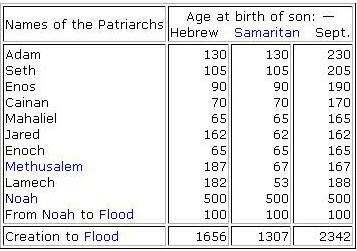
For your info: This scan is central to the chronology argument. It shows that the number of years from creation to the Flood differs between the Hebrew, Samaritan, and Septuagint traditions. The article uses this to argue that biblical chronology is unstable and textually conflicted, which weakens any attempt to defend the Genesis flood chronology as exact divine history.
The same genealogy is also presented in The Student’s Guide to the Precious Bible, pages 569–570.
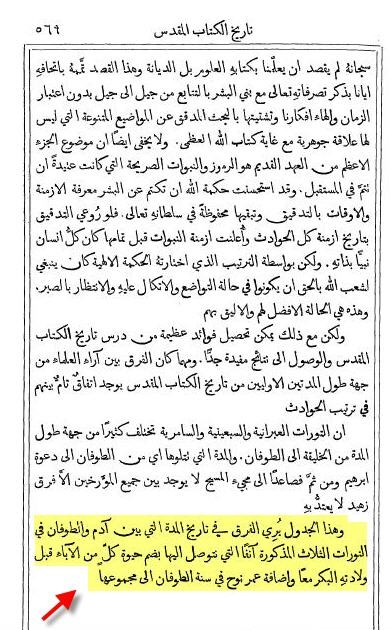
For your info: This page is cited to document the same genealogical problem from another Christian reference. The argument is that this is not an isolated observation from one source, but a repeated admission across Christian materials.
The continuation from page 570 follows:
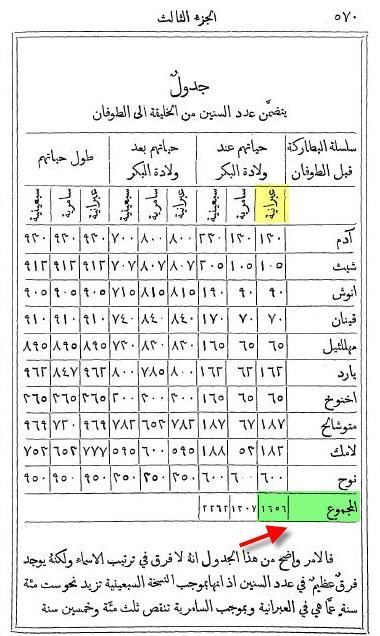
For your info: This continuation completes the cited table or discussion. The article uses it to reinforce the point that the chronological numbers in the biblical textual traditions are not uniform.
Everyone sees the painful reality.
When did the Flood happen?
According to the Samaritan Torah, it happened 1307 years after the beginning of creation.
According to the Greek Torah, it happened 2262 years after the beginning of creation.
According to the Hebrew Torah, it happened 1656 years after the beginning of creation.
The question is: why this difference?
The same previous reference answers us on pages 571–572.
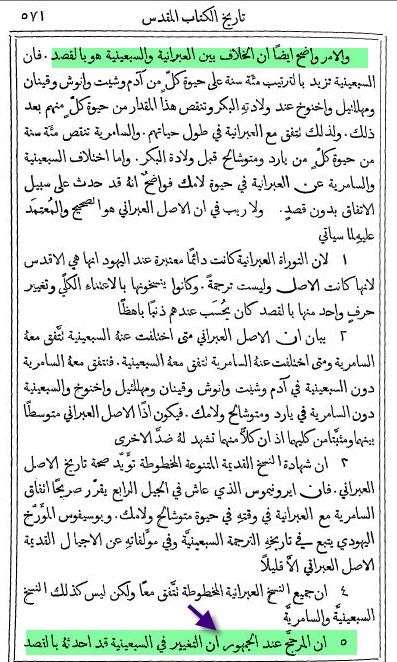
For your info: This page is used to support the article’s claim that the differences in chronology are not accidental. The author frames these differences as evidence of textual corruption and manipulation in the biblical tradition.
The continuation from page 572 follows:
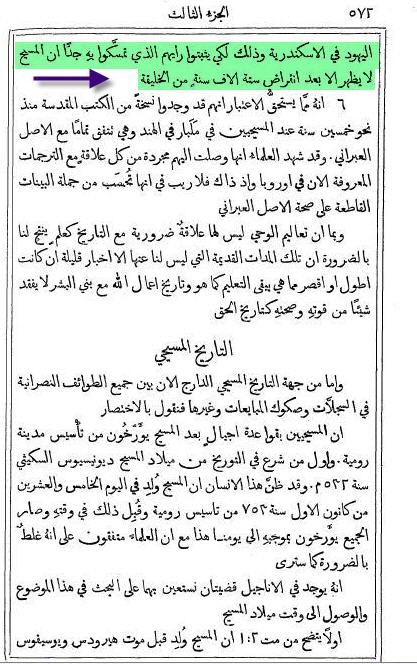
For your info: This continuation is used to complete the argument about why the chronological differences exist. The author uses the reference polemically to argue that Jewish textual alteration occurred and that the biblical chronological tradition cannot be treated as reliable.
Who distorted the Holy Book, O Muslims?
The Jews.
When did the distortion occur, O Muslims?
The third century BC, the time of the Septuagint translation.
Where did the distortion occur, O Muslims?
In Alexandria.
Why did the distortion occur, O Muslims?
So that the Jews may prove their opinion that Christ will appear after 6000 years.
We will not discuss the difference between the versions further, because this is not our topic. Instead, we return and adopt the Church’s opinion that the Hebrew original is in effect.
The Student’s Guide says on page 571:
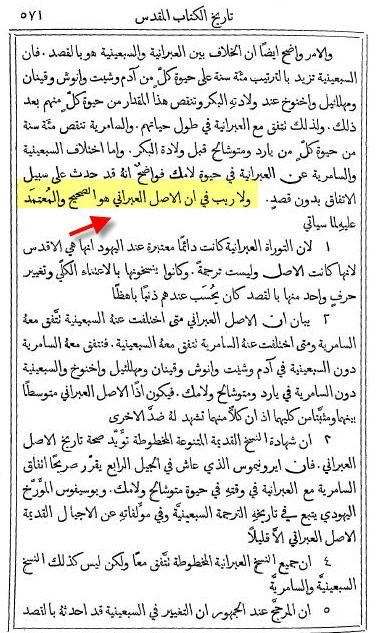
For your info: This scan is used to justify focusing the rest of the article on the Hebrew text. Since the Christian side often treats the Hebrew Masoretic tradition as the operative Old Testament base, the author chooses to argue from that text and its chronology.
Father Abdul-Masih Basit also says that the Hebrew original is in effect.
So the research will revolve around the Hebrew text of the Old Testament.
The Flood According to the Hebrew Text
According to the Hebrew text, we can state the following facts:
- The age of humanity before Christ was about 4004 years.
- The Flood happened in 1656 since the beginning of creation, meaning 2348 BCE.
Church interpreter Antonius Fikry provides a table explaining the genealogy from Adam to Noah according to the Hebrew original.
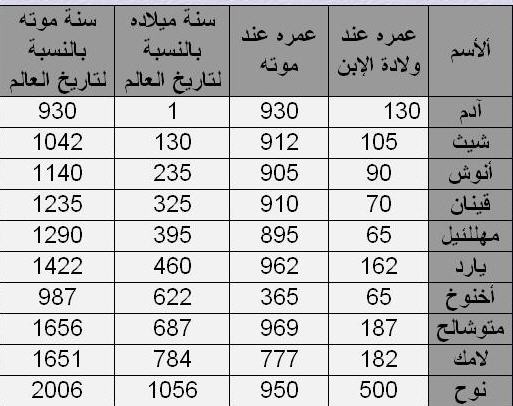
For your info: This scan is cited to show that a Christian interpreter calculates the genealogy from Adam to Noah according to the Hebrew text. The article uses it to establish the biblical chronological claim that the Flood occurred 1656 years after creation.
Even if we knew that the Flood happened when Noah was 600 years old:
“And when Noah was six hundred years old, the flood of waters came upon the earth.”
The results reached by Antonius Fikry are the same as those mentioned in The Student’s Guide. That is, the Flood occurred 1656 years after the beginning of creation.
Dr. Maurice Bucaille also decides this in his book The Torah, the Bible, the Quran and Science, page 57.
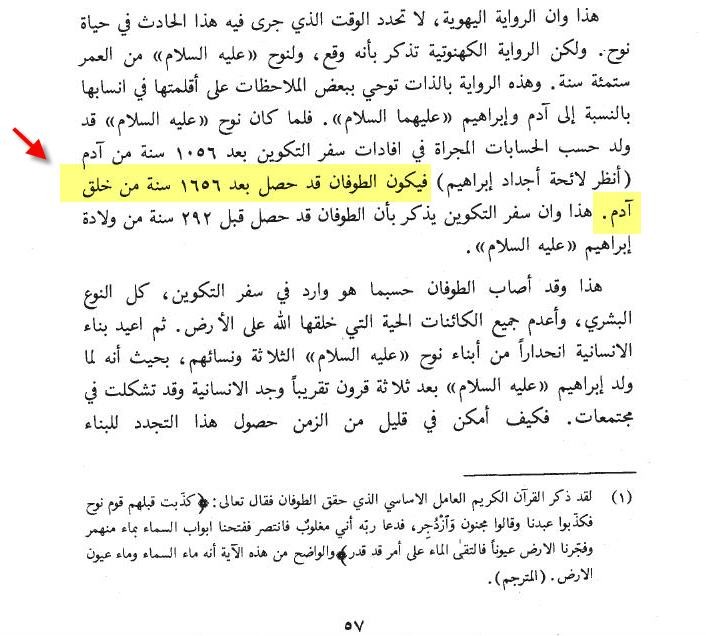
For your info: This page is used to show that the calculation of the Flood date from biblical genealogies is not merely a local Christian interpretation. The article uses Bucaille’s discussion to support the claim that biblical chronology places the Flood around the third millennium BC.
A Jewish website also shows almost the same result.
Now we document these results from The Student’s Guide, pages 576 and 579.
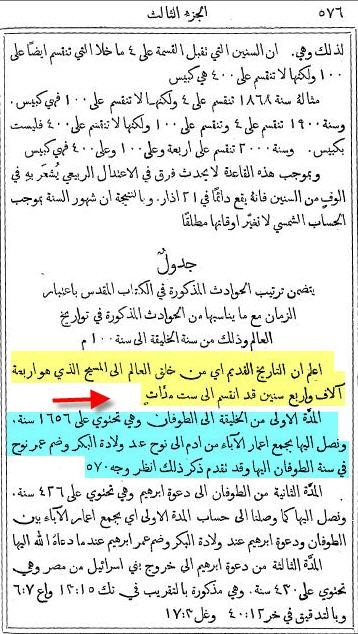
For your info: This page is cited as further documentation of the biblical chronological scheme. The author uses it to show that Christian reference works place biblical events within a narrow ancient timeline.
The continuation from page 579 follows:
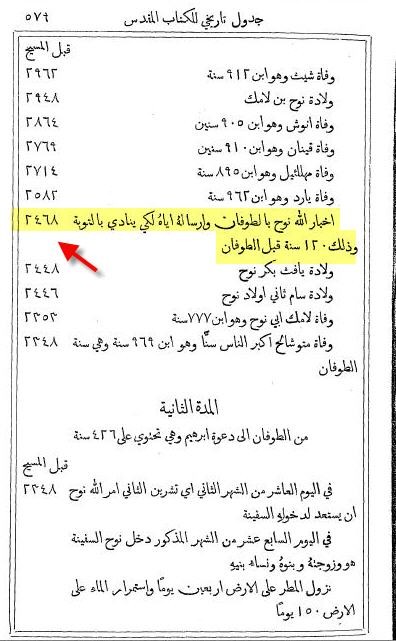
For your info: This page supports the broader chronological framework in which Adam to Jesus is treated as approximately 4000 years. The article later uses that figure to argue that the Bible’s chronology conflicts with ancient civilizations and archaeological data.
This table shows that the difference between Adam and Jesus is about 4000 years.
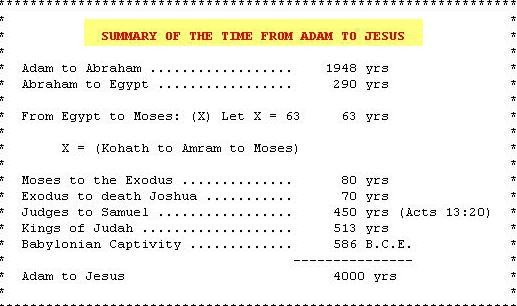
For your info: This scan is used to support the claim that the biblical timeline restricts the age of humanity to around 6000–7000 years. The author later contrasts this with fossils and ancient civilizations.
Another site presents a similar breakdown:
Jesus to Abraham: 2,000 years, 55 generations.
Abraham to Adam: 2,000 years, 20 generations.
From Adam to Abraham: about 2000 years.
From Abraham to Jesus: about 2000 years.
Therefore, the period between Adam and Jesus is about 4000 years.
This result is also confirmed and mentioned in foreign references.
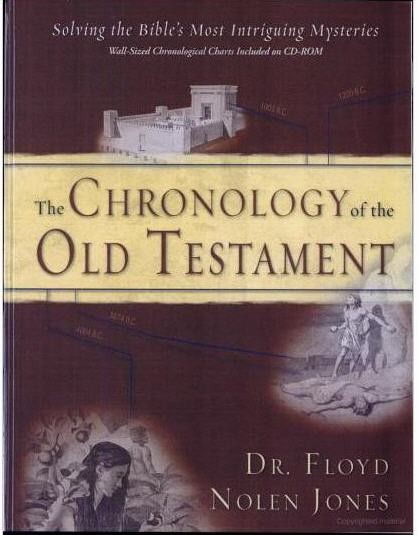
Floyd Nolen Jones says in The Chronology of the Old Testament, page 27:
For your info: This scan is cited to show that some Christian chronological systems date Adam’s creation to around 4004 BC. This supports the article’s argument that the Bible creates a compressed timeline for human history.
The continuation from Floyd Nolen Jones follows:
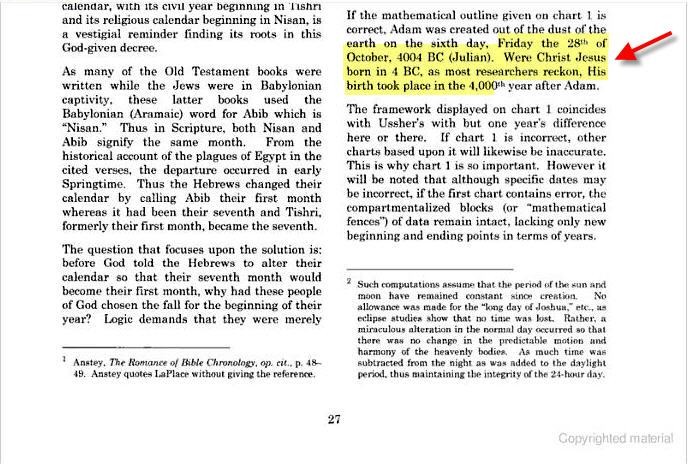
For your info: This continuation reinforces the same chronological claim. The article uses it to argue that, under this biblical chronology, the Flood is placed too late relative to ancient Near Eastern and Egyptian history.
The speech is clear: Adam came to earth 4004 years before the birth of Christ, and Christ was born around 4 BC. There are about 4000 years between them.
When Was Genesis Written?
Everyone knows that the story of the Flood is mentioned in the Book of Genesis. We will not discuss the author of the book here. It does not make much difference to us. The important issue is: when was this book written?
There is much discussion about when Genesis was written, and there is fierce disagreement among scholars. But we will choose the oldest date found.
The Encyclopedia of the Bible says it was written around 1440 BC.
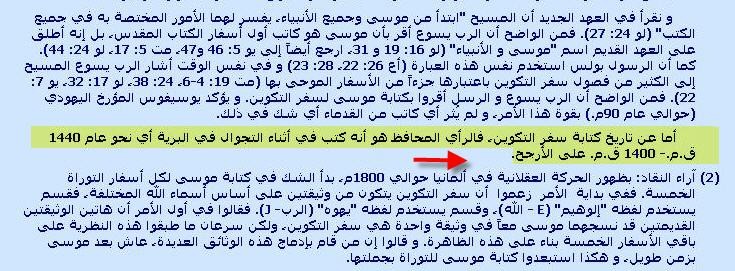
For your info: This scan is used to give the earliest possible conservative date for Genesis. The article deliberately chooses the earliest date in order to argue from the strongest possible Christian position. Even then, Gilgamesh is argued to be older.
There is consensus among the authorities that the Book of Genesis covers the history of mankind from the beginning of creation to the death of Joseph: 2369 years since the beginning of creation, or 1645 BC.
2369 + 1645 = 4004, which is the same result as before.
William Smith’s Dictionary of the Bible says:
For your info: This scan is cited to show that older Bible dictionaries also framed Genesis as covering a specific number of years from creation. The author uses this as part of the internal biblical chronology case.
The continuation from the same reference follows:
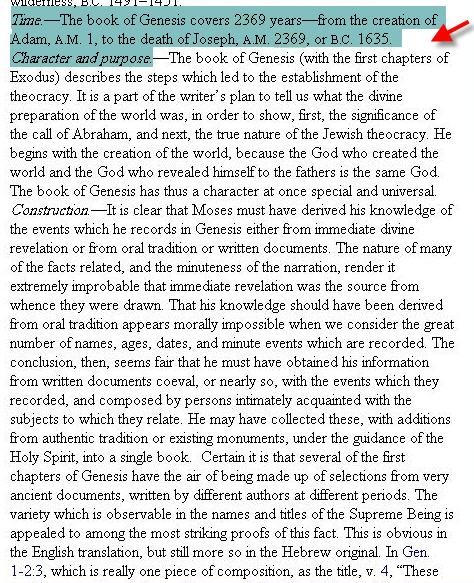
For your info: This continuation supports the claim that Genesis covers a chronological span ending with Joseph. The author uses this to tie the Genesis narrative to the 4004 BC creation framework.
Genesis covers 2,369 years from the beginning of creation.
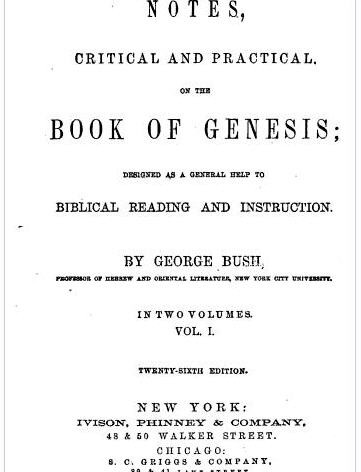
For your info: This scan is used to establish the specific chronological span assigned to Genesis. It supports the calculation that Genesis covers from creation to the death of Joseph.
The next scan continues the same documentation:
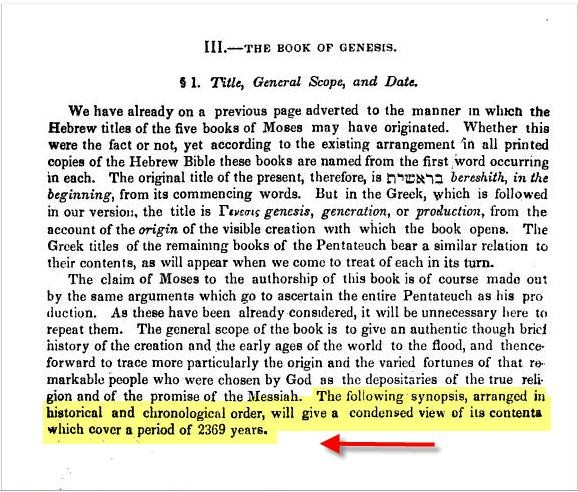
For your info: This continuation keeps the same point in view: Genesis is being treated as a chronological history from creation onward. The author uses this to create a direct comparison with the dates assigned to Gilgamesh.
Another reference says the same:
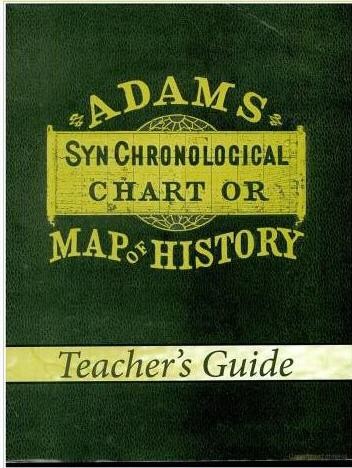
For your info: This scan is included as another supporting reference for the biblical chronology claim. The author is stacking Christian and biblical references to avoid relying on one isolated source.
The continuation follows:
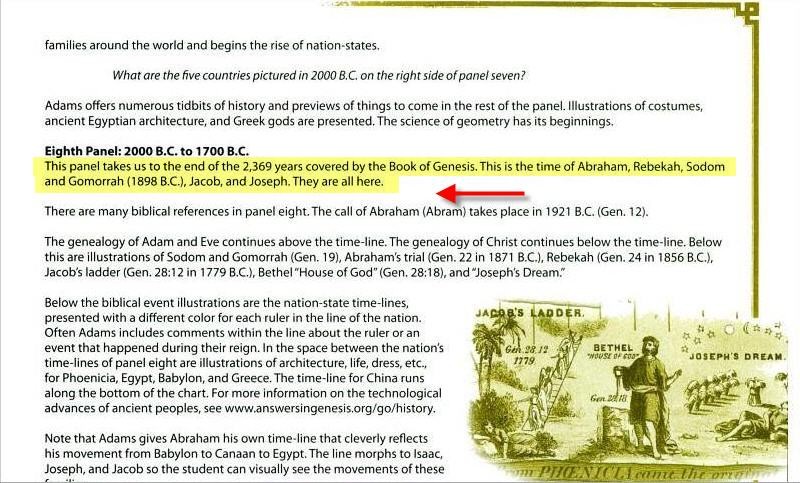
For your info: This continuation further supports the stated chronology. The article’s method here is cumulative documentation.
Another reference explains the date of the Flood and the number of years covered in the Book of Genesis.
For your info: This scan is used to connect the Flood date with the broader Genesis chronology. The author’s argument depends on the Bible’s own numbers forcing a late Flood date.
The continuation follows:
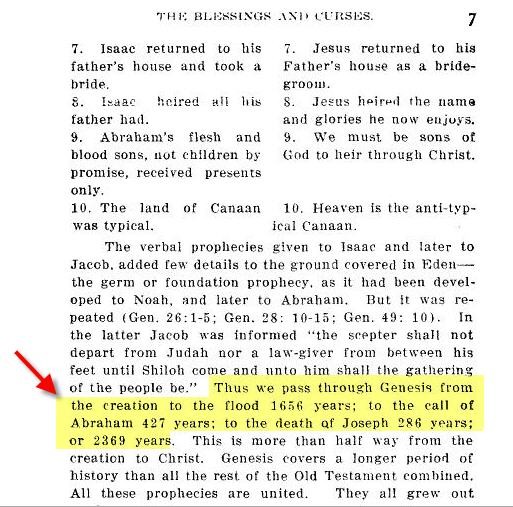
For your info: This continuation is used to complete the chronological documentation. It strengthens the article’s claim that the late biblical Flood date is not an invention of Muslim critics but follows from Christian reference material.
William Whiston summarizes the previous posts in The Complete Works of Flavius Josephus, page 595.
For your info: This scan is used as a summary table for the biblical chronology. The author presents it as a concise external confirmation of the timeline already developed.
The continuation follows:
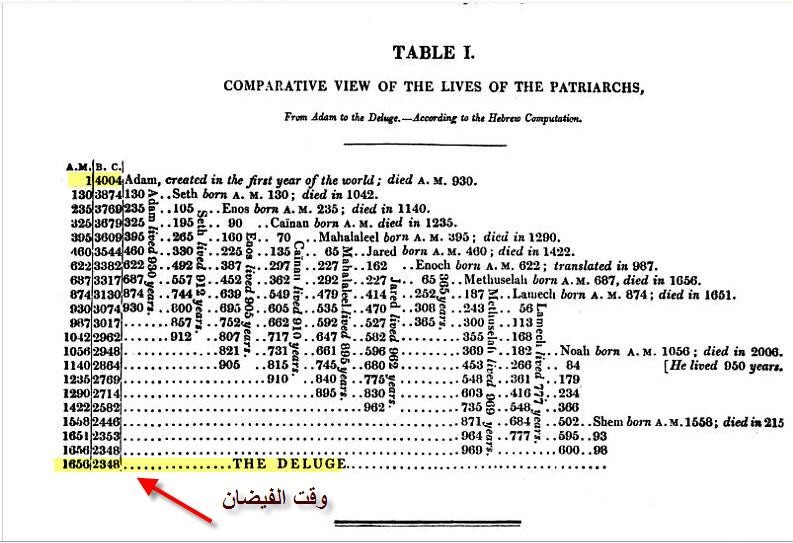
For your info: This continuation completes Whiston’s chronological material. The article uses it to reinforce the date framework before moving to the manuscript evidence.
Hebrew Manuscripts Today
Let us take a quick look at the Hebrew manuscripts that exist today.
Talking about Hebrew manuscripts takes a long time, but we must know that the original script of the Torah is completely different from the Hebrew script we see now, because the Hebrew script developed over the years. All the original manuscripts of the ancient Hebrew text went with the wind.
Happy New Year — just like the New Testament manuscripts.
Introduction to the Bible by Habib Saeed, page 29:

For your info: This scan is cited to show that Hebrew writing and textual transmission developed over time. The author uses it to argue that the original Hebrew manuscripts are no longer available.
The continuation follows:
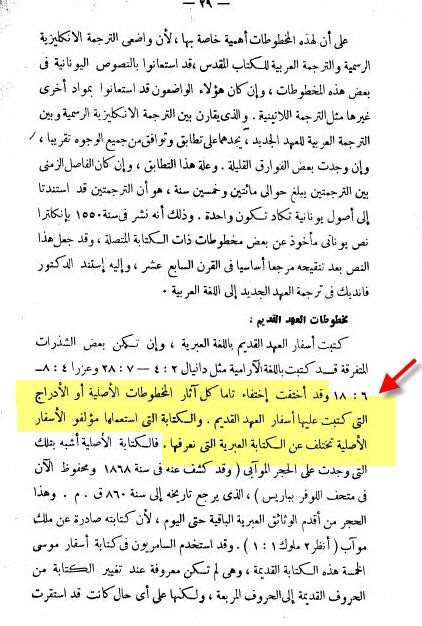
For your info: This continuation supports the same manuscript-transmission point. The article uses it to undermine confidence in claims about the exact original Genesis text.
Father Samuel Youssef tells us about the development of Hebrew script over time.
Introduction to the Old Testament, Samuel Youssef, page 43:
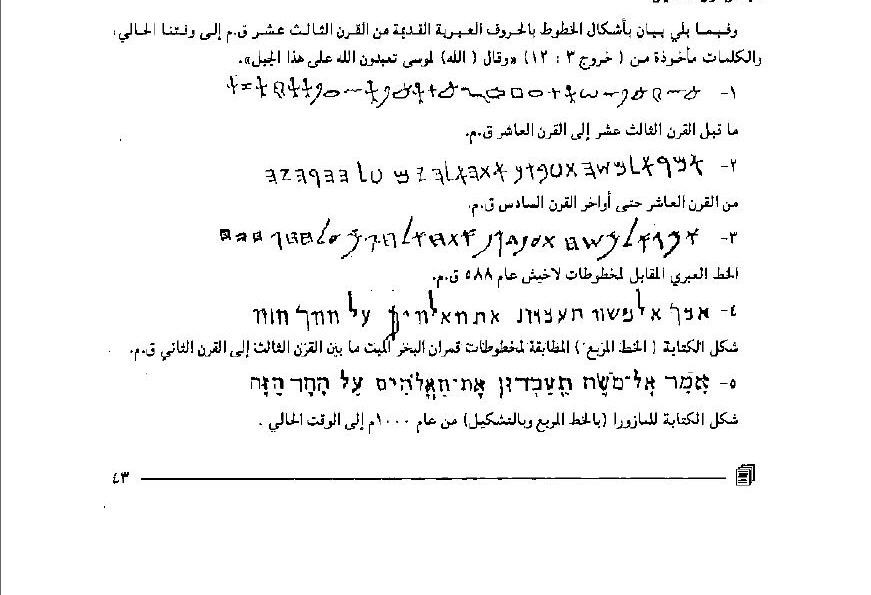
For your info: This scan is used to show from a Christian source that the Hebrew script underwent historical development. The author’s purpose is to question simplistic claims that today’s Hebrew text is directly traceable in unchanged form to Moses.
The Hebrew script was shaped during the period from the seventh to the eighth century AD. I repeat: AD, not BC.
Introduction to the Bible, page 31:
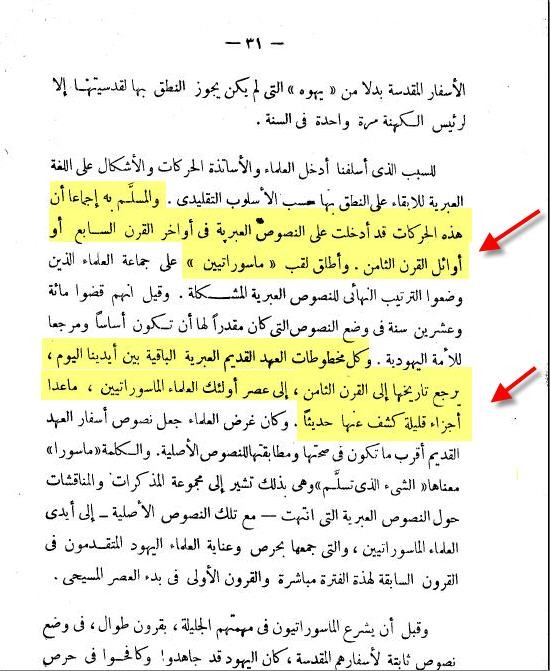
For your info: This scan is cited to highlight the late shaping of the Hebrew script and its vocalization tradition. The author uses this to stress the gap between the alleged ancient origin of Genesis and the much later manuscript tradition.
Everyone should know that all existing Hebrew manuscripts go back to the Masoretic text, the text with diacritics. There is no Hebrew manuscript on the face of the earth before this date, except for the recently discovered Qumran manuscripts and some other papyri that will not be useful here because they contain very little.
Under the title “The Hebrew Manuscripts That Exist Now,” Father Emil Maher says in his book Bible Manuscripts in Their Original Languages that their number is approximately 2000 to 2500 manuscripts, most of them dating back to 1000 AD.
There is no power or strength except with Allah.

For your info: This scan is used to document the number and late dating of existing Hebrew manuscripts. The article uses this to argue that the surviving manuscript base for the Old Testament is very late compared to the claimed date of Genesis.
The continuation follows:
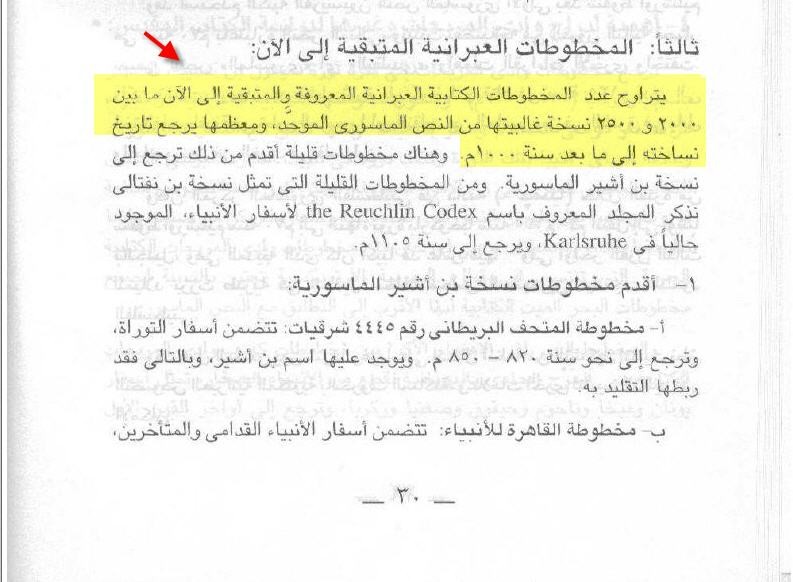
For your info: This continuation supports the claim that most Hebrew manuscripts are late. The article uses this point to create contrast with the surviving Gilgamesh tablets.
What concerns us now is the oldest manuscript of the Book of Genesis. The oldest complete manuscript of the Book of Genesis dates back to the ninth or tenth century.
Introduction to the Bible, page 34:
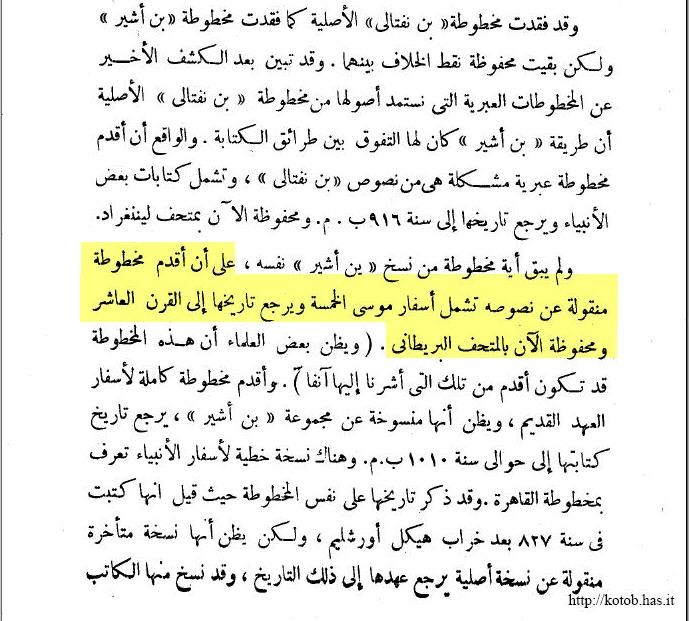
For your info: This scan is crucial for the manuscript comparison. The author uses it to argue that the oldest complete Genesis manuscript is extremely late compared to the oldest complete surviving Gilgamesh material.
Unfortunately, Habib Saeed tells us in Introduction to the Holy Book, page 44, that there is a period of up to 2000 years between the first written book, Genesis, and the first Hebrew manuscript in our hands.
No comment, gentlemen.
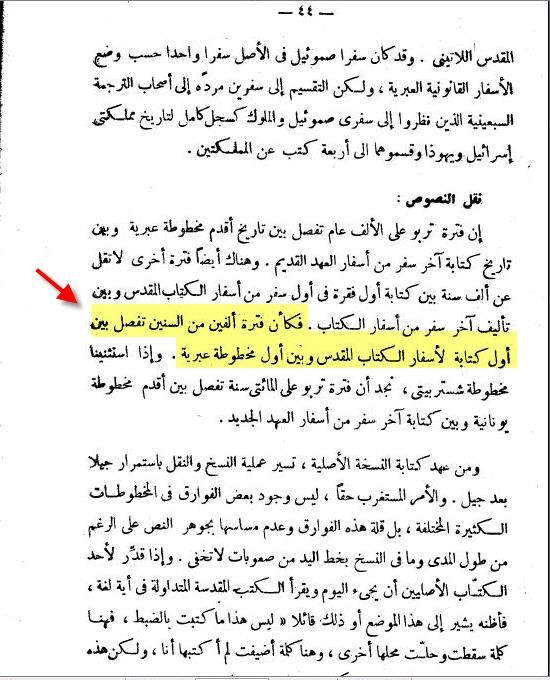
For your info: This scan is used to highlight the alleged 2000-year gap between the writing of Genesis and the first Hebrew manuscript available. The article uses this to attack the reliability of the biblical manuscript tradition.
Summary from Christian References
- The Flood, according to the Hebrew text, occurred in the year 1656 from the beginning of creation, or in the year 2348 BC.
- The Flood incident was recorded in the first book of the Bible, Genesis, around 1440 BC.
- The oldest complete manuscript of the Book of Genesis dates back to approximately the tenth century AD.
Therefore:
- The event according to the Bible: 2348 BC.
- The event was recorded according to the Bible: approximately 1440 BC.
- The oldest complete manuscript that reached us: around the tenth century AD.
The question that now arises is: when did the Epic of Gilgamesh take place? And when was it written?
The Date of Gilgamesh
The bitter truth is that the Epic of Gilgamesh took place around 2500–2700 BC.
Yes, this is the bitter truth.
It was written around 2000 BC, and parts of it still exist to this day.
We learned this from foreign references, because there is a blackout on the history of this incident in Arab references. They know the painful reality.
For your info: This scan is used to establish that Gilgamesh is dated before the biblical Flood according to the Bible’s own chronology. That is the article’s core polemical move: the Bible’s late Flood date creates a chronological contradiction.
Another source is cited:
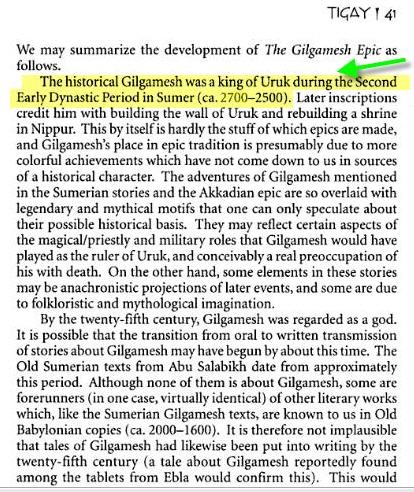
For your info: This scan supports the claim that Gilgamesh belongs to the third millennium BC and that written traditions about him emerged around 2000 BC. The article uses this to argue that Gilgamesh predates Genesis by centuries.
Further documentation follows:
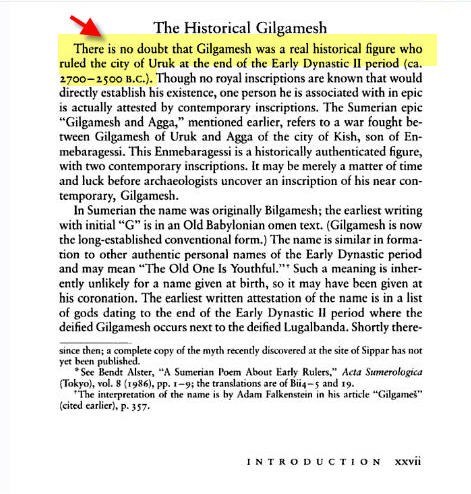
For your info: This scan is used as additional evidence for the antiquity of the Gilgamesh tradition. It supports the argument that the epic’s written form predates the conservative dating of Genesis.
The continuation follows:
For your info: This continuation strengthens the same dating argument. The article’s point is that the Gilgamesh material is not late or dependent on medieval biblical manuscripts.
More supporting scans are cited:
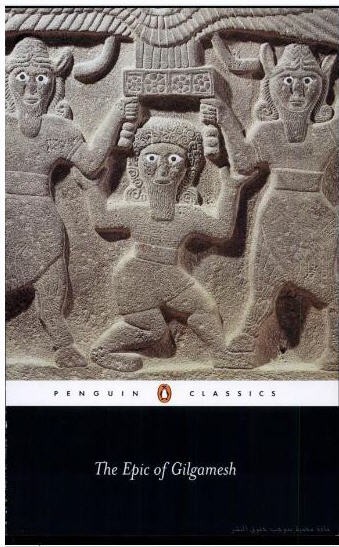
For your info: This scan continues the accumulation of outside references for the date of Gilgamesh. The author is building a cumulative chronological case, not relying on one source.
The next scan follows:
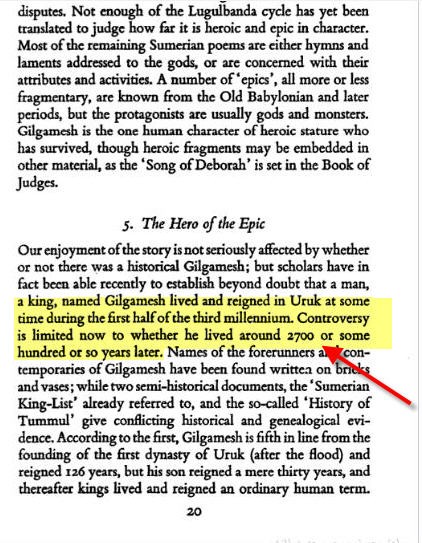
For your info: This continuation is used to support the claim that Gilgamesh was known and written long before the latest stages of Genesis composition.
Additional reference material:

For your info: This scan supports the historical placement of Gilgamesh. It contributes to the article’s comparison between Mesopotamian epic tradition and Genesis.
The continuation follows:
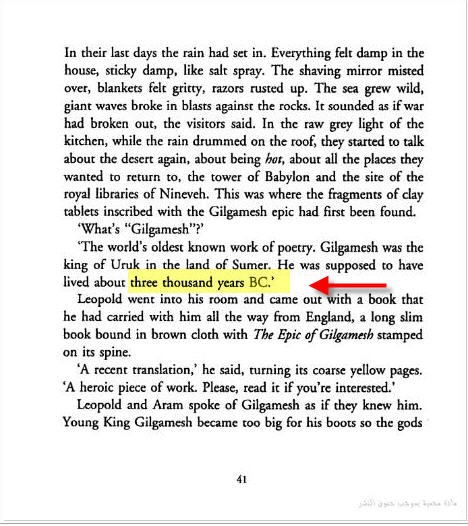
For your info: This continuation keeps the same evidentiary chain. The author’s target is the claim that Genesis must be the original source of the flood story.
More source material follows:
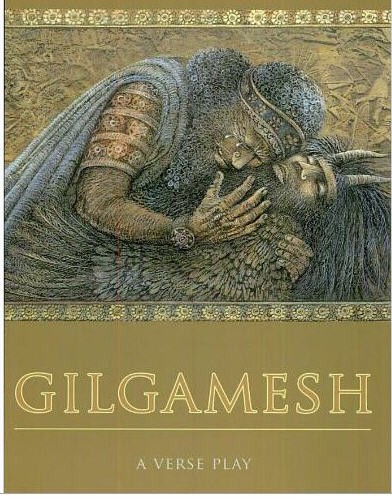
For your info: This scan is used to show that Gilgamesh belongs to the ancient Mesopotamian literary world. The article uses it to argue that Genesis entered the field later.
The continuation follows:
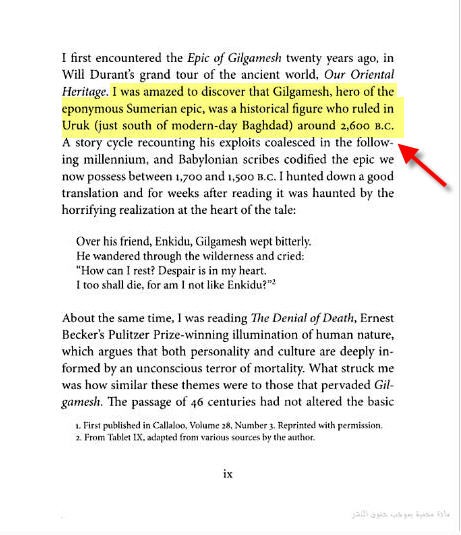
For your info: This continuation further supports the dating and antiquity of the epic tradition. The author uses it to reinforce the chronological priority of Gilgamesh over Genesis.
More scans are cited:
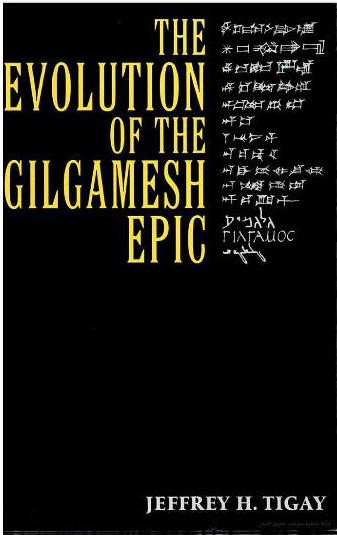
For your info: This scan is another supporting source for the chronology of Gilgamesh. The article uses the accumulation of references to make denial appear unreasonable.
The continuation follows:
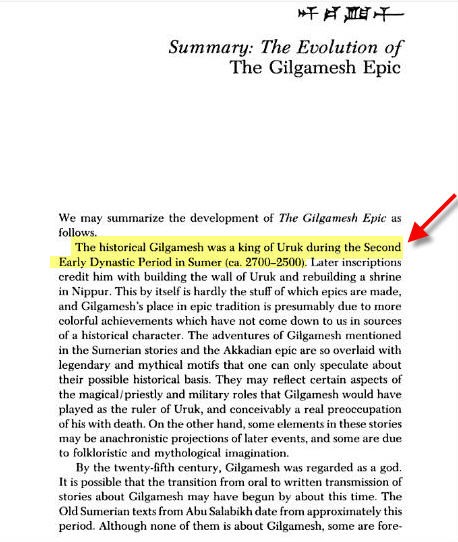
For your info: This continuation completes the cited source. It supports the same basic point: Gilgamesh is older than the conservative date assigned to Genesis.
Further documentation:
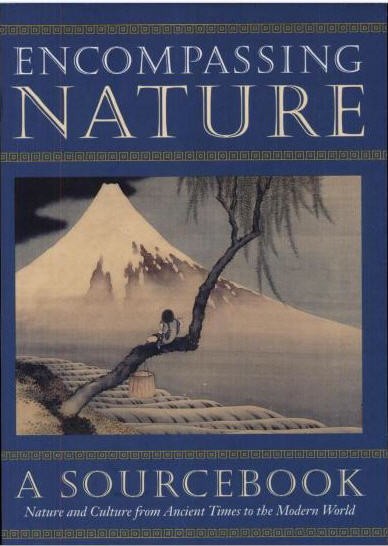
For your info: This scan is included to document the historical setting and dating of Gilgamesh. It strengthens the timeline comparison.
The continuation follows:
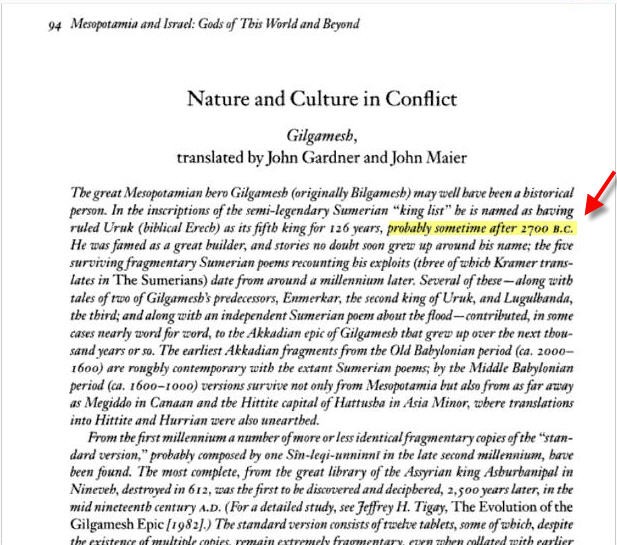
For your info: This continuation supports the same chronological argument. The author uses the dating of Gilgamesh to pressure the claim that Genesis is historically original.
Final supporting scans in this sequence:
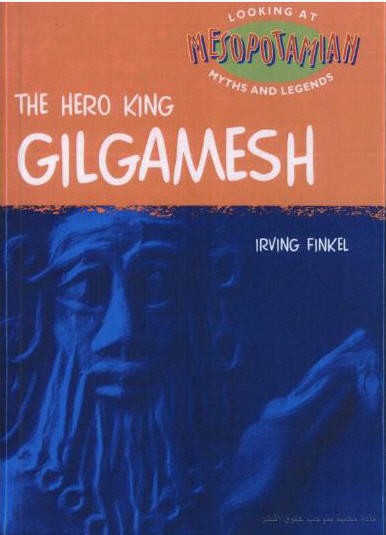
For your info: This scan is used as further documentation of the antiquity of the Gilgamesh tradition. It supports the article’s claim that the epic predates Genesis in written form.
The continuation follows:
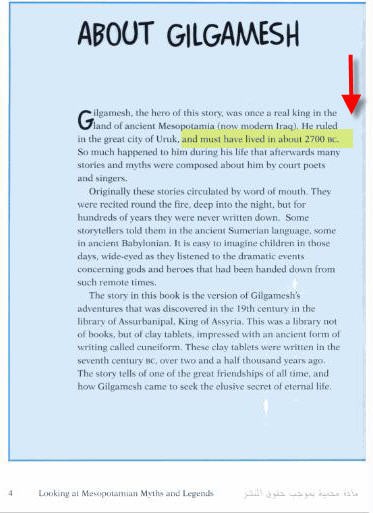
For your info: This continuation completes the sequence of references on Gilgamesh’s antiquity. The article uses all these scans together to argue that the direction of borrowing cannot simply be assumed in favor of Genesis.
The Epic of Gilgamesh is perhaps the oldest written story on Earth. It comes from ancient Sumeria and was originally written on twelve clay tablets in cuneiform script. It concerns the adventures of the historical king of Uruk, somewhere between 2750 and 2500 BCE.
“Gilgamesh was a historical king of Uruk in Babylonia, on the River Euphrates in modern Iraq; he about 2700 BC… Many stories and myths were written about Gilgamesh, some of which were written down about 2000 BC in the Sumerian language on clay tablets which still survive.”
The fullest surviving version is derived from twelve stone tablets in the Akkadian language, found in the ruins of the library of Ashurbanipal, king of Assyria, 669–633 BC.
Yes, this is the bitter truth.
The Epic of Gilgamesh preceded the Flood according to the Bible by more than three centuries.
The first writing of the Epic of Gilgamesh preceded the first writing of the Book of Genesis by more than five centuries.
The oldest complete manuscript of the Epic of Gilgamesh precedes the oldest complete manuscript of the Book of Genesis by more than fifteen centuries.
You are right — absolutely right — you who are responsible for the Jesuit translation, to admit that the author of the Book of Genesis quoted from the Epic of Gilgamesh. This is a fact that only an ignorant person would deny.

For your info: This scan is used as an admission from a Christian or Bible-related source that the Genesis flood narrative has a relationship to older Mesopotamian flood traditions. The article presents it as an acknowledgement that Genesis may have drawn from Gilgamesh or related sources.
The continuation follows:
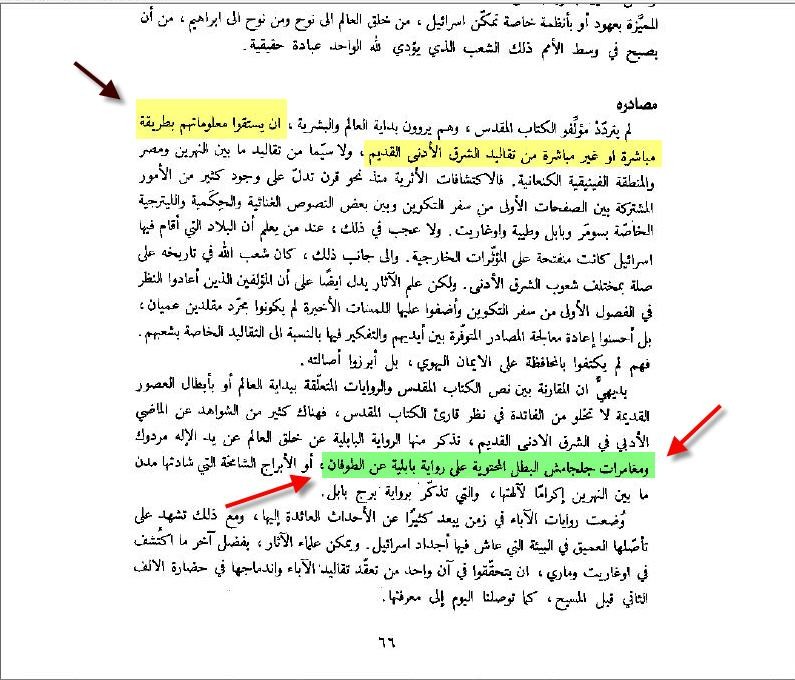
For your info: This continuation is used to strengthen the claim of textual dependence. The author presents this as a Christian-side concession that supports the polemical conclusion.
And upon him, all compensation is in your lineage, O holy book. I mean, O holy one.
Why This Does Not Attack the Qur’an
Perhaps someone will act slyly and say that we are also attacking the Qur’an. This is very funny talk, because what says that the age of humanity on earth is about 6000 years is the Holy Bible and the interpreters of the Holy Bible.
“Some claim that fossils prove the existence of human bones that are more than a million years old, while what is clear from this table is that the age of man on Earth does not exceed 6000–7000 years.”
As for modern science, it has discovered fossils dating back to 10,000 BC. So the genealogy of the Holy Bible is a holy scandal in every word.
What states that the Epic of Gilgamesh was before the Flood is the statistics of the Holy Bible. But the Qur’an did not speak about the age of humanity. This is the first point.
Secondly, the occurrence of the Flood at this time is a gross scientific error. There were many civilizations that existed at this time.
Dr. Maurice Bucaille says in his book, page 58:
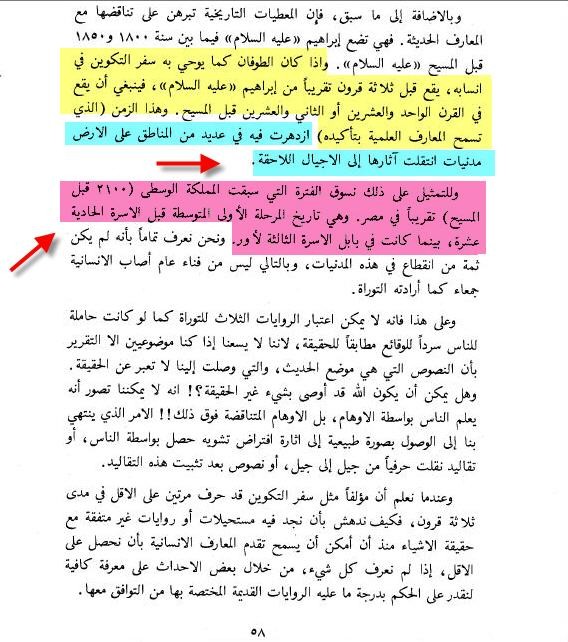
For your info: This scan is used to argue that the biblical Flood date conflicts with known ancient civilizations. The author’s point is that placing a universal flood around 2348 BC creates direct historical and scientific problems.
Let us take the most famous event in history: the building of the pyramids.
The pyramids were built around 2700 BC to 2200 BC. This means it is absolutely impossible for the Flood to have occurred in 2348 BC, as the Christians’ book says.
Habib Saeed explains this in World Religions, page 38.

For your info: This scan is cited to show the dating of the Egyptian pyramids and ancient Egyptian civilization. The article uses this to argue that Egypt continued through the alleged biblical flood period, which would be impossible under a global flood model.
The continuation follows:
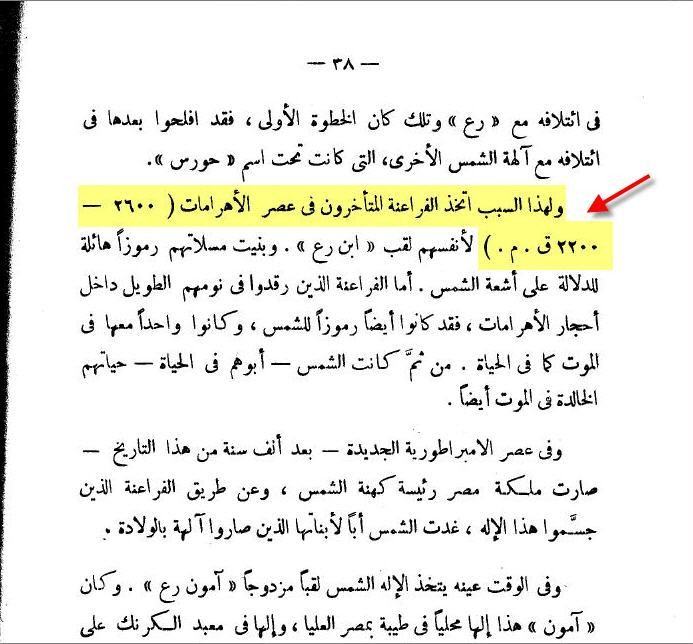
For your info: This continuation strengthens the argument that the pyramid-building period overlaps with the biblical Flood date. The author uses this overlap to attack the historical reliability of Genesis.
The pyramids date back to 2650–2200 BC, and during this period more than ninety pyramids were built in various parts of the ancient Pharaonic state.
The period in which pyramids were constructed was the Old Kingdom, between 2700 and 2200 BC.
If the Flood happened at this time according to the Bible, then it is nothing but a sacred myth.
Thirdly, according to the Bible, the first book written was by Moses, or the writer of Genesis, around 1440 BC. This is the oldest date found for the Book of Genesis. This is also a grave error.
According to the Holy Qur’an, there were heavenly books much earlier than this — before Gilgamesh and other than Gilgamesh.
“People were one nation, then Allah sent the prophets as bringers of good tidings and warners and sent down with them the Scripture in truth to judge between people concerning that wherein they differed. And none differed therein except those who were given it after clear proofs had come to them, out of jealous animosity between themselves. So Allah guided those who believe for whatever they differed over of the truth, by His permission. And Allah guides whom He wills to a straight path.”
Tafsir al-Jalalayn explains “and He sent down with them the Book” as meaning the books.
In the easy interpretation, it says that Allah sent the prophets as callers to the religion of Allah, giving good tidings to whoever obeys Allah of Paradise, warning whoever disbelieves in Him and disobeys Him of the Fire, and He sent down with them the heavenly books with the truth.
In the interpretation of the selected scholars of al-Azhar, it says: “and He sent down with them the books containing the truth.”
We also provide evidence from the scrolls of Abraham, which the Qur’an spoke about, while we do not see any existence of them in the books of the Christians, except in the Apocrypha.
“This is in the former scrolls, the scrolls of Abraham and Moses.”
So the Holy Book was denied and the Noble Qur’an was true. Praise be to Allah, Lord of the Worlds.
Introduction to Gilgamesh and His Historical Epic
The Epic of Gilgamesh is considered one of the most prominent literary works of ancient Iraq, and it is the longest literary epic known to the entire Near East.
The events of this epic revolve around the character of Gilgamesh, a real character around whom legends were woven. His name appeared in the series of Sumerian kings of the first dynasty of Uruk, where he was ranked fifth. It was said that he ruled for 126 years.1 This places him between 2700 and 2500 BC.
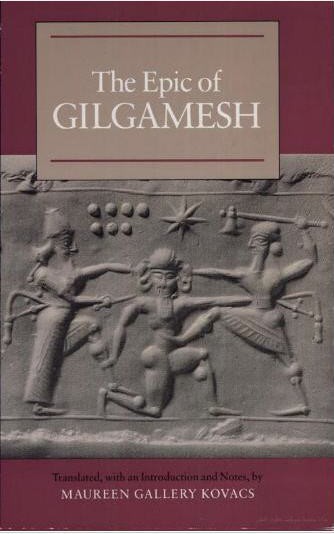
Maureen Gallery Kovacs says in The Epic of Gilgamesh:
“There is no doubt that Gilgamesh was a real historical figure who ruled the city of Uruk at the end of the Early Dynastic II period, 2700–2500 BC.”2
This epic was written around 2000 BC. Kovacs also says:
“The earliest written epics about Gilgamesh were produced in the Sumerian language during the reign of king Shulgi of the Third Dynasty of Ur, ca. 2000 BC.”3
Translation:
The oldest writing of the Epic of Gilgamesh was written in the Sumerian language during the reign of King Shulgi of the Third Dynasty of Ur around 2000 BC.
Before the period of documentation, it was transmitted orally as an oral tradition among the people as popular heritage.4
The Epic of Gilgamesh and Genesis
When talking about this epic, the Book of Genesis must be mentioned because of the source-related relationship between them.
The Encyclopedia of the Bible says:
“There are many similarities between the events of the biblical flood story and the Assyrian story.”5
Before discussing the similarities, we must review a small comparison between the dates of the epic and the book.
As mentioned earlier, Gilgamesh is assumed by scholars to have lived between 2700 and 2500 BC. That is when his story took place. It continued to be passed down orally until it was written around 2000 BC.
There are similarities between the biblical story and the epic in several places. The Book of Genesis has the lion’s share in this comparison, and for that reason it will be the focus of our discussion, since it is supposed to be the oldest book of the Bible.
There are three opinions about when the Book of Genesis was written:
- The first opinion: the fifteenth century BC, which is why some say Moses wrote it.
- The second opinion: the thirteenth century BC.
- The third opinion: the ninth to fifth century BC, with final editing during the fifth century or perhaps later.
The Tyndale Bible Dictionary says:
“The date of the book is also a matter of debate. Even among those who accept Mosaic authorship there is debate as to when Moses lived. Based on the biblical data, Moses should have lived in the 15th century BC (cf. Jgs 11:26; 1 Kgs 6:1), but many scholars incline toward a 13th-century date. As outlined above, the liberal view of the date of Genesis would be from the ninth to the fifth centuries BC, with the final editing coming around the fifth century or perhaps even later.”6
So we have three dates: either 1500 BC, or 1300 BC, or 900–500 BC or later.
This means the oldest written version of the Epic of Gilgamesh existed five full centuries before the appearance of Genesis. It was written in 2000 BC, while Genesis was written in 1500 BC, assuming Moses wrote it. In reality, it was likely written much later.
Original and Copy
The vast majority of the evidence between the epic and the Book of Genesis is found in the story of the Flood and the eleventh tablet of the epic.7
We will review some of the similarities between the Epic of Gilgamesh and the Book of Genesis.
First Aspect: The Ship
You make the ark dwellings.
And coat it from the inside and outside with caulk.
And this is how you make it: three hundred cubits shall be the length of the ark, fifty cubits its breadth, and thirty cubits its height.
And you shall make a window for the ark, and finish it to a cubit above, and put the door of the ark on its side.
Lower, middle, and upper dwellings make it.”
It was stated in the eleventh tablet of the epic:
the sides of its top were of equal length…
I provided it with six decks,
thus dividing it into seven levels.
The inside of it I divided into nine compartments.
I drove plugs to keep out water in its middle part.
I saw to the punting poles and laid in what was necessary.
Three times 3,600 units of raw bitumen I poured into the bitumen kiln,
three times 3,600 units of pitch into it…”
Here we see the similarities: the same unit of measurement, the cubit, is used, though with different dimensions and measures. The ship is divided into floors, and the floors are divided into rooms, as stated in the biblical text. The ship is also coated with tar.
Second Aspect: Going on Board
“So Noah went in, and his sons, his wife, and his sons’ wives with him into the ark because of the waters of the flood.”
It was stated in the epic:
“I had all my kith and kin go up into the boat.”
As we see in Genesis, Noah entered the ship with his family and his sons’ wives. This is exactly what is mentioned in the epic, when Utnapishtim entered his household and family into his ship.
Third Aspect: Covering the Mountains
And all flesh died that moved on the earth: birds, cattle, wild beasts, and every creeping thing that creeps on the earth, and all men.
Everything in whose nostrils there was the breath of the spirit of life, of all that was on the dry land, died.”
The epic says:
overwhelming the people like an attack.
No one could see his fellow,
they could not recognize each other in the torrent.”
Just as the waters covered the mountain tops in Genesis, the epic also depicts the flood submerging the mountain and crushing the people.
Fourth Aspect: After the Flood
The waters calmed down.
And the fountains of the deep and the windows of heaven were stopped, and the rain from heaven was stopped.”
The epic says:
I looked around all day long — quiet had set in,
and all the human beings had turned to clay.”
The Torah is similar to the text of the epic, as the epic tells the story of the end of the Flood, when the sea, storms, and floods calmed down.
Fifth Aspect: The Ship Window
“And it came to pass after forty days, that Noah opened the hatch of the ark that he had made.”
The epic says:
“I opened a vent and fresh air, daylight, fell upon the side of my nose.”
As we see, there was a window in the ship, and it was opened by both Noah and Utnapishtim.
Sixth Aspect: Noah and Utnapishtim Using Birds
But the dove could not find a place for her foot to rest on, so she returned to the ark, because the waters were over the face of the whole earth.
Then he reached out his hand and took it and brought it into the ark with him.
And he stayed another seven days, and again he sent out the dove from the ark.
A dove came to him in the evening, and behold, an olive leaf was in her beak.
And Noah knew that the waters had subsided from the earth.
And he stayed another seven days, and sent out the dove, but it did not return to him again.”
The epic says:
I sent forth a dove and released it.
The dove went off, but came back to me;
No perch was visible so it circled back to me.
I sent forth a swallow and released it.
The swallow went off, but came back to me;
No perch was visible so it circled back to me.
I sent forth a raven and released it.
The raven went off, and saw the waters slither back.
It eats, it scratches, it bobs, but does not circle back to me.”
This final example shows the similarity between the two stories.
In the Torah, Noah sent a dove to see whether the water had dried from the earth. The dove returned to him as a sign that the land was not yet dry.
Utnapishtim did the same thing. He sent a dove for the same reason, and it also returned. Then he sent a swallow. Then birds were sent again. This time Noah also sent a dove, and Utnapishtim sent a raven. Through this sending, it became known that the land was dry: the dove returned to Noah carrying an olive leaf, while the raven did not return because it found land.
Calculate the Amount
After presenting these facts, accompanied by the truths and words of Christian scholars, no intelligent person will be able to say anything except that the Bible inevitably copied the story of the Flood from the Epic of Gilgamesh.
Gilgamesh lived during the period estimated by scholars to be around 2700–2500 BC, while the Flood was in 2370 BC.8
The Epic of Gilgamesh appeared as a written work around 2000 BC, while the Book of Genesis appeared in 1500 BC, five full centuries later, and this is at best assuming that Moses was its writer, which is a very remote possibility.
This completely discredits the Bible and destroys the claim of its infallibility.
There is no doubt that there is a defect. This defect is a result of the Holy Book itself, and the Holy Book itself also fell into it.
According to the data mentioned, two floods occurred on this earth: the first during the reign of Gilgamesh, and the second during the reign of Noah, peace be upon him. This is something any rational person would reject.
The truth is that no Flood occurred on earth except the Flood of Noah, peace be upon him. What is mentioned in the Epic of Gilgamesh is a type of mythology derived from the Flood of Noah. But the Holy Book is the one that put itself in this critical predicament by giving historical precedence to Gilgamesh and placing the real Flood after the legendary flood by two centuries at most.
The true date of the Flood was derived from the incorrect historical data stated in the texts of the Torah.
If we follow the sequence of historical events from the beginning of creation, from Adam to Noah, peace be upon them, we find that the time difference between them is only 1056 years.
Seth lived 105 years and begot Enosh.
Enosh lived 90 years and begot Cainan.
Cainan lived 70 years and begot Mahalalel.
Mahalalel lived 65 years and begot Jared.
Jared lived 162 years and begot Enoch.
Enoch lived 65 years and begot Methuselah.
Methuselah lived 187 years and begot Lamech.
Lamech lived 182 years and had a son, and he called his name Noah.
Then Genesis says:
“In the six hundredth year of Noah’s life, in the second month, on the seventeenth day of the month, all the fountains of the great deep burst forth, and the floodgates of heaven were opened.”
By simple calculation:
1056 + 600 = 1656.
That is, the Flood happened in the year 2370 BC.9
These numbers are undoubtedly a myth that the writers of the Torah falsely attributed to God. They made the Holy Book a copy of the Epic of Gilgamesh and made the entire age of humanity not exceed six thousand years.
This number can be verified through a Jewish website that established a history of Old Testament events and other contemporary events.
The funny and sad thing is that when the Torah made the Flood in 2370 BC, it led the Holy Book into another trap: the existence of ancient civilizations much older than the civilization of the Pharaohs, estimated to be more than 3000 BC, meaning before the Flood.
The Pharaonic Era dates back to 3000 BC. Alexander the Great conquered Egypt in 323 BC. During the Pharaonic Era, Egypt witnessed many aspects of progress and renaissance in all fields.10
One of the evidences that these numbers are fabricated is the difference in this numerical estimate between the three texts: the Masoretic, the Samaritan, and the Septuagint.
There are terrible differences between these texts, as shown in the following table.
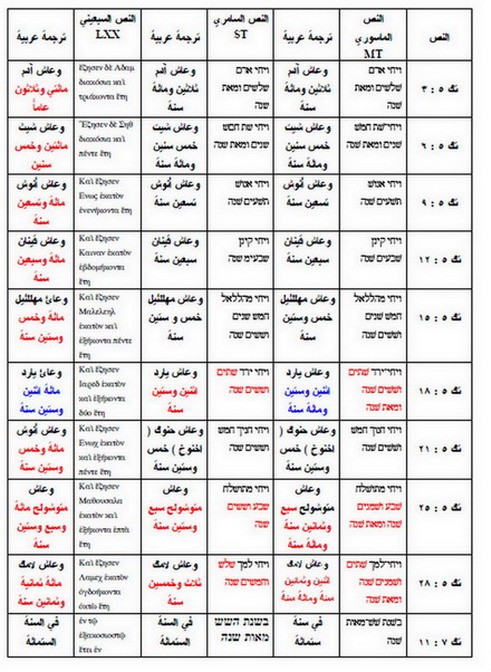
For your info: This table is used to show the chronological differences between the Masoretic, Samaritan, and Septuagint textual traditions. The article’s argument is that the Bible’s internal chronological numbers are unstable, which makes the late biblical Flood date a textual problem rather than reliable sacred history.
Dr. Taha Baqir on the Origin of the Flood Narrative
The abstract truth in this matter was written by the scholar Dr. Taha Baqir when he spoke about the spread of this legend called the Epic of Gilgamesh.
Its news and narratives were taken from the literature of the civilization of the Valley of the Two Rivers.
What we believe regarding this flood is that it was originally a real historical incident that occurred in the folds of the distant past. It was so huge and terrible that it left a profound impact on the minds of different generations, so it was transmitted by oral narratives, and its historical details were distorted.
Due to the many similarities between the flood narrative in the Epic of Gilgamesh and the narrative in the Torah, we believe that both narratives go back to one incident. This incident occurred in ancient Iraq, especially in the southern part of it, meaning the alluvial plain. Its time goes back to the end of the Jemdet Nasr period, around 3200 BC, and to the beginning of the Dawn of the Dynasties around the beginning of the third millennium BC.11
This is the truth that does not accept doubt.
The Epic of Gilgamesh is a legendary story inspired by imagination and derived from a true story: the story of our master Noah, peace be upon him, which was before it by a long time.
Since the story of our master Noah and the Flood had great events and lessons, this story remained stuck in the mind of the new world after the Flood. It was passed down as popular heritage in the form of oral tradition between the ages.
Then the Epic of Gilgamesh and others came and quoted from it. Unfortunately, the Holy Book bears witness against itself with distortion and lack of credibility once again. It throws history to the wall and depicts Noah, peace be upon him, as coming after Gilgamesh, placing itself between the millstones of a harsh result from which there is no escape: the story of the Flood was quoted from this epic.
Whoever insists that the Bible is true must admit either that two floods occurred on this earth, or that the Bible was copied from Gilgamesh.
Whoever wants to adhere to logical reason and refer to historical and scientific facts will find no greater evidence than this that the Bible is a human book inspired by imagination and has no connection to divine revelation, except for a glimmer.
Responding to Doubts
We often find on intellectual prostitution sites and Christian toilets, falsely disguised as dialogue sites with Muslims, doubts about the Holy Qur’an. The basis of these doubts is that some Qur’anic stories were taken from the Talmud or the Jewish Haggadah.
In fact, if that ignorant group of Christians knew what these two books and other Jewish books were, what scholars said about them, and what Jews believed about them, they would not have written these stupid, ignorant lines.
These books as a whole are not purely true, nor are they purely false. They do not contain pure truths or pure falsehoods. They contain truth and falsehood, just like the Torah.
The answer to their trivial doubts is very easy and simple.
The vast majority of the prophets and messengers sent by God Almighty were sent to the Children of Israel. Every prophet among them lived as long as God had decreed and then died, except for Christ, who has not died yet and was raised alive.
Each prophet left a legacy, or what may be called the remnants of prophecy.
These remnants of prophecies are represented in:
- The biography of the prophet.
- His stories.
- His teachings.
These biographies and teachings were transmitted orally, as was the custom, just as the story of the Flood was transmitted and the Epic of Gilgamesh was quoted from it. They circulated among the people, and it is not strange to find some of this in the Talmud, the Haggadah, or any other religious book written by Jewish rabbis.
These prophets were among them, and their reports were transmitted among them. Some of what was mentioned appeared in the Torah. Other material was left and later written in the Talmud or other books.
We have a lesson from the story of the Flood, our master Noah, peace be upon him, and Gilgamesh.
I ask God Almighty to make this work purely for His sake, without any purpose of fame or hypocrisy.
The right to transmit and copy is available to every Muslim. It does not matter at all whether the source is mentioned. I only ask you to pray in secret for me, my parents, and my family.
May God bless and grant peace and blessings upon our master Muhammad, his family and companions. Praise be to God, Lord of the Worlds, at the beginning and the end.
And peace be upon the messengers.
And praise be to God, Lord of the Worlds.”
References
Footnotes
-
Taha Baqir, The Epic of Gilgamesh, p. 13. ↩
-
Maureen Gallery Kovacs, The Epic of Gilgamesh. ↩
-
Maureen Gallery Kovacs, The Epic of Gilgamesh. ↩
-
Andrew George, trans., The Epic of Gilgamesh: The Babylonian Epic Poem and Other Texts in Akkadian and Sumerian, London: Penguin Classics, 1999. ↩
-
The Encyclopedia of the Bible, entry on the Flood. ↩
-
Walter A. Elwell and Philip Wesley Comfort, Tyndale Bible Dictionary, Wheaton, IL: Tyndale House Publishers, 2001, p. 522. ↩
-
Ancienttexts.org, Gilgamesh Tablet XI. ↩
-
The cited article gives 2370 BC in this section and elsewhere gives 2348 BC according to the Hebrew biblical chronology. This inconsistency appears in the original material and should be checked before publication. ↩
-
The original article uses the calculation 1056 + 600 = 1656 and then assigns it to 2370 BC. Elsewhere in the same article, the Flood is assigned to 2348 BC. This is a weak internal inconsistency and should be corrected before publication. ↩
-
Source cited in the original article: Egyptian State Information Service page on Pharaonic history. ↩
-
Dr. Taha Baqir, The Epic of Gilgamesh: The Immortal Odyssey of Iraq, p. 15. ↩