

Four More Verses Omitted from the Oldest Manuscripts — Matthew 23:14, Romans 8:1, Matthew 15:8
Three further passages in the New Testament show the same pattern of scribal addition and deletion — absent from the Sinaiticus, Vaticanus, and Alexandrian codices, omitted by the critical Greek editions, and each carrying a doctrinal motive that explains why the alteration was made.
Matthew 23:14 — “Woe to You, Scribes and Pharisees”
The Verse
Multiple Arabic translations include it — SVD, ALAB, and GNA all render it. The KJV includes it in full. However, the Westcott-Hort critical Greek text (GNT-WH) omits it entirely. The Latin Vulgate of Jerome likewise omits it. The French translation omits it.
Manuscript Evidence
The verse is absent from the Sinaiticus Codex:

The verse is absent from the Vaticanus Codex:

The Alexandrian Codex likewise omits it.
Doctrinal Importance
The verse is absent from three manuscripts, from the Vulgate of Jerome, from the French translation, and from the Westcott-Hort critical edition. The question the source poses is direct: where did this verse come from?

Matthew 27:35 — Noted for Separate Documentation

Romans 8:1 — The Added Clause “Who Do Not Walk According to the Flesh”
The Verse
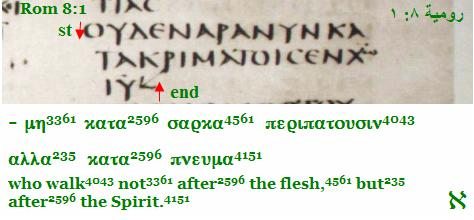
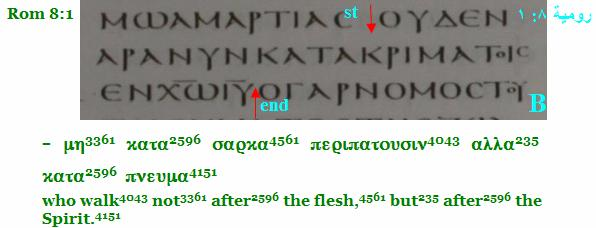
The KJV includes the full clause. The SVD also includes it. However, the critical Greek text (GNT-WH) reads only: “There is therefore now no condemnation to them which are in Christ Jesus” — stopping there, without the added clause about flesh and Spirit. The Latin Vulgate (nihil ergo nunc damnationis est his qui sunt in Christo Iesu) likewise ends without the added clause.
The Byzantine Greek text (GNT-BYZ) includes the clause. The Westcott-Hort text does not.
Manuscript Evidence
The Sinaiticus Codex contains only the shorter reading without the added clause:
The Vaticanus Codex likewise contains only the shorter reading:
The Alexandrian Codex:

Doctrinal Importance
This conflicts directly with Psalm 119:1: “Blessed are those whose way is blameless, who walk in the law of the Lord.” If God’s plan changed from law to spiritual redemption, was this change sudden or pre-planned? The added clause also appears in nearly identical form in Romans 8:4 — “that the righteousness of the law might be fulfilled in us, who do not walk according to the flesh but according to the Spirit” — yet Romans 8:4 was not omitted from the manuscripts. If Romans 8:1’s clause was original, why was it left out of the oldest manuscripts while Romans 8:4’s identical clause was retained? If it was added, why was it not added to Romans 8:4 as well? The inconsistency reveals the hand of a scribe rather than an original author. This is the book and its accompanying characteristic — the human experience associated with human weakness, which alters the divine holiness.

Matthew 15:8 — The Omitted Opening Phrase
The Verse
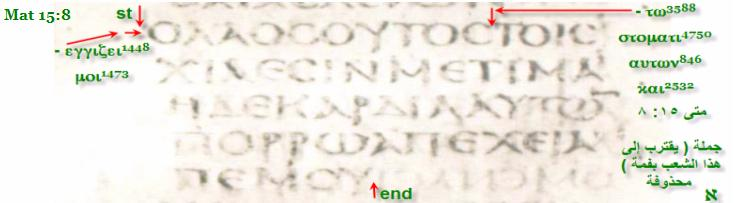
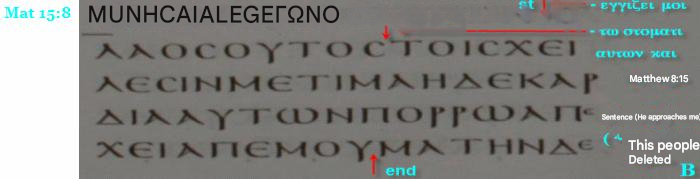
The KJV and multiple Arabic translations include the opening phrase “draweth nigh unto me with their mouth”. The Westcott-Hort critical text (GNT-WH) omits this opening phrase and begins the verse directly with: “This people honoureth me with their lips; but their heart is far from me.”
Manuscript Evidence
The Sinaiticus Codex contains the shorter reading without the opening phrase:
The Vaticanus Codex likewise contains the shorter reading:
The Alexandrian Codex also omits the opening phrase.
Doctrinal Importance
