God in Islam and Christianity — Tawhid, the Deleted Trinity Verse, and Twenty Unworthy Biblical
·36 min read·8057 words
How to Navigate This Note First — God Is One in All His Books — Old Testament, New Testament, and Quran evidence for divine oneness Second — God Is Not a Trinity in Any of His Books — the deletion of 1 John 5:7, the only Trinity text, documented in six Bible translations Third — Nothing Is Like God — The Consensus of All Books — Quranic and Biblical evidence for divine incomparability Fourth — God Is Free from Every Deficiency — the logical principle connecting all that follows Twenty Unworthy Attributes in the Old Testament — a numbered examination of each incompatible description The Quran’s Corrections — how the Quran resolves each Biblical contradiction on divine attributes
The Old Testament and the New Testament both testify, in passage after passage, that God is one and that nothing is like Him — and yet the same scriptures describe Him as wrestling with a man and losing, drunk with wine, waking from sleep, forgetting His covenants, regretting His decisions, mourning barefoot like a dog, and comparing Himself to a lioness, a moth, a shepherd, and a lamb. These are not peripheral verses. They are in Genesis, Exodus, Psalms, Samuel, Kings, Hosea, Micah, Judges, Jeremiah, and Revelation. The argument of this note is simple: either God is as the books of His oneness and incomparability describe Him, or He is as the books of His weakness and regret describe Him. He cannot be both.
First — God Is One in All His Books
From the Old Testament
Deuteronomy 6:4 Hear, O children of Israel: The Lord our God, the Lord is one.
Nehemiah 9:6 You alone are the Lord. You have made heaven and the heaven of heavens, and all their stars, the earth and all that is in it, the seas and all that is in them. You give life to them, and all the host of heaven worships you.
2 Kings 19:15-19 O Lord, God of Israel, who are enthroned above the cherubim, you alone are God of all the kingdoms of the earth. You alone created the heavens and the earth. Look, O Lord, at the ears and hear; open, O Lord, your eyes and see, and hear all the threats of Sennacherib, which he has sent to reproach the living God. O Lord, the kings of Assyria have truly destroyed the nations. And they destroyed their dwellings, and cast their gods into the fire and destroyed them, because they were no gods at all, but wood and stone, the work of human hands. Now therefore, O Lord our God, save us from his hand, that all the kingdoms of the earth may know that you alone are the Lord God.
Isaiah 43:11 I, even I, am the Lord, and besides me there is no savior.
From the New Testament
Mark 12:28-30 And he asked him, “Which commandment is the first of all?” And Jesus answered him, “The first of all is this: Hear, O Israel: The Lord our God is one Lord. And you shall love the Lord your God with all your heart, and with all your soul, and with all your mind, and with all your strength. This is the first commandment.”
1 Corinthians 8:4-6 We know that an idol is not a god existing in the universe, and that there is only one God. Even if the so-called gods were in heaven or on the earth — and how many are those gods and lords! But the Lord is the same. And there are diversities of workings, but the same God who works all in all.
John 17:3 And this is eternal life, that they may know you, the only true God, and him whom you have sent, Jesus Christ.
Revelation 15:3-4 Great and marvelous are your works, O Lord God Almighty. Just and true are your ways, O King of saints. Who will not fear you, O Lord, and glorify your name? For you alone are holy. For all nations will come and worship before you, because your laws have been made manifest.
And do not argue with the People of the Scripture except in a way that is best, except for those who commit injustice among them, and say, “We believe in that which was revealed to us and revealed to you. And our God and your God is one; and we are Muslims in submission to Him.”
Say, “I am only a human being like you. It has been revealed to me that your God is one God, so be upright toward Him and ask His forgiveness. And woe to those who associate others with God.”
And do not say, “Three.” Desist; it is better for you. God is only one God. Exalted is He above having a son. To Him belongs whatever is in the heavens and whatever is on the earth. And sufficient is God as Disposer of affairs.
Indeed, they have disbelieved who say, “God is the third of three.” And there is no god except one God. And if they do not desist from what they are saying, a painful punishment will surely touch those who disbelieve among them. Will they not then repent to God and ask His forgiveness? And God is Oft-Forgiving, Most Merciful.
This is a message to mankind, that they may be warned thereby, and that they may know that He is but one God, and that those of understanding may be reminded.
An-Nahl 16:22 إِلَٰهُكُمْ إِلَٰهٌ وَاحِدٌ
Your God is one God. As for those who do not believe in the Hereafter, their hearts are in denial, and they are arrogant.
Say, “I am only a human being like you. It has been revealed to me that your God is one God. So whoever hopes for the meeting with his Lord — let him do righteous work and not associate in the worship of his Lord anyone.”
Say: It has only been revealed to me that your God is one God. So will you be Muslims?
Al-Ikhlas 112:1 قُلْ هُوَ اللَّهُ أَحَدٌ
Say: He is God, the One.
All of the above evidence — from the Old Testament, the New Testament, and the Quran — converges on a single declaration: God is one. We testify before God on the Day of Resurrection that we followed what His books testified to. But if God asked someone: “Why did you worship Me as one in three?” — what would that person say? Would they tell Him that it is written in His revelation that He is a Trinity? If they said so, God Almighty would condemn them and accuse them of lying. Because the Trinity is not mentioned in the entire Bible. God says every time that He is one. He never said even once that He is a Trinity.
Second — God Is Not a Trinity in Any of His Books
Did God ever say about Himself, even once, that He is a Trinity? Where is there a single piece of evidence for that? The only text about the Trinity in the entire Bible was 1 John 5:7 — and it has been deleted.
The famous alleged text that the church relied upon to prove the Trinity — 1 John 5:7 in its long form — does not exist in any Greek manuscript before the sixteenth century AD. Among more than five thousand Greek manuscripts of the Bible, East and West, this text does not appear in a single manuscript before the sixteenth century. It was later added, and then deleted from modern translations after scholars exposed it as an interpolation.
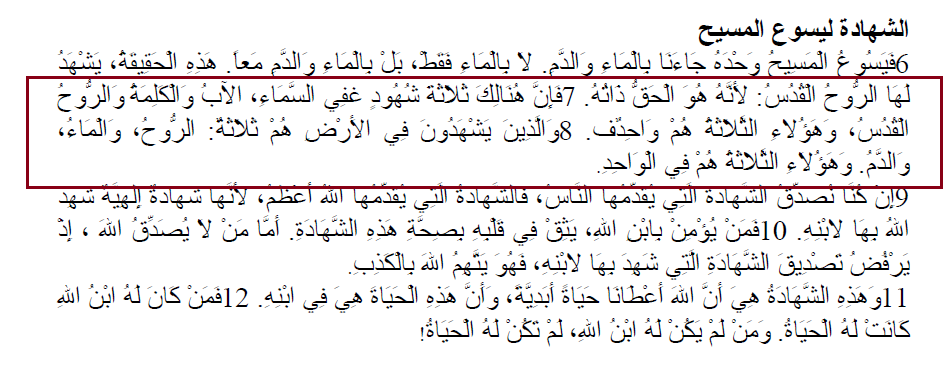
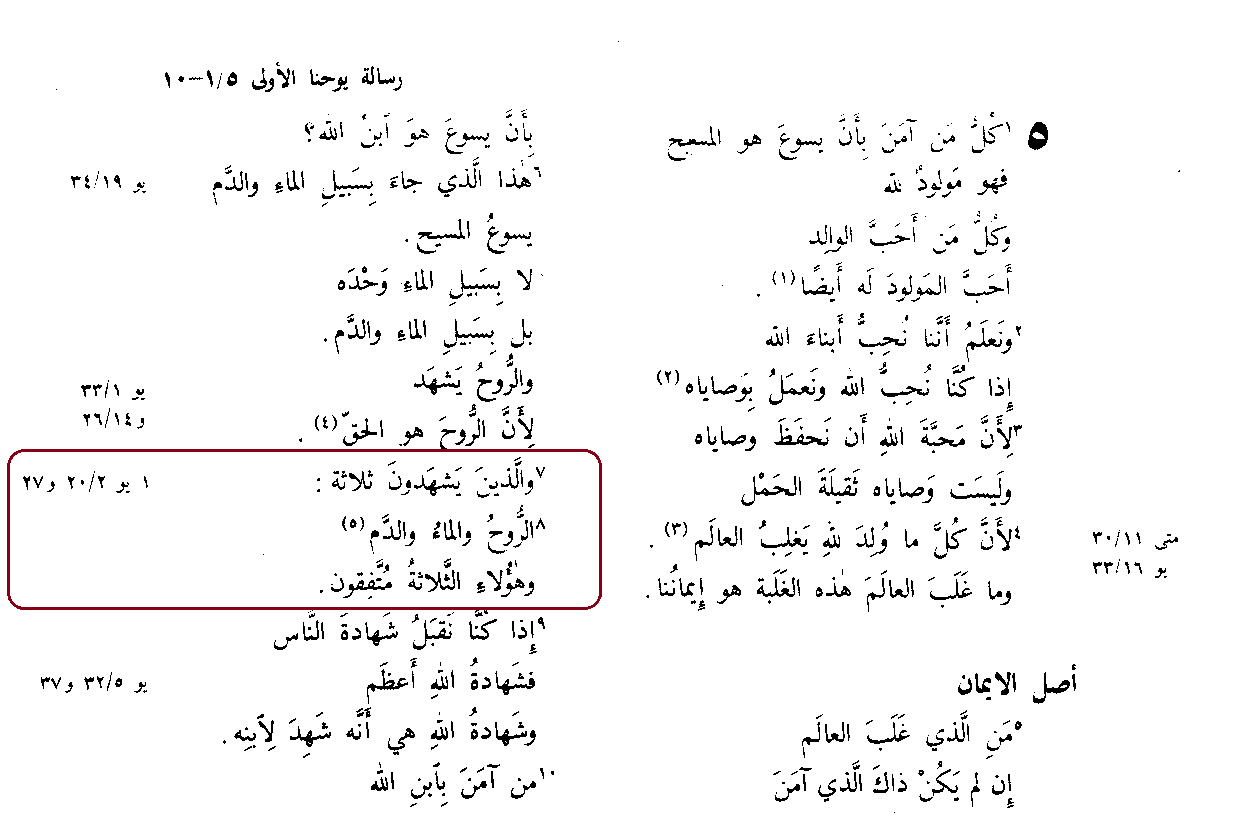
The following image shows the text of 1 John 5:7 before its deletion, from the Arabic Al-Hayat translation, preserved in the older Book of Life edition. The full Trinitarian clause — “the Father, the Word, and the Holy Spirit, and these three are one” — appears:
Page from the Arabic Al-Hayat Bible translation showing 1 John 5:7 before deletion of the Trinitarian clause
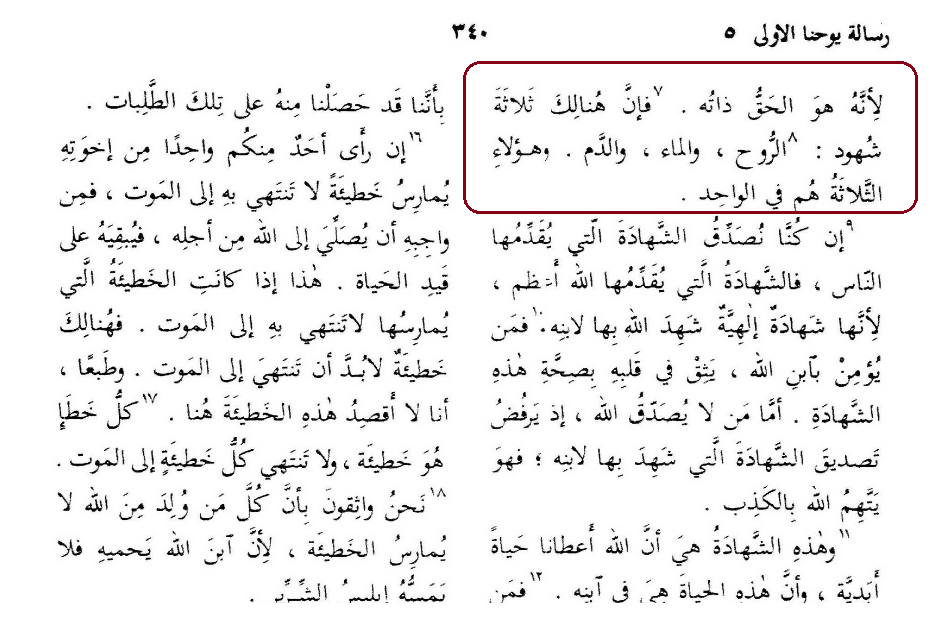
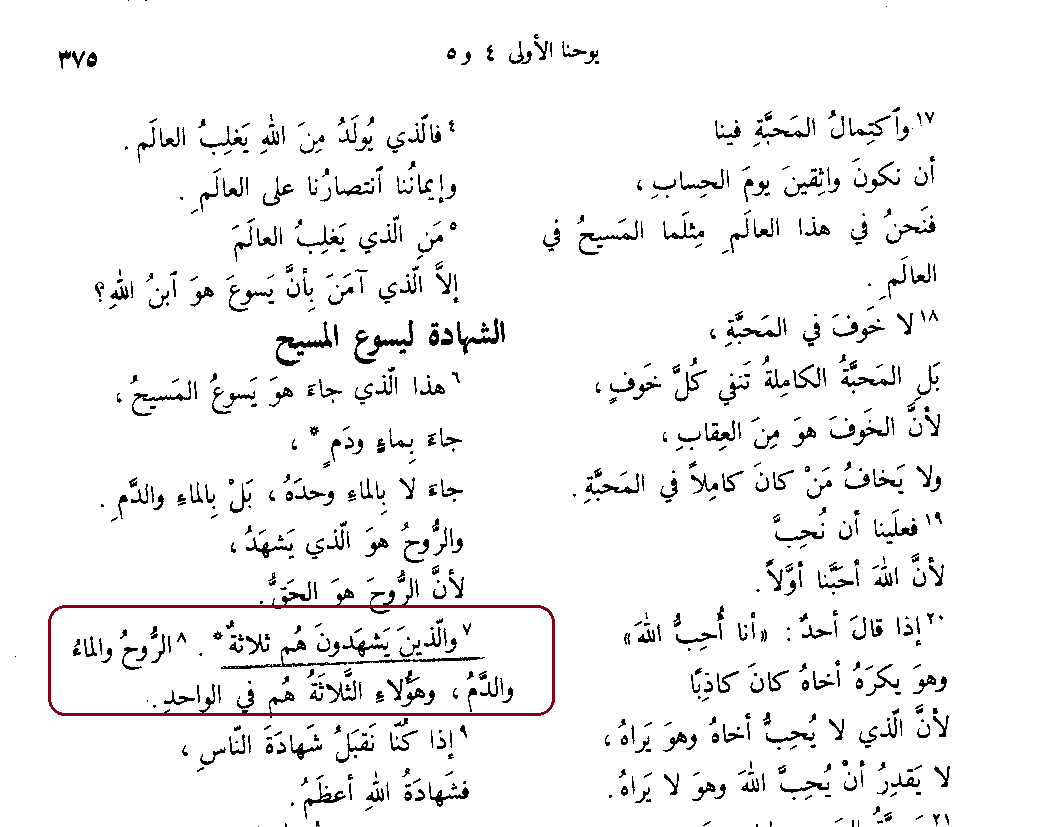
The following image shows the same passage in the 1995 edition of the Al-Hayat Arabic translation, after the Trinitarian clause was deleted:
Page from the 1995 Al-Hayat Arabic Bible showing 1 John 5:7 after deletion of the Trinitarian clause
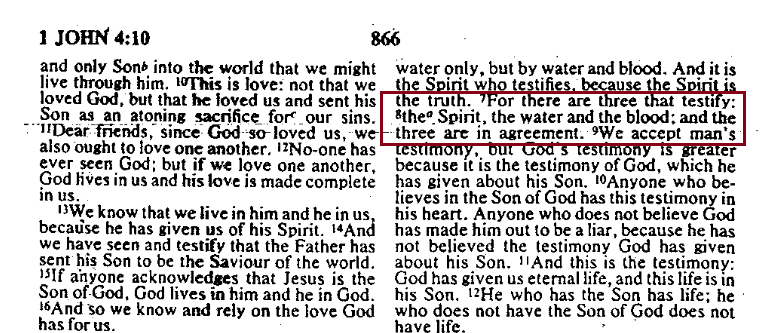
The following image shows the New International Version (NIV) English text of 1 John 5:7, from which the Trinitarian clause has likewise been removed:
NIV English Bible showing 1 John 5:7 without the Trinitarian clause
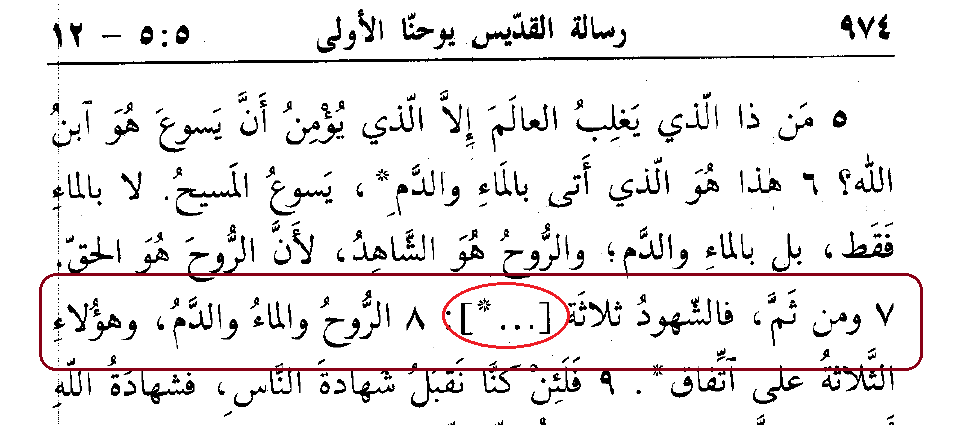
The following image shows the Arabic Pauline translation of 1 John 5:7, from which the Trinitarian clause has been deleted:
Arabic Pauline Bible translation showing 1 John 5:7 without the Trinitarian clause
The following image shows the Jesuit Order Arabic translation of 1 John 5:7, also without the Trinitarian clause:
Jesuit Order Arabic Bible translation showing 1 John 5:7 without the Trinitarian clause
The following image shows the Joint Arabic Translation of 1 John 5:7, confirming the same deletion:
Joint Arabic Bible Translation showing 1 John 5:7 without the Trinitarian clause
Six translations — Al-Hayat (old and 1995 editions), NIV, Pauline Arabic, Jesuit Arabic, and Joint Arabic — all confirm the deletion of the only Trinitarian text in the entire Bible. The Van Dyke Arabic and King James English retain the older form, but this retention reflects the sixteenth-century addition, not the ancient manuscript tradition.
The only evidence from the Bible for the Trinity was deleted, and it did not even exist in any manuscript before the sixteenth century. If you stand before your Lord tomorrow, on what ground will you stand? All Muslims believe in God’s oneness, which they prove with all of God’s heavenly books. And the only text claimed for the Trinity was thrown out. What remains of the argument?
Third — Nothing Is Like God — The Consensus of All Books
2 Samuel 7:22 There is none like you, and there is no God besides you, according to all that we have heard with our ears.
1 Samuel 2:2 There is none holy like the Lord, nor is there anyone like you.
Exodus 15:11 Who is like you, O Lord, among all the gods? Who is like you, majestic in holiness, awesome in glory, making wonders!
Exodus 9:14 That you may know that there is none like me in all the earth.
Jeremiah 10:6-10 There is none like you, O Lord! Great are you, and great is your name in might. Who does not fear you, O King of the nations? For it is fitting for you. For among all the wise men of the nations and in all their kingdoms there is none like you. They are dull and foolish together. But the Lord God is true; He is the living God, and an everlasting King. At his wrath the earth trembles, and the nations cannot endure his anger.
Isaiah 46:5 To whom will you liken me and make me equal, and compare me so that we may be alike?
Isaiah 40:18 To whom then will you liken God? And what likeness will you equate with him?
From all of the above, we are certain: God Almighty is not like any of His creatures, nor is any of His creation like Him. He is free from every defect and is not afflicted by the humiliations that afflict human beings. He truly deserves that we say about Him: Glory and Majesty.
Fourth — God Is Free from Every Deficiency
Having established from all the books that nothing is like God, a principle follows: anything that detracts from the essence of God does not relate to God. Sound reason, sound nature, and sound transmission all agree that any deficiency attributed to God Almighty is rejected. God Almighty is not humiliated or disgraced. He does not forget, does not regret, does not lie, does not wrong anyone, does not collapse. He is All-Knowing, All-Wise, Strong, Mighty, Great, Sublime. He has no likeness and is not an animal or a lioness.
With this principle established from the books themselves, we now examine twenty specific passages in the Old Testament that directly contradict it.
Twenty Unworthy Attributes in the Old Testament
1 — God Described as Tired and Needing Rest
Genesis 2:2-3 And God finished on the seventh day all his work that he had done, and he rested on the seventh day from all his work that he had done. And God blessed the seventh day and sanctified it, because in it he rested from all his work that he had done.
How does one describe God Almighty as tired and in need of rest, and then claim to revere Him? Rest is a property of bodies that exhaust their energy. The Creator of energy cannot exhaust it. If God required rest on the seventh day, He is subject to fatigue — and a being subject to fatigue is dependent on recovery, which is a form of need, and need is incompatible with divinity.
2 — God Described as Weak: Wrestling Jacob and Losing
Genesis 32:24-32 And Jacob was left alone, and a man wrestled with him until the breaking of day. And when he saw that he did not prevail against him, he struck the socket of his thigh, and Jacob’s hip was dislocated as he wrestled with him. And he said, “Let me go, for the day has broken.” But he said, “I will not let you go unless you bless me.” And he asked him, “What is your name?” And he said, “Jacob.” And he said, “Your name shall no longer be called Jacob, but Israel, for you have striven with God and with men, and have prevailed.” And Jacob asked him, “Tell me your name.” And he said, “Why do you ask my name?” And he blessed him there. And Jacob called the name of the place Peniel, saying, “For I have seen God face to face, and yet my life is preserved.”
God wrestled with Jacob throughout the night and could not prevail against him. He then requested release — “Let me go, for the day has broken” — placing God in the position of one who is held against his will and must negotiate with his own creature. Is the Creator not able to create? Is the One who sustains the heavens and the earth unable to subdue a man He has made? No one with a sound mind would accept that the God of the universes would be held by Jacob until dawn.
3 — God in Need of a Helper — Isaiah 63
Isaiah 63:5 Then I looked, but there was no helper; I was astonished because there was no one to support him.
Does God need someone to help or support Him? The verse attributes to God a moment of looking for a helper and finding none, and then astonishment at the absence of support. A God who looks for help and is astonished when none comes is dependent, surprised, and limited — none of which befits the divine nature.
4 — God Powerless Before Iron Chariots — Judges 1:19
Judges 1:19 And the Lord was with Judah, and he took possession of the mountain; but he did not drive out the inhabitants of the valley, because they had chariots of iron.
The Creator of iron could not overcome those who possessed chariots made of it. The text states this without apology: the Lord was with Judah, and yet the inhabitants of the valley were not driven out — because they had iron chariots. Does God appear powerless before the tools of His own creation?
5 — God Asks Permission from Moses and Receives Commands
Exodus 32:9-10 And the Lord said to Moses, “I have seen this people, and behold, it is a stiff-necked people. Now therefore, let me alone, that my wrath may burn hot against them and I may consume them; and I will make of you a great nation.”
Numbers 10:35-36 And when the ark set out, Moses would say, “Arise, O Lord, and let your enemies be scattered; and let those who hate you flee before you.” And when it set down, he would say, “Return, O Lord, to the ten thousand thousands of Israel.”
God asks Moses for permission to act. Moses issues directional commands to God — “Arise, O Lord” and “Return, O Lord” — directing divine movement with the movement of the ark. God is depicted as one who rises when told to rise and returns when told to return.
6 — God Rebuked by a Prophet — 1 Kings 17:20
1 Kings 17:20 And he cried out to the Lord and said, “O Lord my God, have you also brought evil upon the widow with whom I sojourn by putting her son to death?”
The prophet rebukes God directly, accusing Him of bringing evil upon an innocent widow. God stands as the recipient of human accusation. How submissive and obedient to servants — and how patient under their rebuke — is the God depicted in these passages.
7 — God’s Foolishness and Weakness — 1 Corinthians 1:25
1 Corinthians 1:25 For the foolishness of God is wiser than men, and the weakness of God is stronger than men.
No degree of divine foolishness or weakness is compatible with absolute divine perfection. A God who possesses even relative foolishness has a limit to His wisdom. This attribute is stated here plainly by Paul.
8 — God Does Not Know Where Adam Is — Genesis 3
Genesis 3:9-11 Then the Lord God called to the man and said to him, “Where are you, Adam?” And he said, “I heard your voice in the garden, and I was afraid because I was naked; so I hid myself.” And he said, “Who told you that you were naked? Have you eaten of the tree of which I commanded you not to eat?”
God calls out to Adam asking where he is. God asks who told Adam he was naked. God asks whether Adam has eaten from the forbidden tree. These are the questions of one who does not know. The All-Knowing God does not search for His creature in a garden calling his name. He does not require answers from the created in order to learn what He already knows.
9 — God Needs to See Blood to Know Who Is Jewish — Exodus 12:13
Exodus 12:13 And the blood will be a sign for you on the houses where you are; and when I see the blood, I will pass over you, so that the plague of destruction will not be upon you when I strike the land of Egypt.
Does the Lord need to see blood on doorposts in order to know that the occupants of a house are Jews? If He must look at a physical sign in order to distinguish between houses, then His knowledge is limited to external observation — the condition of a finite creature, not the attribute of an infinite God.
10 — God Regrets His Decisions Repeatedly
Jeremiah 18:7-10 Sometimes I speak concerning a nation and a kingdom, to pluck up and to tear down and to destroy; and when that nation turns from its evil, then I will repent of the evil that I thought to do to it. And sometimes I speak concerning a nation and a kingdom, to build and to plant; and when it does evil in my sight, and does not obey my voice, then I will repent of the good which I said I would do to it.
1 Samuel 15:11 And the Lord said: It repenteth me that I have made Saul king, for he has turned away from following me and has not obeyed my command.
Regret presupposes that the one who regrets did not fully know the outcome of his decision at the time he made it — otherwise he would not have made it. A God who regrets making Saul king did not know, at the time of Saul’s appointment, what Saul would become. Regret and foreknowledge cannot coexist.
The same chapter that records God’s regret also states the opposite — in the same book, in the same chapter:
1 Samuel 15:29 And also the Lord of Israel does not lie nor repent, for He is not a man that He should repent.
And then in the very same chapter, verse 35, the author confirms the regret again:
1 Samuel 15:35 And Samuel did not return to see Saul until the day of his death, because Samuel mourned for Saul, and the Lord regretted that he had made Saul king over Israel.
The contradiction exists within a single chapter: God does not repent because He is not a man, and God repented that He had made Saul king. Both statements cannot be true.
11 — God Regrets Creating Humanity Entirely
Genesis 6:5-7 And the Lord saw that the wickedness of man was great in the earth, and that every imagination of the thought of his heart was always iniquity; and his heart was filled with sorrow and grief because he had created man. And the Lord said, “I will destroy man whom I have created from the face of the earth, with all the men and the beasts and the creeping things and the birds of the air; for I am sorry that I created him.”
This time the regret extends to the entire creation of humanity. God became depressed, grieved in his heart, and regretted creating man entirely. Is this the God who is the Knower of what He creates and does, the Creator of the atom and the planets, the One who directs all creation with precision and infinite balance? Where was His knowledge when He was surprised by human evil to the point of regretting creating man?
12 — God’s Regret Continues in Judges and Chronicles
Judges 2:18 For the Lord repented of their groaning because of their adversaries and their oppressors.
1 Chronicles 21:15 And the LORD commanded his angel to destroy Jerusalem. And as he was about to destroy it, the LORD saw what would happen to it, and he repented himself of the evil, and said to the angel who was destroying it, “Withhold your hand from her.”
The regret is not a one-time incident. It is a recurring characteristic, appearing across Genesis, Samuel, Judges, Chronicles, and Jeremiah.
13 — God Gets Tired of Too Much Regret
Jeremiah 6:15 I am tired of regretting.
Does God get tired? And tired of what — of His own regret? This passage compounds two incompatible attributes in a single sentence: fatigue and regret, both impossible for a perfect God.
14 — God Forgets and Needs a Rainbow to Remember
Genesis 8:1 Then God remembered Noah, and all the beasts, and all the cattle that were with him in the ark.
Genesis 9:15-16 I will remember my covenant which is between me and you and every living creature of all flesh; and the waters shall not again be a flood to destroy all flesh. And when the bow is in the cloud, I will look upon it, that I may remember the everlasting covenant between God and every living creature of all flesh that is on the earth.
God “remembered” Noah — implying a prior state of forgetting. God requires the visual stimulus of the rainbow in order to remember His own everlasting covenant. The All-Knowing does not forget. The Ever-Watchful does not need a rainbow to remember His own covenants.
15 — God Conspires with Spirits to Deceive His Own Prophet
1 Kings 22:19-22 I saw the Lord sitting on his throne, and all the host of heaven standing by him on his right and on his left. Then the Lord said, “Who will entice Ahab, that he may go up and fall at Ramoth-gilead?” And this one said thus, and that one said thus. Then the spirit of deception went out and stood before the Lord and said, “I will entice him.” And the Lord asked him, “With what?” He said, “I will go out and be a lying spirit in the mouth of all his prophets.” But he said, “You will surely entice him, and you will prevail. Go out and do so.”
Would God conspire with an angel to place a lying spirit in the mouths of His own prophets? If God makes His prophet a liar, He would lose the trust of all His servants — since He is the one who chose and sent that prophet. And if the prophet lied in God’s revelation, then revelation itself could be true or false, and this invalidates the sanctity of every text.
16 — The Serpent Is More Truthful Than God
Genesis 2:16-17 And the LORD God commanded the man, saying, “Of every tree of the garden you may freely eat; but of the tree of the knowledge of good and evil you shall not eat, for in the day that you eat of it you shall surely die.”
The serpent said: “You will not surely die. For God knows that on the day you eat of it, your eyes will be opened, and you will be like God, knowing good and evil.”
Did they die as God said? Or did they know good and evil as the serpent said? The Bible itself answers:
Genesis 3:22-24 And the LORD God said, “Behold, the man has become like one of us, knowing good and evil. Now, lest he put out his hand and take also from the tree of life, and eat, and live forever.” So the LORD God sent him out of the garden of Eden. And he drove out the man, and placed at the east of the garden of Eden cherubim and a flaming sword turning every way to guard the way to the tree of life.
God did not kill them. He confirmed that they now knew good and evil — exactly as the serpent said. Adam died at the age of 930 years, not on the day he ate. According to the Holy Bible, Satan or the serpent became more truthful than God — God forbid.
17 — God Described as Drunk with Wine — Psalm 78:65
Psalm 78:65 Then the Lord awoke as one who sleeps, like a mighty man crying out because of wine, crying out loud because of wine.
Comparing God, Blessed and Exalted, to a drunkard who screams loudly from the intensity of wine is not acceptable to religion, logic, or reason. The Quran corrects this directly:
Allah — there is no god but He, the Ever-Living, the Sustainer of all existence. Neither drowsiness overtakes Him nor sleep.
18 — God Likened to a Lioness, Leopard, Bear
Hosea 13:7-8 And I will be to them as a lion; I will lie in wait in the way like a leopard; I will strike them down like a bear that is bereaved of its mother’s flesh; I will fill up the thicket of their heart, and devour them like a lioness; the wild beasts of the field will tear them to pieces.
God is unlike anything. Look at how the writer of Hosea likened Him to a lioness, a leopard, and a bereaved bear. These are descriptions not befitting the majesty of the Lord of the worlds.
19 — God Likened to a Dragon — 2 Samuel 22:9
2 Samuel 22:9 Then the earth trembled and quaked; the foundations of the heavens trembled and shook, because the Lord was angry. His nostrils blew out smoke, and out of his mouth was a consuming fire; coals were kindled from it.
It is not befitting to say about the God of the universes that He has a nose from which smoke comes out, or a mouth from which fire comes out. God Almighty is far removed from such descriptions.
20 — God Likened to a Moth, a Dog, and a Lamb
Hosea 5:12 But I am to Ephraim as a moth.
Micah 1:8 Therefore I mourn and howl; I go barefoot and naked; I make a wailing like jackals and a wailing like ostriches.
Revelation 17:14 These will make war with the Lamb, and the Lamb will overcome them, because he is Lord of lords and King of kings.
Christ himself stated in his own Gospel that a human is better than a sheep:
Matthew 12:12 How much more is man than the sheep?
If man is better than a sheep, and the Lord of the worlds is compared to a lamb, then the comparison places the Creator of man beneath man’s dignity by Christ’s own standard. This insult is repeated in Acts 8:32: “He is led like a lamb to the slaughter, and like a lamb before its shearer is silent, so He opened not His mouth.”
The Quran’s Corrections
The Quran systematically corrects each category of these attributed deficiencies:
An-Nisa 4:113 — On misguidance belonging to man, not God And had it not been for the grace of Allah upon you and His mercy, a party of them would have resolved to mislead you. But they mislead not except themselves, and they do not harm you at all. And Allah has sent down to you the Book and wisdom and taught you that which you did not know. And ever has the grace of Allah upon you been great.
Al-Hajj 22:52 — On God protecting His prophets from Satan And We did not send before you any messenger or prophet except that when he made a wish, Satan cast into his wish. Then Allah nullifies what Satan cast into it. Then Allah confirms His verses. And Allah is Knowing and Wise.
Al-Hijr 15:42-43 — On Satan having no authority over sincere believers Indeed, My servants — you have no authority over them, except those who follow you of the deviators. And indeed, Hell is the promised place for them all.
Al-Isra 17:63-65 — On Satan’s inability to touch the sincere servants of God He said, “Go, and whoever of them follows you — indeed, Hell will be your recompense, an ample recompense.” Indeed, My servants — you have no authority over them. And sufficient is your Lord as Disposer of affairs.
Al-A’raf 7:143 — Correcting the Biblical claim that Moses saw God And when Moses came to Our appointed time and his Lord spoke to him, he said, “My Lord, show me Yourself that I may look at You.” He said, “You will not see Me, but look at the mountain; if it remains in its place, then you will see Me.” But when his Lord manifested Himself to the mountain, He rendered it level, and Moses fell unconscious. And when he regained consciousness, he said, “Glory be to You! I repent to You, and I am the first of the believers.”
Al-A’raf 7:104 and Az-Zukhruf 43:46 — Correcting the racism attributed to God Moses said: O Pharaoh, indeed I am a messenger from the Lord of the worlds. And We had certainly sent Moses with Our signs to Pharaoh and his chiefs. And he said, “Indeed, I am the Messenger of the Lord of the worlds.”
Al-Mulk 67:14 — On God’s complete knowledge of what He creates Does He not know who created, while He is the Subtle, the Acquainted?
Missing Points Restored — The Full Source Arguments
On Whether Anyone Can See God — The Biblical Contradiction
The Bible establishes as a firm rule that no one can see God and live:
Vision does not grasp Him, but He grasps vision. And He is the Subtle, the Acquainted.
If we accept this broad rule — that no one can see God in this world — we are surprised to find that many passages in the Torah contradict it directly. Jacob, after wrestling with God all night, declares that he saw God face to face and survived:
Genesis 32:30 And Jacob called the name of the place Peniel, saying, “For I have seen God face to face, and yet my life is preserved.”
The entire Israelite camp is brought to meet God at Mount Sinai:
Exodus 19:16-20 And it came to pass on the third day, when it was morning, that there were thunders and lightnings, and a thick cloud upon the mountain, and the sound of a trumpet exceeding loud; and all the people that were in the camp trembled. And Moses brought the people out of the camp to meet God, and they stood at the foot of the mountain. And Mount Sinai was all in smoke, because the LORD descended upon it in fire; and the smoke thereof went up like the smoke of a furnace, and the whole mountain trembled greatly. And the sound of the trumpet grew louder and louder, while Moses spoke, and God answered him with a voice. And the LORD came down upon Mount Sinai, to the top of the mountain; and God called Moses to the top of the mountain. And Moses went up.
Moses, Aaron, Nadab, Abihu, and seventy elders of Israel saw God and ate and drank in His presence:
Exodus 24:9-11 Then Moses went up, and Aaron, and Nadab, and Abihu, and seventy of the elders of Israel, and they saw the God of Israel. And under his feet was something like a pavement of sapphire, clear as the sky in its purity. But he did not lay his hand on the nobles of the children of Israel. And they saw God, and ate and drank.
And God spoke to Moses face to face as a man speaks to his friend:
Exodus 33:11 And the Lord spoke to Moses face to face, as a man speaks to his friend.
Yet in the very same chapter of Exodus, God tells Moses he may only see His back — not His face:
Exodus 33:21-23 And the Lord said: “Behold, there is a place by me, and you shall stand on the rock. And it shall come to pass, when My glory passes by, that I will put you in a cleft of the rock, and will cover you with My hand until I have passed by. Then I will take away My hand, and you shall see My back; but My face shall not be seen.”
The Bible states in one verse that no man can see God and live. It then states in multiple passages that Jacob saw God face to face and lived, that Moses and seventy elders saw God and ate and drank before Him, and that God spoke to Moses face to face as a man speaks to his friend. And then in the same chapter it says Moses may only see God’s back. Which of these is true? They cannot all be true simultaneously.
The Quran corrects this apparent contradiction precisely, confirming that when Moses went to meet God, he did not see Him — and that the Israelites who demanded to see God were struck by a thunderbolt:
Al-A’raf 7:143 And when Moses came to Our appointed time and his Lord spoke to him, he said, “My Lord, show me Yourself that I may look at You.” He said, “You will not see Me, but look at the mountain; if it remains in its place, then you will see Me.” But when his Lord manifested Himself to the mountain, He rendered it level, and Moses fell unconscious. And when he regained consciousness, he said, “Glory be to You! I repent to You, and I am the first of the believers.”
Al-Baqarah 2:55-56 And when you said, “O Moses, we will never believe you until we see Allah with our own eyes,” and the thunderbolt took you while you were looking on. Then We raised you up after your death that perhaps you would be grateful.
An-Nisa 4:153 The People of the Scripture ask you to bring down to them a book from the heaven. And they had already asked Moses for something greater than that, so they said, “Show us Allah plainly.” Then the thunderbolt seized them for their wrongdoing.
On Woman’s Desire as Punishment — and God’s Own Earlier Command
Genesis 3:16 And to the woman he said, “I will greatly multiply your pain in childbearing; in pain you shall bring forth children. And your desire shall be for your husband, and he shall rule over you.”
If a woman’s desire is a punishment from God, is a man’s desire a punishment for him as well? Does God punish with sexuality and lust? No. God created lust to ensure the continuation of the human race between Adam and Eve and their offspring. And God confirmed this purpose before the fall, when He created Adam and Eve to multiply and fill the earth. Did the God of the universe forget what He had said before in His own book?
Genesis 1:26-28 And God said, “Let us make man in our image, after our likeness; and let them have dominion over the fish of the sea and over the birds of the air and over the livestock and over all the earth and over every creeping thing that creeps on the earth.” So God created man in His own image; in the image of God He created him; male and female He created them. And God blessed them and God said to them, “Be fruitful and multiply, and replenish the earth and subdue it.”
God commanded multiplication before the fall. Lust is the means of reproduction and the survival of the human race. God Almighty is the one who built it into human nature for this purpose. Describing it as a punishment contradicts both the purpose of creation and the earlier divine command. Islam came and corrected this mistaken thought:
Al-Baqarah 2:30 And when your Lord said to the angels, “Indeed, I will place upon the earth a successive authority.” They said, “Will You place upon it one who will cause corruption therein and shed blood, while we exalt You with praise and sanctify You?” He said, “Indeed, I know that which you do not know.”
Al-An’am 6:165 And it is He who has made you successors upon the earth and has raised some of you above others in degrees that He may test you through what He has given you. Indeed, your Lord is swift in penalty; and indeed, He is Forgiving and Merciful.
Lust is a means of reproduction and survival — a divine gift, not a divine punishment. Islam puts things in their proper place.
On God Being Racist — The God of the Hebrews Only
The Torah made God the special God of the Hebrews — a national deity attributed to one people over all others. Consider how Moses and Aaron addressed Pharaoh:
Exodus 5:3 The God of the Hebrews has met with us.
Exodus 7:16 You shall say to him, “The Lord, the God of the Hebrews, sent me to you, saying, ‘Let my people go, that they may worship me in the wilderness.’”
Exodus 9:1 Then the Lord said to Moses, “Go to Pharaoh and say to him, ‘Thus says the Lord, the God of the Hebrews: Let my people go, that they may worship me.’”
Exodus 10:3 So Moses and Aaron went to Pharaoh and said to him, “Thus says the Lord, the God of the Hebrews: How long will you refuse to submit to me? Let my people go, that they may worship me.”
The Quran corrects this directly, confirming that Moses and Aaron never described God as the God of the Hebrews — because God is the Lord of all the worlds, not the Lord of one nation:
Al-A’raf 7:104 And Moses said, “O Pharaoh, indeed I am a messenger from the Lord of the worlds.”
Az-Zukhruf 43:46 And We had certainly sent Moses with Our signs to Pharaoh and his chiefs. And he said, “Indeed, I am the Messenger of the Lord of the worlds.”
Ash-Shu’ara 26:16-17 So go to Pharaoh and say, “We are messengers from the Lord of the worlds — that you send with us the Children of Israel.”
And when Pharaoh asked: “What is the Lord of the worlds?” Moses answered him fully — the Lord of the heavens and the earth and whatever is between them, the Lord of the East and the West:
Ash-Shu’ara 26:23-28 Pharaoh said: And what is the Lord of the worlds? He said: The Lord of the heavens and the earth and whatever is between them, if you should be certain. He said to those around him: Do you not listen? He said: Your Lord and the Lord of your forefathers of old. He said: Indeed, your messenger who has been sent to you is mad. He said: The Lord of the East and the West and whatever is between them, if you only understand.
In this passage alone the Quran carries multiple simultaneous messages. To Muslims: it shows the necessity of directing the call to God as the Lord of all worlds when addressing the People of the Book. To the Jews: it explains their distortion of the story of Moses and Pharaoh — this God is not the God of the Hebrews alone, or the God of the Children of Israel alone, but the Lord of the worlds, the Lord of the East and the West, the Lord of all fathers who came before Pharaoh, the Egyptians, and the Children of Israel alike, the Lord of all humanity.
On God Being Limited to Israel
Exodus 6:7 And I will take you to be my people, and I will be your God. Then you will know that I am the Lord your God, who brought you out from under the burdens of the Egyptians.
2 Kings 5:15 So he returned to the man of God, he and all his army, and came in and stood before him and said, “Behold, I know that there is no God in all the earth except in Israel.”
How can there be no God except in Israel? Is God, the Creator of the universe, present only in Israel? What mind would accept a racist God — a God who is the Creator of the universe but confines Himself to one nation and one geography? Islam came and denied the validity of the belief in a limited God: God is for all people, not for Israel alone and not in Israel alone. He does not prefer one nation over another. Whoever worships Him and makes Him alone, He loves. Whoever disobeys Him and abandons His law abandons Him.
On God Coming from the Lineage of the Jews
The writers of the Gospels made the God of the universes come from the lineage of the Jews — and not from any Jews, but from the lineage of figures who included in their number those condemned by the same scriptures for moral failures. God is described as the God of the Hebrews in the Old Testament, and as Jewish in the New Testament — while the correct belief is that God is the Lord of the worlds, our Lord and your Lord and the Lord of your forefathers, having no relation to race, color, or tribe. There is nothing like Him.
On the Full Reason for God’s Regret Over Saul
The reason given in the Bible for God’s regret over making Saul king is not, at first glance, obviously wrong. But look at what the reason actually was. God commanded Saul as follows:
1 Samuel 15:3 Go now and attack the Amalekites and destroy all that they have. Do not spare any of them, but kill them all, men and women, children and infants, oxen and sheep, camels and donkeys.
Saul did what the Lord commanded: he killed the men, women, and children. He destroyed all the people, from infants to the very old. But he spared the livestock — the sheep, cattle, and lambs. The Lord was furious with Saul’s behavior. Not because he killed the children and infants — unfortunately that is not the reason. But because he did not kill the sheep, cattle, and lambs. So the Lord announced his remorse for making Saul a king.
The Creator was grieved that animals were spared in a genocide He had commanded. The same chapter that records this regret then states, in verse 29, that God does not repent because He is not a man — and then in verse 35, that God repented. Both statements in the same chapter.
Conclusion — Which God Do We Follow? The books of all the Abrahamic traditions agree on three things: God is one, nothing is like Him, and He is free from every deficiency. These three principles, drawn from the Old Testament, the New Testament, and the Quran alike, form the foundation of any sound concept of God. But the Old Testament — in twenty specific passages examined here — attributes to God fatigue, weakness, ignorance, forgetfulness, regret, deception, drunkenness, and physical comparison to a lioness, a moth, a dog, a dragon, and a lamb. These two sets of descriptions cannot both be true of the same God. The Quran does not merely assert the correct attributes — it corrects the wrong ones, point by point, in the very verses that address the same events. The question before every sincere reader is not which tradition they were raised in, but which description of God is compatible with the God that reason, nature, and the unanimous testimony of divine oneness in every scripture demands: a God who is Great, Mighty, Self-Sufficient, All-Knowing, and absolutely unlike anything in His creation.