He Came Between Him and His Shirt, and He Began to Kiss and Embrace Him
We read from Sunan Abu Dawud, may Allah have mercy on him, the Book of Zakat, the Chapter on What is not permissible to Withhold
1669 - Ubaydullah bin Muadh told us, my father told us, Kahams told us, on the authority of Sayyar bin Manzur - a man from Banu Fazarah - on the authority of his father, on the authority of a woman called Baheesah, on the authority of her father, who said: My father asked permission from the Prophet, may Allah bless him and grant him peace, and he came between him and his shirt, and he began to kiss and embrace him, then he said: O Messenger of Allah, what is the thing that is not permissible to withhold? He said: “Water.” He said: O Prophet of Allah, what is the thing that is not permissible to withhold? He said: “Salt.” He said: O Prophet of God, what is the thing that it is not permissible to withhold? He said: “Doing good is better for you.” (1)
The chain of transmission of the narration is weak for the following reasons:
First: Sayyar ibn Manzur is unknown and no one authenticated him except Ibn Hibban and Al-Ajli, and their authentication of him is rejected due to their well-known leniency in authenticating unknown people, and Abd al-Haqq al-Ishbili was ignorant of him .
We read from Tahdhib al-Tahdhib by Ibn Hajar, may God have mercy on him, Part Four, Chapter Seen:
511- “D S - Sayyar” Ibn Manzur Ibn Sayyar al-Fazari al-Basri narrated on the authority of his father and on his authority Kahams Ibn al-Hasan, according to what Muadh Ibn Muadh, al-Nadr Ibn Shumayl, and others said. And Waki’ said on the authority of Kahams on the authority of Manzur Ibn Sayyar on the authority of his father, and this is a mistake according to what al-Bukhari and others said. Ibn Hibban mentioned him among the trustworthy ones. I said, he narrated on the authority of his father the Muqati’, and Abd al-Haqq al-Ishbili said, he is unknown .
And as we said, the authentication of Ibn Hibban, may God have mercy on him, is rejected because he is known for his authentication of unknowns .
We read the words of Ibn Hajar, may God have mercy on him, in the introduction to his book Lisan al-Mizan:
“Ibn Hibban said: Whoever is a denier of hadith, despite its scarcity, it is not permissible to consider him as a virtuous person except after investigation. Even if he was one of those who narrates deniers and agrees with the trustworthy in the reports, he would be a just person whose narration is accepted, because people are righteous and just in their statements until what necessitates criticism becomes clear from them. This is the ruling on the famous narrators. As for the unknowns from whom only the weak narrators narrated, they are abandoned in all cases. I said: This which Ibn Hibban went to, that if the ignorance of a man’s identity is removed, he is on the level of justice until his criticism becomes clear. This is a strange doctrine, and the majority are against it. This is the basis of Ibn Hibban in the book of trustworthy people that he wrote, as he mentions a group of people whom Abu Hatim and others stated were unknown. Ibn Hibban believed that the ignorance of his identity is removed by the narration of one famous person, and this is the doctrine of his sheikh Ibn Khuzaymah, but the ignorance of his condition remains according to others. Ibn Hibban made his rule clear, saying: The just person is the one in whom the criticism is not known, because criticism is the opposite of the praise. So whoever is not criticized is just until…” His injury is evident because he did not burden people with what was hidden from them. He said in the definition of the hadith that is used as evidence if its narrator is stripped of being wounded or above him or below him or his chain of transmission is mursal or interrupted or the text is rejected. This is how Al-Hafiz Shams Al-Din Ibn Abdul Hadi transmitted it in Al-Sarim Al-Munki from his classification. He altered the expression of Ibn Hibban, but he achieved his purpose and the context of some of his words in Ayoub is another mentioned in the letter Alif.
And the same is the case with regard to the documentation of Al-Ajli, as it is rejected because of what is known about his leniency in documenting unknowns .
We read from the weak chain of transmission of Imam Al-Albani, may God have mercy on him, part 14, hadith no. 6905:
I said: It is very strange that Al-Hafiz authenticated him in “Al-Taqreeb” and no one else narrated from him, nor his son Yunus bin Abi Ishaq, according to one opinion, and no one authenticated him except Al-Ajli and Ibn Hibban, who are known for their leniency in authenticating unknown people , and that he did not authenticate (Abu Yazid Al-Madani) mentioned above, despite the authentication of Ibn Ma’een and the narration of trustworthy people from him, and the narration of Al-Bukhari! Glory be to Him who does not forget or make mistakes.
And we read from Mizan Al-I’tidal by Imam Al-Dhahabi, may God have mercy on him, Chapter Seen:
[3630 - Sayyar bin Abi Mansur - or Manzur - from Wa’ilah.] Unknown .
Second: Manzur bin Sayyar, the father of Sayyar, is unknown and no one authenticated him except Ibn Hibban, may God have mercy on him, and he is known for his leniency in authenticating, especially unknown people, and Ibn Qattan and his son mentioned above were ignorant of him .
We read from Tahdhib al-Tahdhib, Part Ten, Chapter Meem:
551- “D S - Manzur 2” Ibn Sayyar al-Fazari al-Basri narrated his hadith as Kahams Ibn al-Hasan, on the authority of Sayyar Ibn Manzur, on the authority of his father, on the authority of a woman called Baheesa, on the authority of her father, that he asked the Prophet, may God bless him and grant him peace, what is the thing that it is not permissible to prevent. Abu Hatim said: Manzur Ibn Sayyar, and it is said: Sayyar Ibn Manzur Ibn Rayyan, from Kufa, narrated on the authority of Umar, and on his authority al-Rabi’ Ibn Umaila. Ibn Hibban said in al-Thiqat: Manzur Ibn Sayyar Ibn Manzur, on the authority of his father, on the authority of Abdullah Ibn Salam, the people of Medina narrated on his authority. I said: Ibn al-Qattan said on the authority of Baheesa: two unknowns.
Third: Baheesa bint Abi Baheesa is unknown and there is no criticism or approval of her. Ibn Hibban’s statement, may God have mercy on him, that she was a companion is rejected. Ibn Hajar, may God have mercy on him, rejected her, and Abd al-Haqq al-Ishbili was ignorant of her .
We read from Tahdhib al-Tahdhib, Part 12, Book of Women:
2744 - “DS - Baheesa2” al-Fazariyyah, on the authority of her father, on the authority of the Prophet, may God bless him and his family and grant them peace. Sayyar ibn Manzur narrated on the authority of her father, on her authority. I said: Ibn Hibban said: She was a companion . Ibn al-Qattan said: Abd al-Haqq said: She is unknown, and so it is.
The narration was weakened by Sheikh Shu’ayb al-Arna’ut, may God have mercy on him, in his graduation of Sunan Abi Dawud, may God have mercy on him, Book of Zakat, Chapter: What is not permissible to withhold
(((1) Its chain of transmission is weak, connected by unknown narrators. Sayyar ibn Manzur was not narrated from except by Kahmas
ibn al-Hasan, and al-Ajli deemed him trustworthy, and Ibn Hibban mentioned him in “al-Thiqat.” Abd al-Haqq al-Ishbili said,
in what al-Hafiz quoted from him in his “Tahdhib”: He is unknown. And his father Manzur - ibn Sayyar al-Fazari - was not narrated from except by his son Sayyar, and his trustworthiness was not transmitted from anyone other than Ibn Hibban. Al-Dhahabi said in “al-Mizan” 4/190: He is not known. And Baheesa al-Fazariyyah, al-Dhahabi said: Abu Sayyar bin Manzur Al-Fazari was the only one to narrate it from her. Al-Hafiz said in “Al-Taqreeb”: She is not known, and it is said that she was a companion. He mentioned in “Al-Isabah” that there is nothing in her hadith that indicates that she was a companion, because the context of Ibn Mandah is that her father asked permission, and the context of Abu Dawud and Al-Nasa’i is that her father asked permission, and he said: This is the reliable one.
We say: There is confusion in the chain of transmission of this hadith as well, as some narrators mention the father of Sayyar bin Manzur, and some do not.
Al-Nasa’i included it in “Al-Kubra” (9591) on the authority of Mu’adh bin Mu’adh Al-Anbari on the authority of Kahmas, with this chain of transmission. It was abbreviated by his saying: “My father asked permission from the Prophet - may Allah bless him and grant him peace - and he came between him and his shirt, and he began to kiss and embrace him.”
The narration was declared weak by Imam Al-Albani - may Allah have mercy on him - in “Al-Silsilah Ad-Da’ifah” Volume 6, Hadith No. 2964:
((2964 - (Doing good is better for you).
weak
It was narrated by Abu Dawud (1669 and 3476), Ad-Darimi (2/269-270), and Ahmad (3/480 and 481) on the authority of Sayyar ibn Manzur - a man from Banu Fazarah -
a man from Banu Fazarah - on the authority of his father on the authority of a woman called Baheesah on the authority of her father who said:
“My father asked permission from the Prophet (peace and blessings of Allaah be upon him), so he came between him and his shirt, and he began to kiss and embrace him, then he said: O Prophet of Allaah! What is the thing that is not permissible to withhold? He said: Water. He said: O Prophet of Allaah! What is the thing that is not permissible to withhold? He said: Salt. He said: O Prophet of Allaah! What is the thing that is not permissible to withhold? He said: “Then he mentioned it.
I said: This is a weak chain of transmission, with chains of transmission through unknown narrators; Baheesah and those below her . ”
She threw her disease at me and slipped away!!!
If we apply the same ridiculous logic that the enemies of Islam use to interpret the weak hadith of Abu Baheesa, then we will force them to interpret this text with the same logic that they forced us to use, and God forbid that Christ and Muhammad, peace and blessings be upon them, would do that!
We read in the Gospel of John, Chapter 13:20
“Most assuredly, I say to you, whoever receives whom I send receives me, and whoever receives me receives him who sent me.”
21 When Jesus had said these things, he was troubled in spirit, and testified, saying, “Truly, truly, I say to you, one of you will betray me.”
22 The disciples looked at one another, perplexed about whom he spoke.
23 Now there was reclining on Jesus’ bosom one of his disciples, whom Jesus loved.
24 Simon Peter then motioned to him to ask who it was of whom he spoke.
25 He leaned back on Jesus’ breast and said to him, “Lord, who is it?”
26 Jesus answered, “He is the one to whom I will give the sop when I have dipped it.” So he dipped the sop and gave it to Judas Iscariot, Simon’s son.
The text is the same as it appears as the Church Fathers interpreted it.
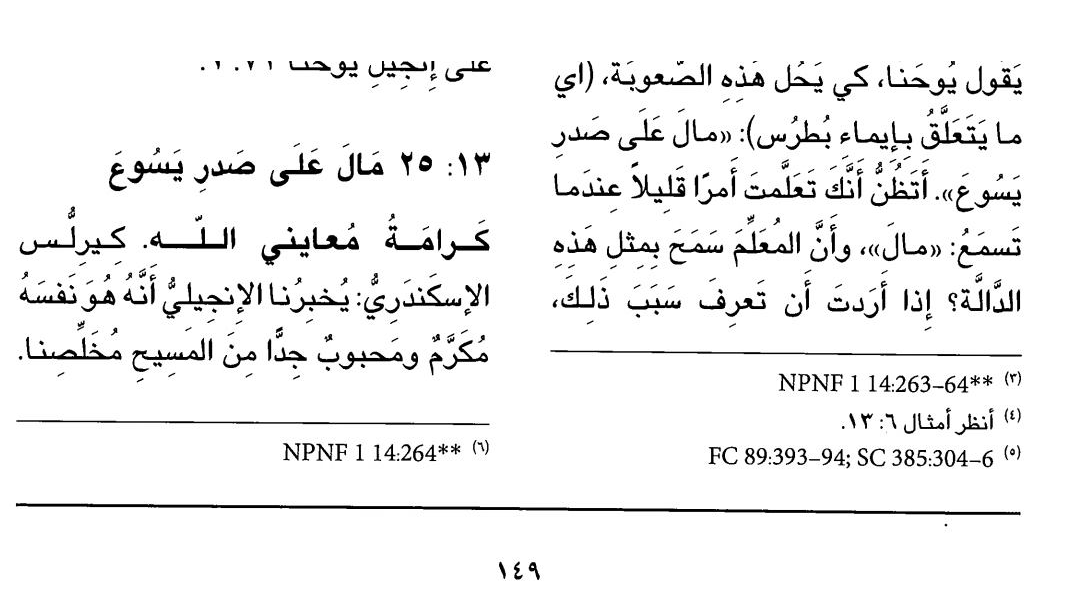
We read from the ancient Christian commentary, page 149-150:
“Cyril of Alexandria: The evangelist tells us that he himself is honored and greatly loved by Christ our Savior . He leans close to Jesus, or rather on his chest, and considers that an example of his great love for him . The pure of heart are close to God, and in the highest ranks. The Savior bestows honor upon them when he says: “Blessed are the pure of heart, for they shall see God.” Blessed are those who keep their thoughts pure from vain worldly concerns. Christ declares to them his glory that transcends reason, and shows that it is the glory of the Father, which is what he meant when he said: “He who has seen me has seen the Father.” Interpretation of the Gospel of John 9.
Leaning on the breast of the Word. Origen: When John leaned on the breast of the Word and rested more mystical rest, he was reclining in the bosom of the Word, which is in the bosom of the Father , as the book says: “The only begotten Son, God, who is In the bosom of the Father he is he who has declared it)) Gospel of John 32.264))
All this is a matter of obligation, as their sick logic leads to an abnormal understanding of this text, just as their sick minds - influenced by the texts of the Book of Songs and the words and metaphors in the Book of Ezekiel - understood the weak hadith mentioned above. Otherwise, Christ and Muhammad, may God bless them and grant them peace, would have been obscene from this sick logic that they adopted .
May God bless our master Muhammad and his family and companions and grant them peace.