Ibn Kathir and “Samad”: Refuting the Claim That Allah’s Name Came from an Idol
Distortion of the Word “Samad” in Editions of Ibn Kathir’s Tafsir — Or Vice Versa?
Table of Contents
- Introduction
- The Dar Ihya Al-Kutub Al-Arabiyya Edition
- The Dar Ibn Hazm Edition
- Returning to Ibn Ishaq Ends the Doubt
- The Error Is in the Mukhtasar Not Tafsir Ibn Kathir
- Earlier Commentators Mentioned Sada Not Samad
- Even If It Were Samad It Would Still Not Touch Allah’s Name
- Verified Editions of Tafsir Ibn Kathir
- Conclusion
Introduction
This article responds to the claim that the word “Samad” appears as the name of an idol in editions of Ibn Kathir’s Tafsir, and whether this implies a distortion in the editions of Ibn Kathir or creates a problem for the Qur’anic name Al-Samad.
The Dar Ihya Al-Kutub Al-Arabiyya Edition
In Ibn Kathir’s interpretation, published by Dar Ihya’ Al-Kutub Al-Arabiyya – Part 2 – Page 225
https://www6.0zz0.com/2019/11/07/02/610782150.jpg
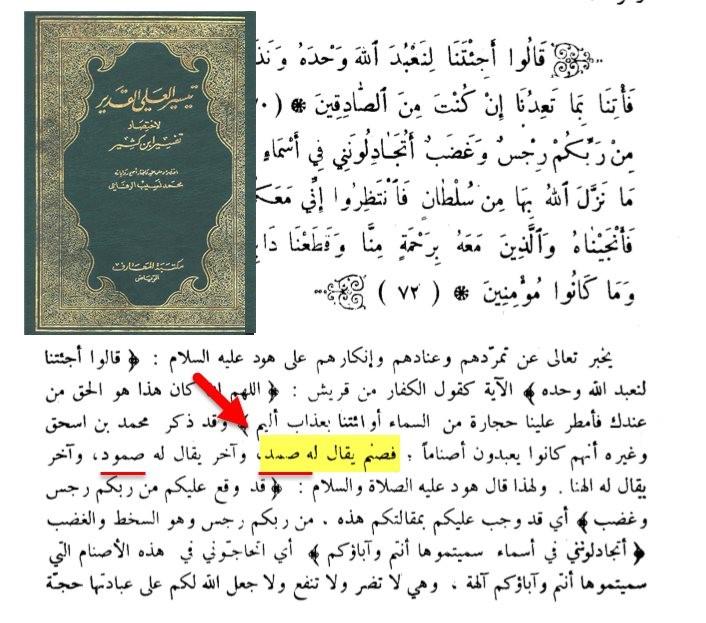
The name of the idol is Samad
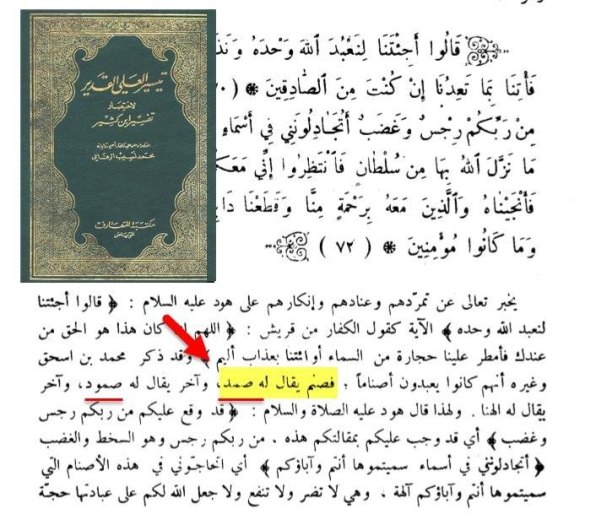
This scan is being used to show the reading found in the Dar Ihya’ Al-Kutub Al-Arabiyya edition, Part 2, page 225. In this printed edition, the idol’s name appears as“Samad”. This is the reading used by the objector to build the doubt. The argument of the article is not that this printed page does not exist, but that this reading is a print-related mistake or a mistake in the abridged version, because the wider textual evidence from Ibn Ishaq, al-Tabari, Ibn Abi Hatim, al-Baghawi, al-Khazin, and verified editions of Tafsir Ibn Kathir all support “Sada’ / Sada”, not “Samad.”
The Dar Ibn Hazm Edition
In the Dar Ibn Hazm edition, the name of the idol is Sada
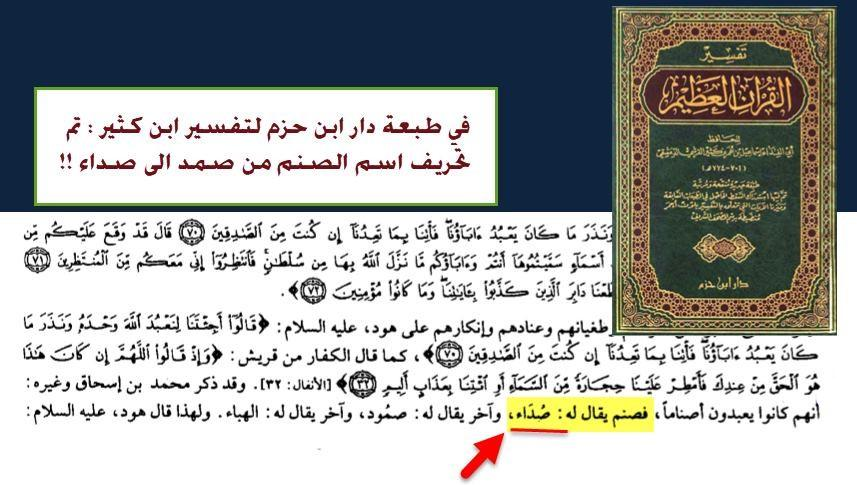
This scan shows the Dar Ibn Hazm edition, where the idol’s name is printed as“Sada” rather than “Samad.” This directly weakens the objection because it shows that a verified edition does not preserve the alleged problematic reading. The scan supports the article’s claim that the proper name in the transmitted report is Sada / Sada’, and that the appearance of Samad in another printed edition is not enough to establish that Ibn Kathir himself wrote it that way.
Returning to Ibn Ishaq Ends the Doubt
First: When Ibn Kathir quotes from Ibn Ishaq, we must return to what Ibn Ishaq said… if we seek the truth of the transmission and not deception… this is the narration of Ibn Ishaq with the chain of transmission, in which the name “Sada” appears, not “Samad,” and this ends the entire doubt.
“Ibn Hamid told us, he said, Salamah told us, on the authority of Ibn Ishaq, he said, the dwellings of Aad and their group, when God sent Hud among them, were Al-Ahqaf. He said: “Al-Ahqaf” is the sand, between Oman and Hadhramaut, and all of Yemen. (4) And despite that, they had spread throughout the land, and conquered its people by virtue of the strength that God had given them. And they were the owners of idols that they worshipped instead of God: an idol called ” Sada ,” an idol called ” Sammud ,” and an idol called ” Al-Haba .” So God sent Hud to them… ”
The narration of Ibn Ishaq itself has Sada, not Samad. Since Ibn Kathir is quoting Ibn Ishaq, the correct way to verify the word is to return to Ibn Ishaq’s transmitted wording.
The Error Is in the Mukhtasar Not Tafsir Ibn Kathir
The error only appeared in the printed Mukhtasar and not in Ibn Kathir’s tafsir itself. This shows how the one who presents the doubt cannot do more than mislead his readers.
“Muhammad ibn Ishaq and others mentioned that they used to worship idols, one idol called Sada’, another called Sumud, and another called al-Haba’.”
The idol’s name is Sada’, not Samad.
Earlier Commentators Mentioned Sada Not Samad
Third: What Ibn Ishaq narrated and the commentators transmitted centuries before Ibn Kathir, and in his time, from which we know that the idol’s name is Sada or Sada’ or Sana and not Samad.. I will quote some of them to block the path of the objector
1. Al-Baghawi
The ‘Aad disobeyed their messenger, so they spent the night… thirsty, and the sky would not quench their thirst.
They had an idol called Sumud … Opposite it are Sada’ and Al-Haba’.
So the Messenger showed us the path of right guidance… So we saw the guidance and dispelled the blindness.
So the idol’s name is Sada’ and not Samad.
2. Al-Tabari
“An idol called Sada’, and an idol called Sumud, and an idol called Al-Haba’.”
So the idol’s name is Sada’, not Samad.
3. Ibn Abi Hatim Al-Razi
“And Muhammad Ibn Ishaq narrated to us with it, and it was from the hadith of ‘Aad, as far as I have been informed, and God knows best, that they were an Arab people, and they were idolaters who worshipped them instead of God. An idol called Sada’, another called Sumud, and an idol called AlHaba’. Then Allah, the Almighty, sent Hud to them, and he commanded them to worship Allah alone, and not to associate any god with Him, and to refrain from oppressing people. He did not command them in what they mentioned, and Allah knows best.”
The idol’s name was Sada’, not Samad.
4. Al-Khazin
“An idol called Sada’, an idol called Samud, and an idol called Al-Haba’.”
The idol’s name is Sada’, not Samad.
Even If It Were Samad It Would Still Not Touch Allah’s Name
Because any name is an attribute. But if you apply it to Allah Almighty, it is preceded by the definite article.
So you are generous and so-and-so is generous, but Allah is the generous. With the definite article.
And you are alive and I am alive, but Allah is the living.
So look at the introduction of the definite article to the name so that it is specific to Allah.
So if it is mentioned with the definite article, it is not used in the language except for Allah.
Therefore, the objector remains burdened with composing a linguistic rule that limits the name to the idol alone.
Rather, he must find a link that connects them, and this is impossible for his likes.
So his claim is invalidated.
Verified Editions of Tafsir Ibn Kathir
Dar Ibn Hazm Edition
The above edition of Dar Ibn Hazm is sufficient for you. It is one of the best verified editions free of omissions.

This scan is presented as further support from the Dar Ibn Hazm edition. It confirms the readingSada’ / Sada, not Samad. The article uses this edition because it is described as one of the strongest verified editions and free from omissions. The point of the scan is that a carefully checked edition of Tafsir Ibn Kathir does not support the claim that Ibn Kathir’s original wording was Samad.
Dar Taiba Edition
Then the Dar Taiba edition
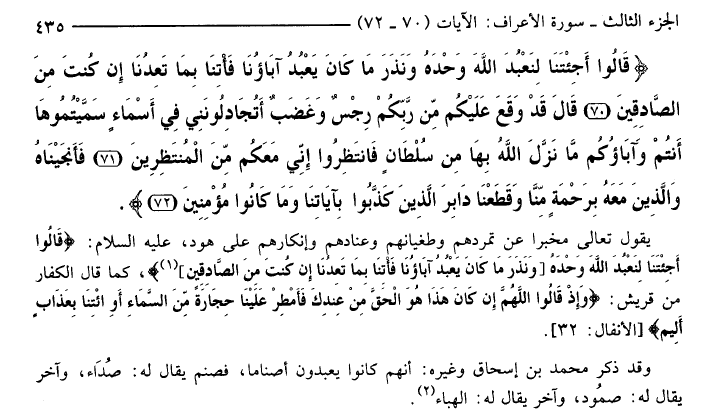
This scan is from the Dar Taiba edition of Tafsir Ibn Kathir. It is included to show that another well-known printed edition also gives the idol’s name asSada’ / Sada, not Samad. This supports the article’s central claim that the reading Samad is not the stable reading of Tafsir Ibn Kathir across proper editions.
Al-Hawini’s Edition
Also, Al-Hawini’s edition is one of the best verified editions:
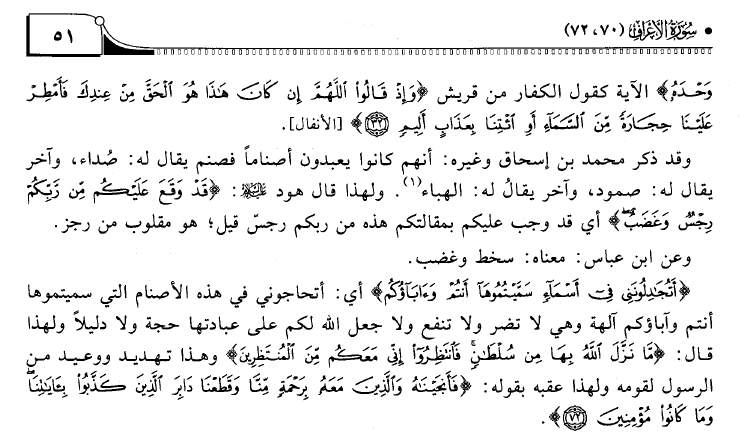
This scan is from Al-Hawini’s verified edition. It is used as another witness that the correct printed wording isSada’ / Sada rather than Samad. Since this is described as one of the best verified editions, the scan strengthens the argument that the objection is built on a weak or mistaken printed reading, not on the actual reliable transmission of the text.
Conclusion
The distortion is not in the interpretation or its printed books.. and there is no one who is concerned with deliberately distorting this, but it is the conspiracy theory and the space and void that has nested in the minds of these people.
Even if one hypothetically accepted the mistaken reading Samad, it would still not affect the Qur’anic name Al-Samad, because the Qur’anic form is definite and specific to Allah.
The objection collapses both textually and linguistically.