

“I Was Commanded to Fight the People”: Does This Hadith Teach Forced Conversion?
No Compulsion in Religion vs. “Fight the People”: Is There a Contradiction?
Table of Contents
- Introduction
- The Hadith Being Misused
- The Correct Meaning of the Hadith
- Ibn Taymiyyah: The Hadith Refers to Those Waging War
- The Word “People” Can Be Restricted by Context
- The Hadith Variant: “I Was Commanded to Fight the Idolaters”
- Ibn Hajar on the Restricted Meaning
- The Qur’anic Example of “The People” Meaning Specific People
- The Prophet Recited a Verse Against Compulsion
- Ibn Rajab: The Prophet Was Not a Dictator Over Faith
- The Qur’an Commands Fighting Aggression, Not Forced Conversion
- Peace Must Be Accepted When the Enemy Inclines to Peace
- Protection for Idolaters Who Seek Asylum
- Ibn Taymiyyah and Ibn al-Qayyim on Fighting Only Combatants
- Reconciling “No Compulsion in Religion” With Jihad
- Fighting Armies Does Not Mean Killing Populations
- The Conquest of Mecca as Proof
- A Note on Asbab al-Nuzul Terminology
- Scan Evidence
- Conclusion
Introduction
“I have been commanded to fight the people until they testify that there is no god but Allah and that Muhammad is the Messenger of Allah.”
The objection claims that this hadith teaches forced conversion or universal war against all non-Muslims.
That reading is false.
The correct interpretation is that the hadith refers to a specific category of hostile idolaters who were fighting and persecuting the Muslim community.
It does not mean Muslims are commanded to force every person on earth to become Muslim.
The Hadith Being Misused
“I have been commanded to fight the people until they say there is no god but Allah and Muhammad is the Messenger of Allah.”
Source: Sahih al-Bukhari 25
Grade: Sahih
This is a shallow reading because it ignores the Qur’an, the variant narrations, the Prophet’s own practice, and the explanations of major scholars.
The Correct Meaning of the Hadith
It does not mean Muslims should force people to enter Islam or fight all people in general.
The hadith must be interpreted with all relevant Qur’anic verses and hadith narrations, not ripped out of context.
Ibn Taymiyyah: The Hadith Refers to Those Waging War
Ibn Taymiyyah commented on this tradition:
It does not mean to fight those who have made peace, with whom Allah has commanded us to fulfill their peace.
Source: Majmu‘ al-Fatawa 19/20
Ibn Taymiyyah explicitly says the hadith refers to those who wage war, not peaceful people or treaty-holders.
The Word “People” Can Be Restricted by Context
We should bring together all the narrations and verses that mention the context in which the Prophet, peace and blessings be upon him, made this statement.
The hadith must be interpreted comprehensively and consistently.
Context determines the intended group.
The Hadith Variant: “I Was Commanded to Fight the Idolaters”
In another narration, the Prophet, peace and blessings be upon him, said:
“I have been commanded to fight the idolaters.”
Source: Sunan Abi Dawud 2642
Grade: Sahih
It refers to the hostile idolaters involved in aggression against Islam and the Muslims.
Ibn Hajar on the Restricted Meaning
Ibn Hajar commented on this tradition:
The answer is that the general statement is specified, as it refers to the achievement of an objective.
Source: Fath al-Bari 1/77
If the hadith literally meant fighting every non-Muslim without exception, then there would be no place for jizyah, treaties, peace agreements, or protected non-Muslim communities.
Since all of these exist in Islamic law, the hadith cannot mean universal forced conversion.
The Qur’anic Example of “The People” Meaning Specific People
Allah Almighty says:
Surah Ali ‘Imran 3:173
Al-Suyuti explains this verse:
“Indeed, the people” means Abu Sufyan and his companions have gathered against you.
Source: Tafsir al-Jalalayn 3:173
Likewise, the hadith uses “the people” in a restricted sense, as proven by other narrations and legal evidence.
The Prophet Recited a Verse Against Compulsion
The hadith does not demand that idolaters accept Islam on a personal religious level by force.
In a variant of the hadith, the Prophet, peace and blessings be upon him, recited verses that prohibit religious domination.
Jabir reported that the Messenger of Allah, peace and blessings be upon him, said:
Then the Prophet, peace and blessings be upon him, recited:
إِنَّمَا أَنْتَ مُذَكِّرٌ لَسْتَ عَلَيْهِمْ بِمُصَيْطِرٍ
“Verily, you are only a reminder. You are not over them as a dictator.”
Surah al-Ghashiyah 88:21–22
Source: Sahih Muslim 21
Grade: Sahih
This proves the hadith is not a license for forced conversion.
Ibn Rajab: The Prophet Was Not a Dictator Over Faith
Ibn Rajab commented on this tradition:
You do not have authority to enter faith into their hearts by force, and you are not responsible for that.
Source: Jami‘ al-‘Ulum wa al-Hikam 1/236
Islam requires belief, certainty, and inward submission.
Coerced speech is not real faith.
The Qur’an Commands Fighting Aggression, Not Forced Conversion
Allah said:
Surah al-Baqarah 2:193
Allah also said:
“If they remove themselves from you and do not fight you and offer you peace, then Allah has not made for you a cause against them.”
Surah al-Nisa’ 4:90
If the enemy ceases fighting and offers peace, Muslims are not given a cause to fight them.
Peace Must Be Accepted When the Enemy Inclines to Peace
Allah said:
“If the enemy inclines to peace, then incline to it also and rely upon Allah. Verily, it is He who is the Hearing, the Knowing.”
Surah al-Anfal 8:61
Ali ibn Abi Talib reported that the Messenger of Allah, peace and blessings be upon him, said:
“Verily, after me there will be conflicts or affairs, so if you are able to end them in peace, then do so.”
Source: Musnad Ahmad 697
Grade: Sahih
Protection for Idolaters Who Seek Asylum
It was not necessary for idolaters to accept Islam in order to receive protection.
If they discontinued hostility and sought asylum, Muslims were required to grant protection and safe passage, even if they did not accept Islam personally.
Allah said:
“If any one of the idolaters seeks your protection, then grant him protection so that he may hear the words of Allah, and then deliver him to his place of safety. That is because they are people who do not know.”
Surah al-Tawbah 9:6
The idolater is given safety, hears the message, and is then delivered to his place of safety.
Ibn Taymiyyah and Ibn al-Qayyim on Fighting Only Combatants
For this reason, scholars maintained that fighting in Islam is to repel aggression and make the world safe for the practice of Islam.
It is not permissible to fight people simply because they are non-Muslims.
Ibn Taymiyyah writes:
“The unbelievers are only fought on the condition that they declare war, according to the majority of scholars, as is evident in the Book and Sunnah.”
Source: al-Nubuwwat 1/140
Ibn al-Qayyim writes:
“The Prophet never forced the religion upon anyone. Rather, he only fought those who waged war against him and fought him. As for those who made peace with him or conducted a truce, he never fought them and never compelled them to enter his religion.”
Source: Hidayat al-Hayara 1/237
Reconciling “No Compulsion in Religion” With Jihad
The question is:
“There is no compulsion in religion”?
Surah al-Baqarah 2:256
The answer is clear.
“There is no compulsion in religion” means that a person is not forced to inwardly believe or personally embrace Islam by coercion.
It does not mean that there is no jihad, no defensive fighting, no fighting hostile armies, or no political rule.
Abdul-Muhsin al-Abbad explains that if a disbeliever is under Muslim authority, he is not told:
Either become Muslim or I will kill you.
Rather, he may remain under Islamic rule with covenantal protection.
But those who fight Islam and the Muslims are fought.
Individuals are not forced into belief.
Combatants and hostile armies may be fought.
Peaceful non-Muslims and treaty-holders are not fought.
Fighting Armies Does Not Mean Killing Populations
It is known that fighting is against armies.
An army fights another army.
An army does not fight a civilian population simply because they are not Muslim.
If Islam defeats disbelief militarily, this does not mean the general population is killed afterward.
The Conquest of Mecca as Proof
The clearest example is the conquest of Mecca.
The Messenger of Allah, peace and blessings be upon him, conquered Mecca and then released its inhabitants, even though the Islam of every single one of them had not been established individually.
This proves that the aim was the rule of Islam and the removal of hostile power, not forcing every individual to personally accept Islam at swordpoint.
It is impossible to force a person to embrace a belief they do not believe in.
Islam must be based on faith and certainty.
If doubt about Islam can be disbelief, then what about someone who does not believe in it at all and merely speaks under coercion?
Real Islam requires belief.
A Note on Asbab al-Nuzul Terminology
Sometimes they mean that the verse applies to that situation or includes its ruling.
Al-Zarkashi said in al-Burhan:
It is a type of argumentation for the ruling based on the verse, not a narration of what actually occurred.
Muqbil ibn Hadi al-Wadi‘i said:
It is explicit when the narrator says, “The reason for the revelation of this verse is such and such,” or when he uses the conjunction fa before the subject of revelation after mentioning the event or question.
The verse is ambiguous in its causality when the narrator says, “This verse was revealed concerning such and such.”
This is sometimes meant to be the reason for revelation and sometimes to be included in the meaning of the verse.
Source: al-Sahih al-Musnad min Asbab al-Nuzul, summarized from Mabahith fi ‘Ulum al-Qur’an by Manna‘ al-Qattan
Scan Evidence
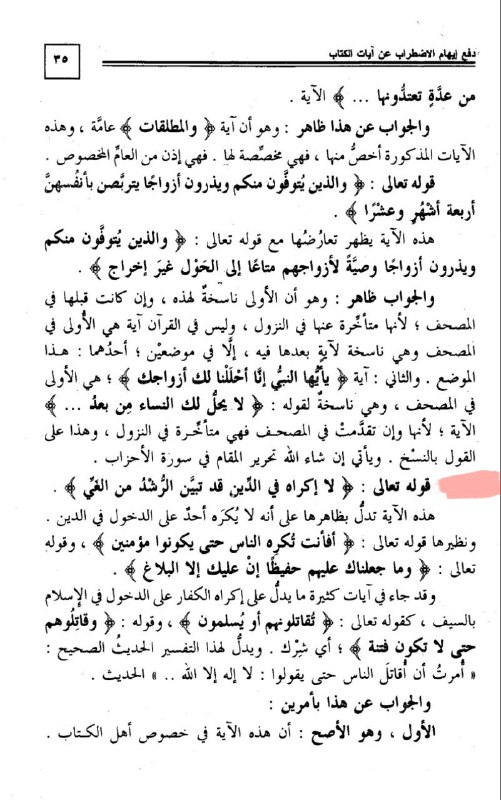
For your info: This Arabic scan discusses the verse “There is no compulsion in religion” and explains that its apparent wording rejects coercion into religion. The highlighted section notes that the verse is general in appearance and that it indicates a person is not to be forced into entering religion. It also connects the issue with other Qur’anic texts and the hadith “I have been commanded to fight the people until they say there is no god but Allah.” The point of the scan is to show that scholars did not understand the hadith as canceling the principle that faith itself cannot be coerced.
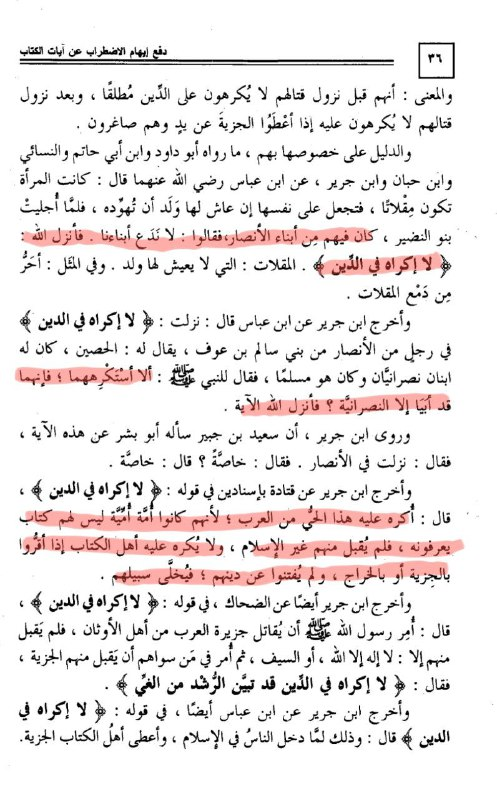
For your info: This scan continues the discussion of “There is no compulsion in religion.” The highlighted lines mention narrations connected to the Ansar and their children, including the context of Banu al-Nadir, where some of the Ansar had children among them and wanted to take them back into Islam. The scan also cites interpretations that the verse was revealed regarding such cases, while also mentioning the view that the Arabs were not accepted except through Islam, unlike People of the Book who could be accepted through jizyah. This page is important because it shows the juristic discussion: no compulsion into personal belief, while still recognizing political and military categories in Islamic law.
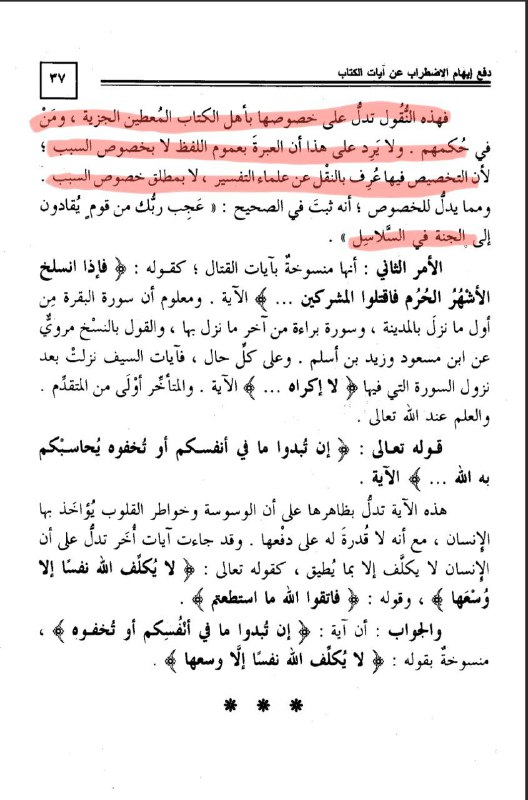
For your info: This scan states that the reports concerning “There is no compulsion in religion” specifically indicate People of the Book who pay jizyah, and that the general wording is not applied without restriction. The highlighted section also mentions that the verse’s wording is general, but the report from the scholars of tafsir applies it to a specific cause or category. The point being used in this article is that Qur’anic and hadith texts must be read through specification, context, and the full body of evidence, not through isolated slogans.
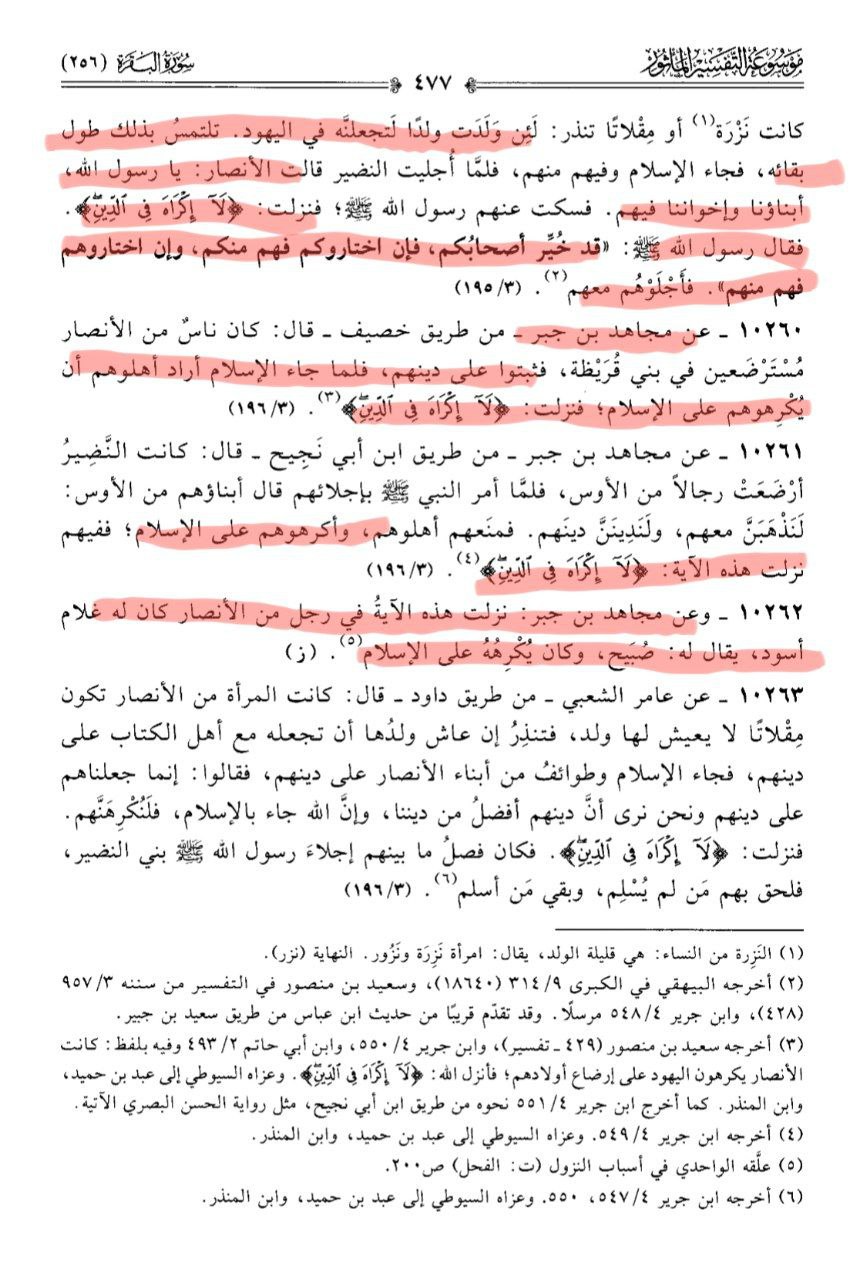
For your info: This Arabic scan is from Mawsu‘at al-Tafsir al-Ma’thur and collects narrations about “There is no compulsion in religion.” The highlighted narrations explain that the verse was connected to cases among the Ansar, including women who vowed to raise surviving children as Jews and then later wanted to compel them after Islam. It also includes reports from Mujahid and others that connect the verse to children among Banu Qurayzah or Banu al-Nadir. The scan supports the article’s point that the verse directly rejects forcing people into Islam, while the broader discussion of jihad concerns hostile power and combatant opposition, not coercing private belief.
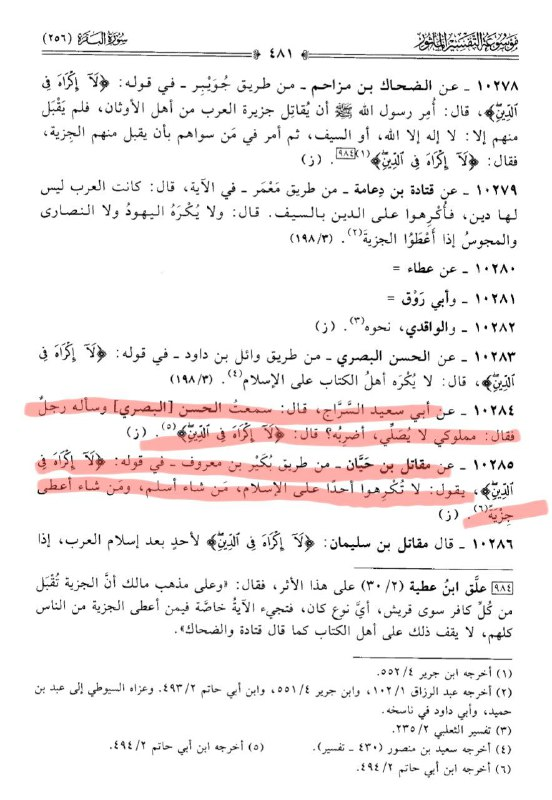
For your info: This scan continues the tafsir reports on “There is no compulsion in religion.” The highlighted section mentions narrations where the Prophet, peace and blessings be upon him, ordered fighting in relation to the Arabian Peninsula, while other reports state that Jews, Christians, and Magians were not to be coerced if they gave jizyah. This page helps clarify the difference between military-political conflict and personal religious compulsion. The article uses it to argue that the hadith about fighting is not a command to force every individual into Islam.
Conclusion
The word “people” is restricted by context and other narrations.
Another authentic narration says “I have been commanded to fight the idolaters,” clarifying the intended group.
Ibn Taymiyyah explained that the hadith refers to those waging war, not those who made peace.
Ibn al-Qayyim explicitly stated that the Prophet never forced anyone into religion.
The Prophet recited “You are only a reminder; you are not over them as a dictator” after mentioning the hadith, proving that faith itself was not forced.
The Qur’an commands Muslims to accept peace when the enemy inclines to peace.
The Qur’an commands Muslims to protect even an idolater who seeks asylum, let him hear the message, and then deliver him to safety.
Therefore, the objection collapses.
The hadith concerns hostile combatants and aggressive idolaters, not peaceful non-Muslims and not forced conversion.