

Islamic Treaties: Duration, Renewal, and the Scholars
A key question in Islamic jurisprudence concerns peace treaties with non-Muslim peoples: how long may they last, may they be renewed, and under what conditions may they be concluded even with adversaries? The scholarly consensus permits indefinite treaties when there is political advantage (!!maslaha!!) — and the Prophet’s ﷺ seerah is itself the proof.
The Quranic Foundation
“As for the polytheists who have honoured every term of their treaty with you and have not supported an enemy against you, honour your treaty with them until the end of its term. Surely Allah loves those who are mindful of Him.”
“And if they tilt towards peace, tilt towards it…”
This verse indicates that if the disbelievers seek peace, it is permissible to enter into a peace agreement with them. Some scholars hold that the permission in this verse is conditional upon the disbelievers taking initiative — that the verse in 47:35 prohibits Muslims from initiating peace. However, the authenticated ruling is that it is permissible for Muslims even to take initiative in negotiating peace if it is in the best interest of the Muslims — not from cowardice or involvement in a life of luxury. The Quranic use of the imperative“do not lose heart” (falā tahīnū) in 47:35 indicates the prohibition is against appeals for peace based on cowardice and flight from jihad. There is therefore no conflict between the two verses — 8:61 concerns peace in the Muslims’ interest, while 47:35 prohibits peace based on weakness. Allah knows best.
The Duration of Treaties — Scholarly Positions
Ibn al-Qayyim — Two Opinions, One Correct
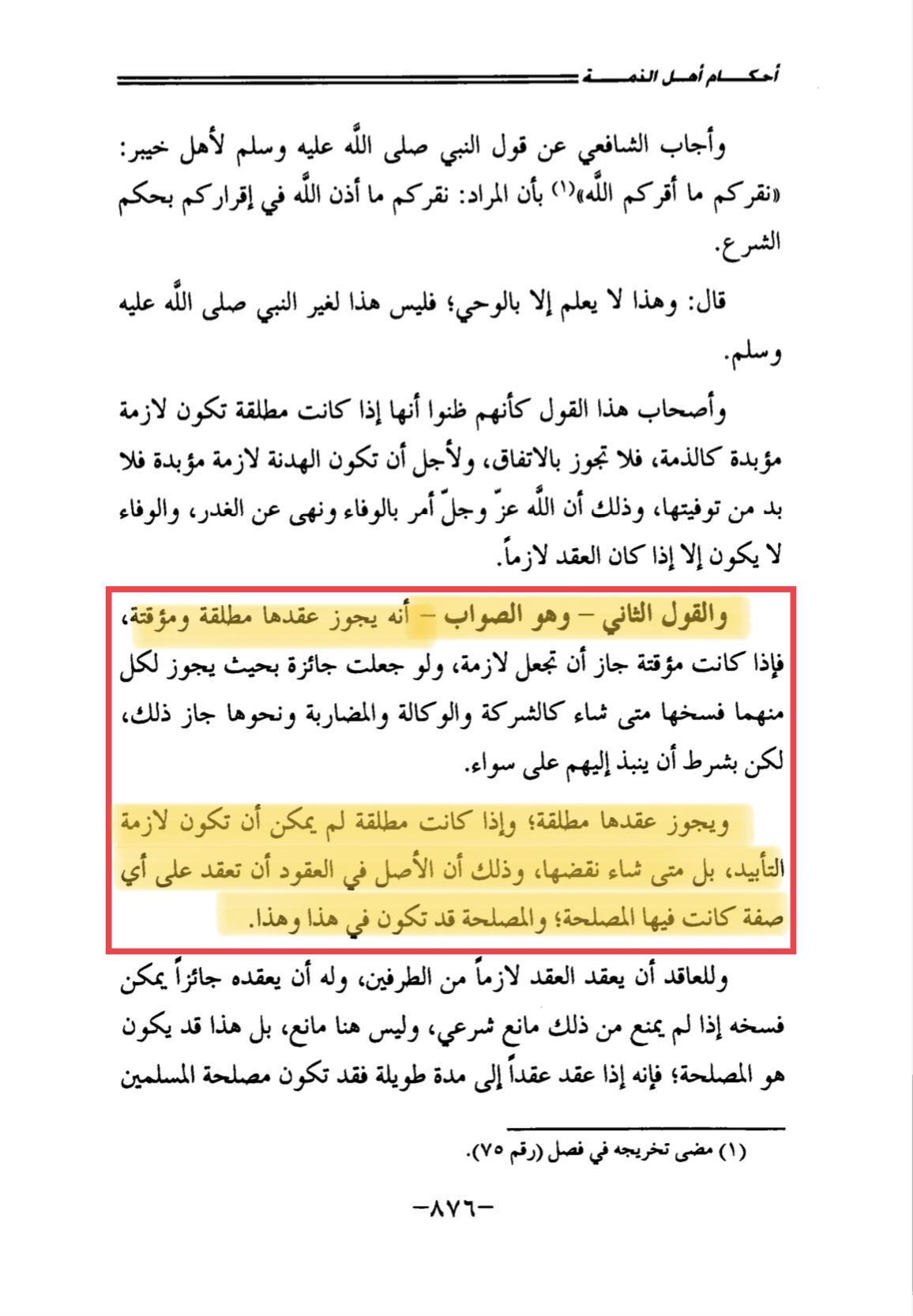
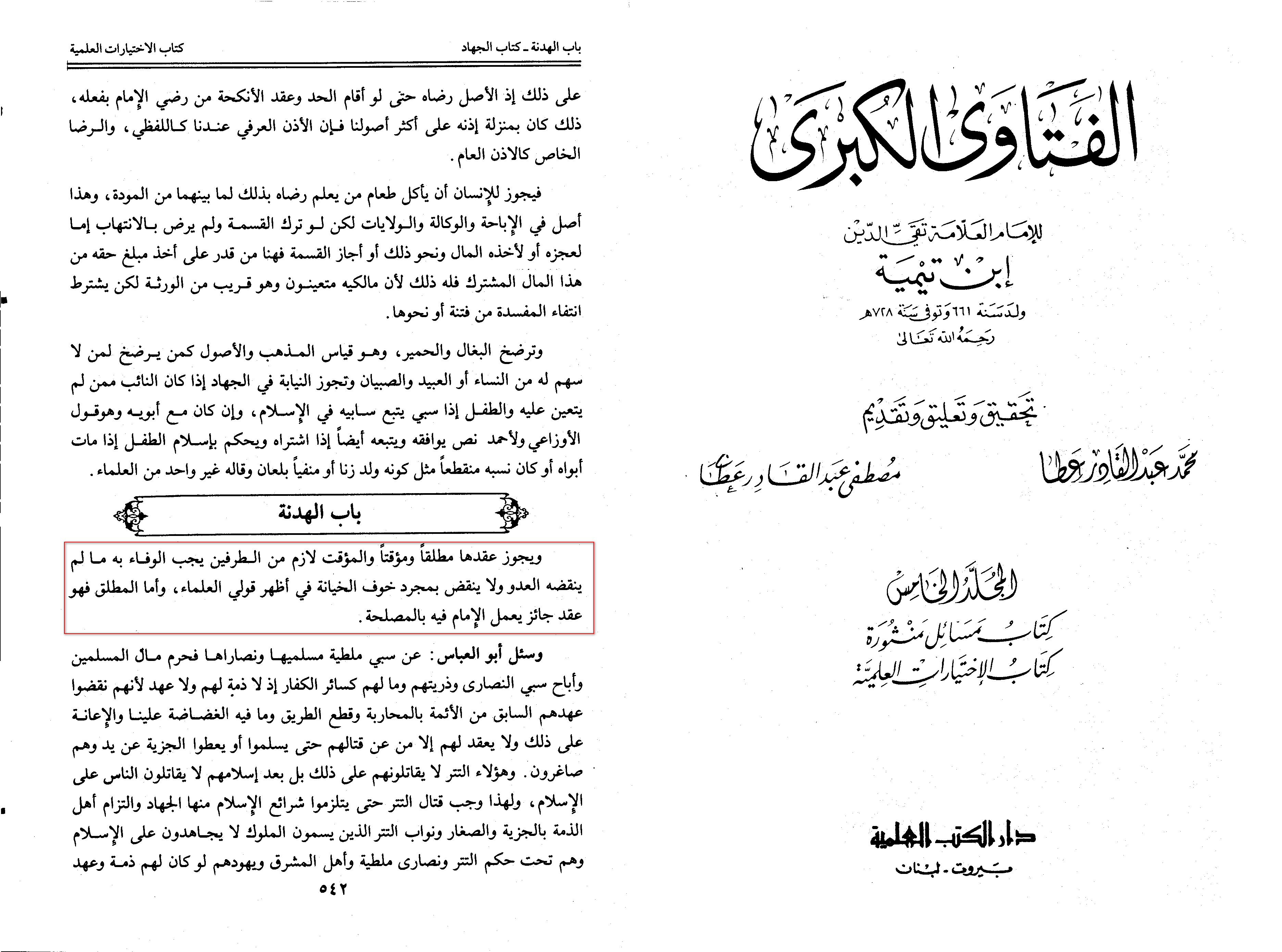
In Ahkam Ahl al-Dhimma (876), Ibn al-Qayyim presents two opinions regarding treaty duration — limited or indefinite — then establishes that the indefinite (forever) position is permissible and is the correct view, with the ruler doing what is better for his people. This is the madhab of Abu Hanifa.
The following source images are from this work:
The advantage of an indefinite treaty — as Abu Hanifa stated — is that it prevents the killing of Muslims while preserving the option to end the treaty if its purpose is no longer served.
This is also the madhab of Imam Malik:
The Maliki school likewise permits the indefinite mu’ahada — a treaty that continues until one party breaks it.
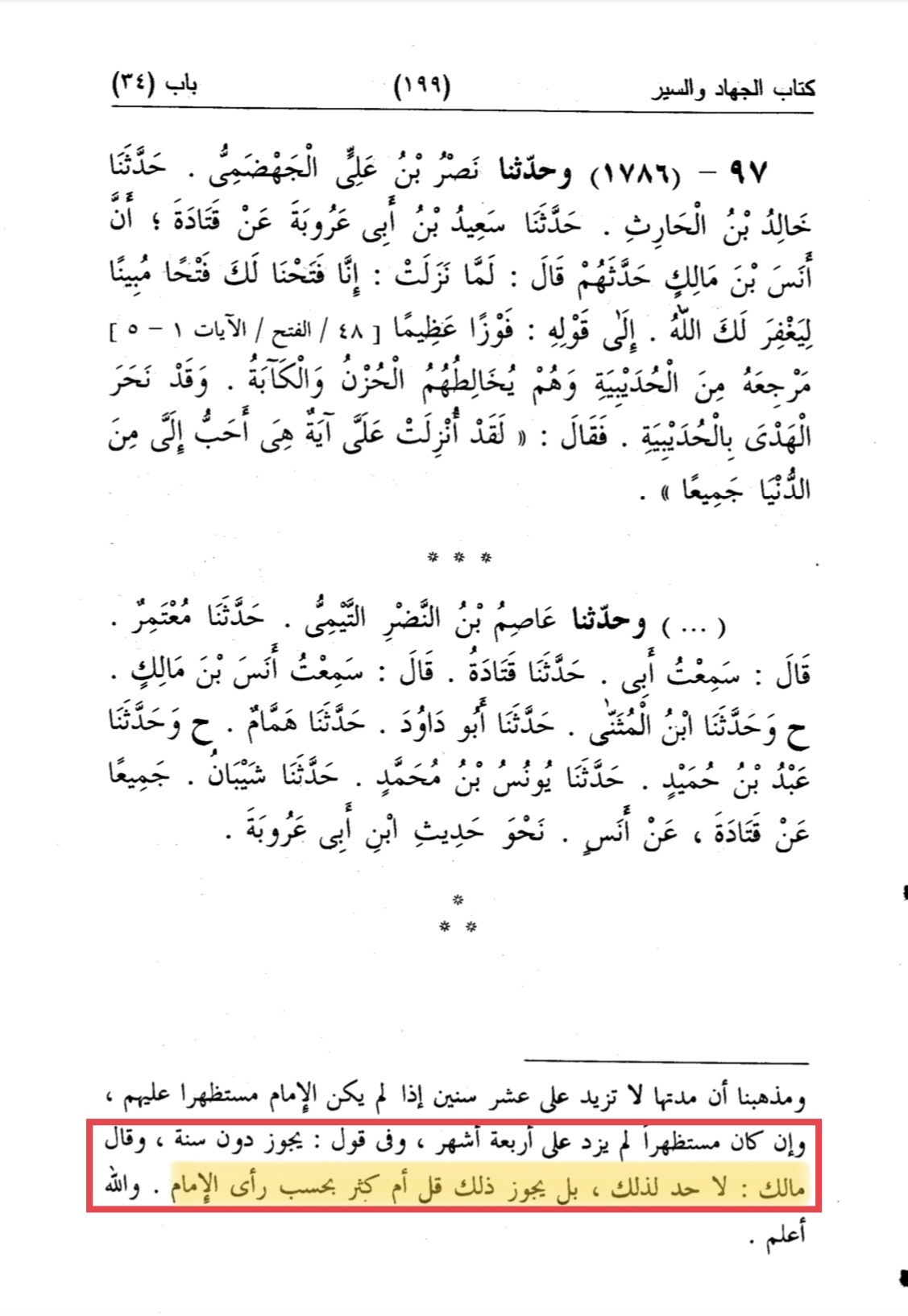
If a treaty ends, it may be renewed. The mu’ahada (peace covenant) may be established for an indefinite time or until it is broken — as Abu Hanifa stated, because the advantage lies in not killing Muslims.
Ibn Taymiyyah — The Prophet’s ﷺ Seerah Is Mutawatir on This
[!scholar] Ibn Taymiyyah — Qa’idah Mukhtasarah fi Qital al-Kuffar (p.134)
“And his seerah was that all of those who alleged a treaty and did not fight him from the disbelievers, he ﷺ did not fight them — and that is in the books of seerah, hadith, tafsir, fiqh and maghazi, and it is mutawatir (mass-transmitted) in his seerah. So he never started to fight any of the disbelievers. If Allah had ordered him to fight every kafir, he would have done the negation of this.”
[!scholar] Ibn Taymiyyah — Al-Fatawa al-Kubra (5/542)
“It is permissible to have a treaty with an undetermined time and with a determined time. As for the undetermined time, the imam should work with the political advantage (maslaha).”
Ibn Taymiyyah also held that offensive jihad is directed toward hirabah (aggression/banditry) — and he affirmed the Hanafi and Maliki position that if a country allows Muslims to live in peace, it is dar al-Islam and impermissible to attack. Attacking such a country without danger or darar (harm) would merely spill Muslim blood — which is impermissible.
The full discussion of the Hudaybiyyah treaty and its implications for the duration and conditions of peace agreements is documented at:
https://discover-the-truth.com/2017/02/05/revisiting-the-hudaybiyyah-treaty/

As-Sakhawi — When Peace Is Sought and When It Is Not
[!scholar] As-Sakhawi — Jamal al-Qurra’ (1/715)
“Allah’s command regarding the treaty (sulh) applies when they have indicated they need it and asked for it. The prohibition in Surah Muhammad is against him ﷺ initiating the treaty offer. Also, if there is no treaty, they are in a state of war.”
Al-Barbarti — Advantage Is the Criterion
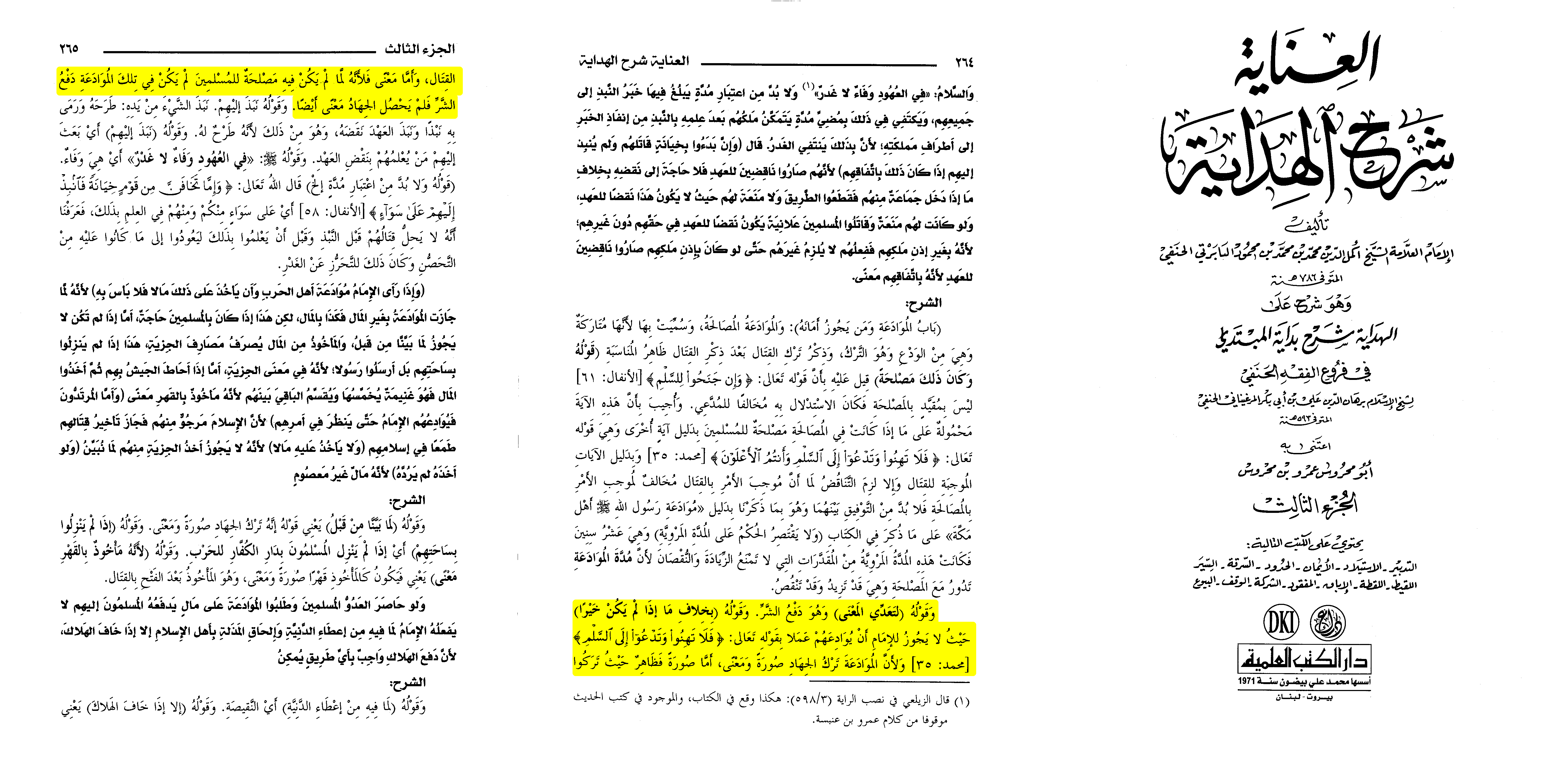
[!scholar] Al-Barbarti — Al-Inayah Sharh al-Hidayah (3/264-265)
“Because the objective has been accomplished — which is to push off evil. On the contrary, if one is not good, then it is not permissible for the ruler to write a peace treaty with them, for writing a peace treaty is leaving jihad in image and meaning: as for the image, it is clear, as they left fighting; as for the meaning, there has been no advantage to the Muslims and there was no pushing off of the enemy’s evil. This was an explanation of the author’s saying that there is no problem in writing a peace treaty in an undetermined time.”
From this we understand: even if the Muslims are strong, if there is an advantage in writing a peace treaty, there is no problem writing it in an undetermined time — as the Prophet ﷺ did at Hudaybiyyah.
The Hanafi Positions on Specific Treaty Scenarios
The Ahnaf have permitted peace treaties even with apostates if those apostates formed a country and the concern is that attacking them would harm Muslims:
The permissibility extends to the contracted country not being required to return those who came to them as apostates — whether man or woman:
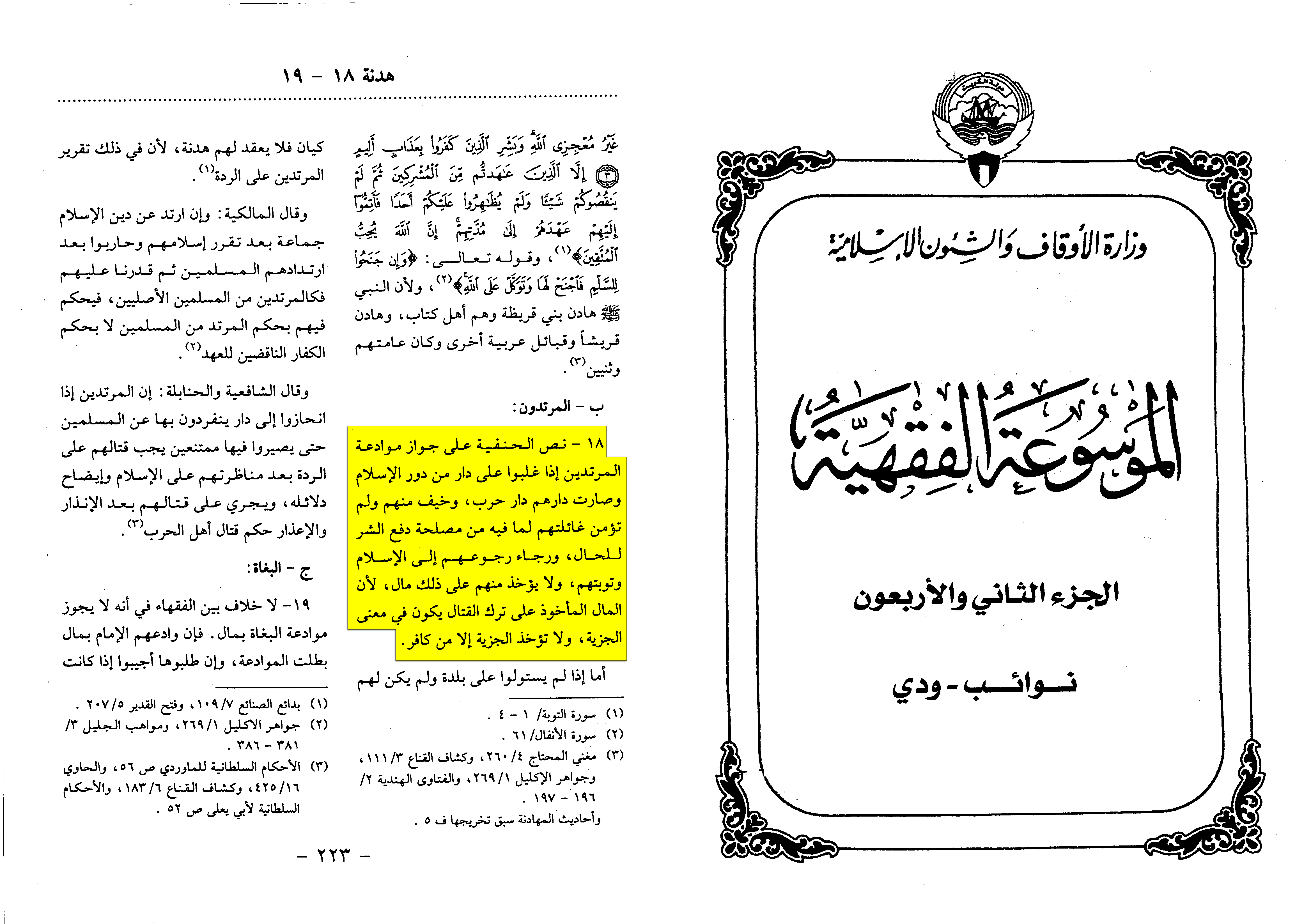
Further Hanafi positions from Al-Mawsu’a al-Fiqhiyya al-Kuwaitiyya:
- It is permissible according to the vast majority of scholars to return males who came as Muslims to our country (ibid p.213).
- The Ahnaf hold that a treaty may be in an undetermined time unless there is no maslaha — because they can conclude it whether strong or weak, for objectives such as stopping evil or spreading Islam more easily (ibid p.213).
It is also permissible, according to Bada’i al-Sana’i, for the ruler to contract with the enemy that if war breaks out, they will be enslaved rather than killed:
The Second Position: Staying on Treaty Terms When There Is No Fear of Treason
When there is maslaha (political advantage) and no fear of treason from the other party, the ruling is to remain on treaty terms. If a country is peaceful and allows Islam inside it, the objective has already been achieved — attacking such a country would merely result in unnecessary bloodshed and may cause the country to become unsafe for Muslims. This position reconciles fully with the Quranic command and the prophetic seerah.
The Hadith: Faithfulness to Covenants Is Obligatory
Grade: Sahih · Al-Albani
Islamic law permits peace treaties of indefinite duration when there is political advantage for the Muslims — this is the position of Abu Hanifa, Malik, Ibn Taymiyyah, al-Barbarti, and al-Sakhawi, supported by the mutawatir seerah of the Prophet ﷺ who never initiated fighting against anyone who held a treaty with him. The criterion is maslaha: if a country is at peace with Muslims and allows Islam, the objective is achieved and war is forbidden. When a treaty is in force, it must be honoured in full — as Mu’awiyah himself demonstrated at the instruction of Amr ibn Abasah, returning his entire army rather than exploiting a technical timing window.
...betrayal during a critical military crisis. Related Posts For context, see: [[islamic-treaties-duration-renewal-and-the-scholars]] Must read:...