John 5:4 Is Not in the Bible: Manuscript Evidence Exposes a Major New Testament Distortion
Distortion of the Text of the Holy Bible — John 5:3-4 (The Pool of Bethesda)
Blessed is He who placed constellations in the heaven and placed therein a lamp and an illuminating moon. And it is He who made the night and the day in succession for whoever desires to remember or desires to be grateful. And prayers and peace be upon Muhammad, the one sent as a guide, a bearer of good tidings, and a warner.
And after that… Continuation of the series of distortions of the text of the Holy Bible…
Table of Contents
- The Context — John 5:1-9
- The Problem — The Distorted Passage
- Text Format in Arabic Translations
- The Meaning of Putting the Text Between Square Brackets
- The Two Texts in Greek — Traditional Versions
- The Form of the Text in the Critical Greek Versions
- What Scholars Said About This Text
- What Scholars Said About the Authenticity of the Text
- Why Did Josephus and Philo Not Mention This Event?
- Detailed Scholar Commentaries
- UBS Committee — Detailed Manuscript Evidence
- Text in Manuscripts — Images
- Source Reference Images
- Conclusion
The Context — John 5:1-9
The context of the fifth chapter of the Gospel speaks of Jesus healing a paralyzed man. Jesus went to a pool of water called the Pool of Bethesda, and found there a large crowd of sick and mentally ill people. The reason for their gathering was that this water was blessed, as an angel descends into the water and stirs it, and after that, anyone who stepped into the water immediately after this event would be healed of any disease. This is the full context:
The Problem — The Distorted Passage
Text Format in Arabic Translations
Text Number 3
1 — Translations that mention the full text:
[Van Dyke][Jn. 5.3] “In these were lying a great multitude of sick people, blind, lame, paralyzed, waiting for the moving of the water.”
[Sarah][Jn. 5.3] “And there were in the corridors a group of sick people, blind, lame, and paralyzed, waiting for the moving of the water.”
[Sheriff][Jn.5.3] “There are many sick people lying there, including the blind, the lame, and the paralyzed, waiting for the water to be stirred.”
[Paulusian][John 5.3] “And under these porches lay a great multitude of sick people, including the blind, the lame, and those with withered limbs, waiting for the water to boil.”
2 — Translations that omit the phrase “they expect the water to move”:
[كاتوليكية][Jn.5.3] يضجع فيها جمهور من المرضى بين عميان وعرج وكسحان.
[يسوعية][Jn.5.3] يضجع فيها جمهور من المرضى بين عميان وعرج وكسحان.
3 — Translations that put the phrase “they expect the water to move” in parentheses:
[Shared][Jn.5.3] “And there was in the corridors a group of sick people, some blind, some lame, some paralyzed, waiting for the moving of the water.”
Text Number 4
1 — Translations that mention the text:
[VANDYK][JN. 5.4] “For an angel went down at a certain time into the pool and stirred up the water. Then whoever first stepped in after the stirring of the water was made well of whatever disease he had.”
[Simplified][John 5.4] “And from time to time an angel went down into the pool and stirred the water. And the first one to go into the pool after the stirring of the water was healed of whatever disease he had in it.”
[Sarah][John 5:4] “For the angel of the Lord went down at certain times into the pool and stirred up the water. Then whoever stepped in first after the stirring of the water was made well of whatever disease he had.”
[Sharif][Jn. 5.4] “Because they believed that an angel would sometimes go down into the pool and stir up the water, and the first one to go down after the stirring of the water would be healed, no matter what his illness was.”
2 — Translations that delete the text:
[Catholic][Jn.5.4] (deleted)
[Jesuit][Jn.5.4] (deleted)
3 — Translations that put the text between square brackets:
[Paulusian][John 5:4] [For the angel of the Lord went down into the pool from time to time, and stirred up the water. And it came to pass that whoever first went in after the stirring of the water was made well of whatever his illness was.]
[Shared][John 5.4] [For the angel of the Lord went down at a certain time into the pool and stirred up the water. Then whoever stepped in first after the stirring of the water was made well of whatever disease he had.]
The Meaning of Putting the Text Between Square Brackets
Here are references that confirm this point (the most famous UBS cash version ever — the Westcott and Hort cash version — the Net Bible cash version):
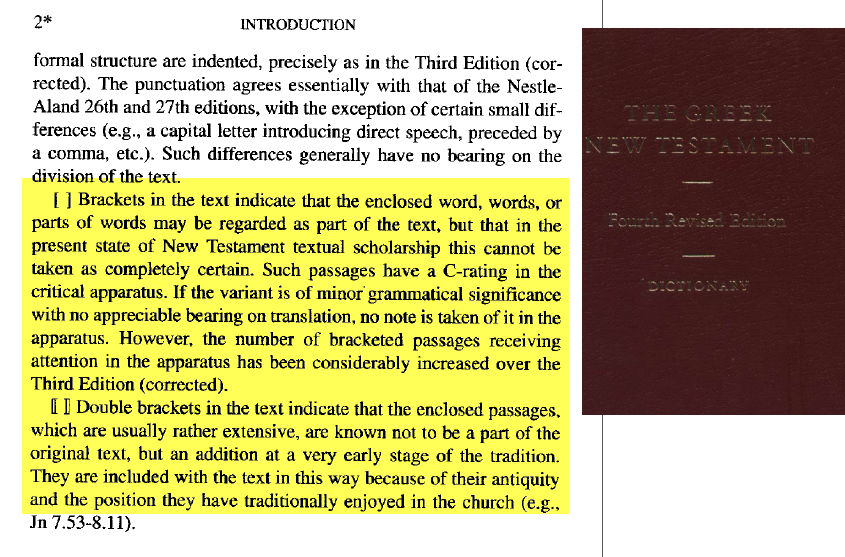
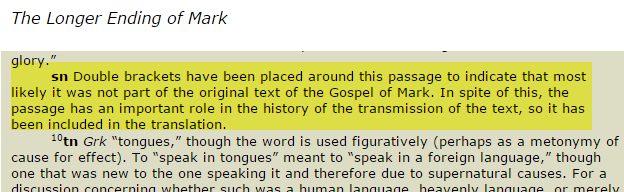
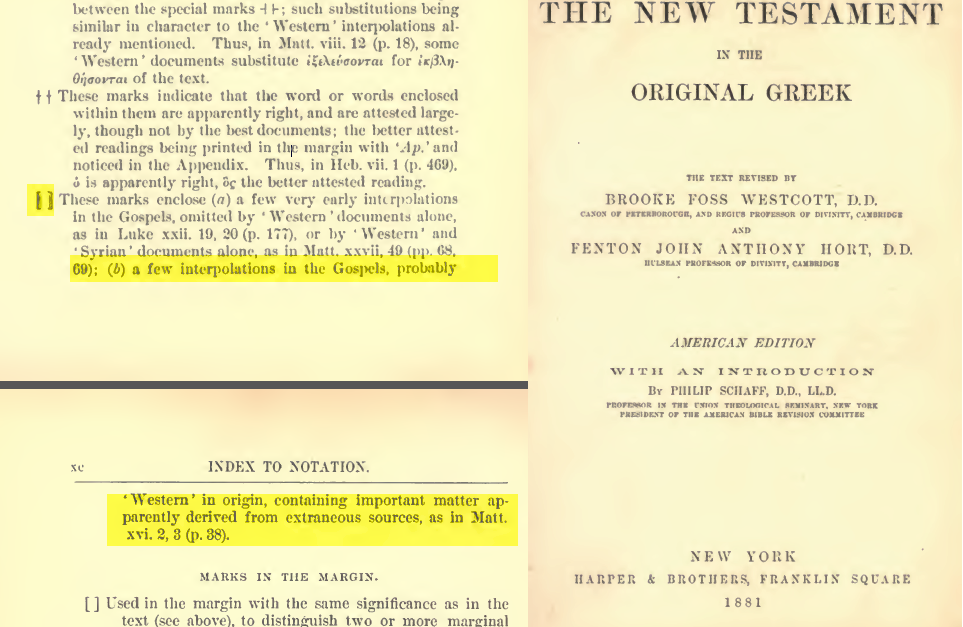
The Two Texts in Greek — Traditional Versions
The Form of the Text in the Critical Greek Versions
2 — Text No. 4 in full is deleted from all critical copies: UBS — NA28 — W&H — Samuel TR — Von Soden — Tichendorf — SBL
BNT John 5:3 “In these lay a multitude of sick people, blind, lame, withered.”
GNT John 5:3 “In these lay a multitude of sick people, blind, lame, withered.”
TIS John 5:3 “In these lay a multitude of sick people, blind, lame, withered.”
VST John 5:3 “In these lay a multitude of sick people, blind, lame, withered.”
WHT John 5:3 “In these lay a multitude of sick people, blind, lame, withered.”
NJB John 5:4 (empty)
BNT John 5:4 (empty)
GNT John 5:4 (empty)
TIS John 5:4 (empty)
VST John 5:4 (empty)
WHT John 5:4 (empty)
1 — UBS Version
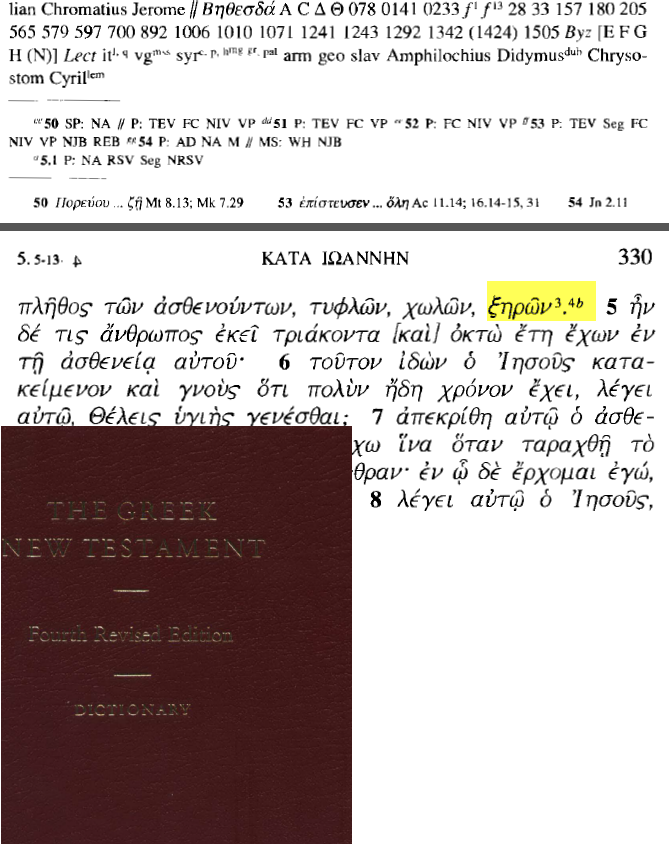
2 — The Famous Nestle Aland Version NA26
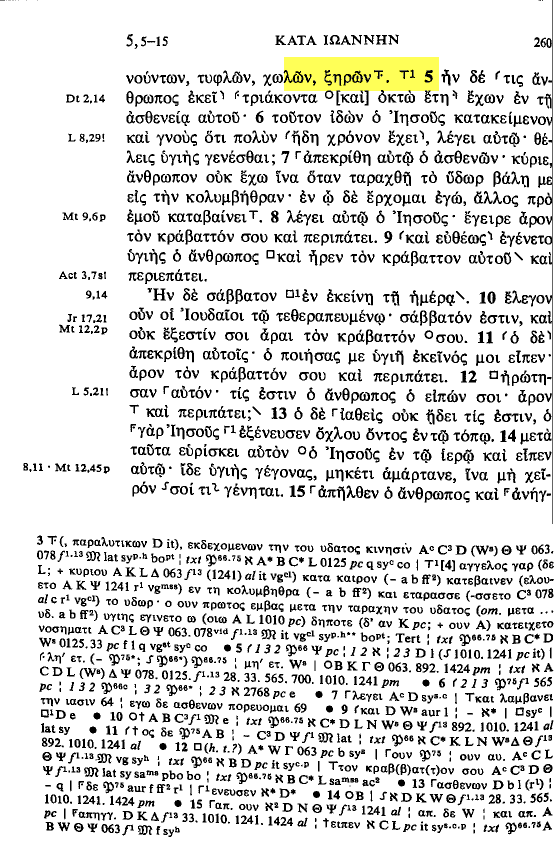
3 — The Famous Westcott and Hort Version
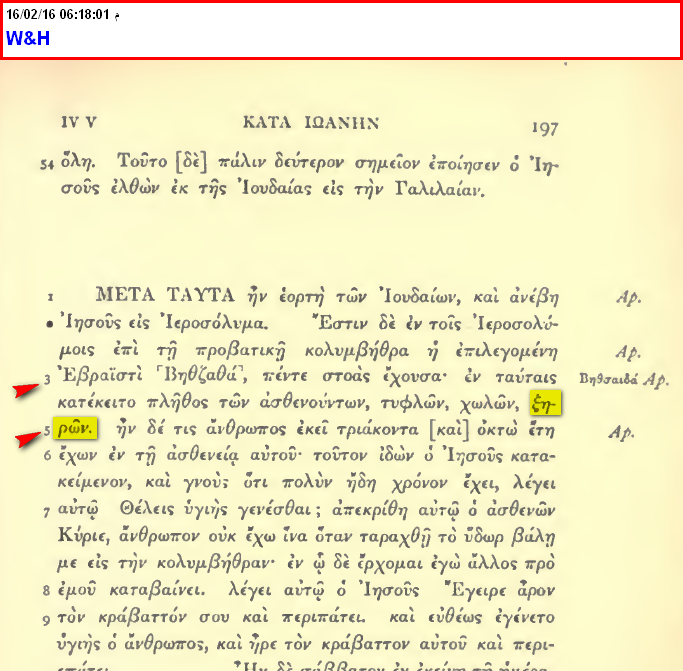
4 — Chandrov Version
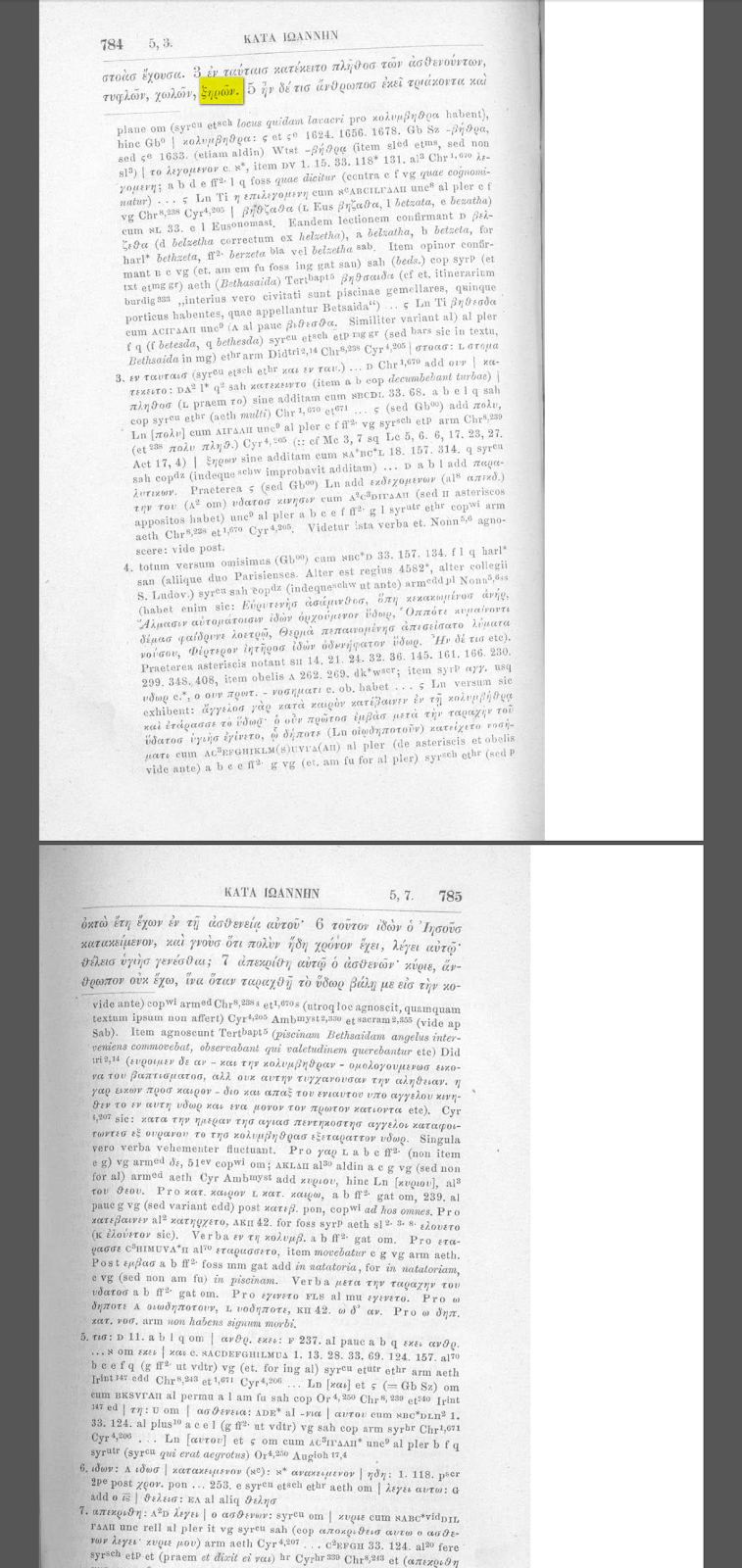
5 — Samuel Triggles Version
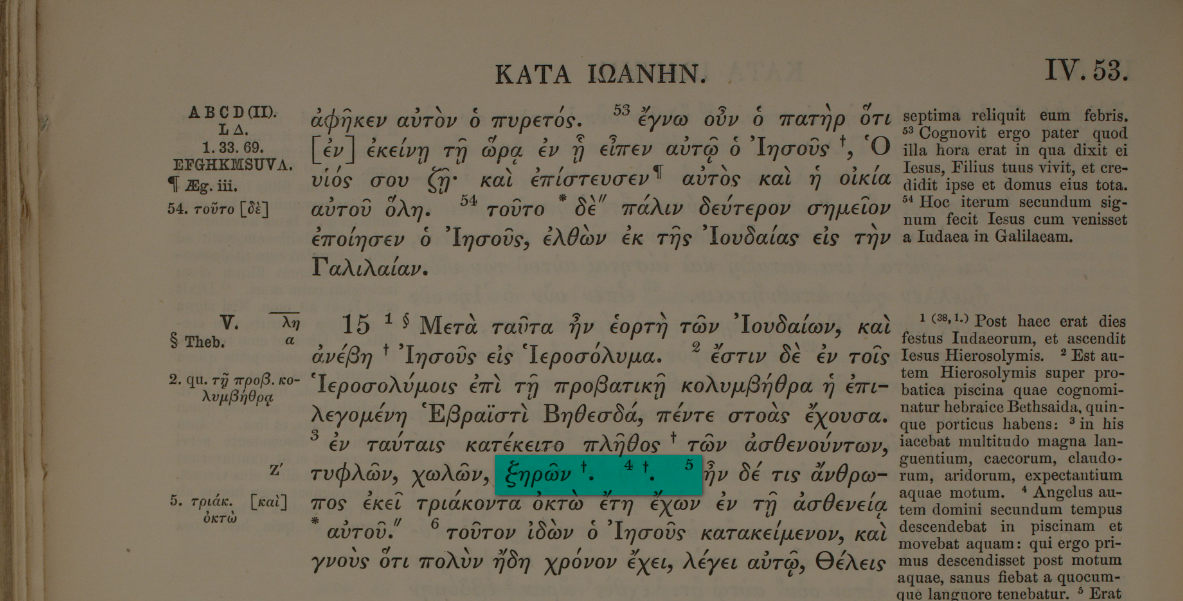
6 — Von Soden’s Version
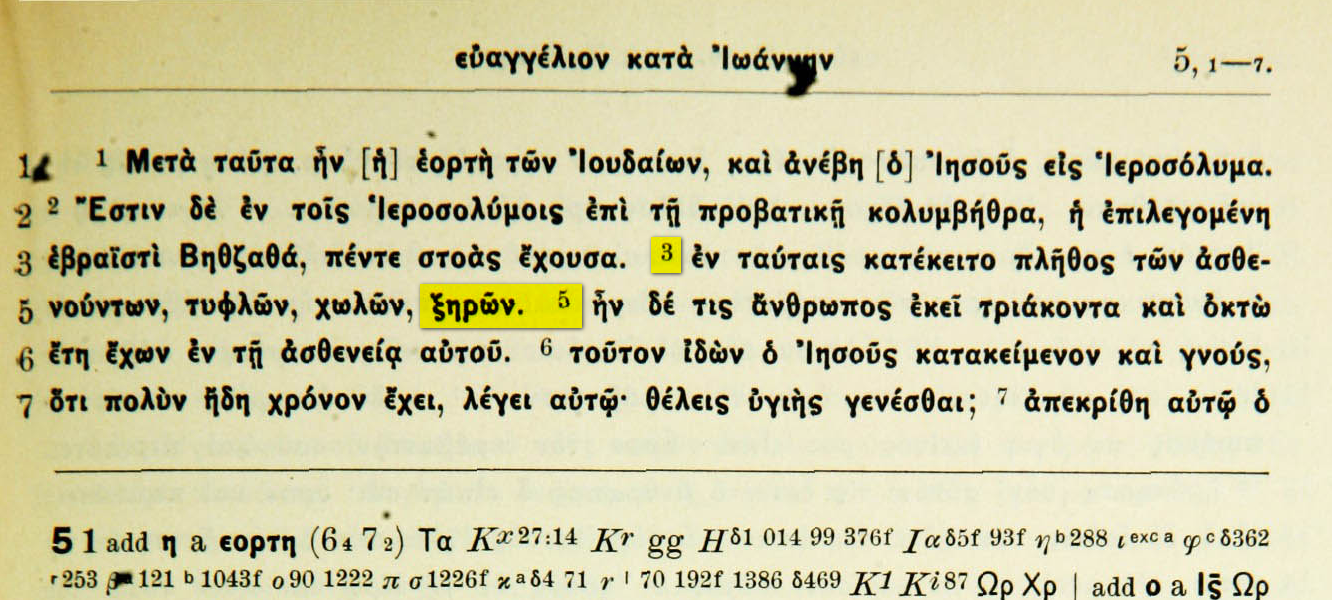
7 — SBL Version
What Scholars Said About This Text
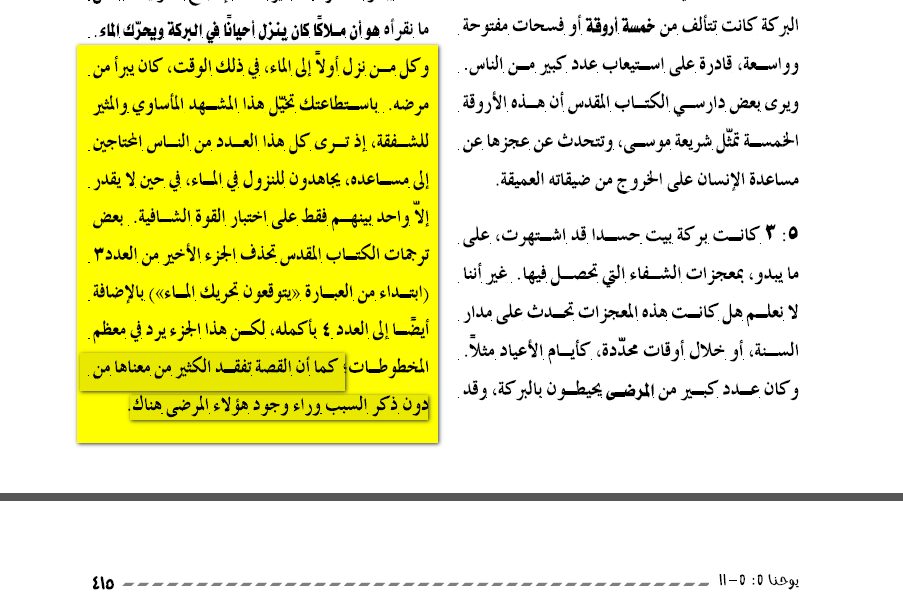
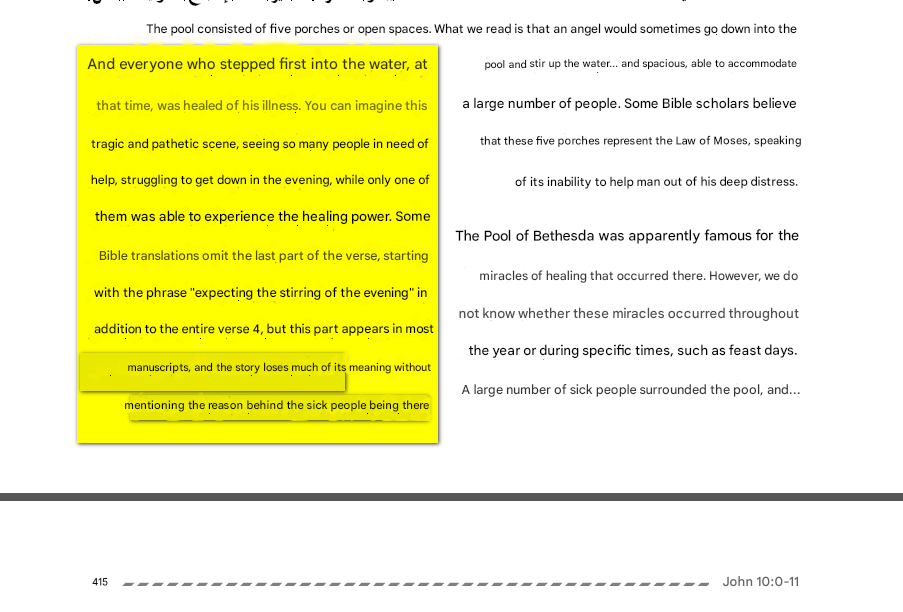
- A.T. Robertson: This text is necessary to explain why these sick people were in this place.
- Calvin: It was the Lord Jesus who was ordering this angel to do this.
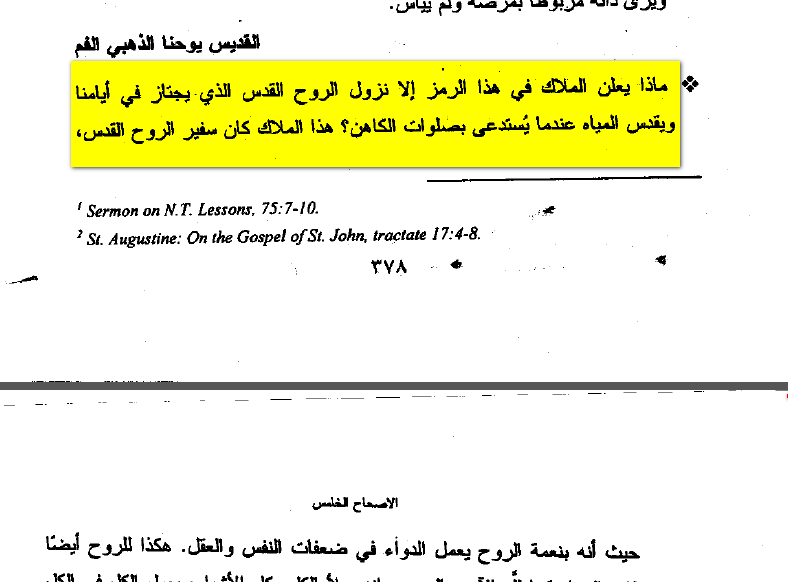
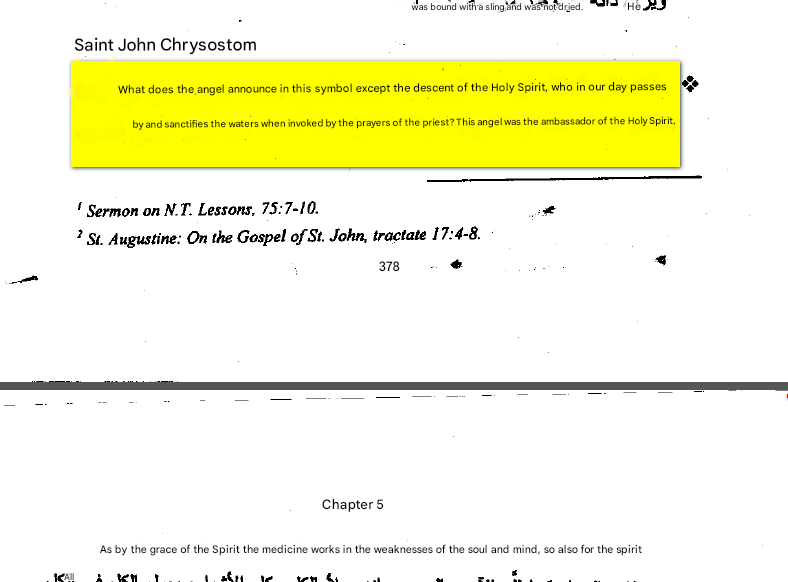
- John Chrysostom: This event is a prefiguration of baptism! This angel is a reference to the Holy Spirit, and his sanctification of the water is a reference to the priest’s sanctification of the water with prayers.
- Anthony Fikry: A symbol of Christ, the Holy Spirit, and the healing of corrupt nature!
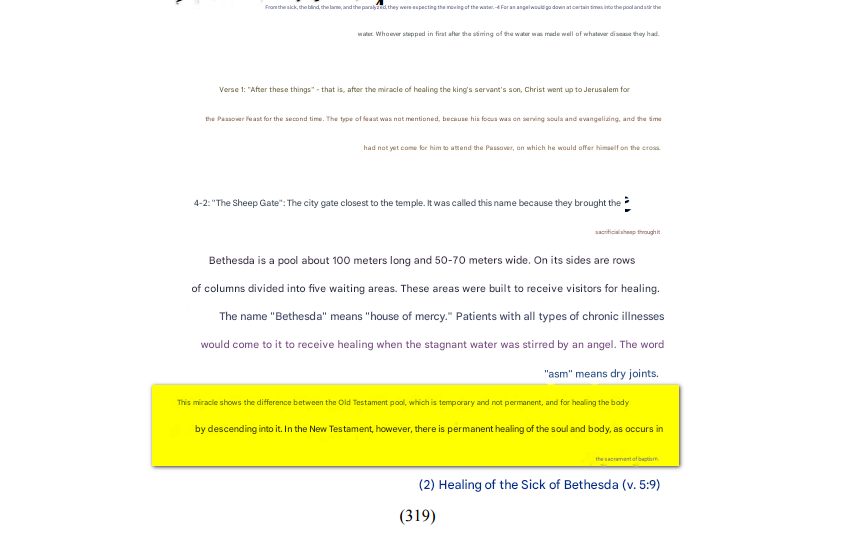
- Interpretation of the Church Encyclopedia: This miracle shows the difference between the temporary blessing of the Old Testament for healing the bodies, and the permanent blessing of the New Testament for healing the soul and body!
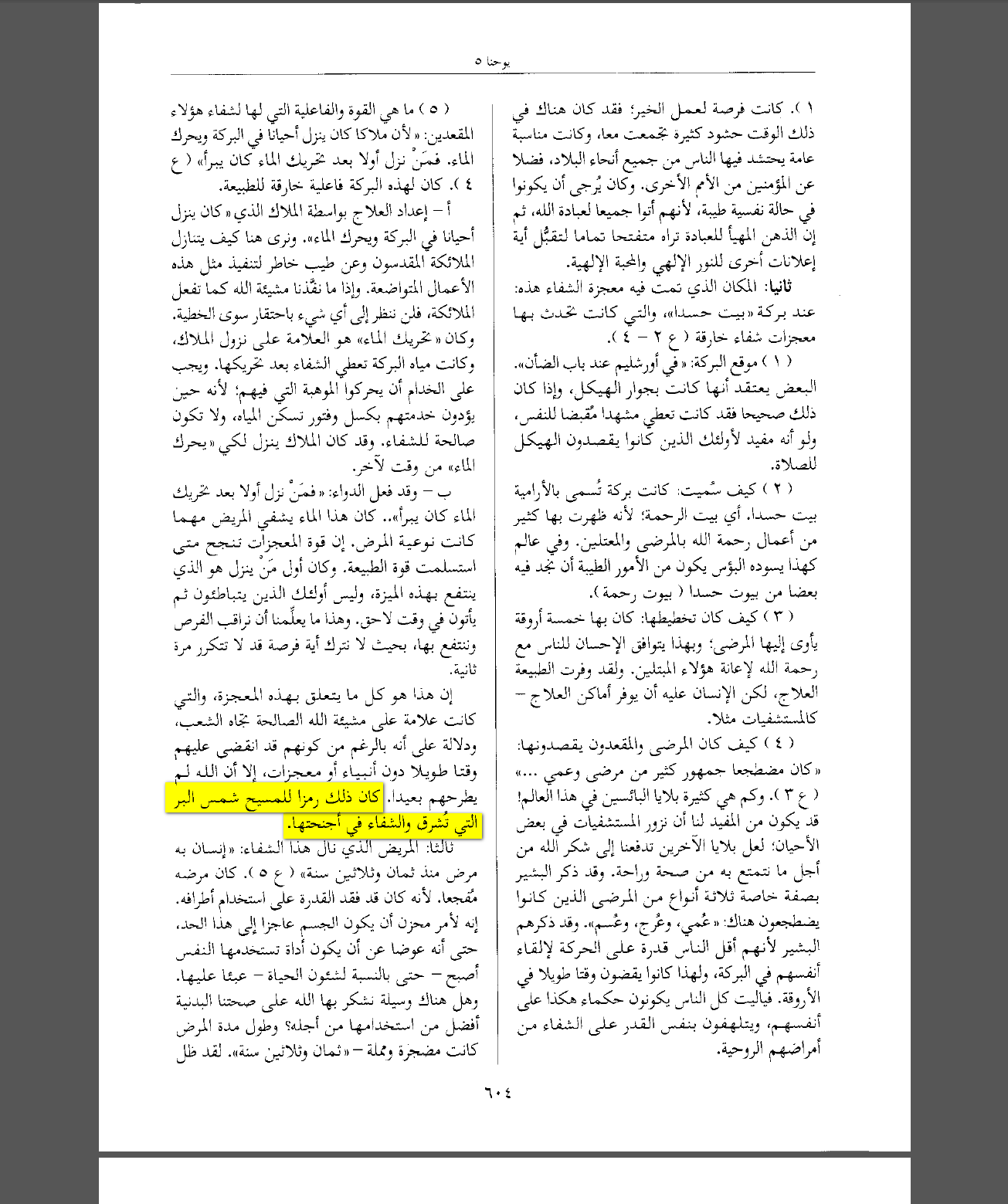
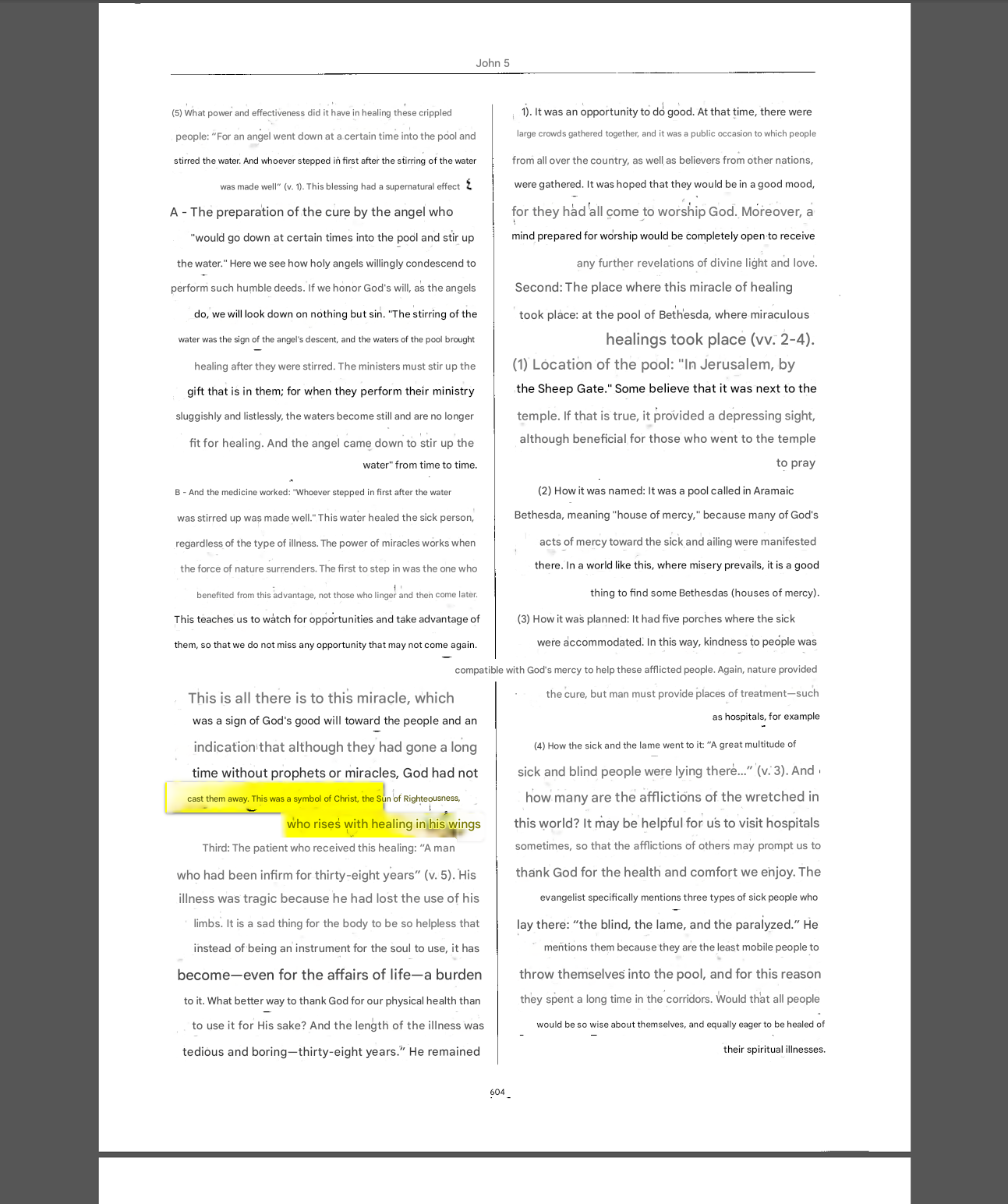
- Matthew Henry: This was a reference to Christ, the Sun of Righteousness, whose wings shine with healing!
What Scholars Said About the Authenticity of the Text
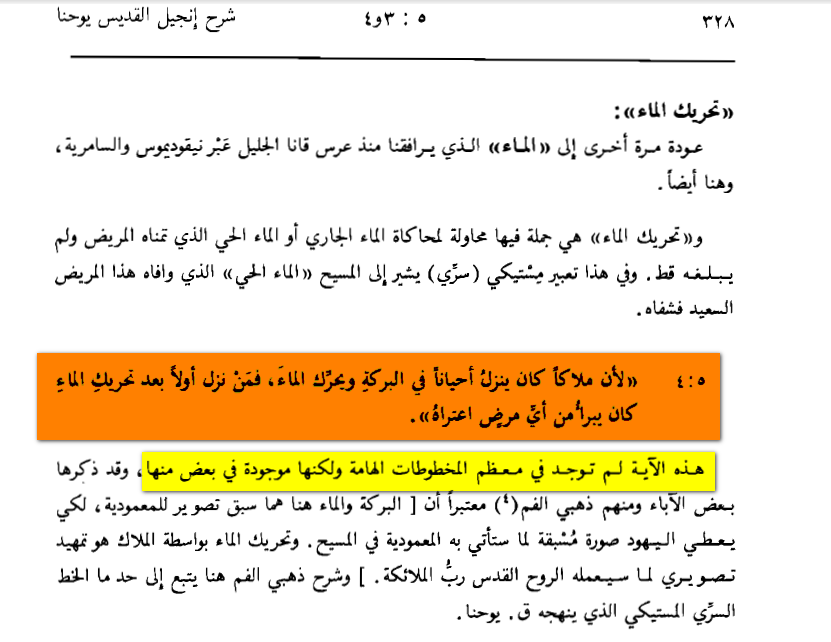
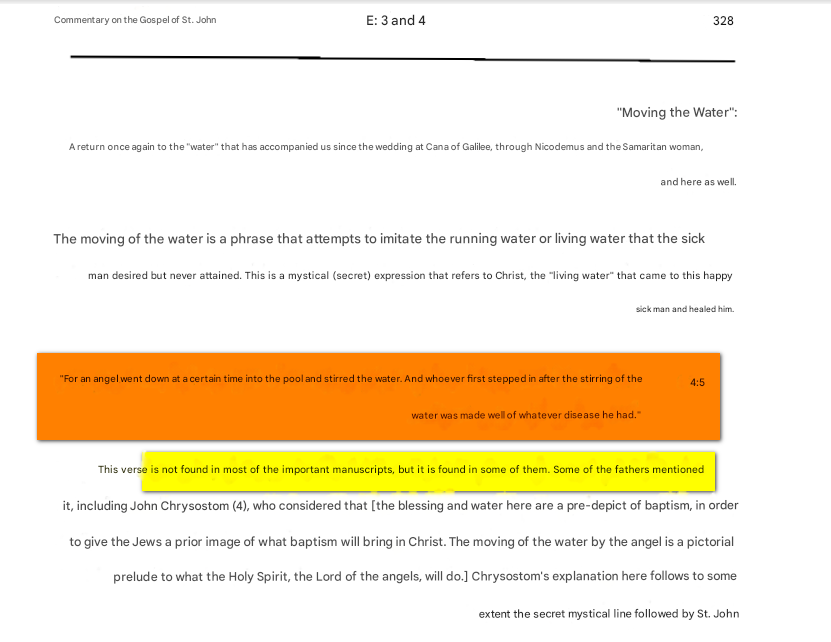
- Matti Al-Meskeen: The text is not found in most of the important manuscripts.
- James Kaufman: The text must be deleted for convincing critical reasons, but the issue of the authenticity of the text is not important!
- Thomas Constable: The text is not original and does not exist in any manuscript before the fifth century.
- John Damello: The text is omitted from the best evidence.
- Charles Ellicott: The text is omitted from most of the oldest manuscripts ever, and there is a consensus among scholars that it is not authentic.
- Wield Felker: The text is definitely not original.
Why Did Josephus and Philo Not Mention This Event?
“Commentary on the Gospel of John, Tadros Yacoub Malti, Chapter 5.” http://www.arabchurch.com/newtestament_tafser/index.htm
Detailed Scholar Commentaries
1 — Matti Al-Meskeen
He stated that the text is absent from most important manuscripts.
2 — James Kaufman
http://www.studylight.org/commentaries/bcc/view.cgi?bk=42&ch=5
Translation: According to convincing critical grounds, this text was deleted from the English Standard Version of 1885. But it was written in the margin because it explains the great popularity of this lake. It is not important to dwell too much on the authenticity of the text.
3 — Thomas Constable
http://www.studylight.org/commentaries/dcc/view.cgi?bk=42&ch=5
4 — John Damello
http://www.studylight.org/commentaries/dcb/view.cgi?bk=42&ch=5
Translation: The best evidence omits the phrase: “expecting the moving of the water. 4 For an angel went down at certain times into the pool and stirred up the water. Then whoever first stepped in after the stirring of the water was made well of whatever disease he had.”
5 — Charles Ellicott
http://www.studylight.org/commentaries/ebc/view.cgi?bk=42&ch=5
Translation with some modifications: Starting from the word “a great multitude” in verse 3 to the end of verse 4, it is all omitted from most of the early manuscripts, including the Sinaiticus and Vaticanus. There is currently a consensus among scholars that the passage is not authentic, such as Tschendorff, Triggles, Alford, Westcott, and Hort. It is interesting to know how it managed to enter the text of the Gospel so that 99.9% of readers currently consider it an authentic part of the Gospel of John. The text is found in the Alexandrian manuscript and the Latin and Syriac translations.
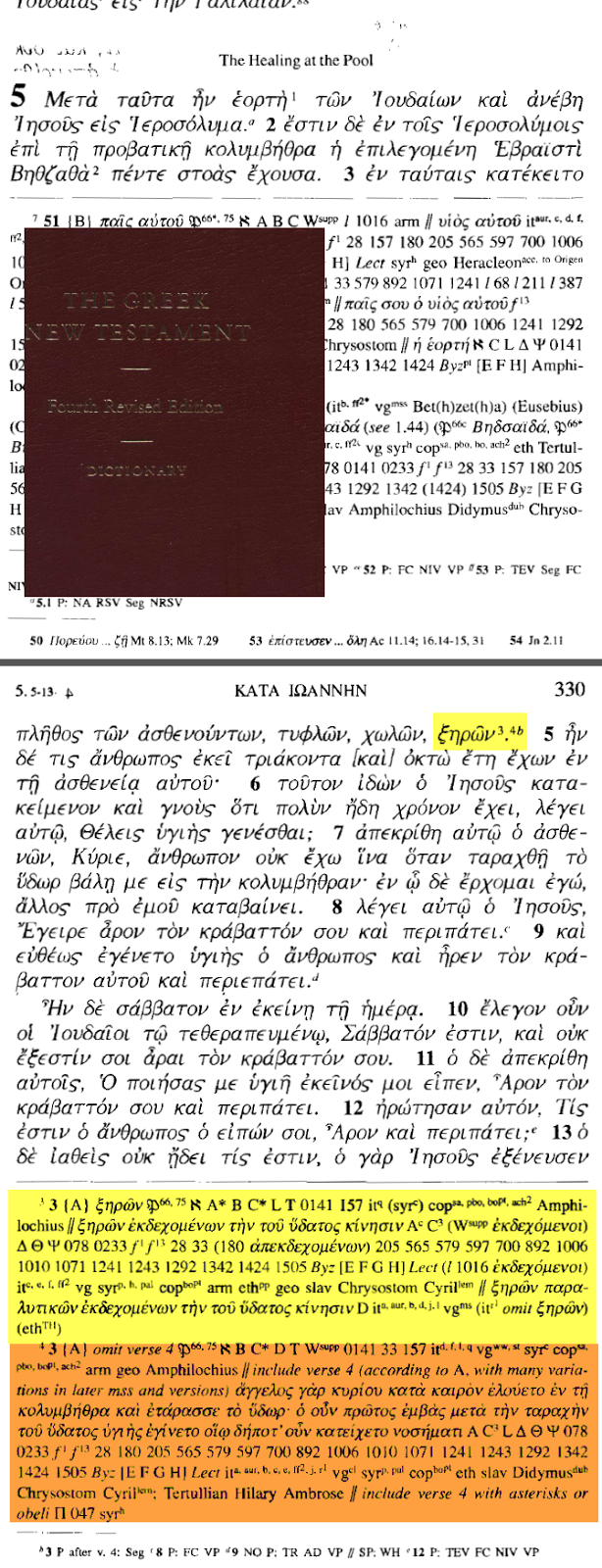
6 — UBS Monetary Committee
The most famous cash copy ever:
7 — Bruce Metzger
A Textual Commentary on the Greek New Testament:
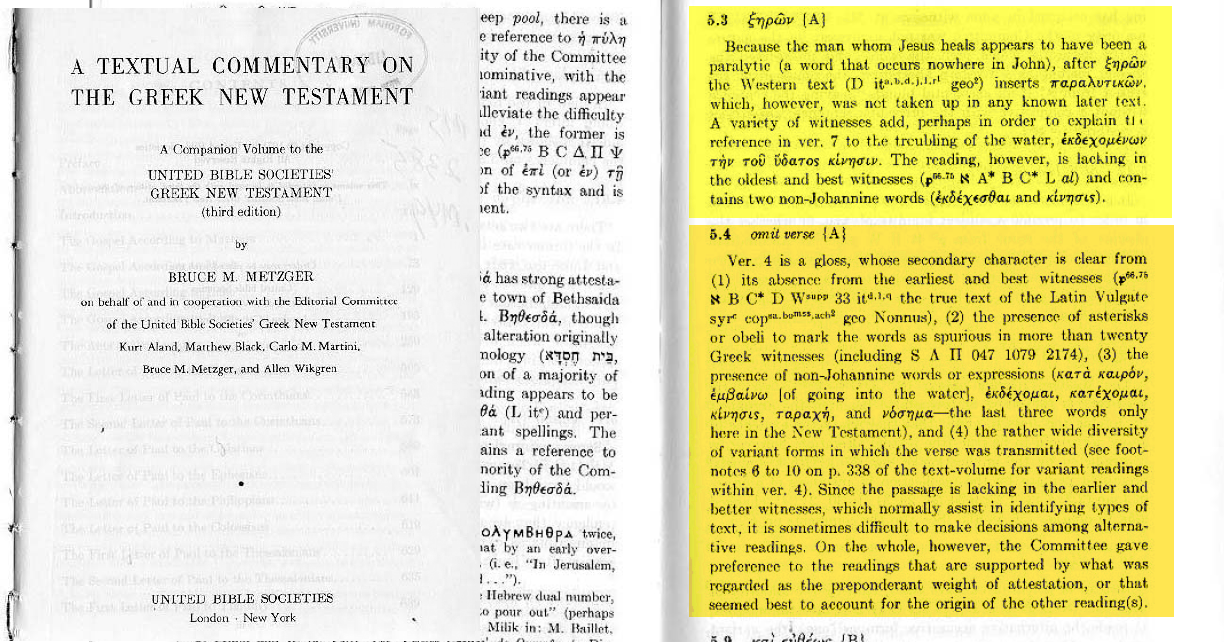
“Because the man whom Jesus heals appears to have been a paralytic (a word that occurs nowhere in John), after xhrw/n the Western text (D ita, b, d, j, l, r1 geo2) inserts paralutikw/n, which, however, was not taken up in any known later text. A variety of witnesses add, perhaps in order to explain the reference in ver. 7 to the troubling of the water, evkdecome,nwn th.n tou/ u[datoj ki,nhsin. The reading, however, is lacking in the oldest and best witnesses (î 66, 75 a A B C* L al) and contains two non-Johannine words (evkde,cesqai and ki,nhsij).”*
5.4 omit verse {A}
“Ver. 4 is a gloss, whose secondary character is clear from (1) its absence from the earliest and best witnesses (î66, 75 a B C D Wsupp 33 itd, l, q the true text of the Latin Vulgate syrc copsa, bomss, ach2 geo Nonnus), (2) the presence of asterisks or obeli to mark the words as spurious in more than twenty Greek witnesses (including S L P 047 1079 2174), (3) the presence of non-Johannine words or expressions (kata. kairo,n, evmbai,nw [of going into the water], evkde,comai, kate,comai, ki,nhsij, tarach,, dh,pote, and no,shma – the last four words only here in the New Testament), and (4) the rather wide diversity of variant forms in which the verse was transmitted.”*
Text No. 4 — Why it is not original:
- Its absence from the oldest and best evidences: (î 66, 75 a BC* DW supp 33 it d, l, q t syr c cop sa, bo mss, ach 2 geo Nonnus) — the best forms of the Vulgate.
- The text is placed between signs in more than 20 Greek manuscripts.
- It contains non-Johannine words such as: kata. kairo,n = from time to time; enter = enter; they are waiting; move = move; tarach, = eruption.
- The different forms in which the text was transmitted.
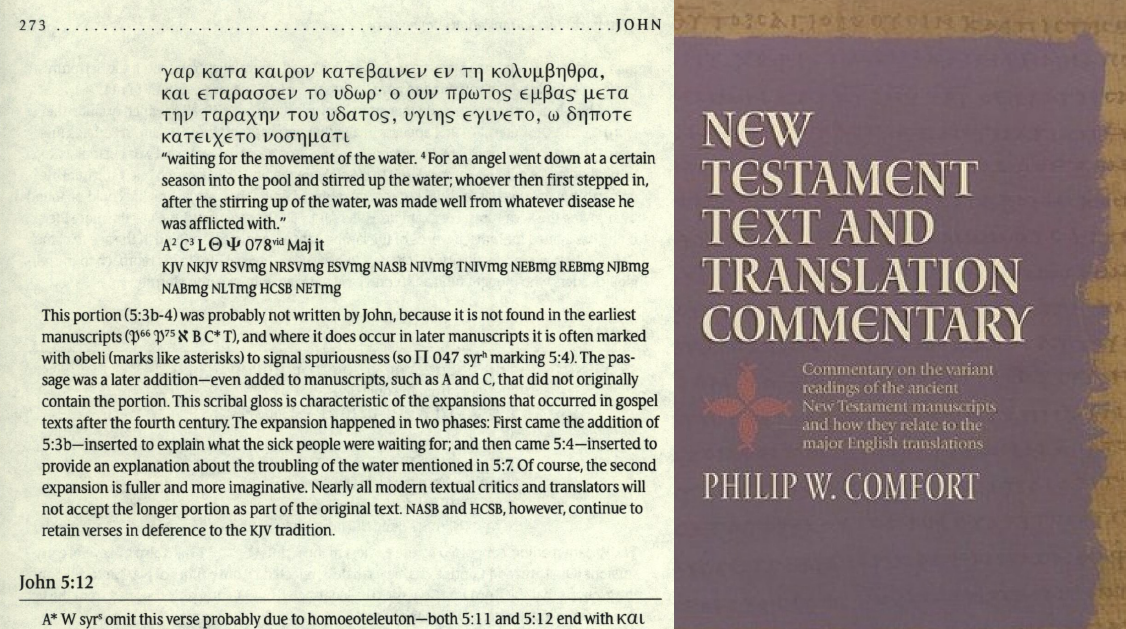
8 — Philip Comfort
New Testament Text & Translation Commentary, p. 273:
9 — Wield Felker
http://www-user.uni-bremen.de/wie/TCG/TC-John.pdf
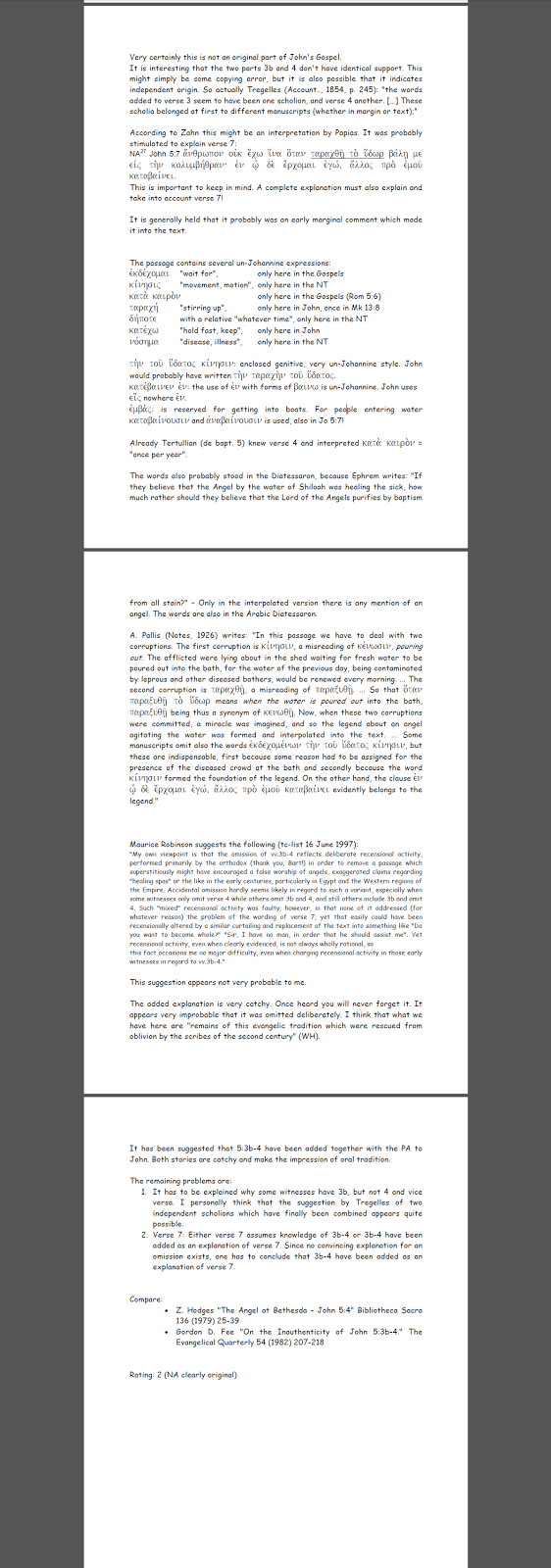
So Samuel Triggles says: ‘The extra words in verse 3 seem to be one interpretation and verse 4 seems to be another, these interpretations originating from different manuscripts.’
The scholar Zahn suggests that this was an interpretive addition by Papias, perhaps to explain the number 7.
In general, it may have been a marginal comment inserted into the text. The paragraph contains many non-Johannian words such as ‘waiting, moving, bubbling, etc.’ The phrase ‘stirring the water’ is not a Johannian style at all.
Tertullian knows it, and perhaps the Diatessaron…”
UBS Committee — Detailed Manuscript Evidence
Regarding Text No. 3
“In these lay a multitude of the sick, the blind, the lame, the withered.” (في هذه كان مضطجعاً جمهور كثير من مرضى وعمي وعرج وعسم)
This passage (ἐκδεχομένων τὴν τοῦ ὕδατος κίνησιν = they expect the water to move) is not original and is a distortion.
The evidence that supports the deletion reading:
First — Original Greek language manuscripts:
- Papyrus 66 from the third century “the oldest manuscript of the Gospel of John ever”
- Papyrus 75 from the third century
- The Sinaiticus manuscript from the fourth century
- The Vatican manuscript from the fourth century
- The Ephraimite manuscript from the fifth century “the original copyist”
- The Alexandrian manuscript from the fifth century “the original copyist”
- Other manuscripts
Second — Latin translation manuscripts:
Latin manuscript “Monacensis q” from the 6th–7th century
Third — Syriac translation manuscripts:
Syriac Curitonianus, 5th century
Fourth — Coptic translation manuscripts:
- Upper Egyptian Coptic
- Bohairic Coptic
- Proto-Bohairic Coptic
- Coptic Under Akhmimic
The second reading — the reading of addition (the text without deletion as it is today):
Manuscripts that testify to this reading:
First — The manuscripts in the original Greek language:
- Washington Manuscript from the beginning of the fifth century
- A later copyist added it to the text of the Alexandrian manuscript
- A later copyist added it to the text of the Ephraim manuscript
- A large number of Greek manuscripts are late in time, starting from the eighth century
Second — Latin translations:
- Manuscript e Platinus from the fifth century
- Manuscript C of Colbertinus from the 11th–12th century
- Manuscript F of Praxianus from the sixth century
- Manuscript ff1 Corbinsis from the 8th century
Third — Syriac translations:
- Syriac Peshitta p from the fifth century
- Palestinian Syriac pal from the sixth century
- Heraclian Syriac h from the seventh century
Fourth — Coptic translations: Coptic Bohairic
Fifth — Other translations: Armenian, Slavonic, Georgian, Ethiopian — all of them are late in time, after the seventh century.
Third reading — The text as it appears in the common text, adding the word παραλυτικῶν = paralyzed:
It is found in the following manuscripts:
First — The Greek manuscripts: Pisa from the 5th century
Second — Latin translations:
- Versilenzi manuscript a from the late fourth and early fifth centuries
- Veronensis manuscript b from the 5th–6th century
- Pisa manuscript d from the fifth century
- Sanertianus j from the 5th–6th century
Regarding Text No. 4
Manuscripts that testify to the deletion reading:
First — The Greek manuscripts:
- Papyrus 66 BC
- Papyrus 75 BC
- The Sinaiticus manuscript, 4th century
- Vatican manuscript Q4
- The Ephraimite Manuscript “The Original Copyist” Q5
- The Pisa manuscript, 5th century
- Washington Manuscript “Original Copyist” Q5
Second — Latin translations:
- Manuscript d, Q5
- The manuscript of Brixianus, 6th century
- Manuscript L Q7–8
- Monacensis manuscript q 6–7
Third — Coptic translation:
- Sa’idi Coptic
- Bohairic Coptic
- Akhmimic Coptic
Fourth — Syriac translation: Syriac Curitonianus, 5th century
Fifth — Other translations: Armenian and Georgian
Manuscripts that testify to the reading of the addition:
First — The Greek manuscripts:
- Alexandria, 5th century
- Ephraimite, added by a later copyist
- Other manuscripts that are later in time, starting from the eighth century
Second — Latin translations:
- Manuscript A Versilens from the late fourth and early fifth centuries
- Manuscript b Veronese 5–6th century
- Manuscript C of Colbertinus, 11th–12th centuries
- Manuscript E Platinus 5th century
- Aurus Holmensis manuscript, 6th–8th centuries
- The Clementine Vulgate manuscript is late in time
Third — Syriac translations:
- Syriac Pesthiya from the fifth century
- Palestinian Syriac 6th century
Fourth — Coptic translations: Coptic Bohairic
Fifth — Other translations that are later in time: Armenian, Slavonic, Georgian, Ethiopian — all later in time.
Manuscripts that place text between quotation marks:
- Manuscript B
- Manuscript 047
- Syriac Heraclean
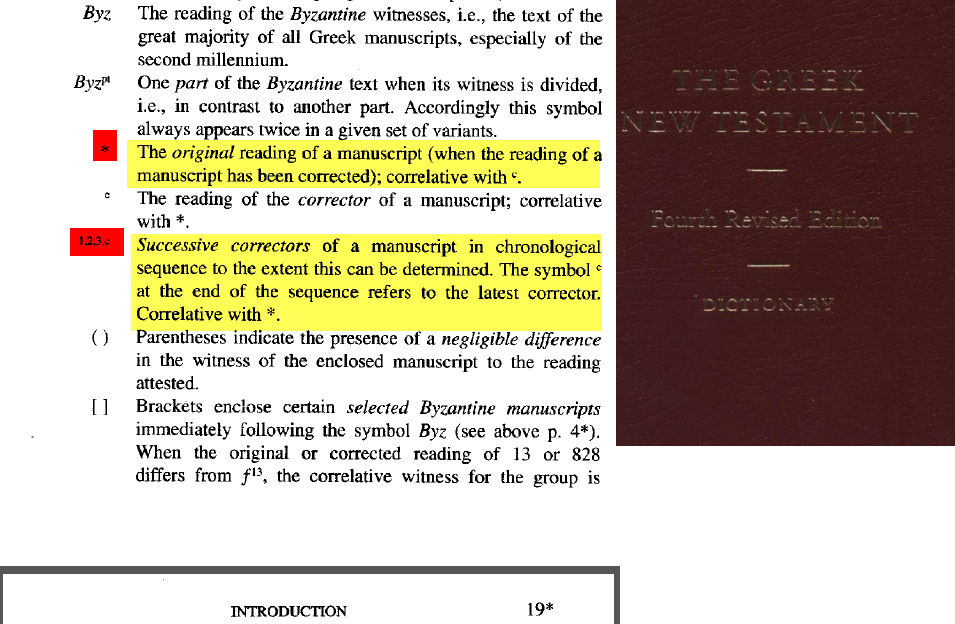
- The presence of an asterisk next to the manuscript symbol, such as A*, means that the text as written by the original copyist.
- The presence of numbers next to the manuscript code, such as C3, means that the text was added by a later “correcting” copyist, not the original copyist. The corrector’s number is 3.
Text in Manuscripts — Images
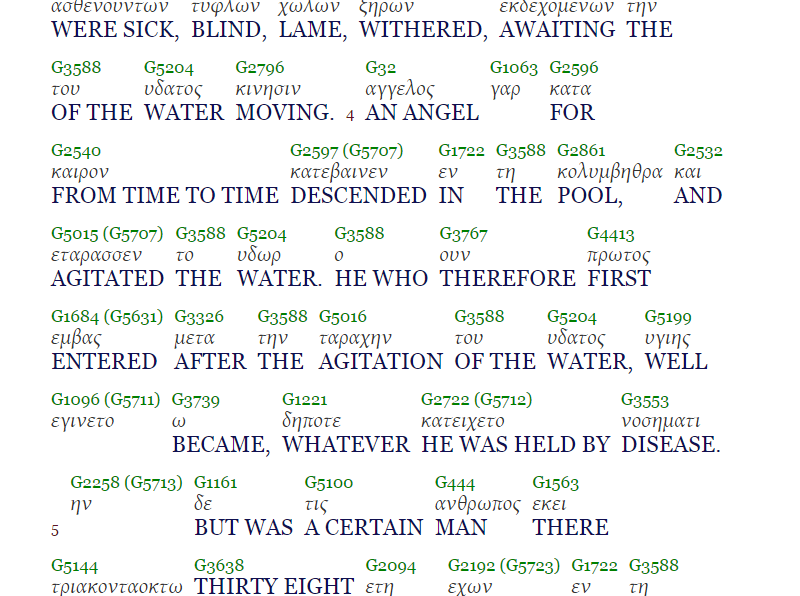
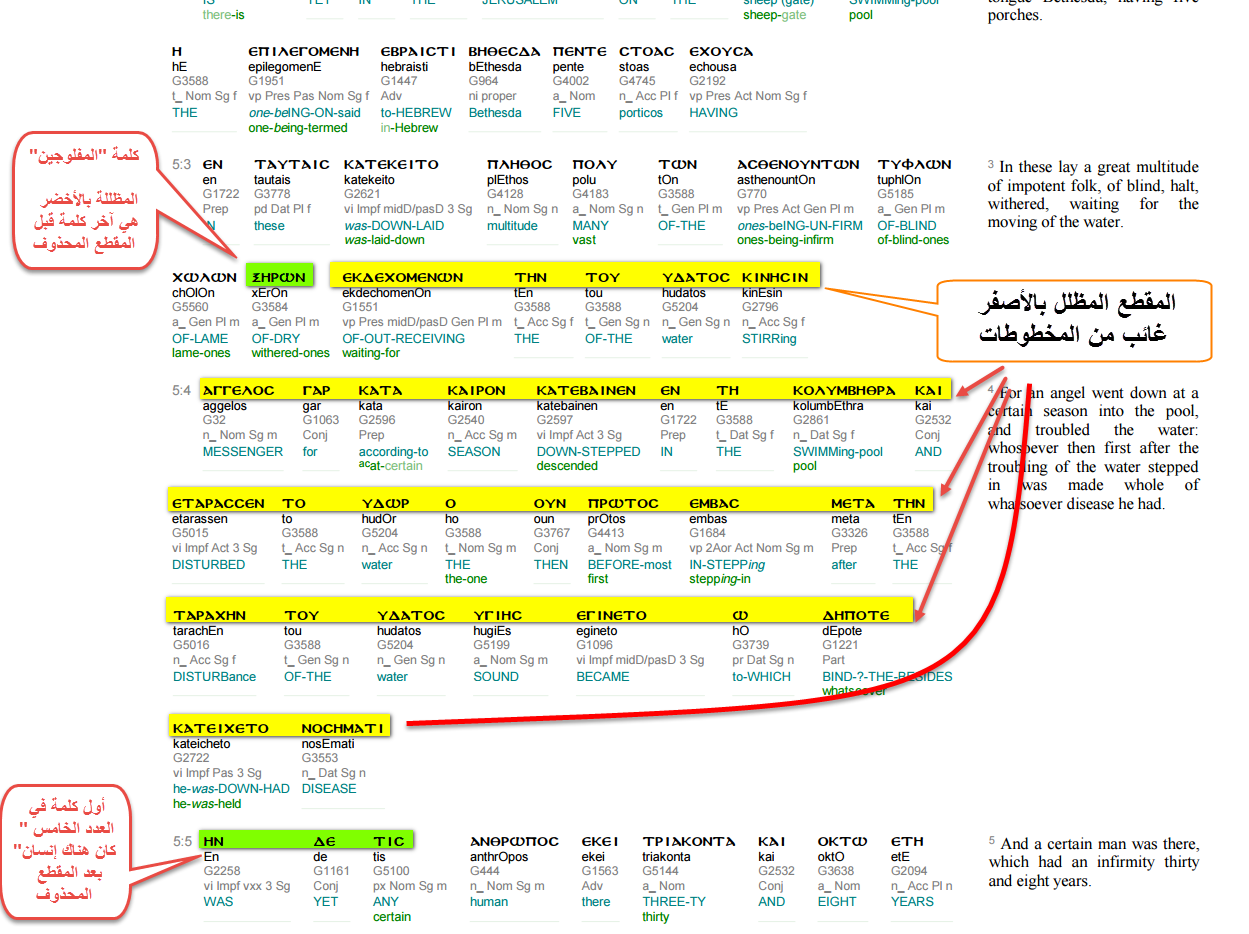
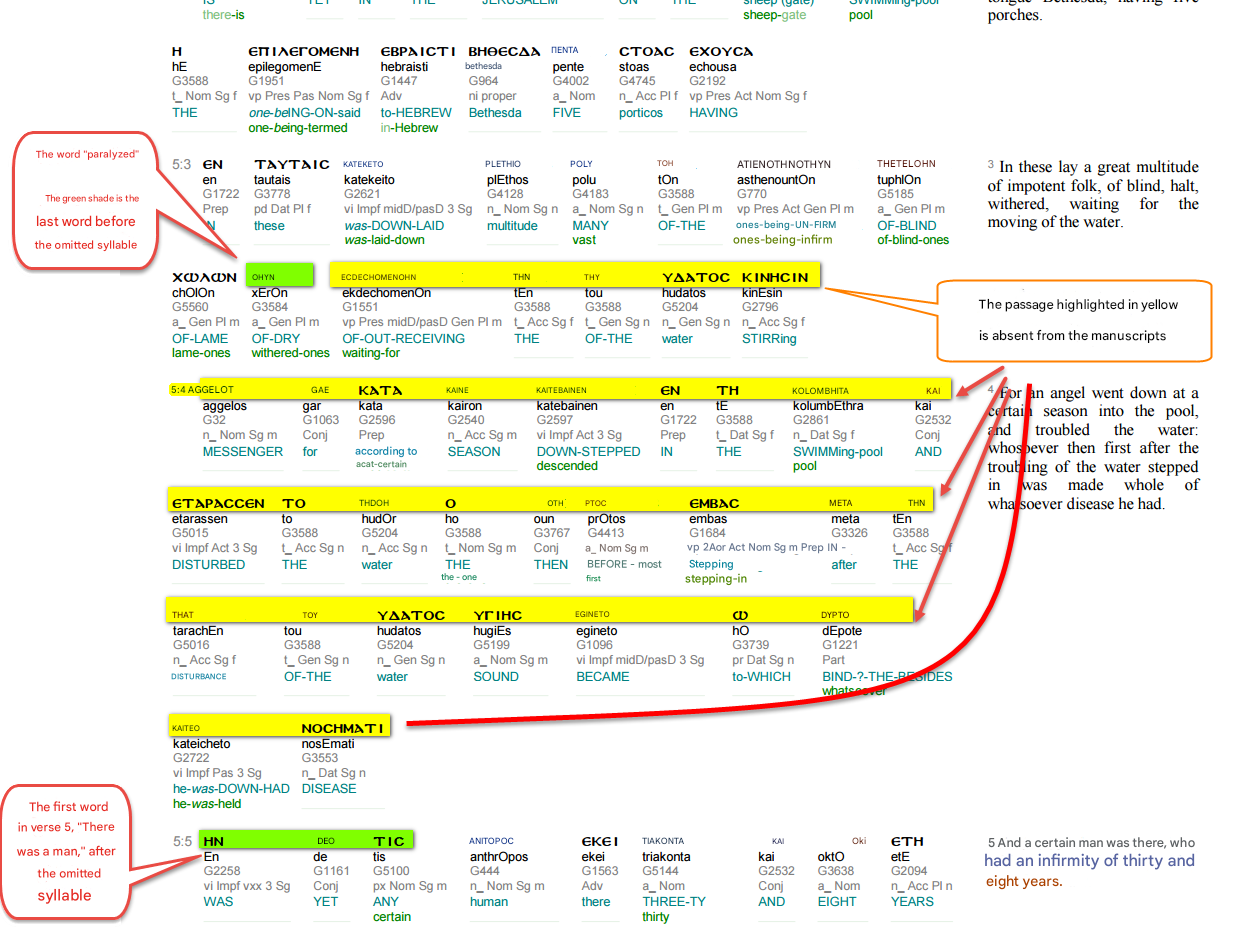
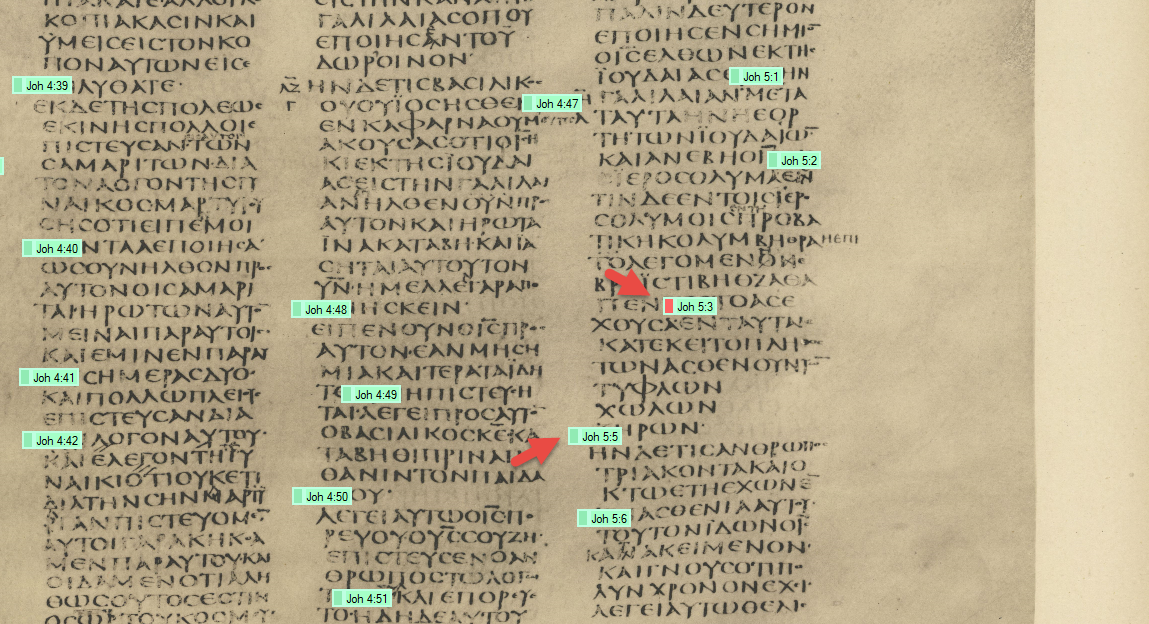
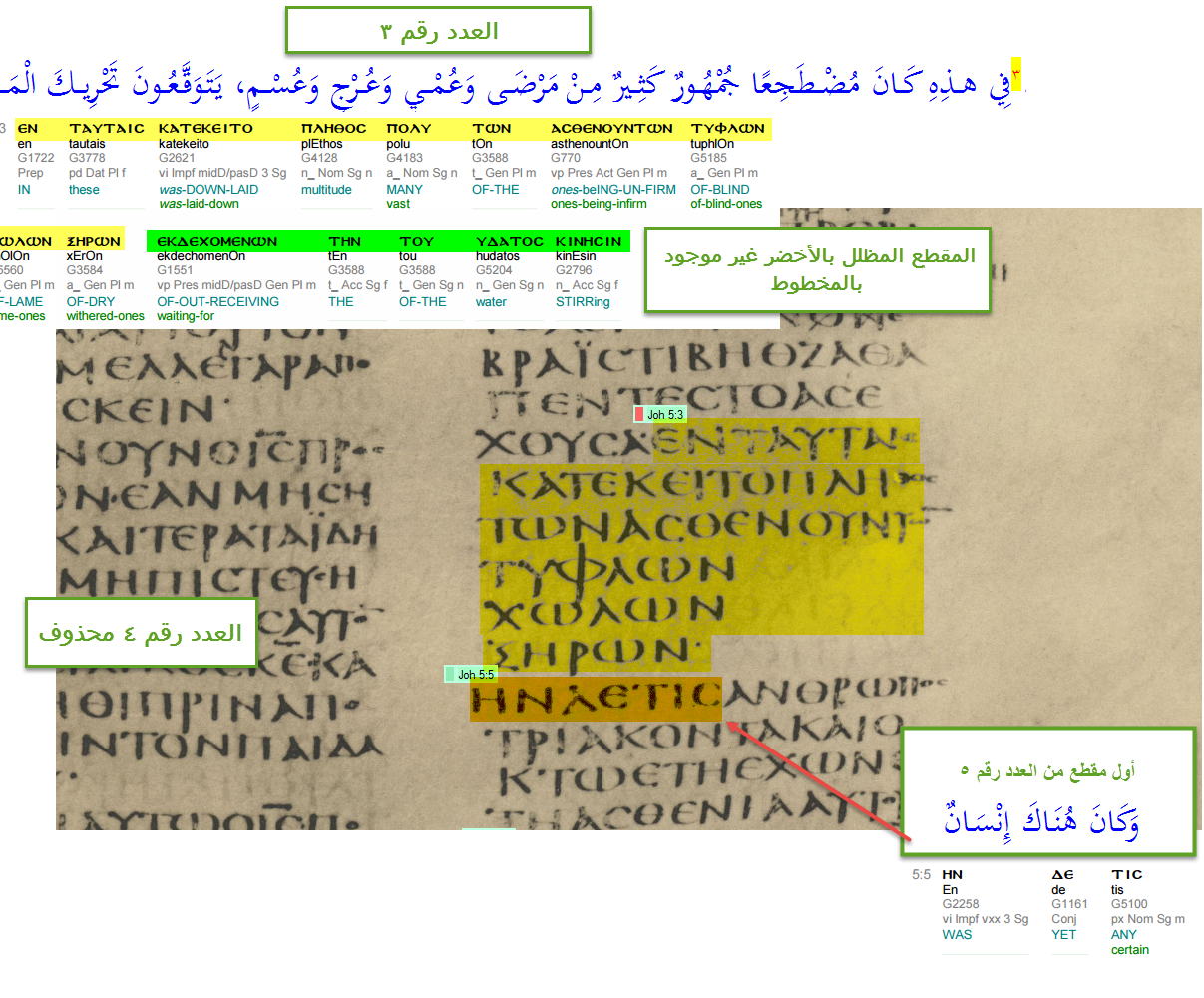
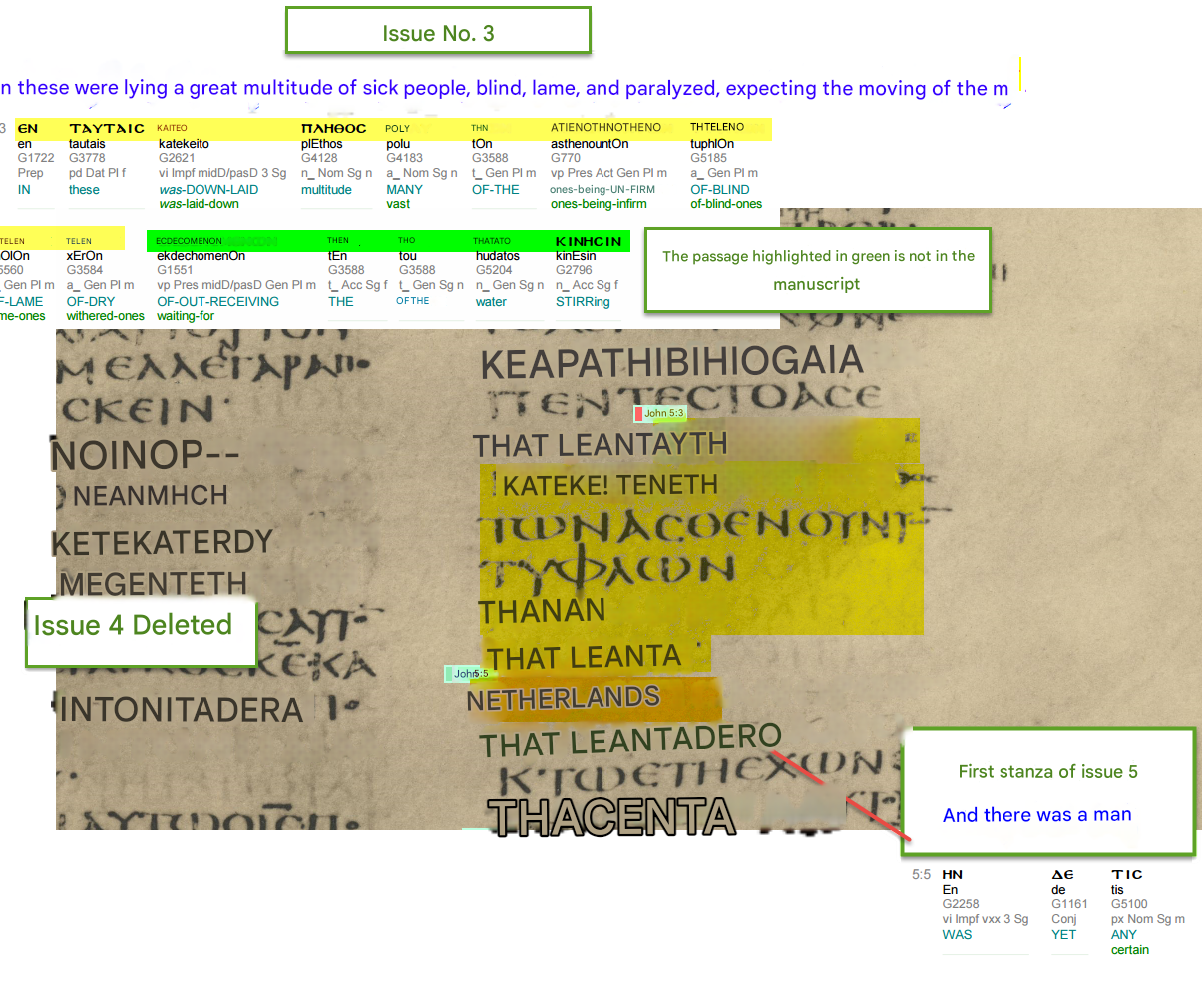
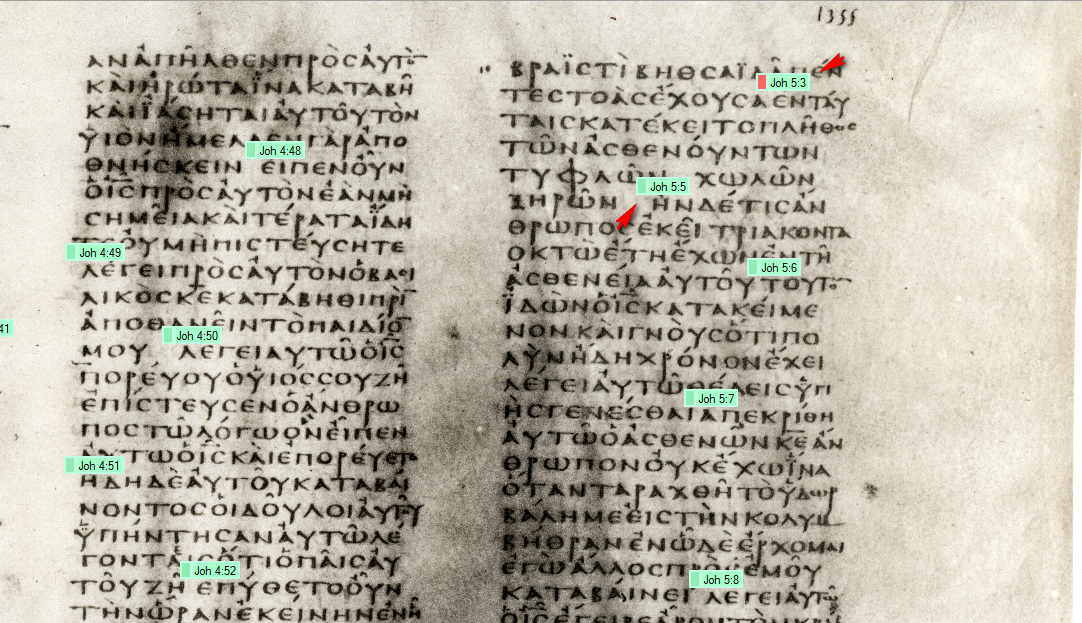
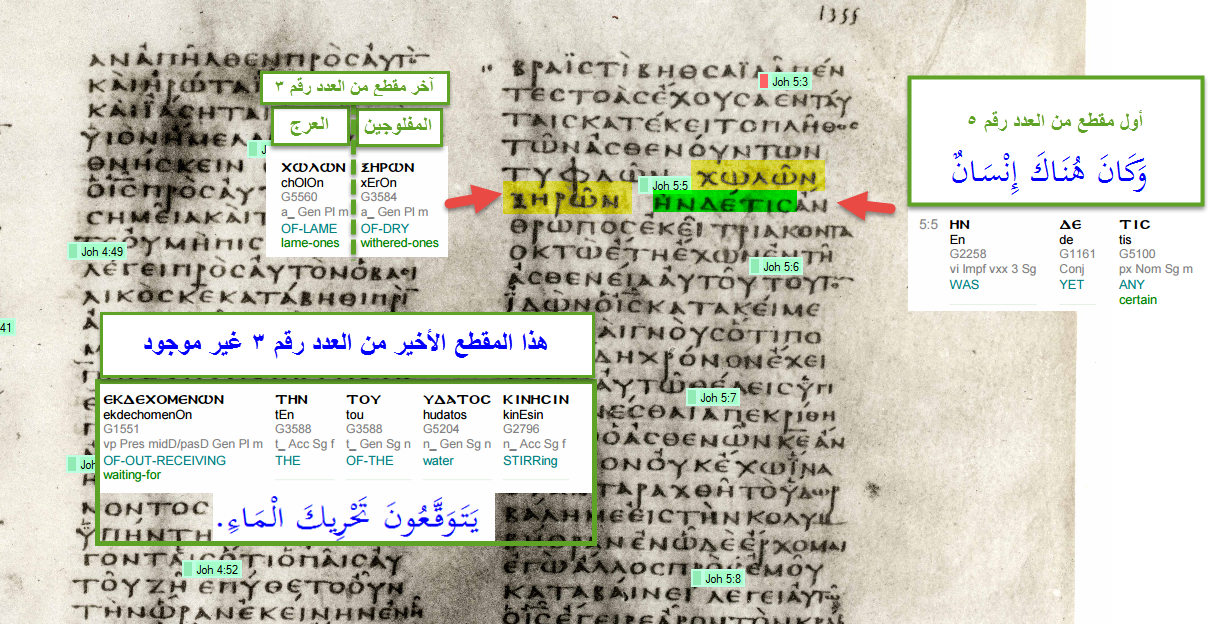
Interliner text format as it appears in manuscripts: Greek text versus English. Text forms 3 and 4 are written in capital letters (the way early Greek manuscripts are written). The yellow highlighted section is absent from the older manuscripts.
Direct browsing link for manuscript images from the famous Daniel Wallace CSNTM website: http://www.csntm.org/Manuscripts.aspx
1 — The Sinaiticus Manuscript
Enlarged image:
2 — The Vatican Manuscript
Enlarged image:
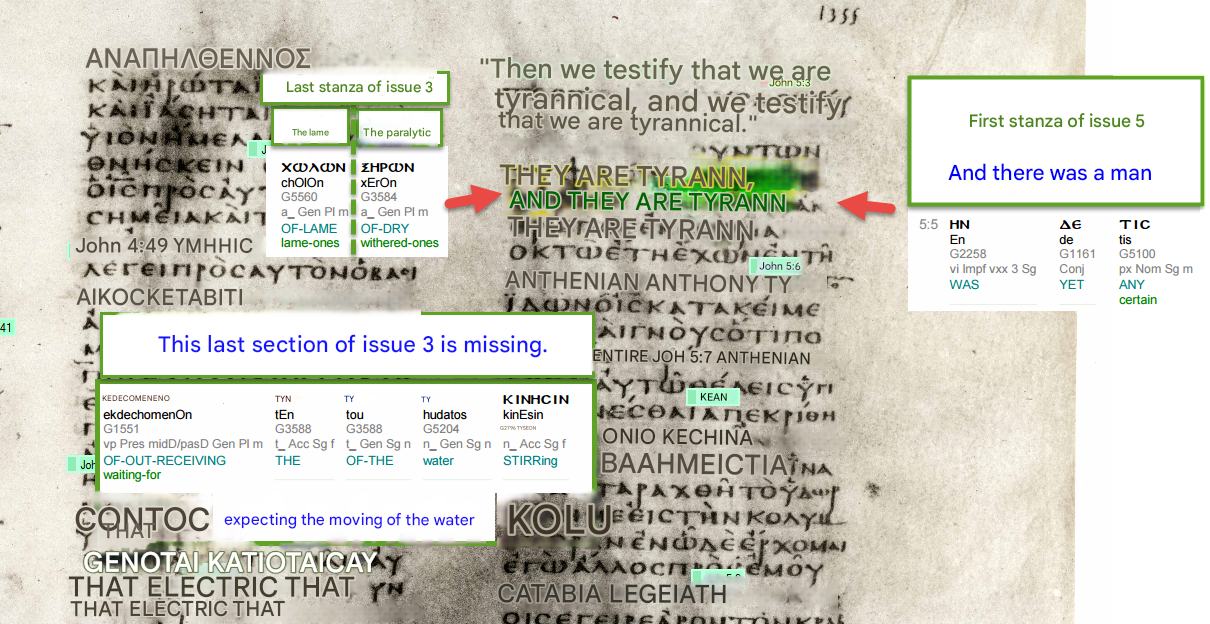
3 — Washington Manuscript
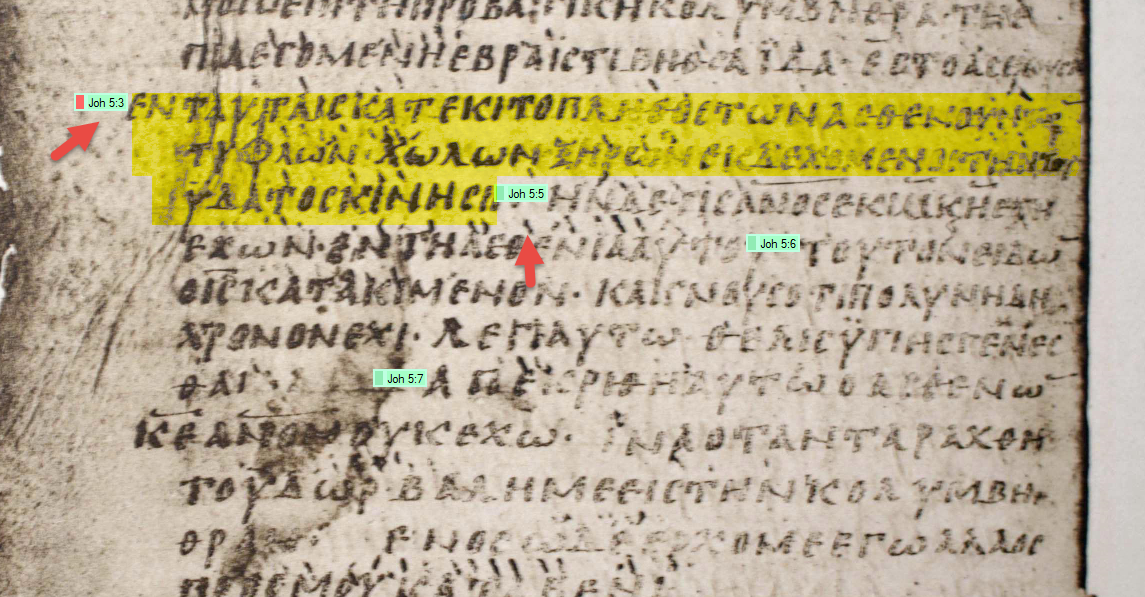
4 — Pisa Manuscript
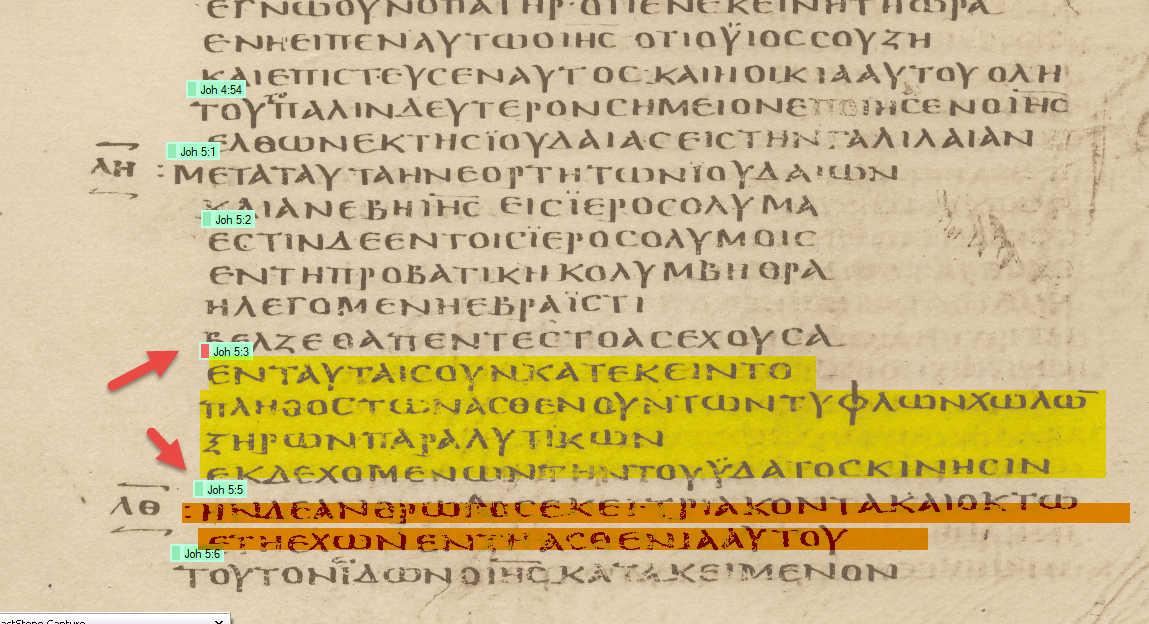
5 — Papyrus 75
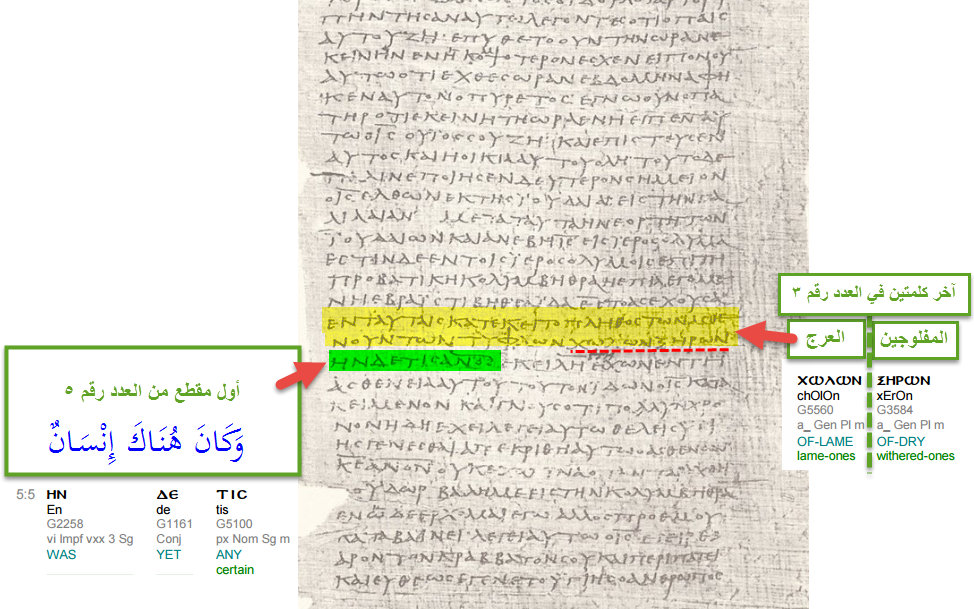
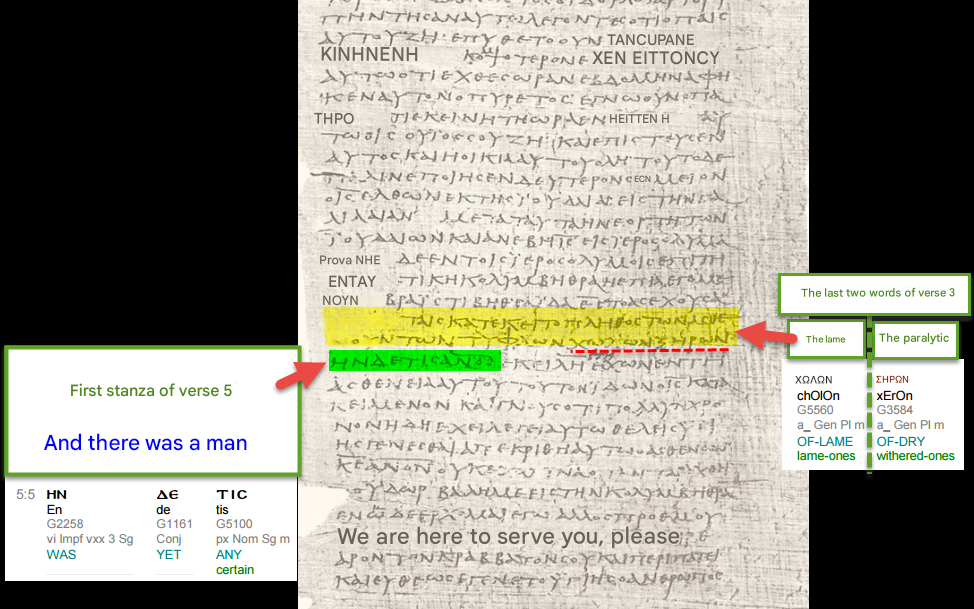
6 — Papyrus 66
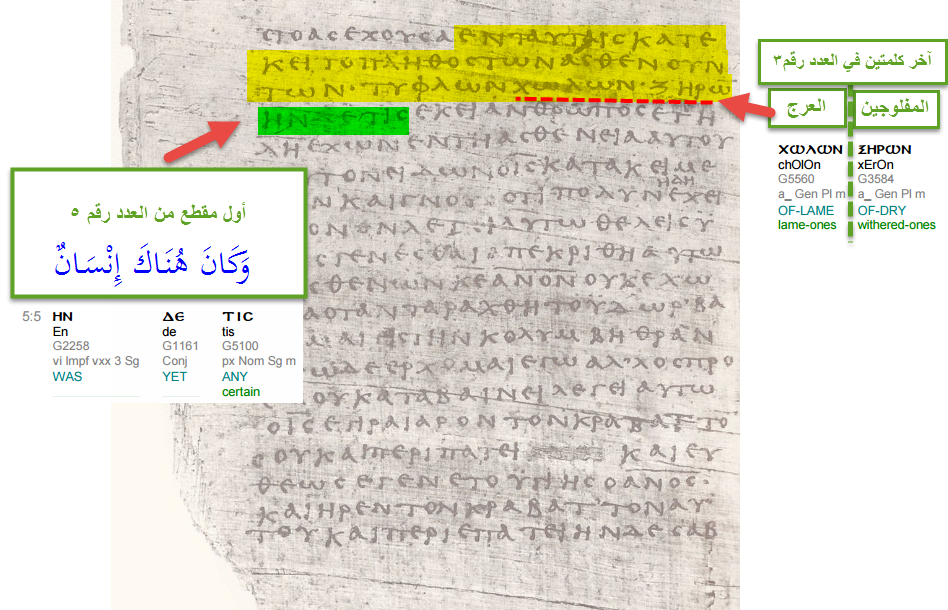
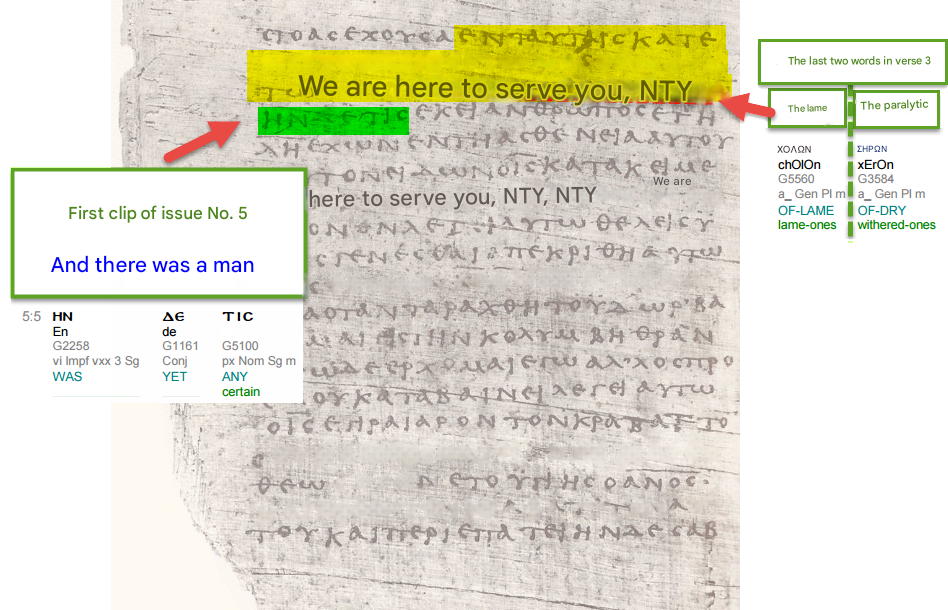
7 — The Upper Egyptian Coptic Manuscript
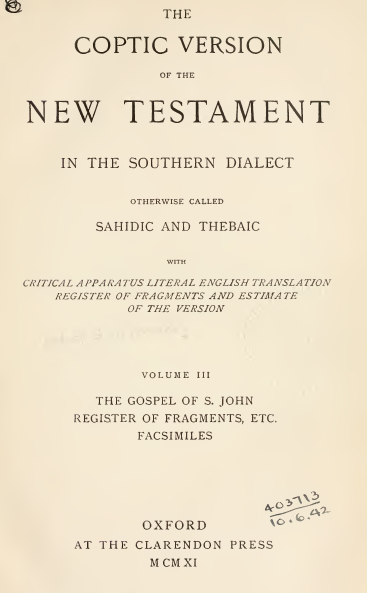
Text No. 3 has its last paragraph deleted, and Text No. 4 has its entirety deleted.
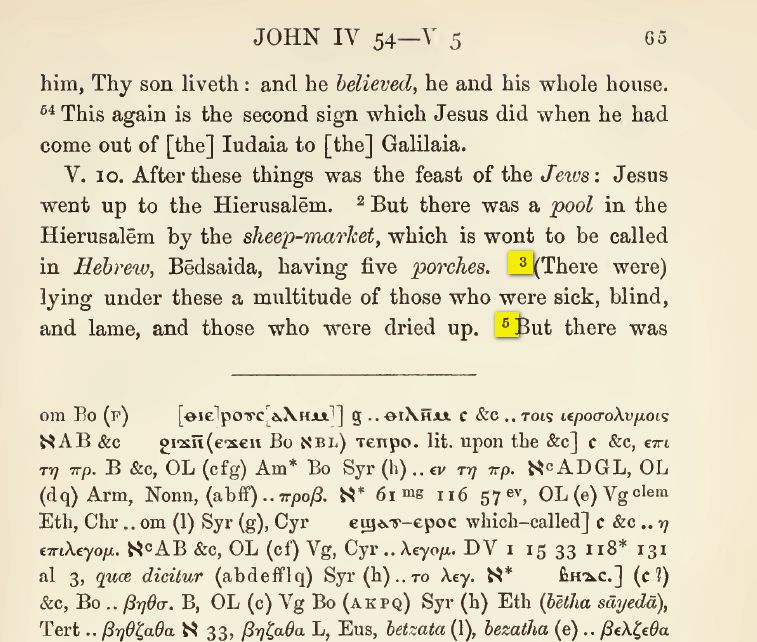
Source Reference Images
Antonius Fikry’s Interpretation, p. 170:
The moving water symbolizes the Holy Spirit. The moving of the water and the healing were a prophecy and a stirring in the minds of the Jews that something was about to happen. This was a sign of the Holy Spirit (living water, and the Jews call moving water living water) who would descend upon the Church of Christ to heal our nature. Whoever descends first will be healed. Naturally, those who descend first are the strong, and this indicates that the Holy Spirit dealt with the spiritually strong in the Old Testament, such as the prophets, and healed them. As for the sick man at the Pool of Bethesda, he refers to someone who has no one and is weak, unaware and without understanding. This was the condition of all people before Christ, except for a few. Christ came to these weak people to heal them. This miracle is a sign that heavenly intervention will occur to heal diseases. The angel who stirred the water was a symbol of Christ, who would send the Holy Spirit. Angel means messenger, and Christ was sent by the Father.
Antonius Fikry’s Interpretation, p. 175:
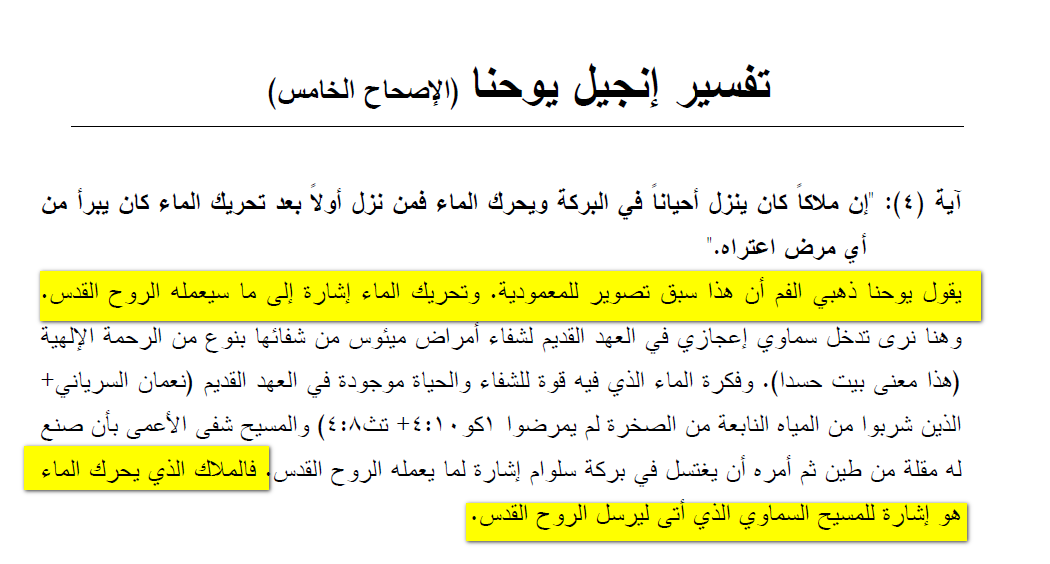
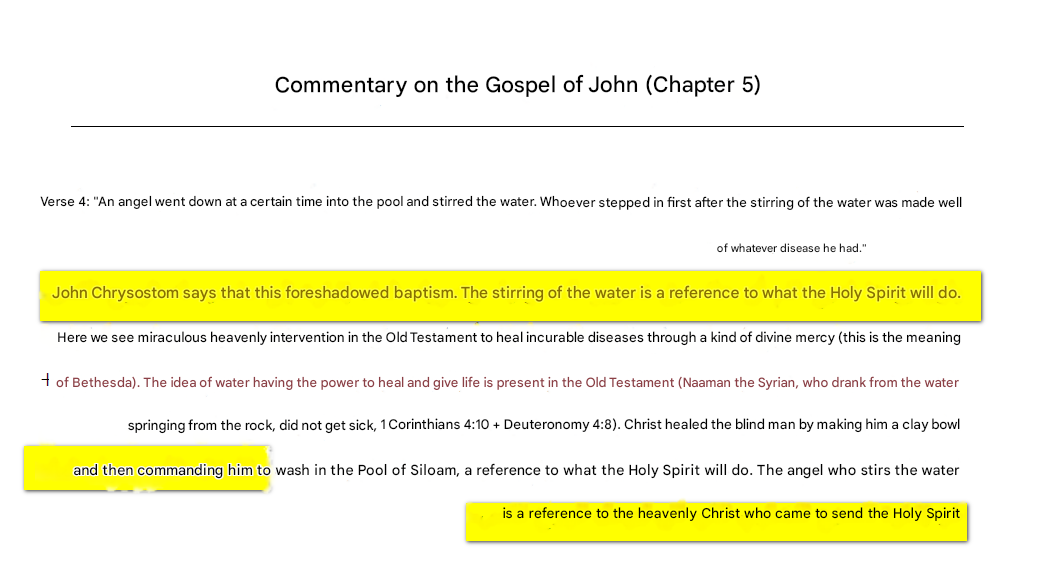
Interpretation of the Church Encyclopedia, P. 319:
http://www.stmarkos.org/explainbible/JohnFull-Ar.pdf
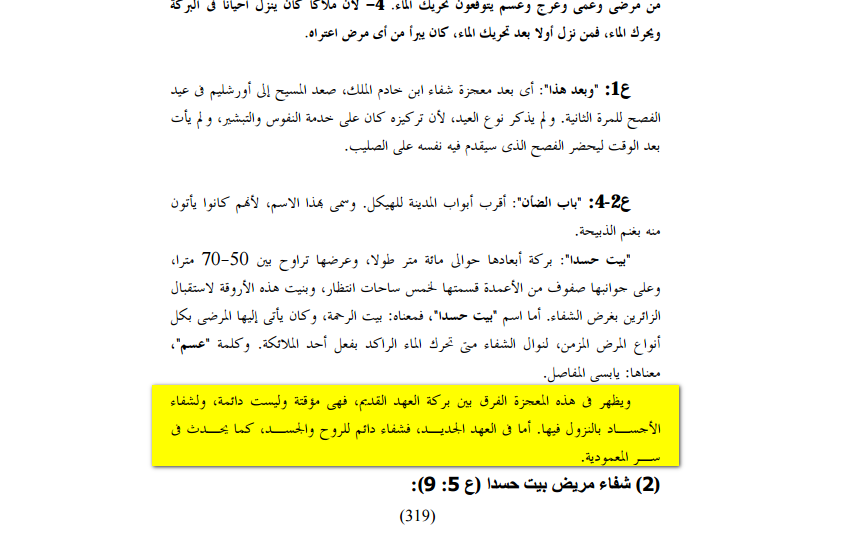
Tadros Yaqoub Malti’s Interpretation, P. 378:
Matthew Henry’s Commentary, P. 604:
E.T. Robertson’s Interpretation, P. 414:
Calvin’s Interpretation:
http://www.studylight.org/commentaries/cal/view.cgi?bk=42&ch=5
Conclusion
The best evidence from the New Testament, without dispute, is in favor of the deletion reading. All critical versions have ruled that the most correct is the deletion reading.
Does a Christian have any manuscript of the Bible before the third century that contains the text??