Matthew 5 44( LOVE YOUR ENEMIES

Text number 44 from the Gospel of Matthew, Chapter 5, is a distorted text!!
How does distortion prove it? This question is often resorted to by Christians after being discussed in any textual problem.
After the belief of Arab Christians was as Father Abdel-Masih Basit Abu Al-Khair said: “The Holy Bible cannot be distorted in any book, chapter, text, word, or letter!!”
The science of textual criticism came to demolish all these dreams caused by the influence of Islam and its view of the Holy Quran…
I will predict the expected behavior of Christians after reading this article: - 1He will tamper with the history of manuscripts.. This is easily treated by forcing Christians to rely on the dates established by critical scholars.
2An attempt to prove the authenticity of the passage away from the comments of the critical copies and the critical prologue of the scholars.. In response to this, it is sufficient to say that the words of the scholars take precedence over the words of the pretenders.
3The last attempt is to discuss the question you posed (How does distortion prove) … The answer to this question, whatever it is, is that the first thing a Christian must admit is (There is no objection to the deliberate introduction of texts or the deliberate deletion of texts from the Bible).. Would a Christian accept this? If he accepted this, then we would discuss the definition… But I am certain that he will not do it.. And so, may God spare the believers the fighting..
One of the results of the science of textual criticism is that it forced Christians, especially Eastern ones, to change their definition of distortion.. The definition of distortion is no longer that the text is deliberately changed.
Rather, distortion for Christians has become: the removal of an important doctrine with all its evidence from the Bible or the introduction of an important doctrine with all its evidence into the Bible… This definition overlooks the occurrence of some deliberate changes, and does not object to their occurrence, but it diminishes their importance. I say, when you discover a distortion of a text in the fifth century, this means that the book is fragile and weak.
The significance of these distortions proven by the science of textual criticism is that (the book did not protect itself from deliberate changes despite five centuries of its dissemination)… So, could it have protected itself from complete destruction five days after its composition? Was it able to survive at a time when the book was not widespread in an early, dark period for which we have no evidence??
This is the importance of these models of deliberate changes in the fifth century!! (The occurrence of corruption in the fifth century during the time of dissemination means the occurrence of destruction during the time of early composition)
The Text Has 5 Forms in Manuscripts: -
1But I say to you, love your enemies and pray for those who persecute you.
( προσεύχεσθε ὑπὲρ τῶν διωκόντων ὑμᾶς)
2But I say to you, love your enemies, bless those who curse you, pray for those who persecute you.
(ἐγὼ δὲ λέγω ὑμῖν, εὐλογεῖτε καωκόντων ὑμᾶς)
3But I say to you, love your enemies, bless those who curse you, pray for those who spitefully use you and persecute you.
(ἐγὼ δὲ λέγω ὑμῖν, εὐλογεῖτε ὑμᾶς ὑμᾶς ὑμᾶς ὑμᾶς ὑμᾶς ὑμᾶς καὶ διωκόντων ὑμᾶς)
4But I say to you, love your enemies, do good to those who hate you, pray for those who spitefully use you and persecute you.
(ἐγὼ δὲ λέγω ὑμῖν ἀγαπᾶτε τοὺς ἐχθροὺς καλῶς ποιεῖτε τοὺς καὶ προσεύχεσθε καὶ διωκόντων ὑμᾶς)
5But I say to you, love your enemies, bless those who curse you, do good to those who hate you, pray for those who despitefully use you and persecute you.
(ἐγὼ δὲ λέγω ὑμῖν ἀγαπᾶτε τοὺς ἐχθροὺς ὑμῶν εὐλογειτε τοὺς ὑμᾶς καλῶς ποιεῖτε τοὺς μισοῦντας ὑμᾶς, ὑπὲρ τῶν ἐπηρεαζόντων ὑμᾶς, καὶ διωκόντων ὑmic
The fifth form is the most common form used by Christians in their Bible today, but the correct text is the first form, the shorter reading.
The first reading is attested to by the oldest Greek manuscripts from the 4th century, the oldest Latin manuscripts from the 4th century, and the oldest Syriac manuscripts from the 4th century.
In contrast, the long reading is attested to by manuscripts from the 5th century onwards…so the difference between them is a century. This is from the perspective of external evidence, in addition to the fact that the rule of copyist probability is also in its favor, which states that the reading that explains the reason for the emergence of the other readings is the most correct. If the original reading was the long reading, what justification would make the Christian copyist delete these parts??
There is no… unlike if the original reading was the ellipsis reading, the copyist would have added parts in order to make this passage similar to the parallel passage from Luke 6:27-28…since Luke’s Gospel contains a similar text, and copyists are in the habit of harmonizing similar passages in the books… In summary, there are three things in favor of the ellipsis reading:
-
The consensus of all critical copies on the inauthenticity of the extra passage.
-
The agreement of the scholarly critical commentaries (the prologuemene) on the same result. 3) Strong external evidence as well as internal evidence that supports the ellipsis reading.
(1) Text Format in Arabic translations:-
-
Sites to browse Arabic translations: -
-
The common translation (al-Fandik) and the interpretive translation of al-Fandik (al-Hayat) both give the full text.
On the other hand, there are 6 Arabic translations that mention the text incompletely (mentioning only two of the five syllables).
1-[Van Dyke][ Mt. 5.44But I say to you, love your enemies, bless those who curse you, do good to those who hate you, and pray for those who despitefully use you and persecute you.
2-[Life][ Mt.5.44][But I say to you: Love your enemies, bless those who curse you, do good to those who hate you, and pray for those who spitefully use you and persecute you,]
3-[Shared][ Mt.5.44But I say to you: Love your enemies and pray for those who persecute you.
4-[Simplified][ Mt.5.44][But I say to you: Love your enemies and pray for those who persecute you.]
5-[Jesuit] Mt.5.44][But I say to you: Love your enemies and pray for those who persecute you,]
6-[Sarah][ Mt.5.44][But I say to you: Love your enemies and pray for those who persecute you,]
7-[Sharif][ Mt.5.44][But I say to you: Love your enemies and pray for those who persecute you.]
8-[Paulian] Mt.5.44But I say to you: Love your enemies and pray for those who persecute you.
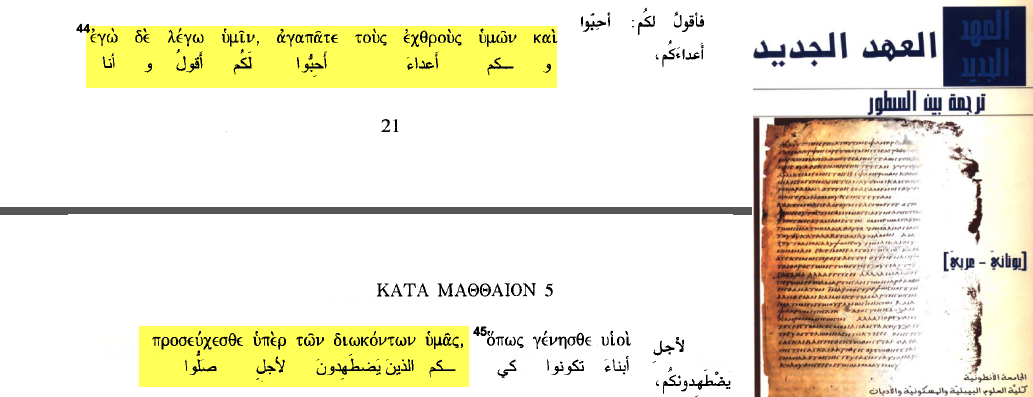
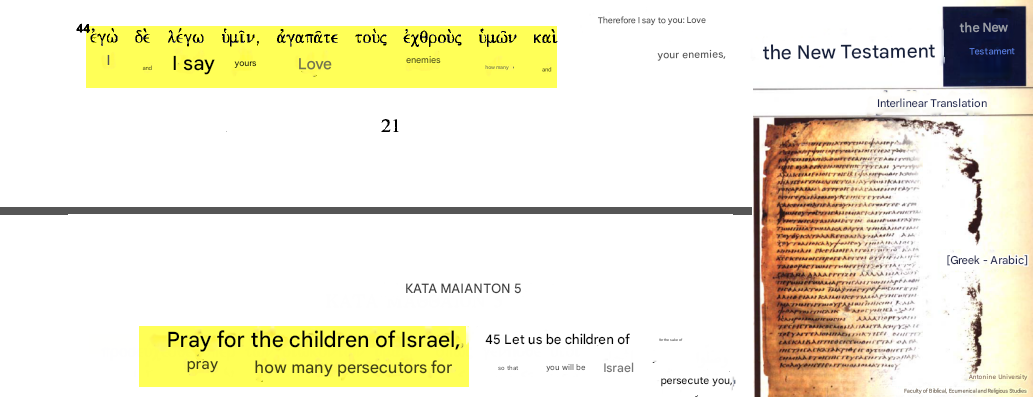
9Paul Al-Feghali’s translation from Greek to Arabic between the lines:
{Embed}
البشارة
[object Object]
(2) Text Form in English Translations
-Links to browse English translations
http://www.biblestudytools.com/wyc/
- The number of translations that mention the missing text = 26
Number of translations that mention the full text = 12
ASV Matthew 5:44 But I say unto you, love your enemies, and pray for them that persecute you;
BBE Matthew 5:44 But I say to you, Have love for those who are against you, and make prayer for those who are cruel to you;
CEB Matthew 5:44 But I say to you, love your enemies and pray for those who harass you
CJB Matthew 5:44 But I tell you, love your enemies! Pray for those who persecute you
CSB Matthew 5:44 But I tell you, love your enemies and pray for those who persecute you
CSBO Matthew 5:44 But I tell you, love your enemies and pray for those who persecute you,
ERV Matthew 5:44 but I say unto you, Love your enemies, and pray for them that persecute you;
ESV Matthew 5:44 But I say to you, Love your enemies and pray for those who persecute you,
{Embed}
BibleGateway.com: A searchable online Bible in over 150 versions an…
Read, hear, and study Scripture at the world’s most-visited Christian website. Grow your faith with devotionals, Bible reading plans, and mobile apps.

{Embed}
http://www.biblestudytools.com/wyc/
Read the Wycliffe Free Online
Search and read Bible verses using the popular WYC translation. Take notes online, highlight verses and save notes!
attachments/30088-bible-study-tools-logo_source_file-6854540af371af37.jpg
DRA Matthew 5:44 But I say to you, Love your enemies: do good to them that hate you: and pray for them that persecute and calumniate you:
DBY Matthew 5:44 But I say unto you, Love your enemies, bless those who curse you, do good to those who hate you, and pray for those who insult you and persecute you,
GWN Matthew 5:44 But I tell you this: Love your enemies, and pray for those who persecute you.
LEW Matthew 5:44 But I say unto you, Love your enemies, and pray for them who persecute you,
MIT Matthew 5:44 But I say to you: Love your enemies, and pray for those who put pressure on you.
NABO Matthew 5:44 But I say to you, love your enemies, and pray for those who persecute you,
NAS Matthew 5:44 “But I say to you, love your enemies, and pray for those who persecute you
NAU Matthew 5:44 “But I say to you, love your enemies and pray for those who persecute you,
NET Matthew 5:44 But I say to you, love your enemy and pray for those who persecute you,
NIB Matthew 5:44 But I tell you: Love your enemies and pray for those who persecute you,
NIRV Matthew 5:44 But here is what I tell you. Love your enemies. Pray for those who hurt you.
NIV Matthew 5:44 But I tell you, love your enemies and pray for those who persecute you,
NJB Matthew 5:44 But I say this to you, love your enemies and pray for those who persecute you;
NAB Matthew 5:44 But I say to you, love your enemies, and pray for those who persecute you,
NLT Matthew 5:44 But I say, love your enemies! Pray for those who persecute you!
NRS Matthew 5:44 But I say to you, Love your enemies and pray for those who persecute you,
RSV Matthew 5:44 But I say to you, Love your enemies and pray for those who persecute you,
TNIV Matthew 5:44 But I tell you, love your enemies and pray for those who persecute you,
ETH Matthew 5:44 But I say unto you, Love your enemies; bless them who execrate you; do that which is good to him who hates you; And pray for them who lead you with a chain, and persecute you.
GNV Matthew 5:44 But I say to you, Loue your enemies: bless them that curse you: do good to them that hate you, and pray for them which hurt you, and persecute you,
KJG Matthew 5:44 But I say unto you, Love your enemies, bless them that curse you, do good to them that hate you, and pray for them which despitefully use you, and persecute you;
KJV Matthew 5:44 But I say unto you, Love your enemies, bless them that curse you, do good to them that hate you, and pray for them which despitefully use you, and persecute you;
MGI Matthew 5:44 But I say to you, love your enemies and bless those who curse you and do that which is pleasing to him who hates you and pray for those who take you by force and persecute you,
MRD Matthew 5:44 But I say to you: Love your enemies; and bless him that curseth you; and do good to him that hates you; And pray for them that leads you in bonds, and that persecutes you:
NKJ Matthew 5:44 “But I say to you, love your enemies, bless those who curse you, do good to those who hate you, and pray for those who in spitefully use you and persecute you,
PNT Matthew 5:44 But I say vnto you, loue your enemies, bless them that curse you, do good to them that hate you, pray for the which hurt you, and persecute you:
RWB Matthew 5:44 But I say to you, Love your enemies, bless them that curse you, do good to them that hate you, and pray for them who despitefully use you, and persecute you;
TNT Matthew 5:44 But I say vnto you love your enimies. Please this course you. Do good to them that hate you. Praye for them which do you wronge and persecute you
WEB Matthew 5:44 But I say to you, Love your enemies, bless them that curse you, do good to them that hate you, and pray for them who despitefully use you, and persecute you;
YLT Matthew 5:44 but I — I say to you, Love your enemies, bless those cursing you, do good to those hating you, and pray for those accusing you falsely, and persecuting you,
(3) The Form of the Text in the Critical Greek Versions
-All Critical Copies Mention the Text incompletely:-
(1) The famous Nestle Aland version NA27
(44 προσεύχεσθε ὑπὲρ τῶν διωκόντων ὑμᾶς).
(2) The most famous version of UBS ever, GNT 5th :-
(44) προσεύχεσθε ὑπὲρ τῶν διωκόντων ὑμᾶς,).
(3) Westcott & Hort WH version:-
http://biblehub.com/text/matthew/5-44.htm
(44) προσεύχεσθε ὑπὲρ τῶν διωκόντων ὑμᾶς)
(4) Tschendorff version:
http://biblehub.com/text/matthew/5-44.htm
(44) προσεύχεσθε ὑπὲρ τῶν διωκόντων ὑμᾶς)
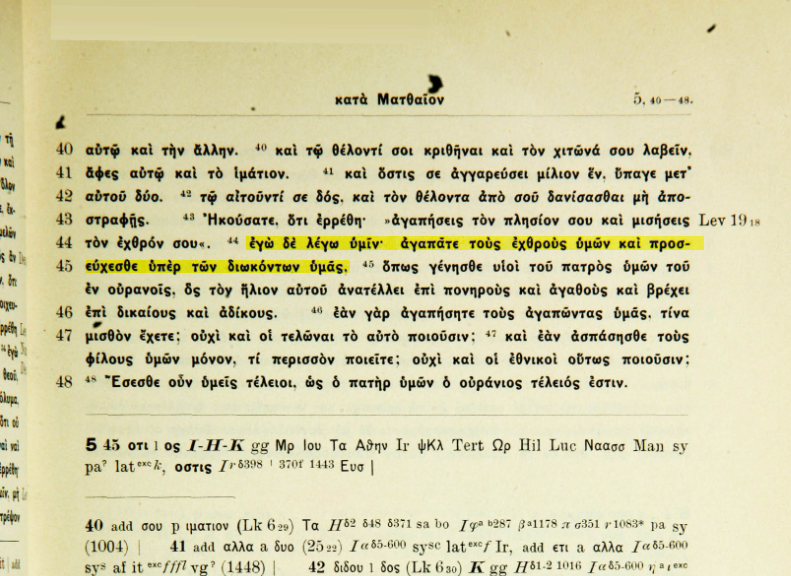
(5) Von Soden’s version:-
http://images.csntm.org/PublishedWorks/von_Soden_volume_4/0013.jpg
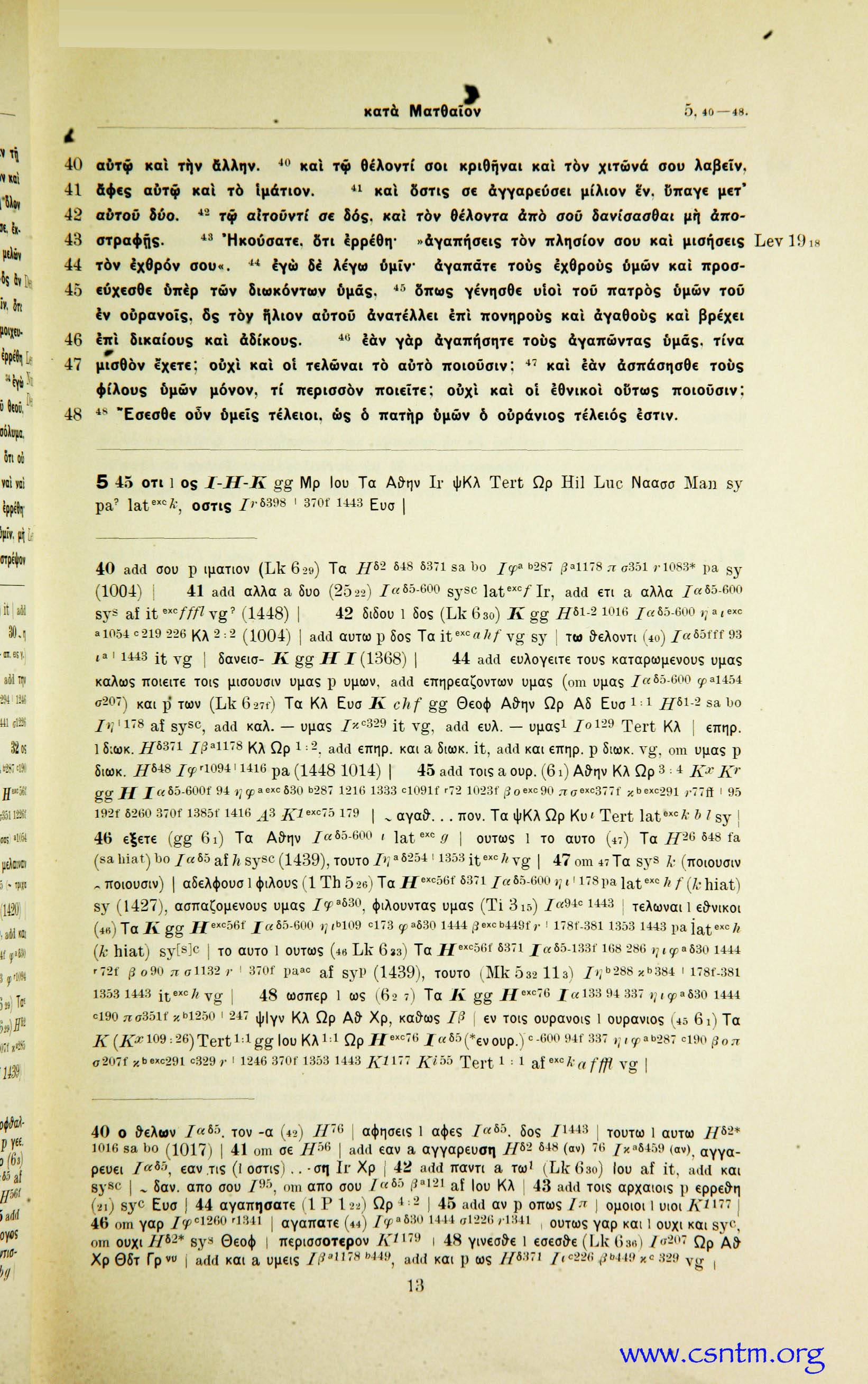
(44) προσεύχεσθε ὑπὲρ τῶν διωκόντων ὑμᾶς)
(4) Traditional Greek Versions
All traditional versions quote the entire passage.
http://biblehub.com/text/matthew/5-44.htm
(1)RP Byzantine Majority Text 2005
ἐγὼ δὲ λέγω ὑμῖν, εὐλογεῖτε ὑμᾶς ὑμᾶς ὑμᾶς ποιεῖτε τοῖς καὶ διωκόντων ὑμᾶς
(2)
Greek Orthodox Church 1904
ἐγὼ δὲ λέγω ὑμῖν, ἀγαπᾶτε τοὺς ἐχθροὺς ὑμῶν, εὐλογεῖτε καταρωμένους ὑμᾶς ὑπὲρ τῶν ἐπηρεαζόντων ὑμᾶς καὶ διωκόντων ὑμᾶς,
(3)
Scrivener’s Textus Receptus 1894
ἐγὼ δὲ λέγω ὑμῖν, ἀγαπᾶτε τοὺς ἐχθροὺς ὑμῶν, εὐλογειτε ὑμᾶς ὑμᾶς ὑμᾶς ποιεῖτε τοὺς ὑμᾶς καὶ διωκόντων ὑμᾶς•
(4)
Stephanus Textus Receptus 1550
ἐγὼ δὲ λέγω ὑμῖν ἀγαπᾶτε τοὺς ἐχθροὺς ὑmic ὑμᾶς καλῶς ποιεῖτε τοὺς μισοῦντας ὑμᾶς, καὶ διωκόντων ὑμᾶς,
(5) The form of the text in the manuscripts
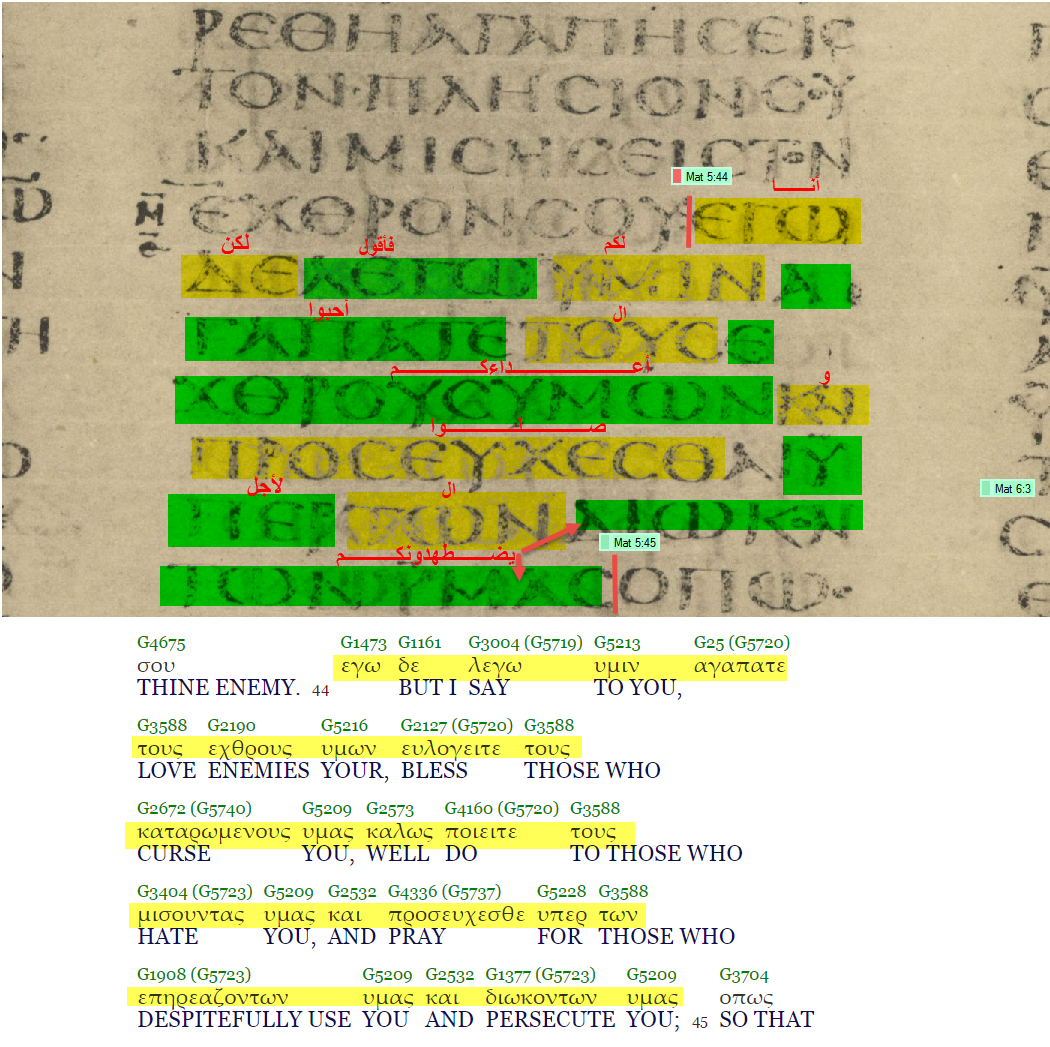
- This is an image of the text in Greek and its English equivalent.
http://studybible.info/IGNT/Matthew%205
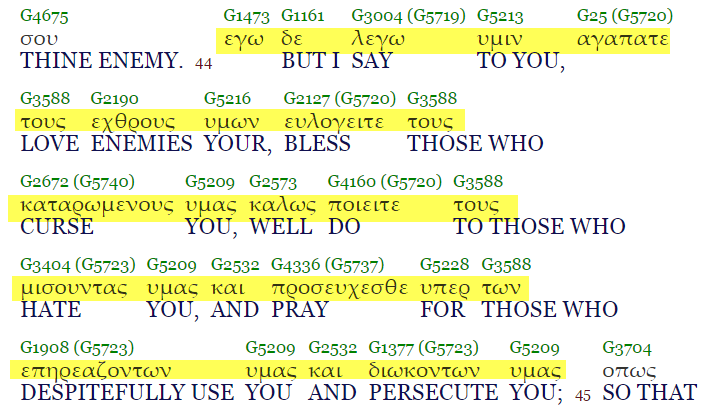
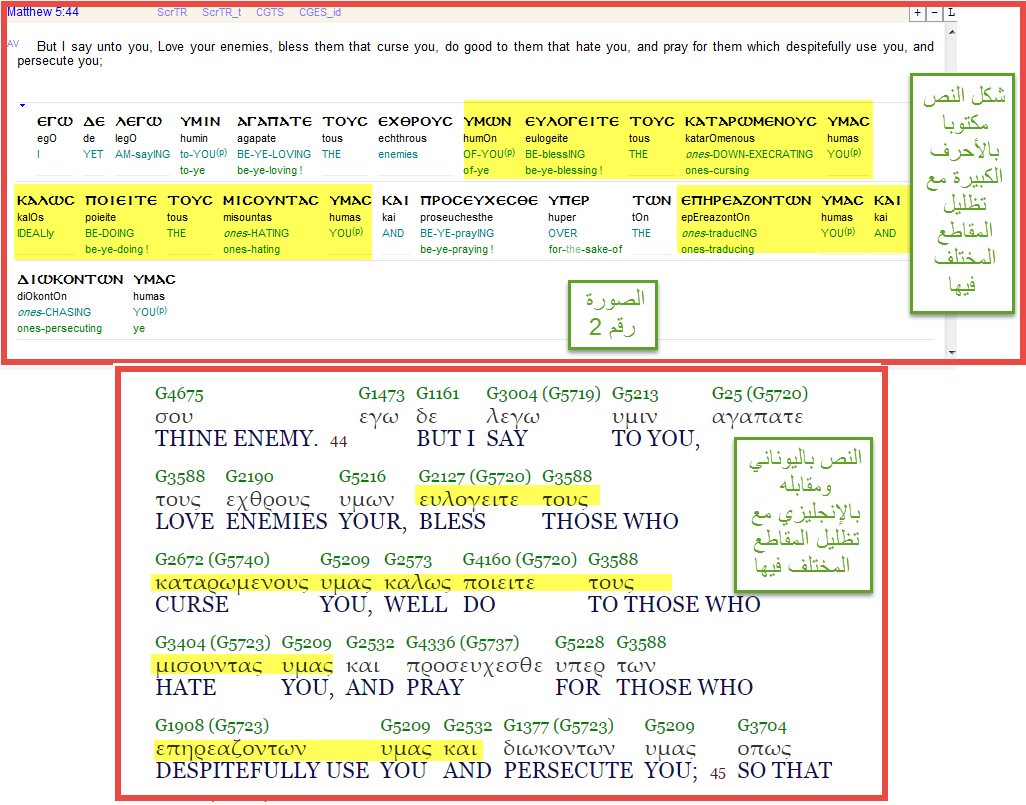
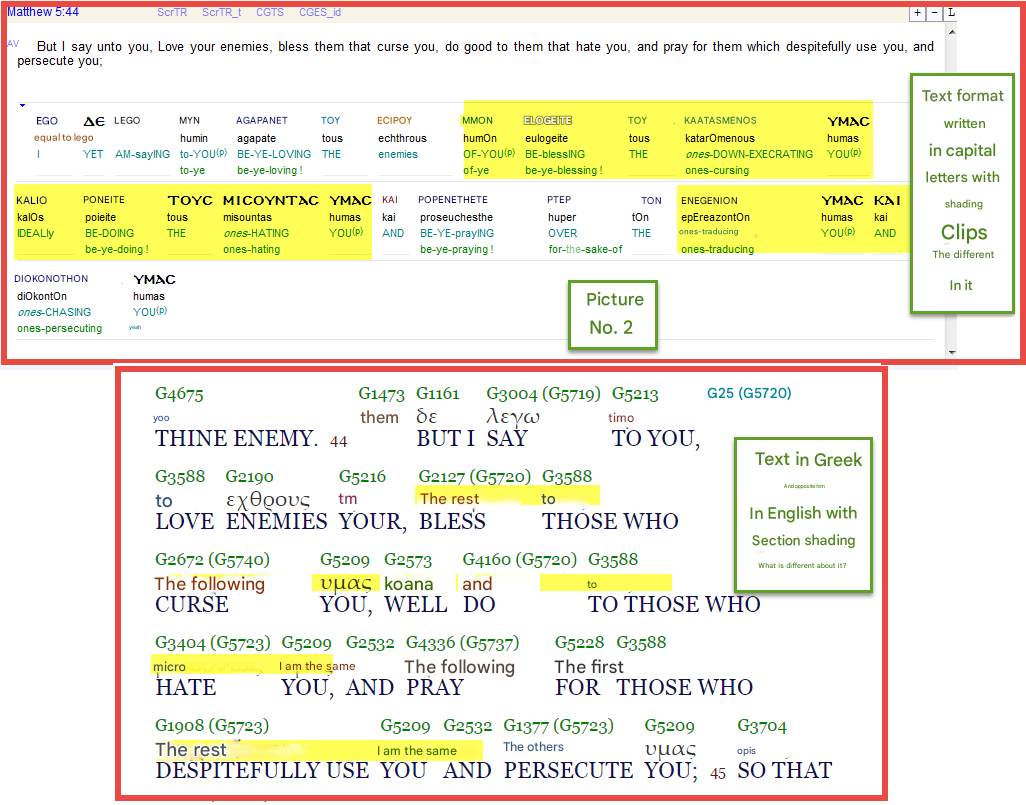
This is a picture of the text in Greek capitals, which is how early Greek manuscripts of the New Testament were written.
The following is a Translation of the Text Sections
ἐγὼ δὲ λέγω ὑμῖν, = but I tell you
ἀγαπᾶτε τοὺς ἐχθροὺς ὑμῶν= Love your enemies
εὐλογεῖτε τοὺς καταρωμένους ὑμᾶςBless those who curse you
καλῶς ποιεῖτε τοῖς ὑμᾶς ὑμᾶςBe good to those who hate you
ὑπὲρ τῶν ἐπηρεαζόντων ὑμᾶςPray for those who wrong you.
καὶ διωκόντων ὑμᾶςAnd they persecute you
This text has 5 different forms in manuscripts:
1But I say to you, love your enemies and pray for those who persecute you.
( προσεύχεσθε ὑπὲρ τῶν διωκόντων ὑμᾶς)
2But I say to you, love your enemies, bless those who curse you, pray for those who persecute you.
(ἐγὼ δὲ λέγω ὑμῖν, εὐλογεῖτε καωκόντων ὑμᾶς)
3But I say to you, love your enemies, bless those who curse you, pray for those who spitefully use you and persecute you.
(ἐγὼ δὲ λέγω ὑμῖν, εὐλογεῖτε ὑμᾶς ὑμᾶς ὑμᾶς ὑμᾶς ὑμᾶς ὑμᾶς καὶ διωκόντων ὑμᾶς)
4But I say to you, love your enemies, do good to those who hate you, pray for those who spitefully use you and persecute you.
(ἐγὼ δὲ λέγω ὑμῖν ἀγαπᾶτε τοὺς ἐχθροὺς καλῶς ποιεῖτε τοὺς καὶ προσεύχεσθε καὶ διωκόντων ὑμᾶς)
5But I say to you, love your enemies, bless those who curse you, do good to those who hate you, pray for those who despitefully use you and persecute you.
(ἐγὼ δὲ λέγω ὑμῖν ἀγαπᾶτε τοὺς ἐχθροὺς ὑμῶν εὐλογειτε τοὺς ὑμᾶς καλῶς ποιεῖτε τοὺς μισοῦντας ὑμᾶς, ὑπὲρ τῶν ἐπηρεαζόντων ὑμᾶς, καὶ διωκόντων ὑmic
*A site for the history of manuscripts in the first seven centuries: -
http://bibletranslation.ws/manu.html
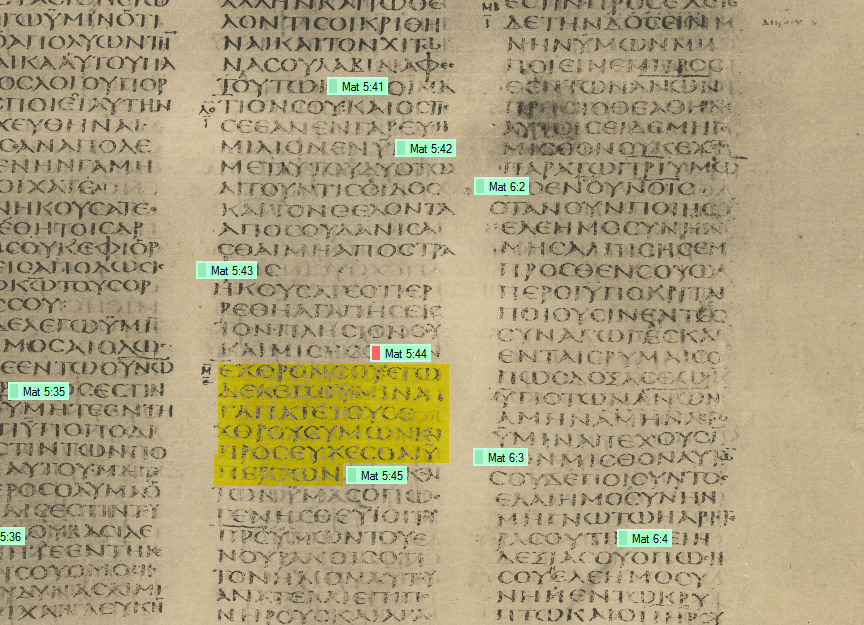
1Image Of the Text in the Sinaiticus Manuscript from the Fourth Century
Sinaiticus witnesses the shorter reading:-
(But I say to you, love your enemies and pray for those who persecute you.)
Sinaiticus is the oldest New Testament manuscript ever to contain verse 44, chapter 5 of the Gospel of Matthew.
Image of the text in the manuscript
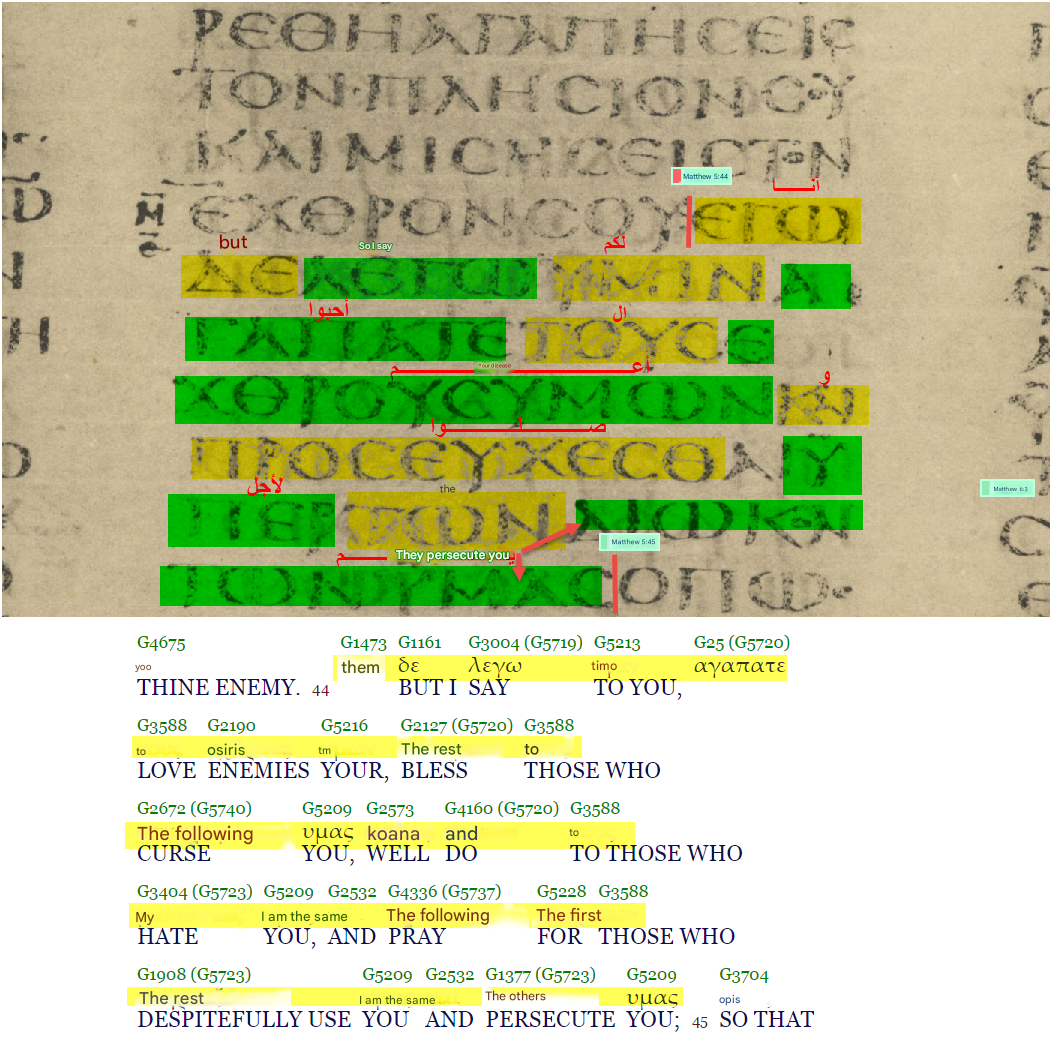
Enlarged image of the text in detail
Direct link to the official website of the manuscript
http://www.codexsinaiticus.org/en/
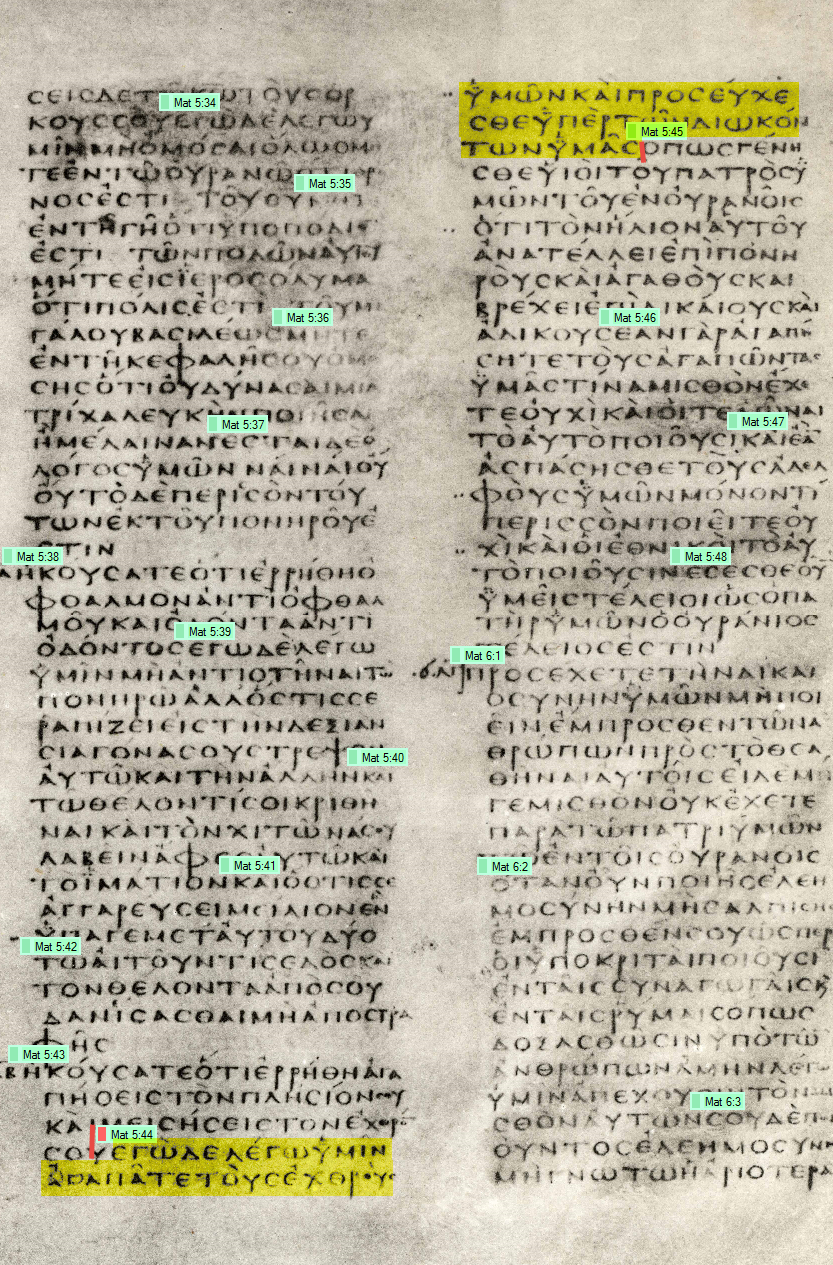
2Image Of the Text in the Vatican Manuscript from the Fourth century:-
The Vatican Codex, along with the Sinaiticus, are the oldest witnesses of Text 44 ever.
The manuscript bears witness to the shorter reading:-
(But I say to you, love your enemies and pray for those who persecute you.)
Image of the text in the manuscript:
{Embed}
http://www.codexsinaiticus.org/en/
Codex Sinaiticus - Home
Codex Sinaiticus is one of the most important books in the world. Handwritten well over 1600 years ago, the manuscript contains the Christian Bible in Greek, including the oldest complete copy of the New Testament. The Codex Sinaiticus Project is an international collaboration to reunite the entire manuscript in digital form and make it accessib…
Link to the manuscript from the official website:
http://www.csntm.org/Manuscript/View/GA_03
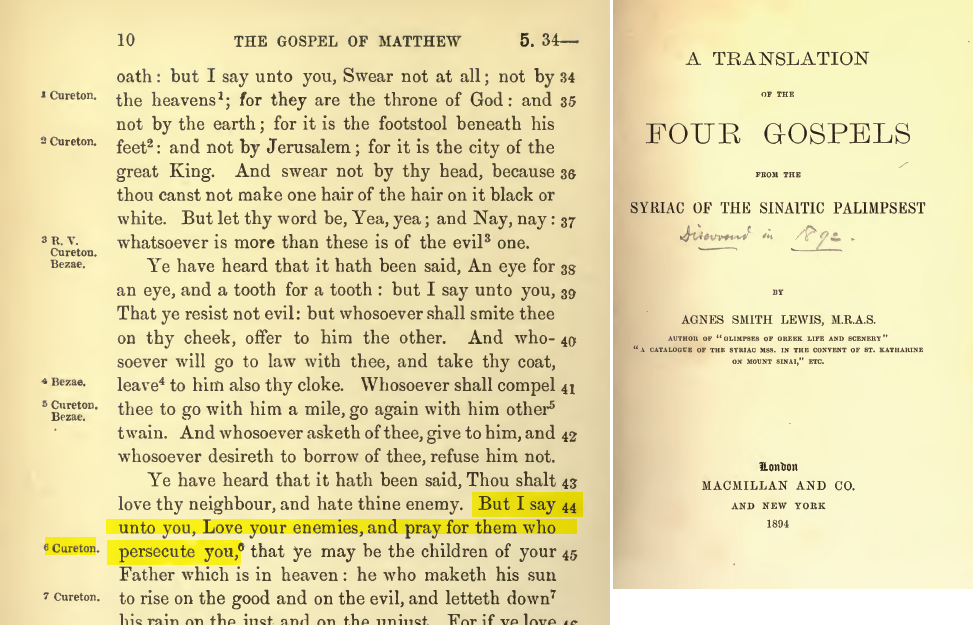
3The Image of the Text in the Syriac Sinaiticus and Syriac Curitonianus Manuscripts
Syriac Sinaitic from the 4th century, and the Syriac Curitonian manuscript from the 5th century:-
Image of the text from a book to transcribe the text of the two manuscripts:
the syriac of the sinaitic palimpsest, by agnes smith
Direct link to the text of the two manuscripts
http://www.dukhrana.com/peshitta/index.php
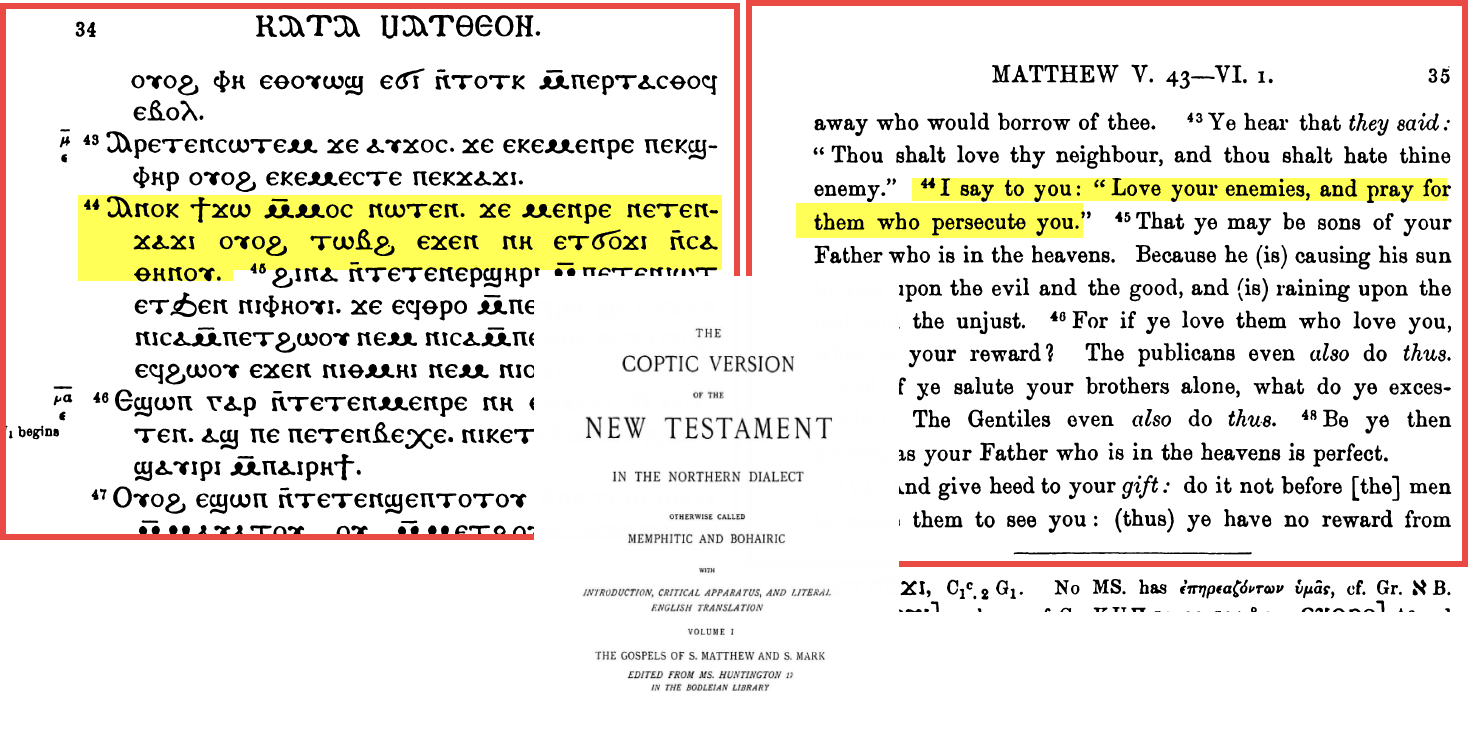
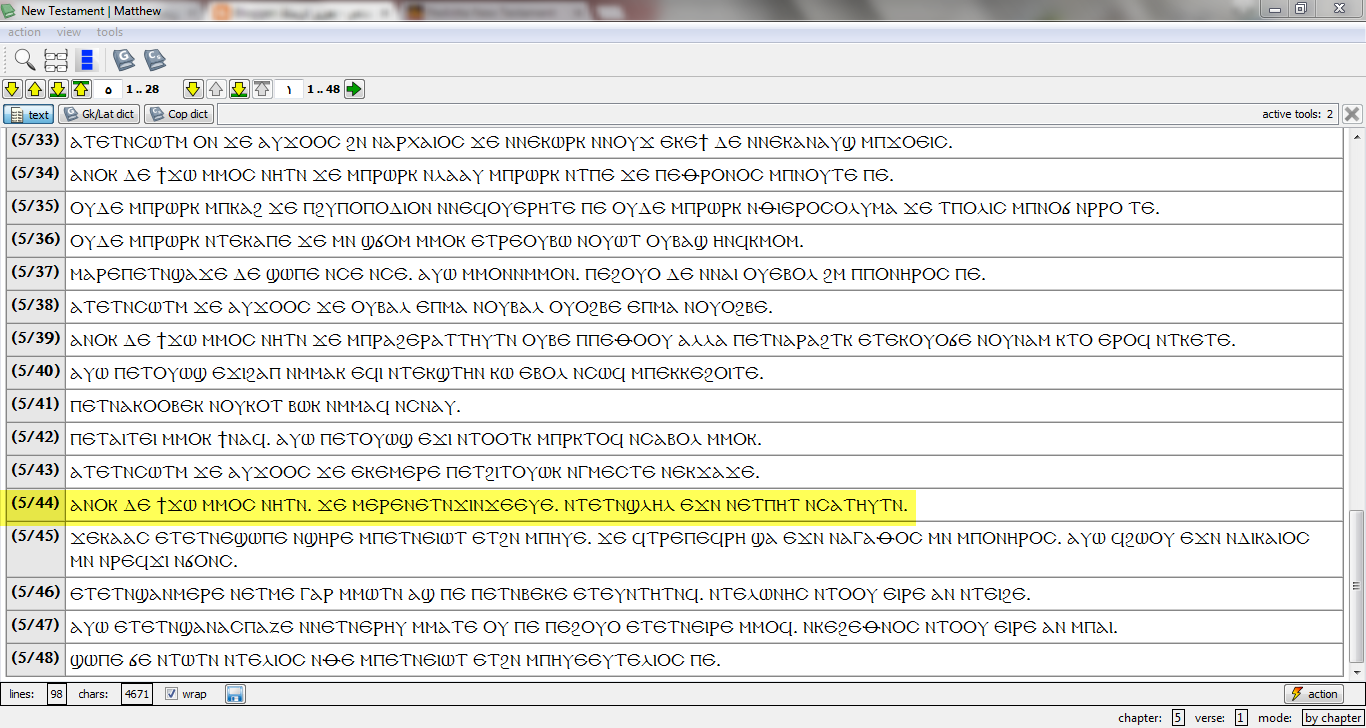
4The Image of the Text in the Bohairic Coptic Manuscripts and the Sahidic Coptic Manuscripts
Transcription of the Bohairic Coptic manuscript from the book The Coptic Version of the New Testament in the Northern Dialect
Transcription of the Upper Egyptian Coptic manuscript from the book The Coptic Version of the New Testament in the Southern Dialect
Bohairic Coptic text
{Embed}
http://www.dukhrana.com/peshitta/index.php
Peshitta New Testament
Peshitta Tool, Browse the verses of the Peshitta New Testament
Sahidic Coptic Text
(Image from Marcion program)
6Comments On Critical Copies: -
- The Union Bible Societies (UBS) version called GNT4th:-
Comment image
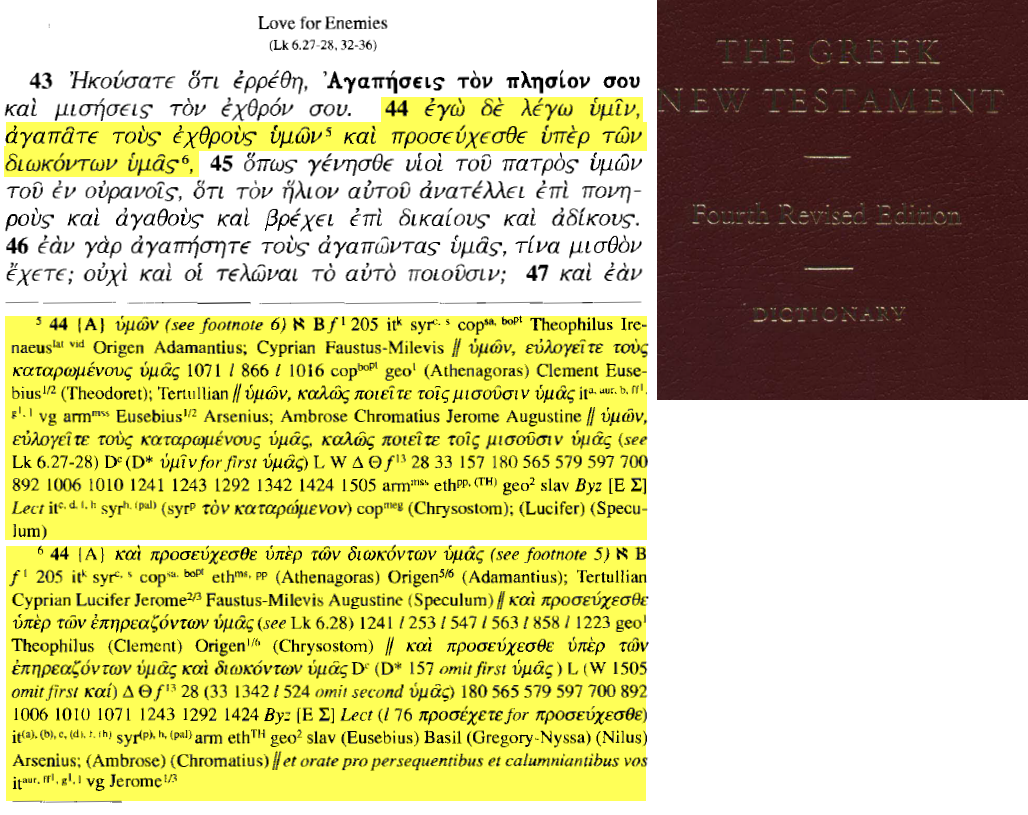
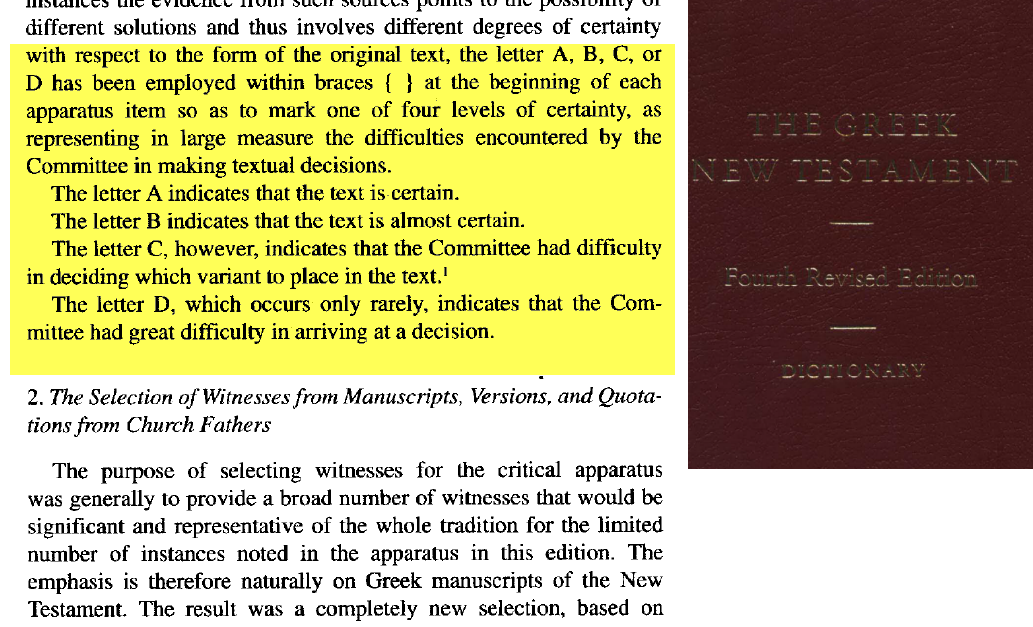
The Union chose to read (Love your enemies, pray for those who persecute you) with a grade of A, which means that they are sure that the choice is correct.
The following image shows the evaluation grades that the committee gives to readings in general, and the significance of each grade, starting from A to D.
The Committee Divided the Text into Two Sections
1The passage that begins with the phrase (Love your enemies), and the differences were mentioned.
2The passage that begins with the phrase (and pray for…), and the differences were mentioned.
Translation with some modifications:
First, regarding the passage (love your enemies), it has four forms in the manuscripts:
1First reading:
But I say, Love your enemies.
(Bless those who curse you, do good to those who hate you)
This is the correct reading, and it was graded A.
The following manuscripts testify to this:
Sinaiticus Q4 - Vatican Q4 - Family manuscripts No. 1 - Manuscript 205 - Old Latin manuscript K from the end of the fourth century - Saidi Coptic manuscript - Bohairic Coptic - and many of the fathers used it
2Second reading:
ἐγὼ δὲ λέγω ὑμῖν ἀγαπᾶτε εὐλογεῖτε τοὺς καταρωμένους ὑμᾶς
But I say, Love your enemies, bless those who curse you.
(Do good to those who hate you)
It is attested to by late manuscripts, namely 1071 BC - Manuscript 866 - 1016 - Coptic Bohairic manuscript - Georgian manuscript
It was used by several fathers.
3The third reading: -
ἐγὼ δὲ λέγω ὑμῖν ἀγαπᾶτε τοὺς ἐχθροὺς ὑmic τοῖς μισοῦσιν ὑμᾶς
= But I say, love your enemies, do good to those who hate you.
(Bless those who curse you)
The following manuscripts testify to this:
Old Latin a (4th-5th century), Old Latin b (5th-6th century), Old Latin aur (6th-8th century), Old Latin ff1 (8th-11th century), Old Latin g1 (7th-10th century), late Armenian manuscript, used by several Fathers
4The fourth reading (which is similar to the current widespread text):
ἐγὼ δὲ λέγω ὑμῖν, ἀγαπᾶτε τοὺς ἐχθροὺς ὑμῶν, εὐλογεῖτε ὑμᾶς ὑμᾶς ὑμᾶς ὑμᾶς ὑμᾶς
= But I say to you, love your enemies, bless those who curse you, do good to those who hate you.
The following manuscripts testify to this:
The Washington Codex from the 5th century, late manuscripts such as L, Theta, Delta, and 19 other Greek manuscripts starting from the 9th century, an Armenian manuscript, a Georgian manuscript, a Syriac-Heraclian manuscript from the 7th century, and a Beshita manuscript from the 5th century, all of which were used by the Fathers John Chrysostom.
Second: The Phrase “Pray for…” Has Three Forms in the Manuscripts
1First reading:
This is the correct reading and it is the reading chosen by the association with a grade of A.
ὑπὲρ τῶν διωκόντων ὑμᾶς
Pray for those who persecute you.
(Don’t pray for those who mistreat you.)
It is found in the following manuscripts:
Latin k - Sinaitic Syriac - Curitonian Syriac - Sahidic Coptic - Bohairic Coptic - Ethiopian manuscript and used by several fathers
2Second reading:
ὑπὲρ τῶν ἐπηρεαζόντων ὑμᾶς
Pray for those who wrong you.
(Pray for those who persecute you)
It is found in a late Greek manuscript of 1241, five late ecclesiastical manuscripts, a Georgian manuscript, and was used by several fathers.
3The third reading (like the current widespread text): -
ὑπὲρ τῶν ἐπηρεαζόντων ὑμᾶς καὶ διωκόντων ὑμᾶς
Pray for those who mistreat and persecute you.
The following manuscripts testify to this:
The Codex Bezae from the 5th century, the Washington Codex from the 5th century, and over 20 later Greek manuscripts beginning in the 8th century.
Latin manuscripts a, b, c, h, Syriac Peshitta from the 5th century, Heraclian from the 7th century, and Armenian, Ethiopian, Georgian, and Slavonic manuscripts, used by several fathers.
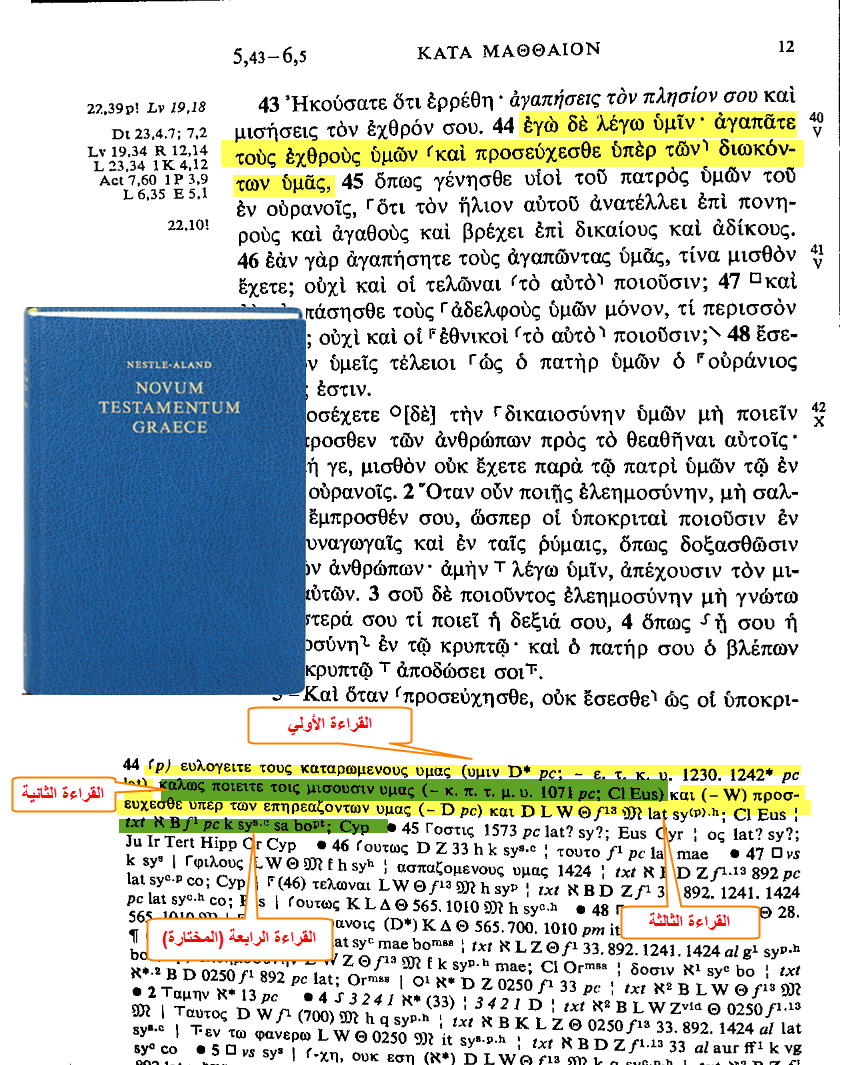
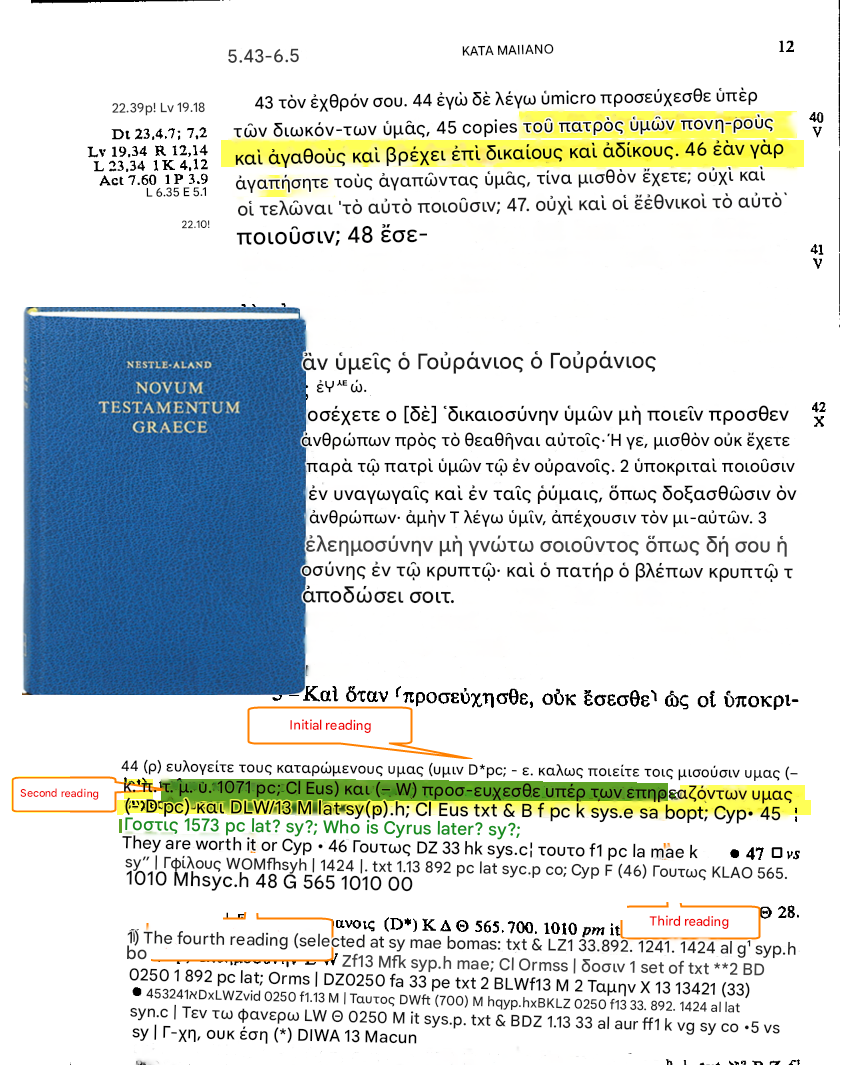
(2) Nestle Aland NA26 version:-
She mentioned four different readings of the text, and the evidence for each reading in the manuscripts, and chose the reading of deletion as the most correct reading.
(3) Critical Comments by the Scholar Bruce Metzger
His commentary in A textual commentary on the Greek New Testament:
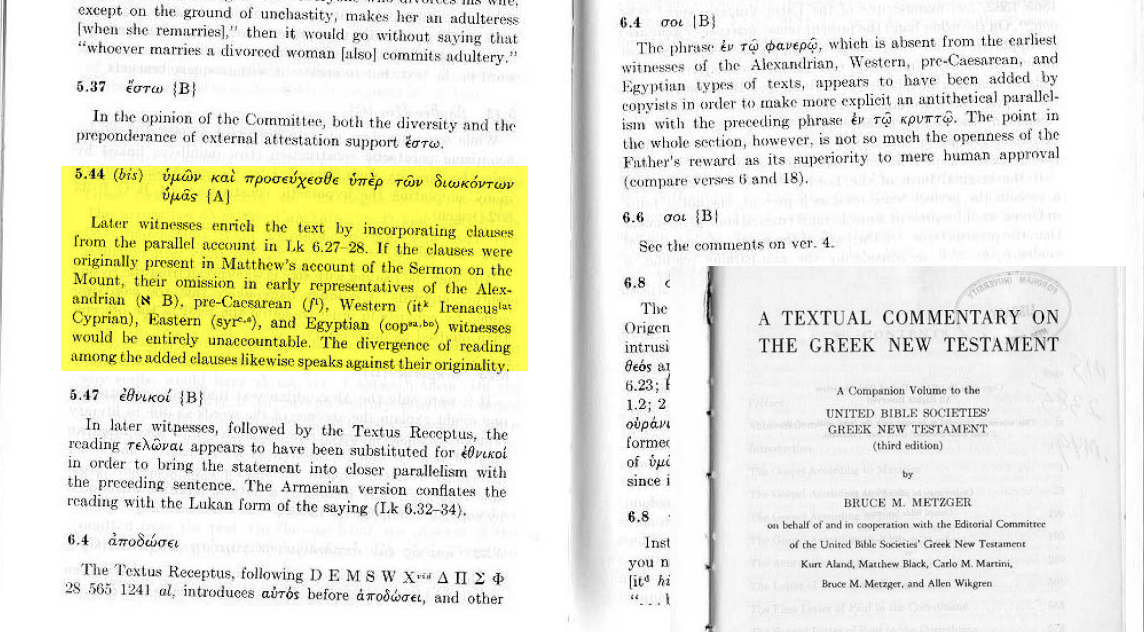
***(Late witnesses enriched this text with other additions taken from another text found in Luke 6:27-28.
If these fragments were original to the text of Matthew’s Gospel, their omission from the early Alexandrian text found in Codex Sinaiticus and Codex Vaticanus, the pre-Caesarean text represented by Family 1, the Western text represented by Codex K, the Old Syriac text represented by Codex Sinaiticus and Syriac Curitonianus, and the Egyptian text represented by Coptic Sahidic and Coptic Boharic, would be inexplicable. The contradiction and difference in reading between the witnesses that add these fragments is evidence against their authenticity.
(4) Critical Comments by Wieland Wilker
Direct browsing link for comments
http://www-user.uni-bremen.de/wie/TCG/TC-Matthew.pdf
Mention the evidence that testifies to the popular reading and that testifies to the critical reading
Then he said: (There is no justification for deleting these parts)
(Harmonization to Lk (so Weiss). There is no reason for an omission.)
He means that if the original reading was the long reading, then what is the justification that makes the copyists delete these parts? He indicates by this that the rule of copy probability is in favor of the deletion reading.
The rule of copyist probability is that “the reading that is most difficult for the copyist is the preferred one, and the reading that explains the reason for the appearance of the other readings is the preferred one.” There is no explanation for its deletion. However, there is a reason for its addition, which is to make it compatible with the similar text in the Gospel of Luke. The phenomenon of change for the sake of compatibility between similar paragraphs in the books is a clear and well-known phenomenon.
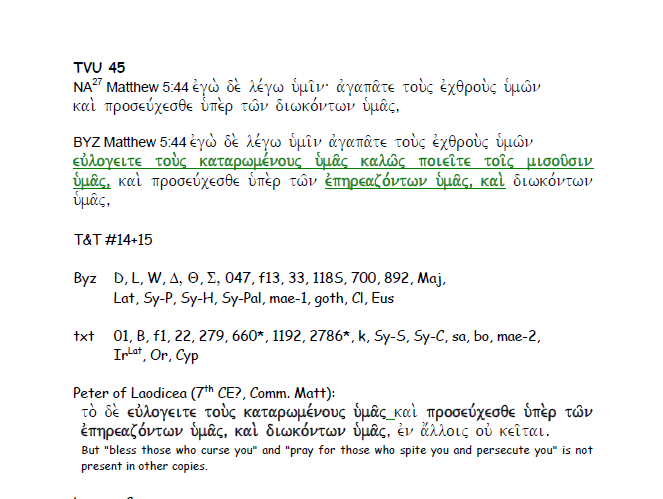
***(Reading the critical text:
”
44 προσεύχεσθε ὑπὲρ τῶν διωκόντων ὑμᾶς = But I say to you, love your enemies and pray for those who persecute you.”Reading the Byzantine text:
“ἐγὼ δὲ λέγω ὑμῖν, Ἀγαπᾶτε τοὺς ἐχθροὺς ὑμῶν, εὐλογεῖτε ὑμᾶς ὑμᾶς ὑμᾶς ποιεῖτε τοῖς καὶ διωκόντων ὑμᾶς
But I say to you, love your enemies, bless those who curse you, do good to those who hate you, and pray for those who despitefully use you and persecute you.The reading of the Byzantine text is attested to by the following manuscripts:
D, L, W, D, Q, S, 047, f13, 33, 118S, 700, 892, Maj,
Lat, Sy-P, Sy-H, Sy-Pal, mae-1, goth, Cl, Eus Critical text reading is attested to by the following manuscripts
txt 01, B, f1, 22, 279, 660*, 1192, 2786*, k, Sy-S, Sy-C, sa, bo, mae-2,
IrLat, Or, Cyp)
(5) Philip W. Comfort’s Critical Comments :-
In the New Testament text and Translation Commentary
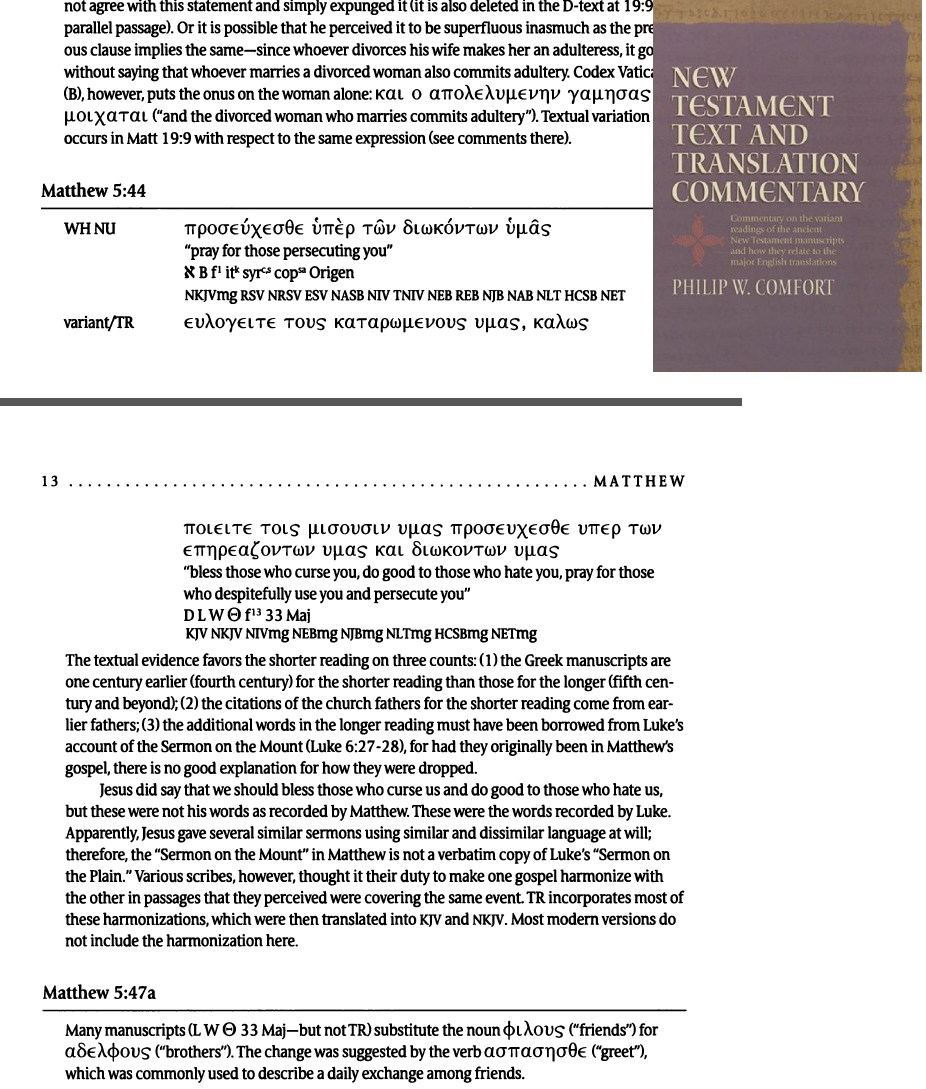
***(The textual evidence is in favor of the shorter reading for three reasons:-
1The Greek manuscripts that testify to the short reading date back to the fourth century, while the Greek evidence for the long reading dates back a full century to the fifth century.
2The patristic evidence in favor of shorter reading earlier than longer reading.
3The added parts are certainly taken from Luke 6:27-28. So, if the long reading is the correct one, there is no justification for omitting them.Jesus actually said, “Bless those who curse you, do good to those who hate you,” but not in the Gospel of Matthew.
(6) Comment on the Electronic Critical Version of CNTTS Critical apparatus:-
H. Milton Haggard Center for New Testament Textual Studies. (2010). The Center for New Testament Textual Studies: NT Critical Apparatus (Mt 5:44). New Orleans Baptist Theological Seminary.
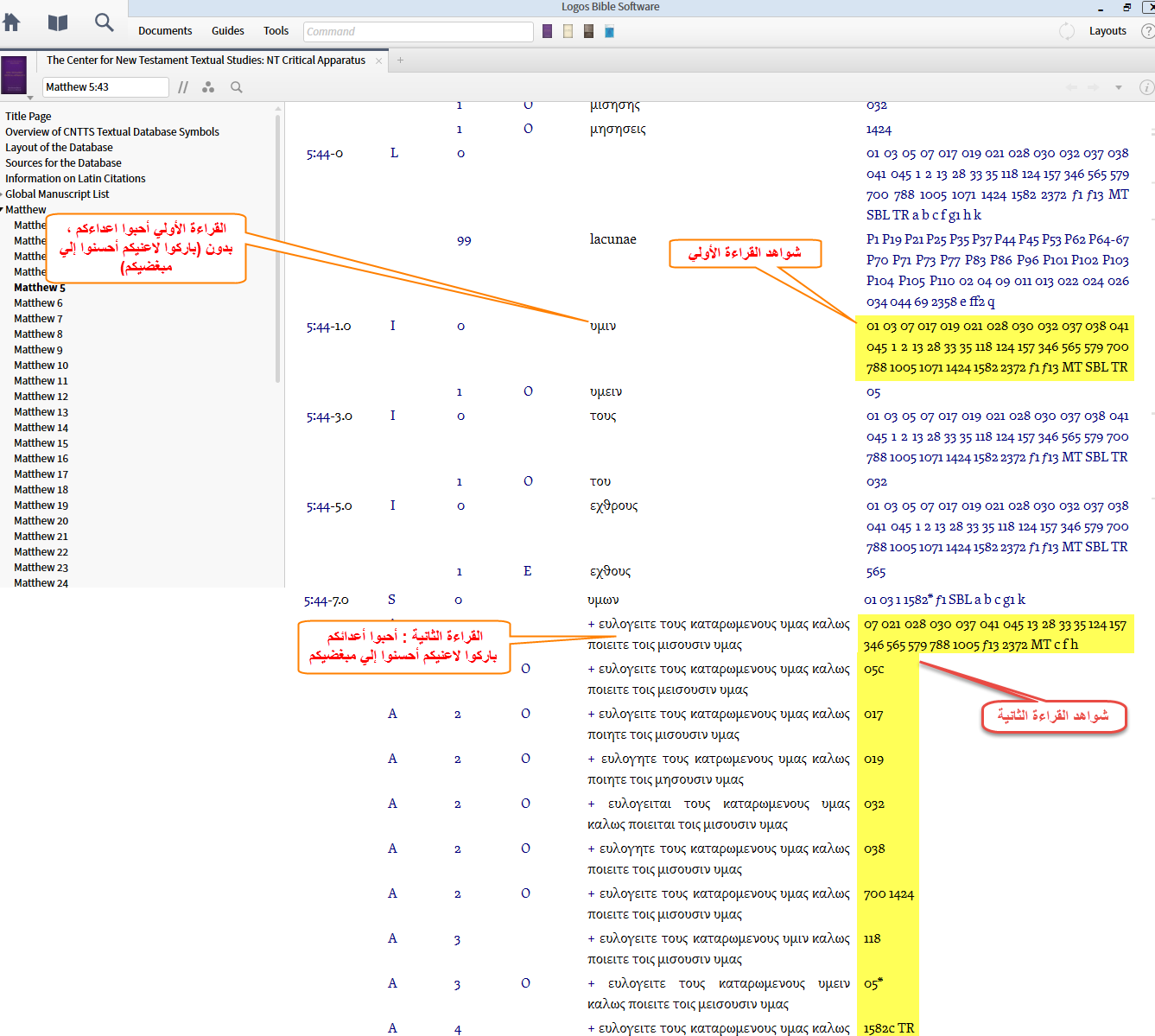
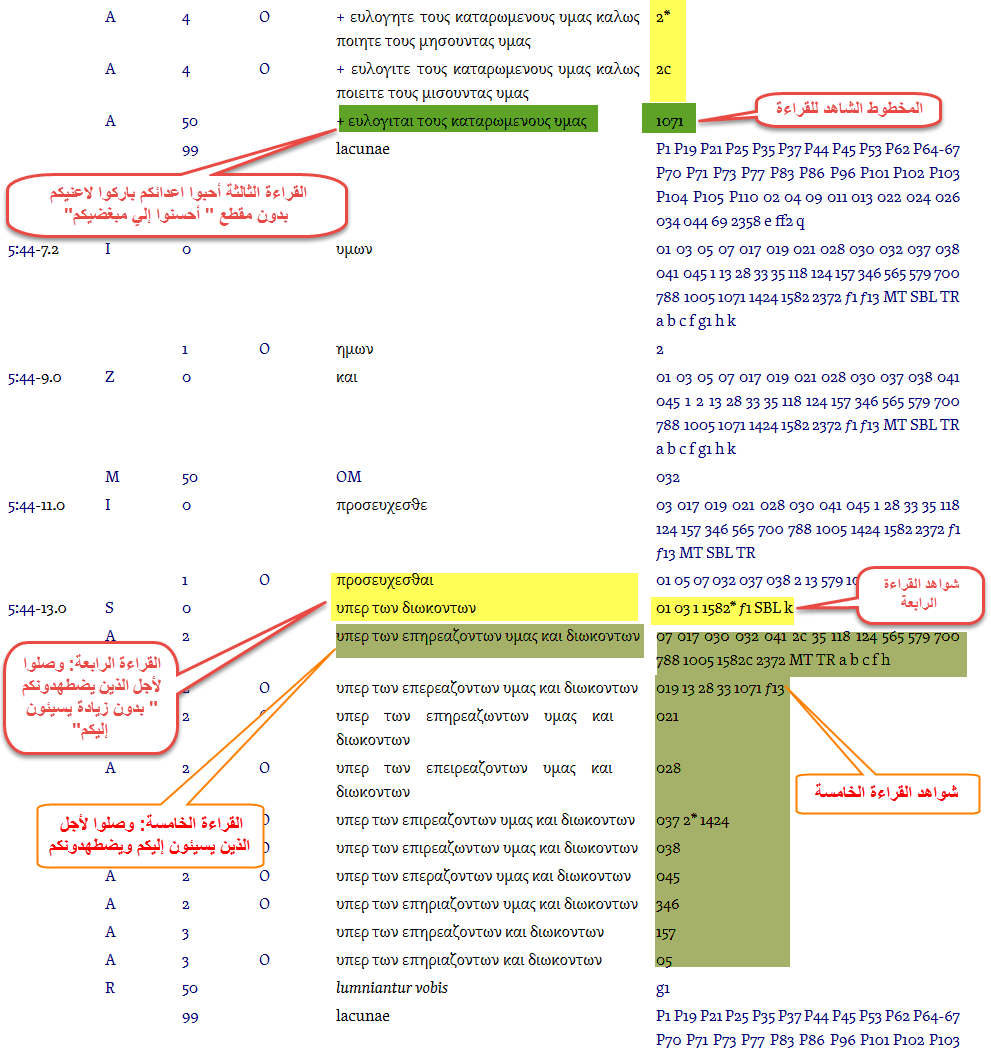
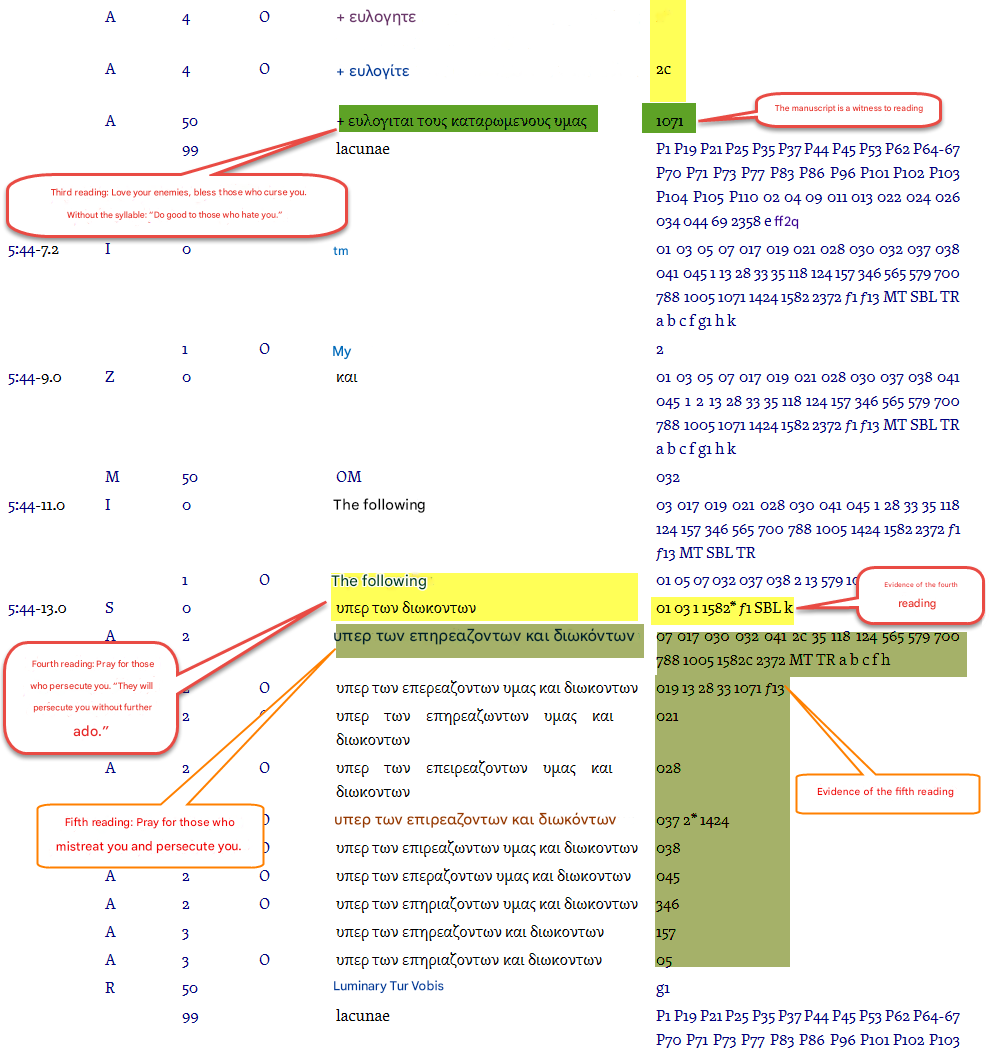
Based on the above, we find that there are no manuscripts older than the Sinaiticus and Vaticanus that attest to the number, and they delete the additions, and they are supported by evidence from various languages, patristic quotations, copyist probability, and critical copies.
This means that the strongest evidence is in favor of the ellipsis reading (early Greek manuscripts with Alexandrian text).
The Question is
Does a Christian have a single critical copy in favor of reading the addition?
Does a Christian have a critical commentary by a textual critic who has testified in favor of the additional reading?
Does a Christian have an older manuscript of the Sinaiticus and Vaticanus for verse 44? (I hope that the Christian will rely on the dates approved by textual criticism scholars and not the invented dates.)
Rather, We cast the truth upon falsehood, and it destroys it, and at once it departs.
Praise be to God, Lord of the Worlds