

Christianity

Matthew 12:47, 18:11, and 17:21 — Three Verses Added by Scribes and Absent from Every Ancient Manuscript

4 min read 898 words

Three verses in the Gospel of Matthew are absent from every major ancient manuscript and every critical Greek edition. They were added by later scribes — and the doctrinal problems each verse creates explains precisely why the critical tradition has removed them.


Matthew 12:47 — “Your Mother and Brothers Are Standing Outside”

The Verse

Matthew 12:47 (KJV) “Then one said unto him, Behold, thy mother and thy brethren stand without, desiring to speak with thee.”

Multiple English translations render this verse — SVD, ALAB, GNA, JAB, and KJV all include it. The Latin Vulgate also contains it: “Dixit autem ei quidam ecce mater tua et fratres tui foris stant quaerentes te.”

However, the critical Greek editions — including the Westcott-Hort text (GNT-WH) — omit it entirely, marking it as a later addition.

Manuscript Evidence

The verse is absent from the Vaticanus Codex:
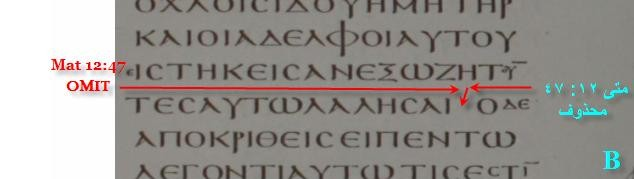
Vaticanus Codex — Matthew 12 showing the absence of verse 47

The verse is also absent from the Sinaiticus Codex:
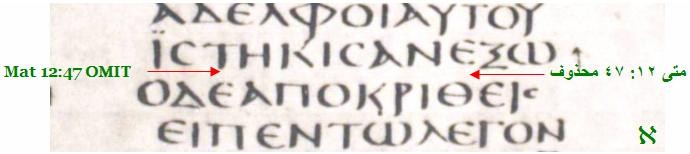
Sinaiticus Codex — Matthew 12 showing the absence of verse 47

The Alexandrian Codex likewise omits this verse.

Doctrinal Importance

The verse records that Jesus’ mother and brothers came to speak with him — and that Jesus refused to meet them, instead redirecting attention to his disciples. This refusal to acknowledge his own mother is theologically uncomfortable. If Jesus is divine and commands honour of parents, his dismissal of his mother’s request requires explanation. The omission from the oldest manuscripts suggests this passage was added by scribes who wished to include the exchange — without accounting for the doctrinal difficulty it creates.

Doctrinal analysis image — Matthew 12:47 and the problem of Jesus refusing to see his mother


Matthew 18:11 — “The Son of Man Came to Save the Lost”

The Verse

Matthew 18:11 (KJV) “For the Son of Man is come to save that which was lost.”

Multiple translations include it — SVD, ALAB, GNA, and KJV. The Latin Vulgate contains it: “Venit enim Filius hominis salvare quod perierat.” The critical Greek texts (GNT-WH) omit it entirely.

Manuscript Evidence

The verse is absent from the Sinaiticus Codex:
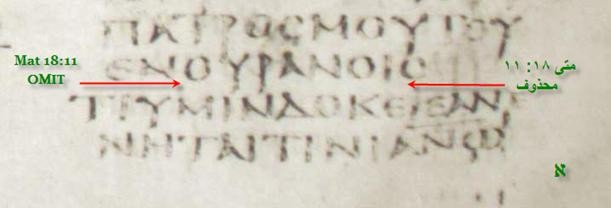
Sinaiticus Codex — Matthew 18 showing the absence of verse 11

The verse is also absent from the Vaticanus Codex:
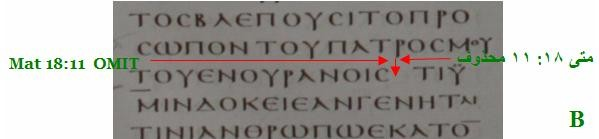
Vaticanus Codex — Matthew 18 showing the absence of verse 11

The Alexandrian Codex likewise omits this verse.

Doctrinal Importance

The omitted verse sits in the middle of a passage entirely about children. Matthew 18:1 begins with the disciples asking: “Who is the greatest in the kingdom of heaven?” Jesus responds in Matthew 18:3: “Unless you change and become like little children, you will never enter the kingdom of heaven.” He continues in Matthew 18:4: “Whoever humbles himself like this little child is the greatest in the kingdom of heaven.” Then Matthew 18:14 states: “It is not the will of your Father in heaven that one of these little ones should perish.”

The interpolated verse 11 — “The Son of Man came to save the lost” — is inserted into a discussion about children and calls them “the lost.” This is internally contradictory: Jesus has just described children as the model of those who enter the kingdom of heaven. Calling them “the lost” whom he came to save contradicts the entire argument of the passage. The verse was copied from Luke 19:10 and inserted here by a scribe who did not notice the contextual contradiction it created.

Doctrinal analysis image — Matthew 18:11 contradiction with the surrounding passage about children


Matthew 17:21 — “This Kind Goes Out Only by Prayer and Fasting”

The Verse

Matthew 17:21 (KJV) “Howbeit this kind goeth not out but by prayer and fasting.”

Multiple translations include it — SVD, ALAB, GNA, JAB, and KJV. The critical Greek text (GNT-WH) omits it entirely.

Manuscript Evidence

The verse is absent from the Sinaiticus Codex:
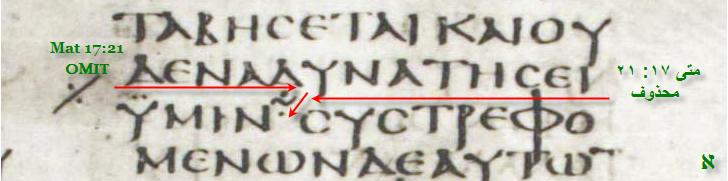
Sinaiticus Codex — Matthew 17 showing the absence of verse 21

The verse is also absent from the Vaticanus Codex:
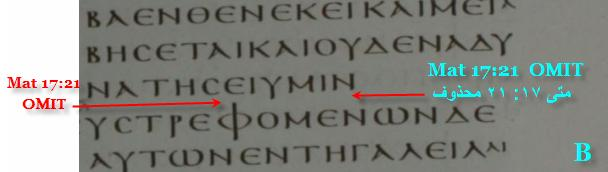
Vaticanus Codex — Matthew 17 showing the absence of verse 21

The Alexandrian Codex likewise omits this verse.

Doctrinal Importance

The verse states that a certain type of demon cannot be expelled except by prayer and fasting. This creates a cascade of theological problems for the doctrine of Jesus’ divinity:

If Jesus gave his disciples power to cast out demons — which the Gospels explicitly record — is there a class of demon that falls outside this power? Does this mean the divine power Jesus granted is insufficient for some cases?

And by what power do prayer and fasting expel what the power of Jesus cannot? To whom are the prayers and fasting directed? If directed to the Father, this implies a power above and beyond what Jesus can provide. If directed to Jesus himself — Jesus was physically present with his disciples at that moment. Would they pray and fast to him while he himself was standing there?

The verse, at minimum, implies that there is a form of spiritual power that operates through human discipline — prayer and fasting — that achieves what the authority of Jesus could not. This directly undermines the doctrine of his divinity. The omission from the oldest manuscripts makes clear why the critical tradition removed it.

Doctrinal analysis — Matthew 17:21 and the theological implications for the divinity of Jesus


Three verses in Matthew — 12:47, 18:11, and 17:21 — are absent from the Sinaiticus, Vaticanus, and Alexandrian codices and omitted by the critical Greek editions. Each was inserted by scribes, and each creates a doctrinal problem that explains the insertion: the refusal to see his mother, the contextual contradiction about children being “the lost,” and the implication that prayer and fasting accomplish what the power of Jesus cannot. The pattern is consistent with what the manuscript record shows across the New Testament — scribes did not merely copy, they edited in the direction of their theology.
2026 https://www.openislam.wiki/og/matthew-12-47-18-11-and-17-21-three-verses-added-by-scribes-and-absent-from-every-ancient-manuscript.png