

Mark 7:16 and Mark 9:44-46 — Verses Deleted from the Oldest Manuscripts and Absent from All Critical Editions
title: “Mark 7:16 and Mark 9:44-46 — Verses Deleted from the Oldest Manuscripts and Absent from All Critical Editions” description: “A textual-critical analysis of three verses in the Gospel of Mark — 7:16, 9:44, and 9:46 — demonstrating their absence from Sinaiticus and Vaticanus, their deletion by all critical editions, and the theological implications of these documented scribal additions.” category: Christianity tags:
- bible
- textual-criticism
- manuscript
- tahrif
- christianity
Mark 7:16 — He Who Has Ears to Hear
Translations Compared
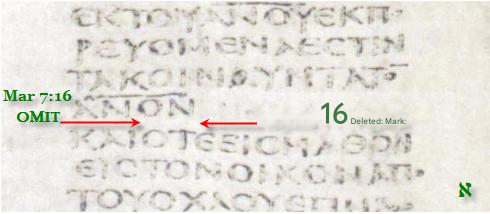
The following translations contain Mark 7:16 as a full verse:
- SVD (Van Dyke): “If anyone has ears to hear, let him hear.”
- ALAB: “He who has ears to hear, let him hear.”
- GNA: “He who has ears to hear, let him hear!”
- KJV: “If any man have ears to hear, let him hear.”
- Vulgate: si quis habitus audiendi audiat
The following critical editions omit the verse entirely:
- GNT-WH (Westcott-Hort): OMIT
- HNT: omitted
In the Byzantine text tradition (GNT-BYZ), the verse is present in the following Greek form:
εἴ τις ἔχει ὦτα ἀκούειν ἀκουέτω
Manuscripts
Codex Sinaiticus (4th Century)
Codex Vaticanus (4th Century) — Mark 7:16 is deleted
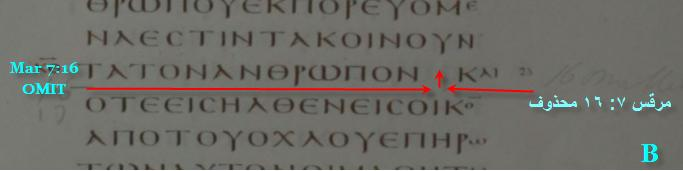
The Vatican Codex — one of the two most important manuscripts of the New Testament — does not contain Mark 7:16.
Codex Alexandrinus (5th Century) — the verse is present

The Alexandrian Codex, from the 5th century, contains the verse — but as seen in the case of John 9:35, the Alexandrian Codex represents a later tradition than Sinaiticus and Vaticanus and cannot override their testimony.
Mark 9:44 — Where Their Worms Do Not Die
Translations Compared
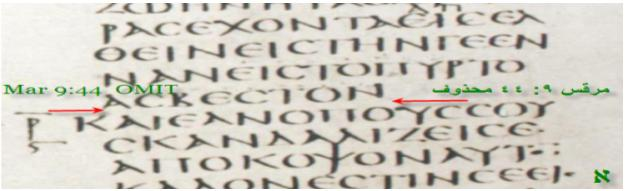
The following translations contain Mark 9:44 as a full verse:
- SVD (Van Dyke): “Where their worms do not die and the fire is not extinguished.”
- ALAB: “Where their worms do not die, and the fire is not extinguished.”
- GNA: “Where the worms do not die and the fire is not extinguished.”
- KJV: “Where their worm dieth not, and the fire is not quenched.”
- Vulgate: present at 9:43
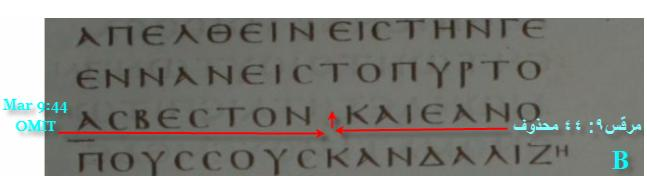
The following critical editions omit the verse entirely:
- GNT-WH (Westcott-Hort): OMIT
- HNT: omitted
In the Byzantine text tradition (GNT-BYZ), the verse reads:
ὅπου ὁ σκώληξ αὐτῶν οὐ τελευτᾷ καὶ τὸ πῦρ οὐ σβέννυται
Manuscripts
Codex Sinaiticus (4th Century)
Codex Vaticanus (4th Century)
Theological Significance of Mark 9:44
The verse describes the punishment of Hell in bodily terms — “where their worms do not die.” The significance of this is that wormsThe worm imagery (σκώληξ — skōlēx) in this context refers to the decay of physical flesh. Worms are not associated with disembodied souls in any ancient tradition; they are a feature of the decomposition of physical bodies. are a feature of flesh and blood bodies, not of disembodied souls. The verse therefore implies a bodily resurrection and a bodily punishment in Hell.

Mark 9:46 — The Repeated Verse
Translations Compared
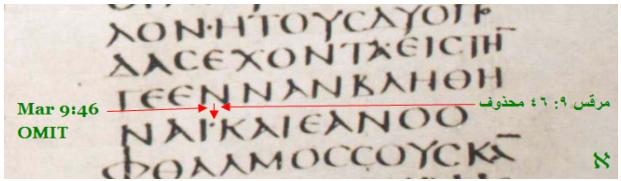
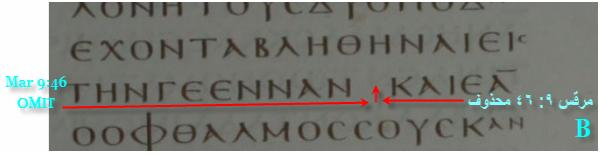
Mark 9:46 is word-for-word identical to Mark 9:44. The same verse appears a second time in the traditional text between verse 45 and verse 47.
The following translations contain Mark 9:46:
- SVD (Van Dyke): “Where their worms do not die and the fire is not extinguished.”
- ALAB: “Where their worms do not die, and the fire is not extinguished.”
- GNA: “Where the worms do not die and the fire is not extinguished.”
- KJV: “Where their worm dieth not, and the fire is not quenched.”
- Vulgate: present at 9:45
The following critical editions omit the verse entirely:
- GNT-WH (Westcott-Hort): OMIT
- HNT: omitted
Manuscripts
Codex Sinaiticus (4th Century)
Codex Vaticanus (4th Century)
The theological significance of Mark 9:46 is the same as that of Mark 9:44 — it is a repetition of the same worm and fire imagery describing the punishment of Hell.
The Doctrinal Significance of These Deletions
The pattern observable across all the examples in this research is consistent:
- The oldest manuscripts (Sinaiticus, Vaticanus, the major papyri) tend to have the shorter text.
- Later manuscripts add material — sometimes for stylistic reasons, sometimes for theological reasons, sometimes to harmonize parallel passages, and sometimes for reasons unknown.
- All critical editions based on the oldest and best manuscripts choose the shorter, deletion reading.
- The traditional text (Textus Receptus / Van Dyke / KJV) is based on a much smaller and later manuscript base compiled by Erasmus in the 16th century from no more than 7 Greek manuscripts.
A text that claims to be the Word of God must be free from contradiction, deletion, addition, alteration, and change. The manuscript tradition of the New Testament demonstrably is not free from any of these things. Every addition and deletion documented in this research is a further data point confirming that the text reaching us today is not in the form in which it was originally produced.
Conclusion
The broader pattern proves what the Quran stated fourteen centuries ago:
So woe to those who write the scripture with their own hands, then say, “This is from Allah,” in order to exchange it for a small price. Woe to them for what their hands have written and woe to them for what they earn.
سُبْحَانَ الَّذِي لَمْ يَتَّخِذْ وَلَدًا وَلَمْ يَكُن لَّهُ شَرِيكٌ فِي الْمُلْكِ وَلَمْ يَكُن لَّهُ وَلِيٌّ مِّنَ الذُّلِّ وَكَبِّرْهُ تَكْبِيرًا
وَآخِرُ دَعْوَانَا أَنِ الْحَمْدُ لِلَّهِ رَبِّ الْعَالَمِينَ
...ous-letter-with-no-confirmed-link-to-the-apostle-john|1 John Not Written by John or the Apostle]]