

The Corruption of the Bible: A Study from Christian Sources
The Bible’s reliability cannot be taken for granted — not because Muslims say so, but because Christian scholars themselves have raised these questions for centuries. This research examines the Bible’s origins, its canonization history, and the documented corruption of its manuscripts, drawing exclusively on Christian sources, Church Fathers, and Western biblical scholarship.
Three scope limitations apply:
- Internal criticism of the Bible’s content is not addressed
- Translation distortions are not the focus — only the original text
- The research does not touch on Islamic scripture
Table of Contents
-
- Part One — The Original Text Is Not Sacred
- Part Two — The Canon Was Never Settled
- Part Three — Anonymous Authorship
- Part Four — Has the Bible Been Corrupted?
- Part Five — Types of Intentional Changes
- 1 — Doctrinal Corruption: Heretics vs Orthodox
- 2 — Defending Jesus (Apologetics)
- 3 — The Conflict Between Christians and Jews
- 4 — Harmonization of Parallel Passages
- 5 — Liturgical Modifications
- 6 — Linking Jesus to Old Testament Prophecy
- 7 — Jews Deleted the Prophecies About the Messiah from the Old Testament
- 8 — Natural Complements Added to the Text
- 9 — Combining Different Readings
- 10 — The Role of Women
- 11 — Distortion to Support Theological Doctrine
- 12 — Removing Historical and Geographical Difficulties
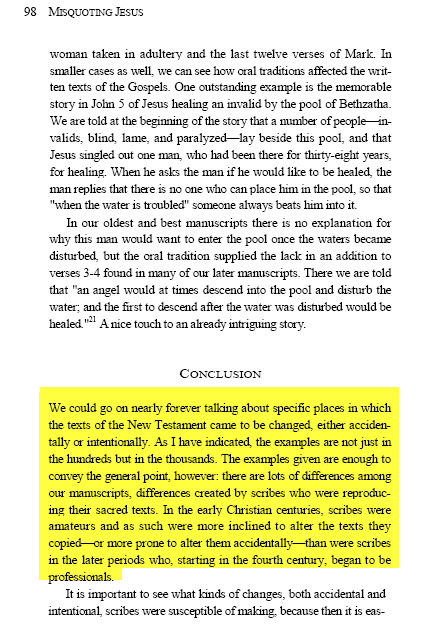
- 13 — Introducing Texts Through Oral Tradition
- 14 — Adding a Religious Framework
- 15 — Suppressing Moral Difficulty
- 16 — Respect for Divine Majesty
- 17 — Jews Deleted What Offended Their Elders
- 18 — Grammatical Corrections
- 19 — Jews Altered Genealogies
- 20 — Miscellaneous Additions
- Conclusion — The Verdict from Christian Sources
- Related
Part One — The Original Text Is Not Sacred
1 — The Gospels Were Copied from Other Documents
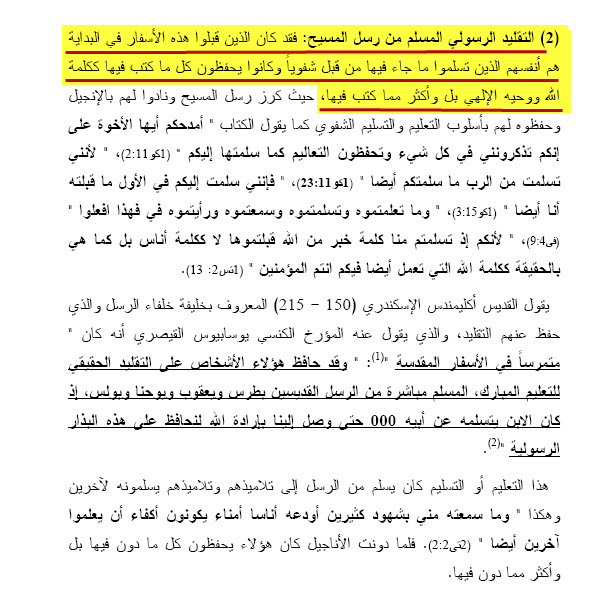
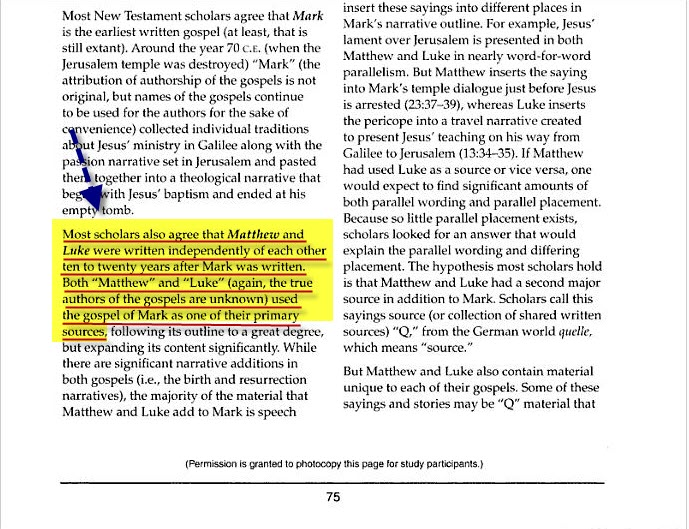
The Gospel writers did not write in isolation — they copied from earlier sources, some of which no longer exist. This alone raises the question: if the sources are unknown, how can the copies be called inspired?
The Synoptic Problem is the scholarly term for the literary relationship between Matthew, Mark, and Luke. Church scholars confirm that:
- The primary source for Matthew and Luke was the Gospel of Mark
- A second common source — called Document Q (Quelle, “sayings of Jesus”) — was used by both Matthew and Luke
- A third source — Document L — was used only by Luke
- A fourth source — Document M — was used only by Matthew
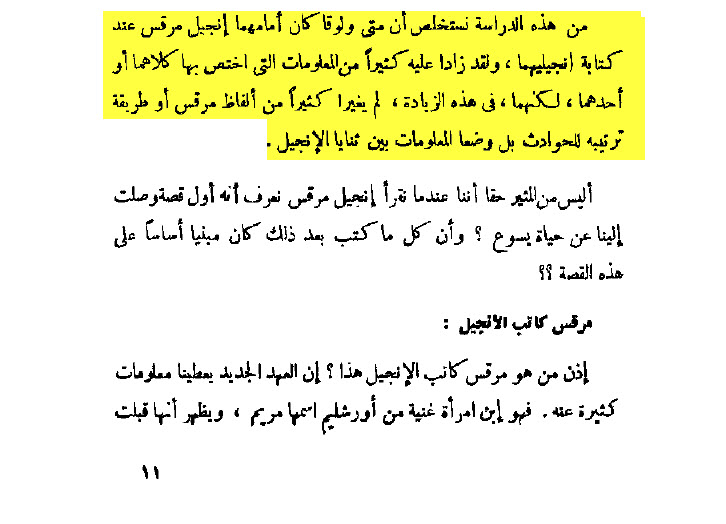
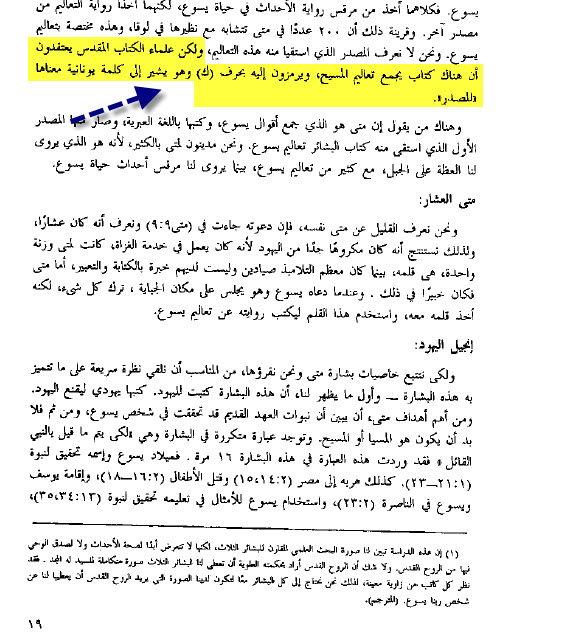
William Barclay further states in his commentary on the Gospel of Matthew (p. 19) that the similarities between Luke and Matthew derive from an ancient lost book collecting the teachings of Christ.
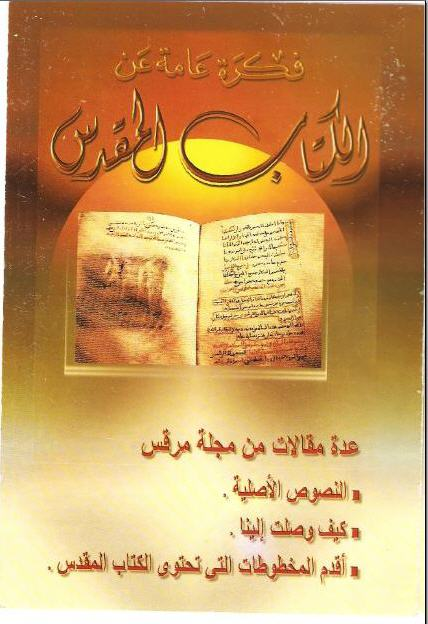
The same conclusion appears in A General Idea about the Holy Bible:
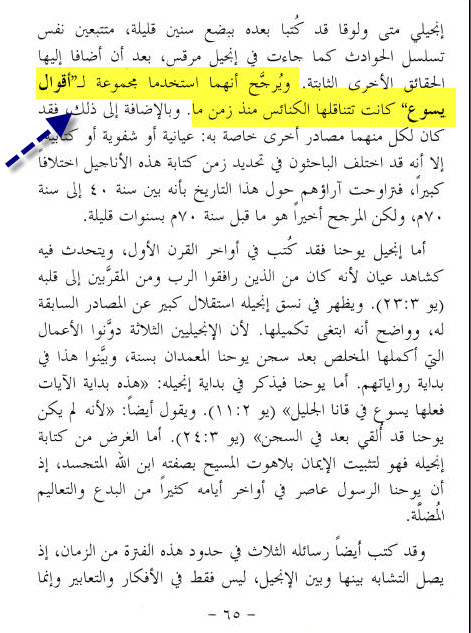
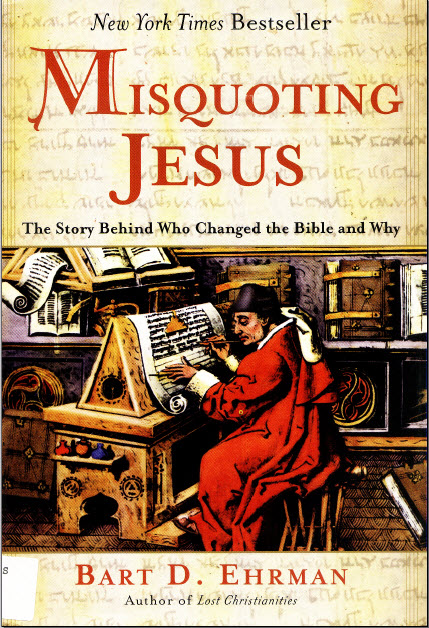
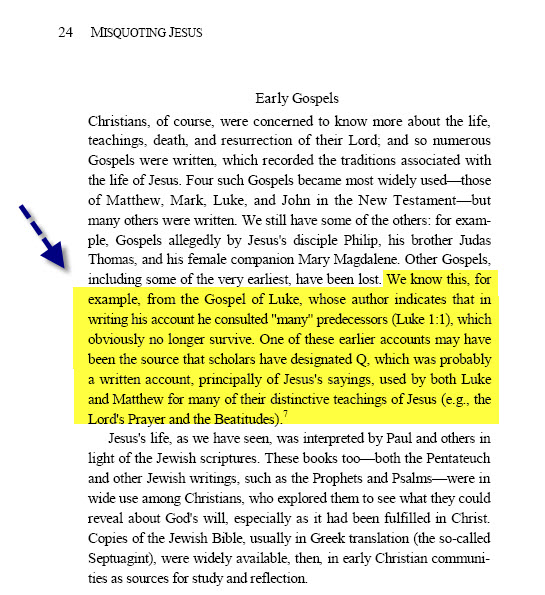
The existence of an ancient collection of Jesus’ sayings is a documented fact — papyrus manuscripts existed in Egypt and elsewhere.
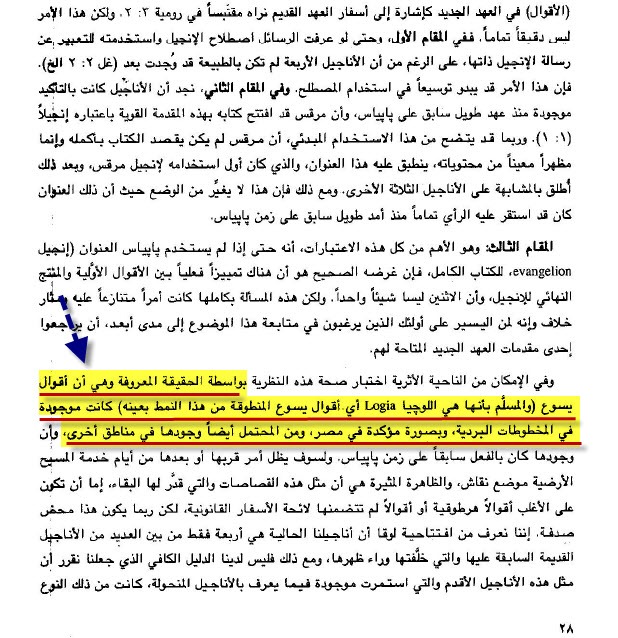
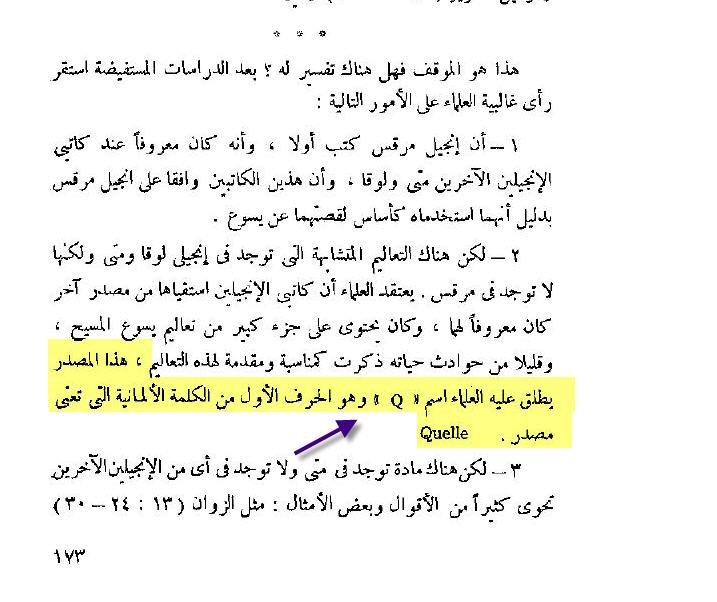
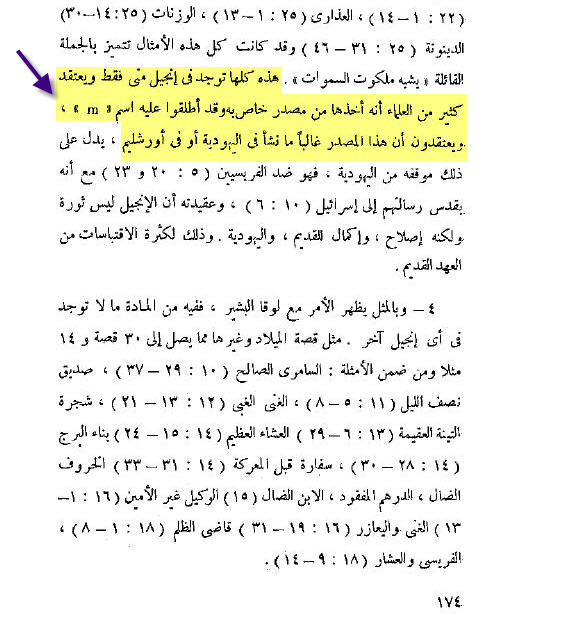
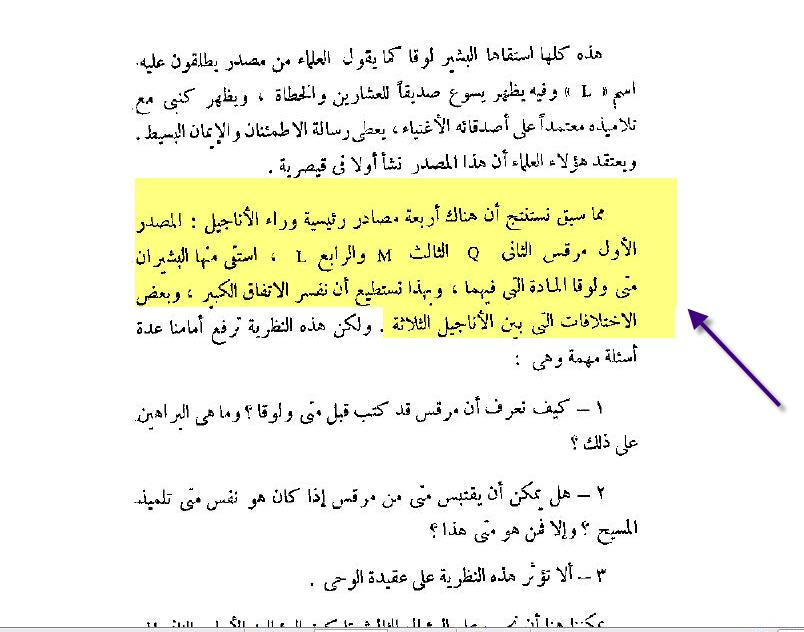
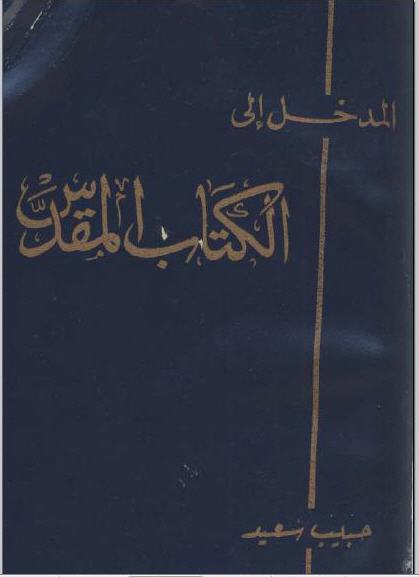
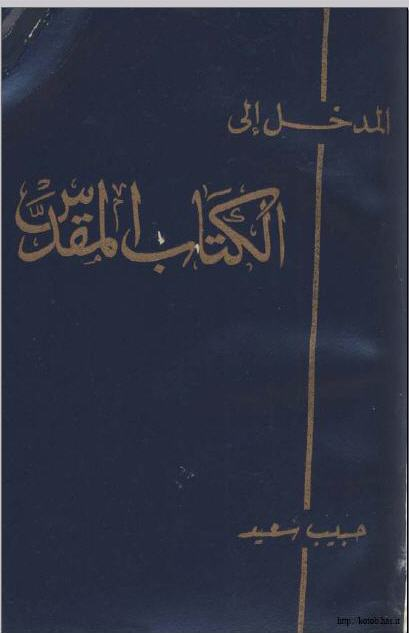
Habib Saeed illustrates this beautifully in Introduction to the Holy Bible, pp. 216–218:
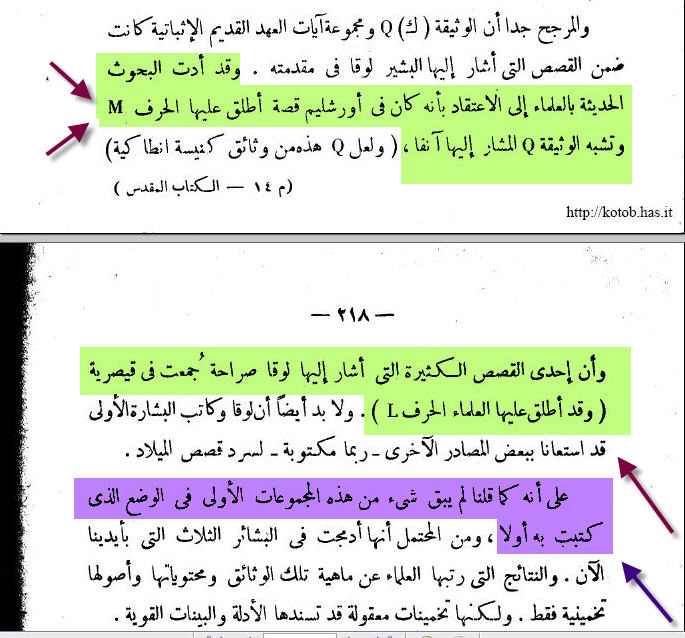
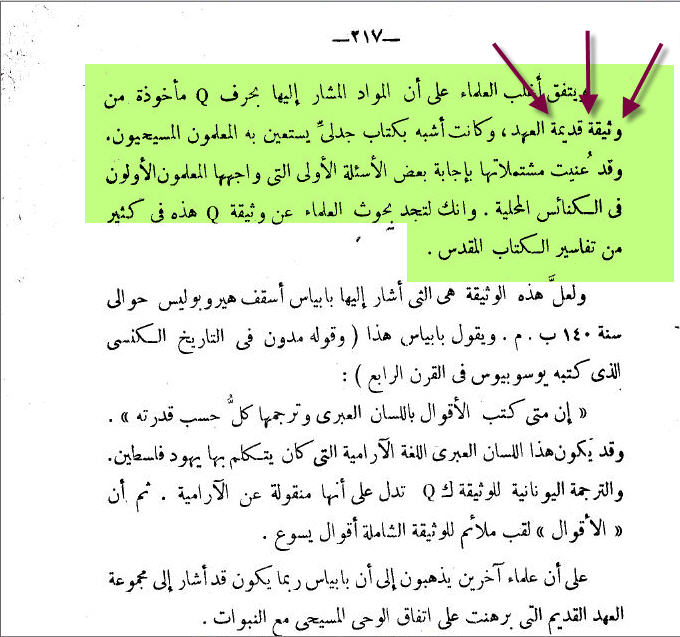
The Jesuit translation includes a simplified diagram explaining these sources:
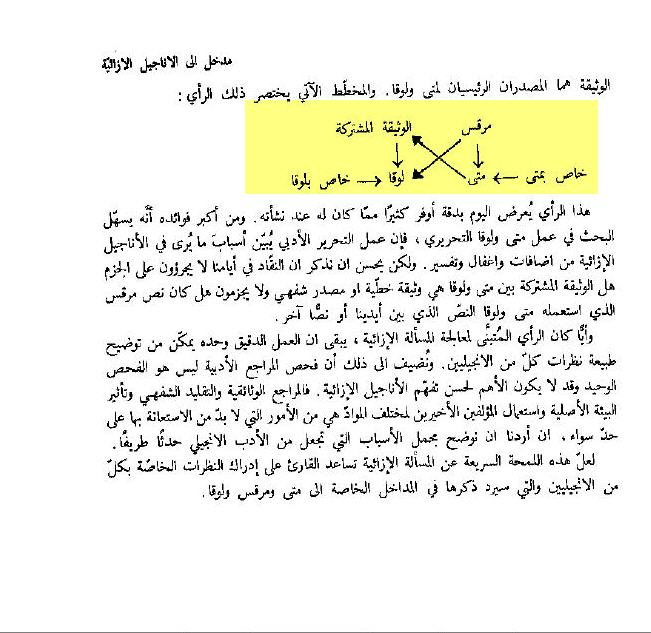
Matthew’s sources: Mark + Q + M. Luke’s sources: Mark + Q + L. The author of A Guide to Reading the Holy Bible adds that Mark himself also drew from Document Q:
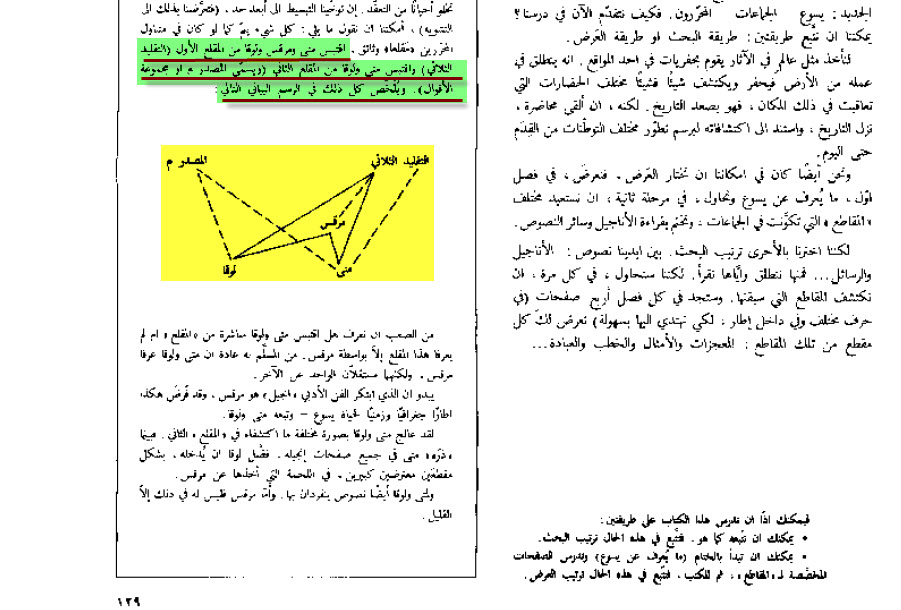
2 — The Torah’s Four Source Documents J E D P
The same pattern holds for the Old Testament. The current Torah derives from four ancient documents written by prophets, priests, and sages, then compiled by unknown persons:
| Symbol | Name |
|---|---|
| J | The Yahwist Tradition |
| E | The Elohist Tradition |
| D | The Deuteronomic Tradition |
| P | The Priestly Tradition |
Father Stephan Charpentier, author of A Guide to Reading the Holy Bible, describes the formation of the Torah from these four sources:
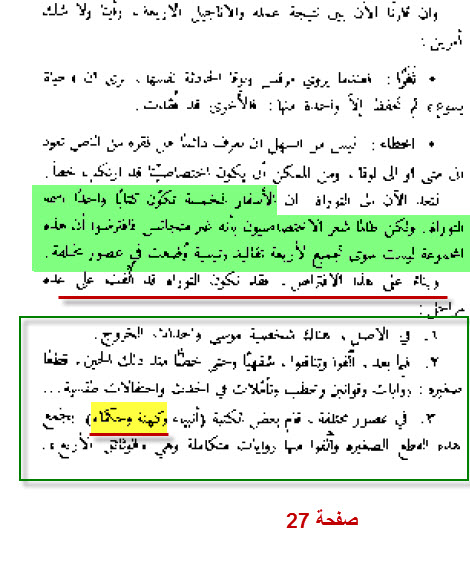
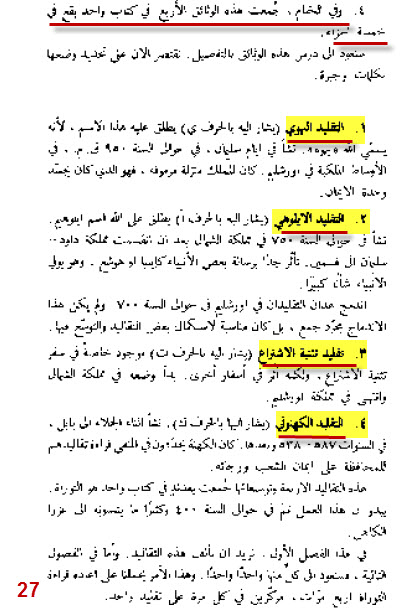
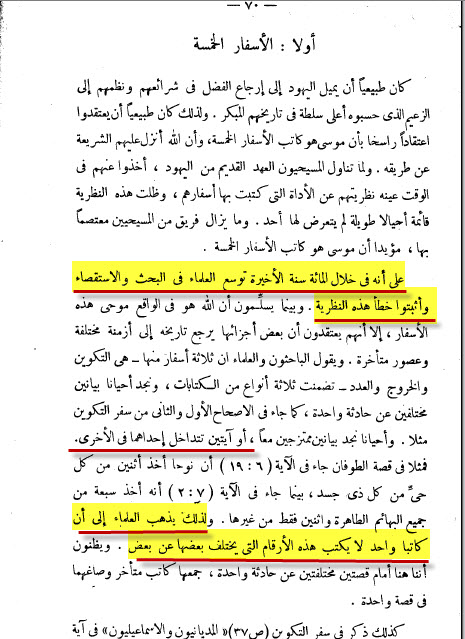
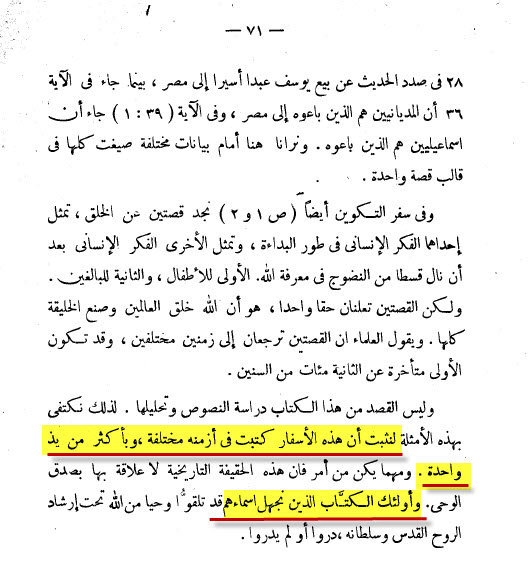
Habib Saeed confirms: overlaps and numerical discrepancies in the Torah show it was written by multiple persons at different times, from different stories — and the writers of the current Torah are unknown:
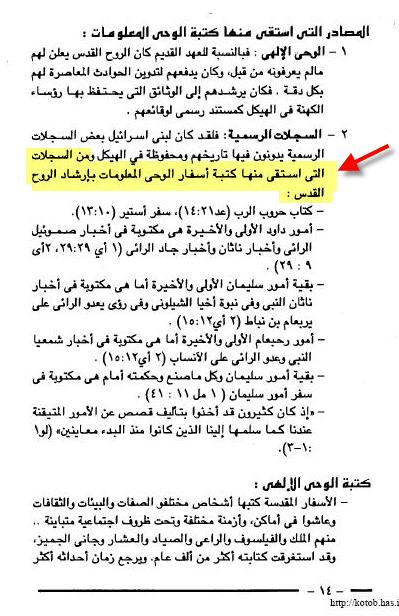
The Old Testament itself refers to prophetic books that its writers had access to — books that no longer exist:
None of these referenced books are found in the Old Testament today.
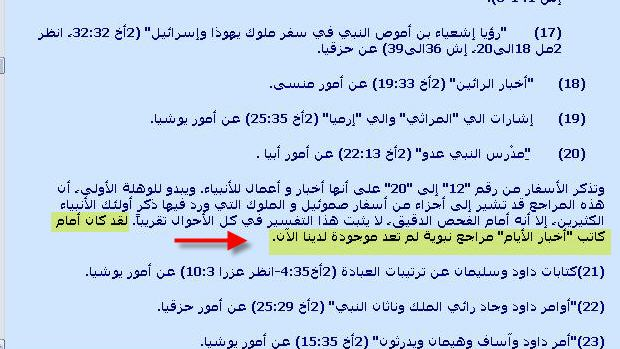
Dr. Malak Muharab confirms the Old Testament was quoted from these now-lost sources:
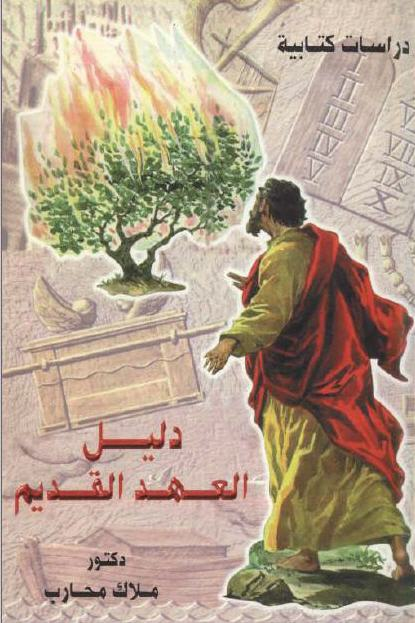
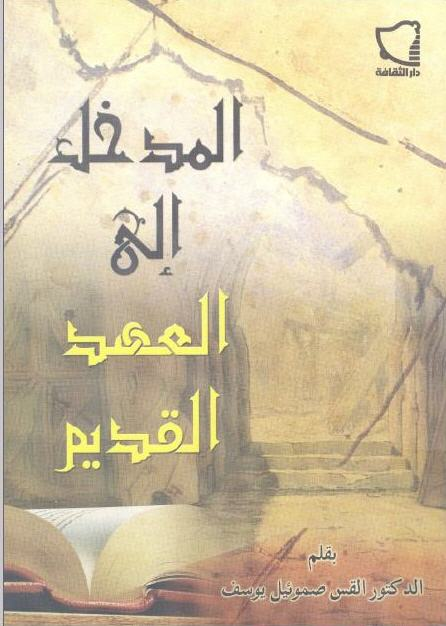
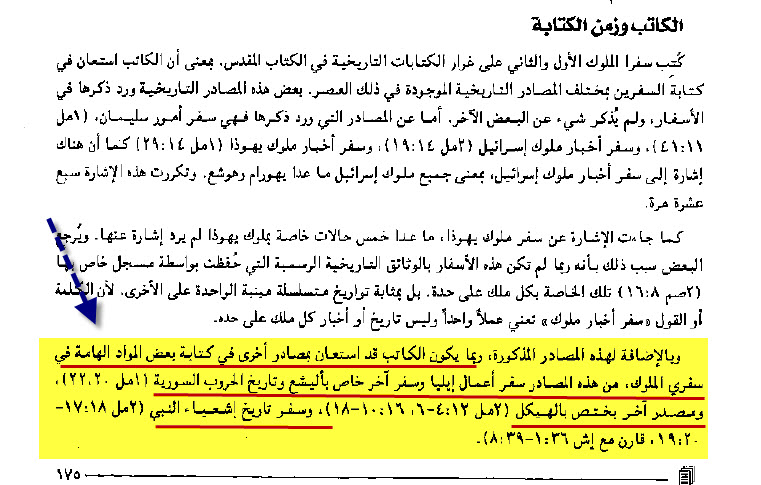
Dr. Samuel Youssef states the writer of the Book of Kings quoted from apocryphal books such as the Book of Acts of Elijah and the History of the Acts of Syria:
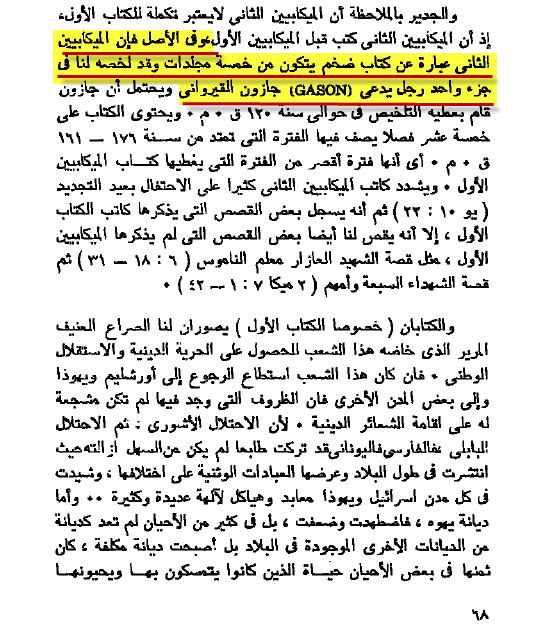
The Second Book of Maccabees is merely a summary of a five-part work — as Dr. Hanna Al-Khadri states in History of Christian Thought, p. 68:
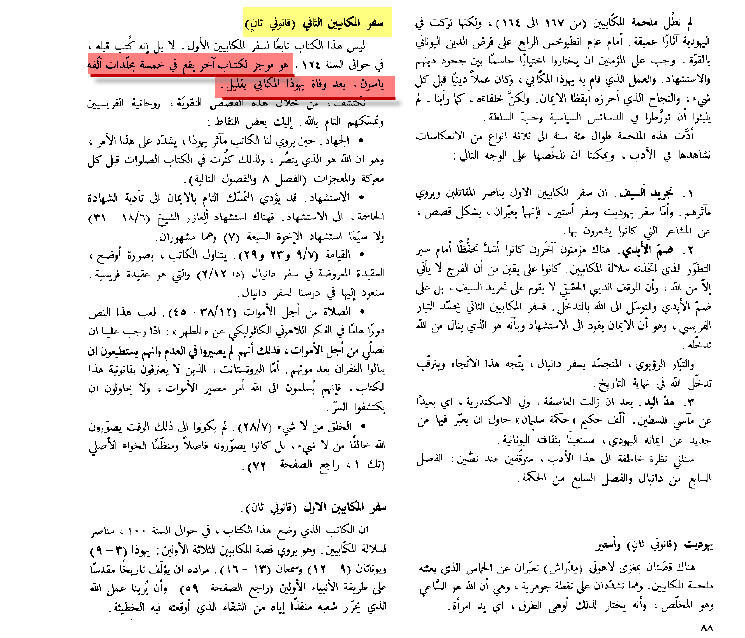
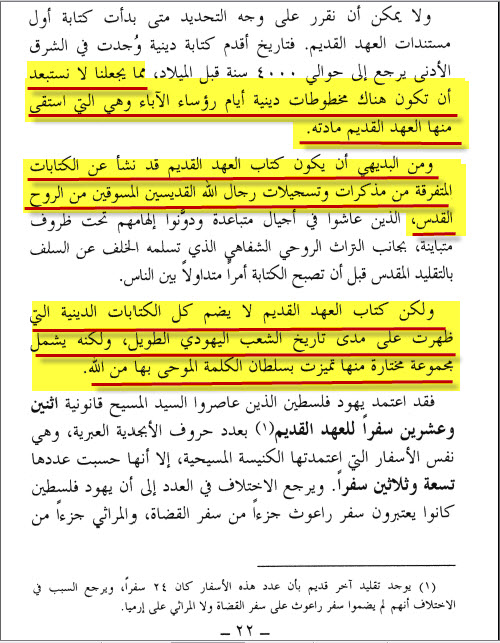
The author of A General Idea about the Holy Bible summarizes the Old Testament situation:
3 — Unknown and Apocryphal Sources
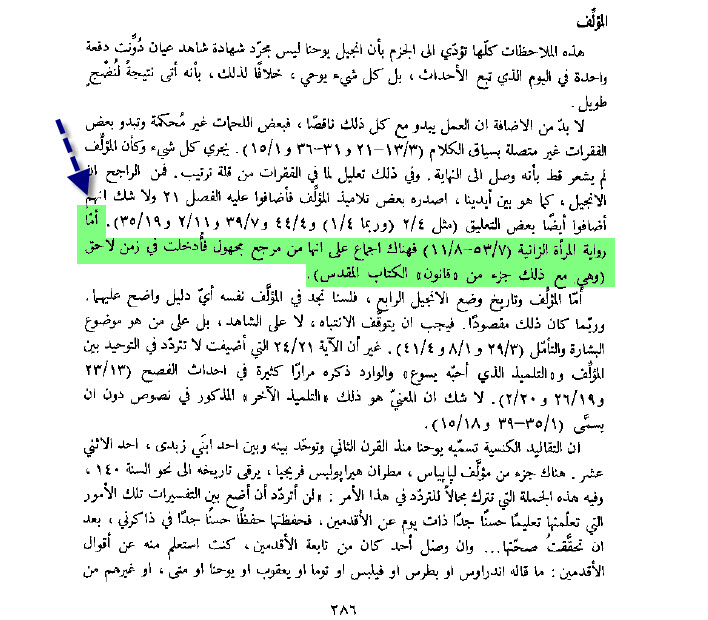
Beyond documented sources, there are also unknown ones. The Jesuit translation acknowledges the story of the adulterous woman was taken from an unknown source:
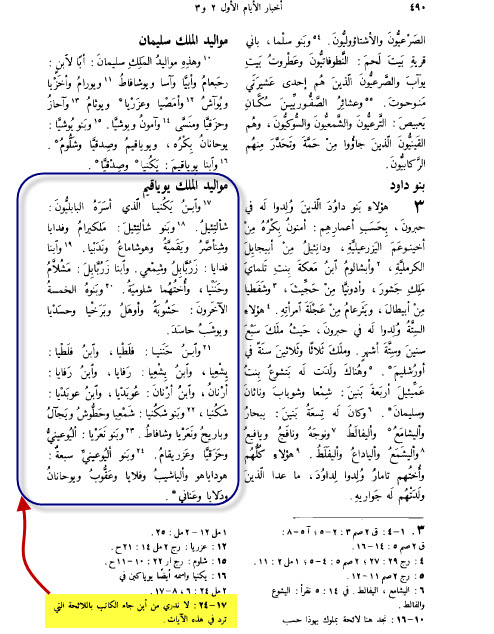
The joint Arabic translation admits uncertainty about where 1 Chronicles’ list of Jehoiakim’s children came from:
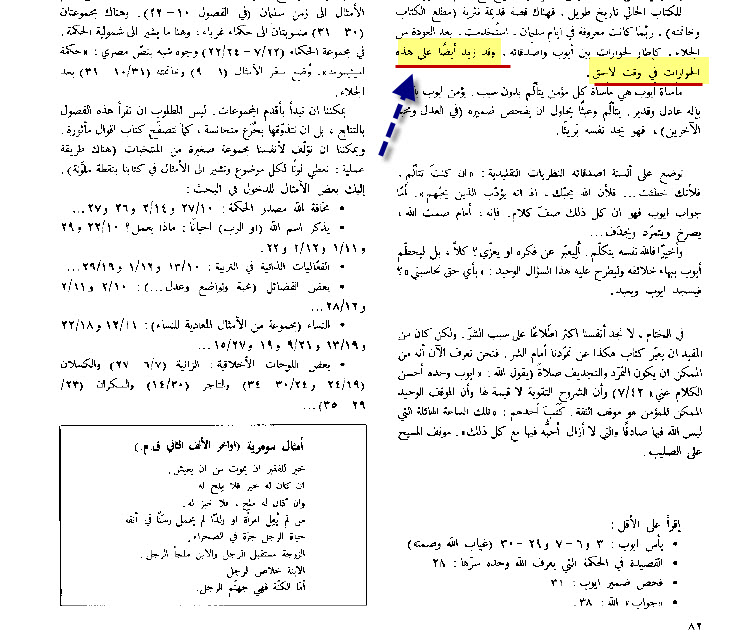
Additions exist in the Book of Job whose author is unknown:
Part Two — The Canon Was Never Settled
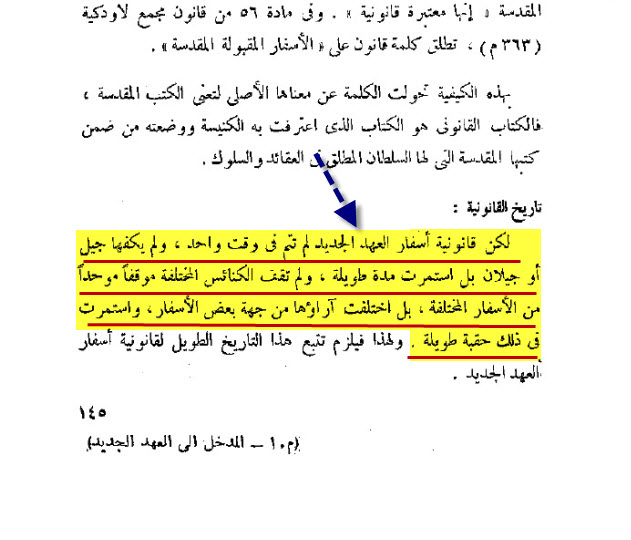
The identity of the Holy Bible was not fixed from the beginning — it developed over centuries, with churches, sects, and individual Church Fathers each holding different canons.
The biggest problem: what was apocryphal in the early centuries has now become sacred, and what is sacred now was unacceptable in the early centuries.
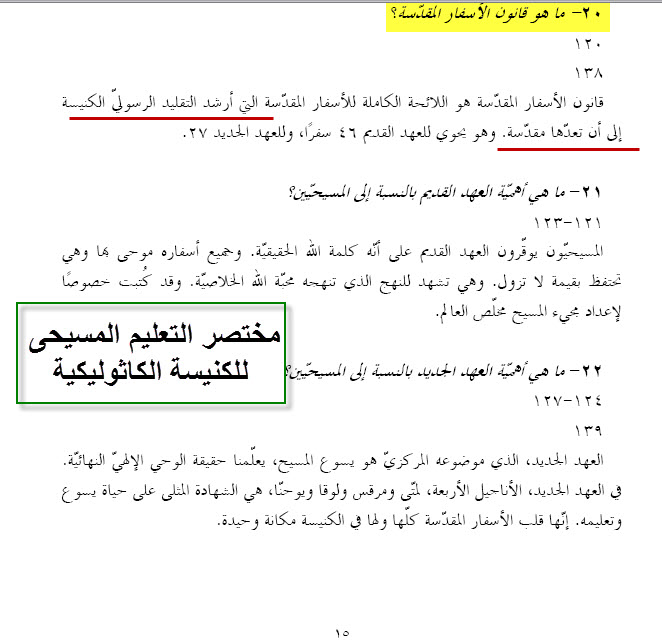
The Catholic Position — Tradition
The Catholic Church holds that tradition guided the Church to these books:
The Protestant Position — Five Conditions
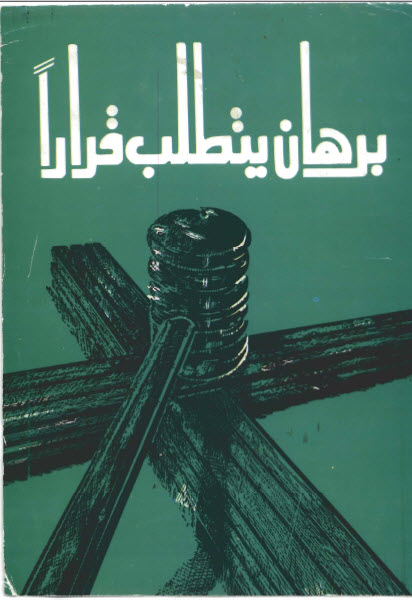
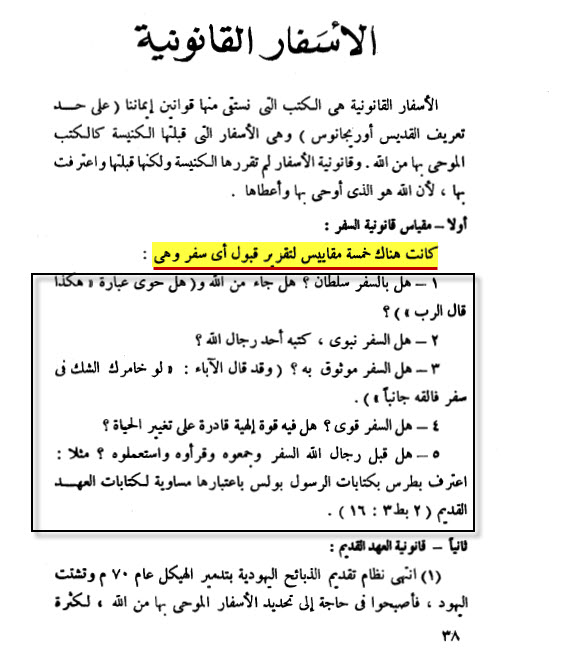
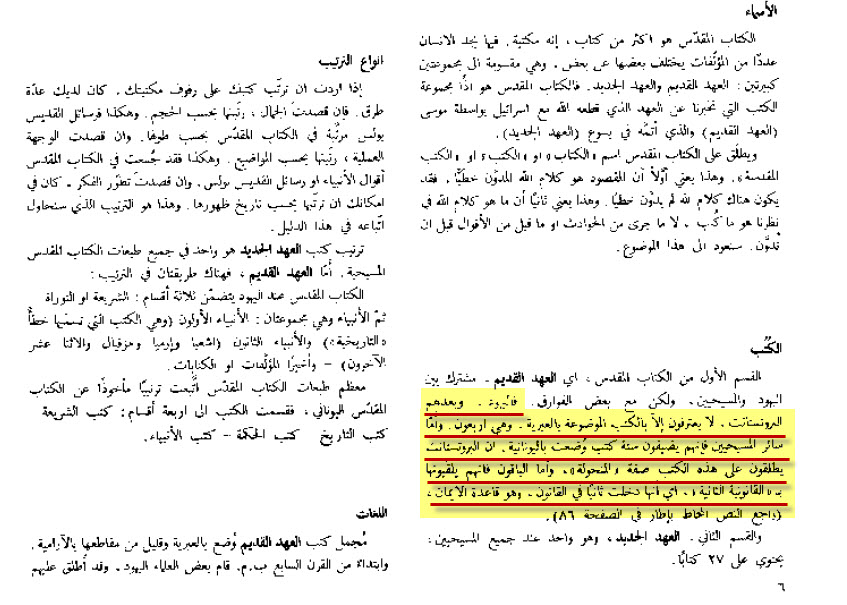
The Protestant Church rejects tradition and requires five conditions for any book to be canonical (Josh McDowell — Proof Demands a Verdict, p. 38):
- Did it contain the phrase “The Lord said”?
- Was it written by a man of God?
- Is the transmission reliable?
- Is transmission strong?
- Did the men of God accept, collect, read, and use it?
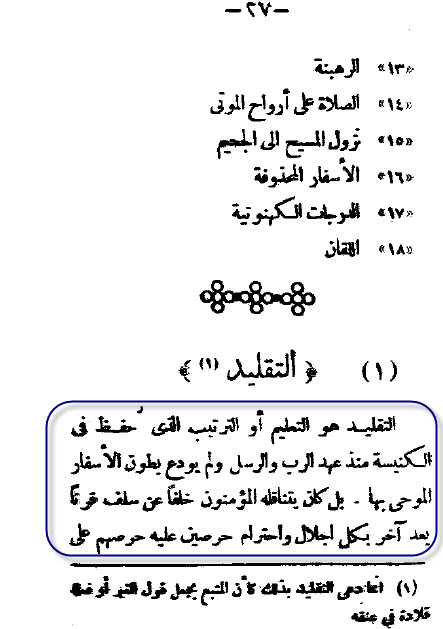
The broader Protestant critique of tradition — including that some traditions contradict the Holy Book, there is no standard to verify a tradition’s correctness, and consensus of one church does not bind all Christians (Systematic Theology — James Ince, p. 41):
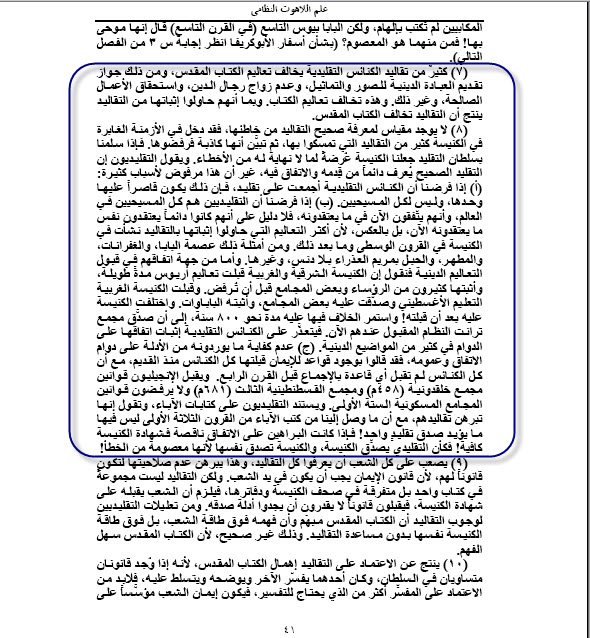
The Orthodox Position
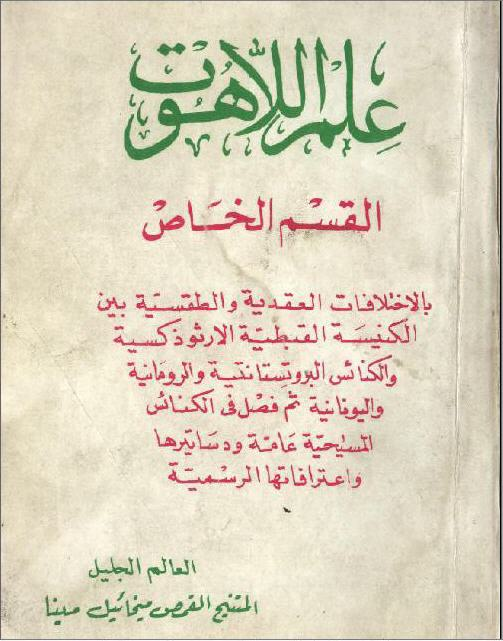
Some Orthodox adhere to tradition alone, like Father Mikhail Mina (Theology, Vol. IV, p. 37):
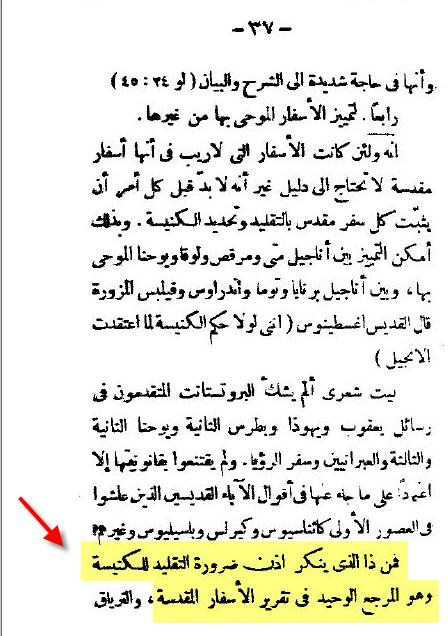
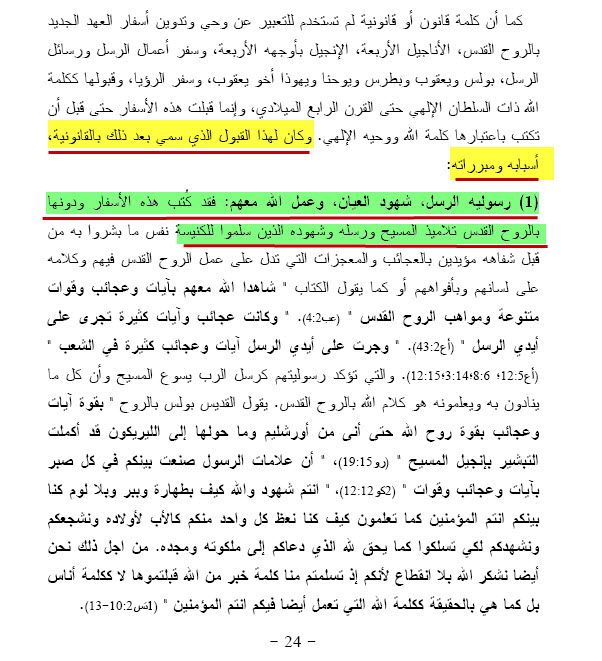
Father Abdel-Masih Basit sets three different Orthodox conditions:
- The scribes must be men of Christ and his disciples
- The Apostolic Tradition
- Delivery of the books to the early church
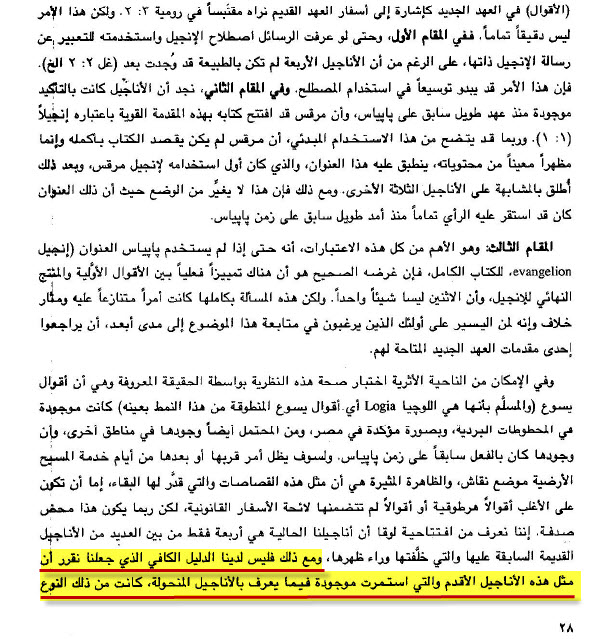
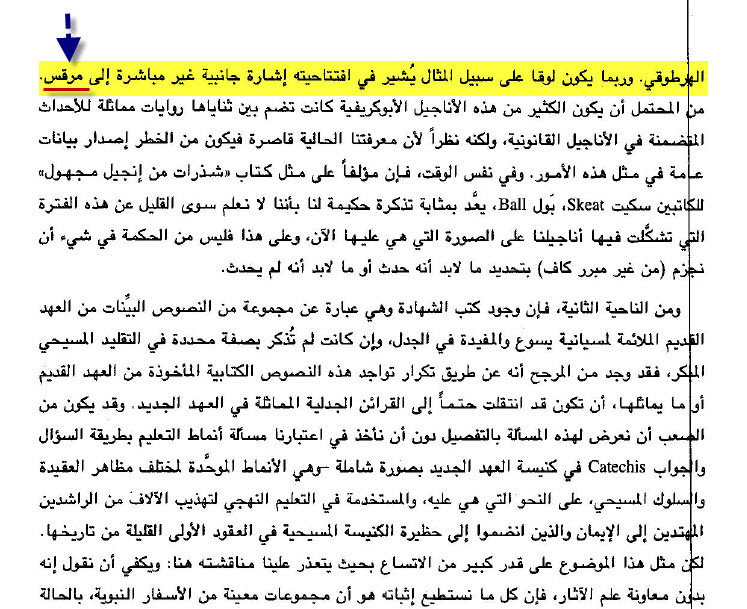
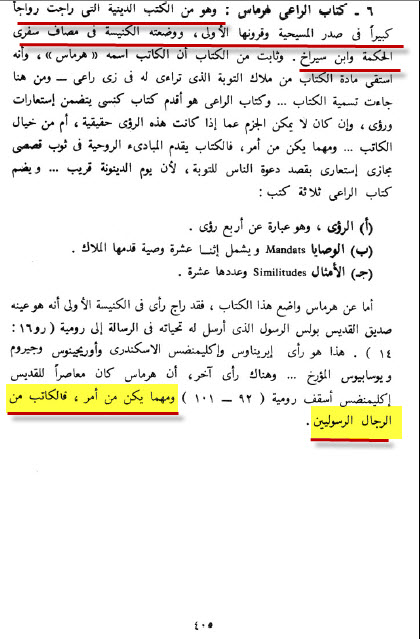
Some scholars admit frankly that we cannot accurately distinguish inspired messages from others. The author of the modern interpretation of Mark notes there is insufficient evidence to definitively classify the Gospels — and that the Gospel of Mark may itself have been among the apocryphal books Luke referenced:
Father Paul Al-Feghali quotes a scholar on Paul’s epistles: “We cannot distinguish precisely between the authentic letters that have been preserved and those that borrowed Paul’s name.”
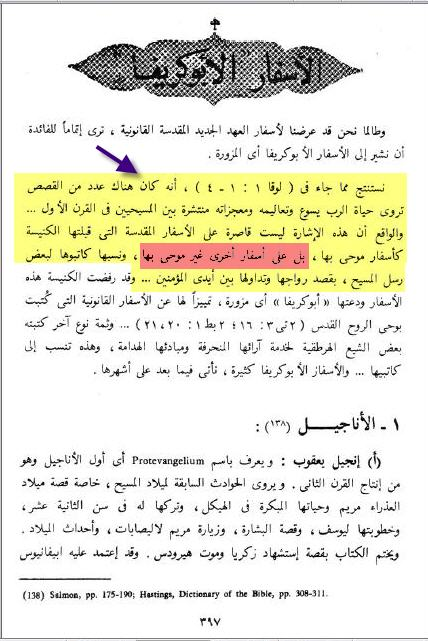
Anba Youanis confirms: there were Christians in ancient times who had other books — and the church rejected them:
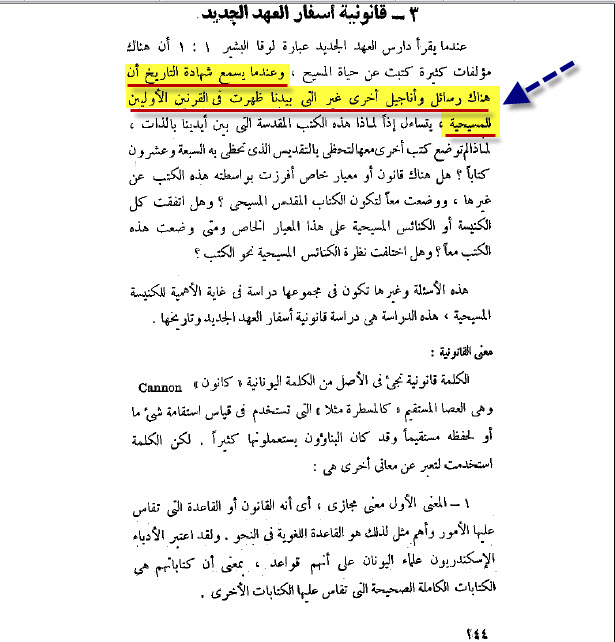
Dr. Fahim Aziz confirms in Introduction to the New Testament (p. 244) that other gospels and epistles appeared in the first centuries of Christianity:
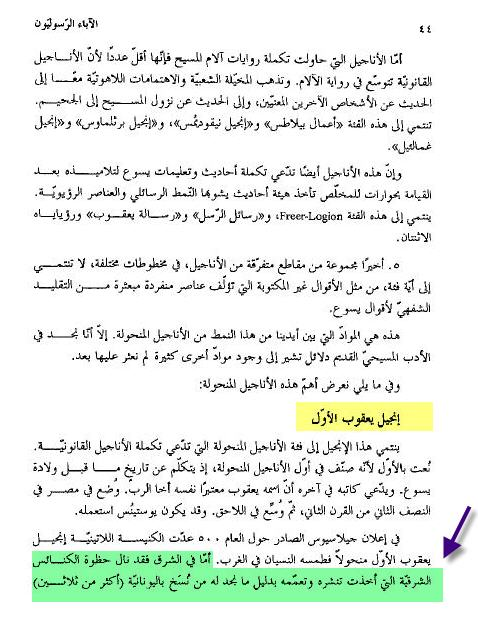
The Eastern Church, for example, accepted the Gospel of James (History of Christian Thought — Hanna Al-Fakhoury):
The Gospel of the Hebrews was used by the Nazarenes:
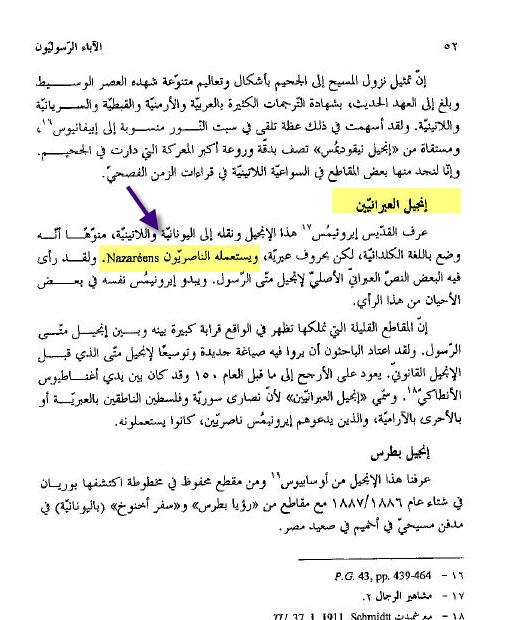
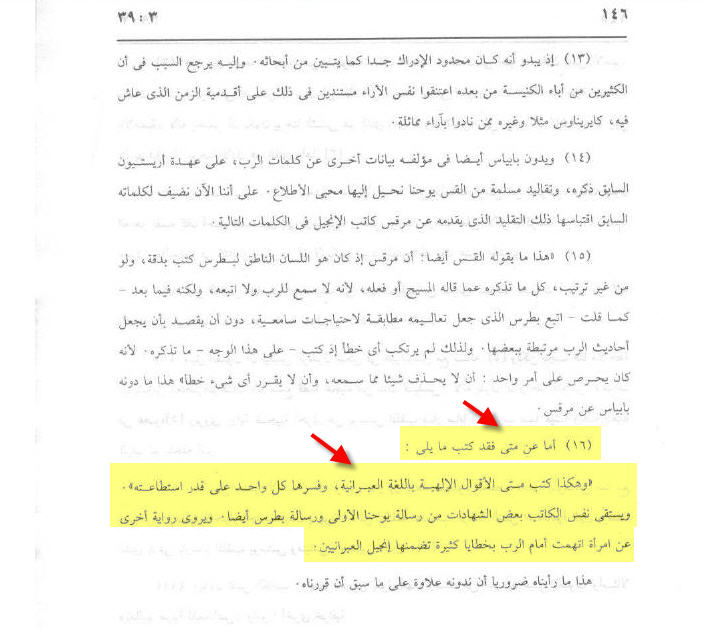
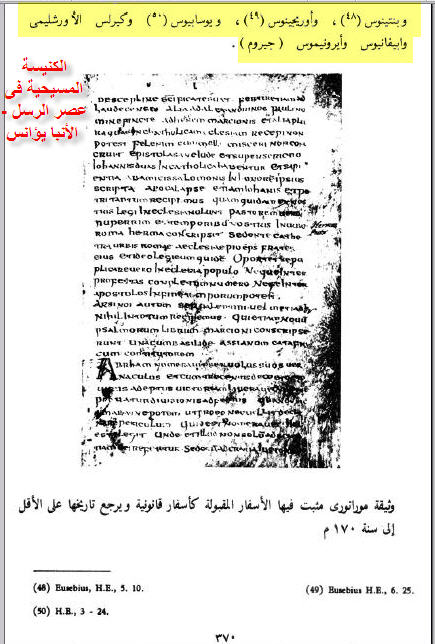
The ancient Church Fathers — including Papias, Irenaeus, Origen, Cyril of Jerusalem, Jerome, and Eusebius — knew the Hebrew Gospel of Matthew, which is entirely distinct from the current Greek Gospel of Matthew:
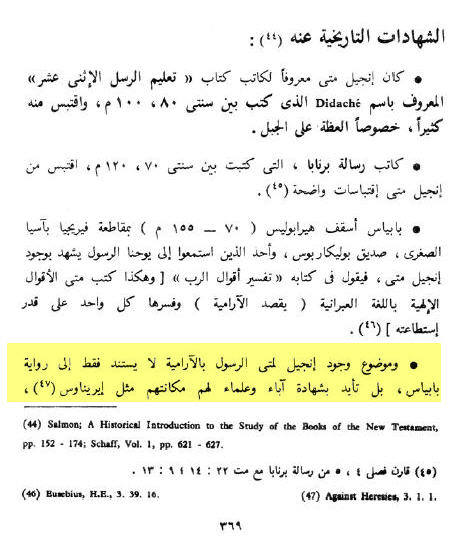
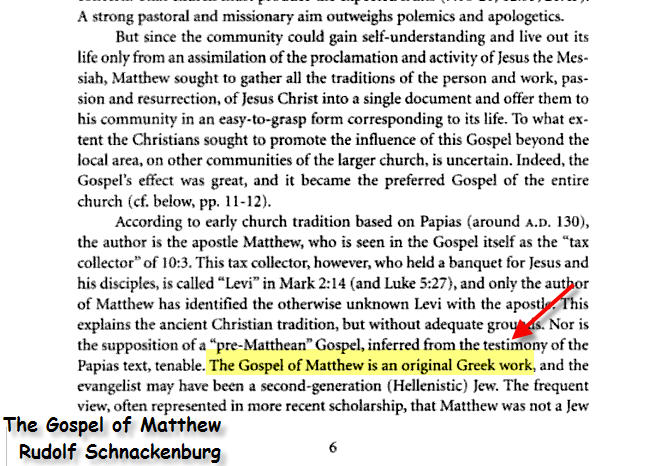
The current Gospel of Matthew was originally written in Greek — it has no connection to the Hebrew Gospel the Fathers knew.
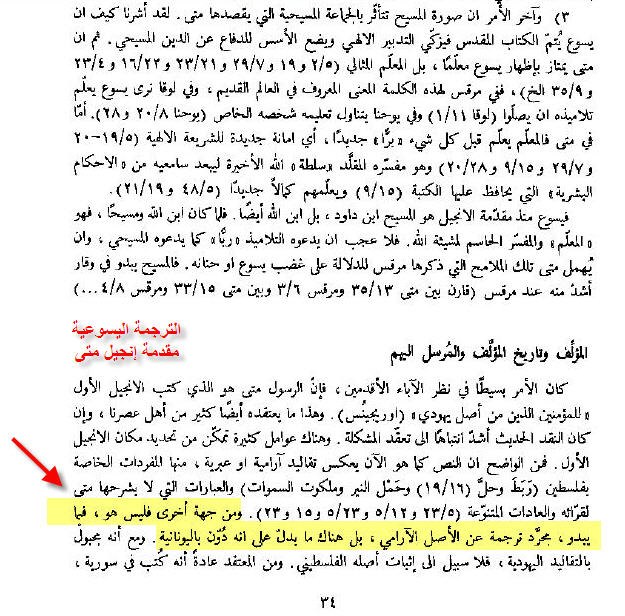
Even those who claim the current Matthew was translated from Hebrew into Greek — the translator is unknown and the date of translation is unknown:
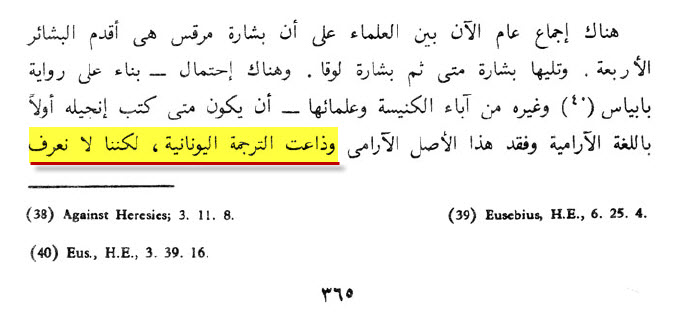
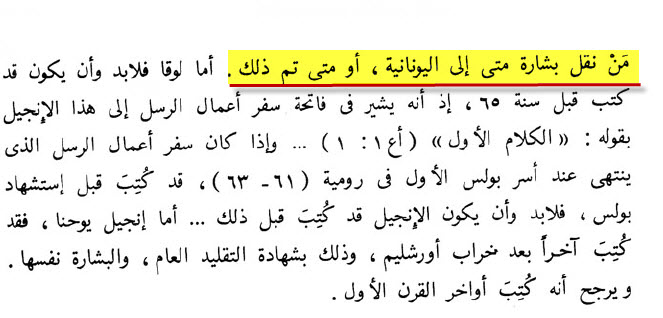
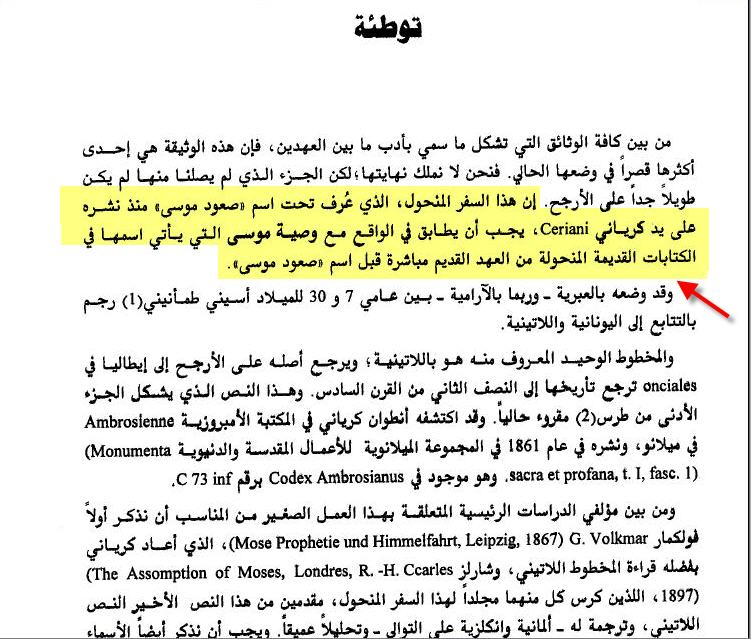
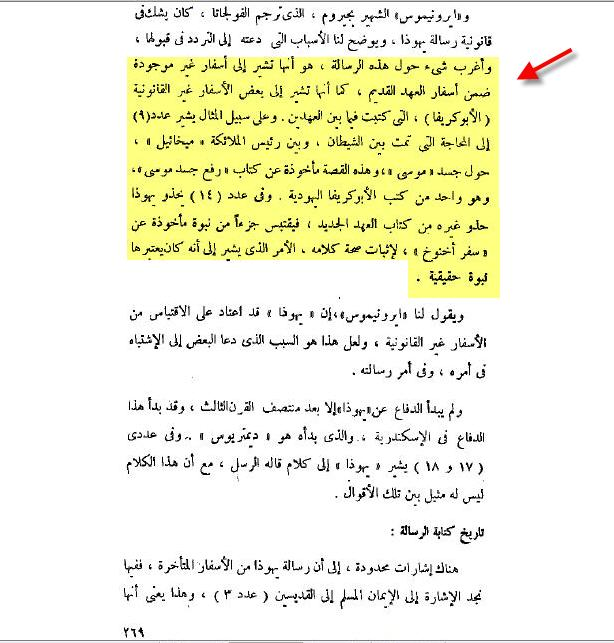
Even the writers of revelation knew apocryphal books. The writer of the Epistle of Jude quotes from the Book of the Ascension of Moses (an apocryphal book) in Jude 1:9, and from 1 Enoch in Jude 1:14 — as William Barclay confirms (Commentary, p. 269):
Each Church Father Had His Own Bible
The Western Church did not recognize the Epistle to the Hebrews and accepted only three Catholic Epistles (1 & 2 John and 1 Peter). The Eastern Church did not recognize the Book of Revelation.
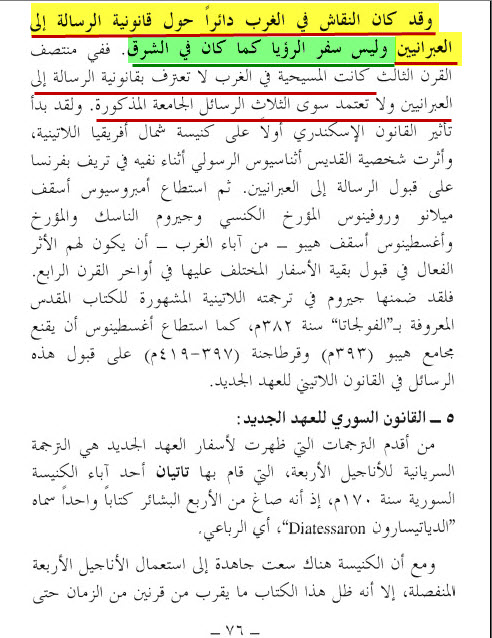
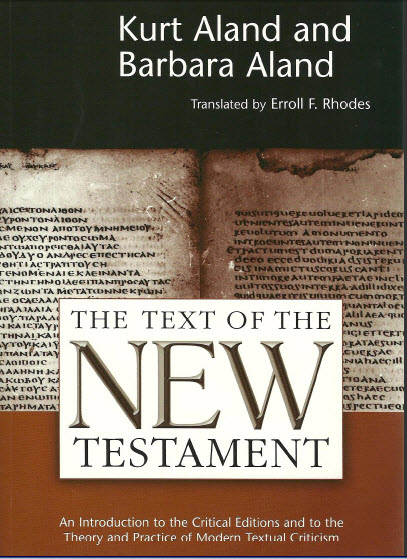
The Catholic Epistles as a collection were not recognized until the fourth century. The 2nd and 3rd Epistles of John, 2 Peter, Jude, and James “struggled for recognition.” The Book of Revelation was widely rejected in the Eastern churches as late as the early fourth century:
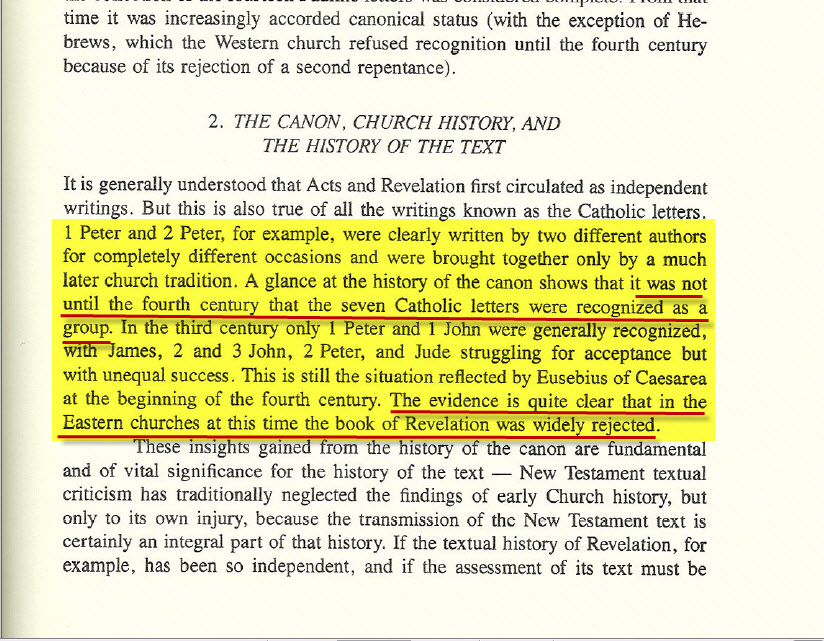
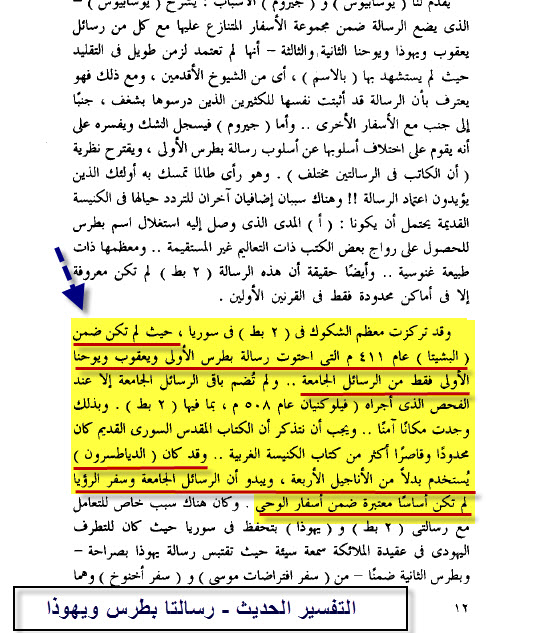
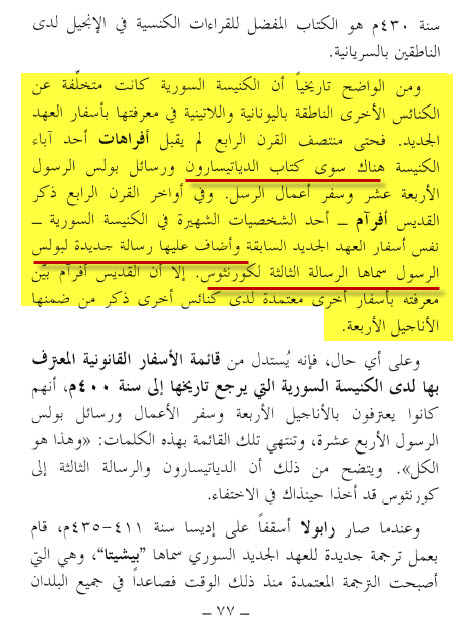
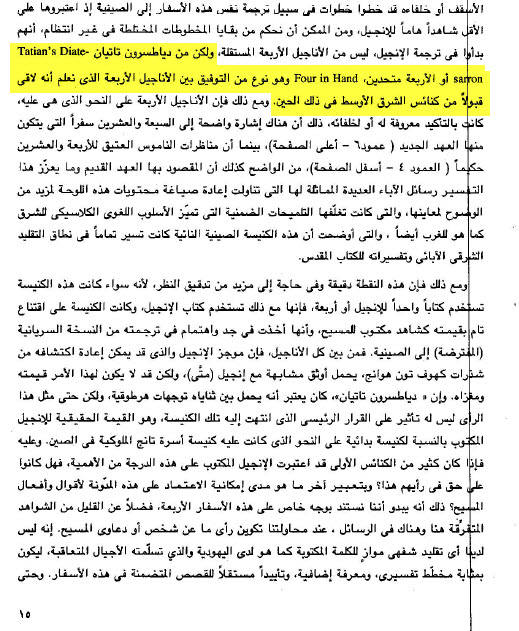
The Syrian Church used the Diatessaron (a harmony of the four Gospels) instead of the four Gospels themselves — and this was accepted across churches of the Middle East. It rejected all the universal epistles, excluded Revelation entirely, and accepted a Third Epistle to the Corinthians that we no longer possess:
The early Greek Fathers believed the Epistle of Jeremiah was canonical:
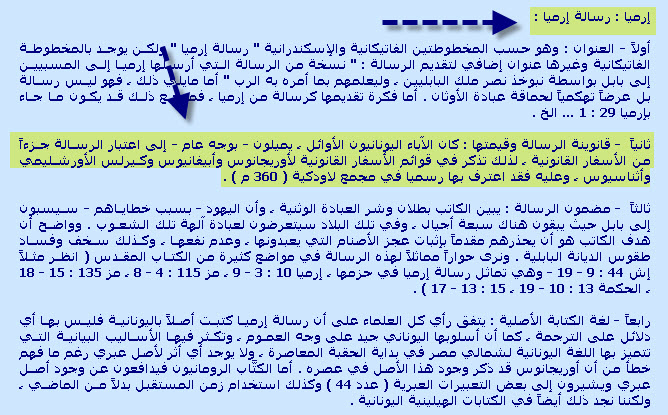
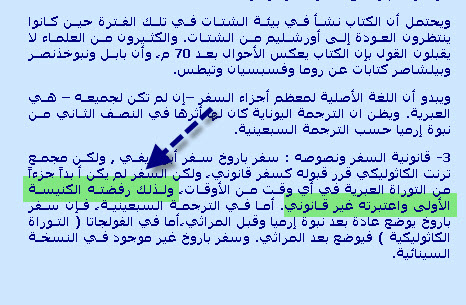
The Book of Baruch was initially rejected, then accepted:
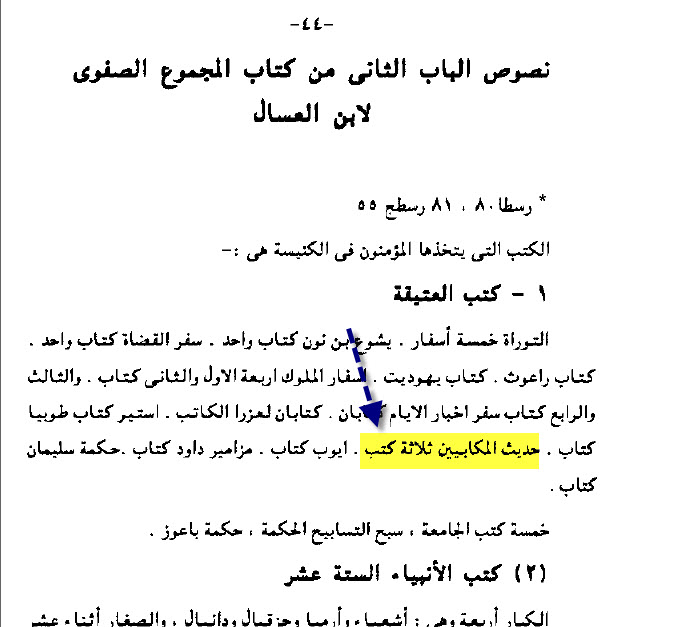
The early church had three books of Maccabees — the current church has two (Safawi Collection of Ibn Al-Assal, p. 44):
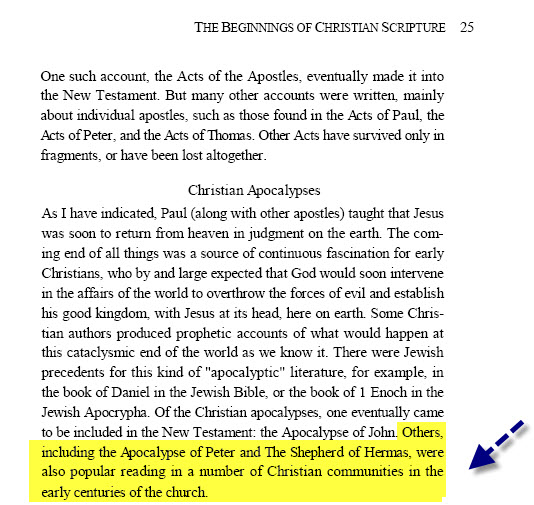
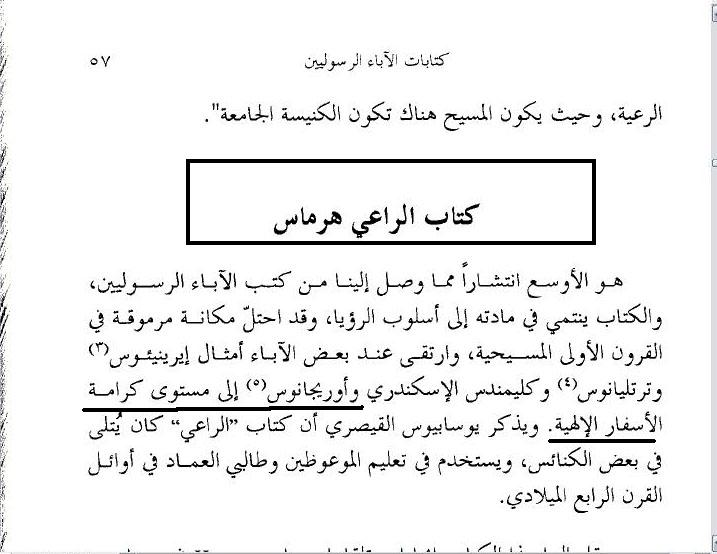
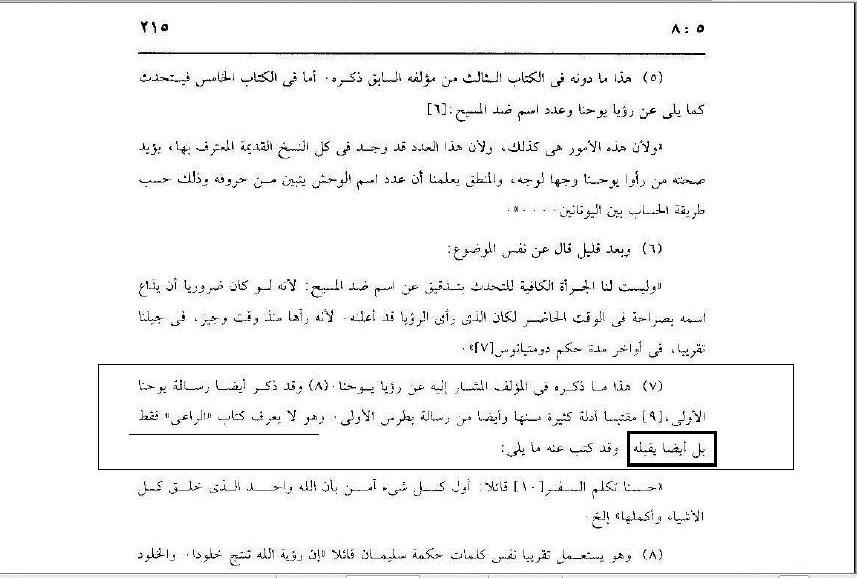
Bart Ehrman confirms the Apocalypse of Peter and the Shepherd of Hermas were commonly read in many early Christian communities:
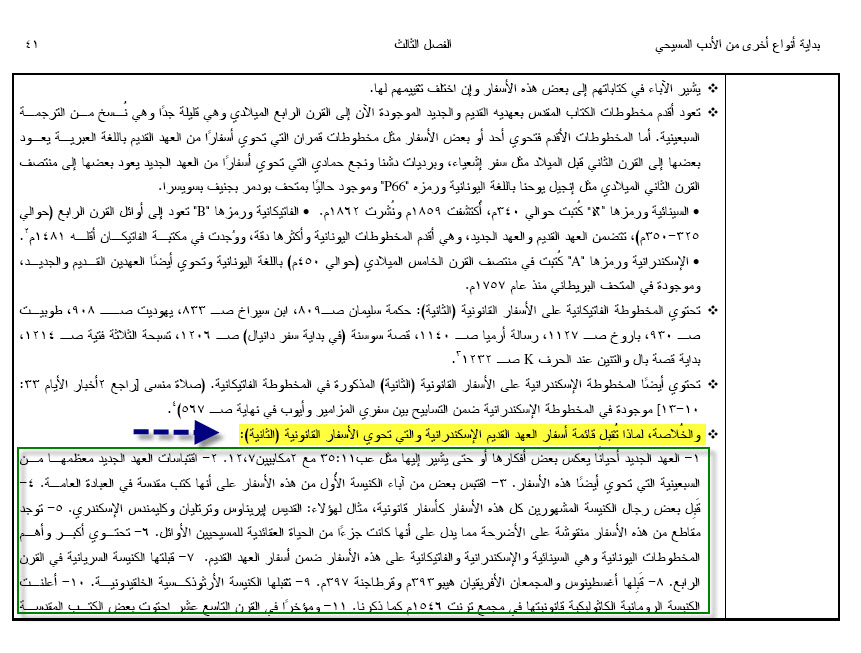
Father Tadros Yacoub Malti gives the Orthodox/Catholic justification for the deuterocanonical books — the New Testament quotes them, the Fathers treated them as sacred, and important manuscripts contain them:
The Protestant position — rejecting them as fabricated:
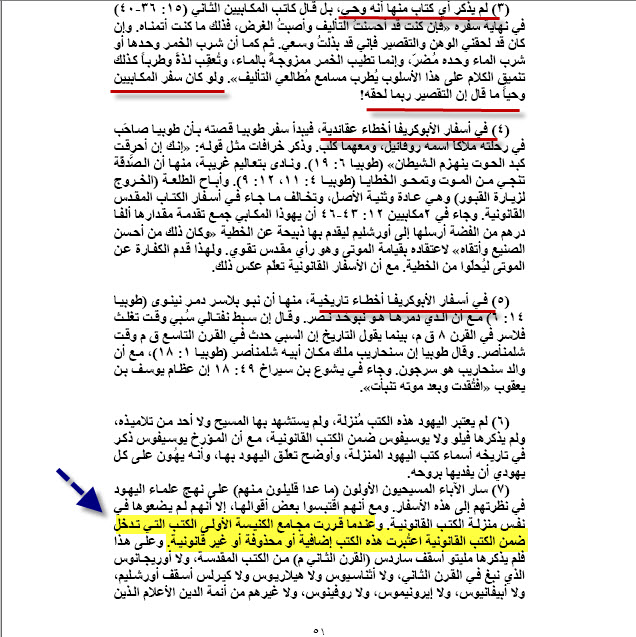
Protestant reasons for rejection — doctrinal and historical errors, early councils considered them illegal:
The Ethiopian Church accepts 81 books:
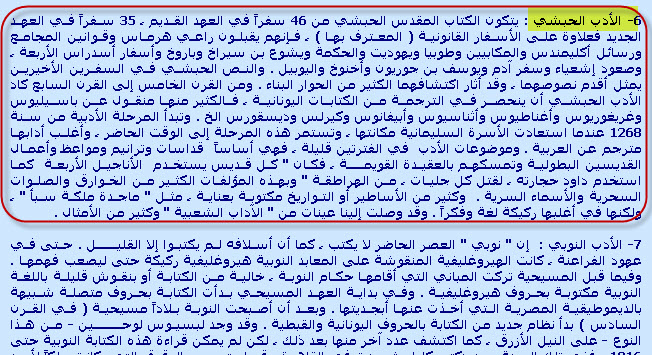
1 — Clement of Alexandria
Father Basit says of Clement: “He received the tradition with all accuracy from those who received it from the messengers.” Yet the tradition Clement received accepted the Epistle of Barnabas and the Apocalypse of Peter as canonical (Church History — Eusebius of Caesarea, Book 6, Chapter 13):
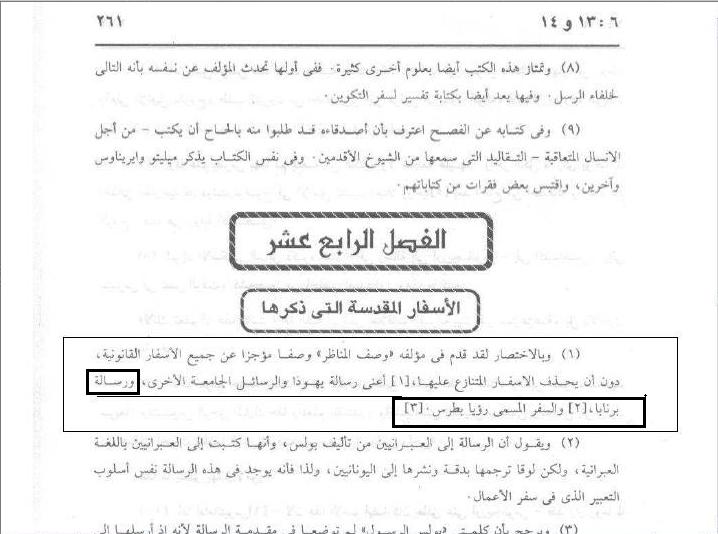
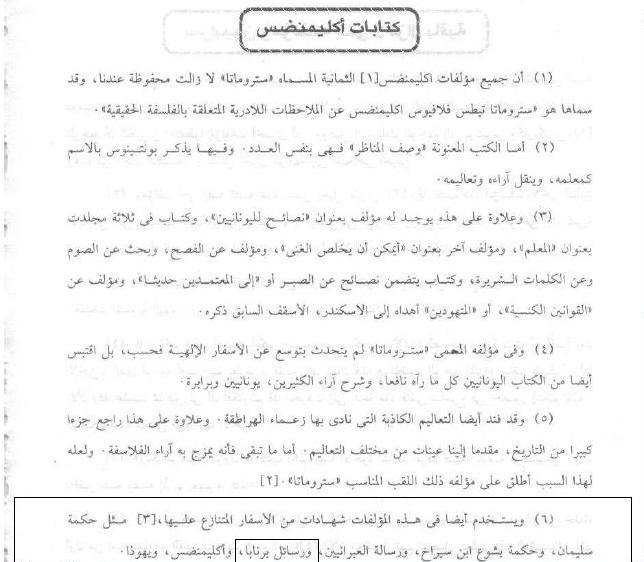
The Biblical Encyclopedia on Clement’s canon:
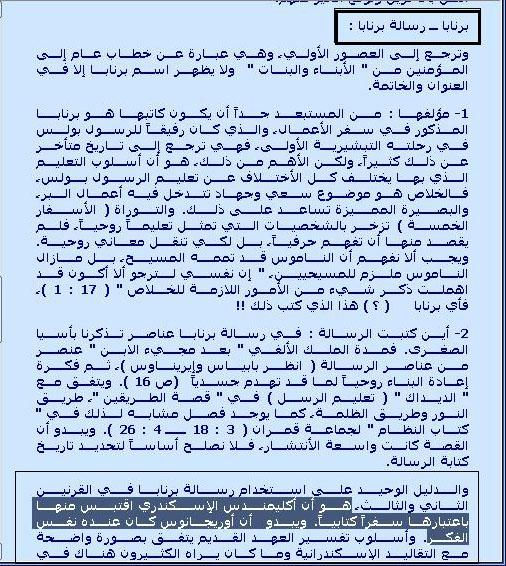
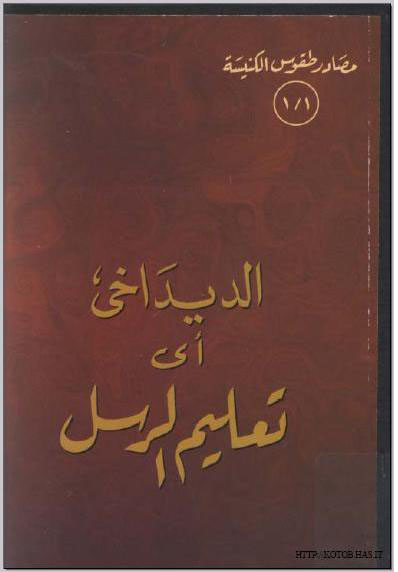
Clement’s tradition also accepted the Didache and the Shepherd of Hermas as sacred (The Didache, pp. 57, 85):
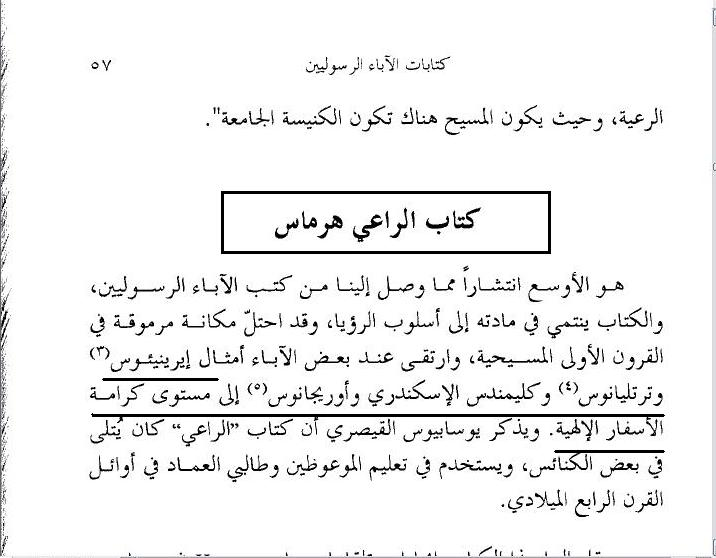
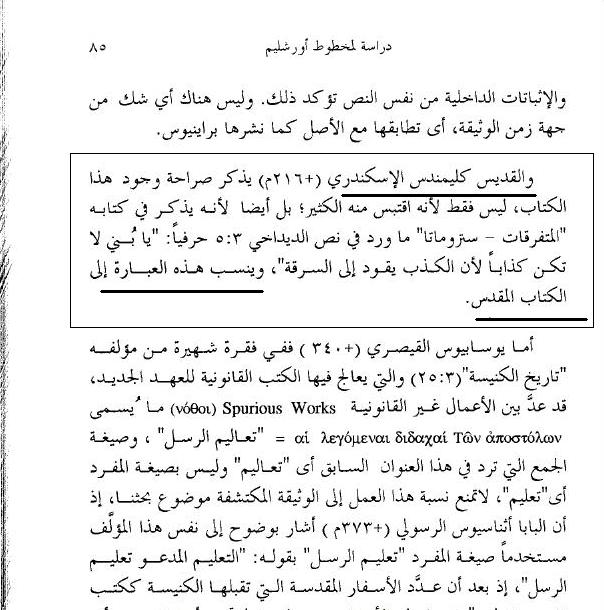
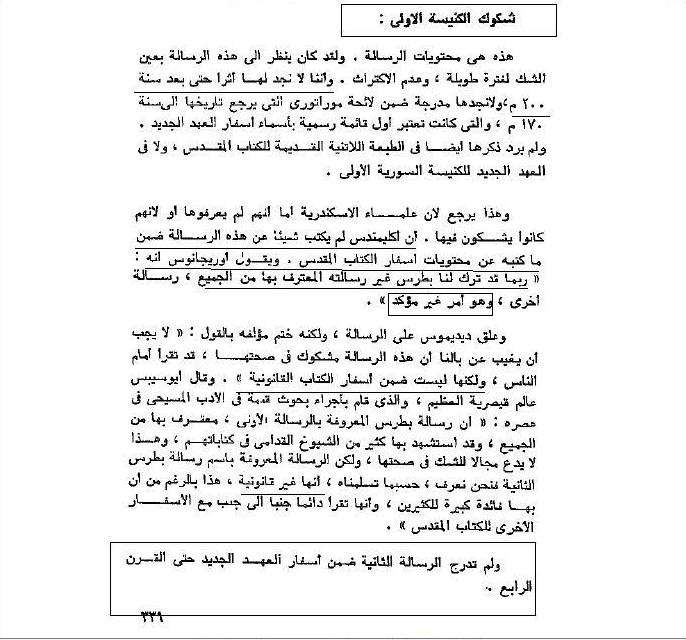
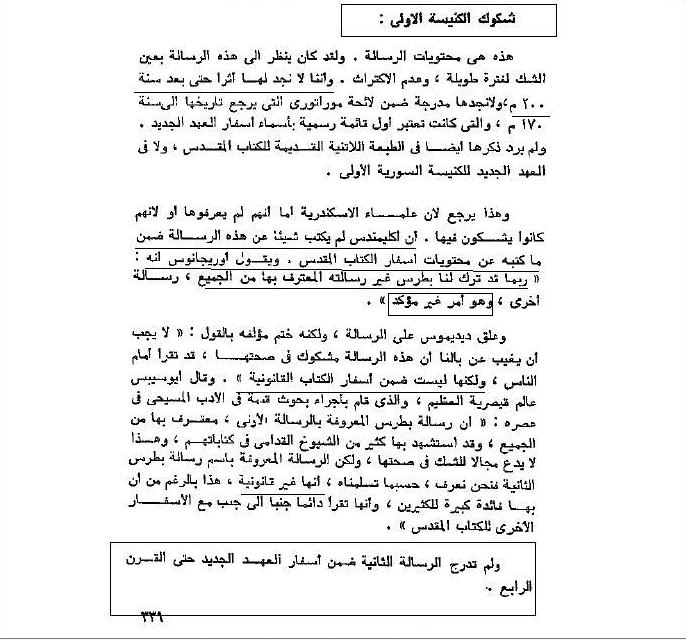
Yet this same tradition “received with great precision from the apostles” knew nothing of the Second Epistle of Peter — Clement wrote nothing about it:
2 — Origen
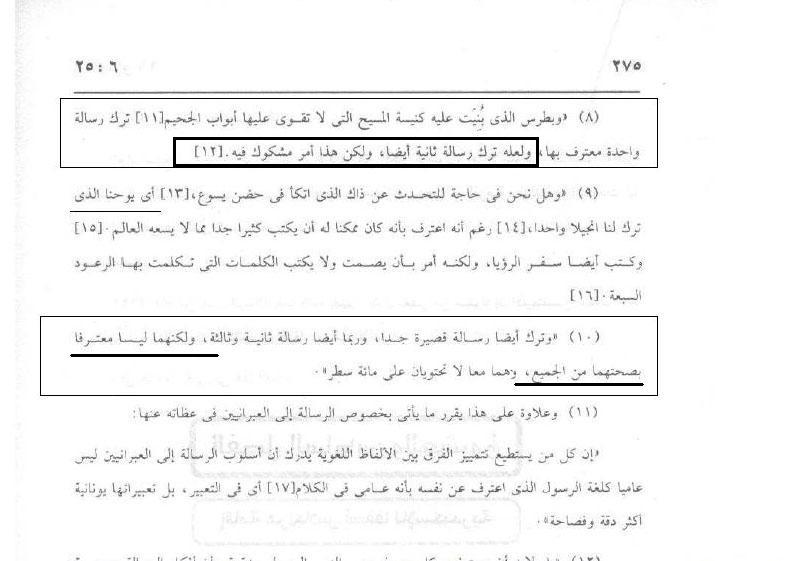
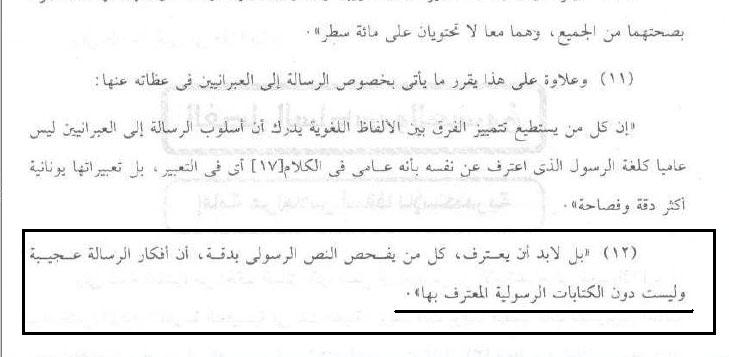
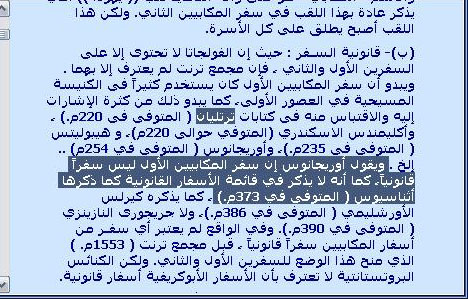
Origen did not accept the Second and Third Epistles of John, the Second Epistle of Peter, the Epistle to the Hebrews, or the First Book of Maccabees (Church History, Book 6, Chapter 25; William Barclay’s Commentary, p. 33):
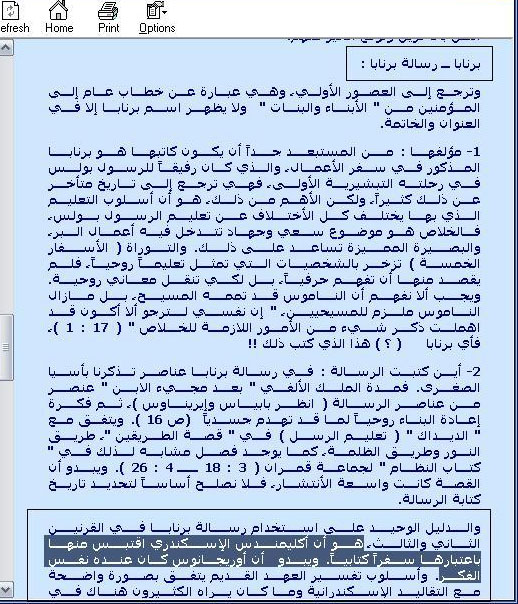
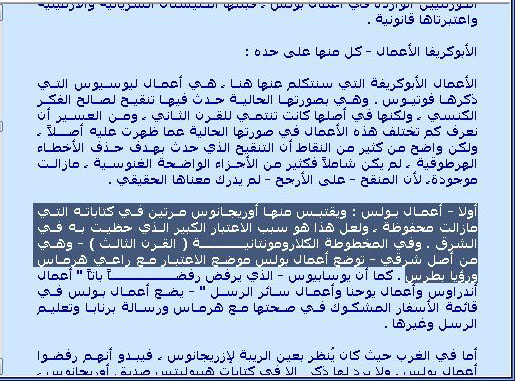
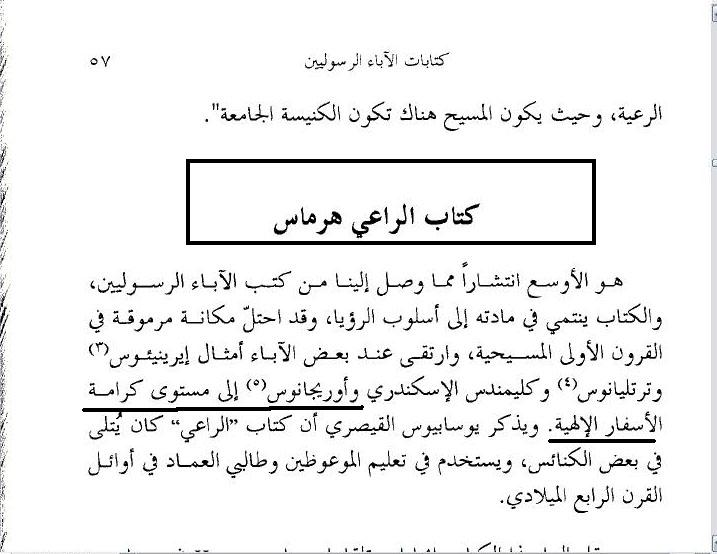
Yet Origen accepted as canonical the Acts of Paul, the Epistle of Barnabas, and the Shepherd of Hermas (The Didache, p. 57):
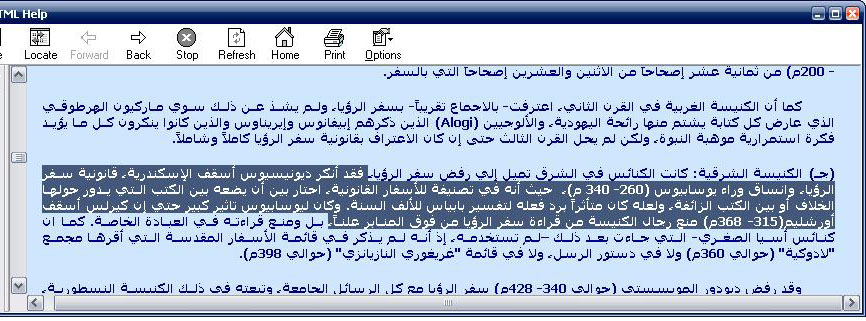
3 — Eusebius of Caesarea
Eusebius denied the Second Epistle of Peter and the Revelation of John (Church History, Book 3, Chapter 3):
4 — Irenaeus of Lyon
Irenaeus accepted the Book of the Shepherd of Hermas as included in the Bible (Church History, Book 5):
5 — Athanasius the Apostolic
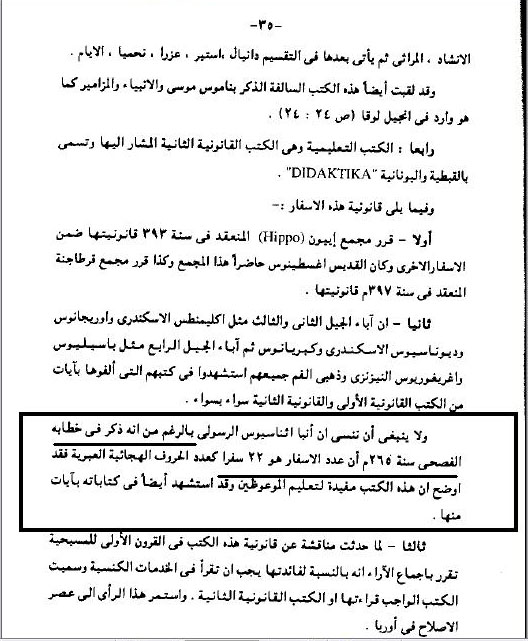
Athanasius held the Old Testament contained 22 books and excluded the deuterocanonical books (Safawi Collection, p. 35):
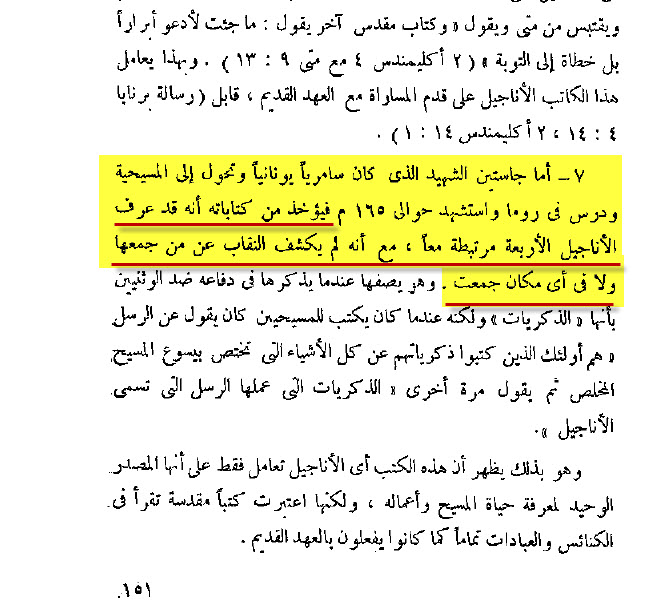
6 — Justin the Martyr
Justin knew the four Gospels linked together, calling them “memories” — but did not reveal who collected them or when:
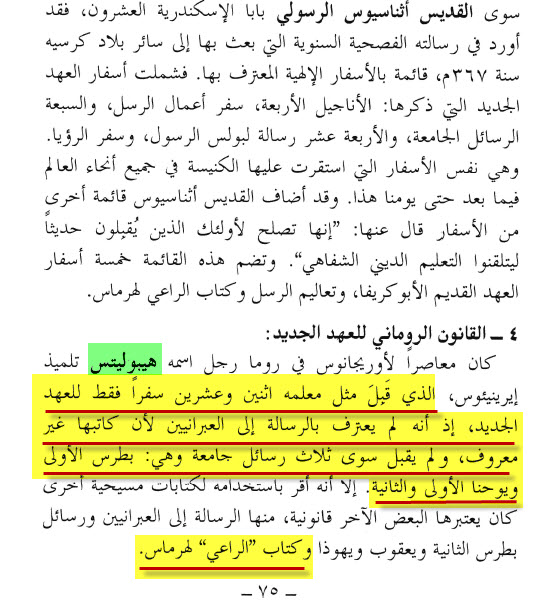
7 — Hippolytus
Hippolytus accepted only 22 books of the Old Testament and denied the Epistle to the Hebrews (unknown author), the 2nd and 3rd Epistles of John, the 2nd Epistle of Peter, the Epistles of James, and the Epistle of Jude (A General Idea about the Bible, p. 75):
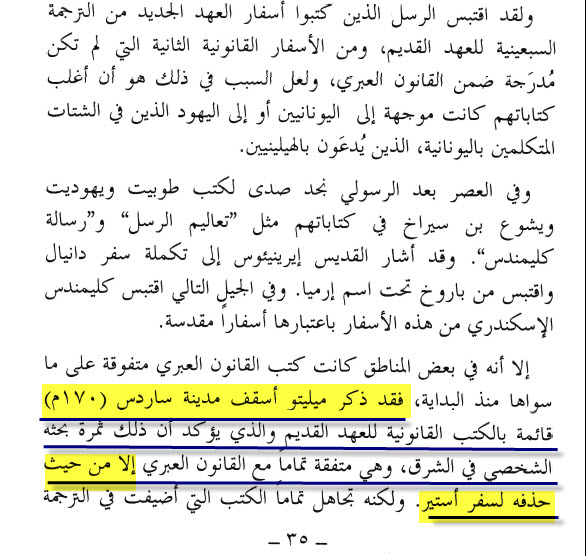
8 — Melito, Bishop of Sardis (170 AD)
Melito deleted and did not believe in the Book of Esther (A General Idea about the Bible):
9 — Jerome
Jerome did not consider the Book of Tobit canonical:
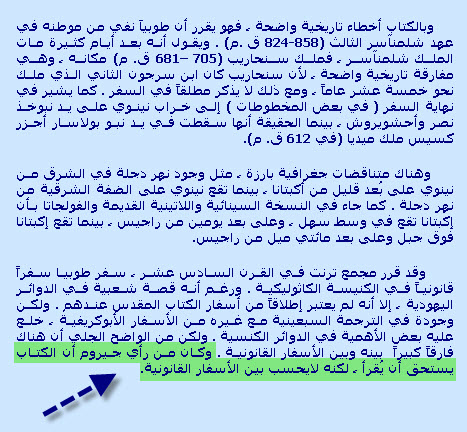
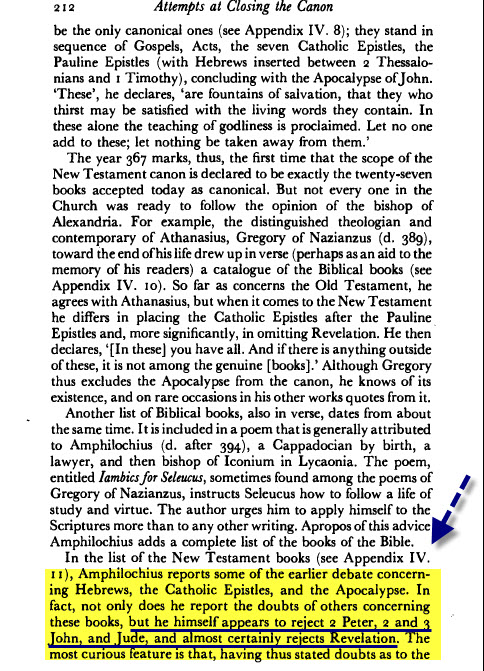
10 — Amphilochius
Bruce Metzger reports Amphilochius expressed doubts about the Epistle to the Hebrews, the General Epistles, and Revelation — and appears to reject 1 & 2 John, 2 Peter, Jude, and specifically Revelation:
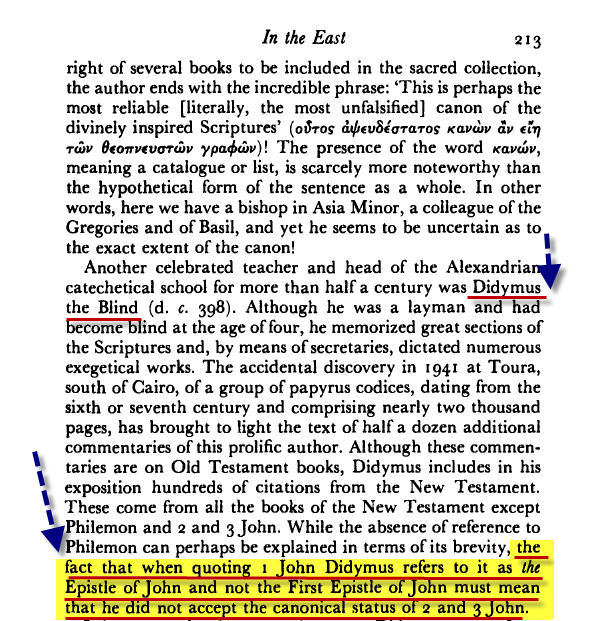
11 — Didymus the Blind
Metzger notes that when Didymus quoted from 1 John, he referred to it simply as “the Epistle of John” — indicating he did not acknowledge 2 and 3 John:
12 — Cyprian
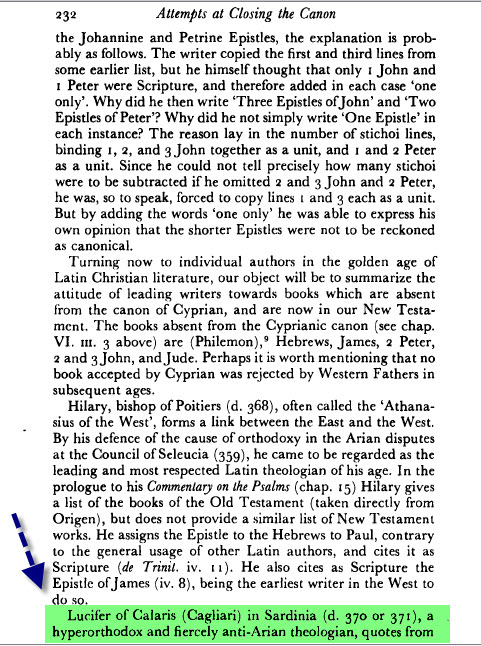
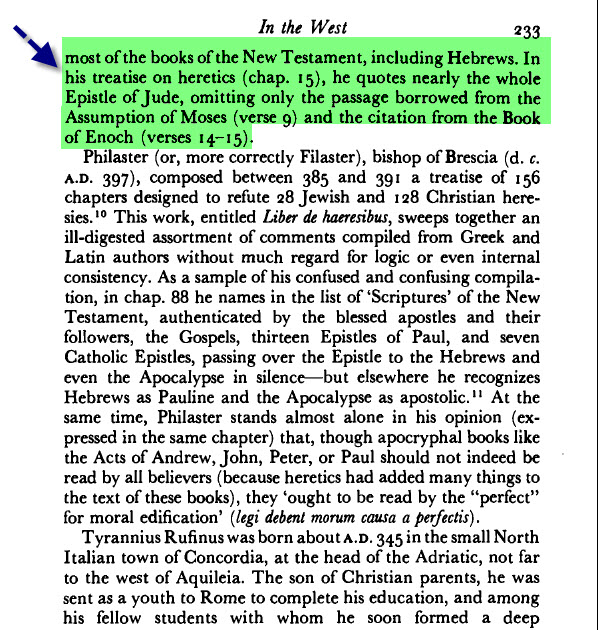
The Catholic Encyclopedia states Cyprian received all New Testament books except Hebrews, 2 Peter, James, and Jude.
When Was the New Testament First Compiled?
Reverend James Ans in Systematic Theology (p. 53) explains plainly: we do not know who compiled the books of the New Testament or when they were compiled:
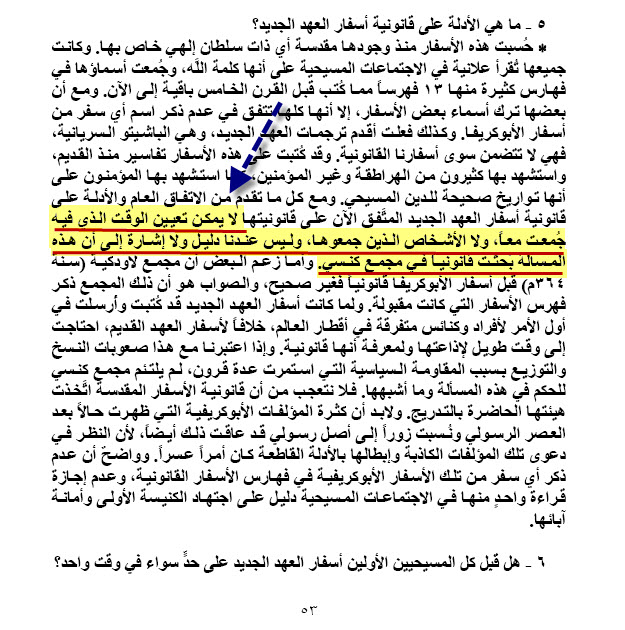
Dr. Fahim Aziz confirms the date when Paul’s epistles and the Gospels became equal to the Old Testament in sacred status is still unknown:
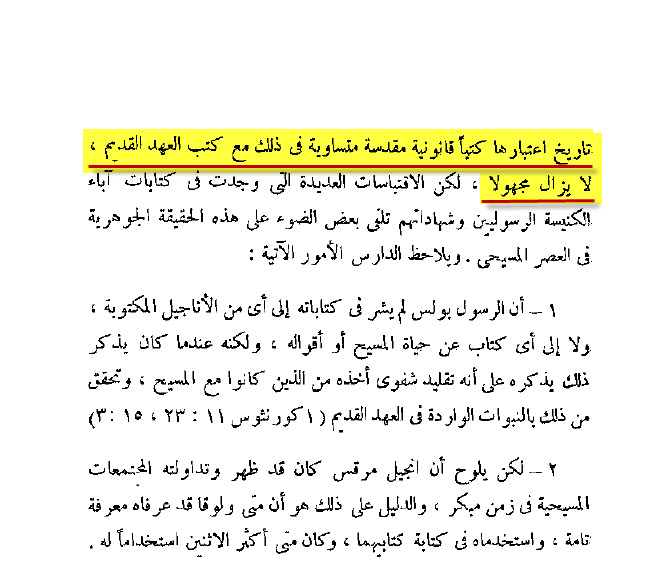
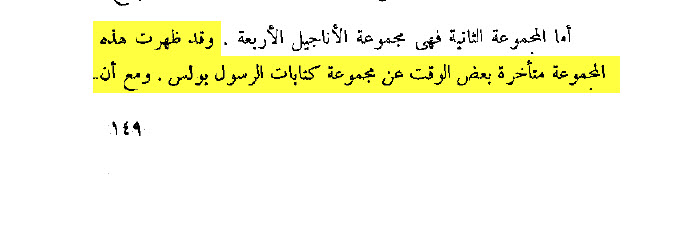
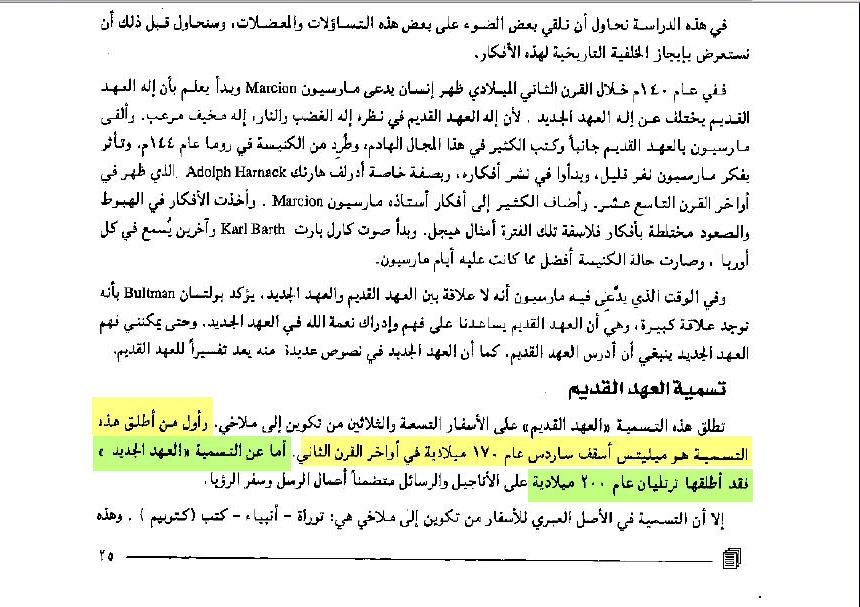
“Old Testament” — first coined by Melitus, 170 AD. “New Testament” — first coined by Tertullian, 200 AD:
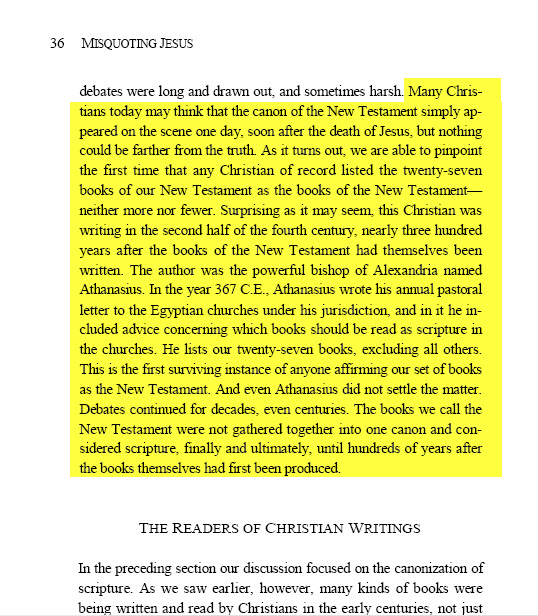
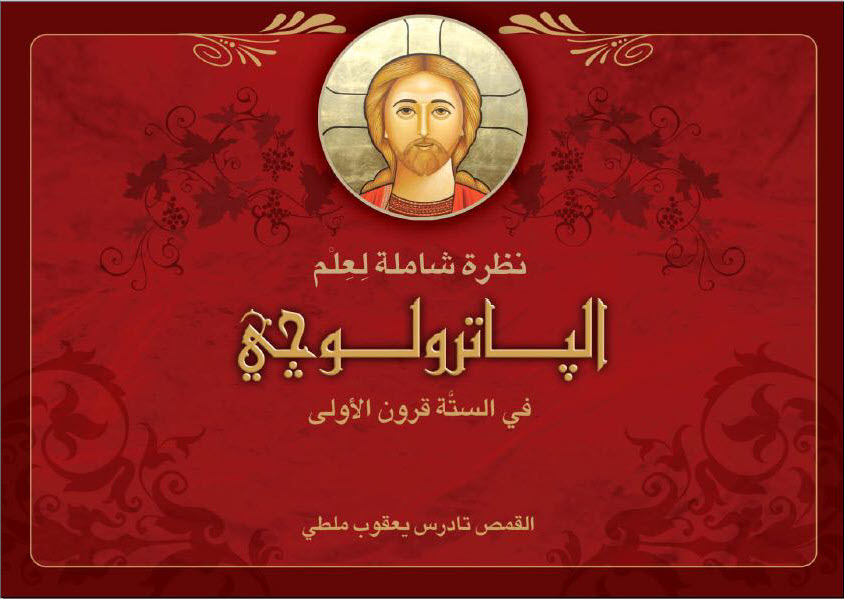
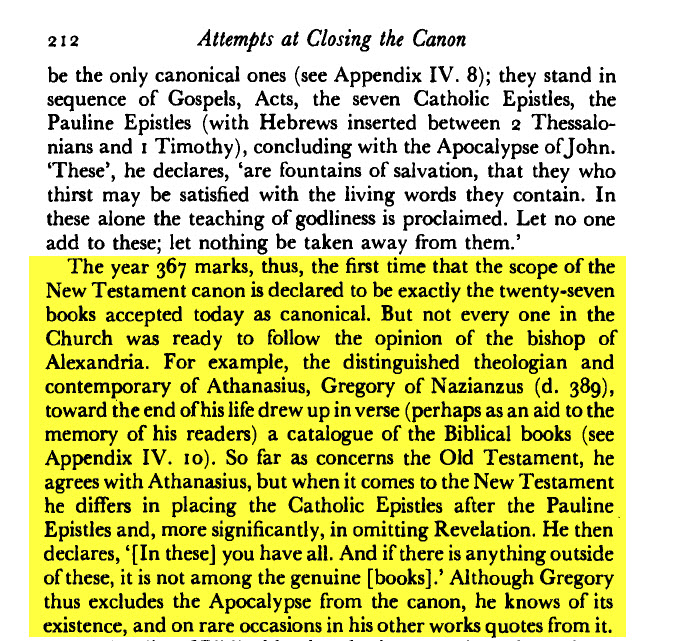
Father Tadros Yacoub Malti confirms: the first person to mention the complete collection of New Testament books was Athanasius in 367 AD:
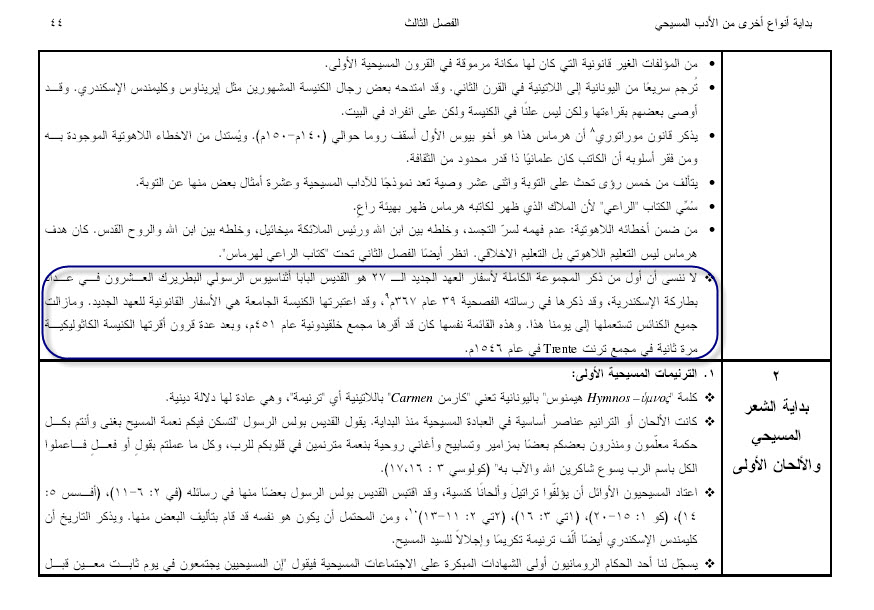
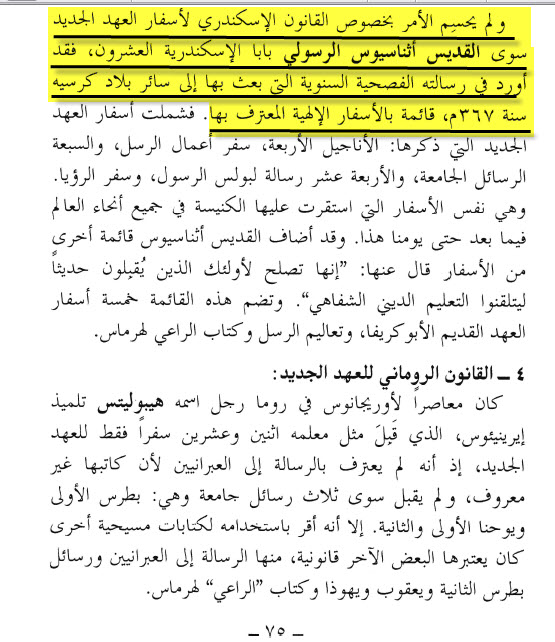
The same appears in A General Idea about the Bible (p. 75) and in Metzger — noting Father Gregory’s disagreement with Athanasius and his deletion of Revelation:
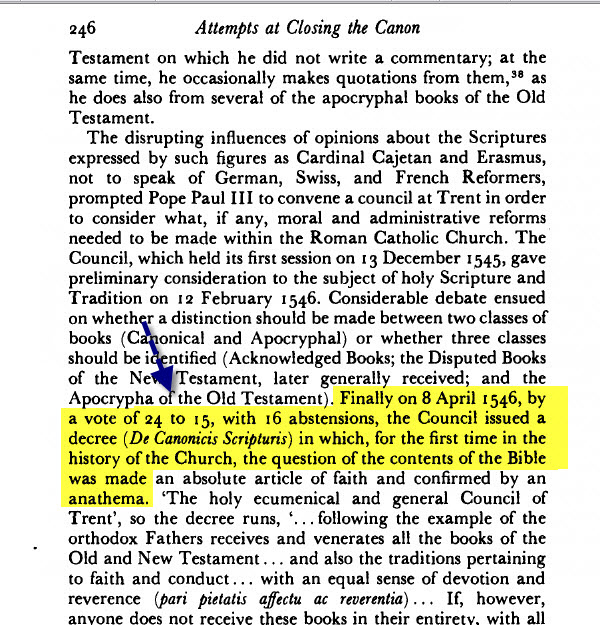
^^The conflict between sects continued until the Council of Trent in 1546, where the number of canonical books was settled by vote^^ — as Metzger documents:
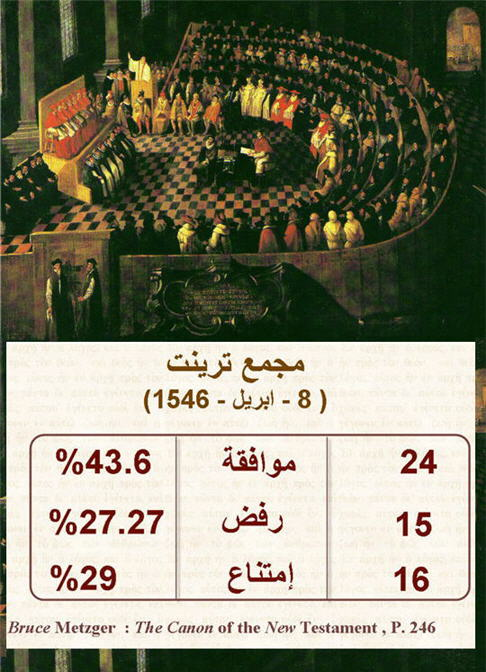
The vote at the Council of Trent:
- 43% voted in favor of the current Bible
- 27% voted against
- 29% abstained
Part Three — Anonymous Authorship
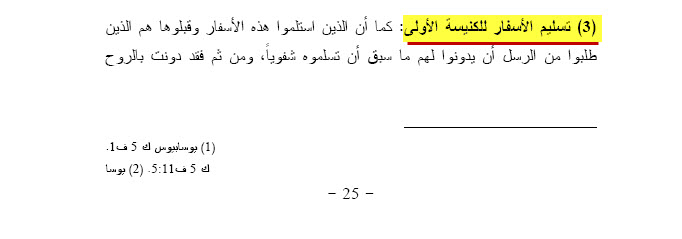
Most books of the Holy Bible do not meet the churches’ own condition that authorship be known — because their authors are simply unknown.
The author of the Encyclopedia of the Church Fathers stated that knowing the author of a book determines the legitimacy of that book:
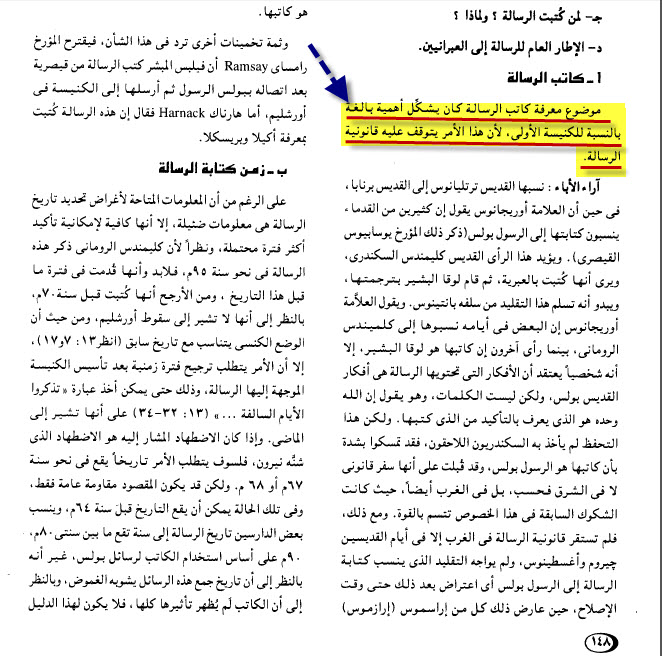
According to this condition, most of the books of the Holy Bible are not canonical — because their authors are unknown.
Old Testament Anonymous Books
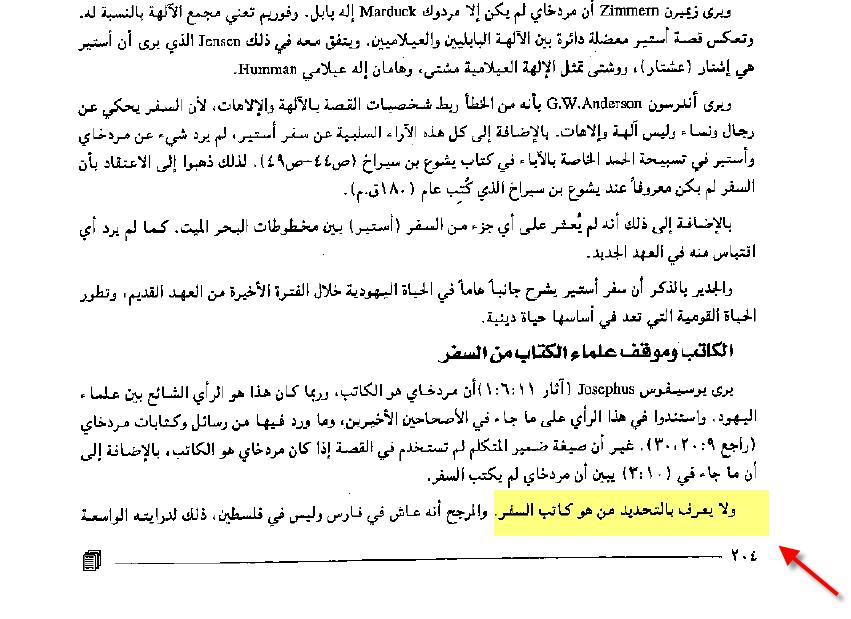
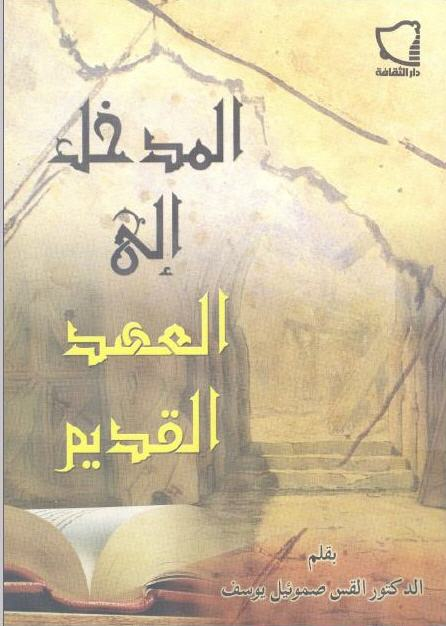
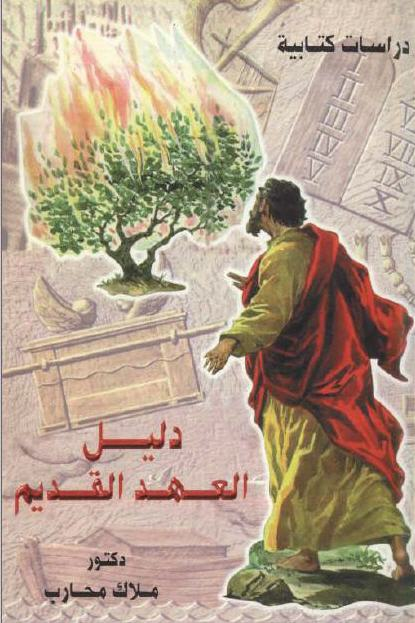
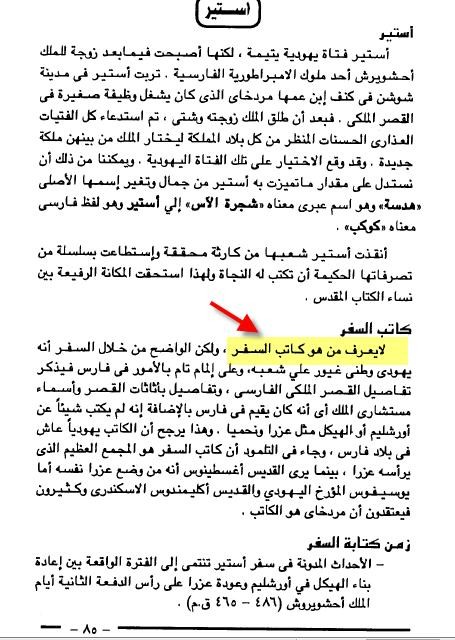
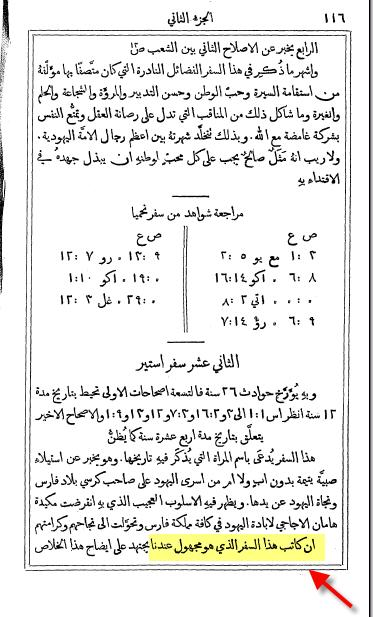
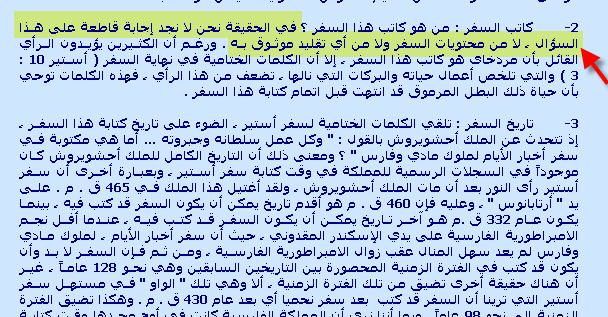
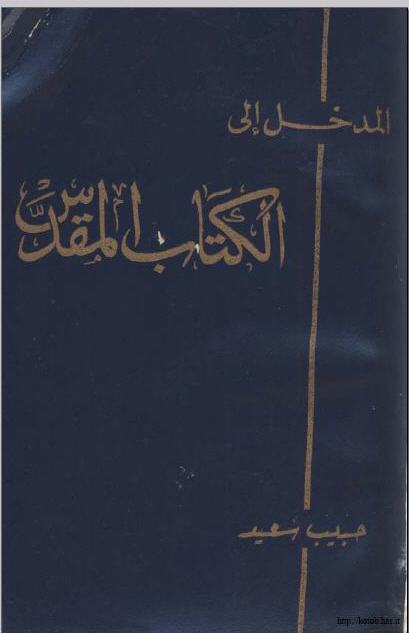
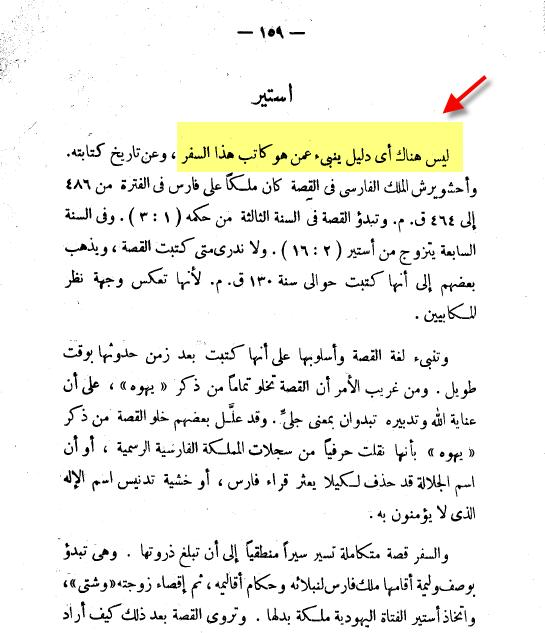
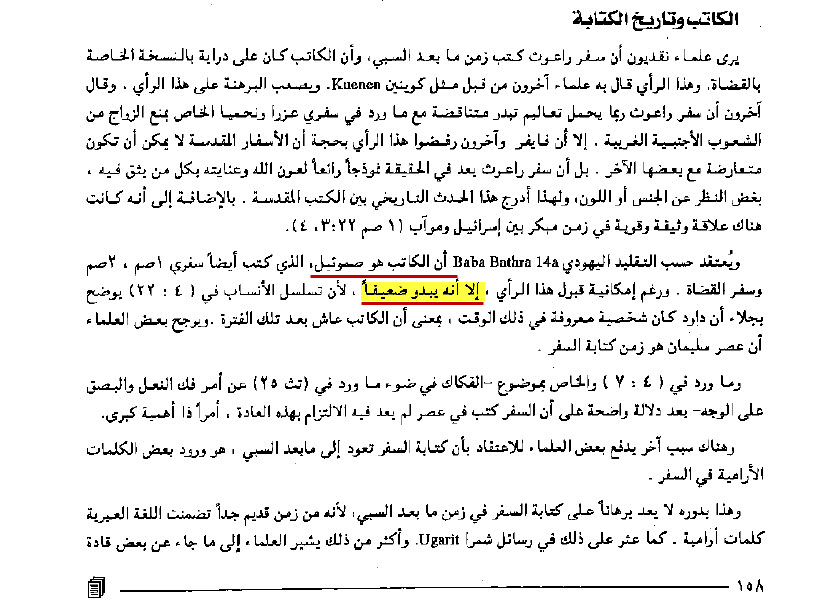
The Book of Esther — author unknown (Introduction to the Old Testament — Dr. Samuel Youssef, p. 204; Guide to the Old Testament — Dr. Malak Muharib, p. 85; A Guide for Students, p. 116; Encyclopedia of the Bible; Introduction to the Bible — Habib Saeed, p. 159):
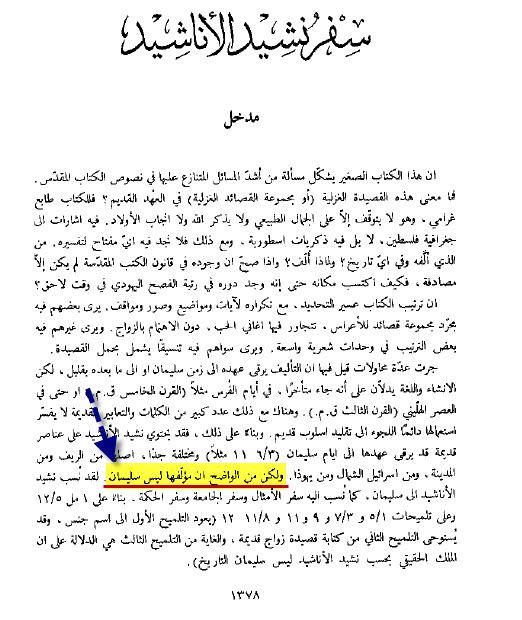
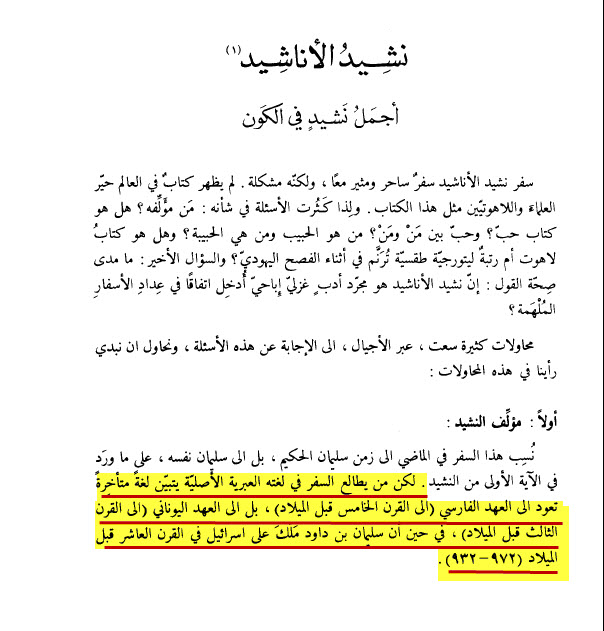
The Song of Songs — author unknown. The language of the book is later than the time of Solomon (Dr. Youhanna Qamir — The Song of Songs Is the Most Beautiful Song in the Universe):
The Travelogue (Chronicles) — writer unknown (Introduction to the Old Testament — Dr. Samuel Youssef, p. 192):
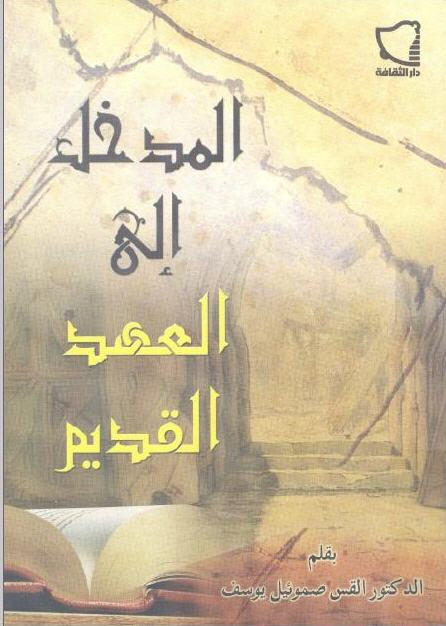
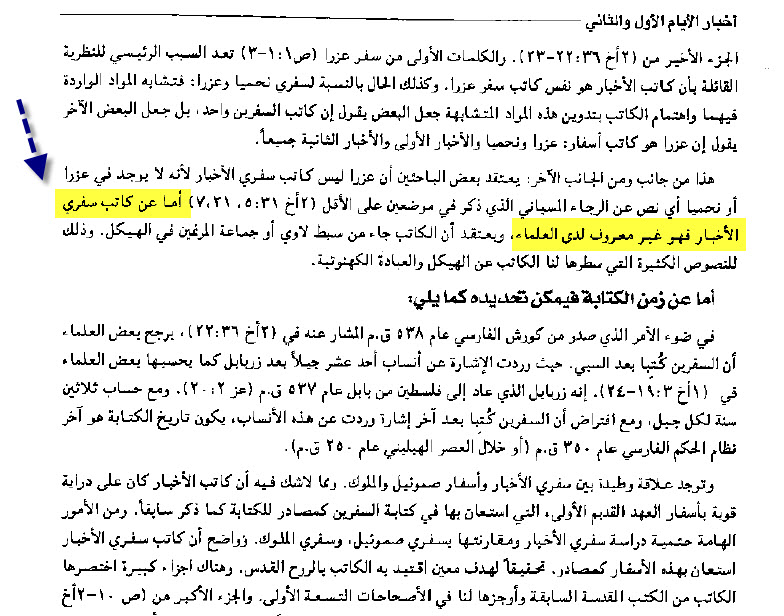
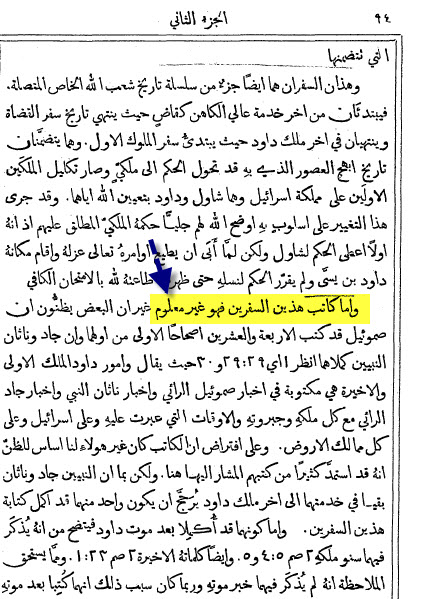
The First and Second Books of Samuel — writer unknown (Student Guide, p. 94):
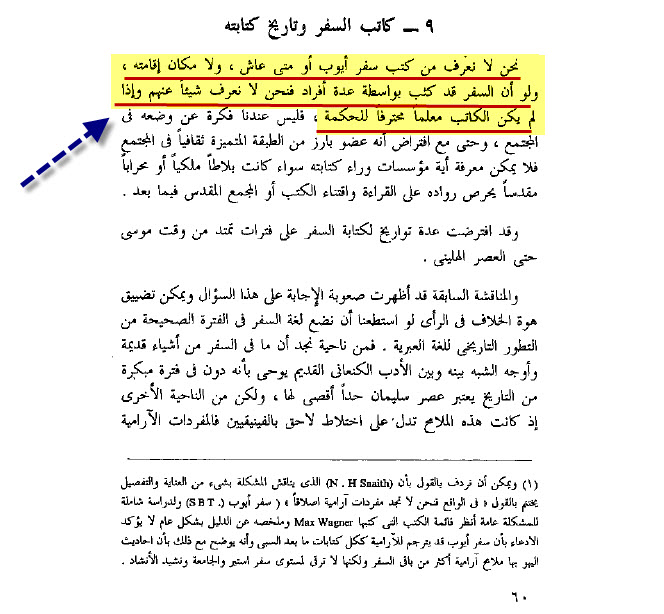
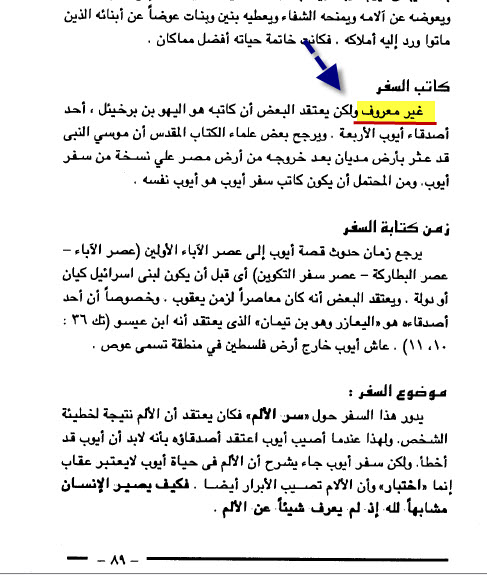
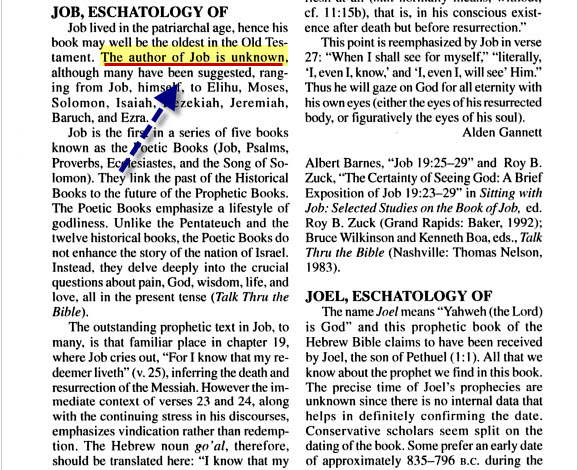
The Book of Job — writer unknown (Modern Commentary on the Old Testament):
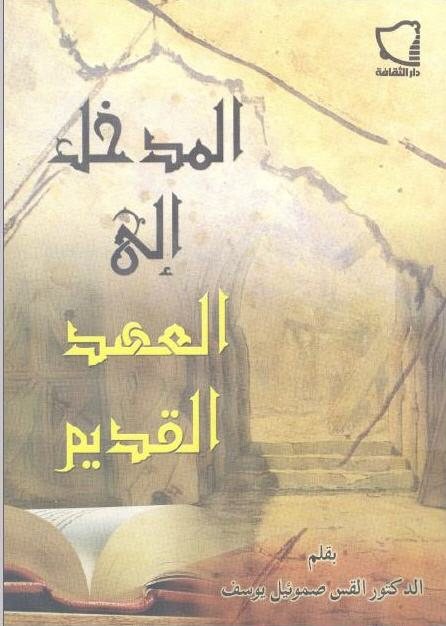
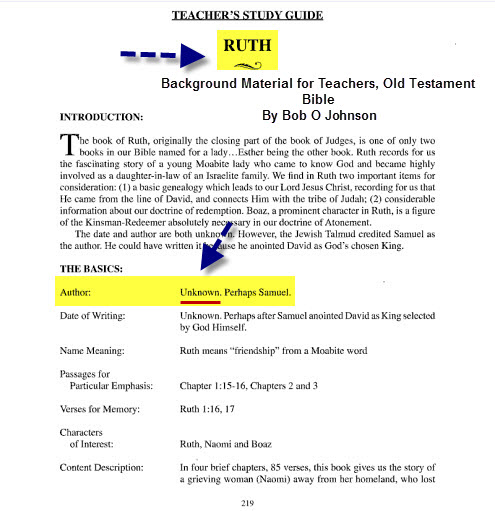
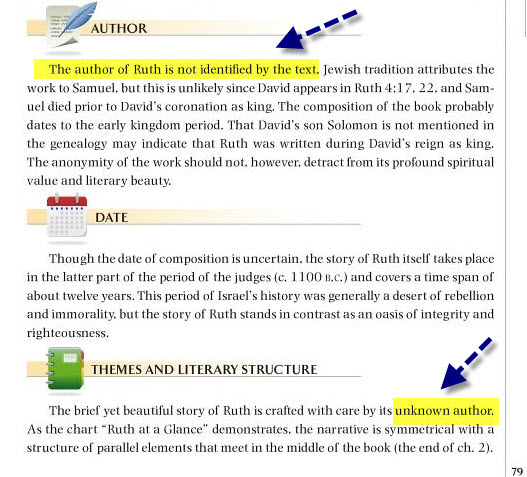
The Book of Ruth — author unknown or anonymous (Introduction to the Old Testament — Dr. Samuel Youssef):
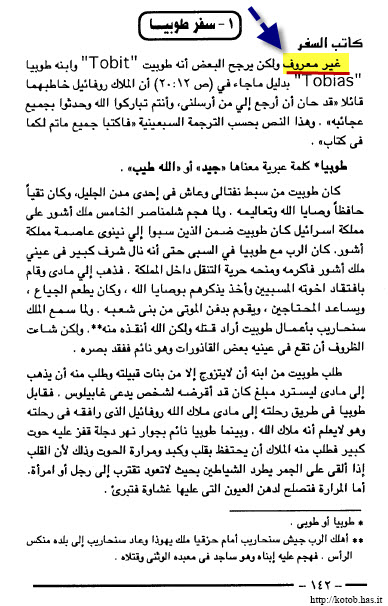
The Book of Tobit — anonymous:
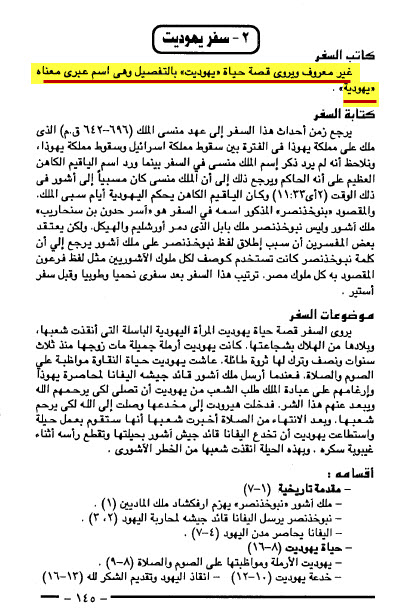
The Book of Judith — same case. The writer of the Book of Ecclesiastes hides under a false name (A Guide to Reading the Bible):
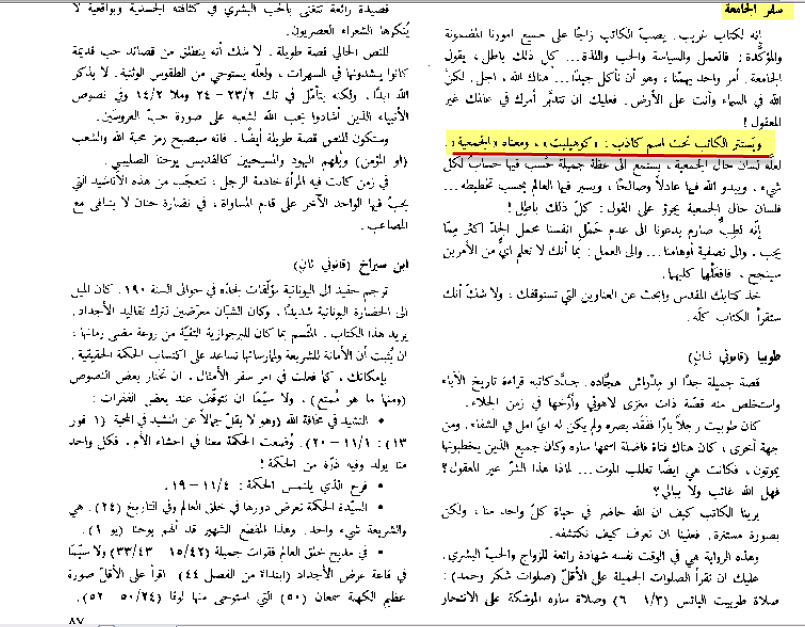
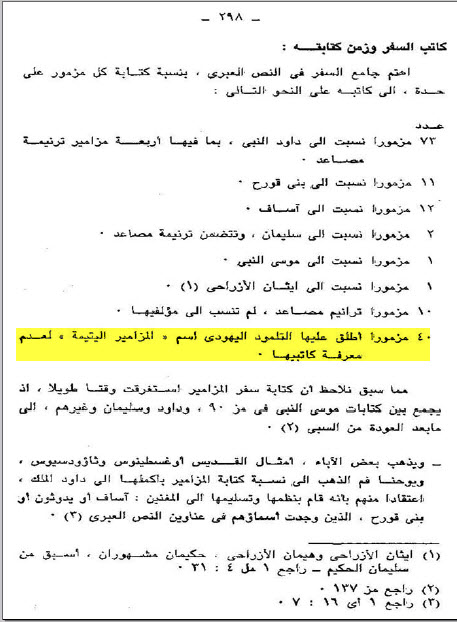
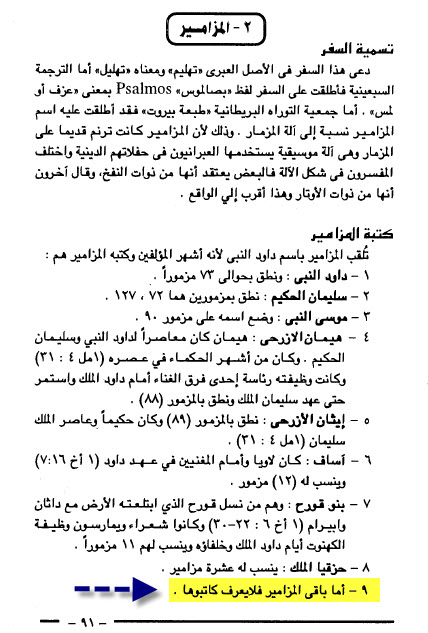
The Psalms of David — even here, some Psalms have unknown authors (the “orphan Psalms”) (Introductions to the Old Testament — Dr. Wahib George; Guide to the Old Testament, p. 91):
New Testament Anonymous Books
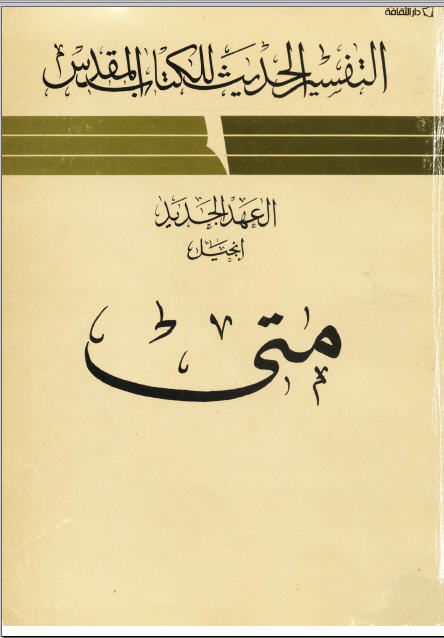
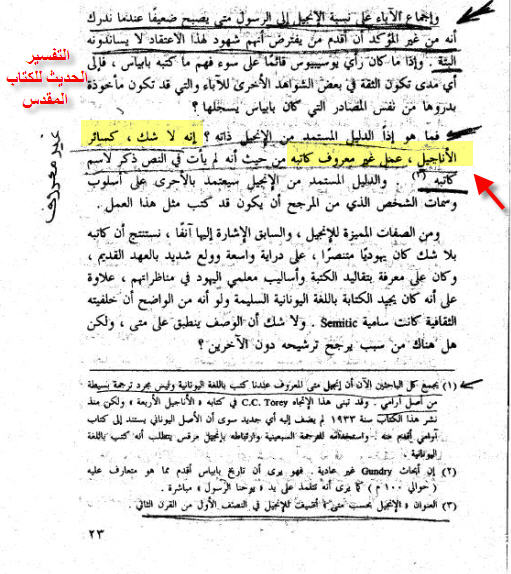
The Gospels are an anonymous work (Modern Interpretation — Gospel of Matthew):
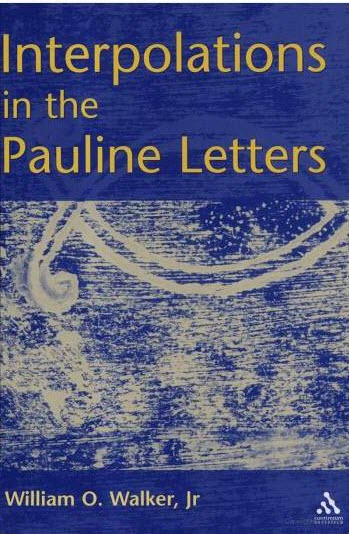
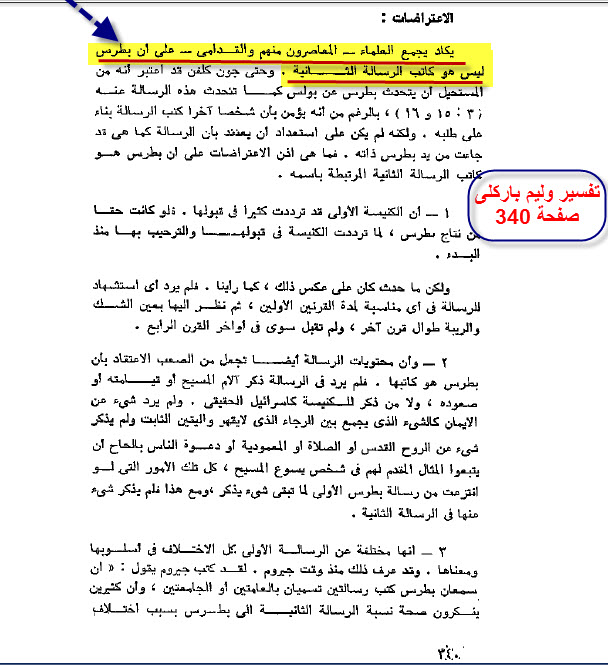
William Walker states all four Gospels, Acts — the names “Matthew, Mark, Luke, and John” — appeared only as titles for the Gospels, added recently, probably in the second century. Most scholars agree Acts was written by the same author as Luke — but the identity of this author is not certain:
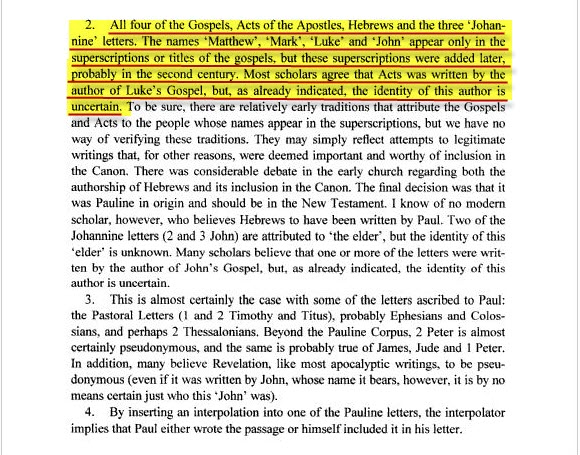
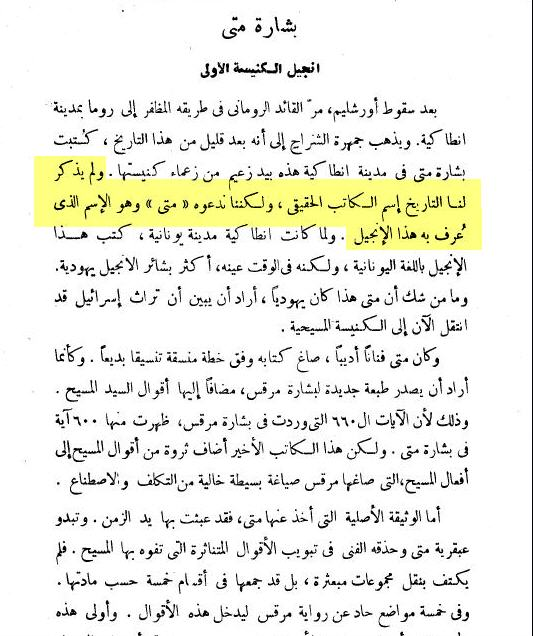
Who wrote the Gospel of Matthew? — Unknown (A Guide to Reading the Bible, p. 183; Introduction to the New Testament, p. 245; Jesuit Translation):
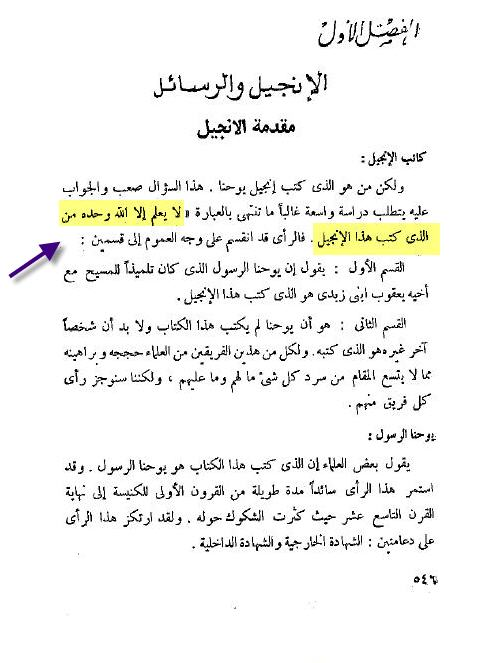
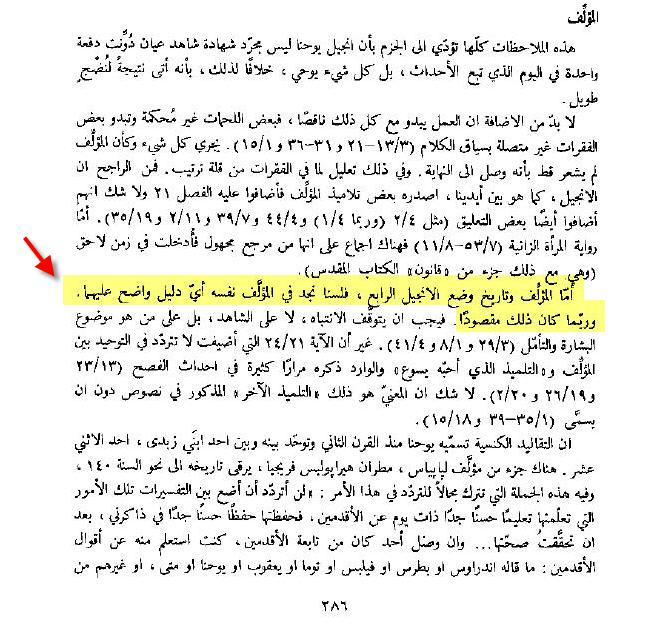
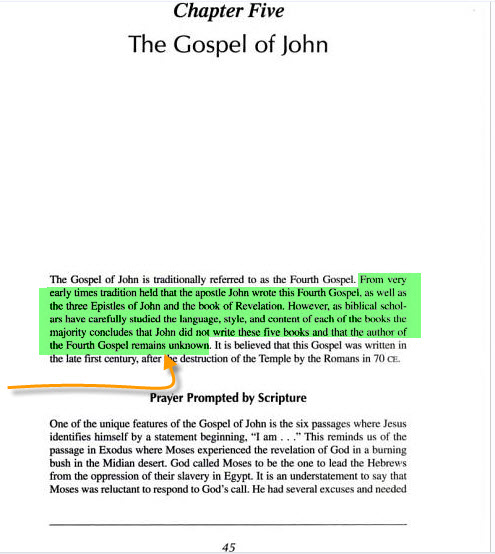
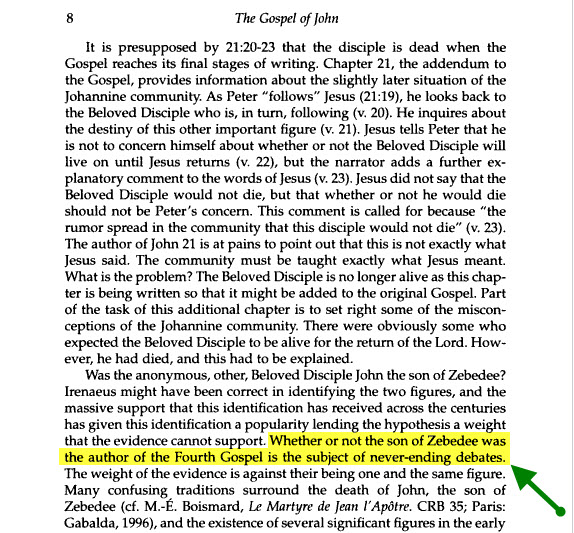
Who wrote the Gospel of John? — Known only to God. Donald Griggs states the tradition attributing John with five books has been studied carefully by scholars who concluded John did not write any of them. The author of the Fourth Gospel will remain unknown:
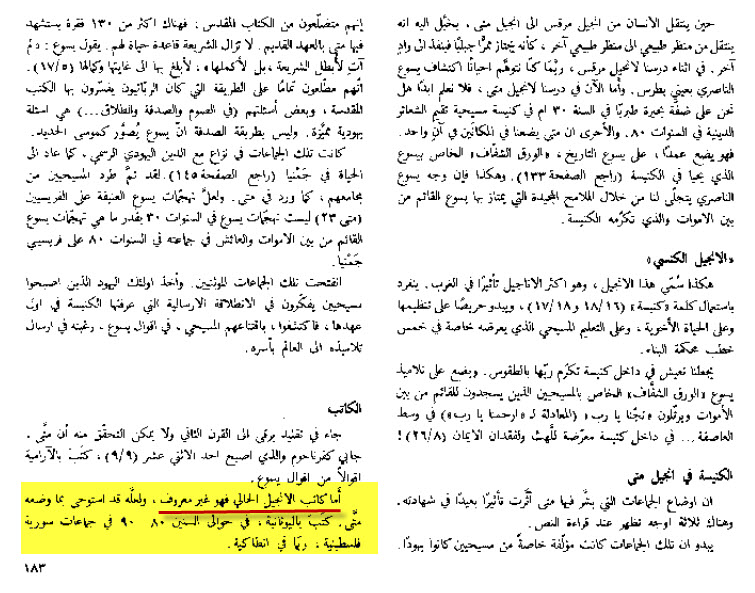
The Epistle to the Hebrews — authorship unknown with certainty (Encyclopedia of the Bible; Introduction to the Bible, p. 342):
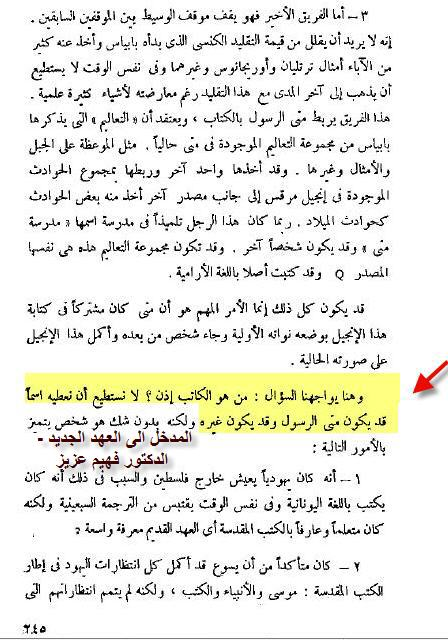
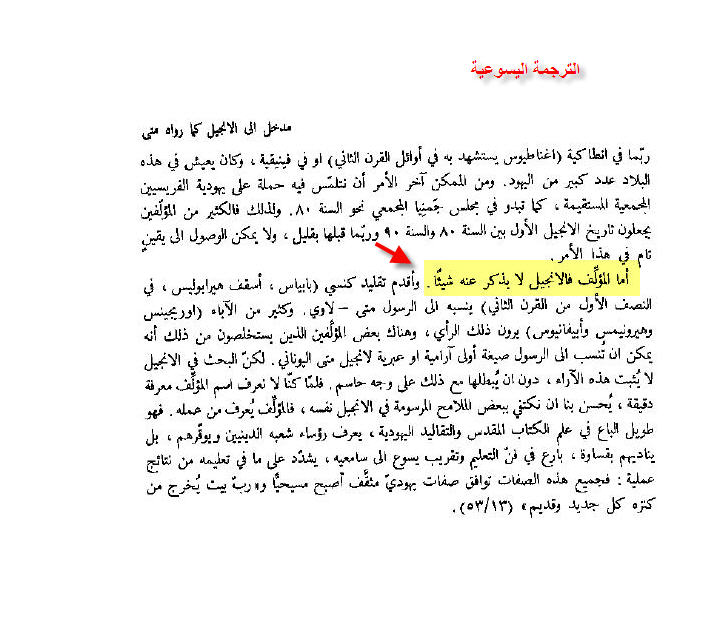
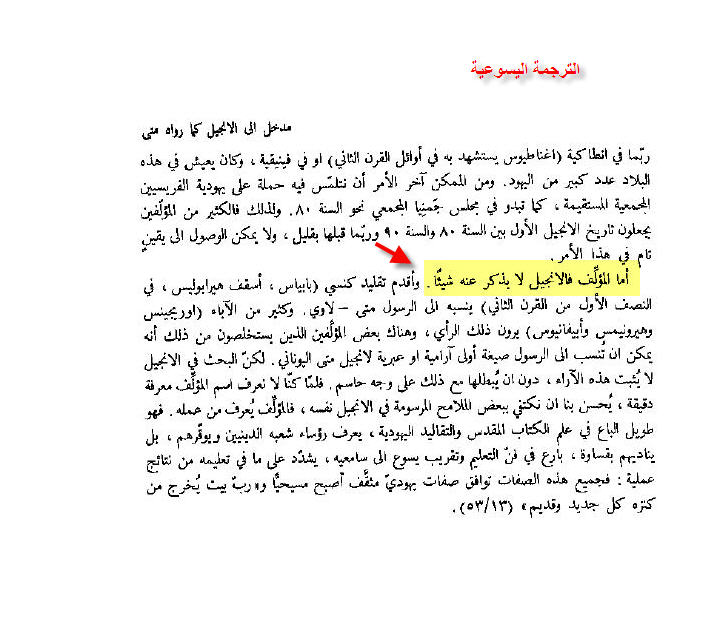
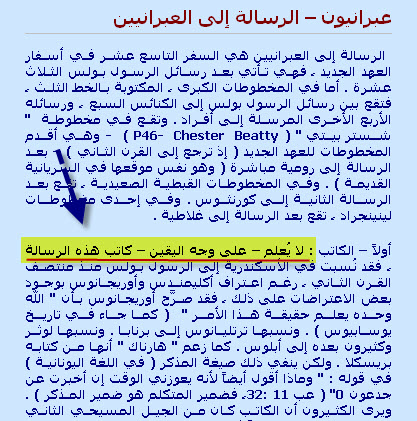
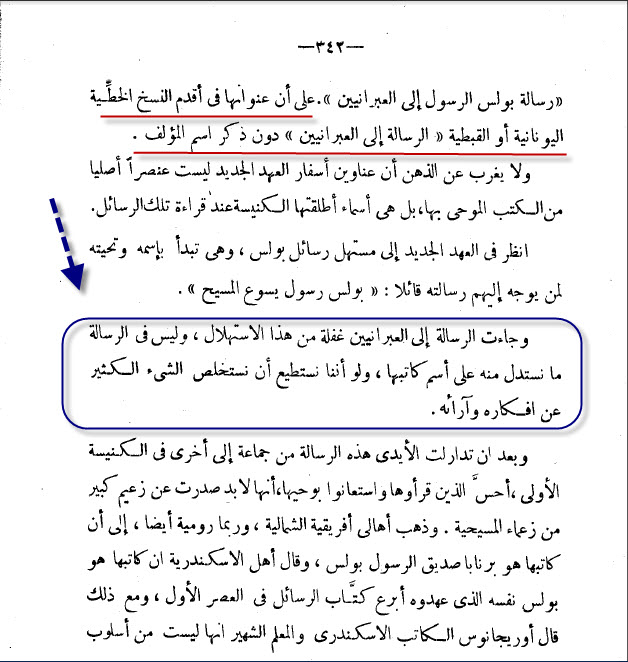
The Epistle of Jude — author specifically unknown (William Barclay’s Commentary; Introduction to the New Testament — Dr. Fahim Aziz, p. 679):
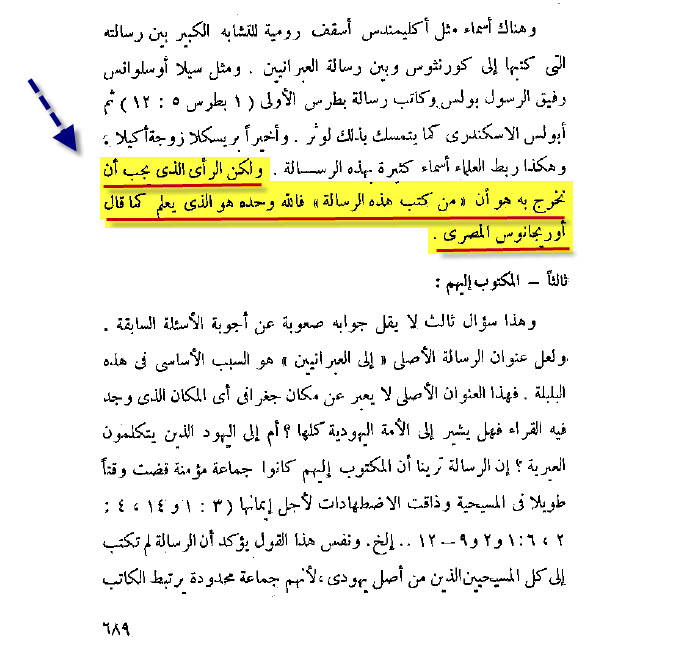
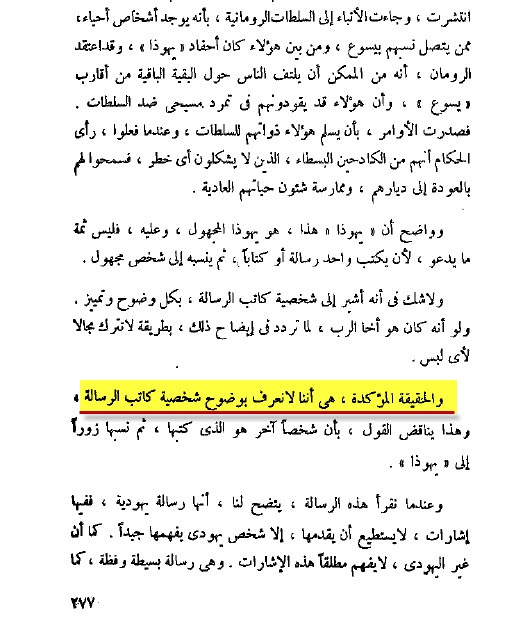
The Second Epistle of Peter — scholars almost unanimously agree its author is unknown and that Peter did not write it:
Some epistles were written under borrowed names — the writer of 2 Thessalonians used Paul’s authority, as Father Paul Al-Feghali’s source confirms: “These are numerous proofs that confirm that we are dealing with a forged work.”
The Shepherd of Hermas — its writer is said to be one of the apostles (as Anba Youanis states) — yet it is excluded from the current Bible:
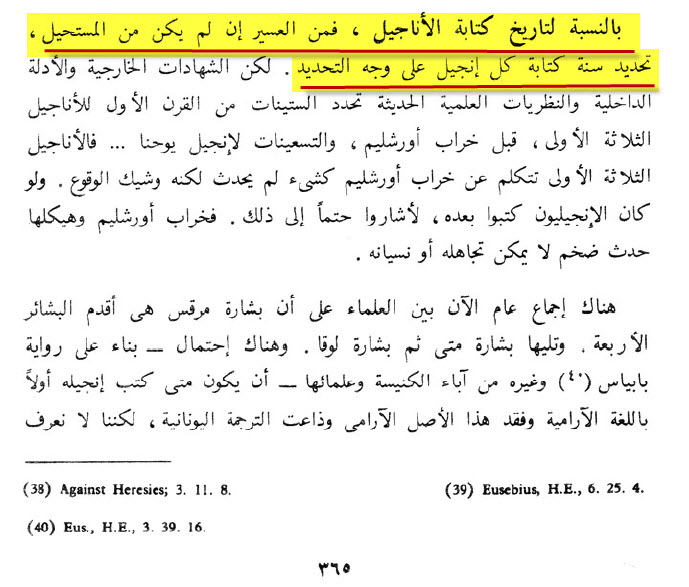
The date of writing the Gospels cannot be determined — as stated by Anba Youanis:
Part Four — Has the Bible Been Corrupted?
Definition of Corruption
The Bible itself speaks of distortion by addition and deletion:
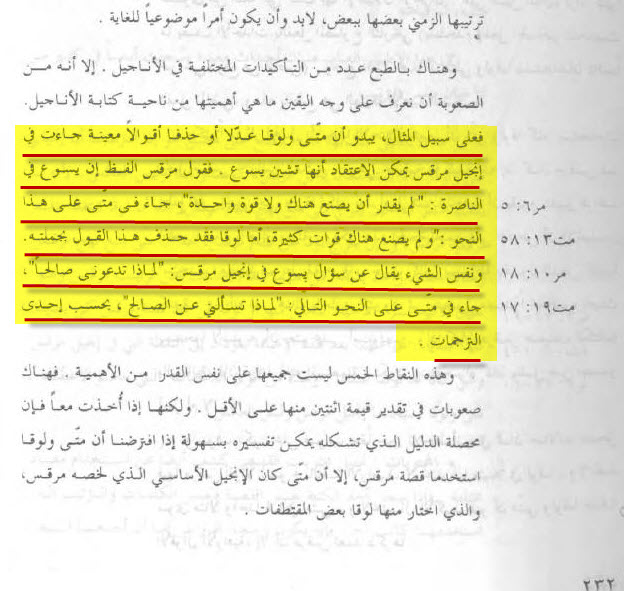
The Gospel writers themselves demonstrate this practice — Matthew and Luke, copying from Mark, deliberately changed words they found theologically uncomfortable. When Mark said Jesus “healed many” (Mark 1:34), Matthew changed it to “healed all” (Matthew 8:16), and Luke changed it to “healed every one of them” (Luke 4:40). When Mark said “he could not do any miracles there” (Mark 6:5), Matthew changed it to “he did not do many miracles there because of their unbelief” (Matthew 13:58). Luke omitted the incident entirely.
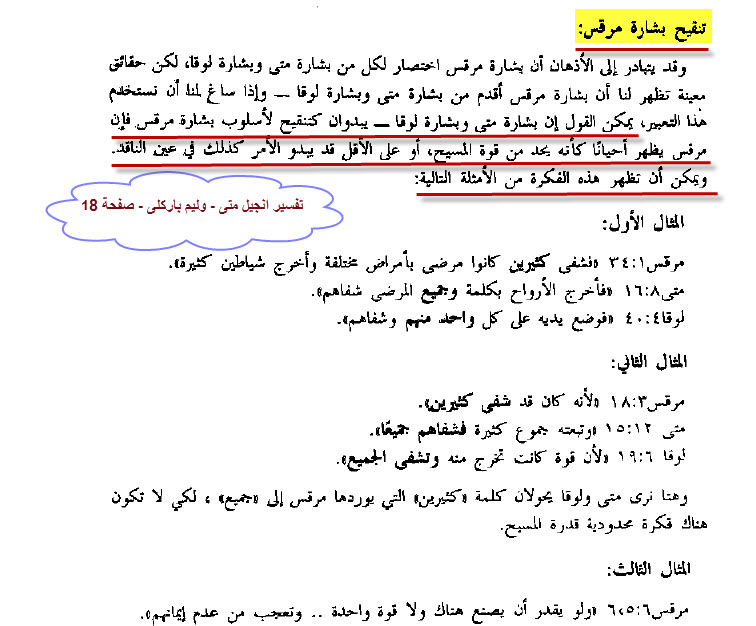
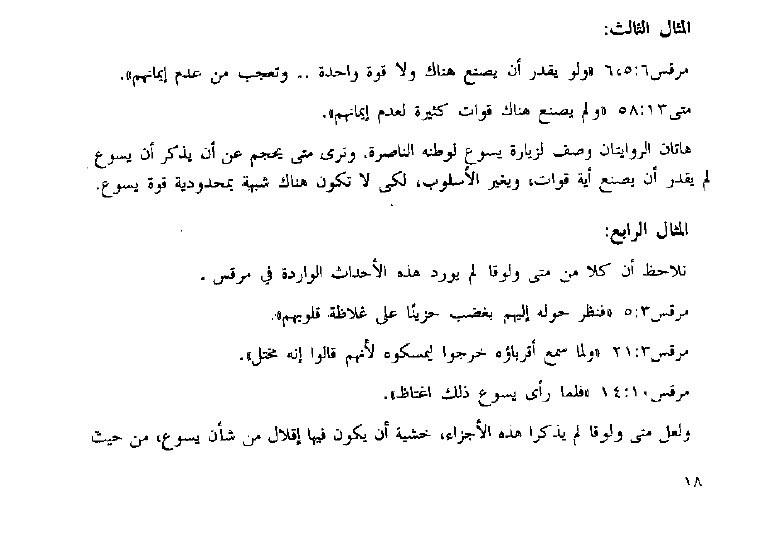
The author of Jesus and the Four Gospels confirms Matthew and Luke altered or deleted statements that appeared in Mark that could be offensive to Jesus:
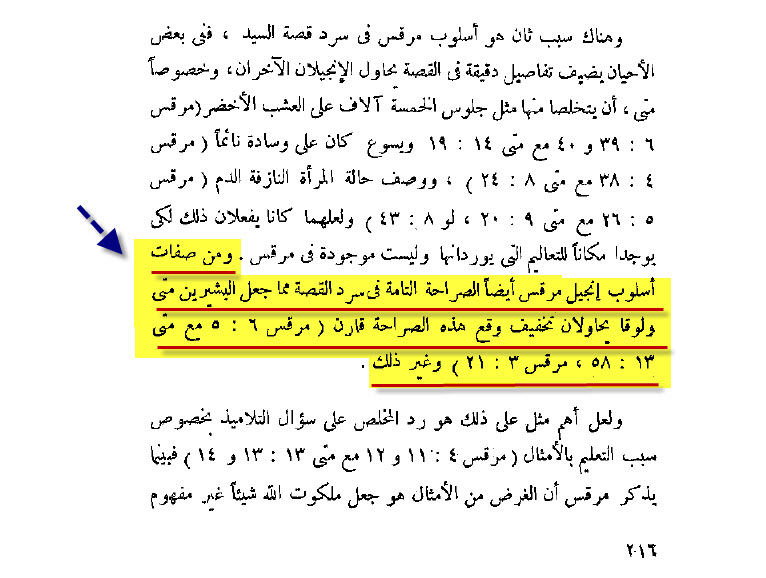
Dr. Fahim Aziz states Matthew and Luke tried to soften the complete frankness that Mark followed:
Factors That Enabled Corruption
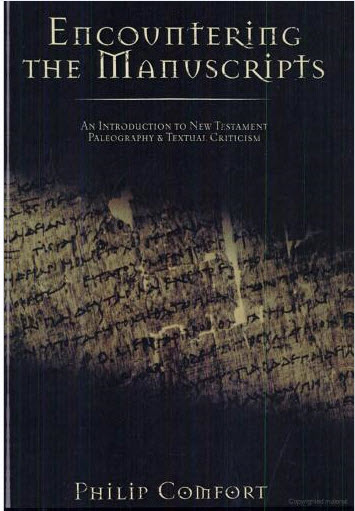
Scholar Philip Comfort asks three questions about how scribes viewed the manuscripts they copied:
- Were they reproducing the text word-for-word?
- Were they presenting the general message with permissible verbal change?
- Were they revising the text for theological or ecclesiastical reasons?
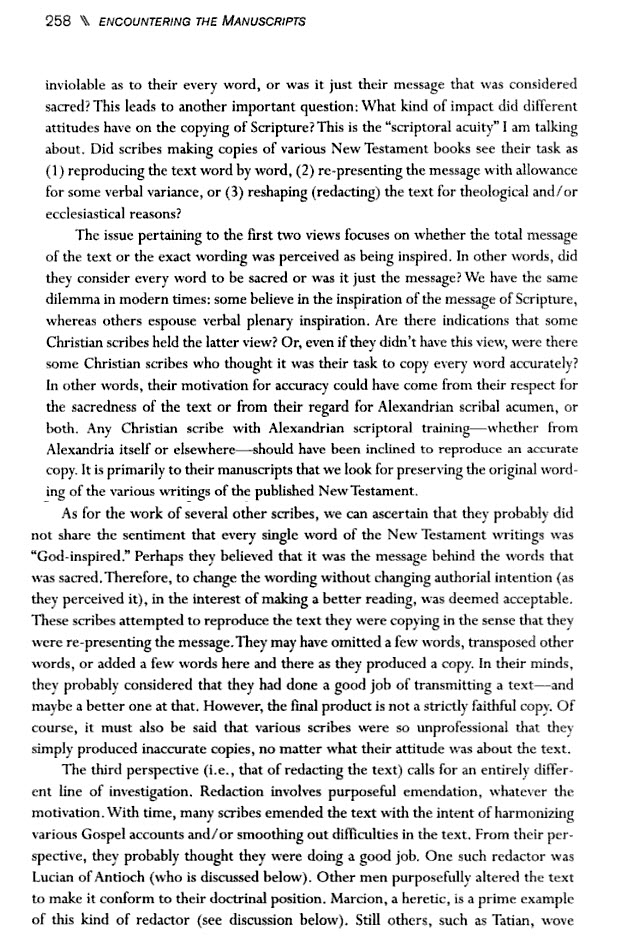
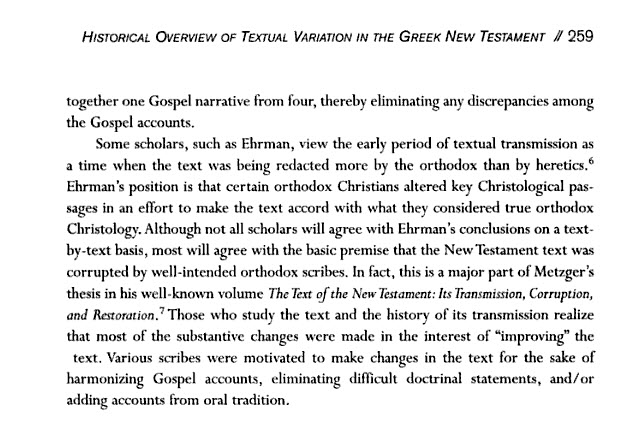
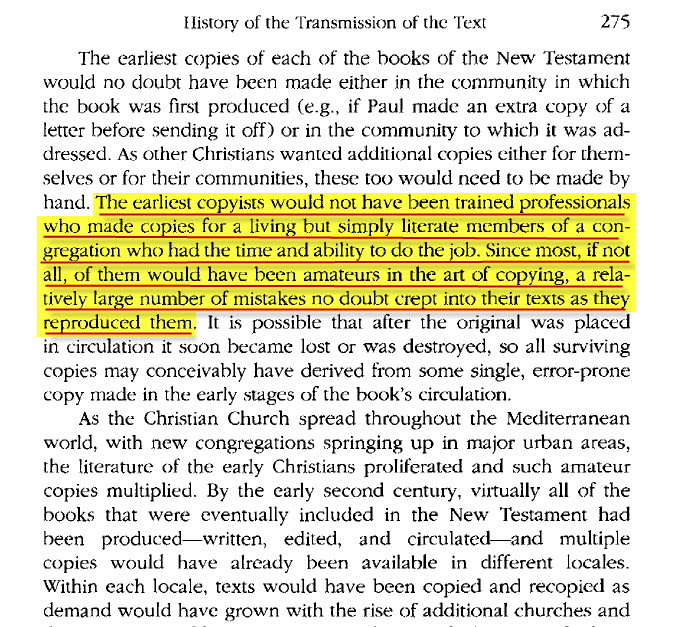
Bart Ehrman confirms this (Misquoting Jesus, pp. 50–51):
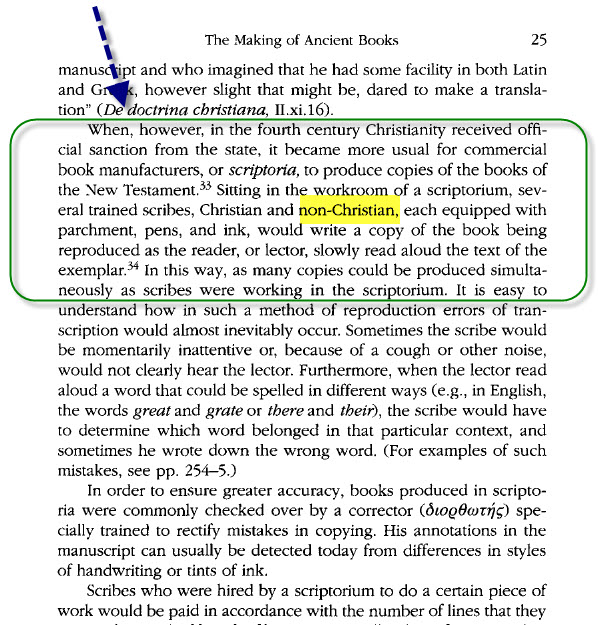
By the fourth century, both Christian and pagan scribes copied the New Testament in commercial book factories. Metzger confirms (p. 25):
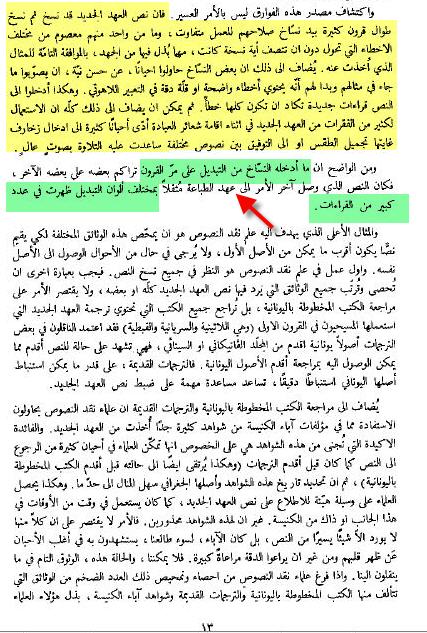
The Jesuit translation describes the full story of how corruption occurred:
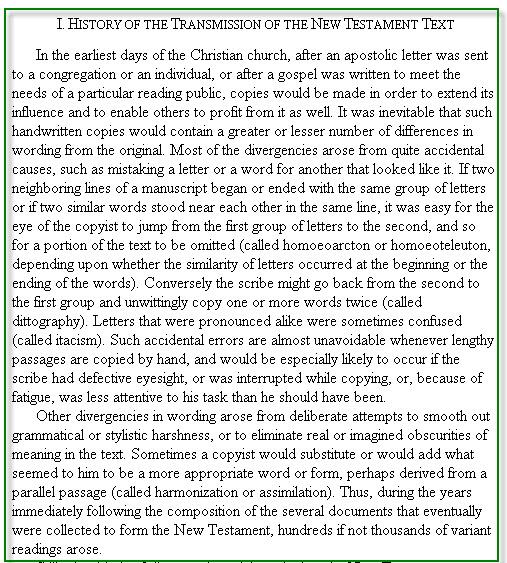
Metzger describes the mechanisms of manuscript corruption — accidental errors (homoeoteleuton, dittography, itacism) and deliberate attempts to improve text (Textual Commentary, p. 3):
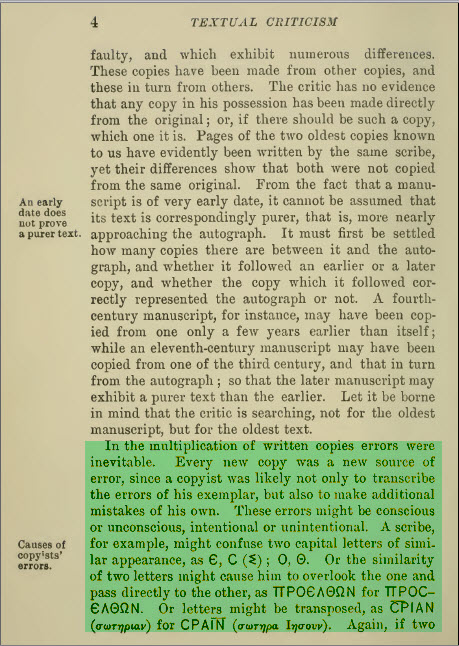
Scholar Marvin Vincent elaborates on the inevitability of errors (History of Textual Criticism, pp. 4–5):
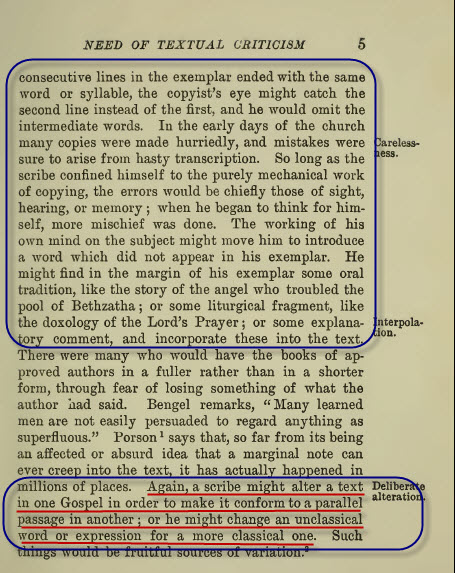
The Biblical Encyclopedia on the emergence of textual variations:
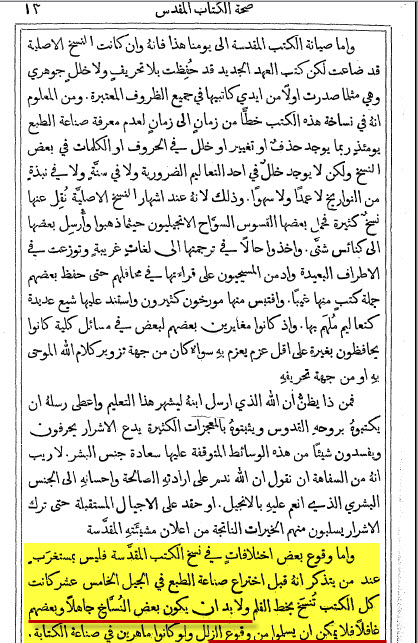
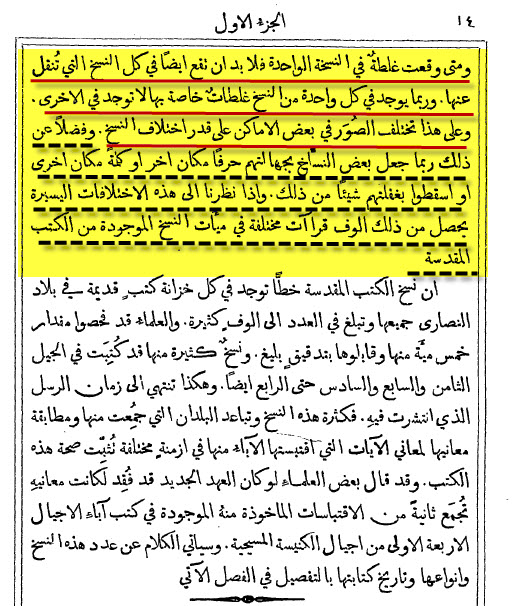
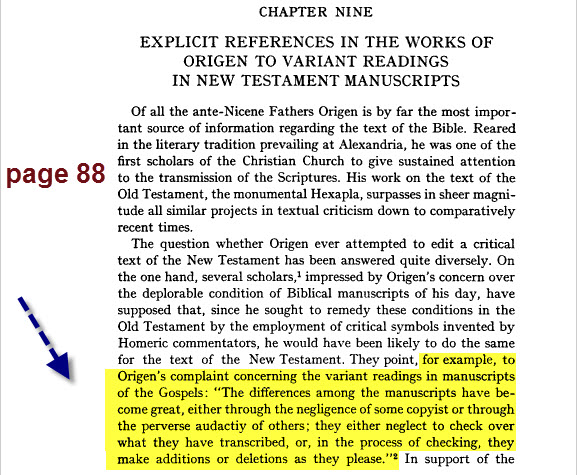
Church Fathers Testify to Corruption
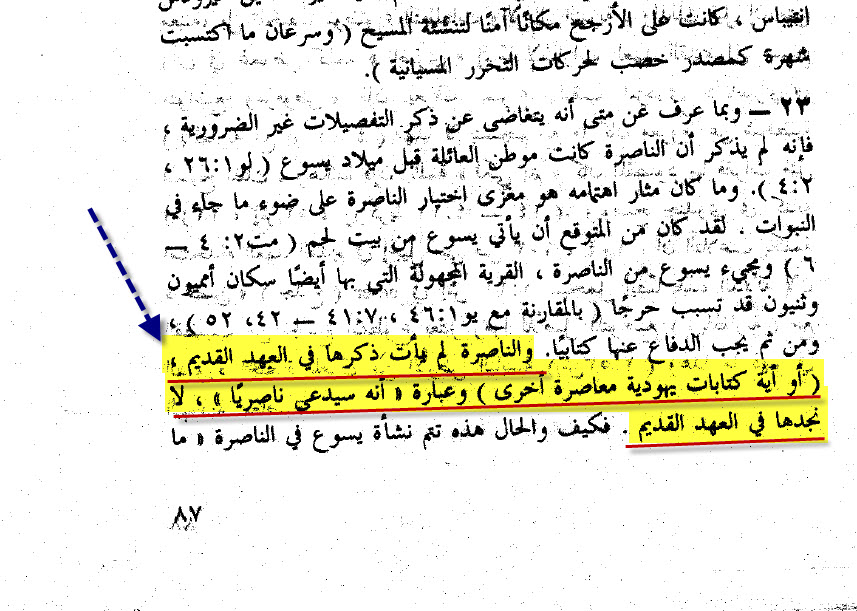
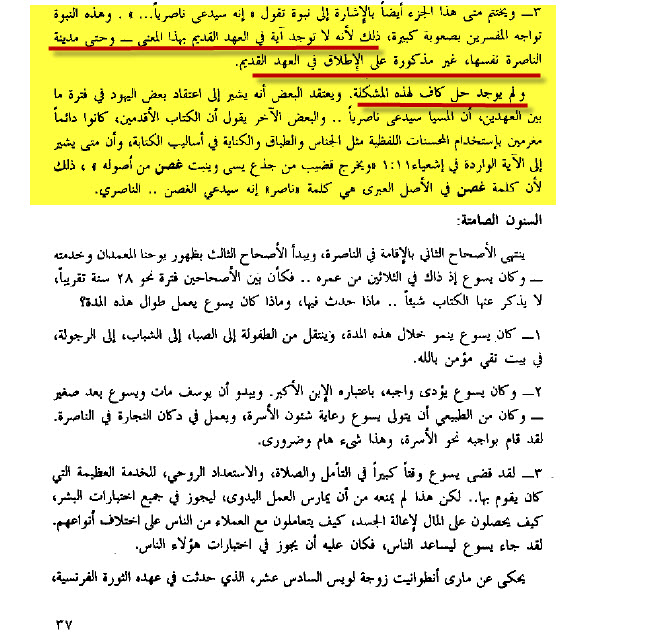
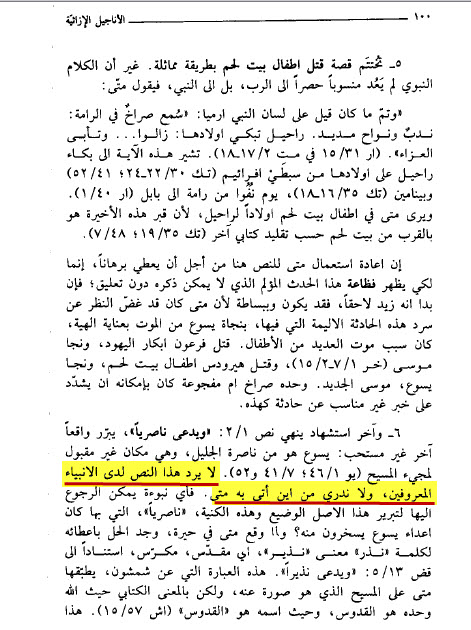
A striking example: Matthew 2:23 says Jesus would be called a Nazarene, “so that what was spoken by the prophets might be fulfilled” — yet this prophecy is not found anywhere in the Old Testament, nor is the town of Nazareth mentioned there. William Barclay and Father Paul Al-Faghali confirm this:
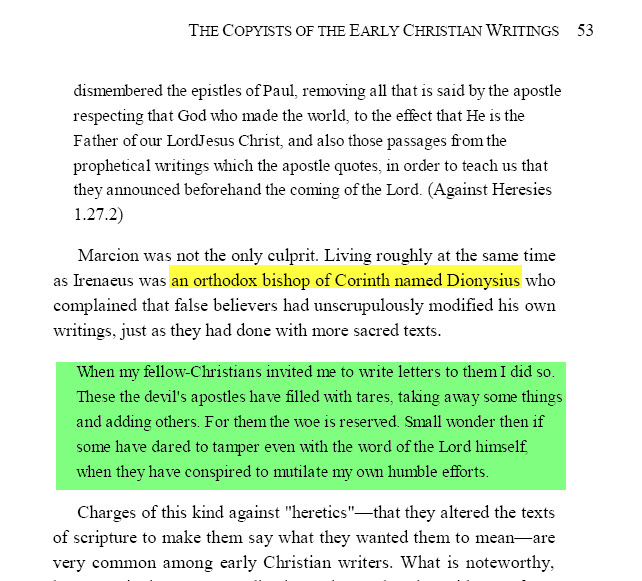
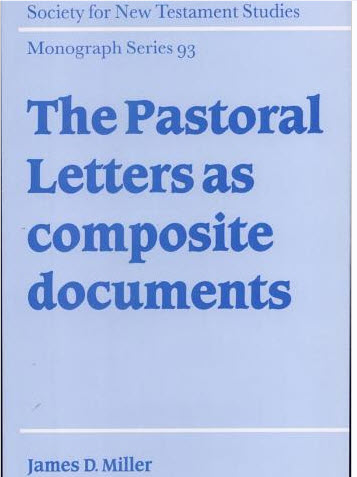
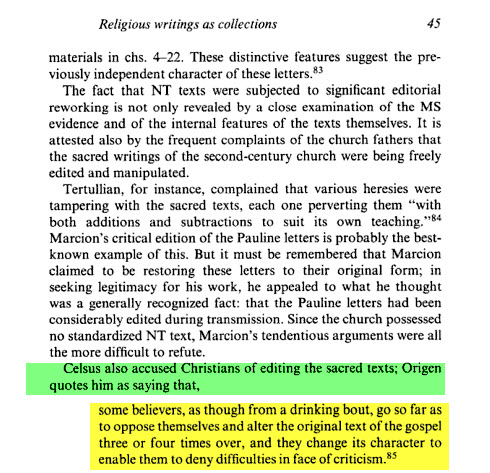
The pagan Celsus also accused Christian scribes of altering manuscripts — changing the original text three, four, or more times to escape criticism (The Pastoral Letters as Composite Documents — James Miller):
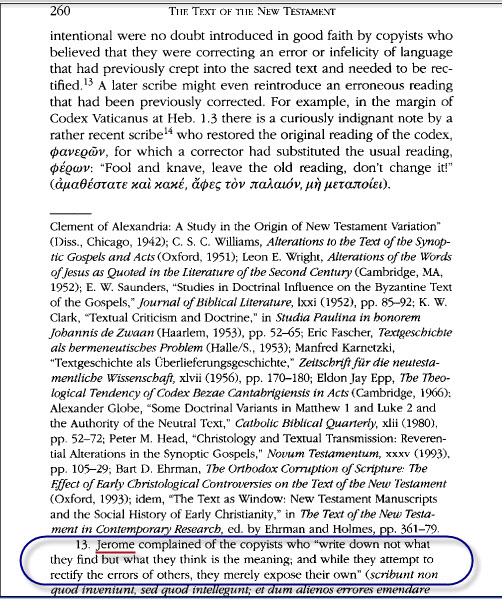
Bruce Metzger quotes Jerome complaining about scribes who copied what they believed to be correct rather than what was before them:
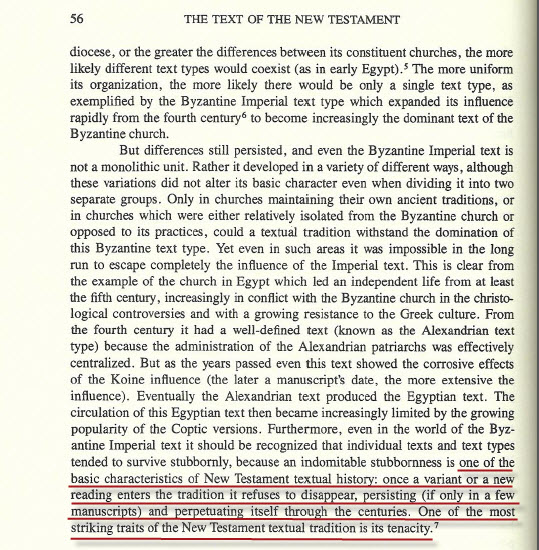
Kurt Aland on the permanence of textual variants once introduced:
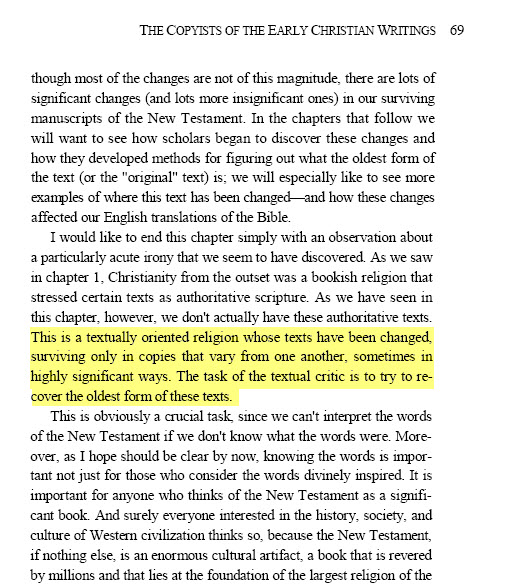
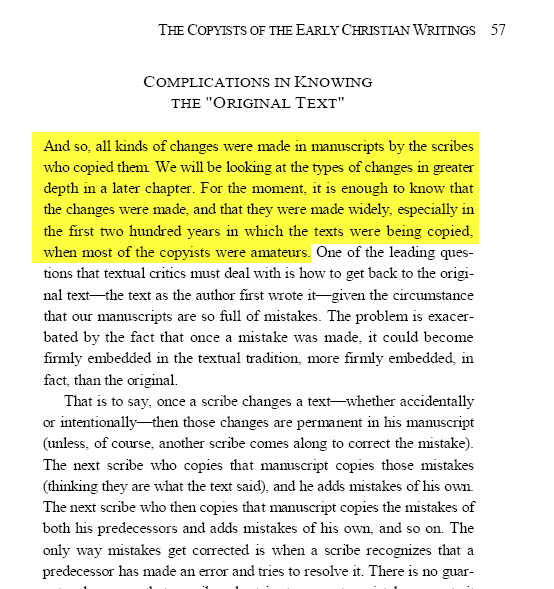
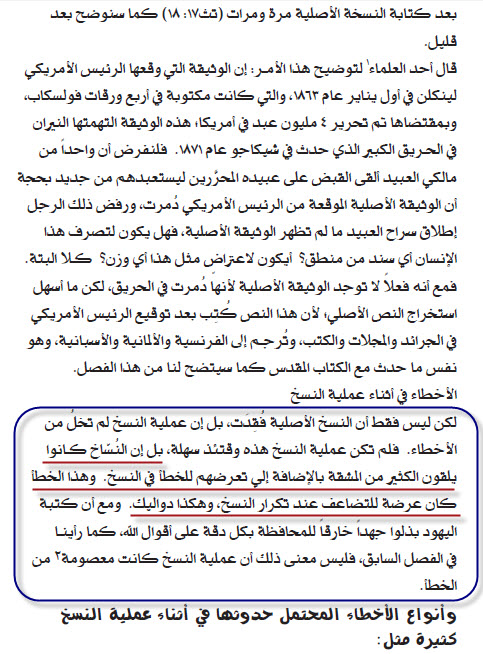
Ehrman on the scale of changes (Misquoting Jesus, p. 57):
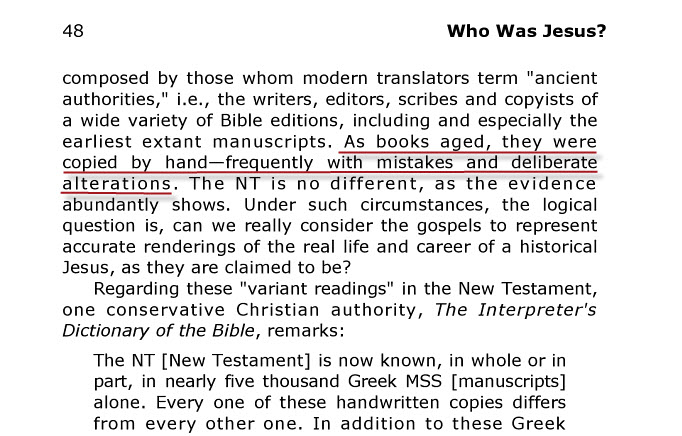
Dr. Youssef Riad on the same:
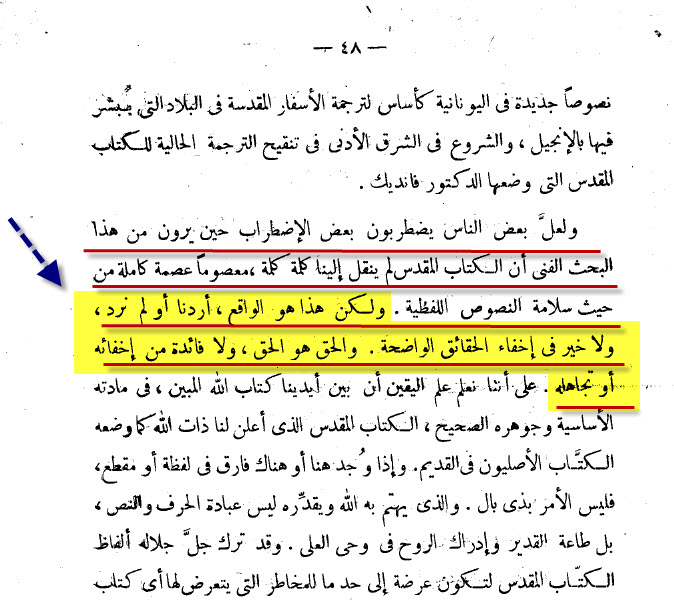
Habib Saeed in Introduction to the Bible — “This is the truth and there is no point in hiding or ignoring it”:
How Many Changes Occurred?
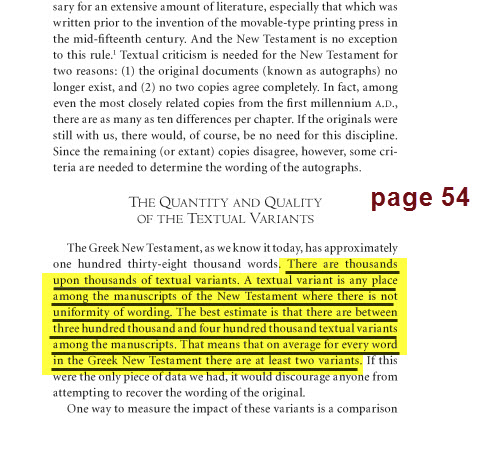
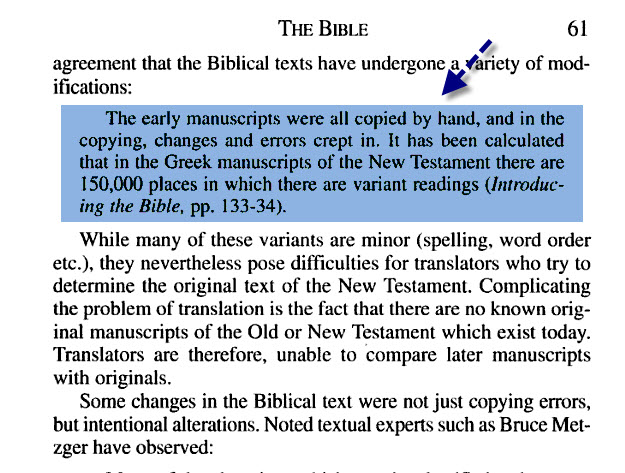
Stephen Gibson confirms 150,000 textual readings were counted in the Greek New Testament manuscripts:
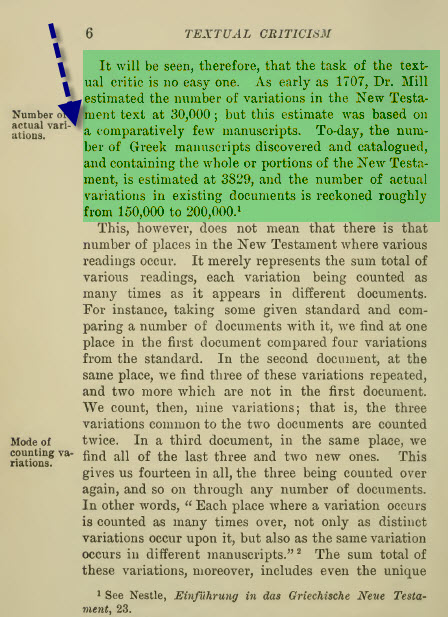
Dr. Mill estimated 30,000 readings in 1707 from a few manuscripts. After the discovery of approximately 3,829 Greek manuscripts, the true number is between 150,000 and 200,000:
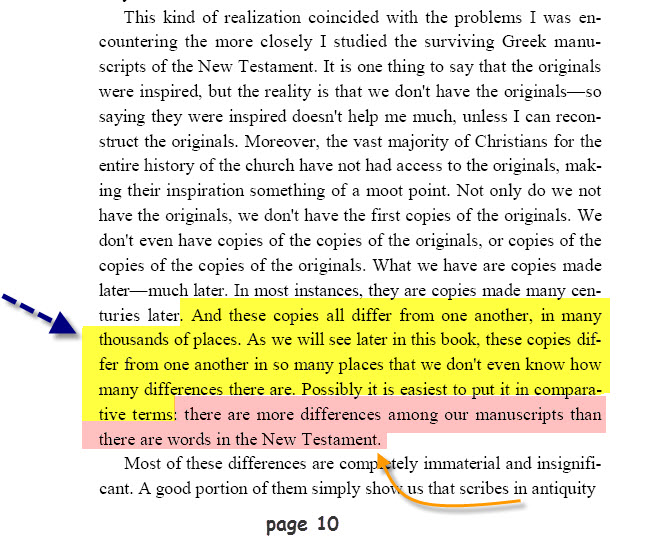
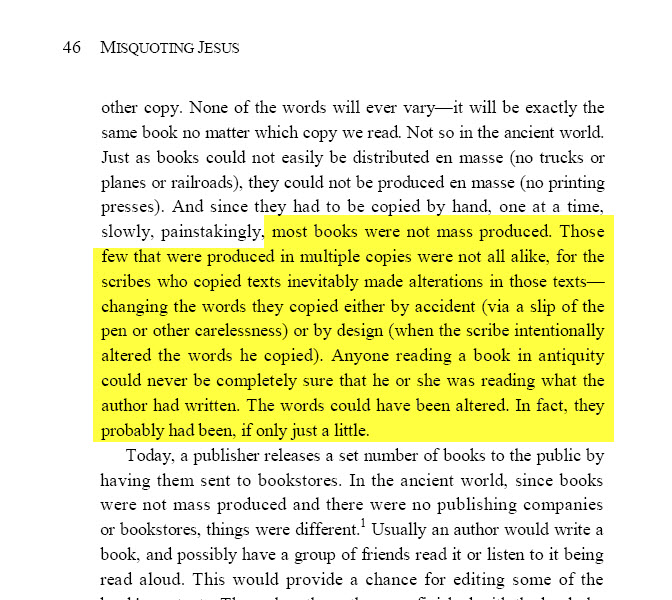
Ehrman on intentional vs. unintentional changes:
Types of unintentional and intentional differences — Biblical Encyclopedia, New Testament Manuscripts:
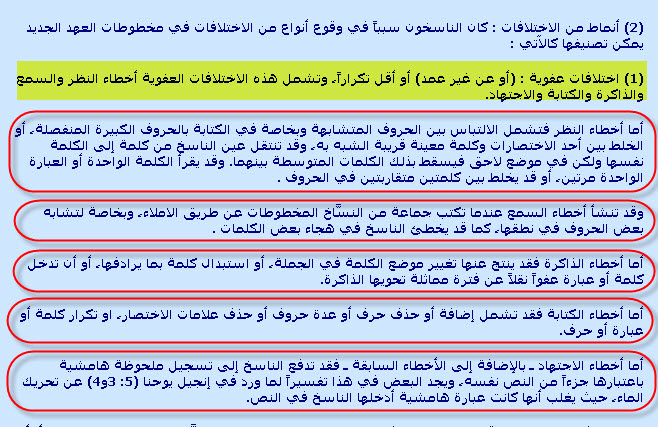
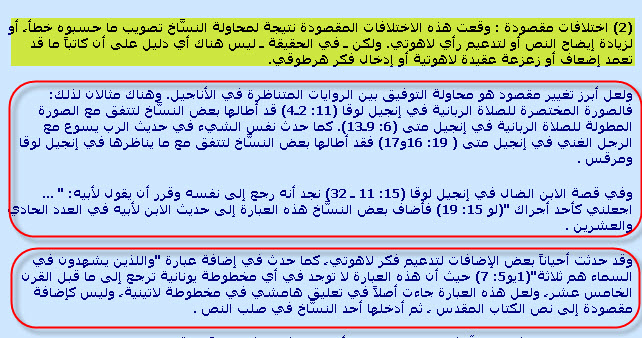
Ehrman on intentional changes:
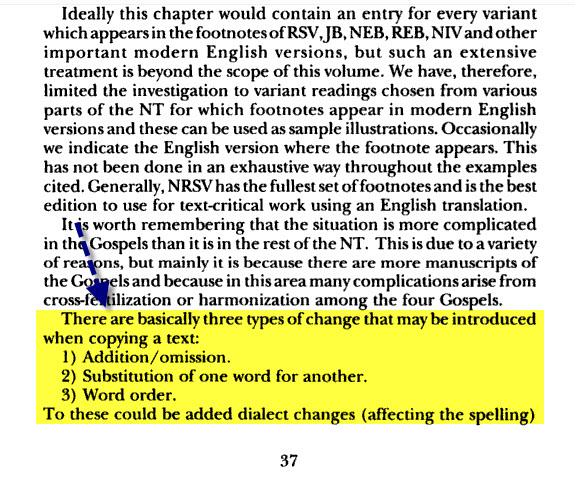
Classification of variants by James Elliott — three main types: addition/deletion, substitution, word order (Manuscripts and the Text of the New Testament):
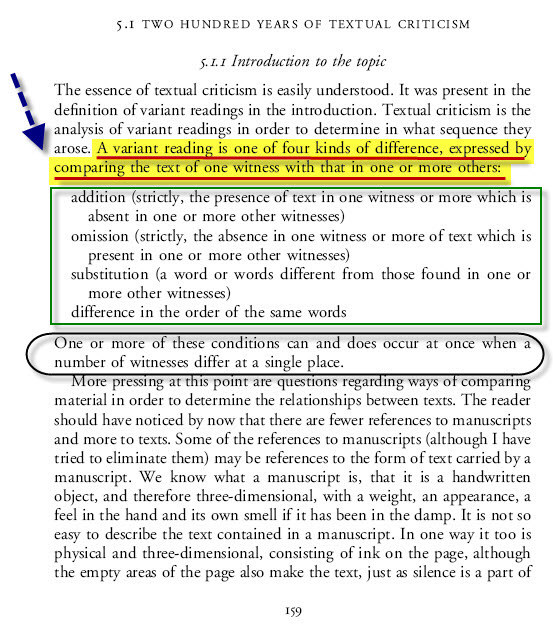
Parker’s classification of textual readings:
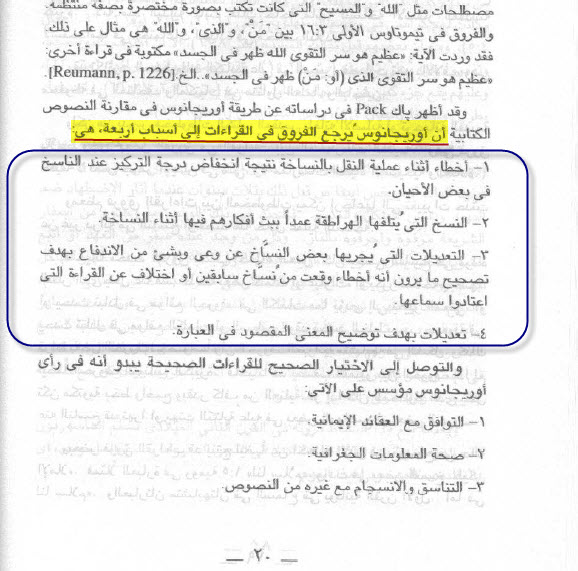
Origen’s four reasons for manuscript differences:
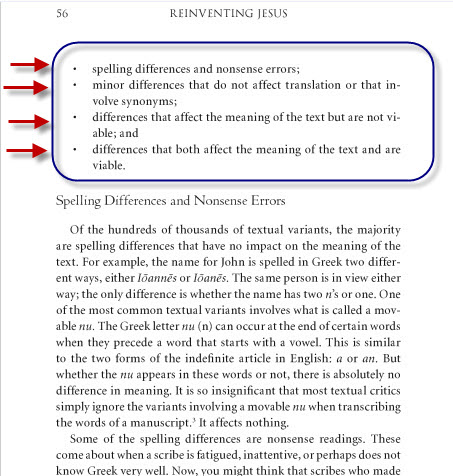
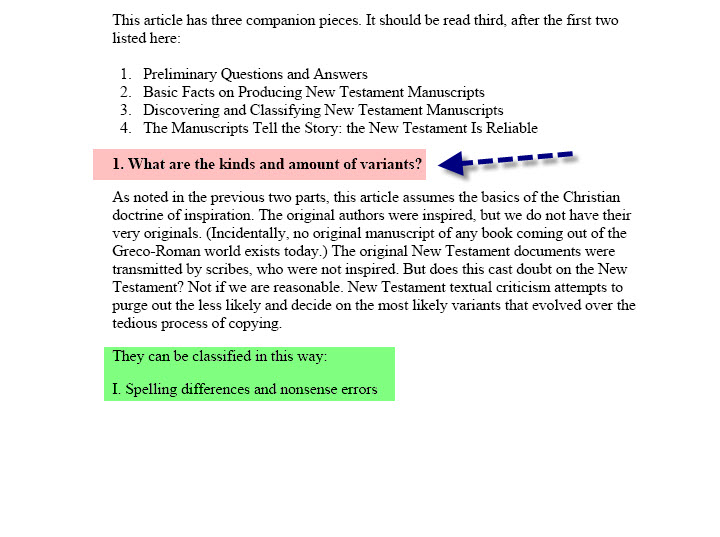
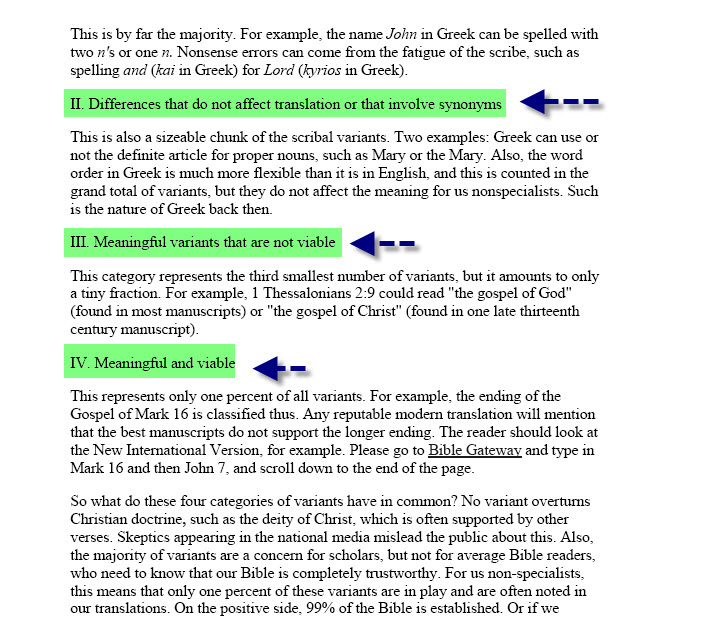
Classification of variants by significance (Arlandson and Reinventing Jesus):
- Spelling differences and nonsense errors
- Differences that do not affect translation
- Meaningful variants that are not viable
- Meaningful and viable variants
Unintentional Changes
Before examining deliberate corruption, the research documents changes that occurred without conscious intent — pure errors of the copying process.
The Jesuit translation, under the heading “Textual Distortion,” confirms that a scribe’s eye could skip a word or phrase and fail to copy it:
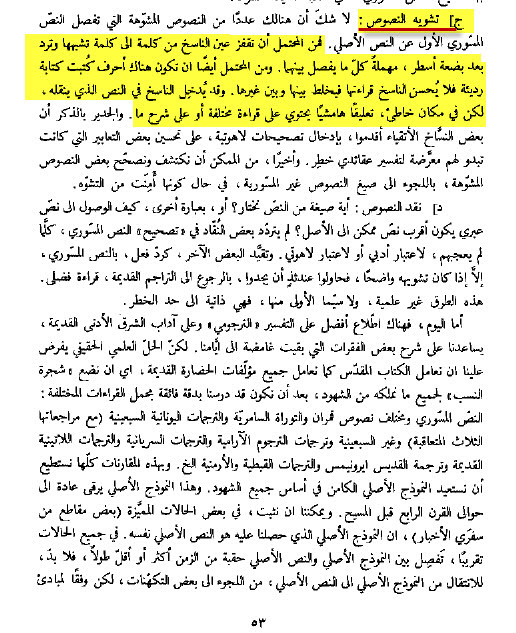
Dr. Youssef Riad classifies these errors in The Inspiration of the Holy Bible — errors of omission, unintentional repetition, and errors of hearing, sight, and memory:
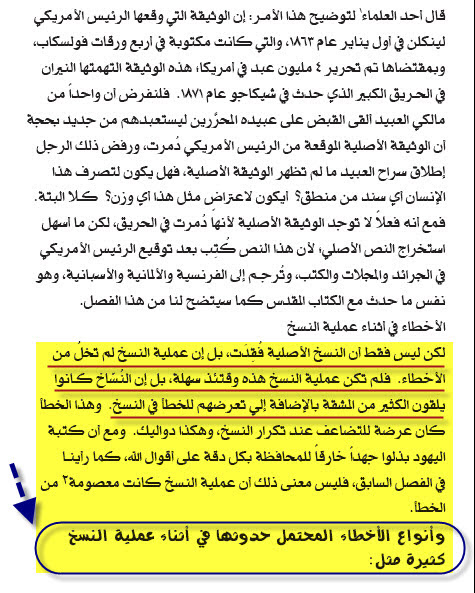
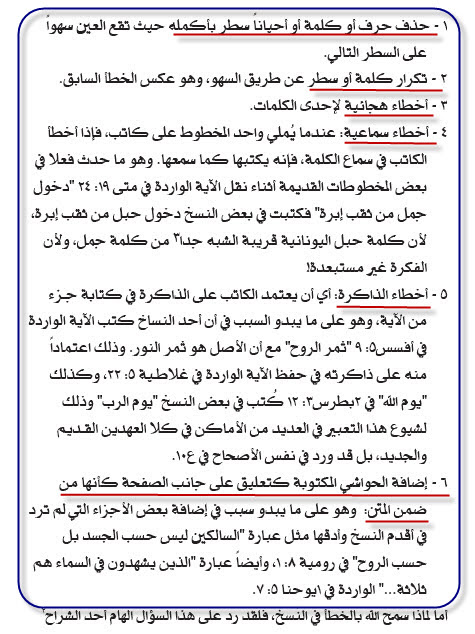
Dr. Emile Maher on scribal errors:
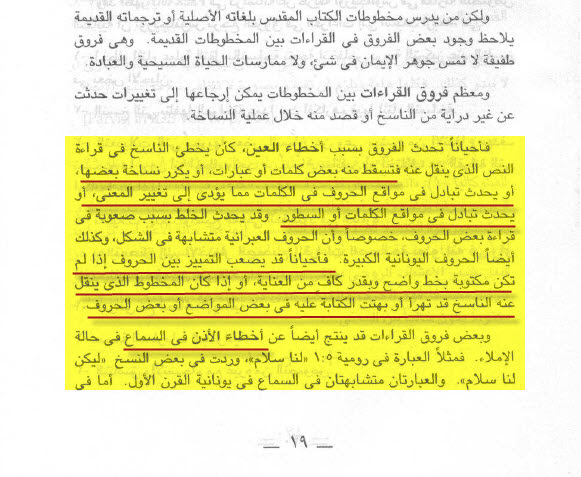
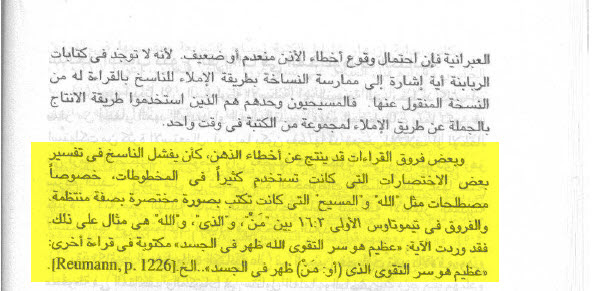
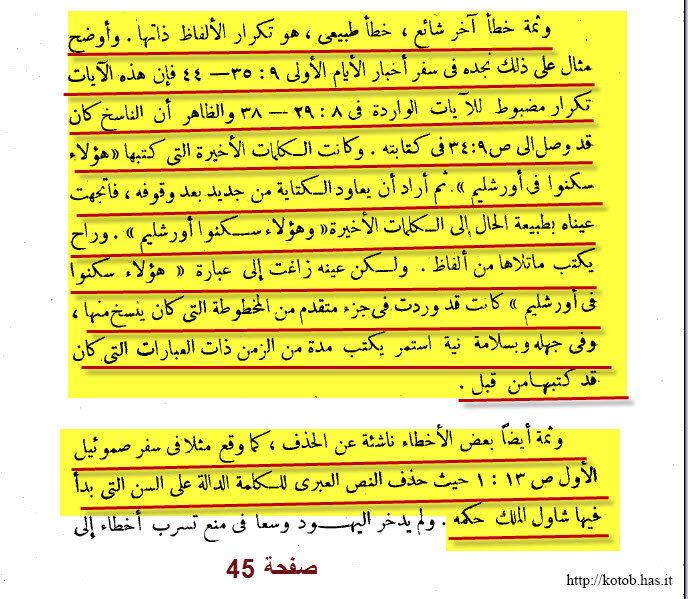
Habib Saeed in Introduction to the Bible (p. 45) gives a concrete example: 1 Kings 9:29–44 is a direct copy of 1 Kings 8:29–38 — caused by the scribe’s eye slipping to a similar line. This repetition still stands in the Bible today, uncorrected. He also notes 1 Samuel has a missing word that remains missing to this day:
Bart Ehrman explains the mechanism of homoeoteleuton (similar endings causing eye-jump), using Luke 12:8–9 as an example — the oldest papyrus of this passage is missing verse 9 entirely because the scribe’s eye jumped from “before the angels of God” in verse 8 to the same phrase in verse 9. In John 17:15, the Vatican Codex omits words that make Jesus appear to say the opposite of what he intended (Misquoting Jesus, pp. 91–92):
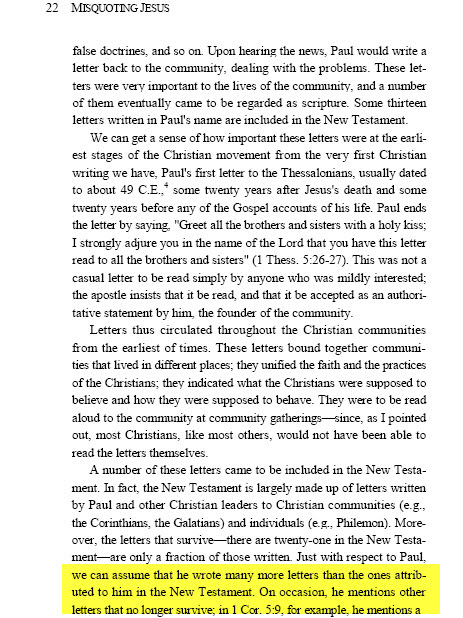
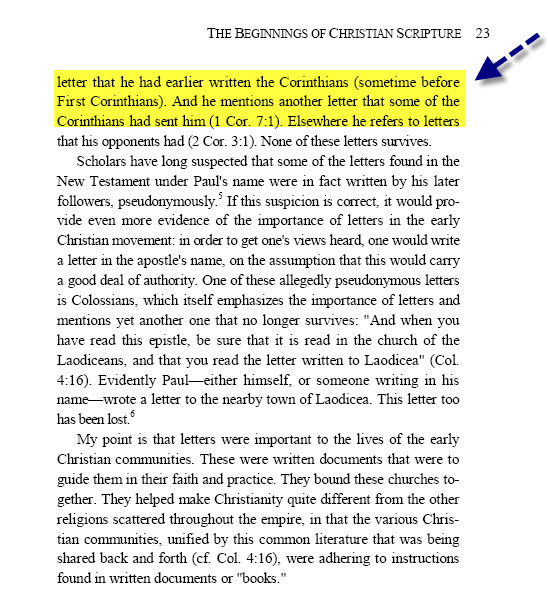
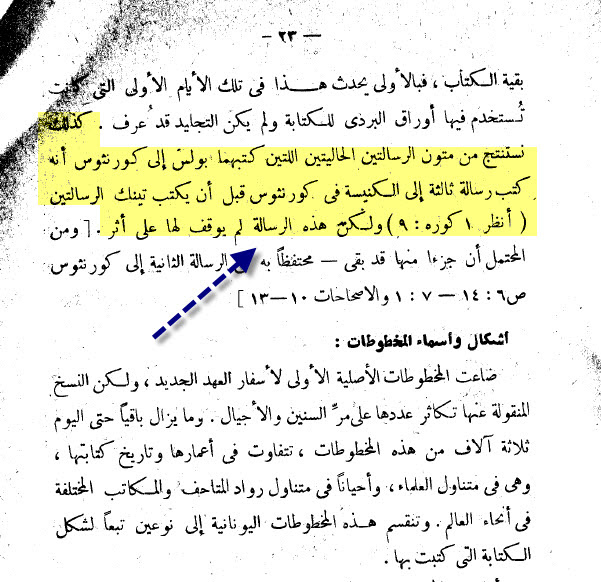
Beyond scribal errors, entire letters of Paul were lost. Paul himself references a letter to the Corinthians written before 1 Corinthians (1 Corinthians 5:9) and a letter sent to him by the Corinthians (1 Corinthians 7:1) — neither survives:
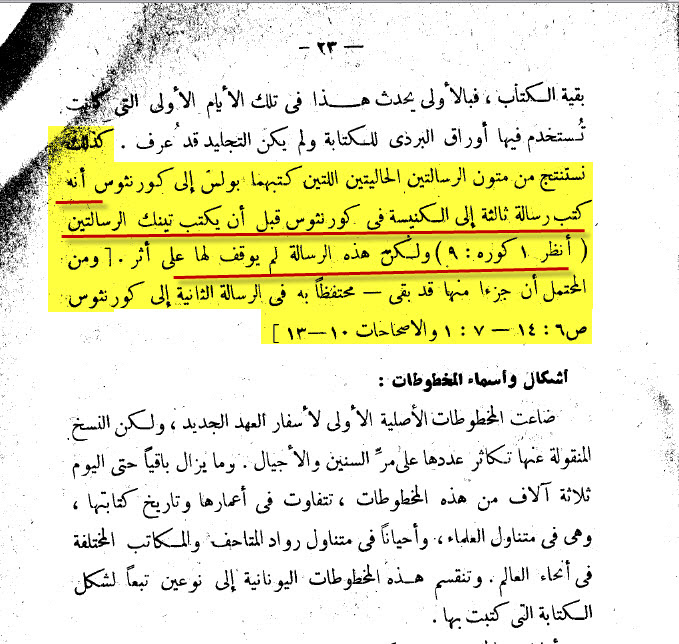
Habib Saeed confirms a lost letter of Paul — the Third Epistle to the Corinthians:
Lost prophecies also exist in the Old Testament. The Common Arabic Translation notes that the prophecy referenced in 1 Kings 22:38 has not been retained in the current Bible:
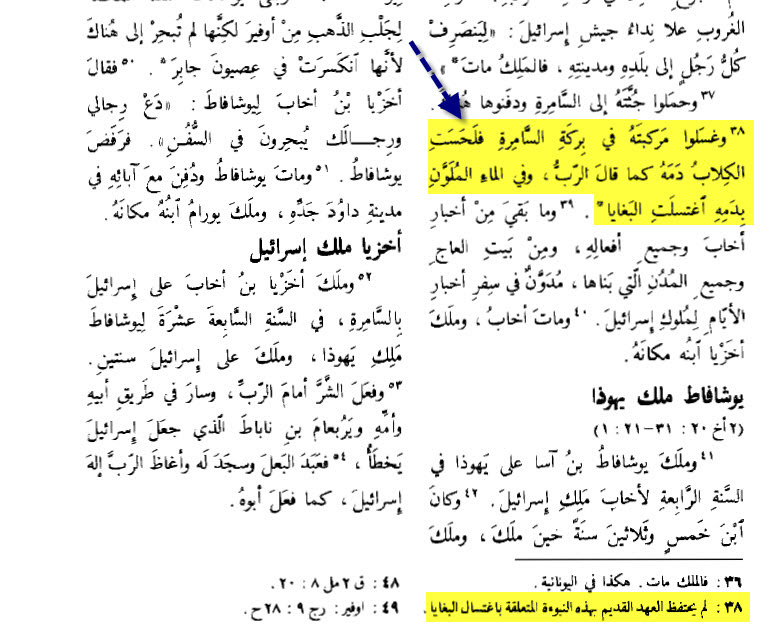
The Jesuit translation confirms unknown additions to the Gospel of John:
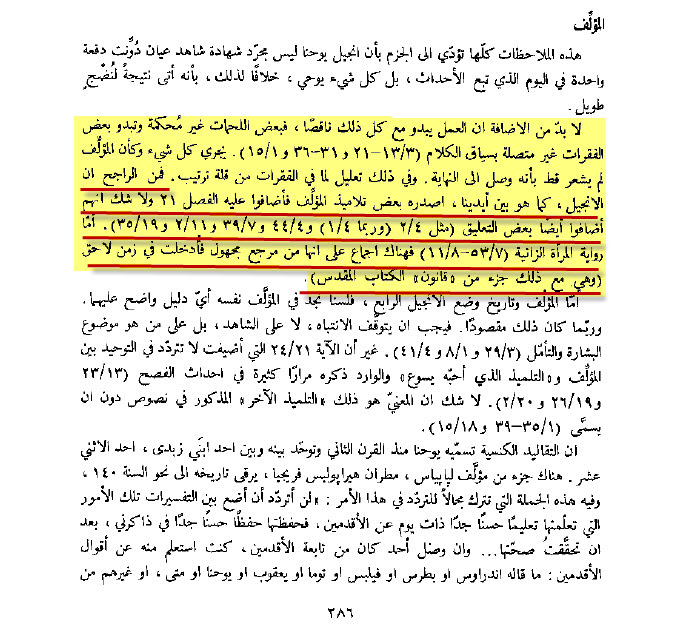
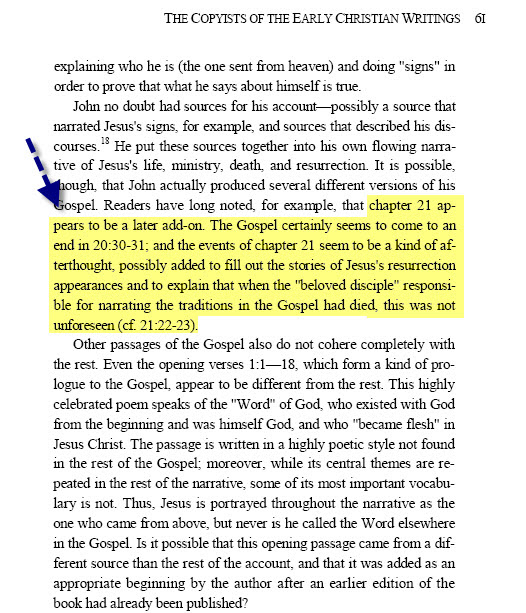
Ehrman confirms John chapter 21 looks like a later addition — the Gospel clearly appears to have ended at 20:30–31, and chapter 21 was likely added to complete post-resurrection appearances:
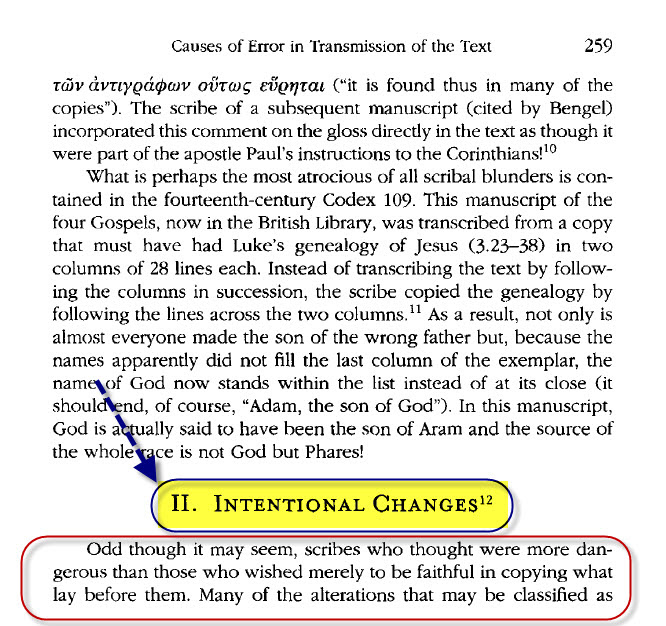
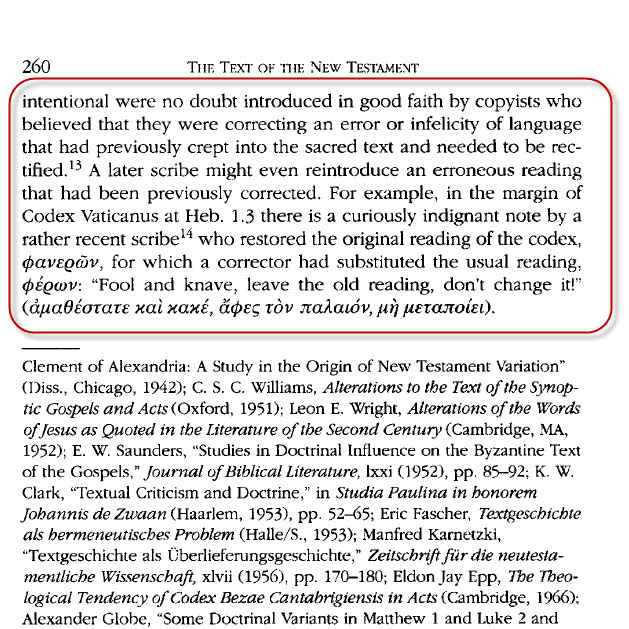
Bruce Metzger on intentional changes — “scribes who were thinking were more dangerous than those who merely wished to be faithful while copying.” In the margin of one Hebrews 3:1 manuscript, a scribe who restored an earlier reading wrote: “Stupid and naive, leave the old reading and don’t change it” (The Text of the New Testament):
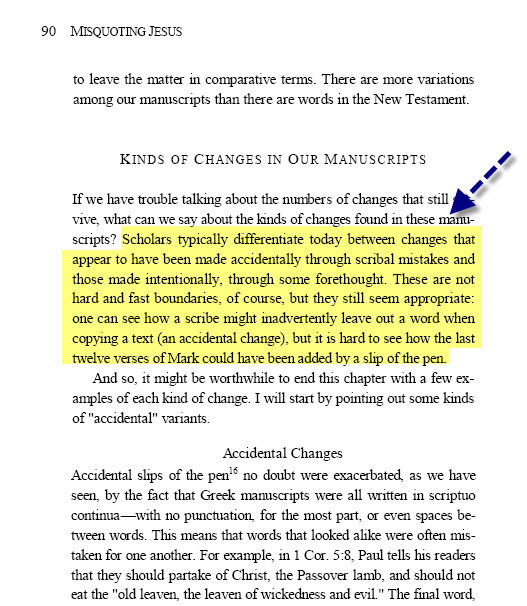
Ehrman on distinguishing intentional from unintentional changes (Misquoting Jesus):
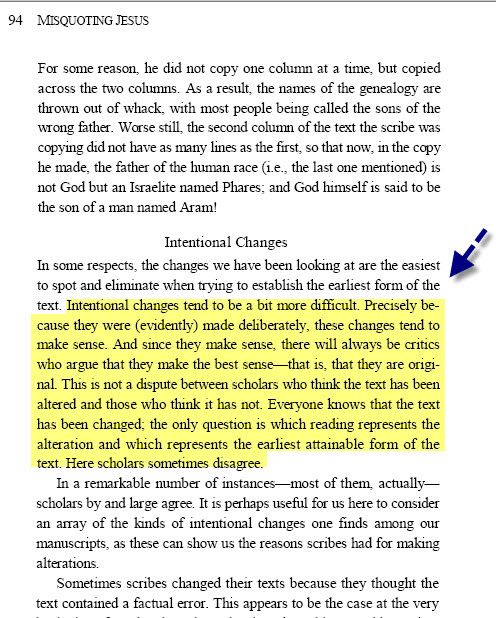
Ehrman on why deliberate changes are harder to identify — they yield useful meaning, so scholars argue they might be the original reading. “Everyone knows that the text has been tampered with; the issue is which reading represents the corruption”:
Part Five — Types of Intentional Changes
1 — Doctrinal Corruption: Heretics vs Orthodox
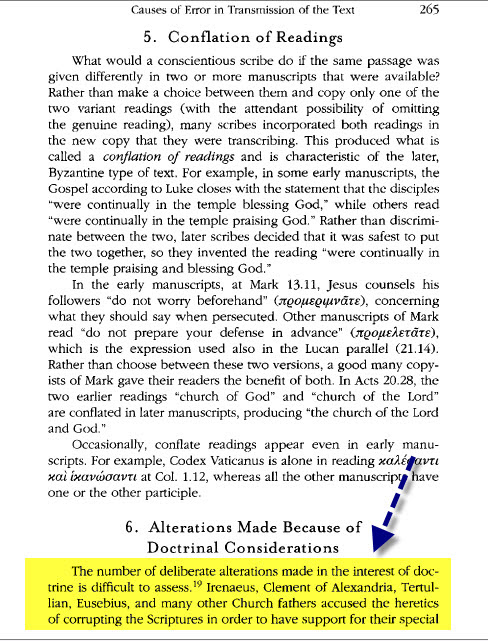
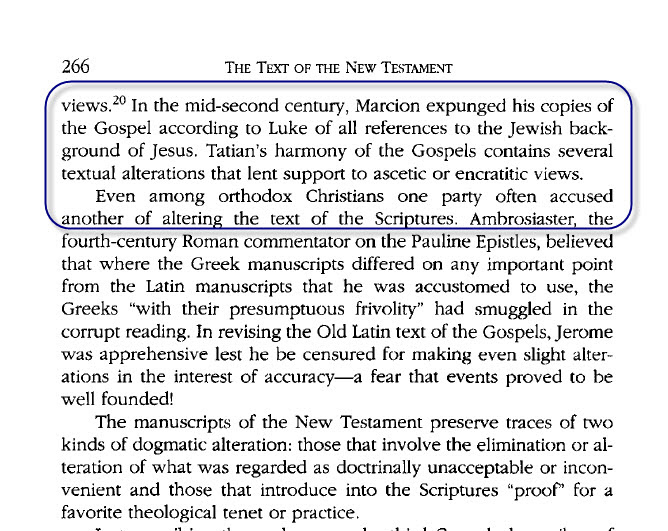
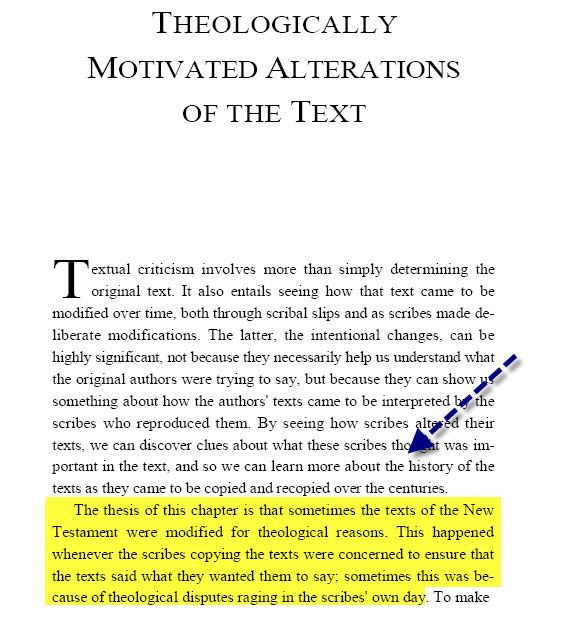
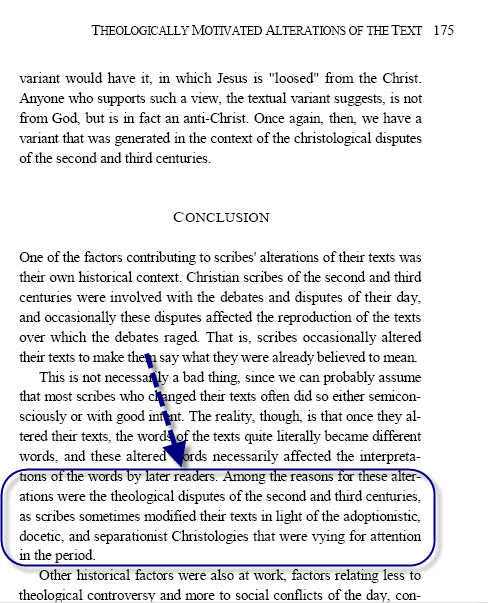
Bart Ehrman confirms: the texts of the New Testament were being altered for theological reasons — the scribe wanted the texts to say what he believed (Misquoting Jesus, p. 151):
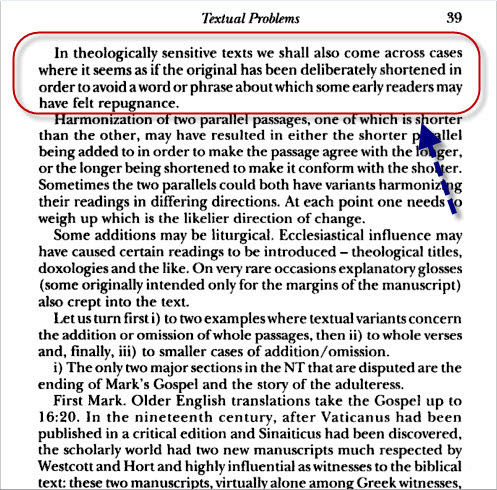
Scholar Keith Elliott confirms some manuscripts appear to have been deliberately cut to avoid phrases that might cause disgust among readers:
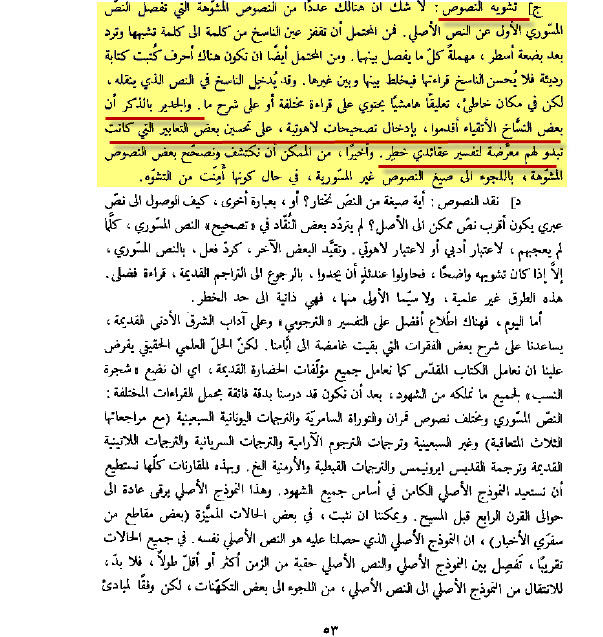
The Jesuit translation (p. 59) under the heading “Distortion of Texts”:
Orthodox scribes also altered texts defensively — Ehrman (Misquoting Jesus, pp. 95–96):
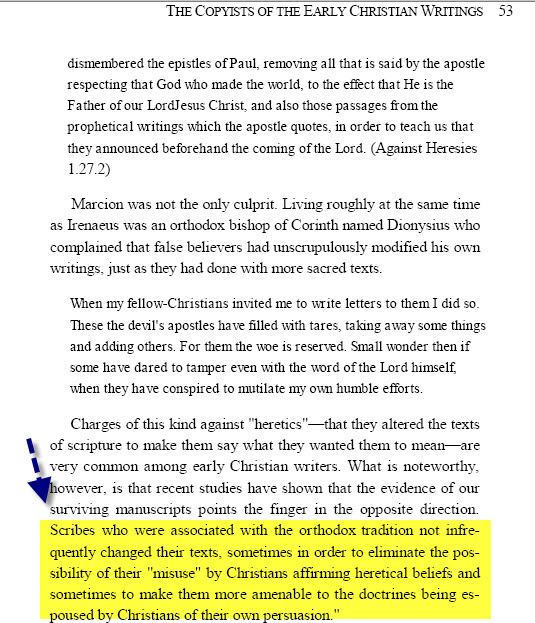
The Orthodox and the Ebionites
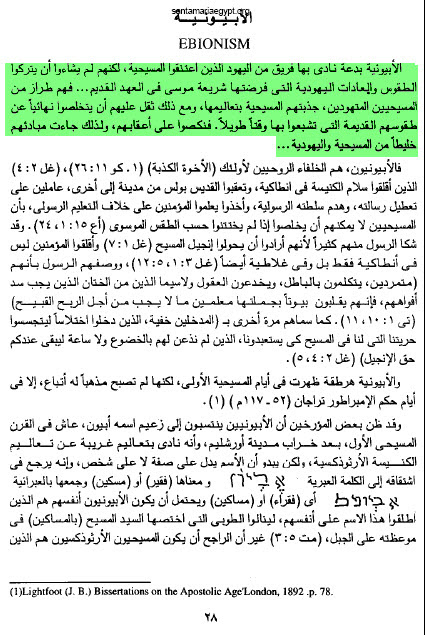
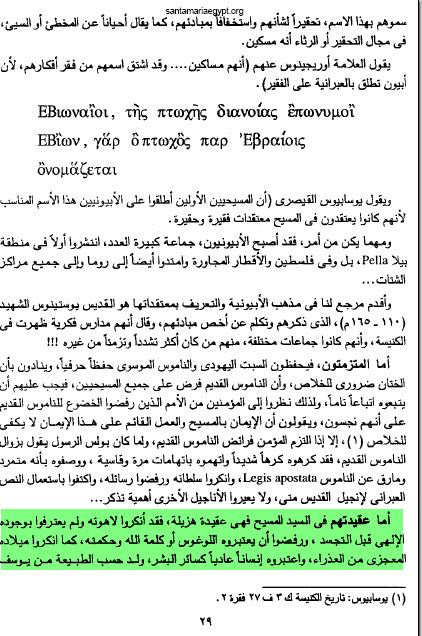
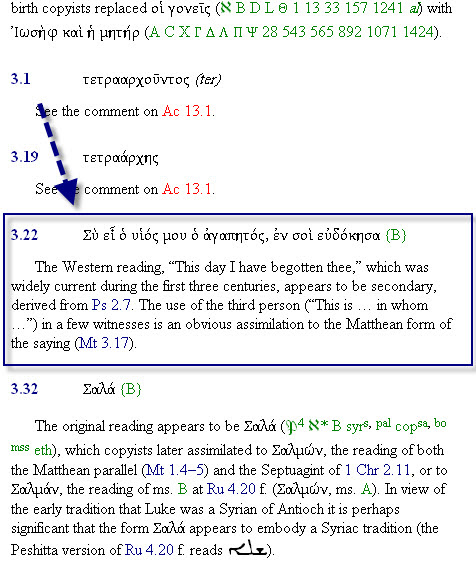
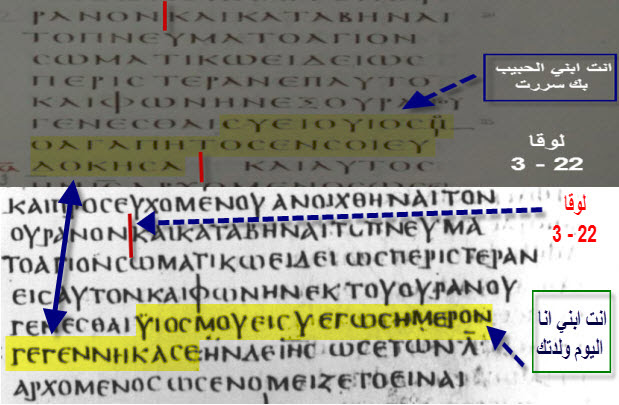
Example 1 — Luke 3:22: The standard reading says “You are my beloved Son; with you I am well pleased.” The Pyzaic manuscript reads “You are my Son; today I have begotten you.”
Ehrman argues the original text is “today I have begotten you” — changed by scribes because it supports the Ebionite doctrine that Christ was not born eternally. Metzger took a different view, suggesting the adoptionist reading was taken from Psalm 2:7 (Misquoting Jesus, p. 159):
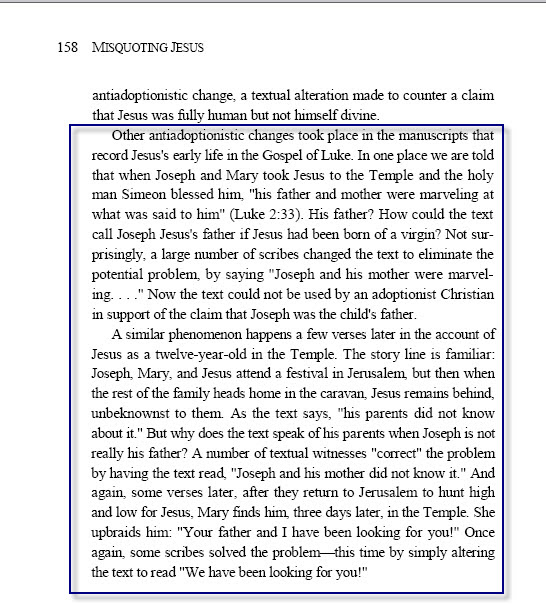
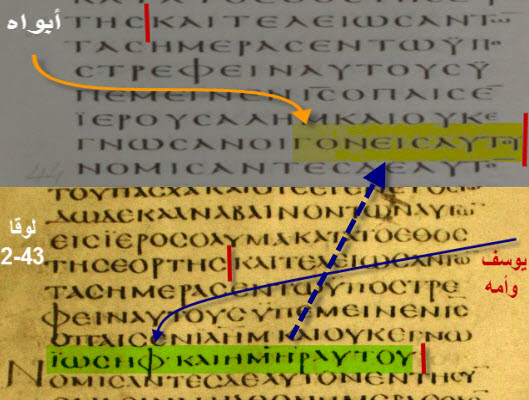
Example 2 — Luke 2:43, 2:33, 2:48: The older manuscripts use “his parents” while newer manuscripts changed it to “Joseph and his mother” — to protect the virgin birth doctrine. Metzger (The Text of the New Testament, p. 267):
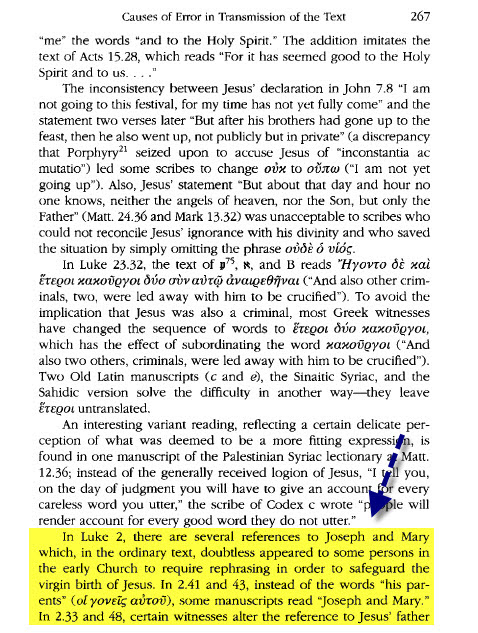
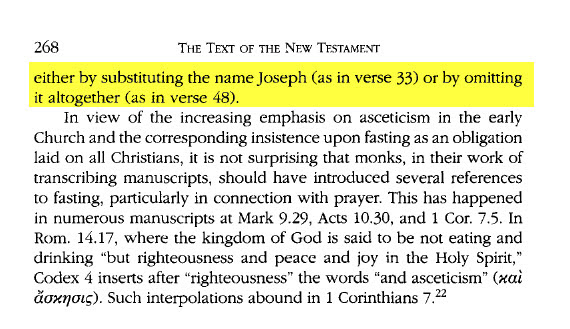
Ehrman elaborates — “His father?! How dare the text call Joseph the father of Jesus if Jesus was born of a virgin?” (Misquoting Jesus, pp. 158):
Manuscript comparison — Vatican manuscript (using “his parents”) vs. Alexandrian manuscript (changed to “Joseph and his mother”):
The Orthodox and the Docetists
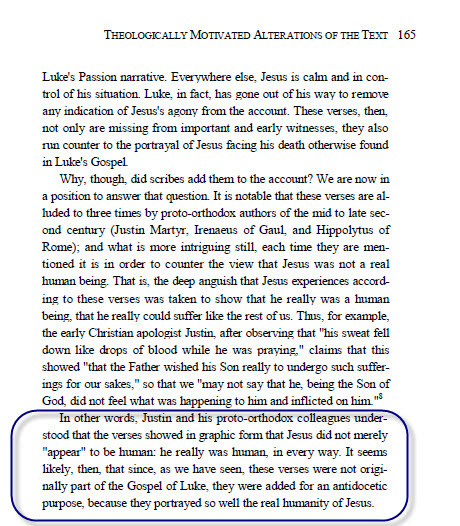
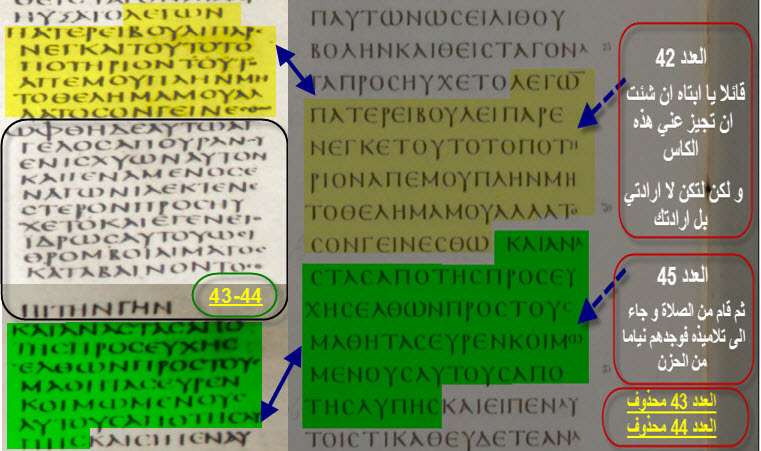
Example 1 — Luke 22:43–44: (The anguish in Gethsemane — “his sweat became like drops of blood”) These verses are absent from the Vatican Manuscript and Papyrus 75, yet quoted by Justin Martyr and other early Fathers. Ehrman argues these verses were added by pre-Orthodox scribes to counter Docetism — proving Christ truly was flesh and blood (Misquoting Jesus, p. 165):
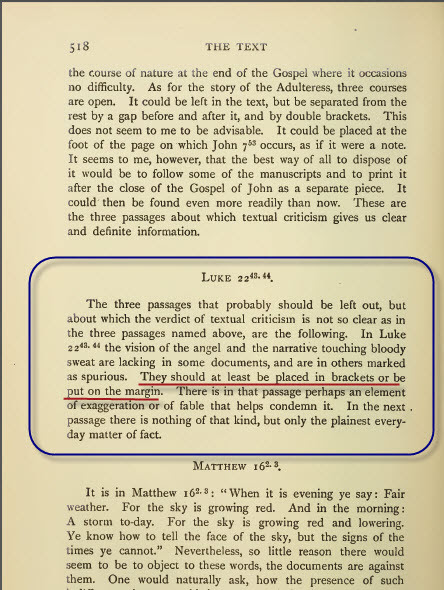
Metzger took the opposite view — the verses may be original but were deleted because they showed Christ’s human weakness (Textual Commentary):
Manuscript comparison — Vatican manuscript (without the verses) vs. Codex Sinaiticus (with the verses):
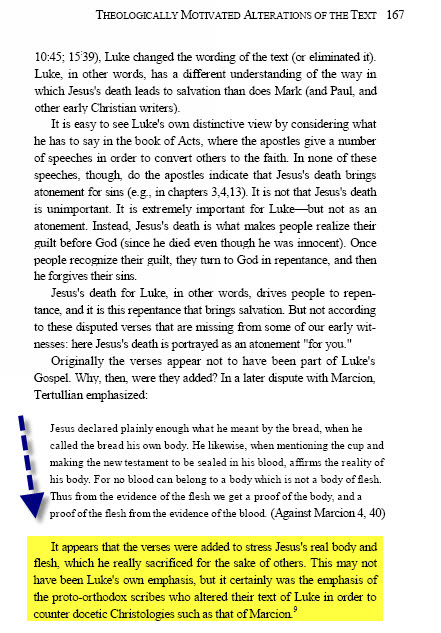
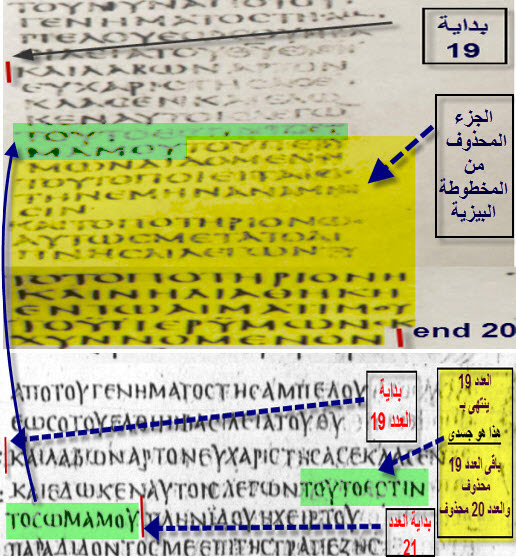
Example 2 — Luke 22:19–20: (The Last Supper — “This is my body which is given for you”) This phrase is absent from the Bezae manuscript. Ehrman argues it was added to emphasize Christ’s true body and blood against Docetist doctrine (Misquoting Jesus):
Codex Bezae (with text omitted) vs. Codex Sinaiticus:
Example 3 — Luke 24:51: “He withdrew from them and ascended into heaven” — this phrase is absent from the Pisan manuscript. Ehrman believes it was added; Metzger suggested it may have been deleted to resolve a chronological contradiction with Acts (Textual Commentary):
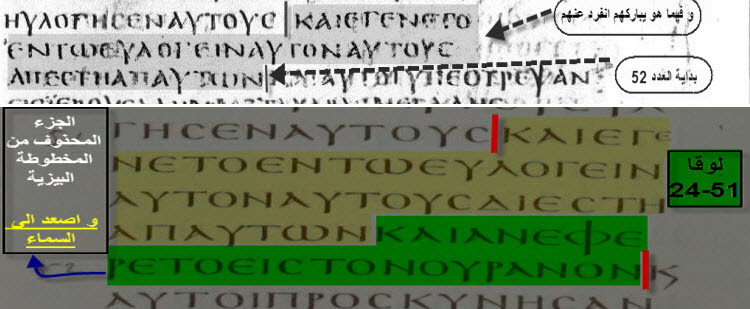
Pisan manuscript vs. Vatican manuscript — Luke 24:51:
The Orthodox and the Gnostics
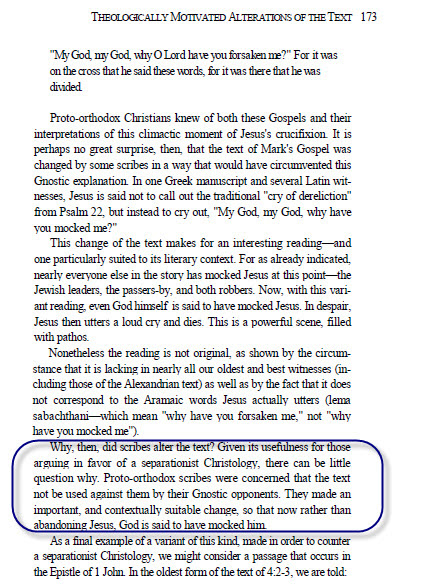
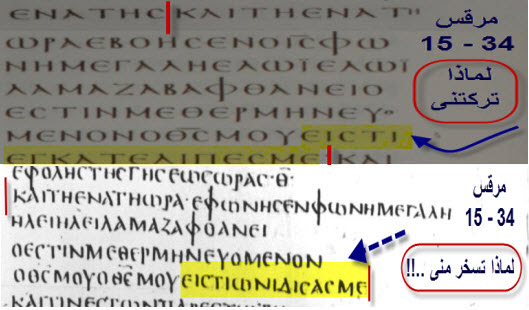
Example — Mark 15:34: “My God, my God, why have you forsaken me?” — The Gnostics used this verse to argue that Christ the divine separated from Jesus at this moment. In response, the scribe of the Pisan manuscript changed “forsaken” to “mocked.” Ehrman (Misquoting Jesus, pp. 172–173):
Vatican manuscript vs. Pisan manuscript — Mark 15:34:
2 — Defending Jesus (Apologetics)
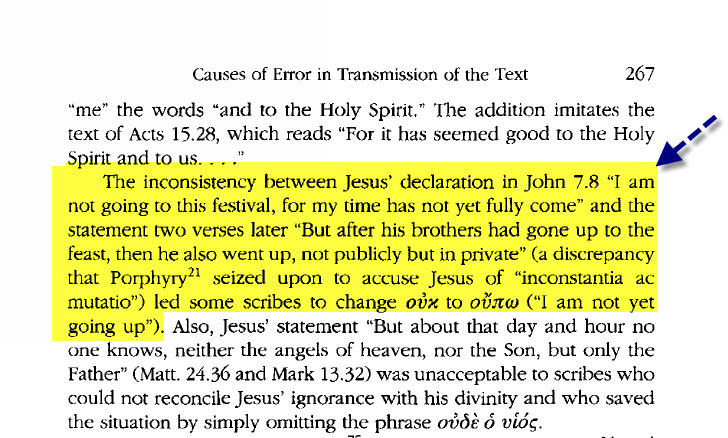
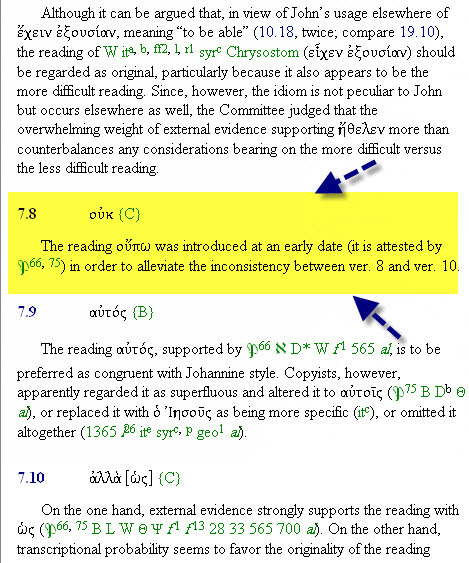
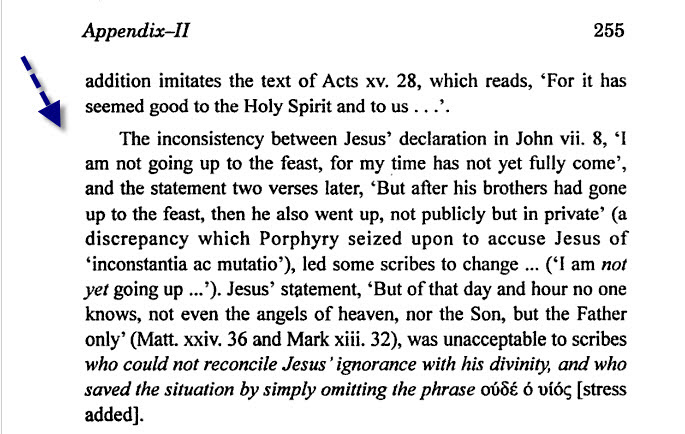
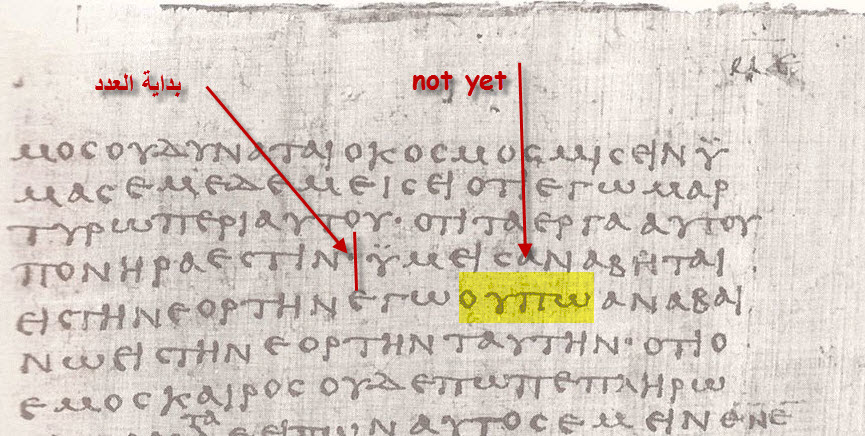
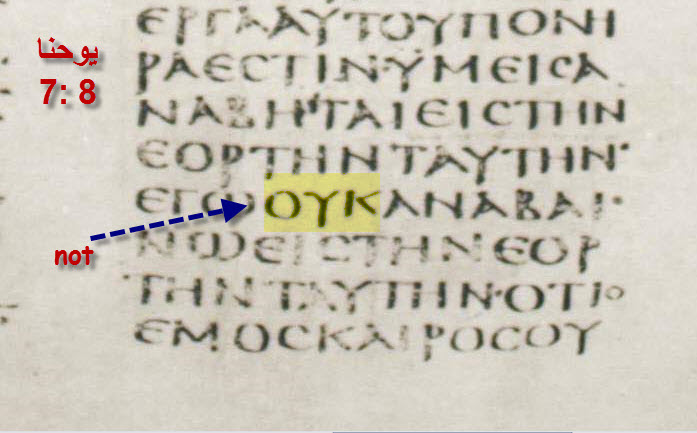
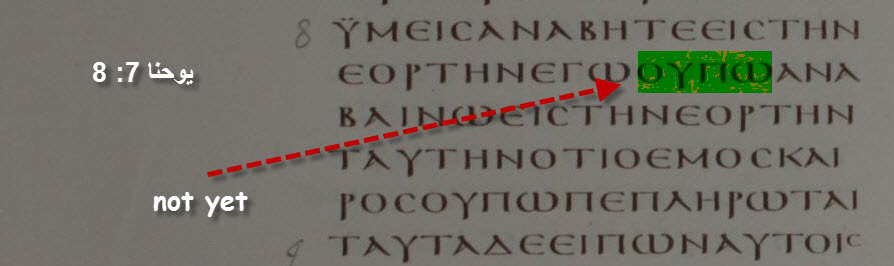
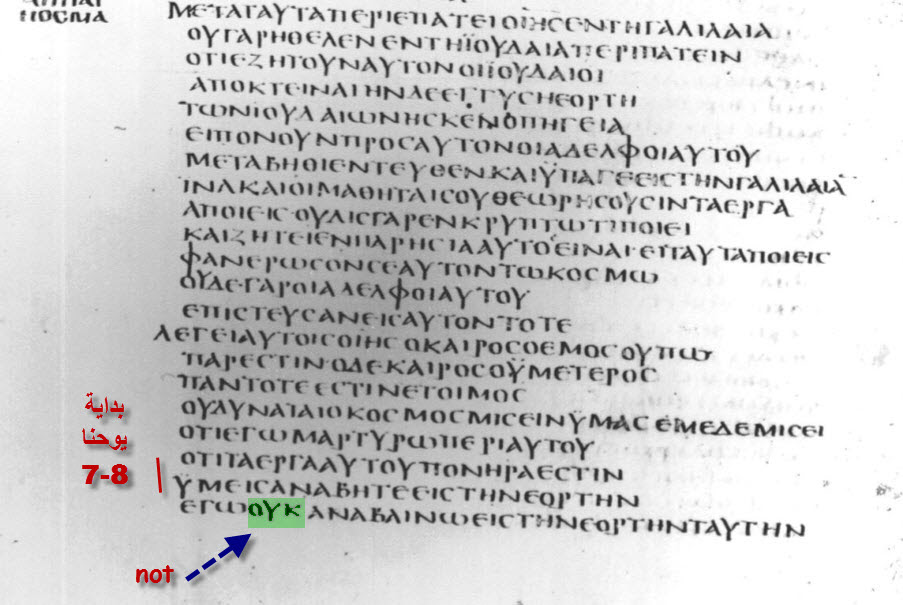
Example 1 — John 7:8: Jesus said “I am not going up to this festival” — then went anyway. The original Greek word is οὐκ (not), but this made Jesus appear to lie. Scribes changed it to οὔπω (not yet) in many manuscripts to resolve the contradiction.
Metzger and Ehrman confirm: the change from “not” to “not yet” entered early — in Papyri 66 and 75 — specifically because the pagan critic Porphyry used the original text to accuse Jesus of lying (The Text of the NT, p. 267):
Abdus Sattar confirms the same — pagan accusation drove scribal change:
Gregory Caspar states a well-intentioned Christian wrote οὔπω above the word οὐκ in the margin — and a scribe incorporated it into the text:
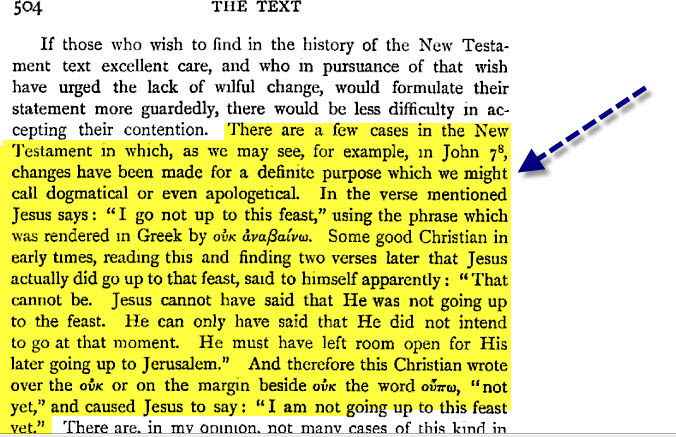
Papyrus 66 (c. 200 AD) — contains οὔπω (does not contradict Jesus):
Codex Sinaiticus (c. 350 AD) — contains οὐκ (contradicts Jesus):
Vatican Manuscript (late 4th century) — contains οὔπω (does not contradict Jesus):
Pisan Manuscript (5th century) — contains οὐκ (contradicts Jesus):
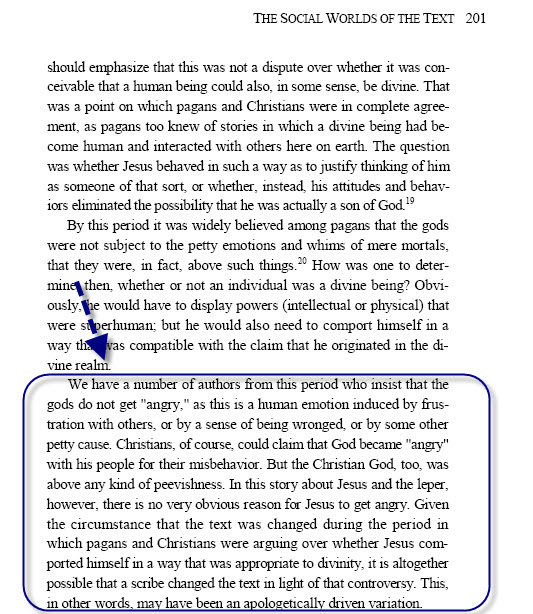
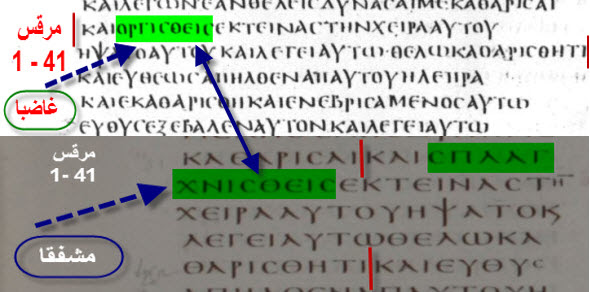
Example 2 — Mark 1:41: “Jesus was moved with compassion” — the Bezae manuscript reads “Jesus was indignant.” Ehrman argues the original is “indignant” — changed because pagans argued a God cannot get angry (Misquoting Jesus, pp. 134–135):
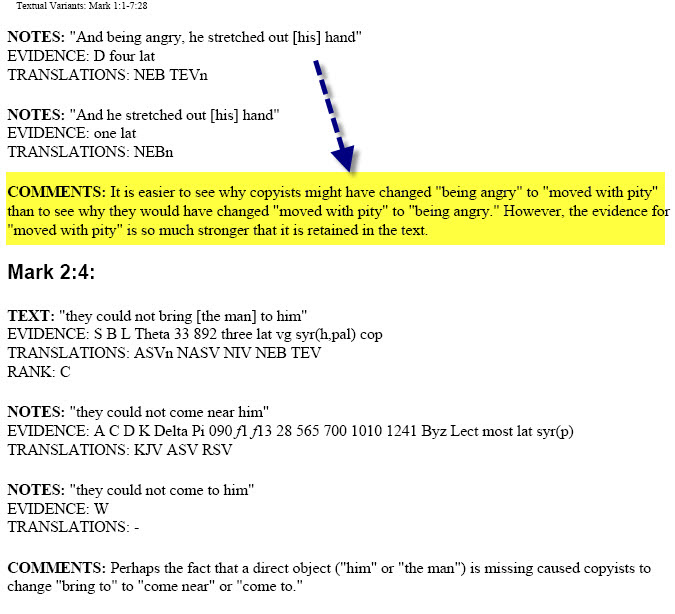
Bruce Terry prefers “compassionate” because most manuscripts support it:
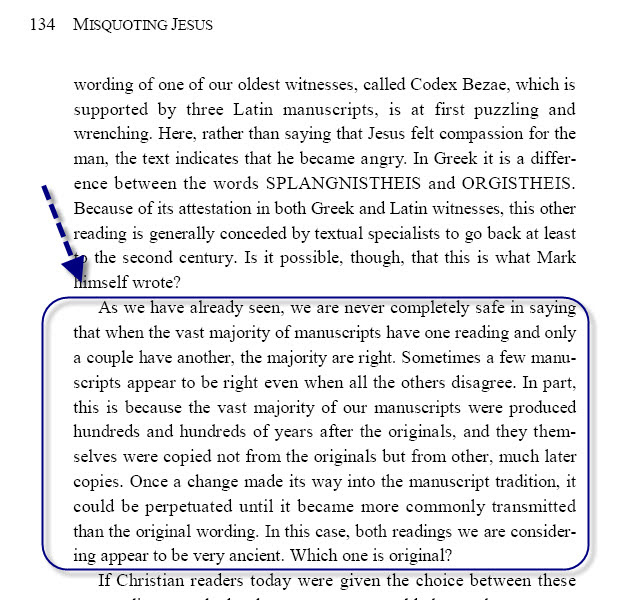
Ehrman responds — majority of manuscripts does not mean original reading, since changes propagate through copying:
Metzger acknowledges difficulty in reaching a definitive decision (Textual Commentary):
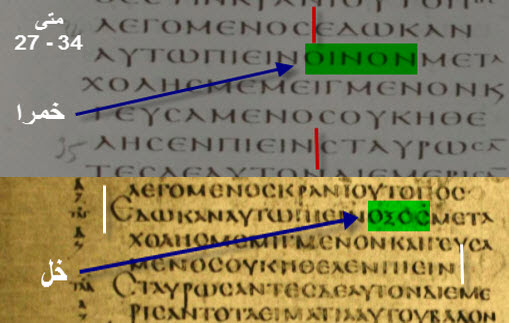
Example 3 — Matthew 27:34: Jesus was given “wine mixed with gall” on the cross — but older manuscripts say “vinegar.” At the Last Supper (Matthew 26:29), Jesus said he would not drink wine again until the Kingdom. Scribes changed “wine” to “vinegar” to protect this vow, as Ehrman explains:
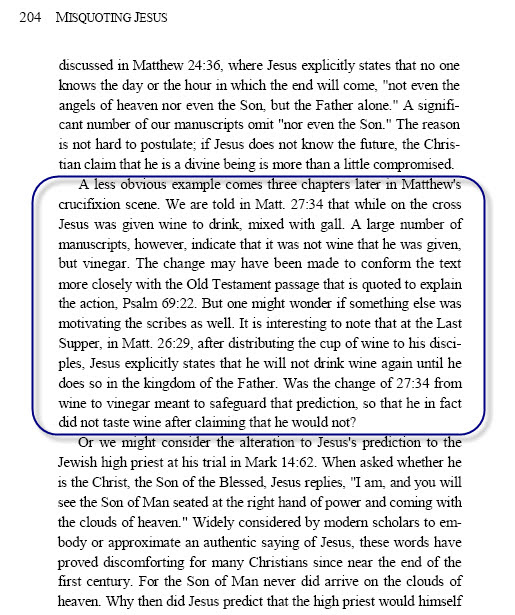
Vatican manuscript (4th century) saying “wine” vs. Alexandrian manuscript (5th century) saying “vinegar”:
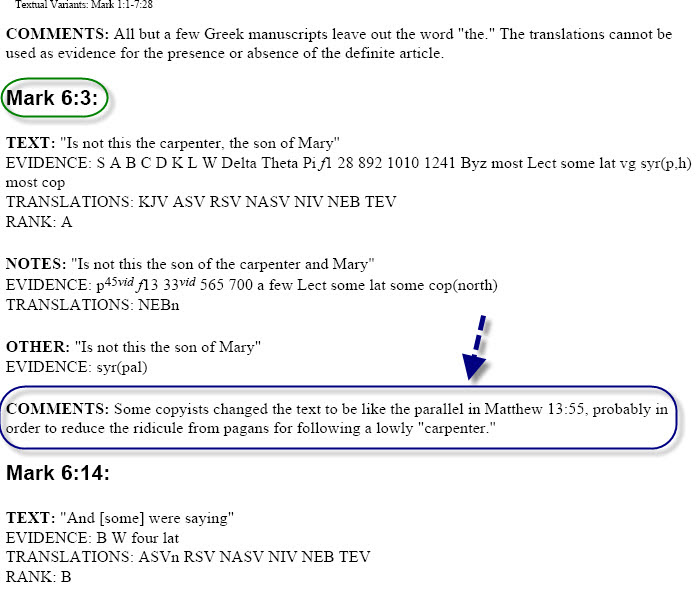
Example 4 — Mark 6:3: “Is this not the carpenter, the son of Mary?” — The pagan Celsus mocked this (“how can a carpenter be the Son of God?”). When Origen responded to Celsus, he flatly denied there was any text calling Jesus a carpenter — because Papyrus 45 (early 3rd century) and many other sources read “the carpenter’s son” instead. Ehrman (Misquoting Jesus, p. 203):
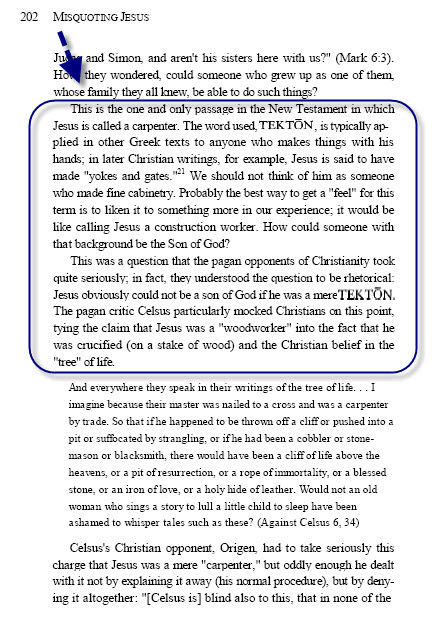
Metzger confirms the correct reading is “the carpenter, son of Mary” but acknowledges the alternative entered because of the objection:
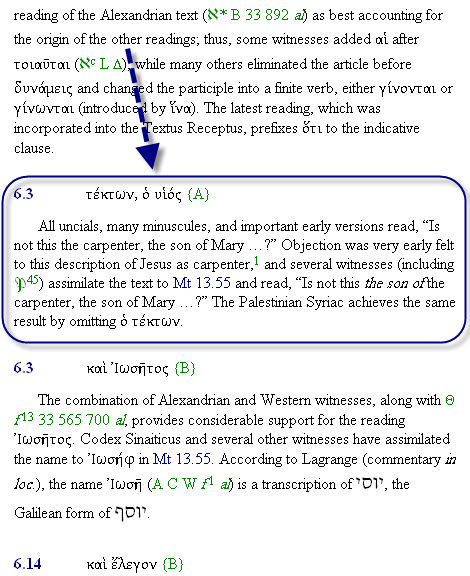
Bruce Terry — change made to reduce pagans’ ridicule of the carpentry profession:
Example 5 — Matthew 24:36: “No one knows the day or the hour — not even the angels, nor the Son, but only the Father.” The phrase “nor the Son” is absent from the majority of manuscripts including the later Byzantine text. Metzger: “The phrase was omitted because it presents a theological problem.” Ehrman: deleted to protect the claim to Jesus’s omniscience as Son of God:
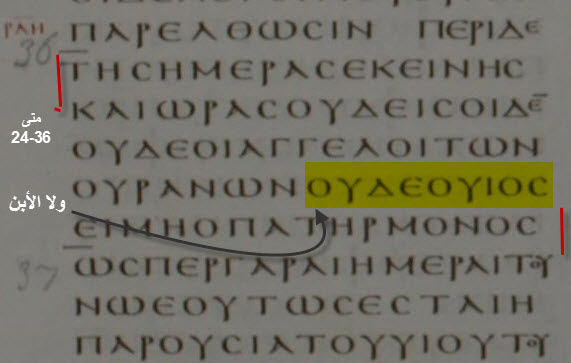
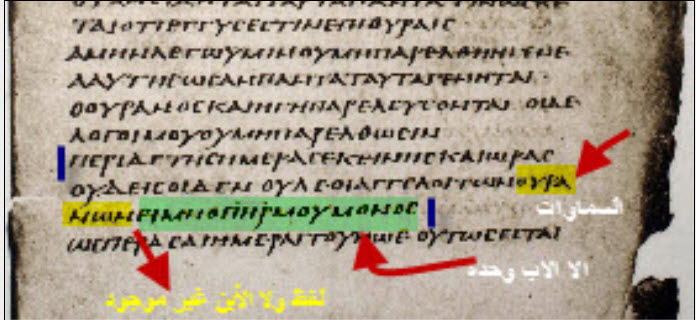
Vatican manuscript (with “nor the Son”) vs. Washington manuscript (without it):
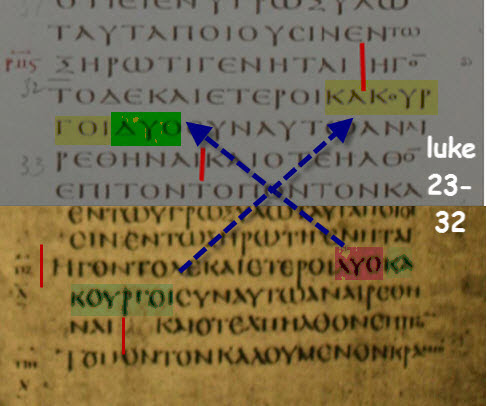
Example 6 — Luke 23:32: “Two others, who were also criminals, were brought to be executed with him” — the Greek phrasing could imply Jesus was also a criminal. Scribes rearranged the word order to make clear only the two others were criminals. Metzger (The Text of the New Testament, 4th ed.) and Ehrman (Misquoting Jesus, p. 203) both document this:
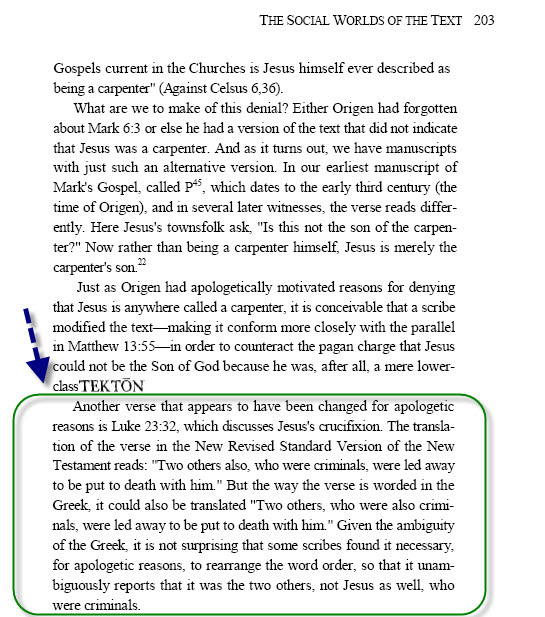
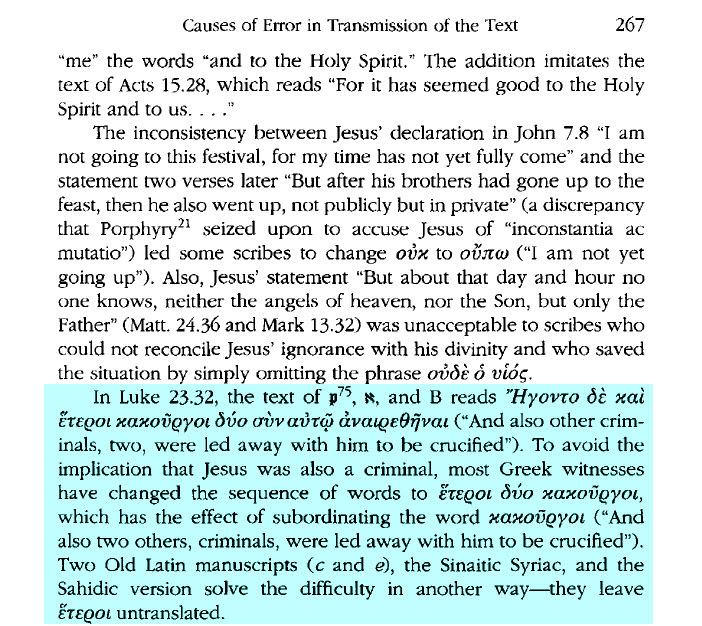
Vatican manuscript vs. Alexandrian manuscript — Luke 23:32 word order comparison:
3 — The Conflict Between Christians and Jews
Theological enmity between Christians and Jews (from the second century onward) left its mark on manuscripts. Justin Martyr claimed God imposed circumcision on Jews as punishment; Tertullian and Origen held Jerusalem was destroyed for killing the Messiah; Melito of Sardis accused Jews of killing God.
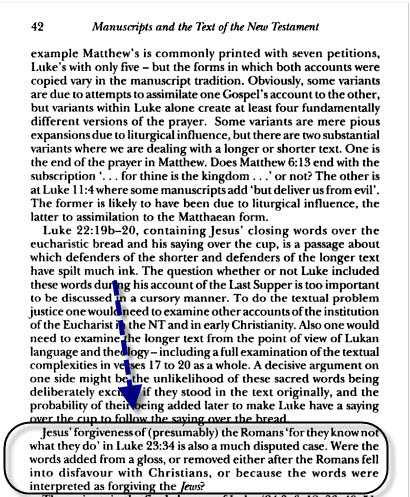
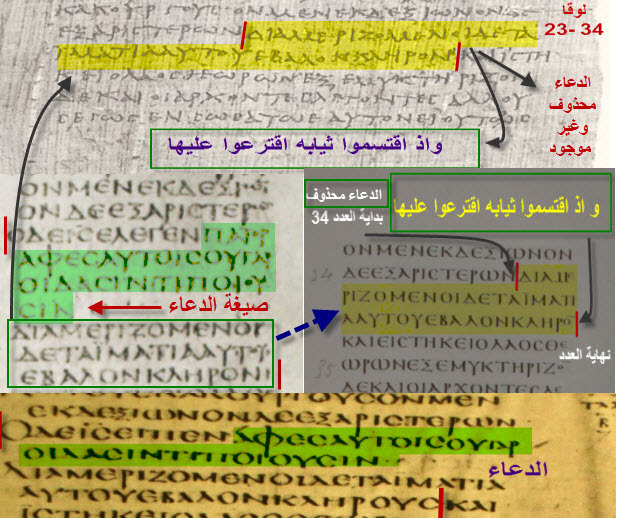
Example — Luke 23:34: “Father, forgive them, for they do not know what they are doing” — this phrase is placed in parentheses in modern translations because it is absent from ancient manuscripts including Papyrus 75 and the Vatican Manuscript. The Jesuit translation believes scribes deleted it because they held the destruction of Jerusalem was God’s punishment for the Jews — making Jesus’s prayer for forgiveness theologically impossible.
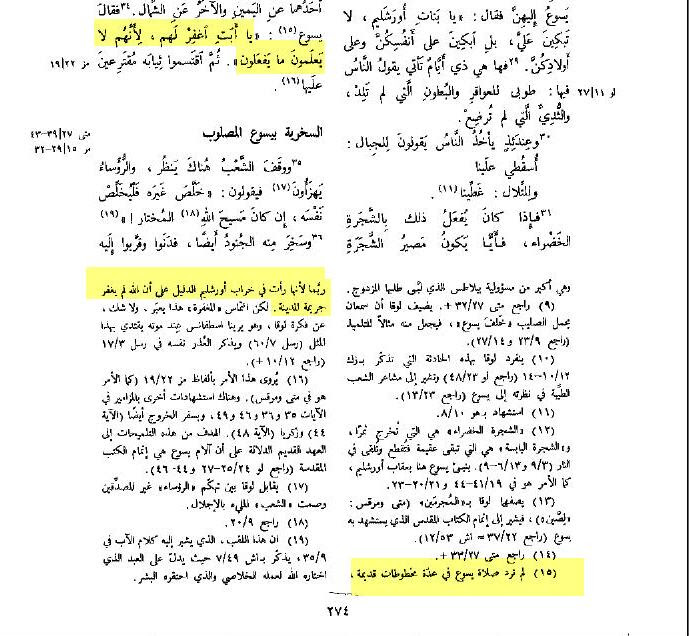
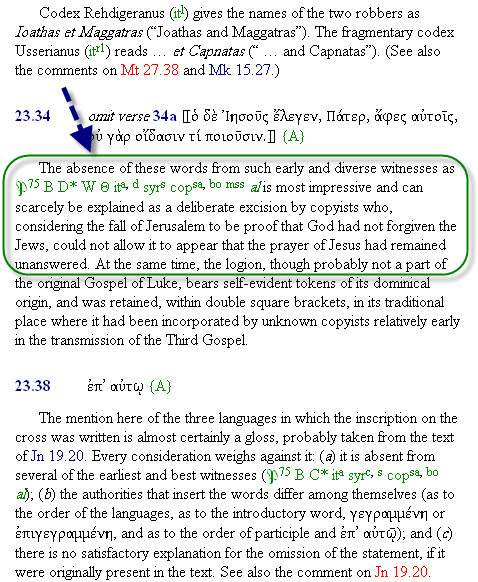
Ehrman elaborates — Origen himself said Jerusalem deserved complete destruction and the Jewish nation deserved annihilation (Misquoting Jesus, p. 191):
Manuscript comparison — Vatican vs. Alexandrian:
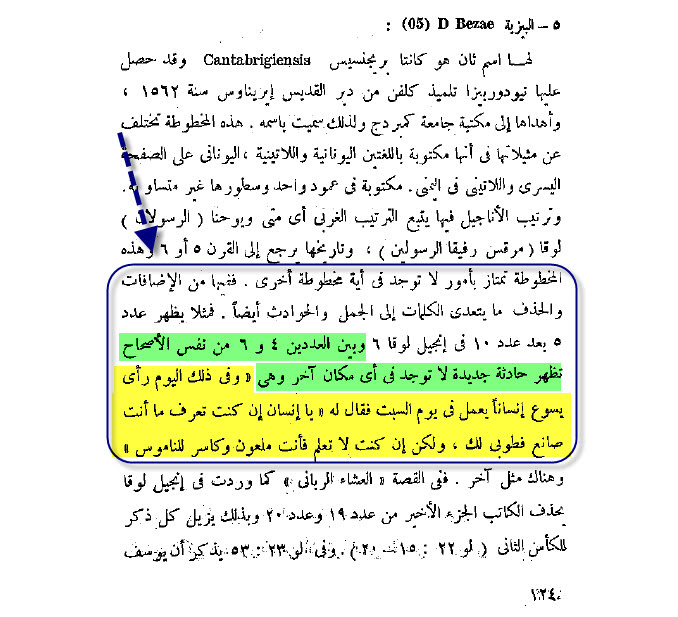
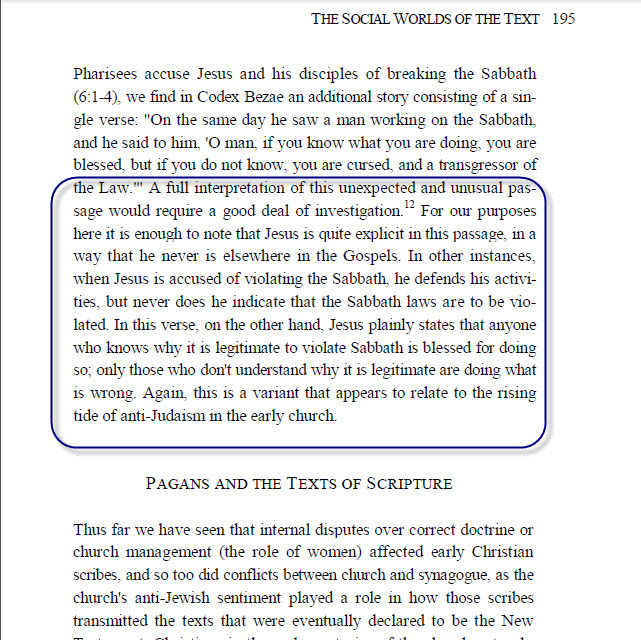
Example 2 — Luke 6:4–5 (Bezae Codex addition): Dr. Fahim Aziz notes verses inserted into the Bezae manuscript between 6:4 and 6:5 — a dialogue between Jesus and a Jew about working on the Sabbath — related to anti-Jewish sentiment in the early church:
4 — Harmonization of Parallel Passages
Scribes attempted to reconcile contradictions between Gospel accounts — either intentionally (knowing the Gospels) or unintentionally (from memory during copying).
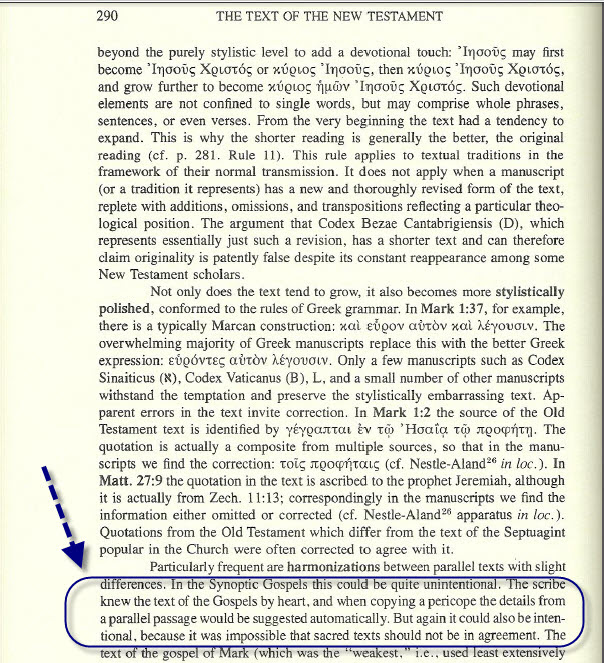
Elliott on the mechanics of harmonization:
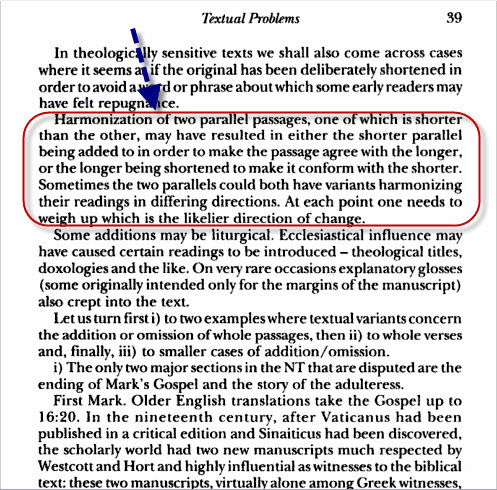
Reinventing Jesus on the tendency toward harmonization:
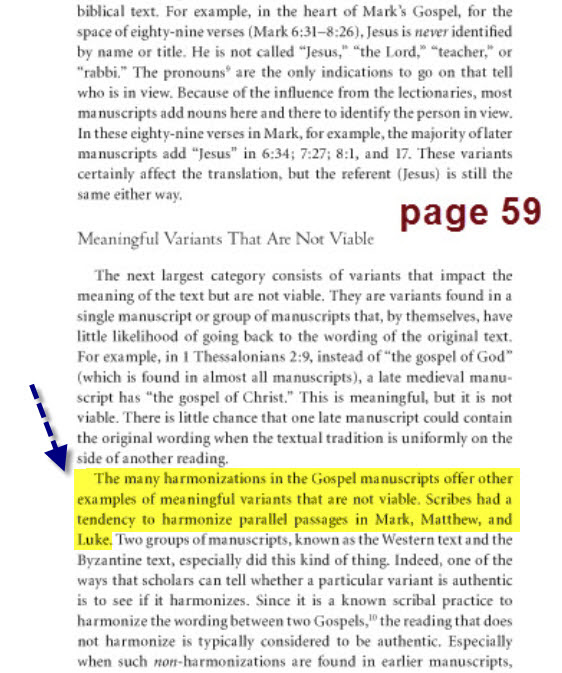
Metzger on the strength of harmonization impulse:
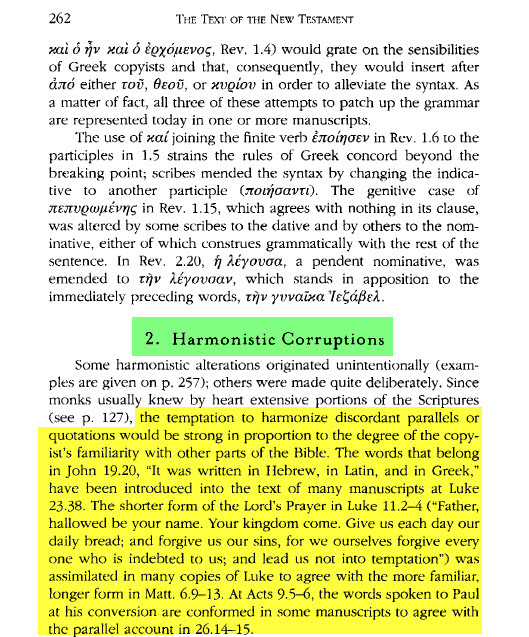
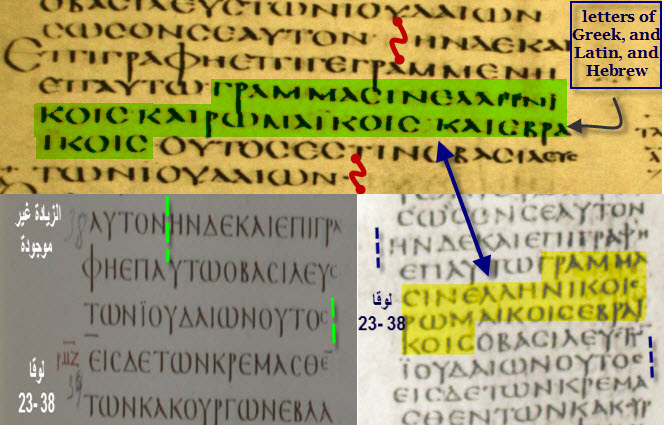
Example — Luke 23:38: “Written in Greek, Roman, and Hebrew letters: This is the King of the Jews.” This phrase is absent from older manuscripts but was added by scribes to harmonize Luke with John 19:20. Modern translations omit it:
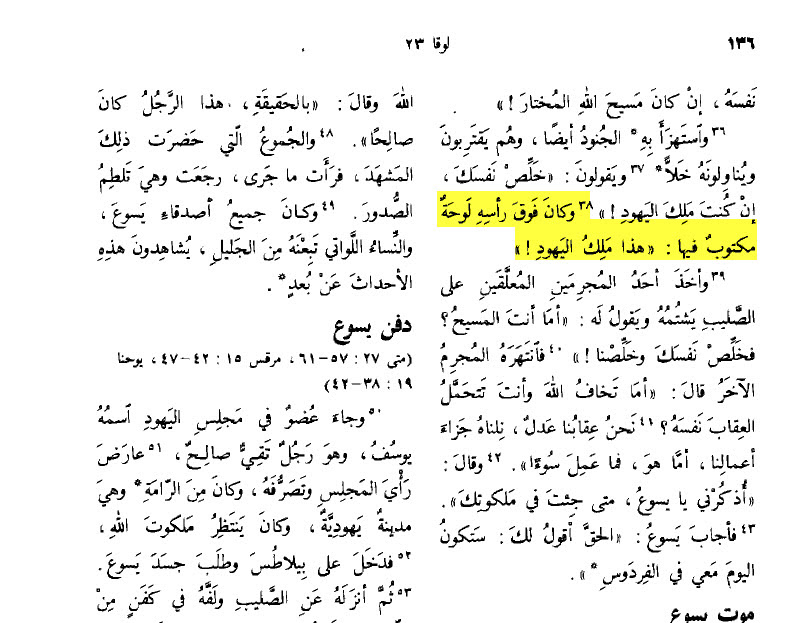
Common Arabic Translation on the harmonized phrase:
Sinaiticus vs. Alexandrinus vs. Vatican — Luke 23:38:
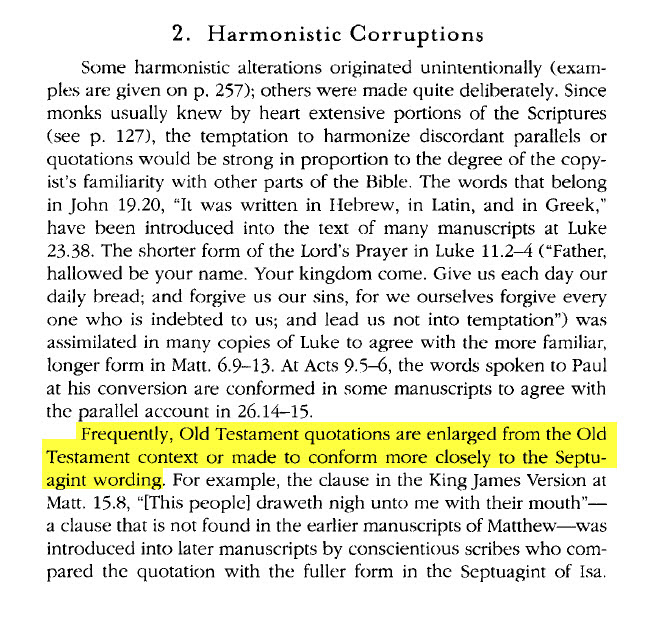
Metzger on harmonization with Old Testament quotations — Old Testament citations in the New Testament were extended to match the Septuagint (The Text of the NT, 4th ed.):
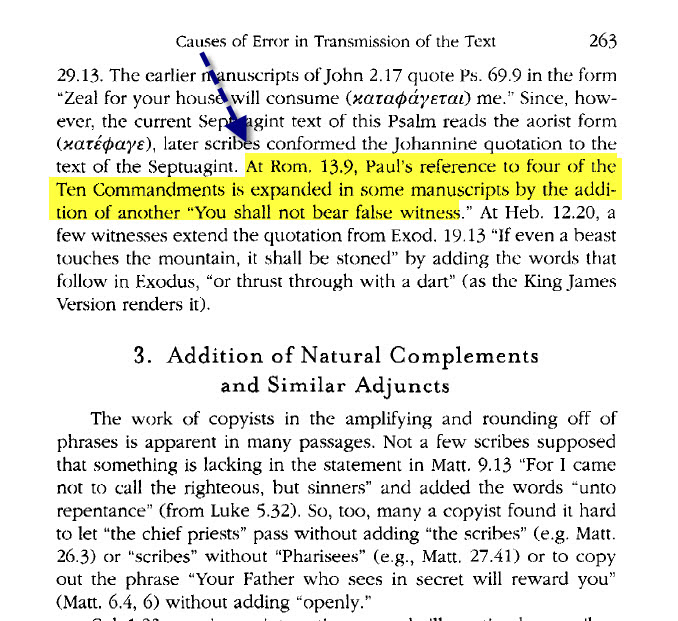
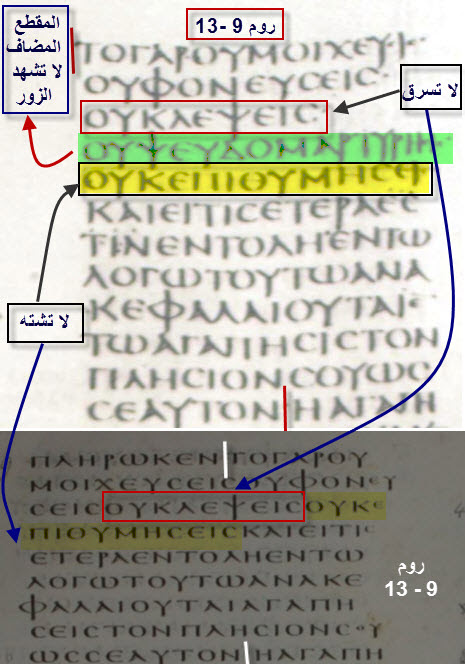
Example — Romans 13:9: Paul listed four commandments but a scribe added “you shall not bear false witness” to match Exodus 20:16. Modern translations omit it:
Sinaiticus vs. Vatican — Romans 13:9:
5 — Liturgical Modifications
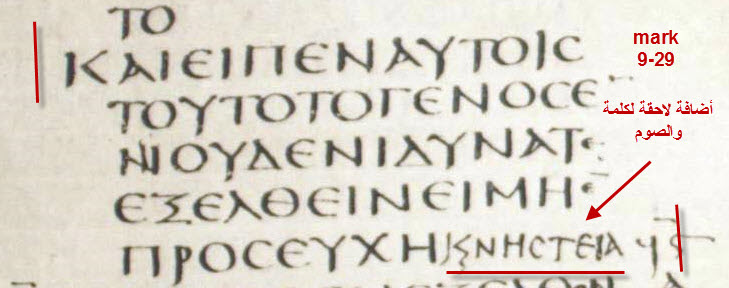
Example — Mark 9:29: “This kind can come out only by prayer” — later manuscripts add “and fasting” because of the growing ascetic tradition in the early Church. Ehrman (Misquoting Jesus):
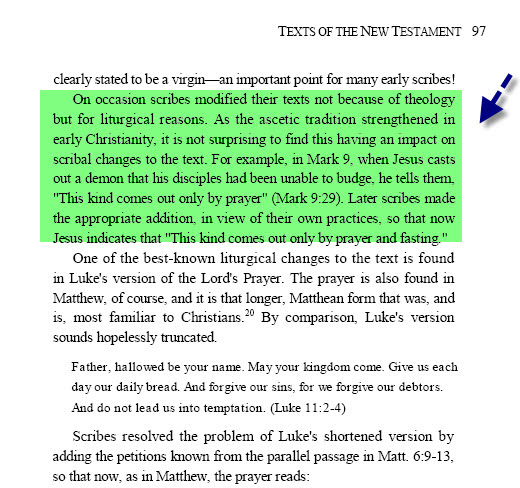
Elliott — liturgical additions added under clerical influence:

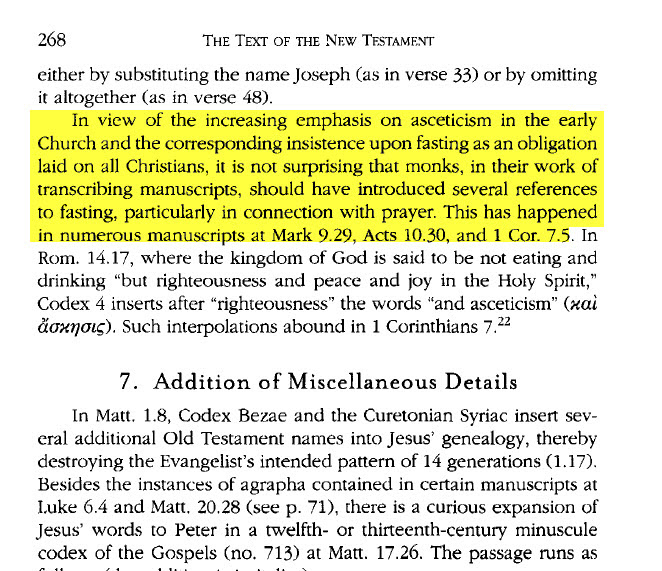
Metzger on fasting additions across multiple manuscripts (The Text of the NT, 4th ed.):
Bezae Codex vs. Codex Sinaiticus — Mark 9:29 with and without “and fasting”:

6 — Linking Jesus to Old Testament Prophecy
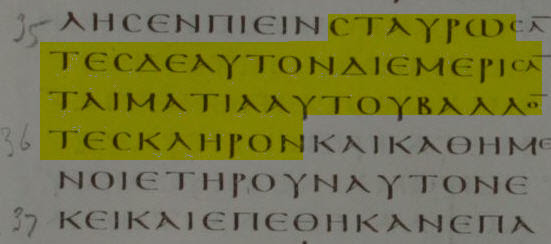
Example 1 — Matthew 27:35: The Van Dyke translation includes a quotation from the prophets about dividing Jesus’s garments — but this text is entirely absent from the ancient manuscripts. Adam Clarke states it should be deleted as it is not part of the original text. All modern translations, critical Greek texts, and the Catholic/Pauline translations omit it:
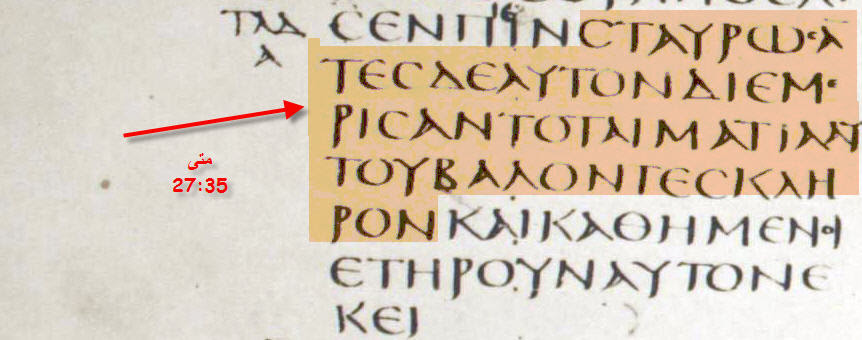
Sinaiticus (early 4th century) — without the added text:
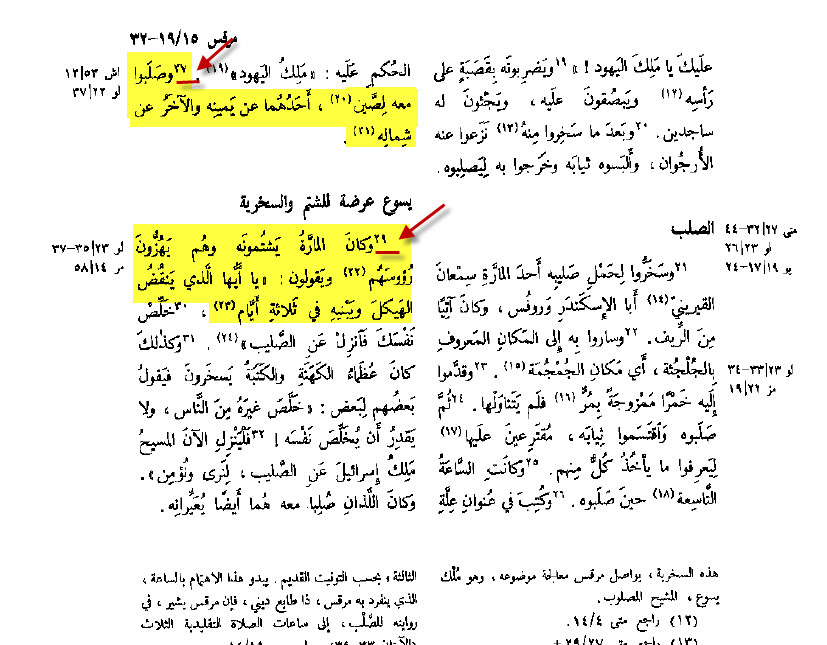
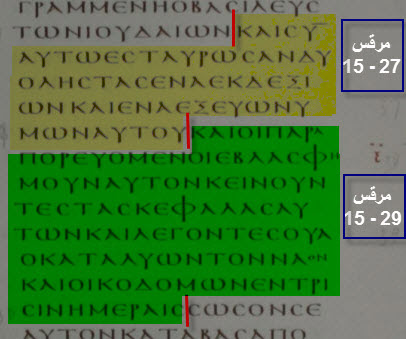
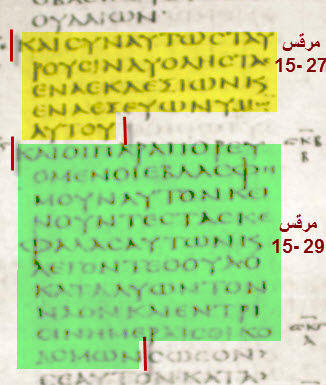
Example 2 — Mark 15:28: “This fulfills the Scripture that says, ‘He was numbered with the transgressors’” — placed in brackets or deleted entirely in modern translations, not found in ancient manuscripts:
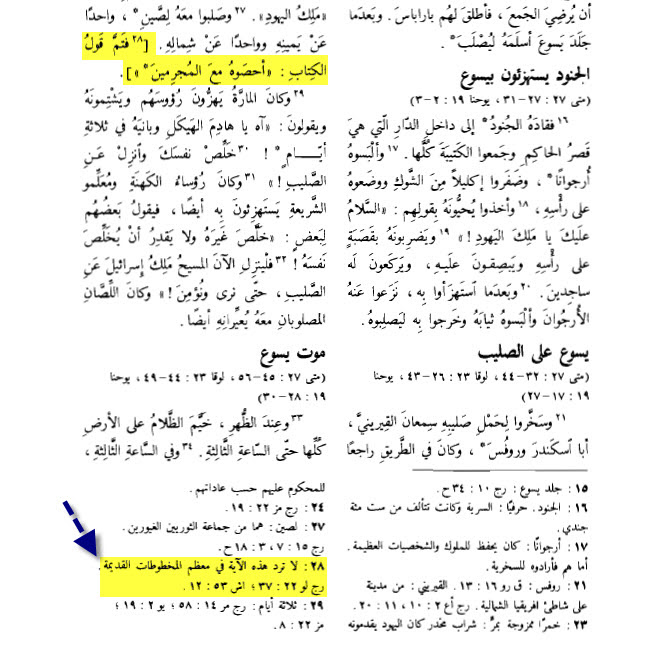
Common Arabic Translation with footnote noting absence from ancient manuscripts:
Vatican and Sinaitic manuscripts — absence of the text:
7 — Jews Deleted the Prophecies About the Messiah from the Old Testament
In previous sections, John Chrysostom and Justin Martyr testified to the Jews deleting prophecies concerning the Messiah. Justin Martyr documented specific deletions in his Dialogue with Trypho (Chapter 72).
From the text of Ezra — the following was removed: “This Passover is our Savior and our refuge. If you understand this and your hearts believe, and we humble ourselves before Him and put our hope in Him, this place will never be deserted. But if you do not believe and do not listen to Him, you will be a laughingstock among the nations.”
From Jeremiah — the following was cut out: “I was like a lamb led to the slaughter, and I did not know that they had plotted against me, saying, ‘Let us spoil His bread and cut off His memory from the land of the living.’” Justin adds that this text still existed in some Jewish copies at his time because “its removal was recent” — which proves the deletion was deliberate and traceable.
Justin also reported in Chapter 73 the existence of distortion in Psalm 96.
John Chrysostom, responding to the question of where the prophecy about Jesus being called a Nazarene could be found (Matthew 2:23), testified that many prophetic books were burned, torn up, and forgotten entirely — including the Book of Deuteronomy, which was completely lost and only found again with great difficulty. He concluded plainly: the Jews were more treacherous to their own book than any foreign invader had been.
8 — Natural Complements Added to the Text
Scribes sensed gaps in the text and added words to make it seem more complete or natural.
Metzger’s examples (The Text of the NT, pp. 263–264):
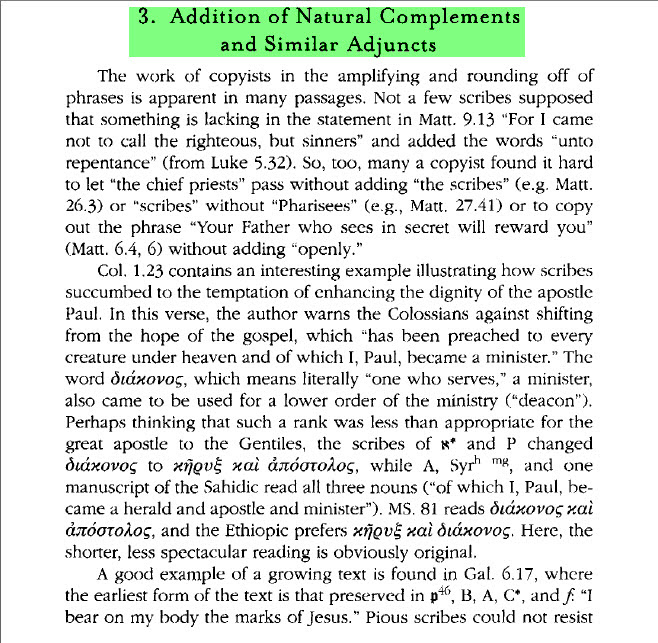
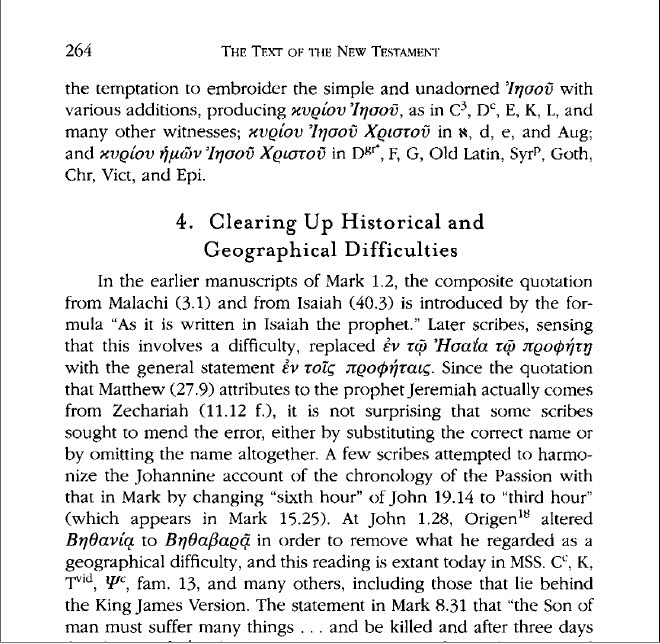
Example 1 — Matthew 9:13: “I have not come to call the righteous, but sinners” — scribes added “to repentance.” Vatican, Sinaitic, and Bezae manuscripts all end with “sinners” alone:
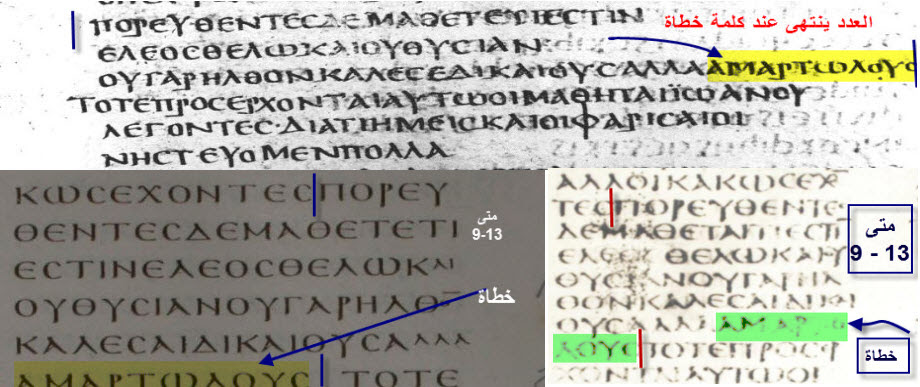
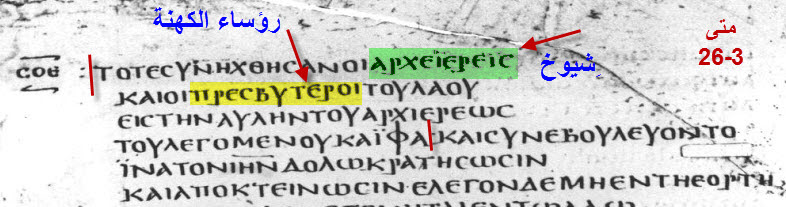
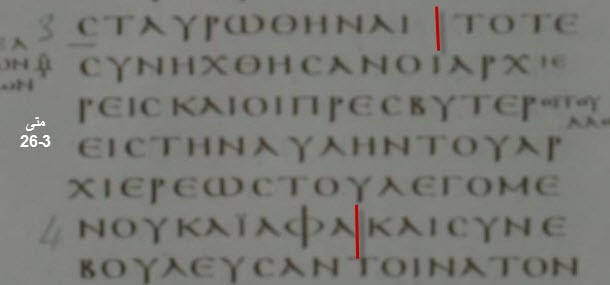
Example 2 — Matthew 26:3: “The chief priests and elders gathered in the house of Caiaphas” — scribes added “the scribes” because it seemed natural they would be present. Vatican and Bezae manuscripts lack the word:
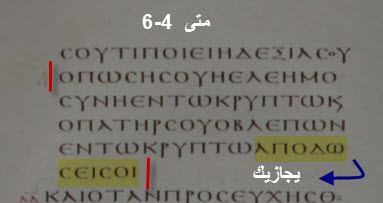
Example 3 — Matthew 6:4: “Your Father who sees in secret will reward you” — scribes added “publicly.” The Vatican manuscript ends with simply “He will reward you”:
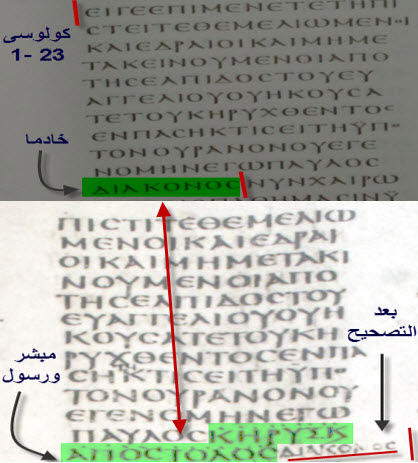
Example 4 — Colossians 1:23: The Codex Sinaiticus (before correction) changed Paul’s title from deacon (diakonos) to evangelist and apostle. Some manuscripts combine all three:
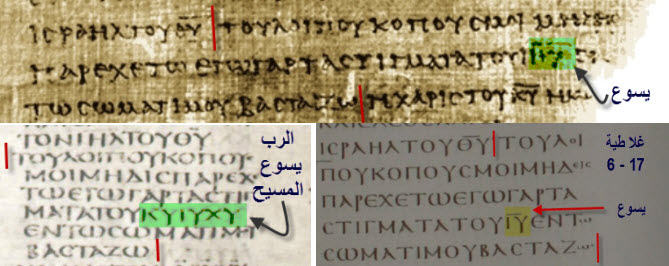
Example 5 — Galatians 6:17: “I bear the marks of Jesus” — scribes changed it to “the marks of the Lord Jesus” (some manuscripts: “the marks of the Lord Jesus Christ”). Papyrus 46 and the Vatican manuscript preserve only “Jesus”:
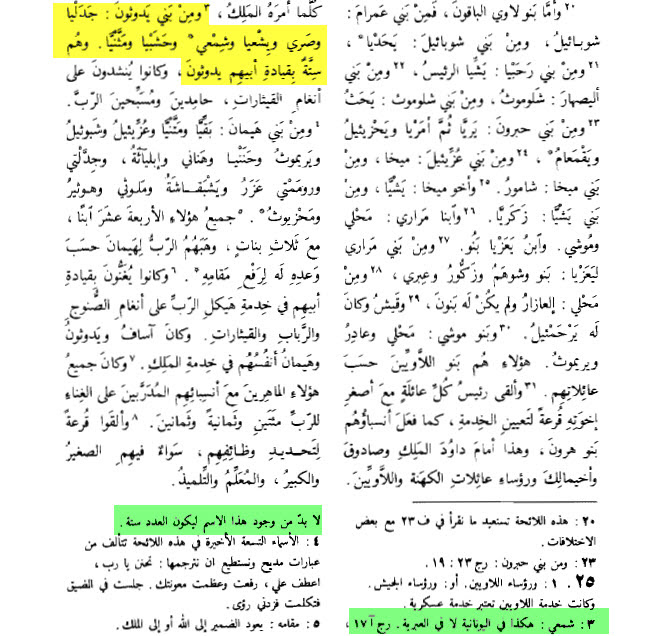
A numerical error: 1 Chronicles 25:3 names five sons of Jeduthun but says “six.” The Greek translation added Shimei to bring the count to six:
Psalm 37:28 — the text saying God punishes with eternal damnation was changed to “He will cut off the offspring of the wicked” (Jesuit Translation):
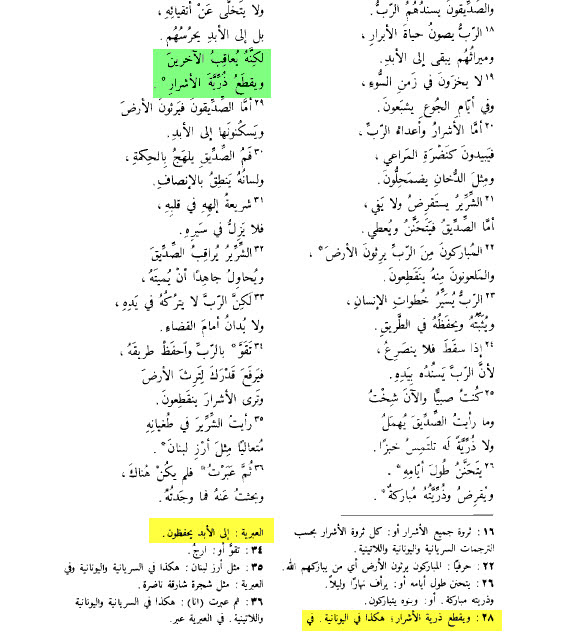
Corrections due to verse distortions in the Book of Job (Jesuit Translation):
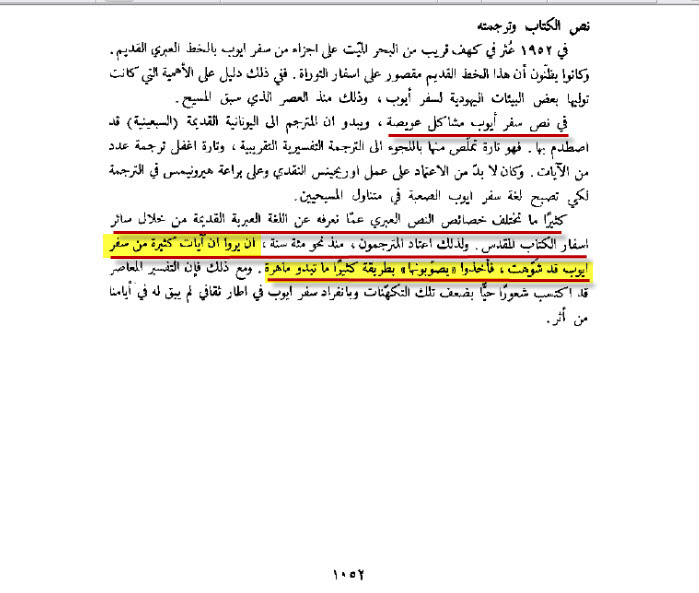
9 — Combining Different Readings
When scribes encountered two different readings in their manuscripts, instead of choosing one, they sometimes combined both into their copy.
Metzger (The Text of the NT, 4th ed.):
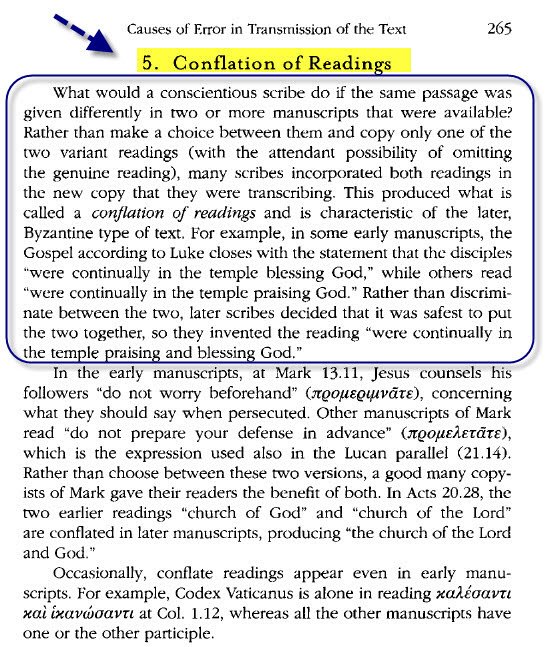
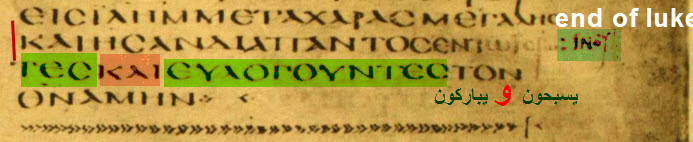
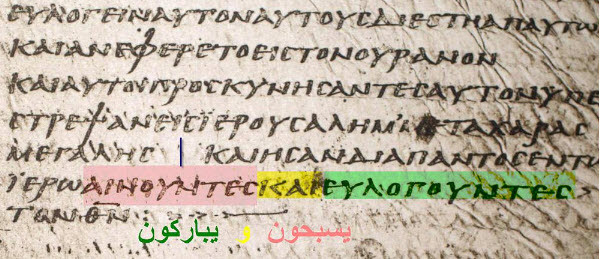
Example — Luke 24:53: Some manuscripts conclude: “they were continually in the temple praising God.” Others: “they were continually in the temple blessing God.” The Bezae manuscript ends with “they praise”; the Vatican and Sinaitic end with “they bless.” The Alexandrian and Washington manuscripts — unable to choose — combined both, giving: “praising and blessing God.” This conflated reading became the Van Dyke translation:
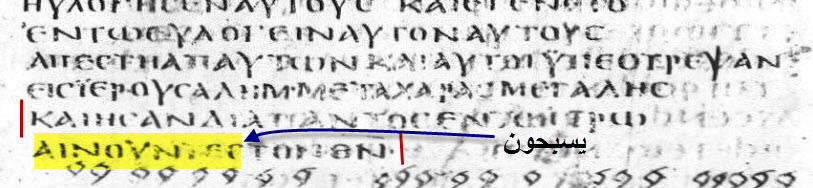
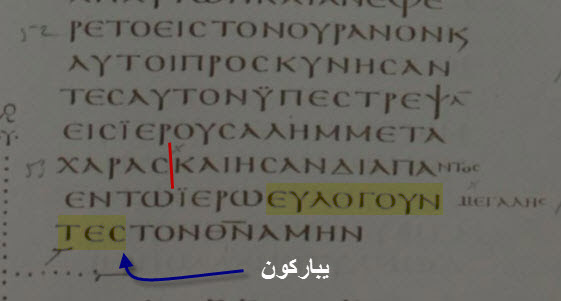
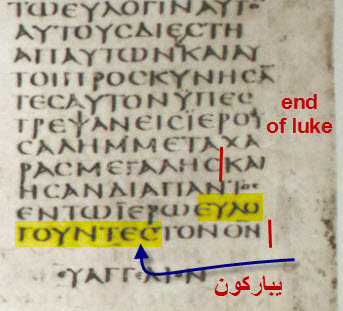
Alexandrian and Washington manuscripts — combined: “praising and blessing”:
10 — The Role of Women
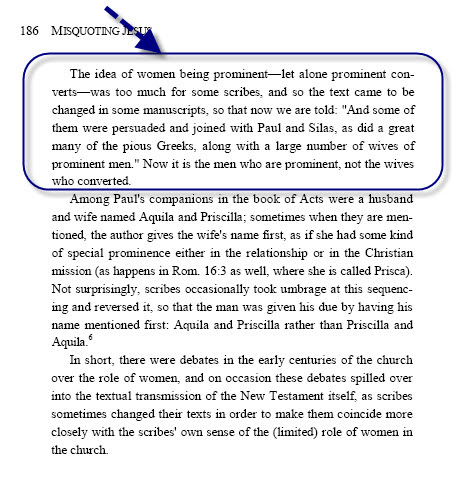
Ehrman documents how scribes — reflecting churches that marginalized women — altered texts to restrict women’s roles. “In almost every instance of such alteration, the text was changed to limit the role of women and diminish their importance within the Christian movement.”
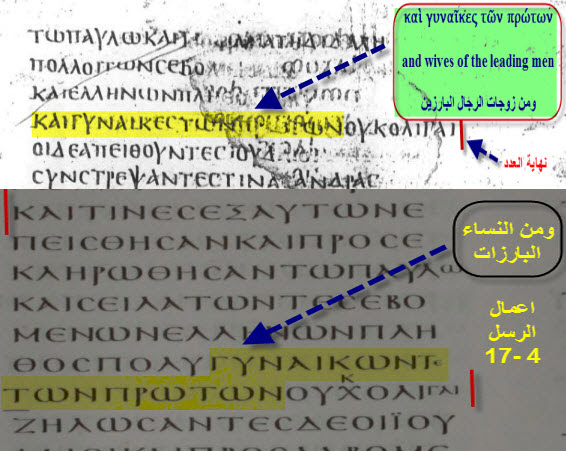
Example 1 — Acts 17:4: The original reads “a large number of virtuous women” converted. Some manuscripts changed it to “wives of the pioneering men” — making the men the pioneers, not the women (Misquoting Jesus):
Codex Piscis vs. Codex Vatican — Acts 17:4 comparison:
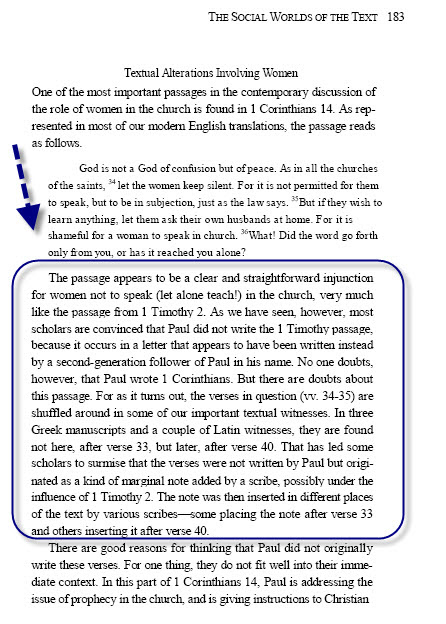
Example 2 — 1 Corinthians 14:34–35: “Let your women keep silent in the churches” — Ehrman and Father Paul Al-Faghali both argue these verses were not written by Paul but inserted as a marginal note by a later scribe, which then entered the text in different positions in different manuscripts. Paul himself in 1 Corinthians 11:5 speaks of women praying and prophesying in church — an outright contradiction:
11 — Distortion to Support Theological Doctrine
The Johannine Comma — 1 John 5:7
Detailed
The Johannine Comma From Christian References( 1 John5_7
This is the most famous theological addition in the Bible. The Van Dyke translation and the King James Version include: “For there are three that bear witness in heaven: the Father, the Word, and the Holy Spirit; and these three are one.” Modern translations omit this entirely.
This is the only verse in the entire Bible that explicitly states the Trinity — and it is not original.
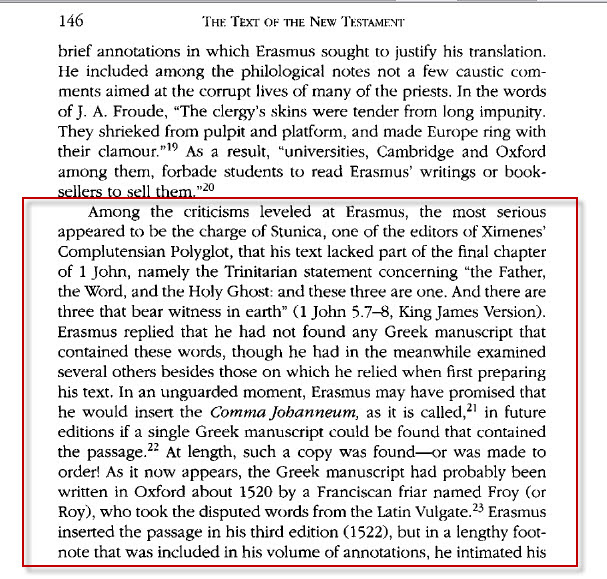
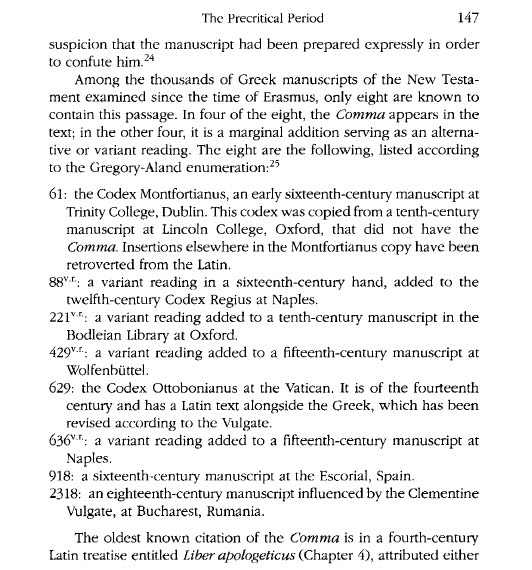
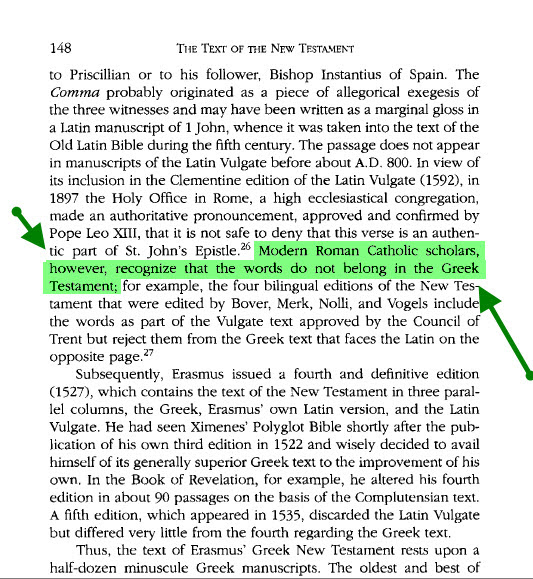
Bart Ehrman on Erasmus and the Johannine Comma (Misquoting Jesus, p. 81):
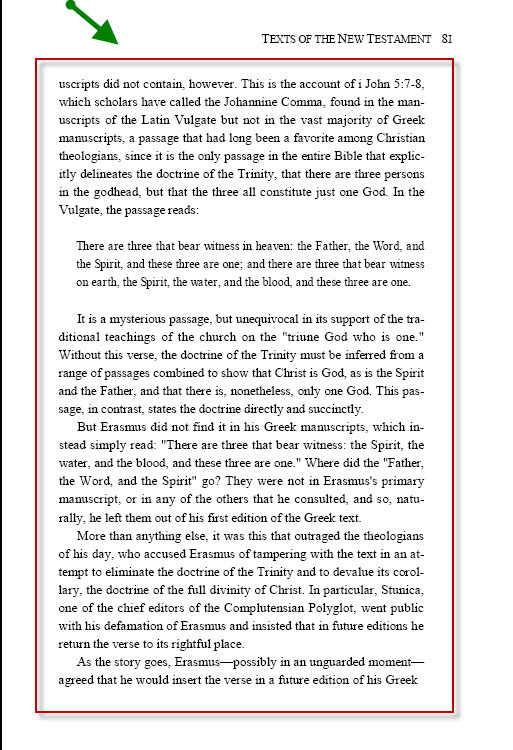
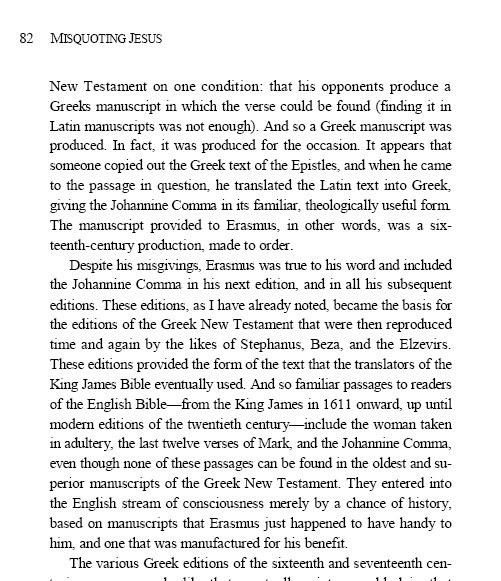
Richard Soulen — the Johannine Comma entered Latin by mistake and was reinstated after protest:
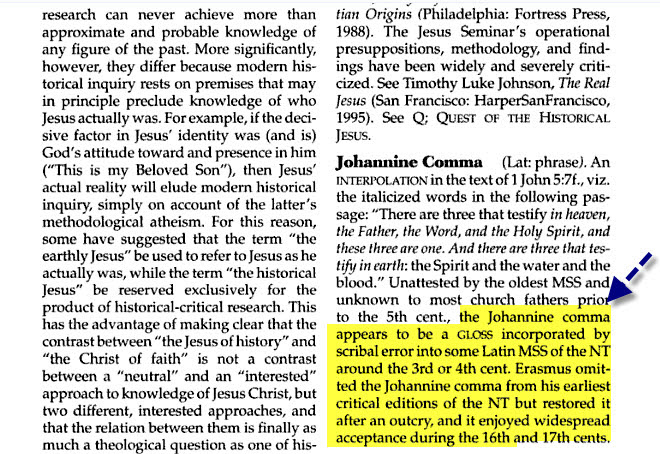
The Jesuit translation acknowledges it was a marginal comment inserted into the text during transmission in the West:
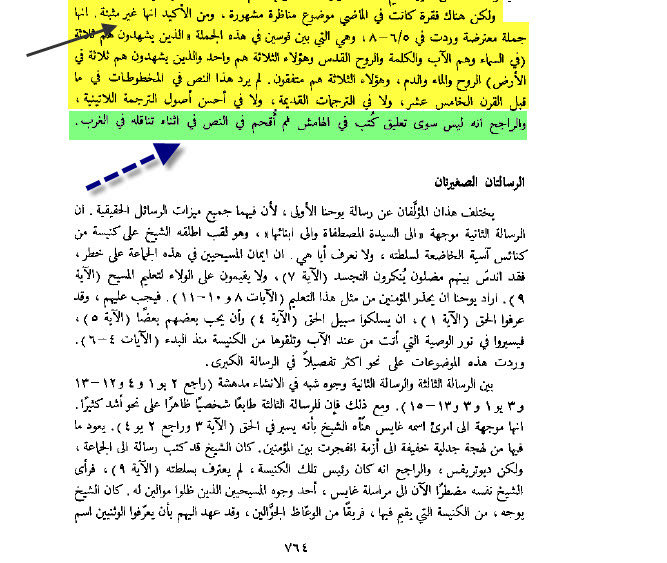
William Kelly states directly: “It is an established fact that the passage beginning with ‘in heaven’ in verse seven and ending with ‘on earth’ in verse eight is not part of the original text”:
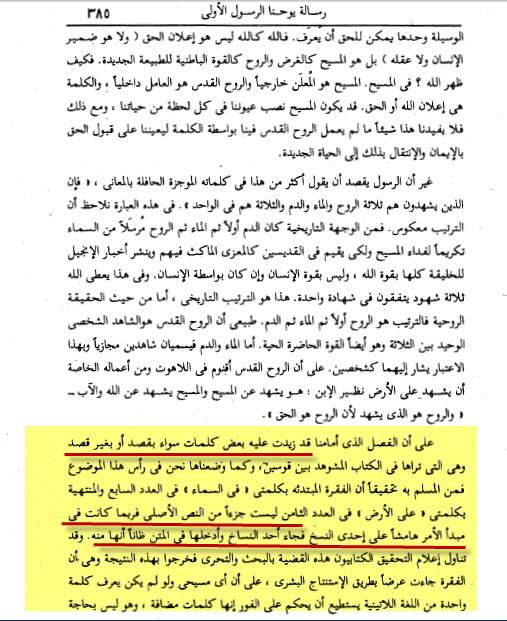
Albert Barnes — the passage was never quoted by Greek Fathers during Trinitarian disputes, which would have been impossible if it were genuine. Adam Clarke: “It is wanting in every MS of this epistle written before the invention of printing, one excepted” (Codex Montfortii).
Metzger: “The passage is quoted by none of the Greek Fathers who, had they known it, would most certainly have employed it in the Trinitarian controversies”:
Johann David confirms the same:
Leonard confirms:
Sinaitic manuscript (c. 350 AD) — Johannine Comma absent:
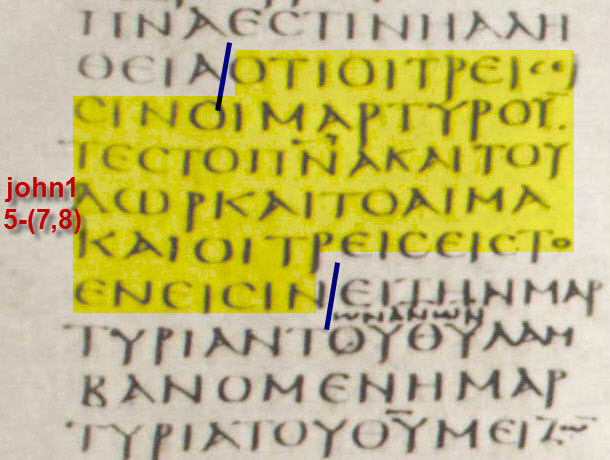
Vatican manuscript (late 4th century) — Johannine Comma absent:
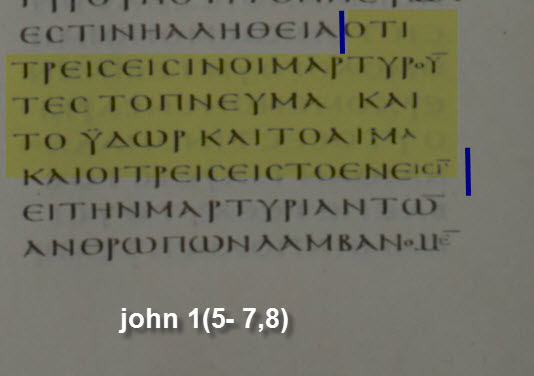
Alexandrian manuscript (5th century) — Johannine Comma absent:
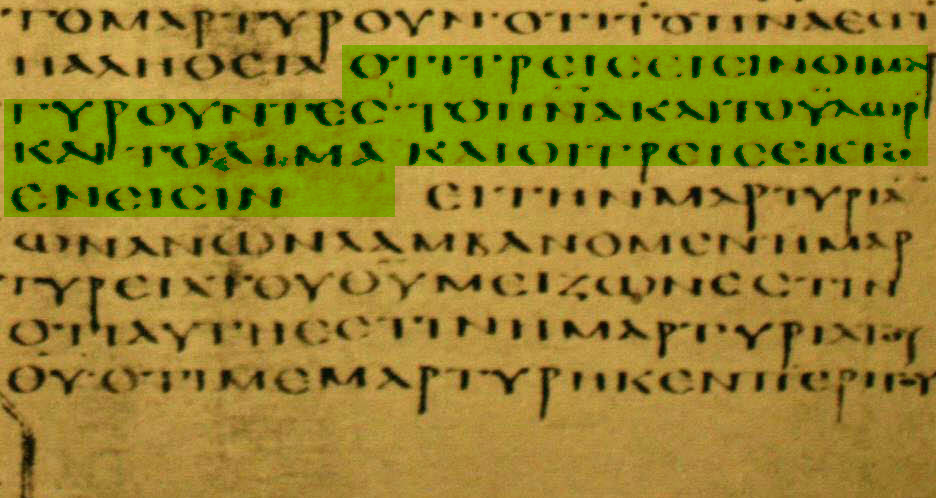
Trinitarian Baptismal Formula — Matthew 28:19
Corruption of the Baptism Text in Matthew 28_19
]]
Matthew 28:19: “Baptizing them in the name of the Father and of the Son and of the Holy Spirit” — Bishop Kyrillos Selim Bustros states this Trinitarian formula was not from Jesus himself but a summary of preaching prepared for baptism in Greek circles. In the early years, baptism was administered “in the name of Jesus Christ” (Acts 2:38; 10:48) or “in the name of the Lord Jesus” (Acts 8:16; 19:5):
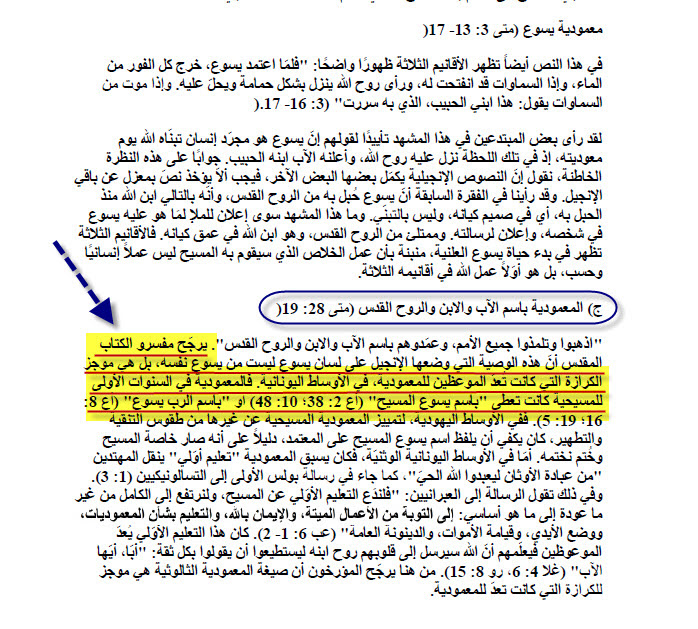
The same appears in the modern interpretation of the Bible — Gospel of Matthew:
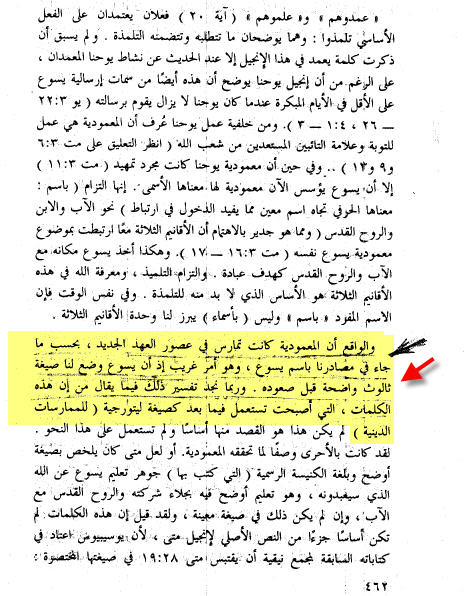
Will Daniels — no one can say with certainty this phrase originated with Matthew; it likely came from a later origin (Understanding the Trinity, p. 263):
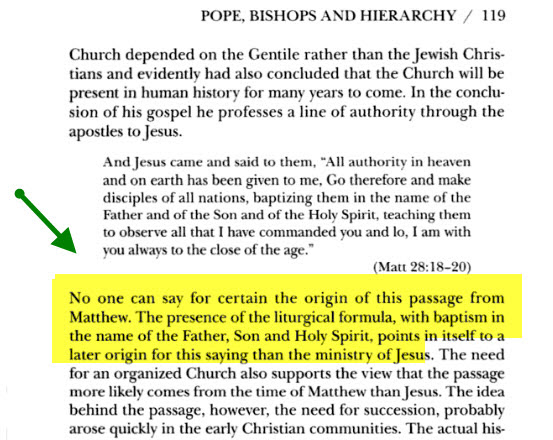
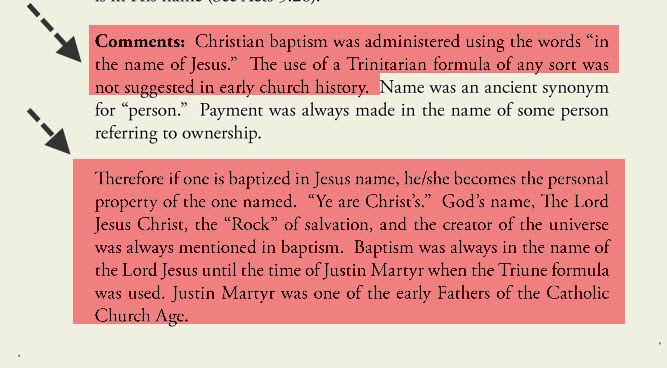
Catholic source: “The baptism of a Christian was known in the name of Jesus — but the Trinitarian formula was unknown in the history of the early Church”:
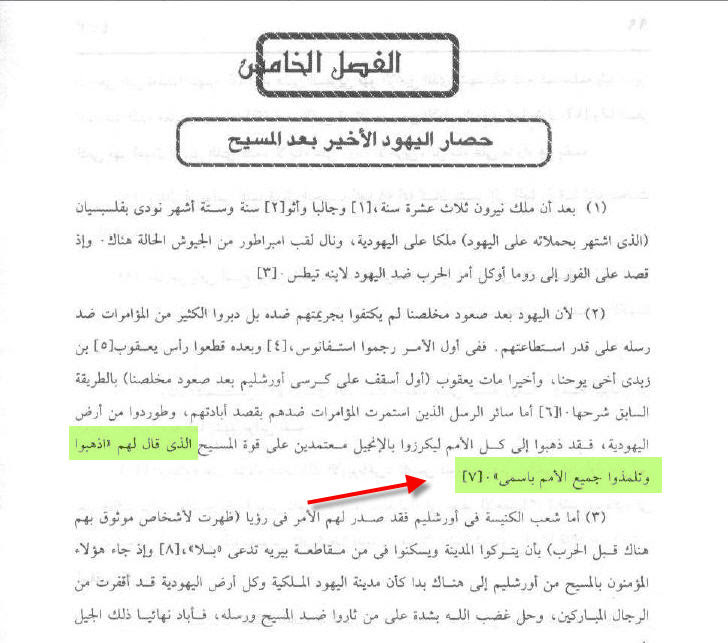
Eusebius of Caesarea quoted the verse without the Trinitarian formula in his writings:
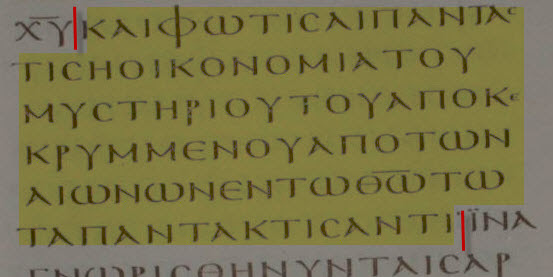
Distortion to support the divinity of Christ — Ephesians 3:9: “The Creator of all things” — scribes added “through Jesus Christ.” Metzger confirms this should be deleted. It is absent from the Vatican and Sinaitic manuscripts:
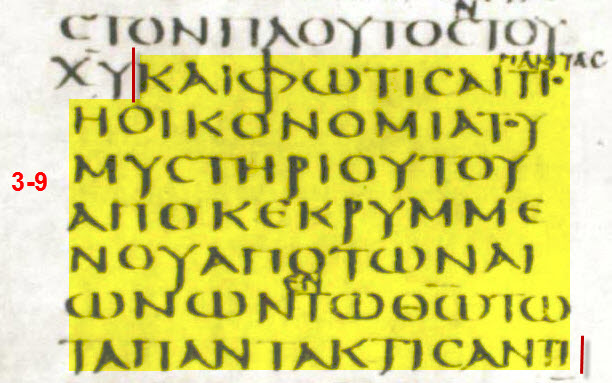
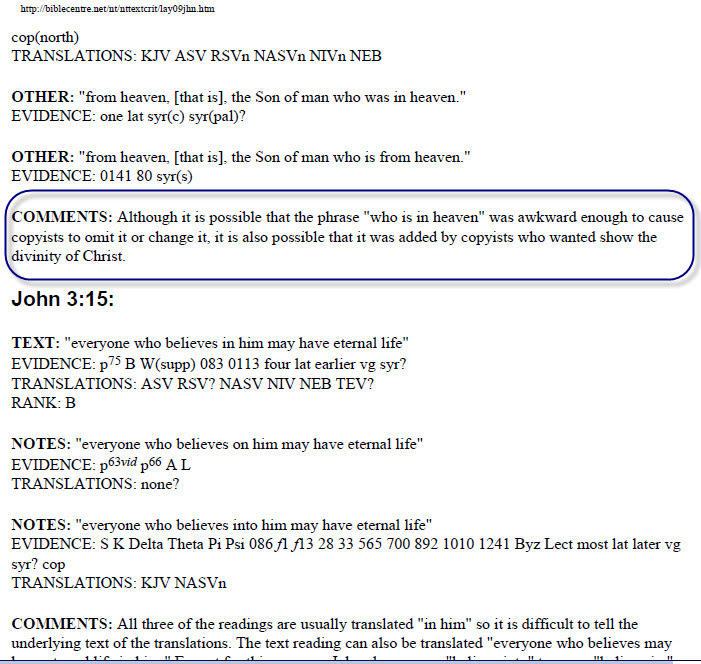
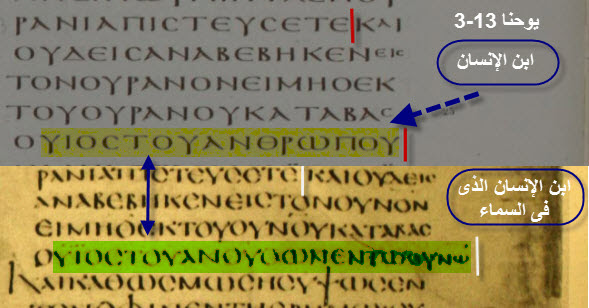
John 3:13: “The Son of Man who is in heaven” — this phrase, strongly supporting the divinity of Jesus, was added by scribes. It is absent from most ancient manuscripts and omitted in modern translations. Bruce Terry: “possibly added by a scribe to emphasize the divinity of Jesus”:
Vatican vs. Alexandrian — John 3:13 comparison:
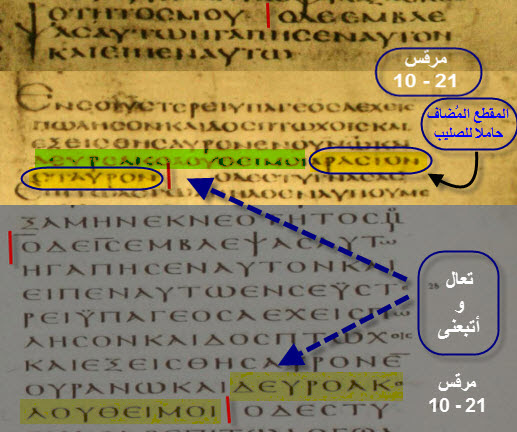
Mark 10:21 — Distortion to support crucifixion and redemption: “Come, follow me” — some manuscripts add “carrying the cross.” This phrase is absent from the Vatican, Sinaitic, and Ephraemi manuscripts and is deleted in modern translations. Metzger confirms:
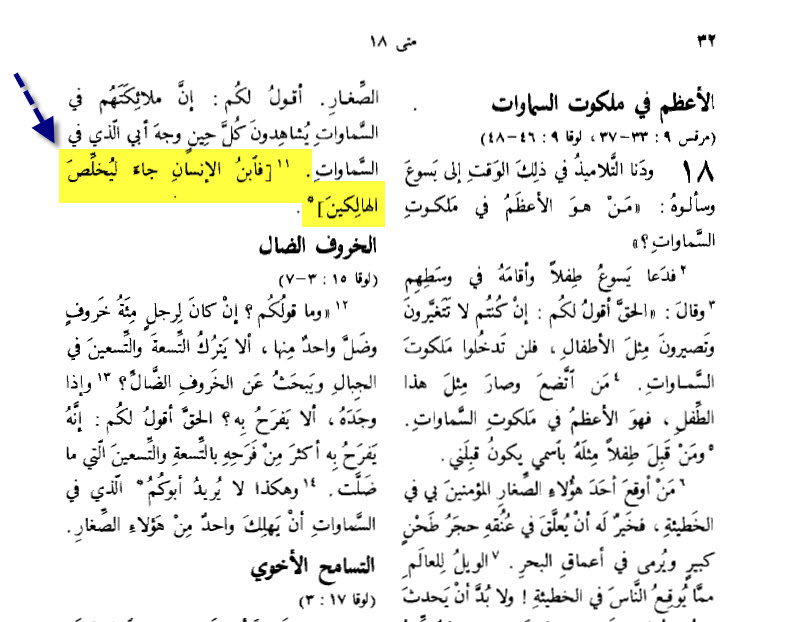
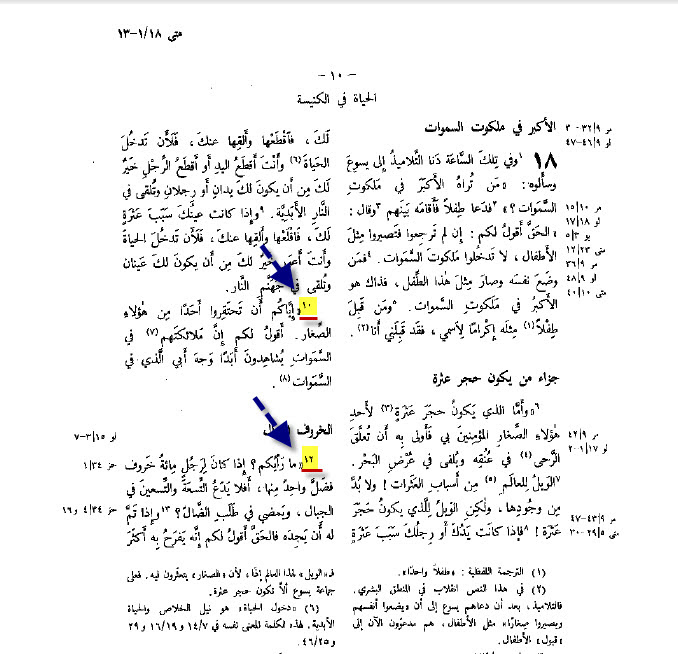
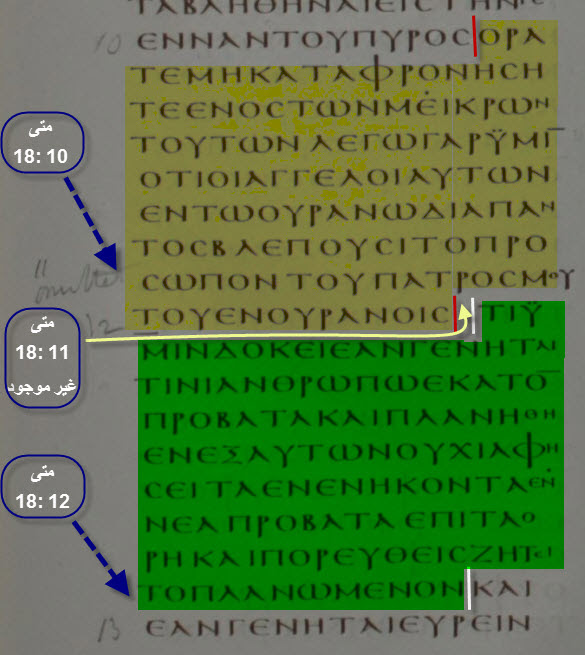
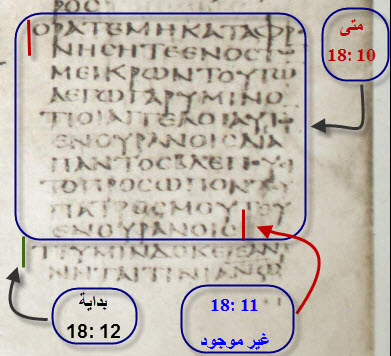
Matthew 18:11: “For the Son of Man came to save what was lost” — absent from ancient manuscripts. Placed in parentheses in the Common Arabic Translation or deleted entirely in the Jesuit Translation:
Ancient manuscripts confirm Matthew 18:11 absent:
12 — Removing Historical and Geographical Difficulties
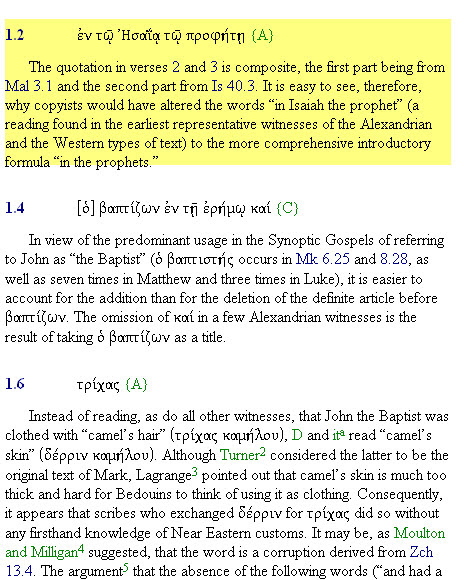
Example 1 — Mark 1:2: The Van Dyke translation reads “As it is written in the Prophets” — but modern translations read “As it is written in the book of Isaiah.” The original text said Isaiah. The problem: the quotation that follows is not from Isaiah but from Malachi 3:1. Scribes changed “Isaiah” to “the Prophets” to cover the error. Metzger and Ehrman both confirm the original is “Isaiah” (Misquoting Jesus, pp. 94–95):
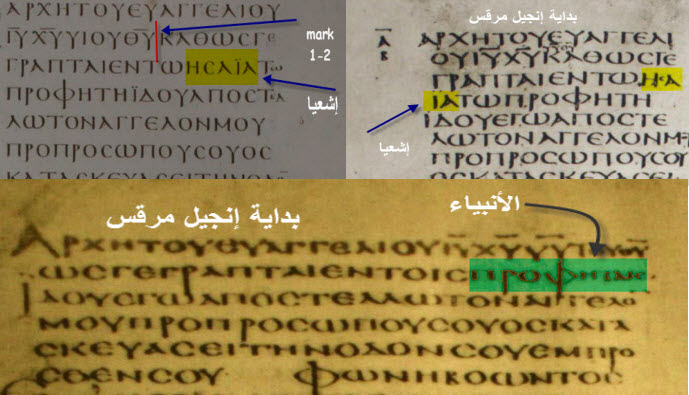
Ancient manuscripts — the original “Isaiah” reading:
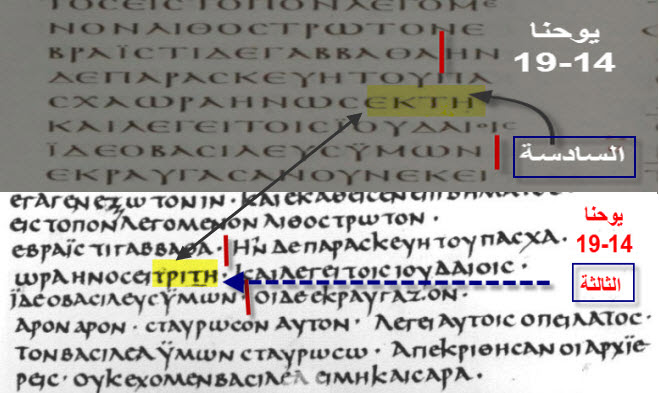
Example 2 — John 19:14 vs Mark 15:25: John says Jesus was sentenced at the sixth hour; Mark says he was crucified at the third hour. Some scribes altered the time in John to reconcile the contradiction. Manuscript comparison:
Example 3 — John 1:28: “This took place at Bethany beyond the Jordan” — Origen changed “Bethany” to “Bethabara” because he found no such place called Bethany in his day. Albert Barnes, Adam Clarke, and Father Matta El-Meskeen all confirm the original is Bethany. Origen changed it on his own geographical ignorance:
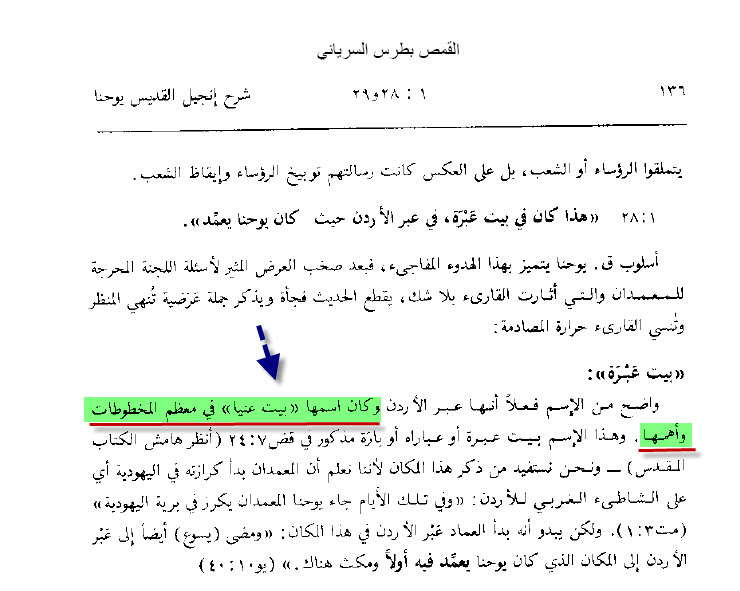
Father Matta El-Meskeen — the Bethany reading found in the most important manuscripts:
Sinaiticus, Vaticanus, and Alexandrinus — all support the original “Bethany” reading:
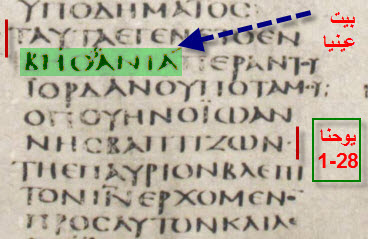
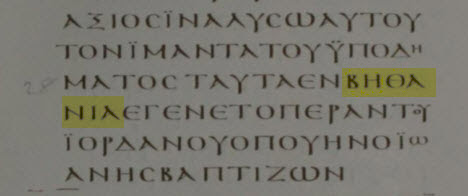
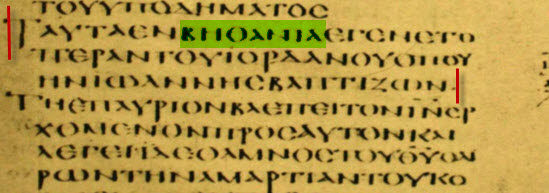
Example 4 — Hebrews 9:4: The text places the golden censer in the Most Holy Place, but Exodus places it in the Tabernacle of Meeting. The scribe of the Vatican manuscript rearranged the verse numbers — moving the golden censer from verse 4 to verse 2 — to eliminate the error. Sinaitic vs. Vatican comparison:
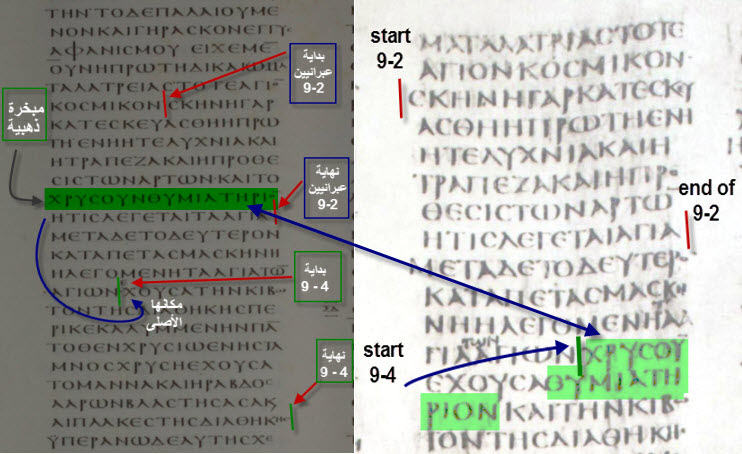
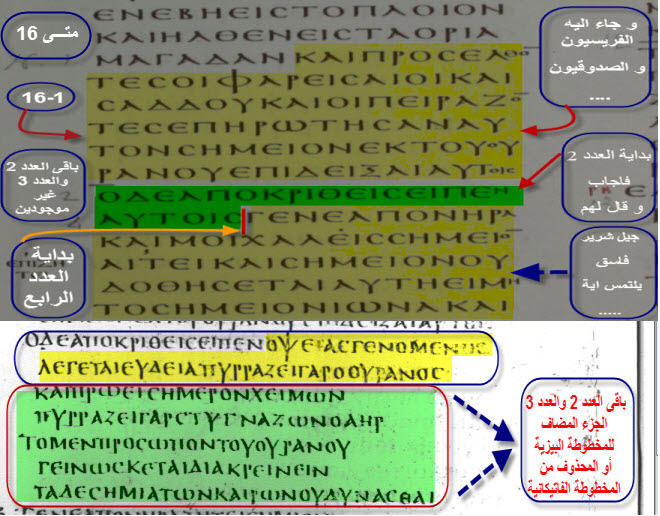
Example 5 — Matthew 16:2–3: The signs-of-the-times passage about a red sky — absent from some manuscripts, possibly deleted by scribes living in Egypt where a red sky does not predict rain. Metzger placed it in brackets (Textual Commentary):
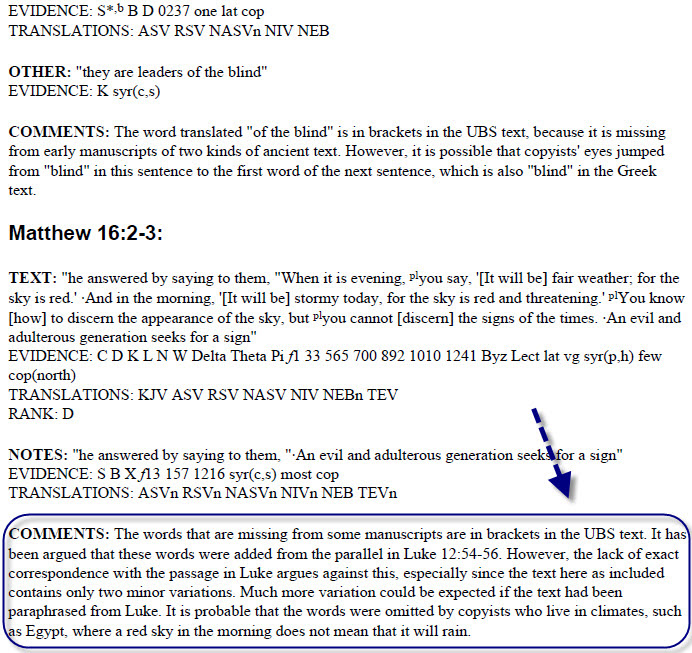
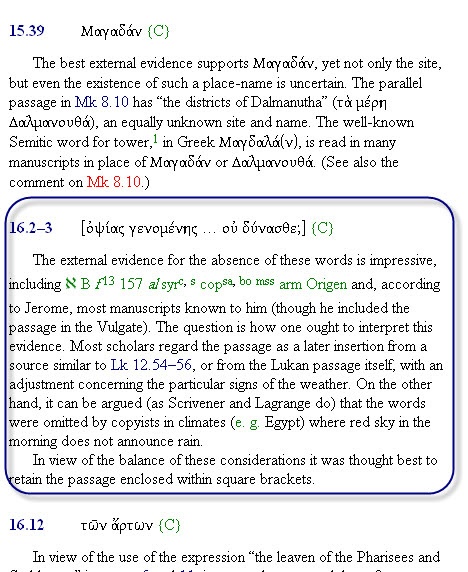
Vatican vs. Bezae — Matthew 16:2–3 comparison:
13 — Introducing Texts Through Oral Tradition
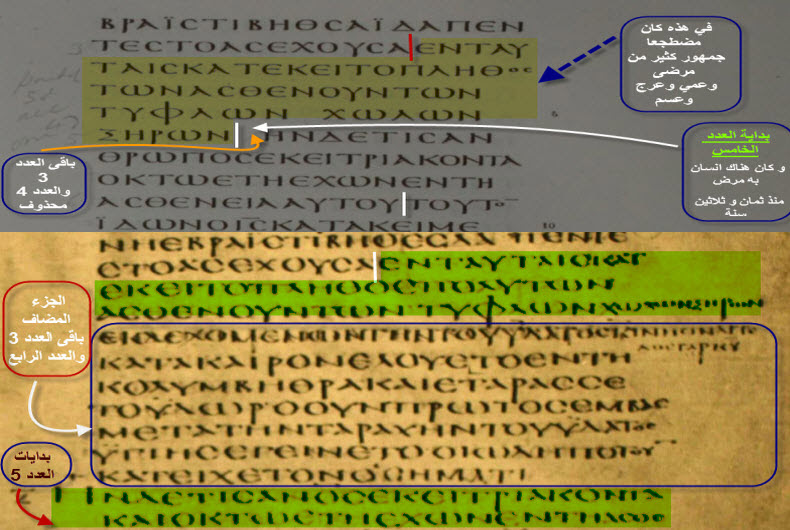
Example — John 5:3–4: “An angel would sometimes go down into the pool and stir the water; and the first person to go down after the water had been stirred was healed.” This entire explanation is absent from the oldest and best manuscripts. It was added from oral tradition to explain verse 7. Ehrman, Bruce Terry, and Metzger all confirm this is an insertion:
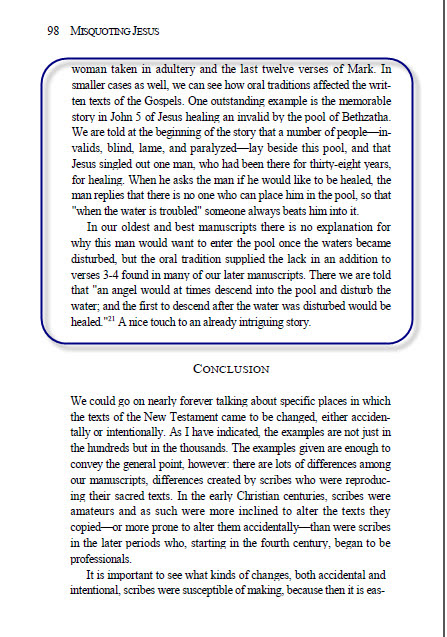
Bruce Terry — the addition explains verse 7, scribal commentary incorporated into text:
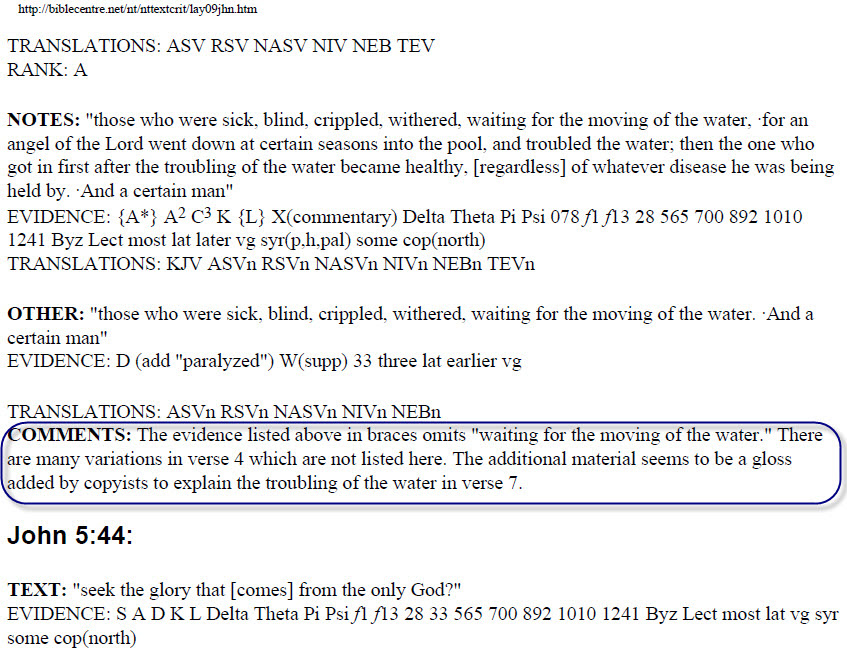
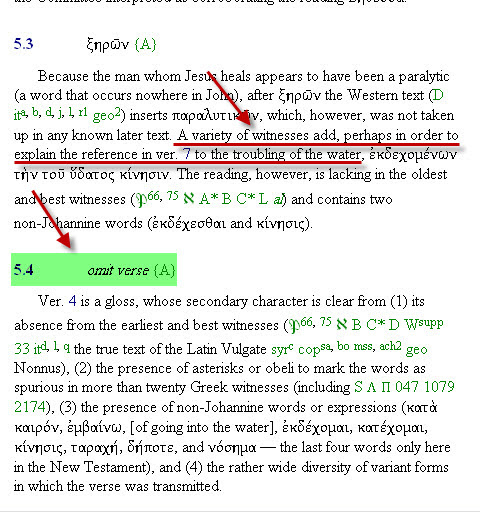
Vatican vs. Alexandrian manuscripts — John 5:3–4 insertion point:
14 — Adding a Religious Framework
The Hebrew version of the Book of Esther (10 chapters — accepted by Protestants and Jews) is religiously impoverished: the name of God does not appear in it even once. The Orthodox/Catholic version has 16 chapters — the extra chapters entered through the Septuagint Greek translation. Jewish scribes added to the book to give it religious character. The Biblical Encyclopedia and Habib Saeed confirm this:
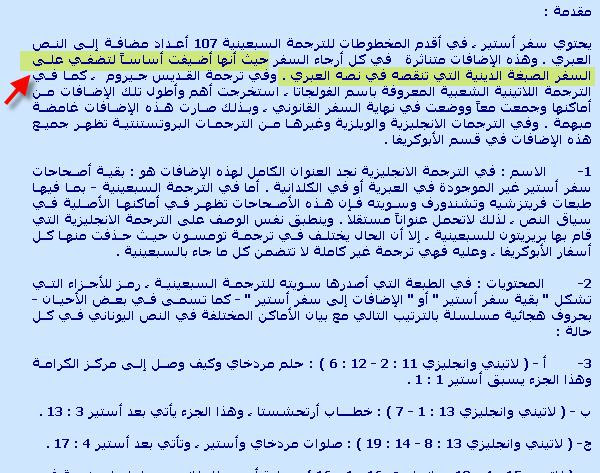
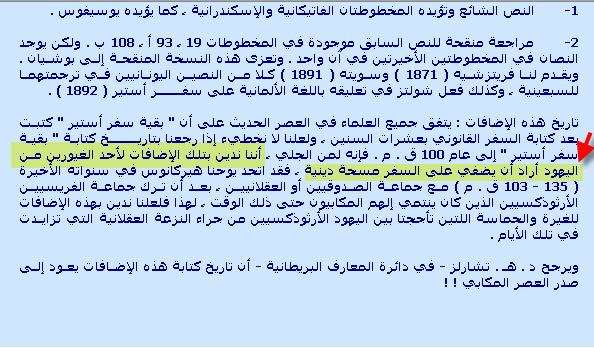
Introduction to the Bible — Habib Saeed:
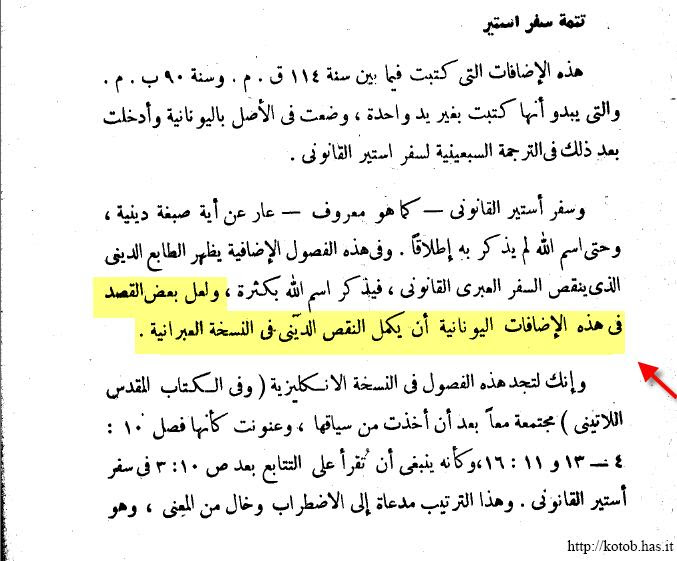
Proof Demands a Verdict — Josh McDowell:
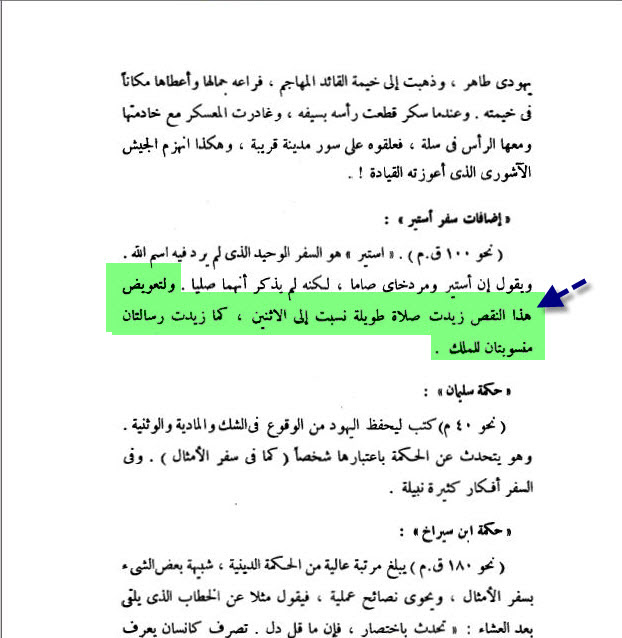
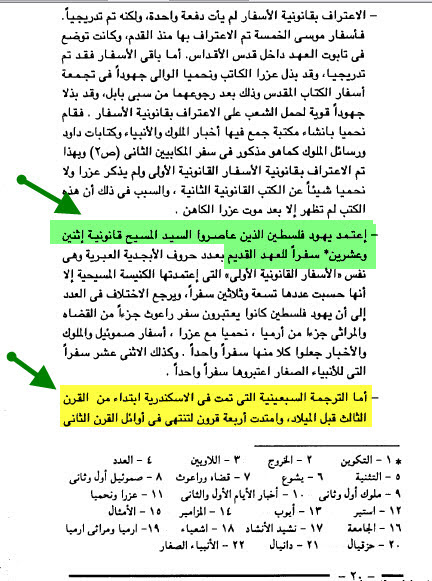
Old Testament Guide — Dr. Malak Mohareb, pp. 20–21 — the additions entered through the Septuagint:
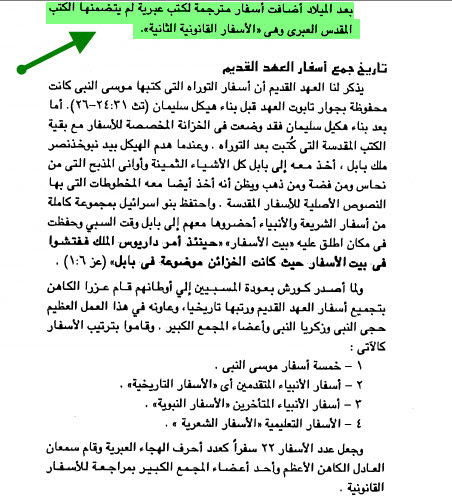
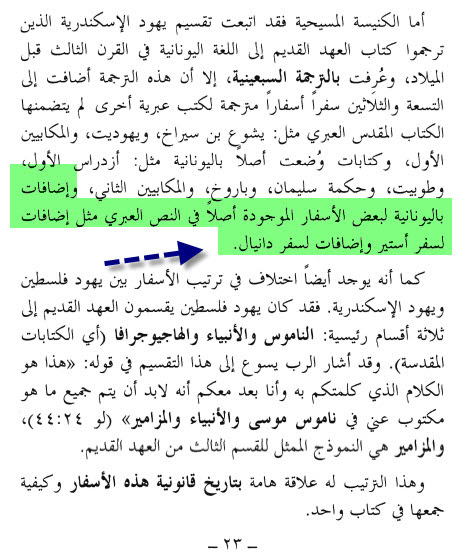
A General Overview of the Bible — additions entered through the Septuagint (p. 23):
15 — Suppressing Moral Difficulty
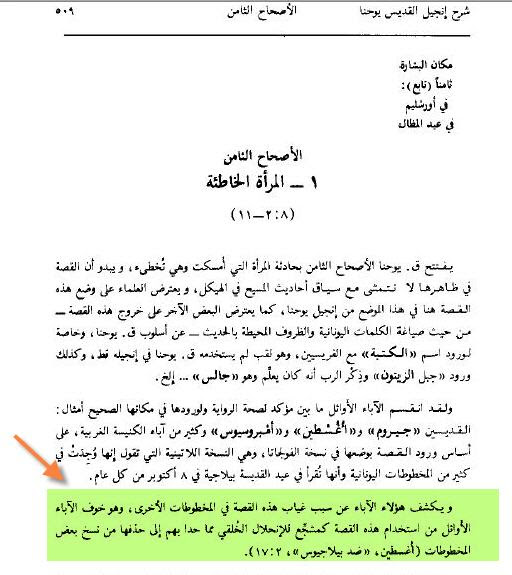
Father Matta El-Meskeen (Commentary, p. 509) documents the Church Fathers’ justification for removing the story of the adulterous woman (John 7:53–8:11) from some manuscripts — because they feared it would encourage adultery:
16 — Respect for Divine Majesty
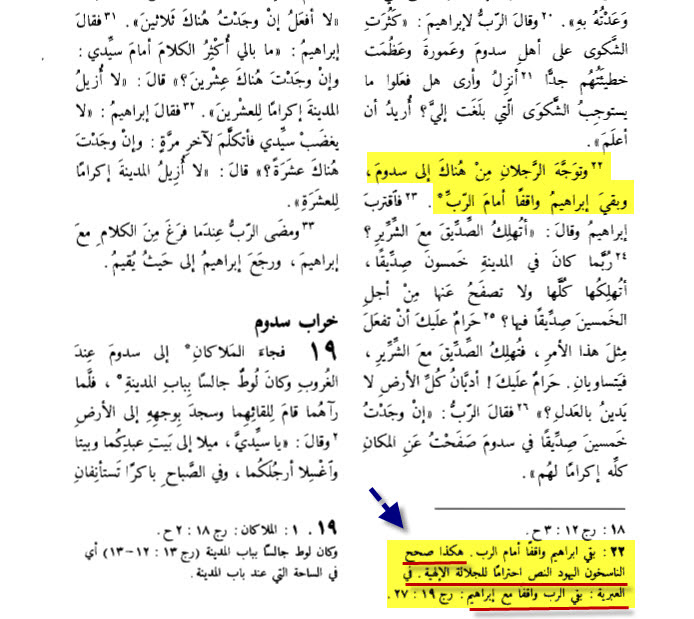
In Genesis 18:22, the scribes changed “The Lord stood before Abraham” to “Abraham stood before the Lord” — because the original phrasing seemed undignified for God. The Common Arabic Translation preserves a note on this:
17 — Jews Deleted What Offended Their Elders
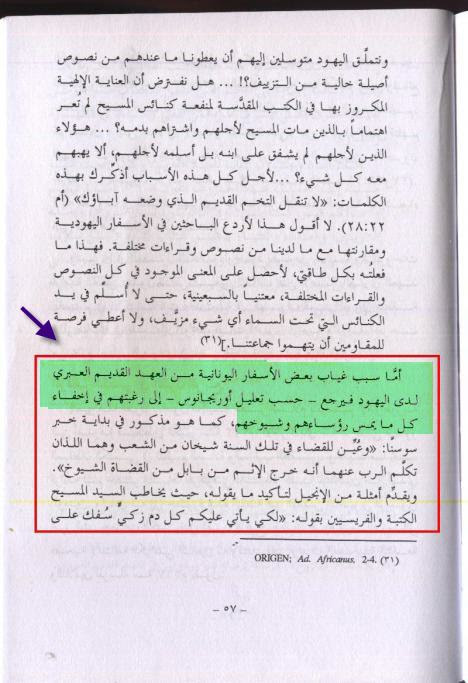
Origen justified the absence of the deuterocanonical books in Jewish texts by accusing the Jews of deliberately deleting passages that were offensive to their elders (The Old Testament as Known by the Church of Alexandria, p. 57):
18 — Grammatical Corrections
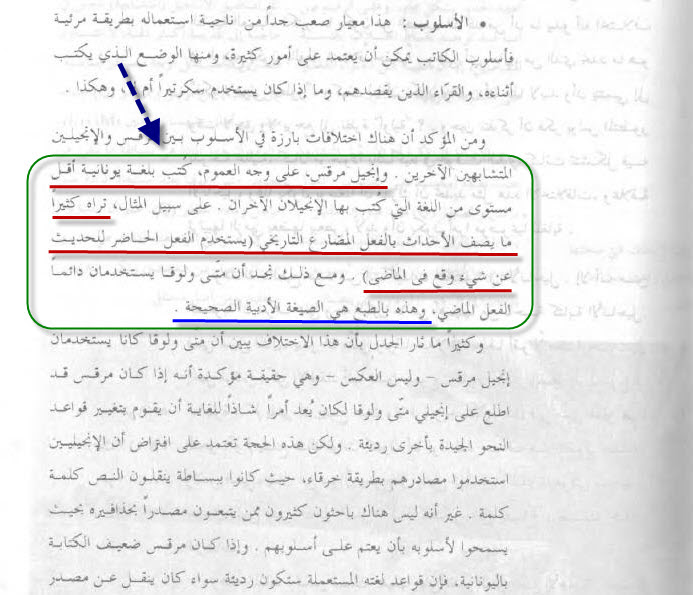
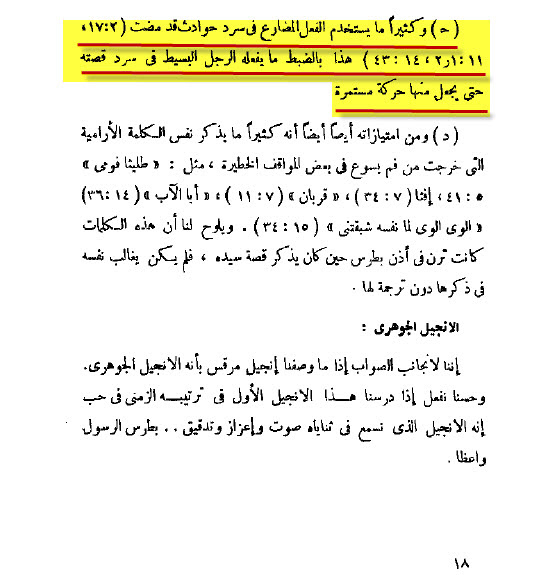
The Gospel of Mark uses the historical present tense (expressing past events in the present tense) — a style that Matthew and Luke corrected. The commentary Jesus and the Four Gospels and William Barclay both confirm this:
Metzger documents grammatical corrections in detail (The Text of the NT, 4th ed., pp. 261–262).
19 — Jews Altered Genealogies
Three versions of the Old Testament exist with thousands of differences between them. The genealogy in Genesis from Creation to the Flood differs dramatically across versions:
| Version | Years from Creation to Flood |
|---|---|
| Hebrew Torah | 1,656 years |
| Samaritan Torah | 1,307 years |
| Septuagint (Greek) | 2,242 years |
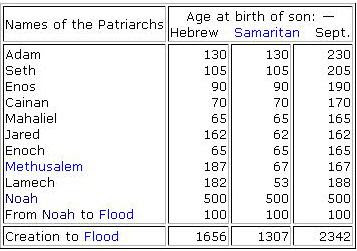
A Guide for Students of the Precious Holy Bible — pp. 569–572:
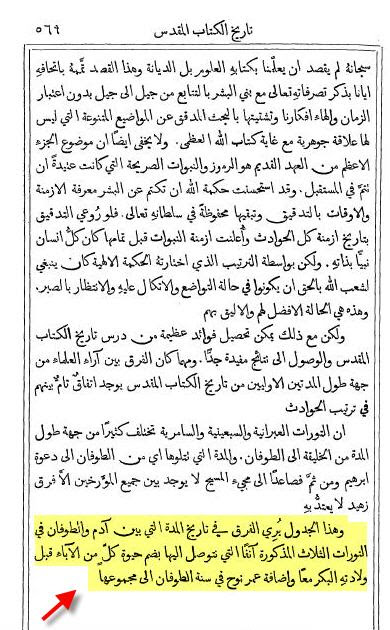
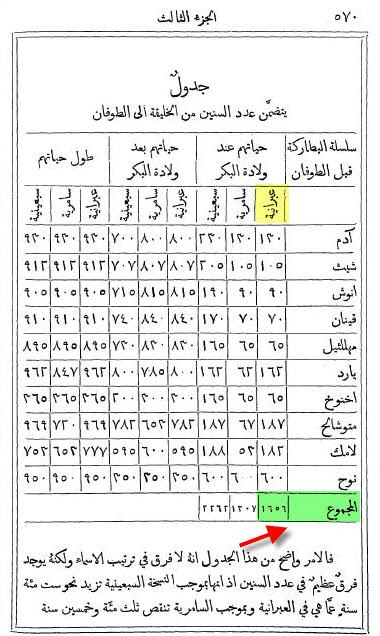
The reason for the discrepancy — pp. 571–572:
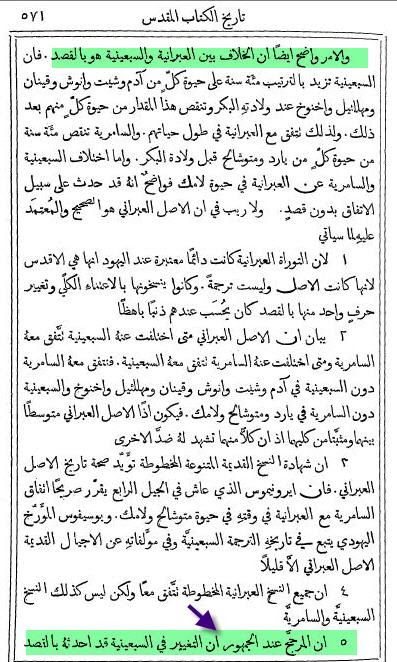
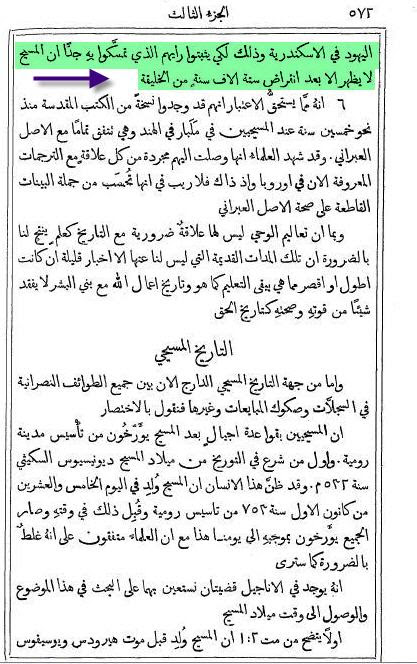
The Jews altered the genealogies in the Greek version to prove their view that the Messiah would appear after 6,000 years.
20 — Miscellaneous Additions
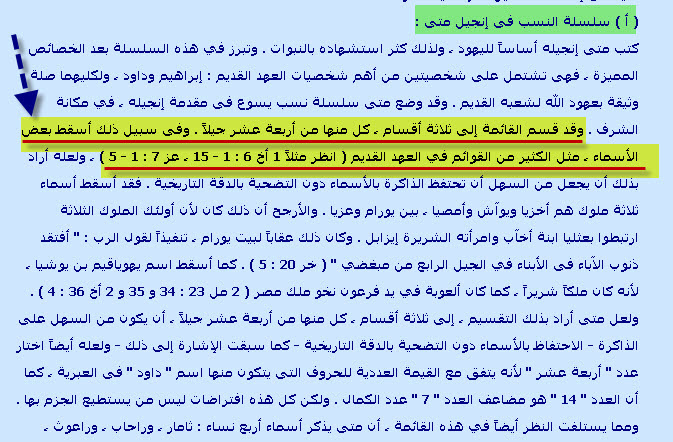
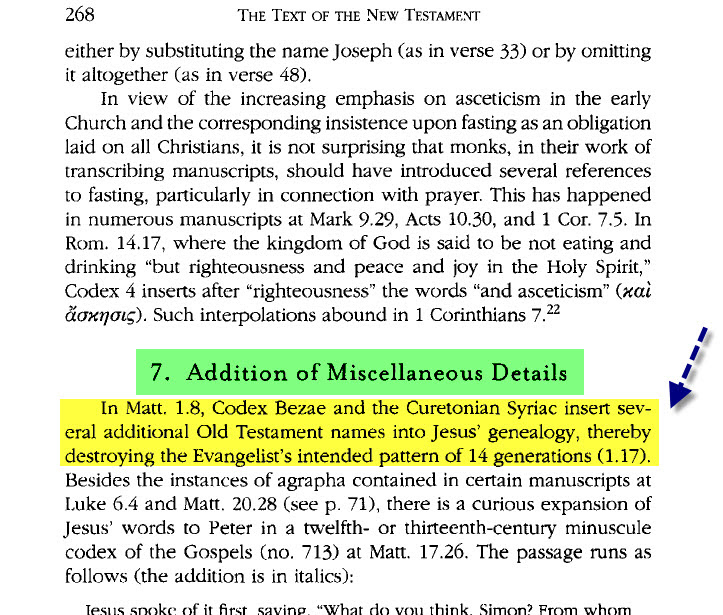
The Genealogy of Matthew: Matthew intentionally structured 14 + 14 + 14 generations, omitting names like Ahaziah, Joash, Amaziah, and Uzziah. The scribe of the Bezae manuscript — displeased — added the missing names from the Old Testament, corrupting the genealogy Matthew intended. Metzger:
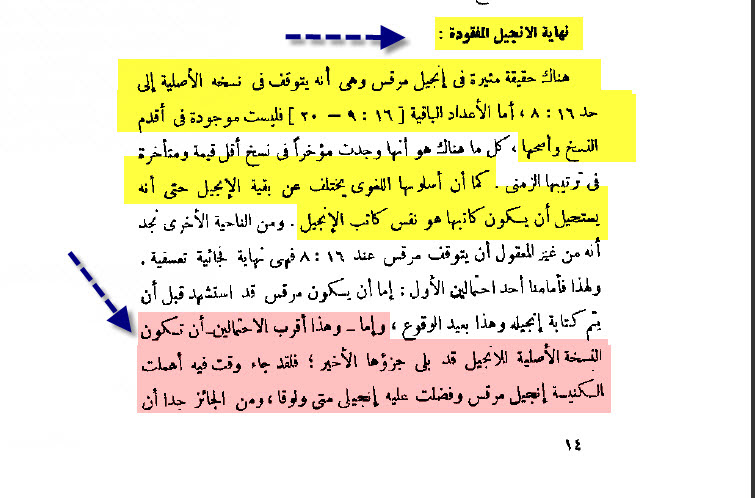
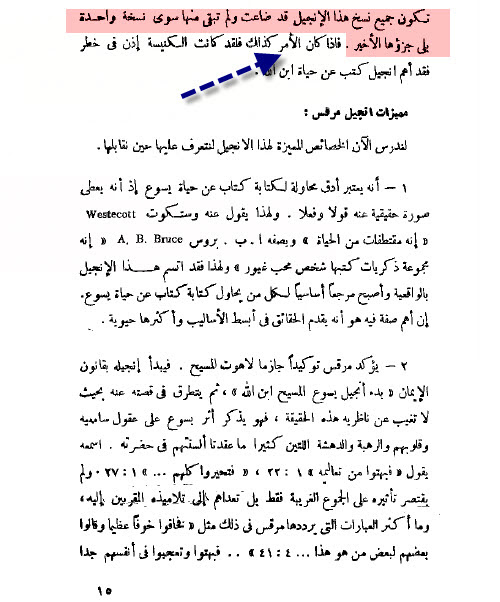
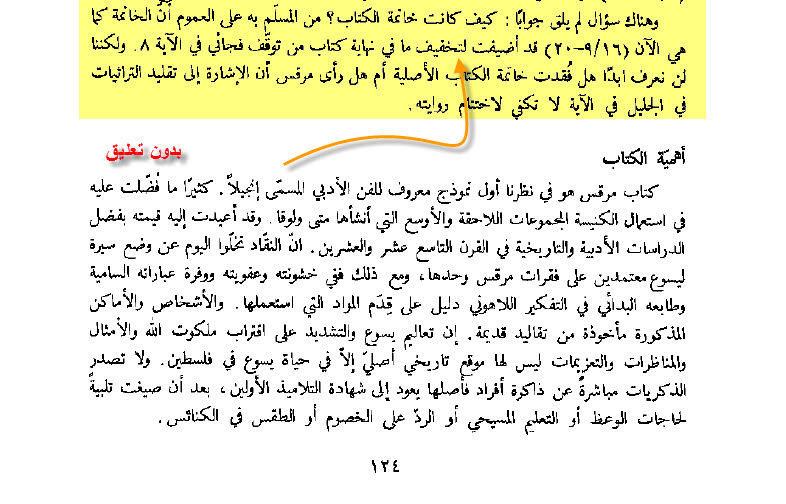
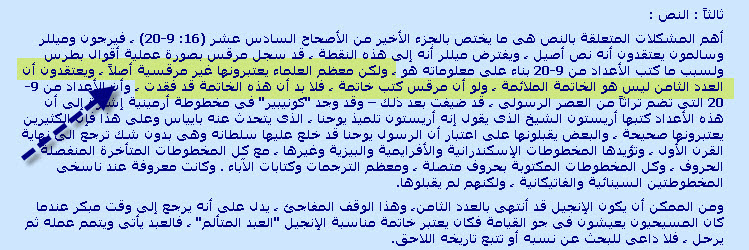
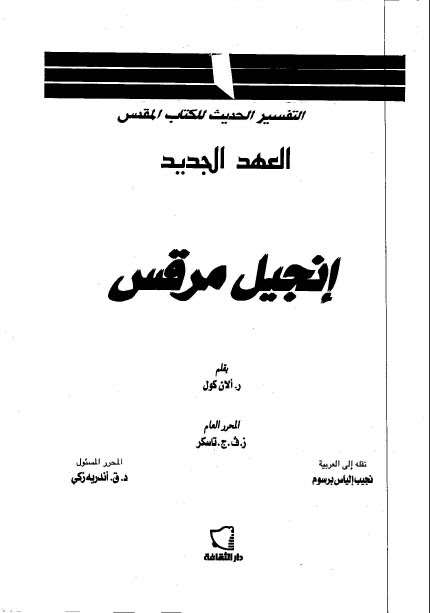
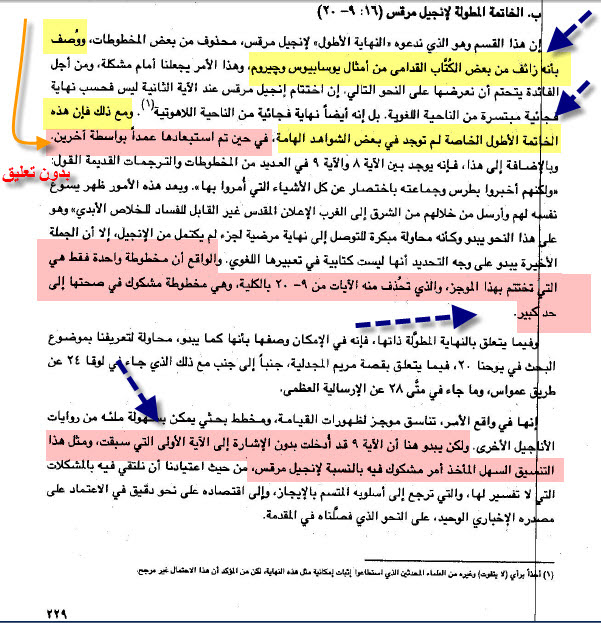
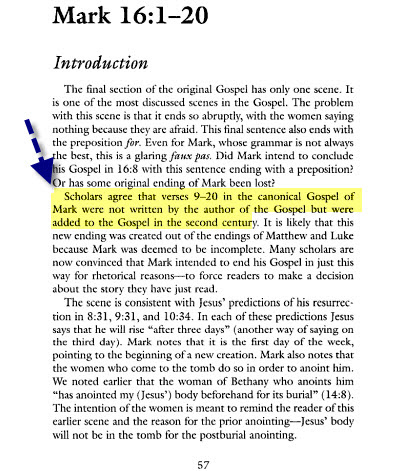
The Ending of Mark (16:9–20): The last twelve verses of the Gospel of Mark were not written by Mark himself — they were added later. Mark’s original ending was lost. Confirmed by: Dr. Fahim Aziz (Introduction to the New Testament, pp. 230–231), Habib Saeed (Introduction to the Holy Bible, pp. 22, 33), Father Matta El-Meskeen (Commentary on the Gospel of Mark), the Biblical Encyclopedia, William Barclay (Commentary on Mark), the Jesuit Translation, and Timothy R. Carmody (The Gospel of Mark, p. 57):
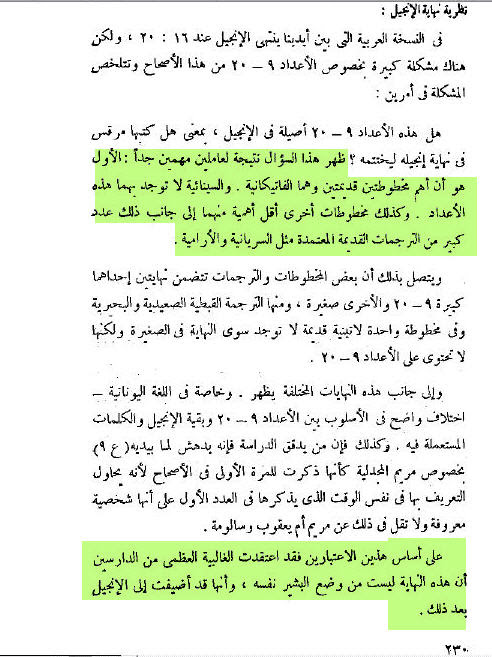
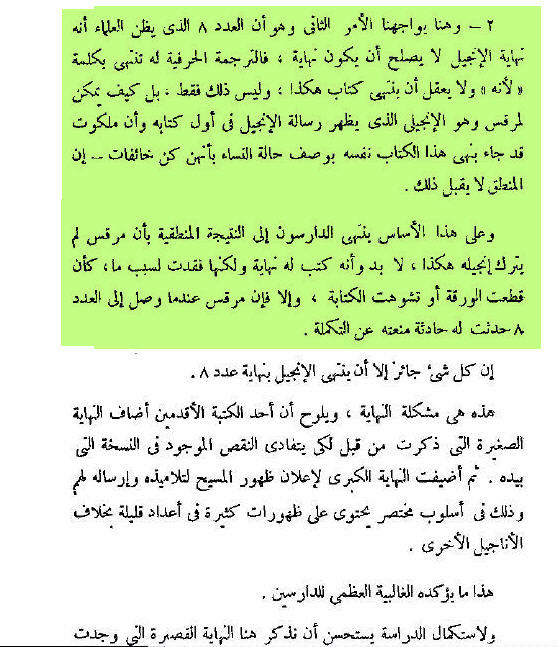
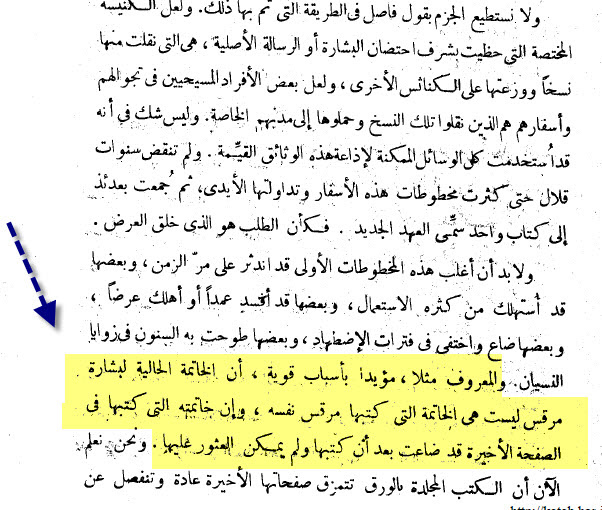
Father Matta El-Meskeen — the last part of the original version is lost:
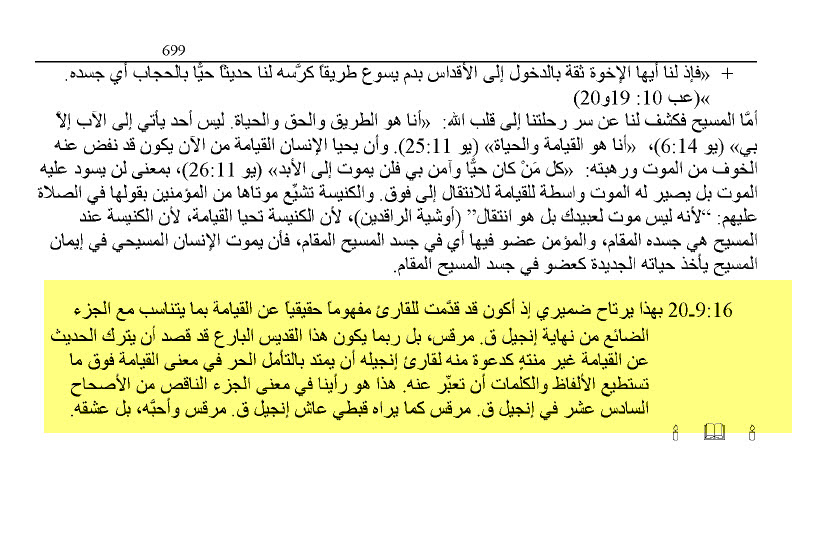
William Barclay — impossible that the current ending was written by the same author as the Gospel:
Jesuit translation — Mark wrote an ending but it has been lost:
Biblical Encyclopedia — the current ending is false (Eusebius and Jerome):
Modern Commentary on the Bible — Gospel of Mark (p. 229):
Timothy R. Carmody — scholars agree current ending added in 2nd century:
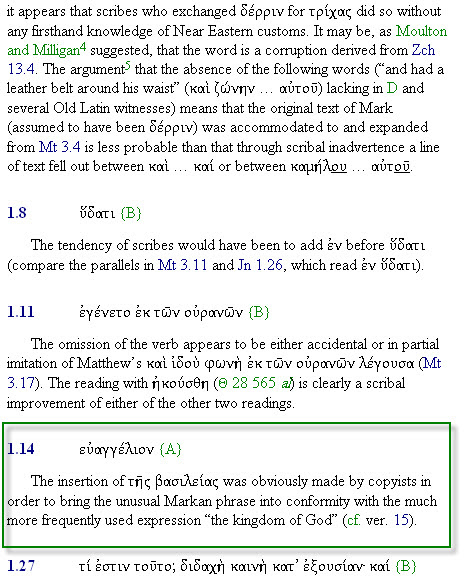
A scribe changed “good news of God” to “good news of the kingdom of God” in Mark 14:1 because it did not fit the writer’s usual style. Metzger:
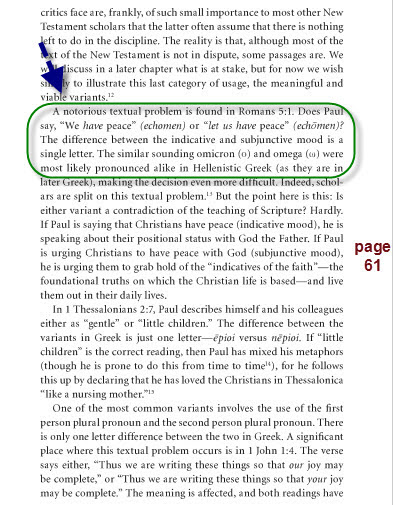
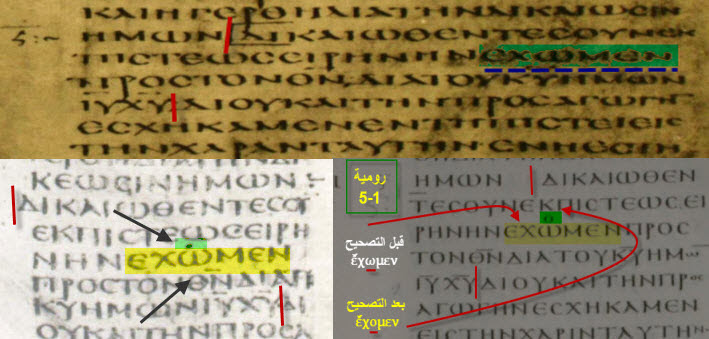
Even one letter changes meaning: Romans 5:1 — “We have peace with God” (ἔχομεν, micron) or “Let us have peace with God” (ἔχωμεν, omega) — the entire meaning shifts with one letter. Vatican and Sinaitic (after correction) read ἔχομεν; the Alexandrian reads ἔχωμεν (Reinventing Jesus):
1 Corinthians 13:3 — “give my body to be burned” (καυθήσομαι) vs. “give my body to boast” (καυχήσωμαι) — two letters different, meaning entirely changed. Metzger’s committee “found it difficult to make a definitive decision” (Textual Commentary).
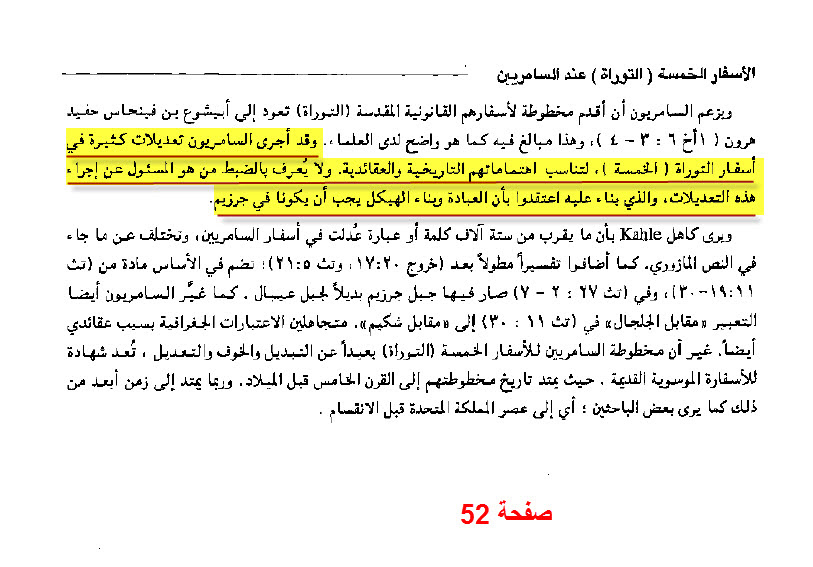
Dr. Samuel Youssef accuses the Samaritans of altering the Torah — then admits we do not know who did it:
Conclusion — The Verdict from Christian Sources
This research began with four questions, and Christian scholarship has answered every one of them.
Can we take any certainty from this book? The answer that emerges from the sources is no — not because Muslims say so, but because the scholars who devoted their lives to studying it say so. Bart Ehrman does not hesitate: “We do not own the originals. What we own are distorted copies.” The Catholic Encyclopedia does not hesitate: “No ancient book has reached us exactly as it left the author’s hands — all have been altered in some way.” Bruce Metzger does not hesitate: “The text was corrupted.” These are not fringe voices. These are the most respected names in biblical scholarship in the Western world.
Who sanctified this book, and was it distorted? The research has demonstrated that sanctification was a process — messy, disputed, drawn out over centuries, and ultimately resolved not by divine guidance but by committee vote. The Council of Trent in 1546, nearly sixteen centuries after Christ, was the first moment any body of Christians settled on the precise contents of the Bible by formal decision — and even then, 27% of those present voted against it and 29% abstained. A book whose table of contents required a vote to finalize cannot claim the certainty of divine preservation.
What are the sources of this book? We have traced them. For the New Testament, the primary sources are Mark, the lost Document Q, the lost Document L, and the lost Document M. For the Old Testament, the four documentary traditions J, E, D, and P — compiled by persons unknown at dates unknown — alongside a library of now-vanished books that the Old Testament writers themselves quoted: the Book of Jasher, the Book of the Acts of Solomon, the books of Nathan, Gad, Samuel, Ahijah, and Iddo. Not a single one of these foundational sources survives today. We are dealing with a book built on a foundation of lost texts, which were themselves of uncertain inspiration.
Did the ancient church know this book? No — not in its current form. The research has shown that Clement of Alexandria’s Bible contained the Epistle of Barnabas and the Apocalypse of Peter. Origen’s Bible contained the Acts of Paul and the Shepherd of Hermas. Eusebius rejected 2 Peter and Revelation. The Syrian Church read the Diatessaron and accepted a Third Epistle to the Corinthians. The Ethiopian Church accepted 81 books. The Eastern Church rejected Revelation for centuries. The Western Church rejected Hebrews. Every Church Father had, in effect, his own personal canon. There was no single ancient church that knew a book called the Holy Bible consisting of 66 or 73 books — because that book did not exist as a fixed entity until centuries after the last apostle died.
Were the scribes aware they were copying a holy book? The research is unambiguous. Some scribes treated every word as sacred and copied with precision. Others believed only the message was inspired and felt free to adjust the wording. Still others revised deliberately — to counter heretics, to defend Jesus from pagan attacks, to remove phrases that seemed to limit Christ’s power, to suppress passages that could encourage immorality, to add doxologies from liturgical tradition, to reconcile contradictions between Gospel accounts. And some were simply amateurs who made mistakes — errors of sight, errors of hearing, errors of memory — that then propagated through every copy made from their copies for centuries.
The Four Pillars of Doubt
The research has established four independent lines of argument, each sufficient on its own, and devastating when taken together.
First — the problem of origins. A book that was copied from other books of unknown nature and unknown inspiration cannot itself make an unqualified claim to inspiration. When Matthew copied from Mark, and when both Matthew and Luke copied from the lost Q source, the question becomes inescapable: on what divine authority did they select what to copy, what to change, and what to omit? The Gospel writers themselves were, as we have seen, revisers — William Barclay used that exact word. They revised. Revision is not revelation.
Second — the problem of the canon. If the Bible is the Word of God, then surely the community of believers would have been guided to recognize it consistently from the beginning. Instead, we find centuries of disagreement, books accepted and then rejected, books rejected and then accepted, individual Fathers each holding different canons, regional churches using entirely different collections, and a final resolution achieved only by vote. The idea that tradition guided the Church to the correct books collapses immediately when we ask: which tradition? The tradition of the Eastern Church that rejected Revelation? The tradition of the Syrian Church that accepted the Diatessaron? The tradition of Clement, who accepted the Apocalypse of Peter? The traditions contradict each other at every turn.
Third — the problem of authorship. Both Protestant and Orthodox conditions for canonicity require that a book be written by an identifiable man of God — an apostle or an apostolic eyewitness. Yet the authors of the following books are unknown: Esther, Ruth, Job, Samuel, Chronicles, Song of Songs, Judith, Tobit, the orphan Psalms, the Gospel of Matthew, the Gospel of Mark, the Gospel of Luke, the Gospel of John, the Acts of the Apostles, the Epistle to the Hebrews, the Epistle of Jude, and the Second Epistle of Peter. Scholars almost unanimously agree that Peter did not write 2 Peter, and that John did not write the Fourth Gospel or the three Johannine epistles. The churches’ own criteria, applied honestly, would exclude most of the books the churches have declared canonical.
Fourth — the problem of the text. Even if we grant that the original authors were inspired — which the preceding three arguments have called into question — the text that has reached us is demonstrably not what those authors wrote. Between 300,000 and 400,000 textual variants separate the manuscripts from one another. The changes were both unintentional — errors of sight, hearing, and memory by amateur scribes — and intentional — theological revisions, apologetic corrections, harmonizations, liturgical additions, and doctrinal adjustments. The Johannine Comma, the only verse in the entire Bible that explicitly states the Trinity, is not part of the original text. The last twelve verses of Mark were not written by Mark. The story of the woman caught in adultery was taken from an unknown source and inserted into John. The phrase “baptizing them in the name of the Father and of the Son and of the Holy Spirit” in Matthew 28:19 was not part of the earliest Christian practice and is suspected by scholars to be a later formulation. These are not peripheral matters. They touch the core doctrines of Christianity.
What Remains
The Christian apologist has several standard responses to these arguments, and it is worth addressing them directly — using Christian sources.
“Most variants are insignificant.” This is true of some — spelling differences, synonyms, minor word order changes. But as the classification in the research shows, a meaningful proportion of variants are significant, and some are theologically decisive. The presence or absence of “nor the Son” in Matthew 24:36 is not a spelling error. The difference between “my beloved Son, in whom I am well pleased” and “today I have begotten you” in Luke 3:22 determines whether Luke’s Gospel supports adoptionism. The presence or absence of the Johannine Comma determines whether the Bible explicitly teaches the Trinity. Significance cannot be wished away by pointing to insignificant variants.
“We can reconstruct the original through textual criticism.” Textual criticism is a discipline of probabilities, not certainties. Bart Ehrman and Bruce Metzger — the two most authoritative names in New Testament textual criticism — disagree on multiple significant readings. On John 7:8, they agree the original says “not” (making Jesus appear to lie) but acknowledge the change was deliberately made. On Luke 3:22, Ehrman argues one reading is original while Metzger argues the opposite. The discipline produces best guesses — informed, rigorous, scholarly best guesses — but guesses nonetheless. A religion that rests on the verbatim Word of God cannot be satisfied with best guesses.
“The message is preserved even if details vary.” This concession — offered by some liberal theologians — actually surrenders the traditional claim. If what matters is the general message rather than the precise text, then verbal inspiration is abandoned, and with it the claim that every word of the Bible is the Word of God. One cannot have it both ways: either every word matters (in which case 300,000–400,000 variants is catastrophic) or only the general message matters (in which case the Bible is a human document conveying religious ideas, not a divine text demanding absolute submission).
The Contrast with the Quran
This research, as stated at the outset, does not address Islam. But the contrast that emerges from the evidence is one that the evidence itself creates. A book whose sources are lost, whose canon was settled by vote in 1546, whose authors are unknown, whose transmission was handled by amateurs and pagans, whose text contains between 300,000 and 400,000 variants, and whose most important theological verses were added centuries after the events — this book occupies a fundamentally different epistemic position from a scripture whose transmission, preservation, and authority are grounded in an unbroken chain of human memory, recorded recitation, and scholarly consensus spanning fourteen centuries without a Council of Trent, without a vote, and without 400,000 variants.
That contrast was not drawn by this research. It was created by the evidence that Christian scholars themselves have produced.
Closing
The questions that opened this research — who sanctified this book, was it distorted, who distorted it, and can we trust it — have been answered. The answers come from Bart Ehrman, Bruce Metzger, William Barclay, the Catholic Encyclopedia, the Jesuit translation, Pope Shenouda, Father Tadros Yacoub Malti, Dr. Fahim Aziz, Habib Saeed, Justin Martyr, Origen, John Chrysostom, Father Dionysius, Eusebius of Caesarea, and dozens of others who spent their lives studying the book they loved.
They found what they found. We have simply collected it.
سبحانك اللهم وبحمدك، أشهد أن لا إله إلا أنت، أستغفرك وأتوب إليك.
Glory be to You, O Allah, and praise be to You. I bear witness that there is no god but You. I seek Your forgiveness and repent to You.
All sources cited in this research are from Christian scholars, Church Fathers, and Western biblical scholarship. No Islamic scripture has been referenced in the analysis.
Related
Problems of Mark 1_2 3 Quotations and Distortions
The Problem of Distorting Luke 1 28
Distortion of the Text of Luke 23_45 From the Eclipse of the Sun Until the Sun Was Darkened
Distortion of the Text of Luke 23_34 “Father, Forgive Them, for They Do Not Know What They Do
Distortion of the Text of John 5_3 4 Regarding the Moving of the Water and the Angel of Blessing
When an Accidental Error Is More Serious Than a Deliberate Distortion the Problem of Matthew 27_35
Nazareth, Netzer, and Matthew 2:23: The Failed Christian Defense Refuted
Corruption of the Gospel of John 9 35
The Johannine Comma From Christian References( 1 John5_7
1 John_ Not Written by John or the Apostle
Distortion of the Text of Matthew 17 21
John 5:4 Is Not in the Bible: Manuscript Evidence Exposes a Major New Testament Distortion
Matthew 5 44( LOVE YOUR ENEMIES
...ble consequence: when doctrine precedes text, the text must eventually be made to conform to the doctrine. The Bible itself, in its oldest recoverable form, describes Jesus in the words of his own...
.... Many incidents seem to have been deliberately placed to prove the fulfillment of prophecies in the Old Testament, and many passages may have been intended to provide a historical basis for a later...
...ning in the KJV and versions based on the later received text. The textual evidence and the admissions of Christian textual commentators show that this phrase was a later theological addition...
...uthoritative scribes rather than at the level of copyists, every subsequent manuscript inherits and faithfully reproduces the corruption. Abundance of manuscripts does not protect the text — it...
...f the Lord Himself." From the book Misquoting Jesus — p. 53 by Bart D. Ehrman [[Corruption of Bible]]
...he-biblical-text|Genesis 34 and the Rape of Dinah — Internal Contradictions Proving Later Insertion Into the Biblical Text]]
...the fifteenth century. The question that every Christian must answer is simple: which canon, and decided by whom?
...p by modern scholars and the Church itself — was nonetheless included in the final canon by councils, tradition, and consensus. This is not the preservation of a divine revelation. It is the...
...spels as Propaganda — Cambridge Companion to the Bible]] — the final scholarly verdict See also:...
e.