

1 John Authorship — Anonymous Letter with No Confirmed Link to the Apostle John
1 John is an anonymous letter, and its true author is unknown. Though traditionally attributed to the Apostle John, there is no concrete evidence linking him to it.
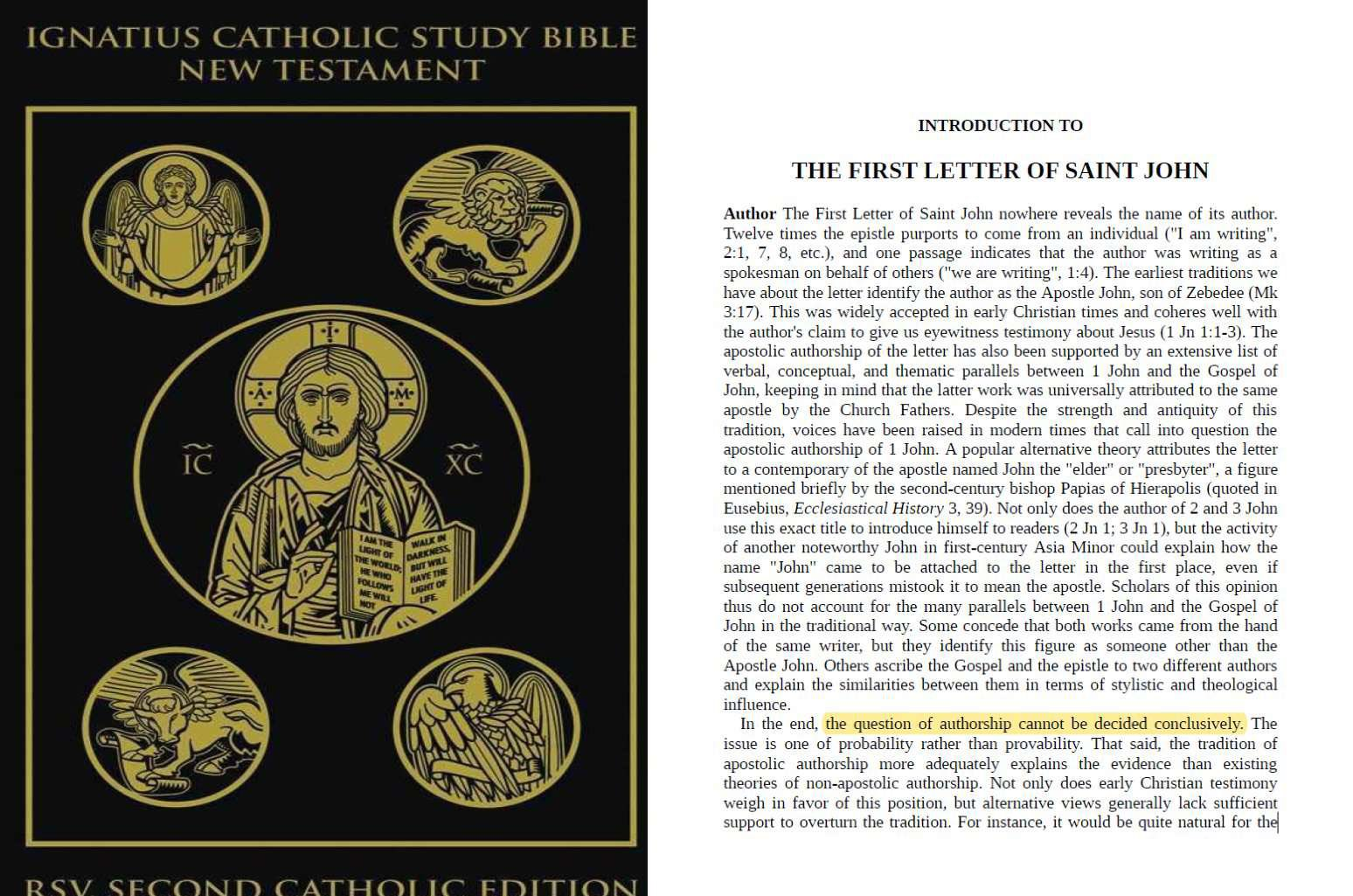
The following image is taken from a scholarly source noting the foundational problem of authorship in 1 John.
The Ignatius Catholic Study Bible: New Testament states, “the question of authorship cannot be decided conclusively.” This means we can’t be certain who wrote 1 John, making its authenticity highly questionable.
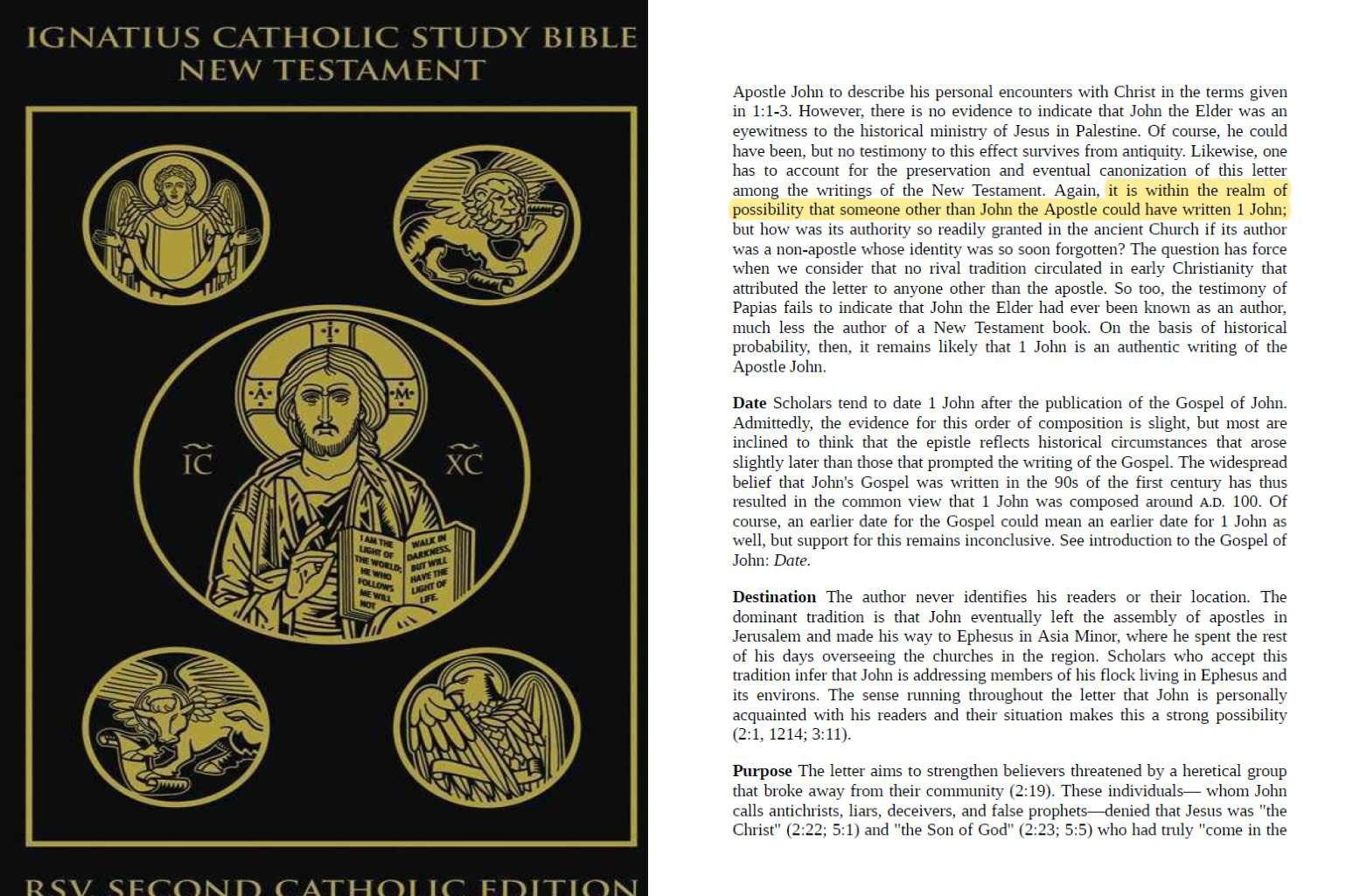
The following image shows the same resource going further, explicitly naming the possibility of non-apostolic authorship.
The Ignatius Catholic Study Bible: New Testament acknowledges that “it is within the realm of possibility that someone other than John the Apostle could have written 1 John,” raising doubts about its true authorship.
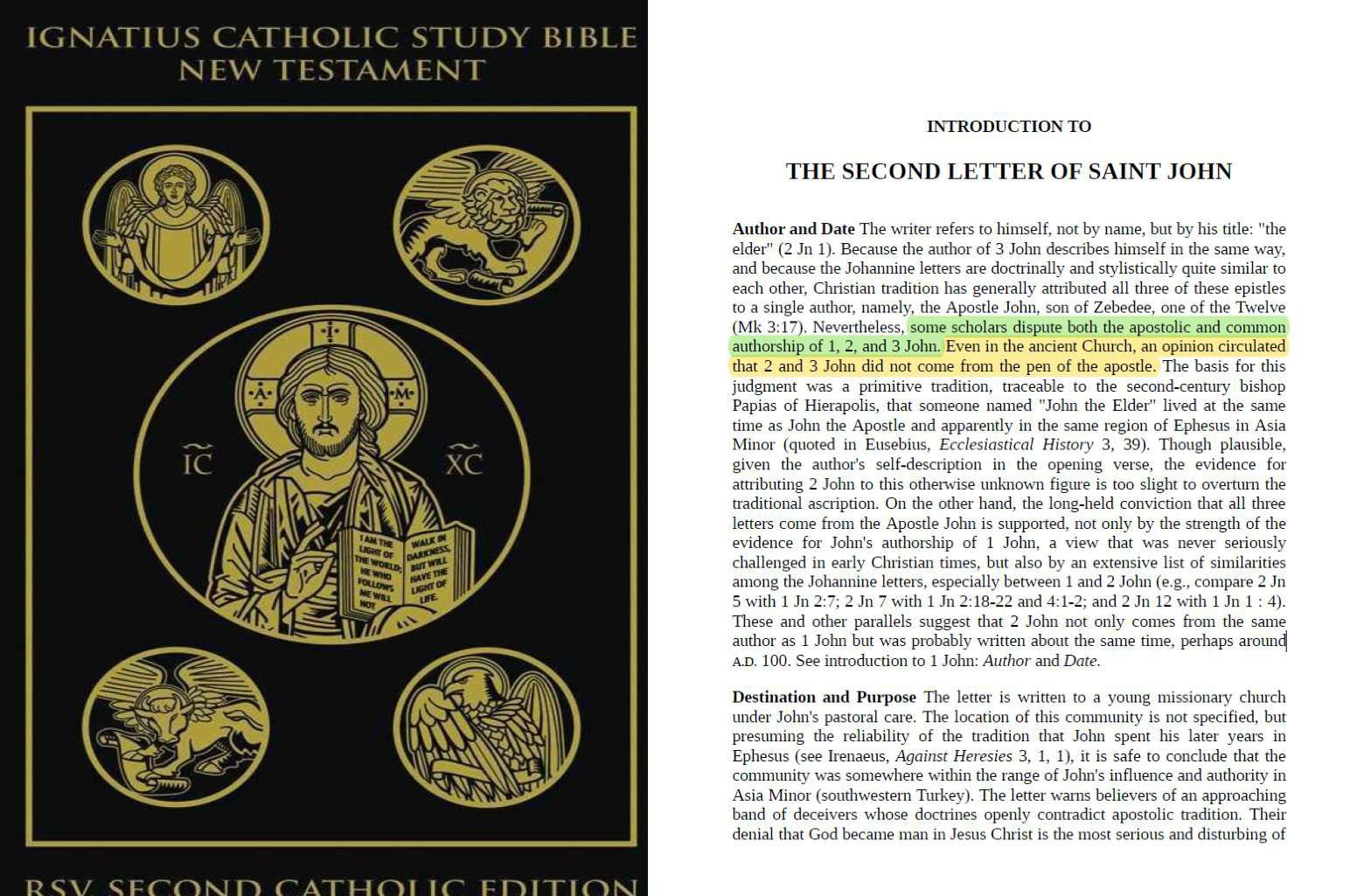
The following image shows the Ignatius Catholic Study Bible acknowledging that this dispute about authorship is not a modern development but goes back to the ancient Church itself.
The Ignatius Catholic Study Bible: New Testament states that “some scholars dispute both the apostolic and common authorship of 1, 2, and 3 John. Even in the ancient Church, an opinion circulated that 2 and 3 John did not come from the pen of the apostle.”
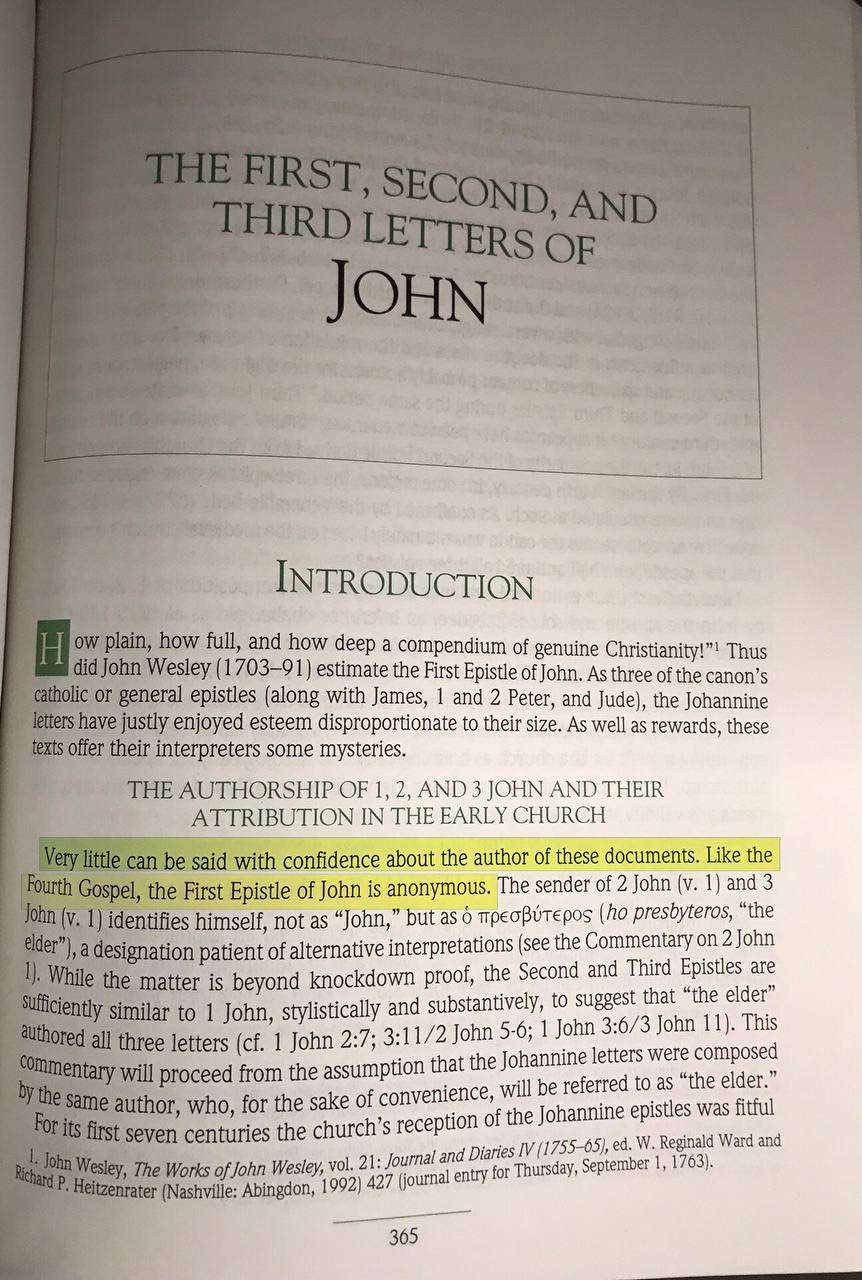
The following image is taken from a scholarly source noting that, like the Fourth Gospel, 1 John contains no internal claim of authorship.
Scholars note that very little can be said with confidence about the author of these documents. Like the Fourth Gospel, 1 John is anonymous, adding to the uncertainty of its true authorship.
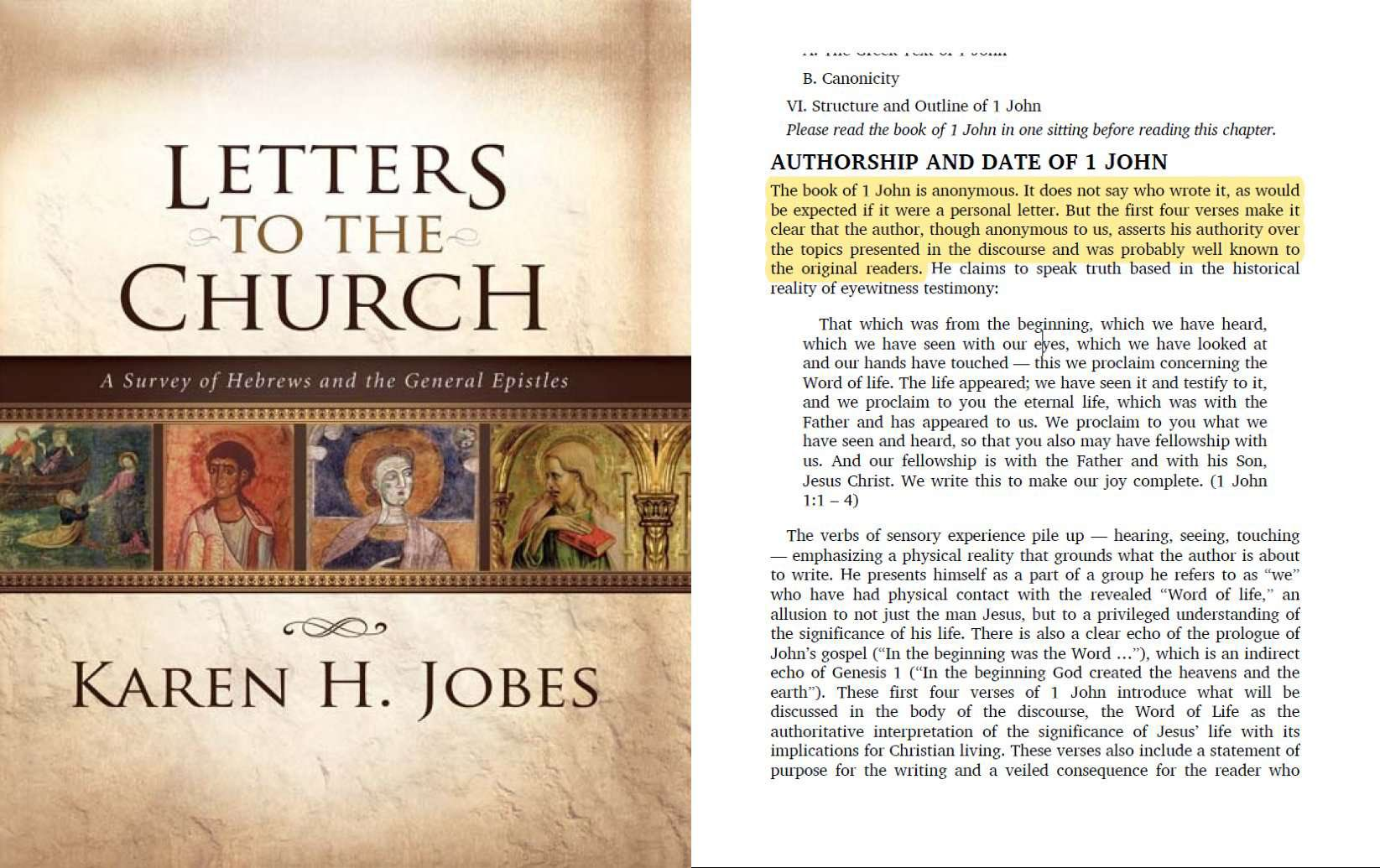
The following image is from a scholarly source expanding on the anonymous character of 1 John and what that anonymity means for questions of authority and readership.
Biblical scholar Karen H. Jobes states that 1 John is anonymous and does not identify its author, as expected in a personal letter. However, the first four verses show the author’s authority over the topics and suggest they were well known to the original readers.
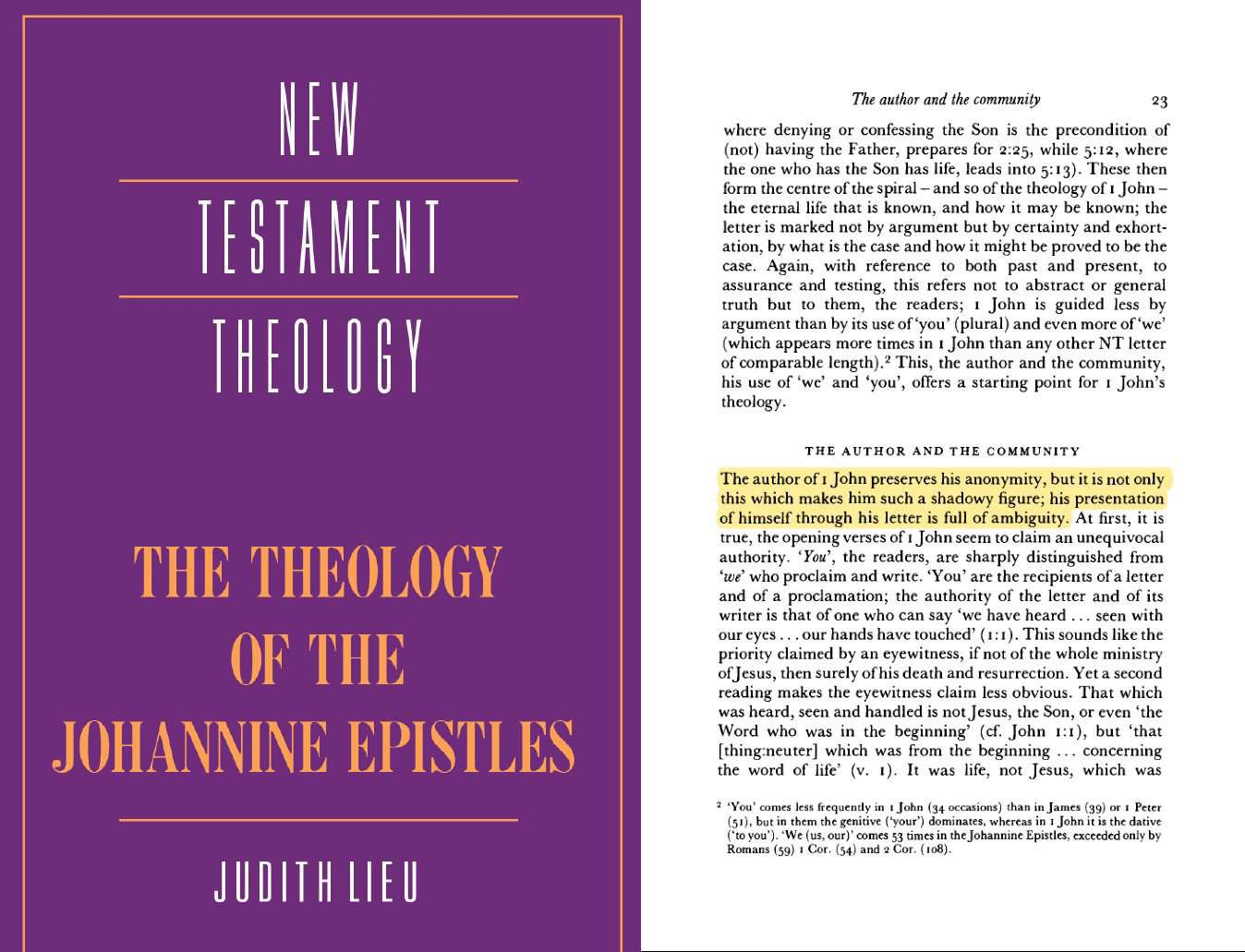
The following image is from historian Judith Lieu, whose scholarship on the Johannine community is considered foundational in the field.
Historian Judith Lieu notes that the author of 1 John deliberately preserves his anonymity, making his identity unclear. She highlights that his self-presentation in the letter is ambiguous, further adding to the uncertainty about who actually wrote it.
The author of 1 John not only fails to name himself — according to Lieu, he actively obscures his identity.
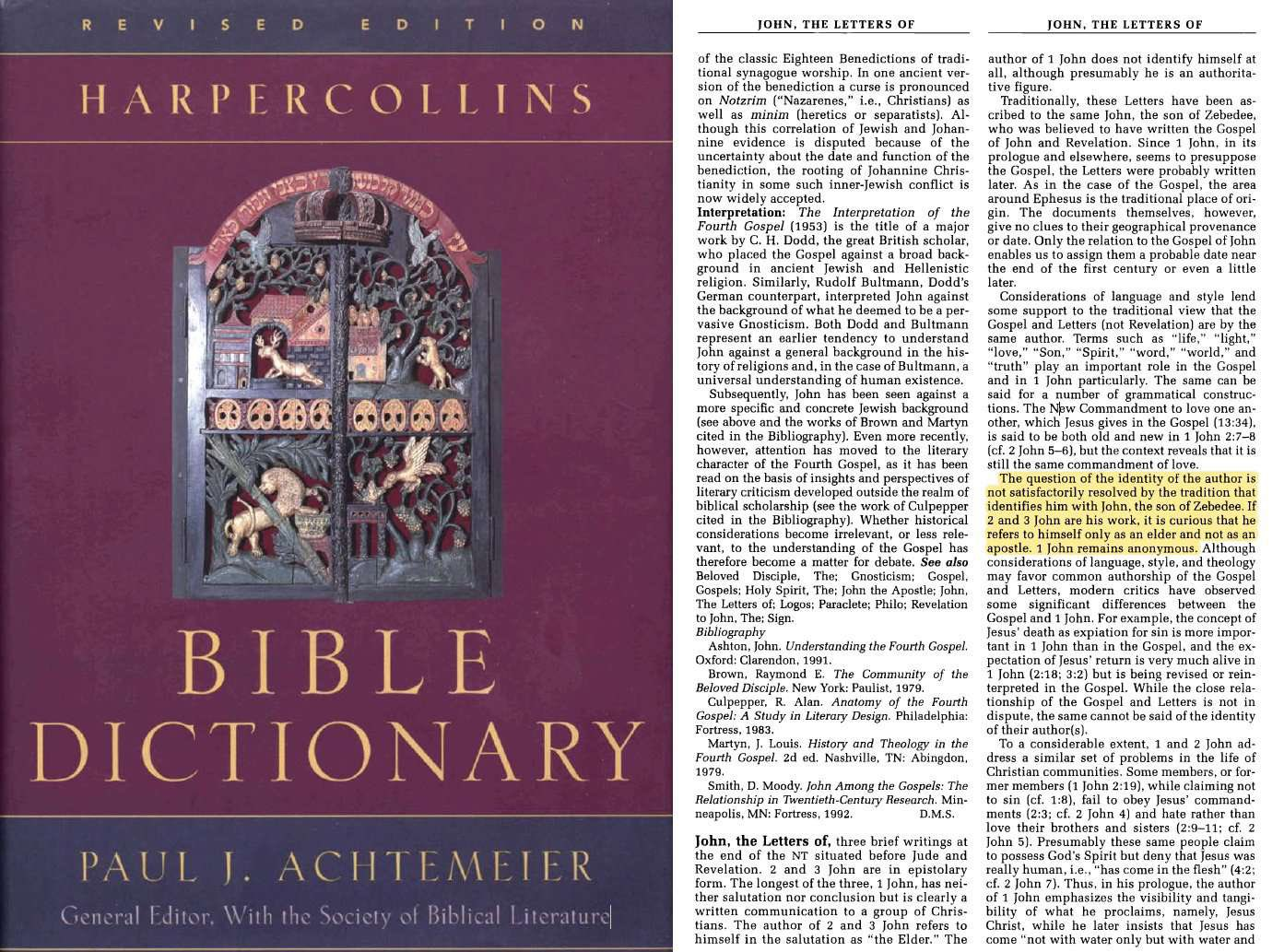
The following image is from Professor Paul J. Achtemeier, whose introduction to the New Testament is a standard academic resource, addressing the authorship problem and the complications introduced by the sister letters.
Professor Paul J. Achtemeier explains that 1 John’s authorship is uncertain. The tradition linking it to John, son of Zebedee, is debated, and if 2 and 3 John share the same author, his title as “elder” instead of “apostle” raises doubts.
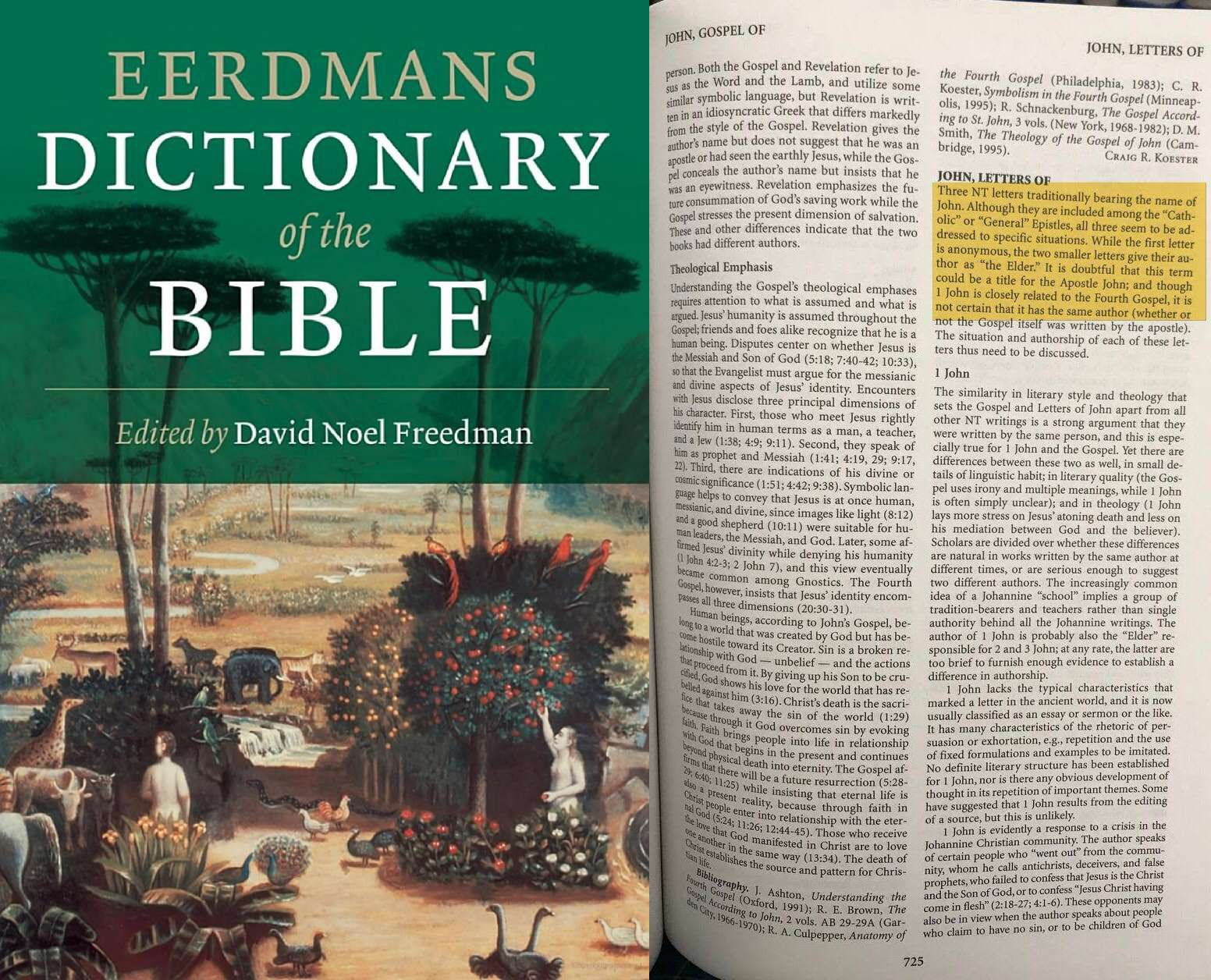
The following image is from David Noel Freedman, the editor of the Anchor Bible Dictionary, one of the most comprehensive reference works in biblical studies.
David Noel Freedman notes that 1 John is anonymous, while 2 and 3 John name the author as “the Elder.” He argues this likely isn’t the Apostle John and that, despite its link to the Fourth Gospel, 1 John’s authorship is uncertain.
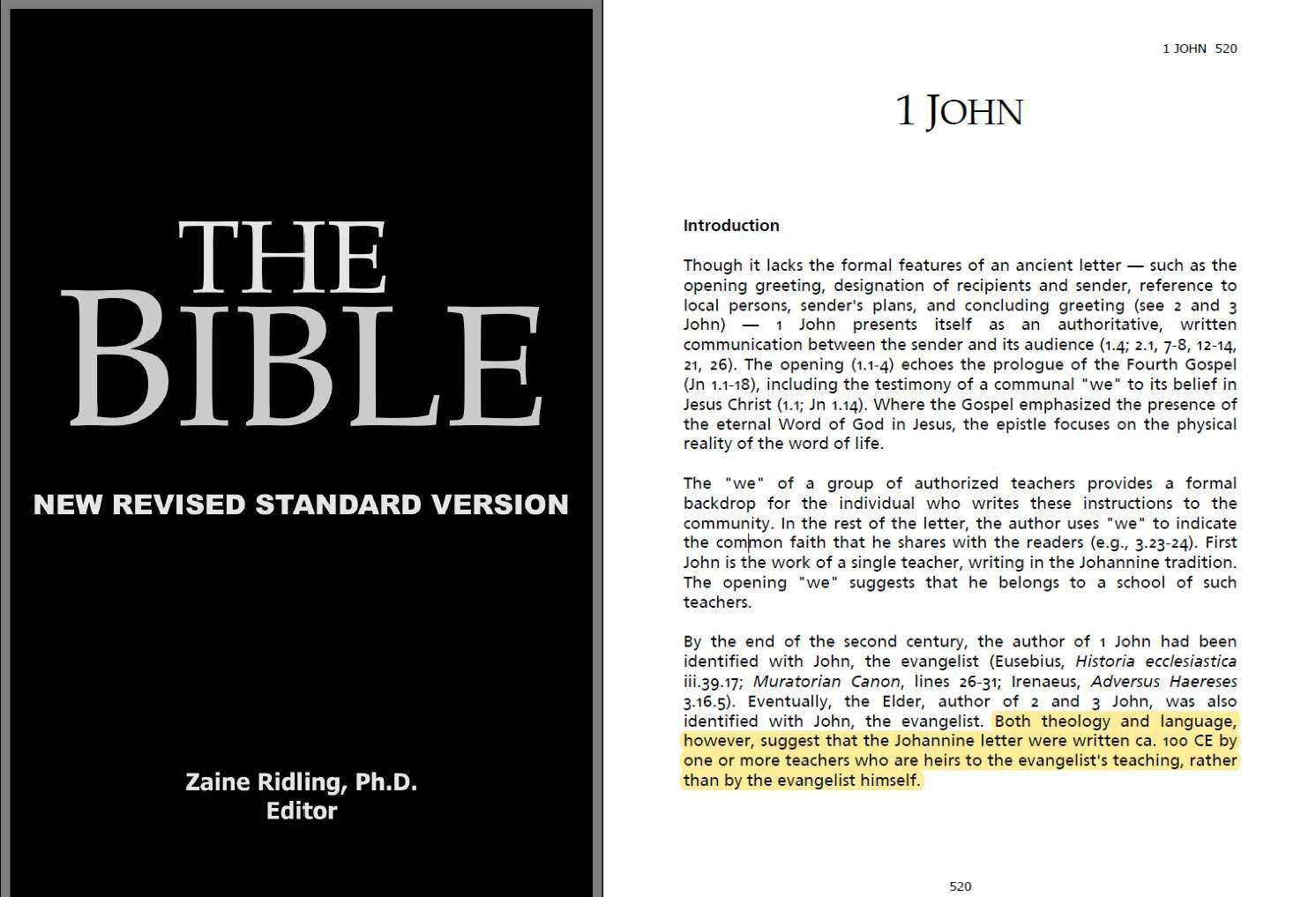
The following image is from Zaine Ridling, Ph.D., whose work addresses the theology and language of the letter as indicators of its date and origin.
Zaine Ridling, Ph.D., states that the theology and language of 1 John suggest it was written around 100 CE by one or more teachers influenced by the evangelist, rather than the evangelist himself.
If 1 John was composed around 100 CE by teachers influenced by the evangelist rather than the evangelist himself, it cannot plausibly be the work of the Apostle John, who by that point would have been dead for decades.
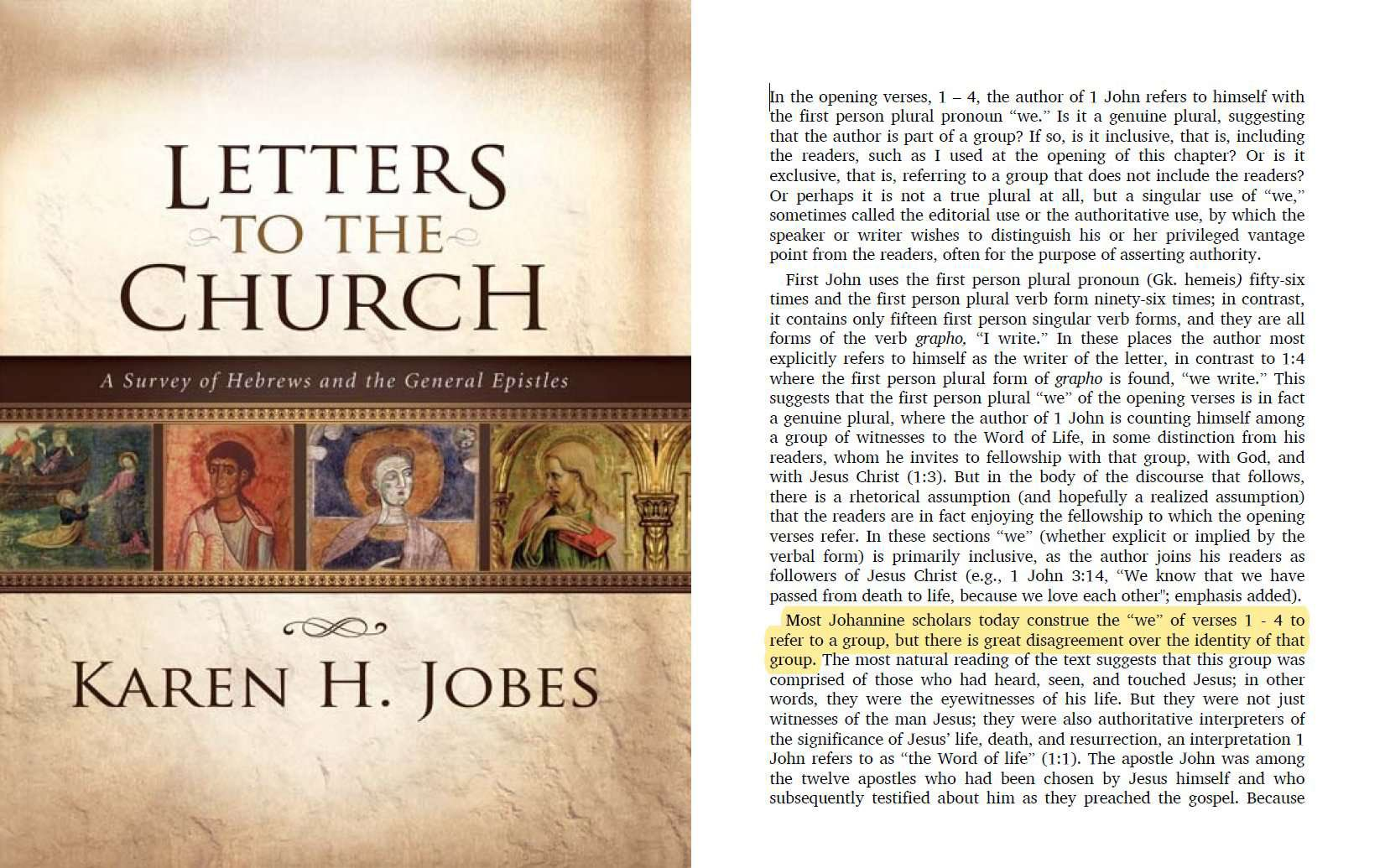
The following image shows Karen H. Jobes raising a further complication: even the internal evidence of 1 John 1:1–4, which uses the first-person plural “we,” is disputed as to what group it refers to.
Biblical scholar Karen H. Jobes notes that most Johannine scholars interpret the “we” in 1 John 1:1–4 as referring to a group, but there is significant debate over who that group actually was.
The following image is the final scholarly source in this compilation, further reinforcing the collective weight of the authorship problem.
The cumulative testimony of the relevant authorities is unambiguous. The Ignatius Catholic Study Bible — a Catholic resource — states that authorship “cannot be decided conclusively” and that someone other than the Apostle John could have written it. Biblical scholars Karen H. Jobes, Judith Lieu, Paul J. Achtemeier, and David Noel Freedman all confirm that 1 John is anonymous and that the traditional attribution is uncertain. Historian Judith Lieu notes the author deliberately preserved his anonymity. Zaine Ridling argues the language and theology point to composition around 100 CE, long after the Apostle’s lifetime, by teachers within his community rather than the apostle himself. The self-designation of “elder” rather than “apostle” in the companion letters further weakens the apostolic claim. No internal evidence names the author. No external evidence conclusively identifies him. The traditional attribution to John the Apostle rests on tradition alone — and that tradition was disputed even in the ancient Church.
...omma-a-fabricated-addition-to-the-bible|The Johannine Comma From Christian References( 1 John57]]