

Luke 1:28 Blessed Are You Among Women — A Later Scribal Addition Rejected by All Major Critical Editions
The Verse Under Study — The disputed text **
The Problem in Four Points** — The core dispute defined
The Seven Rules of Textual Criticism — How scholars evaluate manuscripts Applying the Rules — Why Deletion Wins — Rule-by-rule analysis Manuscript Quality Rankings — Four Classification Systems — Kurt Aland · Felker · Comfort · Waltz Evidence Supporting the Deletion Reading — Full manuscript and versional list Evidence Supporting the Addition Reading — Full manuscript and versional list The Text in Arabic Translations — Nine modern Arabic versions compared The Text in English Translations — 150 versions surveyed across six centuries The Text in Greek Versions — Traditional vs. critical editions The Manuscripts Themselves — Sinaiticus · Vaticanus · Washington · Coptic What the Critical Editions Decided — UBS5 · NA28 · Tischendorf · Metzger What the Scholars Said — Philip Comfort · Felker · Metzger · Bruce Terry · and more Commentary Consensus — Nine major biblical commentaries Summary of Scholar Positions — All 19 scholars and editions listed Conclusion — The verdict
The Verse Under Study
The problem of distorting Luke 1:28 is one of the most thoroughly documented manuscript disputes in the history of the New Testament. A new distortion problem was added to the growing list of textual problems that surfaced with the discovery of Bible manuscripts. The problem is related to the text in the Gospel of Luke, Chapter 1, Verse 28.
The Problem in Four Points
The distortion of Luke 1:28 manifests across four distinct and compounding levels.
The First Point: This text in its expanded form continued to be used by Christians over the long centuries — until the manuscripts were discovered and it was shown that there were three differences in the form of the text among the early manuscripts:
- Reading the deletion: Some manuscripts stop at “The Lord is with you” without any addition.
- Reading the first addition: Some manuscripts add the phrase “Blessed are you among women.”
- Reading the second addition: Some manuscripts mention the full text and then add two phrases: “Blessed are you among women and blessed is the fruit of your womb” = σοῦ.
The Second Point: The printed Greek, English, and Arabic versions also differ from each other. Some versions add the phrase “Blessed are you among women” and others delete it.
The Third Point: The critical printed versions also differ from each other. These are the versions that depend on the study of manuscripts in forming their own biblical text.
The Fourth Point: There is no definitive rule that enables us to know the correct reading with certainty. There are only guesses and assumptions about the available information.
The oldest Greek manuscripts do not contain the addition “Blessed are you among women.” The three oldest Greek manuscripts of this verse are:
- Codex Sinaiticus — from the 4th century
- Codex Vaticanus — from the 4th century
- Codex Washingtonianus — from the 4th century
In addition to other manuscripts, but they are later in time.
The oldest Greek manuscript supporting the reading of the addition “Blessed are you among women” is from the fifth century:
- The Alexandrian manuscript
- The Ephraimite manuscript
- The Beza manuscript
The Greek manuscripts that support the deletion reading are older than those that support the addition reading. The manuscripts that support the addition reading are more numerous, but they are later in time.
Both deletion and addition readings are supported by translations.
Translations supporting the deletion reading:
- Sahidic Coptic from the late third century and beginning of the fourth century
- Bohairic Coptic from the fourth century
- Palestinian Syriac translation from the sixth century
- Armenian translations (chronologically late)
- Georgian translations (chronologically late)
Translations supporting the addition reading:
- Latin translations after the fourth century (Old Latin + Vulgate)
- Syriac Peshitta from the fifth century
- Syriac Diatessaron from the sixth century
- Syriac Heraclian from the sixth century
- Ethiopic and Slavonic translations (late in time)
Both the addition and deletion readings have patristic evidence. Both readings are also supported by more than one text family.
Critical printed versions:
- The majority of critical versions decided to delete the paragraph.
- Most critical versions that use the rule “the oldest is the most correct” chose to delete the paragraph.
- Critical versions that use the rule “the most is the most correct” chose to add the paragraph.
- Most printed Greek versions omitted the paragraph.
- Most printed English versions omit the paragraph.
- Most Arabic versions printed in the twentieth and twenty-first centuries deleted the paragraph.
Regarding the timeline of the text’s status in printed versions:
- From the 15th to the 18th century: most printed copies in all languages contain the paragraph.
- From the 19th to the 21st century: most printed copies in all languages delete the paragraph.
Most textual criticism scholars said that the paragraph is not authentic.
The Seven Rules of Textual Criticism
Before applying evidence, it helps to understand how textual scholars evaluate competing readings. The following seven rules represent the standard toolkit used by most critical scholars. Not a single one of these rules is certain. They are all speculative, and they all have opponents. Therefore, the issue here is merely a possibility, and no one will ever be able to go outside the realm of possibility. Any rule that is stated will remain speculative.
- Greek manuscripts of the Bible are the basis; translations and writings of the fathers are merely support and not evidence in themselves.
- The reading supported by the oldest manuscripts is preferred.
- The reading supported by the best manuscripts is preferred.
- The shorter reading is preferred, especially when the longer reading shows signs of assimilationAssimilation (harmonization): a scribal tendency to harmonize a passage with a parallel text elsewhere in scripture. Identified by the presence of near-identical wording found in another verse..
- The reading supported by family diversity is preferred.
- The reading supported by geographical distribution is preferred.
- The reading that explains the reason for the appearance of other readings is preferred.
The deletion reading has support for all rules from 1 to 6, while the addition reading has support for rules 5 and 6 only.
Applying the Rules — Why Deletion Wins
Rules 1, 2, and 3 — Oldest and Best Greek Manuscripts
The oldest Greek manuscripts support the deletion reading, and this settles the first and second rules in favor of the deletion reading. The Greek evidence for the deletion reading is of the first level in terms of trustworthiness. Textual scholars divide the evidence in terms of quality and trustworthiness into levels.
Rule 4 — Shorter Reading and Assimilation
Here the reading of deletion is the shortest. The reading of addition shows the phenomenon of assimilation, which is that the copyists use other texts in the New or Old Testament as a source of inspiration for the addition they added. The sign of the occurrence of assimilation is the presence of the text in another place in the Holy Book — and indeed the paragraph “Blessed are you among women” is found in verse number 42 of the same chapter, which means assimilation occurred. Scholars have arrived at this rule by observing the copyists’ tendency to add more than their tendency to delete.
Rule 7 — Which Reading Best Explains the Other?
If the original reading in the lost original was the reading of addition, then what is the justification that would make the Christian copyist delete this passage for the reading of deletion to appear? There is none. Unlike if the original reading in the lost original was the reading of deletion — then there is a justification for the appearance of the reading of addition, which is the sanctification of Mary.
Manuscript Quality Rankings — Four Classification Systems
1. Kurt Aland’s Layers
We will find that there are two witnesses from the fourth century from the first level in favor of the deletion reading. There is no witness from the first level for the addition reading at all — the Alexandrian Codex is from the third level in the Gospels, Ephraim is the second level, and Beza is the third level.
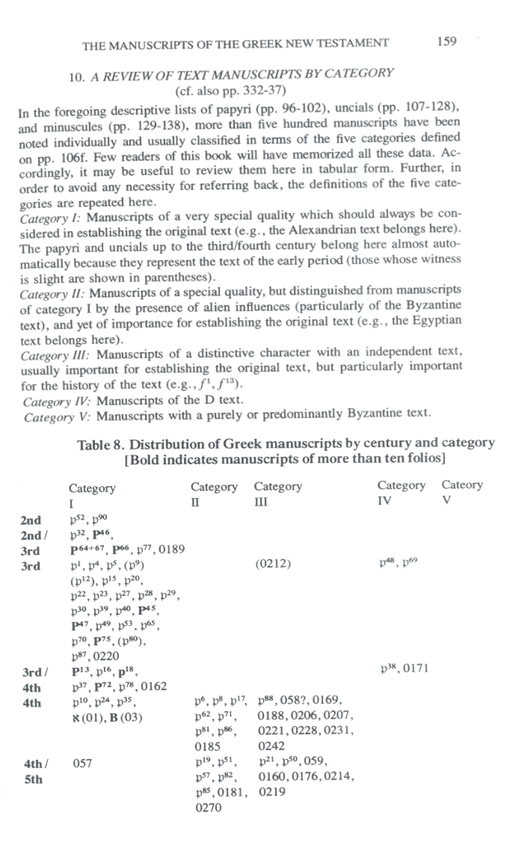
The table above shows Aland’s tiered ranking applied to Luke 1:28, confirming no first-level witness exists for the addition.
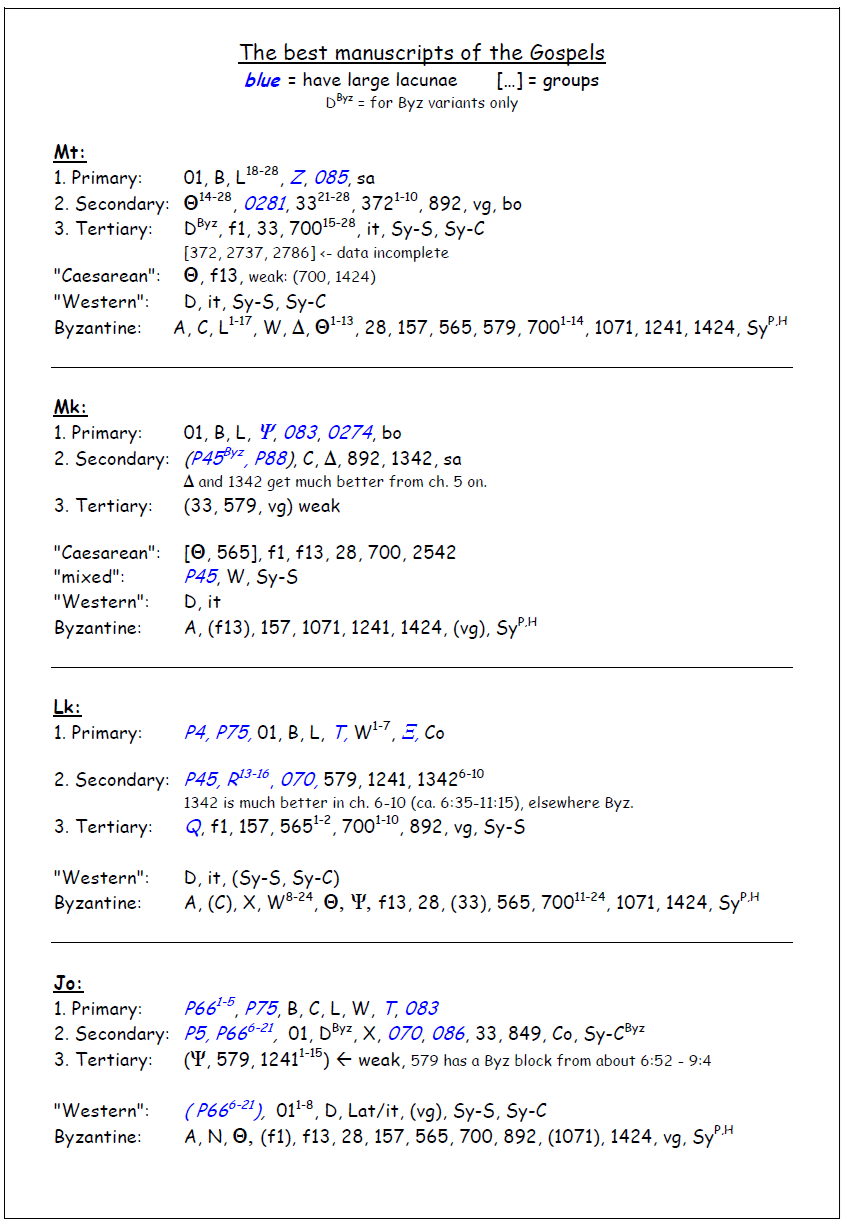
2. Viland Felker’s Layers
According to Viland Felker‘s division, we will find 3 evidences from the first level from the fourth century and the end of the fourth century in favor of the deletion reading, and only one manuscript from the fifth century from the first level in favor of the addition reading.
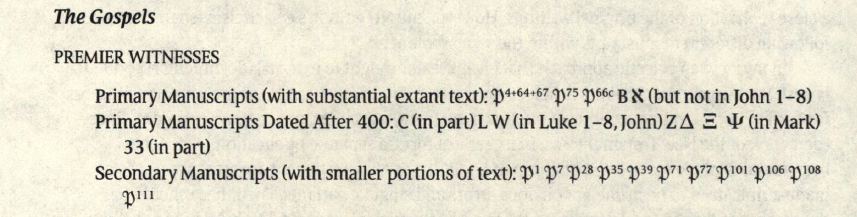
3. Philip Comfort’s Layers
According to Philip Comfort‘s division, we have 4 manuscripts from the first level that testify to the deletion reading — Sinaiticus, Vaticanus, Washingtonianus, and Regius — and one manuscript from the first level that testifies to the addition reading, which is the Ephraimite Codex.
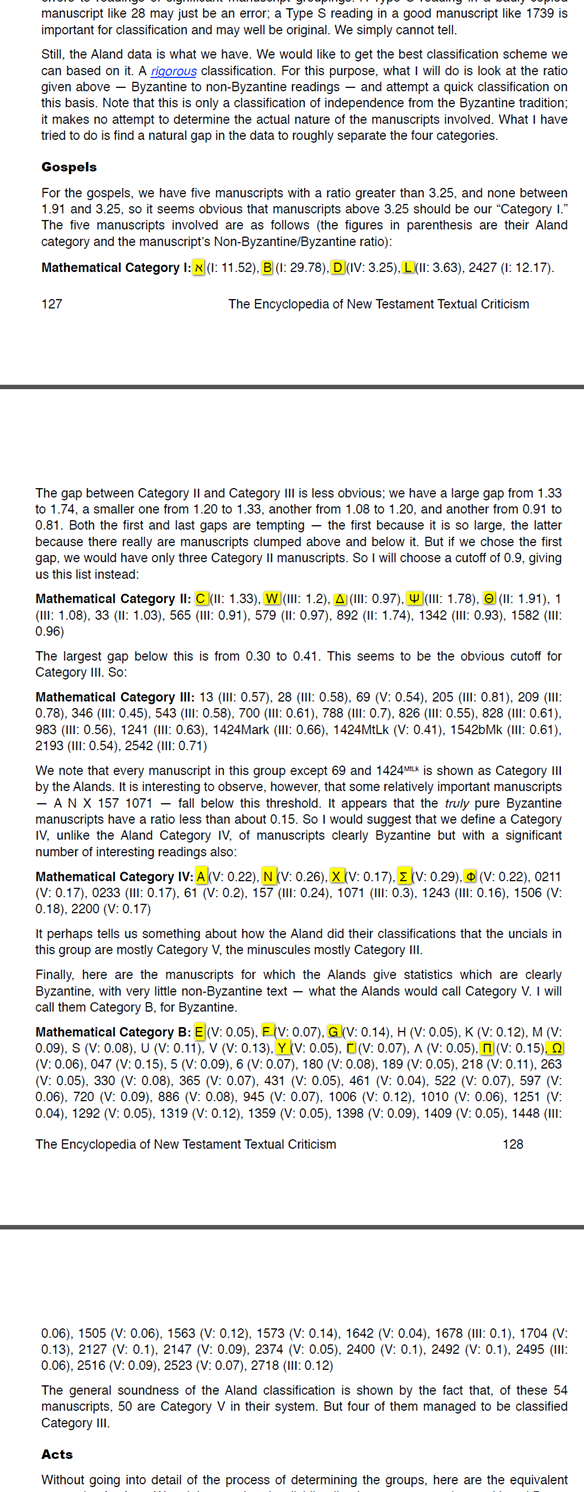
4. Robert Waltz’s Layers — Encyclopedia of Textual Criticism
According to Robert Waltz, author of the Encyclopedia of Textual Criticism:
- Manuscripts supporting the reading of deletion from the first level: 2 — the Sinaiticus and Vaticanus
- From the second level: the Regius manuscript
- From the third level: the Lafrenzis manuscript and the Washington manuscript
- Manuscripts supporting the reading of addition from the first level: none
- From the second level: the Ephraimite Codex
- From the fourth level: the Alexandrian and Beza manuscripts
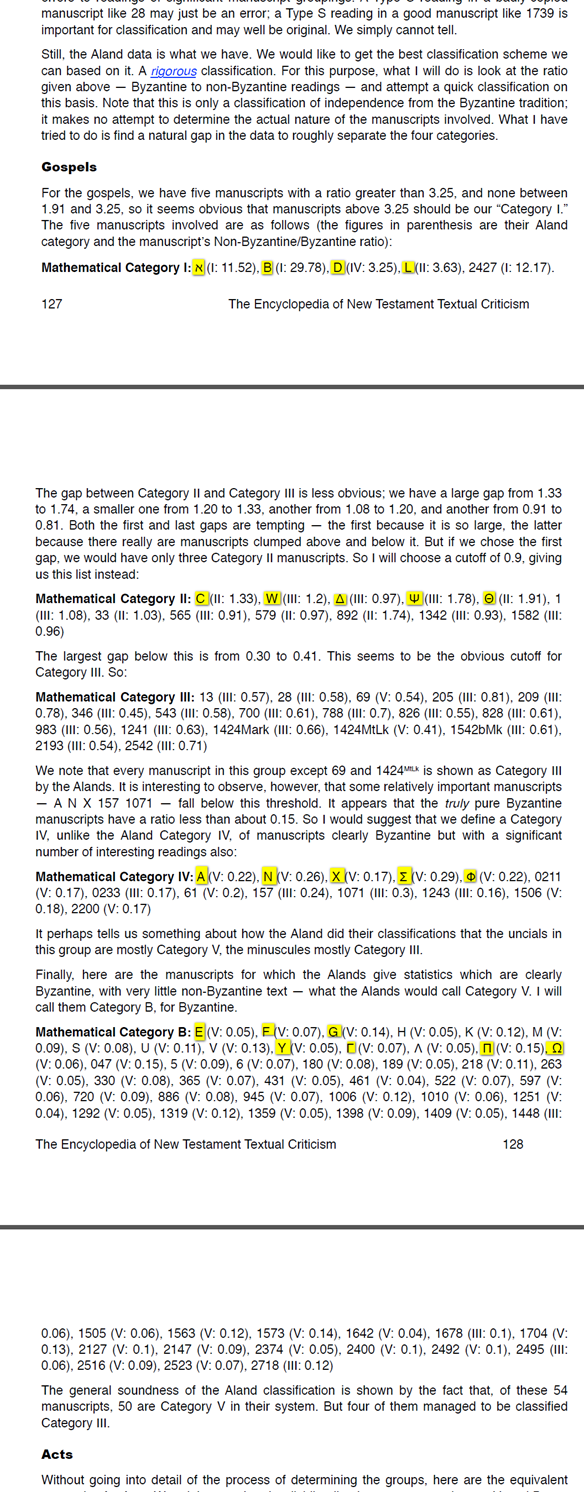
Waltz’s analysis confirms that the addition reading has no first-level support from any classification system.
Evidence Supporting the Deletion Reading
First — Greek Manuscripts
- The Sinaiticus manuscript from the fourth century
- The Vaticanus manuscript from the fourth century
- The Washington manuscript from the late fourth century
- The Regius manuscript from the eighth century
- The Lafrenzes manuscript 044 from the tenth century
- Family of manuscripts No. 1
- Several manuscripts with small letters, such as 565, 579, 700, 1241
Second — Syriac Translations
- Palestinian Syriac from the sixth century
Third — Coptic Translations
- Sahidic Coptic manuscripts from after the fourth century
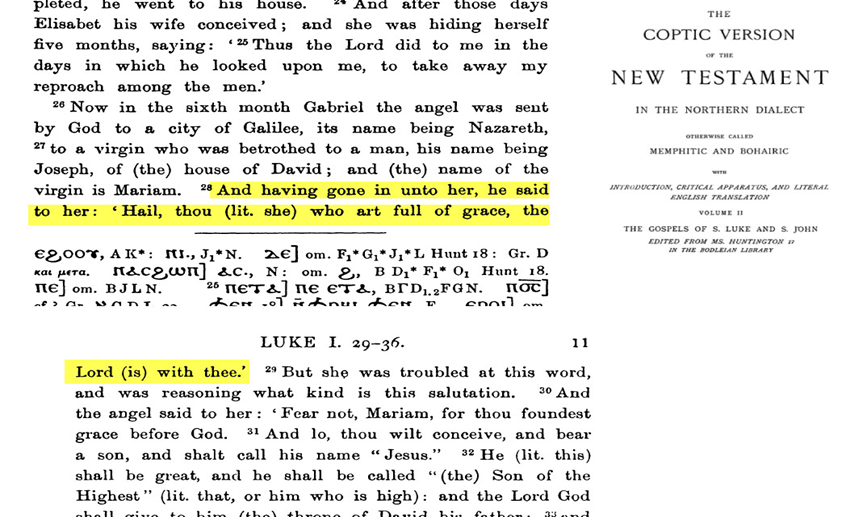
- Bohairic Coptic manuscripts from after the fifth century
Fourth — Other Translations
- Armenian
- Georgian
Fifth — The Fathers
- St. Peter the Thaumaturgus (Ps-Gregory-Thaumaturgus)
- Gregory of Nyssa
- Epiphanius
- Hesychius
- John of Damascus
- Jerome
- Quodvultdeus of Carthage
- Origen (in his lemma)
- Serapion (according to Cyril)
Evidence Supporting the Addition Reading
First — Greek Manuscripts
- Alexandrian Codex from the fifth century
- Ephraimite Codex from the fifth century
- Sangaliensis 039 from the ninth century
- Coriditheanus 038 from the ninth century
- Manuscript 0233 from the eighth century
- Family manuscripts No. 13
- Most manuscripts of small letters (late in time)
- Manuscript E = 07 from the eighth century
- Manuscript 09 = F from the ninth century
- Manuscript 013 = H from the ninth century
Second — Latin Translations
- Versilensis (a) from the fourth century
- Aureus (aur) from the eighth century
- Veronensis from the fifth century
- Colbertinus (c) from the twelfth century
- Beza from the fifth century
- Platinus from the fifth century
- Corbinses (ff2) from the fifth century
- Brixianus (f) from the sixth century
- Monacensis (q) from the seventh century
- Osirian (r1) from the seventh century
- Vulgate
Third — Syriac Translations
- Peshitta Syriac from the fifth century
- Heraclian Syriac from the sixth century
Fourth — Coptic Translations
- One Bohairic Coptic manuscript
Fifth — Other Translations
- Diatessaron
- Ethiopian manuscripts
- Slavonic manuscripts
Sixth — The Fathers
- Eusebius
- Pseudo-Athanasius
- Theodotus of Ancyra
- Tertullian
- Ambrose
- Augustine
Evidence Supporting the Third Reading
(σοῦ. εὐλογημένη σὺ ἐν γυναιξὶν and κοιλίας σου — “Blessed are you among women and blessed is the fruit of your womb”)
- Greek manuscript 1071
- Liturgical Book No. 1074
The Text in Arabic Translations
Among the nine modern Arabic translations (20th–21st century), only one contains the passage — the Van Dyke translation and its interpretive companion Al-Hayat. The remaining seven translations omit the passage.
1. Van Dyke:
[Lk. 1.28] Then the angel came in to her and said, “Hail, you who are highly favored! The Lord is with you; blessed are you among women.”
2. Al-Hayat (Life):
[Lk. 1.28] Then the angel came in and said to her, “Hail, you who are highly favored! The Lord is with you: blessed are you among women.”
3. Common Arabic Translation:
[Lk. 1.28] The angel came in to her and said, “Hail, you who are highly favored! The Lord is with you.”
4. Simplified Arabic Translation:
[Lk. 1.28] Then Gabriel came to her and said, “Hail, you who are highly favored! The Lord is with you.”
5. Jesus Translation:
[Lk.1.28] And he came in to her and said, “Rejoice, you who are highly favored, the Lord is with you.”
6. Sarah Translation:
[Lk.1.28] And the angel came in to her and said, “Peace be upon you, you who are highly favored, the Lord is with you.”
7. Sheriff Translation:
[Lk.1.28] So he came and said to her, “Hail, highly favored one! The Lord is with you.”
8. Catholic Arabic Translation:
[Lk.1.28] So he came in to her and said, “Hail, full of grace, the Lord is with you.”
9. Paulian Translation:
[Lk.1.28] When the angel came in to her, he said to her, “Hail, full of grace, the Lord is with you.”
The following colour-coded table shows the form of the text across Arabic translations over time. Green = the phrase is present; Red = the phrase is deleted; Yellow = present with a comment in the margin.

It appears from the table that with the emergence of the science of textual criticism, the form of the text in translations has changed. The translations that preceded the twentieth century are in a different state than those that appeared in the twentieth century. Late nineteenth century onward, the deletion trend accelerates.
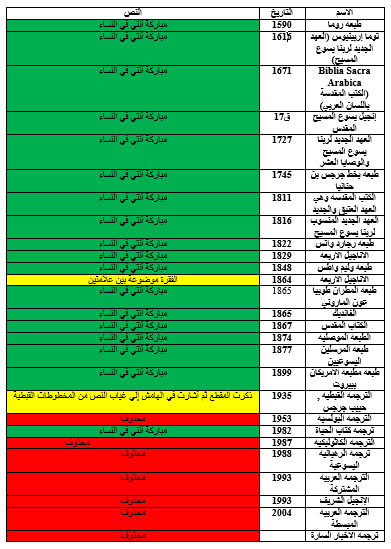
Timeline of Arabic Printed Editions
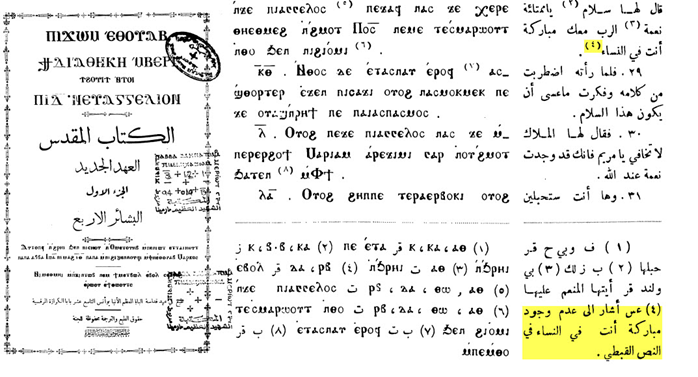
1864 edition: The version put the paragraph between two quotation marks and then stated that the passage does not exist in the Coptic manuscripts.
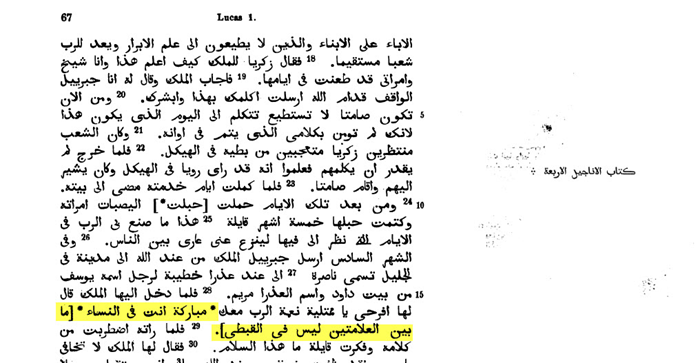
1935 edition: Mentioned in the margin that the text is not found in the Coptic manuscripts.
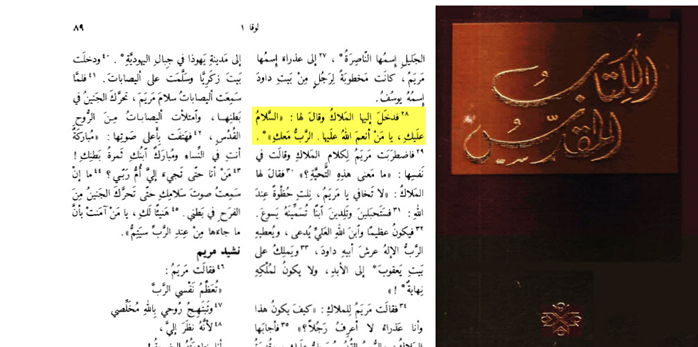
Joint Arabic Translation 1993: The section is deleted entirely.
The Text in English Translations
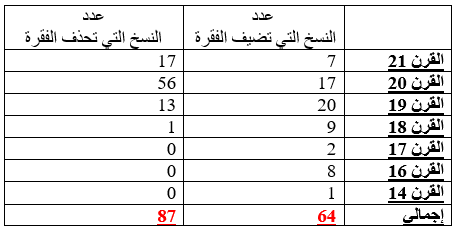
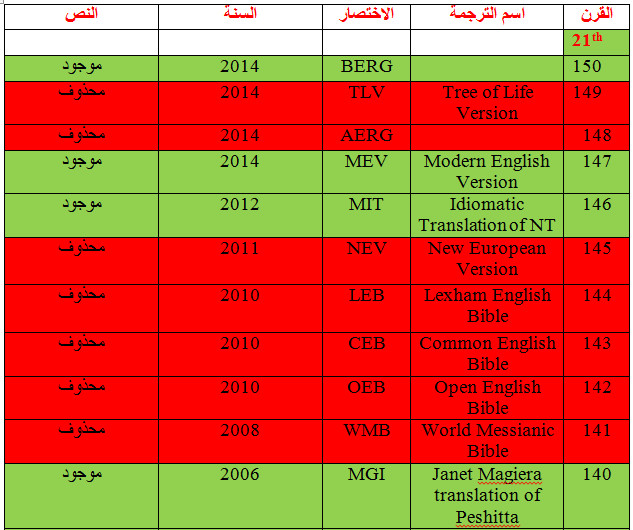
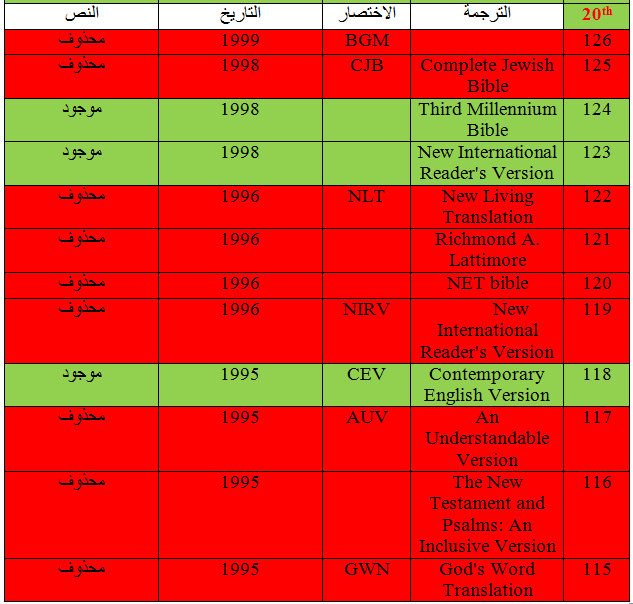
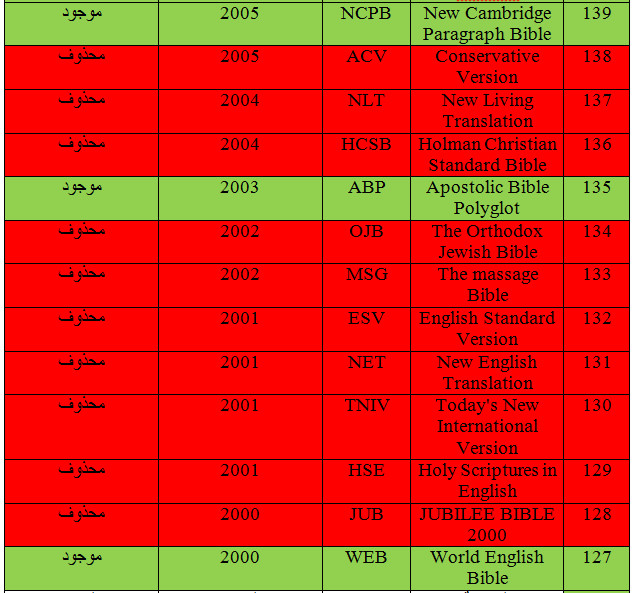
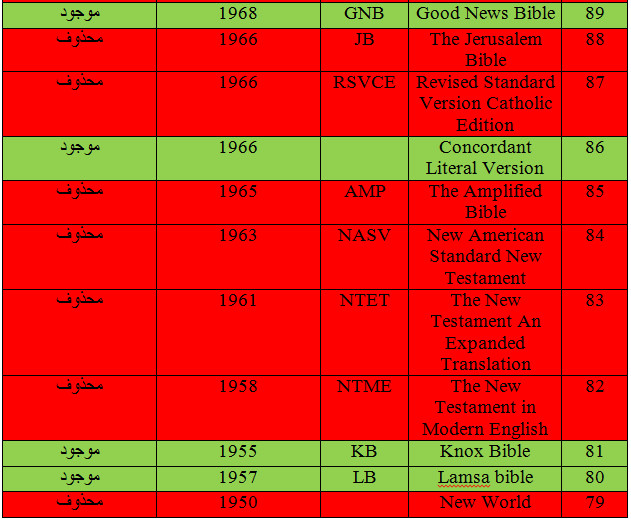
Total English versions surveyed: 150
Statistics by century:
- 20th–21st centuries total: 97 versions
- Percentage that add the paragraph: 25%
- Percentage that delete the paragraph: 75%
- 19th century: add 40% — delete 60%
- 14th–18th centuries combined: add approximately 95% — delete approximately 5%

The NRSVCE, a Catholic edition, omits the phrase — significant given the tradition of Marian veneration in Catholic Christianity.

The Magnificat (1:46–47) shows Mary’s own words of praise. The blessing “Blessed are you among women” in 1:42 is Elizabeth’s speech — its insertion into 1:28 by scribes represents a clear conflation of two distinct passages.
Graph: Deletion Rises Over Time
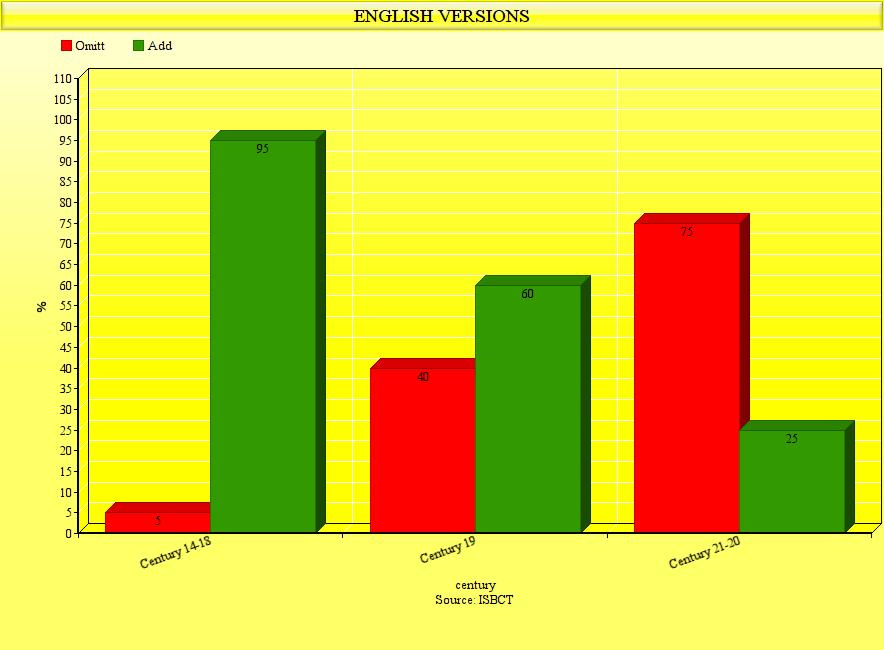
We conclude from this diagram that over time the versions that delete the paragraph increase and the versions that add it decrease.
Tables of 150 English Versions
The BibleGateway platform, which hosts the majority of modern English translations, provides a useful interface for comparing versional readings directly.

The following pages contain the full comparative tables of all 150 English versions surveyed, showing which contain the addition and which do not.
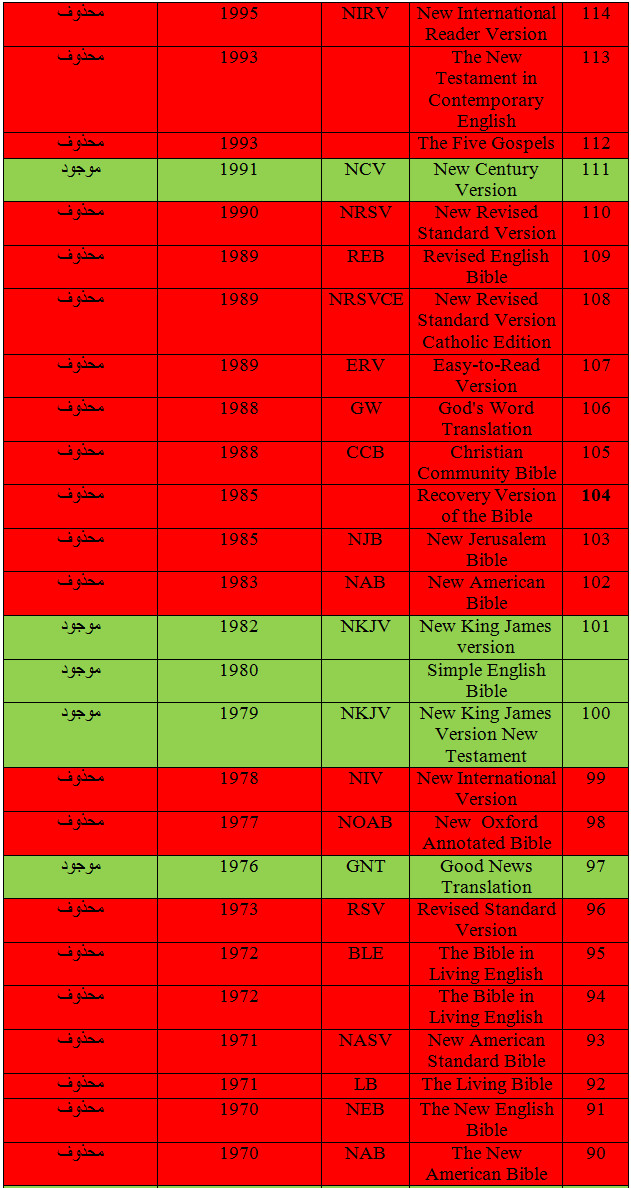
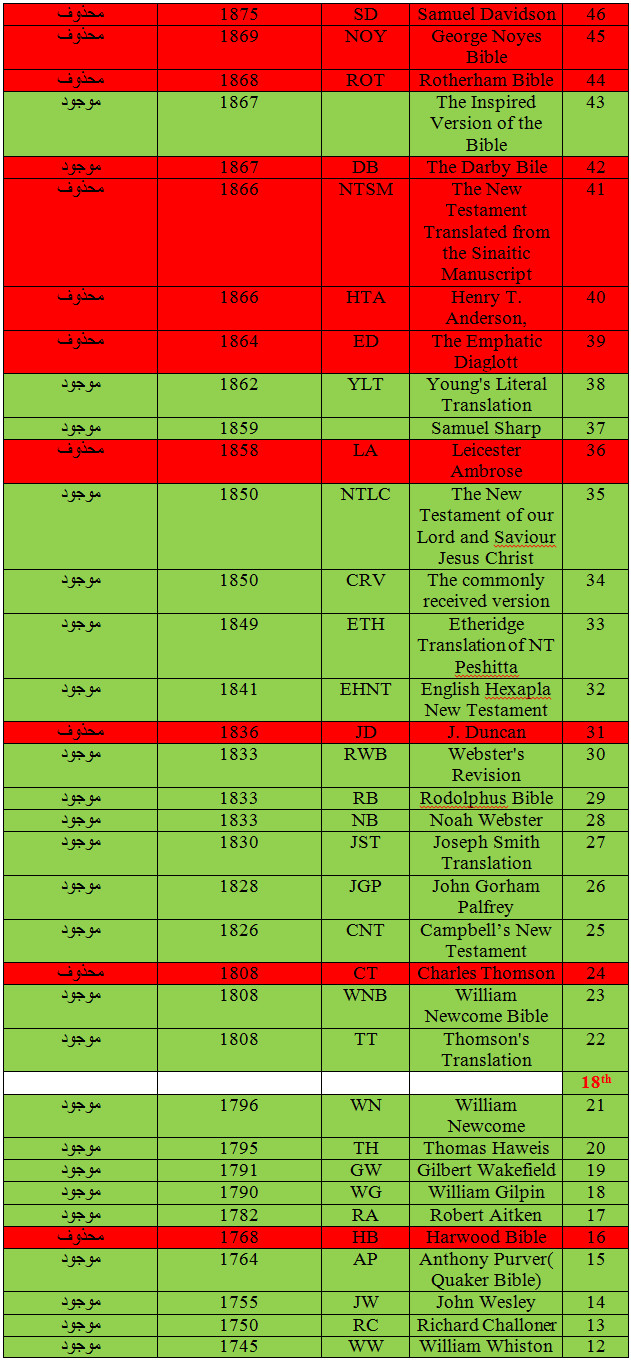
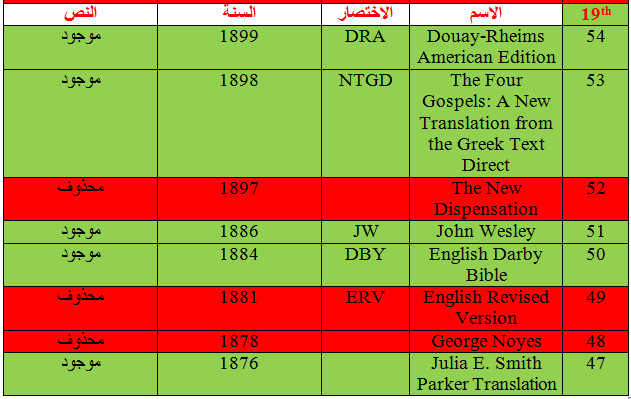
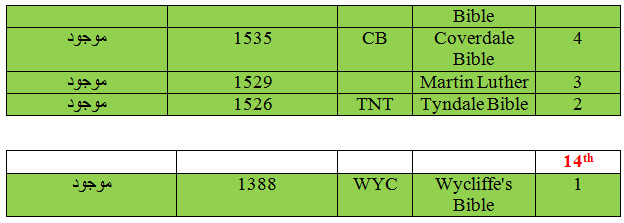
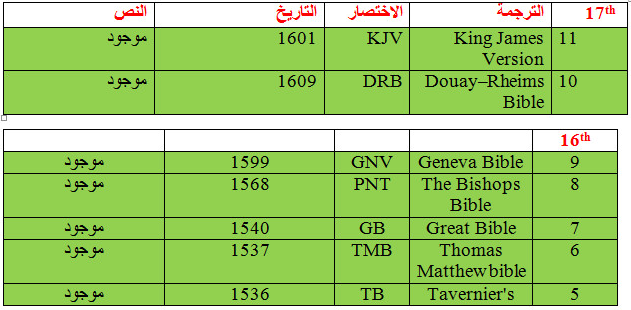
Some Translations that Delete the Passage — 25 Translations
ASV Luke 1:28 — And he came in unto her, and said, Hail, thou that art highly favored, the Lord is with thee.
CJB Luke 1:28 — Approaching her, the angel said, “Shalom, favored lady! ADONAI is with you!”
CSB Luke 1:28 — And the angel came to her and said, “Rejoice, favored woman! The Lord is with you.”
BBE Luke 1:28 — And the angel came in to her and said, Peace be with you, to whom special grace has been given; the Lord is with you.
ERV Luke 1:28 — And he came in unto her, and said, Hail, thou that art highly favoured, the Lord is with thee.
ESV Luke 1:28 — And he came to her and said, “Greetings, favored one, the Lord is with you!”
GWN Luke 1:28 — When the angel entered her home, he greeted her and said, “You are favored by the Lord! The Lord is with you.”
NAB Luke 1:28 — And coming to her, he said, “Hail, favored one! The Lord is with you.”
NAS Luke 1:28 — And coming in, he said to her, “Hail, favored one! The Lord is with you.”
NAU Luke 1:28 — And coming in, he said to her, “Greetings, favored one! The Lord is with you.”
NET Luke 1:28 — The angel came to her and said, “Greetings, favored one, the Lord is with you!”
NIB Luke 1:28 — The angel went to her and said, “Greetings, you who are highly favoured! The Lord is with you.”
NLT Luke 1:28 — Gabriel appeared to her and said, “Greetings, favored woman! The Lord is with you!”
NIRV Luke 1:28 — The angel greeted her and said, “The Lord has given you special favor. He is with you.”
NIV Luke 1:28 — The angel went to her and said, “Greetings, you who are highly favored! The Lord is with you.”
NJB Luke 1:28 — He went in and said to her, ‘Rejoice, you who enjoy God’s favour! The Lord is with you.’
NRS Luke 1:28 — And he came to her and said, “Greetings, favored one! The Lord is with you.”
TNIV Luke 1:28 — The angel went to her and said, “Greetings, you who are highly favored! The Lord is with you.”
NIVO Luke 1:28 — The angel went to her and said, “Greetings, you who are highly favored! The Lord is with you.”
CSBO Luke 1:28 — And the angel came to her and said, “Rejoice, favored woman! The Lord is with you.”
NABO Luke 1:28 — And coming to her, he said, “Hail, favored one! The Lord is with you.”
ROT Luke 1:28 — and entering into her, he said — Joy to thee, favored one! The Lord, be with thee!
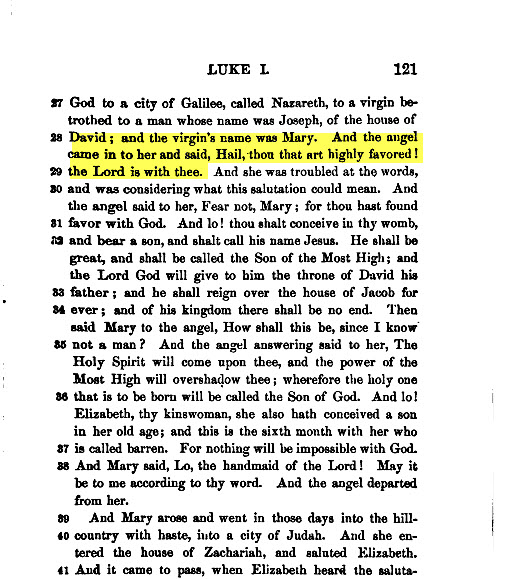
NOY Luke 1:28 — And the angel came in to her and said, Hail, thou that art highly favored! The Lord is with thee.
AERG Luke 1:28 — And enter to she say hello favor-highly the Lord be-with you
Some Translations that Write the Passage — 16 Translations
DBY Luke 1:28 — And the angel came in to her, and said, Hail, thou favored one! The Lord is with thee: blessed art thou amongst women.
DRA Luke 1:28 — And the angel being come in, said unto her: Hail, full of grace, the Lord is with thee: blessed art thou among women.
ETH Luke 1:28 — And the angel entered into her, and said to her, Peace to you, full of grace! Our Lord is with you, you are blessed among women!
GNV Luke 1:28 — And the Angel went in vnto her, and said, Haile thou that art freely beloued: the Lord is with thee: blessed art thou among women.
KJV Luke 1:28 — And the angel came in unto her, and said, Hail, thou that art highly favored, the Lord is with thee: blessed art thou among women.
MGI Luke 1:28 — And the angel approached her and said to her, “Peace to you, [one] full of grace! Our Lord [is] with you, blessed [one] of women.”
MIT Luke 1:28 — He approached her and said, “Be glad, because you have been chosen for blessing! Yahveh is with you.”
NKJ Luke 1:28 — And having come in, the angel said to her, “Rejoice, highly favored one, the Lord is with you; blessed are you among women!”
PNT Luke 1:28 — And the Angel went in vnto her, and said: Hayle [thou that art] freelie beloued, the Lord is with thee, blessed art thou among women.
RWB Luke 1:28 — And the angel came to her, and said, Hail, thou that art highly favoured, the Lord is with thee: blessed art thou among women.
TNT Luke 1:28 — And the angell went in vnto her and said: Hayle full of grace the Lord is with the: blessed arte thou amonge wemen.
WEB Luke 1:28 — And the angel came to her, and said, Hail, thou that art highly favored, the Lord is with thee: blessed art thou among women.
YLT Luke 1:28 — And the messenger having come in unto her, said, ‘Hail, favored one, the Lord is with thee; blessed art among women;’
BERG Luke 1:28 — and enter the angel to she say hello favor-highly the Lord be-with you be-favored you-intensive with woman
BTGNT Luke 1:28 — and into-come the message toward self say joy-cause the lord after you well-account-do you in woman
RPTE Luke 1:28 — Having come in, the angel said to her, “Rejoice, you highly favored one! women.”
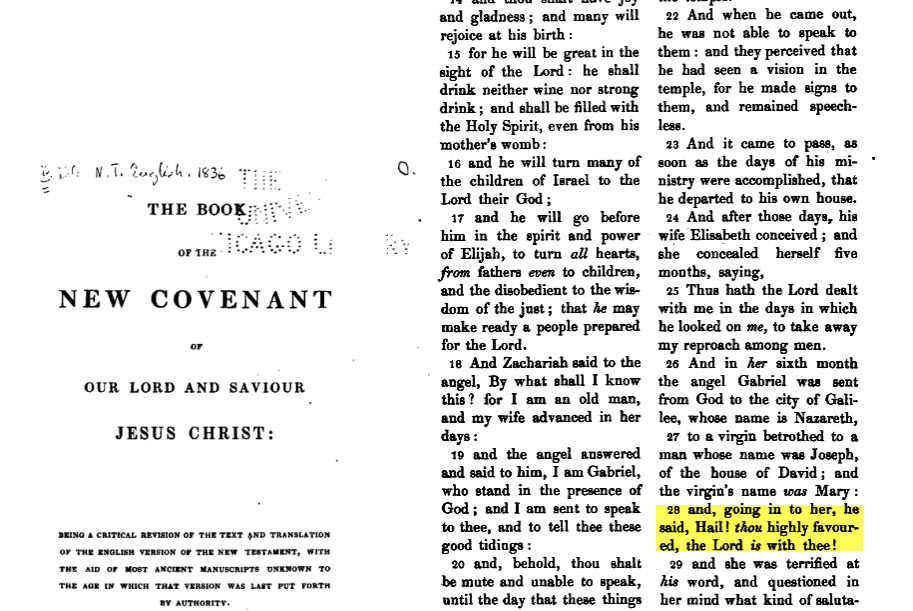
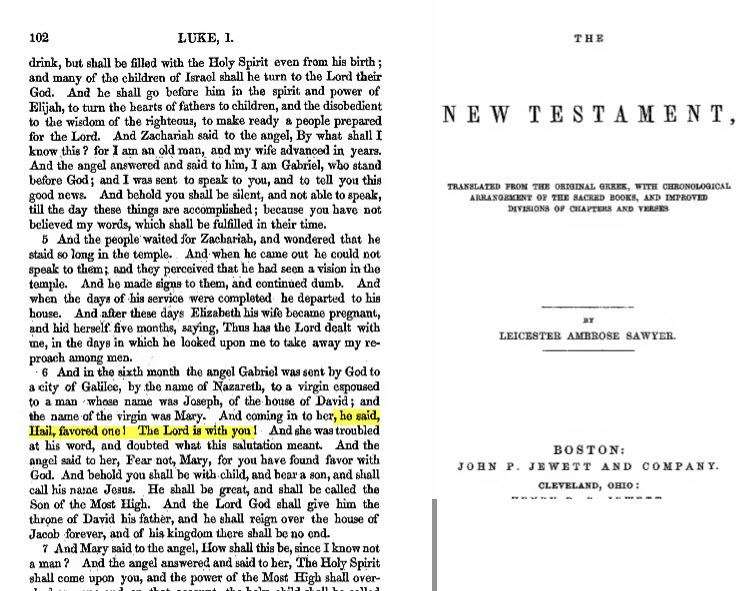
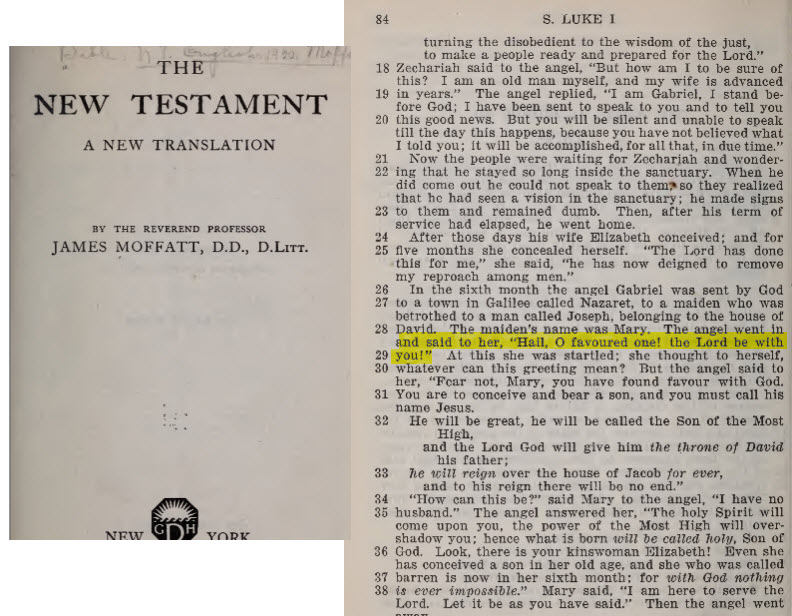
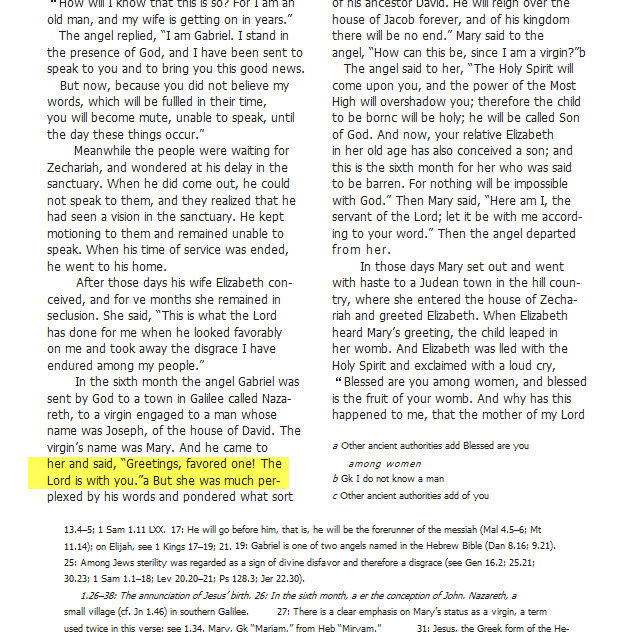
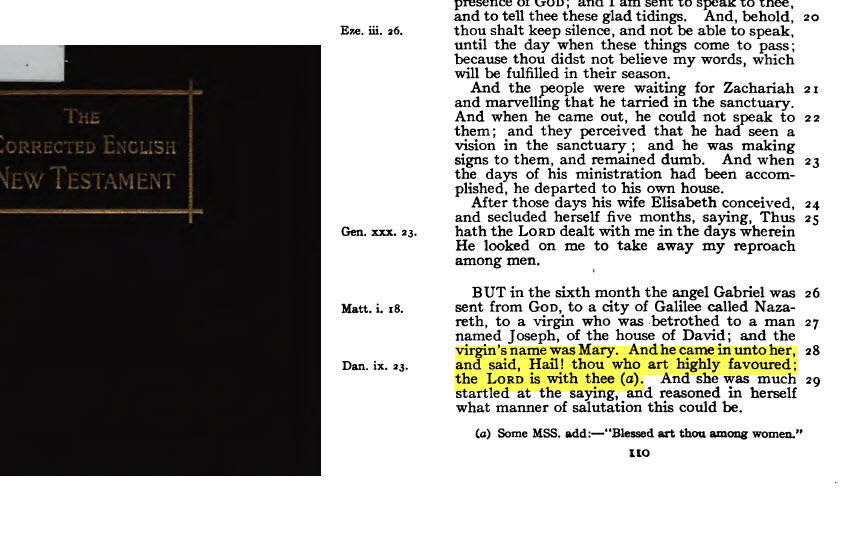
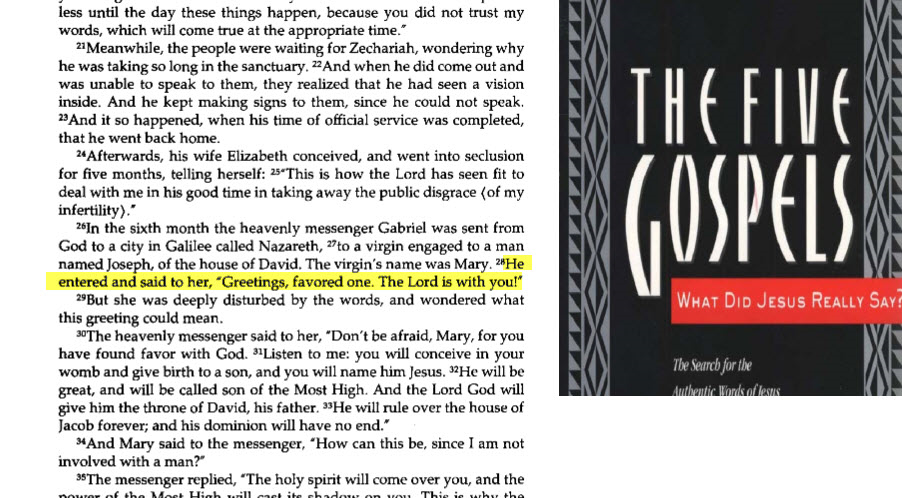
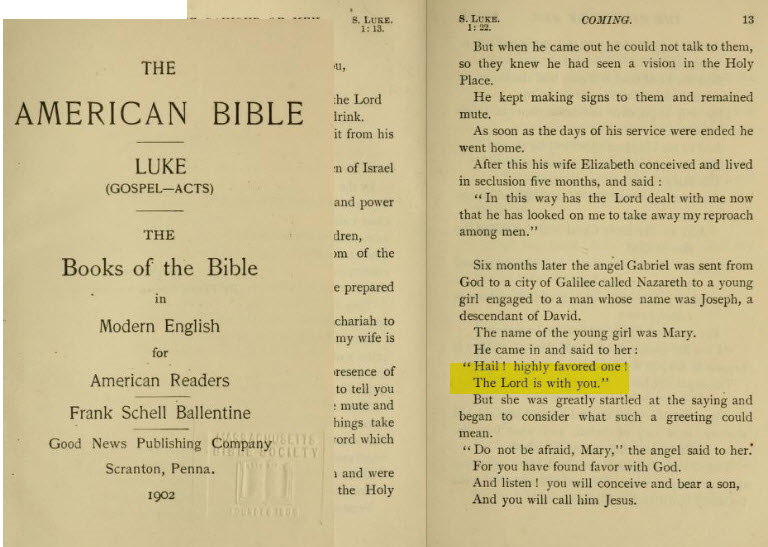
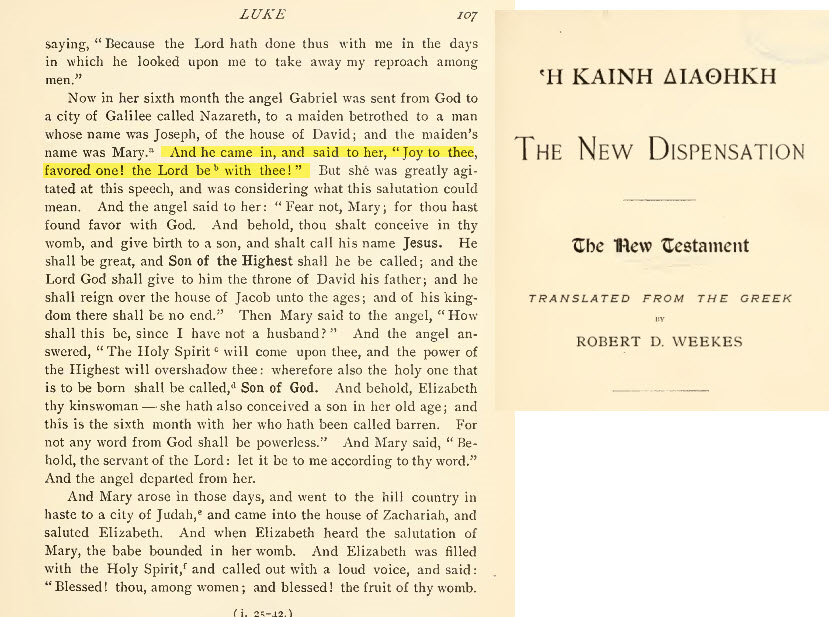
Images of English Versions that Delete the Passage
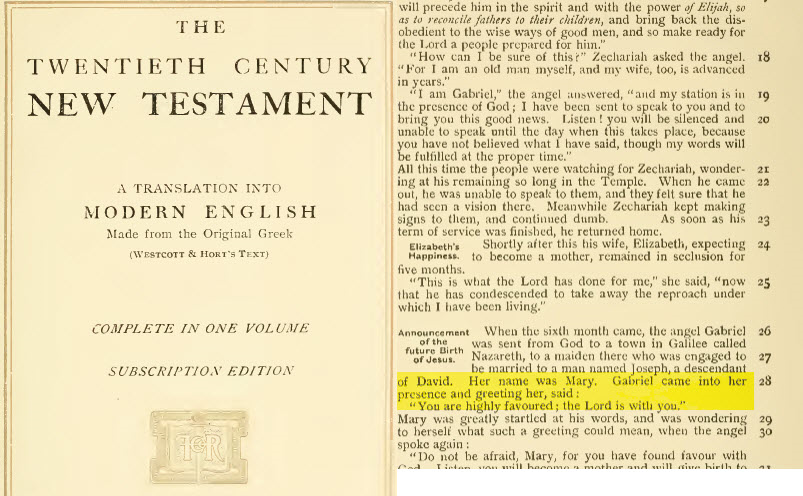
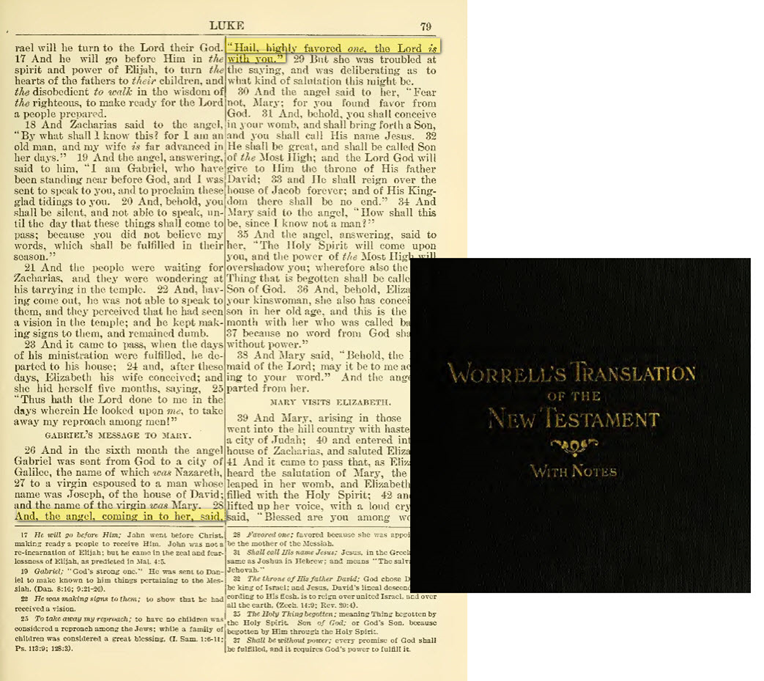
The following scans show printed English Bibles omitting the disputed phrase from Luke 1:28 across different centuries and publishers.
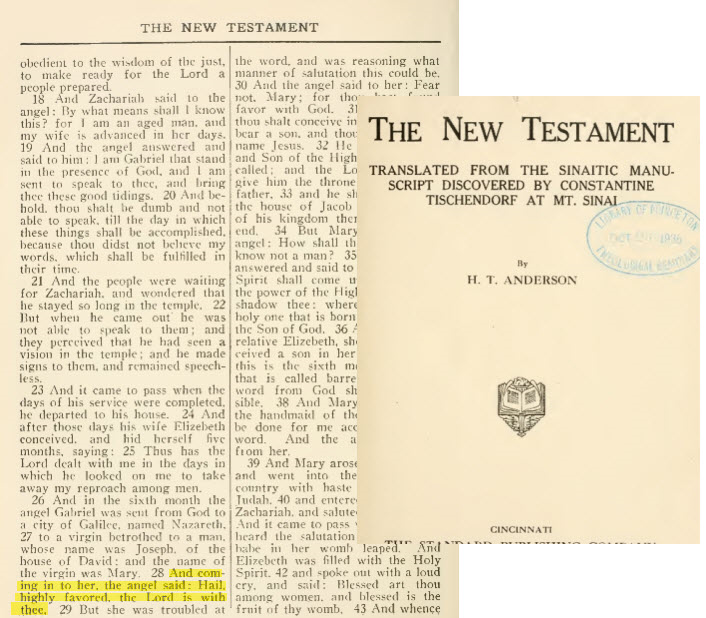
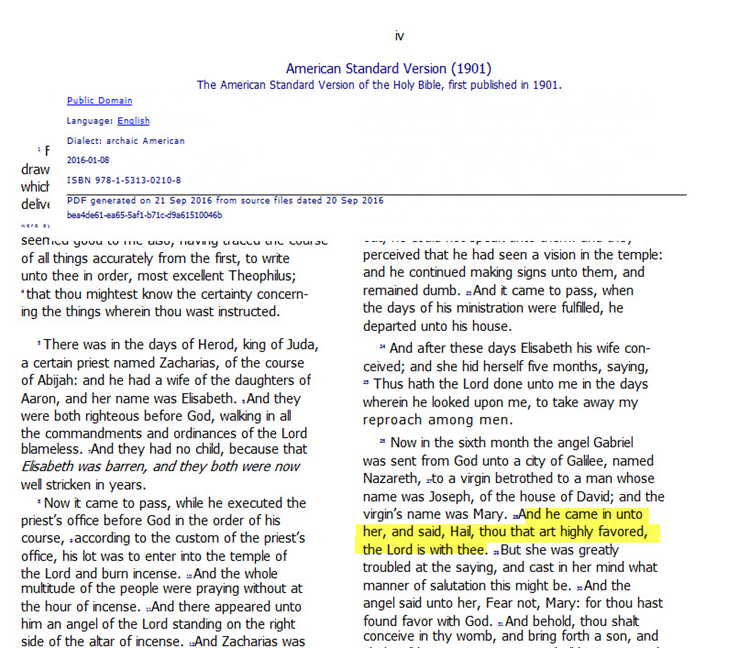
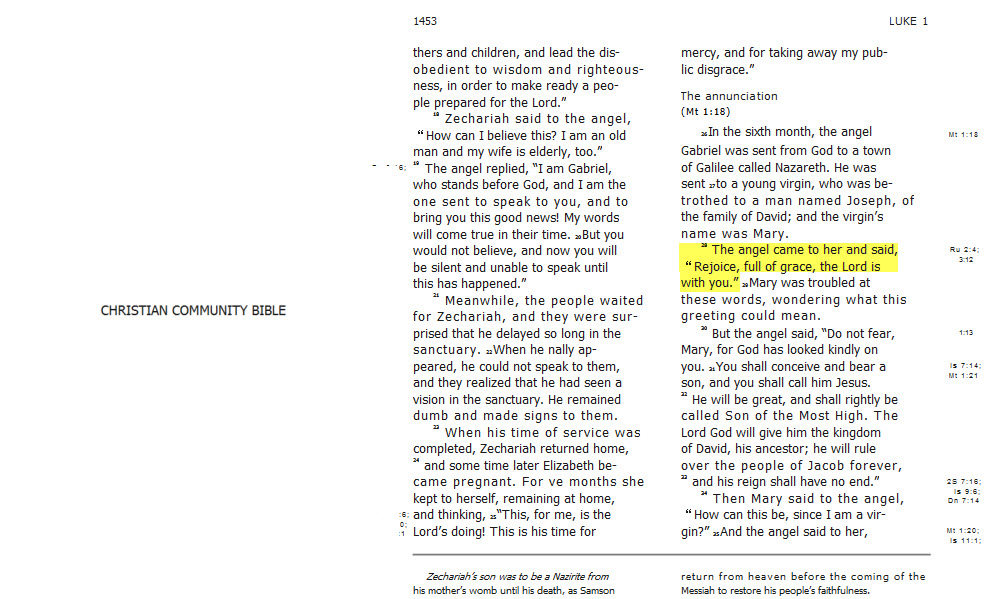
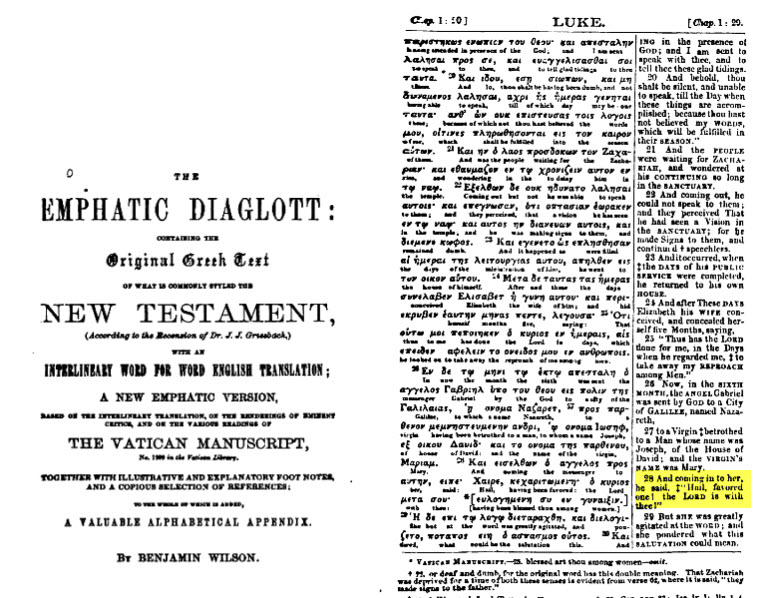
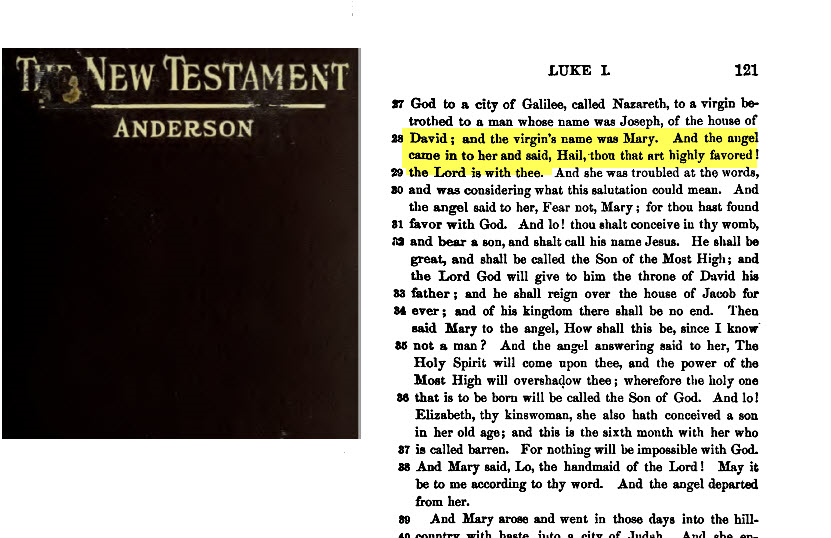
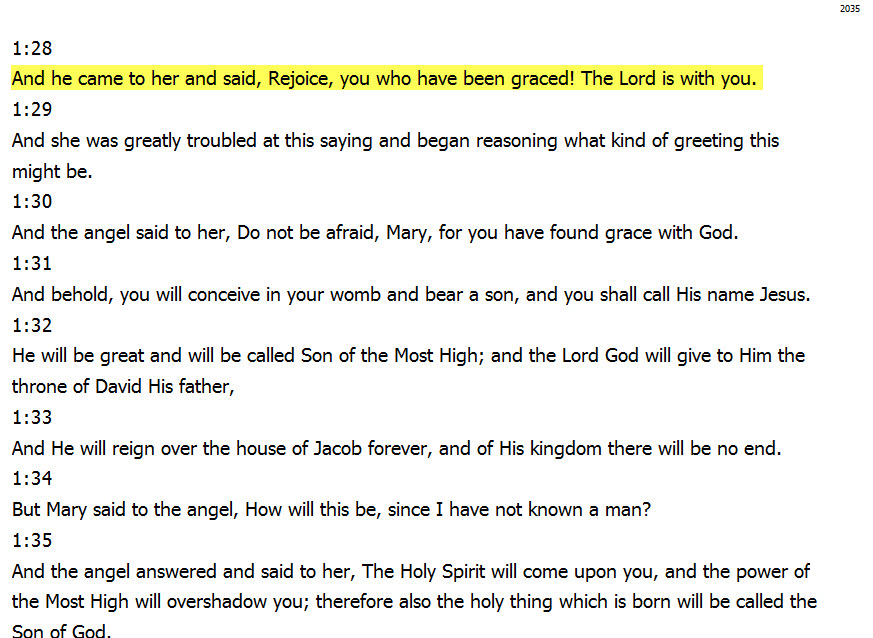
George Noyes, 1878:
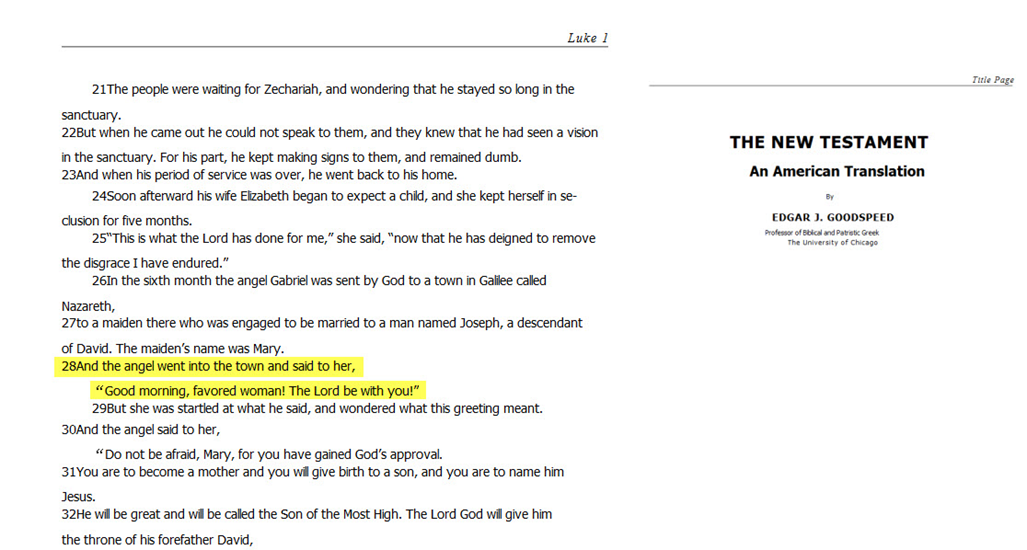
Goodspeed, 1931:
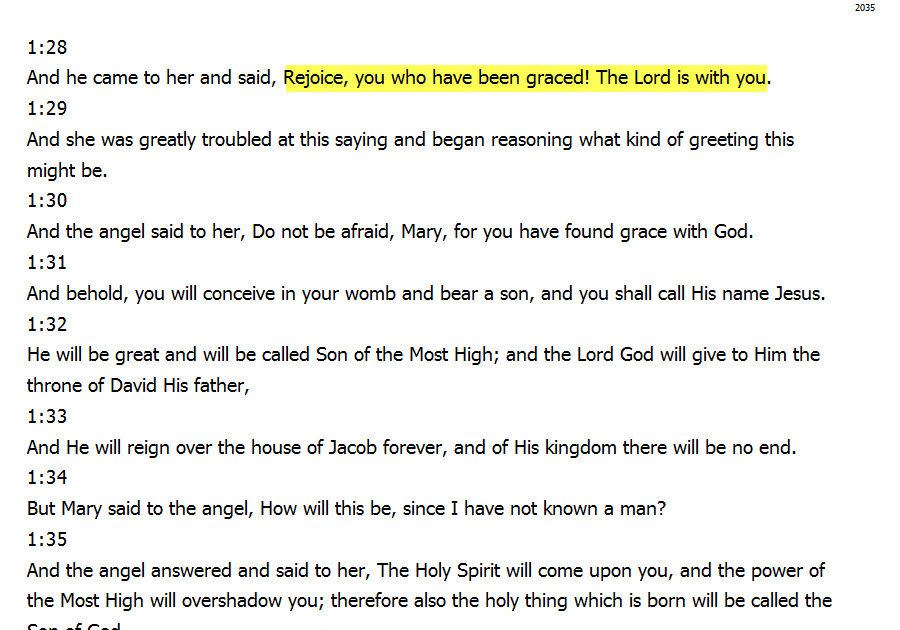
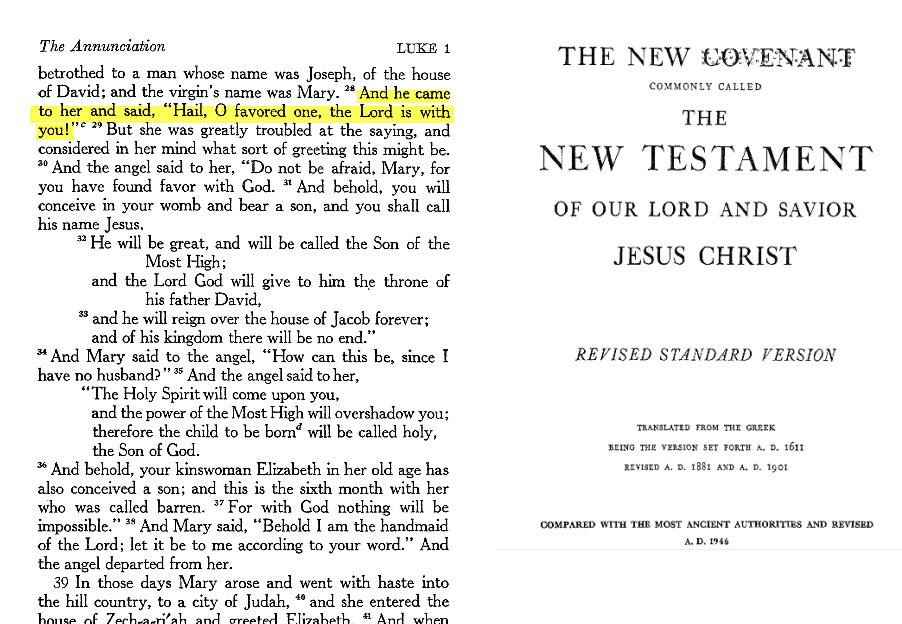
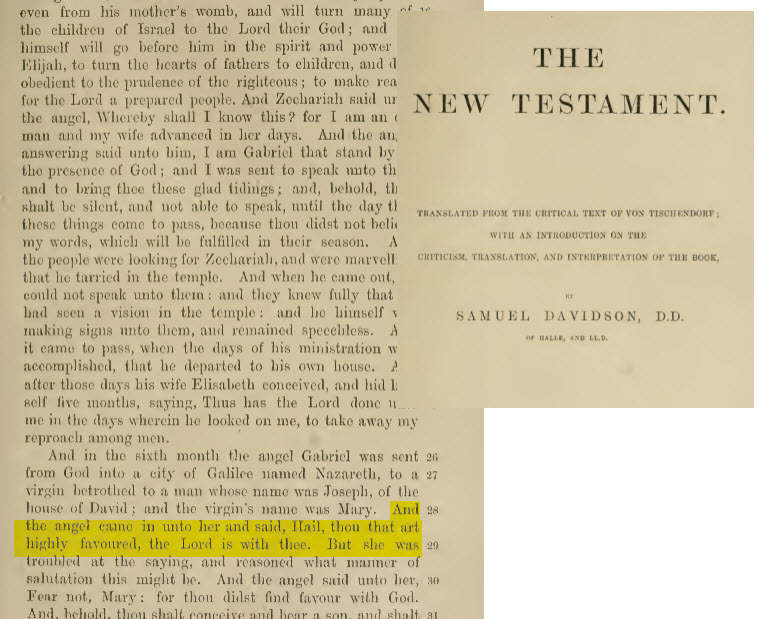
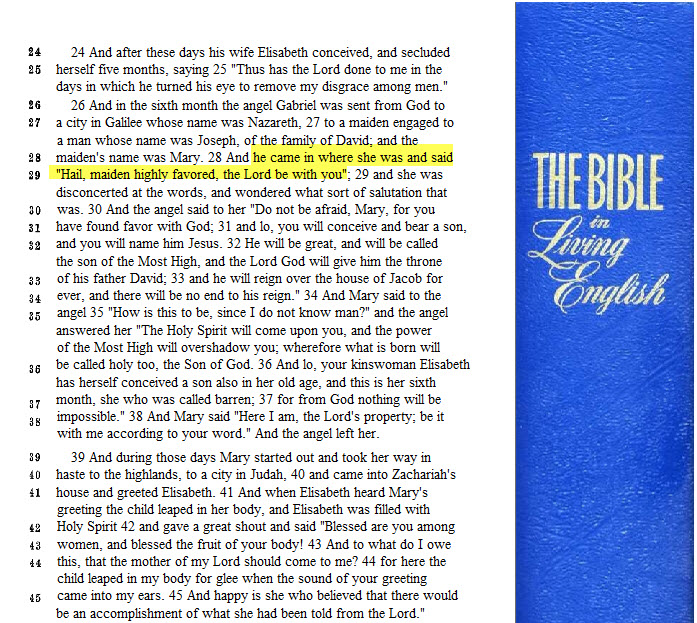
The Text in Greek Versions
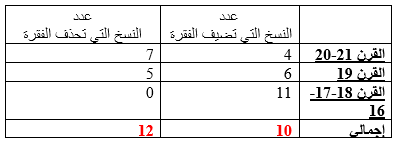
Table: Greek Versions by Century
Graph: Greek Version Trend
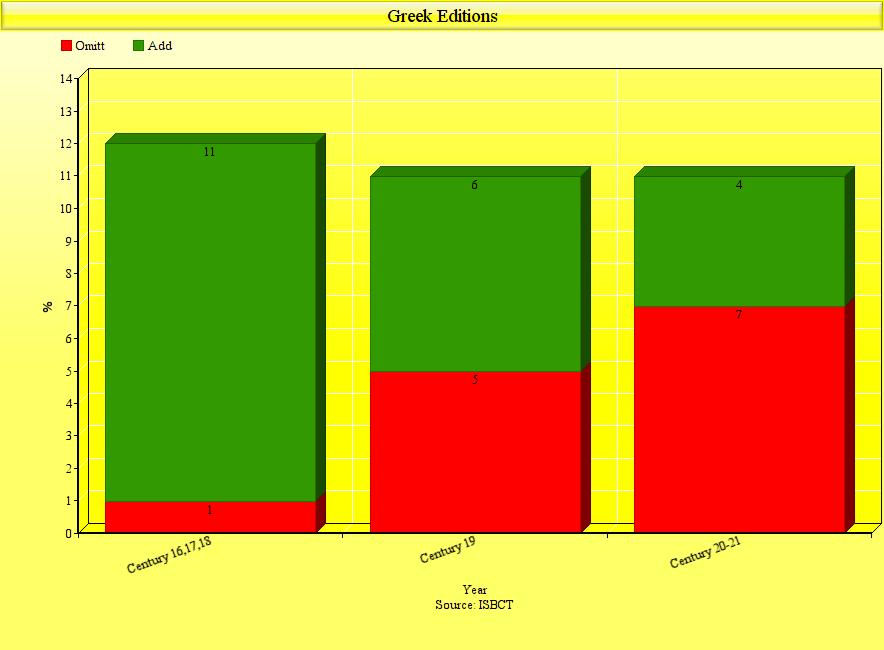
It is clear from the graph that the number of copies that delete text increases over time.
All traditional versions contain the paragraph. These are versions that do not rely on the study of manuscripts for their formation, but rather on a text prepared by a scholar named Erasmus in the sixteenth century, based on only 7 Greek manuscripts.
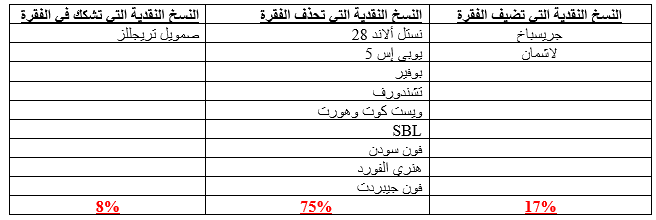
Critical versions using textual criticism: Of the 13 critical versions, 10 deleted the paragraph, 2 added the paragraph, and 1 placed the paragraph in parentheses to question its authenticity.
- Critical versions that use the rule “the most is the most correct” added the paragraph. These are versions that consider the most correct reading to be the one found in the largest number of manuscripts, regardless of the date of those manuscripts.
Table: Critical Version Decisions
Traditional Versions — Contain the Phrase
- Revised Patriarchal Greek Orthodox NT (RPT) Luke 1:28 — γυναιξίν
- Trinitarian Bible (TBT) Luke 1:28 — ὁ ἄγγελος πρὸς αὐτὴν εἶπε, Χαῖρε, κεχαριτωμένη· ὁ Κύριος μετά σου, εὐλογημένη σὺ ἐν γυναιξίν.
- Greek Vamvas Bible (MGK) Luke 1:28 — κεχαριτωμένη· ὁ Κύριος μετὰ σοῦ· εὐλογημένη σὺ ἐν γυναιξίν.
- Scrivener (SCR) Luke 1:28 — ὁ ἄγγελος πρὸς κεχαριτωμένη· ὁ Κύριος μετά σου, εὐλογημένη σὺ ἐν γυναιξίν.
- Robert Stephanus (STE) Luke 1:28 — κεχαριτωμένη ὁ κύριος μετὰ σοῦ εὐλογημένη σὺ ἐν γυναιξίν.
- Greek New Testament of the Greek Orthodox Church (GOC) Luke 1:28
Critical Versions that Add the Paragraph
- Griesbach (GRI-05) Luke 1:28 — ὁ ἄγγελος κεχαριτωμένη· ὁ κύριος μετὰ σοῦ· εὐλογημένη σὺ ἐν γυναιξίν.
- Karl Lachmann (LACH) Luke 1:28 — ὁ ἄγγελος πρὸς…
- William Pierpont Byzantine (BYZ) Luke 1:28 — Καὶ εἰσελθὼν ὁ κύριος μετὰ σοῦ, εὐλογημένη σὺ ἐν γυναιξίν.
Versions that Mention the Passage but Mark Its Authenticity as Doubtful
- Samuel Triggels (TRG2) Luke 1:28 — ὁ κύριος μετὰ σοῦ, γυναιξίν.]
- Metaglottisis Modern Greek (MET) Luke 1:28 — εἶπε: Χαίρε, κεχαριτωμένη, ο Κύριος είναι μαζί σου. [Ευλογημένη εσύ μεταξύ των γυναικών].
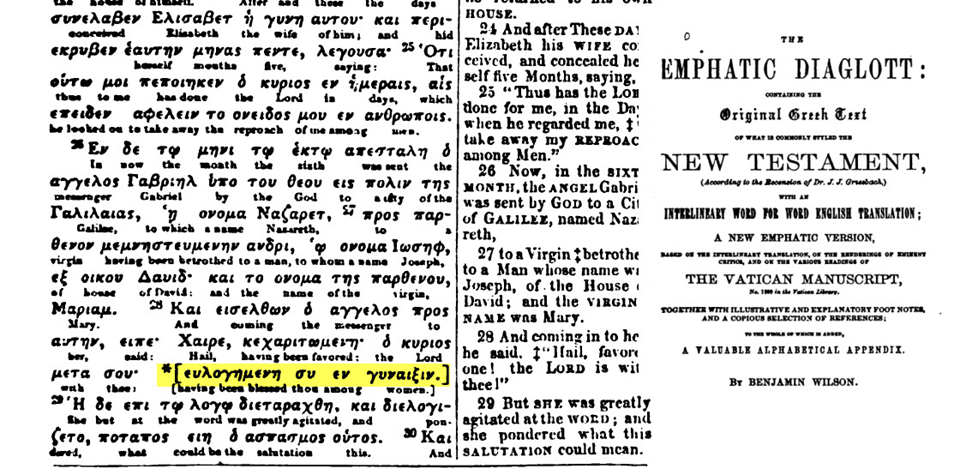
- Emphatic Diglott version 1864 Luke 1:28 — Χαίρε, κεχαριτωμένη, ο Κύριος είναι μαζί σου. [Ευλογημένη εσύ μεταξύ των γυναικών].
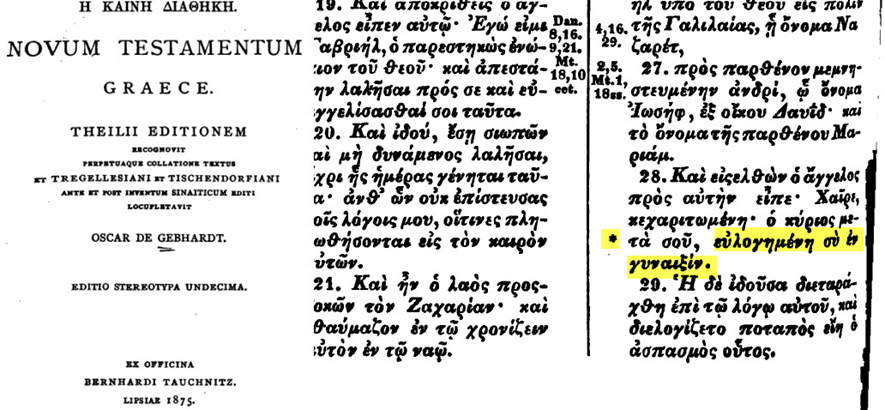
- Karl Godfried and Oscar Leo Bold Luke 1:28 — κεχαριτωμένη, ο Κύριος είναι μαζί σου. *Ευλογημένη εσύ μεταξύ των γυναικών.
Critical Versions that Delete the Paragraph
- Tischendorf (TIS) Luke 1:28 — ἄγγελος εἶπεν· χαῖρε, κεχαριτωμένη, ὁ κύριος μετὰ σοῦ.
- Von Soden (VST) Luke 1:28 — χαῖρε, κεχαριτωμένη, ὁ κύριος μετὰ σοῦ.
- Nestle-Aland NA27 Luke 1:28 — κεχαριτωμένη, ὁ κύριος μετὰ σοῦ.
- Nestle-Aland NA28 Luke 1:28 — κύριος μετὰ σοῦ.
- UBS4/5 Luke 1:28 — ὁ κύριος μετὰ σοῦ.
- Henry Alford (ALF) Luke 1:28 — κύριος μετὰ σοῦ.
- Westcott and Hort (WHT) Luke 1:28 — κύριος μετὰ σοῦ.
- Bouvier (JMB) Luke 1:28 — κύριος μετὰ σοῦ.
- SBL Version Luke 1:28 — κύριος μετὰ σοῦ.
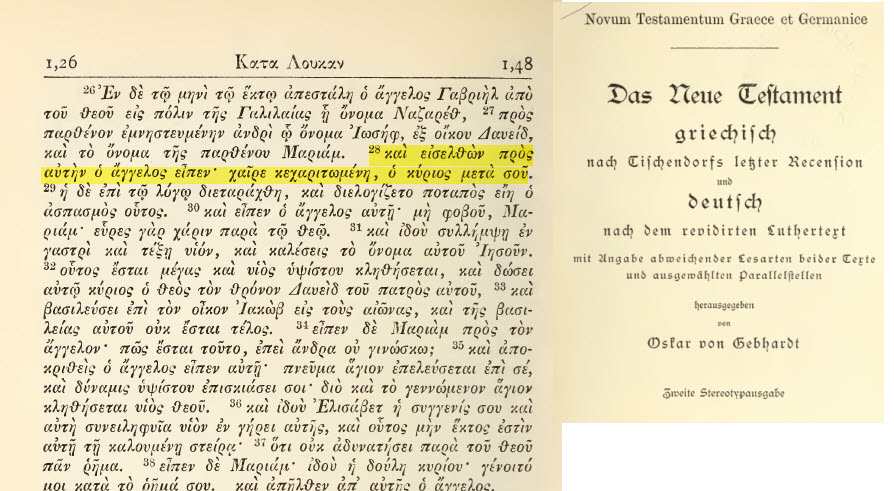
- Von Geberdt’s version 1884 Luke 1:28 — κύριος μετὰ σοῦ.
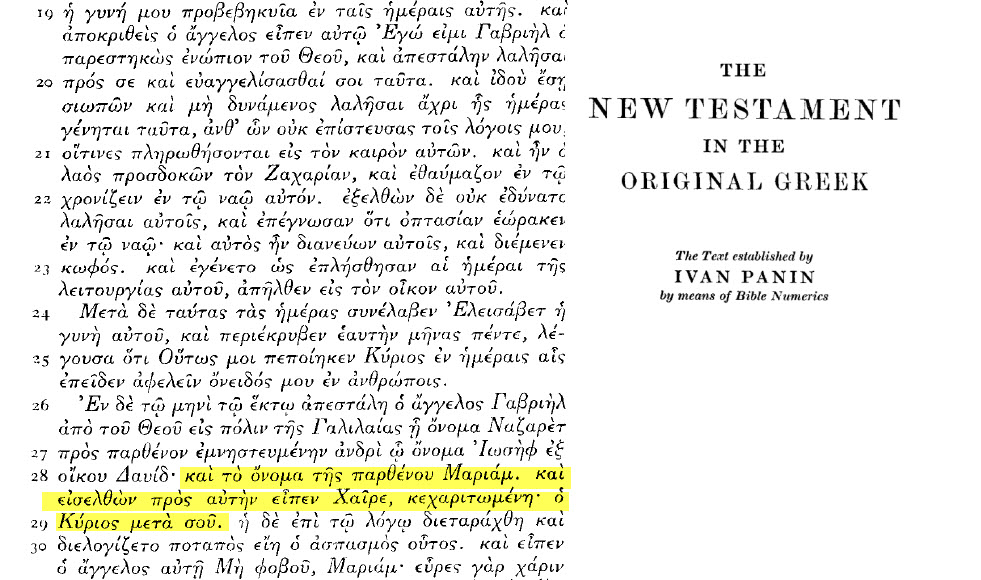
- IVAN PANIN 1934 Luke 1:28 — ὁ κύριος μετὰ σοῦ.
Complete Greek Version Timeline Tables
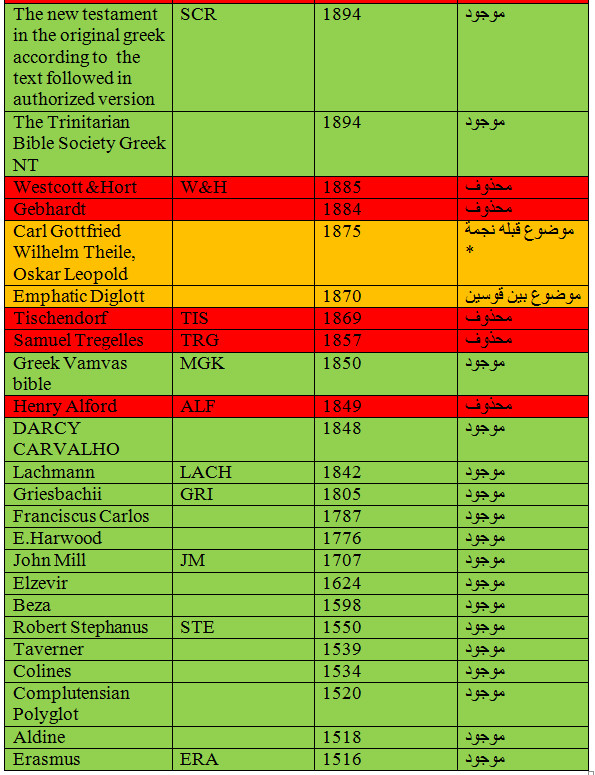
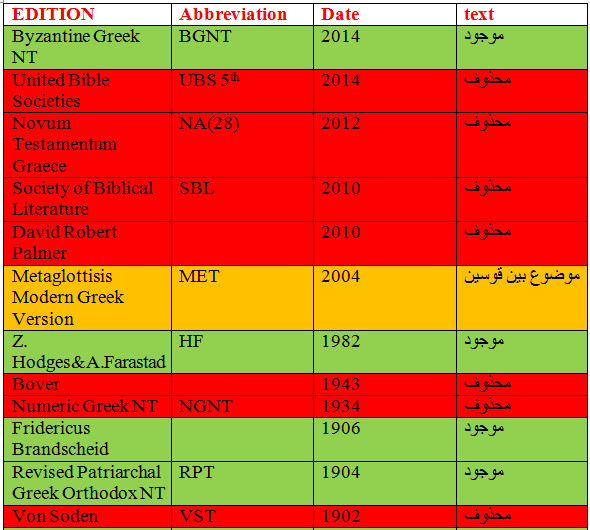
The table shows the change in the status of the text over time, as the number of versions that delete the passage increases with time. Some Greek versions delete the passage, place it in parentheses, or place a star before it.
Carl Gottfried & Wilhelm Theile, 1875:
The Manuscripts Themselves
Text in Manuscripts — Uppercase (Uncial) Script
The text in the five major manuscripts is written in capital letters. The capitalisation and the missing section from the manuscripts can be verified from the original manuscript images.
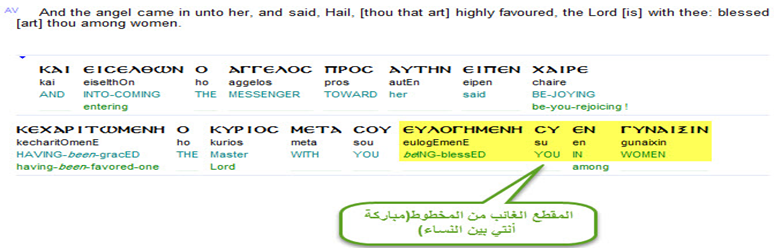
Manuscript Date Chart — 4th vs. 5th Century
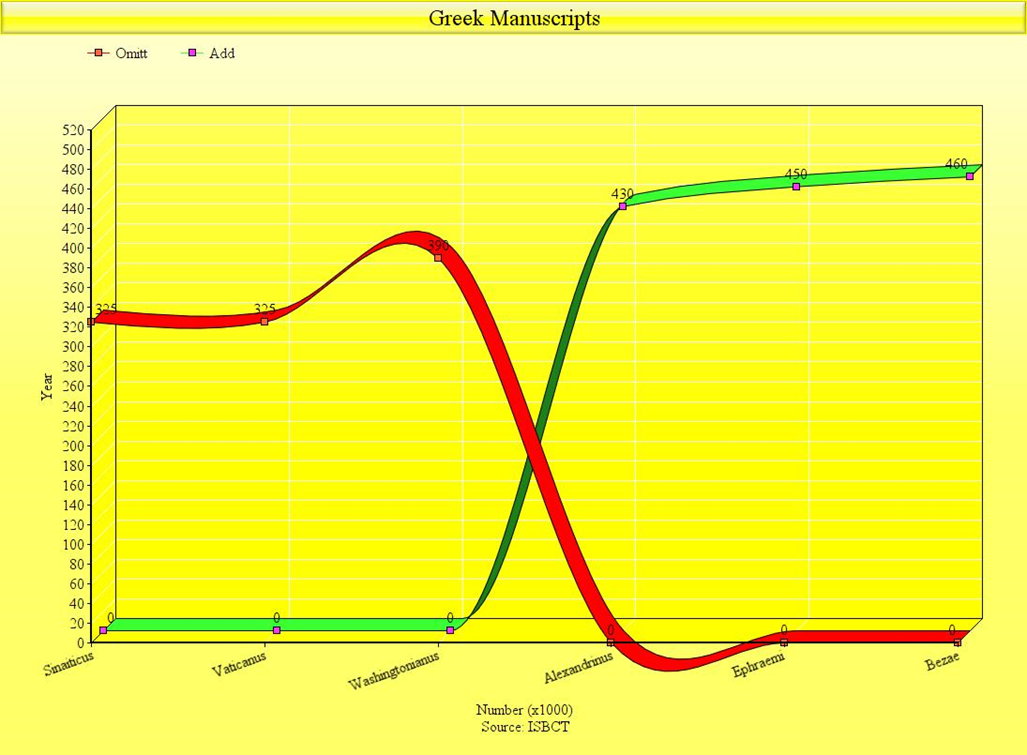
We will notice that the manuscripts in the fourth century delete the paragraph, then the situation changed in the fifth century, so the manuscripts began to contain the paragraph.
Codex Sinaiticus (4th Century)
The Sinaiticus is one of the two most important Greek manuscripts of the Bible in existence. The disputed phrase is absent. Official website: http://www.codexsinaiticus.org/en/
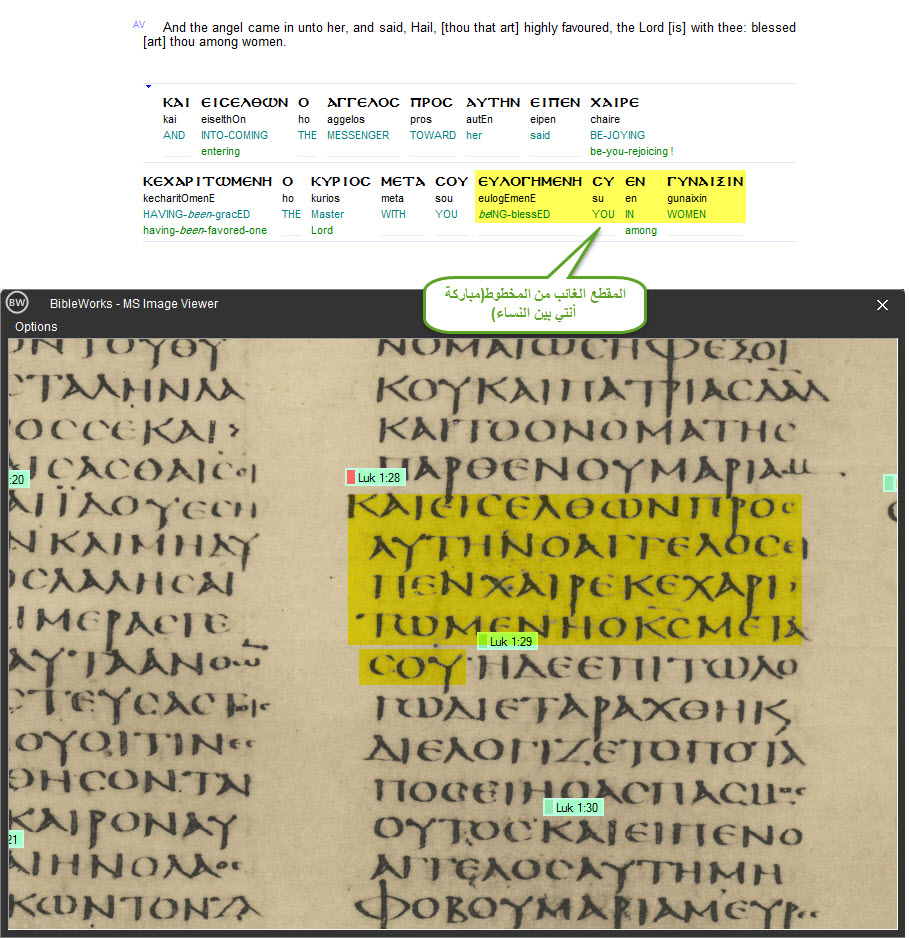
The Codex Sinaiticus Project is an international collaboration to reunite the entire manuscript in digital form. The page above shows its interface used to verify Luke 1:28 in the original.
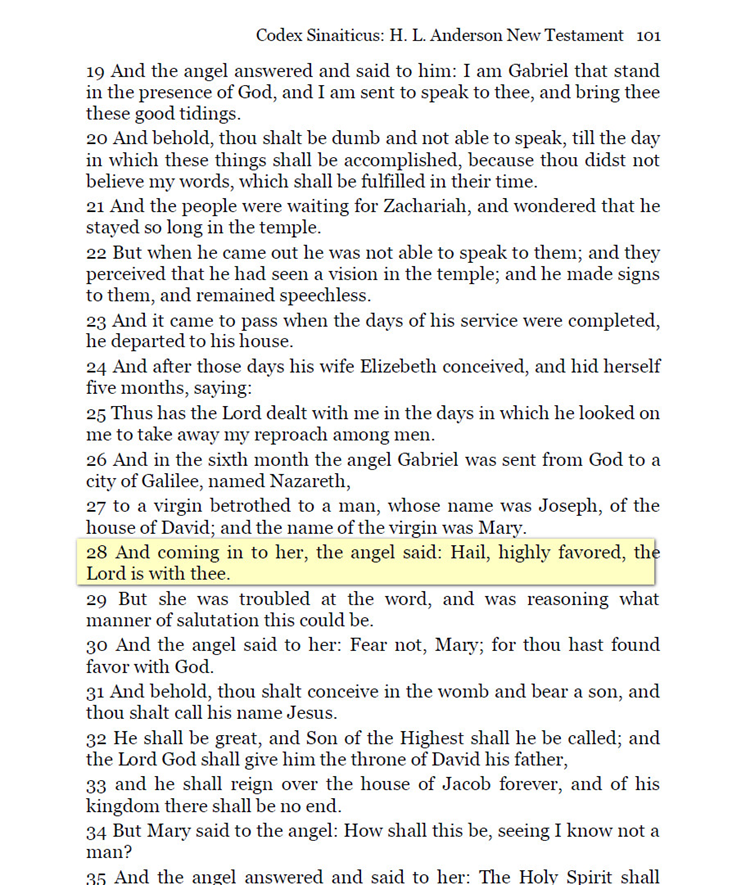
Codex Vaticanus (4th Century)
The Vaticanus is the other pillar of Alexandrian textual witnesses. The disputed phrase is absent. Browse link: https://manuscripts.csntm.org/manuscript/View/GA_03
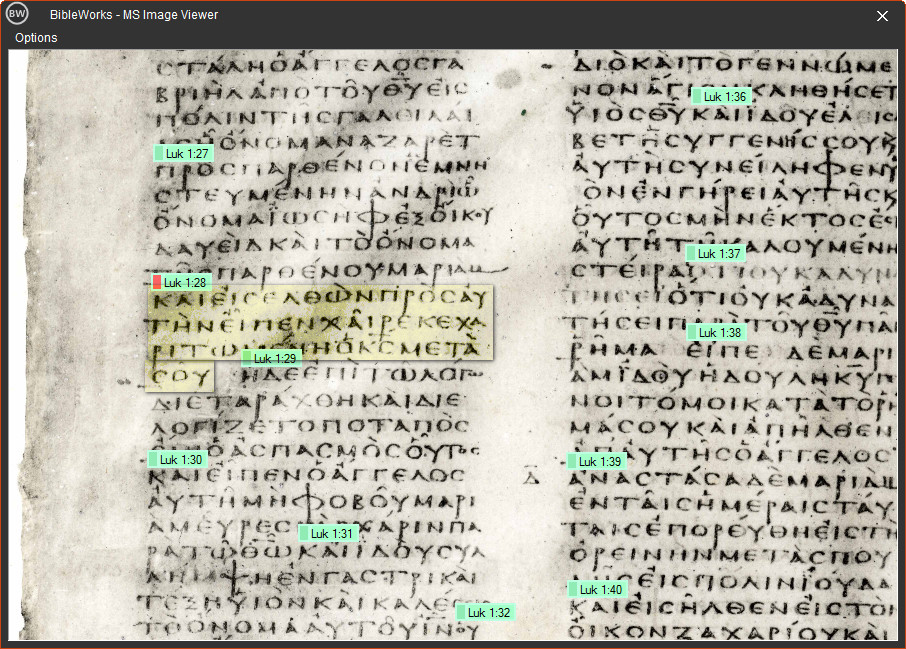
A transcription of the Vatican manuscript also confirms the absence of the addition.
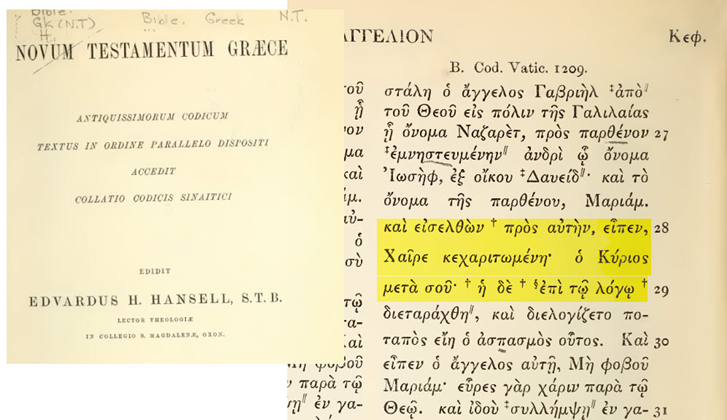
Codex Washingtonianus (Late 4th Century)
View link: http://www.csntm.org/manuscript/View/GA_032
The Washington Codex similarly lacks the addition.
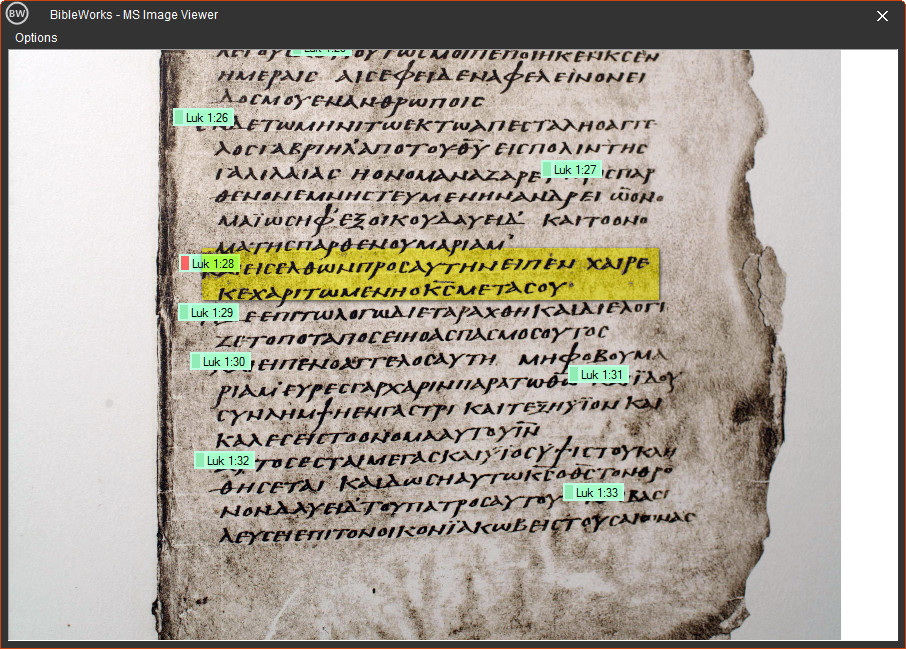
Bohairic Coptic Manuscripts
The Coptic Version of the New Testament in the Northern Dialect, Vol. 2
The Bohairic Coptic tradition — representing the Northern Egyptian church — omits the phrase.
Sahidic Coptic Manuscripts
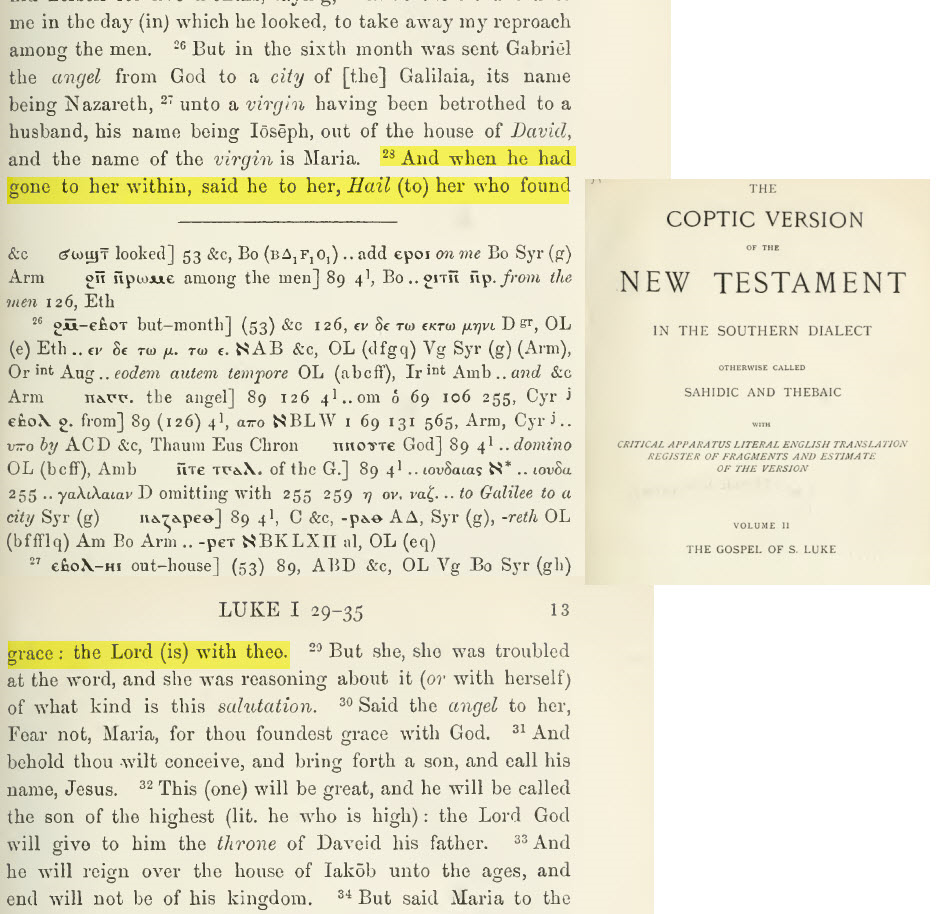
The Coptic Version of the New Testament in the Southern Dialect, Vol. 2
The Sahidic Coptic tradition — representing the Southern Egyptian church — likewise confirms the deletion reading.
What the Critical Editions Decided
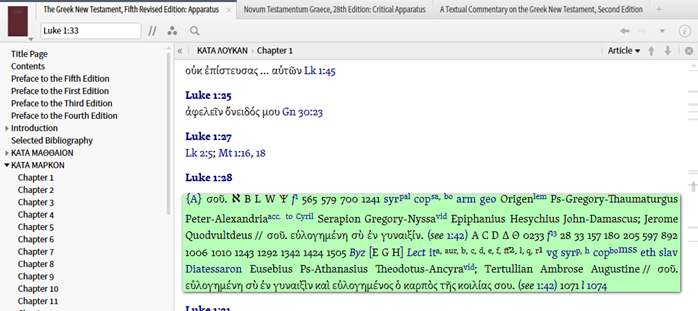
UBS 5th Edition — International Bible Committee
The UBS committee gave the deletion reading a grade of {A} — meaning they are fully confident this is the original text.
Aland, B., Aland, K., Karavidopoulos, J., Martini, C. M., & Metzger, B. (Eds.). (2014). The Greek New Testament: Apparatus (Fifth Revised Edition, pp. 192–193). Deutsche Bibelgesellschaft; American Bible Society; United Bible Societies.
The committee chose to read the deletion with a grade of A, which means that they are sure of the correctness of their choice.
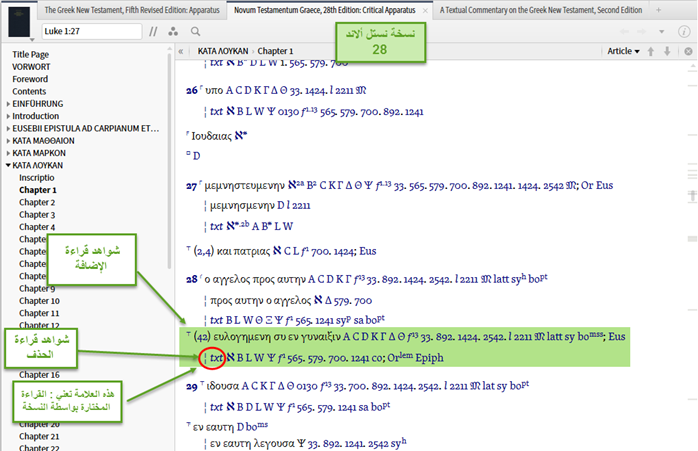
The Famous Nestle-Aland Critical Edition NA28
It chose the deletion reading as the correct reading and mentioned the supporting evidence for each reading.
Nestle, E., & Nestle, E. (2012). Nestle-Aland: NTG Apparatus Criticus (28. Revidierte Auflage, p. 179). Stuttgart: Deutsche Bibelgesellschaft.
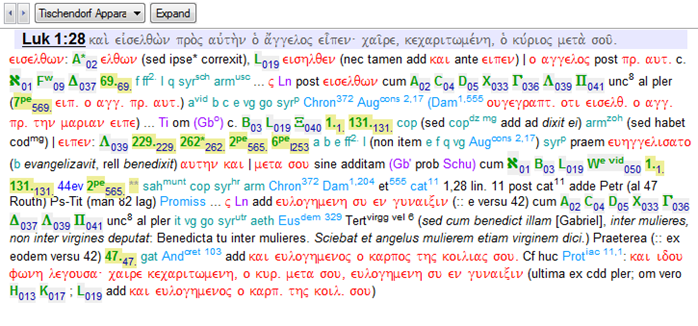
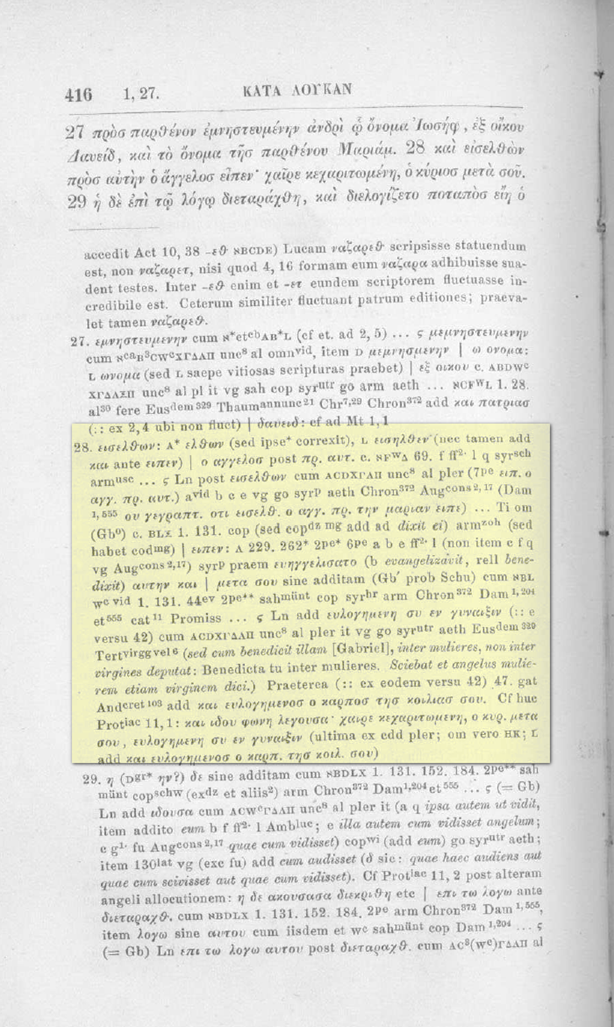
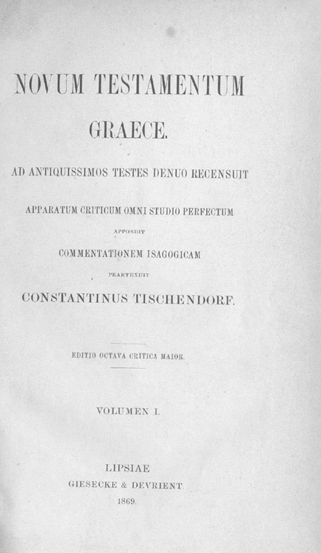
The Critical Apparatus — Novum Testamentum Graece, 8th ed. by Tischendorf
He mentioned 4 different readings:
- The reading of deletion — and mentioned its evidence
- The reading of addition (Blessed are you among women εὐλογημένη σὺ ἐν γυναιξίν) — and mentioned its evidence
- The reading of addition (Blessed are you among women and blessed is the fruit of your womb εὐλογημένος ὁ καρπὸς τῆς κοιλίας σου) — its evidence is manuscript 013H from the ninth century, manuscript 017K from the ninth century, and manuscript 019L from the eighth century
- Addition reading: “And a voice said, Blessed are you among women, O full of grace, for the sun is appointed by you”
What the Scholars Said
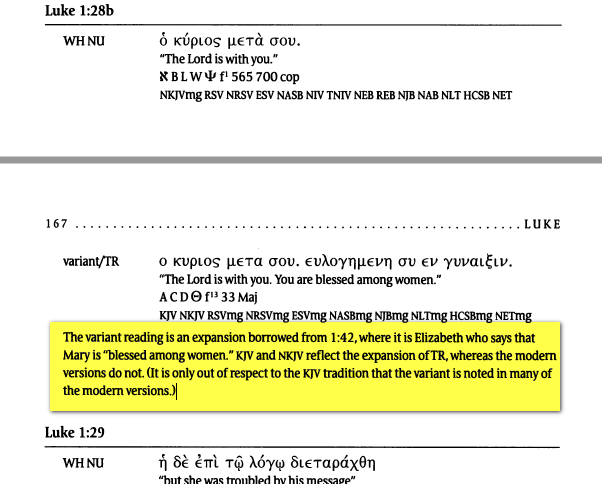
Philip Comfort
Philip Comfort mentioned the manuscripts supporting each reading and then said:
Translation: “This addition — ‘Blessed are you among women’ — is taken from verse 42. Only the reading is found in the King James Version and its new edition. Other modern versions do not have this addition. These modern versions have mentioned this addition in the margin out of respect for the King James Version.”
Viland Felker
After mentioning the evidence supporting each of the three readings, he said:
- The text in the Diatessaron is not found in the place where it should be, which is Luke 12:2 in the Diatessaron.
- According to Frederick Weiss, the passage is an addition inspired by verse 42.
- The deletion reading is clearly the original reading based on the available evidence.
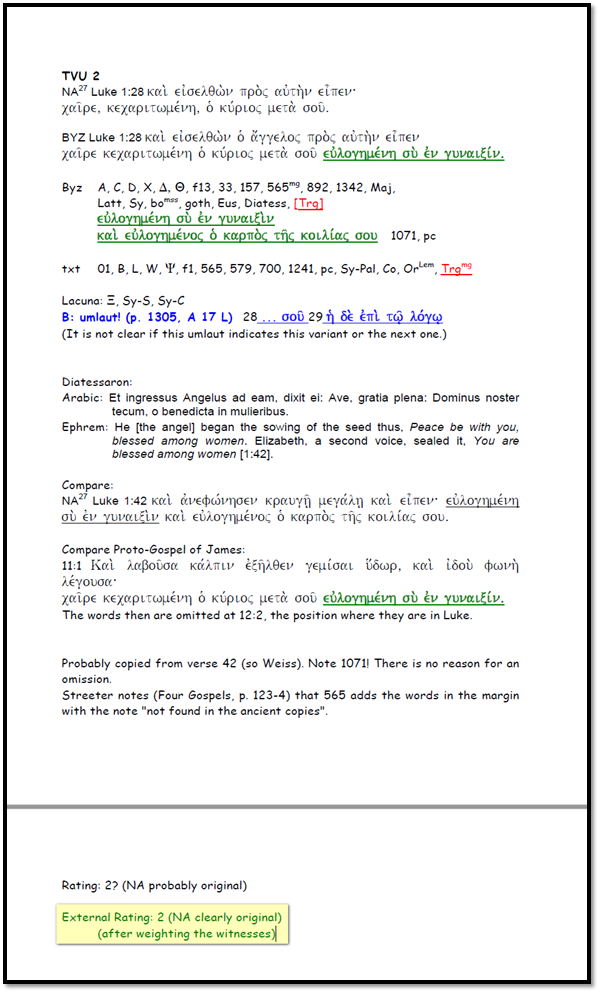
Byz A, C, D, γυναιξίν. εὐλογημένη σὺ ἐν γυναιξὶν and B: umlaut! (p. 1305, A 17 L) 28 … sou/ 29 h` de. evpi. tw|/ lo,gw| (It is not clear if this umlaut indicates this variant or the next one.) Diatessaron Arabic: Et ingressus Angelus ad eam, dixit ei: Ave, gratia plena: Dominus noster tecum, o benedicta in mulieribus. Ephrem: He [the angel] began the sowing of the seed thus, Peace be with you, blessed among women. Elizabeth, a second voice, sealed it, You are blessed among women [1:42]. The words then are omitted at 12:2, the position where they are in Luke.
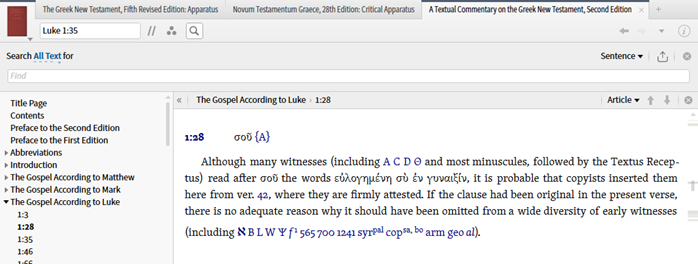
“Probably copied from verse 42 (so Weiss). Note 1071! There is no reason for an omission. Streeter notes (Four Gospels, p. 123-4) that 565 adds the words in the margin with the note ‘not found in the ancient copies.’ External Rating: 2 (NA clearly original) (after weighting the witnesses)”
Bruce Metzger
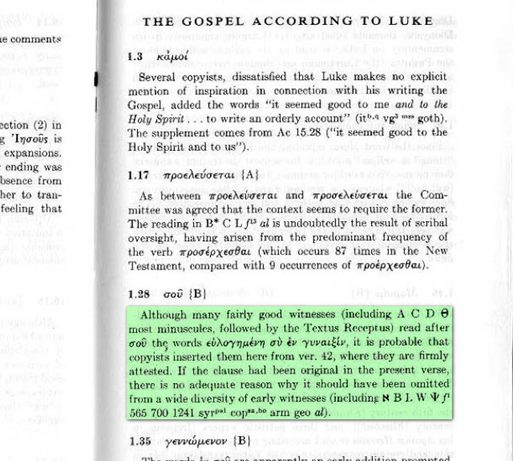
Translation: The most correct reading with a high degree of certainty is the reading of deletion. Although many manuscripts, including most of the manuscripts of small print, support the reading of addition, what appears to be the source of the addition is verse 42, and there is no justification for the copyists to delete this addition if it was the reading found in the original copies.
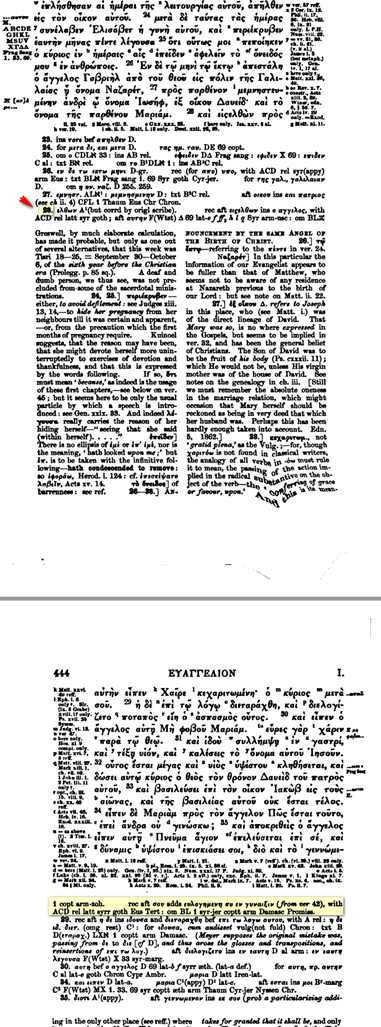
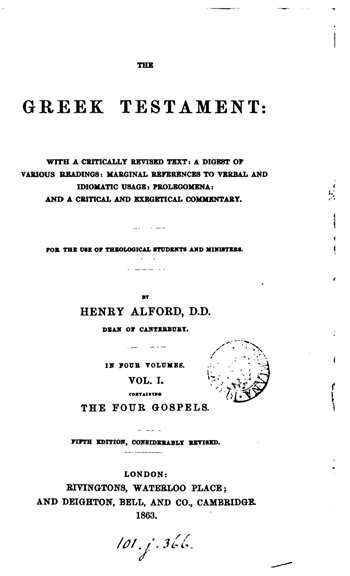
Henry Alford
After mentioning the evidence for each reading, Henry Alford stated the addition reading is taken from verse 42.
The Greek New Testament with a Critical Revised Text, by Henry Alford, pp. 443–444.
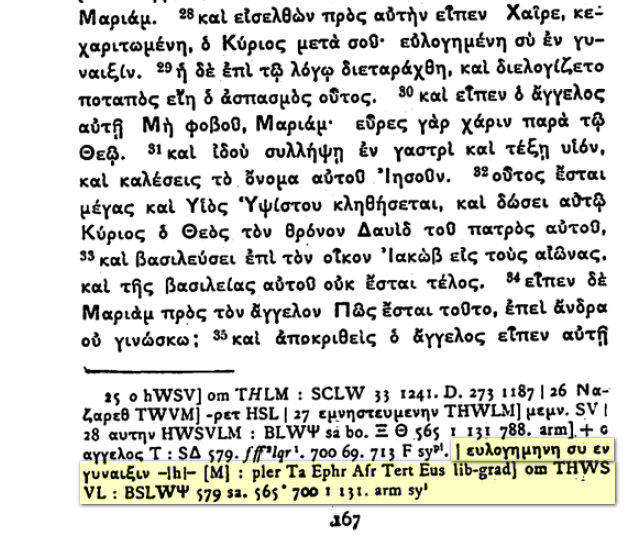
Joseph Maria Bouvier’s Critical Version
Bouvier‘s critical version chose the deletion reading as the original text of Luke 1:28.
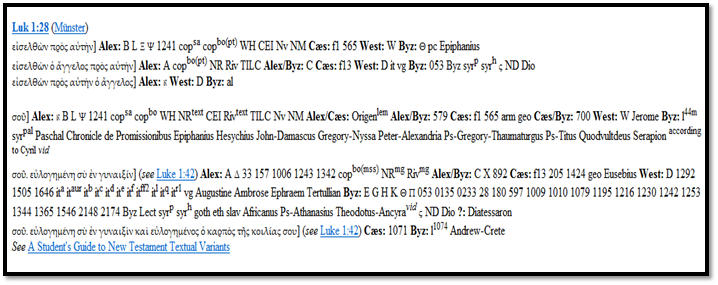
Richard Wilson — New Testament Manuscripts
New Testament Manuscripts, text type of manuscript, by curator Richard Wilson.
Evidence supporting the reading of deletion:
- Alexandrian family evidence: א BL Ψ 1241 copsa copbo
- Alexandrian Caesarean evidence: Origen
- Byzantine Alexandrian evidence: 579
- Caesarean evidence: f1 565 arm geo
- Byzantine Caesarean evidence: 700
- Western evidence: W Jerome
- Byzantine evidence: l44m syrpal Paschal Chronicle de Promissionibus Epiphanius Hesychius John-Damascus Gregory-Nyssa Peter-Alexandria Ps-Gregory-Thaumaturgus Ps-Titus Quodvultdeus Serapion according to Cyril vid
σοῦ] Alex: א BL Ψ 1241 copsa copbo WH NRtext CEI Rivtext TILC Nv NM · Alex/Cos: Origenlem · Alex/Byz: 579 · Cós: f1 565 arm geo · Cos/Byz: 700 · West: W Jerome · Byz: l44m syrpal Paschal Chronicle de Promissionibus Epiphanius Hesychius John-Damascus Gregory-Nyssa Peter-Alexandria Ps-Gregory-Thaumaturgus Ps-Titus Quodvultdeus Serapion according to Cyril vid
Evidence supporting the reading of addition σοῦ. [see Luke 1:42] (εὐλογημένη σὺ ἐν γυναιξίν):
- Alexandrian: A Δ 33 157 1006 1243 1342 copbo(mss) NRmg Rivmg
- Byzantine Alexandrian: CX 892
- Western: D 1292 1505 1646 ita itaur itb itc itd ite itf itff2 itl itq itr1 vg Augustine Ambrose Ephraem Tertullian
- Byzantine: EGHK Θ Π 053 0135 0233 28 180 597 1009 1010 1079 1195 1216 1230 1242 1253 1344 1365 1546 2148 2174 Byz Lect syrp syrh goth eth slav Africanus Ps-Athanasius Theodotus-Ancyravid ς ND Dio ?: Diatessaron
Evidence supporting the third reading (εὐλογημένη σὺ ἐν γυναιξὶν and κοιλίας σου):
- Caesarean: 1071
- Byzantine: Liturgical book 1074 — Andrew of Crete
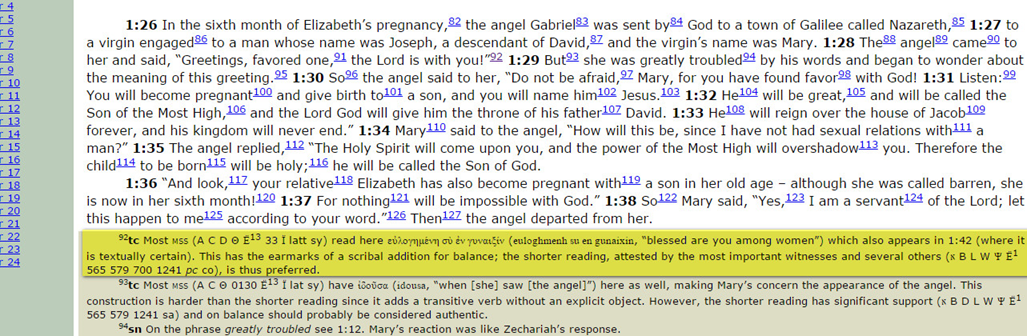
NET Bible Critical Version Commentary
Official Website: https://bible.org/netbible
Translation: “Most manuscripts add the phrase ‘Blessed are you among women,’ which is also found in Luke 1:42. This passage shows clear signs of later addition, as it is the shorter reading and is the reading supported by the testimony of the most important manuscripts and others.”
Bruce Terry
He mentioned the manuscripts supporting each reading, then chose the reading of deletion as the correct reading by placing it after the word TEXT, meaning the reading chosen as the original text. Then he said: “The reading of addition is taken from verse 42, and there is no justification for deleting the paragraph if it was the original reading.”
TEXT: “the Lord [is] with you!” EVIDENCE: SBLW Psi f1 565 700 1241 syr(pal) most cop TRANSLATIONS: ASV RSV NASV NIV NEB TEV RANK: B
NOTES: “the Lord [is] with you! Blessed are you among women!” EVIDENCE: ACDKX Delta Theta Pi f13 28 33 892 1010 Byz Lect lat vg syr(p,h) some cop(north) TRANSLATIONS: KJV ASVn RSVn NASVn
COMMENTS: “The words ‘Blessed are you among women!’ seem to have been added here from verse 42. There is no good reason why they should have been omitted if they were original.”
Jay Green
Translation: “This paragraph is omitted from the Nestle-Aland Version, the Greek UBS Version, and the New American Revised Version.”
Philip Schaff and Matthew Riddle
Commentary Consensus
Nine major biblical commentaries agree on deletion or doubt the authenticity of the addition. The following are the comments, with translations where relevant.
(1) Charles Ellicott — Ellicott’s Commentary for English Readers, THE GOSPEL ACCORDING TO ST. LUKE, by THE VERY REV. E.H. PLUMPTRE, D.D.:
Translation: “These words are omitted from many of the best manuscripts.”
(2) Cambridge Bible Commentary — Cambridge Bible for Schools and Colleges:
Translation: “These words are of doubtful authenticity, omitted from the Vaticanus and many translations. They may be taken from Luke 1:42.”
(3) Pulpit Commentary:
Translation: “These words must be ignored, for they are not found in the older witnesses.”
(4) E.W. Bullinger’s Companion Bible Notes:
Translation: “These words were omitted by Tregelles, Westcott and Hort, and were probably taken from and substituted for the text of verse 42.”
(5) John Dummelow — Commentary on the Bible:
Translation: “These words are omitted from many excellent testimonies.”
(6) Heinrich Meyer — Critical and Exegetical Commentary on the New Testament:
Translation: “This paragraph is omitted from the Sinaiticus, Vaticanus, Regius, Coptic Sahidic, Armenian, Syriac, and John of Damascus. It was omitted by Tischendorf, and Griesbach doubted it. It is an addition from Luke 1:42. Some other witnesses add the phrase ‘and blessed is the fruit of your womb.’”
(7) A. Robertson — Robertson’s Word Pictures in the New Testament:
Translation: “The oldest manuscripts do not add the phrase ‘Blessed are you among women’ here, but only in Luke 1:42.”
(8) Vincent — Vincent’s Word Studies:
Translation: “All excellent manuscripts omit this passage.”
(9) Philip Schaff — Popular Commentary:
Translation: “The rest of the text is rejected as it is taken from Luke 1:42.”
Summary of Scholar Positions
They said about this problem:
- Philip Comfort: The paragraph is an addition taken from verse 42, absent from most modern editions.
- UBS 5th: The correct reading, with a grade of A, is the deletion reading.
- Frederick Weiss: This paragraph is a later addition inspired by verse 42.
- Viland Felker: The deletion reading is clearly the original reading based on the available evidence.
- Bruce Metzger: The correct reading is the deletion reading, and there is no justification for the deletion reading to appear if the addition reading was the original.
- Bruce Terry: The correct reading is the deletion reading, and the addition reading is taken from verse 42.
- Nestle-Aland NA28: The deletion reading is the correct reading.
- Philip Schaff & Matthew Riddle: This paragraph is omitted from the best manuscripts.
- Henry Alford: This paragraph is an addition from verse 42.
- NET Bible: The marks of the later addition are visible on the paragraph, and the most important manuscripts omit it.
- Charles Ellicott: This paragraph is omitted from many of the best manuscripts.
- Cambridge Bible Commentary: This passage is of doubtful authenticity.
- Pulpit Commentary: These words should be ignored, as they are absent from the oldest witnesses.
- E.W. Bullinger: These words were probably taken from verse 42 and inserted here.
- John Dummelow: These words are omitted from many good witnesses.
- Heinrich Meyer: Omitted from many witnesses, questioned by Griesbach and omitted by Tischendorf; they are added from verse 42.
- A. Robertson: This passage is not found in the oldest manuscripts except in Luke 1:42.
- Vincent: All excellent manuscripts omit this passage.
- Philip Schaff: This part of the text is rejected; it is taken from verse 42.
A Final Word
- There are no Latin manuscripts from the second century.
- There is no manuscript called “Assyrian” from the second century.
- There are no manuscripts of the Diatessaron from the second century.
- Not a single textual critic among the scholars who use the rule of chronological seniority as a rule of preference has ruled on the authenticity of the passage.
- We want a single, certain rule by which we can know the correct reading — and none exists.
Conclusion
The final result is as follows:
Differences occur in everything:
- In ancient manuscripts
- In modern printed versions in all languages
- In ancient translations
- In treating the problem
There is no single, certain rule that can be applied to determine the correct reading. The matter is just a guess. According to the available rules, the most correct reading is the reading of deletion.
سُبْحَانَ الَّذِي لَمْ يَتَّخِذْ وَلَدًا وَلَمْ يَكُن لَّهُ شَرِيكٌ فِي الْمُلْكِ وَلَمْ يَكُن لَّهُ وَلِيٌّ مِّنَ الذُّلِّ وَكَبِّرْهُ تَكْبِيرًا
وَآخِرُ دَعْوَانَا أَنِ الْحَمْدُ لِلَّهِ رَبِّ الْعَالَمِينَ
...lems-of-mark-1-2-3-quotations-and-distortions|Problems of Mark 1_2 3 Quotations and Distortions]]