

Acts 3:13 — 'Servant' or 'Son'? How Scribes Changed the Greek Word Pais to Defend the Divinity of Jesus
The oldest and best manuscripts of the Bible describe Jesus as a servant of God — and later scribes changed this word to defend his alleged divinity. This is not a minor variant. It appears across four separate texts in Acts, is confirmed by the five oldest Greek codices, and is acknowledged by the majority of modern critical editions and English translations. The history behind this alteration begins with a foundational contradiction at the heart of Christianity: its laws of faith were established before its canon of scripture.
Faith Before Book — The Foundational Contradiction
It is known by consensus that faith preceded the Book. The laws of Christian faith were established in the year 325 CE at the Council of Nicaea, while the first list of the Christian Holy Book was not established until the year 397 CE. This means Christian doctrine was fixed seventy-two years before the Church had even agreed on which texts constituted its scripture.
The creed was written before the canon was closed.
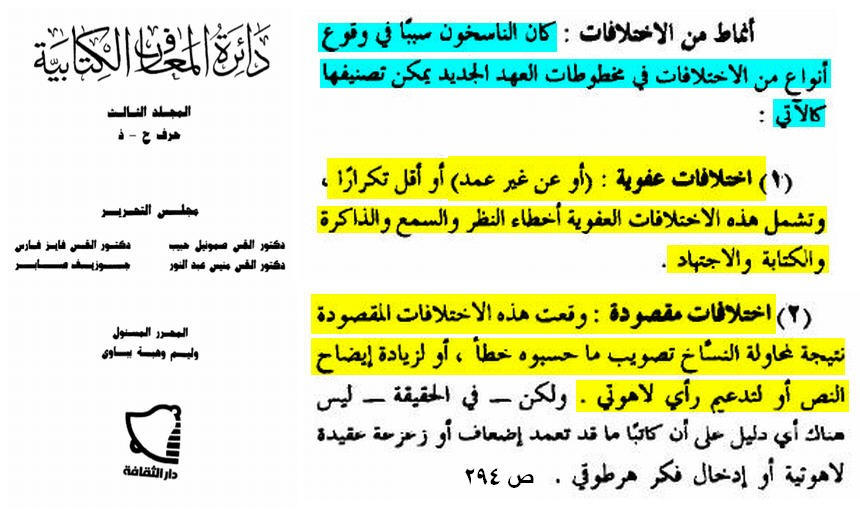
This is why we find many texts in which pious copyists struggled as they tried to reconcile a human law of faith — formulated at Nicaea — with texts of a Holy Book that contradicted that faith. They had no choice but to change and alter the word of the Lord to conform to their doctrine.
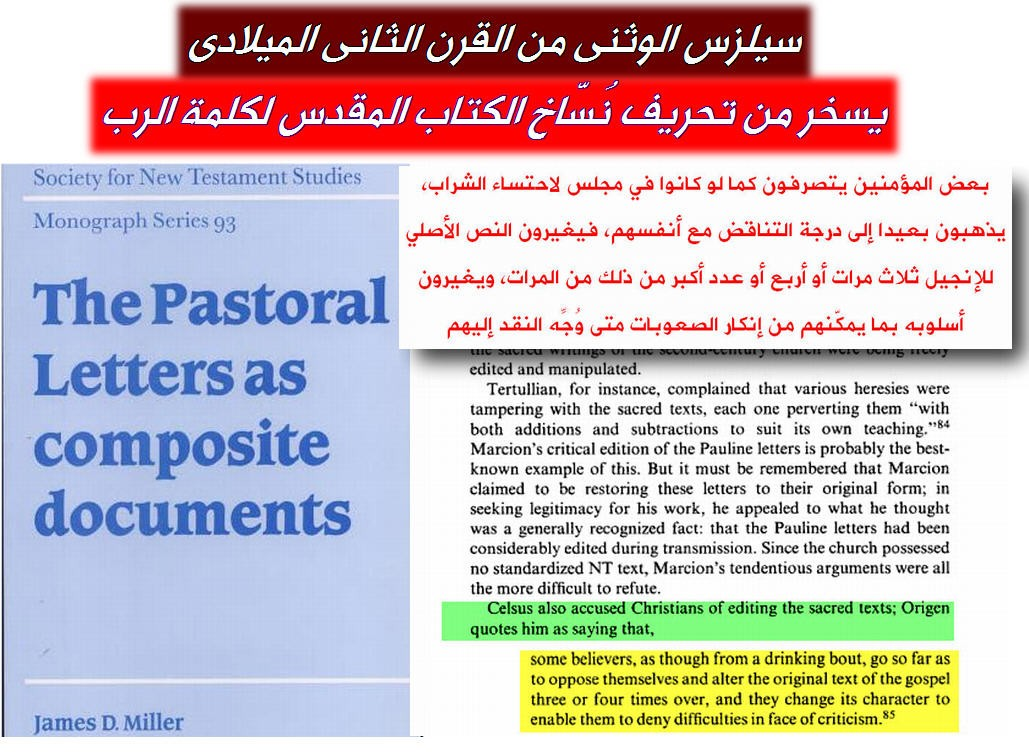
These attempts were the subject of ridicule by pagans from the very first centuries of Christianity. In his book The Pastoral Letters as Composite Documents, the researcher James D. Miller quotes the mockery of the pagan Celsus from the second century CE about the copyists of the word of God:
“Some believers act as if they were in a drinking party, going so far as to contradict themselves; they change the original text of the Gospel three or four times or more and change its style; so that they can deny the difficulties when they are criticized.”
The following image presents the source material from James D. Miller’s work containing Celsus’ mockery.
The Four Texts in Acts — Jesus Described as “Servant”
As an example of what these pious copyists were doing in manipulating the texts of their book to support a doctrine for which there is no clear evidence in the texts themselves, consider four passages in the Book of Acts in which the disciples of Jesus describe him using a specific Greek word.
“The God of Abraham, Isaac, and Jacob, the God of our fathers, glorified his servant Jesus.”
“To you first, God having raised up his servant Jesus, sent him to bless you in turning every one of you from his wickedness.”
“Indeed, they gathered together against Your holy servant Jesus, whom Herod anointed.”
“Stretch out your hand to heal, and let signs and wonders be done in the name of your holy servant Jesus.”
Four texts on the tongue of Jesus’ disciples describing him as “the servant of the Lord.” By referring to the best and oldest manuscripts of the Bible, however, we find that the Greek word used to describe Jesus is the word παῖδα — which means servant — and not “boy” as the Christians distorted it in their later manuscripts.
The Manuscript Evidence — Five Codices
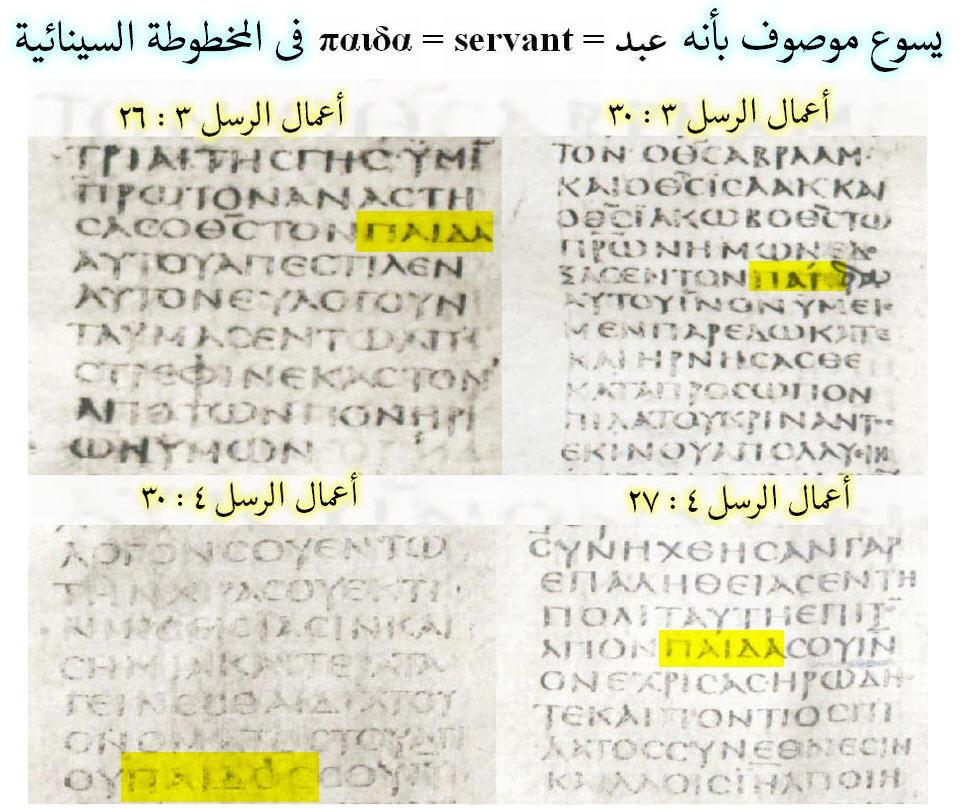
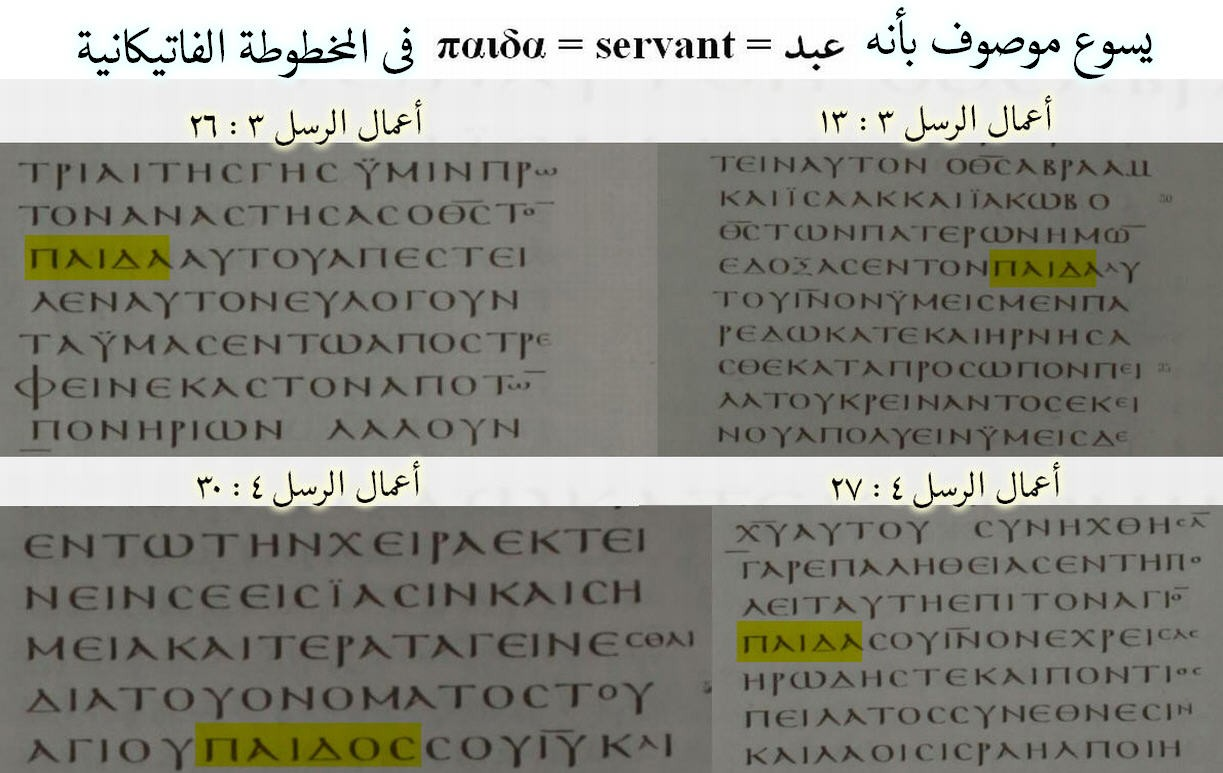
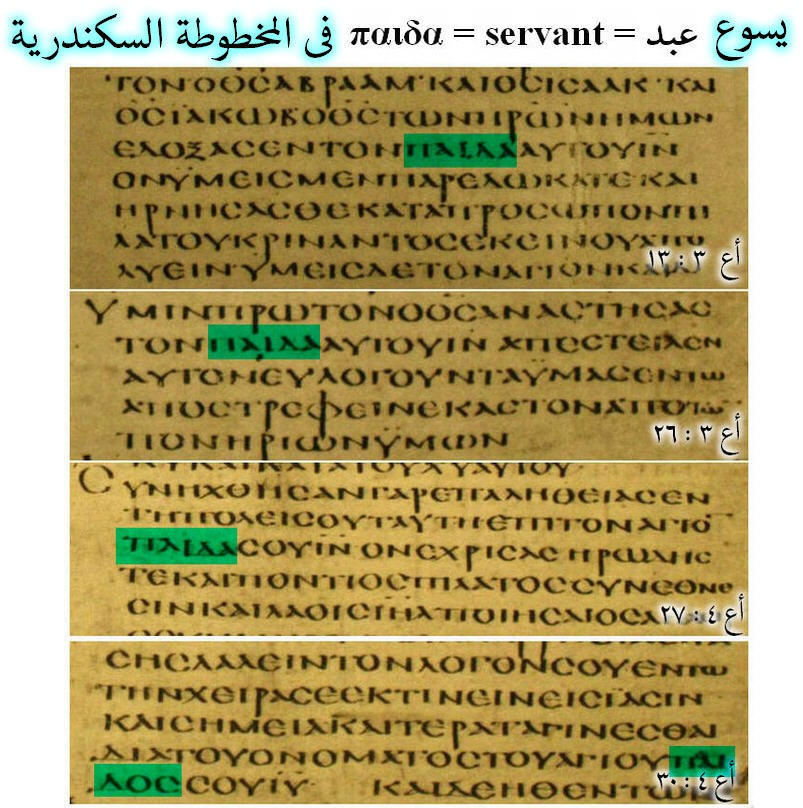
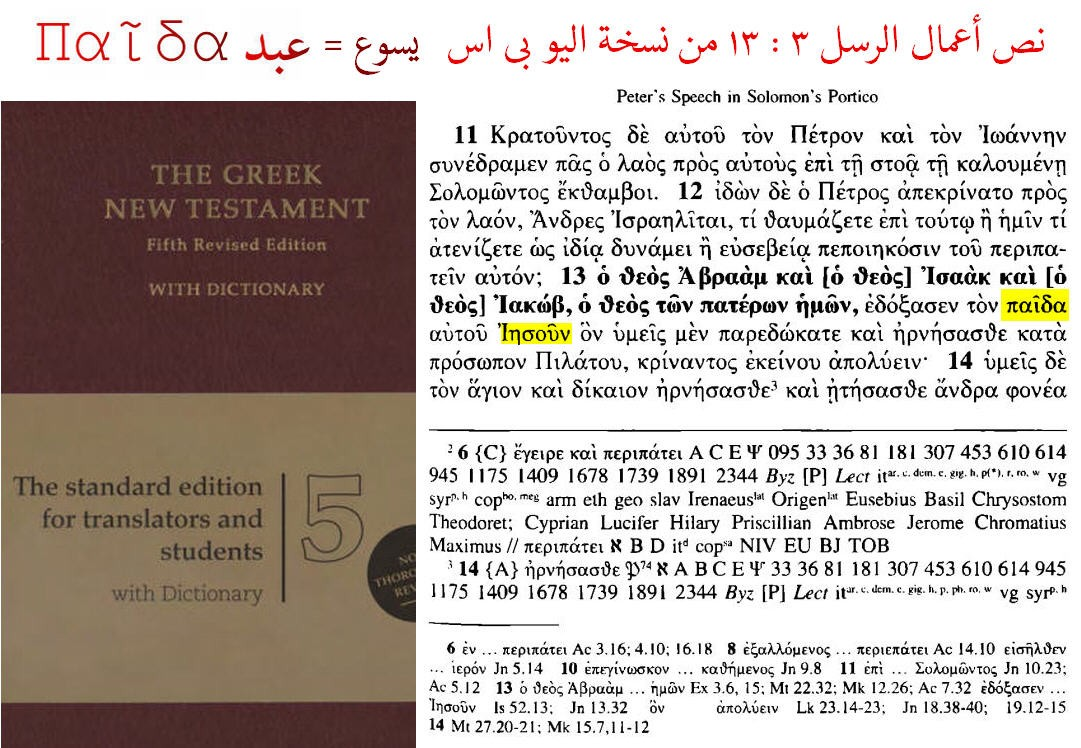
All five of the oldest and best Greek manuscripts of the New Testament use the word παῖδα — servant — in Acts 3:13, Acts 3:26, Acts 4:27, and Acts 4:30.
The Greek text of Acts 3:13 as it appears in these manuscripts reads:
ὁ Θεὸς Ἀβραὰμ καὶ Ἰσαὰκ καὶ Ἰακώβ, ὁ Θεὸς τῶν πατέρων ἡμῶν, ἐδόξασεν τὸν Παῖδα αὐτοῦ Ἰησοῦν
“The God of Abraham and Isaac and Jacob, the God of our fathers, glorified his servant Jesus.”
Acts 3:26 likewise states that Jesus was merely a servant of God:
ἀπέστειλεν αὐτὸν εὐλογοῦντα ὑμᾶς
Acts 4:27 describes Jesus as a servant:
ἐπ’ ἀληθείας ἐν τῇ πόλει ταύτῃ ἐπὶ τὸν ἅγιον Παῖδα σου Ἰησοῦν
Acts 4:30 likewise uses the same word:
καὶ… τὸν ἅγιον Παῖδα σου Ἰησοῦν
The following image presents the manuscript evidence for this reading.
The following image continues the manuscript evidence.
The following image presents the third entry in the manuscript evidence sequence.
The Critical Editions — All Confirm “Servant”
Referring to the standard critical editions of the Greek New Testament — the Nestle-Aland version, the Westcott-Hort version, the UBS version, the Samuel Tregelles version, and the Tischendorf version — we find a consensus based on what was mentioned in the oldest and best Greek manuscripts. The text in all of them reads servant. Acts 3:13 in the Nestle 1904 edition reads:
ΠΡΑΞΕΙΣ 3:13
Greek NT: Nestle 1904
ὁ Θεὸς τῶν πατέρων ἡμῶν, ἐδόξασεν τὸν Παῖδα αὐτοῦ Ἰησοῦν, ὃν…
A servant of God — not a boy, as the later copyists distorted it in defense of their human god.
The English Versions — Most Use “Servant”
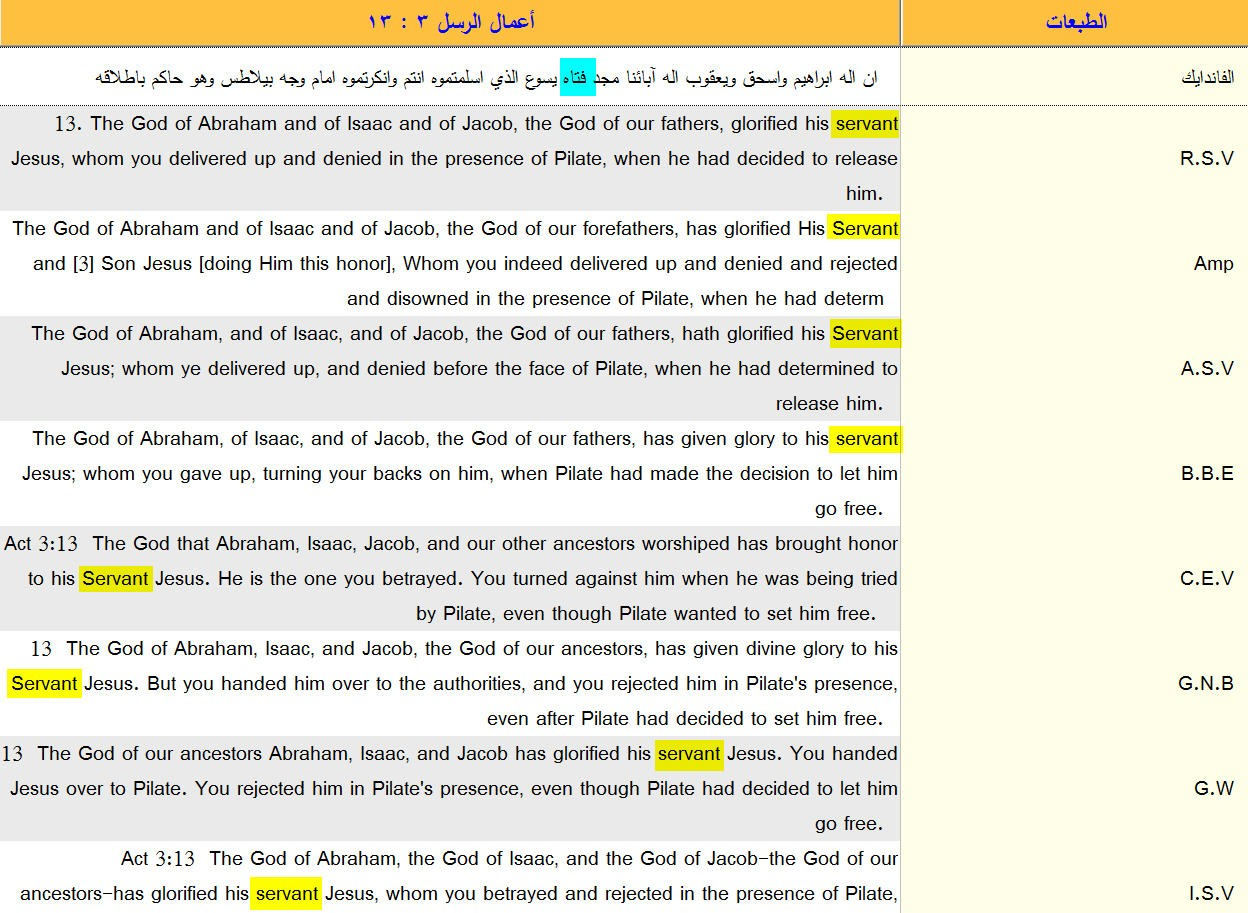
Most English translations rendered the word correctly as servant. These include: AMP, ASV, NIV, RV, RSV, BBE, CEV, GNB, GW, ISV, NRSV, and the NET Bible — all of which translate Acts 3:13 as: “has glorified His Servant Jesus.”
A small number of translations retained the infamous Erasmus translation, using the word “Son” — among them the MSG translation and, of course, the KJV:
“The God of Abraham, and of Isaac, and of Jacob, the God of our fathers, hath glorified his Son Jesus.”
The following image presents the evidence from English version comparisons.
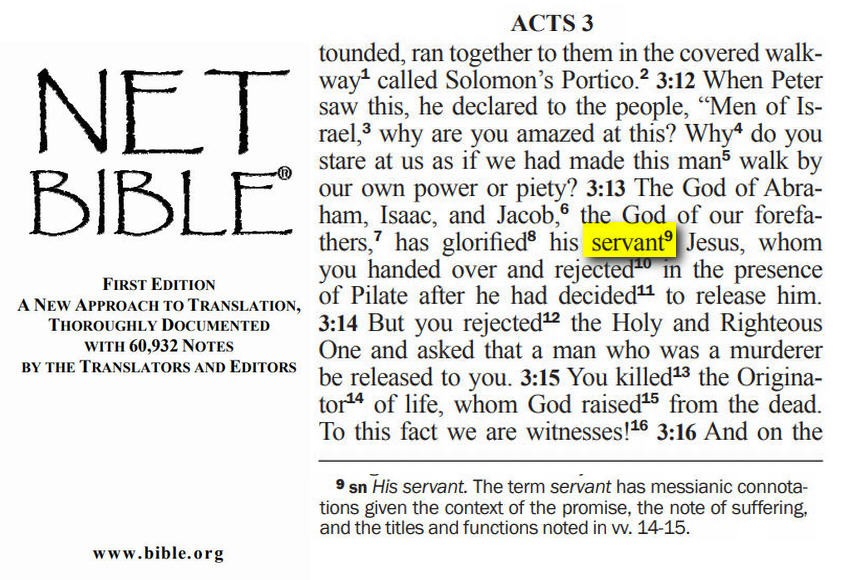
The following image continues the English version comparison evidence.
The following image presents the third entry in the English version comparison sequence.
The Arabic Versions — Divided
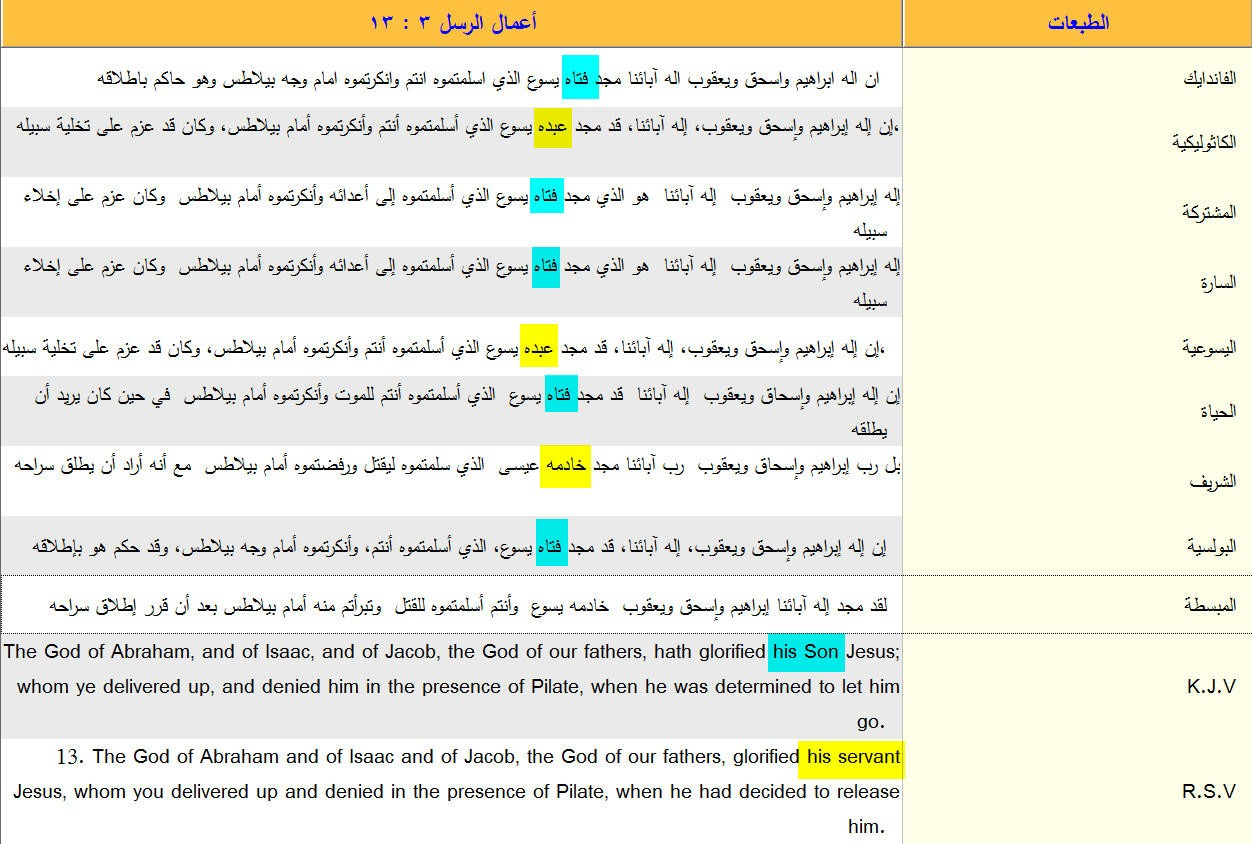
The Arabic Van Dyck version and other Arabic translations — including the Sarah, Common, Pauline, and Life translations — chose the word “his youth,” following the later distorters in order not to make themselves a laughingstock among Muslims.
The Catholic version and the Jesuit translation, however, chose the word “his servant” based on its presence in the oldest and best manuscripts of the Bible:
“The God of Abraham, Isaac, and Jacob, the God of our fathers, has glorified his servant Jesus.”
The simplified translation and the Holy Bible translation chose the word “his servant,” which is close in meaning:
“But the Lord of Abraham, Isaac, and Jacob, the Lord of our fathers, has glorified his servant Jesus.”
The following image presents the Arabic version comparison evidence.
The Meaning of Παῖδα in the Lexicons
A word that means specifically a slave or servant.
The Jesuit fathers translated it as “slave” precisely because that is what the lexicons confirm the word means. The later tradition of translating it as “son” or “boy” is a departure from both the lexical meaning and the manuscript evidence.
Matthew’s Prior Distortion of Isaiah
Matthew preceded the later copyists in distorting this word — out of shame at describing Jesus as a servant — when he claimed that the text of Isaiah contained a prophecy about Jesus:
“That it might be fulfilled which was spoken by Isaiah the prophet, saying, ‘Behold, my servant whom I have chosen, my beloved in whom my soul delights.’”
But by referring to the actual text of Isaiah, we find that the root of the word is servant and not “boy” as Matthew claimed:
“Behold, my servant whom I uphold, my chosen one in whom my soul delights. I have put my Spirit upon him, and he will bring forth justice to the Gentiles.”
The word in Isaiah is unambiguously servant. Matthew’s redaction of this text to read “my servant whom I have chosen” — while the underlying Isaiah text uses the same servant terminology — is itself evidence of the scribal pattern of accommodating Christological doctrine at the expense of textual fidelity.
The following image presents the final source material on Matthew’s use of Isaiah and the closing questions for the reader.
The Greek word παῖδα in Acts 3:13, 3:26, 4:27, and 4:30 means servant. This is confirmed by Strong’s Greek Dictionary, by the five oldest Greek codices — Sinaiticus, Vaticanus, Alexandrinus, Bezae, and Ephraemi — and by every major critical edition of the Greek New Testament: Nestle-Aland, Westcott-Hort, UBS, Tregelles, and Tischendorf. The majority of modern English translations render it correctly as servant. The KJV and a small number of later translations alone use “Son,” following the Erasmus tradition rather than the manuscript evidence. The Arabic Van Dyck tradition chose “his youth” — a rendering that follows the later distorters and is not supported by the oldest manuscripts. The Catholic and Jesuit translations correctly render it as “his servant.” The Council of Nicaea formulated its doctrine of Christ’s divinity in 325 CE — seventy-two years before the Church had even agreed on its canon. The scribal alterations to Acts were a predictable consequence: when doctrine precedes text, the text must eventually be made to conform to the doctrine. The Bible itself, in its oldest recoverable form, describes Jesus in the words of his own disciples as the servant of God — not God himself.