Acts 2:30 Interpolation — How Scribes Added 'Raises Up Christ According to the Flesh' to Manufacture a Messianic Prophecy
Among the texts tampered with by the copyists of the New Testament manuscripts is Acts 2:30, which speaks of a person from the lineage of David who will reign and sit on David’s throne. The oldest and best manuscripts contain no mention of Jesus in this passage whatsoever. A later scribe added the phrase “raises up Christ according to the flesh” in a desperate attempt to prove that Jesus is the one prophesied to inherit the throne of David. Every major critical edition of the Greek New Testament has deleted this addition. The passage also contains an internal contradiction that the copyist apparently failed to notice: it destroys the very claim it was inserted to support.
The Original Text in the Oldest Manuscripts
The text of Acts 2:30 as it appears in its original form, in the same form across the oldest and best manuscripts of the New Testament, reads as follows:
“For he was a prophet, and knew that God had sworn an oath to him to appoint a child from his lineage on his throne.”
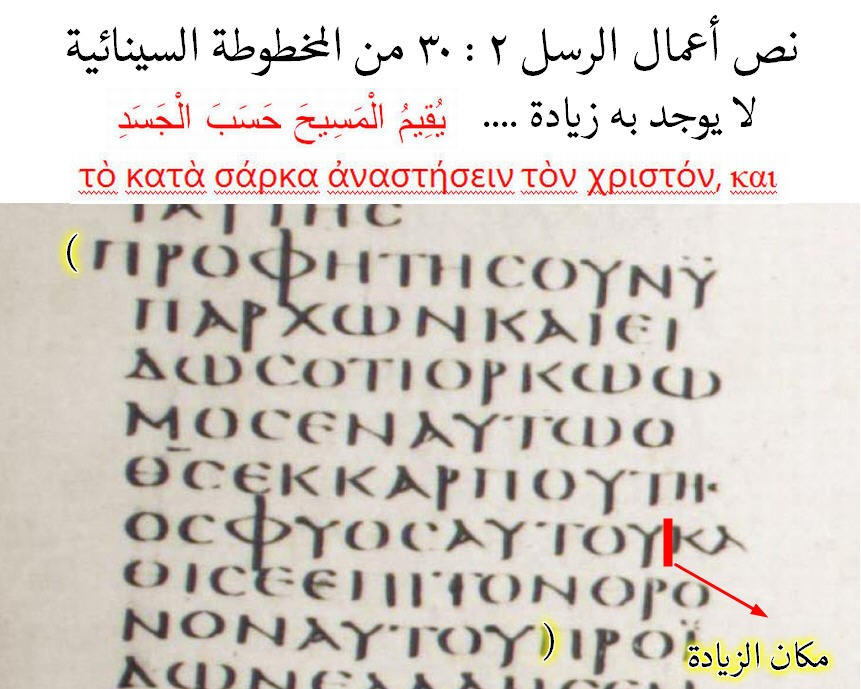
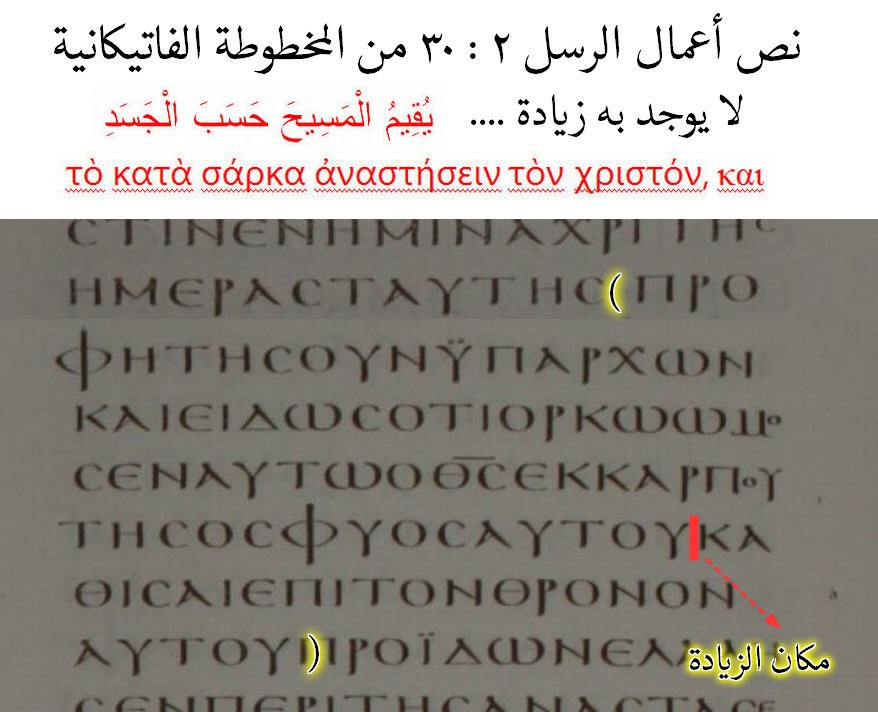
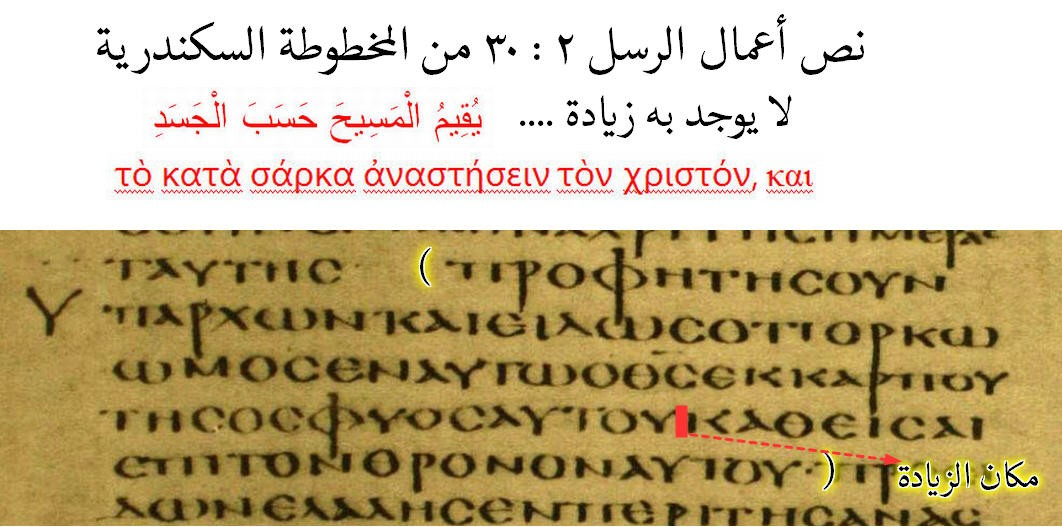
This text appears in the same form in the Sinaitic, Vatican, and Alexandrian manuscripts. In all of them the text ends at the throne — with no mention of Christ, no mention of raising up, and no messianic application to Jesus.
The following image presents the text as it appears in the Codex Sinaiticus.
The following image presents the second manuscript entry in this sequence.
The following image presents the third manuscript entry.
The Later Addition — The Beza Manuscript
In the later copies of the New Testament manuscripts, an unusual addition to the text began to appear. The text was transformed into a prophecy about Jesus by the insertion of the phrase:
τὸ κατὰ σάρκα ἀναστήσειν τὸν χριστόν — “He raises up the Christ according to the flesh”
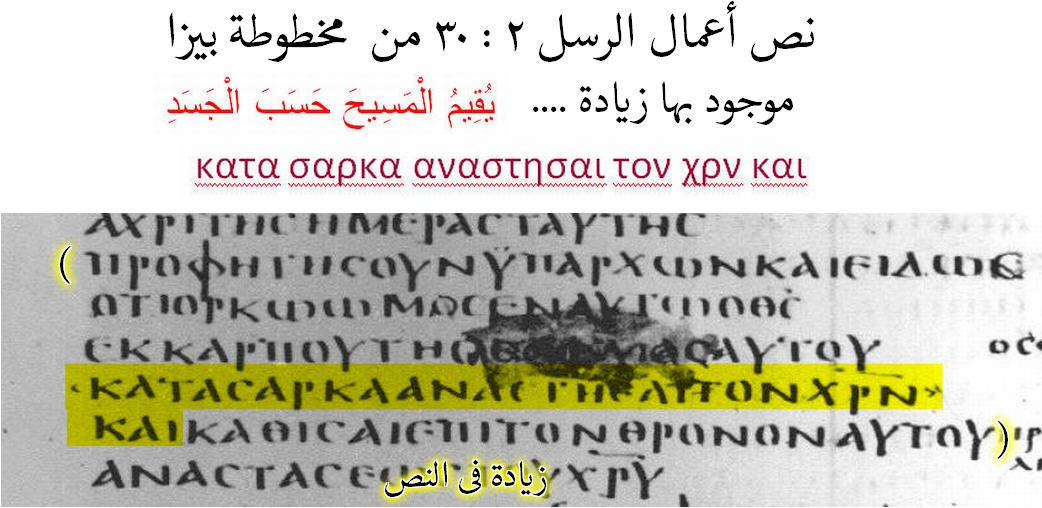
This addition appears, for example, in the Beza manuscript, where the text reads:
καρπου τησ οσφυοσ αυτου — ἐπὶ τὸν θρόνον αὐτοῦ
The following image presents the addition as it appears in the Beza manuscript.
The contradiction between this later text and the older and better manuscripts is itself the evidence of its distortion.
The Critical Editions — All Delete the Addition
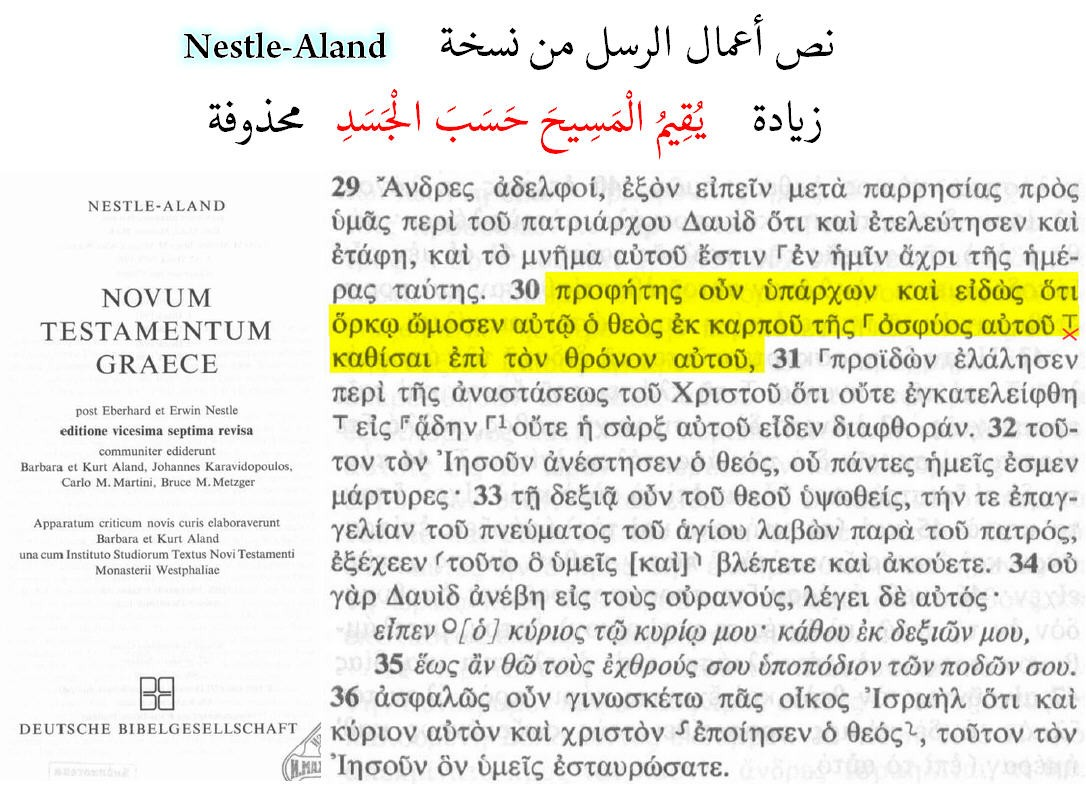
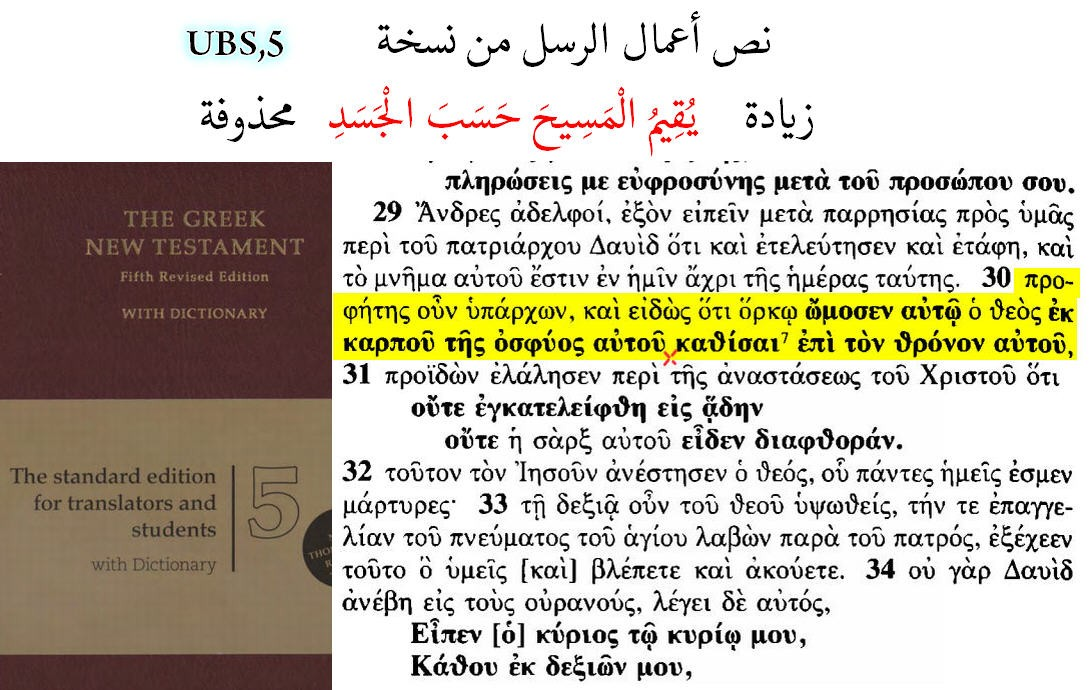
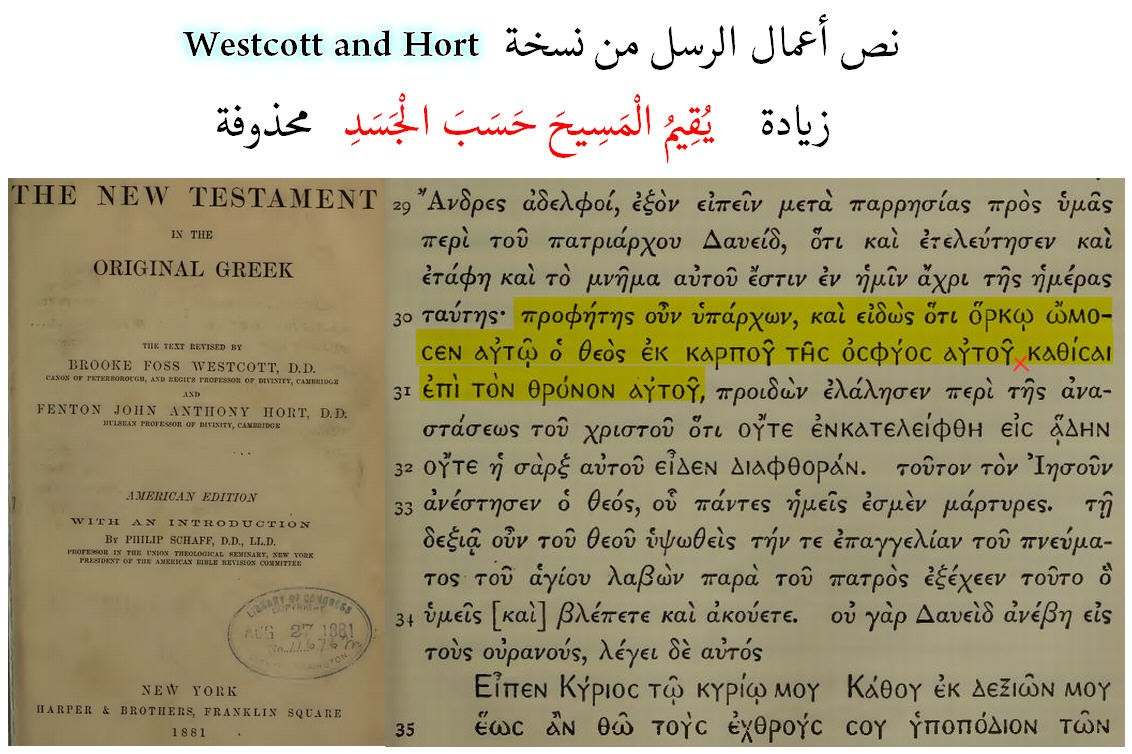
It was therefore natural for all critical editions and translations to delete this anomalous sentence from the text. The phrase τὸ κατὰ σάρκα ἀναστήσειν τὸν χριστόν is deleted from the Nestle-Aland version, the Westcott-Hort version, the UBS version, the Samuel Tregelles version, the Tischendorf version, and all other critical versions that relied on the oldest and best manuscripts of the New Testament. The text in the Nestle-Aland 26th edition reads:
καθίσαι ἐπὶ τὸν θρόνον
No mention of Christ. No “according to the flesh.” No messianic insertion.
The following image presents the critical edition evidence for the deletion of the addition.
The following image continues the critical edition evidence.
The following image presents the third entry in this sequence.
By contrast, the regular Greek versions that depend in their translation on the Received Text retain the addition. The 1894 Scrivener Textus Receptus reads:
προφητης ουν υπαρχων και ειδως οτι ορκω καρπου της οσφυος αυτου — τὸ κατα σαρκα αναστησειν τον χριστον
“Therefore being a prophet, and knowing that God had sworn with an oath to him, that of the fruit of his loins, according to the flesh, he would raise up Christ to sit on his throne.”
The Textus Receptus is widely acknowledged by textual scholars to be among the worst and most corrupted forms of the Greek New Testament text.
The English and Arabic Versions
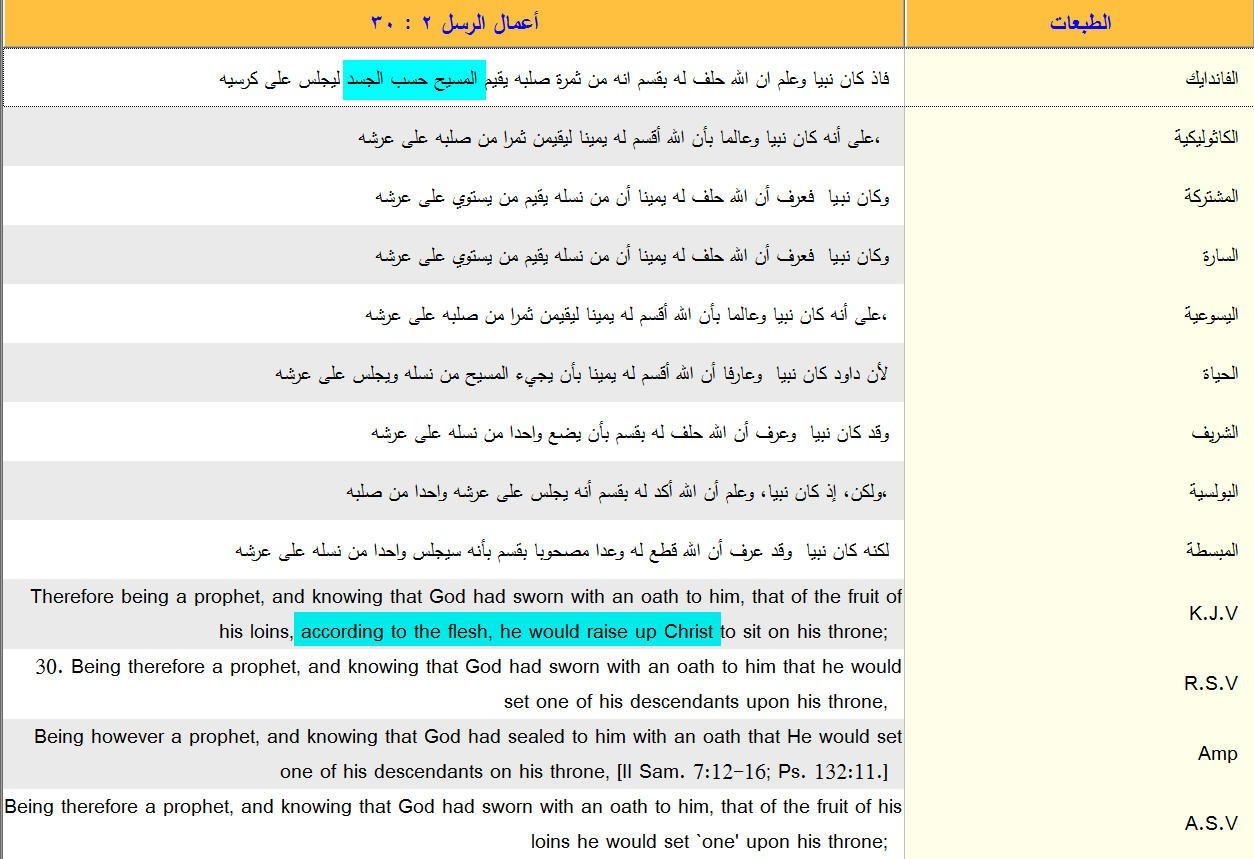
The addition was deleted in all major English versions. Among those that omit the interpolation entirely: AMP, ASV, NIV, RV, RSV, BBE, CEV, GNB, GW, ISV, and NRSV. The NIV renders the passage as:
“But he was a prophet and knew that God had promised him on oath that he would place one of his descendants on his throne.”
The following image presents the English version comparison evidence.
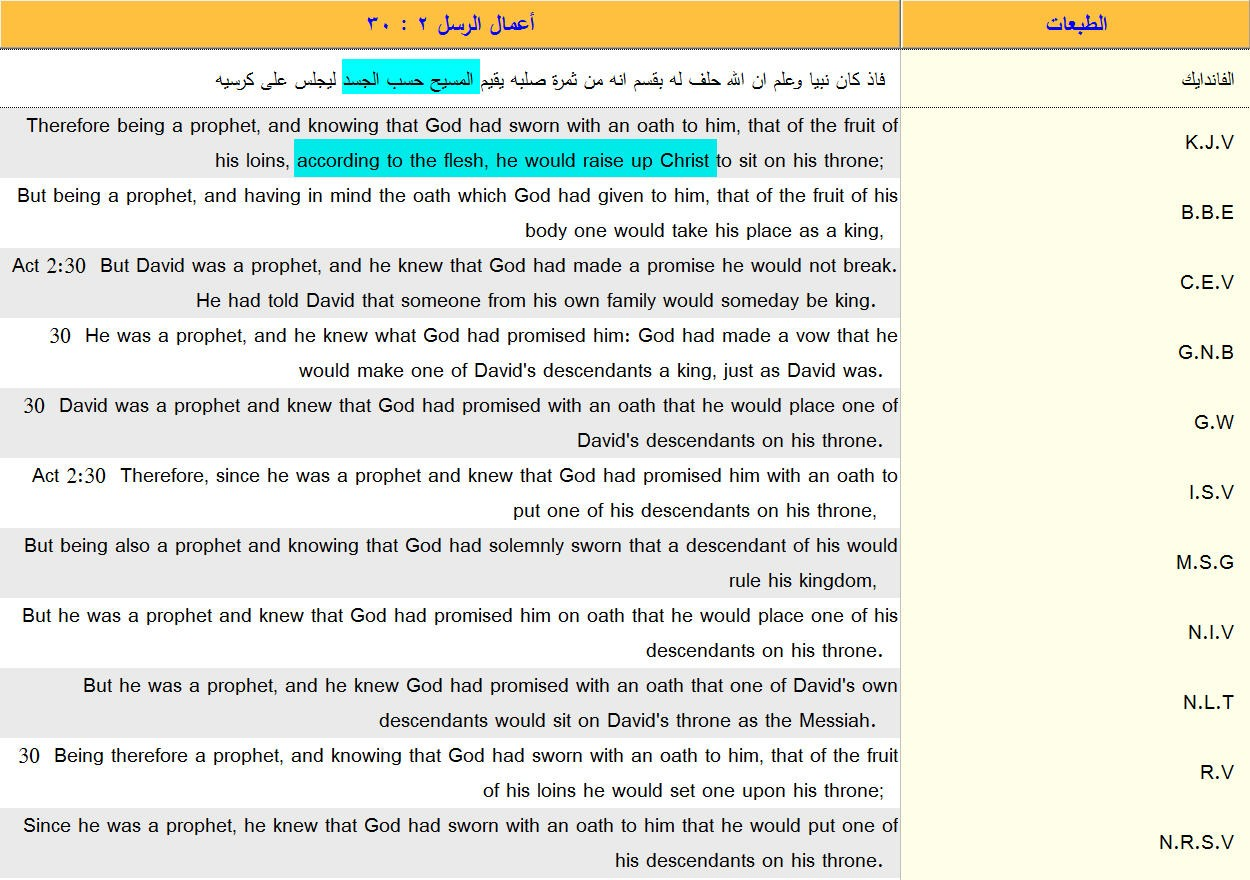
As for the Arabic translations, the Van Dyck version retained the addition, relying in its translation on the Received Text:
“Therefore, being a prophet, and knowing that God had sworn to him with an oath that of the fruit of his loins, according to the flesh, he would raise up Christ to sit on his throne.”
All modern Arabic translations, however, have deleted this anomalous addition. It is not found in the Jesuit translation, nor the Pauline, nor the Simplified, nor the Common, nor the Sarah, nor the Life translation. They all deleted the sentence “he establishes the Christ according to the flesh.”
The following image presents the Arabic version comparison evidence.
The Internal Contradiction the Copyist Missed
Regardless of the textual evidence, the copyist’s attempt to prove that David prophesied that Jesus is the one who will inherit David’s throne is an attempt that proves the extent of the copyists’ ignorance of the texts of their own Holy Book — because it destroys the very claim it was meant to support.
The addition states that Christ is from “the fruit of the loins” of David — meaning Christ is a human descendant of David, not the Lord himself.
More critically, the copyist appears to have been unaware that Jesus, according to the genealogies provided in Matthew and Luke themselves, is descended from King Jehoiakim. According to 1 Chronicles 3, Jehoiakim is one of the grandfathers of Jesus:
“These are the sons of David… And the son of Solomon, Rehoboam, and his son Abijah… And the sons of Josiah: the firstborn, Johanan; the second, Jehoiakim; the third, Zedekiah; the fourth, Shallum.”
God, however, explicitly and permanently barred Jehoiakim’s descendants from the throne of David:
“Therefore thus says the Lord concerning Jehoiakim king of Judah: He shall have no one to sit on the throne of David.”
Jesus is a descendant of Jehoiakim. Jehoiakim’s descendants were permanently barred from the throne of David by divine decree. How then can the one who sits on David’s throne be Jesus?
The Genealogical Barrier — Ruth and the Moabite Lineage
There is a further genealogical barrier that the copyist’s insertion does not address. After Lot committed incest with his two daughters, as recorded in Genesis 19, two nations were born:
“The two daughters of Lot conceived by their father. And the firstborn bore a son, and called his name Moab; and he is the father of the Moabites to this day. And the younger also bore a son, and called his name Ben-ammi; and he is the father of the children of Ammon to this day.”
The Torah then pronounces a permanent ban on descendants of this lineage entering the assembly of the Lord:
“The son of a bastard shall not enter the congregation of the Lord; even to the tenth generation none of them shall enter the congregation of the Lord. The Ammonite and the Moabite shall not enter the congregation of the Lord; even to the tenth generation none of them shall enter the congregation of the Lord forever.”
Boaz, the grandfather of David and therefore an ancestor of Jesus, was born of Rahab, the famous prostitute of Jericho. Boaz then fathered Obed from Ruth the Moabite. Ruth is attributed to Moab, the son of Lot from his eldest daughter. The genealogies of both Matthew and Luke confirm that Ruth the Moabitess is the grandmother of Jesus through David. Jesus therefore carries Moabite lineage — lineage that is barred permanently from the congregation of the Lord according to Deuteronomy 23.
Jesus’ Own Testimony That He Was Not the Awaited Messiah
Jesus himself confirmed in John 7 that he was not the one his contemporaries were awaiting:
“Some of the people of Jerusalem said, ‘Is this not he whom they seek to kill? And behold, he speaks boldly, and they say nothing to him. Do the rulers know for certain that this is the Messiah? But we know where this man is from, but when the Messiah comes, no one will know where he is from.’ Then Jesus cried out as he taught in the temple, ‘You know me and you know where I am from. I did not come of myself, but he who sent me is true, whom you do not know. I know him, because I am from him, and he sent me.’”
Jesus described himself as a messenger from God. Those who heard him understood that he was not the awaited Messiah:
“And they sought to lay hold of him, but no one laid a hand on him, because his hour had not yet come. And many of the crowd believed in him, and said, ‘When the Christ comes, will he do more signs than these which this man has done?’”
The crowd’s words confirm they did not regard Jesus as the Christ. They believed in him as a prophet and wondered whether the coming Christ would surpass him. Jesus did not rule over the children of Israel for a single day, and his mission carried no earthly salvation for them. The Jews knew, based on their knowledge of his origin and lineage, that the awaited Messiah was from the house of Levi and not from the house of David — and therefore not Jesus.
The following image presents the final source material in this note.
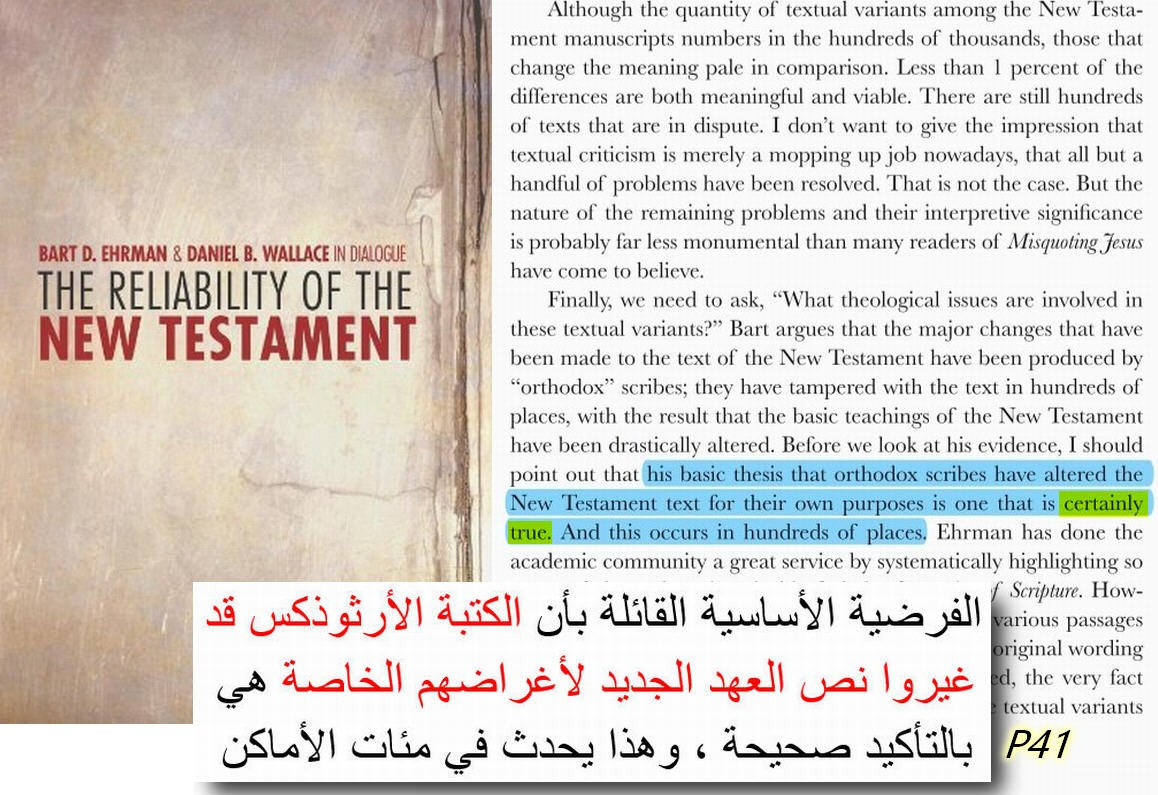
The phrase “raises up Christ according to the flesh” in Acts 2:30 is a scribal interpolation absent from the Sinaiticus, Vaticanus, and Alexandrinus codices — the three oldest and best Greek manuscripts of the New Testament. It was inserted into later manuscripts including the Codex Bezae and the Textus Receptus in a transparent attempt to manufacture a Davidic messianic prophecy for Jesus. Every major critical edition — Nestle-Aland, Westcott-Hort, UBS, Tregelles, and Tischendorf — has deleted it. Every major modern English and Arabic translation except the Van Dyck has likewise removed it. The insertion also collapses under its own internal logic: by placing Jesus in the physical lineage of David, it identifies him as a descendant of Jehoiakim — whose descendants God permanently barred from the Davidic throne in Jeremiah 36:30. Jesus additionally carries Moabite lineage through Ruth, and Deuteronomy 23 permanently bars Moabites from the congregation of the Lord. Jesus himself in John 7 acknowledged he was a messenger sent by God and not the awaited figure whose origins would be unknown. The scribal insertion in Acts 2:30 is not merely textually unsupported — it inadvertently proves, through its own genealogical framing, why Jesus cannot be the one it claims him to be.