I Am the Alpha and the Omega, the Beginning and the End
I Am the Alpha and the Ya — Did Jesus Really Say It?
Table of Contents
- Introduction — The Letters Alif and Ya
- An Important Question — Did the God of the Old Testament Say He is the Alpha and the Omega?
- First Text — Revelation 1 8
- Second Text — Revelation 1 11
- Issue Number Three — Revelation 21 6
- Issue Number Four — Revelation 22 13
- Jesus is a Created Being According to the Testimony of the Bible
- Conclusion
Introduction — The Letters Alif and Ya
The letter Alif is not only an Arabic letter, but it symbolizes the beginning of the Arabic alphabet, as well as αλφα, the Alpha in Greek. The letter Ya represents the last letter of the Arabic alphabet, as does ω, the Omega.
When someone says, “I am the Alpha and the Ya” or εγω ειμι τοαλφα και τοω, this means that he means that he is the First and the Last. If he says this and adds that he is the First and the Last, this means more clearly that he is eternal and everlasting, or at least that is what the listener will think. This is what happens when some people hear this phrase on the tongue of Jesus in the Bible, which brings to the mind of the reader of the book or the listener of some of its chapters an attribute of divinity, which is eternity and everlastingness, which makes him adopt the idea of the divinity of Jesus without research or scrutiny.
The question is, did Jesus really say that? This is what we will discover together through this short research.
Thus, if we prove, even once, that someone falsely attributed this phrase to Jesus, this is sufficient to refute any text that uses the same expression in Jesus’s words. For whoever was able to attribute this phrase to Jesus once can attribute it many times. A liar cannot be trusted to know his true nature without verifying his words. What then if the verification proves that he is exactly as he always was, and as he will continue to try to correct his lie, forcing him to come up with another lie, making two lies, and so on, until the deception becomes too great to convince many who have decided to use their minds, which are the source and foundation of their intellect?
Their duty and the basis of the quality of choice, the law of do and do not, and after the choice comes the Day of Reckoning.
So choose what you will, for you will be held accountable for it and for how you chose. Good intentions alone are not enough without effort. Many are those whose intentions were good but whose efforts were few, and who caused harm where they intended to do good, and who lied. If their intentions were good, their actions would have been good, but this is an illusion when minds are closed and hearts are open to every hysterical cry, sectarian outburst, or mass circumambulation around a defunct idol of knowledge. This is programming from childhood that requires courage, will, and the ability to choose and decode.
This is what we try to help with. We do not force anyone, nor can we do that, but we only try to explain with reason and evidence that the wise can understand, hoping that the Lord of the Worlds will make it a means of guidance for those who choose guidance and whom God wills to guide, for He knows them better than their jugular vein. And perhaps it will be salvation for us when Our Lord, the Lord of the Worlds, asks us, “Have you conveyed the message?” We say, “Yes, O Lord. O God, we bear witness to You and to all Your creation that we have conveyed the message, so forgive us, make our deeds sincere for us, and make them an argument for us on the Day when faces will be whitened and faces will be blackened, and arguments will be many and few will be accepted. You are the Guardian of that and the One capable of it.”
An Important Question — Did the God of the Old Testament Say He is the Alpha and the Omega?
Lord of Hosts is the Alpha and the Omega, the beginning and the end.
Isaiah 48 1-14
Isaiah 44 6
(SVD) Thus says the Lord, the King of Israel and his Redeemer, the Lord Almighty: “I am the first and I am the last; besides me there is no God.”
(ALAB) This is what the Lord Almighty, the King of Israel and his Redeemer, says: “I am the first and the last; besides me there is no God.”
(GNA) And the Lord, the King of Israel, his Redeemer and his Lord Almighty, says: “I am the first and I am the last; besides me there is no God in the universe.”
(JAB) Thus says the Lord, the King of Israel and his Redeemer, the Lord Almighty: “I am the first and I am the last; besides me there is no God.”
(KJV+) Thus 3541 said 559 the LORD 3068 the King 4428 of Israel, 3478 and his redeemer 1350 the LORD 3068 of hosts; 6635 I589 am the first,7223 and I589 am the last;314 and beside 4480, 1107 me there is no 369 God. 430
(HOT+) 3541 559 3068 4428 3478 1350 3068 6635 589 7223 589 314 1107 369 430
(LXX) ὐτὸν θεὸπ ἐμοῦ οὐκ ἔστιν θεός.
(Brenton) Thus said God the King of Israel, and the God of hosts that delivered him; I am the first, and I am hereafter: beside me there is no God.
(FDB) Because of the ‘ternel, the roi of Israel, and its redemption, the ‘ternel of the armies: I am the first, and I am the first; And so I don’t know anything about it.
(Vulgate) haec dicit Dominus rex Israel and redemptor eius Dominus exercituum ego primus and ego novissimus and absque me non est deus
Aleppo Manuscript Al-Yabu — Isaiah 48 12
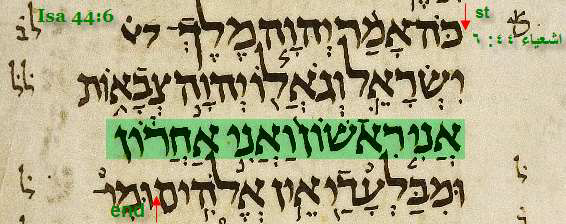
(SVD) “Hear me, Jacob, and Israel, whom I have called. I am the first and I am the last.”
(ALAB) “Hear me, Jacob, and Israel, whom I have called. I am the first and I am the last.”
(GNA) “Hear me, Jacob, and Israel, whom I have called. I am the first and I am the last.”
(JAB) “Hear me, Jacob, and Israel, whom I have called. I am the first and I am the last.”
(KJV+) Hearken 8085 unto 413 me, O Jacob 3290 and Israel, 3478 my called; 7121 I589 am he;1931 I589 am the first,7223 I589 also637 am the last.314
(HOT+) 8085 413 413 3290 3478 7121 589 1931 7223 637 589 314
H589 — אני (‘ănîy) an-ee’ — Contracted from H595; I: — I, (as for) me, mine, myself, we, X which, X who.
H7223 — ראשׁון (ri’shôn) ree-shone’ — From H7221 first, in place, time or rank (as adjective or noun): — ancestor, (that were) before (-time), beginning, eldest, first, fore-father, former (thing), of old time, past.
H637 — אף (‘aph) af — A primitive particle; meaning accession (used as an adverb or conjunction); also or yes; adversatively though: — also, + although, and (furthermore, yet), but, even, + how much less (more, rather than), moreover, with, yea.
H314 — אחרון (‘achărôn) hinder; generally late or last; specifically (as facing the east) west: — after(-ward), to come, following, hind(-er, -ermost, -most), last, latter, reward, ut(ter)most.
(LXX) Ἄκουέ μου, ἐγώ εἰμι πρῶ καὶ ἐγώ εἰμι εἰς τὸν αἰῶνα,
(Brenton) Hear me, O Jacob, and Israel whom I call; I am the first, and I endure forever.
(FDB) Ecoute-moi, Jacob, and toi, Israel, que j’ai appelé. Oh, I’m with the mother, — that’s the first, and that’s the beginning.
(Vulgate) Iacob and Israhel love me ego voco ego ipse ego primus and ego novissimus
G1519 — εἰς (eis) ice — A primary preposition; to or into (indicating the point reached or entered), of place, time, or purpose (result, etc.); also in adverbial phrases.: — [abundant-]ly, against, among, as, at, [back-]ward, before, by, concerning, + continual, + far more exceeding, for [intent, purpose], fore, + forth, in (among, at, unto, -so much that, -to), to the intention that, + of one mind, + never, of, (up-)on, + perish, + set at one again, (so) that, therefore(-unto), throughout, till, to (be, the end, -ward), (here-)until(-to), … ward, [where-]fore, with.
G165 — αἰών (aiōn) ahee-ohn’ — From the same as G104; properly an age; by extension perpetuity (also past); by implication the world; specifically (Jewish) a Messianic period (present or future): — age, course, eternal, (for) ever(-more), [n-]ever, (beginning of the, while the) world (began, without end). Compare G5550.
John 5:32–37 — “There is another who testifies about me, and I know that his testimony about me is true. 33 You sent to John, and he testified to the truth. 34 I do not accept testimony from a human being, but I say this so that you may be saved. 35 He was a burning and shining lamp, and you were willing for a while to rejoice in his light. 36 But I have a greater testimony than John’s, because the works that the Father has given me to accomplish—the very works that I am doing—testify about me that the Father has sent me. 37 And the Father himself, who sent me, testifies about me. You have never heard his voice nor seen his form.”
This is the “other” who said that he is the first and the last. The question remains: Did Jesus say that he is the first and the last?
First Text — Revelation 1 8
(SVD) “I am the Alpha and the Omega, the Beginning and the End,” says the Lord God, who is, who was, and who is to come, the Almighty.
(ALAB) “I am the Alpha and the Omega” (the Beginning and the End). This is what the Lord God, who is, who was, and who is to come, the Almighty, says.
(GNA) The Lord God says, “I am the Alpha and the Omega.” He is, who was, and who is to come, the Almighty.
(JAB) “I am the Alpha and the Omega”: This is what the Lord God, who is, was, and is to come, says, the Almighty.
(KJV+) I1473 am1510, (3588) Alpha1 and2532, (3588) Omega,5598 the beginning746 and2532 the ending, said 5056 the 3588 Lord, 2962 which is, and which was, and which is to come, 3801 the 3588 Almighty. 3841
(GNT-BYZ+) εγω 1473 P-1NS ειμι 1510 V-PAI-1S το 3588 T-NSN αλφα 1 N-LI και 2532 CONJ το 3588 T-NSN ω 5598 N-LI λεγει 3004 V-PAI-3S κυριος 2962 N-NSM ο 3588 T-NSM θεος 2316 N-NSM ο 3588 T-NSM ων 1510 V-PAP-NSM και 2532 CONJ ο 3588 T-NSM ην 1510 V-IAI-3S και 2532 CONJ ο 3588 T-NSM ερχομενος 2064 V-PNP-NSM ο 3588 T-NSM παντοκρατωρ 3841 N-NSM
(GNT-WH+) εγω 1473 P-1NS ειμι 1510 V-PAI-1S το 3588 T-NSN αλφα 1 N-LI και 2532 CONJ το 3588 T-NSN ω 5598 N-LI λεγει 3004 V-PAI-3S κυριος 2962 N-NSM ο 3588 T-NSM θεος 2316 N-NSM ο 3588 T-NSM ων 1510 V-PAP-NSM και 2532 CONJ ο 3588 T-NSM ην 1510 V-IAI-3S και 2532 CONJ ο 3588 T-NSM ερχομενος 2064 V-PNP-NSM ο 3588 T-NSM παντοκρατωρ 3841 N-NSM
(FDB) Why, I am the alpha and the omega, this is the Seigneur Dieu, what is this, what is it, what is there, the whole world.
(Vulgate) ego sum Alpha and Omega principium and finis dicit Dominus Deus qui est and qui erat and qui venturus est Omnipotens
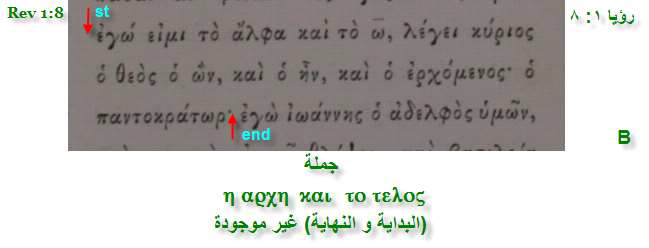
Manuscript Images — Revelation 1 8
The Vatican Manuscript:
The Sinaiticus Manuscript:
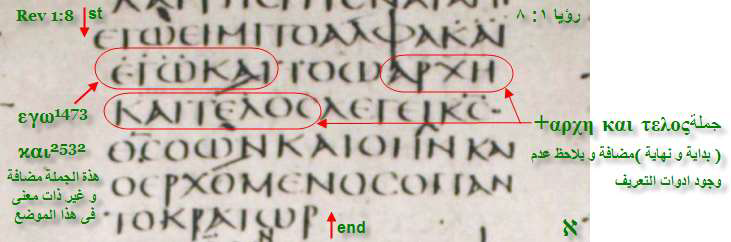
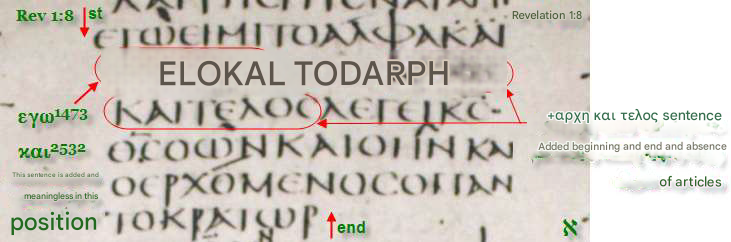
The Alexandrian Manuscript:
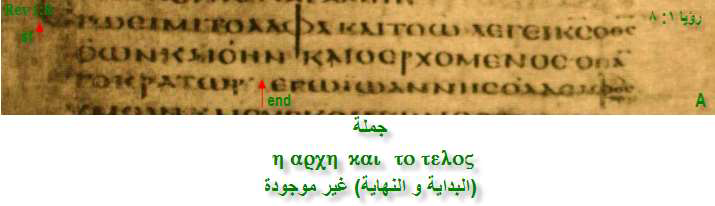
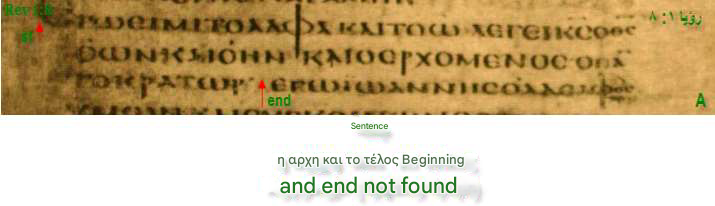
Now, to determine who is speaking, we will present the context of the verse and identify who said that he is the Alpha and the Omega, the beginning and the end (the beginning and the end metaphorically, regardless of the previously discussed differences in manuscripts and translations, and for the sake of argument, since this is the nature of the book we are discussing, or you could say the books). The one we are discussing is not a specific book, but a compilation that varies from one synod to another according to the rules it establishes during its compilation or its approval of the compilation.
Then he uses another conjunction and then a well-known person, Jesus Christ, whom he identifies as the faithful witness, the firstborn from the dead, and the ruler of the kings of the earth, who loved his people and washed them from their sins with his blood, as the writer of Revelation believes, and made them kings and priests to God his Father. We notice that he did not say “God Jesus,” but rather “God his Father,” and he did not say “priests Jesus,” but rather “God his Father.”
To make the idea clearer, consider this example: If I said, “Peace be upon you, so-and-so, from Prince Sultan, Princess Haya, and Prince Saud, whom his father, the King (may God protect him), appointed as Crown Prince,” then, in your opinion, if you are being fair, who do I mean by “may God protect him”? I think that logically, since I singled him out, I mean the King who granted the position to his son.
Then, after that, Amen, and a period, and the sentence and the verse are closed. Then it returns and says, “Behold, he is coming with the clouds, and every eye will see him; even those who pierced him will see him, and all the tribes of the earth will mourn over him.” Then, “Yes,” and “Amen,” and the sentence ends. Of course, the sentence refers to Jesus. Then, in the quoted verse, a figure from among the previous figures says, “I am the Alpha and the Omega, the beginning and the end.” It clarifies that the figure who says this is the one described with the following attributes: the Lord who is, who was, and who is to come, the Almighty.
Now, return to the text again and remember that peace and grace came from three figures, as we mentioned. The last was Jesus Christ, who was described as the witness and the firstborn from the dead. The second was the seven spirits before the throne of the First, who was described as the One who is, who was, and who is to come. Therefore, it is not Jesus, and this is very logical. Whoever says that the one who said this was Jesus is being unfair.
Second Text — Revelation 1 11
(SVD) saying, “I am the Alpha and the Omega, the First and the Last. What you see, write in a book and send it to the seven churches in Asia: to Ephesus, Smyrna, Pergamum, Thyatira, Sardis, Philadelphia, and Laodicea.”
(ALAB) says, “Write down what you see in a book and send it to the seven churches: in Ephesus, Smyrna, Pergamum, Thyatira, Sardis, Philadelphia, and Laodicea.”
(GNA) says, “Write down what you see in a book and send it to the seven churches in Ephesus, Smyrna, Pergamum, Thyatira, Sardis, Philadelphia, and Laodicea.”
(JAB) says, “What you see, write in a book and send it to the seven churches in Ephesus, Smyrna, Pergamum, Thyatira, Sardis, Philadelphia, and Laodicea.”
(KJV+) Saying, 3004 I1473 am1510, (3588) Alpha1 and2532, (3588) Omega,5598 the3588 first4413 and2532 the3588 last:2078 and, 2532 What 3739 you see, 991 write 1125 in 1519 a book, 975 and 2532 send 3992 it unto the 3588 seven 2033 churches 1577 which 3588 are in 1722 Asia; 773 unto 1519 Ephesus, 2181 and 2532 unto 1519 Smyrna, 4667 and 2532 unto 1519 Pergamos, 4010 and 2532 unto 1519 Thyatira, 2363 and 2532 unto 1519 Sardis, 4554 and 2532 unto 1519 Philadelphia, 5359 and 2532 until 1519 Laodicea. 2993
(GNT-BYZ+) λεγουσης 3004 V-PAP-GSF ο 3739 R-ASN βλεπεις 991 V-PAI-2S γραψον 1125 V-AAM-2S εις 1519 PREP βιβλιον 975 N-ASN και 2532 CONJ πεμψον 3992 V-AAM-2S ταις 3588 T-DPF επτα 2033 A-NUI εκκλησιαις 1577 N-DPF εις 1519 PREP σμυρναν 4667 N-ASF και 2532 CONJ εις 1519 PREP 4010 N-ASF 2532 CONJ 1519 PREP 2363 N-APN 2532 CONJ 1519 PREP 4554 N-APF και 2532 CONJ εις 1519 PREP φιλαδελφειαν 5359 N-ASF και 2532 CONJ εις 1519 PREP λαοδικειαν 2993 N-ASF
(GNT-WH+) λεγουσης 3004 V-PAP-GSF ο 3739 R-ASN 991 V-PAI-2S γραψον 1125 V-AAM-2S εις 1519 PREP βιβλιον 975 N-ASN και 2532 CONJ πεμψον 3992 V-AAM-2S ταις 3588 T-DPF 1577 N-DPF 1519 PREP 2181 N-ASF 1519 PREP θυατειρα 2363 N-APN και 2532 CONJ 1519 PREP 4554 N-APF 2532 CONJ 1519 PREP 5359 N-ASF 2532 CONJ 1519 PREP 2993 N-ASF
(FDB) Dist: That is your voice, reads in a delivery and receives September assemblies: in Éphèse, and in Smyrne, and in Pergame, and To Thyatire, to Sardes, and to Philadelphia, And to the world.
(Vulgate) dicentis quod vides scribe in libro and mitte septem ecclesiis Ephesum and Zmyrnam and Pergamum and Thyatiram and Sardis and Philadelphiam and Laodiciam
Popular English Translations:
(ASV) saying, What you see, write in a book and send it to the seven churches: unto Ephesus, and unto Smyrna, and unto Pergamum, and unto Thyatira, and unto Sardis, and unto Philadelphia, and unto Laodicea.
(BBE) Saying, What you see, put in a book, and send it to the seven churches; to Ephesus and to Smyrna and to Pergamos and to Thyatira and to Sardis and to Philadelphia and to Laodicea.
(CEV) The voice said, “Write in a book what you see. Then send it to the seven churches in Ephesus, Smyrna, Pergamum, Thyatira, Sardis, Philadelphia, and Laodicea.”
(Darby) saying, What you see write in a book, and send to the seven assemblies: to Ephesus, and to Smyrna, and to Pergamos, and to Thyatira, and to Sardis, and to Philadelphia, and to Laodicea.
(EMTV) saying, “That which you see, write in a book and send to the seven churches: to Ephesus, to Smyrna, to Pergamos, to Thyatira, to Sardis, to Philadelphia, and to Laodicea.”
(ESV) saying, “Write what you see in a book and send it to the seven churches, to Ephesus and to Smyrna and to Pergamum and to Thyatira and to Sardis and to Philadelphia and to Laodicea.”
(GNB) It said, “Write down what you see, and send the book to the churches in these seven cities: Ephesus, Smyrna, Pergamum, Thyatira, Sardis, Philadelphia, and Laodicea.”
(GW) saying, “Write on a scroll what you see, and send it to the seven churches: Ephesus, Smyrna, Pergamum, Thyatira, Sardis, Philadelphia, and Laodicea.”
(ISV) saying, “Write on a scroll what you see, and send it to the seven churches: Ephesus, Smyrna, Pergamum, Thyatira, Sardis, Philadelphia, and Laodicea.”
(KJV) Saying, I am Alpha and Omega, the first and the last: and, What you see, write in a book, and send it unto the seven churches which are in Asia; unto Ephesus, and unto Smyrna, and unto Pergamos, and unto Thyatira, and unto Sardis, and unto Philadelphia, and unto Laodicea.
(KJVA) Saying, I am Alpha and Omega, the first and the last: and, What you see, write in a book, and send it unto the seven churches which are in Asia; unto Ephesus, and unto Smyrna, and unto Pergamos, and unto Thyatira, and unto Sardis, and unto Philadelphia, and unto Laodicea.
(KJVR) Saying, I am Alpha and Omega, the first and the last: and, What you see, write in a book, and send it unto the seven churches which are in Asia; unto Ephesus, and unto Smyrna, and unto Pergamos, and unto Thyatira, and unto Sardis, and unto Philadelphia, and unto Laodicea.
(LITV) saying, I am the Alpha and the Omega, the First and the Last; Also, what you see, write in a scroll, and send to the seven assemblies of Asia: to Ephesus, and to Smyrna, and to Pergamos, and to Thyatira, and to Sardis, and to Philadelphia, and to Laodicea.
(RV) saying, What you see, write in a book, and send it to the seven churches; unto Ephesus, and unto Smyrna, and unto Pergamum, and unto Thyatira, and unto Sardis, and unto Philadelphia, and unto Laodicea.
(Webster) Saying, I am Alpha and Omega, the first and the last: and, What you see, write in a book, and send it to the seven churches which are in Asia; to Ephesus, and to Smyrna, and to Pergamos, and to Thyatira, and to Sardis, and to Philadelphia, and to Laodicea.
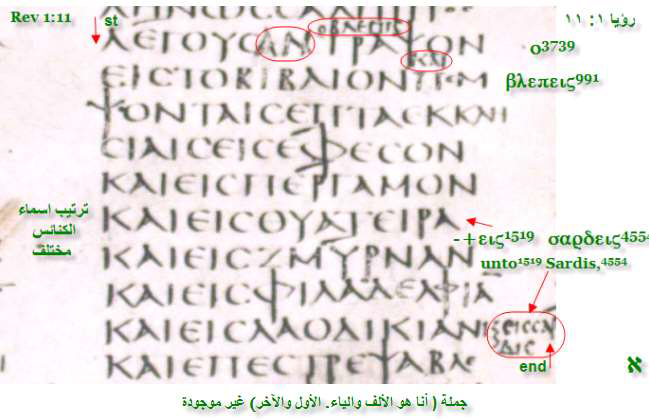
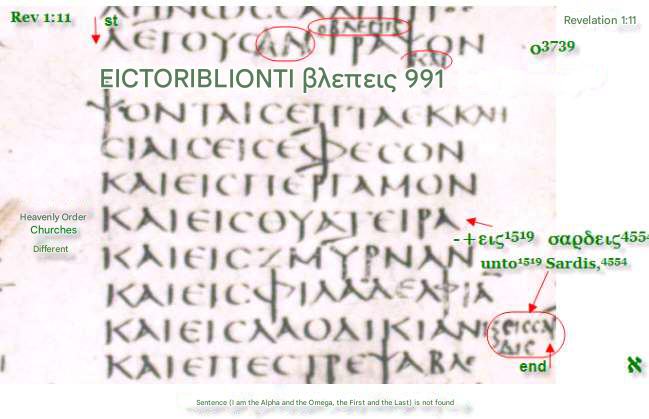
Manuscript Images — Revelation 1 11
The Vatican Manuscript:
The Sinaiticus Manuscript:
The Alexandrian Manuscript:
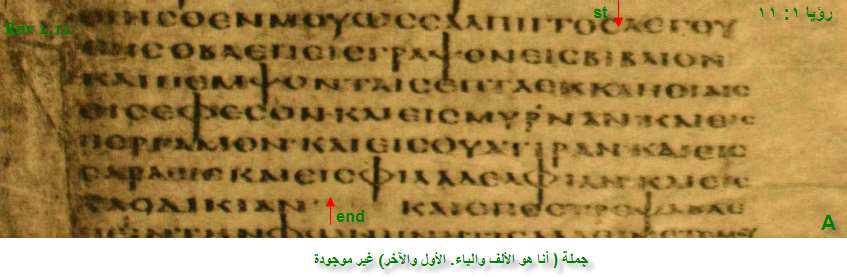
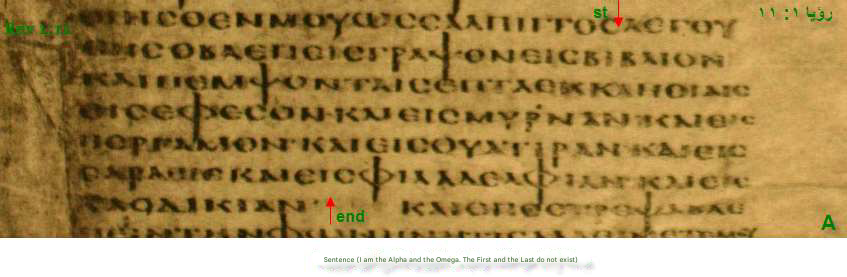
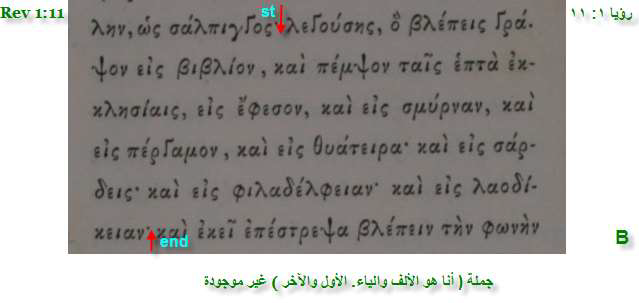
From the linguistic analysis of the number and the different translations, the following is discovered:
1. The only Arabic version that contains the text “(I am the Alpha and the Omega, the First and the Last)” is the Van Dyck version. The versions of “Life,” “Good News,” and “The Fathers” do not mention it at all.
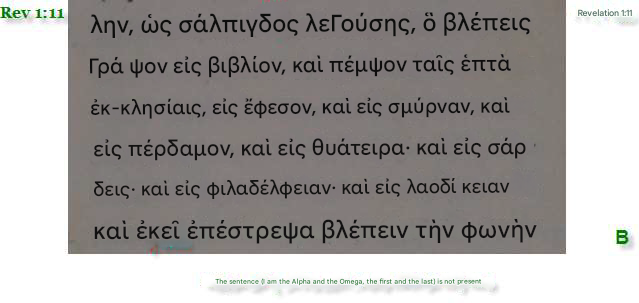
2. The English translations KJVA, KJVA, KJVR, LITV, and Webster add the phrase “(I am the Alpha and the Omega, the First and the Last)”, and there is no corresponding original for it in the Greek text (at least in the three most important manuscripts), which is the language from which the King James Version and all other translations are supposedly translated. The question arises: if the original Greek does not contain the phrase, where did some translations get it from? And if it is from the original text, why did other translations omit it? What do we call this? Correction, adaptation, removal, addition, interpretation, or distortion?
Issue Number Three — Revelation 21 6
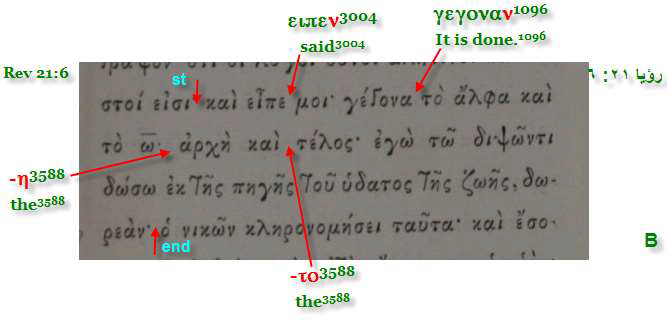
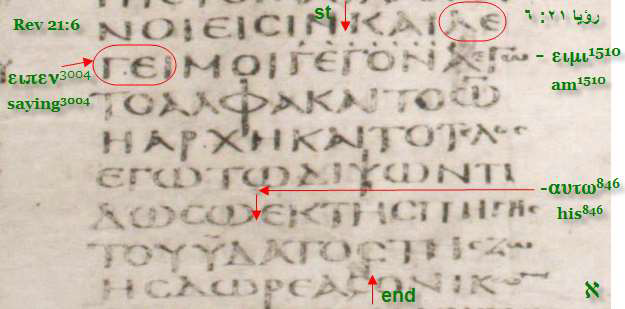
(SVD) Then he said to me, “It is done! I am the Alpha and the Omega, the Beginning and the End. To the thirsty I will give freely from the spring of the water of life.”
(ALAB) Then he said, “It is done! I am the Alpha and the Omega (the Beginning and the End). To the thirsty I will give freely from the spring of the water of life.”
(GNA) And he said to me, “It is done! I am the Alpha and the Omega, the Beginning and the End. To the thirsty I will give freely from the spring of the water of life.”
(JAB) And he said to me, “It is done! I am the Alpha and the Omega, the Beginning and the End. To the thirsty I will give freely from the spring of the water of life.”
(KJV+) And 2532 he said 2036 unto me, 3427 It is done. 1096 I1473 am1510, (3588) Alpha1 and2532, (3588) Omega,5598 the3588 beginning746 and2532 the3588 end.5056 I 1473 will give 1325 unto him that is athirst 1372 of 1537 the 3588 fountain 4077 of the 3588 water 5204 life 2222 freely. 1432
(GNT-BYZ+) και 2532 CONJ ειπεν 3004 V-2AAI-3S μοι 1473 P-1DS γεγονα 1096 V-2RAI-1S | το 3588 T-NSN | [το] 3588 T-NSN VAR: εγω 1473 P-1NS το 3588 T-NSN :END | 1 N-LI και 2532 CONJ το 3588 T-NSN ω 5598 N-LI η 3588 T-NSF αρχη 746 N-NSF και 2532 CONJ το 3588 T-NSN τελος 5056 N-NSN εγω 1473 P-1NS τω 3588 T-DSM διψωντι 1372 V-PAP-DSM | δωσω 1325 V-FAI-1S | [δωσω] 1325 V-FAI-1S VAR: δωσω 1325 V-FAI-1S αυτω 846 P-DSM :END | 1537 PREP της 3588 T-GSF πηγης 4077 N-GSF του 3588 T-GSN υδατος 5204 N-GSN της 3588 T-GSF ζωης 2222 N-GSF δωρεαν 1432 ADV
(GNT-WH+) και 2532 CONJ ειπεν 3004 V-2AAI-3S μοι 1473 P-1DS γεγοναν 1096 V-2RAI-3P εγω 1473 P-1NS | | [ειμι] 1510 V-PAI-1S | το 3588 T-NSN αλφα 1 N-LI και 2532 CONJ το 3588 T-NSN ω 5598 T-NSN 1537 PREP 3588 T-GSF δωρεαν 1432 ADV
(FDB) It il me dit: It’s worth it. Yes, I am the alpha and the omega, the start and the end. A cell with a soif, je donnerai, moi, gratuitement, de la fontaine de l’eau de la vie.
(Vulgate) and this fact is the ego sum Alpha and Omega initium and finis ego sitienti dabo de fonte aquae vivae gratis
Manuscript Images — Revelation 21 6
The Vatican Manuscript:
The Sinaiticus Manuscript:
The Alexandrian Manuscript:
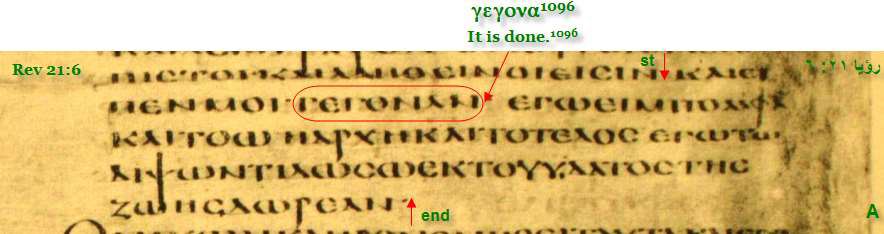
As you can see, the one who spoke the words is the one seated on the throne. So, who is the one seated on the throne in John’s vision?
From Revelation 6:16: “And they said to the mountains and rocks, ‘Fall on us and hide us from the face of him who sits on the throne and from the wrath of the Lamb.’”
As you can see, the one seated on the throne is not the Lamb. If the Lamb symbolizes Jesus, then the one seated on the throne symbolizes the Father.
From Revelation 1:4–5: “John to the seven churches in Asia: Grace and peace to you from him who is and who was and who is to come, and from the seven spirits before his throne, and from Jesus Christ, the faithful witness, the firstborn from the dead, and the ruler of the kings of the earth.”
What we discussed previously confirms that Jesus is the third one, from whom John’s peace and grace came. The second one is the seven spirits before the throne of the first one, who is also the Father, as we have previously established. He is described as the one who is and who was and who is to come, the Almighty.
From Revelation 5:1–10: “And I saw on the right hand of him who sat on the throne a scroll with writing on both the inside and the back, sealed with seven seals… 7 And he came and took the scroll from the right hand of him who sat on the throne… 9 They sing a new song, saying: ‘You are worthy to take the scroll and to open its seals, because you were slain, and with your blood you purchased us for God out of every tribe and language and people and nation. 10 You have made us to be a kingdom and priests to our God, and we shall reign on the earth.’”
As you can clearly see here, the slain lamb (symbolizing Jesus) took the scroll from the right hand of the one seated on the throne. Thus, the matter became clear and requires no lengthy discussion.
This also clarifies the statement: “He who overcomes will inherit all things, and I will be his God, and he will be my son.” We know that Jesus did not directly say, “I am God,” as acknowledged by the Bible. He is the Son, not the Father. The Jews said “We were not born of fornication; we have one Father, and that is God” (John 8:41). Jesus responded in John 8:42: “If God were your Father, you would love me, for I came from God and I am here. I have not come on my own, but he sent me.”
Issue Number Four — Revelation 22 13
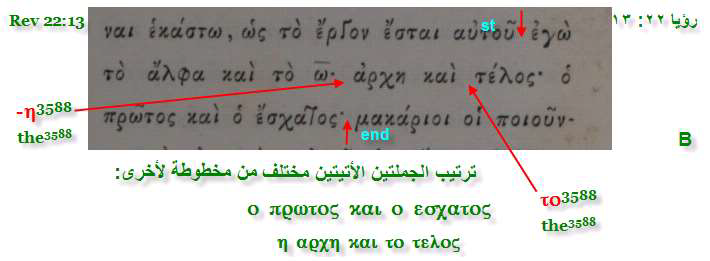
(SVD) I am the Alpha and the Omega, the beginning and the end, the first and the last.
(ALAB) I am the Alpha and the Omega, the first and the last, the beginning and the end.
(GNA) I am the Alpha and the Omega, the first and the last, the beginning and the end.
(JAB) I am the Alpha and the Omega, the first and the last, the beginning and the end.
(KJV+) I 1473 am 1510 Alpha 1 and 2532 Omega, 5598 the beginning 746 and 2532 the end, 5056 the 3588 first 4413 and 2532 the 3588 last. 2078
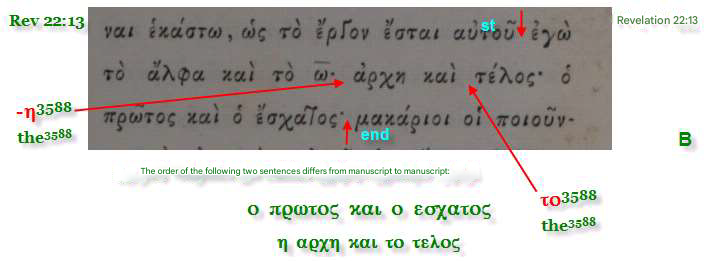
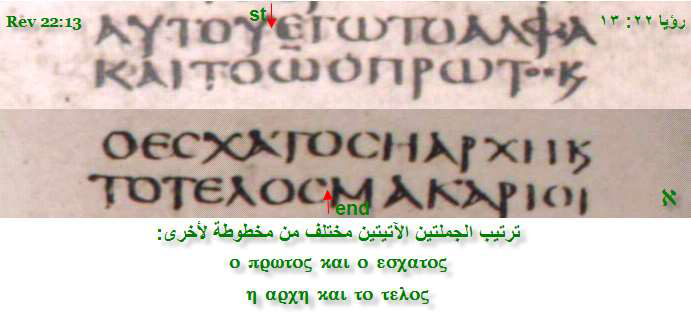
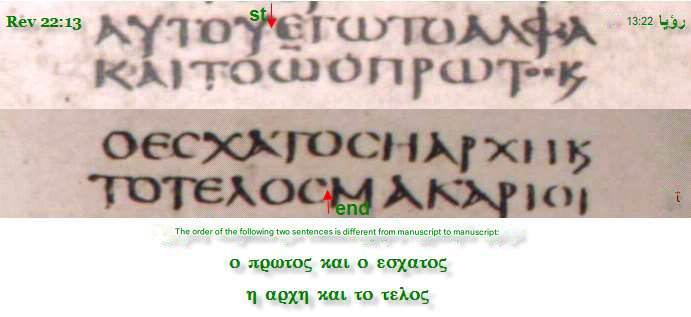
(GNT-BYZ+) εγω 1473 P-1NS το 3588 T-NSN | αλφα 1 N-LI | [αλφα] 1 N-LI VAR: α 1 N-LI :END | και 2532 CONJ το 3588 T-NSN ω 5598 N-LI | ο 3588 T-NSM πρωτος 4413 A-NSM-S και 2532 CONJ ο 3588 T-NSM εσχατος 2078 A-NSM-S η 3588 T-NSF αρχη 746 N-NSF και 2532 CONJ το 3588 T-NSN τελος 5056 N-NSN | [ο 3588 T-NSM πρωτος 4413 A-NSM-S και 2532 CONJ ο 3588 T-NSM εσχατος 2078 A-NSM-S η 3588 T-NSF αρχη 746 N-NSF και 2532 CONJ το 3588 T-NSN τελος] 5056 N-NSN VAR: αρχη 746 N-NSF πρωτος 4413 A-NSM-S και 2532 CONJ ο 3588 T-NSM εσχατος 2078 A-NSM-S :END |
(GNT-WH+) εγω 1473 P-1NS το 3588 T-NSN αλφα 1 N-LI και 2532 CONJ το 3588 T-NSN ω 5598 N-LI ο 3588 T-NSM πρωτος 4413 A-NSM-S και 2532 CONJ ο 3588 T-NSM εσχατος 2078 A-NSM-S η 3588 T-NSF αρχη 746 N-NSF και 2532 CONJ το 3588 T-NSN τελος 5056 N-NSN
(FDB) Yes, I am the alpha and the omega, the first and the beginning, the start and the end.
(Vulgate) ego Alpha and Omega primus and novissimus principium and finis
Manuscript Images — Revelation 22 13
The Vatican Manuscript:
The Sinaiticus Manuscript:
The Alexandrian Manuscript:
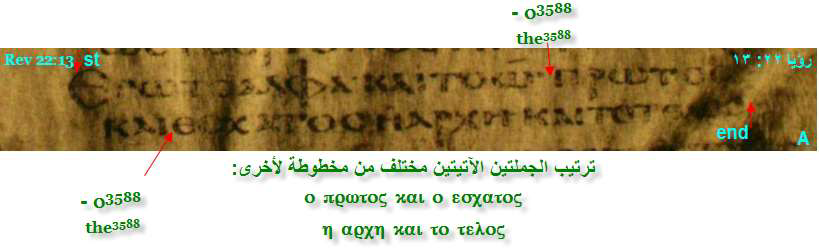
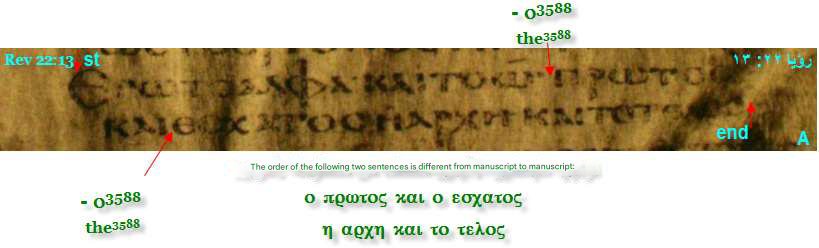
As you can see, the one who says “I am the Alpha and the Omega” appears in the text to be the character to whom the following characteristics apply:
1. The word “angel” (αγγελου) as seen in the linguistic analysis — in English “angel,” in Greek αγγελου.
2. He is a servant along with John and all the prophets.
3. He only commands prostration to God and forbids prostration to him.
4. He is the one who comes quickly and rewards each person for his work.
5. It is the Alpha and the Omega, the beginning and the end, the first and the last.
If the character’s traits are inconsistent, that is not our problem, but the problem of the book. But as you can see, the conversation did not move from the angel to another person in the context.
(KJV+) And 2532 I 1473 John 2491 saw 991 these things, 5023 and 2532 heard 191 them. And 2532 when 3753 I had heard 191 and 2532 saw, 991 I fell down 4098 to worship 4352 before 1715 the 3588 feet 4228 of the 3588 angel 32 which showed 1166 me 3427 these things. 5023
(GNT-BYZ+) | καγω 2504 P-1NS-K | [καγω] 2504 P-1NS-K VAR: και 2532 CONJ εγω 1473 P-1NS :END | ιωαννης 2491 N-NSM ο 3588 T-NSM | ακουων 191 V-PAP-NSM και 2532 CONJ βλεπων 991 V-PAP-NSM | ταυτα 3778 D-APN και 2532 CONJ οτε 3753 ADV ηκουσα 191 V-AAI-1S και 2532 CONJ | εβλεψα 991 V-AAI-1S | VAR: ειδον 3708 V-2AAI-1S :END | επεσον 4098 V-2AAI-1S προσκυνησαι 4352 V-AAN εμπροσθεν 1715 PREP των 3588 T-GPM ποδων 4228 N-GPM του 3588 T-GSM αγγελου 32 N-GSM του 3588 T-GSM | δεικνυοντος 1166 V-PAP-GSM | μοι 1473 P-1DS ταυτα 3778 D-APN
(SVD) He said to me, “See that you do not do that! For I am a servant with you and with your brothers the prophets, and with those who keep the words of this book. Worship God.”
(ALAB) He said to me, “Do not do that! I am a servant like you and your brothers the prophets, and like those who keep the words of this book. Worship God!”
(GNA) He said to me, “Do not do that! I am a servant like you and your brothers the prophets, and like all who keep the words of this book. Worship God!”
(JAB) He said, “Don’t do that! I am a servant like you and your brothers the prophets, and like those who keep the words of this book. Worship God!”
(KJV+) Then 2532 said 3004 he unto me, 3427 See 3708 you do it not: 3361 for 1063 I am 1510 thy 4675 fellow servant, 4889 and 2532 of thy 4675 brethren 80 the 3588 prophets, 4396 and 2532 of them which keep 5083 the 3588 sayings 3056 of this 5127 book: 975 worship 4352 God. 2316
(GNT-BYZ+) και 2532 CONJ λεγει 3004 V-PAI-3S μοι 1473 P-1DS ορα 3708 V-PAM-2S μη 3361 PRT-N συνδουλος 4889 N-NSM σου 4771 P-2GS ειμι 1510 V-PAI-1S και 2532 CONJ των 3588 T-GPM 80 N-GPM σου 4771 P-2GS των 3588 T-GPM προφητων 4396 N-GPM και 2532 CONJ των 3588 T-GPM τηρουντων 5083 V-PAP-GPM τους 3588 T-APM λογους 3056 N-APM του 3588 T-GSN βιβλιου 975 N-GSN τουτου 3778 D-GSN τω 3588 T-DSM θεω 2316 N-DSM προσκυνησον 4352 V-AAM-2S
Is it only Jesus who will come? Some may think so when they read Revelation 1:7 — “Look, he is coming with the clouds, and every eye will see him, even those who pierced him; and all the families of the earth will mourn because of him. Yes, Amen.”
But what some do not know is that there is another who comes according to the book, and he is the one who sits on the throne, as in:
Revelation 1:8 — “I am the Alpha and the Omega, the Beginning and the End, says the Lord, who is and who was and who is to come, the Almighty.” — which we discussed at the beginning of the research and proved that He is the one sitting on the throne and not the Lamb.
Also, through Revelation 4:2 — “And immediately I was in the Spirit, and behold, a throne was set in heaven, and on the throne was one sitting.”
Revelation 4:8 — “And the four living creatures, each with six wings all around and inside, were full of eyes, and they never ceased day and night saying, ‘Holy, holy, holy is the Lord God Almighty, who was and is and is to come.’”
Revelation 4:9–11 — “And when the living creatures give glory and honor and thanks to Him who sits on the throne, who lives forever and ever, the twenty-four elders will fall down before him who sits on the throne, and worship him who lives forever and ever, and they will throw their crowns before the throne, saying: ‘You are worthy, Lord, to receive glory and honor and power, because you created all things, and they exist and were created by your will.’”
As we see, the one who sits on the throne will also come — he who was and who is.
1. Jesus is not an angel — but rather a lower status than the angels, at least in the case of the self-emptying (kenosis), according to Hebrews 2:7: “You have made him a little lower than the angels; you have crowned him with glory and honor, and set him over the works of your hands.” In all cases, he is not an angel, and also the general context in the vision clarifies the presence of the angel who came with the testimony of Jesus.
2. Jesus accepts worship (especially after the supposed resurrection), and this figure does not accept worship and calls for worship to God alone.
3. Jesus was no longer a slave after the supposed resurrection because he returned to his glory, and his slavery was through incarnation. This figure describes himself as a slave along with John and all the prophets.
Jesus is a Created Being According to the Testimony of the Bible
To eliminate any remaining possibility, we will prove that Jesus is a created being and therefore cannot be eternal.
Colossians 1 15
(SVD) He is the image of the invisible God, the firstborn of all creation.
(ALAB) He is the image of the invisible God, the firstborn over all that He has created.
(GNA) He is the image of the invisible God and the firstborn of all creation.
(JAB) He is the image of the invisible God and the firstborn of all creation.
(KJV+) Who 3739 is 2076 the image 1504 of the 3588 invisible 517 God, 2316 the firstborn 4416 of every 3956 creature: 2937
(GNT-BYZ+) 3739 R-NSM 1510 V-PAI3S 1504 N-NSF 3588 T-GSM 2316 N-GSM 3588 T-GSM αορατου 517 A-GSM κτισεως 4416 A-NSM-S πασης 3956 A-GSF κτισεως 2937 N-GSF
(GNT-WH+) ος 3739 R-NSM εστιν 1510 V-PAI-3S εικων 1504 N-NSF του 3588 T-GSM θεου 2316 N-GSM του 3588 T-GSM αορατου 517 A-GSM κτισεως 4416 A-NSM-S πασης 3956 A-GSF κτισεως 2937 N-GSF
G4416 — πρωτοτόκος (prōtotokos) pro-tot-ok’-os — From G4413 and the alternate of G5088; first born (usually as noun, literally or figuratively): — firstbegotten(-born).
G4413 — πρῶτος (prōtos) pro’-tos — Contracted superlative of G4253; foremost (in time, place, order or importance): — before, beginning, best, chief(-est), first (of all), former.
G5088 — τίκτω (tiktō) tik’-to — A strengthened form of a primary word τέκω tekō; to produce (from seed, as a mother, a plant, the earth, etc.), literal or figurative: — bear, be born, bring forth, be delivered, be in travail.
G3956 — πᾶς (pas) pas — Including all the forms of declension; apparently a primary word; all, any, every, the whole: — all (manner of, means) always(-s), any (one), X daily, + ever, every (one, way), as many as, + no(-thing), X thoroughly, whatsoever, whole, whosoever.
G2937 — κτίσις (ktisis) ktis’-is — From G2936; original formation (properly the act; by implication the thing, literally or figuratively): — building, creation, creature, act.
(FDB) This is the invisible image, the first one to create.
(Vulgate) that is imago Dei invisibilis primogenitus omnis creaturae.
(ASV) who is the image of the invisible God, the first born of all creation.
(Darby) who is an image of the invisible God, first born of all creation.
(EMTV) He is the image of the invisible God, the first born over all creation.
(ESV) He is the image of the invisible God, the first born of all creation.
(GW) He is the image of the invisible God, the first born of all creation.
(ISV) He is the image of the invisible God, the first born over all creation.
(KJVA) Who is the image of the invisible God, the first born of every creature.
(KJVR) Who is the image of the invisible God, the first born of every creature.
(LITV) who is the image of the invisible God, the First-born of all creation.
(RV) who is the image of the invisible God, the first born of all creation.
(Webster) Who is the image of the invisible God, the first-born of every creature.
The Question of Prototokos — Anba Bishoy’s Admission
Secondly, we agreed with UPS (United Bill Society) that the phrase “Prototox” should not be translated as “the firstborn of all creation.” This isn’t a fabrication, but a correction of a translation done in Beirut decades ago that hasn’t been reviewed or checked. So, what did we agree on? We agreed that by consulting the most important references in the Greek language and analyses of the New Testament (New Testament Greek), they found that the word “Prototox” means “born before all creation.” When I spoke to them about this, we were in Lebanon at the time, in a meeting. The man responsible for translating the Bible in Europe went to his room during lunchtime and returned after noon. We met, and he told me, ‘I searched my computer, and we found that we translated it…’”
And if the phrase πρωτοτοκος πασης κτισεως does not mean “the firstborn of all creation,” but rather “the one born before all creation,” as Anba Bishoy tells us — and if we consider that to be true — then how do we translate the following verse?
Virgin — Matthew 1 25
(SVD) But he did not know her until she gave birth to her firstborn son, and he named him Jesus.
(ALAB) But he did not consummate the marriage until she gave birth to a son, and he named him Jesus.
(GNA) But he did not know her until she gave birth to her son, and he named him Jesus.
(JAB) Although he did not know her until she gave birth to a son, and he named him Jesus.
(KJV+) And 2532 knew 1097 her 846 not 3756 till 2193 she had brought forth 5088 her 848 firstborn 4416 son: 5207 and 2532 he called 2564 his 846 name 3686 JESUS. 2424
(GNT-BYZ+) και 2532 CONJ ουκ 3756 PRT-N εγινωσκεν 1097 V-IAI-3S αυτην 846 P-ASF εως 2193 ADV ου 3739 R-GSM ετεκεν 5088 V-2AAI-3S τον 3588 T-ASM υιον 5207 N-ASM αυτης 846 P-GSF τον 3588 T-ASM πρωτοτοκον 4416 A-ASM-S και 2532 CONJ εκαλεσεν 2564 V-AAI-3S το 3588 T-ASN ονομα 3686 N-ASN αυτου 846 P-GSM ιησουν 2424 N-ASM
(GNT-WH+) και 2532 CONJ ουκ 3756 PRT-N εγινωσκεν 1097 V-IAI-3S αυτην 846 P-ASF εως 2193 ADV | [ου] 3739 R-GSM | ου 3739 R-GSM | ετεκεν 5088 V-2AAI-3S υιον 5207 N-ASM και 2532 CONJ εκαλεσεν 2564 V-AAI-3S το 3588 T-ASN ονομα 3686 N-ASN αυτου 846 P-GSM ιησουν 2424 N-ASM
(FDB) And there is no cone point when it comes to the first place; And he called his name Jesus.
(Vulgate) and non-cognoscebat with donec peperit filium suum primogenitum and vocavit nomen eius esum
The Sinaiticus Manuscript:
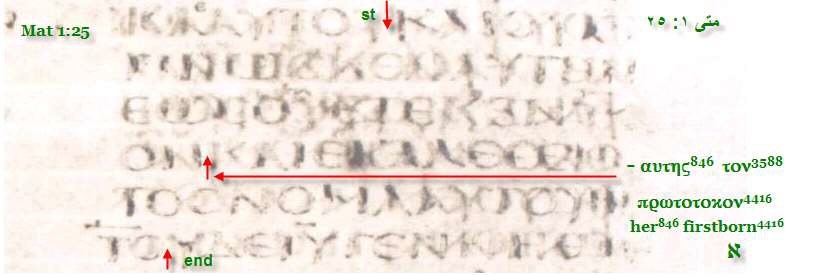
The Vatican Manuscript:
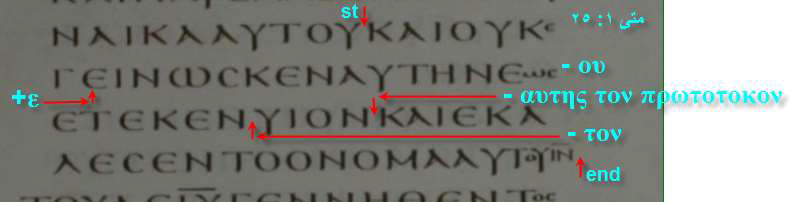
The Alexandrian Manuscript:

Regardless of the changes, substitutions, deletions, and additions in the manuscripts of this verse — should we retranslate “And he did not know her until she gave birth to her firstborn son” to “And he did not know her until she gave birth to the Son before all his brothers”? What should we do with this verse? And will this translation support the idea that Joseph the carpenter had intercourse with Mary after she gave birth to Jesus?
And if someone were to cry out, “How can you claim that when you believe in the virginity of Mary?” we would reply: “This is the language used by the book you adhere to, and this is precisely what we refute.” The solution is not to tamper with the book, whether it be in its translations or its manuscripts and texts in their original language, which we understand. We understand that the book is refuted from these languages, even though translations mean a great deal to the book, but not by separating them from the original language.
Revelation 1 5
(SVD) “And from Jesus Christ, the faithful witness, the firstborn from the dead, and the ruler of the kings of the earth.” He who loved us, and washed us from our sins by His blood.
(ALAB) and from Jesus Christ, the faithful witness, the firstborn from the dead, the King of the kings of the earth, who out of love for us died for us, and washed us from our sins by His blood.
(GNA) and from Jesus Christ, the faithful witness, the firstborn from the dead, and the King of the kings of the earth. He who loved us and freed us from our sins by His blood.
(JAB) and from Jesus Christ, the faithful witness, the firstborn from the dead, and the Lord of the kings of the earth, He who loved us and freed us from our sins by His blood.
(KJV+) And 2532 from 575 Jesus 2424 Christ, 5547 who is the 3588 faithful 4103 witness, 3144 and the 3588 first before 4416 of 1537 the 3588 dead, 3498 and 2532 the 3588 prince 758 of the 3588 kings 935 of the 3588 earth. 1093 Unto him that loved 25 us, 2248 and 2532 washed 3068 us 2248 from 575 our 2257 sins 266 in 1722 his own 848 blood, 129
(GNT-BYZ+) και 2532 CONJ απο 575 PREP ιησου 2424 N-GSM χριστου 5547 N-GSM ο 3588 T-NSM μαρτυς 3144 N-NSM ο 3588 T-NSM πιστος 4103 A-NSM ο 3588 T-NSM νεκρων 3498 A-GPM και 2532 CONJ ο 3588 T-NSM αρχων 758 N-NSM των 3588 T-GPM βασιλεων 935 N-GPM της 3588 T-GSF γης 1093 N-GSF τω 3588 T-DSM | αγαπωντι 25 V-PAP-DSM | VAR: αγαπησαντι 25 V-AAP-DSM :END | 1473 P-1AP N-GPF ημων 1473 P-1GP εν 1722 PREP τω 3588 T-DSN αιματι 129 N-DSN αυτου 846 P-GSM
(FDB) And of the part of Jesus Christ, the faithful father, the first of the dead, and the prince of the land! What we love, and what we love in our hearts in our son’s song.
(Vulgate) and Jesus Christ, who is the first test of the world and the princes of the world who read our hearts and love our hearts in the song.
Revelation 3 14
(SVD) And write to the angel of the church in Laodicea: “These are the words of the Amen, the faithful and true witness, the beginning of God’s creation.”
(ALAB) And write to the angel of the church in Laodicea: Here is what the Truth says, the faithful and true witness, the ruler of God’s creation.
(GNA) And write to the angel of the church in Laodicea: “These are the words of the Amen, the faithful and true witness, the ruler of God’s creation.”
(JAB) And to the angel of the church in Laodicea I write: Here is what the Amen says, the faithful and true witness, the beginning of God’s creation.”
(KJV+) And 2532 unto the 3588 angel 32 of the 3588 church 1577 of the Laodiceans 2994 write; 1125 These things 3592 said 3004 the 3588 Amen, 281 the 3588 faithful 4103 and 2532 true 228 witness, 3144 the 3588 beginning 746 of the 3588 creation 2937 of God; 2316
(GNT-BYZ+) 2532 CONJ τω 3588 T-DSM αγγελω 32 N-DSM της 3588 T-GSF εν 1722 PREP λαοδικεια 2993 N-DSF εκκλησιας 1577 N-GSF γραψον 1125 V-AAM-2S ταδε 3592 D-APN λεγει 3004 V-PAI-3S ο 3588 T-NSM αμην 281 HEB ο 3588 T-NSM μαρτυς 3144 N-NSM ο 3588 T-NSM πιστος 4103 A-NSM και 2532 CONJ αληθινος 228 A-NSM η 3588 T-NSF αρχη 746 N-NSF 3588 T-GSF 2937 N-GSF 3588 T-GSM 2316 N-GSM
(FDB) And in the assembly that is on the Internet, it says: Voice to the audience, the time is valid and veritable, the start of the creation of the contract.
(Vulgate) and Angelo Laodiciae ecclesiae scribe haec dicit Amen testis fidelis et verus qui est principium creaturae Dei
The Vatican Manuscript:
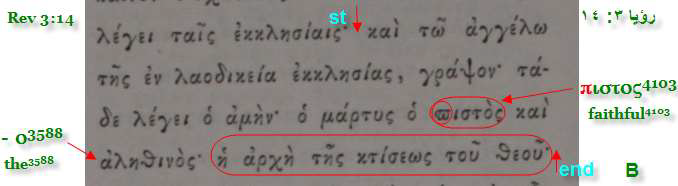
The Sinaiticus Manuscript:
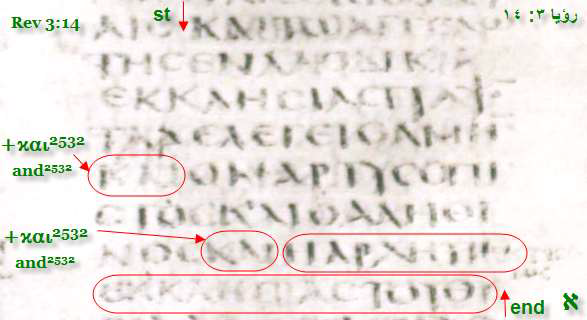
The Alexandrian Manuscript:

As we see here, the word η αρχη, which we discussed in the research “Weaving Texts and Fabricating Doctrines” — where we refuted John 1:1 as a false proof of the alleged divinity of Jesus, and we proved that the word αρχη does not mean eternity but rather a specific beginning — has been clearly explained from the Septuagint translation of Genesis 1:1 and other verses in what we call biblical usage, which correctly explains how the book uses a word and understands its meaning well from the context of the verses.
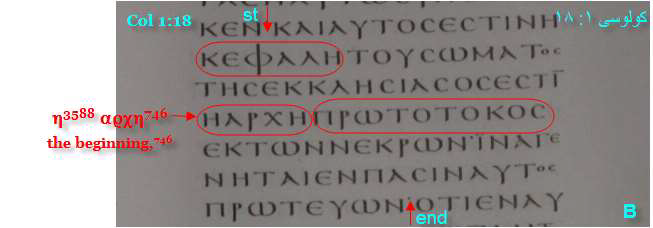
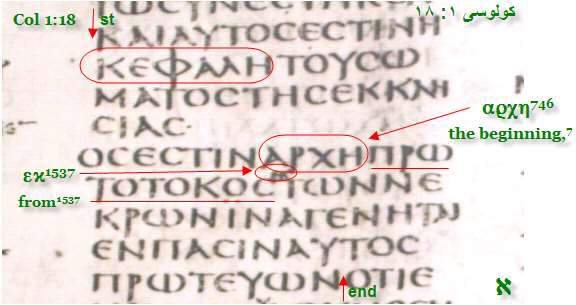
It is useful here to discuss the word η αρχη as a singular feminine word. The word appears in Revelation 3:14 and means beginning, not head or ruler, as confirmed by its usage in Colossians 1:18.
(SVD) He is the head of the body: the Church. He is the beginning, the firstborn from the dead, so that in all things He may have primacy.
(ALAB) He is the head of the body, that is, the Church; He is the beginning and the firstborn from the dead, so that in all things He may have primacy.
(GNA) He is the head of the body, that is, the head of the Church. He is the beginning and the firstborn from the dead, so that in all things He may have primacy.
(JAB) He is the head of the body, that is, the head of the Church. He is the beginning and the firstborn from the dead, so that in all things He may have primacy.
(KJV+) And 2532 he 846 is 2076 the 3588 head 2776 of the 3588 body, 4983 the 3588 church: 1577 who 3739 is 2076 the beginning, 746 the firstborn 4416 from 1537 the 3588 dead; 3498 that 2443 in 1722 all 3956 things he 846 might have 1096 the preeminence. 4409
(GNT-BYZ+) και 2532 CONJ αυτος 846 P-NSM εστιν 1510 V-PAI-3S η 3588 T-NSF κεφαλη 2776 N-NSF του 3588 T-GSN σωματος 4983 N-GSN της 3588 T-GSF εκκλησιας 1577 N-GSF ος 3739 R-NSM εστιν 1510 V-PAI-3S αρχη 746 N-NSF πρωτοτοκος 4416 A-NSM-S εκ 1537 PREP γενηται 1096 T-GPM νεκρων 3498 A-GPM ινα 2443 CONJ V-2ADS-3S εν 1722 PREP πασιν 3956 A-DPN αυτος 846 P-NSM πρωτευων 4409 V-PAP-NSM
(FDB) And he is the chef of the corps, of the assembly, when he starts, he first enters the morts, even if all the things he chooses are in the first place.
(Vulgate) and ipse est caput body ecclesiae qui est principium primogenitus ex mortuis ut sit in omnibus ipse primatum tenens
G2776 — κεφαλή (kephalē) kef-al-ay’ — Probably from the primary word κάπτω kaptō (in the sense of seizing); the head (as the part most readily taken hold of), literally or figuratively: — head.
G3588 — ὁ, ἡ, τό (ho, hē, to) ho, hay, to — The masculine, feminine (second) and neuter (third) forms, in all their inflections; the definite article; the (sometimes to be supplied, at others omitted, in English idiom): — the, this, that, one, he, she, it, etc.
G746 — ἀρχή (archē) ar-khay’ — From G756; (properly abstract) a commencement, or (concrete) chief (in various applications of order, time, place or rank): — beginning, corner, (at the, the) first (estate), magistrate, power, principality, principle, rule.
G4416 — πρωτοτόκος (prōtotokos) pro-tot-ok’-os — From G4413 and the alternate of G5088; first born (usually as noun, literally or figuratively): — firstbegotten(-born).
The Vatican Manuscript (Colossians 1:18):
The Sinaiticus Manuscript (Colossians 1:18):
The Alexandrian Manuscript (Colossians 1:18):
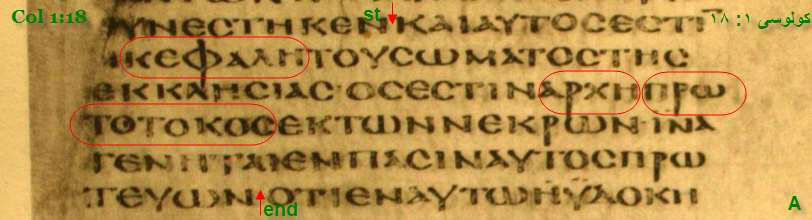
As we see here, there are three expressions in this passage:
- Head (κεφαλη) of the body: the Church
- Who is the beginning ([η] αρχη)
- Firstborn (πρωτοτοκος) from the dead
Therefore, Head is not an expression of Beginning, nor is it of Firstborn. Thus, there is no room for anyone to say that η αρχη in Revelation 3:14 is translated as “Head” as in the Good News translation, or “Principal” as in the Life translation. Rather, it should be translated as it was translated in the Van Dyck translation, “Beginning,” or as it was translated in the Church Fathers, “Beginning.”
And if we do not disagree that κτισεως του θεου means “creation of God,” then the expression η αρχη της κτισεως του θεου in Revelation 3:14 means “the beginning of all God’s creation” — as translated in the Van Dyck, or “the beginning of God’s creation” — as translated in the Church Fathers.
This is further evidence supporting Revelation 3:14 as proof that Jesus is a created being, since the beginning of God’s creation is from God’s creation, just as the first graduate is a graduate.
Conclusion
Thus, we see that Scripture proves that Jesus is a created being and not eternal. He cannot say, “I Am the Alpha and the Omega,” or “I Am the Beginning and the End,” or “I Am the First and the Last.”
The evidence established throughout this research:
-
Isaiah 48 & 44 establish that “the first and the last” is an exclusive attribute of the God of Israel — the Father — not Jesus.
-
Revelation 1:8 — the one who says “I am the Alpha and the Omega” is described as “the Lord who is and who was and who is to come, the Almighty” — a description belonging to the Father, not the Lamb.
-
Revelation 1:11 — the phrase “I am the Alpha and the Omega, the First and the Last” is an addition found in some translations but absent from the Vatican and Alexandrian manuscripts.
-
Revelation 21:6 — the one seated on the throne (the Father) is distinguished from the Lamb (Jesus) in both Revelation 5 and 6.
-
Revelation 22:13 — the speaker describes himself as a servant, an angel, and one who commands worship to God alone — all of which are incompatible with Jesus according to post-resurrection Trinitarian theology.
-
Colossians 1:15 and Revelation 3:14 confirm in plain language that Jesus is the firstborn of all creation and the beginning of God’s creation — i.e., a created being.
Therefore, the answer to the central question is definitive: Jesus did not say that he was the Alpha, nor the Omega, nor the beginning, nor the end.