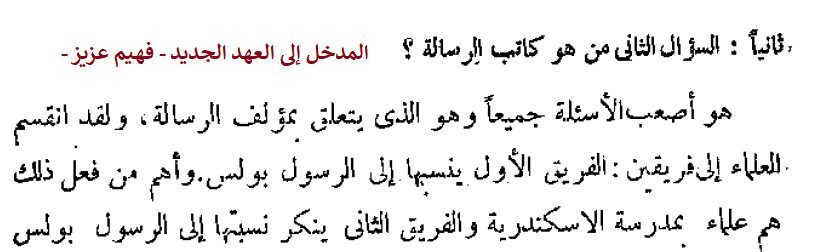
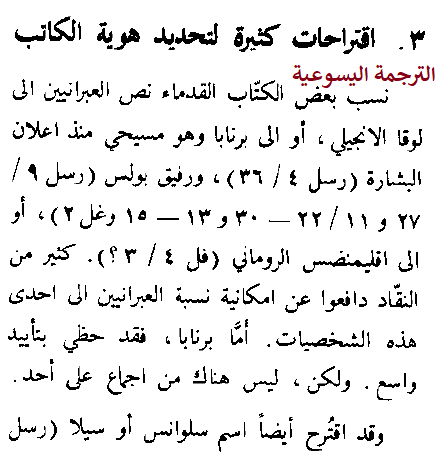
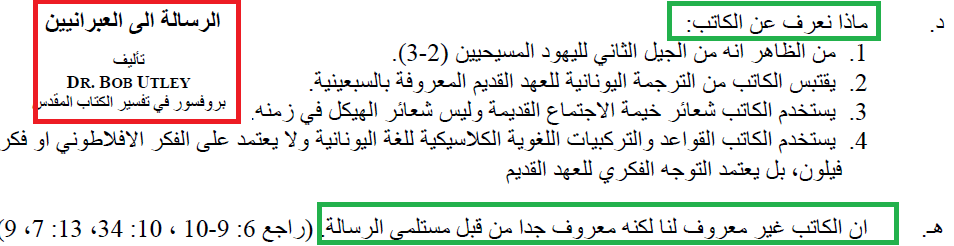
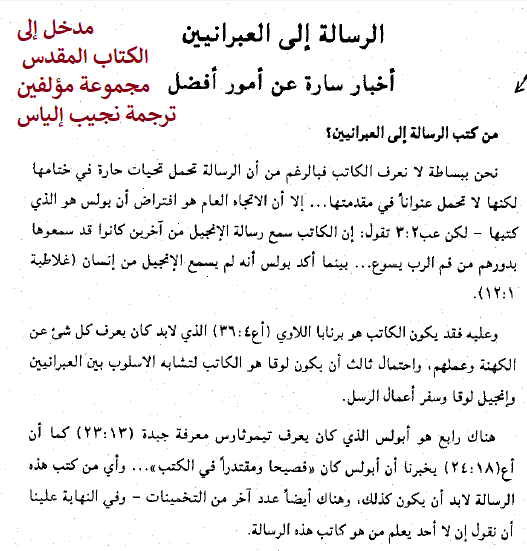
The Epistle to the Hebrews has no confirmed author. This is not a fringe position — it is the consensus of the early Church Fathers, the medieval scholars, the Protestant Reformers, and modern critical scholarship alike. When Christians ask “who changed the Bible, and when, and where?” — this epistle is one of the clearest answers: an anonymous letter was included in the canon, attributed to Paul without evidence, and its authorship remains unknown to this day.
Response Context This post is a direct response to those who ask: “Who changed it? When? Where?” The answer is documented below entirely from Christian sources.
Church Fathers on the Authorship of Hebrews
Pantaenus — 180 AD
Pantaenus on the authorship of Hebrews — from Bruce Metzger, The New Testament CanonContinuedContinuedContinued
— The New Testament Canon Although none of his writings have survived, Pantaenus believed the Epistle to the Hebrews was the work of the Apostle Paul — but that Paul preferred to remain anonymous in it. This opinion of Pantaenus was “an attempt at reconciliation, which was necessary for the existence of two kinds of collection (Paul’s letters), one with and one without the Epistle to the Hebrews.”
Clement of Alexandria adopted Pantaenus’s theory — that Paul wrote it but concealed his identity — while adding the explanation that its translator into Greek was Luke.
Origen — Born c. 185 AD
— quoted in Eusebius “Speaking as a scholar, Origen freely admits that the tradition of the authorship of the Epistle to the Hebrews is not entirely certain. In view of the literary and stylistic problems involved, it is best to conclude that, although the Epistle contains ideas of Paul, it was written by someone else — perhaps Luke or Clement of Rome.”
“Who wrote it, God alone knows.” — Origen’s own conclusion, as quoted by Bart Ehrman in New Testament.
Hippolytus of Rome — Early Third Century
— The New Testament Canon, Hippolytus accepted the four Gospels, thirteen Pauline epistles, Acts, and three Catholic Epistles — but not the Epistle to the Hebrews. His total was twenty-two books. Although he does not classify it as Scripture, he quotes it frequently.
Cyprian — Mid-Third Century
— The New Testament Canon, Cyprian evidently did not consider the Epistle to the Hebrews canonical. Tertullian, who studied Cyprian’s writings, attributed the epistle to Barnabas — not Paul.
The Muratorian Canon — Late Second Century
The Muratorian Canon — Late Second Century The Muratorian list classifies books into four categories: universally accepted, disputed, rejected-but-readable, and heretical. The universally accepted list includes the four Gospels, Acts, thirteen letters of Paul, Jude, letters of John, Wisdom of Solomon, and Revelation of John. Books not listed at all include 1 and 2 Peter, James, and the Epistle to the Hebrews.
Amphilochius — Fourth Century
Amphilochius — The New Testament Canon, Amphilochius mentions the earlier controversy over Hebrews, the Catholic Epistles, and Revelation. He not only relates the doubts of others regarding these books — he also appears to reject 2 Peter, 2 and 3 John, Jude, and Revelation himself.
Athanasius — 367 AD
— Thirty-Ninth Festal Letter, 367 AD Athanasius’s list of the twenty-seven New Testament books — the first complete list matching our current canon — includes Hebrews, placing it between 2 Thessalonians and 1 Timothy among the Pauline Epistles.
This is significant: the first person to list all twenty-seven books did so in 367 AD — nearly three and a half centuries after the last New Testament book was written.
Jerome — 414 AD
— Letter to Claudianus Posthumous Dardanus, 414 AD “The Epistle to the Hebrews has not only been received by the churches of the East, but also by all the writers of the Church who wrote in Greek before our days, as being from Paul the Apostle — so that many believe it to be from Barnabas or Clement. It makes no difference which it is, for it is from a man of the Church.”
Jerome himself does not confirm Pauline authorship — he simply notes the diversity of attribution and sidesteps the question.
Philaster, Bishop of Brescia — Died 397 AD
Philaster — The New Testament Canon, In his list of sacred New Testament books, Philaster includes the Gospels, thirteen Pauline epistles, and seven Catholic epistles — passing over the Epistle to the Hebrews and the Apocalypse of John in silence. Elsewhere, however, he regards Hebrews as Pauline. His treatment is openly contradictory.
The Canon Councils — 393 and 397 AD
Councils of Carthage — 393 and 397 AD The Councils of 393 and 397 listed “thirteen epistles of Paul, and the Epistle to the Hebrews, with the same” — distinguishing Hebrews from the Pauline corpus even while including it. The canon of 419 AD simplified this to “fourteen epistles of Paul.”
The awkward phrasing — “thirteen epistles of Paul, and the Epistle to the Hebrews, with the same” — is itself an admission that the councils were uncertain whether to classify Hebrews as Pauline or not.
Syria — A Church That Excluded It Entirely
The Syriac Peshitta — Fifth Century The Syriac Bible version, the Peshitta, included fourteen Pauline Epistles (including Hebrews) and the three longer Catholic Epistles. However, 2 Peter, 2 and 3 John, Jude, and Revelation were entirely absent from the Syriac canon — giving the Syrian Church a New Testament of only twenty-two books. For a large part of the Syriac Church, this served as the closure of the canon.
The Renaissance and Reformation — Open Rejection
Cardinal Cajetan — 1469–1534
Cardinal — The New Testament Canon, Cajetan “denied the authenticity of the Epistle to the Hebrews to Paul” and expressed doubts about the apostolic authorship of James, Jude, and 2 and 3 John.
Erasmus of Rotterdam — Died 1536
— Greek Testament, Basel, 1516 Erasmus “boldly denies that Paul wrote Hebrews” and doubts that the Epistle of James was written by the Apostle James. He also questions the traditional authorship of 2 Peter, 2 and 3 John, and Jude.
Andreas Bodenstein of Karlstadt — 1480–1541
Andreas Bodenstein of Karlstadt — The New Testament Canon, Karlstadt divided the New Testament into three orders of rank. The third — lowest — order consists of seven disputed books: James, 2 Peter, 2 and 3 John, Jude, Hebrews, and Revelation. He declares plainly that Hebrews is not by Paul.
Martin Luther — German New Testament, September 1522
— Introduction to the New Testament, 1522 Luther placed Hebrews in a third, inferior category of books — alongside James, Jude, and Revelation — giving reasons for doubting their apostolic and canonical character. Of Hebrews specifically, he noted it “comes from the second generation” and teaches, unlike Paul, that there can be no repentance after baptism.
The consequences of Luther’s position were concrete:
Jacob Lucius Bible — Hamburg, 1596 Lucius published a Bible in which the four disputed books — Hebrews, James, Jude, and Revelation — were given the title “Apocrypha”, followed by the explanation: “that is, books that are not equal to other Scriptures.”
David Wolder’s Trinitarian Bible — 1596 Wolder’s table of contents referred to Hebrews, James, Jude, and Revelation as “non-canonical”.
Bible of Gustavus Adolphus — Stockholm, 1618 This Bible separated the four questionable books at the end of the table of contents and called them the “Apocryphal New Testament” — a designation that continued for nearly a century in a dozen or more editions.
Modern Scholarship — The Unanimous Verdict
— New Testament “It was not until AD 367 — nearly two and a half centuries after the last book of the New Testament was written — that any Christian could be acquainted with the list of the names of the twenty-seven books we have that are considered the authoritative canon of Scripture.”
Wikipedia — Epistle to the Hebrews “Because the identity of the author could not be determined, the letter faced some difficulties in entering the Christian Bible. In the end, it was accepted as part of the Bible due to its theology, eloquent presentation, and other internal factors. In ancient times, some circles began to attribute it to Paul in an attempt to provide the unknown work with an explicit apostolic connection. The original King James Version calls the letter ‘The Epistle of Paul the Apostle to the Hebrews.’ However, the King James Version’s attribution to Paul was merely conjecture, and is now disputed by modern scholarship. At present, neither modern scholars nor the Church attribute the Epistle to the Hebrews to Paul.”
Christian Commentators — Admitting Ignorance
Dr. — The Great Treasure in the Interpretation of the Gospel “We say that we do not know the author, and our not knowing him has no bearing on the interpretation of the Epistle or on our considering it as the Word of God.”
Father Tadros Yacoub Malaty — Interpretation of the Epistle to the Hebrews, Introduction Lists six competing theories for the authorship of Hebrews: (1) Paul — the prevailing Eastern view; (2) Barnabas — Tertullian’s attribution; (3) Luke — Origen’s suggestion; (4) Clement of Rome — an early Western view that “disappeared completely”; (5) Silas; (6) Apollos. Six different candidates. Zero certainty.
Father Antonius Fikry — Explanation of the Holy Bible, Introduction to Hebrews Simply lists the author as Paul — with no evidence — because, as the post notes: “this is what they will believe because they want to believe without evidence.”
Summary of All Positions on Hebrews Authorship
Scholar / Source
Position
Pantaenus (180 AD)
Paul — but anonymous
Clement of Alexandria
Paul — translated by Luke
Origen (185 AD)
Unknown. “God alone knows.”
Tertullian
Barnabas
Hippolytus
Not canonical
Cyprian
Not canonical
Muratorian Canon (2nd c.)
Not listed at all
Jerome (414 AD)
Uncertain — Paul, Barnabas, or Clement
Philaster (d. 397)
Listed then unlisted — contradictory
Cardinal Cajetan (1534)
Not by Paul
Erasmus (1536)
Not by Paul
Karlstadt (1541)
Not by Paul — third-rank disputed book
Luther (1522)
Inferior — not truly apostolic
Lucius Bible (1596)
Labelled “Apocrypha”
Wolder Bible (1596)
Labelled “Non-canonical”
Modern scholarship
Not by Paul — authorship unknown
Wikipedia
Attribution to Paul was conjecture
Not a single scholar across nineteen centuries has been able to confirm with certainty who wrote the Epistle to the Hebrews.
“Who changed it? When? Where?” This is the standard challenge from those who defend biblical reliability. They demand a named person, a named date, a named location for any alleged corruption.
The Epistle to the Hebrews is itself the answer. An anonymous letter — with six competing theories about its author — was included in the New Testament canon. It was initially excluded by Hippolytus, Cyprian, and the Muratorian Canon. It was attributed to Paul “in an attempt to provide the unknown work with an explicit apostolic connection” — Wikipedia’s own words. It was later labelled Apocrypha by Lutheran editions and Non-canonical by others.
The one who changed it — who added unknown writings and declared them divinely inspired — is exactly the process this epistle documents. No single named forger is needed when the canon itself developed by committee, vote, and centuries of dispute over unsigned texts.
Conclusion The Epistle to the Hebrews is a case study in how the Bible was assembled. An anonymous text, disputed from the second century onward, excluded from multiple early canons, attributed to six different authors at various points in history, rejected as non-apostolic by the Protestant Reformers, and admitted to be of unknown authorship by modern scholars and the Church itself — was nonetheless included in the final canon by councils, tradition, and consensus. This is not the preservation of a divine revelation. It is the editorial process of a human institution.