

John 3:13 Who Is in Heaven — A Divinity Proof Text Absent from the Two Oldest Papyri, Sinaiticus, and Vaticanus
The Verse Under Study
In Greek (Textus Receptus — Scrivener):
SCR John 3:13 καὶ οὐδεὶς ἀναβέβηκεν εἰς τὸν οὐρανόν, εἰ μὴ ὁ ἐκ τοῦ οὐρανοῦ καταβάς, ὁ υἱὸς τοῦ ἀνθρώπου ὁ ὢν ἐν τῷ οὐρανῷ
The disputed phrase:
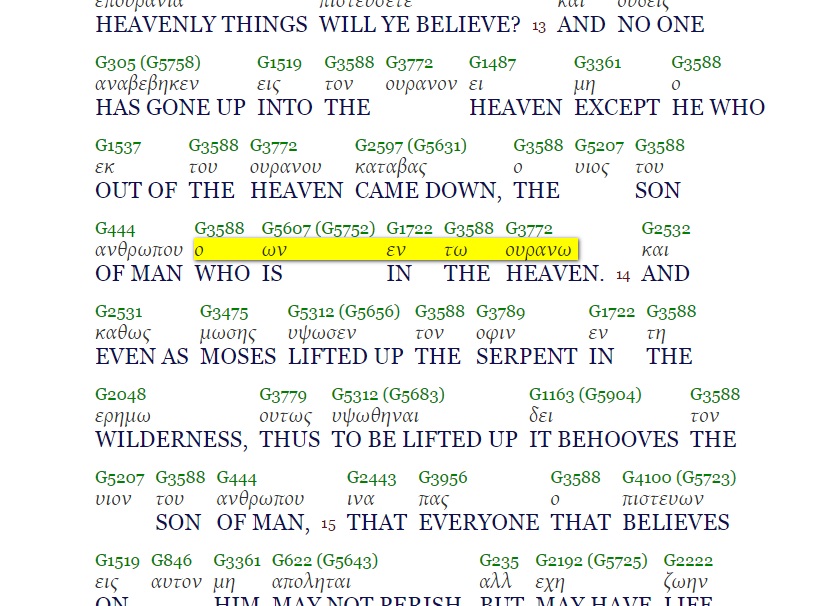
ὁ υἱὸς τοῦ ἀνθρώπου ὁ ὢν ἐν τῷ οὐρανῷ = the Son of Man who is in heaven
This phrase exists in four competing forms across the manuscript tradition:
- Reading 1 — Deletion: The phrase “who is in heaven” is entirely absent. The verse ends at “the Son of Man.”
- Reading 2 — Addition: The full phrase “who is in heaven” (ὁ ὢν ἐν τῷ οὐρανῷ) is present, as in the KJV and Van Dyke.
- Reading 3 — “Who was in heaven”: A past-tense variant found in the Syriac Curitonianus (5th c.) and Latin Platinus (5th c.).
- Reading 4 — “Who is from heaven”: A directional variant found in the Sinaitic Syriac (4th c.) and Greek manuscript 0141.
The oldest witnesses — the two papyri, Sinaiticus, and Vaticanus — all support Reading 1: the phrase is entirely absent.
The Aim of This Research
Supporting manuscripts for each reading (overview):
- Evidence for the deletion reading: manuscripts from the 2nd, 3rd, and 4th centuries.
- Evidence for the addition reading: the oldest Greek manuscripts supporting this reading are from the 8th century; translations from the 4th century.
- Evidence for “who was in heaven”: translations from the 5th century.
- Evidence for “who is from heaven”: a Syriac manuscript from the 4th century and one Greek manuscript.
The Doctrinal Stake — What Christians Claim
Christian commentators use this phrase as direct evidence for the divinity of Christ — specifically to argue that Jesus was simultaneously present on earth speaking to Nicodemus, and in heaven as God, at the very same moment.
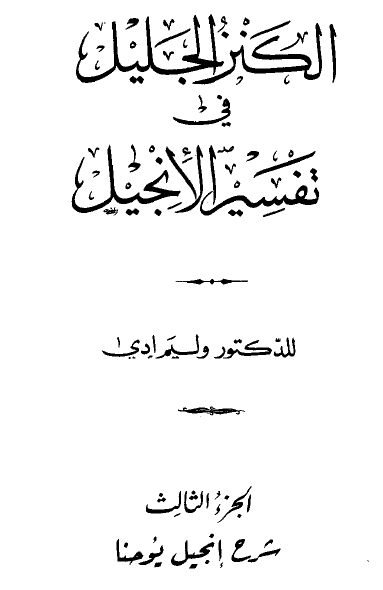
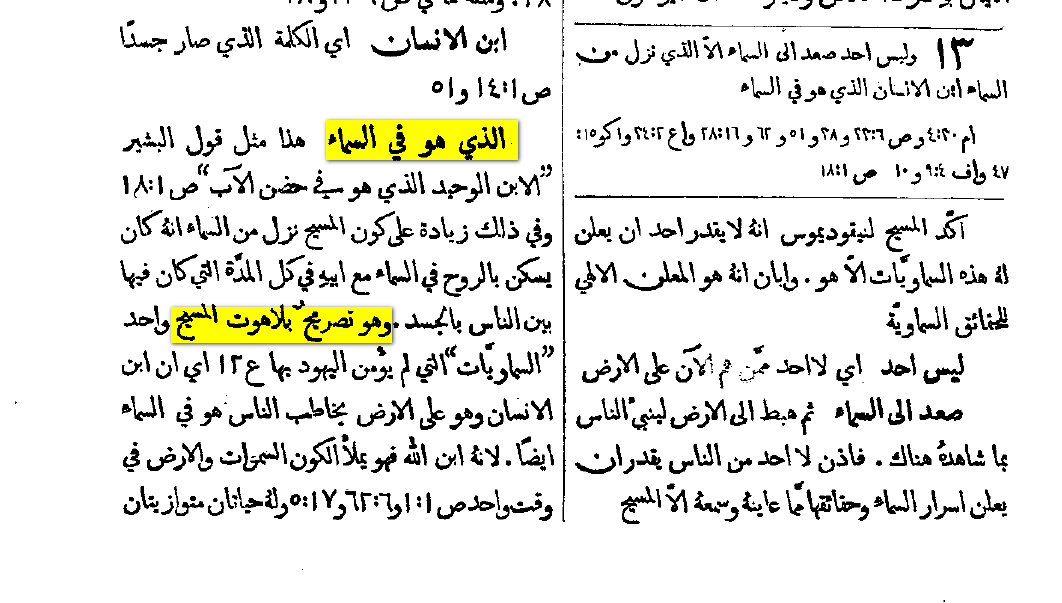
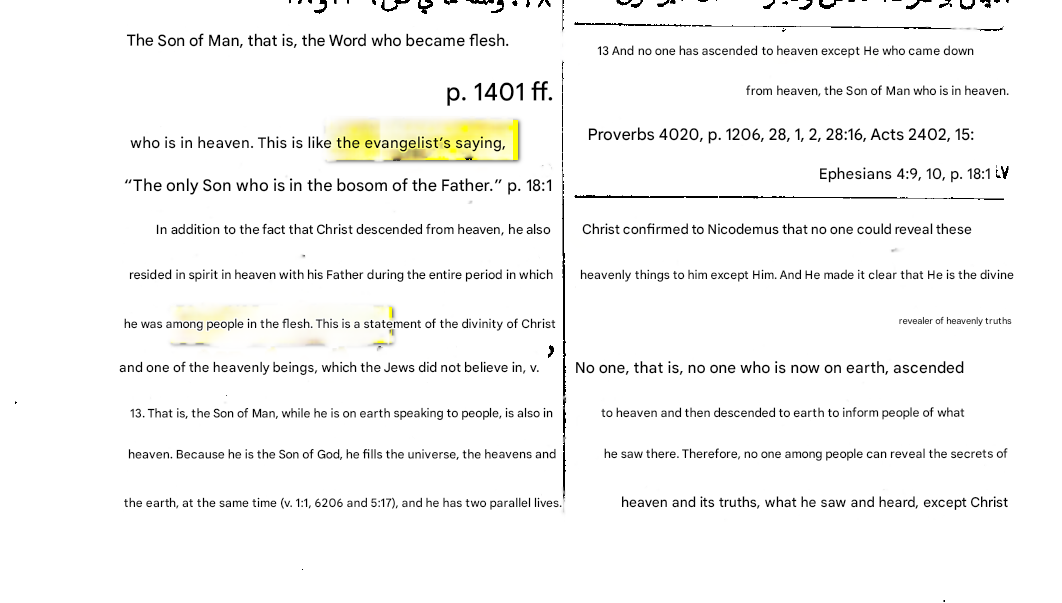
Example 1 — William Eddy in his commentary The Treasure of the Ancients:
“This is a statement of the divinity of Christ.”
Example 2 — The Church Encyclopedia commentary:
First: He is the incarnate God, descending from heaven, ascending to heaven, and being in heaven at the same time. This means that during the time of Christ’s incarnation on earth, He — with His unlimited divinity — did not leave heaven for a single moment. He is in a constant state of incarnation and ascension, as indicated by the conjugation of the word ‘ascended’ in the Greek language. It is not in the past tense as in the Arabic language, but in the present perfect tense as in the English language.”
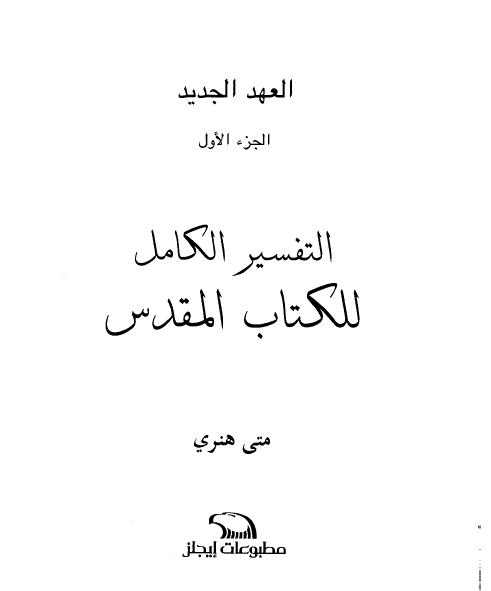
Example 3 — Matthew Henry in his commentary:
“Here Christ speaks in this phrase as God who is in heaven.”
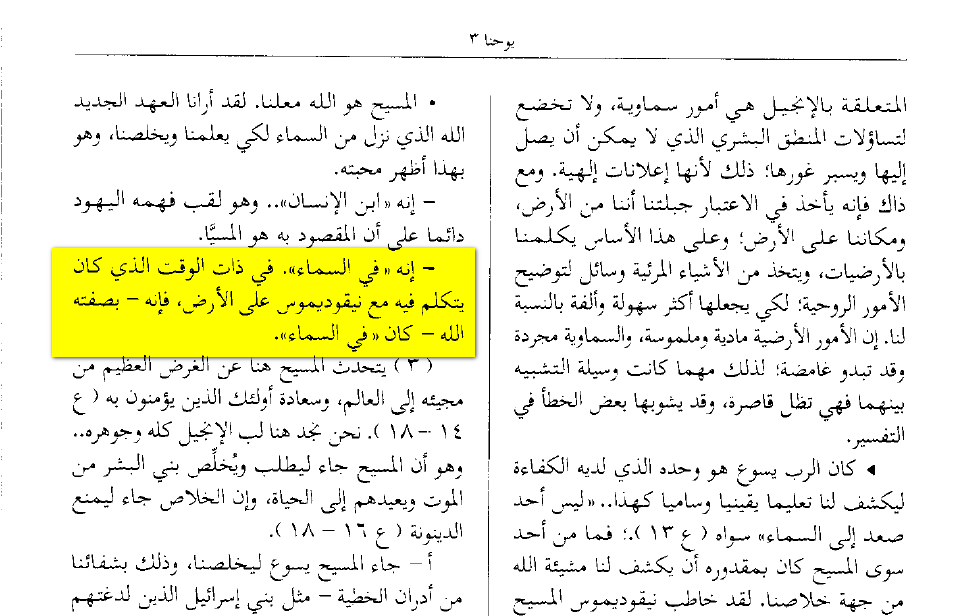
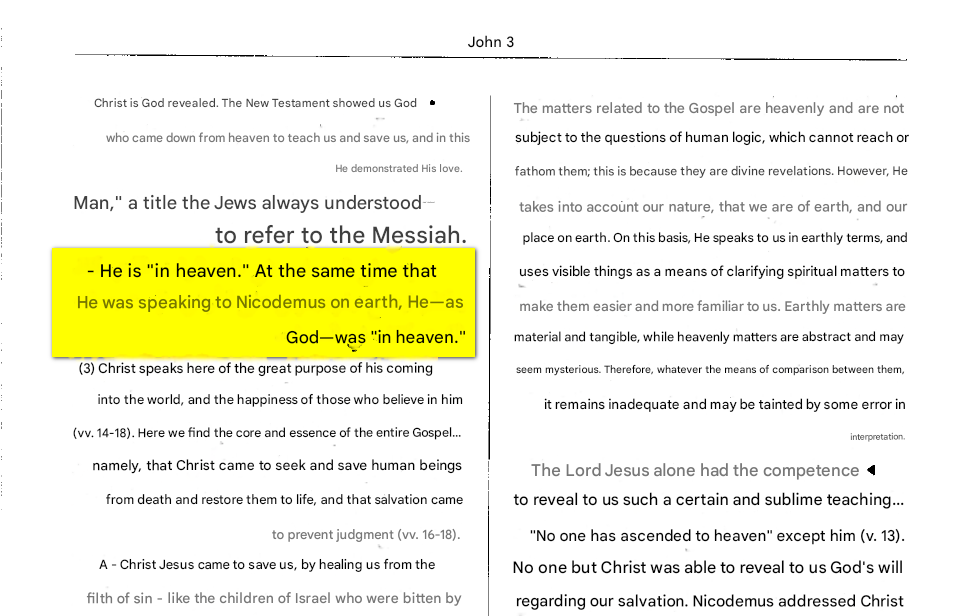
The phrase “who is in heaven” is therefore the theological foundation for the claim that Christ possessed a divine omnipresence — present simultaneously on earth and in heaven. If the phrase is not original, this entire Christological argument collapses.
The Interlinear and Uncial Text
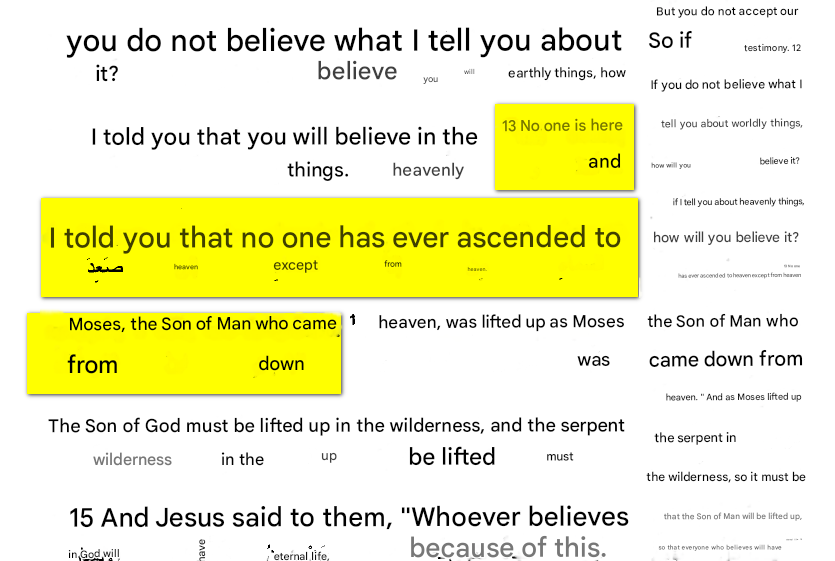
First — the Greek-English interlinear text (http://studybible.info/IGNT/John%203), with shading on the section deleted from the manuscripts:
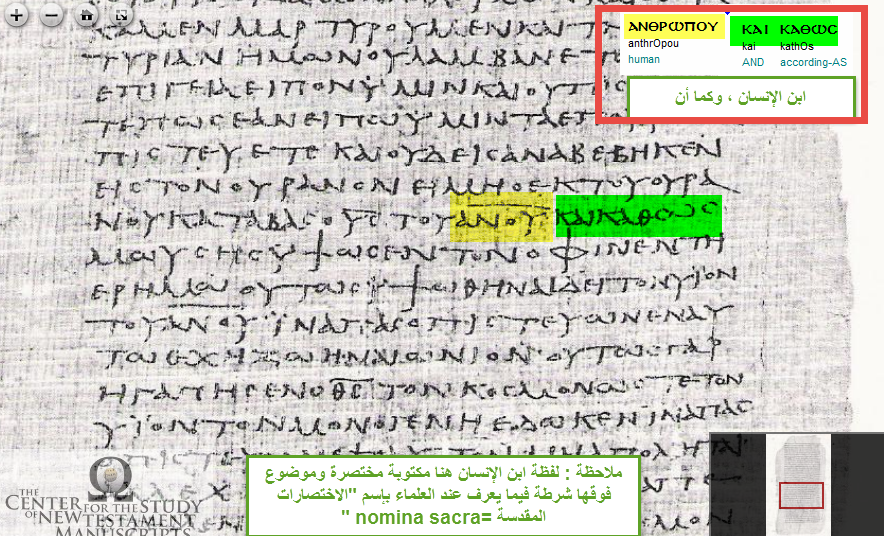
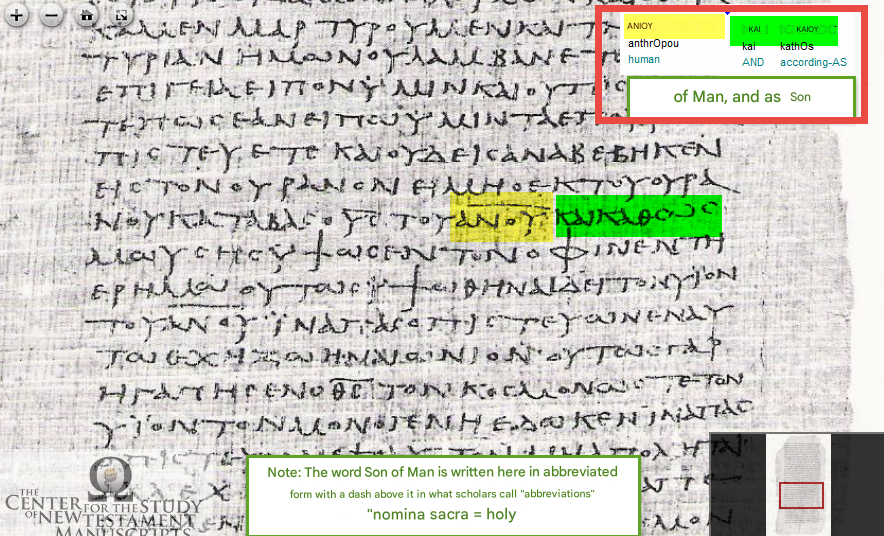
Second — the text in capital letters, which is the form in which early Greek manuscripts are written. Note the last word before the deleted section, which is the word ἀνθρώπου = human/man. Note the first word after the deleted section, which is καὶ καθώς = as, from verse 14.
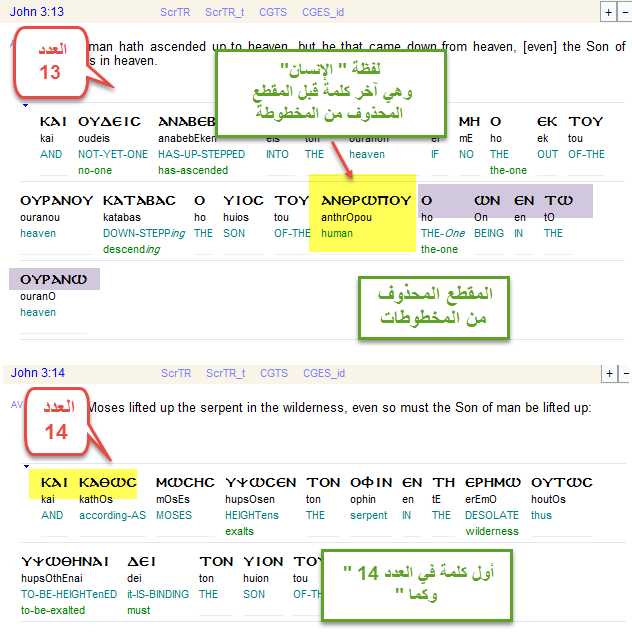
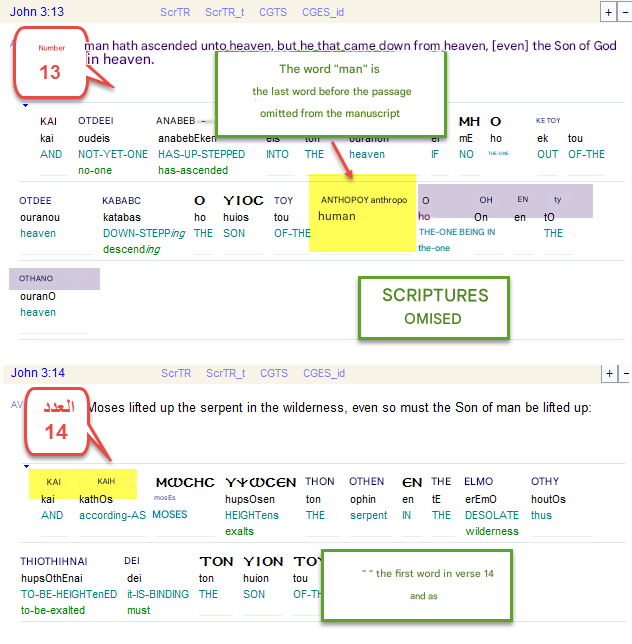
For those who are not skilled at extracting text from manuscripts: when you find these two words next to each other in the manuscript — ἀνθρώπου immediately followed by καθώς — know that the phrase “who is in heaven” has been deleted.

The Oldest Manuscripts — The Phrase Is Absent
Christians believe that the most important manuscripts of the New Testament are the Sinaiticus, the Vaticanus, the Alexandrian, the Ephraimite, the Beza Manuscript, the Washington Manuscript, and some ancient papyri. We will now examine what each of the oldest of these says.
1. Codex Sinaiticus (4th Century) — The Section Is Deleted
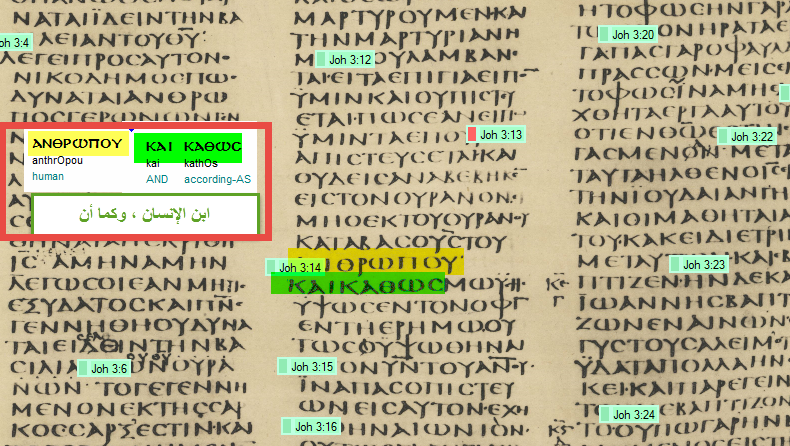
2. Codex Vaticanus (4th Century) — The Section Is Deleted
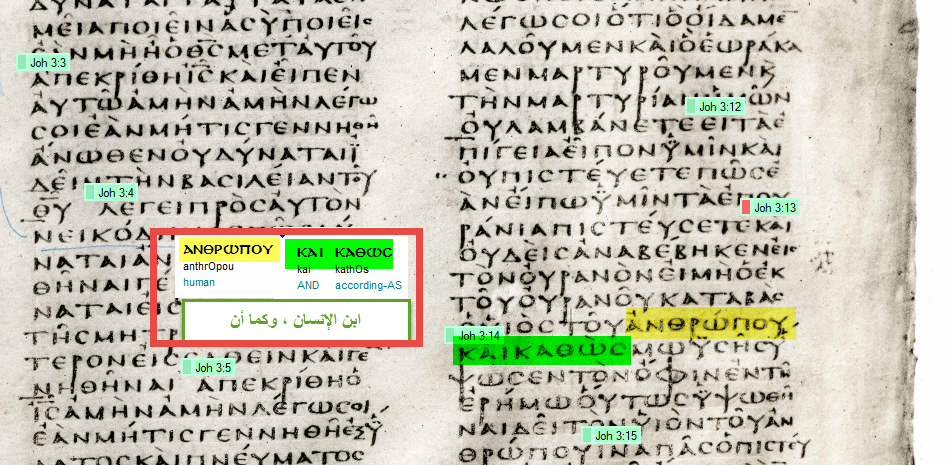
3. Papyrus 66 (𝔓66) — Late 2nd Century — The Section Is Deleted
Papyrus 66 dates to approximately 200 CE — it is one of the oldest papyri of the Gospel of John in existence.
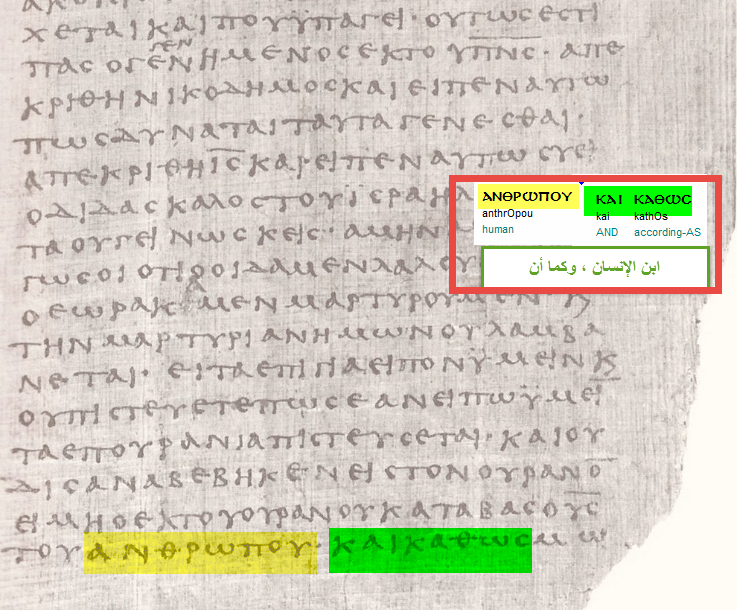
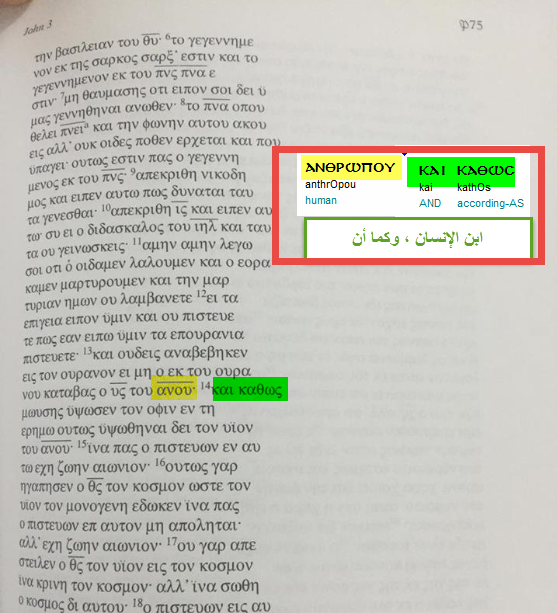
4. Papyrus 75 (𝔓75) — 3rd Century — The Section Is Deleted
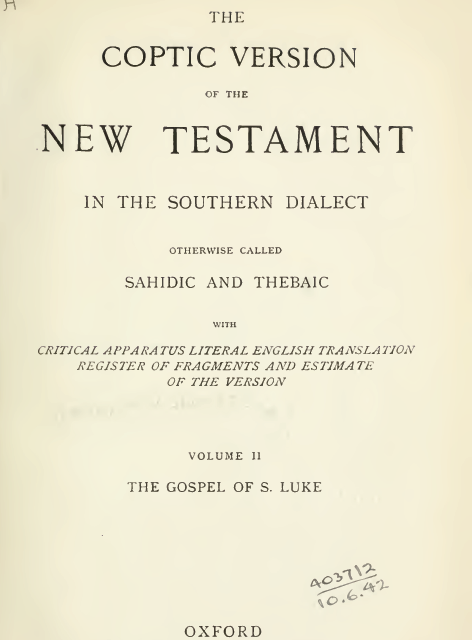
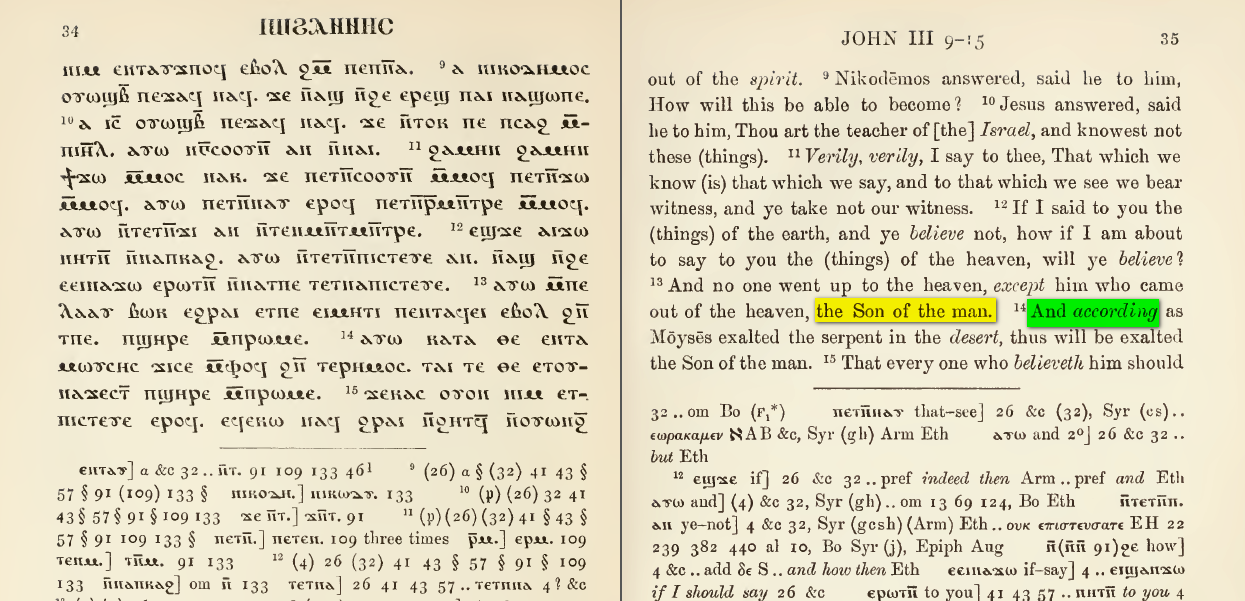
5. Upper Egyptian Coptic — Late 3rd / Early 4th Century — The Section Is Deleted
Transcription of the Papyri
From the book by Philip Comfort and David Barrett, The Complete Text of the Earliest New Testament Manuscripts:
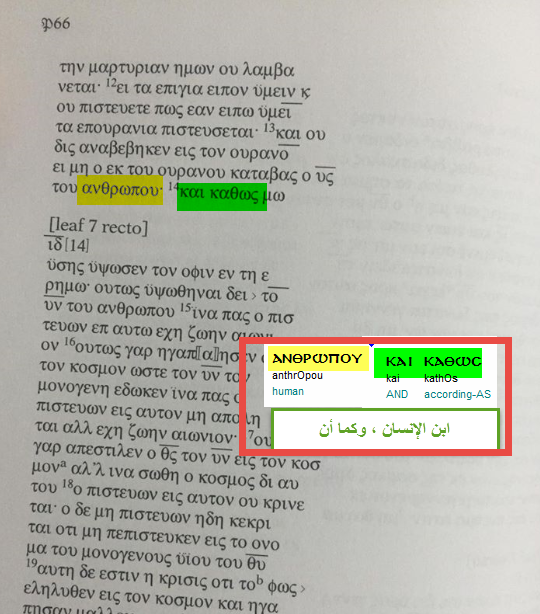
In both transcriptions, the word ἀνθρώπου (man) is immediately followed by καί καθώς (as) — the opening of verse 14. There is no intervening phrase. The phrase “who is in heaven” does not exist in either papyrus.
Transcription of Papyrus 66:
Transcription of Papyrus 75:
Manuscript Chart — David Black’s Research
David Alan Black, writing in Grace Theological Journal 6.1 (1985) pp. 49–66, in an article titled “The Text of John 3:13” — is actually a defender of the authenticity of the addition. Yet he presents the manuscript distribution honestly. The most famous manuscripts for each reading, from his research:
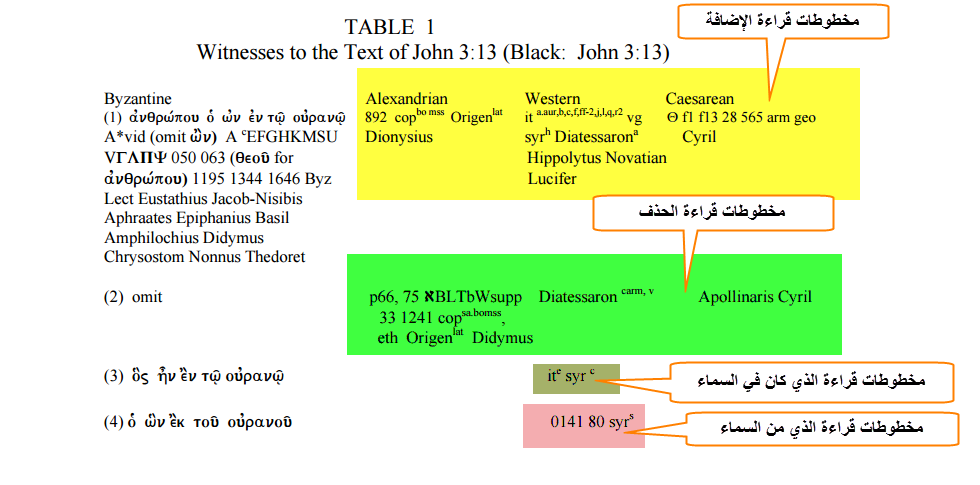
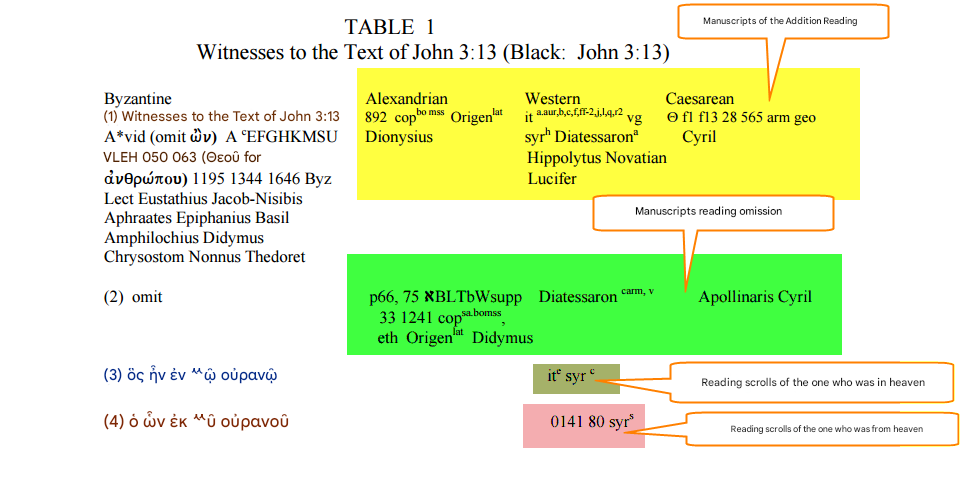
Even Black — defending the addition — admits:
- Important Greek manuscripts omit the passage.
- The text in the early church circulated in two basic and quite distinct forms.
- The Bodmer papyri (𝔓66, 𝔓75) attest the shorter reading, as do the fourth-century uncials Sinaiticus (א) and Vaticanus (B), “which are the earliest and best uncial representatives in John of the Alexandrian text-type.”
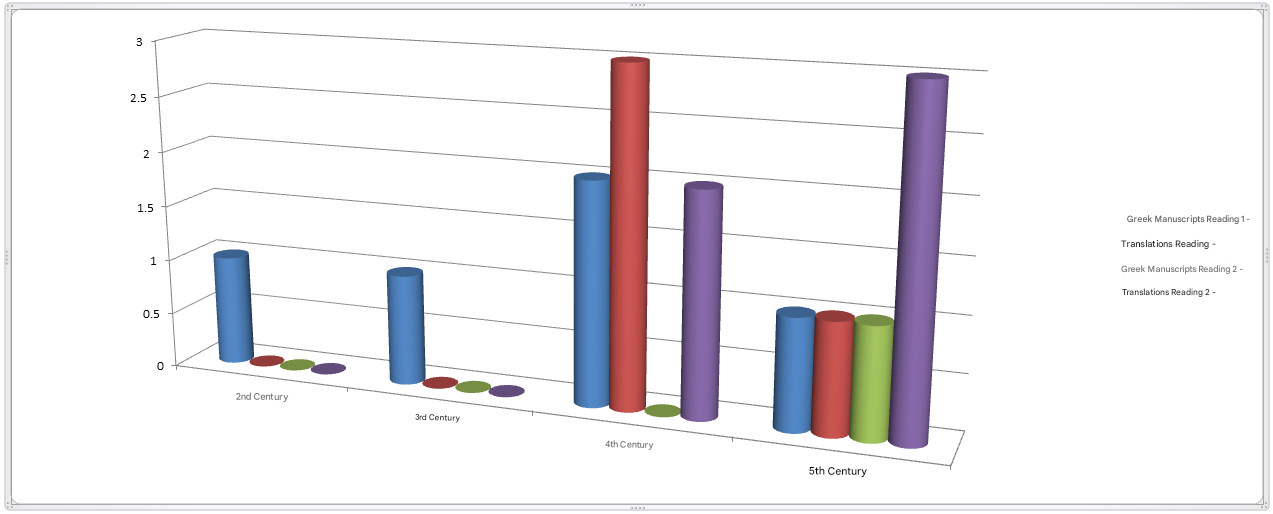
Diagram of manuscripts that omit and add the phrase over the course of the first five centuries:
Reading 1 = reading the deletion. Reading 2 = reading the addition. The first column is the number of Greek manuscripts for reading the deletion; the second column is the number of translation manuscripts for reading the deletion; the third column is the number of Greek manuscripts for reading the addition; the fourth column is the number of translation manuscripts for reading the addition. Translations include Syriac, Latin, and Coptic.

Arabic Versions — Three-Way Split
Link to browse Arabic translations: http://www.albishara.org/page.php?view=arabiccomper
The Arabic versions differ in three different forms:
- Two versions mention the entire passage.
- Two versions delete the entire phrase.
- Four copies write the first half of the passage and delete the second half.
Versions that mention the entire passage:
- Van Dyke: “And no one has ascended to heaven except he who came down from heaven, the Son of Man who is in heaven.”
- Paulian: “For no one has ascended to heaven except he who came down from heaven, that is, the Son of Man who is in heaven.”
Versions that delete the entire phrase:
- Common Arabic: “No one has ascended to heaven except the Son of Man who came down from heaven.”
- Sarah: “No one has ascended to heaven except the Son of Man who came down from heaven.”
Versions that write the first half and delete “who is in heaven”:
- Simplified: “And no one has ascended to heaven except He who came down from heaven, that is, the Son of Man.”
- Jesus Translation: “No one has ascended to heaven except the one who came down from heaven, the Son of Man.”
- Noble: “No one has ascended to heaven except He who came down from heaven, that is, He who became flesh.”
- Catholic: “For no one has ascended to heaven except He who came down from heaven, that is, the Son of Man.”
English Versions — Three-Way Split
17 versions that mention the full phrase “who is in heaven”:
ASV John 3:13 — And no one hath ascended into heaven, but he that descended out of heaven, even the Son of man, who is in heaven.
DBY John 3:13 — And no one has gone up into heaven, save he who came down out of heaven, the Son of man who is in heaven.
DRA John 3:13 — And no man hath ascended into heaven, but he that descended from heaven, the Son of man who is in heaven.
ERV John 3:13 — And no man hath ascended into heaven, but he that descended out of heaven, even the Son of man, which is in heaven.
ETH John 3:13 — And no man hath ascended into heaven, but he who descended from heaven, the Son of man, he who is in heaven.
GNV John 3:13 — For no man ascendeth vp to heauen, but he that hath descended from heauen, that Sonne of man which is in heauen.
LEW John 3:13 — And no man hath ascended up to heaven, but he that came down from heaven, the Son of man which is from heaven.
KJV John 3:13 — And no man hath ascended up to heaven, but he that came down from heaven, even the Son of man which is in heaven.
NKJ John 3:13 — “No one has ascended to heaven but He who came down from heaven, that is, the Son of Man who is in heaven.
MGI John 3:13 — And no man has ascended into heaven, but he who descended from heaven, the Son of Man who is in heaven.
MRD John 3:13 — And no one hath ascended to heaven, but he that descended from heaven, the Son of man who is in heaven.
PNT John 3:13 — And no man ascendeth vp to heauen, but he that came downe from heauen, euen the sonne of man which is in heauen.
RWB John 3:13 — And no man hath ascended to heaven, but he that came down from heaven, even the Son of man who is in heaven.
TNT John 3:13 — And no man ascendeth vp to heaven but he that came doune from heaven that is to saye the sonne of man which is in heaven.
WEB John 3:13 — And no man hath ascended to heaven, but he that came down from heaven, {even} the Son of man who is in heaven.
YLT John 3:13 — And no one hath gone up to the heaven, except he who out of the heaven came down — the Son of Man who is in the heaven.
2 versions that deleted the entire phrase:
GWN John 3:13 — No one has gone to heaven except the Son of Man, who came from heaven.
NLT John 3:13 — No one has ever gone to heaven and returned. But the Son of Man has come down from heaven.
19 versions that wrote “Son of Man” and deleted “who is in heaven”:
NRS John 3:13 — No one has ascended into heaven except the one who descended from heaven, the Son of Man.
RSV John 3:13 — No one has ascended into heaven but he who descended from heaven, the Son of man.
TNIV John 3:13 — No one has ever gone into heaven except the one who came from heaven — the Son of Man.
MIT John 3:13 — No one has ascended to heaven. The exception is the one who descended from heaven — the human one.
NAB John 3:13 — No one has gone up to heaven except the one who has come down from heaven, the Son of Man.
NABO John 3:13 — No one has gone up to heaven except the one who has come down from heaven, the Son of Man.
NAS John 3:13 — “And no one has ascended into heaven, but He who descended from heaven, even the Son of Man.
NAU John 3:13 — “No one has ascended into heaven, but He who descended from heaven: the Son of Man.
NET John 3:13 — No one has ascended into heaven except the one who descended from heaven — the Son of Man.
NIB John 3:13 — No-one has ever gone into heaven except the one who came from heaven — the Son of Man.
NIRV John 3:13 — “No one has ever gone into heaven except the One who came from heaven. He is the Son of Man.
NIV John 3:13 — No one has ever gone into heaven except the one who came from heaven — the Son of Man.
NJB John 3:13 — No one has gone up to heaven except the one who came down from heaven, the Son of man.
BBE John 3:13 — And no one has ever gone up to heaven but he who came down from heaven, the Son of man.
CEB John 3:13 — No one has gone up to heaven except the one who came down from heaven, the Human One.
CJB John 3:13 — No one has gone up into heaven; There is only the one who has come down from heaven, the Son of Man.
CSB John 3:13 — No one has ascended into heaven except the One who descended from heaven — the Son of Man.
CSBO John 3:13 — No one has ascended into heaven except the One who descended from heaven — the Son of Man.
ESV John 3:13 — No one has ascended into heaven except he who descended from heaven, the Son of Man.
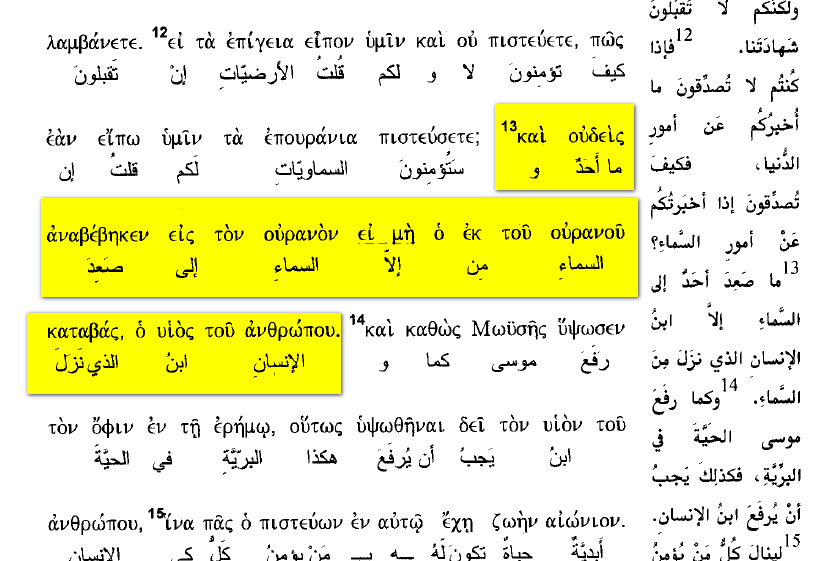
Greek-Arabic Interlinear Text
Greek Critical Editions
Link to browse critical copies: https://www.academic-bible.com/en/home/scholarly-editions/greek-new-testament/greek-new-testament/
Editions that delete “who is in heaven”:
- UBS (BNT): John 3:13 — οὐρανοῦ καταβάς, ὁ υἱὸς τοῦ ἀνθρώπου.
- UBS (GNT): John 3:13 — ἐκ τοῦ οὐρανοῦ καταβάς, ὁ υἱὸς τοῦ ἀνθρώπου.
- Von Soden (VST): John 3:13 — οὐρανοῦ καταβάς, ὁ υἱὸς τοῦ ἀνθρώπου.
- Westcott-Hort (WHT): John 3:13 — οὐρανοῦ καταβάς, ὁ υἱὸς τοῦ ἀνθρώπου.
- Nestle-Aland NA28: same
Editions that include “who is in heaven”:
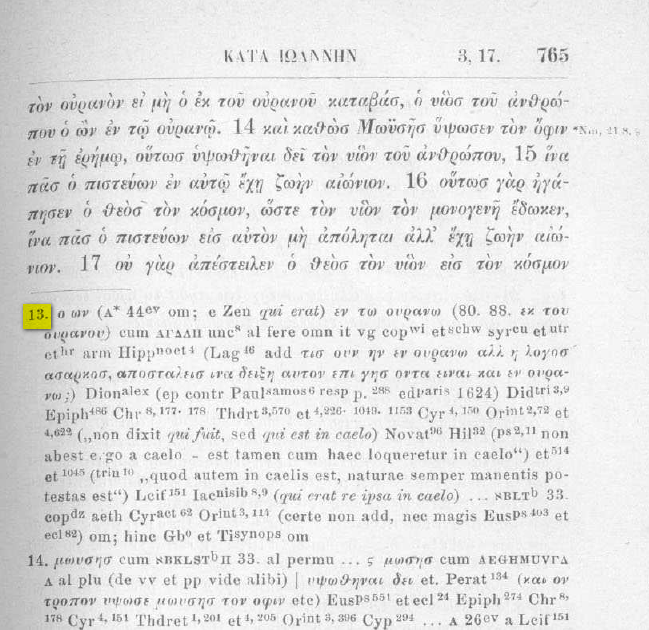
- Tischendorf (TIS): John 3:13 — οὐρανοῦ καταβάς, ὁ υἱὸς τοῦ ἀνθρώπου ὁ ὢν ἐν τῷ οὐρανῷ.
- Tregelles (TRG1): John 3:13 — καὶ οὐδεὶς ἀναβέβηκεν εἰς τὸν οὐρανόν, εἰ μὴ ὁ ἐκ τοῦ οὐρανοῦ καταβάς, ὁ υἱὸς τοῦ ἀνθρώπου ὁ ὢν ἐν τῷ οὐρανῷ·
Full Witness Lists — CNTTS, UBS, NA28, Wilson, Tischendorf
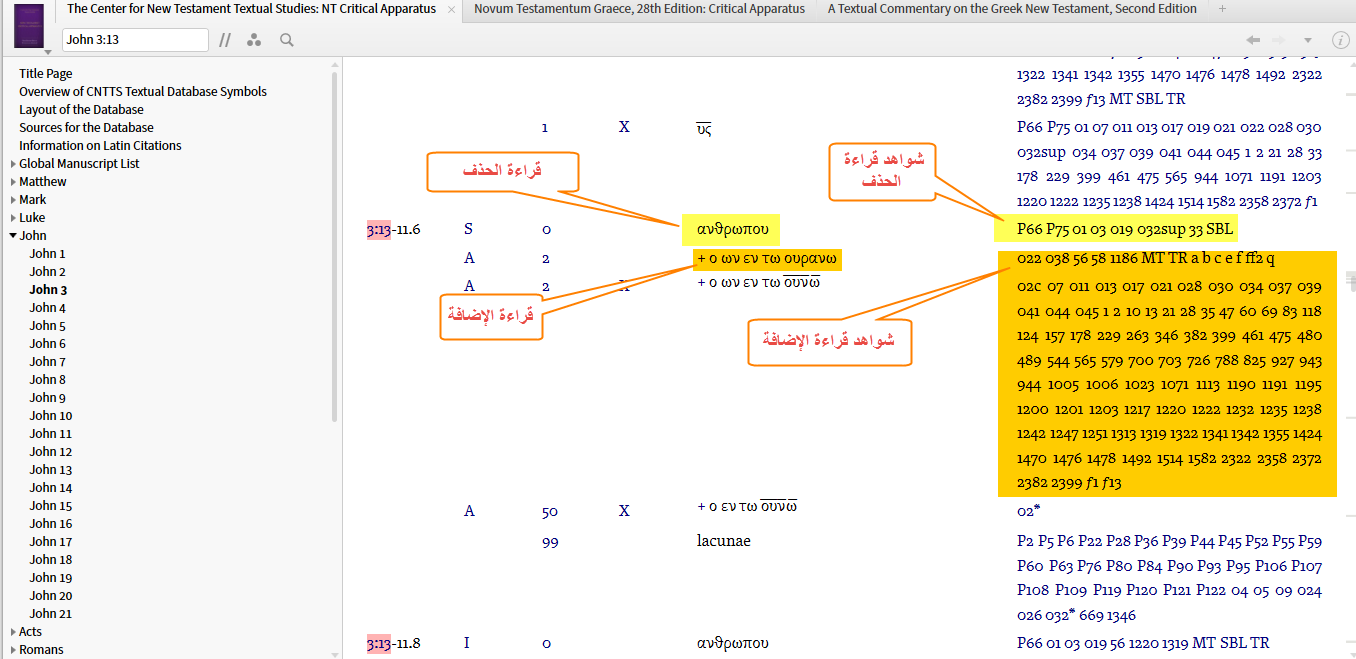
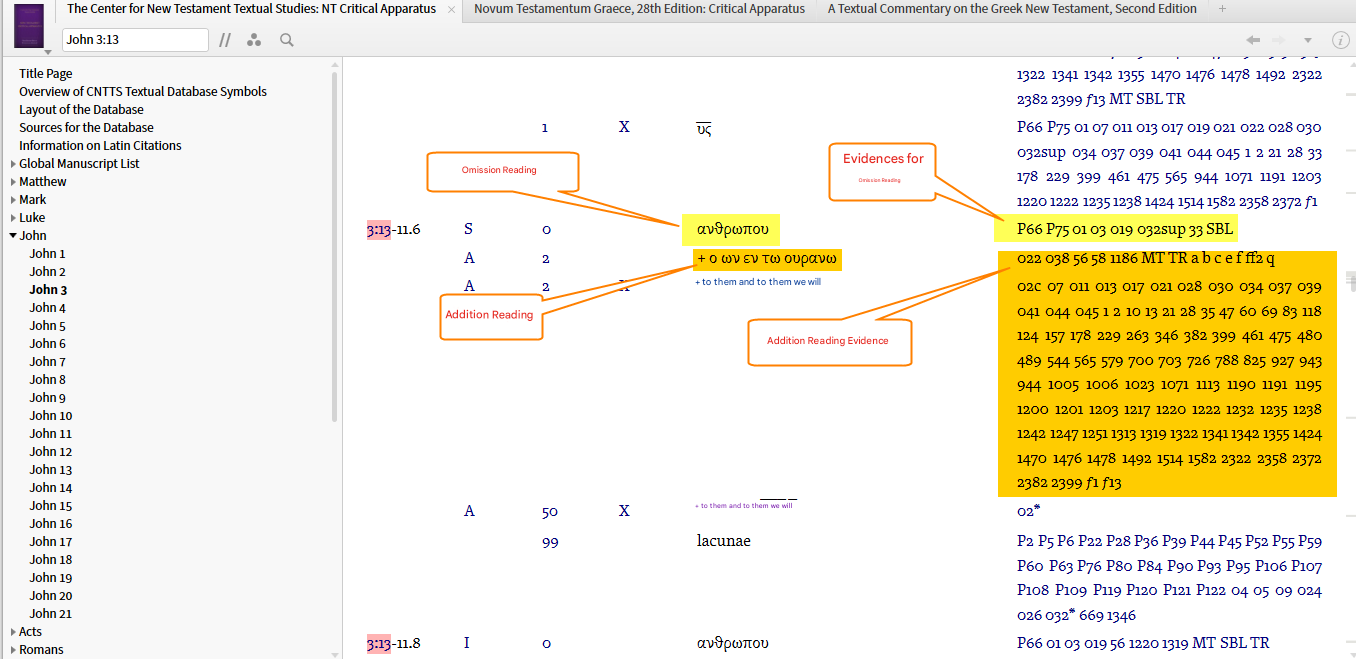
CNTTS Critical Apparatus
H. Milton Haggard Center for New Testament Textual Studies. (2010). The Center for New Testament Textual Studies: NT Critical Apparatus (Jn 3:13). New Orleans Baptist Theological Seminary.
Manuscripts that delete the phrase “who is in heaven”: P66, P75, 01, 03, 019, 032, 33, SBL
Manuscripts that write the phrase: 02, 07, 011, 013, 017, 021, 028, 030, 034, 037, 039, 041, 044, 045, 1, 2, 10, 13, 21, 28, 35, 47, 60, 69, 83, 118, 124, 157, 178, 229, 263, 346, 382, 399, 461, 475, 480, 489, 544, 565, 579, 700, 703, 726, 788, 825, 927, 943, 944, 1005, 1006, 1023, 1071, 1113, 1190, 1191, 1195, 1200, 1201, 1203, 1217, 1220, 1222, 1232, 1235, 1238, 1242, 1247, 1251, 1313, 1319, 1322, 1341, 1342, 1355, 1424, 1470, 1476, 1478, 1492, 1514, 1582, 2322, 2358, 2372, 2382, 2399, f1, f13
UBS Critical Edition — Grade B for Deletion
This critical committee chose the deletion reading with a grade of B — meaning they are highly certain of the correctness of their choice. They mentioned three forms of the text in the manuscripts.
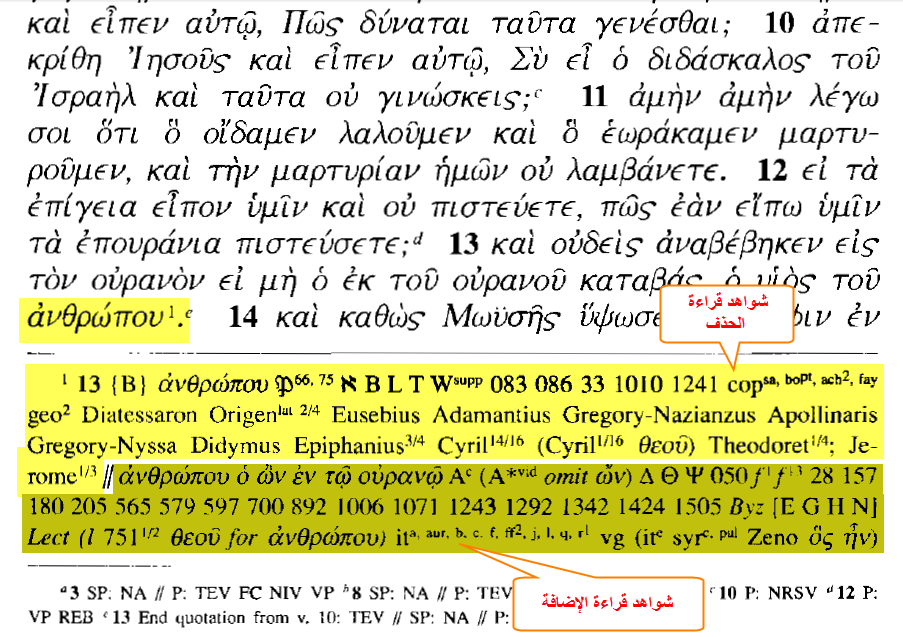
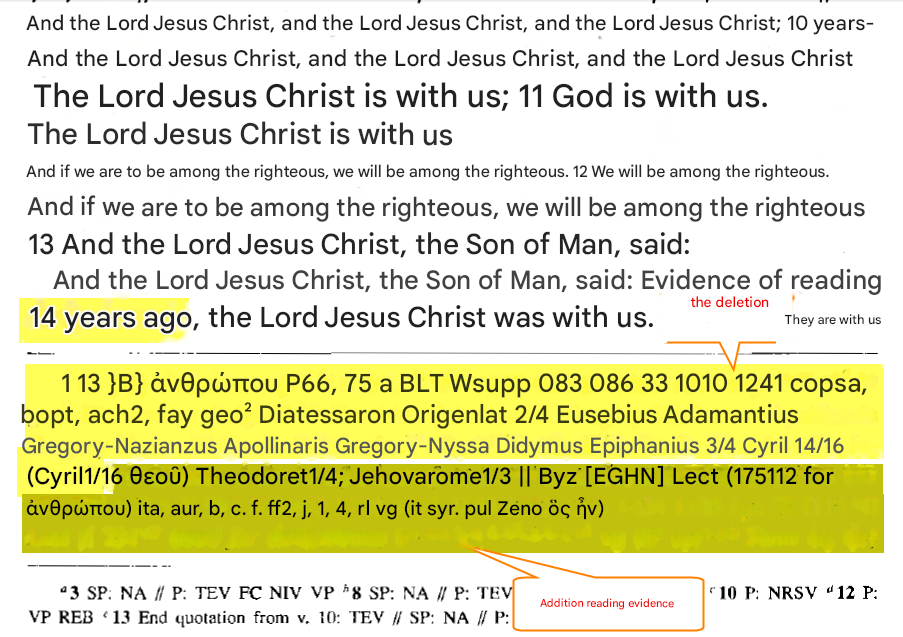
Reading 1 — Deletion witnesses:
Greek evidence:
- Papyrus 66 — second century
- Papyrus 75 — third century
- Sinaiticus Codex — 4th century
- Vatican manuscript — 4th century
- Manuscript T = 029 = Borgianus — 5th century
- Regius Manuscript L — 8th century
- Washington Manuscript — 5th century (“deleted by a later copyist”)
- Other manuscripts of later date
Coptic evidence:
- Upper Egyptian Coptic: Or7594 Q4 · Inv3992 Q3-4 · Crosby-Schoyen Q3-4
- Bohairic Coptic
- Akhmimic Coptic
- Fayumi Coptic
Georgian manuscripts, Tatian’s Diatessaron.
Patristic witnesses for deletion: Origen · Eusebius · Adamantius · Gregory of Nazianzus · Gregory the Text · Apollinarius · Didymus the Blind · Epiphanius · Cyril (14 of 16 citations) · Jerome.
Reading 2 — Addition witnesses:
Greek evidence:
- Alexandrian Codex — later addition by a late copyist
- Manuscript N Petropolitanus — 6th century
- Capital manuscripts from the 9th century
- Small manuscripts from after the 9th century
Latin evidence:
- Vercellenses a — 4th century
- Veronenses b — 5th century
- Corbinses ff2 — 5th century
- Brixianus f — 6th century
- Sarzanens j — 6th century
- Aureus aur — 7th century
- Monacensis q — 7th century
- Ridigeranus l — 8th century
Syriac evidence:
- Palestinian Syriac — 6th century
- Peshitta Syriac — 5th century
Reading 3 — “Who was in heaven”:
- Syriac Curitonianus — 5th century
- Latin Platinus — 5th century
Reading 4 — “Who is from heaven”:
- Sinaitic Syriac — 4th century
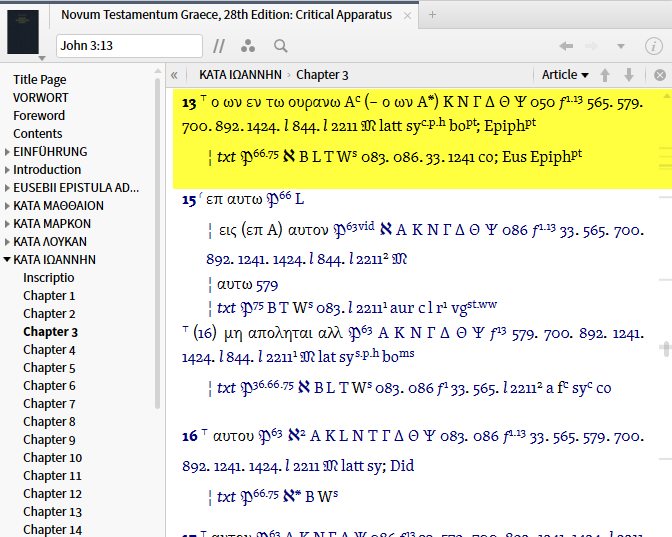
Nestle-Aland NA28
Richard Wilson’s Critical Apparatus
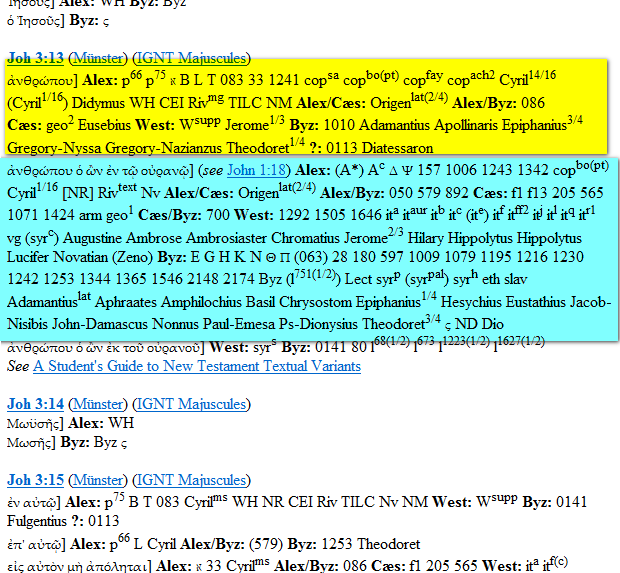
Wilson’s apparatus reads in full:
ἀνθρώπου] Alex: 𝔓66 𝔓75 א B L T 083 33 1241 copsa copbo(pt) copfay copach2 Cyril 14/16 (Cyril 1/16 Didymus) WH CEI Rivmg TILC NM · Alex/Cæs: Origen lat (2/4) · Alex/Byz: 086 · Cæs: geo2 Eusebius · West: W supp Jerome 1/3 · Byz: 1010 Adamantius Apollinaris Epiphanius 3/4 Gregory-Nyssa Gregory-Nazianzus Theodoret 1/4 ?: 0113 Diatessaron
ἀνθρώπου ὁ ὢν ἐν τῷ οὐρανῷ (see also John 1:18)] Alex: (A*) Ac Δ Ψ 157 1006 1243 1342 copbo(pt) Cyril 1/16 [NR] Rivtext Nv · 1071 1424 arm geo1 · Cæs/Byz: 700 · West: 1292 1505 1646 ita itaur itb itc (ite) itf itff2 itj itl itq itr1 vg (syrc) Augustine Ambrose Ambrosiaster Chromatius Jerome 2/3 Hilary Hippolytus Lucifer Novatian (Zeno) · Byz: E G H K… syrh eth slav Adamantius lat Aphraates Amphilochius Basil Chrysostom Epiphanius 1/4 Hesychius Eustathius Jacob-Nisibis John-Damascus Nonnus Paul-Emesa Ps-Dionysius Theodoret 3/4 ς ND Dio
ἀνθρώπου ὁ ὢν ἐκ τοῦ οὐρανοῦ] West: syrs · Byz: 0141 80 l68(1/2) l673 l1223(1/2) l1627(1/2)
Manuscripts of the deletion reading summarized by text family:
- The Alexandrian text: 2nd century Papyrus 66, 3rd century Papyrus 75, late 3rd century Sahidic Coptic, 4th century Sinaiticus and Vaticanus, 5th century Borgianus T, Bohairic Coptic, late 5th century 083, Fayumi Coptic, Akhmimic Coptic, Cyril, Didymus.
- The Alexandrian Caesarean text: Origen (twice).
- Byzantine Alexandrian: Manuscript 086 — 6th century.
- Caesarean text: Eusebius of Caesarea, Georgian manuscripts.
- Western text: Jerome, Washington manuscript (“later addition”).
- Byzantine text: Manuscript 1010, Diatessaron used by Apollinarius, Adamantius, Epiphanius (three times), Gregory of Nazianzus, Gregory of Nyssa, Theodoret.
Manuscripts of the addition reading summarized by text family:
- The Alexandrian text: Capital manuscripts from after the 9th century · Small manuscripts from after the 9th century · Some Bohairic Coptic manuscripts · Cyril of Alexandria (once).
- The Alexandrian Caesarean text: Origen (twice, in the addition reading).
- Alexandrian Caesarean: Manuscripts after the 9th century.
- The Caesarean text: Small manuscripts from after the 9th century.
- Byzantine Caesarean: Manuscript 700 from the 11th century.
- The Western text: Vercelliensis a (4th c.), Veronensis b (5th c.), Corbinus ff2 (5th c.), Brixianus f (6th c.), Sarzanensis j (6th c.), Aureus aur (7th c.), Monacensis q (7th c.), Ridigeranus l (8th c.).
- Byzantine text: Capital manuscripts after the 8th century · Small manuscripts after the 9th century · Peshitta Syriac (5th c.), Palestinian Syriac (6th c.), Heraclian Syriac (7th c.) · Byzantine Fathers.
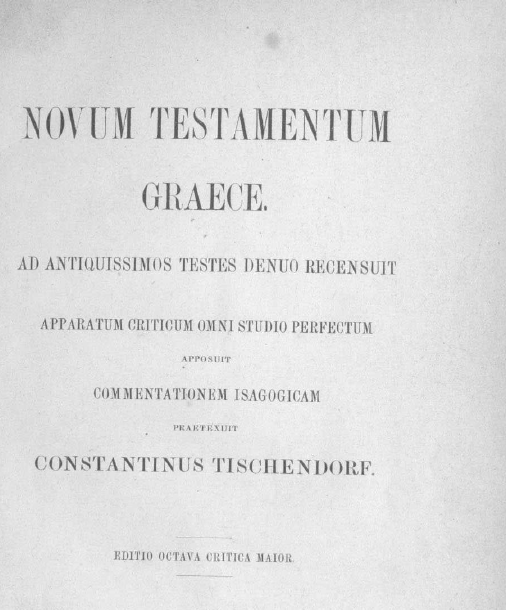
Tischendorf’s Critical Apparatus
What the Scholars Said
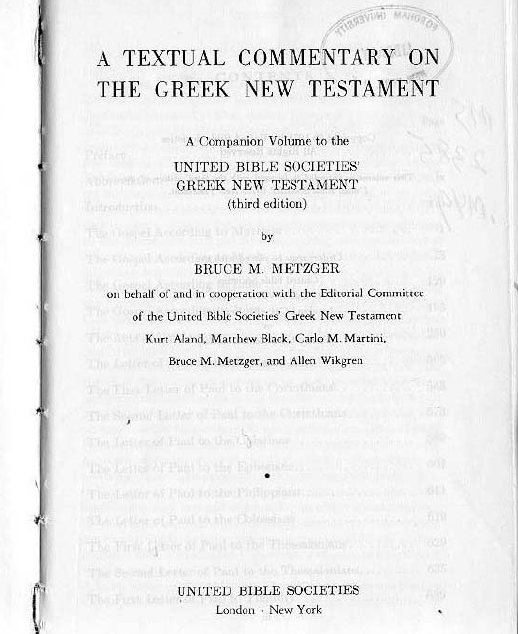
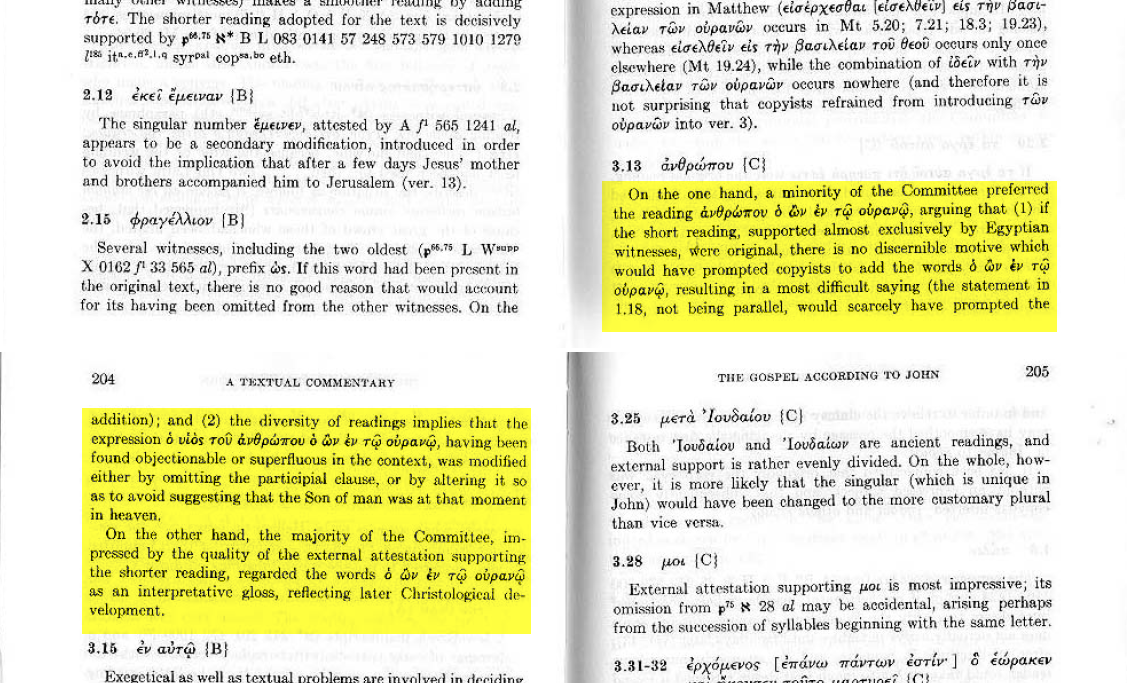
1. Bruce Metzger
Metzger, B.M., United Bible Societies. (1994). A Textual Commentary on the Greek New Testament, second edition (pp. 174–175). London; New York: United Bible Societies.
2. Wieland Willker
A Textual Commentary on the Greek Gospels, Vol. 4: John, by Wieland Willker. Bremen, online published, 10th edition 2013.
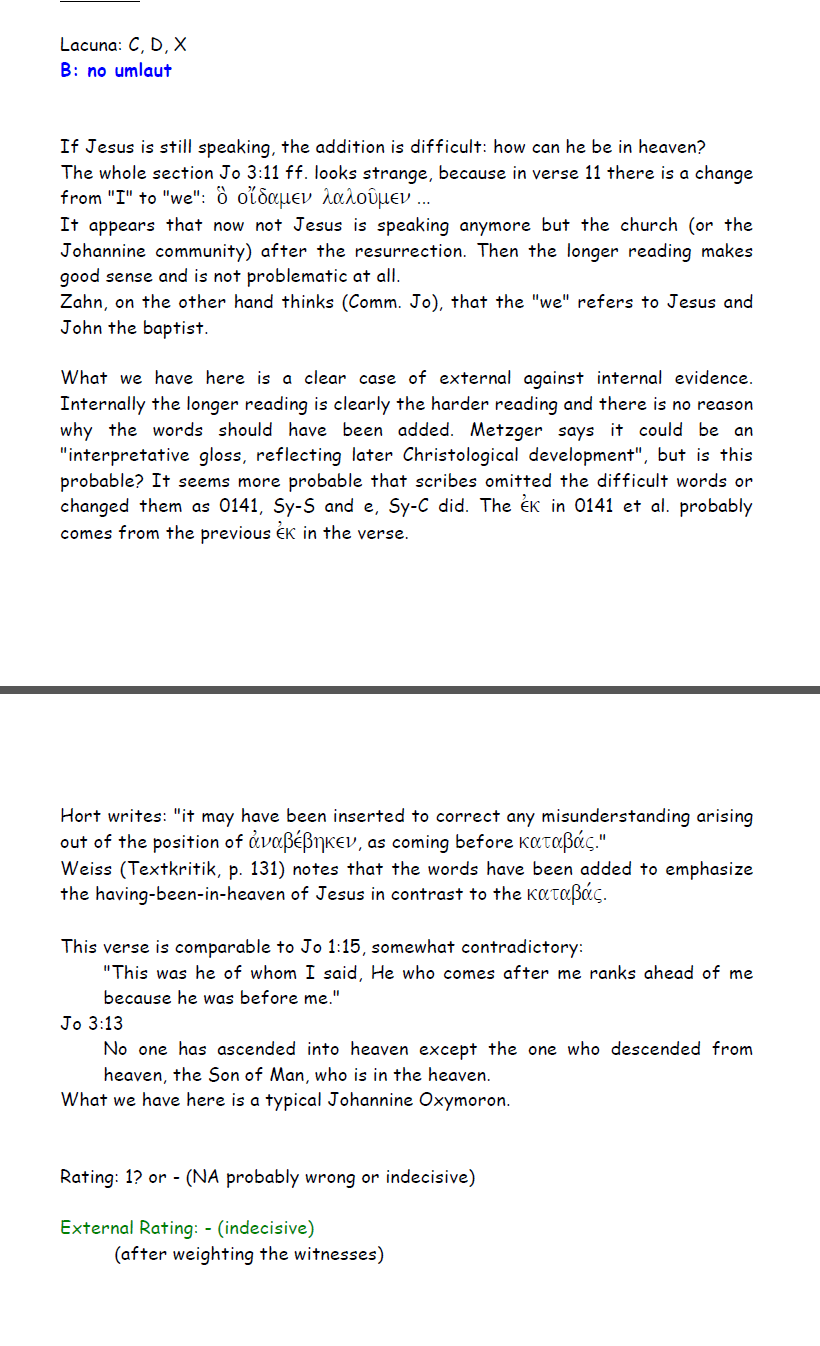
What we have here is a clear case of external against internal evidence. Internally the longer reading is clearly the harder reading and there is no reason why the words should have been added. Metzger says it could be an ‘interpretative gloss, reflecting later Christological development,’ but is this probable? It seems more probable that scribes omitted the difficult words or changed them as 0141, Sy-S and e, Sy-C did. The ἐκ in 0141 et al. probably comes from the previous ἐκ in the verse.
Hort writes: ‘it may have been inserted to correct any misunderstanding arising out of the position of ἀναβέβηκεν, as coming before καταβάς.’
Weiss (Textkritik, p. 131) notes that the words have been added to emphasize the having-been-in-heaven of Jesus in contrast to the καταβάς.”
3. Philip Comfort
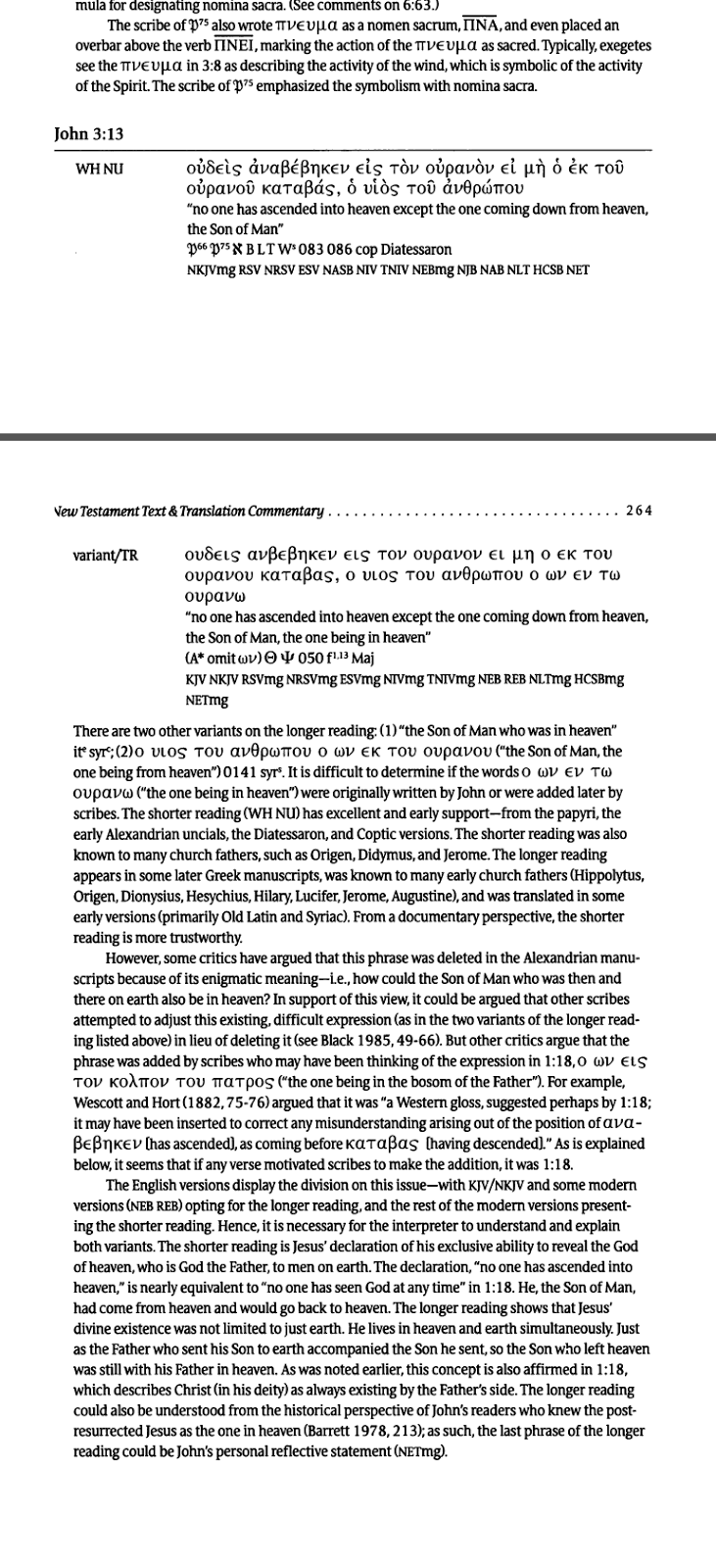
However, some critics have argued that this phrase was deleted in the Alexandrian manuscripts because of its enigmatic meaning — i.e., how could the Son of Man who was then and there on earth also be in heaven? In support of this view, it could be argued that other scribes attempted to adjust this existing, difficult expression (as in the two variants of the longer reading listed above) in lieu of deleting it (see Black 1985, 49-66). But other critics argue that the phrase was added by scribes who may have been thinking of the expression in 1:18, ὁ ὢν εἰς τὸν κόλπον τοῦ Πατρός (‘the one being in the bosom of the Father’). For example, Westcott and Hort (1882, 75-76) argued that it was ‘a Western gloss, suggested perhaps by 1:18; it may have been inserted to correct any misunderstanding arising out of the position of ἀναβέβηκεν [has ascended], as coming before καταβάς [having descended].’
The English Versions display the division on this issue — with KJV/NKJV and some modern versions (NEB REB) opting for the longer reading, and the rest of the modern versions presenting the shorter reading. Hence, it is necessary for the interpreter to understand and explain both variants. The reading is Jesus’ declaration of his exclusive ability to reveal the God of heaven, who is God the Father, to men on earth (cf. 1:18). He, the Son of Man, had come from heaven and would go back to heaven. The longer reading shows that Jesus’ divine existence was not limited to just earth. He lives in heaven and earth simultaneously… As was noted earlier, this concept is also affirmed in 1:18, which describes Christ (in his deity) as always existing by the Father’s side. The longer reading could also be understood from the historical perspective of John’s readers who knew the post-resurrected Jesus as the one in heaven (Barrett 1978, 213); as such, the last phrase of the longer reading could be John’s personal reflective statement (NETmg).“
4. Vincent’s Word Studies
5. NET Bible Critical Commentary
6. David Alan Black — Defender of the Addition Who Testifies to Its Problems
Black is a defender of the authenticity of the addition, but he testifies to the following in his own article (Grace Theological Journal 6.1, 1985, pp. 49-66):
- Important Greek manuscripts omit the passage.
- The text in the early church circulated in two basic, quite distinct forms — one which included the words and another which lacked them.
His own words:
“The present article examines the text of John 3:13 in which the final clause, ‘who is in heaven,’ is lacking in important Greek witnesses to the text of John.”
“The text of John 3:13 circulated in the early church in two basic, yet quite distinct forms, one which included the words, and another which lacked them.”
“Variant reading (2) is also supported by a relatively small number of witnesses. This minority, however, comprises those manuscripts considered to be of the highest quality (as noted by Westcott). The Bodmer papyri 𝔓66, 𝔓75 attest the shorter reading, as do the fourth century uncials Sinaiticus (א) and Vaticanus (B) which are the earliest and best uncial representatives in John of the Alexandrian text-type.”
Why the Deletion Reading Is Correct — Applying the Rules
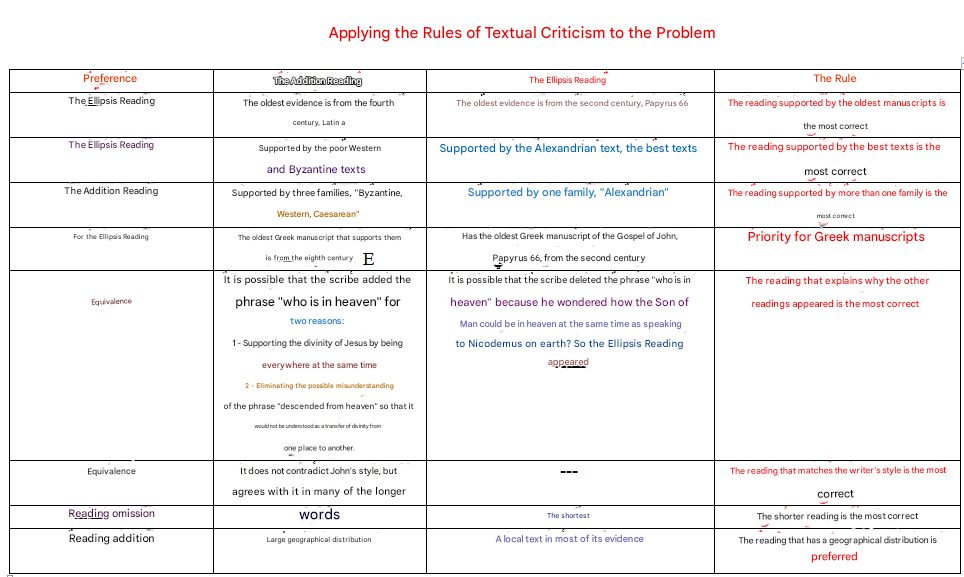
After reviewing all the evidence, we now apply the rules of textual criticism agreed upon by scholars and draw conclusions.
Three rules clearly support the deletion reading:
- Rule of the oldest manuscripts: P66 and P75 (2nd–3rd c.), Sinaiticus and Vaticanus (4th c.) all support deletion.
- Rule of the best manuscripts: The Alexandrian text is universally acknowledged as the highest-quality text type.
- Rule of the shorter reading: The deletion reading is shorter.
Additionally, the rule of Greek priority — Greek manuscripts take precedence over translations — favors deletion, since the Greek addition witnesses are from the 9th century or later, while the Greek deletion witnesses are from the 2nd century.
Two rules appear to support the addition reading:
- Family diversity
- Geographical distribution
However, these apparent advantages collapse under historical scrutiny. See the next section.
On the rule of copying possibility (scribal motivation): Most defenders of the addition argue that the rule of copying possibility favors the addition — asking: what motive would a copyist have to invent this passage, which creates the difficult question “how can the Son of Man be on earth and simultaneously in heaven?” However, the answer is clear to anyone who reads the Christian commentaries cited at the beginning of this note. The Christian commentators show plainly how a copyist steeped in the theology of Christ’s divine omnipresence would have seen this text as containing clear evidence of the divinity of Christ. The Christological motivation to add a phrase supporting simultaneous divine presence in heaven is entirely comprehensible. The difficult character of the saying for modern readers does not mean it was difficult for the scribes who added it — for them, it was a confirmation of their faith.
The Byzantine Text and the Myth of Family Diversity
The Alexandrian text is the best of all text types. There is almost a global consensus on this issue. This idea was established by the scholar Fenton Hort in the nineteenth century and confirmed by the Encyclopedia of New Testament Textual Criticism.
Hort’s theory — which the overwhelming majority of scholars accept — is based on four points:
- Not one of the Fathers of the first four centuries retained the Byzantine text in his quotations primarily, but only incidentally.
- There is not a single manuscript of the Bible with the Byzantine text until the fifth century (the Alexandrian Gospels, which is not merely Byzantine), and there is no manuscript containing the complete Byzantine text until the ninth century.
- The Byzantine text is smooth — all readings that cause problems have been removed from it, and this is a development process that takes time.
- The Byzantine text tended to reconcile readings, so that if the copyist came across two readings, he would combine them together.
From the Encyclopedia of New Testament Textual Criticism by Robert B. Waltz:
“The uselessness of the Byzantine text was not only universally accepted, but nearly unquestioned.”
Now we find that three rules support the deletion reading — oldest, best, shortest — in addition to Greek priority. Two rules appear to support the addition — most families and geographical distribution. But here is why those two apparent advantages are illusory:
The reason for the geographical spread of the addition can be explained by the time factor. Most manuscripts supporting the addition reading are from the 9th century and later. The reason for the apparent diversity of families supporting the addition reading can be explained by the influence of text types on each other. The Byzantine text drew its material from previous texts including the Western text. Then the Caesarean text was influenced by the Byzantine text due to the political and material power of Byzantium, which supported its writers, while the copying centers competing with Byzantium — the Alexandrian, Western, and Caesarean — fell into the orbit of Islam in the 7th century CE. This led to the dominance of the Byzantine text.
The sequence of events was therefore:
- First: A Western text (containing the addition) in the early Latin tradition.
- Then: A Byzantine text that absorbed material from the Western tradition.
- Then: A Caesarean text influenced by the Byzantine.
Therefore, what appears to be “family diversity” in favor of the addition reading is in fact family absorption and dissolution — not genuine independent diversity — because this spread happened late, not early, and its main agent was a text type known for absorbing all other texts beginning from the 8th century, achieving this through political and ideological influence after the collapse of competing copying centers.
Family diversity in favor of the addition reading is therefore a late, secondary, and historically explicable phenomenon — not genuine independent early attestation.
Why the Addition Reading Also Destroys Infallibility
This is the most critical argument in the entire note. The defenders of the addition reading do not recognize the seriousness of their own position. In their defense of it, they are destroying confidence in the manuscripts of the first five centuries.
Their argument: They say the deletion reading is a local (regional) reading — confined to Egypt and the Alexandrian tradition.
Our responses:
First: This is incorrect. The deletion reading has witnesses from all text families. Please review the data from David Black, Richard Wilson, and Philip Comfort shown above. The deletion reading appears in the Alexandrian (P66, P75, Sinaiticus, Vaticanus), in the Western (Washingtonianus, Jerome), in the Caesarean (Origen, Eusebius), and in Byzantine witnesses (manuscript 1010, Diatessaron witnesses). It is not a local reading.
Second: Even assuming it were local — this is the case with the addition reading through the fifth century as well. The addition reading had no universal global witnesses until after the 8th century, when the Byzantine text achieved dominance. Reading became universal after the 8th century through the process of absorption and dissolution that the Byzantine text carried out on other texts.
More dangerous than this: the argument that we should distrust local texts is tantamount to distrusting all New Testament manuscripts up to the fifth century. All the manuscripts of the Bible up to the fifth century are local texts — Alexandrian texts in Egypt, Western texts in North Africa and Italy, Caesarean texts in the Levant. There is no Byzantine text in the first four centuries, and no complete Byzantine text until the ninth century.
They are all local texts. Therefore, challenging the reliability of the local text is challenging the validity of all New Testament manuscripts up to the fifth century.
Are you prepared to say: “My Bible has no reliable manuscripts up to the fifth century CE”?
Deduce this in the following equation:
The Equation — Dropping the Local Text
Dropping the local text = dropping all manuscripts from before the fifth century = dropping the foundation of biblical infallibility
The criterion that Christians have used to defend the Bible’s integrity is dissemination — the argument that widespread copying across many independent locations prevents any distortion from becoming universal. But this criterion fails in both directions:
If the deletion reading is the distortion (the position of the minority who defend the addition): then the deletion entered the text in 2nd–4th century manuscripts — meaning the oldest, best, and most important witnesses of the entire New Testament are all corrupted. This destroys confidence in the Alexandrian text — and the Alexandrian text is the foundation of every critical edition and every modern translation. Moreover:
- The text in manuscripts up to the fourth century was the deletion reading.
- Starting from the fourth century the addition reading appeared.
- So which era’s manuscripts were forged?
- If you say the era before the fourth century: that is the most important era — 400 years of forged manuscripts.
- If you say the era after the fourth century: that is approximately 1,500 years of forged manuscripts.
In both cases, this is a significant success rate for the distorters.
If the addition reading is the distortion (the position of the majority, which is correct): then the addition entered the text from the 4th–5th century onward and spread universally after the 9th century — meaning 1,500 years of manuscripts carry a distortion. The dissemination of manuscripts was unable to prevent or correct this.
In both scenarios: dissemination did not protect the book from distortion.
How does the spread of distortion destroy the infallibility of the book?
-
It loses confidence in the local texts — and this is the case with all manuscripts up to the eighth century; they are all local texts. The occurrence of distortion in the local texts of the fourth century raises fears of the occurrence of distortion in the local texts of the first century. And the reading of the Alexandrian text — the deletion — is supported by various testimonies that deny its claim of being merely local.
-
If the spread of the book was unable to correct the distorters for 700 years — until the eighth century, when the text changed from the different local to the unified global — this means it was even more unable to protect the book in the unknown, dark early period when the spread was not strong, immediately after the composition of these books. The first century was a period in which the book was a local, endemic text. What happened to it in that period, when there were no multiple independent witnesses to check against?
We will summarize all of this in one equation:
Challenging the local text = proving the spread of the distortion = the inability of dissemination to protect the book
Five conclusions from the analysis:
- The oldest Greek manuscripts that testify to the deletion reading precede the oldest Greek manuscripts for the addition reading by 600 years.
- The spread of the addition reading is chronologically late — after the 9th century — so it is worthless as evidence of antiquity.
- The diversity of text families that support the addition reading is caused by the phenomenon of absorption, dissolution, and parasitism known about the Byzantine text.
- The best type of text — the Alexandrian — supports the deletion reading.
- Whatever the correct reading, distortion has been proven in one of the two directions: either before the fourth century (localization of distortion) or after it (expansion of distortion). This demolishes the criterion that “dissemination protected the book from distortion.”
Conclusion
The phrase used by William Eddy, the Church Encyclopedia, and Matthew Henry as the primary proof of Christ’s divine omnipresence does not appear in the oldest and best manuscripts. And even if one chose to defend the addition as original, the existence of four competing forms — deletion, addition, “who was in heaven,” and “who is from heaven” — across the manuscript tradition from the earliest centuries proves tahrif: a text that is the word of God must be free from contradiction, deletion, addition, alteration, and change. The manuscript tradition of John 3:13 demonstrably is none of these things.
سُبْحَانَ الَّذِي لَمْ يَتَّخِذْ وَلَدًا وَلَمْ يَكُن لَّهُ شَرِيكٌ فِي الْمُلْكِ وَلَمْ يَكُن لَّهُ وَلِيٌّ مِّنَ الذُّلِّ وَكَبِّرْهُ تَكْبِيرًا
وَآخِرُ دَعْوَانَا أَنِ الْحَمْدُ لِلَّهِ رَبِّ الْعَالَمِينَ
ten by John or the Apostle]] [[Mar 716,Mark 944,Mark 946]]