

Matthew 27:35 Prophecy Fulfillment Addition — Absent from the Five Most Important Manuscripts and Rejected by All Critical Editions
The Verse Under Study
The disputed portion — marked in braces — is:
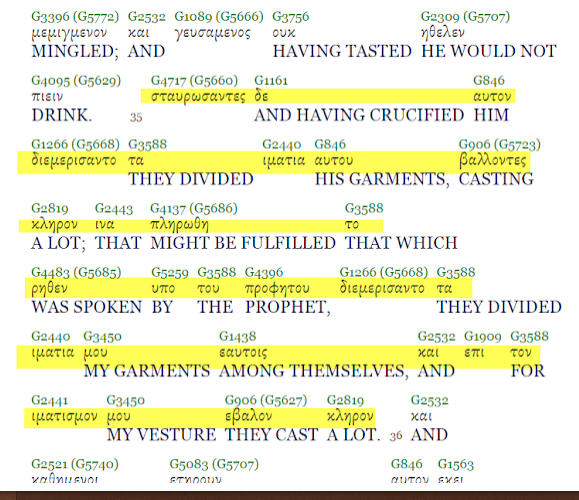
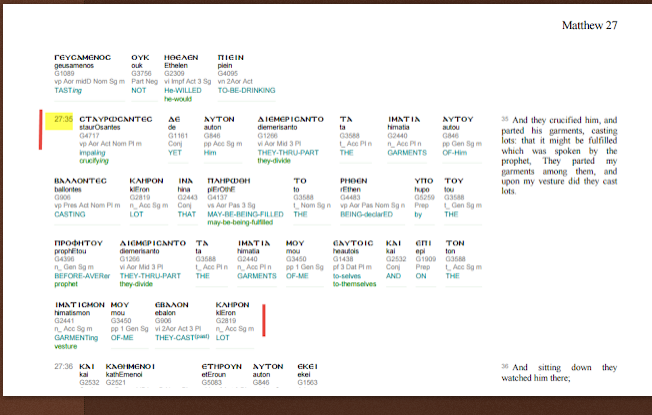
{that it might be fulfilled which was spoken by the prophet, They divided my garments among them, and for my clothing they cast lots.}
In Greek:
{ἵνα πληρωθῇ τὸ ῥηθὲν ὑπὸ τοῦ προφήτου, Διεμερίσαντο τὰ ἱμάτιά μου ἑαυτοῖς, καὶ ἐπὶ τὸν ἱματισμόν μου ἔβαλον κλῆρον}
This clause — attributing the dividing of garments to the fulfillment of Psalm 22:18 — is absent from the oldest and best manuscripts of the New Testament across all languages: Greek, Latin, Coptic, and Syriac.
The Problem Defined
The unknown author of the Gospel called “The Gospel of Matthew” describes the Roman soldiers dividing Christ’s garments by casting lots at the crucifixion. This is standard synoptic material. The problem is the additional clause claiming this fulfills a prophecy from Psalm 22:18.
It is the characteristic habit of the author of Matthew to link events in the life of Christ to Old Testament prophecies. A parallel passage exists in John 19:24:
The addition in Matthew 27:35 was taken directly from John 19:24 — copied by scribes who wished either to attach an Old Testament prophecy to Jesus following Matthew’s usual style, or to harmonize the two Gospel accounts. The textual evidence for this conclusion is overwhelming.
Three Reasons the Deletion Reading Is Correct
Reason 1 — External Evidence
The five most important Greek manuscripts of the New Testament all support the deletion reading:
- Codex Sinaiticus — 4th century
- Codex Vaticanus — 4th century
- Codex Washingtonianus — late 4th / early 5th century
- Codex Bezae — 5th century
- Codex Alexandrinus — 5th century
The oldest Greek manuscripts that contain the long reading are the Theta and Delta manuscripts from the ninth century — five full centuries later than the deletion witnesses.
Beyond the Greek, the deletion reading is supported by early Latin, Syriac, Ethiopic, and Slavonic witnesses. The agreement of five of the most important manuscripts ever produced, across multiple text families and multiple ancient languages, constitutes overwhelming external evidence.
Reason 2 — Internal Evidence
If the original reading was the long reading (containing the prophecy clause), what motive would have led copyists across multiple text families and multiple languages to delete it simultaneously? There is no plausible motive for deletion.
By contrast, if the original reading was the short reading, there are two clear motives that would have pushed copyists to add the prophecy clause:
- The desire of scribes to attach Old Testament prophecies to Jesus, following Matthew’s characteristic style.
- The desire to harmonize the text with the parallel passage in John 19:24, which contains the identical prophecy citation. Scholars call this the possibility of copying — one of the most important rules of textual criticism.
Reason 3 — Critical Edition Consensus
All critical editions of the Greek New Testament have chosen the short reading without exception — NA27, UBS, Tischendorf, Tregelles, Von Soden, and Westcott-Hort. This consensus is based on the manuscript evidence above and on the application of standard critical rules.
The Accidental Error Hypothesis — And Why It Fails
A third explanation has been proposed by some: that the passage was accidentally omitted due to a visual copying error called homoeoteleutonHomoeoteleuton (Greek: similar ending) — a scribal error in which a copyist’s eye skips from one word or phrase to another identical word or phrase further along in the text, accidentally omitting everything between them.. The argument is that the copyist’s eye fell on the second occurrence of the word “lots” (κλῆρον) instead of the first, skipping over everything between them:
“And when they crucified him, they divided his garments, casting lots for them, that it might be fulfilled which was spoken by the prophet, They divided my garments among them, and for my clothing they cast lots.”
This hypothesis can be refuted on two grounds:
First: The large number of manuscripts that testify to the deletion reading, their diversity across text families, and their quality across multiple ancient languages — Greek, Latin, Coptic, Syriac, Georgian, and Ethiopic manuscripts — negates the possibility of an accidental error affecting all of them independently.
Second: The copying possibility (harmonization with John 19:24) provides a simpler and more complete explanation for why the addition appeared.
But suppose for the sake of argument that this was a spontaneous visual error. How did this identical error reach such a large, important, and geographically diverse number of manuscripts in the original language and various languages of the ancient world, all the way up to the fifth century?
The Five Most Important Manuscripts — The Addition Is Absent
The interlinear Greek text of Matthew 27:35 shows the original short form:
The text in uppercase (uncial script) as written in the early Greek manuscripts:
1. Codex Sinaiticus (4th century) — The passage is missing
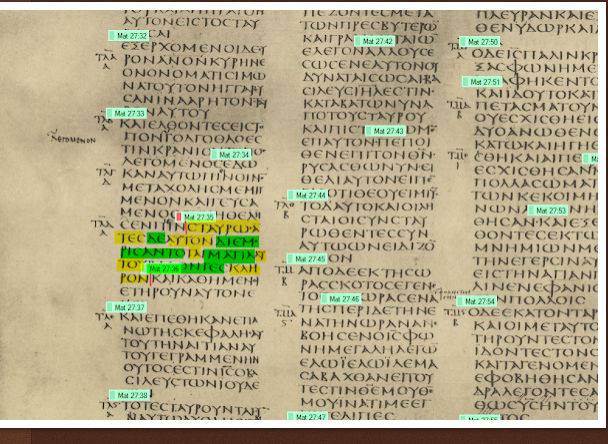
2. Codex Vaticanus (4th century) — The passage is missing
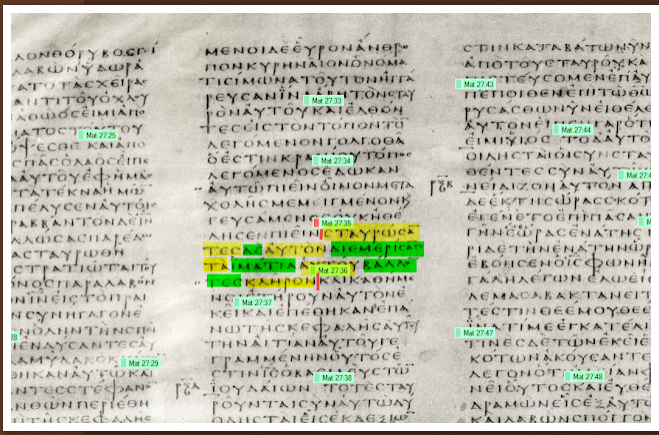
3. Codex Alexandrinus (5th century) — The passage is missing
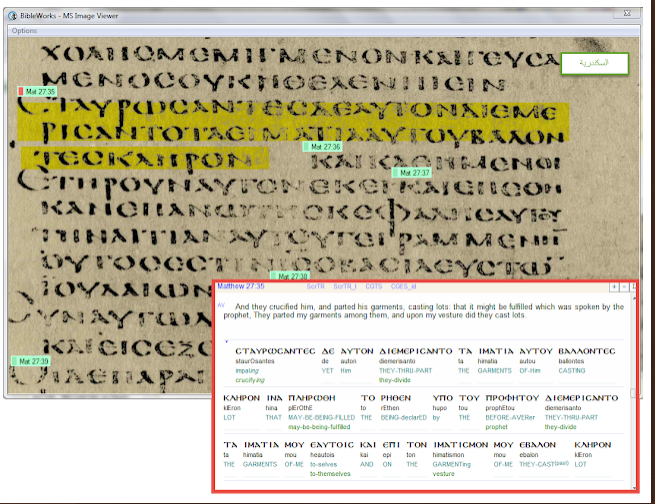
4. Codex Bezae (5th century) — The passage is missing
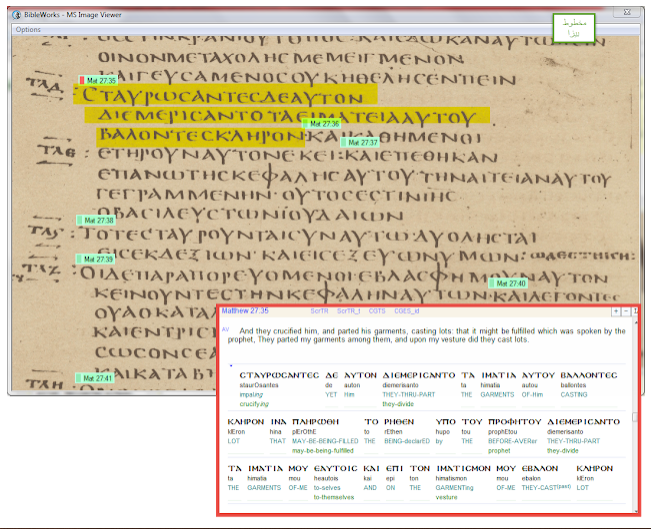
5. Codex Washingtonianus (late 4th / early 5th century) — The passage is missing
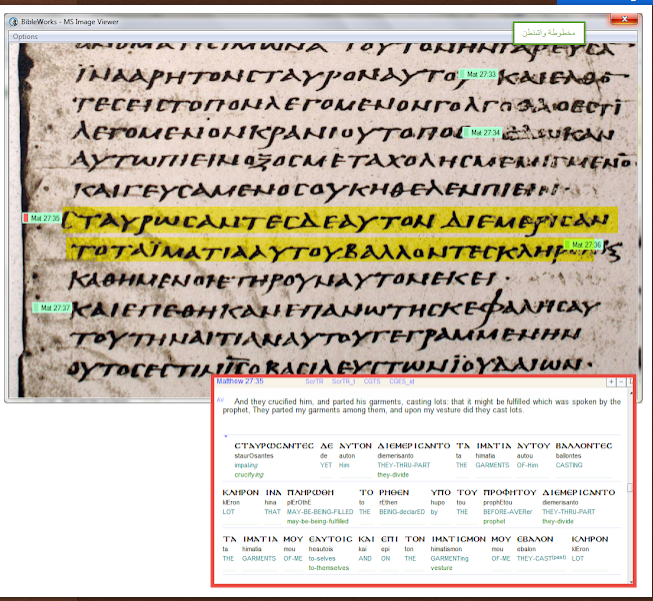
Arabic and English Versions Compared
Arabic Versions
Among the Arabic translations, one translation — the Van Dyke (the translation widespread among Arab Christians) — contains the long reading with the prophecy clause. Nine Arabic translations give the text in its short form:
Van Dyke (long reading — traditional text):
“And when they had crucified him, they divided his garments among themselves, and for my clothing they cast lots: that it might be fulfilled which was spoken by the prophet, They divided my garments among them, and for my clothing they cast lots.”
Common Arabic (short reading):
“And they crucified him, and cast lots for his garments, and divided them.”
Simplified Arabic (short reading):
“And when they had crucified Jesus, they divided his garments among them, and cast lots among them.”
Jesuit (Catholic) Arabic (short reading):
“And they crucified him, and divided his garments among them, and cast lots for them.”
Al-Hayat (Life) (short reading):
“And they crucified him, and divided his garments among them, and cast lots for them.”
Sarah Translation (short reading):
“And they crucified him, and cast lots for his garments, and divided them.”
English Versions
Versions containing the long reading (addition present): DRA, ETH, GNV, KJG, KJV, NKJ, PNT, RWB, TNT, WEB, YLT
Versions with the short reading (addition absent): ASV, CEB, CJB, CSB, CSBO, DBY, BBE, ERV, ESV, GWN, LEW, MGI, MIT, MRD, NAB, NABO, NAS, NAU, NET, NIB, NIRV, NIV, NJB, NLT, NRS, RSV, TNIV
The pattern is consistent with the Luke 1:28 findings: older translations based on the Textus Receptus contain the addition; modern translations based on the critical text omit it.
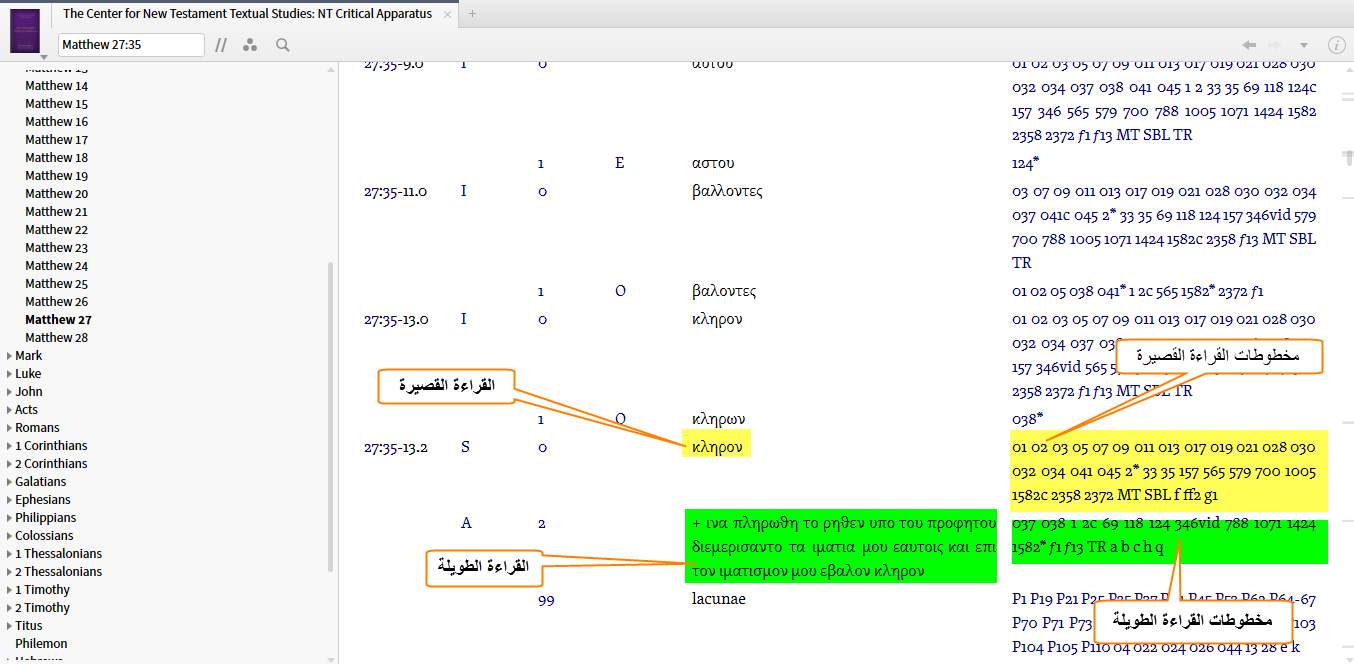
Greek Critical Editions
All critical editions of the Greek New Testament choose the short reading:
- Nestle-Aland NA27: κλῆρον,
- UBS GNT: ἱμάτια αὐτοῦ βάλλοντες κλῆρον,
- Tischendorf (TIS): δὲ αὐτὸν διεμερίσαντο τὰ ἱμάτια αὐτοῦ βαλόντες κλῆρον,
- Tregelles (TRG2): δὲ αὐτὸν διεμερίσαντο τὰ ἱμάτια αὐτοῦ, βάλλοντες κλῆρον·
- Von Soden (VST): σταυρώσαντες δὲ… βάλλοντες κλῆρον,
- Westcott-Hort: short reading
Not one critical edition retains the addition.
Manuscript Evidence — Full Witness Lists
Witnesses to the Short Reading (Deletion)
Greek manuscripts: Sinaiticus (4th c.), Vaticanus (4th c.), Bezae Greek (5th c.), Washingtonianus (5th c.), plus 19 other later Greek manuscripts (01, 02, 03, 05, 07, 09, 011, 013, 017, 019, 021, 028, 030, 032, 034, 041, 045, 2*, 33, 35, 157, 565, 579, 700, 1005, 1582c, 2358, 2372, MT, SBL)
Latin manuscripts: Bezae Latin (5th c.), Manuscript f (5th c.), Manuscript ff2 (5th c.), Manuscript g1 (9th c.), Vulgate
Syriac manuscripts: Peshitta (5th c.)
Other versions: Ethiopic manuscripts, Slavonic manuscripts, several patristic citations
Witnesses to the Long Reading (Addition)
Greek manuscripts: Delta (9th c.), Theta (9th c.), Family 13, four other late Greek manuscripts (037, 038, 1, 2c, 69, 118, 124, 346vid, 788, 1071, 1424, 1582*, f1, f13, TR)
Latin manuscripts: Manuscript A (4th–5th c.), Manuscript B (5th–6th c.), Manuscript C (11th–12th c.), Manuscript H (5th–6th c.), Manuscript Q (6th–7th c.), Manuscript R1 (6th–7th c.)
Coptic manuscripts: One Middle Egyptian Coptic manuscript, late in time
Other versions: One Armenian, one Ethiopic, one Georgian manuscript; several patristic citations
The contrast is clear: the deletion reading has 4th and 5th century support across multiple text families. The addition reading’s earliest Greek support is from the 9th century.
What the Scholars Said
Bruce Metzger
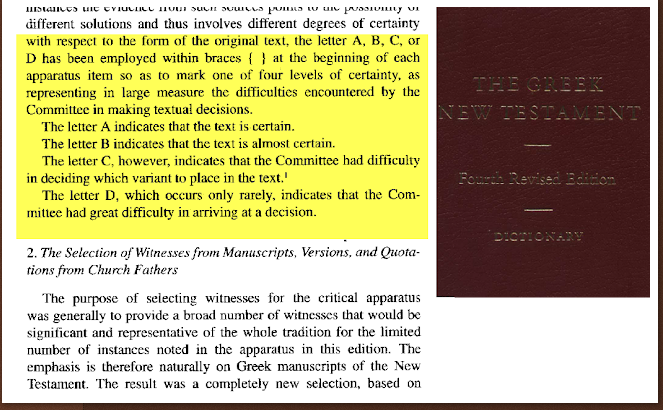
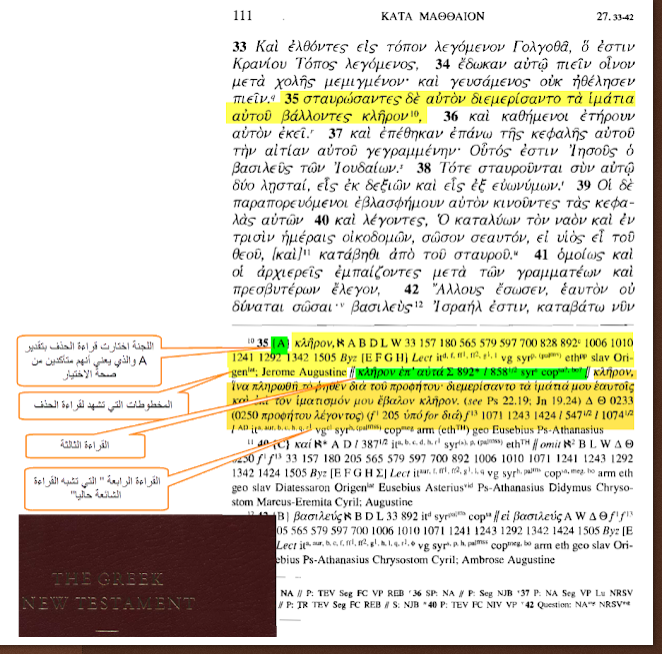
Metzger’s committee acknowledges the homoeoteleuton possibility but rejects it — impressed instead by the breadth and quality of the deletion witnesses spanning both the Alexandrian and Western text families.
Philip Comfort
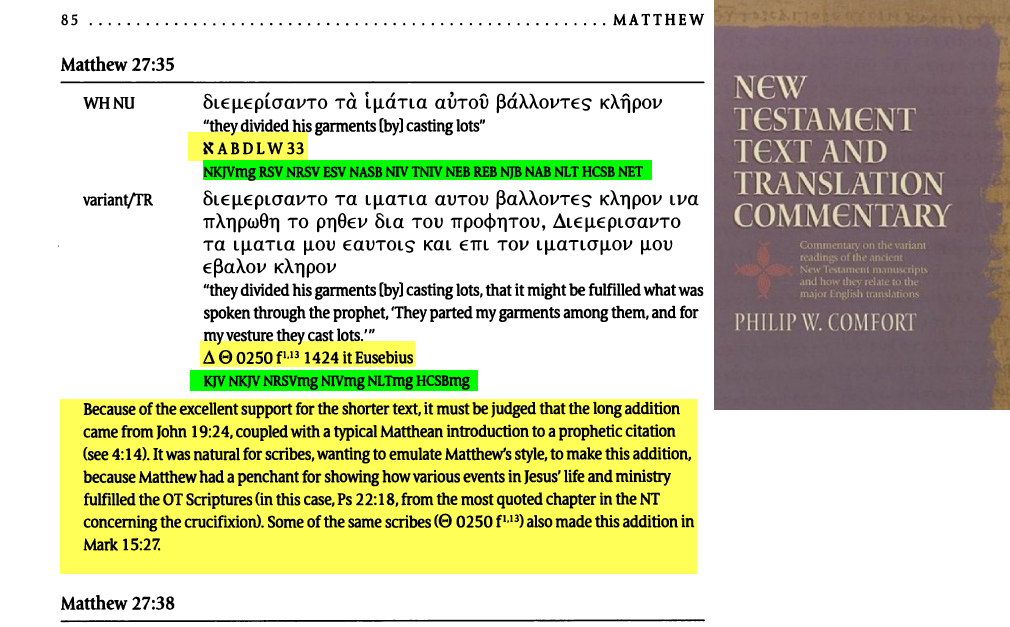
Philip Comfort makes an important additional observation: some of the same scribes who added the prophecy clause to Matthew 27:35 also added it to Mark 15:27. This pattern of scribal harmonization across multiple Gospels further confirms that the addition was deliberate and motivated by the desire to import Matthean prophetic citation style into parallel passages.
Jay P. Green
Jesuit Translation — Critical Footnote
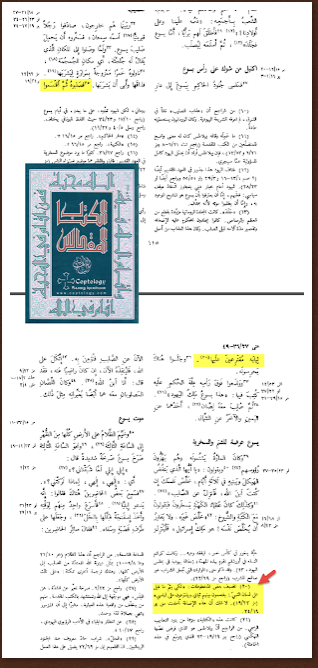
The Jesuit translation — a Catholic critical edition — states plainly and without qualification: “There is no doubt that this addition was taken from John 19:24.”
CNTTS Critical Apparatus
The H. Milton Haggard Center for New Testament Textual Studies critical apparatus lists the following witnesses:
Short reading witnesses: 01, 02, 03, 05, 07, 09, 011, 013, 017, 019, 021, 028, 030, 032, 034, 041, 045, 2*, 33, 35, 157, 565, 579, 700, 1005, 1582c, 2358, 2372, MT, SBL, f, ff2, g1
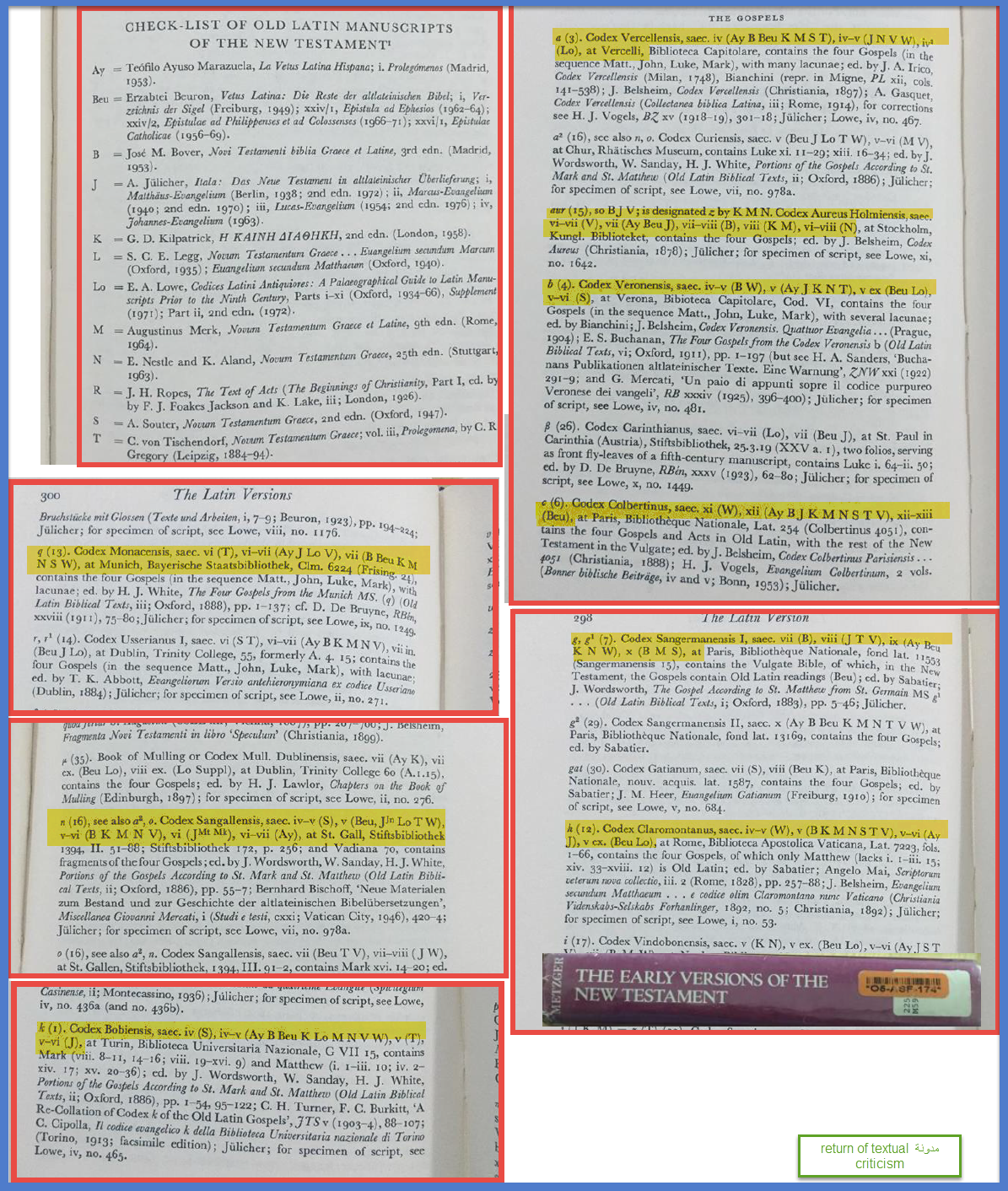
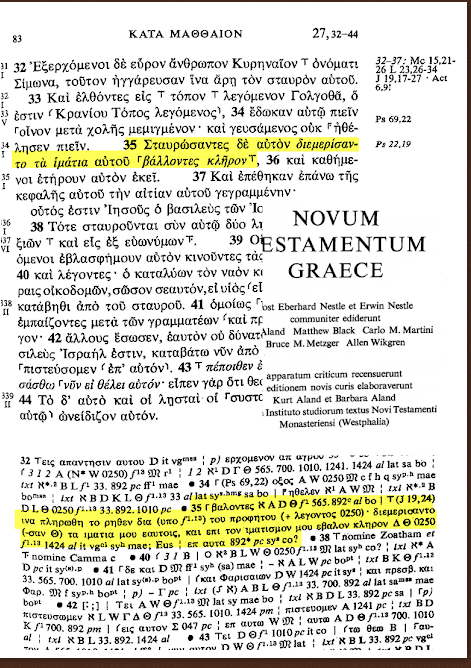
Long reading witnesses: 037, 038, 1, 2c, 69, 118, 124, 346vid, 788, 1071, 1424, 1582*, f1, f13, TR, a, b, c, h, q
Von Soden’s Critical Edition
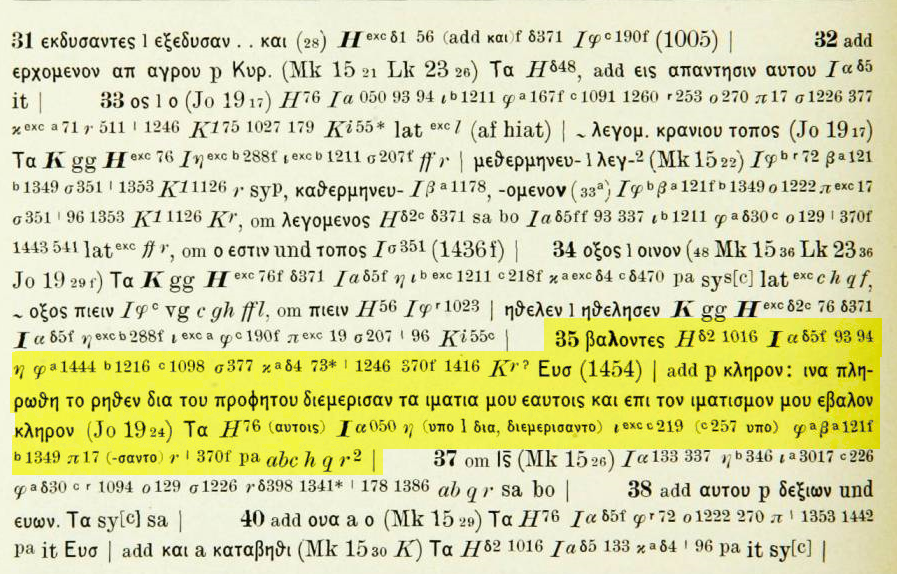
Von Soden’s critical edition likewise adopts the short reading, consistent with every other critical edition.
Conclusion
The Jesuit Catholic translation states it without qualification: “There is no doubt that this addition was taken from John 19:24.”
This is tahrifArabic: تحريف — scribal alteration of the biblical text. Here the addition was motivated by the desire to harmonize Matthew with John and to imitate Matthew’s characteristic style of linking events to Old Testament prophecy. — not by hostile outsiders but by Christian scribes, copying from one Gospel into another, motivated by piety and the desire to make the text conform to what they believed it should say.
سُبْحَانَ الَّذِي لَمْ يَتَّخِذْ وَلَدًا وَلَمْ يَكُن لَّهُ شَرِيكٌ فِي الْمُلْكِ وَلَمْ يَكُن لَّهُ وَلِيٌّ مِّنَ الذُّلِّ وَكَبِّرْهُ تَكْبِيرًا
وَآخِرُ دَعْوَانَا أَنِ الْحَمْدُ لِلَّهِ رَبِّ الْعَالَمِينَ
Distortion of the Text of John 53 4 Regarding the Moving of the Water and the Angel of Blessing]]